
1 Kings 13:33

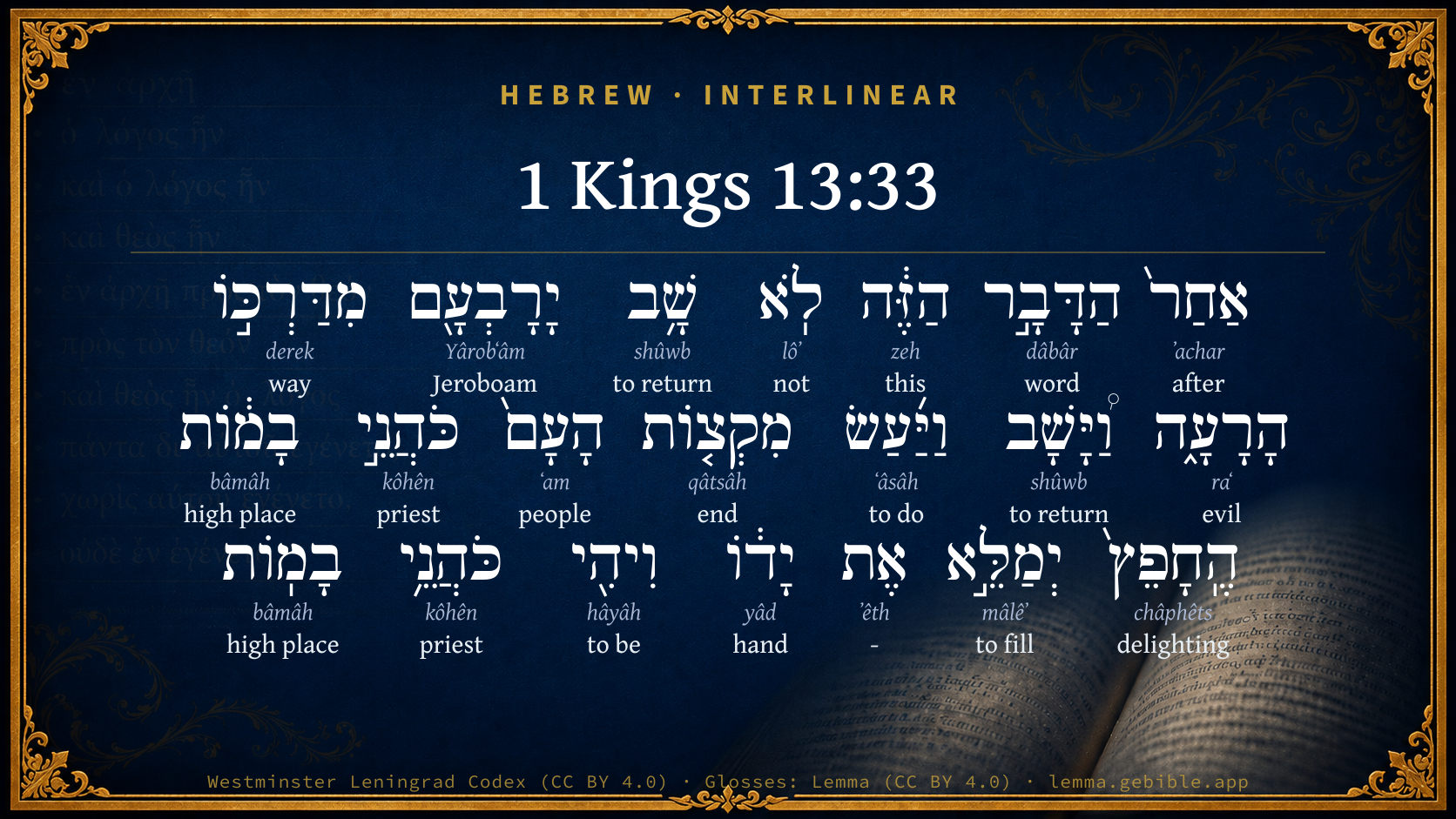
Hebrew (Westminster Leningrad Codex) 1 Kings 13:33 appears in the Hebrew Old Testament. The text above is from the Westminster Leningrad Codex. Each word links to its Strong’s number, a concise gloss, and parsing drawn from the Open Scriptures Hebrew Bible morphology. Click any word for its full Brown-Driver-Briggs (BDB) entry.
Download image
Cite this verse

1 Kings 13:33 (World English Bible). Public Domain. Lemma interlinear Bible study tool, https://lemma.gebible.app/v/1-kings/13/33.

Show BibTeX & RIS
BibTeX
RIS
English Translation
After this thing Jeroboam didn't return from his evil way, but made again from among all the people priests of the high places: whoever would, he consecrated him, that there might be priests of the high places.
World English Bible · Public Domain
Highlights
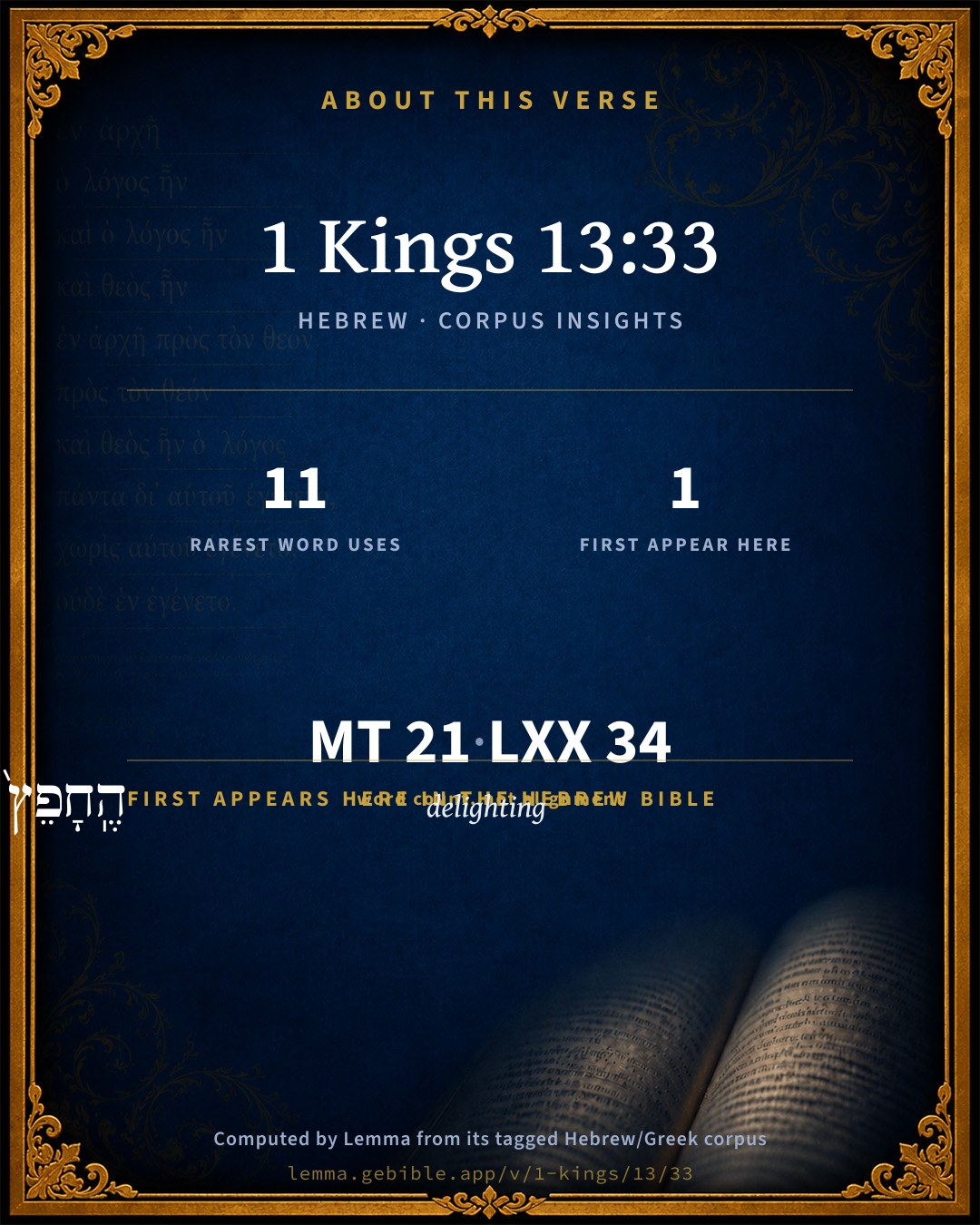
  • 1 first appearance in the Hebrew Bible
Full analysis ↓
Download a study sheet

One document with this verse’s original text, its word-by-word gloss line, the meaning frame, cross-references with their text, attributed commentary, and full source and license credits — printable, and it pastes into notes with its structure intact.

This verse Autodidact and up

Study sheet (.html) Plain text (.txt)

A passage Seminary Student

Up to 50 verses in one chapter. A passage sheet keeps up to 6 commentary sources and 12 cross-references per verse, in the order this page ranks them, and says so on the sheet whenever that leaves anything out. Ask for a single verse and you get the Autodidact verse sheet above.

Everything on this page stays free to read, with no account — the sheet is a download of what is already on screen, not access to it.

Want to remove ads? Support Godless Engineer
Compare translations 3

The same verse in 3 English versions, stacked beneath the original-language interlinear above. Click any original word for its lexicon entry.

Each is an independent rendering of the whole verse — the interlinear is not word-aligned to these translations.

Highlighted words mark where these versions differ — a whole-verse word diff, not a word-by-word alignment.

  • World English Bible Public Domain
    After this thing Jeroboam didn't return from his evil way, but made again from among all the people priests of the high places: whoever would, he consecrated him, that there might be priests of the high places.
  • King James Version Public Domain
    After this thing Jeroboam returned not from his evil way, but made again of the lowest of the people priests of the high places: whosoever would, he consecrated him, and he became one of the priests of the high places.
  • unfoldingWord Literal Text CC BY-SA 4.0
    After this matter Jeroboam did not return from his evil way, but he returned and made priests of the high places from the extremities of the people. The one desiring, he would fill his hand, and he became priests of the high places.

unfoldingWord Literal Text — © unfoldingWord, licensed CC BY-SA 4.0. Word-aligned USFM3 via Door43 (git.door43.org/unfoldingWord/en_ult).

Versions to compare (up to 4)

3 of 4 selected

Show all 18 translations

Every available English version of this verse, each an independent rendering of the whole verse.

  • World English Bible Public Domain
    After this thing Jeroboam didn't return from his evil way, but made again from among all the people priests of the high places: whoever would, he consecrated him, that there might be priests of the high places.
  • Berean Standard Bible Public Domain
    Even after these events, Jeroboam did not repent of his evil ways, but again he appointed priests for the high places from every class of people. He ordained anyone who desired to be a priest of the high places.
  • Majority Standard Bible Public Domain
    Even after these events, Jeroboam did not repent of his evil ways, but again he appointed priests for the high places from every class of people. He ordained anyone who desired to be a priest of the high places.
  • King James Version Public Domain
    After this thing Jeroboam returned not from his evil way, but made again of the lowest of the people priests of the high places: whosoever would, he consecrated him, and he became one of the priests of the high places.
  • American Standard Version (1901) Public Domain
    After this thing Jeroboam returned not from his evil way, but made again from among all the people priests of the high places: whosoever would, he consecrated him, that there might be priests of the high places.
  • Revised Version (1885) Public Domain
    After this thing Jeroboam returned not from his evil way, but made again from among all the people priests of the high places: whosoever would, he consecrated him, that there might be priests of the high places.
  • Geneva Bible (1599) Public Domain
    Howbeit after this, Ieroboam conuerted not from his wicked way, but turned againe, and made of the lowest of the people Priests of the hie places. Who would, might consecrate him selfe, and be of the Priestes of the hie places.
  • Douay-Rheims (1899) Public Domain
    After these words Jeroboam came not back from his wicked way: but on the contrary he made of the meanest of the people priests of the high places: whosoever would, he filled his hand, and he was made a priest of the high places.
  • Young's Literal Translation Public Domain
    After this thing Jeroboam hath not turned from his evil way, and turneth back, and maketh of the extremities of the people priests of high places; he who is desirous he consecrateth his hand, and he is of the priests of the high places.
  • Literal Standard Version CC BY-SA 4.0
    After this thing Jeroboam has not turned from his evil way, and turns back, and makes priests of high places from the extremities of the people; he who is desirous—he consecrates his hand, and he is of the priests of the high places.
  • Unlocked Literal Bible CC BY-SA 4.0
    After this Jeroboam did not turn from his evil way, but continued to appoint common priests for the high places from among all sorts of people. Any who would serve he consecrated as a priest.
  • unfoldingWord Literal Text CC BY-SA 4.0
    After this matter Jeroboam did not return from his evil way, but he returned and made priests of the high places from the extremities of the people. The one desiring, he would fill his hand, and he became priests of the high places.
  • Darby Bible Public Domain
    After this thing Jeroboam turned not from his evil way, but made again from all classes of the people priests of the high places: whosoever would, he consecrated him, and he became [one] of the priests of the high places.
  • World Messianic Bible Public Domain
    After this thing, Jeroboam didn’t turn from his evil way, but again made priests of the high places from among all the people. Whoever wanted to, he consecrated him, that there might be priests of the high places.
  • Webster's Bible Public Domain
    After this thing Jeroboam returned not from his evil way, but made again of the lowest of the people priests of the high places: whoever would, he consecrated him, and he became one of the priests of the high places.
  • Free Bible Version CC BY-SA 4.0
    But even after all this, Jeroboam did not change his evil ways. He went on choosing priests from all kinds of people. He appointed anyone who wanted to be a priest of the high places.
  • Bible in Basic English Public Domain
    After this Jeroboam, not turning back from his evil ways, still made priests for his altars from among all the people; he made a priest of anyone desiring it, so that there might be priests of the high places.
  • JPS Tanakh (1917) Public Domain
    After this thing Jeroboam returned not from his evil way, but made again from among all the people priests of the high places; whosoever would, he consecrated him, that he might be one of the priests of the high places.

Literal Standard Version (2020), Covenant Press — licensed CC BY-SA 4.0. Text via the HelloAO Bible API (eBible.org). Unlocked Literal Bible (unfoldingWord) — licensed CC BY-SA 4.0. Text via the HelloAO Bible API (eBible.org). unfoldingWord Literal Text — © unfoldingWord, licensed CC BY-SA 4.0. Word-aligned USFM3 via Door43 (git.door43.org/unfoldingWord/en_ult). Free Bible Version, Dr. Jonathan Gallagher — licensed CC BY-SA 4.0. Text via the HelloAO Bible API (eBible.org).

Word by word

More ways to search: Search by grammar → Find every occurrence → Compare this word →

Practice this passage: Drill this verse → Learn its vocabulary →

הֶֽחָפֵץ֙
châphêts
H2655
“the · delighting”
Particle, Definite Article + Adjective, Adjective, Masculine, Singular, Absolute
Part of Speech
Particle + Adjective
Type
Adjective
Gender
Masculine
Number
Singular
State
Absolute
Full BDB Definition

Origin: from H2654

TWOT: 712a

desiring, delighting in, having pleasure in
  1. אַחַר֙ ʼachar H310 “after” Preposition
  2. הַדָּבָ֣ר dâbâr H1697 “the · word” Particle, Definite Article + Noun, Common, Masculine, Singular, Absolute
  3. הַזֶּ֔ה zeh H2088 “the · this” Particle, Definite Article + Pronoun, Demonstrative, Masculine, Singular
  4. לֹֽא lôʼ H3808 “not” Particle, Negative
  5. שָׁ֥ב shûwb H7725 “to return” Verb, Qal, Perfect, 3rd Person, Masculine, Singular
  6. יָרָבְעָ֖ם Yârobʻâm H3379 “Jeroboam” Noun, Proper
  7. מִדַּרְכּ֣וֹ derek H1870 “from · way · his” Preposition + Noun, Common, Both, Singular, Construct + Suffix, Personal, 3rd Person, Masculine, Singular
  8. הָרָעָ֑ה raʻ H7451 “the · evil” Particle, Definite Article + Adjective, Adjective, Feminine, Singular, Absolute
  9. וַ֠יָּשָׁב shûwb H7725 “and · to return” Conjunction + Verb, Qal, Sequential Imperfect, 3rd Person, Masculine, Singular
  10. וַיַּ֜עַשׂ ʻâsâh H6213 “and · to do” Conjunction + Verb, Qal, Sequential Imperfect, 3rd Person, Masculine, Singular
  11. מִקְצ֤וֹת qâtsâh H7098 “from · ends of” Preposition + Noun, Common, Both, Plural, Construct
  12. הָעָם֙ ʻam H5971 “the · people” Particle, Definite Article + Noun, Common, Masculine, Singular, Absolute
  13. כֹּהֲנֵ֣י kôhên H3548 “priests of” Noun, Common, Masculine, Plural, Construct
  14. בָמ֔וֹת bâmâh H1116 “high places” Noun, Common, Feminine, Plural, Absolute
  15. יְמַלֵּ֣א mâlêʼ H4390 “to fill” Verb, Piel, Imperfect, 3rd Person, Masculine, Singular
  16. אֶת ʼêth H853 “-” Particle, Direct Object
  17. יָד֔וֹ yâd H3027 “hand · his” Noun, Common, Both, Singular, Construct + Suffix, Personal, 3rd Person, Masculine, Singular
  18. וִיהִ֖י hâyâh H1961 “and · to be” Conjunction + Verb, Qal, Jussive, 3rd Person, Masculine, Singular
  19. כֹּהֲנֵ֥י kôhên H3548 “priests of” Noun, Common, Masculine, Plural, Construct
  20. בָמֽוֹת bâmâh H1116 “high places” Noun, Common, Feminine, Plural, Absolute

About this verse

These counts appear in no published source. They are computed here, from the morphology-tagged text and Lemma’s own curated glosses. What Lemma adds →

21
words
18
distinct lemmas
Historical
section

Notable vocabulary

The rarest word here is הֶֽחָפֵץ֙ delighting H2655 — appearing just 11 times in the whole Hebrew Bible.

First appearance in Scripture

This word makes its first canonical appearance in the Hebrew Bible here:

  • הֶֽחָפֵץ֙ delighting H2655

Shared distinctive vocabulary

הֶֽחָפֵץ֙ delighting H2655 occurs in 10 verses of the Hebrew Bible. Also found in:

Grammatical profile

  • 5 verbs
  • 10 nouns
  • 2 adjectives
  • 1 pronoun
  • 1 preposition
  • 2 particles

Verb forms

  • שָׁ֥ב Qal · Perfect
  • וַ֠יָּשָׁב Qal · Sequential Imperfect
  • וַיַּ֜עַשׂ Qal · Sequential Imperfect
  • יְמַלֵּ֣א Piel · Imperfect
  • וִיהִ֖י Qal · Jussive

Repetition

Words recur within this verse — often emphatic in Hebrew:

  • שָׁ֥ב to return H7725 ×2
  • כֹּהֲנֵ֣י priest H3548 ×2
  • בָמ֔וֹת high place H1116 ×2

Hebrew & Septuagint length

In English translation the verse runs 37 words from the Hebrew and 38 from the Septuagint (LXX English) — closely comparable.

A rough comparison of the two English renderings, which tokenize alike — not a word-level alignment.

Word counts can differ between the Hebrew and the Greek without any difference in meaning — e.g. the Hebrew direct-object marker אֵת has no separate Greek word, and Greek often adds the article ὁ.

In the original languages it is 21 Hebrew tokens and 34 Greek tokens — but the two are counted differently (Hebrew bundles its prefixes and suffixes into one token; the Greek is in lemma form), so that isn’t a like-for-like length.

Cross-references

13

Topical passages linked to 1 Kings 13:33 in the Treasury of Scripture Knowledge — connected by theme and wording, ordered by reader-vote popularity; previews shown in the World English Bible.

  • 2 Chronicles 11:15 and he appointed him priests for the high places, and for the male goats, and for the calves which he had made.
  • 2 Chronicles 13:9 Haven't you driven out the priests of Yahweh, the sons of Aaron, and the Levites, and made you priests after the manner of the peoples of [other] lands? so that whoever comes to consecrate himself with a young bull and seven rams, the same may be a priest of [those who are] no gods.
  • Exodus 28:41 You shall put them on Aaron your brother, and on his sons with him, and shall anoint them, and consecrate them, and sanctify them, that they may minister to me in the priest's office.
  • Numbers 1:51 When the tabernacle is to move, the Levites shall take it down; and when the tabernacle is to be set up, the Levites shall set it up. The stranger who comes near shall be put to death.
  • Numbers 3:10 You shall appoint Aaron and his sons, and they shall keep their priesthood. The stranger who comes near shall be put to death."
  • Numbers 17:5 It shall happen, that the rod of the man whom I shall choose shall bud: and I will make to cease from me the murmurings of the children of Israel, which they murmur against you.
  • Numbers 17:12–13 The children of Israel spoke to Moses, saying, Behold, we perish, we are undone, we are all undone.
  • Judges 17:12 Micah consecrated the Levite, and the young man became his priest, and was in the house of Micah.
  • 1 Kings 12:31–33 He made houses of high places, and made priests from among all the people, who were not of the sons of Levi.
  • Psalms 78:34 When he killed them, then they inquired after him. They returned and sought God earnestly.
  • Jeremiah 18:4 When the vessel that he made of the clay was marred in the hand of the potter, he made it again another vessel, as seemed good to the potter to make it.
  • Amos 6:11 "For, behold, Yahweh commands, and the great house will be smashed to pieces, And the little house into bits.
  • 2 Timothy 3:13 But evil men and impostors will grow worse and worse, deceiving and being deceived.

Cross-references courtesy of OpenBible.info (CC BY 4.0).

Hebrew and Greek witnesses Masoretic Hebrew ↔ Greek Septuagint

The same verse in the two great witnesses to the Old Testament, shown verse-for-verse.

These are two independent witnesses, not word-aligned to each other, and the Septuagint is shown in lemma (dictionary) form.

Hebrew 1 Kings 13:33 Masoretic · Westminster Leningrad Codex

אַחַר֙ הַדָּבָ֣ר הַזֶּ֔ה לֹֽא שָׁ֥ב יָרָבְעָ֖ם מִדַּרְכּ֣וֹ הָרָעָ֑ה וַ֠יָּשָׁב וַיַּ֜עַשׂ מִקְצ֤וֹת הָעָם֙ כֹּהֲנֵ֣י בָמ֔וֹת הֶֽחָפֵץ֙ יְמַלֵּ֣א אֶת יָד֔וֹ וִיהִ֖י כֹּהֲנֵ֥י בָמֽוֹת

After this thing Jeroboam didn't return from his evil way, but made again from among all the people priests of the high places: whoever would, he consecrated him, that there might be priests of the high places.

World English Bible · Public Domain

Greek LXX 1 Kings 13:33 Septuagint · lemma form

καί μετά ὁ ῥῆμα οὗτος οὐ ἐπιστρέφω ιεροβοαμ ἀπό ὁ κακία αὐτός καί ἐπιστρέφω καί ποιέω ἐκ μέρος ὁ λαός ἱερεύς ὑψηλός ὁ βούλομαι πληρόω ὁ χείρ αὐτός καί γίγνομαι ἱερεύς εἰς ὁ ὑψηλός

And after this Jeroboam turned not from his sin, but he turned and made of part of the people priests of the high places: whoever would, he consecrated him, and he became a priest for the high places.

LXX2012 (modern English Septuagint) · Public Domain

On this verse, The Pulpit Commentary discusses the Septuagint’s reading. Read the note in Commentary ↓

Hebrew: Westminster Leningrad Codex (CC BY 4.0). Greek: Septuagint (public domain); English from LXX2012 (modern English Septuagint) (Public Domain). How the Septuagint differs from the Hebrew →

Targum (Aramaic paraphrase)

1

The Targum is the ancient Jewish Aramaic paraphrase of the Hebrew Scriptures — an interpretive translation, not the Hebrew text itself. Onkelos (literal) and Pseudo-Jonathan (expansive) render the Torah, and Jonathan the Prophets. Coverage is partial: where no permissively-licensed English translation exists for a verse, only the Aramaic is shown. This is verse-level text, not a word-by-word alignment to the Hebrew.

  1. Targum Jonathan Prophets (Joshua–Malachi)
    בָּתַר פִּתְגָמָא הָדֵין לָא תָב יָרָבְעָם מֵאוֹרְחֵיהּ בִּישָׁתָא וְתָב וַעֲבַד קְצַת מִן עַמָא כּוּמְרֵי בָמָתָא דְרָעֵי מַקְרִיב יַת קוּרְבָּנֵיהּ וִיהוֹן כּוּמָרִין לְבָמָתָא:

    (no public-domain English translation for this verse)

    Targum Jonathan — Aramaic: “Mikraot Gedolot” (public domain). English: “Sefaria Community Translation” (CC0 1.0 (public-domain dedication)); “London "Chaldee Paraphrase," 1871” (public domain). Text via Sefaria.

Commentary

Notes on 1 Kings 13:33 from classic Christian and Jewish commentators (each source and its license shown beneath its notes). The classic Christian expositions comment on the surrounding passage and are grouped to its opening verse, so a note may address several verses; the Jewish commentaries on the Tanakh (Rashi and others) are per-verse, so they appear only where the commentator wrote on this verse.

Lemma curates 59 commentaries, every one of them public domain or Creative Commons licensed, each selected and text-cleaned for this edition rather than reprinted as found. About our sources →

Trapp's Complete Commentary

John Trapp

1Ki 13:33 After this thing Jeroboam returned not from his evil way, but made again of the lowest of the people priests of the high places: whosoever would, he consecrated him, and he became [one] of the priests of the high places.

Ver. 33. After this thing Jeroboam returned not.] All these wonderful accidents, as God’s hammers, did but beat upon cold iron. Wicked men grow worse and worse, till they have filled up the measure of their sins, and so wrath come upon them to the utmost. See Popelings. {Rev 9:21; Rev 16:9; Rev 16:11}

Whosoever would, he consecrated him.] Heb., He filled his hand; that is, Jeroboam’s hand, as some sense it, they filled with money, to be made priests. Omnia Romae venalia. But it seemeth rather to allude to the custom of censecrating the Levitical priests, by filling their hands with sacrifices and gifts. {Exo 29:9-10} Faciunt et vespae favos; simiae imitantur homines: wasps also have their honeycombs; and apes, that scorn of nature, do imitate men.

John Trapp, A Commentary or Exposition upon All the Books of the Old and New Testament (1647–1656) — public domain. Text from a community e-Sword module.

The Biblical Illustrator

Joseph S. Exell

1Ki_13:33-34

Jeroboam turned not from his way.

Jeroboam: a character study

Jeroboam had decidedly a fine start with a flattering prospect of success, a rare opportunity for excelling both temporally and spiritually. There was the promotion of the king, and by God the conditional promise of kingship, together with His guiding, protecting, and counselling presence. Permanent regnancy for himself and his children after him. Hence, having God to begin with, and Gods unfailing promise to rest on, provided he fulfilled the conditions, what could he have better, what more? A grand Start! A splendid chance to march to the coveted goal of success on the very threshold of an untried life enterprise. But every fair morning does not end in a cloudless eventide; neither does every such beginning as Jeroboam had culminate in continuance in well-doing. The start may be the best part in a mans life. It was so with Jeroboam.

1. There was manifest distrust of God. Evidently he had forgotten Gods promise to be with him and to establish his house and kingdom.

2. This distrust of God led to departure from God. Leaning to his own understanding, he resolved to build two altars and to make two golden calves, and place one of them at Bethel, and the other at Dan, the extreme points in his kingdom.

3. Another point which strikes us in this mans history is his despising Jehovahs warning and servant. These histories of the Bible repeat themselves in the lives around us to-day. There are many men to whom God has given a good start in life. They have been blessed with an auspicious entrance into the world, with social and religious environment most favourable and helpful, God-fearing parents, a religious training, a comfortable home, good education, business tact, common-sense views of life, and men, and things, and, above all, with Heavens call to fellowship and godliness. Each has started right, with high aims and noble purposes. Public favour has greeted them, success has blossomed in their path of enterprise and effort, until, by sweat of brain and brawn of muscle, and the smile of Providence, they have taken a steady and straight course to wealth and position. But, as in the case of Jeroboam, temporal prosperity has been followed by spiritual degeneracy. A going up in the world has resulted in a going down in grace. Such persons, however, are not left without warning. Gods ministers are commanded to prophesy against them. This is done, though it provokes anger and brings disfavour. Faithfulness ofttimes forfeits popularity and position, but it ensures the Well done of God. To rebuke sin in high places, to tear the mask from the face of the hypocrite, to denounce a mans pet idol--indifference, intemperance, or impurity--is like touching gunpowder with a lucifer. You must expect an explosion if not an expulsion. Persecution in some form will hound you; but fear not, for He who has said, Touch not My anointed and do My prophets no harm, covers you with His wings, and smites your persecutors with the rod of judgment.

He wastes their strength and withers their health.

1. Learn from this study of character the influence of one life.

2. Learn, too, the danger of attempting to injure Gods true servants. Whoso toucheth you, toucheth the apple of My eye.

3. Lastly, beware of the developing power of evil. The seedlings of sin finding congenial soil grow into a harvest of woe. The rill of evil first, the river of corruption at last. Jeroboam went from bad to worse. Slighting God grew into abandonment of God. Worship through the medium of symbols became rank idolatry. No man intends to become a drunkard when he lifts the first glass to his lips, but he takes the beginning step towards it. The possibilities of sin--the resources of wrong-doing pent up in every mans nature--no mind can gauge, no tongue can tell Safety alone lies in salvation from sin, salvation through the cross--full, free, eternal (J. O. Keen, D. D.)

.

The Biblical Illustrator, edited by Joseph S. Exell (c. 1880s–1900s) — public domain. Text from a community e-Sword module.

Joseph Benson's Commentary

1Ki 13:33. After this — That is, after all these things; the singular number being put for the plural; after so many evident and successive miracles; Jeroboam returned not from his evil ways — He was not at all changed in his principles or practice, but continued in his idolatry. Made again of the lowest of the people, &c. — He abated not so much as a circumstance in his idolatrous worship. Whosoever would he consecrated him, &c. — Without any respect to tribe, or family, or integrity of body, or mind, or life; all which things were to be regarded in the priesthood.

Joseph Benson's Commentary on the Old and New Testaments (1811–1818) — public domain. Text from a community e-Sword module.

The Preacher's Complete Homiletical Commentary

Joseph S. Exell (gen. ed.)

HOMILETICS OF 1Ki_13:33-34

AN INVETERATE SINNER

I. That an inveterate sinner is indifferent alike to entreaty and warning. “After this thing Jeroboam returned not from his evil way.” There is something exceedingly obstinate and perverse, as well as blinding and infatuating, in idolatry. The gracious overtures of Jehovah through the prophet Ahijah (chap. 1Ki_11:37-38), the prediction against the altar and the miraculous and awe-inspiring events in connection with it, sent as much in mercy as in anger, were surely sufficient to have affected and alarmed any heart not wholly and incorrigibly hardened: and yet they had no effect on Jeroboam! “All these wonderful accidents, as God’s hammers, did but beat upon cold iron.” This state of mind is not acquired all at once. It is the result of repeated rejections of God’s grace, of stifled convictions, and a love of sin for its own sake. An inveterate sinner is an occasion of sorrow to ministers, to angels, to God!

II. That an inveterate sinner adds to his guilt by a stolid persistency in the same course of iniquity. “But made again of the lowest of the people priests of the high places.” Among the worst of heathens, the priesthood was filled with respectable men: but Jeroboam made no discrimination. Any strolling vagrant who offered himself was accepted, irrespective of moral or intellectual fitness. The king became more and more careless as to the character and motives of the men he appointed. The spiritual office is put to shame if borne by men who make a traffic of religion, and are intent only on filling their own hands. Wicked men grow worse and worse, till they have filled up the measure of their sins, and so wrath come upon them to the uttermost (Rev_9:21; Rev_16:9; Rev_16:11).

III. That an inveterate sinner will not escape the most complete punishment. “And this thing became sin unto the house of Jeroboam—even to destroy it from the face of the earth.” Sin will not always triumph. Its glaring abominations cry to heaven for vengeance; and that vengeance, though long delayed, will fall with terrible and desolating power. When neither the severity nor the patient long-suffering of his God brings to repentance a man who walks in evil ways, he is brought by his own sin under the sentence for the obdurate, namely, temporal and eternal ruin (2Ti_3:13; Joh_8:34).

LESSONS:—

1. Unrepented sin hardens the heart.

2. The goodness of God will not leave the most inveterate unwarned.

3. Though hand join in hand, the wicked shall not go unpunished.

GERM NOTES ON THE VERSES

1Ki_13:33-34. Apparently the witness which the man of God bore, and the death which he died, were in vain. The destruction of an altar, and the withering of a hand which was cured again, were lessons soon forgotten. A law once broken, there must be continual new transgressions to justify the first. A superstition once established will go on increasing and multiplying itself. At last the sense of being under any authority will vanish almost wholly from the mind of the rebellious ruler. He will say—using the words in precisely the opposite sense to that in which they are used in the parable—“May I not do what I will with mine own?” As the necessary retribution for such a state of mind, he will become more and more a slave. The priests whom he has made will insist on ever higher prizes for their ignominious work. To soothe the fears which haunt him after the fear of a Righteous Being has been cast aside, he will ask those whom he has put in the place of his conscience what acts he must do that he may seem a religious man to them, possibly at last to himself.—Maurice.

—The means to strengthen or ruin the civil power is either to establish or destroy the right worship of God. The way to destroy religion is to embase the dispensers of it. This is to give the royal stamp to a piece of lead. It is a sad thing when all other employments shall empty themselves into the ministry; when men shall repair to it not for preferment, but refuge, like malefactors flying to the altars only to save their lives, or like those of Eli’s race (1Sa_2:36), that should come crouching and seeking to be put into the priest’s office that they may eat a piece of bread.—R. South.

1Ki_13:33. Idolatry. I. An evil way. II. Delusive. III. Dangerous. IV. Corrupting. V. Leads to destruction.

—He exercised no discretion, but allowed anyone to become a priest, without regard to birth, character, or social position. We may suspect from this that the office was not greatly sought, since no civil governor who cared to set up a priesthood would wish to degrade it in public estimation. Jeroboam did impose one limitation, which would have excluded the very poorest class. The candidate for consecration was obliged to make an offering of one young bullock and seven rams (2Ch_13:9).—Speaker’s Comm.

—The authoritative source of the ministry. I. Is not the will of the aspirant. II. Not the exigencies of a false religious system. III. Not the appointment of the crown. IV. But the call of God.

1Ki_13:34. This persistence in wrong, after the warning given him, was such a sin as to bring a judgment, not only on Jeroboam himself, but on his family. Jeroboam’s departure from the path of right forfeited the crown (chap. 1Ki_11:38), and in that forfeiture was involved naturally the destruction of his family, for in the East, when one dynasty supplants another, the ordinary practice is for the new king to destroy all the males belonging to the house of his predecessor.

—Diminution, disquiet, and desolation of families, is the fruit of sin. He promised himself that the calves would secure the crown to his family, but it proved they lost it and sunk his family. Those betray themselves that think by any sin to support themselves.—M. Henry.

The Preacher's Complete Homiletical Commentary (gen. ed. Joseph S. Exell; Funk & Wagnalls, c. 1892) — public domain (pre-1929). A full-Bible homiletical/sermon-outline anthology covering 65 of 66 books (2 John is absent from the source module). Text from a community e-Sword module.

Tyndale Open Study Notes

Tyndale Open Resources

13:33-34 Apparently, Jeroboam knew what had happened to the man of God, but it did nothing to change his spiritual outlook. Jeroboam’s persistently apostate religion, despite God’s denunciation of it, doomed his dynasty to destruction (14:7-11, 15-16; 15:27-30). As succeeding Israelite kings perpetuated his sin, it brought about the complete demise of the northern kingdom (2 Kgs 17:20-23).

Tyndale Open Study Notes — © Tyndale Open Resources, licensed CC BY-SA 4.0. Text via the HelloAO Bible API.

Geneva Bible (1599)

Geneva Bible translators

So the wicked profit not by God’s threatenings, but go backward, and become worse and worse, 2 Tim. 3:13.

Hebrew, fill his hand.

Geneva Bible (1599) marginal notes — public domain. Text via Bolls.life.

Adam Clarke's Commentary

Verse 33. Jeroboam returned not from his evil way] There is something exceedingly obstinate and perverse, as well as blinding and infatuating, in idolatry. The prediction lately delivered at Beth-el, and the miracles wrought in confirmation of it, were surely sufficient to have affected and alarmed any heart, not wholly and incorrigibly hardened; and yet they had no effect on Jeroboam!

Made-the lowest of the people priests] So hardy was this bad man in his idolatry that he did not even attempt to form any thing according to the model of God's true worship: he would have nothing like God and truth. In his calves, or rather oxen, he copied the manner of Egypt; and in the formation of his priesthood, he seems to have gone aside from all models. Amongst the worst of heathens, the priesthood was filled with respectable men; but Jeroboam took of the lowest of the people, and put them in that office.

Whosoever would, he consecrated him] He made no discrimination: any vagabond that offered was accepted even of those who had no character, who were too idle to work, and too stupid to learn.

Adam Clarke's Commentary on the Bible (1810–1826) — public domain. Text from a community e-Sword/MySword module.

Ellicott's Commentary for English Readers

(33) Whosoever would.—See 1Ki_12:32. The emphatic tone of the words, “whosoever would, he consecrated him,” possibly indicates that, in spite of all that Jeroboam and his prophet could do, there was some difficulty in securing candidates for his unauthorised priesthood.

A Bible Commentary for English Readers, edited by Charles John Ellicott (1878–1897) — public domain. Text from a community e-Sword module.

The Cambridge Bible for Schools and Colleges

gen. ed. J. J. S. Perowne

33–34. Jeroboam goes on in his evil way (Not in Chronicles)

33. made again of the lowest of the people] R.V. made again from among all the people. See note on 1Ki_12:31 above.

he consecrated him] The Hebrew expression is ‘he filled his hand.’ See margin of A.V. The idea is ‘he intrusted this solemn office to his charge.’

and he became one of the priests of the high places] The insertion of the italic ‘one of’ shews that the construction is irregular. The R.V. gives, that there might be priests of the high places. But the awkwardness of the Hebrew which has the verb in the singular and the noun in the plural is not removed thereby. It can be explained but not imitated in a translation. ‘Whosoever would’ in the previous clause is singular in form but plural in notion. Hence the latter portion of the verse says ‘whosoever would he became,’ but as there were many who did so, the result was not one priest but many ‘priests of the high places.’

The Cambridge Bible for Schools and Colleges (gen. ed. J. J. S. Perowne; Cambridge University Press, 1878–1918) — public domain. Text from a community e-Sword module.

Albert Barnes' Notes on the Bible

Whosoever would, he consecrated him - i. e., he exercised no discretion, but allowed anyone to become a priest, without regard to birth, character, or social position. We may suspect from this that the office was not greatly sought, since no civil governor who cared to set up a priesthood would wish to degrade it in public estimation. Jeroboam did impose one limitation, which would have excluded the very poorest class. The candidate for consecration was obliged to make an offering consisting of one young bullock and seven rams 2Ch 13:9.

Albert Barnes' Notes on the Bible (1834–1885) — public domain. Text from a community e-Sword/MySword module.

Haydock's Catholic Bible Commentary

CHAPTER XIII.

Way. Every thing promotes the salvation of the just, while the wicked pervert the most gracious designs of Providence to their own ruin. The king concluded that the prediction deserved no regard, ver. 18. (Calmet) --- Meanest. Chap. xii. 31. Thus he wished to eradicate all sense of religion. (Haydock) --- His, suam, "own." Any person who brought the oil and the necessary victims, might assume the office of priest. See Exodus xxviii. 41. (Haydock)

George Leo Haydock (1774–1849), Haydock's Catholic Family Bible and Commentary, 1859 edition — public domain. Excludes Psalms (Douay-Rheims chapter numbering differs from Protestant) and Deuterocanonical books (Catholic canon only).

Matthew Poole's English Annotations

After this thing, i.e. after all these things; the singular number put for the plural; after so many, and evident, and successive miracles; which is noted to aggravate his infidelity and apostacy.

Made again of the lowest of the people priests; he abated not so much as a circumstance in his idolatrous worship.

Whosoever would; without any respect to tribe or family, or integrity of body, or mind, or life; all which were to be regarded in the priesthood.

He consecrated him, Heb. he filled his hand; of which phrase see Exo 28:41; 29:9,33.

Matthew Poole's English Annotations on the Holy Bible (1683–1685) — public domain. Text from a community e-Sword/MySword module.

Whedon's Commentary on the Bible

Daniel D. Whedon

33. Made again — See note on 1Ki_12:31.

Whosoever would — The mere desire of the one who offered himself for the priesthood was the sufficient call to the holy service.

Daniel D. Whedon (gen. ed.), Commentary on the Old and New Testaments (1874–1909) — public domain. Text from a community e-Sword module.

The Pulpit Commentary

After this thing calculated though it was to make a deep impression and to furnish a solemn warning Jeroboam turned not from his evil way. "Some hand was found that durst repair the altar God had rent" (Matthew Henry). According to Josephus, the old prophet now explained away the miracles of the prophet of Judah, alleging that the altar had fallen because it was new and the king"s hand had become powerless from fatigue (Ant., 8:9, but made again Heb. returned and made." The tautology is significant. He returned not from his sin, but returned to it of the lowest (see on 1Ki_12:11) of the people priests of the high places: whosoever would Heb. pleased, he consecrated Heb. filled his hand. In the consecration of Aaron and his sons, and possibly of their successors also, the portions of the victim which were usually burned upon the altar, together with the right shoulder or leg, which was the priest"s portion, and three cakes of unleavened Bread, were put into the hands of the candidates for the priesthood, and waved before the Lord before they were offered on the altar (Exo_29:22-26; Lev_8:25-28) To "fill the hand" consequently Became a synonym for consecration him It would almost appear, from the extreme readiness with which Jeroboam ordained his priests, that few candidates offered themselves for the office. In one respect, however, he exacted more from the candidate than did the law. For whereas the latter required "one bullock and two rams", (Exo_29:1, etc.) he demanded one Bullock and seven rams as the offering on consecration, (2Ch_13:9) and he became one of the priests Heb. and he became priests, etc. So the Chaldee. LXX kaineto iJereuv of the high places.

The Pulpit Commentary (1880–1919), ed. H.D.M. Spence-Jones & Joseph S. Exell — public domain. Text from a community e-Sword module.

John Wesley's Explanatory Notes

After this - That is, after all these things: the singular number put for the plural; after so many, and evident, and successive miracles. Made again - He abated not so much as a circumstance in his idolatrous worship. Whosoever - Without any respect to tribe or family, or integrity of body, or mind, or life; all which were to be regarded in the priesthood.

John Wesley, Explanatory Notes Upon the Whole Bible (1754–1765) — public domain. Text via the GEBible commentary corpus.

Keil & Delitzsch

C. F. Keil & F. Delitzsch

But this did not lead Jeroboam to conversion. He turned not from his evil way, but continued to make high priests from the mass of the people. ויּעשׂ ויּשׁב, "he returned and made," i.e., he made again or continued to make. For the fact itself compare Kg1 12:31. "Whoever had pleasure (החפץ, cf., Ges. 109), he filled his hand, that he might become a priest of the high places." מלּא את־ידו, to fill the hand, is the technical expression for investing with the priesthood, according to the rite prescribed for the consecration of the priests, namely, to place sacrificial gifts in the hands of the persons to be consecrated (see at Lev 7:37 and Lev 8:25.). The plural בּמות כּהני is used with indefinite generality: that he might be ranked among the priests of high places.

Kg1 13:34

"And it became in (with) this thing the sin of the house of Jeroboam, and the destroying and cutting off from the earth;" that is to say, this obstinate persistence in ungodly conduct was the guilt which had as its natural consequence the destroying of his house from the face of the earth. הזּה בּדּבר is not a mistake for הזּה הדּבר, but בּ is used, as in Ch1 9:33; Ch1 7:23, to express the idea of being and persisting in a thing (for this use of בּ compare Ewald, 295, f.).

Keil & Delitzsch — Biblical Commentary on the Old Testament (1861–1891) — public domain (CC PDM 1.0). Text via the HelloAO Bible API. (Old Testament only.)

unfoldingWord translationNotes

Door43 World Missions Community

This matter became sin to the family of Jeroboam

This can be stated in active form. AT: "Jeroboam's family sinned by doing this thing" (See: Active or Passive)

This matter

This phrase refers to Jeroboam's setting up shrines and appointing priests.

caused his family to be destroyed and to be exterminated

This can be stated in active form. AT: "because of this God destroyed and exterminated Jeroboam's family" (See: Active or Passive)

to be destroyed and to be exterminated

These mean nearly the same thing. AT: "to be completely destroyed" (See: Doublet)

translationWords

Jeroboam

turn

evil

priest

people group

servant

consecrate

sin

family

face

earth

unfoldingWord translationNotes — © Distant Shores Media and the Door43 World Missions Community, licensed CC BY-SA 4.0. Source: git.door43.org/Door43/en_tn.

Rashi

Rabbi Shlomo Yitzchaki (Rashi)

[Even] after all that transpired. That he saw this wonder and heard the words of the prophet, and he, nevertheless, did not repent. And our Rabbis expounded, “After the Holy One Blessed Is He, grasped him by his garment and said to him, ‘Repent, and I and you and the son of Yishay will stroll in the Garden of Eden.’”

Rashi on the Tanakh — English translations: “The Judaica Press complete Tanach with Rashi, translated by A. J. Rosenberg” (CC BY 4.0); “Pentateuch with Rashi's commentary by M. Rosenbaum and A.M. Silbermann, 1929-1934” (public domain); “The Metsudah Tanach series, Lakewood, N.J” (CC BY 4.0); and “The Book of Joshua, Metsudah Publications, 1997” (CC BY 4.0). Text via Sefaria.

Lesson kit

Teaching starters — assembled from the data on this page, not authored interpretation. Every prompt links to the verse data it draws on. Edit before teaching.

1 Kings, in the Historical, opens this verse with 21 words (18 distinct Hebrew lemmas). Its most distinctive word is châphêts (“delighting”). A historical commentator’s framing appears above. Read the whole chapter for the surrounding context.

Discussion questions

  1. What does “delighting” (châphêts) contribute to the verse as a whole?
  2. This is the first place “delighting” appears in Scripture (first appears here). What does its debut here establish?
  3. How does 1 Kings 21:6, which shares the word «delighting», read alongside this verse?
  4. What does the repetition of “to return” (2× in this one verse) do in this verse?
  5. The translations on this page render this verse differently — a whole-verse word diff, not a word-by-word alignment. What might account for the different wordings?
  6. «שָׁ֥ב» is a Qal Perfect verb. How does that grammatical form shape the action described?
  7. Compare how Trapp's Complete Commentary and The Biblical Illustrator read this verse. Where do they agree or differ?

Things to notice

Reading settings

Reading text

Shown beneath each verse's original-language words.

Old Testament
Old Testament edition

Read the OT as the Masoretic Hebrew (MT) or the Greek Septuagint (LXX).

English shown for the Greek Septuagint (in the Hebrew ↔ Greek comparison).

Comparing translations? Open the Compare panel on any verse page to stack up to four side by side.