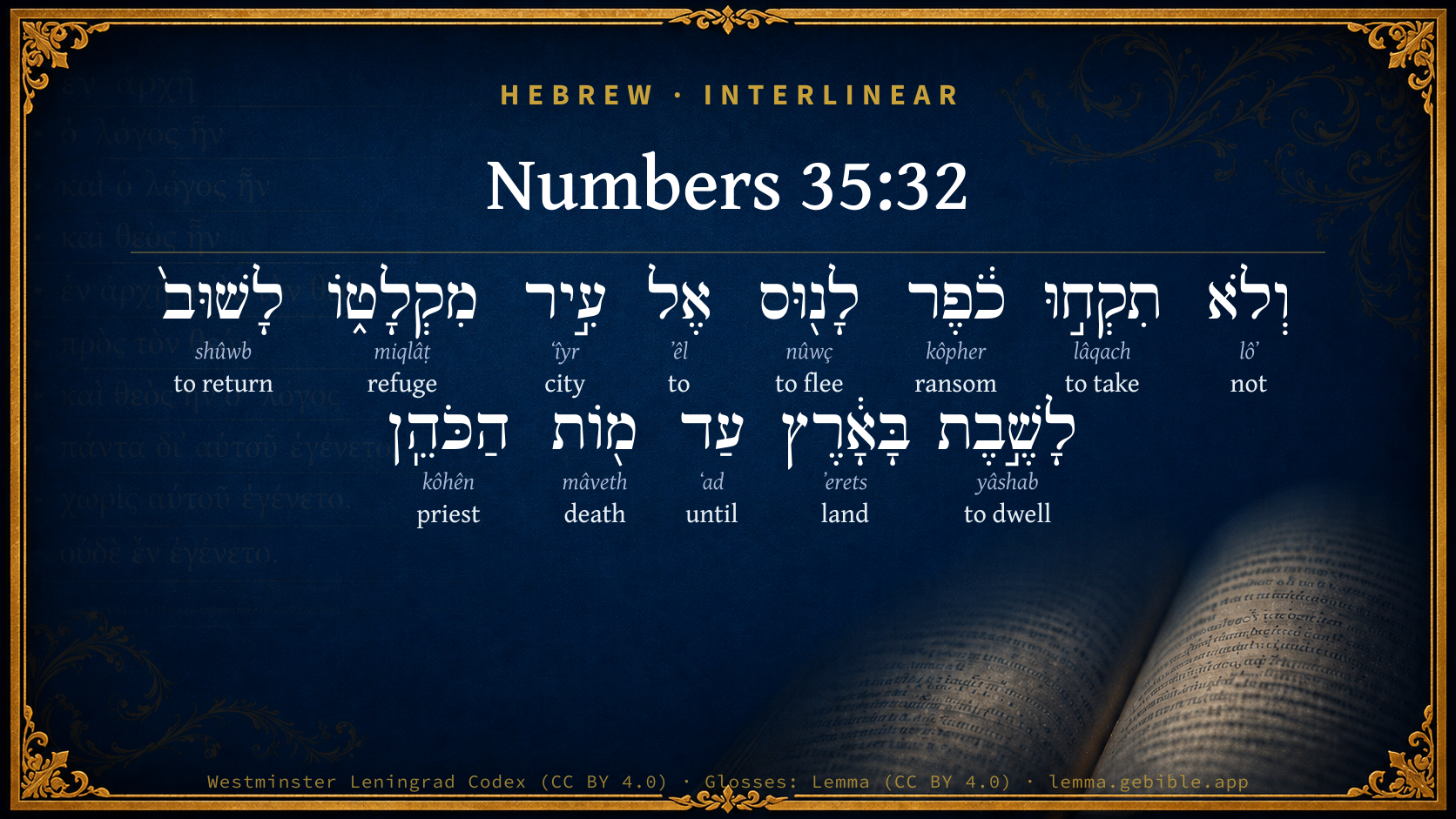
Numbers 35:32

Hebrew (Westminster Leningrad Codex) Numbers 35:32 appears in the Hebrew Old Testament. The text above is from the Westminster Leningrad Codex. Each word links to its Strong’s number, a concise gloss, and parsing drawn from the Open Scriptures Hebrew Bible morphology. Click any word for its full Brown-Driver-Briggs (BDB) entry.
Download image
Cite this verse

Numbers 35:32 (World English Bible). Public Domain. Lemma interlinear Bible study tool, https://lemma.gebible.app/v/numbers/35/32.

Show BibTeX & RIS
BibTeX
RIS
English Translation
You shall take no ransom for him who is fled to his city of refuge, that he may come again to dwell in the land, until the death of the priest.
World English Bible · Public Domain
Download a study sheet

One document with this verse’s original text, its word-by-word gloss line, the meaning frame, cross-references with their text, attributed commentary, and full source and license credits — printable, and it pastes into notes with its structure intact.

This verse Autodidact and up

Study sheet (.html) Plain text (.txt)

A passage Seminary Student

Up to 50 verses in one chapter. A passage sheet keeps up to 6 commentary sources and 12 cross-references per verse, in the order this page ranks them, and says so on the sheet whenever that leaves anything out. Ask for a single verse and you get the Autodidact verse sheet above.

Everything on this page stays free to read, with no account — the sheet is a download of what is already on screen, not access to it.

Want to remove ads? Support Godless Engineer
Compare translations 3

The same verse in 3 English versions, stacked beneath the original-language interlinear above. Click any original word for its lexicon entry.

Each is an independent rendering of the whole verse — the interlinear is not word-aligned to these translations.

Highlighted words mark where these versions differ — a whole-verse word diff, not a word-by-word alignment.

  • World English Bible Public Domain
    You shall take no ransom for him who is fled to his city of refuge, that he may come again to dwell in the land, until the death of the priest.
  • King James Version Public Domain
    And ye shall take no satisfaction for him that is fled to the city of his refuge, that he should come again to dwell in the land, until the death of the priest.
  • unfoldingWord Literal Text CC BY-SA 4.0
    And you shall not take a ransom for the one who flees into the city of his refuge, to return to dwell in the land until the death of the priest.

unfoldingWord Literal Text — © unfoldingWord, licensed CC BY-SA 4.0. Word-aligned USFM3 via Door43 (git.door43.org/unfoldingWord/en_ult).

Versions to compare (up to 4)

3 of 4 selected

Show all 18 translations

Every available English version of this verse, each an independent rendering of the whole verse.

  • World English Bible Public Domain
    You shall take no ransom for him who is fled to his city of refuge, that he may come again to dwell in the land, until the death of the priest.
  • Berean Standard Bible Public Domain
    Nor should you accept a ransom for the person who flees to a city of refuge and allow him to return and live on his own land before the death of the high priest.
  • Majority Standard Bible Public Domain
    Nor should you accept a ransom for the person who flees to a city of refuge and allow him to return and live on his own land before the death of the high priest.
  • King James Version Public Domain
    And ye shall take no satisfaction for him that is fled to the city of his refuge, that he should come again to dwell in the land, until the death of the priest.
  • American Standard Version (1901) Public Domain
    And ye shall take no ransom for him that is fled to his city of refuge, that he may come again to dwell in the land, until the death of the priest.
  • Revised Version (1885) Public Domain
    And ye shall take no ransom for him that is fled to his city of refuge, that he should come again to dwell in the land, until the death of the priest.
  • Geneva Bible (1599) Public Domain
    Also ye shall take no recompense for him that is fled to the citie of his refuge, that he should come againe, and dwell in the lande, before the death of the hie Priest.
  • Douay-Rheims (1899) Public Domain
    The banished and fugitives before the death of the high priest may by no means return into their own cities.
  • Young's Literal Translation Public Domain
    and ye take no atonement for him to flee unto the city of his refuge, to turn back to dwell in the land, until the death of the priest.
  • Literal Standard Version CC BY-SA 4.0
    and you take no atonement for him [who had] to flee to the city of his refuge, to return to dwell in the land, until the death of the priest.
  • Unlocked Literal Bible CC BY-SA 4.0
    You must not accept ransom for the one who has fled to a city of refuge. You must not in this way allow him to reside on his own property until the high priest dies.
  • unfoldingWord Literal Text CC BY-SA 4.0
    And you shall not take a ransom for the one who flees into the city of his refuge, to return to dwell in the land until the death of the priest.
  • Darby Bible Public Domain
    And ye shall take no satisfaction for him that hath fled to the city of his refuge, that he should come again to dwell in the land, until the death of the priest.
  • World Messianic Bible Public Domain
    “‘You shall take no ransom for him who has fled to his city of refuge, that he may come again to dwell in the land before the death of the priest.
  • Webster's Bible Public Domain
    And ye shall take no satisfaction for him that hath fled to the city of his refuge, that he should come again to dwell in the land, until the death of the priest.
  • Free Bible Version CC BY-SA 4.0
    Also you are not allowed to accept payment for a person who runs to a sanctuary town and permit him to return and live on his own land before the death of the high priest.
  • Bible in Basic English Public Domain
    And no price may be offered for one who has gone in flight to a safe town, for the purpose of letting him come back to his place before the death of the high priest.
  • JPS Tanakh (1917) Public Domain
    And ye shall take no ransom for him that is fled to his city of refuge, that he should come again to dwell in the land, until the death of the priest.

Literal Standard Version (2020), Covenant Press — licensed CC BY-SA 4.0. Text via the HelloAO Bible API (eBible.org). Unlocked Literal Bible (unfoldingWord) — licensed CC BY-SA 4.0. Text via the HelloAO Bible API (eBible.org). unfoldingWord Literal Text — © unfoldingWord, licensed CC BY-SA 4.0. Word-aligned USFM3 via Door43 (git.door43.org/unfoldingWord/en_ult). Free Bible Version, Dr. Jonathan Gallagher — licensed CC BY-SA 4.0. Text via the HelloAO Bible API (eBible.org).

Word by word

More ways to search: Search by grammar → Find every occurrence → Compare this word →

Practice this passage: Drill this verse → Learn its vocabulary →

כֹ֔פֶר
kôpher
H3724
“ransom”
Noun, Common, Masculine, Singular, Absolute
Part of Speech
Noun
Type
Common
Gender
Masculine
Number
Singular
State
Absolute
Full BDB Definition

Origin: from H3722

TWOT: 1025b

price of a life, ransom, bribe - asphalt, pitch (as a covering) - the henna plant, name of a plant (henna?) - village
  1. וְלֹא lôʼ H3808 “and · not” Conjunction + Particle, Negative
  2. תִקְח֣וּ lâqach H3947 “to take” Verb, Qal, Imperfect, 2nd Person, Masculine, Plural
  3. לָנ֖וּס nûwç H5127 “to flee” Preposition + Verb, Qal, Infinitive Construct
  4. אֶל ʼêl H413 “to” Preposition
  5. עִ֣יר ʻîyr H5892 “city of” Noun, Common, Feminine, Singular, Construct
  6. מִקְלָט֑וֹ miqlâṭ H4733 “refuge · his” Noun, Common, Masculine, Singular, Construct + Suffix, Personal, 3rd Person, Masculine, Singular
  7. לָשׁוּב֙ shûwb H7725 “to return” Preposition + Verb, Qal, Infinitive Construct
  8. לָשֶׁ֣בֶת yâshab H3427 “to dwell” Preposition + Verb, Qal, Infinitive Construct
  9. בָּאָ֔רֶץ ʼerets H776 “in/at the · land” Preposition, Determined + Noun, Common, Both, Singular, Absolute
  10. עַד ʻad H5704 “until” Preposition
  11. מ֖וֹת mâveth H4194 “death of” Noun, Common, Masculine, Singular, Construct
  12. הַכֹּהֵֽן kôhên H3548 “the · priest” Particle, Definite Article + Noun, Common, Masculine, Singular, Absolute

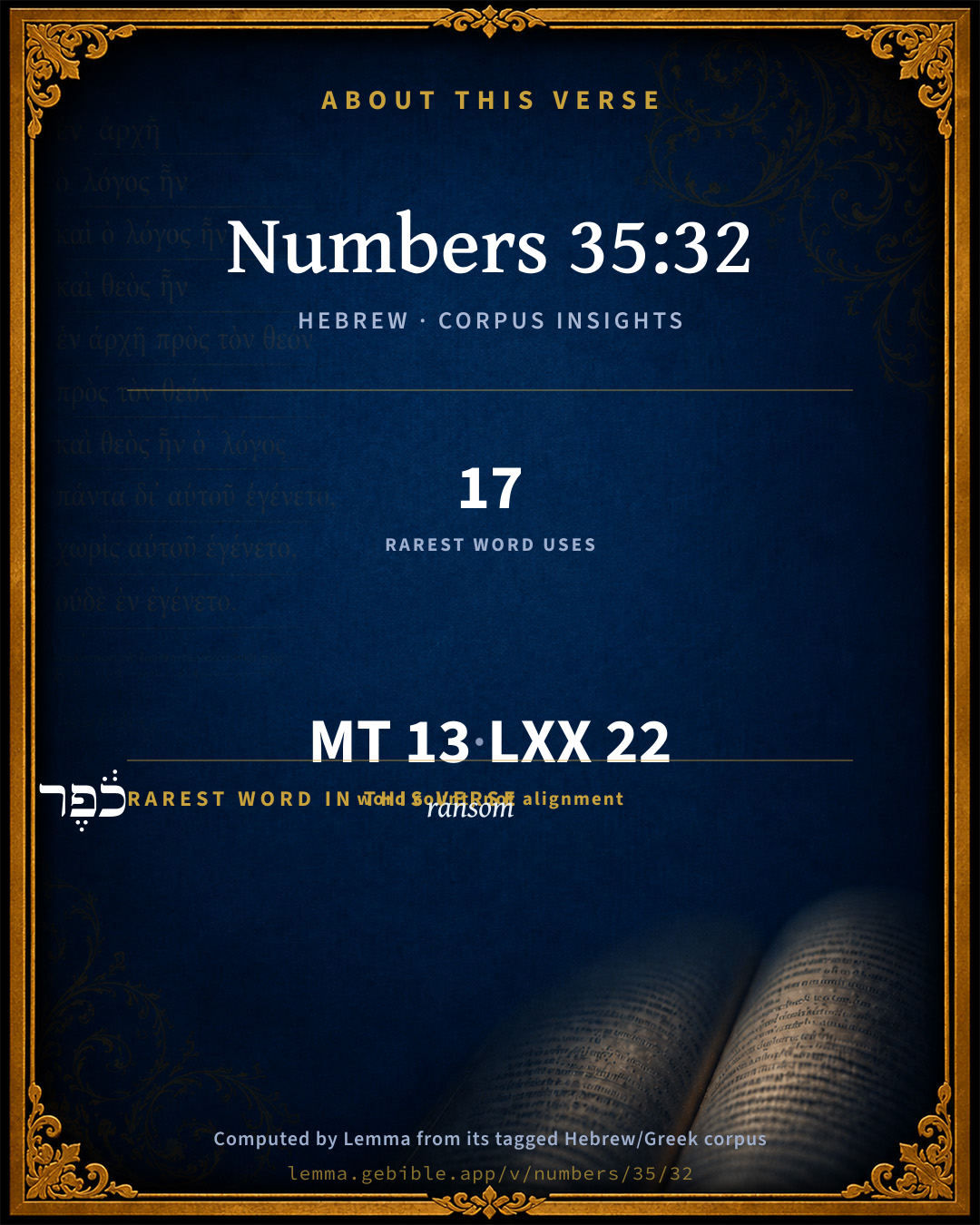
About this verse

These counts appear in no published source. They are computed here, from the morphology-tagged text and Lemma’s own curated glosses. What Lemma adds →

13
words
13
distinct lemmas
Pentateuch
section

Notable vocabulary

The rarest word here is כֹ֔פֶר ransom H3724 — appearing just 17 times in the whole Hebrew Bible.

Shared distinctive vocabulary

כֹ֔פֶר ransom H3724 occurs in 17 verses of the Hebrew Bible. Also found in:

Grammatical profile

  • 4 verbs
  • 6 nouns
  • 2 prepositions
  • 1 particle

Verb forms

  • תִקְח֣וּ Qal · Imperfect
  • לָנ֖וּס Qal · Infinitive Construct
  • לָשׁוּב֙ Qal · Infinitive Construct
  • לָשֶׁ֣בֶת Qal · Infinitive Construct

Hebrew & Septuagint length

In English translation the verse runs 31 words from the Hebrew and 30 from the Septuagint (LXX English) — closely comparable.

A rough comparison of the two English renderings, which tokenize alike — not a word-level alignment.

Word counts can differ between the Hebrew and the Greek without any difference in meaning — e.g. the Hebrew direct-object marker אֵת has no separate Greek word, and Greek often adds the article ὁ.

In the original languages it is 13 Hebrew tokens and 22 Greek tokens — but the two are counted differently (Hebrew bundles its prefixes and suffixes into one token; the Greek is in lemma form), so that isn’t a like-for-like length.

Cross-references

5

Topical passages linked to Numbers 35:32 in the Treasury of Scripture Knowledge — connected by theme and wording, ordered by reader-vote popularity; previews shown in the World English Bible.

  • Acts 4:12 There is salvation in none other, for neither is there any other name under heaven, that is given among men, by which we must be saved!"
  • Galatians 2:21 I don't make void the grace of God. For if righteousness is through the law, then Christ died for nothing!"
  • Galatians 3:10–13 For as many as are of the works of the law are under a curse. For it is written, "Cursed is everyone who doesn't continue in all things that are written in the book of the law, to do them."
  • Galatians 3:22 But the Scriptures shut up all things under sin, that the promise by faith in Jesus Christ might be given to those who believe.
  • Revelation 5:9 They sang a new song, saying, "You are worthy to take the book, And to open its seals: For you were killed, And bought us for God with your blood, Out of every tribe, language, people, and nation,

Cross-references courtesy of OpenBible.info (CC BY 4.0).

Hebrew and Greek witnesses Masoretic Hebrew ↔ Greek Septuagint

The same verse in the two great witnesses to the Old Testament, shown verse-for-verse.

These are two independent witnesses, not word-aligned to each other, and the Septuagint is shown in lemma (dictionary) form.

Hebrew Numbers 35:32 Masoretic · Westminster Leningrad Codex

וְלֹא תִקְח֣וּ כֹ֔פֶר לָנ֖וּס אֶל עִ֣יר מִקְלָט֑וֹ לָשׁוּב֙ לָשֶׁ֣בֶת בָּאָ֔רֶץ עַד מ֖וֹת הַכֹּהֵֽן

You shall take no ransom for him who is fled to his city of refuge, that he may come again to dwell in the land, until the death of the priest.

World English Bible · Public Domain

Greek LXX Numbers 35:32 Septuagint · lemma form

οὐ λαμβάνω λύτρον ὁ φεύγω εἰς πόλις ὁ φυγαδευτήριον ὁ πάλιν καταοἰκέω ἐπί ὁ γῆ ἕως ἄν ἀποθνήσκω ὁ ἱερεύς ὁ μέγας

You⌃ shall not accept a ransom to excuse his fleeing to the city of refuge, so that he should again dwell in the land, until the death of the high-priest.

LXX2012 (modern English Septuagint) · Public Domain

On this verse, Haydock's Catholic Bible Commentary discusses the Septuagint’s reading. Read the note in Commentary ↓

Hebrew: Westminster Leningrad Codex (CC BY 4.0). Greek: Septuagint (public domain); English from LXX2012 (modern English Septuagint) (Public Domain). How the Septuagint differs from the Hebrew →

Targum (Aramaic paraphrase)

2

The Targum is the ancient Jewish Aramaic paraphrase of the Hebrew Scriptures — an interpretive translation, not the Hebrew text itself. Onkelos (literal) and Pseudo-Jonathan (expansive) render the Torah, and Jonathan the Prophets. Coverage is partial: where no permissively-licensed English translation exists for a verse, only the Aramaic is shown. This is verse-level text, not a word-by-word alignment to the Hebrew.

  1. Targum Onkelos Torah (Genesis–Deuteronomy)
    וְלָא תְקַבְּלוּן מָמוֹן לְמֵעֲרוֹק לְקִרְיַת שֵׁזָבוּתֵהּ לְמֵתוּב לְמִתַּב בְּאַרְעָא עַד דִימוּת כַּהֲנָא

    (no public-domain English translation for this verse)

    Targum Onkelos — Aramaic: “Onkelos Genesis” (public domain); “Onkelos Exodus” (public domain); “Onkelos Leviticus” (public domain); “Onkelos Numbers” (public domain); “Onkelos Deuteronomy” (public domain). English: “Sefaria Community Translation” (CC0 1.0 (public-domain dedication)); “J.W. Etheridge. The Targums of Onkelos and Jonathan Ben Uzziel on the Pentateuch. London: Longmans, Green, 1862” (public domain). Text via Sefaria.

  2. Targum Pseudo-Jonathan Torah (Genesis–Deuteronomy)
    וְלָא תְקַבְּלוּן פּוּרְקַן לִדְעָרַק לְקִרְיְיתָא דְקַלְטֵיהּ לְמֵיתוּב לְמֵיתַב בְּאַרְעָא עַד זְמַן דִימוּת כַּהֲנָא

    Neither may you take ransom for him who hath fled to his city of refuge, so as that he may return to dwell in the land before the time of the high priest's decease.

    Targum Pseudo-Jonathan — Aramaic: “Targum Jonathan on Genesis” (public domain); “Targum Jonathan on Exodus” (public domain); “Targum Jonathan on Leviticus” (public domain); “Targum Jonathan on Numbers” (public domain); “Targum Jonathan on Deuteronomy” (public domain). English: “The Targum of Jonathan ben Uzziel, trans. J. W. Etheridge, London, 1862” (public domain). Text via Sefaria.

Commentary

Notes on Numbers 35:32 from classic Christian and Jewish commentators (each source and its license shown beneath its notes). The classic Christian expositions comment on the surrounding passage and are grouped to its opening verse, so a note may address several verses; the Jewish commentaries on the Tanakh (Rashi and others) are per-verse, so they appear only where the commentator wrote on this verse.

Lemma curates 59 commentaries, every one of them public domain or Creative Commons licensed, each selected and text-cleaned for this edition rather than reprinted as found. About our sources →

Adam Clarke's Commentary

Verse 32. Until the death of the priest.] Probably intended to typify, that no sinner can be delivered from his banishment from God, or recover his forfeited inheritance, till Jesus Christ, the great high priest, had died for his offences, and risen again for his justification.

Adam Clarke's Commentary on the Bible (1810–1826) — public domain. Text from a community e-Sword/MySword module.

John Gill's Exposition

Moreover, ye shall take no satisfaction for him that is fled to the city of his refuge,.... Though for killing a man unawares:

that he should come again to dwell in the land, until the death of the priest; the high priest; such a man's liberty was not to be purchased with money, nor even his life to be bought off, should he be taken without his city; a great ransom could not deliver him from the avenger, because he was guilty of this law, which so wisely and mercifully provided for him; and consequently guilty also of great ingratitude to God, as well as of a breach of his law, and of disrespect to his high priest, under whom he was protected.

John Gill's Exposition of the Whole Bible (1746–1763) — public domain (CC PDM 1.0). Text via the HelloAO Bible API.

Haydock's Catholic Bible Commentary

Cities. Hebrew, "you shall take no money to retire to a city of refuge, to return into his own country, till the death of the priest." The Septuagint supply, "you shall take no redemption money, to permit (a voluntary murderer) to flee into a city of refuge, (nor of an involuntary one,) to return," &c. (Grotius) --- The banished, may refer to people of the former description, who had gone away to screen themselves from persecution. But they could never be allowed to inhabit the country any more. Their presence would seem to defile it. (Haydock) --- "You shall not take money of him who has fled to a city of refuge, to suffer him to return home." (Chaldean)

George Leo Haydock (1774–1849), Haydock's Catholic Family Bible and Commentary, 1859 edition — public domain. Excludes Psalms (Douay-Rheims chapter numbering differs from Protestant) and Deuterocanonical books (Catholic canon only).

Matthew Poole's English Annotations

Whereby God would signify the absolute and indispensable necessity of Christ’s death to expiate sin, and to redeem the sinner.

Matthew Poole's English Annotations on the Holy Bible (1683–1685) — public domain. Text from a community e-Sword/MySword module.

The Pulpit Commentary

That he should come again to dwell in the land. No one might buy off the enmity of the avenger before the appointed time, for that would give an unjust advantage to wealth, and would make the whole matter mercenary and vulgar.

The Pulpit Commentary (1880–1919), ed. H.D.M. Spence-Jones & Joseph S. Exell — public domain. Text from a community e-Sword module.

Rashi

Rabbi Shlomo Yitzchaki (Rashi)

ולא תקחו כפר לנוס אל עיר מקלטו AND YE SHALL TAKE NO RANSOM לנוס TO HIS CITY OF REFUGE — The last words are the same as לַנָּס אל עיר מקלטו, "ye shall take no ransom for one who is fled to a city of refuge, i.e., one who has killed inadvertently, cannot be freed from exile by money, by giving a ransom (Sifrei Bamidbar 160:12), לשוב לשבת בארץ THAT HE SHOULD RETURN TO DWELL IN THE LAND before the High Priest dies.

לנוס (the passive participle) has the same meaning as לַנָּס (the active participle), just as, (Micha 2:8) "שובי מלחמה”, which means “those who have returned from battle”; and so, too, (Zephaniah 3:18) “those who are removed far (נוני) from the appointed season”; (Joshua 5:5): “for they were circumcised men (מולים)”. Now just as you say שוב in reference to one who has already returned, and מול in reference to one who is already circumcised, so you can say לנוס in reference to one who has already fled. It calls him נוס (the passive participle), as much as to say “one who was made to flee”; — But you say that לנוס means “to flee” (the infinitive) explaining it thus: “ye shall take no ransom for one who ought to flee”, in order to free him from exile (cf. Sifrei Bamidbar 160:12), then I do not know how it can be said: “ye shall take no ransom … so that he should return to dwell in the land”, for you see, he has not yet fled, so from where shall he return?

Rashi on the Tanakh — English translations: “The Judaica Press complete Tanach with Rashi, translated by A. J. Rosenberg” (CC BY 4.0); “Pentateuch with Rashi's commentary by M. Rosenbaum and A.M. Silbermann, 1929-1934” (public domain); “The Metsudah Tanach series, Lakewood, N.J” (CC BY 4.0); and “The Book of Joshua, Metsudah Publications, 1997” (CC BY 4.0). Text via Sefaria.

Lesson kit

Teaching starters — assembled from the data on this page, not authored interpretation. Every prompt links to the verse data it draws on. Edit before teaching.

Numbers, in the Pentateuch, opens this verse with 13 words (13 distinct Hebrew lemmas). Its most distinctive word is kôpher (“ransom”). A historical commentator’s framing appears above. Read the whole chapter for the surrounding context.

Discussion questions

  1. What does “ransom” (kôpher) contribute to the verse as a whole?
  2. How does Genesis 6:14, which shares the word «ransom», read alongside this verse?
  3. These translations render this verse differently. What is at stake in choosing one wording over another?
  4. «תִקְח֣וּ» is a Qal Imperfect verb. How does that grammatical form shape the action described?
  5. Compare how Adam Clarke's Commentary and John Gill's Exposition read this verse. Where do they agree or differ?

Things to notice

Reading settings

Reading text

Shown beneath each verse's original-language words.

Old Testament
Old Testament edition

Read the OT as the Masoretic Hebrew (MT) or the Greek Septuagint (LXX).

English shown for the Greek Septuagint (in the Hebrew ↔ Greek comparison).

Comparing translations? Open the Compare panel on any verse page to stack up to four side by side.