
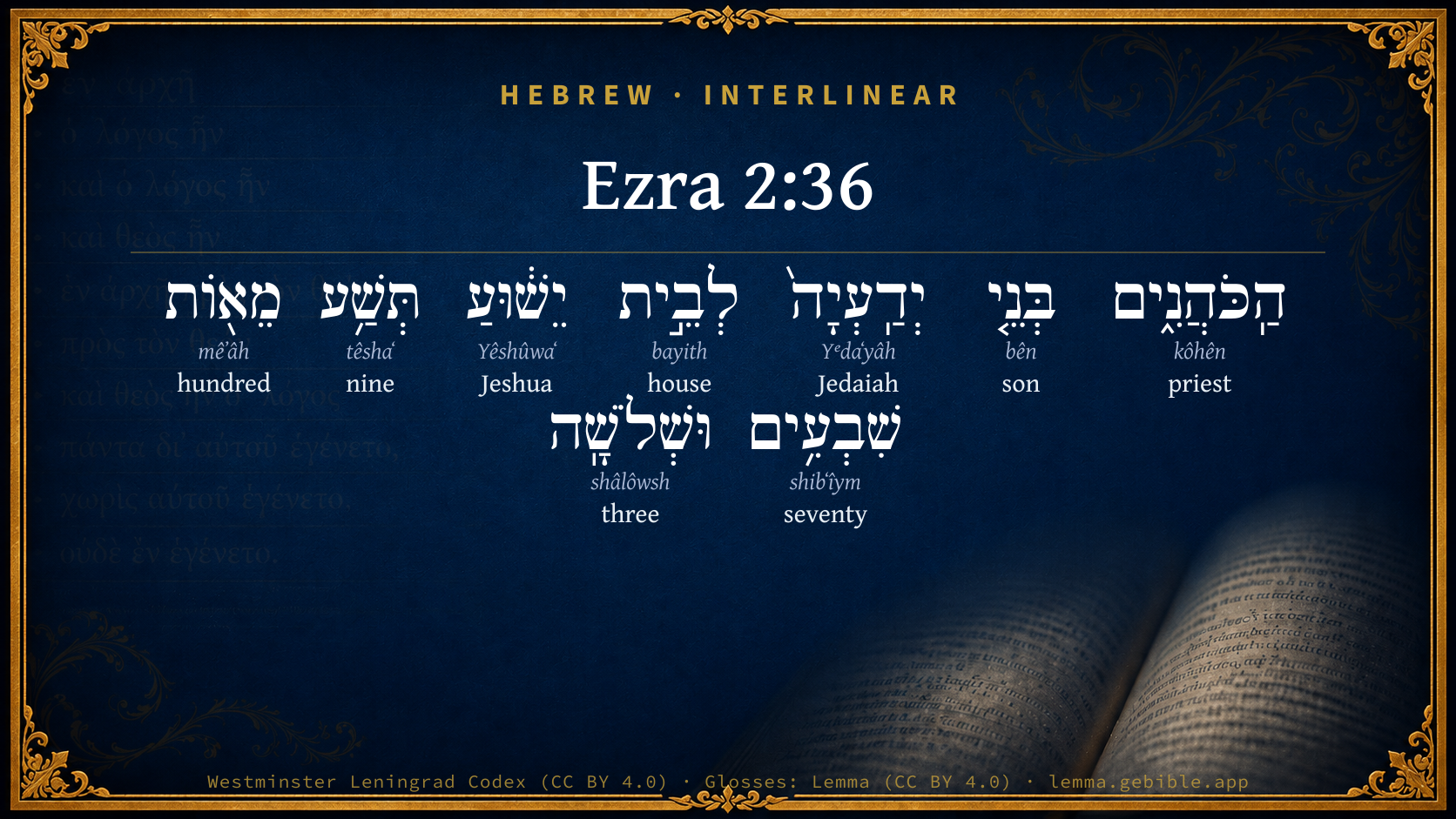
Ezra 2:36

Hebrew (Westminster Leningrad Codex) Ezra 2:36 appears in the Hebrew Old Testament. The text above is from the Westminster Leningrad Codex. Each word links to its Strong’s number, a concise gloss, and parsing drawn from the Open Scriptures Hebrew Bible morphology. Click any word for its full Brown-Driver-Briggs (BDB) entry.
Download image
Cite this verse

Ezra 2:36 (World English Bible). Public Domain. Lemma interlinear Bible study tool, https://lemma.gebible.app/v/ezra/2/36.

Show BibTeX & RIS
BibTeX
RIS
English Translation
The priests: the children of Jedaiah, of the house of Jeshua, nine hundred seventy-three.
World English Bible · Public Domain
Download a study sheet

One document with this verse’s original text, its word-by-word gloss line, the meaning frame, cross-references with their text, attributed commentary, and full source and license credits — printable, and it pastes into notes with its structure intact.

This verse Autodidact and up

Study sheet (.html) Plain text (.txt)

A passage Seminary Student

Up to 50 verses in one chapter. A passage sheet keeps up to 6 commentary sources and 12 cross-references per verse, in the order this page ranks them, and says so on the sheet whenever that leaves anything out. Ask for a single verse and you get the Autodidact verse sheet above.

Everything on this page stays free to read, with no account — the sheet is a download of what is already on screen, not access to it.

Want to remove ads? Support Godless Engineer
Compare translations 3

The same verse in 3 English versions, stacked beneath the original-language interlinear above. Click any original word for its lexicon entry.

Each is an independent rendering of the whole verse — the interlinear is not word-aligned to these translations.

Highlighted words mark where these versions differ — a whole-verse word diff, not a word-by-word alignment.

  • World English Bible Public Domain
    The priests: the children of Jedaiah, of the house of Jeshua, nine hundred seventy-three.
  • King James Version Public Domain
    The priests: the children of Jedaiah, of the house of Jeshua, nine hundred seventy and three.
  • unfoldingWord Literal Text CC BY-SA 4.0
    The priests: the sons of Jedaiah of the house of Jeshua were 973.

unfoldingWord Literal Text — © unfoldingWord, licensed CC BY-SA 4.0. Word-aligned USFM3 via Door43 (git.door43.org/unfoldingWord/en_ult).

Versions to compare (up to 4)

3 of 4 selected

Show all 18 translations

Every available English version of this verse, each an independent rendering of the whole verse.

  • World English Bible Public Domain
    The priests: the children of Jedaiah, of the house of Jeshua, nine hundred seventy-three.
  • Berean Standard Bible Public Domain
    The priests: The descendants of Jedaiah (through the house of Jeshua), 973;
  • Majority Standard Bible Public Domain
    The priests: The descendants of Jedaiah (through the house of Jeshua), 973;
  • King James Version Public Domain
    The priests: the children of Jedaiah, of the house of Jeshua, nine hundred seventy and three.
  • American Standard Version (1901) Public Domain
    The priests: the children of Jedaiah, of the house of Jeshua, nine hundred seventy and three.
  • Revised Version (1885) Public Domain
    The priests: the children of Jedaiah, of the house of Jeshua, nine hundred seventy and three.
  • Geneva Bible (1599) Public Domain
    The Priests: of the sonnes of Iedaiah of the house of Ieshua, nine hundreth seuentie and three:
  • Douay-Rheims (1899) Public Domain
    The priests: the children of Jadaia of the house of Josue, nine hundred seventy-three.
  • Young's Literal Translation Public Domain
    The Priests: sons of Jedaiah, of the house of Jeshua, nine hundred seventy and three.
  • Literal Standard Version CC BY-SA 4.0
    The priests: sons of Jedaiah, of the house of Jeshua, nine hundred seventy-three;
  • Unlocked Literal Bible CC BY-SA 4.0
    The priests: descendants of Jedaiah of the house of Jeshua: 973.
  • unfoldingWord Literal Text CC BY-SA 4.0
    The priests: the sons of Jedaiah of the house of Jeshua were 973.
  • Darby Bible Public Domain
    The priests: the children of Jedaiah, of the house of Jeshua, nine hundred and seventy-three.
  • World Messianic Bible Public Domain
    The priests: the children of Jedaiah, of the house of Yeshua, nine hundred seventy-three.
  • Webster's Bible Public Domain
    The priests: the children of Jedaiah, of the house of Jeshua, nine hundred seventy and three.
  • Free Bible Version CC BY-SA 4.0
    This is the number of the priests: the sons of Jedaiah (through the family of Jeshua), 973;
  • Bible in Basic English Public Domain
    The priests: the children of Jedaiah, of the house of Jeshua, nine hundred and seventy-three.
  • JPS Tanakh (1917) Public Domain
    The priests: the children of Jedaiah, of the house of Jeshua, nine hundred seventy and three.

Literal Standard Version (2020), Covenant Press — licensed CC BY-SA 4.0. Text via the HelloAO Bible API (eBible.org). Unlocked Literal Bible (unfoldingWord) — licensed CC BY-SA 4.0. Text via the HelloAO Bible API (eBible.org). unfoldingWord Literal Text — © unfoldingWord, licensed CC BY-SA 4.0. Word-aligned USFM3 via Door43 (git.door43.org/unfoldingWord/en_ult). Free Bible Version, Dr. Jonathan Gallagher — licensed CC BY-SA 4.0. Text via the HelloAO Bible API (eBible.org).

Word by word

More ways to search: Search by grammar → Find every occurrence → Compare this word →

Practice this passage: Drill this verse → Learn its vocabulary →

About this verse

These counts appear in no published source. They are computed here, from the morphology-tagged text and Lemma’s own curated glosses. What Lemma adds →

9
words
9
distinct lemmas
Historical
section

Notable vocabulary

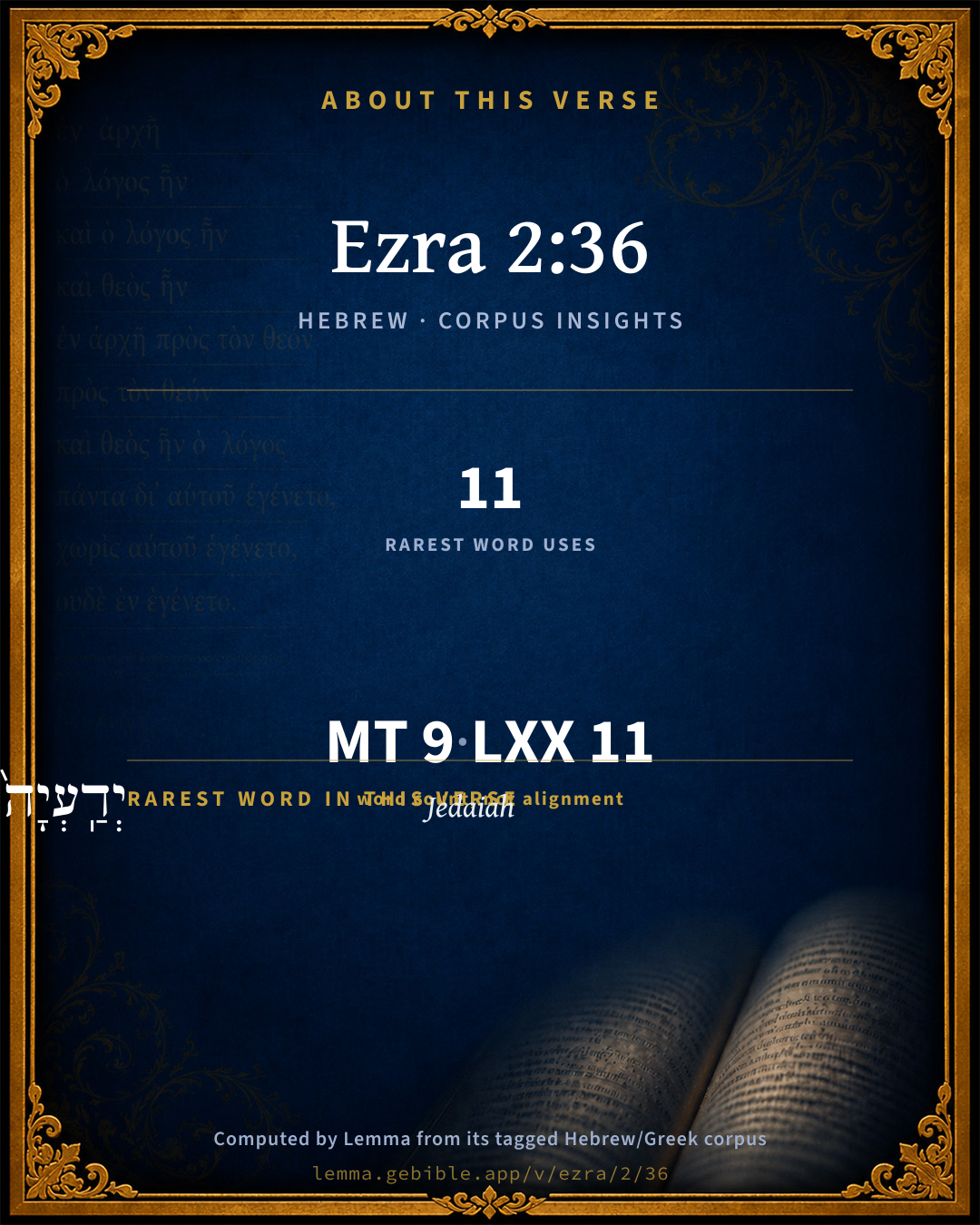
The rarest word here is יְדַֽעְיָה֙ Jedaiah H3048 — appearing just 11 times in the whole Hebrew Bible.

Shared distinctive vocabulary

יְדַֽעְיָה֙ Jedaiah H3048 occurs in 11 verses of the Hebrew Bible. Also found in:

Grammatical profile

  • 5 nouns
  • 4 adjectives

Hebrew & Septuagint length

In English translation the verse runs 14 words from the Hebrew and 18 from the Septuagint (LXX English) — closely comparable.

A rough comparison of the two English renderings, which tokenize alike — not a word-level alignment.

Word counts can differ between the Hebrew and the Greek without any difference in meaning — e.g. the Hebrew direct-object marker אֵת has no separate Greek word, and Greek often adds the article ὁ.

In the original languages it is 9 Hebrew tokens and 11 Greek tokens — but the two are counted differently (Hebrew bundles its prefixes and suffixes into one token; the Greek is in lemma form), so that isn’t a like-for-like length.

Cross-references

4

Topical passages linked to Ezra 2:36 in the Treasury of Scripture Knowledge — connected by theme and wording, ordered by reader-vote popularity; previews shown in the World English Bible.

  • 1 Chronicles 9:10 Of the priests: Jedaiah, and Jehoiarib, Jachin,
  • 1 Chronicles 24:7–18 Now the first lot came forth to Jehoiarib, the second to Jedaiah,
  • Ezra 3:9 Then stood Jeshua with his sons and his brothers, Kadmiel and his sons, the sons of Judah, together, to have the oversight of the workmen in the house of God: the sons of Henadad, with their sons and their brothers the Levites.
  • Nehemiah 7:39 The priests: The children of Jedaiah, of the house of Jeshua, nine hundred seventy-three.

Cross-references courtesy of OpenBible.info (CC BY 4.0).

Hebrew and Greek witnesses Masoretic Hebrew ↔ Greek Septuagint

The same verse in the two great witnesses to the Old Testament, shown verse-for-verse.

These are two independent witnesses, not word-aligned to each other, and the Septuagint is shown in lemma (dictionary) form.

Hebrew Ezra 2:36 Masoretic · Westminster Leningrad Codex

הַֽכֹּהֲנִ֑ים בְּנֵ֤י יְדַֽעְיָה֙ לְבֵ֣ית יֵשׁ֔וּעַ תְּשַׁ֥ע מֵא֖וֹת שִׁבְעִ֥ים וּשְׁלֹשָֽׁה

The priests: the children of Jedaiah, of the house of Jeshua, nine hundred seventy-three.

World English Bible · Public Domain

Greek LXX Ezra 2:36 Septuagint · lemma form

καί ὁ ἱερεύς υἱός ιεδουα ὁ οἶκος ἰησοῦς ἐννακόσιοι ἑβδομήκοντα τρεῖς

And the priests, the sons of Jedua, belonging to the house of Jesus, were nine hundred and seventy-three.

LXX2012 (modern English Septuagint) · Public Domain

In the Septuagint this is one book — Esdras B (2 Esdras): Ezra is chapters 1–10, Nehemiah 11–23.

Hebrew: Westminster Leningrad Codex (CC BY 4.0). Greek: Septuagint (public domain); English from LXX2012 (modern English Septuagint) (Public Domain). How the Septuagint differs from the Hebrew →

Commentary

Notes on Ezra 2:36 from classic Christian and Jewish commentators (each source and its license shown beneath its notes). The classic Christian expositions comment on the surrounding passage and are grouped to its opening verse, so a note may address several verses; the Jewish commentaries on the Tanakh (Rashi and others) are per-verse, so they appear only where the commentator wrote on this verse.

Lemma curates 59 commentaries, every one of them public domain or Creative Commons licensed, each selected and text-cleaned for this edition rather than reprinted as found. About our sources →

Matthew Henry's Commentary

Here is an account, I. Of the priests that returned, and they were a considerable number, about a tenth part of the whole company: for the whole were above 42,000 (Ezr 2:64), and four families of priests made up above 4200 (Ezr 2:36-39); thus was the tenth God's part - a blessed decimation. Three of the fathers of the priests here named were heads of courses, Ch1 24:7, Ch1 24:8, Ch1 24:14. The fourth was Pashur, v. 38. If these were of the posterity of that Pashur that abused Jeremiah (Jer 20:1), it is strange that so bad a man should have so good a seed, and so numerous.

II. Of the Levites. I cannot but wonder at the small number of them, for, taking in both the singers and the porters (Ezr 2:40-42), they did not make 350. Time was when the Levites were more forward to their duty than the priests (Ch2 29:34), but they were not so now. If one place, one family, has the reputation for pious zeal now, another may have it another time. The wind blows where it listeth, and shifts its points.

III. Of the Nethinim, who, it is supposed, were the Gibeonites, given (so their name signifies) by Joshua first (Jos 9:27), and again by David (Ezr 8:20), when Saul had expelled them, to be employed by the Levites in the work of God's house as hewers of wood and drawers of water; and, with them, of the children of Solomon's servants, whom he gave for the like use (whether they were Jews or Gentiles does not appear) and who were here taken notice of among the retainers of the temple and numbered with the Nethinim, Ezr 2:55, Ezr 2:58. Note, It is an honour to belong to God's house, though in the meanest office there.

IV. Of some that were looked upon as Israelites by birth, and others as priests, and yet could not make out a clear title to the honour. 1. There were some that could not prove themselves Israelites (Ezr 2:59, Ezr 2:60), a considerable number, who presumed they were of the seed of Jacob, but could not produce their pedigrees, and yet would go up to Jerusalem, having an affection to the house and people of God. These shamed those who were true-born Israelites, and yet were not called Israelites indeed, who came out of the waters of Judah (Isa 48:1), but had lost the relish of those waters. 2. There were others that could not prove themselves priests, and yet were supposed to be of the seed of Aaron. What is not preserved in black and white will, in all likelihood, be forgotten in a little time. Now we are here told, (1.) How they lost their evidence. One of their ancestors married a daughter of Barzillai, that great man whom we read of in David's time; he gloried in an alliance to that honourable family, and, preferring that before the dignity of his priesthood, would have his children called after Barzillai's family, and their pedigree preserved in the registers of that house, not of the house of Aaron, and so they lost it. In Babylon there was nothing to be got by the priesthood, and therefore they cared not for being akin to it. Those who think their ministry, or their relation to ministers, a diminution or disparagement to them, forget who it was that said, I magnify my office. (2.) What they lost with it. It could not be taken for granted that they were priests when they could not produce their proofs, but they were, as polluted, put from the priesthood. Now that the priests had recovered their rights, and had the altar to live upon again, they would gladly be looked upon as priests. But they had sold their birthright for the honour of being gentlemen, and therefore were justly degraded, and forbidden to eat of the most holy things. Note, Christ will be ashamed of those that are ashamed of him and his service. It was the tirshatha, or governor, that put them under this sequestration, which some understand of Zerubbabel the present governor, others of Nehemiah (who is so called, Neh 8:9, Neh 10:1, and who gave this order when he came some years after); but the prohibition was not absolute, it was only a suspension, till there should be a high priest with Urim and Thummin, by whom they might know God's mind in this matter. This, it seems, was expected and desired, but it does not appear that ever they were blessed with it under the second temple. They had the canon of the Old Testament complete, which was better than Urim; and, by the want of that oracle, they were taught to expect the Messiah the great Oracle, which the Urim and Thummim was but a type of. Nor does it appear that the second temple had the ark in it, either the old one or a new one. Those shadows by degrees vanished, as the substance approached; and God, by the prophet, intimates to his people that they should sustain no damage by the want of the ark, Jer 3:16, Jer 3:17. In those days, when they shall call Jerusalem the throne of the Lord, and all the nations shall be gathered to it, they shall say no more, The ark of the covenant of the Lord, neither shall it come to mind, for they shall do very well without it.

Matthew Henry's Commentary on the Whole Bible (1708–1710) — public domain (CC PDM 1.0). Text via the HelloAO Bible API.

Joseph Benson's Commentary

Ezr 2:36. The priests — Having numbered the people that went of Judah and Benjamin, he proceeds now to the tribe of Levi, and first mentions the priests.

Joseph Benson's Commentary on the Old and New Testaments (1811–1818) — public domain. Text from a community e-Sword module.

Keil & Delitzsch

C. F. Keil & F. Delitzsch

The list of the priests is identical, both in names and numbers, with that of Neh 7:39-42. These are:

The sons of Jedaiah, of the house of Jeshua 973 The sons of Immer 1052 The sons of Pashur 1247 The sons of Harim 1017 Total 4289

Jedaiah is the head of the second order of priests in Ch1 24:7. If, then, Jedaiah here represents this order, the words "of the house of Jeshua" must not be applied to Jeshua the high priest; the second order belonging in all probability to the line of Ithamar, and the high-priestly race, on the contrary, to that of Eleazar. We also meet the name Jeshua in other priestly families, e.g., as the name of the ninth order of priests in Ch1 24:11, so that it may be the old name of another priestly house. Since, however, it is unlikely that no priest of the order from which the high priest descended should return, the view that by Joshua the high priest is intended, and that the sons of Jedaiah were a portion of the house to which Joshua the high priest belonged, is the more probable one. In this case Jedaiah is not the name of the second order of priests, but of the head of a family of the high-priestly race. Immer is the name of the sixteenth order of priests, Ch1 24:14. Pashur does not occur among the orders of priests in 1 Chron 24; but we find the name, Ch1 9:12, and Neh 11:12, among the ancestors of Adaiah, a priest of the order of Malchijah; the Pashur of Jer 20 and Jer 21:1-14 being, on the contrary, called the son of Immer, i.e., a member of the order of Immer. Hence Bertheau considers Pashur to have been the name of a priestly race, which first became extensive, and took the place of an older and perhaps extinct order, after the time of David. Gershom of the sons of Phinehas, and Daniel of the sons of Ithamar, are said, Dan 8:2, to have gone up to Jerusalem with Ezra, while the order to which they belonged is not specified. Among the priests who had married strange wives (Ezr 10:18-22) are named, sons of Jeshua, Immer, Harim, Pashur; whence it has been inferred "that, till the time of Ezra, only the four divisions of priests here enumerated had the charge of divine worship in the new congregation" (Bertheau). On the relation of the names in Ezr 2:36-39 to those in Neh 10:3-9 and 12:1-22, see remarks on these passages.

Keil & Delitzsch — Biblical Commentary on the Old Testament (1861–1891) — public domain (CC PDM 1.0). Text via the HelloAO Bible API. (Old Testament only.)

Tyndale Open Study Notes

Tyndale Open Resources

2:36-42 the priests . . . the Levites: Only seventy-four Levites returned to Jerusalem—a very low number. Ezra later worked hard to get thirty-eight more to come with him (see study note on 8:18).

Tyndale Open Study Notes — © Tyndale Open Resources, licensed CC BY-SA 4.0. Text via the HelloAO Bible API.

Geneva Bible (1599)

Geneva Bible translators

Before he hath declared the two tribes of Judah and Benjamin, and now cometh to the tribe of Levi, and beginneth at the Priests.

Geneva Bible (1599) marginal notes — public domain. Text via Bolls.life.

Jamieson, Fausset & Brown

Robert Jamieson, A. R. Fausset & David Brown

The priests--Each of their families was ranged under its prince or head, like those of the other tribes. It will be remembered that the whole body was divided into twenty-four courses, one of which, in rotation, discharged the sacerdotal duties every week, and each division was called after the name of its first prince or chief. It appears from this passage that only four of the courses of the priests returned from the Babylonish captivity; but these four courses were afterwards, as the families increased, divided into twenty-four, which were distinguished by the names of the original courses appointed by David [Ch1 23:6-13]. Hence we find the course of Abijah or Abia (Ch1 24:10) subsisting at the commencement of the Christian era (Luk 1:5).

Jamieson, Fausset & Brown — Commentary Critical and Explanatory on the Whole Bible (1871) — public domain (CC PDM 1.0). Text via the HelloAO Bible API.

Adam Clarke's Commentary

Verse 36. The priests] The preceding list takes in the census of Judah and Benjamin.

Adam Clarke's Commentary on the Bible (1810–1826) — public domain. Text from a community e-Sword/MySword module.

Ellicott's Commentary for English Readers

(36) The priests: the children of Jedaiah.—The priests are then given by family names, their numbers being very large in proportion to each of the other classes. Three only of David’s priestly courses are represented (1Ch_24:7-8; 1Ch_24:14); Pashur, a name mentioned elsewhere as the name of a priestly race, not being among the twenty-four in the Chronicles.

Of the house of Jeshua.—A peculiar expression, seeming to indicate merely that the present high priest belonged to the race of Jedaiah, who, in that case, is not the same as the head of the second order in the Chronicles, unless indeed he sprang from the high-priestly family of Eleazar.

A Bible Commentary for English Readers, edited by Charles John Ellicott (1878–1897) — public domain. Text from a community e-Sword module.

The Cambridge Bible for Schools and Colleges

gen. ed. J. J. S. Perowne

36. the children of Jedaiah, of the house of Jeshua] In the 24 Priestly houses enumerated in 1Ch_24:7-18, the house of Jedaiah stands second.

The words ‘of the house of Jeshua’ have been differently explained. (a) It has been considered to refer to a very ancient house from which sprang two branches, the family of Jedaiah mentioned here and 1Ch_24:7, and the family of Jeshua mentioned as the ninth priestly house in 1Ch_24:11. (b) The Jeshua here spoken of is considered to be the High-priest; ‘the sons of Jedaiah were a portion of the house to which J. the high-priest belonged … Jedaiah is not the name of the second order of priests, but of the head of a family of the high-priestly race (Keil).

(c) But as the name of Jedaiah is followed by that of Immer, the sixteenth priestly house (1Ch_24:14), it is more natural to suppose that ‘the children of Jedaiah’ were members of the second priestly house. The explanation of the passage is supplied by the similar twofold genealogical reference given in Ezr_2:6; Ezr_2:16. The house is mentioned first and then follows its limitation to a special branch or family.

Here the house is the priestly house of Jedaiah; the branch or family is that of Jeshua. This Jeshua belonged probably to some former generation, but gave his name to a particular branch of the house of Jedaiah.

The difficulty occasioned by this verse has arisen from the desire to identify this Jeshua with the High-priest and from the mistake of supposing that the names of the heads of families were necessarily the companions of Zerubbabel instead of being rather the distinctive names of clans.

36–39. The names and numbers of the houses of the priests correspond exactly in the three registers.

The Cambridge Bible for Schools and Colleges (gen. ed. J. J. S. Perowne; Cambridge University Press, 1878–1918) — public domain. Text from a community e-Sword module.

John Gill's Exposition

The Levites,.... Singers and porters, who are reckoned in this, and the two following verses, whose numbers were no more than three hundred and forty one; whereas, in the times of David, they were 38,000, Ch1 23:3.

.

Ezra 2:43

ezr 2:43

ezr 2:43

ezr 2:43The Nethinims,.... Supposed by Aben Ezra and Jarchi to be the Gibeonites, who were "given" by Joshua, as the word Nethinims signifies, to the congregation, to be hewers of wood and drawers of water; but rather were those that were given by David to assist the Levites; of these is an account from hence to the end of Ezr 2:58, together with those who descended from Solomon's servants, who seem to be the remains of the Canaanites in the land, whom Solomon made bondservants of, Kg1 9:20, who, and their posterity, became proselytes; or those sprung from men that were domestic servants of Solomon's, and valued themselves on that account; the number of the Nethinims and these together were three hundred ninety and two.

John Gill's Exposition of the Whole Bible (1746–1763) — public domain (CC PDM 1.0). Text via the HelloAO Bible API.

Haydock's Catholic Bible Commentary

Josue, the high priest, ver. 2.

George Leo Haydock (1774–1849), Haydock's Catholic Family Bible and Commentary, 1859 edition — public domain. Excludes Psalms (Douay-Rheims chapter numbering differs from Protestant) and Deuterocanonical books (Catholic canon only).

The Pulpit Commentary

The priests. Four priestly families went up with Zerubbabel. Of these, three traced their descent to persons who had been heads of the priestly courses in the reign of David, viz., Jedaiah, Immer, and Hardin. (1Ch_24:7, 1Ch_24:8, 1Ch_24:14) The other family had for founder a priest named Pashur, who was not otherwise distinguished. The numbers assigned to the priests by Ezra are identical with those in Nehemiah. (Neh_7:39-42) Jedaiah, of the house of Jeshua. To whose house, that is, Jeshua, the existing high priest, belonged. Hence, no doubt, the precedency given to the house of Jedaiah, which numerically was the least important.

The Pulpit Commentary (1880–1919), ed. H.D.M. Spence-Jones & Joseph S. Exell — public domain. Text from a community e-Sword module.

Kretzmann's Popular Commentary

Paul E. Kretzmann

The Priests, Levites, and Servants of the Temple

v. 36. The priests: the children of Jedaiah, of the house of Jeshua, the latter being the first high priest of the new community, a grandson of Seraiah, whom Nebuchadnezzar had put to death at Riblah, 2Ki 25:18-19, nine hundred seventy and three.

v. 37. The children of Immer, a thousand fifty and two.

v. 38. The children of Pashur, a thousand two hundred forty and seven.

v. 39. The children of Rarim, a thousand and seventeen. This list shows only four courses of priests, but these four were afterwards again increased to twenty-four, according to the division of David and with the names they originally bore, for we find a course of Abia mentioned in the New Testament, 1Ch 24:10; Luk 1:5.

v. 40. The Levites: the children of Jeshua and Kadmiel, of the children of Hodaviah (or Hodevah, or Judah), seventy and four.

v. 41. The singers: the children of Asaph, the only company that accompanied the first company of returning exiles, an hundred twenty and eight.

v. 42. The children of the porters: the children of Shallum, the children of Ater, the children of Talmon, the children of Akkub, the children of Hatita, the children of Shobai, in all an hundred thirty and nine.

v. 43. The Nethinim, the descendants of foreign nations, who performed the meaner tasks about the Temple, 1Ch 9:2: the children of Ziha, the children of Hazupha, the children of Tabbaoth,

v. 44. the children of Keros, the children of Siaha, the children of Padon,

v. 45. the children of Lebanah, the children of Hagabah, the children of Akkub,

v. 46. the children of Hagab, the children of Shalmai, the children of Hanan,

v. 47. the children of Giddel, the children of Gahar, the children of Reaiah,

v. 48. the children of Rezin, the children of Nekoda, the children of Gazzam,

v. 49. the children of Uzza, the children of Paseah, the children of Besai,

v. 50. the children of Asnah, the children of Mehunim, the children of Nephusim,

v. 51. the children of Bakbuk, the children of Hakupha, the children of Harhur,

v. 52. the children of Bazluth, the children of Mehida, the children of Harsha,

v. 53. the children of Barkos, the children of Sisera, the children of Thamah,

v. 54. the children of Neziah, the children of Hatipha.

v. 55. The children of Solomon’s servants, usually connected with the Nethinim, apparently descendants of prisoners of war that were not Canaanites: the children of Sotai, the children of Sophereth, the children of Peruda,

v. 56. the children of Jaalah, the children of Darkon, the children of Giddel,

v. 57. the children of Shephatiah, the children of Hattil, the children of Pochereth of Zebaim, the children of Ami (or Ainon).

v. 58. All the Nethinim and the children of Solomon’s servants were three hundred ninety and two. All these people, whose fathers had not originally been members of Israel, now clung to the true God with faithful loyalty. It is not the derivation, the human descent and family, that counts with the Lord, but the faith of the heart and true loyalty in one’s entire life.

Paul E. Kretzmann, Popular Commentary of the Bible (1921–1924) — public domain. Text from a community e-Sword module.

unfoldingWord translationNotes

Door43 World Missions Community

General Information:

This section lists the names of priests whose descendants returned from the exile along with the number in each group. (See: Numbers)

Jedaiah ... Immer ... Pashhur ... Harim

These are men's names. (See: How to Translate Names)

Jeshua

This is a man's name. See how you translated this in Esra 2:06.

Harim

The "Harim" in Esra 2:32 is the name of a place, but here "Harim" is the name of a man.

translationWords

priest

descend

unfoldingWord translationNotes — © Distant Shores Media and the Door43 World Missions Community, licensed CC BY-SA 4.0. Source: git.door43.org/Door43/en_tn.

Rashi

Rabbi Shlomo Yitzchaki (Rashi)

The priests: the children of Jedaiah Until here, he counted the children of Judah and Benjamin, and from now on he counts the priests and the Levites, as he says above (1:5): “So the heads of the families of Judah and Benjamin and the priests and the Levites arose....”

Rashi on the Tanakh — English translations: “The Judaica Press complete Tanach with Rashi, translated by A. J. Rosenberg” (CC BY 4.0); “Pentateuch with Rashi's commentary by M. Rosenbaum and A.M. Silbermann, 1929-1934” (public domain); “The Metsudah Tanach series, Lakewood, N.J” (CC BY 4.0); and “The Book of Joshua, Metsudah Publications, 1997” (CC BY 4.0). Text via Sefaria.

Lesson kit

Teaching starters — assembled from the data on this page, not authored interpretation. Every prompt links to the verse data it draws on. Edit before teaching.

Ezra, in the Historical, opens this verse with 9 words (9 distinct Hebrew lemmas). Its most distinctive word is Yᵉdaʻyâh (“Jedaiah”). A historical commentator’s framing appears above. Read the whole chapter for the surrounding context.

Discussion questions

  1. What does “Jedaiah” (Yᵉdaʻyâh) contribute to the verse as a whole?
  2. How does 1 Chronicles 9:10, which shares the word «Jedaiah», read alongside this verse?
  3. These translations render this verse differently; the difference is in the English rendering, not the original. What questions does that raise?
  4. Compare how Matthew Henry's Commentary and Joseph Benson's Commentary read this verse. Where do they agree or differ?

Things to notice

Reading settings

Reading text

Shown beneath each verse's original-language words.

Old Testament
Old Testament edition

Read the OT as the Masoretic Hebrew (MT) or the Greek Septuagint (LXX).

English shown for the Greek Septuagint (in the Hebrew ↔ Greek comparison).

Comparing translations? Open the Compare panel on any verse page to stack up to four side by side.