
Ezekiel 40:46

Hebrew (Westminster Leningrad Codex) Ezekiel 40:46 appears in the Hebrew Old Testament. The text above is from the Westminster Leningrad Codex. Each word links to its Strong’s number, a concise gloss, and parsing drawn from the Open Scriptures Hebrew Bible morphology. Click any word for its full Brown-Driver-Briggs (BDB) entry.
Download image
Cite this verse

Ezekiel 40:46 (World English Bible). Public Domain. Lemma interlinear Bible study tool, https://lemma.gebible.app/v/ezekiel/40/46.

Show BibTeX & RIS
BibTeX
RIS
English Translation
and the chamber whose prospect is toward the north is for the priests, the keepers of the charge of the altar: these are the sons of Zadok, who from among the sons of Levi come near to Yahweh to minister to him.
World English Bible · Public Domain
Download a study sheet

One document with this verse’s original text, its word-by-word gloss line, the meaning frame, cross-references with their text, attributed commentary, and full source and license credits — printable, and it pastes into notes with its structure intact.

This verse Autodidact and up

Study sheet (.html) Plain text (.txt)

A passage Seminary Student

Up to 50 verses in one chapter. A passage sheet keeps up to 6 commentary sources and 12 cross-references per verse, in the order this page ranks them, and says so on the sheet whenever that leaves anything out. Ask for a single verse and you get the Autodidact verse sheet above.

Everything on this page stays free to read, with no account — the sheet is a download of what is already on screen, not access to it.

Want to remove ads? Support Godless Engineer
Compare translations 3

The same verse in 3 English versions, stacked beneath the original-language interlinear above. Click any original word for its lexicon entry.

Each is an independent rendering of the whole verse — the interlinear is not word-aligned to these translations.

Highlighted words mark where these versions differ — a whole-verse word diff, not a word-by-word alignment.

  • World English Bible Public Domain
    and the chamber whose prospect is toward the north is for the priests, the keepers of the charge of the altar: these are the sons of Zadok, who from among the sons of Levi come near to Yahweh to minister to him.
  • King James Version Public Domain
    And the chamber whose prospect is toward the north is for the priests, the keepers of the charge of the altar: these are the sons of Zadok among the sons of Levi, which come near to the LORD to minister unto him.
  • unfoldingWord Literal Text CC BY-SA 4.0
    The room facing north is for the priests on duty at the altar. These are the sons of Zadok who come near to Yahweh to serve him; they are among the sons of Levi.”

unfoldingWord Literal Text — © unfoldingWord, licensed CC BY-SA 4.0. Word-aligned USFM3 via Door43 (git.door43.org/unfoldingWord/en_ult).

Versions to compare (up to 4)

3 of 4 selected

Show all 18 translations

Every available English version of this verse, each an independent rendering of the whole verse.

  • World English Bible Public Domain
    and the chamber whose prospect is toward the north is for the priests, the keepers of the charge of the altar: these are the sons of Zadok, who from among the sons of Levi come near to Yahweh to minister to him.
  • Berean Standard Bible Public Domain
    and the chamber that faces north is for the priests who keep charge of the altar. These are the sons of Zadok, the only Levites who may approach the LORD to minister before Him.”
  • Majority Standard Bible Public Domain
    and the chamber that faces north is for the priests who keep charge of the altar. These are the sons of Zadok, the only Levites who may approach the LORD to minister before Him.”
  • King James Version Public Domain
    And the chamber whose prospect is toward the north is for the priests, the keepers of the charge of the altar: these are the sons of Zadok among the sons of Levi, which come near to the LORD to minister unto him.
  • American Standard Version (1901) Public Domain
    and the chamber whose prospect is toward the north is for the priests, the keepers of the charge of the altar: these are the sons of Zadok, who from among the sons of Levi come near to Jehovah to minister unto him.
  • Revised Version (1885) Public Domain
    and the chamber whose prospect is toward the north is for the priests, the keepers of the charge of the altar: these are the sons of Zadok, which from among the sons of Levi come near to the LORD to minister unto him.
  • Geneva Bible (1599) Public Domain
    And the chamber whose prospect is toward the North, is for the Priestes that haue the charge to keepe the altar: these are the sonnes of Zadok among ye sonnes of Leui which may come neere to the Lord to minister vnto him.
  • Douay-Rheims (1899) Public Domain
    But the chamber that looketh towards the north shall be for the priests that watch over the ministry of the altar. These are the sons of Sadoc, who among the sons of Levi, come near to the Lord, to minister to him.
  • Young's Literal Translation Public Domain
    and the chamber, whose front `is' northward, `is' for priests keeping charge of the altar: they `are' sons of Zadok, who are drawing near of the sons of Levi unto Jehovah, to serve Him.'
  • Literal Standard Version CC BY-SA 4.0
    and the chamber, whose front [is] northward, [is] for priests keeping charge of the altar: they [are] sons of Zadok, who are drawing near of the sons of Levi to YHWH, to serve Him.”
  • Unlocked Literal Bible CC BY-SA 4.0
    The room facing north is for the priests on duty at the altar. These are the sons of Zadok who come near to Yahweh to serve him; they are among the sons of Levi.”
  • unfoldingWord Literal Text CC BY-SA 4.0
    The room facing north is for the priests on duty at the altar. These are the sons of Zadok who come near to Yahweh to serve him; they are among the sons of Levi.”
  • Darby Bible Public Domain
    And the cell whose front is toward the north is for the priests, the keepers of the charge of the altar. These are the sons of Zadok, those who, from among the sons of Levi, approach unto Jehovah to minister unto him.
  • World Messianic Bible Public Domain
    The room which faces toward the north is for the priests who perform the duty of the altar. These are the sons of Zadok, who from among the sons of Levi come near to the LORD to minister to him.”
  • Webster's Bible Public Domain
    And the chamber whose prospect is towards the north is for the priests, the keepers of the charge of the altar: these are the sons of Zadok among the sons of Levi, who come near to the LORD to minister to him.
  • Free Bible Version CC BY-SA 4.0
    and the room that faces north is for the priests in charge of the altar. These priests are the descendants of Zadok and are the only Levites who are allowed to come near to the Lord and minister before him.”
  • Bible in Basic English Public Domain
    And the room facing north is for the priests who have the care of the altar: these are the sons of Zadok, who, from among the sons of Levi, come near to the Lord to do the work of his house.
  • JPS Tanakh (1917) Public Domain
    And the chamber whose prospect is toward the north is for the priests, the keepers of the charge of the altar; these are the sons of Zadok, who from among the sons of Levi come near to the LORD to minister unto Him.'

Literal Standard Version (2020), Covenant Press — licensed CC BY-SA 4.0. Text via the HelloAO Bible API (eBible.org). Unlocked Literal Bible (unfoldingWord) — licensed CC BY-SA 4.0. Text via the HelloAO Bible API (eBible.org). unfoldingWord Literal Text — © unfoldingWord, licensed CC BY-SA 4.0. Word-aligned USFM3 via Door43 (git.door43.org/unfoldingWord/en_ult). Free Bible Version, Dr. Jonathan Gallagher — licensed CC BY-SA 4.0. Text via the HelloAO Bible API (eBible.org).

Word by word

More ways to search: Search by grammar → Find every occurrence → Compare this word →

Practice this passage: Drill this verse → Learn its vocabulary →

הַקְּרֵבִ֧ים
qârêb
H7131
“the · near”
Particle, Definite Article + Adjective, Adjective, Masculine, Plural, Absolute
Part of Speech
Particle + Adjective
Type
Adjective
Gender
Masculine
Number
Plural
State
Absolute
Full BDB Definition

Origin: from H7126

TWOT: 2065a

near, approaching
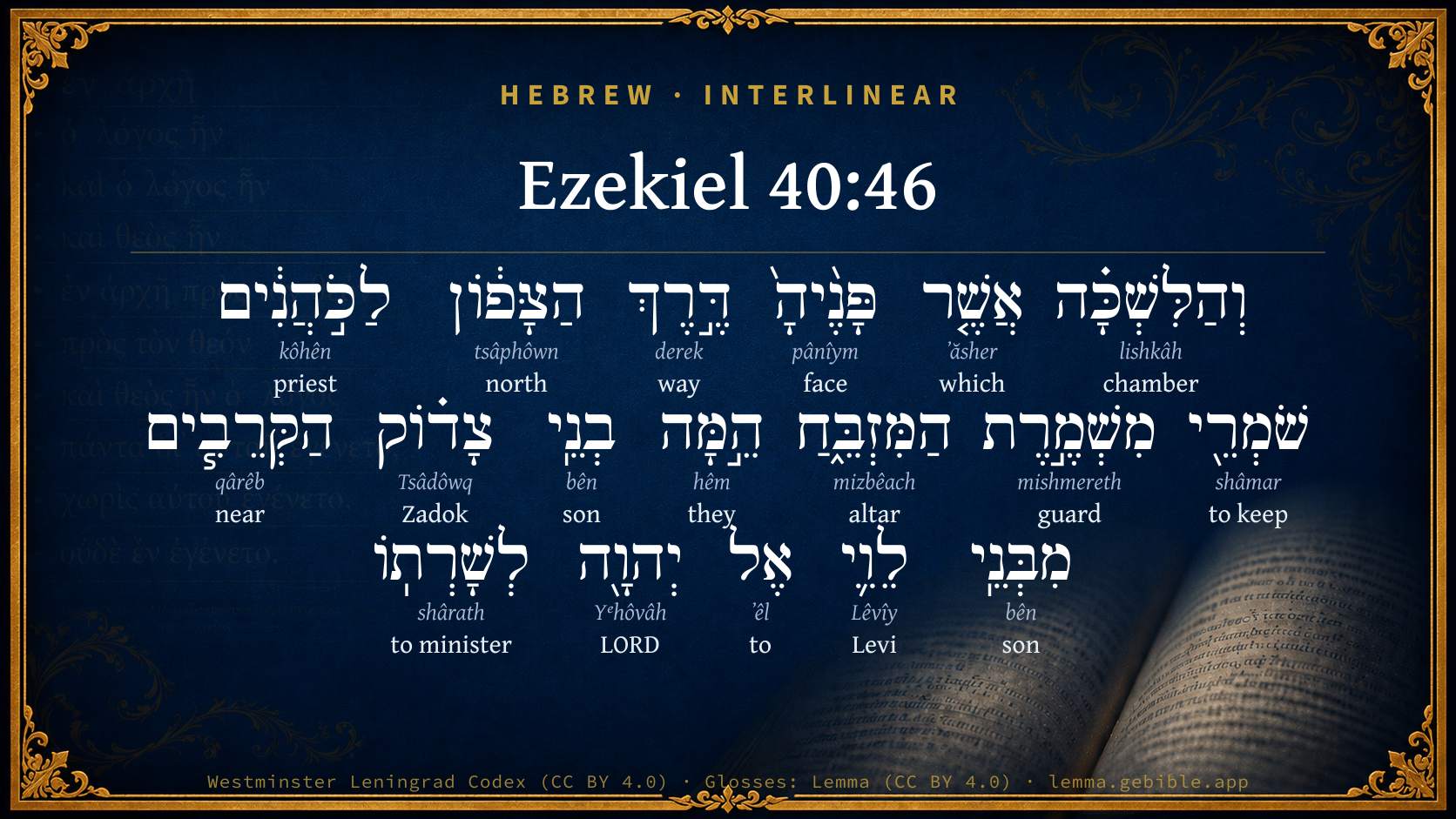
  1. וְהַלִּשְׁכָּ֗ה lishkâh H3957 “and · the · chamber” Conjunction + Particle, Definite Article + Noun, Common, Feminine, Singular, Absolute
  2. אֲשֶׁ֤ר ʼăsher H834 “which” Particle, Relative
  3. פָּנֶ֨יהָ֙ pânîym H6440 “face(s) · her” Noun, Common, Both, Plural, Construct + Suffix, Personal, 3rd Person, Feminine, Singular
  4. דֶּ֣רֶךְ derek H1870 “way of” Noun, Common, Both, Singular, Construct
  5. הַצָּפ֔וֹן tsâphôwn H6828 “the · north” Particle, Definite Article + Noun, Common, Feminine, Singular, Absolute
  6. לַכֹּ֣הֲנִ֔ים kôhên H3548 “to/for the · priests” Preposition, Determined + Noun, Common, Masculine, Plural, Absolute
  7. שֹׁמְרֵ֖י shâmar H8104 “keeping” Verb, Qal, Participle Active, Masculine, Plural, Construct
  8. מִשְׁמֶ֣רֶת mishmereth H4931 “guard of” Noun, Common, Feminine, Singular, Construct
  9. הַמִּזְבֵּ֑חַ mizbêach H4196 “the · altar” Particle, Definite Article + Noun, Common, Masculine, Singular, Absolute
  10. הֵ֣מָּה hêm H1992 “they” Pronoun, Personal, 3rd Person, Masculine, Plural
  11. בְנֵֽי bên H1121 “sons of” Noun, Common, Masculine, Plural, Construct
  12. צָד֗וֹק Tsâdôwq H6659 “Zadok” Noun, Proper
  13. מִבְּנֵֽי bên H1121 “from · sons of” Preposition + Noun, Common, Masculine, Plural, Construct
  14. לֵוִ֛י Lêvîy H3878 “Levi” Noun, Proper
  15. אֶל ʼêl H413 “to” Preposition
  16. יְהוָ֖ה Yᵉhôvâh H3068 “LORD” Noun, Proper
  17. לְשָׁרְתֽוֹ shârath H8334 “to minister · him” Preposition + Verb, Piel, Infinitive Construct + Suffix, Personal, 3rd Person, Masculine, Singular

About this verse

These counts appear in no published source. They are computed here, from the morphology-tagged text and Lemma’s own curated glosses. What Lemma adds →

18
words
17
distinct lemmas
Prophets
section

Notable vocabulary

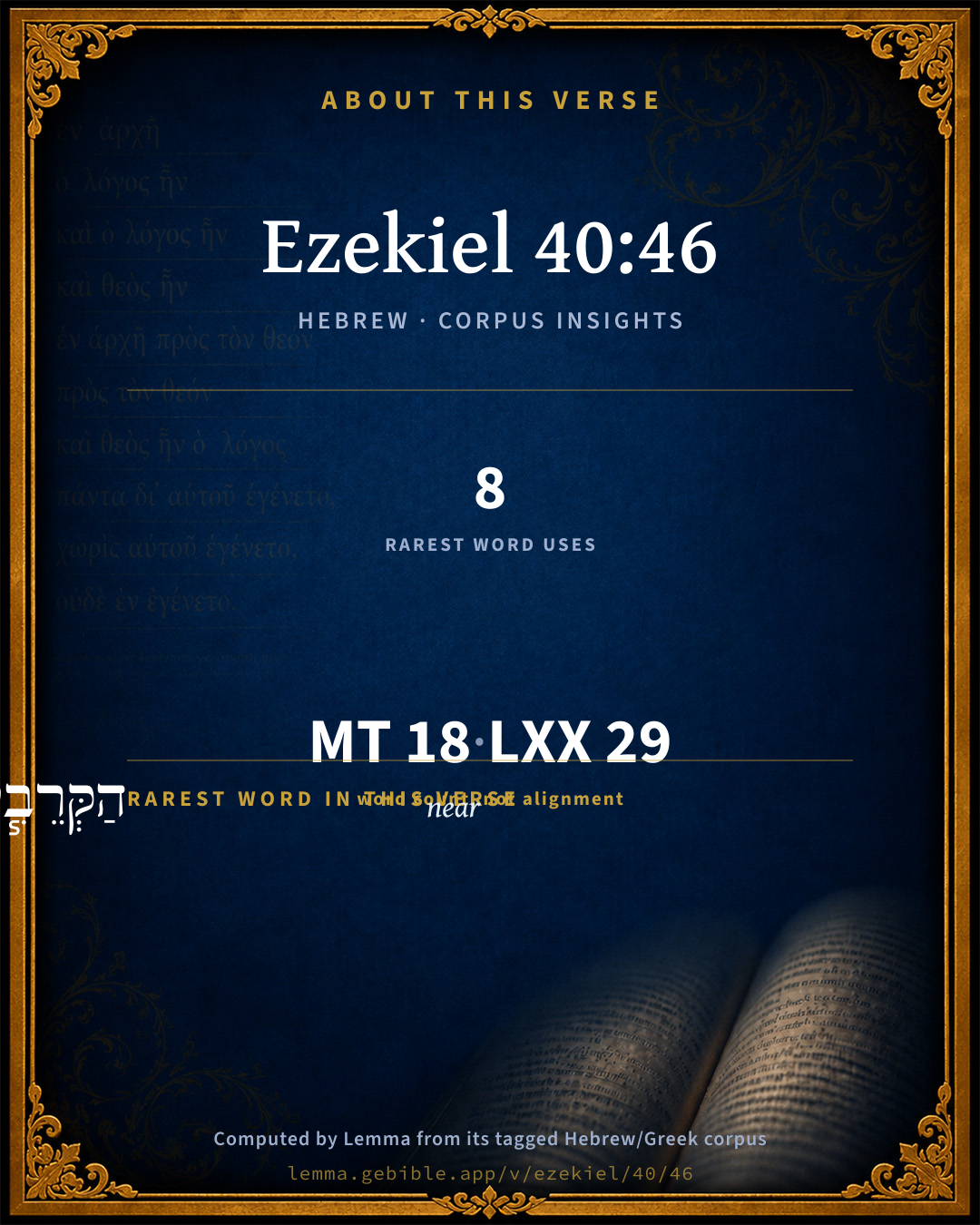
The rarest word here is הַקְּרֵבִ֧ים near H7131 — appearing just 8 times in the whole Hebrew Bible.

Shared distinctive vocabulary

הַקְּרֵבִ֧ים near H7131 occurs in 7 verses of the Hebrew Bible. Also found in:

Grammatical profile

  • 2 verbs
  • 12 nouns
  • 1 adjective
  • 1 pronoun
  • 1 preposition
  • 1 particle

Verb forms

  • שֹׁמְרֵ֖י Qal · Participle Active
  • לְשָׁרְתֽוֹ Piel · Infinitive Construct

Repetition

A word recurs within this verse — often emphatic in Hebrew:

  • בְנֵֽי son H1121 ×2

Hebrew & Septuagint length

In English translation the verse runs 42 words from the Hebrew and 40 from the Septuagint (LXX English) — closely comparable.

A rough comparison of the two English renderings, which tokenize alike — not a word-level alignment.

Word counts can differ between the Hebrew and the Greek without any difference in meaning — e.g. the Hebrew direct-object marker אֵת has no separate Greek word, and Greek often adds the article ὁ.

In the original languages it is 18 Hebrew tokens and 29 Greek tokens — but the two are counted differently (Hebrew bundles its prefixes and suffixes into one token; the Greek is in lemma form), so that isn’t a like-for-like length.

Cross-references

12

Topical passages linked to Ezekiel 40:46 in the Treasury of Scripture Knowledge — connected by theme and wording, ordered by reader-vote popularity; previews shown in the World English Bible.

  • Ezekiel 44:15 But the priests the Levites, the sons of Zadok, who kept the charge of my sanctuary when the children of Israel went astray from me, they shall come near to me to minister to me; and they shall stand before me to offer to me the fat and the blood, says the Lord Yahweh:
  • 1 Kings 2:35 The king put Benaiah the son of Jehoiada in his room over the host; and Zadok the priest did the king put in the room of Abiathar.
  • Ezekiel 43:19 You shall give to the priests the Levites who are of the seed of Zadok, who are near to me, to minister to me, says the Lord Yahweh, a young bull for a sin-offering.
  • Numbers 16:5 and he spoke to Korah and to all his company, saying, In the morning Yahweh will show who are his, and who is holy, and will cause him to come near to him: even him whom he shall choose will he cause to come near to him.
  • Numbers 18:5 You shall keep the charge of the sanctuary, and the charge of the altar; that there be wrath no more on the children of Israel.
  • Ezekiel 48:11 [It shall be] for the priests who are sanctified of the sons of Zadok, who have kept my charge, who didn't go astray when the children of Israel went astray, as the Levites went astray.
  • Leviticus 6:12–13 The fire on the altar shall be kept burning on it, it shall not go out; and the priest shall burn wood on it every morning: and he shall lay the burnt offering in order upon it, and shall burn on it the fat of the peace offerings.
  • Leviticus 10:3 Then Moses said to Aaron, "This is what Yahweh spoke of, saying, "'I will show myself holy to those who come near me, And before all the people I will be glorified.'" Aaron held his peace.
  • Numbers 16:40 to be a memorial to the children of Israel, to the end that no stranger, who isn't of the seed of Aaron, comes near to burn incense before Yahweh; that he not be as Korah, and as his company: as Yahweh spoke to him by Moses.
  • Ezekiel 42:13 Then said he to me, The north chambers and the south chambers, which are before the separate place, they are the holy chambers, where the priests who are near to Yahweh shall eat the most holy things: there shall they lay the most holy things, and the meal-offering, and the sin-offering, and the trespass-offering; for the place is holy.
  • Ezekiel 45:4 It is a holy portion of the land; it shall be for the priests, the ministers of the sanctuary, who come near to minister to Yahweh; and it shall be a place for their houses, and a holy place for the sanctuary.
  • Ephesians 2:13 But now in Christ Jesus you who once were far off are made near in the blood of Christ.

Cross-references courtesy of OpenBible.info (CC BY 4.0).

Hebrew and Greek witnesses Masoretic Hebrew ↔ Greek Septuagint

The same verse in the two great witnesses to the Old Testament, shown verse-for-verse.

These are two independent witnesses, not word-aligned to each other, and the Septuagint is shown in lemma (dictionary) form.

Hebrew Ezekiel 40:46 Masoretic · Westminster Leningrad Codex

וְהַלִּשְׁכָּ֗ה אֲשֶׁ֤ר פָּנֶ֨יהָ֙ דֶּ֣רֶךְ הַצָּפ֔וֹן לַכֹּ֣הֲנִ֔ים שֹׁמְרֵ֖י מִשְׁמֶ֣רֶת הַמִּזְבֵּ֑חַ הֵ֣מָּה בְנֵֽי צָד֗וֹק הַקְּרֵבִ֧ים מִבְּנֵֽי לֵוִ֛י אֶל יְהוָ֖ה לְשָׁרְתֽוֹ

and the chamber whose prospect is toward the north is for the priests, the keepers of the charge of the altar: these are the sons of Zadok, who from among the sons of Levi come near to Yahweh to minister to him.

World English Bible · Public Domain

Greek LXX Ezekiel 40:46 Septuagint · lemma form

καί ὁ ἐξέδρα ὁ βλέπω πρός βορέας ὁ ἱερεύς ὁ φυλάσσω ὁ φυλακή ὁ θυσιαστήριον ἐκεῖνος εἰμί ὁ υἱός σαδδουκ ὁ ἐγγίζω ἐκ ὁ λευί πρός κύριος λειτουργέω αὐτός

And the chamber that looks to the north is for the priests that keep the charge of the altar: they are the sons of Sadduc, those of the tribe of Levi who draw near to the Lord to serve him.

LXX2012 (modern English Septuagint) · Public Domain

On this verse, John Gill's Exposition discusses the Septuagint’s reading. Read the note in Commentary ↓

Hebrew: Westminster Leningrad Codex (CC BY 4.0). Greek: Septuagint (public domain); English from LXX2012 (modern English Septuagint) (Public Domain). How the Septuagint differs from the Hebrew →

Targum (Aramaic paraphrase)

1

The Targum is the ancient Jewish Aramaic paraphrase of the Hebrew Scriptures — an interpretive translation, not the Hebrew text itself. Onkelos (literal) and Pseudo-Jonathan (expansive) render the Torah, and Jonathan the Prophets. Coverage is partial: where no permissively-licensed English translation exists for a verse, only the Aramaic is shown. This is verse-level text, not a word-by-word alignment to the Hebrew.

  1. Targum Jonathan Prophets (Joshua–Malachi)
    וְלִשְׁכְּתָא דִפְתִיחַ לְאוֹרַח צִפּוּנָא לְכַהֲנַיָא נַטְרֵי מַטְרַת מַדְבְּחָא אִינוּן בְּנֵי צָדוֹק דְקָרְבִין מִבְּנֵי לֵוִי לְפוּלְחָנָא דַייָ לְשַׁמָשָׁא קֳדָמוֹהִי:

    (no public-domain English translation for this verse)

    Targum Jonathan — Aramaic: “Mikraot Gedolot” (public domain). English: “Sefaria Community Translation” (CC0 1.0 (public-domain dedication)); “London "Chaldee Paraphrase," 1871” (public domain). Text via Sefaria.

Commentary

Notes on Ezekiel 40:46 from classic Christian and Jewish commentators (each source and its license shown beneath its notes). The classic Christian expositions comment on the surrounding passage and are grouped to its opening verse, so a note may address several verses; the Jewish commentaries on the Tanakh (Rashi and others) are per-verse, so they appear only where the commentator wrote on this verse.

Lemma curates 59 commentaries, every one of them public domain or Creative Commons licensed, each selected and text-cleaned for this edition rather than reprinted as found. About our sources →

Trapp's Complete Commentary

John Trapp

Eze 40:46 And the chamber whose prospect [is] toward the north [is] for the priests, the keepers of the charge of the altar: these [are] the sons of Zadok among the sons of Levi, which come near to the LORD to minister unto him.

Ver. 46. Which come near.] Exo 19:22 Lev 10:3; Lev 21:17-18; Lev 21:21; Lev 21:23.

John Trapp, A Commentary or Exposition upon All the Books of the Old and New Testament (1647–1656) — public domain. Text from a community e-Sword module.

Tyndale Open Study Notes

Tyndale Open Resources

40:46 The Lord at last rewarded the loyalty of Zadok (see 44:15) by decreeing that his descendants were the only ones permitted to approach the Lord to minister to him. Access to God in this Temple was restricted to those whom the Lord had chosen and who were fit to enter the holy space.

Tyndale Open Study Notes — © Tyndale Open Resources, licensed CC BY-SA 4.0. Text via the HelloAO Bible API.

Jamieson, Fausset & Brown

Robert Jamieson, A. R. Fausset & David Brown

Zadok--lineally descended from Aaron. He had the high priesthood conferred on him by Solomon, who had set aside the family of Ithamar because of the part which Abiathar had taken in the rebellion of Adonijah (Kg1 1:7; Kg1 2:26-27).

Jamieson, Fausset & Brown — Commentary Critical and Explanatory on the Whole Bible (1871) — public domain (CC PDM 1.0). Text via the HelloAO Bible API.

The Cambridge Bible for Schools and Colleges

gen. ed. J. J. S. Perowne

46. The other chamber was for the ministrants at the altar; these were the sons of Zadok, Eze_44:15-31.

The Cambridge Bible for Schools and Colleges (gen. ed. J. J. S. Perowne; Cambridge University Press, 1878–1918) — public domain. Text from a community e-Sword module.

John Gill's Exposition

The length of the porch was twenty cubits,.... From east to west; from the first gate of it to the last; which led directly into the house, or temple:

and the breadth eleven cubits; which may be thus accounted for; two cubits apiece being allowed for each post, and three for each leaf of the door that were hung upon them, and one for the upright post in the middle on which they shut; in all eleven:

and he brought me by the steps whereby they went up to it; as there was an ascent of seven steps to the several gates that led into the outward court; and another of eight steps, which led from that to the gates of the inner court; so there was an ascent from the inner court to the porch of the house, or temple; but how many steps there were is not said. The Septuagint and Arabic versions read ten steps; and the Vulgate Latin version eight steps. According to the Misnah (w), there were twelve in the second temple; so say Jarchi and Kimchi, with whom Josephus (x) agrees. Cocceius thinks there could not be more than two, since the ground of the inward court and temple were continued; but as their number is not given, a determination cannot be made; only it may be observed, that the saints' progress in the knowledge of Christ, and of divine things, and in faith and holiness, is gradual.

And there were pillars by the posts, one on this side, and another on that side; one on the north side, and the other on the south, somewhat like the two pillars of Jachin and Boaz, in Solomon's temple; which some apply to the ordinances of the Gospel saints partake of at their entrance into the Gospel church; but rather they are an emblem of Christ, the supporter of his church, and of all those that aright enter into it; and who, through his grace and strength, become pillars there also, Rev 3:12, he is their Jachin, who establishes them on himself, the sure foundation; and their Boaz, in whom their strength is, and from whom they have it to exercise grace, discharge duty, and persevere to the end.

(w) Middot, c. 2. sect. 3. (x) De Bello Jud. l. 5. c. 5. sect. 4.

Next: Ezekiel Chapter 41

John Gill's Exposition of the Whole Bible (1746–1763) — public domain (CC PDM 1.0). Text via the HelloAO Bible API.

Albert Barnes' Notes on the Bible

The position of the “chamber” looking to the north commanded a view of the brasen altar and the sacrifices, which were prepared at the north side of the altar.

The sons of Zadok - The priests were all descended from one or other of the two sons of Aaron, Eleazar and Ithamar. David distributed the priestly offices between the families of Zadok, the representative of Eleazar, and Ahimelech, the representative of Ithamar 1Ch 24:3. From the time of Solomon not only the high priesthood, but the priesthood itself, so far as concerned its service, that of offering upon the two altars, seems to have been confined to the descendants of Zadok (see 1Ch 6:49-53). Perhaps the other offices, such as those mentioned in Eze 40:45, were performed by the descendants of Abiathar and Ithamar. Compare 1Sa 2:36, and below, Eze 43:19; Eze 44:15; Eze 48:11. The priests who had charge of the sacrifices were distinguished from the rest of the Levitical priests, “as they which come near to the Lord, and Eze 42:13 the priests that approach unto the Lord.”

Albert Barnes' Notes on the Bible (1834–1885) — public domain. Text from a community e-Sword/MySword module.

Haydock's Catholic Bible Commentary

Altar. Not on actual service, (chap. xli. 13.) but to prepare the victims.

George Leo Haydock (1774–1849), Haydock's Catholic Family Bible and Commentary, 1859 edition — public domain. Excludes Psalms (Douay-Rheims chapter numbering differs from Protestant) and Deuterocanonical books (Catholic canon only).

Matthew Poole's English Annotations

The chamber: see Eze 40:45.

For the priests, the keepers: see Eze 40:45.

Of the charge of the altar; to preserve the fire perpetually on the altar, &c.

Zadok; the high priest, who was put in by Solomon’s depriving of Abiathar, in whose race the high priesthood continued. While God’s order was observed, his sons, especially among the Levites, had this charge, and in their turns took care of the altar, which that they might the better do, they had those chambers, whose prospect I suppose was toward the altar.

Matthew Poole's English Annotations on the Holy Bible (1683–1685) — public domain. Text from a community e-Sword/MySword module.

The Pulpit Commentary

The keepers of the charge of the altar. These formed another body of priests, whose duties generally were to officiate in the temple-worship, and more specifically to sacrifice and burn incense upon the altars (Leviticus 1-6). Under the Law the priests were all descendants of Aaron. (Exo_27:20, 21 28:1-4 29:9, 44 40:15) By David these were divided into two classes the sons of Eleazar, at the head of whom stood Zadok; and the sons of Ithamar, with Ahimelech as their chief. (1Ch_24:3) In the vision-temple the sons of Zadok among the sons of Levi have the sole right of drawing near to the Lord to minister unto him. (see on Eze_43:15)

The Pulpit Commentary (1880–1919), ed. H.D.M. Spence-Jones & Joseph S. Exell — public domain. Text from a community e-Sword module.

John Wesley's Explanatory Notes

The keepers - To preserve the fire perpetually on the altar.

John Wesley, Explanatory Notes Upon the Whole Bible (1754–1765) — public domain. Text via the GEBible commentary corpus.

unfoldingWord translationNotes

Door43 World Missions Community

General Information:

The man continues speaking to Ezekiel in the vision.

The room facing north

This refers to the room on the south side of the inner courtyard. The door of the room was on the north side of the room. AT: "This room whose door is on its north side" or "This room on the south side of the inner courtyard"

the priests on duty at the altar

"the priests who were offering sacrifices on the altar"

come near to Yahweh to serve him

"approach Yahweh in his temple in order to serve him"

he measured

"the man measured"

cubits

See how you translated these "long" cubits in Ezekiel 40:05.

one hundred cubits

about 54 meters (See: Biblical Distance)

with the altar

"and the altar was"

the house

This refers to the temple.

translationWords

altar

son

Zadok

Yahweh

servant

Levi

house

unfoldingWord translationNotes — © Distant Shores Media and the Door43 World Missions Community, licensed CC BY-SA 4.0. Source: git.door43.org/Door43/en_tn.

Lesson kit

Teaching starters — assembled from the data on this page, not authored interpretation. Every prompt links to the verse data it draws on. Edit before teaching.

Ezekiel, in the Prophets, opens this verse with 18 words (17 distinct Hebrew lemmas). Its most distinctive word is qârêb (“near”). A historical commentator’s framing appears above. Read the whole chapter for the surrounding context.

Discussion questions

  1. How does “near” (qârêb) shape what this verse is saying?
  2. How does Numbers 17:13, which shares the word «near», read alongside this verse?
  3. What does the repetition of “son” (2× in this one verse) do in this verse?
  4. The translations on this page render this verse differently — a whole-verse word diff, not a word-by-word alignment. What might account for the different wordings?
  5. «שֹׁמְרֵ֖י» is a Qal Participle Active verb. How does that grammatical form shape the action described?
  6. Compare how Trapp's Complete Commentary and Tyndale Open Study Notes read this verse. Where do they agree or differ?

Things to notice

Reading settings

Reading text

Shown beneath each verse's original-language words.

Old Testament
Old Testament edition

Read the OT as the Masoretic Hebrew (MT) or the Greek Septuagint (LXX).

English shown for the Greek Septuagint (in the Hebrew ↔ Greek comparison).

Comparing translations? Open the Compare panel on any verse page to stack up to four side by side.