Numbers 27:19

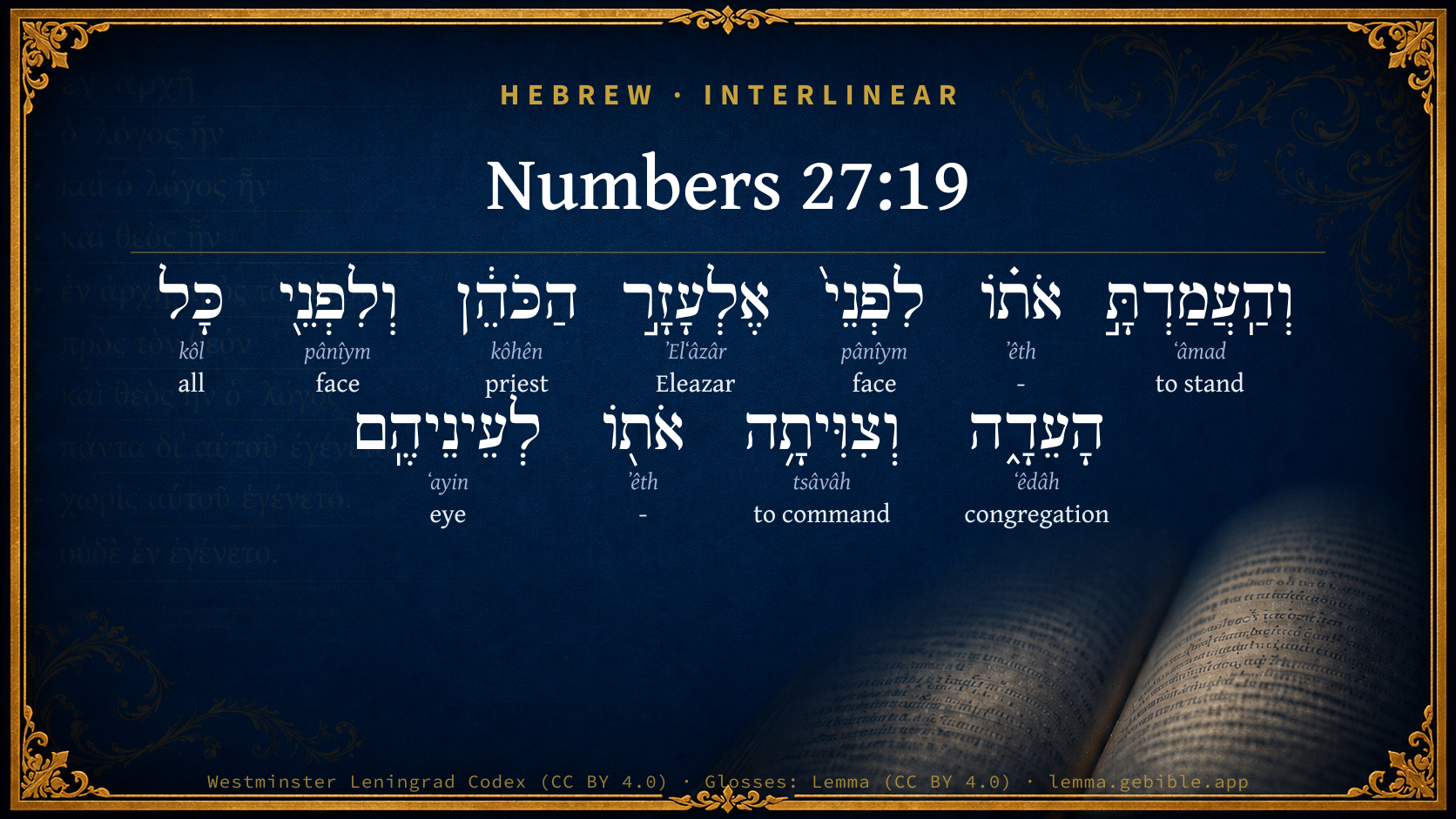
Hebrew (Westminster Leningrad Codex) Numbers 27:19 appears in the Hebrew Old Testament. The text above is from the Westminster Leningrad Codex. Each word links to its Strong’s number, a concise gloss, and parsing drawn from the Open Scriptures Hebrew Bible morphology. Click any word for its full Brown-Driver-Briggs (BDB) entry.
Download image
Cite this verse

Numbers 27:19 (World English Bible). Public Domain. Lemma interlinear Bible study tool, https://lemma.gebible.app/v/numbers/27/19.

Show BibTeX & RIS
BibTeX
RIS
English Translation
and set him before Eleazar the priest, and before all the congregation; and give him a charge in their sight.
World English Bible · Public Domain
Download a study sheet

One document with this verse’s original text, its word-by-word gloss line, the meaning frame, cross-references with their text, attributed commentary, and full source and license credits — printable, and it pastes into notes with its structure intact.

This verse Autodidact and up

Study sheet (.html) Plain text (.txt)

A passage Seminary Student

Up to 50 verses in one chapter. A passage sheet keeps up to 6 commentary sources and 12 cross-references per verse, in the order this page ranks them, and says so on the sheet whenever that leaves anything out. Ask for a single verse and you get the Autodidact verse sheet above.

Everything on this page stays free to read, with no account — the sheet is a download of what is already on screen, not access to it.

Want to remove ads? Support Godless Engineer
Compare translations 3

The same verse in 3 English versions, stacked beneath the original-language interlinear above. Click any original word for its lexicon entry.

Each is an independent rendering of the whole verse — the interlinear is not word-aligned to these translations.

Highlighted words mark where these versions differ — a whole-verse word diff, not a word-by-word alignment.

  • World English Bible Public Domain
    and set him before Eleazar the priest, and before all the congregation; and give him a charge in their sight.
  • King James Version Public Domain
    And set him before Eleazar the priest, and before all the congregation; and give him a charge in their sight.
  • unfoldingWord Literal Text CC BY-SA 4.0
    And you shall stand him before the face of Eleazar the priest and before the face of all the congregation, and you shall command him before their eyes.

unfoldingWord Literal Text — © unfoldingWord, licensed CC BY-SA 4.0. Word-aligned USFM3 via Door43 (git.door43.org/unfoldingWord/en_ult).

Versions to compare (up to 4)

3 of 4 selected

Show all 18 translations

Every available English version of this verse, each an independent rendering of the whole verse.

  • World English Bible Public Domain
    and set him before Eleazar the priest, and before all the congregation; and give him a charge in their sight.
  • Berean Standard Bible Public Domain
    Have him stand before Eleazar the priest and the whole congregation, and commission him in their sight.
  • Majority Standard Bible Public Domain
    Have him stand before Eleazar the priest and the whole congregation, and commission him in their sight.
  • King James Version Public Domain
    And set him before Eleazar the priest, and before all the congregation; and give him a charge in their sight.
  • American Standard Version (1901) Public Domain
    and set him before Eleazar the priest, and before all the congregation; and give him a charge in their sight.
  • Revised Version (1885) Public Domain
    and set him before Eleazar the priest, and before all the congregation; and give him a charge in their sight.
  • Geneva Bible (1599) Public Domain
    And set him before Eleazar the Priest, and before all the Congregation, and giue him a charge in their sight.
  • Douay-Rheims (1899) Public Domain
    And he shall stand before Eleazar the priest and all the multitude:
  • Young's Literal Translation Public Domain
    and hast caused him to stand before Eleazar the priest, and before all the company, and hast charged him before their eyes,
  • Literal Standard Version CC BY-SA 4.0
    and have caused him to stand before Eleazar the priest and before all the congregation, and have charged him before their eyes,
  • Unlocked Literal Bible CC BY-SA 4.0
    Place him before Eleazar the priest and before all the community, and command him before their eyes to lead them.
  • unfoldingWord Literal Text CC BY-SA 4.0
    And you shall stand him before the face of Eleazar the priest and before the face of all the congregation, and you shall command him before their eyes.
  • Darby Bible Public Domain
    and thou shalt set him before Eleazar the priest, and before the whole assembly; and give him commandment before their eyes.
  • World Messianic Bible Public Domain
    Set him before Eleazar the priest, and before all the congregation; and commission him in their sight.
  • Webster's Bible Public Domain
    And set him before Eleazar the priest, and before all the congregation: and give him a charge in their sight.
  • Free Bible Version CC BY-SA 4.0
    Make him stand in front of Eleazar the priest and all the Israelites, and dedicate him while they watch.
  • Bible in Basic English Public Domain
    And take him before Eleazar the priest and all the meeting of the people, and give him his orders before their eyes.
  • JPS Tanakh (1917) Public Domain
    and set him before Eleazar the priest, and before all the congregation; and give him a charge in their sight.

Literal Standard Version (2020), Covenant Press — licensed CC BY-SA 4.0. Text via the HelloAO Bible API (eBible.org). Unlocked Literal Bible (unfoldingWord) — licensed CC BY-SA 4.0. Text via the HelloAO Bible API (eBible.org). unfoldingWord Literal Text — © unfoldingWord, licensed CC BY-SA 4.0. Word-aligned USFM3 via Door43 (git.door43.org/unfoldingWord/en_ult). Free Bible Version, Dr. Jonathan Gallagher — licensed CC BY-SA 4.0. Text via the HelloAO Bible API (eBible.org).

Word by word

More ways to search: Search by grammar → Find every occurrence → Compare this word →

Practice this passage: Drill this verse → Learn its vocabulary →

אֶלְעָזָ֣ר
ʼElʻâzâr
H499
“Eleazar”
Noun, Proper
Part of Speech
Noun
Type
Proper
Full BDB Definition

Origin: from H410 and H5826

TWOT: None

Eleazar = "God has helped" - the high priest son of Aaron - Abinadab's son who cared for the ark - the priest who rebuilt and dedicated the restored walls of Jerusalem in time of Ezra - one of David's mighty warriors - a Levite - one of the line of Parosh
  1. וְהַֽעֲמַדְתָּ֣ ʻâmad H5975 “and · to stand” Conjunction + Verb, Hiphil, Sequential Perfect, 2nd Person, Masculine, Singular
  2. אֹת֗וֹ ʼêth H853 “- · him” Particle, Direct Object + Suffix, Personal, 3rd Person, Masculine, Singular
  3. לִפְנֵי֙ pânîym H6440 “to/for · face(s) of” Preposition + Noun, Common, Both, Plural, Construct
  4. הַכֹּהֵ֔ן kôhên H3548 “the · priest” Particle, Definite Article + Noun, Common, Masculine, Singular, Absolute
  5. וְלִפְנֵ֖י pânîym H6440 “and · to/for · face(s) of” Conjunction + Preposition + Noun, Common, Both, Plural, Construct
  6. כָּל kôl H3605 “all of” Noun, Common, Masculine, Singular, Construct
  7. הָעֵדָ֑ה ʻêdâh H5712 “the · congregation” Particle, Definite Article + Noun, Common, Feminine, Singular, Absolute
  8. וְצִוִּיתָ֥ה tsâvâh H6680 “and · to command” Conjunction + Verb, Piel, Sequential Perfect, 2nd Person, Masculine, Singular
  9. אֹת֖וֹ ʼêth H853 “- · him” Particle, Direct Object + Suffix, Personal, 3rd Person, Masculine, Singular
  10. לְעֵינֵיהֶֽם ʻayin H5869 “to/for · eyes · their” Preposition + Noun, Common, Both, Dual, Construct + Suffix, Personal, 3rd Person, Masculine, Plural

About this verse

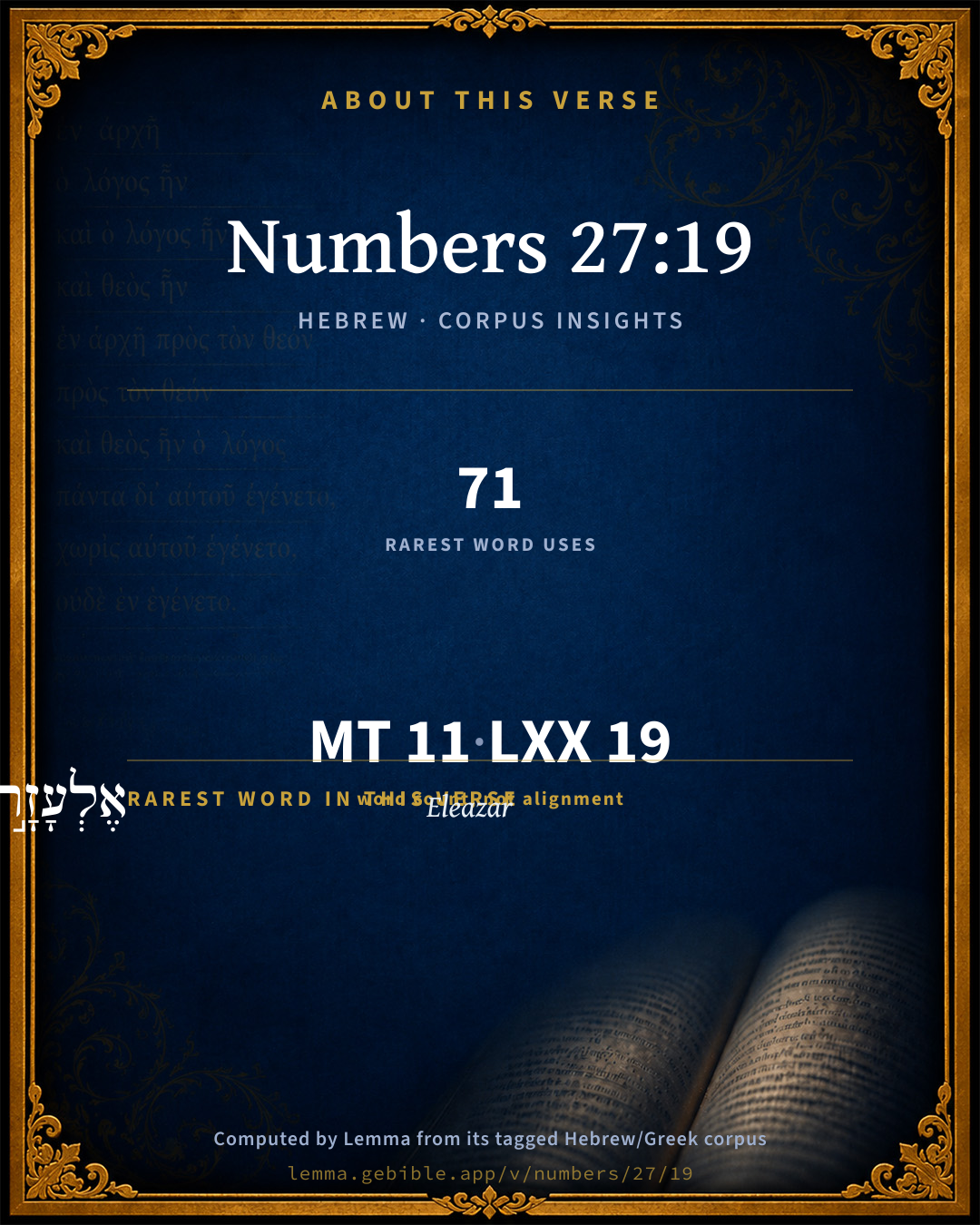
These counts appear in no published source. They are computed here, from the morphology-tagged text and Lemma’s own curated glosses. What Lemma adds →

11
words
9
distinct lemmas
Pentateuch
section

Grammatical profile

  • 2 verbs
  • 7 nouns
  • 2 particles

Verb forms

  • וְהַֽעֲמַדְתָּ֣ Hiphil · Sequential Perfect
  • וְצִוִּיתָ֥ה Piel · Sequential Perfect

Repetition

A word recurs within this verse — often emphatic in Hebrew:

  • לִפְנֵי֙ face H6440 ×2

Hebrew & Septuagint length

In English translation the verse runs 20 words from the Hebrew and 30 from the Septuagint (LXX English) — the Septuagint runs noticeably longer here. See the side-by-side →

A rough comparison of the two English renderings, which tokenize alike — not a word-level alignment.

Word counts can differ between the Hebrew and the Greek without any difference in meaning — e.g. the Hebrew direct-object marker אֵת has no separate Greek word, and Greek often adds the article ὁ.

In the original languages it is 11 Hebrew tokens and 19 Greek tokens — but the two are counted differently (Hebrew bundles its prefixes and suffixes into one token; the Greek is in lemma form), so that isn’t a like-for-like length.

Cross-references

10

Topical passages linked to Numbers 27:19 in the Treasury of Scripture Knowledge — connected by theme and wording, ordered by reader-vote popularity; previews shown in the World English Bible.

  • Deuteronomy 3:28 But charge Joshua, and encourage him, and strengthen him; for he shall go over before this people, and he shall cause them to inherit the land which you shall see.
  • Deuteronomy 31:7–8 Moses called to Joshua, and said to him in the sight of all Israel, Be strong and of good courage: for you shall go with this people into the land which Yahweh has sworn to their fathers to give them; and you shall cause them to inherit it.
  • Deuteronomy 31:23 He gave Joshua the son of Nun a charge, and said, Be strong and of good courage; for you shall bring the children of Israel into the land which I swore to them: and I will be with you.
  • Luke 9:1–5 He called the twelve together, and gave them power and authority over all demons, and to cure diseases.
  • Luke 10:2–11 Then he said to them, "The harvest is indeed plentiful, but the laborers are few. Pray therefore to the Lord of the harvest, that he may send out laborers into his harvest.
  • Acts 20:28–31 Take heed, therefore, to yourselves, and to all the flock, in which the Holy Spirit has made you overseers, to shepherd the assembly of the Lord and God which he purchased with his own blood.
  • Colossians 4:17 Tell Archippus, "Take heed to the ministry which you have received in the Lord, that you fulfill it."
  • 1 Timothy 5:21 I charge you in the sight of God, and Christ Jesus, and the chosen angels, that you observe these things without prejudice, doing nothing by partiality.
  • 1 Timothy 6:13–17 I charge you before God, who gives life to all things, and before Christ Jesus, who before Pontius Pilate testified the good confession,
  • 2 Timothy 4:1–6 I charge you therefore before God and the Lord Jesus Christ, who will judge the living and the dead at his appearing and his Kingdom:

Cross-references courtesy of OpenBible.info (CC BY 4.0).

Hebrew and Greek witnesses Masoretic Hebrew ↔ Greek Septuagint

The same verse in the two great witnesses to the Old Testament, shown verse-for-verse.

Here the Septuagint runs noticeably longer than the Hebrew — LXX2012 (modern English Septuagint) 30 words vs World English Bible 20. A rough length comparison of the two English translations, not a word-level alignment — read both below.

These are two independent witnesses, not word-aligned to each other, and the Septuagint is shown in lemma (dictionary) form.

Hebrew Numbers 27:19 Masoretic · Westminster Leningrad Codex

וְהַֽעֲמַדְתָּ֣ אֹת֗וֹ לִפְנֵי֙ אֶלְעָזָ֣ר הַכֹּהֵ֔ן וְלִפְנֵ֖י כָּל הָעֵדָ֑ה וְצִוִּיתָ֥ה אֹת֖וֹ לְעֵינֵיהֶֽם

and set him before Eleazar the priest, and before all the congregation; and give him a charge in their sight.

World English Bible · Public Domain

Greek LXX Numbers 27:19 Septuagint · lemma form

καί ἵστημι αὐτός ἔναντι ελεαζαρ ὁ ἱερεύς καί ἐντελλόμαι αὐτός ἔναντι πᾶς συναγωγή καί ἐντελλόμαι περί αὐτός ἐναντίον αὐτός

And you shall set him before Eleazar the priest, and you shall give him a charge before all the congregation, and you shall give a charge concerning him before them.

LXX2012 (modern English Septuagint) · Public Domain

On this verse, The Pulpit Commentary discusses the Septuagint’s reading. Read the note in Commentary ↓

Hebrew: Westminster Leningrad Codex (CC BY 4.0). Greek: Septuagint (public domain); English from LXX2012 (modern English Septuagint) (Public Domain). How the Septuagint differs from the Hebrew →

Targum (Aramaic paraphrase)

2

The Targum is the ancient Jewish Aramaic paraphrase of the Hebrew Scriptures — an interpretive translation, not the Hebrew text itself. Onkelos (literal) and Pseudo-Jonathan (expansive) render the Torah, and Jonathan the Prophets. Coverage is partial: where no permissively-licensed English translation exists for a verse, only the Aramaic is shown. This is verse-level text, not a word-by-word alignment to the Hebrew.

  1. Targum Onkelos Torah (Genesis–Deuteronomy)
    וּתְקֵים יָתֵיהּ לָקֳדָם אֶלְעָזָר כַּהֲנָא וְלָקֳדָם כָּל כְּנִשְׁתָּא וּתְפַקֵד יָתֵיהּ לְעֵינֵיהוֹן

    (no public-domain English translation for this verse)

    Targum Onkelos — Aramaic: “Onkelos Genesis” (public domain); “Onkelos Exodus” (public domain); “Onkelos Leviticus” (public domain); “Onkelos Numbers” (public domain); “Onkelos Deuteronomy” (public domain). English: “Sefaria Community Translation” (CC0 1.0 (public-domain dedication)); “J.W. Etheridge. The Targums of Onkelos and Jonathan Ben Uzziel on the Pentateuch. London: Longmans, Green, 1862” (public domain). Text via Sefaria.

  2. Targum Pseudo-Jonathan Torah (Genesis–Deuteronomy)
    וְתָקִים יָתֵיהּ קֳדָם אֶלְעָזָר כַּהֲנָא וְקָדָם כָּל כְּנִישְׁתָּא וְתַפְקֵיד יָתֵיהּ לְמֵיחְמֵיהוֹן

    and make him stand before Elazar the priest and the whole congregation, and instruct him in their presence.

    Targum Pseudo-Jonathan — Aramaic: “Targum Jonathan on Genesis” (public domain); “Targum Jonathan on Exodus” (public domain); “Targum Jonathan on Leviticus” (public domain); “Targum Jonathan on Numbers” (public domain); “Targum Jonathan on Deuteronomy” (public domain). English: “The Targum of Jonathan ben Uzziel, trans. J. W. Etheridge, London, 1862” (public domain). Text via Sefaria.

Commentary

Notes on Numbers 27:19 from classic Christian and Jewish commentators (each source and its license shown beneath its notes). The classic Christian expositions comment on the surrounding passage and are grouped to its opening verse, so a note may address several verses; the Jewish commentaries on the Tanakh (Rashi and others) are per-verse, so they appear only where the commentator wrote on this verse.

Lemma curates 59 commentaries, every one of them public domain or Creative Commons licensed, each selected and text-cleaned for this edition rather than reprinted as found. About our sources →

Joseph Benson's Commentary

Num 27:19. Before all the congregation — That they may be witnesses of the whole action, and may acknowledge him for their supreme ruler. Give him charge — Thou shalt give him counsels and instructions for the right management of that great trust.

Joseph Benson's Commentary on the Old and New Testaments (1811–1818) — public domain. Text from a community e-Sword module.

Ellicott's Commentary for English Readers

(19) And give him a charge . . . —Comp. Deu_31:23, “And he gave Joshua the son of Nun a charge, and said, Be strong and of a good courage.”

A Bible Commentary for English Readers, edited by Charles John Ellicott (1878–1897) — public domain. Text from a community e-Sword module.

The Cambridge Bible for Schools and Colleges

gen. ed. J. J. S. Perowne

19. and give him a charge] and thou shalt command him; i.e. declare to him solemnly the way in which he is to govern.

The Cambridge Bible for Schools and Colleges (gen. ed. J. J. S. Perowne; Cambridge University Press, 1878–1918) — public domain. Text from a community e-Sword module.

John Gill's Exposition

And thou shalt put some of thine honour upon him,.... Meaning not the Spirit that was on Moses, and the gifts of the Spirit; for to do this was the work of the Lord, and not Moses, see Num 11:17, but of the honour of civil government; suggesting that he should give him a share in it, and use him not as a minister and servant, as he had been, but as his colleague and partner; and let him have some of the ensigns of power and authority, and some exercise of it; not only to inure him to government, but to make him respectable among the people:

that all the congregation of Israel may be obedient; to him as their ruler and governor, hearken to his words, and obey his commands.

John Gill's Exposition of the Whole Bible (1746–1763) — public domain (CC PDM 1.0). Text via the HelloAO Bible API.

Matthew Poole's English Annotations

That they may be witnesses of the whole action, and may acknowledge him for their supreme ruler.

Give him a charge: thou shalt command him in my name to undertake the government of my people, which otherwise he will be afraid and unwilling to do, and thou shalt give him counsels and instructions for the right management of that great trust.

Matthew Poole's English Annotations on the Holy Bible (1683–1685) — public domain. Text from a community e-Sword/MySword module.

Whedon's Commentary on the Bible

Daniel D. Whedon

19. Eleazar the priest — The high priest. In the Pentateuch the definite article the sufficiently designated the high priest, except in Num_35:25, and Lev_21:10, where the adjective gadhol, great, is used.

Give him a charge — Literally, command or instruct him in regard to this high office in the sight of the congregation.

Daniel D. Whedon (gen. ed.), Commentary on the Old and New Testaments (1874–1909) — public domain. Text from a community e-Sword module.

The Pulpit Commentary

Give him a charge. htyWxi. Septuagint, entelh autw . Command or instruct him as to his duties.

The Pulpit Commentary (1880–1919), ed. H.D.M. Spence-Jones & Joseph S. Exell — public domain. Text from a community e-Sword module.

John Wesley's Explanatory Notes

Before all the congregation - That they may be witnesses of the whole action, and may acknowledge him for their supreme ruler. Give him charge - Thou shalt give him counsels and instructions for the right management of that great trust.

John Wesley, Explanatory Notes Upon the Whole Bible (1754–1765) — public domain. Text via the GEBible commentary corpus.

Rashi

Rabbi Shlomo Yitzchaki (Rashi)

וצויתה אתו AND GIVE HIM A CHARGE concerning Israel; say to him, “Know that they are troublesome, that they are refractory — accept your office having in mind that you will have to take upon yourself all this (cf. Sifrei Bamidbar 92 on 11:16).

Rashi on the Tanakh — English translations: “The Judaica Press complete Tanach with Rashi, translated by A. J. Rosenberg” (CC BY 4.0); “Pentateuch with Rashi's commentary by M. Rosenbaum and A.M. Silbermann, 1929-1934” (public domain); “The Metsudah Tanach series, Lakewood, N.J” (CC BY 4.0); and “The Book of Joshua, Metsudah Publications, 1997” (CC BY 4.0). Text via Sefaria.

Ramban (Nachmanides)

Rabbi Moshe ben Nachman (Ramban / Nachmanides)

AND THOU SHALT COMMAND HIM [Joshua] — “concerning Israel, [saying to him]: ‘Know that they are troublesome, that they are stubborn. [Accept this position of leadership over them with full awareness of this and] on condition that you take upon yourself [all this].’” This is the language of Rashi. But it is not correct in my opinion, because it says [and thou shalt command him] before their eyes [and Moses would not have told Joshua to say such words in their presence], for this matter ought rather to have been told to him [Joshua] between the two of them [Moses and Joshua]; for if he would say it in their presence, it would [only] have caused them to break off all restraint. And it would have been more fitting that he [Moses] should chastise the people, warning them separately [and not in Joshua’s presence] not to be troublesome and stubborn any more [rather than to tell Joshua, in their presence, that they were a troublesome and stubborn people]! But [the meaning of] and thou shalt command him before their eyes is that you should instruct him in the duties of a prince and judge, since it was because he [Joshua] was to be their leader that he entrusted them to his care. [Therefore] he should [indeed] have warned him to exert himself exceedingly on their behalf, and to fight the battles of the Eternal, and that he should be the one to go out before them [in battle] and to bring them in, and that he should be careful in matters of judgment. These [instructions] indeed ought to be said in their presence, in order that they should trust him and listen to him, for they would then know that he will treat their affairs in a truthful manner, since his master had so commanded him. And this is what Moses [actually] did, as it is said there, And Moses called unto Joshua, and said unto him in the sight of all Israel: ‘Be strong and of good courage etc. fear not, neither be dismayed.’ And in the Sifre [we find the following text]: “And command Joshua — concerning instruction [learning and teaching Torah]. And encourage ‘him,’ and strengthen ‘him.’ This teaches us that there cannot be two leaders in one generation.” Now these are duties of the prince, to be firm and not to be afraid of the people.In my opinion the plain meaning of Scripture is that the explanation of [the expression] ‘v’tzav’ (and thou shalt command) him before their eyes is [that it refers to] appointing [him officially as their leader], for Moses was to appoint Joshua in the presence of the people to be the ruler over them. This is similar to [the expression], from the time ‘tzivah othi’ (I was appointed) to be their governor etc. So also: ‘vayetzaveihu’ (and the Eternal hath appointed him) to be the prince over His people. Similarly, Even from the day that ‘tzivithi’(‘I commanded’) judges to be over My people Israel, which means “I appointed” [and likewise all these expressions of ‘tzav,’ which literally mean “command,” here mean “appoint”].

Ramban (Nachmanides) on the Tanakh — English translation: “Commentary on the Torah by Ramban (Nachmanides). Translated and annotated by Charles B. Chavel. New York, Shilo Pub. House, 1971-1976” (CC BY 4.0). Text via Sefaria.

Lesson kit

Teaching starters — assembled from the data on this page, not authored interpretation. Every prompt links to the verse data it draws on. Edit before teaching.

Numbers, in the Pentateuch, opens this verse with 11 words (9 distinct Hebrew lemmas). Its most distinctive word is ʼElʻâzâr (“Eleazar”). The Greek Septuagint runs longer here. A historical commentator’s framing appears above. Read the whole chapter for the surrounding context.

Discussion questions

  1. The word ʼElʻâzâr carries the sense “Eleazar.” How does it shape the verse?
  2. How does Deuteronomy 3:28, which shares this passage’s theme, read alongside this verse?
  3. What does the repetition of “face” (2× in this one verse) do in this verse?
  4. The Septuagint runs longer here than the Hebrew. What might account for the difference?
  5. The translations on this page render this verse differently — a whole-verse word diff, not a word-by-word alignment. What might account for the different wordings?
  6. «וְהַֽעֲמַדְתָּ֣» is a Hiphil Sequential Perfect verb. How does that grammatical form shape the action described?
  7. Compare how Joseph Benson's Commentary and Ellicott's Commentary for English Readers read this verse. Where do they agree or differ?

Things to notice

Reading settings

Reading text

Shown beneath each verse's original-language words.

Old Testament
Old Testament edition

Read the OT as the Masoretic Hebrew (MT) or the Greek Septuagint (LXX).

English shown for the Greek Septuagint (in the Hebrew ↔ Greek comparison).

Comparing translations? Open the Compare panel on any verse page to stack up to four side by side.