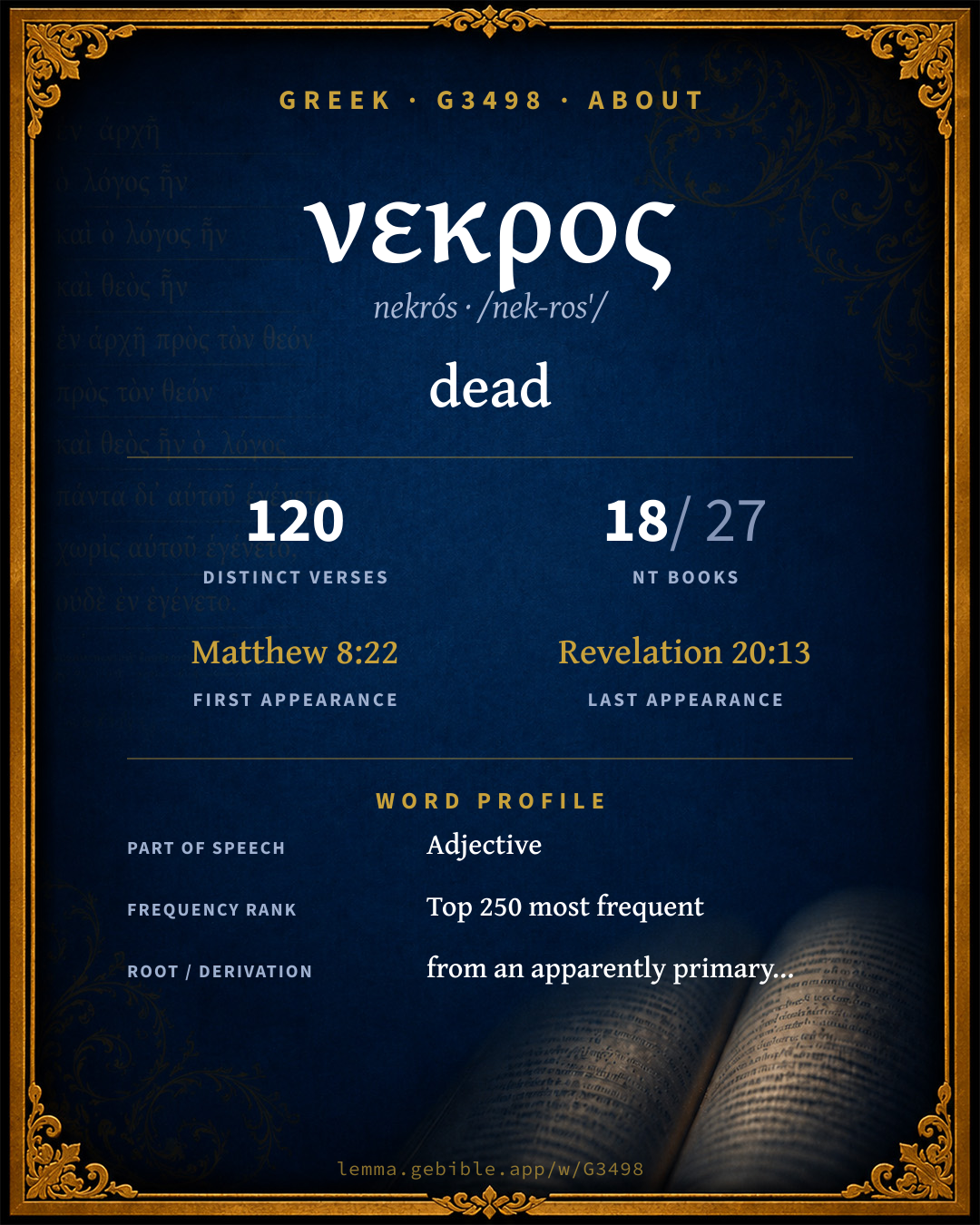
νεκρός
dead
‘dead’ is one of 2 main senses fuller range ↓
Full lexicon entry — Thayer's Greek Lexicon
From Thayer's Greek Lexicon
Where this word appears
See every Genitive-case word in the Greek New Testament →
Grammar key — what these labels mean
Part of speech
- Adjective
- A word that describes or qualifies a noun.
Case
- Genitive
- The case of source, possession, or “of” — answers “whose / from what.”
- Accusative
- The case of the direct object and of extent.
- Nominative
- The case of the subject (and the predicate nominative).
- Dative
- The case of the indirect object, means, or location — “to / for / with / in.”
Gender
- Masculine
- Grammatically masculine.
- Feminine
- Grammatically feminine.
- Neuter
- Grammatically neuter.
Number
- Plural
- More than one.
- Singular
- One.
Grammatical forms 11 distinct
- Adjective, Genitive, Plural, Masculine 74 times (58%)
- Adjective, Accusative, Plural, Masculine 19 times (15%)
- Adjective, Nominative, Plural, Masculine 14 times (11%)
- Adjective, Nominative, Singular, Masculine 9 times (7%)
- Adjective, Nominative, Singular, Feminine 3 times (2%)
- Adjective, Dative, Plural, Masculine 2 times (2%)
- Adjective, Genitive, Plural, Neuter 2 times (2%)
- Adjective, Nominative, Singular, Neuter 2 times (2%)
+3 more forms (3 occurrences)
Parsed forms decoded from the imported morphology (Robinson–Tischendorf, public domain), counted across 128 parsed occurrences — not distinct verses.
Every verse where G3498 appears — 120 distinct verses across 18 books. Click any verse to open its interlinear word-by-word view. Verse text shown in the World English Bible for context — . Each verse’s Greek form is shown with its reference; the English is not keyword-highlighted, since the data carries no word-level English alignment. Use “Compare translations” on any verse to read it across multiple English versions. This concordance covers the Greek New Testament; Septuagint (Greek Old Testament) occurrences of this word are not indexed here.
Matthew 11 verses
- Matthew 8:22 νεκροὺς νεκρούς adj acc pl masc adj acc pl masc But Jesus said to him, "Follow me, and leave the dead to bury their own dead."
- Matthew 10:8 νεκροὺς adj acc pl masc Heal the sick, cleanse the lepers, and cast out demons. Freely you received, so freely give.
- Matthew 11:5 νεκροὶ adj nom pl masc the blind receive their sight, the lame walk, the lepers are cleansed, the deaf hear, the dead are raised up, and the poor have good news preached to them.
- Matthew 14:2 νεκρῶν adj gen pl masc and said to his servants, "This is John the Baptizer. He is risen from the dead. That is why these powers work in him."
- Matthew 17:9 νεκρῶν adj gen pl masc As they were coming down from the mountain, Jesus commanded them, saying, "Don't tell anyone what you saw, until the Son of Man has risen from the dead."
- Matthew 22:31 νεκρῶν adj gen pl masc But concerning the resurrection of the dead, haven't you read that which was spoken to you by God, saying,
- Matthew 22:32 νεκρῶν adj gen pl masc 'I am the God of Abraham, and the God of Isaac, and the God of Jacob?' God is not the God of the dead, but of the living."
- Matthew 23:27 νεκρῶν adj gen pl masc "Woe to you, scribes and Pharisees, hypocrites! For you are like whitened tombs, which outwardly appear beautiful, but inwardly are full of dead men's bones, and of all uncleanness.
- Matthew 27:64 νεκρῶν adj gen pl masc Command therefore that the tomb be made secure until the third day, lest perhaps his disciples come at night and steal him away, and tell the people, 'He is risen from the dead;' and the last deception will be worse than the first."
- Matthew 28:4 νεκροί adj nom pl masc For fear of him, the guards shook, and became like dead men.
- Matthew 28:7 νεκρῶν adj gen pl masc Go quickly and tell his disciples, 'He has risen from the dead, and behold, he goes before you into Galilee; there you will see him.' Behold, I have told you."
Mark 7 verses
- Mark 6:14 νεκρῶν adj gen pl masc King Herod heard this, for his name had become known, and he said, "John the Baptizer has risen from the dead, and therefore these powers are at work in him."
- Mark 9:9 νεκρῶν adj gen pl masc As they were coming down from the mountain, he charged them that they should tell no one what things they had seen, until after the Son of Man had risen from the dead.
- Mark 9:10 νεκρῶν adj gen pl masc They kept this saying to themselves, questioning what the "rising from the dead" meant.
- Mark 9:26 νεκρός adj nom sg masc Having cried out, and convulsed greatly, it came out of him. The boy became like one dead; so much that most of them said, "He is dead."
- Mark 12:25 νεκρῶν adj gen pl masc For when they will rise from the dead, they neither marry, nor are given in marriage, but are like angels in heaven.
- Mark 12:26 νεκρῶν adj gen pl masc But about the dead, that they are raised; haven't you read in the book of Moses, about the Bush, how God spoke to him, saying, 'I am the God of Abraham, the God of Isaac, and the God of Jacob?'
- Mark 12:27 νεκρῶν adj gen pl masc He is not the God of the dead, but of the living. You are therefore badly mistaken."
Luke 13 verses
- Luke 7:15 νεκρὸς adj nom sg masc He who was dead sat up, and began to speak. And he gave him to his mother.
- Luke 7:22 νεκροὶ adj nom pl masc Jesus answered them, "Go and tell John the things which you have seen and heard: that the blind receive their sight, the lame walk, the lepers are cleansed, the deaf hear, the dead are raised up, and the poor have good news preached to them.
- Luke 9:7 νεκρῶν adj gen pl masc Now Herod the tetrarch heard of all that was done by him; and he was very perplexed, because it was said by some that John had risen from the dead,
- Luke 9:60 νεκροὺς νεκρούς adj acc pl masc adj acc pl masc But Jesus said to him, "Leave the dead to bury their own dead, but you go and announce the Kingdom of God."
- Luke 15:24 νεκρὸς adj nom sg masc for this, my son, was dead, and is alive again. He was lost, and is found.' They began to celebrate.
- Luke 15:32 νεκρὸς adj nom sg masc But it was appropriate to celebrate and be glad, for this, your brother, was dead, and is alive again. He was lost, and is found.'"
- Luke 16:30 νεκρῶν adj gen pl masc "He said, 'No, father Abraham, but if one goes to them from the dead, they will repent.'
- Luke 16:31 νεκρῶν adj gen pl masc "He said to him, 'If they don't listen to Moses and the prophets, neither will they be persuaded if one rises from the dead.'"
- Luke 20:35 νεκρῶν adj gen pl masc But those who are considered worthy to attain to that age and the resurrection from the dead, neither marry, nor are given in marriage.
- Luke 20:37 νεκροί adj nom pl masc But that the dead are raised, even Moses showed at the bush, when he called the Lord 'The God of Abraham, the God of Isaac, and the God of Jacob.'
- Luke 20:38 νεκρῶν adj gen pl masc Now he is not the God of the dead, but of the living, for all are alive to him."
- Luke 24:5 νεκρῶν adj gen pl masc Becoming terrified, they bowed their faces down to the earth. They said to them, "Why do you seek the living among the dead?
- Luke 24:46 νεκρῶν adj gen pl masc He said to them, "Thus it is written, and thus it was necessary for the Christ to suffer and to rise from the dead the third day,
John 8 verses
- John 2:22 νεκρῶν adj gen pl masc When therefore he was raised from the dead, his disciples remembered that he said this, and they believed the Scripture, and the word which Jesus had said.
- John 5:21 νεκροὺς adj acc pl masc For as the Father raises the dead and gives them life, even so the Son also gives life to whom he desires.
- John 5:25 νεκροὶ adj nom pl masc Most assuredly, I tell you, the hour comes, and now is, when the dead will hear the Son of God's voice; and those who hear will live.
- John 12:1 νεκρῶν adj gen pl masc Then six days before the Passover, Jesus came to Bethany, where Lazarus was, who had been dead, whom he raised from the dead.
- John 12:9 νεκρῶν adj gen pl masc A large crowd therefore of the Jews learned that he was there, and they came, not for Jesus' sake only, but that they might see Lazarus also, whom he had raised from the dead.
- John 12:17 νεκρῶν adj gen pl masc The multitude therefore that was with him when he called Lazarus out of the tomb, and raised him from the dead, was testifying about it.
- John 20:9 νεκρῶν adj gen pl masc For as yet they didn't know the Scripture, that he must rise from the dead.
- John 21:14 νεκρῶν adj gen pl masc This is now the third time that Jesus was revealed to his disciples, after he had risen from the dead.
Acts 17 verses
- Acts 3:15 νεκρῶν adj gen pl masc and killed the Prince of life, whom God raised from the dead, to which we are witnesses.
- Acts 4:2 νεκρῶν adj gen pl masc being upset because they taught the people and proclaimed in Jesus the resurrection from the dead.
- Acts 4:10 νεκρῶν adj gen pl masc be it known to you all, and to all the people of Israel, that in the name of Jesus Christ of Nazareth, whom you crucified, whom God raised from the dead, in him does this man stand here before you whole.
- Acts 5:10 νεκράν adj acc sg fem She fell down immediately at his feet, and died. The young men came in and found her dead, and they carried her out and buried her by her husband.
- Acts 10:41 νεκρῶν adj gen pl masc not to all the people, but to witnesses who were chosen before by God, to us, who ate and drank with him after he rose from the dead.
- Acts 10:42 νεκρῶν adj gen pl masc He charged us to preach to the people and to testify that this is he who is appointed by God as the Judge of the living and the dead.
- Acts 13:30 νεκρῶν adj gen pl masc But God raised him from the dead,
- Acts 13:34 νεκρῶν adj gen pl masc "Concerning that he raised him up from the dead, now no more to return to corruption, he has spoken thus: 'I will give you the holy and sure blessings of David.'
- Acts 17:3 νεκρῶν adj gen pl masc explaining and demonstrating that the Christ had to suffer and rise again from the dead, and saying, "This Jesus, whom I proclaim to you, is the Christ."
- Acts 17:31 νεκρῶν adj gen pl masc because he has appointed a day in which he will judge the world in righteousness by the man whom he has ordained; of which he has given assurance to all men, in that he has raised him from the dead."
- Acts 17:32 νεκρῶν adj gen pl masc Now when they heard of the resurrection of the dead, some mocked; but others said, "We want to hear you again concerning this."
- Acts 20:9 νεκρός adj nom sg masc A certain young man named Eutychus sat in the window, weighed down with deep sleep. As Paul spoke still longer, being weighed down by his sleep, he fell down from the third story, and was taken up dead.
- Acts 23:6 νεκρῶν adj gen pl masc But when Paul perceived that the one part were Sadducees and the other Pharisees, he cried out in the council, "Men and brothers, I am a Pharisee, a son of Pharisees. Concerning the hope and resurrection of the dead I am being judged!"
- Acts 24:21 νεκρῶν adj gen pl masc unless it is for this one thing that I cried standing among them, 'Concerning the resurrection of the dead I am being judged before you today!'"
- Acts 26:8 νεκροὺς adj acc pl masc Why is it judged incredible with you, if God does raise the dead?
- Acts 26:23 νεκρῶν adj gen pl masc how the Christ must suffer, and how, by the resurrection of the dead, he would be first to proclaim light both to these people and to the Gentiles."
- Acts 28:6 νεκρόν adj acc sg masc But they expected that he would have swollen or fallen down dead suddenly, but when they watched for a long time and saw nothing bad happen to him, they changed their minds, and said that he was a god.
Romans 15 verses
- Romans 1:4 νεκρῶν adj gen pl masc who was declared to be the Son of God with power, according to the Spirit of holiness, by the resurrection from the dead, Jesus Christ our Lord,
- Romans 4:17 νεκροὺς adj acc pl masc As it is written, "I have made you a father of many nations." This is in the presence of him whom he believed: God, who gives life to the dead, and calls the things that are not, as though they were.
- Romans 4:24 νεκρῶν adj gen pl masc but for our sake also, to whom it will be accounted, who believe in him who raised Jesus, our Lord, from the dead,
- Romans 6:4 νεκρῶν adj gen pl masc We were buried therefore with him through baptism to death, that just like Christ was raised from the dead through the glory of the Father, so we also might walk in newness of life.
- Romans 6:9 νεκρῶν adj gen pl masc knowing that Christ, being raised from the dead, dies no more. Death no more has dominion over him!
- Romans 6:11 νεκροὺς adj acc pl masc Thus also consider yourselves also to be dead to sin, but alive to God in Christ Jesus our Lord.
- Romans 6:13 νεκρῶν adj gen pl masc Neither present your members to sin as instruments of unrighteousness, but present yourselves to God, as alive from the dead, and your members as instruments of righteousness to God.
- Romans 7:4 νεκρῶν adj gen pl masc Therefore, my brothers, you also were made dead to the law through the body of Christ, that you would be joined to another, to him who was raised from the dead, that we might bring forth fruit to God.
- Romans 7:8 νεκρά adj nom sg fem But sin, finding occasion through the commandment, produced in me all kinds of coveting. For apart from the law, sin is dead.
- Romans 8:10 νεκρὸν adj nom sg neut If Christ is in you, the body is dead because of sin, but the spirit is alive because of righteousness.
- Romans 8:11 νεκρῶν νεκρῶν adj gen pl masc adj gen pl masc But if the Spirit of him who raised up Jesus from the dead dwells in you, he who raised up Christ Jesus from the dead will also give life to your mortal bodies through his Spirit who dwells in you.
- Romans 10:7 νεκρῶν adj gen pl masc or, 'Who will descend into the abyss?' (that is, to bring Christ up from the dead.)"
- Romans 10:9 νεκρῶν adj gen pl masc that if you will confess with your mouth the Lord Jesus, and believe in your heart that God raised him from the dead, you will be saved.
- Romans 11:15 νεκρῶν adj gen pl masc For if the rejection of them is the reconciling of the world, what would their acceptance be, but life from the dead?
- Romans 14:9 νεκρῶν adj gen pl masc For to this end Christ died, rose, and lived again, that he might be Lord of both the dead and the living.
1 Corinthians 11 verses
- 1 Corinthians 15:12 νεκρῶν νεκρῶν adj gen pl masc adj gen pl masc Now if Christ is preached, that he has been raised from the dead, how do some among you say that there is no resurrection of the dead?
- 1 Corinthians 15:13 νεκρῶν adj gen pl masc But if there is no resurrection of the dead, neither has Christ been raised.
- 1 Corinthians 15:15 νεκροὶ adj nom pl masc Yes, we are found false witnesses of God, because we testified about God that he raised up Christ, whom he didn't raise up, if it is so that the dead are not raised.
- 1 Corinthians 15:16 νεκροὶ adj nom pl masc For if the dead aren't raised, neither has Christ been raised.
- 1 Corinthians 15:20 νεκρῶν adj gen pl masc But now Christ has been raised from the dead. He became the first fruits of those who are asleep.
- 1 Corinthians 15:21 νεκρῶν adj gen pl masc For since death came by man, the resurrection of the dead also came by man.
- 1 Corinthians 15:29 νεκρῶν νεκροὶ adj gen pl masc adj nom pl masc Or else what will they do who are baptized for the dead? If the dead aren't raised at all, why then are they baptized for the dead?
- 1 Corinthians 15:32 νεκροὶ adj nom pl masc If I fought with animals at Ephesus for human purposes, what does it profit me? If the dead are not raised, then "let us eat and drink, for tomorrow we die."
- 1 Corinthians 15:35 νεκροί adj nom pl masc But someone will say, "How are the dead raised?" and, "With what kind of body do they come?"
- 1 Corinthians 15:42 νεκρῶν adj gen pl masc So also is the resurrection of the dead. It is sown in corruption; it is raised in incorruption.
- 1 Corinthians 15:52 νεκροὶ adj nom pl masc in a moment, in the twinkling of an eye, at the last trumpet. For the trumpet will sound, and the dead will be raised incorruptible, and we will be changed.
2 Corinthians 1 verse
Galatians 1 verse
Ephesians 4 verses
- Ephesians 1:20 νεκρῶν adj gen pl masc which he worked in Christ, when he raised him from the dead, and made him to sit at his right hand in the heavenly places,
- Ephesians 2:1 νεκροὺς adj acc pl masc You were made alive when you were dead in transgressions and sins,
- Ephesians 2:5 νεκροὺς adj acc pl masc even when we were dead through our trespasses, made us alive together with Christ (by grace you have been saved),
- Ephesians 5:14 νεκρῶν adj gen pl masc Therefore he says, "Awake, you who sleep, and arise from the dead, and Christ will shine on you."
Philippians 1 verse
Colossians 3 verses
- Colossians 1:18 νεκρῶν adj gen pl masc He is the head of the body, the assembly, who is the beginning, the firstborn from the dead; that in all things he might have the preeminence.
- Colossians 2:12 νεκρῶν adj gen pl masc having been buried with him in baptism, in which you were also raised with him through faith in the working of God, who raised him from the dead.
- Colossians 2:13 νεκροὺς adj acc pl masc You were dead through your trespasses and the uncircumcision of your flesh. He made you alive together with him, having forgiven us all our trespasses,
1 Thessalonians 2 verses
- 1 Thessalonians 1:10 νεκρῶν adj gen pl masc and to wait for his Son from heaven, whom he raised from the dead-- Jesus, who delivers us from the wrath to come.
- 1 Thessalonians 4:16 νεκροὶ adj nom pl masc For the Lord himself will descend from heaven with a shout, with the voice of the archangel, and with God's trumpet. The dead in Christ will rise first,
2 Timothy 2 verses
Hebrews 7 verses
- Hebrews 6:1 νεκρῶν adj gen pl neut Therefore leaving the doctrine of the first principles of Christ, let us press on to perfection--not laying again a foundation of repentance from dead works, of faith toward God,
- Hebrews 6:2 νεκρῶν adj gen pl masc of the teaching of baptisms, of laying on of hands, of resurrection of the dead, and of eternal judgment.
- Hebrews 9:14 νεκρῶν adj gen pl neut how much more will the blood of Christ, who through the eternal Spirit offered himself without blemish to God, cleanse your conscience from dead works to serve the living God?
- Hebrews 9:17 νεκροῖς adj dat pl masc For a will is in force where there has been death, for it is never in force while he who made it lives.
- Hebrews 11:19 νεκρῶν adj gen pl masc accounting that God is able to raise up even from the dead. Figuratively speaking, he also did receive him back from the dead.
- Hebrews 11:35 νεκροὺς adj acc pl masc Women received their dead by resurrection. Others were tortured, not accepting their deliverance, that they might obtain a better resurrection.
- Hebrews 13:20 νεκρῶν adj gen pl masc Now may the God of peace, who brought again from the dead the great shepherd of the sheep with the blood of an eternal covenant, our Lord Jesus,
James 2 verses
1 Peter 4 verses
- 1 Peter 1:3 νεκρῶν adj gen pl masc Blessed be the God and Father of our Lord Jesus Christ, who according to his great mercy became our father again to a living hope through the resurrection of Jesus Christ from the dead,
- 1 Peter 1:21 νεκρῶν adj gen pl masc who through him are believers in God, who raised him from the dead, and gave him glory; so that your faith and hope might be in God.
- 1 Peter 4:5 νεκρούς adj acc pl masc who will give account to him who is ready to judge the living and the dead.
- 1 Peter 4:6 νεκροῖς adj dat pl masc For to this end was the Gospel preached even to the dead, that they might be judged indeed as men in the flesh, but live as to God in the spirit.
Revelation 11 verses
- Revelation 1:5 νεκρῶν adj gen pl masc and from Jesus Christ, the faithful witness, the firstborn of the dead, and the ruler of the kings of the earth. To him who loves us, and washed us from our sins by his blood;
- Revelation 1:17 νεκρός adj nom sg masc When I saw him, I fell at his feet like a dead man. He laid his right hand on me, saying, "Don't be afraid. I am the first and the last,
- Revelation 1:18 νεκρὸς adj nom sg masc and the Living one. I was dead, and behold, I am alive forevermore. Amen. I have the keys of Death and of Hades.
- Revelation 2:8 νεκρὸς adj nom sg masc "To the angel of the assembly in Smyrna write: "The first and the last, who was dead, and has come to life says these things:
- Revelation 3:1 νεκρὸς adj nom sg masc "And to the angel of the assembly in Sardis write: He who has the seven Spirits of God, and the seven stars says these things: "I know your works, that you have a reputation of being alive, but you are dead.
- Revelation 11:18 νεκρῶν adj gen pl masc The nations were angry, and your wrath came, as did the time for the dead to be judged, and to give your bondservants the prophets, their reward, as well as to the saints, and those who fear your name, to the small and the great; and to destroy those who destroy the earth."
- Revelation 14:13 νεκροὶ adj nom pl masc I heard the voice from heaven saying, "Write, 'Blessed are the dead who die in the Lord from now on.'" "Yes," says the Spirit, "that they may rest from their labors; for their works follow with them."
- Revelation 16:3 νεκροῦ adj gen sg masc The second angel poured out his bowl into the sea, and it became blood as of a dead man. Every living thing in the sea died.
- Revelation 20:5 νεκρῶν adj gen pl masc The rest of the dead didn't live until the thousand years were finished. This is the first resurrection.
- Revelation 20:12 νεκρούς νεκροὶ adj acc pl masc adj nom pl masc I saw the dead, the great and the small, standing before the throne, and they opened books. Another book was opened, which is the book of life. The dead were judged out of the things which were written in the books, according to their works.
- Revelation 20:13 νεκροὺς νεκροὺς adj acc pl masc adj acc pl masc The sea gave up the dead who were in it. Death and Hades gave up the dead who were in them. They were judged, each one according to his works.
About this entry
At a glance — auto-summarized from this page’s data, not written by a person. Every figure links to its source below. This summary describes the numbers; it doesn’t interpret them.
“dead” is the headline sense of the Greek adjective νεκρος (nekrós). First canonically at Matthew 8:22, it enters the text early. The Greek New Testament uses it across 120 verses — common. Catalogued under 2 senses, its meaning is not single-sense. It shares a root with νεκροω. The sections below give every sense, occurrence, and version rendering.
Gloss history
Strong's 1890 vs modern scholarship

About this word
Strong's G3498 catalogs a Greek word from the Greek New Testament.
These counts are not copied from any lexicon or concordance. They are computed here, from the morphology-tagged Greek New Testament. What Lemma adds →
- 120
- distinct verses
- The word appears in 120 distinct verses.
- 18 / 27
- NT books
- The word appears in 18 of 27 New Testament books.
- #130
- by frequency
- Top 250 most frequent Greek words (rank 130 of 5,347 Greek words by occurrence).
View all 120 occurrences in the concordance →
By section of the New Testament
By traditional corpus
Conventional, traditional groupings — biblical authorship is debated, so this is a traditional corpus grouping, not an authorship claim. Some books belong to more than one corpus (Luke is in both the Gospels and the Lukan corpus, and so on), so these shares overlap and need not total 100%. Each figure is a share of the word’s 120 distinct verses.
- Pauline corpus 40 verses · 33%
- Gospels 39 verses · 33%
- Lukan (Luke–Acts) 30 verses · 25%
- Johannine 19 verses · 16%
- Revelation 11 verses · 9%
- Hebrews 7 verses · 6%
- General (Catholic) Epistles 6 verses · 5%
How translations render this word
Counts come from each version’s own published word-to-Strong’s tagging or interlinear alignment — an approximate guide to how each version renders this word, not a word-level alignment the data otherwise carries. Because each total is that version’s own tagged count, the per-version totals vary from one another and need not match the appearance or distinct-verse counts above. These counts may also differ from a printed concordance because Lemma counts each distinctly tagged rendering and does not collapse phrase taggings into a single head-word total. This is a fixed set of word-tagged versions (KJV, ASV, BSB, ULT) and does not change with the reading translation you choose elsewhere. Each version’s license is shown beside its name below (and on Sources).
- King James Version: Dead 125×
- American Standard Version: Dead 115×, Is dead 2×, One dead 2×
- Berean Standard Bible: Dead 122×, Death 2×
- unfoldingWord Literal Text: Dead 108×, Dead ones 16×, Dead man 2×
King James Version Public Domain
Renders G3498 across 132 tagged occurrences — most commonly:
Plus 7 renderings that appear only once — usually multi-word phrases or single function words the recovered tagging swept in, not distinct renderings.
American Standard Version Public Domain
Renders G3498 across 128 tagged occurrences — most commonly:
Plus 7 renderings that appear only once — usually multi-word phrases or single function words the recovered tagging swept in, not distinct renderings.
Berean Standard Bible Public Domain
Renders G3498 across 126 tagged occurrences — most commonly:
Plus 2 renderings that appear only once — usually multi-word phrases or single function words the recovered tagging swept in, not distinct renderings. Not rendered by a distinct English word in 2 further occurrences.
unfoldingWord Literal Text CC BY-SA 4.0
Renders G3498 across 133 tagged occurrences — most commonly:
Plus 3 renderings that appear only once — usually multi-word phrases or single function words the recovered tagging swept in, not distinct renderings.
Senses in Thayer's
The 2 senses Thayer's distinguishes for this word, in lexicon order (not ranked by frequency or importance). The full entry — with sub-senses — is in the Lexicon Entry tab.
- properly
- metaph.
Word origin
Origin: from an apparently primary nekus (a corpse)
From an apparently primary word νέκυς nekus (a corpse ); dead (literally or figuratively; also as noun): - dead.
— Strong’s Exhaustive Concordance (1890), public domain.
Forms in the corpus
The 13 distinct written forms G3498 takes in the Greek New Testament, most frequent first — each parse links to that case’s occurrences in the concordance.
| Form | Parsing | Example | Uses |
|---|---|---|---|
| νεκρῶν nekrō̂n | Adjective, Genitive, Plural, Masculine | Matthew 14:2 | 76 |
| νεκροὺς nekroùs | Adjective, Accusative, Plural, Masculine | Matthew 8:22 | 13 |
| νεκροὶ nekroì | Adjective, Nominative, Plural, Masculine | Matthew 11:5 | 11 |
| νεκρούς nekroús | Adjective, Accusative, Plural, Masculine | Matthew 8:22 | 6 |
| νεκρὸς nekròs | Adjective, Nominative, Singular, Masculine | Luke 7:15 | 6 |
| νεκρά nekrá | Adjective, Nominative, Singular, Feminine | Romans 7:8 | 3 |
| νεκροί nekroí | Adjective, Nominative, Plural, Masculine | Matthew 28:4 | 3 |
| νεκρός nekrós | Adjective, Nominative, Singular, Masculine | Mark 9:26 | 3 |
| νεκρόν nekrón | Adjective, Accusative, Singular, Masculine | Acts 28:6 | 2 |
| νεκροῖς nekroîs | Adjective, Dative, Plural, Masculine | Hebrews 9:17 | 2 |
| νεκράν nekrán | Adjective, Accusative, Singular, Feminine | Acts 5:10 | 1 |
| νεκροῦ nekroû | Adjective, Genitive, Singular, Masculine | Revelation 16:3 | 1 |
| νεκρὸν nekròn | Adjective, Nominative, Singular, Neuter | Romans 8:10 | 1 |
Same root — word family
Other Thayer's entries built from the same root as G3498, grouped by Strong’s listed origin. These share a root / origin per the lexicon — not necessarily a shared meaning. Each links to that word’s own entry.
Derived from this word
Compare all same-root words → They share a root, not necessarily a meaning.
Septuagint usage
The same Greek word νεκρος appears 49 times in the Greek Old Testament (Septuagint), across 47 verses in 15 books.
- 49
- LXX occurrences
- Tagged occurrences of this Greek word in the Septuagint.
- 47
- verses
- Distinct Septuagint verses containing this word.
- 15 / 39
- OT books
- The word appears in 15 of the 39 Old Testament books.
Sample Septuagint occurrences
- Genesis 23:3 νεκρός
- Leviticus 21:5 νεκρός
- Numbers 19:16 νεκρός
- Deuteronomy 14:1 νεκρός
- Judges 4:22 νεκρός
- 1 Samuel 31:8 νεκρός
- 2 Samuel 19:7 νεκρός
- 2 Kings 19:35 νεκρός
- 2 Chronicles 20:24 νεκρός
- Psalms 30:13 νεκρός
- Ecclesiastes 9:3 νεκρός
- Isaiah 5:13 νεκρός
Septuagint occurrences (same lexeme)
Every verse where the same Strong’s number (G3498) appears in the Greek Septuagint. Verse text shown in the World English Bible for context; the Greek form is the matched word — the English is not keyword-highlighted.
- Genesis 23:3 νεκρός Abraham rose up from before his dead, and spoke to the children of Heth, saying,
- Genesis 23:4 νεκρός "I am a stranger and a foreigner living with you. Give me a possession of a burying-place with you, that I may bury my dead out of my sight."
- Genesis 23:6 νεκρός "Hear us, my lord. You are a prince of God among us. In the choice of our tombs bury your dead. None of us will withhold from you his tomb, but that you may bury your dead."
- Genesis 23:8 νεκρός He talked with them, saying, "If it be your mind that I should bury my dead out of my sight, hear me, and entreat for me to Ephron the son of Zohar,
- Genesis 23:11 νεκρός "No, my lord, hear me. I give you the field, and I give you the cave that is in it. In the presence of the children of my people I give it to you. Bury your dead."
- Genesis 23:13 νεκρός He spoke to Ephron in the audience of the people of the land, saying, "But if you will, please hear me. I will give the price of the field. Take it from me, and I will bury my dead there."
- Genesis 23:15 νεκρός "My lord, listen to me. What is a piece of land worth four hundred shekels of silver between me and you? Therefore bury your dead."
- Leviticus 21:5 νεκρός "'They shall not shave their heads, neither shall they shave off the corners of their beards, nor make any cuttings in their flesh.
- Numbers 19:16 νεκρός Whoever in the open field touches one who is slain with a sword, or a dead body, or a bone of a man, or a grave, shall be unclean seven days.
- Deuteronomy 14:1 νεκρός You are the children of Yahweh your God: you shall not cut yourselves, nor make any baldness between your eyes for the dead.
- Deuteronomy 18:11 νεκρός or a charmer, or a consulter with a familiar spirit, or a wizard, or a necromancer.
- Deuteronomy 28:26 νεκρός Your dead body shall be food to all birds of the sky, and to the animals of the earth; and there shall be none to frighten them away.
- Judges 4:22 νεκρός Behold, as Barak pursued Sisera, Jael came out to meet him, and said to him, Come, and I will show you the man whom you seek. He came to her; and, behold, Sisera lay dead, and the tent-pin was in his temples.
- Judges 19:28 νεκρός He said to her, Up, and let us be going; but none answered: then he took her up on the donkey; and the man rose up, and got him to his place.
- 1 Samuel 31:8 νεκρός It happened on the next day, when the Philistines came to strip the slain, that they found Saul and his three sons fallen on Mount Gilboa.
- 2 Samuel 19:7 νεκρός Now therefore arise, go forth, and speak comfortably to your servants; for I swear by Yahweh, if you don't go forth, there will not stay a man with you this night: and that will be worse to you than all the evil that has happened to you from your youth until now.
- 2 Kings 19:35 νεκρός It happened that night, that the angel of Yahweh went forth, and struck in the camp of the Assyrians one hundred eighty-five thousand: and when men arose early in the morning, behold, these were all dead bodies.
- 2 Kings 23:30 νεκρός His servants carried him in a chariot dead from Megiddo, and brought him to Jerusalem, and buried him in his own tomb. The people of the land took Jehoahaz the son of Josiah, and anointed him, and made him king in his father's place.
- 2 Chronicles 20:24 νεκρός When Judah came to the watch-tower of the wilderness, they looked at the multitude; and, behold, they were dead bodies fallen to the earth, and there were none who escaped.
- Psalms 30:13 νεκρός
- Psalms 37:21 νεκρός The wicked borrow, and don't pay back, But the righteous give generously.
- Psalms 87:5 νεκρός Yes, of Zion it will be said, "This one and that one was born in her;" The Most High himself will establish her.
- Psalms 87:11 νεκρός
- Psalms 105:28 νεκρός He sent darkness, and made it dark. They didn't rebel against his words.
- Psalms 113:25 νεκρός
- Psalms 142:3 νεκρός When my spirit was overwhelmed within me, You knew my path. In the way in which I walk, They have hidden a snare for me.
- Ecclesiastes 9:3 νεκρός This is an evil in all that is done under the sun, that there is one event to all: yes also, the heart of the sons of men is full of evil, and madness is in their heart while they live, and after that they go to the dead.
- Ecclesiastes 9:4 νεκρός For to him who is joined with all the living there is hope; for a living dog is better than a dead lion.
- Ecclesiastes 9:5 νεκρός For the living know that they will die, but the dead don't know anything, neither do they have any more a reward; for the memory of them is forgotten.
- Isaiah 5:13 νεκρός Therefore my people go into captivity for lack of knowledge; Their honorable men are famished, And their multitudes are parched with thirst.
- Isaiah 8:19 νεκρός When they shall tell you, "Consult with those who have familiar spirits and with the wizards, who chirp and who mutter:" shouldn't a people consult with their God? on behalf of the living [should they consult] with the dead?
- Isaiah 14:19 νεκρός But you are cast forth away from your tomb like an abominable branch, clothed with the slain, who are thrust through with the sword, who go down to the stones of the pit; as a dead body trodden under foot.
- Isaiah 22:2 νεκρός You that are full of shouting, a tumultuous city, a joyous town; your slain are not slain with the sword, neither are they dead in battle.
- Isaiah 26:14 νεκρός [They are] dead, they shall not live; [they are] deceased, they shall not rise: therefore have you visited and destroyed them, and made all memory of them to perish.
- Isaiah 26:19 νεκρός Your dead shall live; my dead bodies shall arise. Awake and sing, you who dwell in the dust; for your dew is [as] the dew of herbs, and the earth shall cast forth the dead.
- Isaiah 34:3 νεκρός Their slain also shall be cast out, and the stench of their dead bodies shall come up; and the mountains shall be melted with their blood.
- Isaiah 37:36 νεκρός The angel of Yahweh went forth, and struck in the camp of the Assyrians one hundred and eighty-five thousand; and when men arose early in the morning, behold, these were all dead bodies.
- Jeremiah 7:33 νεκρός The dead bodies of this people shall be food for the birds of the sky, and for the animals of the earth; and none shall frighten them away.
- Jeremiah 9:21 νεκρός For death is come up into our windows, it is entered into our palaces; to cut off the children from outside, [and] the young men from the streets.
- Jeremiah 19:7 νεκρός I will make void the counsel of Judah and Jerusalem in this place; and I will cause them to fall by the sword before their enemies, and by the hand of those who seek their life: and their dead bodies will I give to be food for the birds of the sky, and for the animals of the earth.
- Jeremiah 40:5 νεκρός Now while he was not yet gone back, Go back then, [said he], to Gedaliah the son of Ahikam, the son of Shaphan, whom the king of Babylon has made governor over the cities of Judah, and dwell with him among the people; or go wherever it seems right to you to go. So the captain of the guard gave him food and a present, and let him go.
- Lamentations 3:6 νεκρός He has made me to dwell in dark places, as those that have been long dead.
- Ezekiel 9:7 νεκρός He said to them, Defile the house, and fill the courts with the slain: go you forth. They went forth, and struck in the city.
- Ezekiel 11:6 νεκρός You have multiplied your slain in this city, and you have filled the streets of it with the slain.
- Ezekiel 11:7 νεκρός Therefore thus says the Lord Yahweh: Your slain whom you have laid in the midst of it, they are the flesh, and this [city] is the caldron; but you shall be brought forth out of the midst of it.
- Ezekiel 32:18 νεκρός Son of man, wail for the multitude of Egypt, and cast them down, even her, and the daughters of the famous nations, to the lower parts of the earth, with those who go down into the pit.
- Ezekiel 37:9 νεκρός Then said he to me, Prophesy to the wind, prophesy, son of man, and tell the wind, Thus says the Lord Yahweh: Come from the four winds, breath, and breathe on these slain, that they may live.
These are occurrences of the same Greek lexeme (G3498) in the Septuagint — not a translation of any one Hebrew word. The store carries no word-level Hebrew↔Greek alignment, so no Hebrew original is asserted here. Counts come from the recovered LXX Strong's tagging — high-frequency vocabulary is well covered, while rare or late forms may be untagged — so they reflect tagged occurrences and may slightly undercount.