
Psalms 105:28

Hebrew (Westminster Leningrad Codex) Psalms 105:28 appears in the Hebrew Old Testament. The text above is from the Westminster Leningrad Codex. Each word links to its Strong’s number, a concise gloss, and parsing drawn from the Open Scriptures Hebrew Bible morphology. Click any word for its full Brown-Driver-Briggs (BDB) entry.
Download image
Cite this verse

Psalms 105:28 (World English Bible). Public Domain. Lemma interlinear Bible study tool, https://lemma.gebible.app/v/psalms/105/28.

Show BibTeX & RIS
BibTeX
RIS
English Translation
He sent darkness, and made it dark. They didn't rebel against his words.
World English Bible · Public Domain
Download a study sheet

One document with this verse’s original text, its word-by-word gloss line, the meaning frame, cross-references with their text, attributed commentary, and full source and license credits — printable, and it pastes into notes with its structure intact.

This verse Autodidact and up

Study sheet (.html) Plain text (.txt)

A passage Seminary Student

Up to 50 verses in one chapter. A passage sheet keeps up to 6 commentary sources and 12 cross-references per verse, in the order this page ranks them, and says so on the sheet whenever that leaves anything out. Ask for a single verse and you get the Autodidact verse sheet above.

Everything on this page stays free to read, with no account — the sheet is a download of what is already on screen, not access to it.

Want to remove ads? Support Godless Engineer
Compare translations 3

The same verse in 3 English versions, stacked beneath the original-language interlinear above. Click any original word for its lexicon entry.

Each is an independent rendering of the whole verse — the interlinear is not word-aligned to these translations.

Highlighted words mark where these versions differ — a whole-verse word diff, not a word-by-word alignment.

  • World English Bible Public Domain
    He sent darkness, and made it dark. They didn't rebel against his words.
  • King James Version Public Domain
    He sent darkness, and made it dark; and they rebelled not against his word.
  • unfoldingWord Literal Text CC BY-SA 4.0
    He sent darkness and made it dark, and they did not rebel against his words.

unfoldingWord Literal Text — © unfoldingWord, licensed CC BY-SA 4.0. Word-aligned USFM3 via Door43 (git.door43.org/unfoldingWord/en_ult).

Versions to compare (up to 4)

3 of 4 selected

Show all 18 translations

Every available English version of this verse, each an independent rendering of the whole verse.

  • World English Bible Public Domain
    He sent darkness, and made it dark. They didn't rebel against his words.
  • Berean Standard Bible Public Domain
    He sent darkness, and it became dark—yet they defied His words.
  • Majority Standard Bible Public Domain
    He sent darkness, and it became dark—yet they defied His words.
  • King James Version Public Domain
    He sent darkness, and made it dark; and they rebelled not against his word.
  • American Standard Version (1901) Public Domain
    He sent darkness, and made it dark; And they rebelled not against his words.
  • Revised Version (1885) Public Domain
    He sent darkness, and made it dark; and they rebelled not against his words.
  • Geneva Bible (1599) Public Domain
    He sent darkenesse, and made it darke: and they were not disobedient vnto his commission.
  • Douay-Rheims (1899) Public Domain
    He sent darkness, and made it obscure: and grieved not his words.
  • Young's Literal Translation Public Domain
    He hath sent darkness, and it is dark, And they have not provoked His word.
  • Literal Standard Version CC BY-SA 4.0
    He has sent darkness, and it is dark, || And they have not provoked His word.
  • Unlocked Literal Bible CC BY-SA 4.0
    He sent darkness and made that land dark, but its people did not obey his commands.
  • unfoldingWord Literal Text CC BY-SA 4.0
    He sent darkness and made it dark, and they did not rebel against his words.
  • Darby Bible Public Domain
    He sent darkness, and made it dark; and they rebelled not against his word.
  • World Messianic Bible Public Domain
    He sent darkness, and made it dark. They didn’t rebel against his words.
  • Webster's Bible Public Domain
    He sent darkness, and made it dark; and they rebelled not against his word.
  • Free Bible Version CC BY-SA 4.0
    He plunged the country into darkness—for hadn't they defied what the Lord had said?
  • Bible in Basic English Public Domain
    He sent black night and made it dark; and they did not go against his word.
  • JPS Tanakh (1917) Public Domain
    He sent darkness, and it was dark; and they rebelled not against His word.

Literal Standard Version (2020), Covenant Press — licensed CC BY-SA 4.0. Text via the HelloAO Bible API (eBible.org). Unlocked Literal Bible (unfoldingWord) — licensed CC BY-SA 4.0. Text via the HelloAO Bible API (eBible.org). unfoldingWord Literal Text — © unfoldingWord, licensed CC BY-SA 4.0. Word-aligned USFM3 via Door43 (git.door43.org/unfoldingWord/en_ult). Free Bible Version, Dr. Jonathan Gallagher — licensed CC BY-SA 4.0. Text via the HelloAO Bible API (eBible.org).

Word by word

More ways to search: Search by grammar → Find every occurrence → Compare this word →

Practice this passage: Drill this verse → Learn its vocabulary →

וַיַּחְשִׁ֑ךְ
châshak
H2821
“and · to be dark”
Conjunction + Verb, Hiphil, Sequential Imperfect, 3rd Person, Masculine, Singular
Part of Speech
Conjunction + Verb
Stem
Hiphil
Form
Sequential Imperfect
Person
3rd Person
Gender
Masculine
Number
Singular
Full BDB Definition

Origin: a primitive root

TWOT: 769

to be or become dark, grow dim, be darkened, be black, be hidden - (Qal) - to be or grow dark - to have a dark colour - to grow dim - (Hiphil) - to make dark, cause to be dark - to hide, conceal - to obscure, confuse (figuratively)
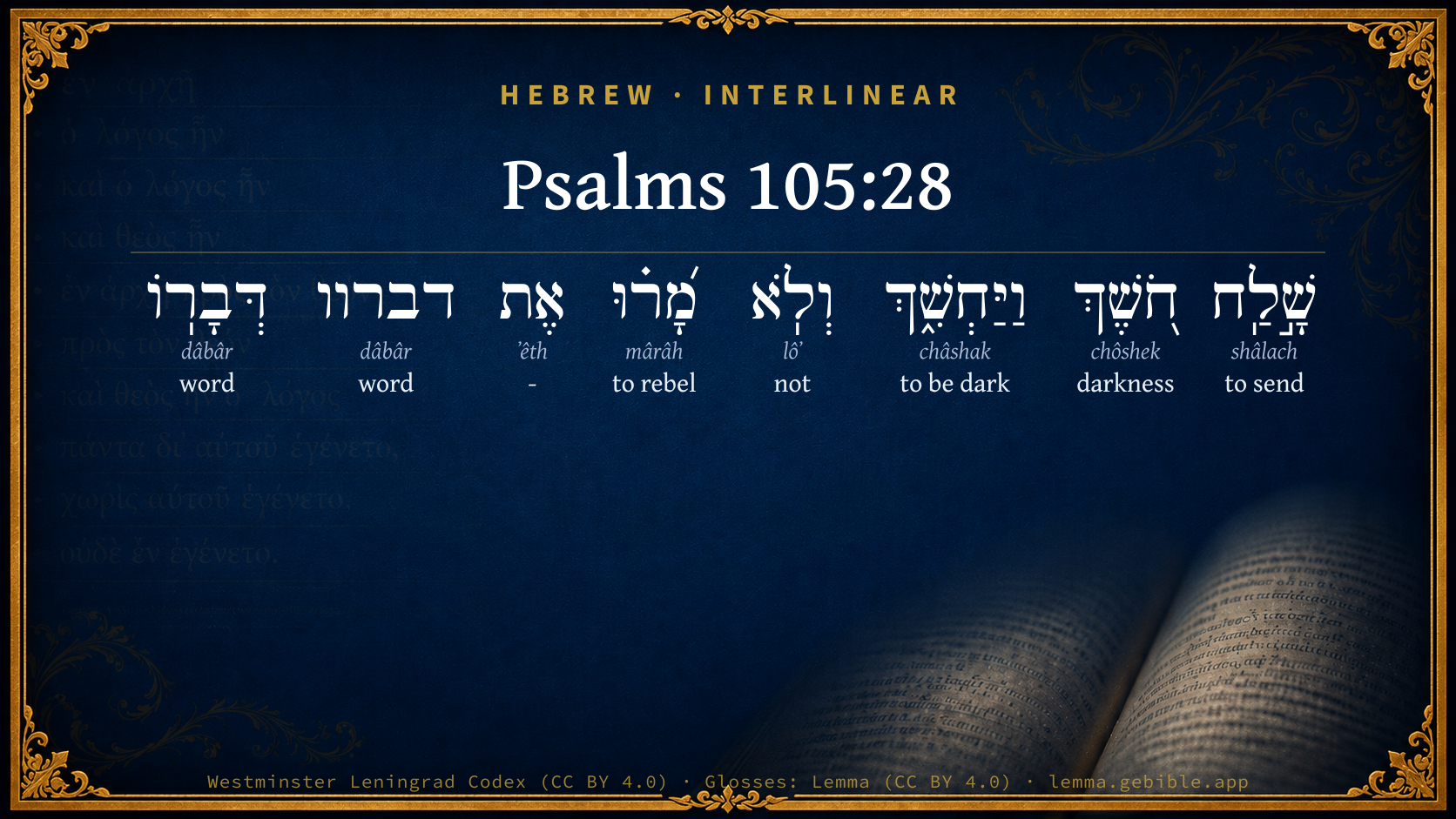
  1. שָׁ֣לַֽח shâlach H7971 “to send” Verb, Qal, Perfect, 3rd Person, Masculine, Singular
  2. חֹ֭שֶׁךְ chôshek H2822 “darkness” Noun, Common, Masculine, Singular, Absolute
  3. וְלֹֽא lôʼ H3808 “and · not” Conjunction + Particle, Negative
  4. מָ֝ר֗וּ mârâh H4784 “to rebel” Verb, Qal, Perfect, 3rd Person, Common, Plural
  5. אֶת ʼêth H853 “-” Particle, Direct Object
  6. דברוו dâbâr H1697 “words · his” Noun, Common, Masculine, Plural, Construct + Suffix, Personal, 3rd Person, Masculine, Singular
  7. דְּבָרֽוֹ dâbâr H1697 “word · his” Noun, Common, Masculine, Singular, Construct + Suffix, Personal, 3rd Person, Masculine, Singular

About this verse

These counts appear in no published source. They are computed here, from the morphology-tagged text and Lemma’s own curated glosses. What Lemma adds →

8
words
7
distinct lemmas
Wisdom
section

Notable vocabulary

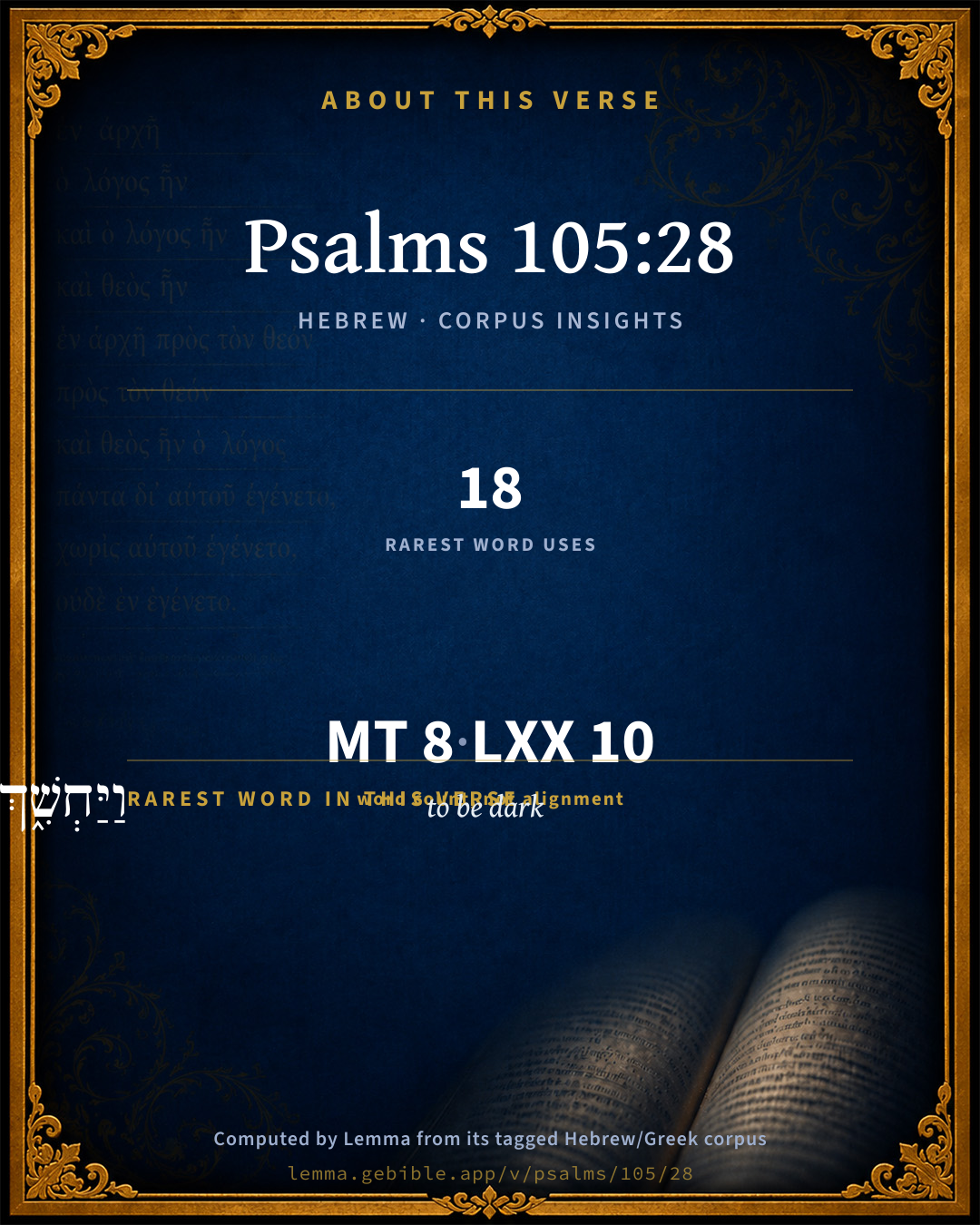
The rarest word here is וַיַּחְשִׁ֑ךְ to be dark H2821 — appearing just 18 times in the whole Hebrew Bible.

Shared distinctive vocabulary

וַיַּחְשִׁ֑ךְ to be dark H2821 occurs in 18 verses of the Hebrew Bible. Also found in:

Grammatical profile

  • 3 verbs
  • 3 nouns
  • 2 particles

Verb forms

  • שָׁ֣לַֽח Qal · Perfect
  • וַיַּחְשִׁ֑ךְ Hiphil · Sequential Imperfect
  • מָ֝ר֗וּ Qal · Perfect

Repetition

A word recurs within this verse — often emphatic in Hebrew:

  • דברוו word H1697 ×2

Hebrew & Septuagint length

In English translation the verse runs 13 words from the Hebrew and 14 from the Septuagint (LXX English) — closely comparable.

A rough comparison of the two English renderings, which tokenize alike — not a word-level alignment.

Word counts can differ between the Hebrew and the Greek without any difference in meaning — e.g. the Hebrew direct-object marker אֵת has no separate Greek word, and Greek often adds the article ὁ.

In the original languages it is 8 Hebrew tokens and 10 Greek tokens — but the two are counted differently (Hebrew bundles its prefixes and suffixes into one token; the Greek is in lemma form), so that isn’t a like-for-like length.

Cross-references

8

Topical passages linked to Psalms 105:28 in the Treasury of Scripture Knowledge — connected by theme and wording, ordered by reader-vote popularity; previews shown in the World English Bible.

  • Psalms 99:7 He spoke to them in the pillar of cloud. They kept his testimonies, The statute that he gave them.
  • Joel 2:31 The sun will be turned into darkness, And the moon into blood, Before the great and terrible day of Yahweh comes.
  • Luke 23:44–45 It was now about the sixth hour, and darkness came over the whole land until the ninth hour.
  • 2 Peter 2:4 For if God didn't spare angels when they sinned, but cast them down to Tartarus, and committed them to pits of darkness, to be reserved to judgment;
  • 2 Peter 2:17 These are wells without water, clouds driven by a storm; for whom the blackness of darkness has been reserved forever.
  • Exodus 10:21–23 Yahweh said to Moses, "Stretch out your hand toward the sky, that there may be darkness over the land of Egypt, even darkness which may be felt."
  • Ezekiel 2:4–8 The children are impudent and stiff-hearted: I do sent you to them; and you shall tell them, Thus says the Lord Yahweh.
  • Joel 2:2 A day of darkness and gloominess, A day of clouds and thick darkness. As the dawn spreading on the mountains, A great and strong people; There has never been the like, Neither will there be any more after them, Even to the years of many generations.

Cross-references courtesy of OpenBible.info (CC BY 4.0).

Hebrew and Greek witnesses Masoretic Hebrew ↔ Greek Septuagint

The same verse in the two great witnesses to the Old Testament, shown verse-for-verse.

You’re reading Greek Psalm 104 (Hebrew Psalm 105). The Septuagint counts the superscription, so verse numbers can differ from the Hebrew — chapter-level alignment, not verse-by-verse. Numbering follows Rahlfs.

These are two independent witnesses, not word-aligned to each other, and the Septuagint is shown in lemma (dictionary) form.

Hebrew Psalms 105:28 Masoretic · Westminster Leningrad Codex

שָׁ֣לַֽח חֹ֭שֶׁךְ וַיַּחְשִׁ֑ךְ וְלֹֽא מָ֝ר֗וּ אֶת דברוו דְּבָרֽוֹ

He sent darkness, and made it dark. They didn't rebel against his words.

World English Bible · Public Domain

Greek LXX Greek Psalm 104:28 Septuagint · lemma form

ἐκ ἀποστέλλω σκότος καί σκοτίζω καί παραπικραίνω ὁ λόγος αὐτός

He sent forth darkness, and made it dark; yet they rebelled against his words.

LXX2012 (modern English Septuagint) · Public Domain

On this verse, Joseph Benson's Commentary discusses the Septuagint’s reading. Read the note in Commentary ↓

Hebrew: Westminster Leningrad Codex (CC BY 4.0). Greek: Septuagint (public domain); English from LXX2012 (modern English Septuagint) (Public Domain). How the Septuagint differs from the Hebrew →

Commentary

Notes on Psalms 105:28 from classic Christian and Jewish commentators (each source and its license shown beneath its notes). The classic Christian expositions comment on the surrounding passage and are grouped to its opening verse, so a note may address several verses; the Jewish commentaries on the Tanakh (Rashi and others) are per-verse, so they appear only where the commentator wrote on this verse.

Lemma curates 59 commentaries, every one of them public domain or Creative Commons licensed, each selected and text-cleaned for this edition rather than reprinted as found. About our sources →

Trapp's Complete Commentary

John Trapp

Psa 105:28 He sent darkness, and made it dark; and they rebelled not against his word.

Ver. 28. He sent darkness] Palpable darkness, by reason of most black and thick vapours of the earth mingling themselves with the air; such as Aben Ezra said that he once felt, sailing upon the ocean, the gross vapours there putting out the light of fire and candle, and not suffering them to be re-enkindled.

And they rebelled not against his word] They, that is, the plagues called for, came immediately, with an Ecce me. Or, they, that is, Moses and Aaron, refused not to denounce and inflict those plagues, though Pharaoh threatened to kill them; where a man would wonder at Pharaoh’s hardness and hardiness, that being in the midst of that deep and dreadful darkness, he could rage against God, and threaten with death his servant Moses. The Arabic (reading לו for לא) rendereth it, Et irritarunt sermonem eius; and they (the Egyptians) provoked his word, or rebelled against it.

John Trapp, A Commentary or Exposition upon All the Books of the Old and New Testament (1647–1656) — public domain. Text from a community e-Sword module.

Joseph Benson's Commentary

Psa 105:28-31. He sent darkness, &c. — This was one of the last plagues, though here mentioned first: God sent darkness, and, coming with commission from him, it came with efficacy; his command made it dark. And they rebelled not against his word — That is, the people of Israel were not disobedient to God’s commands by Moses and Aaron, respecting killing the passover, and making preparation, in other respects, to leave Egypt. The old translation follows the LXX., and reads, They were not obedient to his word; which may be applied to Pharaoh and the Egyptians, who, notwithstanding the terror of this plague, would not let the people go; but there is no ground for this interpretation in the Hebrew, the reading of which, however, לא מרו את דברוו, Houbigant translates, His words were not changed, that is, “What God had commanded to be done was done.” Their land brought forth frogs — That is, their country brought them forth; for they were produced by their rivers, Exo 8:3. In the chambers of their kings — Which entered into the chambers of Pharaoh, and his sons, and his chief nobles, and governors of provinces under him; such persons being often called kings in Scripture. And lice in all their coasts — Or borders, that is, in all their land, even to the remotest parts or borders of it. For a further elucidation of the particulars contained in these and the following verses, to Psa 105:37, see notes on Psa 78:43-51.

Joseph Benson's Commentary on the Old and New Testaments (1811–1818) — public domain. Text from a community e-Sword module.

J. A. Alexander on Psalms

Joseph Addison Alexander

28. (Psa 105:28) He sent darkness and made it dark, and they did not resist his words, or according to the marginal reading, his word. This is by some understood to mean the plague of darkness, which immediately preceded the slaughter of the first-born, Exo 10:22. But to this explanation there are two objections first, that it entirely disturbs the order of the plagues, which is otherwise observed with great exactness, the only deviation being very trivial compared with this; secondly, because it would then be necessary to apply the last clause to Moses and Aaron, or to Israel in general, thereby making it unmeaning, or else to admit a contradiction of the history, which expressly says that the Egyptians did resist the word of God even after the plague of darkness, Exo 10:27. The only remaining explanation is, that darkness, in the verse before us, as in many other cases, is a figure for calamity in general, and applied not to one plague in particular, but to the whole series, of which a more detailed account is then subjoined.

Joseph Addison Alexander, The Psalms Translated and Explained (1850) — public domain. Text from a community e-Sword module.

Geneva Bible (1599)

Geneva Bible translators

Meaning, Moses and Aaron.

Geneva Bible (1599) marginal notes — public domain. Text via Bolls.life.

Adam Clarke's Commentary

Verse 28. They rebelled not against his word.] Instead of ולא מרו velo maru, "they rebelled," some think that a ש shin has been lost from before the word, and that it should be read ולא שמרו velo shamru, "they did not observe or keep his word." Or the words may be spoken of Moses and Aaron; they received the commandment of God, and they did not rebel against it. They believed what he had spoken, and acted according to his orders. It could not be spoken of the Egyptians; for they rebelled against his words through the whole course of the transactions.

Adam Clarke's Commentary on the Bible (1810–1826) — public domain. Text from a community e-Sword/MySword module.

John Calvin's Commentaries

In the 28th verse he specifics one of these miracles, which yet was not the first in order, but from which it is easy to gather that God was the author of the deliverance of Israel, and in which the course of nature was entirely changed; for nothing is more astonishing than to see the light turned into darkness. In the second clause, he commends the faithfulness of Moses and Aaron, in courageously executing whatever God had commanded them: And they were not rebellious against his words There was, as if it had been said, the most perfect harmony between the command of God and the obedience of both his servants.

John Calvin's Commentaries (1540-1563) — public domain. Text from the Calvin Translation Society English edition (1840s-50s) via the Christian Classics Ethereal Library (ccel.org). Calvin's coverage is partial (roughly two-thirds of the Bible); uncommented books and verses are honest gaps, never fabricated. The 19th-century editor's footnotes and remarks are omitted so the notes are faithfully Calvin's own voice.

Ellicott's Commentary for English Readers

(28) Darkness.—The enumeration of the plagues omits the fifth and sixth, and begins with the ninth, and appends a clause which, from the first, has troubled translators. Of whom is it said, “They rebelled not against his words”? Of the Egyptians it is not true; and to refer the words to Moses and Aaron, in contrast with their resistance to the Divine command at Massah and Meribah, is feeble. The LXX. and the Syriac solved the difficulty by rejecting the negative. (Comp. the Prayer Book Version.)

The simplest explanation is to take the verb as imperfect subjunctive: “He sent darkness, and made it dark, that they might not rebel against his word.”

But this fails to supply a reason for the position in the list of the ninth plague, and the suggested emendation of Mr. Burgess is so satisfactory in this respect, that it almost by itself carries conviction with it. By a very slight change, he obtains: “He sent darkness, and darkened them, that they might not discern his tokens;” taking deber in the same sense that it bears in Psa_105:27.

Thus the plague of darkness is, by a slight device of the poet, made to symbolise the moral blindness displayed by the Egyptians throughout.

A Bible Commentary for English Readers, edited by Charles John Ellicott (1878–1897) — public domain. Text from a community e-Sword module.

The Cambridge Bible for Schools and Colleges

gen. ed. J. J. S. Perowne

28. It is difficult to say why the ninth plague (Exo_10:21 ff.) is placed first here. Possibly, like the fifth and sixth, it was not originally mentioned, and the verse was the marginal gloss of a reader who noticed the omission, which was subsequently inserted in the text in the wrong place. If however the text is sound, perhaps the ninth plague is mentioned first, because it is regarded as the plague which wrought conviction in the minds of the Egyptians, who were already anxious that the Israelites should be allowed to depart (Exo_10:7; Exo_11:2-3); though the further plague of the death of the firstborn was needed finally to convince Pharaoh. The plague of darkness was specially calculated to inspire the worshippers of the sun-god with the sense of Jehovah’s power. The next line and they rebelled not against his words confirms this interpretation. ‘They’ must refer to the Egyptians, and the allusion must be to their change of feeling towards the Israelites after the plague of darkness, described in Exo_11:2-3. Some commentators suppose that ‘they’ refers to Moses and Aaron, who did not disobey God’s commands, as they afterwards did at Meribah (Num_20:24; Num_27:14), but accepted their perilous mission. Such a statement however does not seem natural in the present context. Others read they observed not (שׁמרו for מרו). Others follow the LXX and Syr. in omitting the negative. So in effect Coverdale (following the Zürich Bible, ‘dann sy warend seinem geheyss nit gehorsam’), for they were not obedient unto his word; P.B.V. and they were not &c. But the remark would be out of place at the point when the resistance of the Egyptians had been overcome.

his word] So the Q’rç; R.V. his words follows the K’thîbh, which is supported by the LXX, Aq., and Jer.

The Cambridge Bible for Schools and Colleges (gen. ed. J. J. S. Perowne; Cambridge University Press, 1878–1918) — public domain. Text from a community e-Sword module.

John Gill's Exposition

He sent darkness, and made it dark,.... The land of Egypt; either he, God, or it, darkness, made it dark, or it was made dark; the Targum is,

"made them dark;''

that is, the Egyptians; darkness was a messenger of the Lord's, who forms the light and creates darkness; it came at his word and covered all the land, excepting the dwellings of Israel; even a thick darkness that might be felt, so that the Egyptians could not see one another, nor rise from their place for three days together; such as sometimes rises at sea, and is said to be so dark, that for five days together day and night are the same; this was the ninth of the ten plagues, Exo 10:21 and was an emblem of the darkness which is on the minds of men in an unregenerate state; who are covered with gross darkness, and are even darkness itself; which is universal as to persons, and the powers and faculties of their souls concerning divine things: and it also bears some resemblance to the darkness which will be in the kingdom of the beast upon the pouring out of the fifth vial, or plague, on spiritual Egypt, Rev 16:10.

And they rebelled not against his word: the plague of darkness, and the rest of the plagues which God commanded; these, as they were his servants, were not disobedient to him, they came at his word; see Psa 105:31, so Jarchi interprets it; or else Moses and Aaron, who were sent of God to inflict those plagues, did not refuse to obey the divine orders; though Pharaoh threatened them hard, yet they feared not the wrath and menaces of the king, but did as the Lord commanded them. Aben Ezra, Kimchi, and Ben Melech, mention both these senses, but the latter seems most agreeable. The Septuagint, Syriac, and Arabic versions, leave out the word "not"; and so some copies of the Vulgate Latin version, and Apollinarius in his metaphrase, "and they rebelled against his word"; that is, the Egyptians did not hearken to the word of the Lord, nor to the signs and wonders he wrought, but their hearts were hardened, and they would not let Israel go. But this is contrary to the original text; though Arama interprets it of them, that they did not rebel, but confessed this miracle, which being the greatest of all, as he observes, is first mentioned. Dr. Lightfoot (y) thinks it is to be understood of Israel, and of some special part of obedience performed by them; which he takes to be circumcision, which they had omitted in Egypt, at least many of them, and was necessary to their eating of the passover, which was to be done in a few days, Exo 12:48 and it was a fit time to perform this service while darkness for three days was upon the Egyptians; in which they were shut up by the Lord, that they might not take the opportunity against his people, now sore through circumcision.

(y) Works, vol. 1. p. 707.

John Gill's Exposition of the Whole Bible (1746–1763) — public domain (CC PDM 1.0). Text via the HelloAO Bible API.

Albert Barnes' Notes on the Bible

He sent darkness, and made it dark - Exo 10:21-23.

And they rebelled not against his word - More literally, “his words.” The reference is to Moses and Aaron; and the idea, as expressed here, is that they were obedient to the command of God; that they went and did what he ordered them; that, although he required them to go before a mighty and proud monarch, to denounce against him the vengeance of heaven, and to be the instruments of bringing upon the land unspeakably severe judgments, yet they did not shrink from what God commanded them to do. They were true to his appointment, and showed themselves to be faithful messengers of God. Others, however, suppose that this refers to the Egyptians, and that it is to be taken as a question: “And did they not rebel against his word?” The language might bear this, and the translators of the Septuagint seem to have so understood it, for they render it, “And they rebelled against his words.” But the most natural construction is that in our common version, and the design is evidently to commend the boldness and the fidelity of Moses and Aaron.

Albert Barnes' Notes on the Bible (1834–1885) — public domain. Text from a community e-Sword/MySword module.

Matthew Poole's English Annotations

Either,

1. The darkness and other plagues; which obeyed God’s word, and instantly came at God’s call. So this may be a reflection upon the Egyptians, that those brutish or unreasonable creatures were more obedient to the will and command of God than they were. Thus diseases are said to come or go at God’s command, Mat 8:8. Or rather,

2. Moses and Aaron, mentioned Psa 105:26, and called they, Psa 105:27, whose obedience in denouncing and inflicting these plagues, and especially that plague of darkness, is noted and commended here as an act of great faith and fortitude, because they inflicted that plague after Pharaoh had threatened them, Exo 10:10; as the obedience of their parents is commended as a great act of faith, because they preserved and hid their son contrary to the express command of the king of Egypt.

Matthew Poole's English Annotations on the Holy Bible (1683–1685) — public domain. Text from a community e-Sword/MySword module.

The Treasury of David

Charles H. Spurgeon

Ver. 28. He sent darkness, and made it dark. It was no natural or common darkness to be accounted for by the blinding dust of the simoon, it was beyond all precedent and out of the range of ordinary events. It was a horrible palpable obscurity which men felt clinging about them as though it were a robe of death. It was a thick darkness, a total darkness, a darkness which lasted three days, a darkness in which no one dared to stir. What a condition to be in! This plague is first mentioned, thought it is not first in order, because it fitly describes all the period of the plagues: the land was in the darkness of sorrow, and in the darkness of sin all the time. If we shudder as we think of that long and terrible gloom, let us reflect upon the gross darkness which still covers heathen lands as the result of sin, for it is one of the chief plagues which iniquity creates for itself. May the day soon come when the people which sit in darkness shall see a great light.

And they rebelled not against his word. Moses and Aaron did as they were bidden, and during the darkness the Egyptians were so cowed that even when it cleared away they were anxious for Israel to be gone, and had it not been for the pride of Pharaoh they would have rejoiced to speed them on their journey there and then. God can force men to obey, and even make the stoutest hearts eager to pay respect to his will, for fear his plagues should be multiplied. Possibly, however, the sentence before us neither refers to Moses nor the Egyptians, but to the plagues which came at the Lord's bidding. The darkness, the hail, the frogs, the murrain, were all so many obedient servants of the great Lord of all.

Ver. 28. He sent darkness. The darkness here stands at the beginning, (not in the historical order that the particular plague of darkness stood), to mark how God's wrath hung over Egypt as a dark cloud during all the plagues. A.R. Fausset.

Ver. 28. Darkness. There is an awful significance in this plague of darkness. The sun was a leading object of devotion among the Egyptians under the name of Osiris. The very name Pharaoh means not only the king but also the sun, and characterises the king himself as the representative of the sun and entitled in some sort to divine honours. But now the very light of the sun has disappeared and primeval chaos seems to have returned. Thus all the forms of Egyptian will worship were covered with shame and confusion by the plagues. James G. Murphy, in "A Commentary on Exodus", 1866.

Ver. 28. Made it dark. God is often described as manifesting his displeasure in a cloud. Joel speaks of the day of God's vengeance as "a day of darkness and of gloominess, a day of clouds and of thick darkness" (Joe 2:2); and Zephaniah employs nearly the same language (Ps 1:15). The pillar that went before the Israelites, and gave them light, was to the Egyptians "a cloud and darkness" (Ex 14:20). The darkness which was upon the face of the earth "in the beginning, "is described by Jehovah in the book of Job as a cloud: "When I made the cloud the garment thereof, and thick darkness a swaddling band for it" (Job 38:9). So now the land of Egypt may have been wrapped about by a thick palpable cloud, cold, damp, impenetrable: the people would feel it upon their limbs, as swaddling bands; the sun would be blotted out by it, and all things reduced almost to a state of deathof which this ninth plague was in a certain sense the shadow cast before. Such a cloud would be even more terrible in Egypt, sunny Egypt, than in other countries; for there the sky is almost always clear, and heavy rains unknown. But in any place, and under any conditions, it must have been full of horror and misery. Nothing could represent this more forcibly than the short sentence, "Neither rose any from his place for three days." It was an horror of great darkness; it rested on them like a pall; they knew not what dangers might be around them, what judgment was next to happen: they had not been forewarned of this plague, and they could not tell but it might be only a prelude to some more awful visitation: their soul melted in them, for fear of those things that might come upon them: they dared not move from chamber to chamber, nor even from seat to seat: wherever they chanced to be at the moment when the darkness fell upon them, there they must remain. Pharaoh might call in vain for his guards; they could not come to him. Moses and Aaron were no longer within reach, for none could go to seek them. Masters could not command their slaves, nor slaves hasten to obey their master's call; the wife could not flee to her husband nor the child cling to its parents: the same fear was upon all, both high and low; the same paralysing terror and dismay possessed them every one. As says the patriarch Job, they "laid hold on horror" (Job 18:20). And this continued for three days and nights: they had no lamps nor torches; either they could not kindle them, or they dared not move to procure them: they were silent in darkness, like men already dead. Hope and expectation of returning light might at first support them; but hope delayed through seventy-two weary hours would presently die out, and leave them to despair. The darkness would become more oppressive and intolerable the longer it continued; "felt" upon their bodies as a physical infliction, and "felt" even more in their souls in agonies of fear and apprehension; such a darkness as that which, in the book of Revelation, the fifth angel pours out upon the seat of the beast "Whose kingdom was full of darkness; and they gnawed their tongues for pain, and blasphemed the God of heaven because of their pains and their sores, and repented not of their deeds" (Re 16:10, 11). If there be any truth in the traditions of the Jews on this subject, there were yet greater alarms under this canopy of darkness, this palpable obscurity, than any which would arise out of the physical infliction. Darkness is a type of Satan's kingdom; and Satan had some liberty in Egypt to walk up and down upon the land, and to go to and fro in it. The Jewish Rabbis tell us that the devil and his angels were let loose during these three dreadful days; that they had a wider range and greater liberty than usual for working mischief. They describe these evil spirits going among the wretched people, glued to their scats as they were, with terror; frightening them with fearful apparitions; piercing their ears with hideous shrieks and groans; driving them almost to madness with the intensity of their fears; making their flesh creep, and the hair of their head to stand on end. Such a climax seems to be referred to by the Psalmist, "He cast upon them the fierceness of his anger, wrath, and indignation, and trouble, by sending evil angels among them" (Ps 78:40). Thomas S. Millington, in "Signs and Wonders in the Land of Ham",

1873.

Ver. 28. And they rebelled not against his word. The plague of darkness and the rest of the plagues which God commanded; these as they were his servants, were not disobedient to him, they came at his word. Ps 105:31, 34. John Gill.

Ver. 28. They rebelled not against his word; as Jonah did, who, when he was sent to denounce God's judgments against Nineveh, went to Tarshish. Moses and Aaron were not moved, either with a foolish fear of Pharaoh's wrath, or a foolish pity of Egypt's misery, to relax or retard any of the plagues which God ordered them to inflict on the Egyptians; but stretched forth their hand to inflict them as God appointed. They that are instructed to execute judgment, will find their remissness construed a rebellion against God's word. Matthew Henry.

Psalms 105:29*

Charles H. Spurgeon's The Treasury of David (1869–1885) — public domain. Psalms only. Text from a community e-Sword/MySword module.

Whedon's Commentary on the Bible

Daniel D. Whedon

28. Darkness—This was the ninth plague. Exo_10:21-23. The poet does not follow the historic order of the miracles. The causative form of the verb indicates a direct act of God. in producing this phenomenon, as distinct from ordinary natural darkness, fit emblem of the ignorance of the people and the wrath of God.

They rebelled not—That is, Moses and Aaron, who are here to be considered the subject of the verb. Though reluctant to begin, (Exodus 3, 4,) they had stood firm to the word of God through all this terrible scene.

Daniel D. Whedon (gen. ed.), Commentary on the Old and New Testaments (1874–1909) — public domain. Text from a community e-Sword module.

The Pulpit Commentary

He sent darkness, and made it dark. (see Exo_10:21-23) And they rebelled not against his word. If the "not" is to stand in this passage, it must be referred to Moses and Aaron. Professor Cheyne, however, following the Septuagint and Peshito versions, boldly cancels the "not."

The Pulpit Commentary (1880–1919), ed. H.D.M. Spence-Jones & Joseph S. Exell — public domain. Text from a community e-Sword module.

John Wesley's Explanatory Notes

They - Moses and Aaron, who inflicted that plague after Pharaoh had threatened them.

John Wesley, Explanatory Notes Upon the Whole Bible (1754–1765) — public domain. Text via the GEBible commentary corpus.

unfoldingWord translationNotes

Door43 World Missions Community

made that land dark

"made the sky dark"

frogs

a small jumping reptile

even in the rooms of their rulers

"they were even in the rooms of their rulers"

translationWords

obey

water

blood

rule

unfoldingWord translationNotes — © Distant Shores Media and the Door43 World Missions Community, licensed CC BY-SA 4.0. Source: git.door43.org/Door43/en_tn.

Rashi

Rabbi Shlomo Yitzchaki (Rashi)

And they did not disobey His word The plagues, that He commanded upon them, came according to His commandments and did not deviate from His word.

Rashi on the Tanakh — English translations: “The Judaica Press complete Tanach with Rashi, translated by A. J. Rosenberg” (CC BY 4.0); “Pentateuch with Rashi's commentary by M. Rosenbaum and A.M. Silbermann, 1929-1934” (public domain); “The Metsudah Tanach series, Lakewood, N.J” (CC BY 4.0); and “The Book of Joshua, Metsudah Publications, 1997” (CC BY 4.0). Text via Sefaria.

Lesson kit

Teaching starters — assembled from the data on this page, not authored interpretation. Every prompt links to the verse data it draws on. Edit before teaching.

Psalms, in the Wisdom, opens this verse with 8 words (7 distinct Hebrew lemmas). Its most distinctive word is châshak (“to be dark”). A historical commentator’s framing appears above. Read the whole chapter for the surrounding context.

Discussion questions

  1. The word châshak carries the sense “to be dark.” How does it shape the verse?
  2. Exodus 10:15 shares the word «to be dark» with this verse. How do the two illuminate each other?
  3. “word” occurs 2× in this one verse. What is the effect of the repetition?
  4. These translations render this verse differently; the difference is in the English rendering, not the original. What questions does that raise?
  5. The verb «שָׁ֣לַֽח» is Qal Perfect. How does its form color the action?
  6. Reading how Trapp's Complete Commentary and Joseph Benson's Commentary read this verse, where do the two commentators agree and where do they part?

Things to notice

Reading settings

Reading text

Shown beneath each verse's original-language words.

Old Testament
Old Testament edition

Read the OT as the Masoretic Hebrew (MT) or the Greek Septuagint (LXX).

English shown for the Greek Septuagint (in the Hebrew ↔ Greek comparison).

Comparing translations? Open the Compare panel on any verse page to stack up to four side by side.