Revelation 16:3

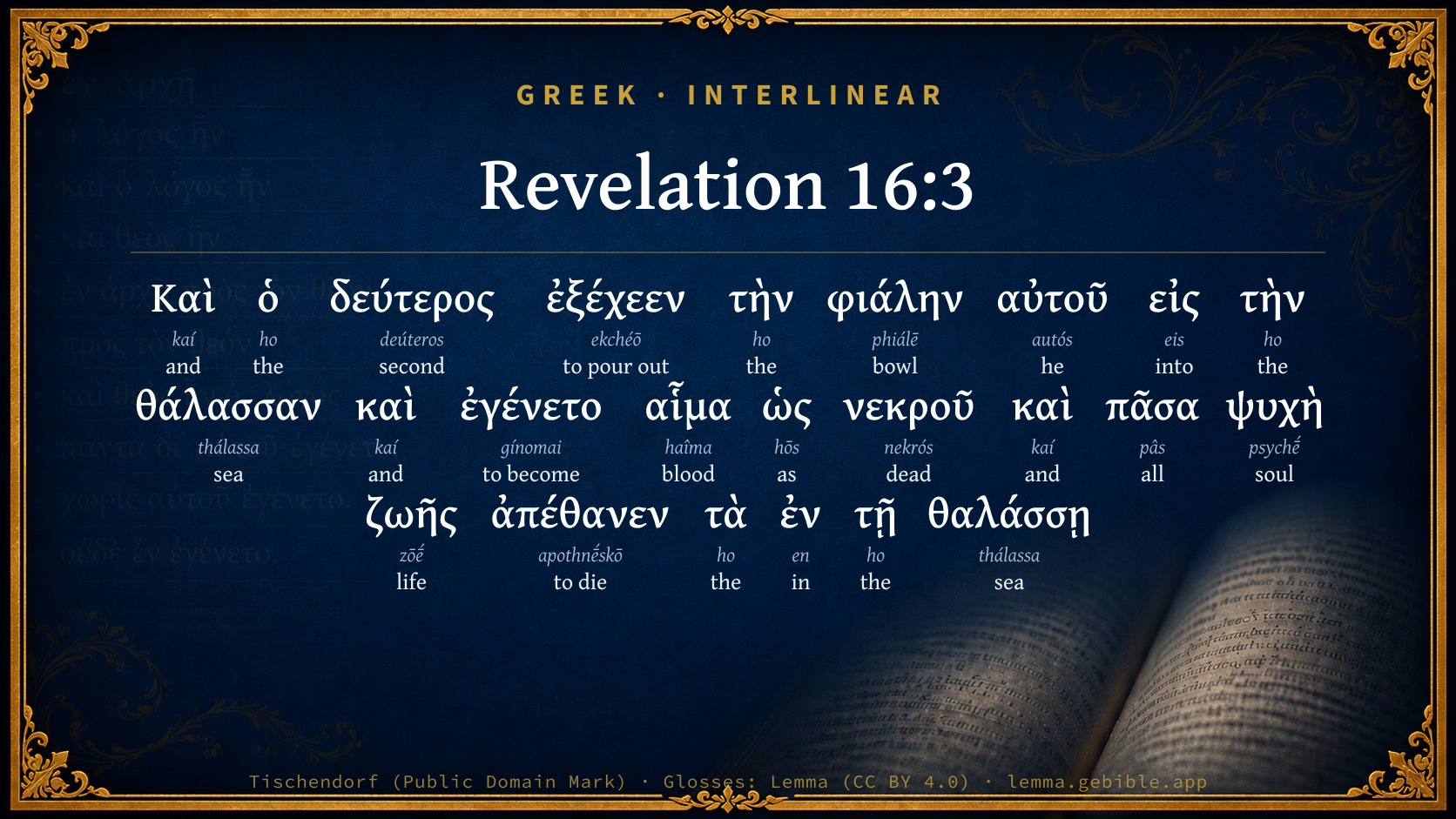
Greek (Tischendorf 8th ed.) Revelation 16:3 appears in the Greek New Testament. The text above is from the Tischendorf 8th edition. Each word links to its Strong’s number and a concise gloss. Click any word for its full Thayer’s Greek Lexicon entry.
Download image
Cite this verse

Revelation 16:3 (World English Bible). Public Domain. Lemma interlinear Bible study tool, https://lemma.gebible.app/v/revelation/16/3.

Show BibTeX & RIS
BibTeX
RIS
English Translation
The second angel poured out his bowl into the sea, and it became blood as of a dead man. Every living thing in the sea died.
World English Bible · Public Domain
Download a study sheet

One document with this verse’s original text, its word-by-word gloss line, the meaning frame, cross-references with their text, attributed commentary, and full source and license credits — printable, and it pastes into notes with its structure intact.

This verse Autodidact and up

Study sheet (.html) Plain text (.txt)

A passage Seminary Student

Up to 50 verses in one chapter. A passage sheet keeps up to 6 commentary sources and 12 cross-references per verse, in the order this page ranks them, and says so on the sheet whenever that leaves anything out. Ask for a single verse and you get the Autodidact verse sheet above.

Everything on this page stays free to read, with no account — the sheet is a download of what is already on screen, not access to it.

Want to remove ads? Support Godless Engineer
Compare translations 3

The same verse in 3 English versions, stacked beneath the original-language interlinear above. Click any original word for its lexicon entry.

Each is an independent rendering of the whole verse — the interlinear is not word-aligned to these translations.

Highlighted words mark where these versions differ — a whole-verse word diff, not a word-by-word alignment.

  • World English Bible Public Domain
    The second angel poured out his bowl into the sea, and it became blood as of a dead man. Every living thing in the sea died.
  • King James Version Public Domain
    And the second angel poured out his vial upon the sea; and it became as the blood of a dead man: and every living soul died in the sea.
  • unfoldingWord Literal Text CC BY-SA 4.0
    And the second poured out his bowl into the sea and it became blood as of a corpse, and every living soul in the sea died.

unfoldingWord Literal Text — © unfoldingWord, licensed CC BY-SA 4.0. Word-aligned USFM3 via Door43 (git.door43.org/unfoldingWord/en_ult).

Versions to compare (up to 4)

3 of 4 selected

Show all 19 translations

Every available English version of this verse, each an independent rendering of the whole verse.

  • World English Bible Public Domain
    The second angel poured out his bowl into the sea, and it became blood as of a dead man. Every living thing in the sea died.
  • Berean Standard Bible Public Domain
    And the second angel poured out his bowl into the sea, and it turned to blood like that of the dead, and every living thing in the sea died.
  • Majority Standard Bible Public Domain
    And the second angel poured out his bowl into the sea, and it turned to blood like that of the dead, and every living thing in the sea died.
  • King James Version Public Domain
    And the second angel poured out his vial upon the sea; and it became as the blood of a dead man: and every living soul died in the sea.
  • American Standard Version (1901) Public Domain
    And the second poured out his bowl into the sea; and it became blood as of a dead man; and every living soul died, `even' the things that were in the sea.
  • Revised Version (1885) Public Domain
    And the second poured out his bowl into the sea; and it became blood as of a dead man; and every living soul died, even the things that were in the sea.
  • Geneva Bible (1599) Public Domain
    And the second Angel powred out his viall vpon the sea, and it became as the blood of a dead man: and euery liuing thing dyed in the sea.
  • Douay-Rheims (1899) Public Domain
    And the second angel poured out his vial upon the sea, and there came blood as it were of a dead man; and every living soul died in the sea.
  • Young's Literal Translation Public Domain
    And the second messenger did pour out his vial to the sea, and there came blood as of `one' dead, and every living soul died in the sea.
  • Literal Standard Version CC BY-SA 4.0
    And the second messenger poured out his bowl into the sea, and it became blood as of [one] dead, and every living soul in the sea died.
  • Unlocked Literal Bible CC BY-SA 4.0
    The second angel poured out his bowl into the sea. It became blood, like the blood of a dead person, and every living thing in the sea died.
  • unfoldingWord Literal Text CC BY-SA 4.0
    And the second poured out his bowl into the sea and it became blood as of a corpse, and every living soul in the sea died.
  • Darby Bible Public Domain
    And the second poured out his bowl on the sea; and it became blood, as of a dead man; and every living soul died in the sea.
  • World Messianic Bible Public Domain
    The second angel poured out his bowl into the sea, and it became blood as of a dead man. Every living thing in the sea died.
  • Webster's Bible Public Domain
    And the second angel poured out his vial upon the sea; and it became as the blood of a dead man: and every living soul died in the sea.
  • Free Bible Version CC BY-SA 4.0
    The second poured out his bowl on the sea, and it became like the blood of a corpse and everything living in the sea died.
  • Bible in Basic English Public Domain
    And the second let what was in his vessel come out into the sea; and it became blood as of a dead man; and every living thing in the sea came to an end.
  • Text-Critical English NT CC BY 4.0
    The second angel poured out his bowl into the sea, and it turned into blood, like that of a dead person, and every creature in the sea died.
  • Tyndale New Testament (1534) Public Domain
    And the seconde angell shed out his viall apon the see and it turned as it were into the bloud of a deed man: and every lyvinge thynge dyed in the see.

Literal Standard Version (2020), Covenant Press — licensed CC BY-SA 4.0. Text via the HelloAO Bible API (eBible.org). Unlocked Literal Bible (unfoldingWord) — licensed CC BY-SA 4.0. Text via the HelloAO Bible API (eBible.org). unfoldingWord Literal Text — © unfoldingWord, licensed CC BY-SA 4.0. Word-aligned USFM3 via Door43 (git.door43.org/unfoldingWord/en_ult). Free Bible Version, Dr. Jonathan Gallagher — licensed CC BY-SA 4.0. Text via the HelloAO Bible API (eBible.org).

Word by word

More ways to search: Search by grammar → Find every occurrence → Compare this word →

Practice this passage: Drill this verse → Learn its vocabulary →

φιάλην
phiálē
G5357
“bowl”
Noun, Accusative, Singular, Feminine
Part of Speech
Noun
Case
Accusative
Number
Singular
Gender
Feminine
Full Thayer's Definition

Origin: of uncertain affinity

TDNT: None

1. a broad shallow bowl, deep saucer
  1. Καὶ kaí G2532 “and” Conjunction
  2. ὁ ho G3588 “the” Article, Nominative, Singular, Masculine
  3. δεύτερος deúteros G1208 “second” Adjective, Nominative, Singular, Masculine
  4. ἐξέχεεν ekchéō G1632 “to pour out” Verb, Aorist, Active, Indicative, 3rd person, Singular
  5. τὴν ho G3588 “the” Article, Accusative, Singular, Feminine
  6. αὐτοῦ autós G846 “he” Personal pronoun, Genitive, Singular, Masculine
  7. εἰς eis G1519 “into” Preposition
  8. τὴν ho G3588 “the” Article, Accusative, Singular, Feminine
  9. θάλασσαν thálassa G2281 “sea” Noun, Accusative, Singular, Feminine
  10. καὶ kaí G2532 “and” Conjunction
  11. ἐγένετο gínomai G1096 “to become” Verb, Aorist, Middle deponent, Indicative, 3rd person, Singular
  12. αἷμα haîma G129 “blood” Noun, Nominative, Singular, Neuter
  13. ὡς hōs G5613 “as” Adverb
  14. νεκροῦ nekrós G3498 “dead” Adjective, Genitive, Singular, Masculine
  15. καὶ kaí G2532 “and” Conjunction
  16. πᾶσα pâs G3956 “all” Adjective, Nominative, Singular, Feminine
  17. ψυχὴ psychḗ G5590 “soul” Noun, Nominative, Singular, Feminine
  18. ζωῆς zōḗ G2222 “life” Noun, Genitive, Singular, Feminine
  19. ἀπέθανεν apothnḗskō G599 “to die” Verb, Aorist, Active, Indicative, 3rd person, Singular
  20. τὰ ho G3588 “the” Article, Nominative, Plural, Neuter
  21. ἐν en G1722 “in” Preposition
  22. τῇ ho G3588 “the” Article, Dative, Singular, Feminine
  23. θαλάσσῃ thálassa G2281 “sea” Noun, Dative, Singular, Feminine

About this verse

These counts appear in no published source. They are computed here, from the morphology-tagged text and Lemma’s own curated glosses. What Lemma adds →

24
words
17
distinct lemmas
Revelation
section

Notable vocabulary

The rarest word here is φιάλην bowl G5357 — appearing just 12 times in the whole Greek New Testament.

Shared distinctive vocabulary

φιάλην bowl G5357 occurs in 12 verses of the Greek New Testament. Also found in:

Repetition

Words recur within this verse:

Cross-references

9

Topical passages linked to Revelation 16:3 in the Treasury of Scripture Knowledge — connected by theme and wording, ordered by reader-vote popularity; previews shown in the World English Bible.

  • Exodus 7:17–21 Thus says Yahweh, "In this you shall know that I am Yahweh. Behold, I will strike with the rod that is in my hand on the waters which are in the river, and they shall be turned to blood.
  • Revelation 8:8–9 The second angel sounded, and something like a great burning mountain was thrown into the sea. One third of the sea became blood,
  • Revelation 11:6 These have the power to shut up the sky, that it may not rain during the days of their prophecy. They have power over the waters, to turn them into blood, and to strike the earth with every plague, as often as they desire.
  • Psalms 78:44 Turned their rivers into blood, And their streams, so that they could not drink.
  • Psalms 105:29 He turned their waters into blood, And killed their fish.
  • Genesis 7:22 All in whose nostrils was the breath of the spirit of life, of all that was on the dry land, died.
  • Ezekiel 16:38 I will judge you, as women who break wedlock and shed blood are judged; and I will bring on you the blood of wrath and jealousy.
  • Revelation 10:2 He had in his hand a little open book. He set his right foot on the sea, and his left on the land.
  • Revelation 13:1 Then I stood on the sand of the sea. I saw a beast coming up out of the sea, having ten horns and seven heads. On his horns were ten crowns, and on his heads, blasphemous names.

Cross-references courtesy of OpenBible.info (CC BY 4.0).

Where the printed editions differ

1 variant

Places in this verse where the major printed Greek editions disagree on the wording in a way that affects the translation — a comparison of editions, not a manuscript-by-manuscript collation. The editions are the modern critical texts (Nestlé-Aland 28/27, SBL, Westcott-Hort, Tregelles, Tyndale House) and the traditional texts behind the KJV (the Textus Receptus and the Byzantine/Majority text). It is not a claim about which reading is original.

  1. Extra text
    ἄγγελος

    “angel”

    In TRByz Not in NA28NA27TynSBLWHTreg

    ἄγγελος (angelos) 'angel' is only in traditional manuscripts (TR+Byz)

Textual data: Translators Amalgamated Greek New Testament (STEPBible TAGNT) · CC BY 4.0.

Commentary

Notes on Revelation 16:3 from classic Christian and Jewish commentators (each source and its license shown beneath its notes). The classic Christian expositions comment on the surrounding passage and are grouped to its opening verse, so a note may address several verses; the Jewish commentaries on the Tanakh (Rashi and others) are per-verse, so they appear only where the commentator wrote on this verse.

Lemma curates 59 commentaries, every one of them public domain or Creative Commons licensed, each selected and text-cleaned for this edition rather than reprinted as found. About our sources →

The Cambridge Bible for Schools and Colleges

gen. ed. J. J. S. Perowne

The Second Vial, Rev_16:3

3. Angel] Should be omitted, reading the second, as we had “the first” before. So in Rev_16:4; Rev_16:8; Rev_16:10; Rev_16:12; Rev_16:17.

as the blood of a dead man] Lit., blood as it were of a dead man. See Exo_7:17 sqq., esp. 21. Compare in this Book ch. Rev_8:8; but here the plague has a wider reach.

The Cambridge Bible for Schools and Colleges (gen. ed. J. J. S. Perowne; Cambridge University Press, 1878–1918) — public domain. Text from a community e-Sword module.

Joseph Benson's Commentary

Rev 16:3. And the second angel poured out his vial upon the sea, &c. — This, says the same pious author, must begin where the other ended, as to the period of time. Now I find that in the year 1566 the wars between the king of Spain and the states of the Netherlands began. The Spaniards, indeed, were often victorious at first, yet they were at length compelled to declare them free states. It was then that the sea became blood to the Romanists, their votaries being miserably defeated in their expectations. For after their cruelties under the duke of Alva, in the Low Countries, and their massacre of the Protestants, in France and other places, the scene was changed very quickly; so that, in the year 1588, the Spaniards lost their vast armada, and ever after declined in their power. And the duke of Guise, the inveterate enemy of the Protestants, was killed the same year; and A.D. 1598 Philip II. of Spain died, being eaten of vermin: the edict of Nantz was also issued the same year in France in favour of the Protestants. So that, as the Reformed interest was in peace everywhere, and conquered in Holland and England, the Popish party, on the other hand, saw Spain, the late terror of the Protestants, brought to a languishing condition, and all their allies weary of wars and persecutions. And as in the year 1609 the truce was made between the Spaniards and the Dutch, so the war, though renewed and carried on afterward, became languid and faint, so as hardly to be regarded by either party, especially the Dutch, who were generally victorious and successful. Hence, as the period of this vial began in 1566, so we may reckon it continued about fifty years, namely, till the year 1617, when the third vial began.

Joseph Benson's Commentary on the Old and New Testaments (1811–1818) — public domain. Text from a community e-Sword module.

Tyndale Open Study Notes

Tyndale Open Resources

16:3-4 The plagues of the second and third bowls are similar to the first plague of Egypt (Exod 7:17-21). Perhaps John had in mind that much of Rome’s food and wealth came by sea. After Julius Caesar rid the sea of pirates, shipping became Rome’s lifeblood. Its end would mean economic death for the empire (see Rev 18:17-19).

Tyndale Open Study Notes — © Tyndale Open Resources, licensed CC BY-SA 4.0. Text via the HelloAO Bible API.

Meyer's Critical & Exegetical Commentary

Heinrich August Wilhelm Meyer

Rev_16:3. The second vial changes the great sea into blood, as that of a dead man, so that every thing living therein dies.

καὶ ἐγένετο αίμα ὡς νεκροῦ. According to the analogy of Rev_8:8; Rev_8:11, ἡ θάλασσα is to be regarded as the subject to ἐγένετο.[3676] The advance of the present plague, in comparison with Rev_8:8, lies not only in that now the entire sea is changed into blood, and that every thing living therein dies, but also in that the sea becomes as the blood of a dead man, i.e., not a great pool of blood, as of many slain,[3677] but the horribleness of the fact is augmented in that the sea seems like the clotted and already putrefying blood of a dead man.[3678]

ψυχὴ ζωῆς. The var. correctly give the meaning: ψ. ζῶσα.[3679] The expression originates from Gen_1:30 : Ὃ ἜΧΕΙ ἘΝ ἘΑΥΤῷ ΨΥΧῊΝ ΖΩῆς. Cf. on the gen. limitation ΖΩῆς, Winer, p. 177 sq.

The ΤᾺ before ἘΝ Τ. ΘΑΛ.[3680] refers, as to meaning, to the individual ΚΤΊΣΜΑΤΑ comprised in the collective ΠᾶΣΑ ΨΥΧ.[3681]

[3676] Beng., etc. Against De Wette: es estand Blut.

[3677] νεκροῦ = νεκρῶν. C. a Lap., Eichh., De Wette, Hengstenb., etc.

[3678] Beng., Züll., etc.

[3679] Cf. Rev_8:9 : κτίσματα τὰ ἕχοντα ψυχάς.

[3680] See Critical Notes.

[3681] Cf. Rev_5:13.

Meyer — Critical and Exegetical Commentary on the New Testament — English translation by Peter Christie, edited by Frederick Crombie (T&T Clark, 1880) — public domain. Text from a community e-Sword module.

Expositor's Greek Testament

ed. W. Robertson Nicoll

Rev 16:3 . “Coagulated blood,” fatal to animal life (as in first Egyptian plague). This plague is final, as compared, e.g. , with that of Rev 8:8 .

The Expositor's Greek Testament, edited by W. Robertson Nicoll (1897–1910) — public domain. Text from a community e-Sword module.

Geneva Bible (1599)

Geneva Bible translators

The history of the second Angel who troubleth and molesteth the seas, that he may stir up the conscience of men sleeping in their wickedness. See Rev. 8:8.

It was turned into rotten and filthy blood, such as is in dead bodies.

Geneva Bible (1599) marginal notes — public domain. Text via Bolls.life.

Jamieson, Fausset & Brown

Robert Jamieson, A. R. Fausset & David Brown

angel--So B and ANDREAS. But A, C, and Vulgate omit it.

upon--Greek, "into."

became as . . . blood--answering to another Egyptian plague.

of a dead man--putrefying.

living soul--So B and ANDREAS. But A, C, and Syriac, "soul of life" (compare Gen 1:30; Gen 7:21-22).

in the sea--So B and ANDREAS. But A, C, and Syriac read, "(as respects) the things in the sea."

Jamieson, Fausset & Brown — Commentary Critical and Explanatory on the Whole Bible (1871) — public domain (CC PDM 1.0). Text via the HelloAO Bible API.

Adam Clarke's Commentary

Verse 3. As the blood of a dead man] Either meaning blood in a state of putrescency, or an effusion of blood in naval conflicts; even the sea was tinged with the blood of those who were slain in these wars. This is most probably the meaning of this vial. These engagements were so sanguinary that both the conquerors and the conquered were nearly destroyed; every living soul died in the sea.

Adam Clarke's Commentary on the Bible (1810–1826) — public domain. Text from a community e-Sword/MySword module.

Ellicott's Commentary for English Readers

(3) And the second angel . . .—Better, And the second (angel) poured out his vial on the sea, and it became blood as of a dead man, and every soul of life died (even) the things that were in the sea. The reference to the first of the Egyptian plagues is clear (Exo_7:20; comp. Rev_8:8-9). It has been remarked that “the Egyptian plagues stood in a very close connection with the natural state and circumstances of Egypt. The Nile, which was their strength, became worse than useless when its waters were turned to blood.” There is a similar feature here. The sea, out of which the wild beast rose, from which the world-power drew strength, is turned to blood, the blood as of a dead man, corrupt and loathsome. The sea represented the tumultuous impulses and passions of the masses; there is a certain healthy force in these, but under certain conditions, when devoted to selfishness and earthliness, they become corrupt and deadly. Ruled by God and by right, the voice of multitudes is melodious as the voice of the sea, and the free movement of peoples, like the ocean, a health-giving moral environment to nations; but swayed by impulse, or directed by worldliness, they become an element of corruption, killing every token of better life.

A Bible Commentary for English Readers, edited by Charles John Ellicott (1878–1897) — public domain. Text from a community e-Sword module.

John Gill's Exposition

And the second angel poured out his vial upon the sea,.... Not literally; and so does not design the stagnation of it, which it is thought will be before the general conflagration; see Amo 7:4 nor is it to be understood of the sea of this world, and the men of it, who are like a troubled sea; but rather of Popish doctrines and councils, which are a sea of errors, and will now be confuted and put an end to. Brightman applies it to the council of Trent, and makes this angel to be Chemnitius, a German divine, who wrote a confutation of it; but as the sea is a collection of many waters, and many waters in this book signify the people and nations under the Romish yoke, sea here may design the whole jurisdiction of Rome, or mystical Babylon; see Jer 51:36 and particularly its maritime powers, Spain and Portugal: and as the second trumpet affected the sea, Rev 8:8 and brought the Vandals into Spain and Portugal, so this second vial affects the sea, and brings great wars, slaughter, and bloodshed into these parts, when they also will be reformed from Popery:

and it became as the blood of a dead man; thick, clotted together, and putrid, and so never to be returned to their former state:

and every living soul died in the sea: those, that are not reformed will either die by the sword, or fly into other parts; for there will be no comfortable living for the Popish party in those countries where now they live in power, ease, and affluence. This, and the following vial, are referred by Mr. Daubuz, the one to the first crusades, or holy wars, for the regaining of the holy land, and the other to the latter of them.

John Gill's Exposition of the Whole Bible (1746–1763) — public domain (CC PDM 1.0). Text via the HelloAO Bible API.

Trapp's Complete Commentary

John Trapp

3 And the second angel poured out his vial upon the sea; and it became as the blood of a dead man: and every living soul died in the sea.

Ver. 3. Upon the sea] The popish council (called a sea, from the concourse thereunto from all parts), that of Trent especially, with their deadly decrees, making the traditions of the Church the rule of faith, &c. And these deadly decrees were written with the blood of heretics.

Died in the sea] As the fishes of Jordan do as soon as they fall into the Mare mortuum, Sea of Death and as the fishes in the River Nile did, when the waters thereof were turned into blood.

John Trapp, A Commentary or Exposition upon All the Books of the Old and New Testament (1647–1656) — public domain. Text from a community e-Sword module.

Albert Barnes' Notes on the Bible

And the second angel poured out his vial upon the sea - So the second trumpet Rev 8:8, “And the second angel sounded, and as it were a great mountain burning with fire was cast into the sea; and the third part of the sea became blood.” For the meaning of this as a symbol, see the notes on that verse.

And it became as the blood of a dead man - “Either very bloody, like a mangled corse, or else colored, as it were, with the dark and almost black blood of a dead man” (Prof. Stuart, in loco). The latter would seem to be, most probably, the meaning; implying that the ocean would become discolored, and indicating that this was the effect of blood shed in great quantities on its waters. In Rev 8:8 it is, “the sea became blood”; here the allusion to the blood of a dead man would more naturally suggest the idea of naval conflicts, and of the blood of the slain poured in great quantities into the deep.

And every living soul died in the sea - In Rev 8:9 it is said that “the third part of the creatures that were in the sea died, and the third part of the ships were destroyed.” Here the destruction is more general; the calamity is more severe and awful. It is as if every living thing - πᾶσα ψυχὴ ζῶσα pasa psuchē zōsa - had died. No emphasis should be put on the word “soul” here, for the word means merely “a creature, a living thing, an animal,” Act 2:43; Act 3:23; Rom 13:1; 1Co 15:45. See Robinson, Lexicon sub voce, c. The sense here is, that there would be some dreadful calamity, as if the sea were to be changed into dark blood, and as if every living thing in it were to die.

In inquiring into the proper application of this, it is natural to look for something pertaining to the sea, or the ocean (see the notes on Rev 8:8-9), and we should expect to find the fulfillment in some calamity that would fall on the marine force, or the commerce of the power that is here referred to; that is, according to the interpretation all along adopted, of the papal power; and the proper application, according to this interpretation, would be the complete destruction or annihilation of the naval force that contributed to sustain the papacy. This we should look for in respect to the naval power of France, Spain, and Portugal, for these are the only papal nations that have had a navy. We should expect, in the fulfillment of this, to find a series of naval disasters, reddening the sea with blood, which would tend to weaken the power of the papacy, and which might be regarded as one in the series of events that would ultimately result in its entire overthrow.

Accordingly, in pursuance of the plan adopted in explaining the pouring out of the first vial, it is to be observed that immediately succeeding, and connected with, the events thus referred to, there was a series of naval disasters that swept away the fleets of France, and that completely demolished the most formidable naval power that had ever been prepared by any nation under the papal dominion. This series of disasters is thus noticed by Mr. Elliott (iii. 329, 330): “Meanwhile, the great naval war between France and England was in progress; which, from its commencement in February, 1793, lasted for above twenty years, with no intermission but that of the short and delusive peace of Amiens; in which war the maritime power of Great Britain was strengthened by the Almighty Providence that protected her to destroy everywhere the French ships, commerce, and smaller colonies; including those of the fast and long-continued allies of the French, Holland and Spain. In the year 1793, the greater part of the French fleet at Toulon was destroyed by Lord Hood; in June, 1794, followed Lord Howe’s great victory over the French off Ushant; then the taking of Corsica, and nearly all the smaller Spanish and French West India Islands; then, in 1795, Lord Bridport’s naval victory, and the capture of the Cape of Good Hope; as also soon after of a French and Dutch fleet, sent to retake it; then, in 1797, the victory over the Spanish fleet off Cape Vincent; and that of Camperdown over the Dutch; then, in succession, Lord Nelson’s three mighty victories - of the Nile in 1798, of Copenhagen in 1801, and in 1805 of Trafalgar. Altogether in this naval war, from its beginning in 1793, to its end in 1815, it appears that there were destroyed near 200 ships of the line, between 300 and 400 frigates, and an almost incalculable number of smaller vessels of war and ships of commerce. The whole history of the world does not present such a period of naval war, destruction, and bloodshed.” This brief summary may show, if this was referred to, the propriety of the expression, “The sea became as the blood of a dead man”; and may show also that, on the supposition that it was intended that these events should be referred to, an appropriate symbol has been employed. No language could more strikingly set forth these bloody scenes.

Albert Barnes' Notes on the Bible (1834–1885) — public domain. Text from a community e-Sword/MySword module.

Haydock's Catholic Bible Commentary

And the second. On pouring out the vial follows the divine judgment. There appears blood, like that of a dead man. This passage, Pastorini is of opinion alludes to the Arian heresy, which, like blood, flowed in vigorous circulation whilst in health and strength, gradually retarded its motion, as in a dying man, and was at last totally lost and stopped, like the circulation in a dead man. Hence every living soul died in the sea. (Pastorini) --- Calmet interprets it as a prediction of the calamities which befell the Roman empire, during the invasion of the Persians on the east, and the Goths and other barbarous nations on the west.

George Leo Haydock (1774–1849), Haydock's Catholic Family Bible and Commentary, 1859 edition — public domain. Excludes Psalms (Douay-Rheims chapter numbering differs from Protestant) and Deuterocanonical books (Catholic canon only).

Matthew Poole's English Annotations

This answered the first plague upon Pharaoh, Exo 7:20, All the waters that were in the river were turned to blood; and the fish that was in the river died. By the sea here Dr. More understands the jurisdiction and dominion of the papacy, wherein he agrees with Mr. Mede. I rather agree with those who understand the whole system of the popish religion; their rites and ceremonies, their doctrines of indulgences and purgatory, &c. God showeth his prophet, and instructeth us, that he will bring the papacy to ruin:

1. By bringing his clergy (which are the earth upon which he stands) into scorn and contempt; discovering their frauds and cheats.

2. By discovering the folly and vanity of their pompous and theatrical religion, consisting only in vain shows, and idle rites and ceremonies, without any regard to that religion which is spiritual, and pure, and undefiled before God; discovering the cheats of their confessions and absolutions, their masses, pardons, and indulgences; making them appear to be not only idle, but pernicious and damnable; so as Christians could not live in the communion of their church, but it must be damnable to those who keep in the communion of it.

Matthew Poole's English Annotations on the Holy Bible (1683–1685) — public domain. Text from a community e-Sword/MySword module.

Whedon's Commentary on the Bible

Daniel D. Whedon

3. Blood of a dead man—The magnificent blue and billowy sea… became, not like the crimson and fluid blood, still living, but black and coagulated, as being dead. This was fatal not only to the fisherman, the sailor, and the merchant, but to the life of every living thing in its waters. Notes on Rev_18:15-19; Rev_18:24.

Living soul—Literally, every soul of life; that is, the animal soul, in which the vitality is inherent. To the power that has used the sea for oppression, the sea must pour back corruption and death.

Daniel D. Whedon (gen. ed.), Commentary on the Old and New Testaments (1874–1909) — public domain. Text from a community e-Sword module.

The Pulpit Commentary

And the second angel poured out his vial upon the sea. Omit "angel," which is not found in the best manuscripts, though it is understood. "Into the sea," as in ver. 2. The sea is also the object of the second trumpet plague (see on ver. 1). And it became as the blood of a dead man; became blood as of a dead man. Almost an exact reproduction of the second trumpet, and of the first of the Egyptian plagues. The last clause intensifies the horrible nature of the judgment, and thus in some degree increases the severity of this plague over that of the trumpets. And every living soul died in the sea; and every soul of life died, even the things in the sea, though living soul (zwsa) is found in a, B, P, some cursives, versions, and Fathers. Not merely human lives. The things, ta , is omitted in a, B, P, and others. In Rev_8:9 we have, "Even the creatures that were in the sea." The interpretations are as numerous as in the case of the second trumpet. (see on Rev_8:9) It is most probable that the sea is here mentioned as part of creation (another part of which is mentioned in the following verse), the whole of which suffers for the sin of man, and the whole of which, intended for his benefit, becomes a source of affliction and woe to him through sin.

The Pulpit Commentary (1880–1919), ed. H.D.M. Spence-Jones & Joseph S. Exell — public domain. Text from a community e-Sword module.

John Wesley's Explanatory Notes

The second poured out his phial upon the sea - As opposed to the dry land. And it become blood, as of a dead man - Thick, congealed, and putrid. And every living soul - Men, beasts, and fishes, whether on or in the sea, died.

John Wesley, Explanatory Notes Upon the Whole Bible (1754–1765) — public domain. Text via the GEBible commentary corpus.

Scofield Reference Notes

C. I. Scofield

angel

(See Scofield "Heb 1:4").

The Scofield Reference Bible (1917 edition), notes by C. I. Scofield — public domain. Text from a community e-Sword module.

Burkitt's Expository Notes on the New Testament

William Burkitt

Observe here, That this second and third plague poured out upon the sea, and the rivers of waters, whereby they became blood, have a manifest allusion to that plague of Egypt whereby all the waters were turned onto blood, Exo 7:19.

Observe farther, That by the sea and the rivers full of blood, the bloody persecutors in the antichristian church are supposed to be meant, who by slaughter and bloodshed seek to plant and propagate a bloody religion throughout the earth.

Observe lastly, That the pouring out of these vials gradually and successively upon idolaters and persecutors, and not altogether and all at once, but one after another, teaches us how abounding the patience, forbearance, and long-suffering goodness of God is, even towards the worst of sinners; not willing that any should perish, but that all should come to repentance.

William Burkitt's Expository Notes on the New Testament (1700–1703) — public domain. Text from a community e-Sword module.

The People's New Testament

B. W. Johnson

3. And the second angel poured out his vial upon the sea. The first calamity has been upon the earth; the second is upon the ocean. The second angel pours his vial upon the sea. Then the waters become red as blood and in the great mortality that follows it seems to John as if every soul in the sea was dead. Again we ask if, in this series of calamities, there is one that smites the Catholic powers from the seas? Under the second trumpet a great and burning mountain fell into the sea. The Vandal power swept the Mediterranean, destroyed the Roman navy and then laid siege to the old imperial Rome. From the sea spiritual Rome, under the second vial, is weakened. The symbolism is fulfilled in the mightiest naval strife ever known. In 1780 France and England, upon the ocean, were nearly equally matched. Among the shores of the struggling colonies of the United States sometimes the English, sometimes the French fleets, rode in triumph. At Yorktown, the superiority of the French at sea cooped Cornwallis in until Washington compelled his surrender. With 1793 begins another contest for the mastery of the seas. It continues after Napoleon sits on the imperial throne, and did not end for twenty years. France, again a Catholic power by Napoleon's concordant with the Pope, rallies under the imperial flag with herself, Catholic Spain, Portugal and Italy, in the struggle. Protestant England and Catholic Europe strive together upon the ocean. The old Catholic powers, those which in the past have been the vile instruments of Papal wrong, the nations whose kings have committed fornication with the great spiritual harlot, suffer the loss in this long and deadly struggle of six hundred ships of the Line, the largest war vessels that then went to sea, besides the thousands of ships of war of smaller size. At the close of the contest, the naval power of Catholic Europe had been swept from the ocean. Once the Pope had claimed the dominion of the seas, and had given away newly discovered islands and continents, but now that proud claim has gone forever.

B. W. Johnson's The People's New Testament with Notes (1889–1891) — public domain. Electronic text from the Christian Classics Ethereal Library (CCEL) ThML edition.

unfoldingWord translationNotes

Door43 World Missions Community

poured out his bowl

The word "bowl" refers to what is in it. See how you translated this in Revelation 16:2. AT: "poured out the wine from his bowl" or "poured out God's wrath from his bowl" (See: Metonymy)

the sea

This refers to all the salt water lakes and oceans. (See: Synecdoche)

translationWords

angel

blood

die

life

unfoldingWord translationNotes — © Distant Shores Media and the Door43 World Missions Community, licensed CC BY-SA 4.0. Source: git.door43.org/Door43/en_tn.

Cambridge Greek Testament for Schools and Colleges

3. ὁ δεύτερος. Text. Rec[520] adds ἄγγελος here and throughout. Here it is supported by B2 and most cursives, at 4 by 1, at 8 by א 1, at 10 by 1 And[521] cop[522] arm[523], at 12 by And[524] cop[525] arm[526] old Lat. and cursives, at 17 by Nc1 And[527] cop[528] arm[529] old Latin.

[520] Rec. Textus Receptus as printed by Scrivener.

[521] Andreas Archbishop of Caesarea.

[522] Coptic.

[523] Armenian.

[524] Andreas Archbishop of Caesarea.

[525] Coptic.

[526] Armenian.

[527] Andreas Archbishop of Caesarea.

[528] Coptic.

[529] Armenian.

ζωῆς is omitted by Primas[530] Text. Rec[531] has ζῶσα with אB2P 1.

[530] Primasius, edited by Haussleiter.

[531] Rec. Textus Receptus as printed by Scrivener.

3. THE SECOND VIAL

3. ὁ δεύτερος, without ἄγγελος, as in 4, 8, 10, 12, 17. This is a contrast to the vision of the Trumpets.

αἷμα ὡς νεκροῦ. Lit., “blood as it were of a dead man,” and so more foul and horrible. See Exo 7:17 sqq., esp. 21. Compare in this Book ch. Rev 8:8; but here the plague has a wider reach.

πᾶσα ψυχὴ ζωῆς. Cf. ὅ ἔχει ψυχὴν ζωῆς Gen 1:30.

Cambridge Greek Testament for Schools and Colleges (Cambridge University Press, 1896; 21 vols, various authors incl. Carr, Maclear, Plummer, Farrar, Lumby, Moule, M. R. James, Simcox) — public domain. Text from a community e-Sword module.

Alford’s Greek Testament

Henry Alford

3.] And the second poured out his vial into the sea: and it (the sea, cf. ch. 8:8, 11: not, “there was,” as De Wette: for the question would arise, where? the analogy of the Egyptian plague is surely decisive) became blood as of a dead man (blood as when a dead corpse lies in its blood: loathsome and corrupting): and every soul of life (living soul, ref. Gen.: ψυχή in its physical sense of animal soul) died, (all) the things in the sea (τά is in apposition with and exegetical of πᾶσα ψ. ζωῆς).

Henry Alford, The Greek Testament (1849–1861) — public domain. Text from a community e-Sword module.

Vincent's Word Studies in the New Testament

Marvin R. Vincent

It became [εγενετο] . Or there came.

Blood. Compare Exo 7:19.

As of a dead man. Thick, corrupt, and noisome.

Living soul [ψυχη ζωσα] . The best texts read yuch zwhv soul of life.

Marvin R. Vincent, Word Studies in the New Testament (1887–1900) — public domain. Text from a community e-Sword/MySword module.

Lesson kit

Teaching starters — assembled from the data on this page, not authored interpretation. Every prompt links to the verse data it draws on. Edit before teaching.

Revelation, in the Revelation, opens this verse with 24 words (17 distinct Greek lemmas). Its most distinctive word is phiálē (“bowl”). A historical commentator’s framing appears above. Read the whole chapter for the surrounding context.

Discussion questions

  1. What does “bowl” (phiálē) contribute to the verse as a whole?
  2. How does Revelation 5:8, which shares the word «bowl», read alongside this verse?
  3. What does the repetition of “sea” (2× in this one verse) do in this verse?
  4. These translations render this verse differently. What is at stake in choosing one wording over another?
  5. Compare how The Cambridge Bible for Schools and Colleges and Joseph Benson's Commentary read this verse. Where do they agree or differ?

Things to notice

Reading settings

Reading text

Shown beneath each verse's original-language words.

Old Testament
Old Testament edition

Read the OT as the Masoretic Hebrew (MT) or the Greek Septuagint (LXX).

English shown for the Greek Septuagint (in the Hebrew ↔ Greek comparison).

Comparing translations? Open the Compare panel on any verse page to stack up to four side by side.