Acts 13:30

Greek (Tischendorf 8th ed.) Acts 13:30 appears in the Greek New Testament. The text above is from the Tischendorf 8th edition. Each word links to its Strong’s number and a concise gloss. Click any word for its full Thayer’s Greek Lexicon entry.
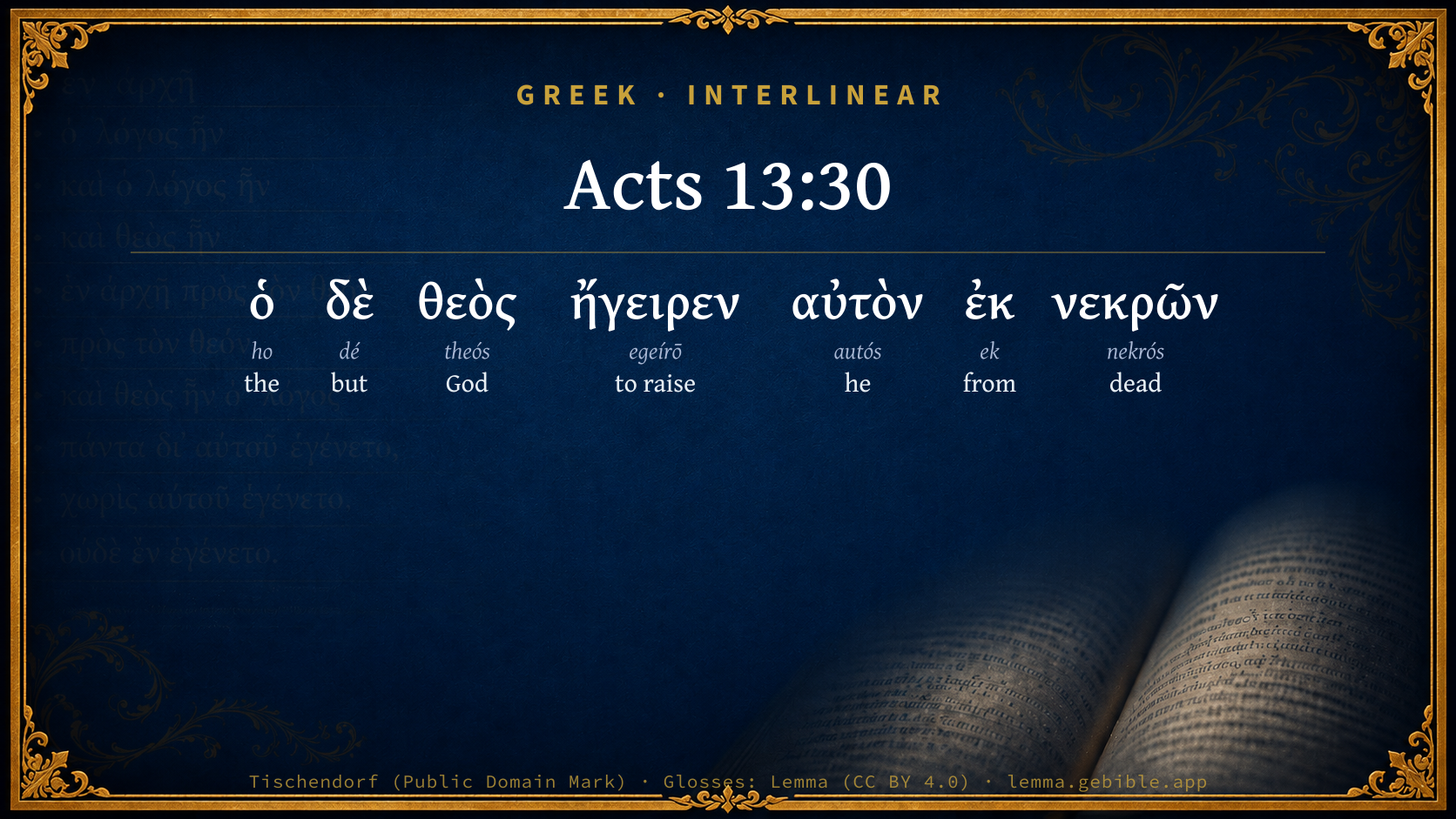
Download image
Cite this verse

Acts 13:30 (World English Bible). Public Domain. Lemma interlinear Bible study tool, https://lemma.gebible.app/v/acts/13/30.

Show BibTeX & RIS
BibTeX
RIS
English Translation
But God raised him from the dead,
World English Bible · Public Domain
Download a study sheet

One document with this verse’s original text, its word-by-word gloss line, the meaning frame, cross-references with their text, attributed commentary, and full source and license credits — printable, and it pastes into notes with its structure intact.

This verse Autodidact and up

Study sheet (.html) Plain text (.txt)

A passage Seminary Student

Up to 50 verses in one chapter. A passage sheet keeps up to 6 commentary sources and 12 cross-references per verse, in the order this page ranks them, and says so on the sheet whenever that leaves anything out. Ask for a single verse and you get the Autodidact verse sheet above.

Everything on this page stays free to read, with no account — the sheet is a download of what is already on screen, not access to it.

Want to remove ads? Support Godless Engineer
Compare translations 3

The same verse in 3 English versions, stacked beneath the original-language interlinear above. Click any original word for its lexicon entry.

Each is an independent rendering of the whole verse — the interlinear is not word-aligned to these translations.

Highlighted words mark where these versions differ — a whole-verse word diff, not a word-by-word alignment.

  • World English Bible Public Domain
    But God raised him from the dead,
  • King James Version Public Domain
    But God raised him from the dead:
  • unfoldingWord Literal Text CC BY-SA 4.0
    But God raised him from the dead,

unfoldingWord Literal Text — © unfoldingWord, licensed CC BY-SA 4.0. Word-aligned USFM3 via Door43 (git.door43.org/unfoldingWord/en_ult).

Versions to compare (up to 4)

3 of 4 selected

Show all 19 translations

Every available English version of this verse, each an independent rendering of the whole verse.

  • World English Bible Public Domain
    But God raised him from the dead,
  • Berean Standard Bible Public Domain
    But God raised Him from the dead,
  • Majority Standard Bible Public Domain
    But God raised Him from the dead,
  • King James Version Public Domain
    But God raised him from the dead:
  • American Standard Version (1901) Public Domain
    But God raised him from the dead:
  • Revised Version (1885) Public Domain
    But God raised him from the dead:
  • Geneva Bible (1599) Public Domain
    But God raised him vp from the dead.
  • Douay-Rheims (1899) Public Domain
    But God raised him up from the dead the third day:
  • Young's Literal Translation Public Domain
    and God did raise him out of the dead,
  • Literal Standard Version CC BY-SA 4.0
    and God raised Him out of the dead,
  • Unlocked Literal Bible CC BY-SA 4.0
    But God raised him from the dead.
  • unfoldingWord Literal Text CC BY-SA 4.0
    But God raised him from the dead,
  • Darby Bible Public Domain
    but God raised him from among [the] dead,
  • World Messianic Bible Public Domain
    But God raised him from the dead,
  • Webster's Bible Public Domain
    But God raised him from the dead:
  • Free Bible Version CC BY-SA 4.0
    But God raised him from the dead,
  • Bible in Basic English Public Domain
    But God gave him back from the dead:
  • Text-Critical English NT CC BY 4.0
    But God raised him from the dead,
  • Tyndale New Testament (1534) Public Domain
    But God raysed him agayne from deeth

Literal Standard Version (2020), Covenant Press — licensed CC BY-SA 4.0. Text via the HelloAO Bible API (eBible.org). Unlocked Literal Bible (unfoldingWord) — licensed CC BY-SA 4.0. Text via the HelloAO Bible API (eBible.org). unfoldingWord Literal Text — © unfoldingWord, licensed CC BY-SA 4.0. Word-aligned USFM3 via Door43 (git.door43.org/unfoldingWord/en_ult). Free Bible Version, Dr. Jonathan Gallagher — licensed CC BY-SA 4.0. Text via the HelloAO Bible API (eBible.org).

Word by word

More ways to search: Search by grammar → Find every occurrence → Compare this word →

Practice this passage: Drill this verse → Learn its vocabulary →

νεκρῶν
nekrós
G3498
“dead”
Adjective, Genitive, Plural, Masculine
Part of Speech
Adjective
Case
Genitive
Number
Plural
Gender
Masculine
Full Thayer's Definition

Origin: from an apparently primary nekus (a corpse)

TDNT: 18:52,6

1. properly a. one that has breathed his last, lifeless b. deceased, departed, one whose soul is in heaven or hell c. destitute of life, without life, inanimate 2. metaph. a. spiritually dead 1. destitute of a life that recognises and is devoted to God, because given up to trespasses and sins 2. inactive as respects doing right b. destitute of force or power, inactive, inoperative
  1. ὁ ho G3588 “the” Article, Nominative, Singular, Masculine
  2. δὲ dé G1161 “but” Conjunction
  3. θεὸς theós G2316 “God” Noun, Nominative, Singular, Masculine
  4. ἤγειρεν egeírō G1453 “to raise” Verb, Aorist, Active, Indicative, 3rd person, Singular
  5. αὐτὸν autós G846 “he” Personal pronoun, Accusative, Singular, Masculine
  6. ἐκ ek G1537 “from” Preposition

About this verse

These counts appear in no published source. They are computed here, from the morphology-tagged text and Lemma’s own curated glosses. What Lemma adds →

7
words
7
distinct lemmas
Acts
section

Cross-references

13

Topical passages linked to Acts 13:30 in the Treasury of Scripture Knowledge — connected by theme and wording, ordered by reader-vote popularity; previews shown in the World English Bible.

  • Acts 2:24 whom God raised up, having freed him from the agony of death, because it was not possible that he should be held by it.
  • Acts 17:31 because he has appointed a day in which he will judge the world in righteousness by the man whom he has ordained; of which he has given assurance to all men, in that he has raised him from the dead."
  • Matthew 28:6 He is not here, for he has risen, just like he said. Come, see the place where the Lord was lying.
  • John 2:19 Jesus answered them, "Destroy this temple, and in three days I will raise it up."
  • John 10:17 Therefore the Father loves me, because I lay down my life, that I may take it again.
  • Acts 2:32 This Jesus God raised up, to which we all are witnesses.
  • Acts 3:13 The God of Abraham, Isaac, and Jacob, the God of our fathers, has glorified his Servant Jesus, whom you delivered up, and denied in the presence of Pilate, when he had determined to release him.
  • Acts 3:15 and killed the Prince of life, whom God raised from the dead, to which we are witnesses.
  • Acts 3:26 God, having raised up his servant, Jesus, sent him to you first, to bless you, in turning away everyone of you from your wickedness."
  • Acts 4:10 be it known to you all, and to all the people of Israel, that in the name of Jesus Christ of Nazareth, whom you crucified, whom God raised from the dead, in him does this man stand here before you whole.
  • Acts 5:30–31 The God of our fathers raised up Jesus, whom you killed, hanging him on a tree.
  • Acts 10:40 God raised him up the third day, and gave him to be revealed,
  • Hebrews 13:20 Now may the God of peace, who brought again from the dead the great shepherd of the sheep with the blood of an eternal covenant, our Lord Jesus,

Cross-references courtesy of OpenBible.info (CC BY 4.0).

Commentary

Notes on Acts 13:30 from classic Christian and Jewish commentators (each source and its license shown beneath its notes). The classic Christian expositions comment on the surrounding passage and are grouped to its opening verse, so a note may address several verses; the Jewish commentaries on the Tanakh (Rashi and others) are per-verse, so they appear only where the commentator wrote on this verse.

Lemma curates 59 commentaries, every one of them public domain or Creative Commons licensed, each selected and text-cleaned for this edition rather than reprinted as found. About our sources →

Meyer's Critical & Exegetical Commentary

Heinrich August Wilhelm Meyer

Act_13:30. But God, after such extreme and unrighteous rejection of Jesus on the part of those men, what a glorious deed has He done! Thus Paul paves the way to announce the highest Messianic σημεῖον of Jesus (comp. Rom_1:4), the resurrection from the dead; and that according to its certainty as matter of experience (Act_13:31), as well as a fulfilment of the prophetic promise (Act_13:32-37).

Meyer — Critical and Exegetical Commentary on the New Testament — English translation by Peter Christie, edited by Frederick Crombie (T&T Clark, 1880) — public domain. Text from a community e-Sword module.

Geneva Bible (1599)

Geneva Bible translators

We must set the glory of the resurrection against the shame of the cross, and grave. And the resurrection is proved as well by witnesses which saw it, as by the testimonies of the Prophets.

Geneva Bible (1599) marginal notes — public domain. Text via Bolls.life.

Adam Clarke's Commentary

Verse 30. But God raised him from the dead] And thus gave the fullest proof of his innocence. God alone can raise the dead; and he would not work a miracle so very extraordinary, but on some extraordinary occasion.

Adam Clarke's Commentary on the Bible (1810–1826) — public domain. Text from a community e-Sword/MySword module.

John Calvin's Commentaries

30. God hath raised him up. The death of Christ was the salvation of the godly, yet joined with the resurrection; therefore doth Paul stand longer upon this second point. For he should never have persuaded his hearers that they were to seek salvation in Christ’s death, unless the power of Almighty God had appeared in raising Christ from death.

John Calvin's Commentaries (1540-1563) — public domain. Text from the Calvin Translation Society English edition (1840s-50s) via the Christian Classics Ethereal Library (ccel.org). Calvin's coverage is partial (roughly two-thirds of the Bible); uncommented books and verses are honest gaps, never fabricated. The 19th-century editor's footnotes and remarks are omitted so the notes are faithfully Calvin's own voice.

The Cambridge Bible for Schools and Colleges

gen. ed. J. J. S. Perowne

30. But God raised him from the dead] This was the proof that God had now fulfilled the promise made unto Abraham and to David, that of their seed should one come, in whom all the nations of the earth should be blessed, even as St Paul says below, by being justified from all things, from which they could not be justified by the law of Moses. And elsewhere (Rom_1:4) the Apostle says that Jesus “was declared to be the Son of God with power, according to the spirit of holiness, by the resurrection from the dead.”

The Cambridge Bible for Schools and Colleges (gen. ed. J. J. S. Perowne; Cambridge University Press, 1878–1918) — public domain. Text from a community e-Sword module.

John Gill's Exposition

God hath fulfilled the same unto us their children,.... The natural descendants of them, as Paul and Barnabas, and the Jews in the synagogue, were:

in that he hath raised up Jesus again; which may not be understood of his resurrection from the dead, since the promise made, and now fulfilled, has not a single respect to that; but of his being raised up, and sent forth into the world, to be a Saviour and Redeemer, and to sit upon the throne of David, as in Act 2:30 of which raising of him up to regal dignity, mention is made in Psa 2:1, Psa 6:1 which is produced as a testimony of it; and the rather this seems to be the sense, since the article of the resurrection of the dead is spoken of in the next verse, as distinct from this; and other passages of Scripture are produced, as speaking of it; though admitting that Christ's resurrection from the dead is here intended, as the Alexandrian copy reads, what follows is very applicable to it, without any detriment to the doctrine of Christ's eternal generation and sonship, as will be hereafter made to appear:

as it is written in the second psalm: Beza's most ancient copy, and other very ancient copies, read, "in the first psalm"; for the first and second psalms seem to have been reckoned by the ancient Jews but one psalm, or one section; for so they say (d).

""blessed is the man", &c. and "why do the Heathen rage", &c. , are one "parasha", or section: and they further observe (e), that "every section that was dear to David, he began it with "blessed", and ended it with "blessed"; he began with "blessed", as it is written, Psa 1:1 "blessed is the man", &c. and he ended it with "blessed", as it is written, Psa 2:12 "blessed are all they that put their "trust in him":'' though it is elsewhere said (f), "blessed is the man", &c. Psa 1:1 "and why do the heathen rage", &c. Psa 2:1 are two sections; and "to the chief musician on Muth Labben", Psa 9:1) and "why standest thou afar off", &c. (Ps 10:1-18) are two sections.''

And Kimchi calls (g) this psalm, as the generality of copies here do, saying,

"this psalm is , "the second psalm."''

And that this psalm belongs to the Messiah, is evident from the mention made of him in Psa 2:2 from the mad counsel, and vain attempts of the kings of the earth against him, Psa 2:1. God's decree and resolution to make and declare him King of Zion, notwithstanding all their efforts upon him, Psa 2:4 from his asking and having the Gentiles, and uttermost parts of the earth for his inheritance, which is true of no other, Psa 2:8 and especially from that reverence, worship, and adoration, which are to be given to him, and that trust and confidence to be placed in him, Psa 2:10 which can by no means agree with David, nor with any mere creature whatever; and as for Psa 2:7 which is here cited, what is said in that is inapplicable even to angels, Heb 1:5 and much more to David, or any mere man. The whole psalm was, by the ancient Jews, interpreted of the Messiah, as is confessed by some of their later doctors. R. David Kimchi says (h),

"there are that interpret it of Gog and Magog, and the Messiah, he is the King Messiah; and so the Rabbins of blessed memory interpret it.''

And Jarchi confesses the same, and is somewhat more open in giving his reason for interpreting it otherwise.

"Our Rabbins (says he) expound this affair concerning the King Messiah; but according to its literal sense, and for an answer to the heretics (or Christians), it is right to explain it concerning David himself.''

he clause, "and for an answer to the heretics", is left out in later editions, but was in the more ancient ones; it being so open and barefaced, that the Jews did not choose to let it stand. Aben Ezra is in a doubt whether to interpret the psalm of David, or of the Messiah; though he thinks the former is best; and particularly this seventh verse is, by several of their ancient writers, applied to the Messiah; in one of their writings, esteemed very ancient, are these words (i);

"from thence shall come forth, in that day, the Messiah of David; and this is the mystery of, "I will declare the decree, the Lord said unto me, thou art my Son", &c.''

And this is the sense of R. Ame (k), a famous ancient doctor of theirs: upon mention of those words in Jer 31:22 "the Lord hath created a new thing", &c.

"says R. Hone, in the name of R. Ame, this is the King Messiah, as it is said, Psa 2:7 "this day have I begotten thee".''

And in like manner in the Talmud (l), it is understood of the Messiah, where are these expressions;

"the Rabbins teach, that Messiah, the son of David, who shall be revealed in haste in our days, the holy blessed God said unto him, ask anything of me, and I will give it thee, as it is said, Psa 2:7 "I will declare the decree, &c. this day have I begotten thee".''

And that this was the sense of the Jews in the times of the apostle, need not be doubted, since the apostle cites these words before a Jewish assembly, in one of their synagogues, and applies them to the Messiah, without any hesitation, or any further reasoning upon it, as being a thing generally agreed on, and out of doubt; wherefore the Jew (m) has no reason to charge the apostle with an error in citing a passage in this psalm, and applying it to Christ, since their ancient doctors have allowed, that it belongs to him, and even the very passage which the apostle produces; which passage Maimonides (n) himself applies to the Messiah. This objector would have it, that David spoke the whole psalm by the Holy Spirit concerning himself, and that he calls himself the Lord's anointed; and that being anointed by the will of the Lord, what was against his kingdom, was against the Lord himself; and that he is called the Son of God, because he attended to the worship of God; and that the begetting of him refers to the time of his unction by Samuel; and that it can by no means agree with Jesus of Nazareth, who never ruled in any place, but others ruled over him, when they condemned him to death as the meanest of the people; and who himself says, that he came not to be ministered unto, Mat 20:28 especially he thinks those words, "ask of me, and I will give the Heathen", &c. greatly militate against the application of the psalm to Jesus; for if he is God, what need has he to ask of another? But since the Jewish doctors themselves have applied this psalm to the Messiah, the apostle ought not to be blamed for making such an application; and there are many things which cannot be applied to David himself; for whatever may be said of his anointing, begetting, and sonship, the uttermost parts of the earth were never given for his possession; and much less can he be the son the kings of the earth are called upon to kiss and worship, or he be the object of trust and confidence; and though Jesus in the days of his humiliation was not ministered unto, but ministered to others, and ruled not over others, but submitted to the death of the cross; he has since been made and declared Lord of all, and his kingdom has taken place in the nations of the world, and ere long all the kingdoms of it will become his; and though he is God, it is no ways inconsistent with him, as man and Mediator, to ask anything of his Father, and especially what has been agreed between them shall be given: the words cited by the apostle are, "thou art my Son, this day have I begotten thee"; in Beza's ancient copy, the verse following these words is added, "ask of me", &c. The words are to be understood of the eternal filiation of Christ, and are produced, to set forth the greatness and dignity of his person; whom God had raised and sent forth in human nature, to be the Saviour and Redeemer of his people: though should they be applied to the resurrection of Christ from the dead, it will no ways prejudice the doctrine of Christ's proper and natural sonship, as being the only begotten of the Father; since the resurrection of Christ is not the cause of his sonship, or the reason why he is called the Son of God, but a manifestation of it; Christ was the Son of God, before his resurrection from the dead; he was declared to be so by a voice from heaven, was believed on by his disciples as such, and confessed by others, both men and devils: besides, if his resurrection was the cause of his sonship, he must beget himself, which is absurd, for he was himself concerned in his resurrection from the dead; more over, his sonship would not be proper, but figurative and metaphorical, whereas he is God's own, or proper son; besides, on this account he could not be called God's only begotten Son, because there are others that have been, and millions that will be raised from the dead besides him: but the reason why these words are applied to the resurrection of Christ, allowing them to be so, is not because he was then begotten as the Son of God, but because he was then manifested to be the eternally begotten Son of God; things are said to be, when they are only manifested to be; so Christ is said to be that day begotten, because he was "declared to be the Son of God with power, by the resurrection from the dead", Rom 1:4 Hence these words are applicable to any time or thing wherein Christ is manifested to be the only begotten Son of God, and accordingly are applied to different times and things; see Heb 1:3.

(d) T. Bab. Beracot, fol. 9. 2. (e) Ib. fol. 10. 1. (f) Piske Tosephot in T. Bab. Megilla, art. 34. (g) In Psal. ii. 1. (h) In Psal. ii. 12. Vid. T. Bab. Avoda Zara, fol. 3. 2. (i) Zohar in Numb. fol. 82. 2. (k) In Abarbinel. Mashmia Jeshua, fol. 37. 2. (l) T. Bab. Succa, fol. 52. 1. (m) R. Isaac, Chizzuk Emuna, par. 2. c. 68. p. 454, &c. (n) In Misn. Sanhedrin, c. 11. sect. 1.

John Gill's Exposition of the Whole Bible (1746–1763) — public domain (CC PDM 1.0). Text via the HelloAO Bible API.

Trapp's Complete Commentary

John Trapp

30 But God raised him from the dead:

Ver. 30. {See Trapp on "Mat 28:6"}

John Trapp, A Commentary or Exposition upon All the Books of the Old and New Testament (1647–1656) — public domain. Text from a community e-Sword module.

Albert Barnes' Notes on the Bible

But God raised him ... - See the notes on Act 2:23-24.

Albert Barnes' Notes on the Bible (1834–1885) — public domain. Text from a community e-Sword/MySword module.

Matthew Poole's English Annotations

Lest they should be offended at our Saviour’s dying so shameful and cursed a death, and to take away the scandal of the cross, he shows, that his resurrection was as glorious as his death could be ignominious, being by it declared to be the Son of God with power, Rom 1:4.

Matthew Poole's English Annotations on the Holy Bible (1683–1685) — public domain. Text from a community e-Sword/MySword module.

Whedon's Commentary on the Bible

Daniel D. Whedon

30. God raised him—Here by one bold stroke the malefactor is made divine. Jesus not only worked miracles, but he was in his history and in himself the greatest of miracles. Is the Sanhedrin great? this Jesus is infinitely greater.

Daniel D. Whedon (gen. ed.), Commentary on the Old and New Testaments (1874–1909) — public domain. Text from a community e-Sword module.

Kretzmann's Popular Commentary

Paul E. Kretzmann

The argument from the resurrection of Christ:

v. 30. But God raised Him from the dead;

v. 31. and He was seen many days of them which came up with Him from Galilee to Jerusalem, who are His witnesses unto the people.

v. 32. And we declare unto you glad tidings, how that the promise which was made unto the fathers,

v. 33. God hath fulfilled the same unto us, their children, in that He hath raised up Jesus again; as it is also written in the Second Psalm, Thou art My Son, this day have I begotten Thee.

v. 34. And as concerning that He raised Him up from the dead, now no more to return to corruption, He said on this wise, I will give you the sure mercies of David.

v. 35. Wherefore He saith also in another psalm, Thou shalt not suffer Thine Holy One to see corruption.

v. 36. For David, after he had served his own generation by the will of God, fell on sleep, and was laid unto his fathers, and saw corruption.

v. 37. But He whom God raised again saw no corruption.

Paul boldly places the statement at the head of this section of his discourse: But God raised Him from the dead. The full importance of the resurrection of Jesus for Christian faith must ever be kept in mind, since it is fundamental for the understanding of Christ’s redemption. The first proof which Paul brings for the resurrection is the testimony of the eye-witnesses. Jesus was seen many days by those that had traveled with Him from Galilee to Jerusalem, who were now kept busy bearing witness of that fact to the people. Because of the certainty of this miracle not only the eye-witnesses, but also the present speaker and Barnabas were bringing their hearers the Gospel-news, that the promise given to the fathers God had fulfilled for those that were present, their children, in this fact, that He raised Jesus from the dead. And in case the testimony of the eye-witnesses were not deemed sufficient by them, Paul brings proof from Scriptures. There were the words of the Second Psalm: Thou art My Son, today have I begotten Thee. He was the eternal Son of God, in full possession of eternal life. It was impossible for Him, therefore, to remain in death; He must arise and give full expression to the life which was His from eternity. The second Scripture-passage which Paul adduces to prove that the resurrection of Christ was in accordance with prophecy, that God raised Him up from the dead, and that He should never return to corruption and decay, which seemed to envelop Him as He lay there in the tomb, was taken from Isa 55:3, quoted from the Greek text. There God promises His people to make an everlasting covenant with them by giving them the holy and sure blessings of David. The sacred promises given to David could be realized only in the triumph, the resurrection, of God’s Holy One; only by the living Christ can the blessings of the Gospel be ratified and assured. "If now this Christ, through whom this covenant is made, true man, as He was promised to David of his blood and flesh, should bring and give eternal grace, for which reason He must be God, to whom alone it pertains to give this: then He must not remain in death, though He die like a natural man, but Himself must rise from the dead, in order that He may deliver others also from death and give them eternal life, that He may in truth be called and be an eternal King of grace, righteousness, and life, as God has firmly promised. " The final passage which Paul quotes is the same one which Peter had used in his great Pentecost sermon, Psa 16:10: Thou wilt not give Thy Holy One to see corruption. For, as the speaker rightly argues, these words cannot apply to David, since he, after having performed the work of his office for his own generation, fell asleep according to the will of God and did see corruption and decay in death. But this Christ, whom God raised up from the dead and also exalted to heavenly glory, did not see corruption, did not become subject to decay. A more direct and explicit prediction of the resurrection of Jesus cannot be found in the entire Old Testament, and the force of the words must have been felt by all the hearers.

Paul E. Kretzmann, Popular Commentary of the Bible (1921–1924) — public domain. Text from a community e-Sword module.

McGarvey & Pendleton's Commentaries

J. W. McGarvey

30-33. The speaker proceeds to the climax of his argument; a proof of the Messiahship still more conclusive, if possible than the testimony of John, or the fulfillment of prophesy. (30) " But God raised him from the dead; (31) and he was seen many days by those who came up with him from Galilee to Jerusalem, who are his witnesses to the people. (32) And we declare to you glad tidings concerning the promise made to the fathers, (33) that God has fulfilled it to us, their children, by raising up Jesus; as it is written in the second Psalm, Thou art my son; to-day have I begotten thee. " The fact of the resurrection of Jesus, so well attested by competent witnesses, is introduced, not only as the final proof of his Messiahship, but as happy tidings to these Jews, being no less than the fulfillment of the promise to the fathers, and the realization of their most cherished hopes.

The difficulty of applying the words of David, "Thou art my son; to-day I have begotten thee," to the resurrection of Jesus, has led many commentators to suppose that both it and the expression, "raising up Jesus," refer to his incarnation. But these words of David, in every other instance of their occurrence in the New Testament, are applied to his resurrection, and not to his natural birth. In Hebrews 5:5 , Paul says: "Christ glorified not himself to be made a priest, but he who said to him, Thou art my son; to-day have I begotten thee." Now, as Christ was not a priest until after he had died as a victim, and was prepared to enter heaven with his own blood, it is clear that these words are applied to his resurrection, at the time of which he entered upon his priestly office. So, likewise, in Hebrews 1:5 , the question, "To which of the angels said he at any time, Thou art my son; to-day have I begotten thee?" is adduced as evidence of his superiority to angels, and can not, therefore, refer to the period when he was "made a little lower than the angels." That the term rendered begotten may be properly referred to the resurrection is evident from the fact that he is called the "first begotten from the dead," and the "first born from the dead," in which two expressions the Greek words are the same. He was the "only begotten son of God," by his birth of the Virgin Mary; but he became the "first born from the dead," or the "first born of the whole creation," when he was declared to be the Son of God with power by the resurrection from the dead. In applying the quotation from the second Psalm, therefore, to the resurrection, and endeavoring to cheer the Jews in Antioch, with the thought that a long-cherished and familiar promise was thereby fulfilled, Paul was giving his real understanding of the passage quoted, and it is one as much more cheering than that which many commentators have gathered from it, as the exaltation of Christ from the grave to his throne in the heavens was a more glorious birth than that which brought him into this sinful world.

J. W. McGarvey (with Philip Y. Pendleton), Commentaries on the New Testament (The Fourfold Gospel, 1914; Acts; and the epistles) — public domain. Text from a community e-Sword/MySword module.

unfoldingWord translationNotes

Door43 World Missions Community

But God raised him

"But" indicates a strong contrast between what the people did and what God did.

raised him from the dead

"raised him from among those who were dead." To be with "the dead" means that Jesus was dead.

raised him

Here, to raise up is an idiom for causing someone who has died to become alive again. AT: "caused him to live again" (See: Idiom)

from the dead

From among all those who have died. This expression describes all dead people together in the underworld. To raise someone from among them speaks of making that person alive again.

He was seen ... Galilee to Jerusalem

This can be stated in active form. AT: "The disciples who traveled with Jesus from Galilee to Jerusalem saw him for many days" (See: Active or Passive)

many days

We know from other writings that this period was 40 days. Translate "many days" with a term that would be appropriate for that length of time.

are now his witnesses to the people

"are now testifying to the people about Jesus" or "are now telling the people about Jesus"

translationWords

God

raise

die

Galilee

Jerusalem

testimony

unfoldingWord translationNotes — © Distant Shores Media and the Door43 World Missions Community, licensed CC BY-SA 4.0. Source: git.door43.org/Door43/en_tn.

Cambridge Greek Testament for Schools and Colleges

30. ὁ δὲ θεὸς ἤγειρεν αὐτὸν ἐκ νεκρῶν, but God raised Him from the dead. This was the proof that God had now fulfilled the promise made unto Abraham and to David, that of their seed should one come, in whom all the nations of the earth should be blessed, even as St Paul says below, by being justified from all things, from which they could not be justified by the law of Moses. And elsewhere (Rom 1:4) the Apostle says that Jesus ‘was declared to be the Son of God with power, according to the spirit of holiness, by the resurrection from the dead.’

Cambridge Greek Testament for Schools and Colleges (Cambridge University Press, 1896; 21 vols, various authors incl. Carr, Maclear, Plummer, Farrar, Lumby, Moule, M. R. James, Simcox) — public domain. Text from a community e-Sword module.

Lesson kit

Teaching starters — assembled from the data on this page, not authored interpretation. Every prompt links to the verse data it draws on. Edit before teaching.

Acts, in the Acts, opens this verse with 7 words (7 distinct Greek lemmas). Its most distinctive word is nekrós (“dead”). A historical commentator’s framing appears above. Read the whole chapter for the surrounding context.

Discussion questions

  1. The word nekrós carries the sense “dead.” How does it shape the verse?
  2. Acts 2:24 shares this passage’s theme. How do the two illuminate each other?
  3. Reading how Meyer's Critical & Exegetical Commentary and Geneva Bible (1599) read this verse, where do the two commentators agree and where do they part?

Reading settings

Reading text

Shown beneath each verse's original-language words.

Old Testament
Old Testament edition

Read the OT as the Masoretic Hebrew (MT) or the Greek Septuagint (LXX).

English shown for the Greek Septuagint (in the Hebrew ↔ Greek comparison).

Comparing translations? Open the Compare panel on any verse page to stack up to four side by side.