Ephesians 1:20

Greek (Tischendorf 8th ed.) Ephesians 1:20 appears in the Greek New Testament. The text above is from the Tischendorf 8th edition. Each word links to its Strong’s number and a concise gloss. Click any word for its full Thayer’s Greek Lexicon entry.
Download image
Cite this verse

Ephesians 1:20 (World English Bible). Public Domain. Lemma interlinear Bible study tool, https://lemma.gebible.app/v/ephesians/1/20.

Show BibTeX & RIS
BibTeX
RIS
English Translation
which he worked in Christ, when he raised him from the dead, and made him to sit at his right hand in the heavenly places,
World English Bible · Public Domain
Download a study sheet

One document with this verse’s original text, its word-by-word gloss line, the meaning frame, cross-references with their text, attributed commentary, and full source and license credits — printable, and it pastes into notes with its structure intact.

This verse Autodidact and up

Study sheet (.html) Plain text (.txt)

A passage Seminary Student

Up to 50 verses in one chapter. A passage sheet keeps up to 6 commentary sources and 12 cross-references per verse, in the order this page ranks them, and says so on the sheet whenever that leaves anything out. Ask for a single verse and you get the Autodidact verse sheet above.

Everything on this page stays free to read, with no account — the sheet is a download of what is already on screen, not access to it.

Want to remove ads? Support Godless Engineer
Compare translations 3

The same verse in 3 English versions, stacked beneath the original-language interlinear above. Click any original word for its lexicon entry.

Each is an independent rendering of the whole verse — the interlinear is not word-aligned to these translations.

Highlighted words mark where these versions differ — a whole-verse word diff, not a word-by-word alignment.

  • World English Bible Public Domain
    which he worked in Christ, when he raised him from the dead, and made him to sit at his right hand in the heavenly places,
  • King James Version Public Domain
    Which he wrought in Christ, when he raised him from the dead, and set him at his own right hand in the heavenly places,
  • unfoldingWord Literal Text CC BY-SA 4.0
    which he worked in Christ, having raised him from the dead and seated at his right hand in the heavenly places,

unfoldingWord Literal Text — © unfoldingWord, licensed CC BY-SA 4.0. Word-aligned USFM3 via Door43 (git.door43.org/unfoldingWord/en_ult).

Versions to compare (up to 4)

3 of 4 selected

Show all 19 translations

Every available English version of this verse, each an independent rendering of the whole verse.

  • World English Bible Public Domain
    which he worked in Christ, when he raised him from the dead, and made him to sit at his right hand in the heavenly places,
  • Berean Standard Bible Public Domain
    which He exerted in Christ when He raised Him from the dead and seated Him at His right hand in the heavenly realms,
  • Majority Standard Bible Public Domain
    which He exerted in Christ when He raised Him from the dead and seated Him at His right hand in the heavenly realms,
  • King James Version Public Domain
    Which he wrought in Christ, when he raised him from the dead, and set him at his own right hand in the heavenly places,
  • American Standard Version (1901) Public Domain
    which he wrought in Christ, when he raised him from the dead, and made him to sit at his right hand in the heavenly `places',
  • Revised Version (1885) Public Domain
    which he wrought in Christ, when he raised him from the dead, and made him to sit at his right hand in the heavenly places,
  • Geneva Bible (1599) Public Domain
    Which he wrought in Christ, when he raised him from the dead, and set him at his right hand in the heauenly places,
  • Douay-Rheims (1899) Public Domain
    Which he wrought in Christ, raising him up from the dead, and setting him on his right hand in the heavenly places.
  • Young's Literal Translation Public Domain
    which He wrought in the Christ, having raised him out of the dead, and did set `him' at His right hand in the heavenly `places',
  • Literal Standard Version CC BY-SA 4.0
    which He worked in the Christ, having raised Him out of the dead, and sat [Him] at His right hand in the heavenly [places],
  • Unlocked Literal Bible CC BY-SA 4.0
    This is the same power that God worked in Christ when he raised him from the dead and seated him at his right hand in the heavenly places.
  • unfoldingWord Literal Text CC BY-SA 4.0
    which he worked in Christ, having raised him from the dead and seated at his right hand in the heavenly places,
  • Darby Bible Public Domain
    [in] which he wrought in the Christ [in] raising him from among [the] dead, and he set him down at his right hand in the heavenlies,
  • World Messianic Bible Public Domain
    which he worked in Messiah when he raised him from the dead and made him to sit at his right hand in the heavenly places,
  • Webster's Bible Public Domain
    Which he wrought in Christ, when he raised him from the dead, and set him at his own right hand in the heavenly places,
  • Free Bible Version CC BY-SA 4.0
    that he demonstrated in raising Christ from the dead. God seated Christ at his right hand in heaven,
  • Bible in Basic English Public Domain
    By which he made Christ come back from the dead, and gave him a place at his right hand in heaven,
  • Text-Critical English NT CC BY 4.0
    He exercised this power in Christ by raising him from the dead and seating him at his right hand in the heavenly places,
  • Tyndale New Testament (1534) Public Domain
    which he wrought in Christ when he raysed him from deeth and set him on his right honde in hevenly thynges

Literal Standard Version (2020), Covenant Press — licensed CC BY-SA 4.0. Text via the HelloAO Bible API (eBible.org). Unlocked Literal Bible (unfoldingWord) — licensed CC BY-SA 4.0. Text via the HelloAO Bible API (eBible.org). unfoldingWord Literal Text — © unfoldingWord, licensed CC BY-SA 4.0. Word-aligned USFM3 via Door43 (git.door43.org/unfoldingWord/en_ult). Free Bible Version, Dr. Jonathan Gallagher — licensed CC BY-SA 4.0. Text via the HelloAO Bible API (eBible.org).

Word by word

More ways to search: Search by grammar → Find every occurrence → Compare this word →

Practice this passage: Drill this verse → Learn its vocabulary →

ἐπουρανίοις
epouránios
G2032
“heaven”
Adjective, Dative, Plural, Neuter
Part of Speech
Adjective
Case
Dative
Number
Plural
Gender
Neuter
Full Thayer's Definition

Origin: from G1909 and G3772

TDNT: 13:58,7

1. existing in heaven a. things that take place in heaven b. the heavenly regions 1. heaven itself, the abode of God and angels 2. the lower heavens, of the stars 3. the heavens, of the clouds c. the heavenly temple or sanctuary 2. of heavenly origin or nature
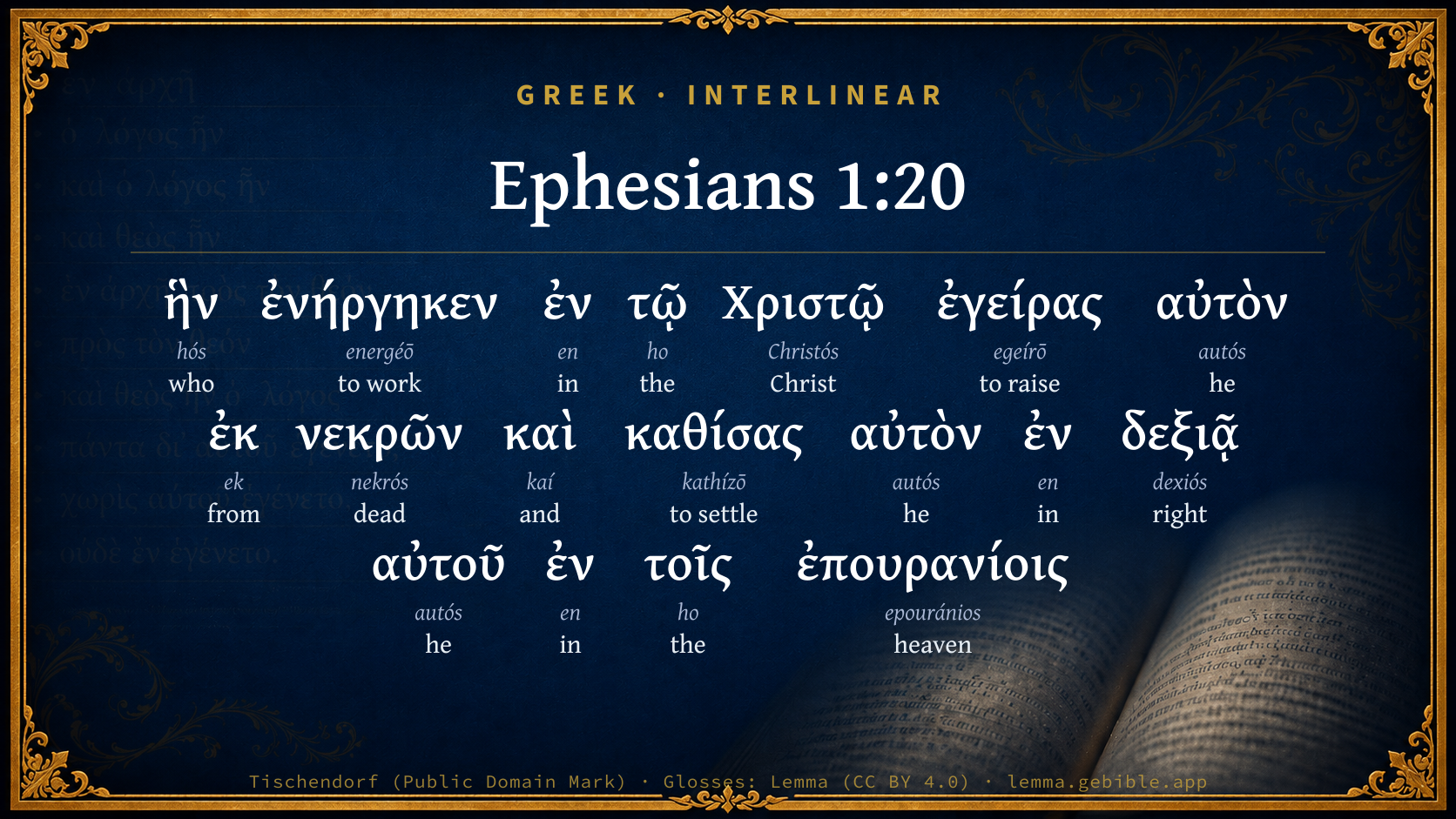
  1. ἣν hós G3739 “who” Relative pronoun, Accusative, Singular, Feminine
  2. ἐνήργηκεν energéō G1754 “to work” Verb, Perfect, Active, Indicative, 3rd person, Singular
  3. ἐν en G1722 “in” Preposition
  4. τῷ ho G3588 “the” Article, Dative, Singular, Masculine
  5. Χριστῷ Christós G5547 “Christ” Noun, Dative, Singular, Masculine
  6. ἐγείρας egeírō G1453 “to raise” Verb, Aorist, Active, Participle, Nominative, Singular, Masculine
  7. αὐτὸν autós G846 “he” Personal pronoun, Accusative, Singular, Masculine
  8. ἐκ ek G1537 “from” Preposition
  9. νεκρῶν nekrós G3498 “dead” Adjective, Genitive, Plural, Masculine
  10. καὶ kaí G2532 “and” Conjunction
  11. καθίσας kathízō G2523 “to settle” Verb, Aorist, Active, Participle, Nominative, Singular, Masculine
  12. αὐτὸν autós G846 “he” Personal pronoun, Accusative, Singular, Masculine
  13. ἐν en G1722 “in” Preposition
  14. δεξιᾷ dexiós G1188 “right” Adjective, Dative, Singular, Feminine
  15. αὐτοῦ autós G846 “he” Personal pronoun, Genitive, Singular, Masculine
  16. ἐν en G1722 “in” Preposition
  17. τοῖς ho G3588 “the” Article, Dative, Plural, Neuter

About this verse

These counts appear in no published source. They are computed here, from the morphology-tagged text and Lemma’s own curated glosses. What Lemma adds →

18
words
13
distinct lemmas
Pauline Epistles
section

Notable vocabulary

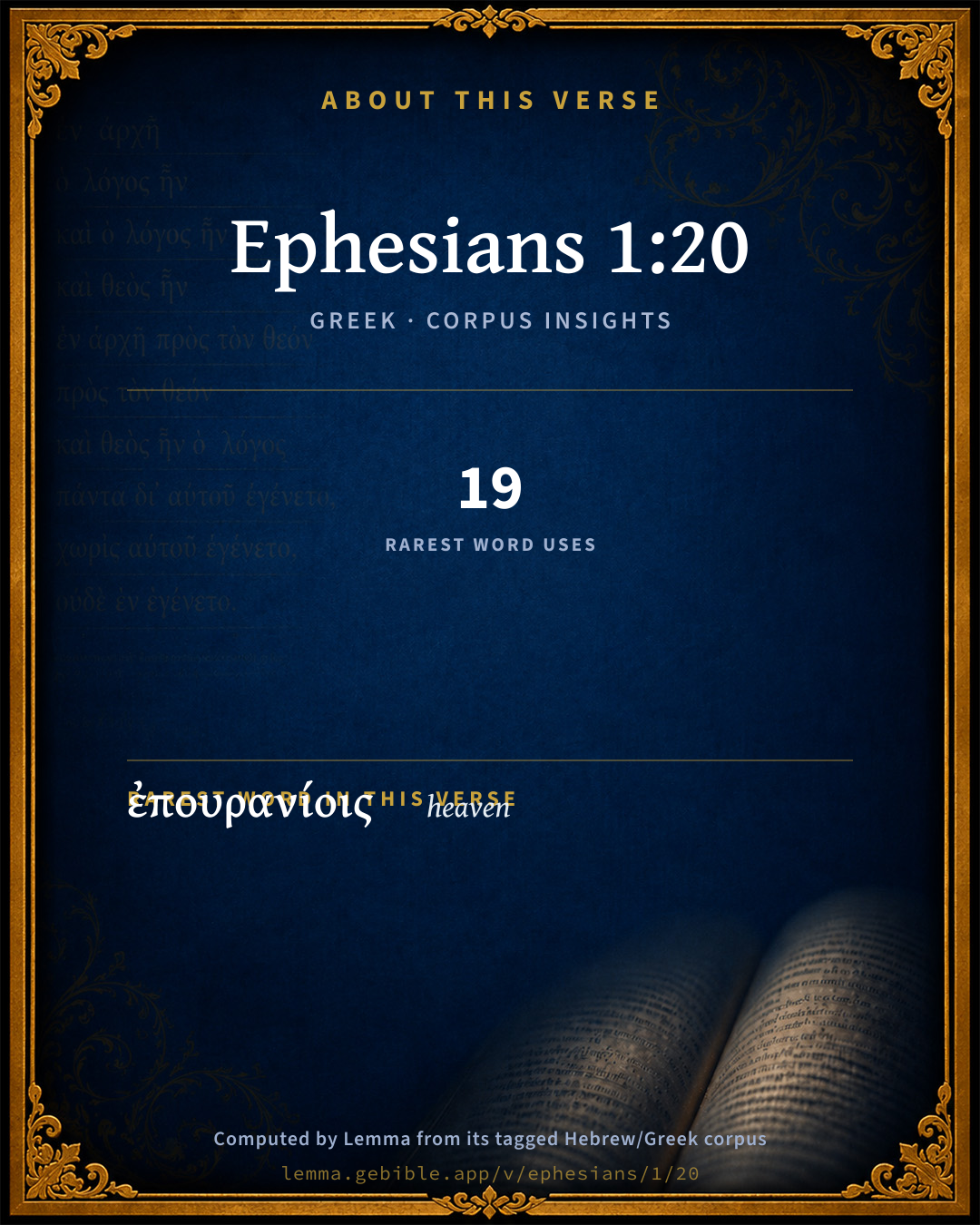
The rarest word here is ἐπουρανίοις heaven G2032 — appearing just 19 times in the whole Greek New Testament.

Shared distinctive vocabulary

ἐπουρανίοις heaven G2032 occurs in 17 verses of the Greek New Testament. Also found in:

Repetition

Words recur within this verse:

Cross-references

31

Topical passages linked to Ephesians 1:20 in the Treasury of Scripture Knowledge — connected by theme and wording, ordered by reader-vote popularity; previews shown in the World English Bible.

  • Hebrews 10:12 but he, when he had offered one sacrifice for sins for ever, sat down on the right hand of God;
  • Mark 16:19 So then the Lord Jesus, after he had spoken to them, was received up into heaven, and sat down at the right hand of God.
  • Psalms 110:1 Yahweh says to my Lord, "Sit at my right hand, Until I make your enemies your footstool for your feet."
  • Matthew 22:43–45 He said to them, "How then does David in the Spirit call him Lord, saying,
  • Matthew 28:18 Jesus came to them and spoke to them, saying, "All authority has been given to me in heaven and on earth.
  • Acts 2:24–36 whom God raised up, having freed him from the agony of death, because it was not possible that he should be held by it.
  • Hebrews 1:3 His Son is the radiance of his glory, the very image of his substance, and upholding all things by the word of his power, when he had by himself made purification for our sins, sat down on the right hand of the Majesty on high;
  • Philippians 3:10 that I may know him, and the power of his resurrection, and the fellowship of his sufferings, becoming conformed to his death;
  • Colossians 3:1 If then you were raised together with Christ, seek the things that are above, where Christ is, seated on the right hand of God.
  • Matthew 26:64 Jesus said to him, "You have said it. Nevertheless, I tell you, henceforth you will see the Son of Man sitting at the right hand of Power, and coming on the clouds of the sky."
  • Mark 14:62 Jesus said, "I AM. You will see the Son of Man sitting at the right hand of Power, and coming with the clouds of the sky."
  • John 17:1–5 Jesus said these things, and lifting up his eyes to heaven, he said, "Father, the time has come. Glorify your Son, that your Son may also glorify you;
  • Acts 5:31 God exalted him with his right hand to be a Prince and a Savior, to give repentance to Israel, and remission of sins.
  • Romans 8:34 Who is he who condemns? It is Christ who died, yes rather, who was raised from the dead, who is at the right hand of God, who also makes intercession for us.
  • Ephesians 2:5–6 even when we were dead through our trespasses, made us alive together with Christ (by grace you have been saved),
  • Revelation 5:11–14 I saw, and I heard something like a voice of many angels around the throne, the living creatures, and the elders; and the number of them was ten thousands of ten thousands, and thousands of thousands;
  • Psalms 16:9–11 Therefore my heart is glad, and my tongue rejoices. My body shall also dwell in safety.
  • John 10:18 No one takes it away from me, but I lay it down by myself. I have power to lay it down, and I have power to take it again. I received this commandment from my Father."
  • John 10:30 I and the Father are one."
  • Acts 4:10 be it known to you all, and to all the people of Israel, that in the name of Jesus Christ of Nazareth, whom you crucified, whom God raised from the dead, in him does this man stand here before you whole.
  • Acts 7:55–56 But he, being full of the Holy Spirit, looked up steadfastly into heaven, and saw the glory of God, and Jesus standing on the right hand of God,
  • Acts 10:40 God raised him up the third day, and gave him to be revealed,
  • Acts 26:8 Why is it judged incredible with you, if God does raise the dead?
  • Romans 1:4 who was declared to be the Son of God with power, according to the Spirit of holiness, by the resurrection from the dead, Jesus Christ our Lord,
  • Romans 6:5–11 For if we have become united with him in the likeness of his death, we will also be part of his resurrection;
  • Ephesians 1:3 Blessed be the God and Father of our Lord Jesus Christ, who has blessed us with every spiritual blessing in the heavenly places in Christ;
  • Ephesians 4:8–10 Therefore he says, "When he ascended on high, he led captivity captive, and gave gifts to men."
  • Hebrews 2:9 But we see him who has been made a little lower than the angels, Jesus, because of the suffering of death crowned with glory and honor, that by the grace of God he should taste of death for everyone.
  • Hebrews 13:20 Now may the God of peace, who brought again from the dead the great shepherd of the sheep with the blood of an eternal covenant, our Lord Jesus,
  • 1 Peter 1:3 Blessed be the God and Father of our Lord Jesus Christ, who according to his great mercy became our father again to a living hope through the resurrection of Jesus Christ from the dead,
  • Revelation 1:17 When I saw him, I fell at his feet like a dead man. He laid his right hand on me, saying, "Don't be afraid. I am the first and the last,

Cross-references courtesy of OpenBible.info (CC BY 4.0).

Where the printed editions differ

1 variant

Places in this verse where the major printed Greek editions disagree on the wording in a way that affects the translation — a comparison of editions, not a manuscript-by-manuscript collation. The editions are the modern critical texts (Nestlé-Aland 28/27, SBL, Westcott-Hort, Tregelles, Tyndale House) and the traditional texts behind the KJV (the Textus Receptus and the Byzantine/Majority text). It is not a claim about which reading is original.

  1. Extra text
    αὐτὸν

    “him”

    In Tyn Not in NA28NA27SBLWHTregTRByz

    αὐτὸν (auton) 'him' is only in a few manuscripts (Tyn)

Textual data: Translators Amalgamated Greek New Testament (STEPBible TAGNT) · CC BY 4.0.

Commentary

Notes on Ephesians 1:20 from classic Christian and Jewish commentators (each source and its license shown beneath its notes). The classic Christian expositions comment on the surrounding passage and are grouped to its opening verse, so a note may address several verses; the Jewish commentaries on the Tanakh (Rashi and others) are per-verse, so they appear only where the commentator wrote on this verse.

Lemma curates 59 commentaries, every one of them public domain or Creative Commons licensed, each selected and text-cleaned for this edition rather than reprinted as found. About our sources →

The Cambridge Bible for Schools and Colleges

gen. ed. J. J. S. Perowne

20. which he wrought] The verb is aorist. Another reading, but without equal support, gives the perfect: “He hath wrought.”—The time-reference is to the actual past crisis of the Lord’s exaltation.

in Christ] In the supreme instance of Christ. Cp. “in me” 1Ti_1:16.—Olshausen (quoted by Bp Ellicott) remarks that this passage, with Php_2:6-11 and Col_1:14-19, gives us “the entire Christology of St Paul.” In them we find His essential and glorious Deity; His eternal Sonship; His immediate action in Creation; His Headship over the created Universe; His Divine free-will in Incarnation and Humiliation; His atoning Death, “making peace by the blood of His Cross;” His Resurrection, and Exaltation as the Incarnate, by the Father’s power; His Headship over the Church, and animation of it with His Spirit. See further, Appendix J.

when he raised him] I.e., in the act of raising Him. This was the act of almighty power, embodying the wonders at once of a triumph over the physical mystery of death, of the manifestation of an “eternal redemption” from condemnation and sin, and of the ministration of the Life of the Risen One to His people.

From another point of view the Resurrection was the act of the Son’s own will; “I have power to take it again,” Joh_10:18. But where it is viewed as the Father’s acceptance of the work of the Son, or as the Father’s testimony to Him, it is always attributed to the Father as His act. Cp. Act_2:24; Act_3:15; Act_5:30; Act_10:40; Act_13:30-37; Act_17:31; Rom_1:4; Rom_4:24, &c.; 1Co_6:14; Gal_1:1; 1Th_1:10; Heb_13:20; 1Pe_1:3.

and set him at his own right hand] The Ascension is directly recorded only thrice (Mark 16; Luke 24; Acts 1), but it is constantly taken for granted and dealt with, in the Acts and Epistles, as a fact as objective and literal as the Resurrection. Cp. Act_2:33; Act_3:19-20; Act_5:31; Act_7:55; Rom_8:34; 1Co_15:25; Php_2:9; Php_3:20; Col_3:1; 1Th_1:10; 1Th_4:16; 2Th_1:7; Heb_1:3 and passim; 1Pe_3:22; Rev_3:21; Rev_5:6, &c.

“His own right hand:”—the glorious metaphor betokens a share in the throne (Rev_3:21), not merely session near it. From eternity the Divine Son had been “with God” (Joh_1:1); “beside the Father” (Joh_17:5; A.V. “with thee”); now also as the Incarnate after Death and Resurrection He appears in the same exaltation; “the Son of Man at the right hand of God” (Act_7:55). In this Capacity, as well as in that of Filial Godhead, He now “reigns;” wields “all power in heaven and earth.” And this Session, like Resurrection, is the act of the Father’s accepting and glorifying will.—Observe that in Scripture imagery the ascended Lord is always on the throne; “a Priest upon his throne” (Zec_6:13); not pleading before, but exalted upon, “the throne of grace” (Heb_4:16). Cp. Psa_110:1; Psa_110:4.

in the heavenly places] See note above on Eph_1:3. A Region is spoken of, in which the glorified Lord locally is. Local conceptions, indeed, soon fail us in thoughts of the eternal world. But the fact of the Lord’s veritable ascended Body binds us to them, in a real degree; for where body is in question there also is locality.

far above] The same word as in Eph_4:10, and in Heb_9:5 (A. V., “over”). The Gr. does not necessarily denote distance; see Heb_9:5. But the compound form admits the idea, and in St Paul’s style, especially in a passage like this, we are right to see it.—The Saviour’s eminence is measured by the height of the Creator’s throne above Creation.

all principality, &c.] More strictly, all government, and authority, and power, and lordship. For similar phrases cp. Rom_8:38; Col_1:16 (a close parallel), Eph_2:15; below, Eph_3:10, Eph_6:12; 1Pe_3:22 (a close parallel). Two thoughts are conveyed; first, subordinately, the existence of orders and authorities[32] in the angelic (as well as human) world; then, primarily, the imperial and absolute Headship of the Son over them all. The additional thought is given us by Col_1:16 that He was also, in His preexistent glory, their Creator; but this is not in definite view here, where He appears altogether as the exalted Son of Man after Death. In Romans 8, Colossians 2, and Ephesians 6, (quoted above,) we have cognate phrases where evil powers are meant; (and see note below on Eph_6:12, on the remarkable wording, “in the heavenly places”). But the context here is distinctly favourable to a good reference. That the Redeemer should be “exalted above” powers of evil is a thought scarcely adequate in a connexion so full of the imagery of glory as this. That He should be “exalted above” the holy Angels is fully in point. 1Pe_3:22 is our best parallel; and cp. Rev_5:11-12. See also Mat_13:41 : “The Son of Man shall send forth His angels.”

[32] “The mighty kingdoms angelical,” as S. T. Coleridge (Omniana) has it in a sentence of extraordinary depth and beauty.

We gather from the Ep. to the Colossians that the Churches of Asia Proper were at this time in danger from a quasi-Jewish doctrine of Angel-worship, akin to the heresies afterwards known as Gnosticism. Such a fact gives special point to the phrases here. On the other hand it does not warrant the inference that St Paul repudiates all the ideas of such an Angelology. The idea of order and authority in the angelic world he surely endorses, though quite in passing.

Theories of Angelic Orders, more or less elaborate, are found in the Testaments of the Twelve Patriarchs, cent. 1–2; Origen, cent. 3; St Ephrem Syrus, cent. 4. By far the most famous ancient treatise on the subject is the book On the Celestial Hierarchy, under the name (certainly assumed) of Dionysius the Areopagite; a book first mentioned cent. 6, from which time onwards it had a commanding influence in Christendom. (See article Dionysius in Smith’s Dict. Christ. Biography.) “Dionysius” ranked the Orders (in descending scale) in three Trines; Seraphim, Cherubim, Thrones; Dominations, Virtues, Powers (Authorities); Principalities, Archangels, Angels. The titles are thus a combination of the terms Seraphim, Cherubim, Archangels, Angels, with those used by St Paul here and in Colossians 1.

Readers of Paradise Lost, familiar with the majestic line,

“Thrones, Dominations, Princedoms, Virtues, Pow’rs,”

are not always aware of its learned accuracy of allusion. The Dionysian system powerfully attracted the sublime mind of Dante. In the Paradiso, Canto xxxviii., is a grand and characteristic passage, in which Beatrice expounds the theory to Dante, as he stands, in the ninth heaven, in actual view of the Hierarchies encircling the Divine Essence:

“All, as they circle in their orders, look

Aloft; and, downward, with such sway prevail

That all with mutual impulse tend to God.

These once a mortal view beheld. Desire

In Dionysius so intensely wrought

That he, as I have done, ranged them, and named

Their orders, marshal’d in his thought.”

Cary’s Dante.

and every name that is named] Cp. Php_2:9, “the Name that is above every name.” To the words suggestive of celestial ranks in detail, St Paul adds this more absolutely inclusive phrase, like the “any other creature” of Rom_8:39. “Name,” in such a phrase, is, practically, state and place of dignity. Whatever such there are, and however justly recognized (“named”), the exalted Christ sits infinitely above them.

not only in this world, but &c.] Lit. this age, aiôn. The word is used in the following passages more or less kindred, Mat_12:32; Luk_16:8; 1Co_1:20; 1Co_2:6; 1Co_2:8; 1Co_3:18; 2Co_4:4; Gal_1:4; 1Ti_6:17; 2Ti_4:10; Tit_2:12. See also on Eph_2:2 below. The root-idea of the word is duration, a period; then, by transition, the contents or condition of the period, an order of things. Here “this age” is the period of mortality, probation, preparation for “the age to come,” the spiritual and eternal régime, the final development of “the Kingdom of God” (1Co_15:50). All superhuman authorities recognized now, all that may be set up and recognized then, alike are absolutely inferior to Christ. We have here a suggestion of the truth (to which 1Co_15:28 is no real contradiction) that “of His Kingdom there shall be no end.” The eternal throne will be that “of God and of the Lamb” (Rev_22:1; Rev_22:3).

The Cambridge Bible for Schools and Colleges (gen. ed. J. J. S. Perowne; Cambridge University Press, 1878–1918) — public domain. Text from a community e-Sword module.

The Biblical Illustrator

Joseph S. Exell

Eph_1:20-21

And set Him at His own right hand in the heavenly places, far above all principality.

The Christians exaltation

1. The same power which raised Christ, raises us.

2. God leaves His dearest children to the depth of misery before He sends relief.

(1) This He does to glorify His power, which does not so brightly appear until things are desperate.

(2) That we may learn the better to put our trust in Him when reduced to extremities.

(3) That He may the more endear His benefits to us, He lets us struggle on long without them.

3. God always sends salvation to His people in due time. There is a double salvation.

(1) Staving off evil, so that it cannot come near us or touch us.

(2) Keeping us, so that it shall not hold us, much less prevail over us.

4. Glory correspondent to humiliation. (Paul Bayne.)

The throne resumed

I. The throne of essential and eternal majesty, which from everlasting belonged to Christ. Sovereign of all worlds, ruling in the armies of heaven, and among the inhabitants of the earth, swaying the sceptre as a right of His own self-existence, which the Father owned, and which the Holy Ghost taught the apostle to call the sceptre of Christ. Well, then, we are forbidden to find any fault with the manner in which he sways that sceptre. It is a right sceptre. If He sways it to bring a scourge on the land, it is right; if He sways it to bring affliction on any of His people, it is right. If He sways His sceptre to thwart our carnal desires and imaginations, it is right. Now this sceptre of righteousness, this righteous sceptre, which Jesus sways from His high throne eternal in the heavens, set up from everlasting or ever the earth was made, demands righteousness in all the creature performs; and while He bestows and communicates it to all the election of grace, it is so far a sceptre of righteousness that He will execute righteous judgment upon all who live and die haters of His gospel and His truth, and He will extend from the top of His sceptre, as Ahasuerus did to Esther, life, and privilege, and promise, Whatsoever ye ask shall be done.

II. Look now at the humiliation to which Christ stooped from His eternal, essential throne. Though He was in the form of God, and thought it not robbery to be equal with God, yet He took not on Him the nature of angels, much as He loved them, and much as He employed them, but He took upon Him the seed of Abraham, and humbled Himself, and became obedient to death, even the death of the cross. Then observe, this stoop of humiliation was for the purpose of establishing His mediatorial kingdom on earth.

III. The enthronization resumed. The Father has raised Him up, having suffered the penalty, paid all, done all, conquered all, rescued all the election of grace from the ruin of the Fall. The Father hath raised Him up--not to go through another scene of poverty, persecution, despising, and ridicule, but set Him at His own right hand, as the emblem of power, and that, too, in heavenly places. Then I view my glorious Christ ascended up to where He was before, and exalted up far above all heavens to fill all things, that from His high throne He may manage still all the affairs of His Church, invested with official authority, insisting on the progress and prosperity of His Church, imparting all supplies of grace, even grace for grace, and having engaged, under solemn responsibility, to bring all His redeemed and regenerated family to sit with Him upon His throne. But there are more heavenly places than one. It is given in my text in the plural. I grant the first meaning to be, on the throne of glory in the invisible world, in common with the Father and the Holy Ghost, having all power given to Him in heaven and in earth, that He may give eternal life to as many as the Father hath given Him, viewing Him there enthroned, and never more to quit the throne. Then observe, He is seated at the Fathers right hand, as well as all these heavenly places, to give of His fulness for the reception of His Church; and therefore the apostle said, Of His fulness have all we received, and grace for grace. Glory to His name, that we have liberty to come as often as we feel our grace vessel empty, and have it replenished, crying unto Him, More grace, Lord; more grace, Lord! (J. Irons.)

The exaltation of Christ

1. Our Saviour Christ, as man, is taken to have prerogative before every other creature.

(1) This being so, what reverence ought we to show Him in all our services about Him whose excellence is so high above every creature.

(2) Having one so eminent for our Saviour and Mediator, let us cleave contented to Him, caring to know nothing but Him, accounting all dross that we may be found in Christ.

2. Christ not only as God, but as man also, has power over every creature.

(1) What reason have we, then, to subject ourselves to Him.

(2) Let this strengthen our confidence that He will subdue for us all our enemies.

3. Christ is crowned with glory at Gods right hand before and above all things.

(1) This should draw up our hearts to heaven, where He now sits in majesty. Should we have some friends highly advanced, though in parts very remote from us, we would long to see them and make a journey to them.

(2) This assures us that all we who are Christs shall in due time be brought to heaven where He is. The Head and members must be united (Joh_17:24).

4. There is a world to come, in which those who are Christs shall reign with Him forever.

(1) This should afford comfort to us in the trials and sorrows of this present life. (Paul Bayne.)

The triumph and glory of heaven

Heaven is a place of complete victory and glorious triumph. This is the battlefield; there is the triumphal procession. This is the land of the sword and the spear; that is the land of the laurel wreath and jewelled crown. This is the land of the garment rolled in blood, and of the dust of the fight; that is the land of the trumpets joyful sound; that is the place of the white robe, and of the shout of conquest. Oh, what a thrill of joy shall shoot through the hearts of all the blessed when their conquests shall be complete in heaven; when death itself, the last of mans foes, shall be slain; when Satan shall be dragged captive at the chariot wheels of Christ; when He shall have overthrown sin, and trampled corruption as the mire in the streets; when the great shout of universal victory shall rise from the hearts of all the redeemed. (C. H. Spurgeon.)

Christ now in heaven

Suppose a kings son should get out of a besieged prison and leave his wife and children behind, whom he loves as his own soul; would the prince, when arrived at his fathers palace, please and delight himself with the splendour of the Court, and forget his family in distress. No; but having their cries and groans always in his ears, he should come to his father, and entreat him, as ever he loved him, that he would send all the forces of his kingdom and raise the siege, and save his dear family from perishing. Nor will Christ, though gone up from the world and ascended into glory, forget for a moment His children that are left behind Him militant here on earth. (W. Gurnall.)

The Biblical Illustrator, edited by Joseph S. Exell (c. 1880s–1900s) — public domain. Text from a community e-Sword module.

The Expositor's Bible

Chapter 6

THE DOCTRINE. WHAT GOD WROUGHT IN THE CHRIST

Eph_1:20-23

The division that we make at Eph_1:20, marking off at this point the commencement of the Doctrine of the epistle, may appear somewhat forced. The great doxology of the first half of the chapter is intensely theological; and the prayer which follows it, like that of the letter to the Colossians, melts into doctrine imperceptibly. The apostle teaches upon his knees. The things he has to tell his readers, and the things he has asked on their behalf from God, are to a great extent the same. Still the writers attitude in the second chapter is manifestly that of teaching; and his doctrine there is so directly based upon the concluding sentences of his prayer that it is necessary, for logical arrangement, to place these verses within the doctrinal section of the epistle.

The resurrection of Christ made men sensible that a new force of life had come into the world, of incalculable potency. This power was in existence before. In prelusive ways, it has wrought in the world from its foundation, and since the fall of man. By the incarnation of the Son of God it took possession of human flesh; by His sacrificial death is won its decisive triumph. But the virtue of these acts of Divine grace lay in their hiding of power, in the self-abnegation of the Son of God who emptied Himself and took a servants form, and became obedient unto death.

With what a rebound did the "energy of the might of Gods strength" put forth itself in Him, when once this sacrifice was accomplished! Even His disciples who had seen Jesus still the tempest and feed the multitude from a handful of bread and call back the spirit to its mortal frame, had not dreamed of the might of Godhead latent in Him, until they beheld Him risen from the dead. He had promised this in words; but they understood His words only when they saw the fact, when He actually stood before them "alive after His passion." The scene of Calvary-the cruel sufferings of their Master, His helpless ignominy and abandonment by God, the malignant triumph of His enemies-gave to this revelation an effect beyond measure astonishing and profound in its impression. From the stupor of grief and despair they were raised to a boundless hope, as Jesus rose from the death of the cross to glorious life and Godhead.

Of the same nature was the effect produced by His manifestation to Paul himself. The Nazarene prophet known to Saul by report as an attractive teacher and worker of miracles, had made enormous pretensions, blasphemous if they were not true. He put Himself forward as the Messiah and the very Son of God! But when brought to the test, His power utterly failed. God disowned and forsook Him; and "He was crucified of weakness." His followers declared, indeed, that He had returned from the grave. But who could believe them, a handful of Galilean enthusiasts, desperately clinging to the name of their disgraced leader! If He has risen, why does He not show Himself to others? Who can accept a crucified Messiah? The new faith is a madness, and an insult to our common Judaism! Such were Sauls former thoughts of the Christ. But when his challenge was met and the Risen One confronted him in the way to Damascus, when from that Form of insufferable glory there came a voice saying, "I am Jesus, whom thou persecutest!" it was enough. Instantly the conviction penetrated his soul, "He liveth by the power of God." Sauls previous reasonings against the Messiahship of Jesus by the same rigorous logic were now turned into arguments for Him.

It is "the Christ," let us observe, in whom God "wrought raising Him from the dead": the Christ of Jewish hope (Eph_1:12), the centre and sum of the Divine counsel for the world (Eph_1:10), the Christ whom in that moment never to be forgotten the humbled Saul recognised in the crucified Nazarene.

The demonstration of the power of Christianity Paul had found in the resurrection of Jesus Christ. The power which raised Him from the dead is the working energy of our faith. Let us see what this mysterious power wrought in the Redeemer Himself; and then we will consider how it bears upon us. There are two steps indicated in Christs exaltation: He was raised from the death of the cross to new life amongst men; and again from the world of men He was raised to the throne of God in heaven. In the enthronement of Jesus Christ at the Fathers right hand, Eph_1:22-23 further distinguish two separate acts: there was conferred on Him a universal Lordship; and He was made specifically Head of the Church, being given to her for her Lord and Life, and he who contains the fulness of the Godhead. Such is the line of thought marked out for us.

I. God raised the Christ from the dead.

This assertion is the cornerstone of St. Pauls life and doctrine, and of the existence of Christendom. Did the event really take place? There were Christians at Corinth who affirmed, "There is no resurrection of the dead." And there are followers of Jesus now who with deep sadness confess, like the author of "Obermann Once more":

"Now He is dead! Far hence He lies

In the lorn Syrian town;

And on His grave, with shining eyes,

The Syrian stars look down."

If we are driven to this surrender, compelled to think that it was an apparition, a creation of their own passionate longing and heated fancy that the disciples saw and conversed with during those forty days, an apparition sprung from his fevered remorse that arrested Saul on the Damascus road - if we no longer believe in Jesus and the resurrection, it is in vain that we still call ourselves Christians. The foundation of the Christian creed is struck away from under our feet. Its spell is broken; its energy is gone.

Individual men may and do continue to believe in Christ, with no faith in the supernatural, men who are sceptics in regard to His resurrection and miracles. They believe in Himself, they say, not in His legendary wonders; in His character and teaching, in His beneficent influence-in the spiritual Christ, whom no physical marvel can exalt above His intrinsic greatness. And such trust in Him, where it is sincere, He accepts for all that it is worth, from the believers heart. But this is not the faith that saved Paul, and built the Church. It is not the faith which will save the world. It is the faith of compromise and transition, the faith of those whose conscience and heart cling to Christ while their reason gives its verdict against Him. Such belief may hold good for the individuals who profess it; but it must die with them. No skill of reasoning or grace of sentiment will for long conceal its inconsistency. The plain blunt sense of mankind will decide again, as it has done already, that Jesus Christ was either a blasphemer, or He was the Son of the Eternal God; either He rose from the dead in very truth, or His religion is a fable. Christianity is not bound up with the infallibility of the Church, whether in Pope or Councils, nor with the inerrancy of the letter of Scripture: it stands or falls with the reality of the facts of the gospel, with the risen life of Christ and His presence in the Spirit amongst men.

The fact of Christs resurrection is one upon-which modern science has nothing new to say. The law of death is not a recent discovery. Men were as well aware of its universality in the first century as they are in the nineteenth, and as little disposed as we are ourselves to believe in the return of the dead to bodily life. The stark reality of death makes us all sceptics. Nothing is clearer from the narratives than the utter surprise of the friends of Jesus at His reappearance, and their complete unpreparedness for the event. They were not eager, but "slow of heart to believe." Their very love to the Master, as in the case of Thomas, made them fearful of self-deception. It is a shallow and an unjust criticism that dismisses the disciples as interested witnesses and predisposed to faith in the resurrection of their dead Master. Should we be thus credulous in the case of our best-beloved dead? The instinctive feeling that meets any thought of the kind, after the fact of death is once certain, is rather that of deprecation and aversion, such as Martha expressed when Jesus went to call her brother from his grave. In all the long record of human imposture and illusion, no resurrection story has ever found general credence outside of the Biblical revelation. No system of faith except our own has ever been built on the allegation that a dead man rose from the grave.

Christs was not the only resurrection; but it is the only final resurrection. Lazarus of Bethany left his tomb at the word of Jesus, a living man; but he was still a mortal man, doomed to see corruption. He returned from the grave on this side, as he had entered it, "bound hand and foot with grave-clothes." Not so with the Christ, He passed through the region of death and issued on the immortal side, escaped from the bondage of corruption. Therefore He is called the "firstfruits" and "the firstborn out of the dead." Hence the alteration manifest in the risen form of Jesus. He was "changed," as St. Paul conceives those will be who await on earth their Lords return. (1Co_15:51) The mortal in Him was swallowed up of life. The corpse that was laid in Josephs tomb was there no longer. From it another body has issued, recognised for the same person by look and voice and movement, but indescribably transfigured. Visible and tangible as the body of the Risen One was-"Handle Me, and see," He said-it was superior to material limitations; it belonged to a state whose laws transcend the range of our experience, in which the body is the pliant instrument of the animating spirit. From the Person of the risen Saviour the apostle formed his conception of the "spiritual body," the "house from heaven" with which, as he teaches, each of the saints will be clothed-the wasted form that we lay down in the grave being transformed into the semblance of His "body of glory, according to the mighty working whereby He is able to subdue all things to Himself". (Php_3:20-21)

The resurrection of the Christ inaugurated a new order of things. It was like the appearance of the first living organism amidst dead matter, or of the first rational consciousness in the unconscious world. He "is," says the apostle, the "beginning, first-begotten out of the dead". (Col_1:18) With the harvest filling our granaries, we cease to wonder at the firstfruits; and in the new heavens and earth Christs resurrection will seem an entirely natural thing. Immortality will then be the normal condition of human existence.

That resurrection, nevertheless, did homage to the fundamental law of science and of reason, that every occurrence, ordinary or extraordinary, shall have an adequate cause. The event was not more singular and unique than the nature of Him whom it befell. Looking back over the Divine life and deeds of Jesus, St. Peter said: "It was not possible that He should be holden of death." How unfitting and repugnant to thought, that the common death of all men should come upon Jesus Christ! There was that in His Person, in its absolute purity and godlikeness, which repelled the touch of corruption. He was "marked out," writes our apostle, "as Son of God," according to His spirit of holiness, by His resurrection from the Rom_1:4. These two signs of Godhead agree in Jesus; and the second is no more superhuman than the first. For Him the supernatural was natural. There was a mighty working of the being of God latent in Him, which transcended and subdued to itself the laws of our physical frame, even more completely than they do the laws and conditions of the lower realms of nature.

II. The power which raised Jesus our Lord from the dead could not leave Him in the world of sin and death. Lifting Him from hades to earth, by another step it exalted the risen Saviour above the clouds, and seated Him at Gods right hand in the heavens.

The forty days were a halt by the way, a condescending pause in the operation of the almighty power that raised Him. "I ascend," He said to the first that saw Him, -"I ascend to my Father and your Father, to my God and your God." He must see His own in the world again; He must "show Himself alive after His passion by infallible proofs," that their hearts may be comforted and knit together in the assurance of faith, that they may be prepared to receive His Spirit and to bear their witness to the world. Then He will ascend up where He was before, returning to the Fathers bosom. It was impossible that a spiritual body should tarry in a mortal dwelling; impossible that the familiar relations of discipleship should be resumed. No new follower can now ask of Him, "Rabbi, where dwellest Thou," under what roof amid the homes of men? For He dwells with those that love Him always and everywhere, like the Father. (Joh_14:23) From this time Christ will not be known after the flesh, but as the "Lord of the Spirit." (2Co_3:18)

"In the heavenlies" now abides the Risen One. This expression, so frequent in the epistle as to be characteristic of it, denotes not locality so much as condition and sphere. It speaks of the bright and deathless world of God and the angels, of which the sky has always been to men the symbol. Thither Christ ascended in the eyes of His apostles on the fortieth day from His rising. Once before His death its brightness for a moment had irradiated His form upon the Mount of Transfiguration. Clad in the like celestial splendour He showed Himself to His future apostle Paul, as to one born out of due time, to make him His minister and witness. Since then, of all the multitudes that have loved His appearing, no other has looked upon Him with bodily eyes. He dwells with the Father in light unapproachable.

But rest and felicity are not enough for Him. Christ sits at the right hand of power, that He may rule. In those heavenly places, it seems, there are thrones higher and lower, names more or less eminent, but His stands clear above them all. In the realms of space, in the epochs of eternity there is none to rival our Lord Jesus, no power that does not owe Him tribute. God "hath put all things under His feet." The Christ, who died on the cross, who rose in human form from the grave, is exalted to share the Fathers glory and dominion, is filled with Gods own fulness, and made without limitation or exception "Head over all things."

In his enumeration of the angelic orders in Eph_1:21, the apostle follows the phraseology current at the time, without giving any precise dogmatic sanction to it. The epistle to the Colossians furnishes a somewhat different Col_1:16; and in 1Co_15:24 we find the "principality, dominion, and power" without the "lordship." As Lightfoot says, St. Paul "brushes away all these speculations" about the ranks and titles of the angels, "without inquiring how much or how little truth there may be in them His language shows a spirit of impatience with this elaborate angelology." There is, perhaps, a passing reproof conveyed by this sentence to the "worshipping of the angels" inculcated at the present time in Colossae, to which other Asian Churches may have been drawn. "Pauls faith saw the Risen and Rising One passing through and beyond and above successive ranks of angelic powers, until there was in heaven no granaeur which he had not left behind. Then, after naming heavenly powers known to him, he uses a universal phrase covering not only those known by men living on earth in the present age, but also those names which will be needed and used to describe men and angels throughout the eternal future" (Beet).

The apostle appropriates here two sentences of Messianic prophecy, from Psalms110 and 8. The former was addressed to the Lords Anointed, the King-Priest enthroned in Zion: "Sit thou on my right hand, until I make thine enemies thy footstool!" The latter text describes man in his pristine glory, as God formed him after His likeness and set him in command over His creation. This saying St. Paul applies with an unbounded scope, to the God-man raised from the dead, Founder of the new creation: "Thou madest Him to have dominion over the works of Thy hands; Thou hast put all things under His feet." To the former of these passages St. Paul repeatedly alludes; indeed, since our Lord quoted it in this sense, it became the standing designation of His heavenly dignity. The words of Psalms 8. are brought in evidence again in Heb_2:5-10, and expounded from a somewhat different standpoint. As the writer of the other epistle shows, this coronation belongs to the human race, and it falls to the Son of man to win it. St. Paul in quoting the same Psalm is not insensible of its human reference. It was a prophecy for Jesus and His brethren, for Christ and the Church. So it forms a natural transition from the thought of Christs dominion over the universe (Eph_1:21) to that of His union with the Church (Eph_1:22 b).

III. The second clause of Eph_1:22 begins with an emphasis upon the object which the English Version fails to recognise: "and Him He gave"-the Christ exalted to universal authority "Him God gave, Head over all things [as He is], to the Church which is His body, -the fulness of Him who fills all things in all."

At the topmost height of His glory, with thrones and princedoms beneath His feet, Christ is given to the Church! The Head over all things, the Lord of the created universe, He-and none less or lower-is the Head of redeemed humanity. For the Church "is His body" (this clause is interjected by way of explanation): she is the vessel of His Spirit, the organic instrument of His Divine-human life. As the spirit belongs to its body, by the like fitness the Christ in His surpassing glory is the possession of believing men. The body claims its head, the wife her husband. No matter where Christ is, however high in heaven, He belongs to us. Though the Bride is lowly and of poor estate, He is hers! and she knows it, and holds fast His heart. She recks little of the peoples ignorance and scorn, if their Master is her affianced Lord, and she the bestbeloved in His eyes.

How rich is this gift of the Father to the Church in the Son of His love, the concluding words of the paragraph declare: "Him He gave to the Church [gave] the fulness of Him that fills all in all." In the risen and enthroned Christ God bestowed on man a gift in which the Divine plenitude that fills creation is embraced. For this last clause, it is clear to us, does not qualify "the Church which is His body," and expositors have needlessly taxed their ingenuity with the incongruous apposition of "body" and "fulness"; it belongs to the grand Object of the foregoing description, to "the Christ" whom God raised from the dead and invested with His own prerogatives. The two separate designations, "Head over all things" and "Fulness of the All-filler," are parallel, and alike point back to Him who stands with a weight of gathered emphasis-heaped up from Eph_1:19 onwards-at the front of this last sentence (Eph_1:22 b). There has been nothing to prepare the reader to ascribe the august title of the pleroma, the Divine fulness, to the Church-enough for her, surely, if she is His body and He Gods gift to her-but there has been everything to prepare us to crown the Lord Jesus with this glory. To that which God had wrought in Him and bestowed on Him, as previously related, Eph_1:23 adds something more and greater still; for it shows what God makes the Christ to be, not to the creatures, to the angels, to the Church, but to God Himself! Our text is in strict agreement with the sayings about "the fulness" in Col_1:15-20 and Col_2:9-10; as well as with the later references of this epistle, in Eph_3:19, Eph_4:13; and with Joh_1:16. This title belongs to Christ as God is in Him and communicates to Him all Divine powers. It was, in the apostles view, a new and distinct act by which the father bestowed on the incarnate Son, raised by His power from the dead, the functions of Deity. Of this glory Christ had of His own accord "emptied Himself" in becoming man for our salvation. (Php_2:6-7) Therefore when the sacrifice was effected and the time of humiliation passed, it "was the Fathers pleasure that all the fulness should make its dwelling in Him". (Col_1:19) At no point did Christ exalt Himself, or arrogate the glory once renounced. He prayed, when the hour was come: "Now, Father, glorify Thou me with Thine own self, with the glory which I had with Thee before the world was." It was for the Father. to say, as He raised and enthroned Him: "Thou art my Son; I to-day have begotten Thee!". (Act_13:33)

Again there was poured into the empty, humbled, and impoverished form of the Son of God the brightness of the Fathers glory and the infinitude of the Fathers authority and power. The majesty that He had foregone was restored to Him in undiminished measure. But how great a change meanwhile in Him who received it! This plenitude devolves not now on the eternal Son in His pure Godhead, but on the Christ, the Head and Redeemer of mankind. God who fills the universe with His presence, with His cherishing love and sustaining power, has conferred the fulness of all that He is upon our Christ. He has given Him, so replenished and perfected, to the body of His saints, that He may dwell and work in them forever.

William Robertson Nicoll, ed., The Expositor's Bible (London: Hodder & Stoughton, 1887–1910) — public domain. 65 of 66 books (1 Corinthians is not separately keyed, as that volume carries no machine-parseable verse references); section-level commentary keyed to the opening verse. Introductory and overview sections not keyed to a specific passage are excluded.

Bengel's Gnomon

Johann Albrecht Bengel

Eph 1:20. Ἣν, which) viz. ἐνέργειαν, working; ἐνεργεῖν ἐνέργειαν, as ἀγαπᾷν ἀγάπην, ch. Eph 2:4.—ἐγείρας—καὶ ἐκάθισεν, having raised—He set Him) Often from the participle the sentence is turned to the indicative; ch. Eph 2:17; Col 1:6; Rev 3:7.

Bengel's Gnomon of the New Testament — English translation (T&T Clark, Edinburgh, 1860) — public domain. Text from a community e-Sword module.

Meyer's Critical & Exegetical Commentary

Heinrich August Wilhelm Meyer

Eph_1:20. Ἥν] namely, ἐνέργειαν; see Winer, p. 205 [E. T. 273].

ἐν τῷ Χριστῷ] in the case of Christ.

ἐγείρας] aorist participle, contemporaneous with the act of the verb, like γνωρίσας, Eph_1:9.[115]

καὶ ἐκάθισεν] deviation from the participial construction after ΚΑΊ. See Hermann, ad Soph. El. p. 153, and note on Col_1:6; Buttm. neut. Gr. p. 327 f. [E. T. 382].

ἐν τοῖς ἐπουραν.] in the heaven (see on Eph_1:3), is not to be transformed into the vague conception of a status coelestis, of a higher relation to the world, and the like (Calovius, Harless, Hofmann, and others), but to be left as a specification of place. For Christ is with-glorified body, as σύνθρονος of the Father on the seat where the Divine Majesty is enthroned (see on Mat_6:9), exalted above the heavenly angels (Eph_1:21), in heaven (Php_3:20 f.); so Stephen beheld Him (Act_7:55), and the seer of the Apocalypse (Revelation 5., al.); and from thence, surrounded by the angels, He will return, even as He has bodily ascended thither (1Th_4:16; Act_1:11; Act_3:21; 1Pe_3:21 f.; Mat_24:30; Mat_25:31); hence also those who-arise and are changed at the Parousia, are caught up εἰς ἀέρα, to meet the Lord coming from heaven (1Th_4:17). Up to that time He intercedes for us at the right hand of the Father (Rom_8:34). The true commentary on ἐκάθισεν ἐν δεξιᾷ αὑτοῦ ἐν τοῖς ἐπουρ. is accordingly, Mar_16:19 : ἈΝΕΛΉΦΘΗ ΕἸς ΤῸΝ ΟὐΡΑΝῸΝ ΚΑῚ ἘΚΆΘΙΣΕΝ ἘΚ ΔΕΞΙῶΝ ΤΟῦ ΘΕΟῦ. And our passage itself, Eph_1:20 ff. (comp. Eph_4:10), is the commentary on Ὁ ΘΕῸς ΑὐΤῸΝ ὙΠΕΡΎΨΩΣΕ Κ.Τ.Λ., Php_2:9.

[115] In connection with this, observe the interchange of the perfect (ἐνήργηκεν, see the critical remarks) and the aorist (ἐγείρας): which (working) He has wrought (concluded action, regarded from the standpoint of the writer), when He raised, etc.

Meyer — Critical and Exegetical Commentary on the New Testament — English translation by Peter Christie, edited by Frederick Crombie (T&T Clark, 1880) — public domain. Text from a community e-Sword module.

Expositor's Greek Testament

ed. W. Robertson Nicoll

Eph 1:20 . ἥν ἐνήργησεν ἐν τῷ Χριστῷ ἐγείρας αὐτὸν ἐκ νεκρῶν : which He wrought in the Christ when He raised Him from the dead . The ἣν refers to the preceding ἐνέργειαν . The documentary authorities vary between the ἐνήργησεν of the TR (after [113] [114] [115] [116] [117] , etc.) and ἐνήργηκεν which is the reading of [118] [119] , etc., and is preferred by LTTr (marg.) WH (with the other in margin). The aorist is more in keeping with the definite historical event referred to; the succeeding aorists on the other hand favour the perfect, making it the more difficult reading to account for. Here again the article with the Χριστῷ may give it the official sense “the Christ”. This is the more probable in view of the use of the ἐν as well as the relation of the statement to the hope and the inheritance . The surpassing power of God was not only manifested in the case of our Lord, but was wrought in Him, and in Him not as an individual member of the race, but as “the Christ,” the Anointed of God, in whom we are represented and have our Head. The result of that working of God’s energy in Him was His resurrection from the dead an event which, as Paul uniformly teaches, had a power not for Himself only but for us. The ἐγείρας may have the force (coincidence in time) given it by the AV and the RV, etc., “when he raised Him”; or it may be better taken as the defining, explanatory aor. (as in γνωρίσας , Eph 1:9 ), “in that He raised Him”. καὶ ἐκάθισεν ἐν δεξιᾷ αὐτοῦ : and seated Him on His right hand . The ἐκάθισεν of the TR, supported by such MSS. as [120] [121] [122] [123] , the Copt. and Goth. Versions, etc., must give place to καθίσας , the reading of [124] [125] [126] 17, etc., adopted by LTTrWHRV. A few authorities ( [127] [128] 17, etc.) insert αὐτόν before ἐν δεξιᾷ . The exaltation to the place of honour and authority following the resurrection is a further witness to what the ἐνέργεια of God can effect. ἐν τοῖς ἐπουρανίοις : in the heavenlies . That the phrase has the local sense here ( cf. on Eph 1:3 above) is made abundantly clear by the terms ἐγείρας , καθίσας , ἐν δεξιᾷ all terms with a local reference. The phrase οὐρανοῖς indeed is found instead of ἐπουρανίοις in a few ancient authorities (B, Hil., Vict.).

[113] Codex Sinaiticus (sæc. iv.), now at St. Petersburg, published in facsimile type by its discoverer, Tischendorf, in 1862.

[114] Codex Claromontanus (sæc. vi.), a Græco-Latin MS. at Paris, edited by Tischendorf in 1852.

[115] Codex Augiensis (sæc. ix.), a Græco-Latin MS., at Trinity College, Cambridge, edited by Scrivener in 1859. Its Greek text is almost identical with that of G, and it is therefore not cited save where it differs from that MS. Its Latin version, f, presents the Vulgate text with some modifications.

[116] Codex Mosquensis (sæc. ix.), edited by Matthæi in 1782.

[117] Codex Angelicus (sæc. ix.), at Rome, collated by Tischendorf and others.

[118] Codex Vaticanus (sæc. iv.), published in photographic facsimile in 1889 under the care of the Abbate Cozza-Luzi.

[119] Codex Alexandrinus (sæc. v.), at the British Museum, published in photographic facsimile by Sir E. M. Thompson (1879).

[120] Codex Claromontanus (sæc. vi.), a Græco-Latin MS. at Paris, edited by Tischendorf in 1852.

[121] Codex Augiensis (sæc. ix.), a Græco-Latin MS., at Trinity College, Cambridge, edited by Scrivener in 1859. Its Greek text is almost identical with that of G, and it is therefore not cited save where it differs from that MS. Its Latin version, f, presents the Vulgate text with some modifications.

[122] Codex Mosquensis (sæc. ix.), edited by Matthæi in 1782.

[123] Codex Angelicus (sæc. ix.), at Rome, collated by Tischendorf and others.

[124] Codex Vaticanus (sæc. iv.), published in photographic facsimile in 1889 under the care of the Abbate Cozza-Luzi.

[125] Codex Sinaiticus (sæc. iv.), now at St. Petersburg, published in facsimile type by its discoverer, Tischendorf, in 1862.

[126] Codex Alexandrinus (sæc. v.), at the British Museum, published in photographic facsimile by Sir E. M. Thompson (1879).

[127] Codex Sinaiticus (sæc. iv.), now at St. Petersburg, published in facsimile type by its discoverer, Tischendorf, in 1862.

[128] Codex Alexandrinus (sæc. v.), at the British Museum, published in photographic facsimile by Sir E. M. Thompson (1879).

The Expositor's Greek Testament, edited by W. Robertson Nicoll (1897–1910) — public domain. Text from a community e-Sword module.

Hodge's Commentary on Romans, Ephesians & First Corinthians

Charles Hodge

Eph_1:20

Which he wrought in Christ when he raised him from the dead, ἣν ἐνήργησεν, κτλ. There are two things evidently intended in these words. First, that the power which raises the believer from spiritual death, is the same as that which raised Christ from the grave. And secondly, that there is a striking analogy between these events and an intimate connection between them. The one was not only the symbol, but the pledge and procuring cause of the other. The resurrection of Christ is both the type and the cause of the spiritual resurrection of his people, as well of their future rising from the grave in his glorious likeness. On this analogy and connection the apostle speaks at large in Rom_6:1-10, and also in the following chapters of this epistle. As often therefore as the believer contemplates Christ as risen and seated at the right hand of God, he has at once an illustration of the change which has been effected in his own spiritual state, and a pledge that the work commenced in regeneration shall be consummated in glory.

And caused him to sit at his own right hand in the heavenly places. Kings place at their right hand those whom they design to honor, or whom they associate with themselves in dominion. No creature can be thus associated in honor and authority with God, and therefore to none of the angels hath he ever said: Sit thou at my right hand. Heb_1:13. That divine honor and authority are expressed by sitting at the right hand of God, is further evident from those passages which speak of the extent of that dominion and of the nature of that honor to which the exalted Redeemer is entitled. It is an universal dominion. Mat_28:18; Phi_2:9; 1Pe_3:22; and it is such honor as is due to God alone. Joh_5:23.

Charles Hodge — Commentary on Romans (1835), First Corinthians (1857), and Ephesians (1856) — public domain. Text from a community e-Sword module.

Geneva Bible (1599)

Geneva Bible translators

The Apostle willeth us to behold in our most glorious Christ with the eye of faith, that most excellent power and glory of God, whereof all the faithful are partakers, although it be as yet very dark in us, by reason of the ignominy of the cross and the weakness of the flesh.

To be set on God’s right hand, is to be partaker of the sovereignty which he hath over all creatures.

Geneva Bible (1599) marginal notes — public domain. Text via Bolls.life.

Jamieson, Fausset & Brown

Robert Jamieson, A. R. Fausset & David Brown

in Christ--as our "first-fruits" of the resurrection, and Head, in virtue of God's mighty working in whom His power to us-ward is made possible and actual [ALFORD].

when he raised him--"in that He raised Him." The raising of Christ is not only an earnest of our bodies being hereafter raised, but has a spiritual power in it involving (by virtue of our living union with Him, as members with the Head) the resurrection, spiritually of the believer's soul now, and, consequently, of his body hereafter (Rom 6:8-11; Rom 8:11). The Son, too, as God (though not as man), had a share in raising His own human body (Joh 2:19; Joh 10:17-18). Also the Holy Spirit (Rom 1:4; Pe1 3:18).

set him--Greek, "made Him sit." The glorious spirits stand about the throne of God, but they do not sit at God's right hand (Heb 1:13).

at his own right hand-- (Psa 110:1). Where He remains till all His enemies have been put under His feet (Co1 15:24). Being appointed to "rule in the midst of His enemies" during their rebellion (Psa 110:2), He shall resign His commission after their subjection [PEARSON] (Mar 16:19; Heb 1:3; Heb 10:12).

in the heavenly places-- (Eph 1:3). As Christ has a literal body, heaven is not merely a state, but a place; and where He is, there His people shall be (Joh 14:3).

Jamieson, Fausset & Brown — Commentary Critical and Explanatory on the Whole Bible (1871) — public domain (CC PDM 1.0). Text via the HelloAO Bible API.

Adam Clarke's Commentary

Verse 20. Set him at his own right hand in the heavenly places] Gave him, as mediator between God and man, the highest honours and dignities, Php 2:9; in which state of exaltation he transacts all the affairs of his Church, and rules the universe. The right hand is the place of friendship, honour, confidence, and authority.

Adam Clarke's Commentary on the Bible (1810–1826) — public domain. Text from a community e-Sword/MySword module.

John Calvin's Commentaries

20. Which he wrought in Christ. The Greek verb is ἐνέργησεν, from which ἐνέργεια is derived. It might run thus, According to the efficacy which he effected. But the translation which I have given conveys the same meaning, and is less harsh.

With the greatest propriety does he enjoin us to contemplate this power in Christ; for in us it is hitherto concealed. “My strength,” says he, “is made perfect in weakness.” (2 Corinthians 12:9.) In what do we excel the children of the world but in this, that our condition appears to be somewhat worse than theirs? Though sin does not reign, it continues to dwell in us, and death is still strong. Our blessedness, which lies in hope, is not perceived by the world. The power of the Spirit is a thing unknown to flesh and blood. A thousand distresses, to which we are daily liable, render us more despised than other men.

Christ alone, therefore, is the mirror in which we can contemplate that which the weakness of the cross hinders from being clearly seen in ourselves. When our minds rise to a confident anticipation of righteousness, salvation, and glory, let us learn to turn them to Christ. We still lie under the power of death; but he, raised from the dead by heavenly power, has the dominion of life. We labor under the bondage of sin, and, surrounded by endless vexations, are engaged in a hard warfare, (1 Timothy 1:18;) but he, sitting at the right hand of the Father, exercises the highest government in heaven and earth, and triumphs gloriously over the enemies whom he has subdued and vanquished. We lie here mean and despised; but to him has been “given a name” (Philippians 2:9,) which angels and men regard with reverence, and devils and wicked men with dread. We are pressed down here by the scantiness of all our comforts: but he has been appointed by the Father to be the sole dispenser of all blessings. For these reasons, we shall find our advantage in directing our views to Christ, that in him, as in a mirror, we may see the glorious treasures of Divine grace, and the unmeasurable greatness of that power, which has not yet been manifested in ourselves.

And set him at his own right hand. This passage shews plainly, if any one does, what is meant by the right hand of God. It does not mean any particular place, but the power which the Father has bestowed on Christ, that he may administer in his name the government of heaven and earth. It is idle, therefore, to inquire why Stephen saw him standing, (Acts 7:55,) while Paul describes him as sitting at God’s right hand. The expression does not refer to any bodily posture, but denotes the highest royal power with which Christ has been invested. This is intimated by what immediately follows, far above all principality and power: for the whole of this description is added for the purpose of explaining what is meant by the right hand.

God the Father is said to have raised Christ to “his right hand,” because he has made him to share in his government, because by him he exerts all his power; the metaphor being borrowed from earthly princes, who confer the honor of sitting along with themselves on those whom they have clothed with the highest authority. As the right hand of God fills heaven and earth, it follows that the kingdom and power of Christ are equally extensive. It is in vain, therefore, to attempt to prove that, because Christ sitteth at the right hand of God, he dwells in heaven alone. His human nature, it is true, resides in heaven, and not in earth; but that argument is foreign to the purpose. The expression which follows, in heavenly places, does not at all imply that the right hand of God is confined to heaven, but directs us to contemplate the heavenly glory amidst which our Lord Jesus dwells, the blessed immortality which he enjoys, and the dominion over angels to which he has been exalted.

John Calvin's Commentaries (1540-1563) — public domain. Text from the Calvin Translation Society English edition (1840s-50s) via the Christian Classics Ethereal Library (ccel.org). Calvin's coverage is partial (roughly two-thirds of the Bible); uncommented books and verses are honest gaps, never fabricated. The 19th-century editor's footnotes and remarks are omitted so the notes are faithfully Calvin's own voice.

Ellicott's Commentary for English Readers

(20) Which he wrought in Christ.—The reality of the work of God upon us is insured by the reality of that work upon the true Son of Man, whose members we are, in His resurrection, His ascension, His exaltation over all things at the right hand of God, and His headship of the Church. It is notable that, while it is on the spiritual meaning of the resurrection of Christ that the chief stress is laid in the earlier Epistles (as in Rom_6:4-11; 1Co_15:12-22; 1Co_15:50-57), in these later Epistles the Apostle passes on beyond this, as taken for granted (see Col_3:1), and dwells on “Christ in heaven,” exalted far above all created things, but yet vouchsafing to be in a peculiar sense the head and life of the Church on earth. See, for example, Php_2:9-11; Col_1:14-19; and compare the pervading conception of the Apocalypse. In this advance of thought he approaches to the idea of our Lord’s own great intercession (Joh_17:5 et seq.), constantly connecting the unity of His Church in Him with the glory which was His from all eternity, and to which He was to return—“Now, O Father, glorify Thou Me with Thine own self with the glory which I had with Thee before the world was. . . . I will that they also whom Thou hast given Me, be with Me where I am, that they may behold My glory.”

A Bible Commentary for English Readers, edited by Charles John Ellicott (1878–1897) — public domain. Text from a community e-Sword module.

John Gill's Exposition

Which he wrought in Christ, when he raised him from the dead,.... There are many articles of faith contained in this passage; as that Christ died, that he is raised from the dead, that he was raised from the dead by God the Father, and that his resurrection was by the power of God: the resurrection of any person is an instance of great power, but Christ's resurrection from the dead was an instance of peculiar and special power; for he was raised from the dead as a public person, representing all his people, for whom he became a surety; and he was raised again for their justification, and to great glory in himself, after he had been brought into a very low estate indeed: moreover, this passage in connection with the preceding verse suggests, that there is some proportion between the power put forth on Christ in raising him from the dead, and that which is exerted in the work of conversion and faith: there is some likeness between the things themselves, as well as in the display of power in them; Christ's resurrection is called a begetting, and he is styled the first begotten from the dead, and the regeneration of men is signified by a resurrection from the dead; as Christ's body was really dead, lifeless, and without motion, antecedent to his resurrection, so men, previous to conversion, are dead in trespasses and sins, and are destitute of spiritual life and motion; and as Christ's human nature could not help itself, could not raise itself, so neither can dead sinners convert themselves, or bring themselves out of that state and condition, in which they are by nature; and as the resurrection of Christ was the pure work of God, and a display of his almighty power, so the work of faith, of grace and conversion, is the entire work of God, which is begun, carried on, and finished wholly by his power; and as Christ's resurrection was in order to his glorification, so is the regeneration and conversion of men, in order to their enjoyment of the heavenly inheritance, as it follows:

and set him at his own right hand in the heavenly places; which is expressive of the great honour conferred upon the human nature of Christ, such as never was given to any of the angels, and of the glory it is exalted to; and shows that he has done his work on earth with acceptance, which he came about; and therefore is set down at his Father's right hand, where he enjoys rest and ease from his labours, and is out of the reach of every enemy; will never die again, but live for ever, to intercede for his people, to assist and protect them, and bring them where he is; and in whom, as their head and representative, they are already set down in the same heavenly places.

John Gill's Exposition of the Whole Bible (1746–1763) — public domain (CC PDM 1.0). Text via the HelloAO Bible API.

Trapp's Complete Commentary

John Trapp

20 Which he wrought in Christ, when he raised him from the dead, and set him at his own right hand in the heavenly places,

Ver. 20. Which he wrought in Christ] God puts forth the same almighty power in quickening the heart by faith, that he did in raising up his Son Christ from the dead; it must needs then be more than a moral suasion that he useth. Christ wrought the centurion’s faith, as God; he wondered at it, as man. God wrought, and man marvelled; he did both, to teach us where to bestow our wonder.

John Trapp, A Commentary or Exposition upon All the Books of the Old and New Testament (1647–1656) — public domain. Text from a community e-Sword module.

Albert Barnes' Notes on the Bible

Which he wrought in Christ - Which he exerted in relation to the Lord Jesus when he was dead. The “power” which was then exerted was as great as that of creation. It was imparting life to a cold and “mangled” frame. It was to open again the arteries and veins, and teach the heart to beat and the lungs to heave. It was to diffuse vital warmth through the rigid muscles, and to communicate to the body the active functions of life. It is impossible to conceive of a more direct exertion of “power” than in raising up the dead; and there is no more striking illustration of the nature of conversion than in such a resurrection.

And set him at his own right hand - The idea is, that great power was displayed by this, and that a similar exhibition is made when man is renewed and exalted to the high honor of being made an heir of God. On the fact that Jesus was received to the right hand of God, see the notes at Mar 16:19; compare the notes at Act 2:33.

In the heavenly places - see the notes at Eph 1:3. The phrase here evidently means in heaven itself.

Albert Barnes' Notes on the Bible (1834–1885) — public domain. Text from a community e-Sword/MySword module.

Matthew Poole's English Annotations

Which he wrought in Christ, when he raised him from the dead; i.e. the power God exerciseth toward believers is such as that was whereby he raised up Christ from the dead.

And set him at his own right hand; hath invested him with the greatest honour, dignity, and power, as princes set the next in honour and authority to themselves at their right hands: see Mat 20:21.

In the heavenly places; in the highest heaven, called the third heaven, 2Co 12:2, and paradise, 2Co 12:4.

Matthew Poole's English Annotations on the Holy Bible (1683–1685) — public domain. Text from a community e-Sword/MySword module.

Whedon's Commentary on the Bible

Daniel D. Whedon

20. St. Paul now pictures the stupendous working of this power, beginning with Christ’s resurrection, and finishing (Eph_1:23) with his glorious supremacy. No human machineries—nay, no catastrophes in geology, no forces in astronomy—furnish to the eyes divinely enlightened so sublime and so gracious a display of the omnipotence of the Father of glory as the work he hath wrought in Christ. And the glory of this work has the profoundest interest for us, as we are identified with Christ through all the stages here traced. So the apostle will show in Eph_2:1-7. This work was in Christ, but for us who believe.

From the dead—From deads, or dead ones; being the Greek genitive plural without the article. See note on Luk_20:35.

Right hand—See notes on Act_7:55-56. The spirit eyes of the martyr Stephen were so enlightened and vivified as to see the realities of God and Christ in the supernal world; namely, Christ at the right hand of God. See our note, Rom_8:34.

In heavenly places— In those superterrene domains which our eyes of flesh cannot see unless, like Stephen’s, supernaturally quickened. See note on Eph_1:3.

Daniel D. Whedon (gen. ed.), Commentary on the Old and New Testaments (1874–1909) — public domain. Text from a community e-Sword module.

The Pulpit Commentary

Which he wrought in Christ, when he raised him from the dead. The same power that produced the marvelous miracle of Christ"s resurrection now works in the hearts of believers. To appreciate this, we must bear in mind the apostle"s full doctrine of the resurrection of Jesus, embracing not only the revivifying of his dead body, but the transformation of that body into a spiritual body, and the constituting of Jesus a second Adam, who should transmit or communicate to Ms spiritual seed both a renewed soul and a glorified body, as the first Adam transmitted a sinful nature and a corruptible body to his natural seed. The power that accomplished all this now works in believers, and can surely work in them all needed transformation. And set him at his own right hand in the heavenly places, effecting on him a change alike sudden and marvelous: from the cross and the tomb to the throne of glory, from being as a worm and no man, to be higher than the kings of the earth King of kings, and Lord of lords. It is frequently represented in Scripture that Jesus in heaven is at the right hand of God. There must be a spot in the heavens where his glorified body exists, in immediate contact with some manifestation of the glory of the Father. There Stephen saw him; thence he came to meet Saul on the way to Damascus; and his promise to his people is Where I am, there shall ye be also. (Joh_14:3)

Vers. 20, 21.

The exaltation of Christ.

set him at his own right hand in the heavenly places." There was power both in the resurrection and in the ascension of our Lord. As the Resurrection was the seal of his redeeming sacrifice, his ascension was the seal of the Resurrection, usually linked with it in Bible allusions, but specially referred to by Peter. (Act_2:33-36 1Pe_3:22) In John"s Gospel there is an emphatic reference to the event: "I came forth from the Father, and am come into the world; again, I leave the world, and go to the Father". (Joh_16:28) In the Epistle to the Hebrews it receives greater prominence than the Resurrection itself. (Heb_2:9 Heb_4:14) It was a phrase in one of the earliest hymns of the Church he was "received up into glory". (1Ti_3:16) The sitting at the right hand of God is the immediate and necessary sequel of the ascension from the earth. Several important facts are implied in this heavenly session.

I KINGLY DIGNITY. This accrues to him from his obedience unto death, (Php_2:9-11) and is never referred to Christ before his incarnation, but only to the God-Man after his ascension. Yet he was in reality King as well as Priest before his incarnation. If he saved men from the beginning, he was King from the beginning. The dominion of the Mediator was conferred upon him in consequence of his obedience unto death, and was yet enjoyed and exercised by him long before his death; just as he saved men from the beginning by the blood of the cross, as being the "Lamb slain from the foundation of the world." The exaltation he received after death was not an accession of new glory or power, but the manifestation under new conditions of a glory he had from the beginning. This was the position assigned to him in the hundred and tenth psalm, "The Lord said unto my Lord, Sit thou at my right hand." Its fulfillment is manifest in such sentences as the following: hath God exalted with his right hand to be a Prince and Savior"; (Act_5:31) "He was made higher than the heavens"; (Heb_7:26) he "sits on the right hand of power"; (Mar_14:62) he is "now set down at the right hand of the throne of God". (Heb_12:2) Thus, though "crucified in weakness," he "liveth by the power of God". (2Co_13:14)

II KINGLY AUTHORITY. Over all the principalities and powers, evil and good, in two worlds; for not only is he far above all these, but God "hath put all things under his feet." He had himself declared immediately before his ascension, "All power is given unto me in heaven and in earth". (Mat_28:18) There is nothing excepted from the vast sweep of his power. All things whatsoever are his footstool. The brow that was once crowned with thorns wears the crown of universal dominion. The pierced hand holds the scepter of the universe. Herein lies the sublime guarantee for the preservation and completion of his Church on earth. He will ultimately triumph over all his enemies. (Heb_10:13)

III BLESSEDNESS. This points to "the joy set before him", (Heb_12:2) the joy of holy love, because "he has received of the travail of his soul and is satisfied". (Isa_53:11) It was in allusion to himself that the bright words are used, Thou wilt show me the path of life: in thy presence is fullness of joy; at thy right hand are pleasures for evermore". (Psa_16:11)

IV PERPETUITY. He liveth ever to God without dying again. (Rom_6:10) We have to do with a risen Christ who dieth no more, and therefore can be ever helpful, unlike our friends of earth, whose death ends all their relations to us.

V INTERCESSORY WORK. He is our heavenly Advocate. (1Jn_2:1) He has entered heaven "for us," now "to appear in the presence of God for us". (Heb_9:24) It is this presence of our High Priest which is so helpful to us in our many infirmities, and is the guarantee of our daily pardon in virtue of the great sacrifice on Calvary. Thus, being reconciled to God by his death, we are saved by his life, in consequence of the power which is unceasingly passing forth from the Head to the members. (Rom_5:10) The salvation of Christ on earth and in heaven is one inseparable whole. Thus the session of Christ is connected with the peace, the sanctification, the security, the hope of all believers.

VI LESSONS AND ENCOURAGEMENTS TO BELIEVERS. Our Savior assumes and exercises a lordship over the lives and over the deaths of all his disciples; "for whether we live or whether we die, we are the Lord"s"; (Rom_14:8) and in the ease of two eminent disciples, Peter and John, he claimed this lordship, "And if I will that he tarry till I come, what is that to thee?". (Joh_21:18, Joh_21:22) Therefore all the energy and devotion of our lives are to be given to him. He demands of us a heavenly direction of mind, (Col_3:2) with a sense of our heavenly citizenship to keep us apart from the sins and vanities of life. We ought to cherish a sentiment of holy fear, on account of our relation to a Redeemer so highly exalted in glory; and yet a sentiment of holy boldness, knowing that our High Priest is on the throne of glory and of grace. T.C.

Vers. 20-22.

The supremacy of Christ.

We commonly think of Christ as the Man of sorrows, humiliated and crucified; but we should more often remember that this familiar picture describes what is completely past. If we would love and worship our Lord as he now is, we must look at him in his exaltation triumphant, joyous, glorious. We should see the typical Christ in Raffaelle"s "Transfiguration" rather than in the many piteous "Ecce Homo"s!" that arrest our attention. We have not to weep at the tomb, "He is not here; he is risen." The supremacy of Christ is twofold in rank and in authority.

I THE SUPREME RANK OF CHRIST.

1. Where in it consists. Christ sits at God"s "right hand in the heavenly places, far above all rule," etc. By an accumulation of titles of beings below Christ, St. Paul not only declares, but helps to make us feel, the lofty rank of Christ. For since we have only seen the humiliation, it is difficult to realize the exaltation.

2. Whence it arises.

(1) From the nature of Christ. He is Son of God as well as Son of man. In the end every nature finds its level.

(2) From the character of Christ. The highest honor is due not to wisdom, nor to power, but to goodness. It is not the Socrates, nor the Alexander, but the holy Jesus of Nazareth who is raised to the right hand of God.

(3) The sacrifice of Christ. "Every one that humbleth himself shall be exalted." God exalts Christ to his throne, because Christ humbled himself to the cross.

3. What effects should flow from it.

(1) It should excite our joy. It is our Lord, our Savior, our Brother, who is thus honored. If we thought less of ourselves and more of Christ, our worship would be less plaintive; we should make heaven"s arch ring with songs of gladness.

(2) It should inspire our reverence. We must have a low nature if we cannot love reverently when we love warmly. Yet with many a genuine affection for Christ seems to inspire an unbecoming familiarity.

(3) It should shed glory on the service of Christ. How can we be ashamed to be Christians, if this is to be followers of the highest in rank?

(4) It should encourage our hopes. At first it may strike a chili fear as we see our Lord removed far above us. But faith knows that he is the same Man who sat weary by the well of Sychar, and lay sleeping in the fishing-boat of Gennesaret. The risen Christ had his still pierced hands. It is unworthy to think that in his heavenly exaltation he will forget his earthly friends. If he does not, his glory is ours. He will call his people to share his triumph.

II THE SUPREME AUTHORITY OF CHRIST.

1. Wherein it consists.

(1) "He put all things in subjection under his feet." All earthly and heavenly things work according to the will of Christ.

(2) He is the Head of the Church. He not only teaches and saves and blesses; he rules. And he has never abdicated nor delegated his authority. Any assumption of the headship, which belongs only to Christ, is rebellion against him. If the pope claims this authority, he must be an antichrist.

2. Whence it arises.

(1) From the nature of Christ. He is a born King.

(2) From the character of Christ. He is just and merciful, and has the ideal royal character. He is most fit to rule.

(3) From the triumph of Christ. He is victorious over sin and death. He reigns by right of conquest.

3. What effects should flow from it.

(1) We should obey Christ, and

(2) have full confidence in him. Here is good ground for believing that he will make all the strange, dark events of our lives work right in the end; that he will conquer all his foes and all the evil of the world; and that those who suffer with him here shall also reign with him hereafter. W.F.A.

The Pulpit Commentary (1880–1919), ed. H.D.M. Spence-Jones & Joseph S. Exell — public domain. Text from a community e-Sword module.

John Wesley's Explanatory Notes

And he hath seated him at his own right hand - That is, he hath exalted him in his human nature, as a recompence for his sufferings, to a quiet, everlasting possession of all possible blessedness, majesty, and glory.

John Wesley, Explanatory Notes Upon the Whole Bible (1754–1765) — public domain. Text via the GEBible commentary corpus.

Burkitt's Expository Notes on the New Testament

William Burkitt

Our apostle, in these words, discovers to us Christ’s exaltation, or that glory and dignity which, after his resurrection and ascension, the Father put upon him as God-man, or Mediator; far surpassing the glory of all created beings. Now this is represented to us by the notion, and under the metaphor, of Christ’s sitting at God’s right hand.

This imports, 1. Fulness of rest and pleasure, that he quietly, securely, and everlastingly, possesses all that happiness and satisfaction in heaven, which God himself is possessed of, and delighted with, far above all the pleasures and delightful satisfactions which all the glorified saints and glorious angels do or can possibly enjoy.

2. It implies a fulness of honour and glory, of dignity and respect. When Solomon set Bathsheba at his right hand, it was in token of honour and respect to her. Heb 2:9 we see Jesus to be crowned with glory and honour, sitting down at the right hand of the majesty on high.

3. Christ’s sitting at God’s right hand, imports his having all rule, dominion, and power, put into his hand, to govern all things both in heaven and on earth.

4. It imports and implies ability to execute that power; all those royal glorious endowments which God filled the human nature of Christ with, to make him fit to be the supreme head of his church, and the great and wise governor of the world; all this doth God’s setting Christ at his own right hand import and imply.

William Burkitt's Expository Notes on the New Testament (1700–1703) — public domain. Text from a community e-Sword module.

The People's New Testament

B. W. Johnson

20–23. Which he wrought in Christ. God's power wrought in Christ in the tomb so that he came forth living. At his own right hand. The Scriptures represent Christ at God's right hand. See Mark 16:19; Heb. 8:1; 10:12; 12:2; Col. 3:1. His seat there indicates his glory, and also that the work of redemption has been wrought.

B. W. Johnson's The People's New Testament with Notes (1889–1891) — public domain. Electronic text from the Christian Classics Ethereal Library (CCEL) ThML edition.

Cambridge Greek Testament for Schools and Colleges

20. ἣν ἐνήργηκεν ἐν τῷ χριστῷ. This need not mean more than that God’s power was seen in operation in the case of the Christ, but (see Additional Note, p. 128) it is at least possible that, as in Gal 3:5, ἐνεργῶν δυνάμεις ἐν ὑμῖν means ‘sets miraculous power to work in you,’ i.e. makes you centres of spiritual force, so here ἣν sc. ἐνέργειαν ἑνήργηκεν ἐν τῷ χριστῷ means that God has made the Christ the centre of spiritual force for the universe. The tense of ἐνήργηκεν suggests that the effects of the operation are felt in the present.

ἐν τῷ χριστῷ. The article suggests that the Christ is regarded as throughout one with His members, cf. on Eph 1:10.

ἐγείρας. See Hort on 1Pe 1:21, where δόξαν αὐτῷ δόντα connects the thoughts of Resurrection and Ascension as here and in Eph 2:6.

καθίσας ἐν δεξιᾷ αὐτοῦ. Cf. Psa 110:1 κάθου ἐκ δεξιῶν μου. Our Lord’s quotation of this Psalm (Mat 22:44 and parallels) is taken up by St Peter on the day of Pentecost, Act 2:34. St Paul refers to it also in Rom 8:34; Col 3:1. It supplies, with Eph 1:4 of the same Psalm, one of the main themes of the Epistle to the Heb 1:3; Heb 8:1; Heb 10:12; Heb 12:2. The only other allusion to it is in 1Pe 3:22. ἐν δεξιᾷ. In LXX. and in express quotations in N.T. (Mat 22:44, &c.; Act 2:25; Heb 1:13) the phrase is ἐκ δεξιῶν. With ἐν cp. Rev 3:21 καθίσαι … ἐν τῷ θρόνῳ. The right hand of the Lord is a constant figure in the Psalms for the sovereign power of God as seen in the deliverance, support and protection of His people, and in judgement on His and their enemies.

ἐν τοῖς ἐπουρανίοις. See on Eph 1:3.

Cambridge Greek Testament for Schools and Colleges (Cambridge University Press, 1896; 21 vols, various authors incl. Carr, Maclear, Plummer, Farrar, Lumby, Moule, M. R. James, Simcox) — public domain. Text from a community e-Sword module.

Vincent's Word Studies in the New Testament

Marvin R. Vincent

Which [ην] . Refer to working (ver. 19).

He wrought [ενηργησεν] . The best texts read ejnhrghken, perfect tense, He hath wrought. The verb is kindred with working (ver. 19).

In Christ. In the case of Christ. Christ 's dead body was the point on which this working of divine power was exhibited. See Rom 8:11; 2Co 4:14.

When He raised [εγειρας] . Or, in that He raised.

And set [και εκαθισεν] . Rev., made Him to sit. The best texts read kaqisav having seated, or in that He caused him to sit.

Right hand. See Act 7:56.

In the heavenly places. See on ver. 2. Local. Not merely of a spiritual state, which does not suit the local expressions made to sit and right hand.

Marvin R. Vincent, Word Studies in the New Testament (1887–1900) — public domain. Text from a community e-Sword/MySword module.

Lesson kit

Teaching starters — assembled from the data on this page, not authored interpretation. Every prompt links to the verse data it draws on. Edit before teaching.

Ephesians, in the Pauline Epistles, opens this verse with 18 words (13 distinct Greek lemmas). Its most distinctive word is epouránios (“heaven”). A historical commentator’s framing appears above. Read the whole chapter for the surrounding context.

Discussion questions

  1. How does “heaven” (epouránios) shape what this verse is saying?
  2. How does John 3:12, which shares the word «heaven», read alongside this verse?
  3. What does the repetition of “in” (3× in this one verse) do in this verse?
  4. These translations render this verse differently. What is at stake in choosing one wording over another?
  5. Compare how The Cambridge Bible for Schools and Colleges and The Biblical Illustrator read this verse. Where do they agree or differ?

Things to notice

Reading settings

Reading text

Shown beneath each verse's original-language words.

Old Testament
Old Testament edition

Read the OT as the Masoretic Hebrew (MT) or the Greek Septuagint (LXX).

English shown for the Greek Septuagint (in the Hebrew ↔ Greek comparison).

Comparing translations? Open the Compare panel on any verse page to stack up to four side by side.