
Lamentations 3:6

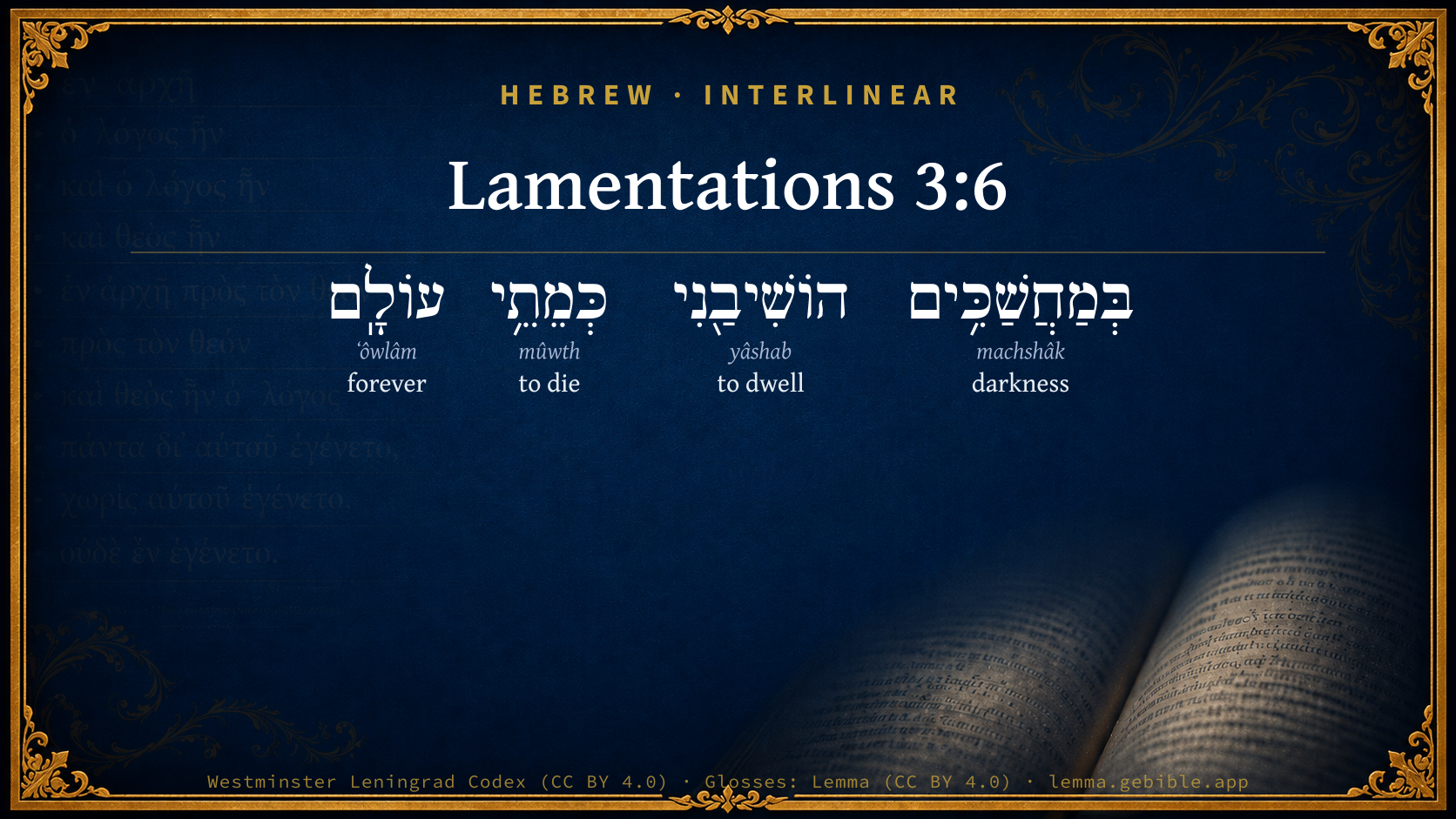
Hebrew (Westminster Leningrad Codex) Lamentations 3:6 appears in the Hebrew Old Testament. The text above is from the Westminster Leningrad Codex. Each word links to its Strong’s number, a concise gloss, and parsing drawn from the Open Scriptures Hebrew Bible morphology. Click any word for its full Brown-Driver-Briggs (BDB) entry.
Download image
Cite this verse

Lamentations 3:6 (World English Bible). Public Domain. Lemma interlinear Bible study tool, https://lemma.gebible.app/v/lamentations/3/6.

Show BibTeX & RIS
BibTeX
RIS
English Translation
He has made me to dwell in dark places, as those that have been long dead.
World English Bible · Public Domain
Download a study sheet

One document with this verse’s original text, its word-by-word gloss line, the meaning frame, cross-references with their text, attributed commentary, and full source and license credits — printable, and it pastes into notes with its structure intact.

This verse Autodidact and up

Study sheet (.html) Plain text (.txt)

A passage Seminary Student

Up to 50 verses in one chapter. A passage sheet keeps up to 6 commentary sources and 12 cross-references per verse, in the order this page ranks them, and says so on the sheet whenever that leaves anything out. Ask for a single verse and you get the Autodidact verse sheet above.

Everything on this page stays free to read, with no account — the sheet is a download of what is already on screen, not access to it.

Want to remove ads? Support Godless Engineer
Compare translations 3

The same verse in 3 English versions, stacked beneath the original-language interlinear above. Click any original word for its lexicon entry.

Each is an independent rendering of the whole verse — the interlinear is not word-aligned to these translations.

Highlighted words mark where these versions differ — a whole-verse word diff, not a word-by-word alignment.

  • World English Bible Public Domain
    He has made me to dwell in dark places, as those that have been long dead.
  • King James Version Public Domain
    He hath set me in dark places, as they that be dead of old.
  • unfoldingWord Literal Text CC BY-SA 4.0
    In dark places he made me dwell, like the dead of long ago. GIMEL

unfoldingWord Literal Text — © unfoldingWord, licensed CC BY-SA 4.0. Word-aligned USFM3 via Door43 (git.door43.org/unfoldingWord/en_ult).

Versions to compare (up to 4)

3 of 4 selected

Show all 18 translations

Every available English version of this verse, each an independent rendering of the whole verse.

  • World English Bible Public Domain
    He has made me to dwell in dark places, as those that have been long dead.
  • Berean Standard Bible Public Domain
    He has made me dwell in darkness like those dead for ages.
  • Majority Standard Bible Public Domain
    He has made me dwell in darkness like those dead for ages.
  • King James Version Public Domain
    He hath set me in dark places, as they that be dead of old.
  • American Standard Version (1901) Public Domain
    He hath made me to dwell in dark places, as those that have been long dead.
  • Revised Version (1885) Public Domain
    He hath made me to dwell in dark places, as those that have been long dead.
  • Geneva Bible (1599) Public Domain
    He hath set me in darke places, as they that be dead for euer.
  • Douay-Rheims (1899) Public Domain
    Beth. He hath set me in dark places as those that are dead for ever.
  • Young's Literal Translation Public Domain
    In dark places He hath caused me to dwell, As the dead of old.
  • Literal Standard Version CC BY-SA 4.0
    In dark places He has caused me to dwell, || As the dead of old.
  • Unlocked Literal Bible CC BY-SA 4.0
    He made me live in dark places, like those who died long ago.
  • unfoldingWord Literal Text CC BY-SA 4.0
    In dark places he made me dwell, like the dead of long ago. GIMEL
  • Darby Bible Public Domain
    He hath made me to dwell in dark places as those that have been long dead.
  • World Messianic Bible Public Domain
    He has made me dwell in dark places, as those who have been long dead.
  • Webster's Bible Public Domain
    He hath set me in dark places, as they that are dead of old.
  • Free Bible Version CC BY-SA 4.0
    He has forced me to live in darkness like those long dead.
  • Bible in Basic English Public Domain
    He has kept me in dark places, like those who have been long dead.
  • JPS Tanakh (1917) Public Domain
    He hath made me to dwell in dark places, as those that have been long dead.

Literal Standard Version (2020), Covenant Press — licensed CC BY-SA 4.0. Text via the HelloAO Bible API (eBible.org). Unlocked Literal Bible (unfoldingWord) — licensed CC BY-SA 4.0. Text via the HelloAO Bible API (eBible.org). unfoldingWord Literal Text — © unfoldingWord, licensed CC BY-SA 4.0. Word-aligned USFM3 via Door43 (git.door43.org/unfoldingWord/en_ult). Free Bible Version, Dr. Jonathan Gallagher — licensed CC BY-SA 4.0. Text via the HelloAO Bible API (eBible.org).

Word by word

More ways to search: Search by grammar → Find every occurrence → Compare this word →

Practice this passage: Drill this verse → Learn its vocabulary →

About this verse

These counts appear in no published source. They are computed here, from the morphology-tagged text and Lemma’s own curated glosses. What Lemma adds →

4
words
4
distinct lemmas
Prophets
section

Notable vocabulary

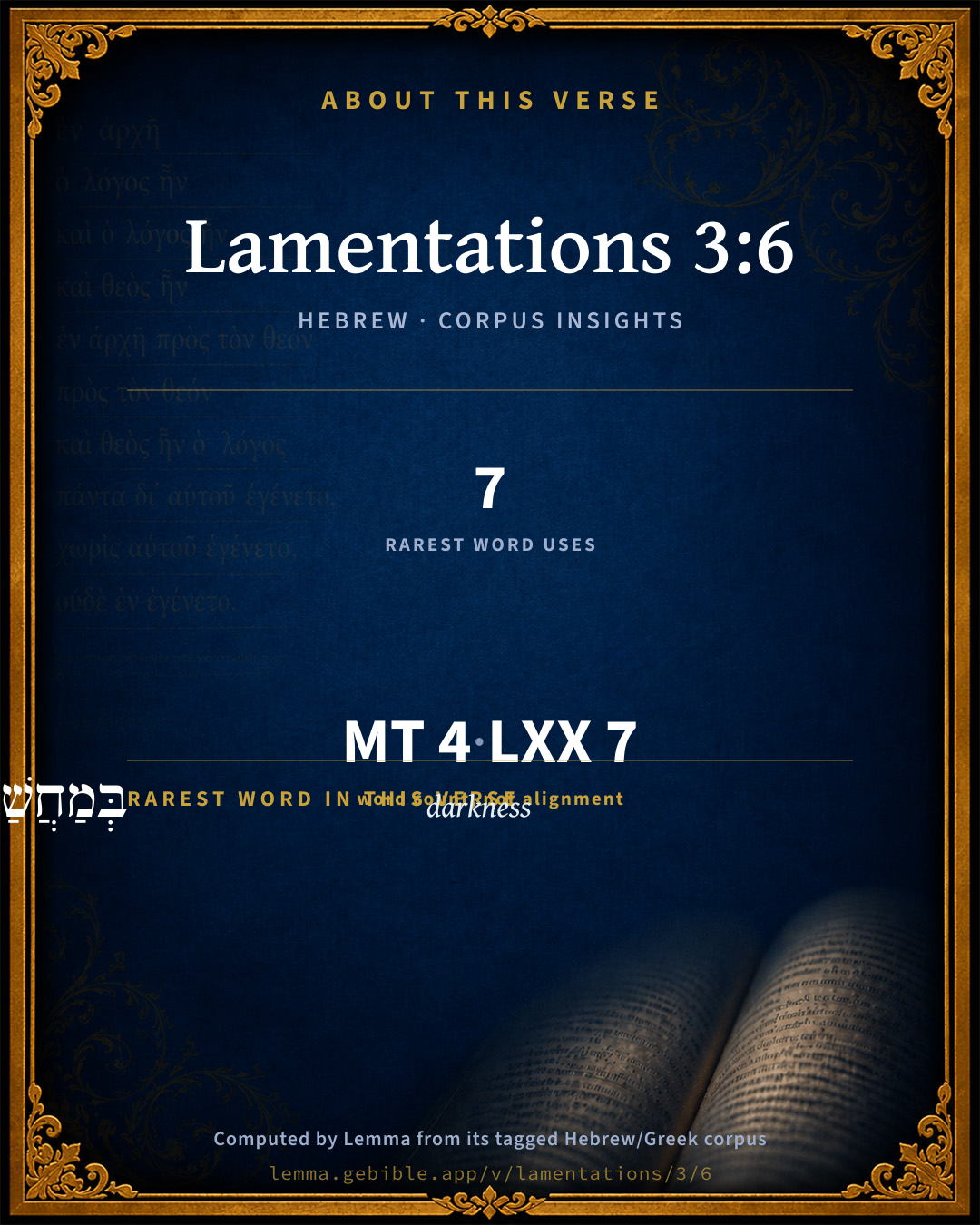
The rarest word here is בְּמַחֲשַׁכִּ֥ים darkness H4285 — appearing just 7 times in the whole Hebrew Bible.

Shared distinctive vocabulary

בְּמַחֲשַׁכִּ֥ים darkness H4285 occurs in 7 verses of the Hebrew Bible. Also found in:

Grammatical profile

  • 2 verbs
  • 2 nouns

Verb forms

  • הוֹשִׁיבַ֖נִי Hiphil · Perfect
  • כְּמֵתֵ֥י Qal · Participle Active

Hebrew & Septuagint length

In English translation the verse runs 16 words from the Hebrew and 14 from the Septuagint (LXX English) — closely comparable.

A rough comparison of the two English renderings, which tokenize alike — not a word-level alignment.

Word counts can differ between the Hebrew and the Greek without any difference in meaning — e.g. the Hebrew direct-object marker אֵת has no separate Greek word, and Greek often adds the article ὁ.

In the original languages it is 4 Hebrew tokens and 7 Greek tokens — but the two are counted differently (Hebrew bundles its prefixes and suffixes into one token; the Greek is in lemma form), so that isn’t a like-for-like length.

Cross-references

3

Topical passages linked to Lamentations 3:6 in the Treasury of Scripture Knowledge — connected by theme and wording, ordered by reader-vote popularity; previews shown in the World English Bible.

  • Psalms 88:5–6 Set apart among the dead, Like the slain who lie in the grave, Whom you remember no more. They are cut off from your hand.
  • Psalms 143:3 For the enemy pursues my soul. He has struck my life down to the ground. He has made me live in dark places, as those who have been long dead.
  • Psalms 143:7 Hurry to answer me, Yahweh. My spirit fails. Don't hide your face from me, So that I don't become like those who go down into the pit.

Cross-references courtesy of OpenBible.info (CC BY 4.0).

Hebrew and Greek witnesses Masoretic Hebrew ↔ Greek Septuagint

The same verse in the two great witnesses to the Old Testament, shown verse-for-verse.

These are two independent witnesses, not word-aligned to each other, and the Septuagint is shown in lemma (dictionary) form.

Hebrew Lamentations 3:6 Masoretic · Westminster Leningrad Codex

בְּמַחֲשַׁכִּ֥ים הוֹשִׁיבַ֖נִי כְּמֵתֵ֥י עוֹלָֽם

He has made me to dwell in dark places, as those that have been long dead.

World English Bible · Public Domain

Greek LXX Lamentations 3:6 Septuagint · lemma form

ἐν σκοτεινός καταἵζω ἐγώ ὡς νεκρός αἰών

He has set me in dark places, as them that have long been dead.

LXX2012 (modern English Septuagint) · Public Domain

Hebrew: Westminster Leningrad Codex (CC BY 4.0). Greek: Septuagint (public domain); English from LXX2012 (modern English Septuagint) (Public Domain). How the Septuagint differs from the Hebrew →

Commentary

Notes on Lamentations 3:6 from classic Christian and Jewish commentators (each source and its license shown beneath its notes). The classic Christian expositions comment on the surrounding passage and are grouped to its opening verse, so a note may address several verses; the Jewish commentaries on the Tanakh (Rashi and others) are per-verse, so they appear only where the commentator wrote on this verse.

Lemma curates 59 commentaries, every one of them public domain or Creative Commons licensed, each selected and text-cleaned for this edition rather than reprinted as found. About our sources →

Trapp's Complete Commentary

John Trapp

Lam 3:6 He hath set me in dark places, as [they that be] dead of old.

Ver. 6. He hath set me in dark places.] Dungeons haply, which are a kind of graves, and where poor prisoners lie as forgotten. The Persians called their prisons ληθας, oblivions. And Ezekiel saith that Babylon was to the Jews as a grave, where they lay for dead till those dead bones lived again. {Eze 37:1-14}

As they that be dead of old.] Free among the dead and forgotten. It may be said of a saint, in some cases, that

“ Vivit, et est vitae nescius ipse sum. ”

John Trapp, A Commentary or Exposition upon All the Books of the Old and New Testament (1647–1656) — public domain. Text from a community e-Sword module.

Tyndale Open Study Notes

Tyndale Open Resources

3:6-9 Some understand these verses as a poetic reference to Jeremiah’s confinement in a muddy cistern before the destruction of Jerusalem (Jer 38:6-13).

Tyndale Open Study Notes — © Tyndale Open Resources, licensed CC BY-SA 4.0. Text via the HelloAO Bible API.

Jamieson, Fausset & Brown

Robert Jamieson, A. R. Fausset & David Brown

set me--HENDERSON refers this to the custom of placing the dead in a sitting posture.

dark places--sepulchers. As those "dead long since"; so Jeremiah and his people are consigned to oblivion (Psa 88:5-6; Psa 143:3; Eze 37:13).

Jamieson, Fausset & Brown — Commentary Critical and Explanatory on the Whole Bible (1871) — public domain (CC PDM 1.0). Text via the HelloAO Bible API.

John Calvin's Commentaries

Here he amplifies what he had before said of poison and trouble; he says that he was placed in darkness, not that he might be there for a little while, but remain there for a long time; he hath made me, he says, to dwell in darkness. But the comparison which follows more clearly explains the Prophet’s meaning, as the dead of ages. The word עולם, oulam, may refer to future or past time. Some say, as the dead for ever, who are perpetually dead. But the Scripture elsewhere calls those the dead of ages who have been long buried, and have decayed, and whose memory has become nearly extinct. For as long as the dead body retains its form, it seems more like a living being; but when it is reduced to ashes, when no bone appears, when the whole skin and nerves and blood have perished, and no likeness to man remains, there can then be no hope of life. The Scripture then calls those the dead of ages, who have wholly decayed. So also in this place the Prophet says, that he dwelt in darkness, into which he had been cast by God’s hand, and that he dwelt there as though he had been long dead, and his body had become now putrid.

This way of speaking appears indeed hyperbolical; but we must always remember what I have reminded you of, that it is not possible sufficiently to set forth the greatness of that sorrow which the faithful feel when terrified by the wrath of God. He then adds, —

John Calvin's Commentaries (1540-1563) — public domain. Text from the Calvin Translation Society English edition (1840s-50s) via the Christian Classics Ethereal Library (ccel.org). Calvin's coverage is partial (roughly two-thirds of the Bible); uncommented books and verses are honest gaps, never fabricated. The 19th-century editor's footnotes and remarks are omitted so the notes are faithfully Calvin's own voice.

Ellicott's Commentary for English Readers

(6) He hath set me in dark places.—A verbal reproduction of Psa_143:3. The “dark places” are those of hell or Hades. For dead of old read dead eternally or dead for ever, the adverb looking forward rather than back.

A Bible Commentary for English Readers, edited by Charles John Ellicott (1878–1897) — public domain. Text from a community e-Sword module.

The Cambridge Bible for Schools and Colleges

gen. ed. J. J. S. Perowne

6. Identical with the last part of Psa_143:3. See intr. note.

dark places] in the gloom of Sheol.

long dead] or, for ever dead, permanently forgotten, never able to return into the light of God’s favour.

The Cambridge Bible for Schools and Colleges (gen. ed. J. J. S. Perowne; Cambridge University Press, 1878–1918) — public domain. Text from a community e-Sword module.

John Gill's Exposition

He hath set me in dark places,.... In the dark house of the prison, as the Targum; in the dark dungeon where the prophet was put; or the captivity in which the Jews were, and which was like the dark grave or state of the dead; and hence they are said to be in their graves, Eze 37:12. Christ was laid in the dark grave literally:

as they that be dead of old: that have been long dead, and are forgotten, as if they had never been; see Psa 88:5; or, "as the dead of the world" (f), or age; who, being dead, are gone out of the world, and no more in it. The Targum is,

"as the dead who go into another world.''

(f) , Sept. "quasi mortuos seculi", Montanus, Calvin.

John Gill's Exposition of the Whole Bible (1746–1763) — public domain (CC PDM 1.0). Text via the HelloAO Bible API.

Albert Barnes' Notes on the Bible

Or, “He hath” made me to dwell “in darkness,” i. e. in Sheol or Hades, “as those” forever “dead.”

Albert Barnes' Notes on the Bible (1834–1885) — public domain. Text from a community e-Sword/MySword module.

Haydock's Catholic Bible Commentary

Ever indeed, Ecclesiastes xii. 5., and Psalm xlviii. 12. Jeremias (xxxviii. 6.) was in imminent danger.

George Leo Haydock (1774–1849), Haydock's Catholic Family Bible and Commentary, 1859 edition — public domain. Excludes Psalms (Douay-Rheims chapter numbering differs from Protestant) and Deuterocanonical books (Catholic canon only).

Matthew Poole's English Annotations

The prophet compareth their state in Babylon to the state of bodies in the graves, or in some charnel-house, which are places of darkness, full of rottenness and dead men’s bones. Such was the state of the Jews in Jerusalem during the time of the siege before the city was taken, when Jerusalem was a most miserable place by reason of the multitudes slain by the enemy, or by the famine: such was their state in Babylon, where the company of heathens made their state as the state of the living amongst the dead.

Matthew Poole's English Annotations on the Holy Bible (1683–1685) — public domain. Text from a community e-Sword/MySword module.

Whedon's Commentary on the Bible

Daniel D. Whedon

6. Dark places — Literally, in darkness; that is, in sheol.

Dead of old — Literally, dead of eternity; namely, those who shall never return to life.

Daniel D. Whedon (gen. ed.), Commentary on the Old and New Testaments (1874–1909) — public domain. Text from a community e-Sword module.

The Pulpit Commentary

This verse is verbally reproduced in Psa_143:3. In dark places; i.e. in Hades. (comp. Psa_88:7) As they that be dead of old. A strange comparison; for what difference can it make whether the dead are men of the ancient or the modern world? The rendering, however, though perfectly admissible, is less suitable to the context than as they that are forever dead; who have entered "the land from which there is no return" (an Assyrian title of Hades). Comp. "the everlasting house," i.e. the, (Ecc_12:5) "the everlasting sleep". (Jer_51:39, Jer_51:57)

"Dark places.

The sufferer feels as though he were in the dark places of the dead, in the everlasting house which no tenant ever quits.

I GOD SOMETIMES SETS HIS PEOPLE IN DARK PLACES. He permits the light of gladness to fade and the vision of truth to be dimmed and the conscious brightness of his presence to be lost, so that the soul is plunged in black depths of sorrow, doubt, and loneliness. Then the dismayed sufferer feels himself lost, well nigh dead. But he is not dead, nor even deserted by God. The very fact that he admits that God has set him in the dark place is a confession that the hand of God has been with him. Real death and utter desolation come from the desertion of the soul by God; the chastisement that he directly imposes evidences his presence and energy, and it therefore promises life.

II WHILE IN THE LIGHT WE SHOULD BE PREPARED FOR THE DARK PLACES. We stumble in the dark, and are terrified and confounded by it because we do not know it and are not in readiness for it. Like Adam in "Paradise Lost," we are surprised at the first coming on of light. Because we expect the night and know that a new day will follow, we can contemplate the deepening gloom of evening without apprehension. The miner, prepared for the darkness of his subterranean work, takes his lamp with him. Every soul should be warned that it is likely some day to be plunged into spiritual darkness. If ready with the quiet inward light of faith, it need fear nothing. While we know that God"s rod and staff are with us to comfort us, we shall not be dismayed, though we shall be saddened, at being called to walk through the valley of the shadow of death.

III SOULS LEARN LESSONS OF LIGHT IN DARK PLACES. In a deep well the stars above are visible at noon. In deep humiliation heavenly light is seen that is lost in the garish show of earthly commonplace life as well as on the heights of pride and presumption. Tears of sorrow purge the vision of the soul. It is well sometimes to be alone in the dark with God.

IV THERE ARE DARK PLACES OF SPIRITUAL DEATH THAT ARE MORE AWFUL THAN THE ABODE OF DEPARTED SPIRITS. To the old world view Hades was a realm of sinless gloom. But worse than the darkness of this Hades is the darkness of those who are dead in trespasses and sin. Such men carry hell within their own breasts. The blackness of death broods over their spiritual natures so that they feel no qualms of conscience, and are awake to no voices from heaven. These darkest places are never assigned by God to his creatures. If they are found in them it is because they have plunged into them of their own will.

The Pulpit Commentary (1880–1919), ed. H.D.M. Spence-Jones & Joseph S. Exell — public domain. Text from a community e-Sword module.

Lesson kit

Teaching starters — assembled from the data on this page, not authored interpretation. Every prompt links to the verse data it draws on. Edit before teaching.

Lamentations, in the Prophets, opens this verse with 4 words (4 distinct Hebrew lemmas). Its most distinctive word is machshâk (“darkness”). A historical commentator’s framing appears above. Read the whole chapter for the surrounding context.

Discussion questions

  1. The word machshâk carries the sense “darkness.” How does it shape the verse?
  2. Psalms 74:20 shares the word «darkness» with this verse. How do the two illuminate each other?
  3. These translations render this verse differently. What is at stake in choosing one wording over another?
  4. The verb «הוֹשִׁיבַ֖נִי» is Hiphil Perfect. How does its form color the action?
  5. Reading how Trapp's Complete Commentary and Tyndale Open Study Notes read this verse, where do the two commentators agree and where do they part?

Things to notice

Reading settings

Reading text

Shown beneath each verse's original-language words.

Old Testament
Old Testament edition

Read the OT as the Masoretic Hebrew (MT) or the Greek Septuagint (LXX).

English shown for the Greek Septuagint (in the Hebrew ↔ Greek comparison).

Comparing translations? Open the Compare panel on any verse page to stack up to four side by side.