
Jeremiah 40:5

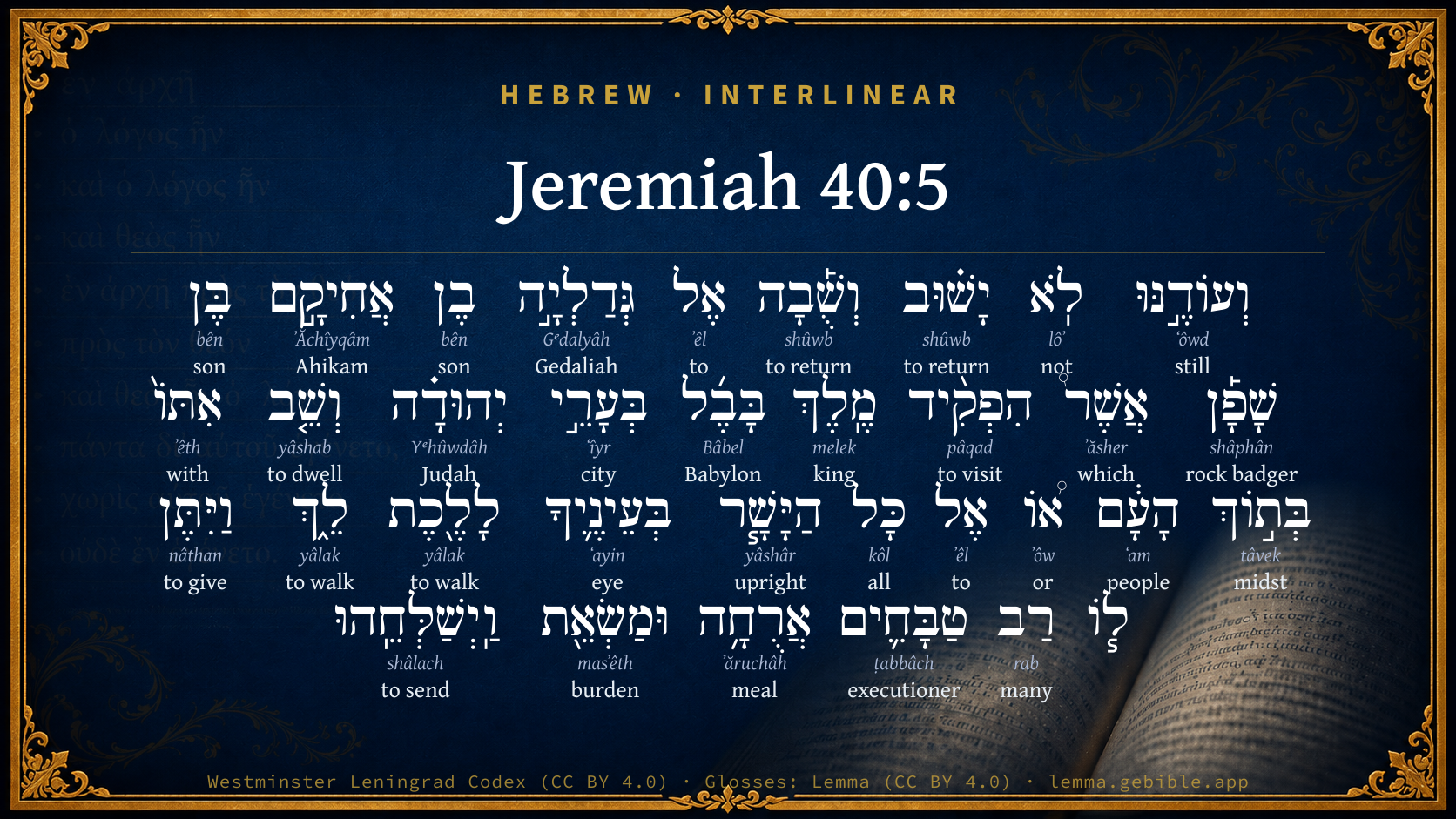
Hebrew (Westminster Leningrad Codex) Jeremiah 40:5 appears in the Hebrew Old Testament. The text above is from the Westminster Leningrad Codex. Each word links to its Strong’s number, a concise gloss, and parsing drawn from the Open Scriptures Hebrew Bible morphology. Click any word for its full Brown-Driver-Briggs (BDB) entry.
Download image
Cite this verse

Jeremiah 40:5 (World English Bible). Public Domain. Lemma interlinear Bible study tool, https://lemma.gebible.app/v/jeremiah/40/5.

Show BibTeX & RIS
BibTeX
RIS
English Translation
Now while he was not yet gone back, Go back then, [said he], to Gedaliah the son of Ahikam, the son of Shaphan, whom the king of Babylon has made governor over the cities of Judah, and dwell with him among the people; or go wherever it seems right to you to go. So the captain of the guard gave him food and a present, and let him go.
World English Bible · Public Domain
Download a study sheet

One document with this verse’s original text, its word-by-word gloss line, the meaning frame, cross-references with their text, attributed commentary, and full source and license credits — printable, and it pastes into notes with its structure intact.

This verse Autodidact and up

Study sheet (.html) Plain text (.txt)

A passage Seminary Student

Up to 50 verses in one chapter. A passage sheet keeps up to 6 commentary sources and 12 cross-references per verse, in the order this page ranks them, and says so on the sheet whenever that leaves anything out. Ask for a single verse and you get the Autodidact verse sheet above.

Everything on this page stays free to read, with no account — the sheet is a download of what is already on screen, not access to it.

Want to remove ads? Support Godless Engineer
Compare translations 3

The same verse in 3 English versions, stacked beneath the original-language interlinear above. Click any original word for its lexicon entry.

Each is an independent rendering of the whole verse — the interlinear is not word-aligned to these translations.

Highlighted words mark where these versions differ — a whole-verse word diff, not a word-by-word alignment.

  • World English Bible Public Domain
    Now while he was not yet gone back, Go back then, [said he], to Gedaliah the son of Ahikam, the son of Shaphan, whom the king of Babylon has made governor over the cities of Judah, and dwell with him among the people; or go wherever it seems right to you to go. So the captain of the guard gave him food and a present, and let him go.
  • King James Version Public Domain
    Now while he was not yet gone back, he said, Go back also to Gedaliah the son of Ahikam the son of Shaphan, whom the king of Babylon hath made governor over the cities of Judah, and dwell with him among the people: or go wheresoever it seemeth convenient unto thee to go. So the captain of the guard gave him victuals and a reward, and let him go.
  • unfoldingWord Literal Text CC BY-SA 4.0
    When Jeremiah did not reply, Nebuzaradan said, “Go to Gedaliah son of Ahikam son of Shaphan, whom the king of Babylon has put in charge of the cities of Judah. Stay with him among the people or go wherever it is good in your eyes to go.” The commander of the king’s bodyguards gave him food and a gift, and then sent him away.

unfoldingWord Literal Text — © unfoldingWord, licensed CC BY-SA 4.0. Word-aligned USFM3 via Door43 (git.door43.org/unfoldingWord/en_ult).

Versions to compare (up to 4)

3 of 4 selected

Show all 18 translations

Every available English version of this verse, each an independent rendering of the whole verse.

  • World English Bible Public Domain
    Now while he was not yet gone back, Go back then, [said he], to Gedaliah the son of Ahikam, the son of Shaphan, whom the king of Babylon has made governor over the cities of Judah, and dwell with him among the people; or go wherever it seems right to you to go. So the captain of the guard gave him food and a present, and let him go.
  • Berean Standard Bible Public Domain
    But before Jeremiah turned to go, Nebuzaradan added, “Return to Gedaliah son of Ahikam, the son of Shaphan, whom the king of Babylon has appointed over the cities of Judah, and stay with him among the people, or go anywhere else that seems right.” Then the captain of the guard gave him a ration and a gift and released him.
  • Majority Standard Bible Public Domain
    But before Jeremiah turned to go, Nebuzaradan added, “Return to Gedaliah son of Ahikam, the son of Shaphan, whom the king of Babylon has appointed over the cities of Judah, and stay with him among the people, or go anywhere else that seems right.” Then the captain of the guard gave him a ration and a gift and released him.
  • King James Version Public Domain
    Now while he was not yet gone back, he said, Go back also to Gedaliah the son of Ahikam the son of Shaphan, whom the king of Babylon hath made governor over the cities of Judah, and dwell with him among the people: or go wheresoever it seemeth convenient unto thee to go. So the captain of the guard gave him victuals and a reward, and let him go.
  • American Standard Version (1901) Public Domain
    Now while he was not yet gone back, Go back then, `said he', to Gedaliah the son of Ahikam, the son of Shaphan, whom the king of Babylon hath made governor over the cities of Judah, and dwell with him among the people; or go wheresoever it seemeth right unto thee to go. So the captain of the guard gave him victuals and a present, and let him go.
  • Revised Version (1885) Public Domain
    Now while he was not yet gone back, Go back then, said he, to Gedaliah the son of Ahikam, the son of Shaphan, whom the king of Babylon hath made governor over the cities of Judah, and dwell with him among the people: or go wheresoever it seemeth convenient unto thee to go. So the captain of the guard gave him victuals and a present, and let him go.
  • Geneva Bible (1599) Public Domain
    For yet he was not returned: therefore he said, Returne to Gedaliah the sonne of Ahikam, the sonne of Shaphan, whom the King of Babel hath made gouernour ouer all the cities of Iudah, and dwell with him among the people, or goe wheresoeuer it pleaseth thee to goe. So the chiefe stewarde gaue him vitailes and a rewarde, and let him goe.
  • Douay-Rheims (1899) Public Domain
    And come not with me: but dwell with Godolias the son of Ahicam the son of Saphan, whom the king of Babylon hath made governor over the cities of Juda: dwell therefore with him in the midst of the people: or whithersoever it shall please thee to go, go. And the general of the army gave him victuals and presents, and let him go.
  • Young's Literal Translation Public Domain
    and while he doth not reply -- `Or turn back unto Gedaliah son of Ahikam, son of Shaphan, whom the king of Babylon hath appointed over the cities of Judah, and dwell with him in the midst of the people, or whithersoever it is right in thine eyes to go -- go.' And the chief of the executioners giveth to him for the way, and a gift, and sendeth him away,
  • Literal Standard Version CC BY-SA 4.0
    And while he does not reply—“Or turn back to Gedaliah son of Ahikam, son of Shaphan, whom the king of Babylon has appointed over the cities of Judah, and dwell with him in the midst of the people, or wherever it is right in your eyes to go—go.” And the chief of the executioners gives a ration and gift to him, and sends him away,
  • Unlocked Literal Bible CC BY-SA 4.0
    When Jeremiah did not reply, Nebuzaradan said, “Go to Gedaliah son of Ahikam son of Shaphan, whom the king of Babylon has put in charge of the cities of Judah. Stay with him among the people or go wherever it is good in your eyes to go.” The commander of the king's bodyguards gave him food and a gift, and then sent him away.
  • unfoldingWord Literal Text CC BY-SA 4.0
    When Jeremiah did not reply, Nebuzaradan said, “Go to Gedaliah son of Ahikam son of Shaphan, whom the king of Babylon has put in charge of the cities of Judah. Stay with him among the people or go wherever it is good in your eyes to go.” The commander of the king’s bodyguards gave him food and a gift, and then sent him away.
  • Darby Bible Public Domain
    And while he had not yet given answer; [he said,] Yea, go back to Gedaliah the son of Ahikam the son of Shaphan, whom the king of Babylon hath appointed over the cities of Judah, and abide with him in the midst of the people; or go wheresoever it seemeth right in thy sight to go. And the captain of the body-guard gave him provisions and a present, and let him go.
  • World Messianic Bible Public Domain
    Now while he had not yet gone back, “Go back then,” he said, “to Gedaliah the son of Ahikam, the son of Shaphan, whom the king of Babylon has made governor over the cities of Judah, and dwell with him among the people; or go wherever it seems right to you to go.” So the captain of the guard gave him food and a present, and let him go.
  • Webster's Bible Public Domain
    Now while he had not yet gone back, he said, Go back also to Gedaliah the son of Ahikam the son of Shaphan, whom the king of Babylon had made governor over the cities of Judah, and dwell with him among the people: or go wherever it seemeth convenient to thee to go. So the captain of the guard gave him provisions and a reward, and let him go.
  • Free Bible Version CC BY-SA 4.0
    Since Jeremiah didn't answer right away, Nebuzaradan went on, “Go back to Gedaliah son of Ahikam, son of Shaphan. He's been appointed as governor over Judah by the king of Babylon. You can stay with him with your people, or you can go anywhere you want.” The commander of the guard gave him a food allowance and some money and let him go.
  • Bible in Basic English Public Domain
    Then go back to Gedaliah, the son of Ahikam, the son of Shaphan, whom the king of Babylon has made ruler over the towns of Judah, and make your living-place with him among the people; or go wherever it seems right to you to go. So the captain of the armed men gave him food and some money and let him go.
  • JPS Tanakh (1917) Public Domain
    Yet he would not go back. — Go back then to Gedaliah the son of Ahikam, the son of Shaphan, whom the king of Babylon hath made governor over the cities of Judah, and dwell with him among the people; or go wheresoever it seemeth right unto thee to go.' So the captain of the guard gave him an allowance and a present, and let him go.

Literal Standard Version (2020), Covenant Press — licensed CC BY-SA 4.0. Text via the HelloAO Bible API (eBible.org). Unlocked Literal Bible (unfoldingWord) — licensed CC BY-SA 4.0. Text via the HelloAO Bible API (eBible.org). unfoldingWord Literal Text — © unfoldingWord, licensed CC BY-SA 4.0. Word-aligned USFM3 via Door43 (git.door43.org/unfoldingWord/en_ult). Free Bible Version, Dr. Jonathan Gallagher — licensed CC BY-SA 4.0. Text via the HelloAO Bible API (eBible.org).

Word by word

More ways to search: Search by grammar → Find every occurrence → Compare this word →

Practice this passage: Drill this verse → Learn its vocabulary →

אֲרֻחָ֥ה
ʼăruchâh
H737
“meal”
Noun, Common, Feminine, Singular, Absolute
Part of Speech
Noun
Type
Common
Gender
Feminine
Number
Singular
State
Absolute
Full BDB Definition

Origin: passive participle of H732 (in the sense of appointing)

TWOT: 161b

meal, allowance, ration - food - diet
  1. וְעוֹדֶ֣נּוּ ʻôwd H5750 “and · still · his” Conjunction + Adverb + Suffix, Personal, 3rd Person, Masculine, Singular
  2. לֹֽא lôʼ H3808 “not” Particle, Negative
  3. יָשׁ֗וּב shûwb H7725 “to return” Verb, Qal, Imperfect, 3rd Person, Masculine, Singular
  4. וְשֻׁ֡בָה shûwb H7725 “and · return” Conjunction + Verb, Qal, Imperative, 2nd Person, Masculine, Singular + Suffix, h
  5. אֶל ʼêl H413 “to” Preposition
  6. גְּדַלְיָ֣ה Gᵉdalyâh H1436 “Gedaliah” Noun, Proper
  7. בֶן bên H1121 “son of” Noun, Common, Masculine, Singular, Construct
  8. אֲחִיקָ֣ם ʼĂchîyqâm H296 “Ahikam” Noun, Proper
  9. בֶּן bên H1121 “son of” Noun, Common, Masculine, Singular, Construct
  10. שָׁפָ֡ן shâphân H8227 “rock badger” Noun, Proper
  11. אֲשֶׁר֩ ʼăsher H834 “which” Particle, Relative
  12. הִפְקִ֨יד pâqad H6485 “to visit” Verb, Hiphil, Perfect, 3rd Person, Masculine, Singular
  13. מֶֽלֶךְ melek H4428 “king of” Noun, Common, Masculine, Singular, Construct
  14. בָּבֶ֜ל Bâbel H894 “Babylon” Noun, Proper
  15. בְּעָרֵ֣י ʻîyr H5892 “in/at · cities of” Preposition + Noun, Common, Feminine, Plural, Construct
  16. יְהוּדָ֗ה Yᵉhûwdâh H3063 “Judah” Noun, Proper
  17. וְשֵׁ֤ב yâshab H3427 “and · dwell” Conjunction + Verb, Qal, Imperative, 2nd Person, Masculine, Singular
  18. אִתּוֹ֙ ʼêth H854 “with · him” Preposition + Suffix, Personal, 3rd Person, Masculine, Singular
  19. בְּת֣וֹךְ tâvek H8432 “in/at · midst of” Preposition + Noun, Common, Masculine, Singular, Construct
  20. הָעָ֔ם ʻam H5971 “the · people” Particle, Definite Article + Noun, Common, Masculine, Singular, Absolute
  21. א֠וֹ ʼôw H176 “or” Conjunction
  22. אֶל ʼêl H413 “to” Preposition
  23. כָּל kôl H3605 “all of” Noun, Common, Masculine, Singular, Construct
  24. הַיָּשָׁ֧ר yâshâr H3477 “the · upright” Particle, Definite Article + Adjective, Adjective, Masculine, Singular, Absolute
  25. בְּעֵינֶ֛יךָ ʻayin H5869 “in/at · eyes · your” Preposition + Noun, Common, Both, Dual, Construct + Suffix, Personal, 2nd Person, Masculine, Singular
  26. לָלֶ֖כֶת yâlak H3212 “to walk” Preposition + Verb, Qal, Infinitive Construct
  27. לֵ֑ךְ yâlak H3212 “walk” Verb, Qal, Imperative, 2nd Person, Masculine, Singular
  28. וַיִּתֶּן nâthan H5414 “and · to give” Conjunction + Verb, Qal, Sequential Imperfect, 3rd Person, Masculine, Singular
  29. רַב rab H7227 “many of” Noun, Common, Masculine, Singular, Construct
  30. טַבָּחִ֛ים ṭabbâch H2876 “executioners” Noun, Common, Masculine, Plural, Absolute
  31. וּמַשְׂאֵ֖ת masʼêth H4864 “and · burden” Conjunction + Noun, Common, Feminine, Singular, Absolute
  32. וַֽיְשַׁלְּחֵֽהוּ shâlach H7971 “and · to send · him” Conjunction + Verb, Piel, Sequential Imperfect, 3rd Person, Masculine, Singular + Suffix, Personal, 3rd Person, Masculine, Singular

About this verse

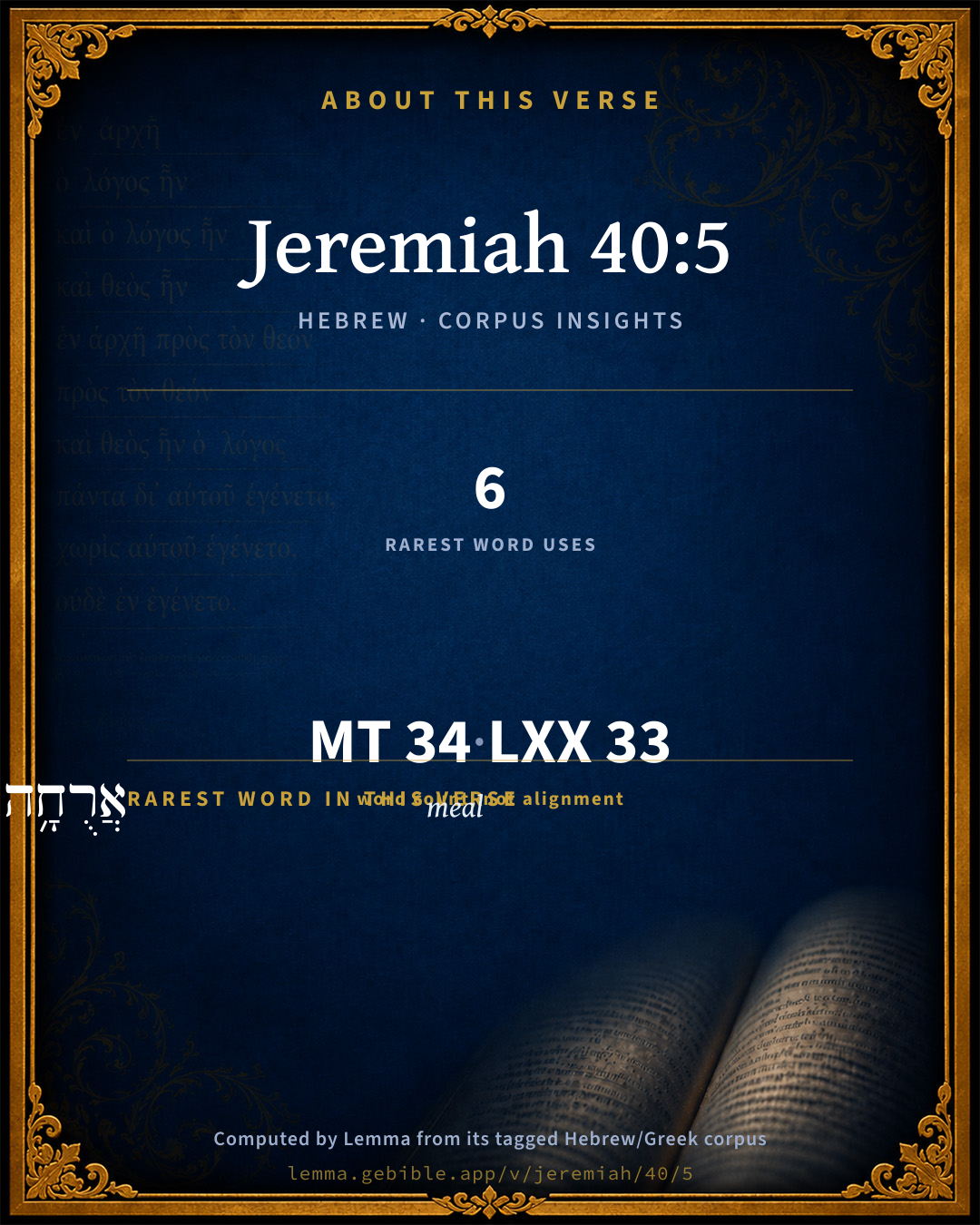
These counts appear in no published source. They are computed here, from the morphology-tagged text and Lemma’s own curated glosses. What Lemma adds →

34
words
29
distinct lemmas
Prophets
section

Notable vocabulary

The rarest word here is אֲרֻחָ֥ה meal H737 — appearing just 6 times in the whole Hebrew Bible.

Shared distinctive vocabulary

אֲרֻחָ֥ה meal H737 occurs in 4 verses of the Hebrew Bible. Also found in:

Grammatical profile

  • 8 verbs
  • 17 nouns
  • 1 adjective
  • 4 prepositions
  • 1 conjunction
  • 1 adverb
  • 2 particles

Verb forms

  • יָשׁ֗וּב Qal · Imperfect
  • וְשֻׁ֡בָה Qal · Imperative
  • הִפְקִ֨יד Hiphil · Perfect
  • וְשֵׁ֤ב Qal · Imperative
  • לָלֶ֖כֶת Qal · Infinitive Construct
  • לֵ֑ךְ Qal · Imperative
  • וַיִּתֶּן Qal · Sequential Imperfect
  • וַֽיְשַׁלְּחֵֽהוּ Piel · Sequential Imperfect

Repetition

Words recur within this verse — often emphatic in Hebrew:

  • יָשׁ֗וּב to return H7725 ×2
  • בֶן son H1121 ×2
  • לָלֶ֖כֶת to walk H3212 ×2
  • אֶל to H413 ×2

Hebrew & Septuagint length

In the original languages it is 34 Hebrew tokens and 33 Greek tokens — but the two are counted differently (Hebrew bundles its prefixes and suffixes into one token; the Greek is in lemma form), so that isn’t a like-for-like length.

Cross-references

22

Topical passages linked to Jeremiah 40:5 in the Treasury of Scripture Knowledge — connected by theme and wording, ordered by reader-vote popularity; previews shown in the World English Bible.

  • Jeremiah 39:14 they sent, and took Jeremiah out of the court of the guard, and committed him to Gedaliah the son of Ahikam, the son of Shaphan, that he should carry him home: so he lived among the people.
  • 2 Kings 8:7–9 Elisha came to Damascus; and Benhadad the king of Syria was sick; and it was told him, saying, The man of God is come here.
  • Jeremiah 41:2 Then arose Ishmael the son of Nethaniah, and the ten men who were with him, and struck Gedaliah the son of Ahikam the son of Shaphan with the sword, and killed him, whom the king of Babylon had made governor over the land.
  • 2 Kings 22:12 The king commanded Hilkiah the priest, and Ahikam the son of Shaphan, and Achbor the son of Micaiah, and Shaphan the scribe, and Asaiah the king's servant, saying,
  • 2 Kings 22:14 So Hilkiah the priest, and Ahikam, and Achbor, and Shaphan, and Asaiah, went to Huldah the prophetess, the wife of Shallum the son of Tikvah, the son of Harhas, keeper of the wardrobe (now she lived in Jerusalem in the second quarter); and they talked with her.
  • 2 Kings 25:22–24 As for the people who were left in the land of Judah, whom Nebuchadnezzar king of Babylon had left, even over them he made Gedaliah the son of Ahikam, the son of Shaphan, governor.
  • 2 Chronicles 34:20 The king commanded Hilkiah, and Ahikam the son of Shaphan, and Abdon the son of Micah, and Shaphan the scribe, and Asaiah the king's servant, saying,
  • Ezra 7:6 this Ezra went up from Babylon: and he was a ready scribe in the law of Moses, which Yahweh, the God of Israel, had given; and the king granted him all his request, according to the hand of Yahweh his God on him.
  • Ezra 7:27 Blessed be Yahweh, the God of our fathers, who has put such a thing as this in the king's heart, to beautify the house of Yahweh which is in Jerusalem;
  • Nehemiah 1:11 Lord, I beg you, let now your ear be attentive to the prayer of your servant, and to the prayer of your servants, who delight to fear your name; and please prosper your servant this day, and grant him mercy in the sight of this man. Now I was cup bearer to the king.
  • Nehemiah 2:4–8 Then the king said to me, For what do you make request? So I prayed to the God of heaven.
  • Job 22:29 When they cast down, you shall say, 'be lifted up.' He will save the humble person.
  • Proverbs 16:7 When a man's ways please Yahweh, He makes even his enemies to be at peace with him.
  • Proverbs 21:1 The king's heart is in Yahweh's hand like the watercourses. He turns it wherever he desires.
  • Jeremiah 15:11 Yahweh said, Most assuredly I will strengthen you for good; most assuredly I will cause the enemy to make supplication to you in the time of evil and in the time of affliction.
  • Jeremiah 26:24 But the hand of Ahikam the son of Shaphan was with Jeremiah, that they should not give him into the hand of the people to put him to death.
  • Jeremiah 40:4 Now, behold, I loose you this day from the chains which are on your hand. If it seem good to you to come with me into Babylon, come, and I will look well to you; but if it seem ill to you to come with me into Babylon, forbear: behold, all the land is before you; where it seems good and right to you to go, there go.
  • Jeremiah 52:31–34 It happened in the seven and thirtieth year of the captivity of Jehoiachin king of Judah, in the twelfth month, in the five and twentieth day of the month, that Evilmerodach king of Babylon, in the [first] year of his reign, lifted up the head of Jehoiachin king of Judah, and brought him forth out of prison;
  • Acts 27:3 The next day, we touched at Sidon. Julius treated Paul kindly, and gave him permission to go to his friends and refresh himself.
  • Acts 27:43 But the centurion, desiring to save Paul, stopped them from their purpose, and commanded that those who could swim should throw themselves overboard first to go toward the land;
  • Acts 28:10 They also honored us with many honors, and when we sailed, they put on board the things that we needed.
  • Hebrews 13:6 So that with good courage we say, "The Lord is my helper. I will not fear. What can man do to me?"

Cross-references courtesy of OpenBible.info (CC BY 4.0).

Hebrew and Greek witnesses Masoretic Hebrew ↔ Greek Septuagint

The same verse in the two great witnesses to the Old Testament, shown verse-for-verse.

These are two independent witnesses, not word-aligned to each other, and the Septuagint is shown in lemma (dictionary) form.

Hebrew Jeremiah 40:5 Masoretic · Westminster Leningrad Codex

וְעוֹדֶ֣נּוּ לֹֽא יָשׁ֗וּב וְשֻׁ֡בָה אֶל גְּדַלְיָ֣ה בֶן אֲחִיקָ֣ם בֶּן שָׁפָ֡ן אֲשֶׁר֩ הִפְקִ֨יד מֶֽלֶךְ בָּבֶ֜ל בְּעָרֵ֣י יְהוּדָ֗ה וְשֵׁ֤ב אִתּוֹ֙ בְּת֣וֹךְ הָעָ֔ם א֠וֹ אֶל כָּל הַיָּשָׁ֧ר בְּעֵינֶ֛יךָ לָלֶ֖כֶת לֵ֑ךְ וַיִּתֶּן ל֧וֹ רַב טַבָּחִ֛ים אֲרֻחָ֥ה וּמַשְׂאֵ֖ת וַֽיְשַׁלְּחֵֽהוּ

Now while he was not yet gone back, Go back then, [said he], to Gedaliah the son of Ahikam, the son of Shaphan, whom the king of Babylon has made governor over the cities of Judah, and dwell with him among the people; or go wherever it seems right to you to go. So the captain of the guard gave him food and a present, and let him go.

World English Bible · Public Domain

Greek LXX Structure differs

In the Septuagint, Jeremiah is about an eighth shorter than the Hebrew and arranges its material differently — the Oracles Against the Nations (Hebrew chapters 46–51) appear in the middle of the Greek book, after 25:13. Because the chapter and verse boundaries do not line up, a verse-for-verse comparison with the Hebrew is not shown.

A verse-for-verse comparison isn’t shown here because the chapters and verses don’t line up. Switch to the LXX edition with the MT / LXX toggle above to read the Greek directly.

Hebrew: Westminster Leningrad Codex (CC BY 4.0). Greek: Septuagint (public domain); English from a public-domain English Septuagint. How the Septuagint differs from the Hebrew →

Targum (Aramaic paraphrase)

1

The Targum is the ancient Jewish Aramaic paraphrase of the Hebrew Scriptures — an interpretive translation, not the Hebrew text itself. Onkelos (literal) and Pseudo-Jonathan (expansive) render the Torah, and Jonathan the Prophets. Coverage is partial: where no permissively-licensed English translation exists for a verse, only the Aramaic is shown. This is verse-level text, not a word-by-word alignment to the Hebrew.

  1. Targum Jonathan Prophets (Joshua–Malachi)
    וְאִם לֵית אַתְּ צָבֵי לְמֵיתַב וְתוּב לְוַת גְדַלְיָה בַּר אֲחִיקָם בַּר שָׁפָן דְמַנֵי מַלְכָּא דְבָבֶל בְּקִרְוַיָא דְבֵית יְהוּדָה וְתִיב עִמֵיהּ בְּגוֹ עַמָא אוֹ לְכָל דְכָשַׁר בְּעֵינָךְ לְמֵיזַל אֱזֵיל וּמָנֵי לֵיהּ רַב קָטוֹלַיָא מַתְּנַן וּנְבַזְבַּן וְשַׁלְחֵיהּ:

    (no public-domain English translation for this verse)

    Targum Jonathan — Aramaic: “Mikraot Gedolot” (public domain). English: “Sefaria Community Translation” (CC0 1.0 (public-domain dedication)); “London "Chaldee Paraphrase," 1871” (public domain). Text via Sefaria.

Commentary

Notes on Jeremiah 40:5 from classic Christian and Jewish commentators (each source and its license shown beneath its notes). The classic Christian expositions comment on the surrounding passage and are grouped to its opening verse, so a note may address several verses; the Jewish commentaries on the Tanakh (Rashi and others) are per-verse, so they appear only where the commentator wrote on this verse.

Lemma curates 59 commentaries, every one of them public domain or Creative Commons licensed, each selected and text-cleaned for this edition rather than reprinted as found. About our sources →

Trapp's Complete Commentary

John Trapp

Jer 40:5 Now while he was not yet gone back, [he said], Go back also to Gedaliah the son of Ahikam the son of Shaphan, whom the king of Babylon hath made governor over the cities of Judah, and dwell with him among the people: or go wheresoever it seemeth convenient unto thee to go. So the captain of the guard gave him victuals and a reward, and let him go.

Ver. 5. Now while he was not yet gone back.] But yet showed by his looks or otherwise, {a} that he was not willing to go to Babylon; Nebuchadnezzar, who had already set his eyes upon him, {as Jer 40:4} perceiving it, said,

Go back unto Gedaliah.] Who shall both protect thee and provide for thee.

So the captain of the guard gave him victuals,] i.e., Necessaries for his journey; for he came out of prison nudus tanquam ex mari, bare and needy.

And a reward.] Or, A present, fit for a prophet, donum honorarium, such as they used to give the seers, {1Sa 9:8 1Ki 14:3} and such as he might safely and comfortably take, as from God himself, who had promised it. {Jer 15:11}

{a} Ex ipso vultu vel silentio Ieremiae, &c.

John Trapp, A Commentary or Exposition upon All the Books of the Old and New Testament (1647–1656) — public domain. Text from a community e-Sword module.

Joseph Benson's Commentary

Jer 40:5-6. Now while he was not yet gone back — Hebrew, ועודנו לא ישׁוב, while he would not yet return, he said, &c. — The prophet seems to have been in doubt at first what course to take. The Chaldee reads the clause, If thou wilt not abide [here] go back to Gedaliah. understanding the verb ישׁובas if it were derived from ישׁב, to abide, words of a like sound having often a promiscuous signification. This Gedaliah was a person of considerable interest and authority. So the captain of the guard gave him victuals and a reward — It was by the particular order of Nebuchadnezzar that the prophet was used in this kind manner. Then went Jeremiah unto Gedaliah to Mizpah — A town in the confines of Judah and Benjamin, where Gedaliah fixed his residence, being a place of note in the times of the judges, and afterward rebuilt by King Asa. See the margin.

Joseph Benson's Commentary on the Old and New Testaments (1811–1818) — public domain. Text from a community e-Sword module.

Jamieson, Fausset & Brown

Robert Jamieson, A. R. Fausset & David Brown

while he was not yet gone back--parenthetical. When Jeremiah hesitated whether it would be best for him to go, Nebuzara-dan proceeded to say, "Go, then, to Gedaliah," (not as English Version, "Go back, also"), if thou preferrest (as Nebuzara-dan inferred from Jeremiah's hesitancy) to stop here rather than go with me.

victuals-- (Isa 33:16).

reward--rather, "a present." This must have been a seasonable relief to the prophet, who probably lost his all in the siege.

Jamieson, Fausset & Brown — Commentary Critical and Explanatory on the Whole Bible (1871) — public domain (CC PDM 1.0). Text via the HelloAO Bible API.

Adam Clarke's Commentary

Verse 5. Go back also to Gedaliah] If thou wilt stay in thy own land, thou hadst best put thyself under the protection of thy countryman Gedaliah, whom the King of Babylon has made governor of the land.

Adam Clarke's Commentary on the Bible (1810–1826) — public domain. Text from a community e-Sword/MySword module.

John Calvin's Commentaries

Jeremiah goes on with the same discourse, that Nebuzar-adan dealt bountifully with him, and permitted him to go wherever he wished. We hence conclude that Nebuchadnezzar was fully convinced of the honesty and uprightness of Jeremiah. For he knew how he was regarded among his own people, and that he might rouse great disturbances, except he was upright and quiet. As, then, Nebuchadnezzar had no doubt respecting’ the character of Jeremiah, he wished to grant him free liberty to choose his own habitation in any city he pleased, or to remove wherever it seemed good to him. Invitation was given him to go to Babylon, and a promise of favor was added; but it was further permitted to him to remain in his own country.

I have said that this was done according to the divine purpose, that the Prophet might give a proof of his religion. For if he had gone to Chaldea, it might have been that the confidence of many would have failed them, and that faith in the promises would have vanished: for they might have thought it a sign of hopeless despair, had the Prophet gone there. That he might not then disturb weak minds, he thought it his duty to remain in his own country. And hence God inclined the mind of Nebuchadnezzar and the minds of his leaders to grant liberty to the holy Prophet to remain in Judea, as though for the purpose of raising a standard for the captives, and of accomplishing their return after seventy years. We shall, however, see presently that he was led away elsewhere; but that in no degree frustrated his prophecies, because violent men led him away as a captive, and he at length died in Egypt. But he did not willingly remove from Judea, though he found there nothing but grief and sorrow; for he did not gratify himself, nor could he indulge in any pleasures, in the abundance of meat and drink, but he was ever lamenting the overthrow of his own nation, and especially the destruction of the Temple. As, then, he preferred Judea to all other countries, and submitted to be a constant spectator of so many miseries, he gave a remarkable proof of his faith and patience, and thus strengthened the faith of the miserable exiles, so that they might know that God would be yet merciful and propitious to his people.

He goes on with the words of Nebuzaradan, but he introduces this clause, He was not yet gone back, that is, because he was not yet gone back. Then Nebuzaradan said, “Return to Gedaliah, that is, if thou preferrest to live here rather than to follow me, then go to Gedaliah.” Here Nebuzaradan shews how he would have Jeremiah to live in safety in that land, which was as yet like a den of robbers, even that he should be with Gedaliab. And we see how solicitous Nebuzaradan was to preserve the life of the Prophet, for he wished that Gedaliah should be his guardian, as he had briefly said before; but he now sets the matter more fully and more at large before him, Return, he says, to Gedaliah, whom the king of Babylon hath set over the cities of Judah, and dwell with him he intimates that Jeremiah would be without danger if he dwelt with Gedaliah, because he had been set over Judah by the king of Babylon. Repeated at the same time is what we have before observed, that it was in the Prophet’s power, either to go to Gedaliah or to go anywhere else; Whatever place, he says, it seems right in thine eyes to go to, go there He did not then assign to him any certain place, but gave him leave to go anywhere; so that the Prophet was to choose for himself an habitation either in Judea or out of Judea.

It follows, that he gave him food; for so I render the ארחה, areche, though some, “a present;” but it means food, as we shall hereafter see in the fifty-first chapter, where Jeremiah speaks of daily bread. The second word, משאה, meshae, I regard as meaning a gift or a present. Then Nebuzaradan bestowed on God’s servant food and other gifts. As to food, the Prophet might have well accepted it, for after the city was taken we know that he must have been in want of everything. Even before, he lived very scantily and miserably, having only a piece of bread daily. And now, when Nebuzaradan supplied him with food, there was no reason why the holy man should not in such want receive what was given him. But as to the presents, Jeremiah may seem to have forgotten himself; for it was a disgrace to him to receive from an enemy of God’s people, a present or gifts for his doctrine; for whence proceeded this benevolence and bounty to the Prophet, except that Nebuzaradan knew that his prophecy referred to the destruction of his own nation? It seems, then, that for this reason he wished to reward the holy man; he ought then to have refused these presents. But it is probable that he was not enriched by a large sum of money, or by costly things; Nebuzaradan only gave him some token of benevolence; and the Prophet might without suspicion have received the present, not as a reward for his doctrine, but rather as a confirmation of it offered by God, because the Jews had been enemies to him as long as he had been faithfully spending his labors among them; for when he bitterly reproved them, he had no other object but to secure their safety. But as he had been so inhumanely treated by the Jews, God intended that more humanity should be shown to him by a heathen and barbarous nation than by the children of Abraham, who boasted that they were the holy people of God. It was, then, for this reason that Jeremiah received gifts from the hand of Nebuzaradan. It follows, —

John Calvin's Commentaries (1540-1563) — public domain. Text from the Calvin Translation Society English edition (1840s-50s) via the Christian Classics Ethereal Library (ccel.org). Calvin's coverage is partial (roughly two-thirds of the Bible); uncommented books and verses are honest gaps, never fabricated. The 19th-century editor's footnotes and remarks are omitted so the notes are faithfully Calvin's own voice.

Ellicott's Commentary for English Readers

(5) Go back also to Gedaliah the son of Ahikam.—The captain of the guard seems to have felt, on second thoughts, possibly after hearing the prophet’s unrecorded answer, that he had not taken sufficient precaution for Jeremiah’s safety, and therefore consigns him once more to the care of his friend and protector. On parting with him he treats him as an honoured guest, sends him a portion of food from his own table (comp. Jer_52:34)—a welcome gift, doubtless, after the privations of the siege—and an honorarium, in money as a compensation for the sufferings he had undergone as a preacher of submission to the conqueror.

Governor over the cities of Judah.—The official title is significant. Jerusalem is treated as if it had been blotted from the face of the earth, and required no superintendence. Gedaliah, the prophet’s friend, had obviously acted on his counsels, and accepted the sovereignty of Nebuchadnezzar as being for the time the ordinance of God. A true patriot might well hold it to be his duty at such a time to accept office under the conqueror, in the hope of being able to do something for the remnant of the nation that was left under his charge.

A Bible Commentary for English Readers, edited by Charles John Ellicott (1878–1897) — public domain. Text from a community e-Sword module.

John Gill's Exposition

Now while he was not yet gone back, he said, go back also to Gedaliah,.... These words, by different versions, are made difficult to be understood, both, whose words they are, and of whom they are spoken. Jarchi makes them to be words of God, and the sense this,

"and by all this he (Jeremiah) had no mind to return; and God said to him, go back to Gedaliah.''

According to the Targum, they are the words of Nebuzaradan, which paraphrases them thus;

"if thou wilt not return (that is, with him to Babylon, or rather to Jerusalem, or best to his own native place), or if thou wilt not dwell (that is, in this place), go back to Gedaliah.''

But of whom they are spoken interpreters differ. Some say of Zedekiah, as Cocceius; while he (Zedekiah) does not return, that is, to Jerusalem; which possibly he might, though as yet not determined by the king of Babylon; in the mean while is bid to go to Gedaliah, appointed governor. Others of Gedaliah, thus, while he (Gedaliah) does not return, but stays at Mizpah, go to him thither. Though it seems best to understand it of Jeremiah, who, having had leave from the captain, did not immediately set out anywhere; but, seething to be at a loss which way to go, Nebuzaradan gives him his advice; that seeing he did not care to go to Babylon, that he would go to Gedaliah

the son of, Ahikam the son of Shaphan, whom the king of Babylon had made governor over all the cities of Judah, and dwell with him among the people; this was one of the princes of Judah, who, during the siege, went over to the Chaldeans, and who was in great esteem with them; and being, no doubt, recommended to the king of Babylon by his generals, he made him governor of the land under him:

or go wherever it seemeth convenient unto thee to go; though he gave him his advice, he did not press it, but left him at full liberty to take his own way, and go into what part of the land he pleased, and settle in it:

so the captain of the guard gave him victuals, and a reward, and let him go; the prophet was just come out of prison, and destitute of the necessaries of life, and the land was laid waste by the enemy; and therefore he could not have subsisted without a supply, which was liberally given by the captain; not only food for present refreshment, and sufficient for his journey, which way soever he took, but a present of money or clothes, or both; which was very kind usage of a prophet by a Heathen officer.

John Gill's Exposition of the Whole Bible (1746–1763) — public domain (CC PDM 1.0). Text via the HelloAO Bible API.

Albert Barnes' Notes on the Bible

Now while he was not yet gone back - Most modern commentators render “And as he yet answered nothing, Return then, he said, to Gedaliah ...”

Victuals - A ration of food.

A reward - A present.

Albert Barnes' Notes on the Bible (1834–1885) — public domain. Text from a community e-Sword/MySword module.

Haydock's Catholic Bible Commentary

And. Hebrew, "And as he (the people, or Godolias) will not return, dwell;" or, "He had not yet answered, when the general said: Return to Godolias." He perceived that the prophet was not desirous of going to Babylon; and he insinuated that such a step would not be for his advantage, as the captives would not return. --- Presents. He had been plundered like the rest.

George Leo Haydock (1774–1849), Haydock's Catholic Family Bible and Commentary, 1859 edition — public domain. Excludes Psalms (Douay-Rheims chapter numbering differs from Protestant) and Deuterocanonical books (Catholic canon only).

Matthew Poole's English Annotations

While he was not yet gone back: it is not much material whether we interpret the he here mentioned of Jeremiah or Gedaliah. If we interpret it of Jeremiah, the sense is, that before Jeremiah was gone out of the presence of Nebuzar-adan, he, either by his silence, or by some declaration of his mind that is not here recorded, declaring that he was more inclined to stay in his own country, Nebuzaradan bid him,

Go back, & c. If we understand it of Gedaliah, the sense must be, Because Gedaliah is not to come back any more to me, go thou to him, &c. We read that the king of Babylon left Gedaliah as his viceroy or deputy in Judah. What he was, more than the son of Ahikam. and grandchild of Shaphan, the Scripture tells us not, only that he was left by the king of Babylon as ruler over the people he thought fit to leave, 2Ki 25:22; probably he was one of them who, during the siege, had gone out to the king of Babylon: to him the captain of the guard directeth the prophet, but gives him liberty to dwell where he pleaseth; so sends him away with victuals and a reward. It is more than probable that the king of Babylon had heard from some of the Jews, who, during the siege, had made an escape to his army, that the scope of the prophet’s prophecies were for the delivery of the city, and the Jews’ submission to him, as was before said.

Matthew Poole's English Annotations on the Holy Bible (1683–1685) — public domain. Text from a community e-Sword/MySword module.

Whedon's Commentary on the Bible

Daniel D. Whedon

5. While he was not yet gone back — While he hesitated. But the original here is an unsolved enigma, so that many boldly say it is impossible to understand it, it is undoubtedly corrupt. But this is too strong. The sense may be, and as he yet answered nothing.

Daniel D. Whedon (gen. ed.), Commentary on the Old and New Testaments (1874–1909) — public domain. Text from a community e-Sword module.

The Pulpit Commentary

Now while he was not yet, etc. This rendering, however, seems against the Hebrew usage. Two renderings are open to us.

1. "But since one returneth not from Babylon, then go back to Gedaliah," etc.; so Hitzig.

2. Taking ver. 5 as a continuation of "but if it seemeth ill to thee," etc., "forbear" (in ver. 4), and, supplying, "I have spoken the word," continue, "and it shall not be reversed; yea, go back;" so Graf, regarding the passage as an explanation of the permission to "forbear." A reward; rather, a present.

The Pulpit Commentary (1880–1919), ed. H.D.M. Spence-Jones & Joseph S. Exell — public domain. Text from a community e-Sword module.

John Wesley's Explanatory Notes

Now - Jeremiah before he was gone out of the presence of Nebuzar-adan, declaring that he was more inclined to stay in his own country, Nebuzar-adan bid him, Go back.

John Wesley, Explanatory Notes Upon the Whole Bible (1754–1765) — public domain. Text via the GEBible commentary corpus.

unfoldingWord translationNotes

Door43 World Missions Community

Gedaliah ... Ahikam ... Shaphan

These are the names of men. See how you translated this in Jeremiah 39:14.

among the people

"among the Judeans"

it is good in your eyes

"Eyes" here is a metonym for what the person thinks. AT: "it is what you consider to be right" (See: Metonymy)

who were left behind in the land

"who stayed in Judah"

translationWords

commander

gift

Mizpah

unfoldingWord translationNotes — © Distant Shores Media and the Door43 World Missions Community, licensed CC BY-SA 4.0. Source: git.door43.org/Door43/en_tn.

Rashi

Rabbi Shlomo Yitzchaki (Rashi)

But he would still not return Despite this, he did not wish to return. The Holy One, blessed be He, said to him, “And return to Gedaliah,” who was appointed over the remaining poor people. They, too, need you, like the rest of the exiles.

an allowance and a present Heb. ארחה ומשאת. Jonathan renders: מתנן וּנבזבן.

Rashi on the Tanakh — English translations: “The Judaica Press complete Tanach with Rashi, translated by A. J. Rosenberg” (CC BY 4.0); “Pentateuch with Rashi's commentary by M. Rosenbaum and A.M. Silbermann, 1929-1934” (public domain); “The Metsudah Tanach series, Lakewood, N.J” (CC BY 4.0); and “The Book of Joshua, Metsudah Publications, 1997” (CC BY 4.0). Text via Sefaria.

Lesson kit

Teaching starters — assembled from the data on this page, not authored interpretation. Every prompt links to the verse data it draws on. Edit before teaching.

Jeremiah, in the Prophets, opens this verse with 34 words (29 distinct Hebrew lemmas). Its most distinctive word is ʼăruchâh (“meal”). A historical commentator’s framing appears above. Read the whole chapter for the surrounding context.

Discussion questions

  1. What does “meal” (ʼăruchâh) contribute to the verse as a whole?
  2. 2 Kings 25:30 shares the word «meal» with this verse. How do the two illuminate each other?
  3. “to return” occurs 2× in this one verse. What is the effect of the repetition?
  4. These translations render this verse differently. What is at stake in choosing one wording over another?
  5. The verb «יָשׁ֗וּב» is Qal Imperfect. How does its form color the action?
  6. Reading how Trapp's Complete Commentary and Joseph Benson's Commentary read this verse, where do the two commentators agree and where do they part?

Things to notice

Reading settings

Reading text

Shown beneath each verse's original-language words.

Old Testament
Old Testament edition

Read the OT as the Masoretic Hebrew (MT) or the Greek Septuagint (LXX).

English shown for the Greek Septuagint (in the Hebrew ↔ Greek comparison).

Comparing translations? Open the Compare panel on any verse page to stack up to four side by side.