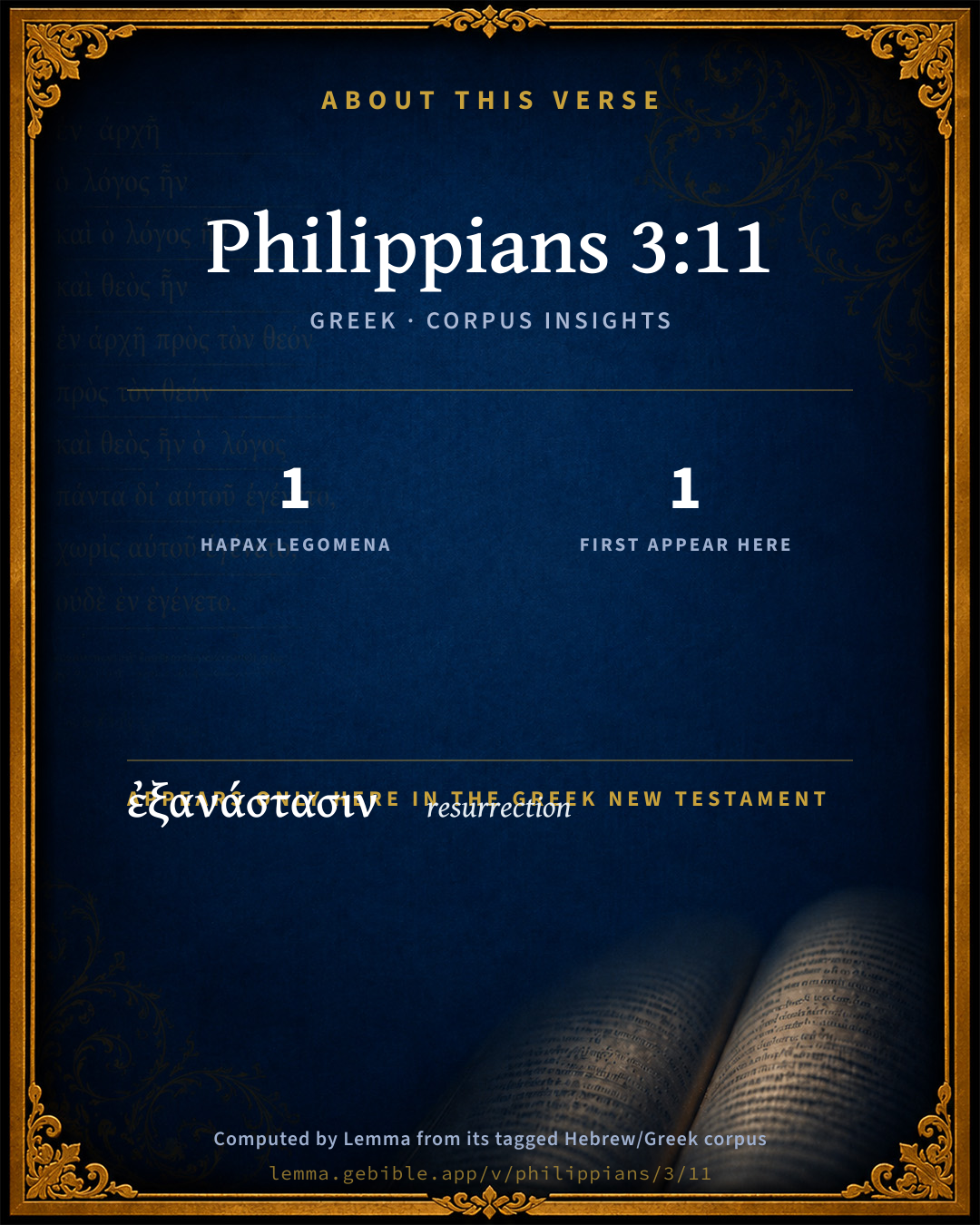
Philippians 3:11

Greek (Tischendorf 8th ed.) Philippians 3:11 appears in the Greek New Testament. The text above is from the Tischendorf 8th edition. Each word links to its Strong’s number and a concise gloss. Click any word for its full Thayer’s Greek Lexicon entry.
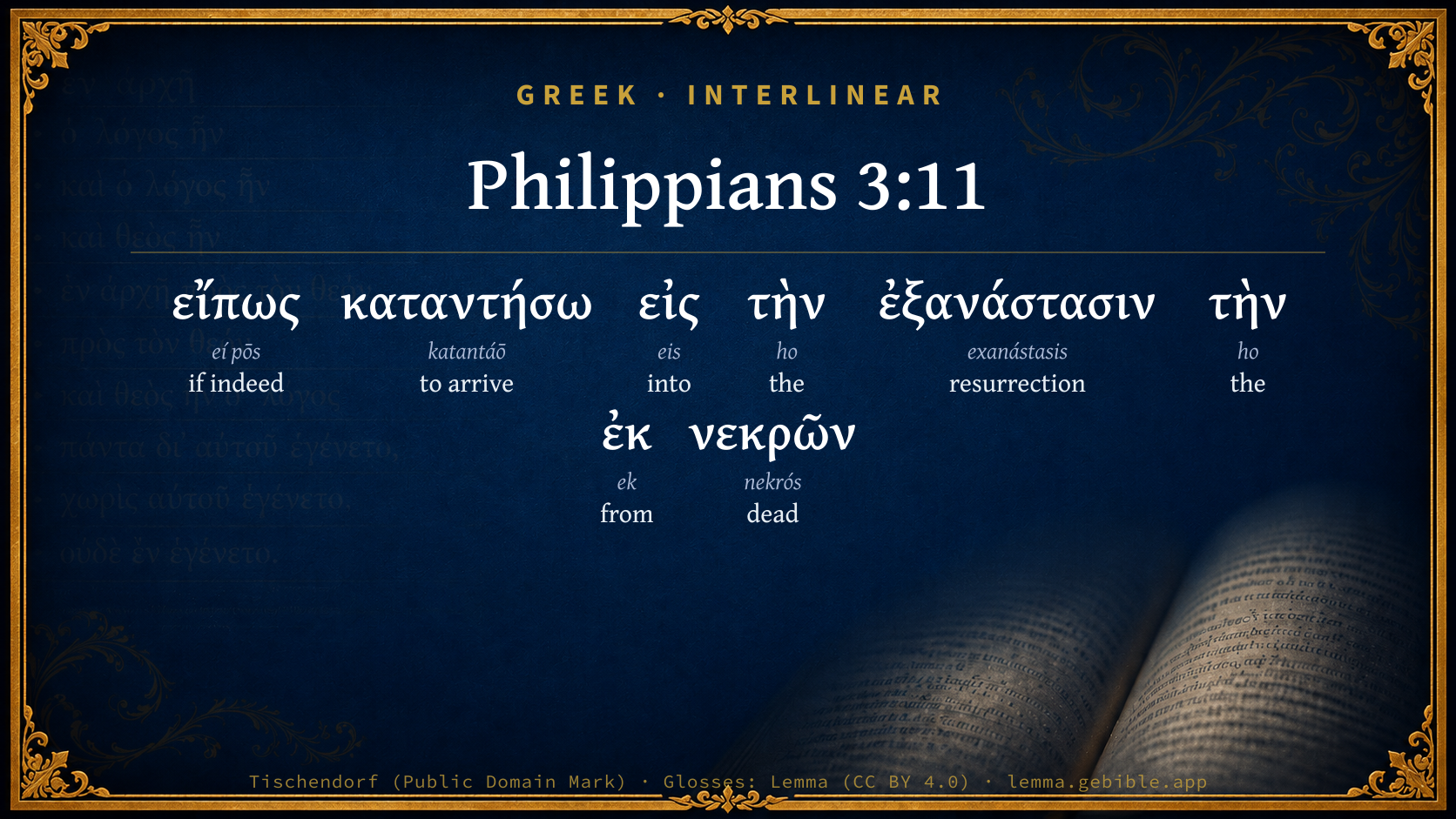
Download image
Cite this verse

Philippians 3:11 (World English Bible). Public Domain. Lemma interlinear Bible study tool, https://lemma.gebible.app/v/philippians/3/11.

Show BibTeX & RIS
BibTeX
RIS
English Translation
if by any means I may attain to the resurrection from the dead.
World English Bible · Public Domain
Highlights
  • 1 hapax legomenon — only here in the Greek New Testament
  • 1 first appearance in the Greek New Testament
Full analysis ↓
Download a study sheet

One document with this verse’s original text, its word-by-word gloss line, the meaning frame, cross-references with their text, attributed commentary, and full source and license credits — printable, and it pastes into notes with its structure intact.

This verse Autodidact and up

Study sheet (.html) Plain text (.txt)

A passage Seminary Student

Up to 50 verses in one chapter. A passage sheet keeps up to 6 commentary sources and 12 cross-references per verse, in the order this page ranks them, and says so on the sheet whenever that leaves anything out. Ask for a single verse and you get the Autodidact verse sheet above.

Everything on this page stays free to read, with no account — the sheet is a download of what is already on screen, not access to it.

Want to remove ads? Support Godless Engineer
Compare translations 3

The same verse in 3 English versions, stacked beneath the original-language interlinear above. Click any original word for its lexicon entry.

Each is an independent rendering of the whole verse — the interlinear is not word-aligned to these translations.

Highlighted words mark where these versions differ — a whole-verse word diff, not a word-by-word alignment.

  • World English Bible Public Domain
    if by any means I may attain to the resurrection from the dead.
  • King James Version Public Domain
    If by any means I might attain unto the resurrection of the dead.
  • unfoldingWord Literal Text CC BY-SA 4.0
    if, in some way, I might attain to the resurrection from the dead.

unfoldingWord Literal Text — © unfoldingWord, licensed CC BY-SA 4.0. Word-aligned USFM3 via Door43 (git.door43.org/unfoldingWord/en_ult).

Versions to compare (up to 4)

3 of 4 selected

Show all 19 translations

Every available English version of this verse, each an independent rendering of the whole verse.

  • World English Bible Public Domain
    if by any means I may attain to the resurrection from the dead.
  • Berean Standard Bible Public Domain
    and so, somehow, to attain to the resurrection from the dead.
  • Majority Standard Bible Public Domain
    and so, somehow, to attain to the resurrection from the dead.
  • King James Version Public Domain
    If by any means I might attain unto the resurrection of the dead.
  • American Standard Version (1901) Public Domain
    if by any means I may attain unto the resurrection from the dead.
  • Revised Version (1885) Public Domain
    if by any means I may attain unto the resurrection from the dead.
  • Geneva Bible (1599) Public Domain
    If by any meanes I might attaine vnto the resurrection of the dead:
  • Douay-Rheims (1899) Public Domain
    If by any means I may attain to the resurrection which is from the dead.
  • Young's Literal Translation Public Domain
    if anyhow I may attain to the rising again of the dead.
  • Literal Standard Version CC BY-SA 4.0
    if anyhow I may attain to the resurrection of the dead.
  • Unlocked Literal Bible CC BY-SA 4.0
    so somehow I may experience the resurrection from the dead.
  • unfoldingWord Literal Text CC BY-SA 4.0
    if, in some way, I might attain to the resurrection from the dead.
  • Darby Bible Public Domain
    if any way I arrive at the resurrection from among [the] dead.
  • World Messianic Bible Public Domain
    if by any means I may attain to the resurrection from the dead.
  • Webster's Bible Public Domain
    If by any means I may attain to the resurrection of the dead.
  • Free Bible Version CC BY-SA 4.0
    so that somehow I might be part of the resurrection from the dead!
  • Bible in Basic English Public Domain
    If in any way I may have the reward of life from the dead.
  • Text-Critical English NT CC BY 4.0
    in the hope of attaining the resurrection from the dead.
  • Tyndale New Testament (1534) Public Domain
    yf by eny meanes I myght attayne vnto the resurreccion from deeth.

Literal Standard Version (2020), Covenant Press — licensed CC BY-SA 4.0. Text via the HelloAO Bible API (eBible.org). Unlocked Literal Bible (unfoldingWord) — licensed CC BY-SA 4.0. Text via the HelloAO Bible API (eBible.org). unfoldingWord Literal Text — © unfoldingWord, licensed CC BY-SA 4.0. Word-aligned USFM3 via Door43 (git.door43.org/unfoldingWord/en_ult). Free Bible Version, Dr. Jonathan Gallagher — licensed CC BY-SA 4.0. Text via the HelloAO Bible API (eBible.org).

Word by word

More ways to search: Search by grammar → Find every occurrence → Compare this word →

Practice this passage: Drill this verse → Learn its vocabulary →

About this verse

These counts appear in no published source. They are computed here, from the morphology-tagged text and Lemma’s own curated glosses. What Lemma adds →

8
words
7
distinct lemmas
Pauline Epistles
section

Notable vocabulary

1 hapax legomenon — a word that appears only here in the entire Greek New Testament:

  • ἐξανάστασιν resurrection G1815

First appearance in Scripture

This word makes its first canonical appearance in the Greek New Testament here:

  • ἐξανάστασιν resurrection G1815

Shared distinctive vocabulary

εἴπως if indeed G1513 occurs in 4 verses of the Greek New Testament. Also found in:

Repetition

A word recurs within this verse:

Cross-references

15

Topical passages linked to Philippians 3:11 in the Treasury of Scripture Knowledge — connected by theme and wording, ordered by reader-vote popularity; previews shown in the World English Bible.

  • Luke 20:35–36 But those who are considered worthy to attain to that age and the resurrection from the dead, neither marry, nor are given in marriage.
  • Revelation 20:5 The rest of the dead didn't live until the thousand years were finished. This is the first resurrection.
  • Acts 23:6 But when Paul perceived that the one part were Sadducees and the other Pharisees, he cried out in the council, "Men and brothers, I am a Pharisee, a son of Pharisees. Concerning the hope and resurrection of the dead I am being judged!"
  • Acts 26:7 which our twelve tribes, earnestly serving night and day, hope to attain. Concerning this hope I am accused by the Jews, King Agrippa!
  • 2 Corinthians 11:3 But I am afraid that somehow, as the serpent deceived Eve in his craftiness, so your minds might be corrupted from the simplicity that is in Christ.
  • Hebrews 11:35 Women received their dead by resurrection. Others were tortured, not accepting their deliverance, that they might obtain a better resurrection.
  • Psalms 49:7 None of them can by any means redeem his brother, Nor give God a ransom for him.
  • Luke 14:14 and you will be blessed, because they don't have the resources to repay you. For you will be repaid in the resurrection of the righteous."
  • John 11:24 Martha said to him, "I know that he will rise again in the resurrection at the last day."
  • Romans 11:14 if by any means I may provoke to jealousy those who are my flesh, and may save some of them.
  • 1 Corinthians 9:22 To the weak I became as weak, that I might gain the weak. I have become all things to all men, that I may by all means save some.
  • 1 Corinthians 9:27 but I beat my body and bring it into submission, lest by any means, after I have preached to others, I myself should be rejected.
  • 2 Thessalonians 2:3 Let no one deceive you in any way. For it will not be, unless the departure comes first, and the man of sin is revealed, the son of destruction,
  • Acts 27:12 Because the haven was not suitable to winter in, the majority advised going to sea from there, if by any means they could reach Phoenix, and winter there, which is a port of Crete, looking northeast and southeast.
  • 1 Thessalonians 3:5 For this cause I also, when I couldn't stand it any longer, sent that I might know your faith, for fear that by any means the tempter had tempted you, and our labor would have been in vain.

Cross-references courtesy of OpenBible.info (CC BY 4.0).

Commentary

Notes on Philippians 3:11 from classic Christian and Jewish commentators (each source and its license shown beneath its notes). The classic Christian expositions comment on the surrounding passage and are grouped to its opening verse, so a note may address several verses; the Jewish commentaries on the Tanakh (Rashi and others) are per-verse, so they appear only where the commentator wrote on this verse.

Lemma curates 59 commentaries, every one of them public domain or Creative Commons licensed, each selected and text-cleaned for this edition rather than reprinted as found. About our sources →

The Biblical Illustrator

Joseph S. Exell

Php_3:11

If by any means I might attain unto the resurrection of the dead

St.

Paul in the context reckoneth up his gain by Christ

Viz., his justification and sanctification; but his gain reacheth further, even to glorious resurrection.

I. The benefit to be obtained by Christ. How is this a privilege since there is a resurrection of the wicked? (Act_24:15). But theirs is one to condemnation (Joh_5:29), and so a fall rather than a rising. Therefore the faithful are only called the Children of the Resurrection (Luk_20:36). The word here is not ἀνάστασις, but εξανάστασις, to express the full and blessed resurrection that no evil shall follow (Luk_14:14).

II. The submission of a self-denying believer to use any means to obtain it. The words seem to express a doubtfulness, but indeed they do not (2Co_5:1), for there is no uncertainty in Gods promise. Why doth he then thus express himself?

1. To intimate the difficulty, thereby to quicken his desire and diligence.

2. To express the variety of the means by which God bringeth His people to glory (Php_3:10).

3. To set forth his full submission (Luk_14:26).

4. His unwearied diligence and earnest endeavour to obtain this happiness, whatever it cost him.

5. The value of this benefit, and his vehement desire to attain it. (T. Manton, D. D.)

The doctrine here taught is that the blessedness of the saints at the resurrection is so great that we should be content to use any means and run any hazards to attain it.

I. What is the happiness of the saints in that day.

1. Our personal inherent blessedness is glory revealed in us (Rom_8:18).

(1) The body hath its felicity.

(a) Because the man cannot be happy till the body be raised again. The soul alone doth not constitute human nature.

(b) It is agreeable to the wisdom and goodness of God that the body which had its share in the work should share the reward.

(c) The estate of those who die will not be worse than that of those who are only changed at Christs coming, or there would be a disparity.

(d) In the heavenly state there are objects which can only be discerned by the bodily senses--the human nature of Christ, e.g.

(e) As Christ was taken to heaven bodily, so shall we, for we bear the image of the heavenly one (Php_3:21; 1Co_15:42-44).

(2) For the happiness of the soul. We shall be satisfied with the vision of God and transformed Into his likeness (1Co_13:12; 1Jn_3:2; 2Co_3:18).

2. Adherent privileges.

(1) Justification: We have that now by faith; then we shall have our absolution from the Judges mouth.

(2) Adoption. We have that light now (Joh_1:12)--then the full fruition thereof (Rom_8:23).

(3) Redemption. That day is called the day of redemption (Eph_4:30), because then we are completely delivered from all misery, both of soul and body (Eph_1:14).

II. The means whereby God bringeth us thither.

1. The way of our holiness and the active part of our obedience.

(1) Dying to sin (Rom_8:13; Gal_6:8).

(2) Living to God. The spiritual life is heaven begun (2Pe_3:14; Luk_21:36; Act_24:15-16).

2. As to passive obedience observe--

(1) That no suffering must be excepted out of our resignation (Mat_16:25; Luk_14:26).

(2) This must be endured cheerfully.

III. The reason why, rather than fail, we must submit to any means which God hath appointed.

1. From the absolute dominion and prerogative of God, both to make laws and to put us on what trials He pleaseth to appoint.

2. From the goodness and suitableness of His laws.

(1) There is wisdom in them.

(2) We have no reason to be discouraged, for Divine help is assured (2Ti_4:17-18).

(3) The Divine comfort is to be had (1Pe_4:14; Rom_5:5).

3. The great difficulty lieth not in a respect of the end, but the means; and so the trial of our sincerity must be rather looked for there.

4. The hope propounded will bear this submission. Immortal happiness is most durable, and endless misery most terrible; the world is vanity, heaven real. (T. Manton, D. D.)

The resurrection

I. There is a happy estate hereafter which begins with the resurrection. More happy than that which Adam lost or from which the angels fell.

II. The beginning of this happy estate is at the resurrection.

1. All good shall be perfected.

2. All evil cease.

3. Body as well as soul, perfected being, shall enjoy the fulness of the one and immunity from the other.

III. The apostle makes the resurrection the last thing, thereby establishing an order (Luk_24:26; 2Ti_2:12). Calvary comes before Olivet in the experience of both Christ and His people.

IV. It is hard to come to heaven because of this Divine order.

1. Away then with all idle and secure thoughts of sparing ourselves. We must come to health by physic.

2. In all crosses let us not look into the state we are in so much as that we are going to. We are going to a palace and should not be dejected because of the narrowness of the way (Heb_12:21).

3. Labour for a right esteem of the things of this world. They are momentary and fading:

4. Labour to strengthen our graces.

(1) Faith to assure us that we are Gods children, and have heaven laid up for us.

(2) Hope which makes us cheer fully endure in expectation of what faith believes.

(3) Love to Christ which made Paul desire to be with Him which was best of all (Php_1:23). (R. Sibbes, D. D.)

The resurrection

(ἐξανὰστασις) of the saints

I. Is distinguished from that of the wicked--by its glory (Php_3:21). Dan_12:2 --By its precedence (1Th_4:16; 1Co_15:23). Rev_20:5 --By its results (Joh_5:29).

II. Is an object of Christian ambition--requiring faith--consecration--effort.

III. Will amply repay every sacrifice--of self-gratification--earthly advantage--life. (J. Lyth, D. D.)

The resurrection of the just

No one could be more convinced than Paul of the blessedness in which the saint enters at death, and he was wonderfully qualified by visions and revelations to entertain this conviction. Yet he sets his heart upon that which could only be remote. What, then, must be that sequel which can fix and overwhelm such a mind, that while an instantaneous heaven lies before it, is transported beyond it to splendours which it agonizes to attain?

I. What is that entire satisfaction and climax for which the text teaches us to long and labour. Immortality as an idea was not unknown to the pagans, but the resurrection is the almost exclusive doctrine of Scripture.

1. That resurrection will be simultaneous, and the judgment of all will immediately succeed it.

2. Yet it is not unnatural that this common event should sometimes be specially regarded and personally applied. In the language of Paul to the Corinthians it is argued in the case of believers from their union with Christ. He mentions not the wicked who shall rise for different reasons. They could never wish to attain the resurrection. The first resurrection (1Th_4:15) is shared by the dead over those who have never died, and that of Rev_20:6, is of souls.

3. St. Paul desired but a share in the general resurrection, attended as that event would be to him and all the people of God with consequences of surpassing happiness and glory.

4. Yet searching the experience of present Christians we do not find this hope ardently cherished. Thousands are contented with the salvation and glorification of the soul; this is to be deplored as the slight of a matchless good. Apart from the resurrection man is incomplete.

II. What are the scriptural representations of its accompaniments and consequences.

1. The mutual recognition of saints in heaven. Is violence to be done to memory, and can love be changed? Can a spirit made perfect be wanting in sympathies which so much purified it from imperfection?

2. The happiness of our future condition is made chiefly to depend on our resemblance to Christ.

3. There the saints shall be fully acknowledged. They who here were unknown and hated shall there shine forth as the sun.

4. Christians shall be glorified with their Master.

5. We therefore find the righteous in Scripture earnestly seeking and exultantly hailing this resurrection. Why? Because--

(1) It is the triumph of Christ.

(2) The full redemption of the believer.

(3) The restitution of our entire nature.

(4) Purposes will then be indicated which our present mixed being has not hitherto revealed, for both mind and body; the latter will then be a perfect instrument for the soul.

(5) A congeniality will be established between the risen saints and the materialism of their glorious abode.

(6) In the reintegration of our manhood shall be displayed the most perfect spectacle of the beauty of holiness.

(7) There will be endless progression.

III. What are the determinations by which it is to be won. The manner or method supposes far higher means than those we can command. The power of the resurrection alone secures our confidence. The means, however, in this connection, refer not to the causative but the moral; to the influence of present character and conduct on this event. We often mark the influence of former conduct on our present condition; and so we exist and act for all the future of our immortality.

1. What prayer, then, should we devote to this attainment?

2. What anticipation should familiarize it?

3. What preparation should facilitate it? Mortify therefore your members.

4. What counterpart should we exhibit of it. (R. W. Hamilton, D. D.)

The attainment of the resurrection

I. Pauls aim. How can that future rising be attained at all by mans effort in time?

1. Paul has been speaking of a spiritual fellowship with Christs sufferings and death and rising, and then as a direct result he passes to this, from which we infer that the resurrection in the future is the result of mans spiritual life in the present. Men fancy that the future glory of the risen Christian is by a kind of miracle suddenly added beyond the grave. Paul regards it as a glory daily growing now, to be manifested then. It is an outgrowth of fellowship with Christ, and its blessedness will be greater or less according to the perfection of that fellowship.

2. In what manner was this Christian life a constant attainment of the resurrection? The power of Christs resurrection is the influence in the soul which renders its life a gradual growth towards the rising glory of man.

(1) The risen Christ is the pledge of a risen life. Christ did not rise merely to prove our immortality; if that were all its meaning it would only deepen mans fear. We do not want immortality unless we know that our life, throwing off its sins, shall rise upwards to God. Rising to God Christ showed that man is accepted by the Father, rising in the human, He showed how, through Him, human life should rise into life Divine.

(2) The rising of Christ is a power to elevate life. We have fellowship not with the past, but with the living Jesus: we are moulded by the power not only of a dying Saviour, but of the living friend. He carries our sympathies upwards with Himself to God and the spiritual world.

(3) Hence arises the gradual attainment of the resurrection, every experience of our risen life makes us feel the necessity of the future; yet every experience is an actual attaining of that future.

II. Pauls endeavour. The necessity of this agonizing endeavour arises from two facts.

1. The difficulty of accomplishing it. This is so--

(1) Because our souls are subject to the influences of three great worlds.

(a) By its fascinations this old earth appeals to our hearts, and seems by many arms to bind us to itself as our home.

(b) The dark world of unbelief and indifference awakening the carnal nature renders the Christian life an inevitable struggle.

(c) At the same time through the love of God and the Cross of Christ heaven is attracting the soul.

(2) Because of the incessant and dominant power of our easily besetting sin. This power arises largely in that every man thinks his own weakness small and insignificant.

(3) And then listen to Paul after his high attainments telling us that he has to keep his body under lest he should be a castaway.

2. The glory of its attainment. You know how this raised Paul to exertion. He moved onwards to eternity under the constant influence of its attraction. Alas! how feebly we feel this as a motive for endeavour. We lash ourselves into exertion by fear, when we might be so cheered into it by sweet hope as to become unconscious of toil. (E. L. Hull, B. A.)

The attainment of the resurrection dependent on fellowship with Christ

Just as the perfect beauty of the flower lies dormant in the seed, and through its burial in the cold earth is invisibly developing itself, to bloom forth at the voice of spring, so the perfect beauty of the resurrection is hidden in the Christian now; and, by all his toil and struggle, that germ of glory is growing. Just as the mental power and strong determined will of the man are hidden in the child, and are maturing unconsciously through all the wonder of its infancy, so the resurrection manhood of the soul is lying in it during this childhood of Time; and by the education of fellowship with Christ, and struggle to be Christ-like, is advancing to its final splendour. (E. L. Hull, B. A.)

The Biblical Illustrator, edited by Joseph S. Exell (c. 1880s–1900s) — public domain. Text from a community e-Sword module.

Tyndale Open Study Notes

Tyndale Open Resources

3:11 To experience the resurrection from the dead is to be saved from judgment and receive eternal life (see Rev 20:4-6). Paul was aware of God’s holiness and the severity of the final judgment (Rev 20:11-15); he knew he must persevere in his pursuit of Christ and salvation (cp. Gal 5:5).

Tyndale Open Study Notes — © Tyndale Open Resources, licensed CC BY-SA 4.0. Text via the HelloAO Bible API.

Bengel's Gnomon

Johann Albrecht Bengel

Php 3:11. Εἴπως, if by any means, in any way) This denotes the struggle of Paul’s faith; so, εἰ, if, Php 3:12.—καταντήσω, I may attain) He gradually passes from the figure of loss and gain to that of a race. Καταντᾷν is to come up to, the very act of attaining and gaining possession.—ἐξανάστασιν [42]ΤῶΝ ΝΕΚΡῶΝ) i.e. ἀνάστασιν (Χριστοῦ) ἐκ τῶν νεκρῶν, the resurrection (of Christ) from the dead; comp. Rom 1:4, note [2Ti 2:11]; for the style of Paul ascribes ἀνάστασιν to Christ; ἘΞΑΝΆΣΤΑΣΙΝ to Christians.[43] But the resurrection of Christ and our resurrection are considered as one resurrection, by reason of the κοινωνία, fellowship. After the mention of the resurrection, he brings in some things suited to his own present state, and interweaves the rest [of the discussion of the resurrection] at Php 3:20-21.

[42] Τὴν ἐκ is read by ABD(Δ)fg Vulg., Iren. 309, Lucif. 166. Τῶν ἐκ is read by G. Τῶν by Memph. and Rec. Text.—ED.

[43] This fact ought to have led Beng. to take ἀναστάσεως above of the resurrection, not the mere appearing of Christ. The phrase, “power of His resurrection,” expresses a parallel idea to Eph 1:19-20, “The exceeding greatness of His power to usward who believe, according to the working of His mighty power, which He wrought in Christ when He raised Him from the dead.” Comp. Col 2:12; Col 3:1; Rom 6:5. The same power is needed to quicken the soul as was needed to raise Jesus from the dead. To have that power (the Holy Spirit) in us, is a pledge of our hereafter attaining the ἐξανάστασις, Rom 8:11. This word probably implies the rising of the saints first out of the rest of the dead, 1Co 15:23; Rev 20:5. Ἐξανάστασις is nowhere else found in N. T.—ED.

The Germ. Vers., following the decision of the 2d Ed., adopts the reading τὴν ἐκ νεκρῶν, which was reckoned among those not to be approved in the larger Ed.—E. B.

Bengel's Gnomon of the New Testament — English translation (T&T Clark, Edinburgh, 1860) — public domain. Text from a community e-Sword module.

Meyer's Critical & Exegetical Commentary

Heinrich August Wilhelm Meyer

Php_3:11. Εἴ πως] if possibly, designating the aim, the attainment of which is before the apostles mind in the συμμορφιζόμενος τῷ θαν. αὐτοῦ. In this case, however, the deliberative form of expression (comp. Rom_1:10; Rom_11:14; Kühner, II. 2, p. 1034) bears the impress, not of doubt that he will attain to the resurrection of the dead (in case, namely, he should not live to see the Parousia), but of humility under the conception of the greatness of the bliss, and of the moral condition to which, on mans part, it is subject; οὐ θαῤῥῶ γάρ, φησιν, οὔπω· οὕτως ἐταπεινοφρόνει, ὅπερ ἀλλαχοῦ λέγει· ὁ δοκῶν ἑστάναι, βλεπέτω μὴ πέσῃ, Theophylact: comp. Chrysostom. This suffices also in opposition to Baurs doubt (Paulus, II. p. 79 f.) whether Paul could have expressed himself in this way at all. The expression excludes moral security, but not the certitudo salutis in itself, as, following Estius and other Catholic expositors, Bisping still thinks. The certainty of salvation is founded on Gods decree, calling (Rom_8:29 f.), promise, and attestation by the Spirit (Rom_8:10), in faith on the saving facts of redemption (Rom_8:32 ff.). Comp. Calovius.

The reader could not feel any doubt as to what ἐξανάστασις τῶν νεκρῶν Paul means, namely, the first, in which οἱ τοῦ Χριστοῦ ἐν τῇ παρουσίᾳ αὐτοῦ (1Co_15:23) shall arise.[162] Comp. 1Th_4:16. It is the resurrection of the dead κατʼ ἐξοχήν, not different from the ἈΝΆΣΤΑΣΙς ΤῶΝ ΔΙΚΑΊΩΝ. See on Luk_14:14. Nevertheless, we must not find this resurrection denoted by the double compound ἐξανάστ., the ἘΞ in it conveying the idea ἘΚ Τῆς Γῆς ΕἸς ΤῸΝ ἈΈΡΑ (Theophylact). This ΕΞ is simply to be explained by the conception ἘΚ Τῆς Γῆς, so that neither in the substantial meaning nor even in style (Bengel: Paulinus enim stylus Christo adscribit ἀνάστασιν, ἐξανάστασιν Christianis) is ἘΞΑΝΆΣΤ. to be distinguished from ἈΝΆΣΤ.; but the former is to be explained solely from the more vividly imaginative view of the event which the apostle has before him. Comp. on 1Co_6:14. The double compound substantive does not occur elsewhere in the N. T. (the verb, Mar_12:19; Luk_20:28; Act_15:5); but see Polyb. iii. 55. 4, ii. 21. 9, ii. 35. 4; Gen_7:4. Compl. We may add, that while it has been explained, at variance with the context, as referring to the ethical resurrection, Rom_6:4 f. (Flacius, Balduin, Coccejus, and others; comp. Schrader), it is also erroneous to find in it the sense: if perchance I should remain alive until the resurrection of the dead (van Hengel, Hilgenfeld); since, on the contrary, essentially the same meaning is expressed as in Luk_20:34 by οἱ καταξιωθέντες … τῆς ἀναστάσεως, and it is conceived as a possible case (comp. Php_1:20 ff., Php_2:17) that Paul will not remain alive until the Parousia.[163] καταντ. εἰς (comp. Eph_4:13) denotes the attaining to a goal (frequently in Polybius, see Schweighäuser, Lex. p. 332; see also the passages from the LXX. and Apocr. in Schleusner, III. p. 234 f.), which, however, is here not a point of time, but a bliss which is to be attained. Comp. Act_26:7.

[162] It is incorrect to ascribe to the apostle the idea that none but believers will rise at the resurrection, and that unbelievers will remain in Hades (Weiss). The resurrection of all, as Christ Himself unquestionably taught it (see on Joh_5:28 f.; Luk_14:14), is also in Pauls view the necessary premiss of the judgment of all, of believers and also of unbelievers (of the κίσμος, Rom_3:6; 1Co_6:2; 1Co_11:32). That view, moreover, is at variance with the apostles distinct declaration in Act_24:15, comp. Act_17:31. Gerlach properly declares himself (Letzte Dinge, p. 147 ff.) opposed to Weiss, but still limits the final judgment, at p. 101 ff., as regards the persons subjected to it, in a way that is exegetically altogether unjustifiable.

[163] This also applies against the view of Otto, Pastoralbr. p. 233, who has altogether misunderstood vv. 11 and 12.

Meyer — Critical and Exegetical Commentary on the New Testament — English translation by Peter Christie, edited by Frederick Crombie (T&T Clark, 1880) — public domain. Text from a community e-Sword module.

Expositor's Greek Testament

ed. W. Robertson Nicoll

Phi 3:11 . εἴ πως καταντ . This construction closely corresponds to the Homeric usage of εἴ κε or ἤν (as in Odyss. , 3, 83, πατρὸς ἐμοῦ κλέος μετέρχομαι , ἤν που ἀκούσω ) where the protasis really contains in itself its own apodosis “which consists of an implied idea of purpose” or hope (see Goodwin, MT [54] . , p. 180; Burton, MT [55] . , § 276; Viteau, Le Verbe , pp. 62, 116). Here the clause is almost equivalent to an indirect question. The Resurrection is the Apostle’s goal, for it will mean perfect, unbroken knowledge of Christ and fellowship with Him. Paul knows by experience the difficulty of remaining loyal to the end, of being so conformed to Christ’s death that the power of sin will not revive its mastery over him. So his apparent uncertainty here of reaching the goal is not distrust of God. It is distrust of himself. It emphasises the need he feels of watchfulness and constant striving ( cf. διώκω , Phi 3:12 ), lest “having preached to others” he “be found a castaway” (1Co 9:27 . 1Co 9:24-27 , along with Rom 8:17 , are the best parallel to the passage before us). But, on the other side, he is always reminded that “faithful is He that calleth you” (1Th 5:24 ). καταντήσω . Probably aorist subjunctive (as corresponding with καταλάβω in Phi 3:12 ). τὴν ἐξαν . τ . νεκρ . Authority, both external and internal, supports the reading τὴν ἐκ νεκρῶν . ἐξανάστ . is found nowhere else in N.T., and never in LXX. In later Greek it means “expulsion”. It occurs only here in this sense. Holst, suggests that ἐξαν . is used here of the actual resurrection, because ἀνάστασις was used above of believers with an ethical, ideal meaning. We are disposed to believe (with Ws [56] . and others) that Paul is thinking only of the resurrection of believers ( cf. Ps. Sol. 3:13 16 for Jewish thought on this subject, the thought which had been Paul’s mental atmosphere). This is his usual standpoint. In the famous passage 1Co 15:12 ff. it is exclusively of Christians he speaks. We have no information as to what he taught regarding a general resurrection. But considering that it is with spontaneous, artless letters we have to do, and not with theoretical discussions, it would be hazardous to say that he ignored or denied a general resurrection. For him the resurrection of Christians depends on and is conformed to the resurrection of their Lord. Teichmann ( Auferstehung u. Gericht , p. 67), comparing chap. Phi 1:23 with this passage, holds that Paul, although he has replaced the idea of resurrection by that of a continuous existence after death, occasionally (as here) uses the traditional termini technici. This may be so. More probably at one time he would give prominence to the thought of uninterrupted fellowship with Christ after death, while at another his longings would centre round the great crisis when Christ should acknowledge all His faithful servants and make them full sharers in His glory. It is not to be doubted that Paul, like the rest of the early Christians, expected that crisis soon to come.

[54] . Moods and Tenses (Burton, Goodwin).

[55] . Moods and Tenses (Burton, Goodwin).

[56] . Weiss.

The Expositor's Greek Testament, edited by W. Robertson Nicoll (1897–1910) — public domain. Text from a community e-Sword module.

Geneva Bible (1599)

Geneva Bible translators

To life everlasting, which followeth the resurrection of the Saints.

Geneva Bible (1599) marginal notes — public domain. Text via Bolls.life.

Jamieson, Fausset & Brown

Robert Jamieson, A. R. Fausset & David Brown

If by any means--not implying uncertainty of the issue, but the earnestness of the struggle of faith (Co1 9:26-27), and the urgent need of jealous self-watchfulness (Co1 10:12).

attain unto the resurrection of the dead--The oldest manuscripts read, "the resurrection from (out of) the dead," namely, the first resurrection; that of believers at Christ's coming (Co1 15:23; Th1 4:15; Rev 20:5-6). The Greek word occurs nowhere else in the New Testament. "The power of Christ's resurrection" (Rom 1:4), ensures the believer's attainment of the "resurrection from the (rest of the) dead" (compare Phi 3:20-21). Compare "accounted worthy to obtain the resurrection from the dead" (Luk 20:35). "The resurrection of the just" (Luk 14:14).

Jamieson, Fausset & Brown — Commentary Critical and Explanatory on the Whole Bible (1871) — public domain (CC PDM 1.0). Text via the HelloAO Bible API.

Adam Clarke's Commentary

Verse 11. The resurrection of the dead.] That is, the resurrection of those who, having died in the Lord, rise to glory and honour; and hence St. Paul uses a peculiar word which occurs no where else in the New Testament, εξαναστασις. The words, as they stand in the best MSS., are as follow: εις την εξαναστασιν την εκ νεκρων, to that resurrection which is of the dead. This glorious resurrection, and perhaps peculiarly glorious in the case of martyrs, is that to which St. Paul aspired. The word αναστασις signifies the resurrection in general, both of the just and unjust; εξαναστασις may signify that of the blessed only.

Adam Clarke's Commentary on the Bible (1810–1826) — public domain. Text from a community e-Sword/MySword module.

The Cambridge Bible for Schools and Colleges

gen. ed. J. J. S. Perowne

11. if by any means] For the strong language of contingency here cp. 1Co_9:27. Taken along with such expressions of exulting assurance as Rom_8:31-39; 2Ti_1:12; and indeed with the whole tone of “joy and peace in believing” (Rom_15:13) which pervades the Scriptures, we may fairly say that it does not imply the uncertainty of the final glory of the true saint. It is language which views vividly, in isolation, one aspect of the “Pilgrim’s Progress” towards heaven; the aspect of our need of continual watching, self-surrender, and prayer, in order to the development of that likeness without which heaven would not be heaven. The other side of the matter is the efficacy and perseverance of the grace which comes out in our watching; without which we should not watch; which “predestinates” us “to be conformed to the image of the Son of God” (Rom_8:29). The mystery lies, as it were, between two apparently parallel lines; the reality of an omnipotent grace, and the reality of the believer’s duty. As this line or that is regarded, in its entire reality, the language of assurance or of contingency is appropriate. But the parallel lines, as they seem now, prove at last to converge in glory (Joh_6:39-40; Joh_6:44; Joh_6:54; Joh_10:27-29; Rom_8:30; 1Th_5:23-24).

See Hooker’s Sermon Of the Certainty and Perpetuity of Faith in the Elect, especially the closing paragraphs.

I might] Lit., and here better, with R.V., I may.

the resurrection of the dead] The better supported reading gives, as R.V., the resurrection from the dead. The phrase implies a certain leaving behind of “the dead”; and this is further emphasized in the Greek, where the noun rendered “resurrection” is the rare word exanastasis, i.e. the common word (anastasis) for resurrection, strengthened by the preposition meaning “from.” This must not, however, be pressed far; later Greek has a tendency towards compounding words without necessarily strengthening the meaning. It is the setting of the word here which makes an emphasis in it likely.—It has been inferred that St Paul here refers to a special and select resurrection, so to speak, and that this is “the first resurrection” of Rev_20:5-6, interpreted as a literal resurrection of either all saints or specially privileged saints, before that of the mass of mankind. (Such an interpretation of Revelation 20 appears as early as Tertullian, cent. 2, de Monogamiâ, c. x.). But against this explanation here lies the fact that St Paul nowhere else makes any unmistakable reference to such a prospect (1Co_15:23-24 is not decisive, and certainly not 1Th_4:16); and that this makes it unlikely that he should refer to it here, where he manifestly is dealing with a grand and ruling article of his hope. We explain it accordingly of the glorious prospect of the Resurrection of the saints in general. And we account for the special phrase by taking him to be filled with the thought of the Lord’s Resurrection as the pledge and, so to speak, the summary of that of His people; and His Resurrection was emphatically “from the dead.”—Or it may be that we have here to explain “the dead” as a term of abstract reference, meaning practically “the state of the dead,” the world of death.—In any case, the phrase refers to “the resurrection of life” (Dan_12:2; Joh_5:29); “the resurrection of the just” (Luk_14:14); differenced from that of “the unjust” (Act_24:15), whether or no in time, certainly in an awful distinction of conditions and results. The blessed resurrection is here called “the resurrection” as the blessed life is called “the life” (e.g. 1Jn_5:12). The antithesis is not non-resurrection, and non-existence, but such resurrection, and such existence, as are ruin and woe.—It is observable that the Apostle here implies his expectation of death, to be followed by resurrection; not of survival till the Lord’s Return. Cp. 2Co_4:14.

The Cambridge Bible for Schools and Colleges (gen. ed. J. J. S. Perowne; Cambridge University Press, 1878–1918) — public domain. Text from a community e-Sword module.

John Gill's Exposition

If by any means I, might attain unto the resurrection of the dead. Not in a figurative sense, the resurrection from the death of sin to a life of grace, of which Christ is the efficient cause, for this the apostle had attained to; unless the consummation of that spiritual life, in perfect holiness, should be intended, than which nothing was more desirable by him; nor in a representative sense, for this also he enjoyed in Christ his head, being risen with him, and in him, when he rose from the dead; but in a literal sense and designs not the general resurrection of the just and unjust, which he believed; for he knew that everyone must, and will attain to this, even Pharaoh, Judas, and the worst of men; but the special and particular resurrection of the righteous, the better resurrection, which will be first, and upon the personal coming of Christ, and by virtue of union to him, and in a glorious manner, and to everlasting life and happiness: and when the apostle says, "if by any means" he might attain to this, it is not to be understood as if he doubted of it, which would be inconsistent with his firm persuasion, that nothing should separate him from the love of God, and with his full assurance of faith, as to interest in Jesus Christ; but it denotes the difficulty of attaining it, since through various afflictions and great tribulations a believer must pass, before he comes to it; and also the apostle's earnest desire of it, and strenuous endeavour for it; not caring what scenes of trouble, or sea of sorrow what fiery trials, severe sufferings, or cruel death he went through, so be it he obtained as he believed he should, the glorious and better resurrection; he counted not his life dear to himself, he loved it not unto death, having in view the blissful and happy state after it.

If by any means I, might attain unto the resurrection of the dead. Not in a figurative sense, the resurrection from the death of sin to a life of grace, of which Christ is the efficient cause, for this the apostle had attained to; unless the consummation of that spiritual life, in perfect holiness, should be intended, than which nothing was more desirable by him; nor in a representative sense, for this also he enjoyed in Christ his head, being risen with him, and in him, when he rose from the dead; but in a literal sense and designs not the general resurrection of the just and unjust, which he believed; for he knew that everyone must, and will attain to this, even Pharaoh, Judas, and the worst of men; but the special and particular resurrection of the righteous, the better resurrection, which will be first, and upon the personal coming of Christ, and by virtue of union to him, and in a glorious manner, and to everlasting life and happiness: and when the apostle says, "if by any means" he might attain to this, it is not to be understood as if he doubted of it, which would be inconsistent with his firm persuasion, that nothing should separate him from the love of God, and with his full assurance of faith, as to interest in Jesus Christ; but it denotes the difficulty of attaining it, since through various afflictions and great tribulations a believer must pass, before he comes to it; and also the apostle's earnest desire of it, and strenuous endeavour for it; not caring what scenes of trouble, or sea of sorrow what fiery trials, severe sufferings, or cruel death he went through, so be it he obtained as he believed he should, the glorious and better resurrection; he counted not his life dear to himself, he loved it not unto death, having in view the blissful and happy state after it.

Philippians 3:12

phi 3:12

phi 3:12

phi 3:12Not as though I had already attained,.... Or "received"; he had received much grace out of the fulness of it in Christ; he had received the gift of righteousness, the forgiveness of his sins, and the adoption of children; he had attained to a lively hope of the incorruptible inheritance, and had received a right unto it, and had a meetness for it; but as yet he had not received the thing itself, nor was he come to the end of his race, and so had not received the crown of righteousness laid up for him; he had not yet attained to perfect knowledge, nor perfect holiness, nor perfect happiness: wherefore he adds,

either were already perfect; he was perfect in comparison of others, that were in a lower class of grace, experience, and knowledge, in which sense the word is used in Phi 3:15, and in Co1 2:6; he was so, as perfection intends sincerity, uprightness, and integrity; the root of the matter, the truth of grace was in him; his faith was unfeigned, his love was without dissimulation, his hope was without hypocrisy, his conversation in the world was in godly simplicity, and his preaching and his whole conduct in his ministry were of sincerity, and in the sight of God: he was perfect as a new creature with respect to parts, having Christ formed in him, and all the parts of the new man, though not as to degrees; this new man not being as yet grown up to a perfect man, or to its full growth, to the measure of the stature of the fulness of Christ; he was perfect with respect to justification, being perfectly justified from all things, by the righteousness of Christ, but not with respect to sanctification; and though his sanctification was perfect in Christ, yet not in himself; his knowledge was imperfect, something was wanting in his faith, and sin dwelt in him, of which he sometimes grievously complained: now this he says, lest he should be thought to arrogate that to himself, which he had not:

but I follow after; Christ the forerunner, after perfect knowledge of him, perfect holiness from him, and perfect happiness with him: the metaphor is taken from runners in a race, who pursue it with eagerness, press forward with all might and main, to get up to the mark, in order to receive the prize; accordingly the Syriac version renders it, , "I run", and so the Arabic: the apostle's sense is, that though he had not yet reached the mark, he pressed forward towards it, he had it in view, he stretched and exerted himself, and followed up very closely to it, in hope of enjoying the prize:

if that I may apprehend that for which also I am apprehended of Christ Jesus; he was apprehended of Christ, when he met him in his way to Damascus, stopped him in his journey, laid him prostrate on the ground, and laid hold on him as his own, challenged and claimed his interest in him, Act 9:3, as one that the Father had given him, and he had purchased by his blood; he entered into him, and took possession of him, and took up his residence in him, having dispossessed the strong man armed, and ever since held him as his own; and he apprehended, or laid hold on him, to bring him as he had engaged to do, to a participation of grace here, and glory hereafter; that he might know him himself, and make him known to others; that he might be made like unto him, have communion with him, and everlastingly enjoy him: and these things the apostle pursued after with great vehemence, that he might apprehend them, and be in full possession of them; and which he did, in the way and manner hereafter described.

John Gill's Exposition of the Whole Bible (1746–1763) — public domain (CC PDM 1.0). Text via the HelloAO Bible API.

Trapp's Complete Commentary

John Trapp

11 If by any means I might attain unto the resurrection of the dead.

Ver. 11. I might attain to the resurrection] That is (by a metonomy of the subject for the adjunct), that perfection of holiness that accompanieth the estate of the resurrection. True grace never aims at a pitch, but aspireth to perfection. It is a low and unworthy strain in some to labour after no more grace than will keep life and soul together, that is, soul and hell asunder (as one speaketh). But that man for heaven, and heaven for him, that sets up for his mark the resurrection of the dead, that would be as perfect now as the glorified saints shall be at the day of judgment.

John Trapp, A Commentary or Exposition upon All the Books of the Old and New Testament (1647–1656) — public domain. Text from a community e-Sword module.

Albert Barnes' Notes on the Bible

If by any means - Implying, that he meant to make use of the most strenuous exertions to obtain the object.

I might attain unto - I may come to, or may secure this object.

The resurrection of the dead - Paul believed that all the dead would be raised Act 24:15; Act 26:6-8; and in this respect he would certainly attain to the resurrection of the dead, in common with all mankind. But the phrase, “the resurrection of the dead,” also might be used, in a more limited sense, to denote the resurrection of the righteous as a most desirable object; and this might be secured by effort. It was this which Paul sought - this for which he strove - this that was so bright an object in his eye that it was to be secured at any sacrifice. To rise with the saints; to enter with them into the blessedness of the heavenly inheritance, was an object that the apostle thought was worth every effort which could he made. The doctrine of the resurrection was, in his view, that which distinguished the true religion, and which made it of such inestimable value Act 26:6-7; Act 23:6; 1 Cor. 15; and he sought to participate in the full honor and glory of such a resurrection.

Albert Barnes' Notes on the Bible (1834–1885) — public domain. Text from a community e-Sword/MySword module.

Haydock's Catholic Bible Commentary

If by any means I may attain to the resurrection, which is from the dead; i.e. may attain to a happy resurrection, when the dead shall rise again. (Witham) --- This manner of expression does not betray any distrust or fear, but merely insinuates the difficulty of the enterprise, the uncertainty of success, and the ardent desire of the apostle, who sought by every means to arrive at this happiness, either by sufferings and labours, or even by martyrdom. (St. John Chrysostom; Estius)

George Leo Haydock (1774–1849), Haydock's Catholic Family Bible and Commentary, 1859 edition — public domain. Excludes Psalms (Douay-Rheims chapter numbering differs from Protestant) and Deuterocanonical books (Catholic canon only).

Matthew Poole's English Annotations

Being found in whom, after justification and sanctification, he doubts not to be glorified, (by a figure of a part, resurrection of the body, for the whole), though he expresseth himself as one that must pass through difficulties ere he attain not only to a spiritual resurrection from sin, but a glorious one of the body from the grave, even such a one as will be an elevation or ascension of the body united to the soul, not only exempted from the grave, but exalted into the air, to be for ever with the Lord, 1Th 4:14,17; from whom he was assured no death should separate him, Rom 8:38,39; 2Ti 4:8; who lived by faith in expectation of the time and the manner of it, 1Co 15:14,19,30,32; 1Pe 1:6,7, that he should be then completely holy in his measure as Christ himself is.

Matthew Poole's English Annotations on the Holy Bible (1683–1685) — public domain. Text from a community e-Sword/MySword module.

Whedon's Commentary on the Bible

Daniel D. Whedon

11. Attain unto the resurrection—No doubt is implied of the resurrection of all men, “both of the just and unjust,” for on this point the apostle had put himself on record. Act_24:15. But as Paul here uses for resurrection not simply the ordinary Greek word anastasis, uprising, but exanastasis, out-uprising, millenarians have found a reference to a supposed first resurrection in order of time. Note, 1Co_15:24.

This they find confirmed in the Greek preposition before the dead, a true rendering of the phrase being the out-uprising from (without the article) deads. But of the phrase from deads we have shown that the meaning may be a resurrection from their own dead selves, (Luk_20:35; 1Co_15:12,) that is, a resurrection from being dead. The prefix ex in exanastasis is, we suppose, as is often the case, simply intensive or emphatic, and brings out the meaning of extra-resurrection; that is, the glorious resurrection, or glorious side of the resurrection simultaneous with the inglorious resurrection of the wicked, as in Joh_5:26-29. It was to this glorious extra-resurrection that St. Paul aspired.

Daniel D. Whedon (gen. ed.), Commentary on the Old and New Testaments (1874–1909) — public domain. Text from a community e-Sword module.

The Pulpit Commentary

If by any means I might attain unto the resurrection of the dead. The apostle uses the language of humble expectation. For the particles, "if by any means" (ei pwv), comp. Act_27:12 Rom_1:10 Rom_11:14. The verb "attain" means to arrive at the end of a journey; it presents the figure of a pilgrimage. Read, with R.V and the best manuscripts, the resurrection from the dead. This phrase (used also in Luk_20:35 and Act_4:2) means the resurrection of the blessed dead. (comp. 1Co_15:23 1Th_4:16) This meaning is strengthened here by the repetition of the preposition with the word "resurrection" (exanastasiv). The general resurrection is always called the resurrection of the dead.

The Pulpit Commentary (1880–1919), ed. H.D.M. Spence-Jones & Joseph S. Exell — public domain. Text from a community e-Sword module.

John Wesley's Explanatory Notes

The resurrection of the dead - That is, the resurrection to glory.

John Wesley, Explanatory Notes Upon the Whole Bible (1754–1765) — public domain. Text via the GEBible commentary corpus.

Burkitt's Expository Notes on the New Testament

William Burkitt

By the resurrection of the dead, here, is not to be understood the general resurrection, for all men shall attain to that, whether they strive for it or no; but he intends that complete holiness, and absolute perfection in grace, which shall attend the state of the resurrection; so he explains it himself in the next verse, Not that I have already attained, &c. or am already perfect; and he shows how diligent he was in endeavouring, in the use of all possible means, to arrive at it, and attain unto it.

Learn, That the glorious resurrection of the just, or grace consummated in glory, is attainable, and deserves and requires the utmost care and diligence of the most holy and zealous Christians to be exerted and put forth, in order to the attaining of it: If by any means I may attain to the resurrection of the dead.

William Burkitt's Expository Notes on the New Testament (1700–1703) — public domain. Text from a community e-Sword module.

Godbey's Commentary on the New Testament

William B. Godbey

ARGUMENT 11

THE GOAL

11. “If, perchance, I may attain unto the resurrection, which is out from the dead.” Here is a positive allusion to the first resurrection conferred on the bridehood of Christ at the premillennial rapture of the saints. It is much to be deplored that this most inspiring theme of apostolic preaching was permitted to drop out of the pulpit as one of the mournful results of the Constantinian apostasy, and by some means this wonderful passage was spoliated of its beauty and force during the Dark Ages, and brought to light in the Sinaic manuscript discovered by Tischendorf in 1859, which I now hold in my hand. The English reading of this wonderful passage is not only destitute of force, but intelligence. Modern theologians have vainly attempted to explain away the first resurrection by identifying it with regeneration. Such a construction is utterly untenable, running into Swedenborgianism, making the second resurrection also spiritual, and altogether doing away with the resurrection of the body. We see here that this premillennial resurrection, when our Lord rides down on the clouds and calls his bride to meet him in the air, is the goal on which Paul’s eye was fixed in his indefatigable race for glory. This qualification for the transfiguration and consequent readiness for the Lord’s return to the earth, was the most inspiring theme of the apostolic age, thrilling Paul and his comrades with an irrepressible enthusiasm amid all their persecutions, privations, and conflicts. It is a significant fact that the popular Churches are silent on the two most absorbing themes of the apostolic ministry; i.e., entire sanctification and the Lord’s return to the earth.

William B. Godbey, Commentary on the New Testament (1896–1900) — public domain. Text from a community e-Sword module.

The People's New Testament

B. W. Johnson

11. If by any means I might attain to the resurrection from the dead. This great consummation of a glorious resurrection to a heavenly life is worth attaining by every sacrifice, and by every possible means.

B. W. Johnson's The People's New Testament with Notes (1889–1891) — public domain. Electronic text from the Christian Classics Ethereal Library (CCEL) ThML edition.

Cambridge Greek Testament for Schools and Colleges

11. τὴν ἐκ νεκρῶν. So אABD2, 17 73 80, vulg goth syr (pesh and harkl), Bas Chrys Orig (Lat. transl.) Tert. So all recent Editors. K2L, most cursives, copt, Theodoret Theophyl read τῶν νεκρῶν.

11. εἴπως καταντήσω κτλ. “If by any means I may arrive.” Observe the (unusual) use of the conjunctive with εἰ. Cp. 1Co 14:5, ἐκτὸς εἰ μή τις διερμηνεύῃ, and the reading εἰ … θερίσωμεν in some MSS. of 1Co 9:11. The construction is found in e.g. the Greek tragedians, and in Greek of the Roman period it is not unfrequent.—Note the strong language of contingency; cp. 1Co 9:27, μή πως … ἀδόκιμος γένωμαι. Contrast the exulting assurance of Rom 8:35, τίς ἡμᾶς χωρίσει; κτλ.: and cp. ibid. Rom 8:30; Joh 10:27-29; &c.; and indeed the whole tone of “joy and peace in believing” so largely pervading the Scriptures. The two classes of expression represent as it were parallel lines, each of which is necessary to convey the idea of salvation. One line is the omnipotent grace, “made perfect in our weakness” (2Co 12:9). The other is the unalterable fact of our duty, to watch and pray. As one line or the other is brought into prominence (and there are times when one, or the other, must be stated alone), the language of assurance or of contingency is appropriate; till the parallel lines (as to us they seem and practically are) prove at last, in the love of God, to converge in glory.

εἰς τὴν ἐξανάστασιν τὴν ἐκ νεκρῶν. On the reading, see critical note. “At the resurrection which is from the dead.” The phrase is peculiar and forcible, both by the use of the rare ἐξανάστασις, found here only in Biblical Greek (but ἐξανίστημι, with no special emphasis of meaning, is not uncommon in O.T. Greek), and by the τὴν ἐκ νεκρῶν. The double compound ἐξανα- must not be pressed; such forms are a characteristic of later classical Greek, in which (Polybius, Strabo) ἐξανάστασις occurs; ἐξανίστημι being familiar earlier, in e.g. the Tragedians, Thucydides, and Plato, and often without emphasis on the ἐξ. But in the phrase here as a whole there is assuredly a fulness and force of its own. Accordingly it has been held that St Paul refers to a special resurrection, and that this is the mysterious “first resurrection” of Rev 20:5-6, a rising of either all saints only, or of a special class of saints only; a resurrection “up from among the dead,” leaving the multitude behind. But St Paul nowhere else makes any certain reference to such a prospect (1Co 15:23-24, is not decisive, and 1Th 4:16 has another bearing). This surely makes it unlikely that he should refer to it here, where he is plainly dealing with plain and ruling truths and hopes. It seems best then to explain these words of the glorious prospect of the resurrection of believers in general, as it is seen in 1 Corinthians 15.; and the force of the phrase may be due to the energy and climax of the passage; he throws his whole soul into the thought of leaving behind for ever the state of death, which state he denotes (on this hypothesis) by the concrete phrase, οἱ νεκροί.

It is observable that he here implies his expectation of death, to be followed by resurrection; not of survival till the Lord’s Return.

Cambridge Greek Testament for Schools and Colleges (Cambridge University Press, 1896; 21 vols, various authors incl. Carr, Maclear, Plummer, Farrar, Lumby, Moule, M. R. James, Simcox) — public domain. Text from a community e-Sword module.

International Critical Commentary

11. εἴ πως καταντήσω εἰς τὴν ἐξανάστασιν τὴν ἐκ νεκρῶν: ‘if possibly I may attain unto the resurrection from the dead.’ The words connect themselves most naturally with συμμορφ. τῷ θαν. αὐ., according to Paul’s habitual association of resurrection with death. Resurrection, physical or ethical, is attained only through death.

Lips., without assigning any reason, and Kl. for reasons which seem fanciful, connect with γνῶναι.

For εἴ πως see Act 27:12; Rom 1:10, Rom 11:14. Much unnecessary difficulty has been made over the apparent uncertainty expressed in these words, and the fancied inconsistency with the certainty elsewhere expressed by Paul, as Rom 8:38, Rom 8:39, Rom 8:5:17, Rom 8:18, Rom 8:21; 2Co 5:1 ff.; Php 1:22, Php 1:23. He elsewhere urges the necessity of caution against a possible lapse from faith (2:12; 1Co 10:12; Gal 3:3, Gal 5:4), and he takes the same caution to himself (1Co 9:27). His words here are an expression of humility and self-distrust, not of doubt. Weiss remarks that while, on the human side, the attainment of the goal may be regarded as doubtful, or at least conditioned upon humble self-estimate, on the side of the working of divine grace it appears certain.

καταντᾷν: Only in Paul and Acts. In Paul, of persons, 1Co 10:11, 1Co 10:14:36; of ethical relations, Eph 4:13. In Acts always of places, except 26:7.

καταντήσω is aor. subj., as καταλάβω (vs. 12). Εἰ with the subj. is rare in good class. prose, but occurs in LXX, and is common in later Greek. (See Burt. 253, 276.)

τὴν ἐξανάστασιν τὴν ἐκ νεκρῶν:

KL, Arm., Cop., read ἐξαν. των νεκρων. So TR.

Ἐξανάστασις occurs only here in Bib. The verb ἐξανιστάναι is found Mar 12:9; Luk 20:28; Act 15:5, but in neither of the passages of the rising of the dead. Why the compound word was selected instead of the simple ἀνάστασις, we cannot explain. Possibly, as Mey., in order to give greater vividness to the image; but this is far from satisfactory. Beng.’s explanation, that it is intended to mark the resurrection of believers as distinguished from that of Christ, is arbitrary and fanciful. Ἀνάστ. or ἐξανάστ. ἐκ is found only three times in N.T. (Luk 20:35; Act 4:2; 1Pe 1:3).

Lightf. says: “The general resurrection of the dead, whether good or bad, is ἡ ἀνάστ. τῶν νεκ. (e.g. 1Co 15:42); on the other hand, the resurrection of Christ and of those who rise with Christ is generally [ἡ] ἀνάστ. [ἡ] ἐκ νεκ.” This can hardly be borne out. See Rom 1:4, ἀνάστ. νεκ., of Christ,—so Act 26:23; 1Co 15:42, 1Co 15:43, ἀνάστ. τ. νεκ., of a resurrection which is in incorruption, glory, and power; Act 17:31, ἐκ νεκ., of Christ; vs. 32, ἀνάστ. νεκ. It is true that in every case where ἐκ occurs the reference is to the resurrection of the just, but three instances are not enough to build such a distinction upon.

The reference here is clearly to the resurrection of believers. The question of the resurrection of the wicked is irrelevant; and the idea of a reference to a spiritual resurrection while still in the body is entirely without support.

International Critical Commentary — older volumes (1896–1929), various authors — public domain. Text from a community e-Sword module.

Vincent's Word Studies in the New Testament

Marvin R. Vincent

If by any means [ει πως] . For the form of expression compare Rom 1:10; Rom 11:14. Not an expression of doubt, but of humility.

I might attain [καταντησω] . See on Act 26:7.

The resurrection of the dead [την εξαναστασιν την εκ νεκρων] . Rev., more correctly, from the dead. Lit., the resurrection, that, namely, from the dead. Compare Act 4:2. This compound noun for resurrection is found only here, and expresses the rising from or from among [εξ] , which is further emphasized by the repetition of the preposition ejk (from). The kindred compound verb occurs Mr 12:19; Luk 20:28; Act 14:5, but in neither passage of raising the dead. The word here does not differ in meaning from ajnastasiv, commonly used, except that the idea is more vividly conceived as a rising from the earth. See Mt 22:31; Luk 20:35. The phrase resurrection of or from the dead does not often occur in the Gospels, and resurrection ejk from the dead only twice in the New Testament, Act 4:2; 1Pe 1:3. For the phrase, see on Luk 16:31. Resurrection of the dead is a generic phrase, denoting the general resurrection of the dead, bad and good. Resurrection from the dead, in the only two passages where it occurs, signifies resurrection unto life. In 1Pe 1:3, it is applied to Christ.

Marvin R. Vincent, Word Studies in the New Testament (1887–1900) — public domain. Text from a community e-Sword/MySword module.

Lesson kit

Teaching starters — assembled from the data on this page, not authored interpretation. Every prompt links to the verse data it draws on. Edit before teaching.

Philippians, in the Pauline Epistles, opens this verse with 8 words (7 distinct Greek lemmas). Its most distinctive word is exanástasis (“resurrection”). A historical commentator’s framing appears above. Read the whole chapter for the surrounding context.

Discussion questions

  1. The word exanástasis carries the sense “resurrection.” How does it shape the verse?
  2. This verse holds 1 word here found nowhere else in the Greek New Testament. What might the rare word draw attention to?
  3. The word “resurrection” first appears here in Scripture. What is being introduced at this debut?
  4. Acts 27:12 shares the word «if indeed» with this verse. How do the two illuminate each other?
  5. “the” occurs 2× in this one verse. What is the effect of the repetition?
  6. These translations render this verse differently; the difference is in the English rendering, not the original. What questions does that raise?
  7. Reading how The Biblical Illustrator and Tyndale Open Study Notes read this verse, where do the two commentators agree and where do they part?

Things to notice

  • 1 word in this verse appears nowhere else in the Greek New Testament.
  • 1 word makes its first canonical appearance in Scripture here.
  • These translations choose different wording for 6 words in this verse.
  • “the” occurs 2× in this single verse.
  • 7 distinct Greek lemmas span 8 words in this verse.

Reading settings

Reading text

Shown beneath each verse's original-language words.

Old Testament
Old Testament edition

Read the OT as the Masoretic Hebrew (MT) or the Greek Septuagint (LXX).

English shown for the Greek Septuagint (in the Hebrew ↔ Greek comparison).

Comparing translations? Open the Compare panel on any verse page to stack up to four side by side.