Ezekiel 9:7

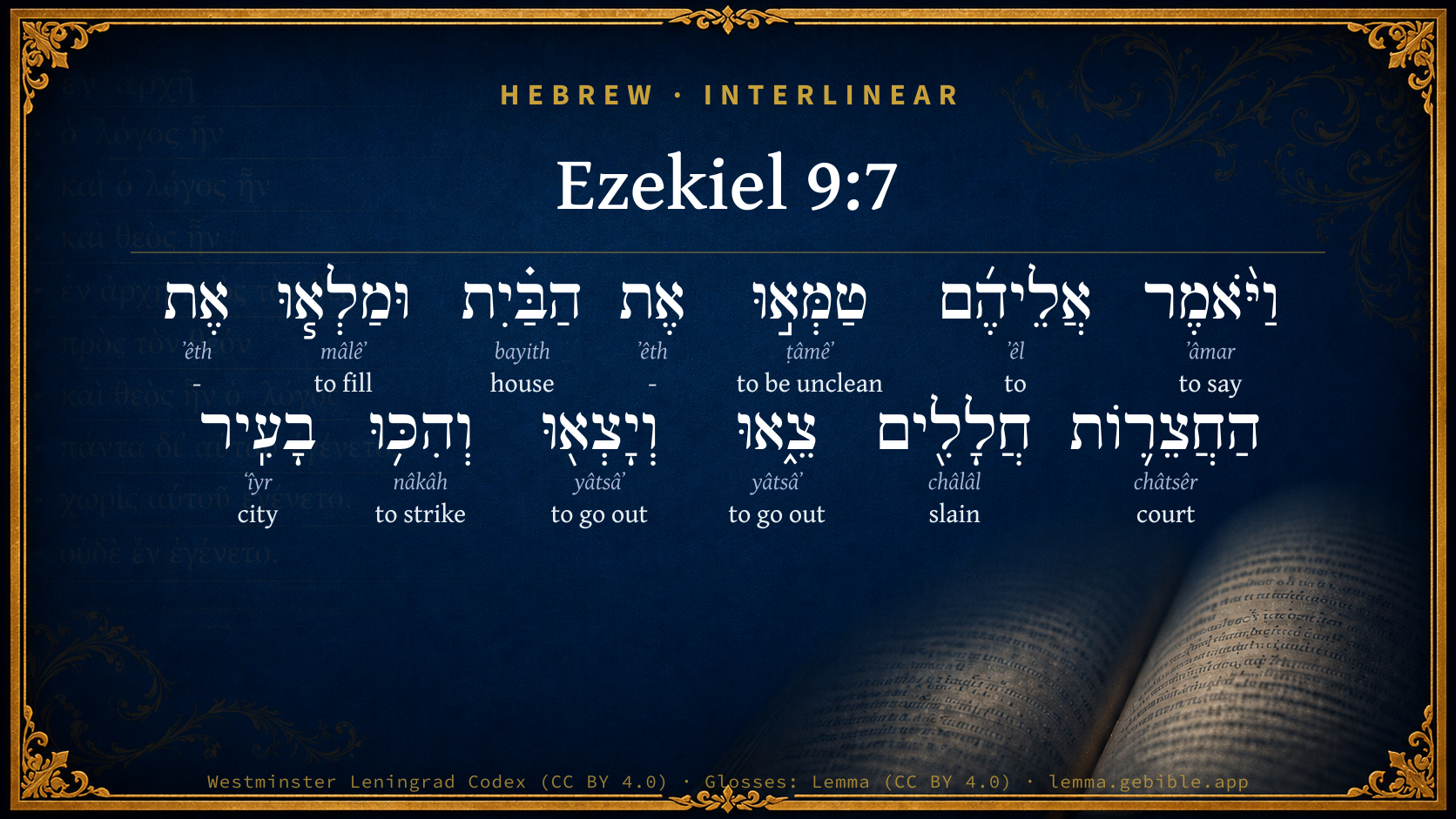
Hebrew (Westminster Leningrad Codex) Ezekiel 9:7 appears in the Hebrew Old Testament. The text above is from the Westminster Leningrad Codex. Each word links to its Strong’s number, a concise gloss, and parsing drawn from the Open Scriptures Hebrew Bible morphology. Click any word for its full Brown-Driver-Briggs (BDB) entry.
Download image
Cite this verse

Ezekiel 9:7 (World English Bible). Public Domain. Lemma interlinear Bible study tool, https://lemma.gebible.app/v/ezekiel/9/7.

Show BibTeX & RIS
BibTeX
RIS
English Translation
He said to them, Defile the house, and fill the courts with the slain: go you forth. They went forth, and struck in the city.
World English Bible · Public Domain
Download a study sheet

One document with this verse’s original text, its word-by-word gloss line, the meaning frame, cross-references with their text, attributed commentary, and full source and license credits — printable, and it pastes into notes with its structure intact.

This verse Autodidact and up

Study sheet (.html) Plain text (.txt)

A passage Seminary Student

Up to 50 verses in one chapter. A passage sheet keeps up to 6 commentary sources and 12 cross-references per verse, in the order this page ranks them, and says so on the sheet whenever that leaves anything out. Ask for a single verse and you get the Autodidact verse sheet above.

Everything on this page stays free to read, with no account — the sheet is a download of what is already on screen, not access to it.

Want to remove ads? Support Godless Engineer
Compare translations 3

The same verse in 3 English versions, stacked beneath the original-language interlinear above. Click any original word for its lexicon entry.

Each is an independent rendering of the whole verse — the interlinear is not word-aligned to these translations.

Highlighted words mark where these versions differ — a whole-verse word diff, not a word-by-word alignment.

  • World English Bible Public Domain
    He said to them, Defile the house, and fill the courts with the slain: go you forth. They went forth, and struck in the city.
  • King James Version Public Domain
    And he said unto them, Defile the house, and fill the courts with the slain: go ye forth. And they went forth, and slew in the city.
  • unfoldingWord Literal Text CC BY-SA 4.0
    He said to them, “Defile the house, and fill its courtyards with the dead. Proceed!” So they went out and attacked the city.

unfoldingWord Literal Text — © unfoldingWord, licensed CC BY-SA 4.0. Word-aligned USFM3 via Door43 (git.door43.org/unfoldingWord/en_ult).

Versions to compare (up to 4)

3 of 4 selected

Show all 18 translations

Every available English version of this verse, each an independent rendering of the whole verse.

  • World English Bible Public Domain
    He said to them, Defile the house, and fill the courts with the slain: go you forth. They went forth, and struck in the city.
  • Berean Standard Bible Public Domain
    Then He told them, “Defile the temple and fill the courts with the slain. Go forth!” So they went out and began killing throughout the city.
  • Majority Standard Bible Public Domain
    Then He told them, “Defile the temple and fill the courts with the slain. Go forth!” So they went out and began killing throughout the city.
  • King James Version Public Domain
    And he said unto them, Defile the house, and fill the courts with the slain: go ye forth. And they went forth, and slew in the city.
  • American Standard Version (1901) Public Domain
    And he said unto them, Defile the house, and fill the courts with the slain: go ye forth. And they went forth, and smote in the city.
  • Revised Version (1885) Public Domain
    And he said unto them, Defile the house, and fill the courts with the slain: go ye forth. And they went forth, and smote in the city.
  • Geneva Bible (1599) Public Domain
    And he sayde vnto them, Defile the house, and fill the courtes with the slaine, then goe foorth: and they went out, and slewe them in the citie.
  • Douay-Rheims (1899) Public Domain
    And he said to them: Defile the house, and ill the courts with the slain: go ye forth. And they went forth, and slew them that were in the city.
  • Young's Literal Translation Public Domain
    And they begin among the aged men who `are' before the house, and He saith unto them, `Defile the house, and fill the courts with the wounded, go forth.' And they have gone forth and have smitten in the city.
  • Literal Standard Version CC BY-SA 4.0
    And they begin among the aged men who [are] before the house, and He says to them, “Defile the house, and fill the courts with the wounded, go forth.” And they have gone forth and have struck in the city.
  • Unlocked Literal Bible CC BY-SA 4.0
    He said to them, “Defile the house, and fill its courtyards with the dead. Proceed!” So they went out and attacked the city.
  • unfoldingWord Literal Text CC BY-SA 4.0
    He said to them, “Defile the house, and fill its courtyards with the dead. Proceed!” So they went out and attacked the city.
  • Darby Bible Public Domain
    And he said unto them, Defile the house, and fill the courts with the slain: go forth. And they went forth, and smote in the city.
  • World Messianic Bible Public Domain
    He said to them, “Defile the house, and fill the courts with the slain. Go out!” They went out, and struck in the city.
  • Webster's Bible Public Domain
    And he said to them, Defile the house, and fill the courts with the slain: go ye forth. And they went forth, and slew in the city.
  • Free Bible Version CC BY-SA 4.0
    Then he told them, “Make the Temple unclean and fill the courtyards with dead bodies. Go ahead and do it!” So they went and started killing all through the city.
  • Bible in Basic English Public Domain
    And he said to them, Make the house unclean, make the open places full of dead: go forward and send destruction on the town.
  • JPS Tanakh (1917) Public Domain
    And He said unto them: 'Defile the house, and fill the courts with the slain; go ye forth.' And they went forth, and smote in the city.

Literal Standard Version (2020), Covenant Press — licensed CC BY-SA 4.0. Text via the HelloAO Bible API (eBible.org). Unlocked Literal Bible (unfoldingWord) — licensed CC BY-SA 4.0. Text via the HelloAO Bible API (eBible.org). unfoldingWord Literal Text — © unfoldingWord, licensed CC BY-SA 4.0. Word-aligned USFM3 via Door43 (git.door43.org/unfoldingWord/en_ult). Free Bible Version, Dr. Jonathan Gallagher — licensed CC BY-SA 4.0. Text via the HelloAO Bible API (eBible.org).

Word by word

More ways to search: Search by grammar → Find every occurrence → Compare this word →

Practice this passage: Drill this verse → Learn its vocabulary →

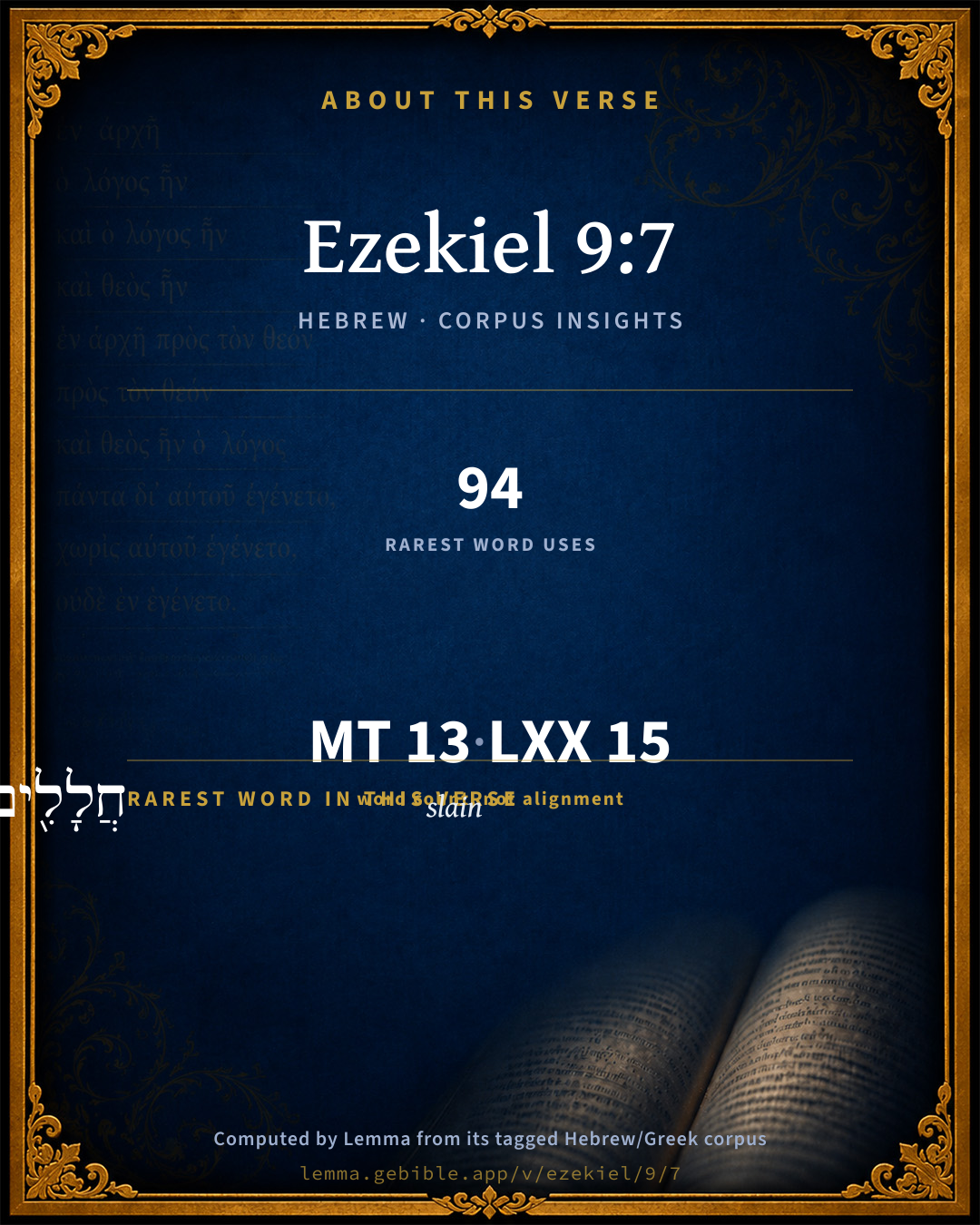
חֲלָלִ֖ים
châlâl
H2491
“slain”
Adjective, Adjective, Masculine, Plural, Absolute
Part of Speech
Adjective
Type
Adjective
Gender
Masculine
Number
Plural
State
Absolute
Full BDB Definition

Origin: from H2490

TWOT: 660a

slain, fatally wounded, pierced (noun masculine) - pierced, fatally wounded - slain - (CLBL) profaned (adjective) - defiled, profaned (by divorce)
  1. וַיֹּ֨אמֶר ʼâmar H559 “and · to say” Conjunction + Verb, Qal, Sequential Imperfect, 3rd Person, Masculine, Singular
  2. אֲלֵיהֶ֜ם ʼêl H413 “to · them” Preposition + Suffix, Personal, 3rd Person, Masculine, Plural
  3. טַמְּא֣וּ ṭâmêʼ H2930 “be unclean” Verb, Piel, Imperative, 2nd Person, Masculine, Plural
  4. אֶת ʼêth H853 “-” Particle, Direct Object
  5. הַבַּ֗יִת bayith H1004 “the · house” Particle, Definite Article + Noun, Common, Masculine, Singular, Absolute
  6. וּמַלְא֧וּ mâlêʼ H4390 “and · fill” Conjunction + Verb, Piel, Imperative, 2nd Person, Masculine, Plural
  7. אֶת ʼêth H853 “-” Particle, Direct Object
  8. הַחֲצֵר֛וֹת châtsêr H2691 “the · courts” Particle, Definite Article + Noun, Common, Both, Plural, Absolute
  9. צֵ֑אוּ yâtsâʼ H3318 “go out” Verb, Qal, Imperative, 2nd Person, Masculine, Plural
  10. וְיָצְא֖וּ yâtsâʼ H3318 “and · to go out” Conjunction + Verb, Qal, Perfect, 3rd Person, Common, Plural
  11. וְהִכּ֥וּ nâkâh H5221 “and · to strike” Conjunction + Verb, Hiphil, Perfect, 3rd Person, Common, Plural
  12. בָעִֽיר ʻîyr H5892 “in/at the · city” Preposition, Determined + Noun, Common, Feminine, Singular, Absolute

About this verse

These counts appear in no published source. They are computed here, from the morphology-tagged text and Lemma’s own curated glosses. What Lemma adds →

13
words
11
distinct lemmas
Prophets
section

Grammatical profile

  • 6 verbs
  • 3 nouns
  • 1 adjective
  • 1 preposition
  • 2 particles

Verb forms

  • וַיֹּ֨אמֶר Qal · Sequential Imperfect
  • טַמְּא֣וּ Piel · Imperative
  • וּמַלְא֧וּ Piel · Imperative
  • צֵ֑אוּ Qal · Imperative
  • וְיָצְא֖וּ Qal · Perfect
  • וְהִכּ֥וּ Hiphil · Perfect

Repetition

A word recurs within this verse — often emphatic in Hebrew:

  • צֵ֑אוּ to go out H3318 ×2

Hebrew & Septuagint length

In English translation the verse runs 25 words from the Hebrew and 20 from the Septuagint (LXX English) — closely comparable.

A rough comparison of the two English renderings, which tokenize alike — not a word-level alignment.

Word counts can differ between the Hebrew and the Greek without any difference in meaning — e.g. the Hebrew direct-object marker אֵת has no separate Greek word, and Greek often adds the article ὁ.

In the original languages it is 13 Hebrew tokens and 15 Greek tokens — but the two are counted differently (Hebrew bundles its prefixes and suffixes into one token; the Greek is in lemma form), so that isn’t a like-for-like length.

Cross-references

5

Topical passages linked to Ezekiel 9:7 in the Treasury of Scripture Knowledge — connected by theme and wording, ordered by reader-vote popularity; previews shown in the World English Bible.

  • 2 Chronicles 36:17 Therefore he brought on them the king of the Chaldeans, who killed their young men with the sword in the house of their sanctuary, and had no compassion on young man or virgin, old man or gray-headed: he gave them all into his hand.
  • Ezekiel 7:20–22 As for the beauty of his ornament, he set it in majesty; but they made the images of their abominations [and] their detestable things therein: therefore have I made it to them as an unclean thing.
  • Psalms 79:1–3 God, the nations have come into your inheritance. They have defiled your holy temple. They have laid Jerusalem in heaps.
  • Lamentations 2:4–7 He has bent his bow like an enemy, he has stood with his right hand as an adversary, Has killed all that were pleasant to the eye: In the tent of the daughter of Zion he has poured out his wrath like fire.
  • Luke 13:1 Now there were some present at the same time who told him about the Galileans, whose blood Pilate had mixed with their sacrifices.

Cross-references courtesy of OpenBible.info (CC BY 4.0).

Hebrew and Greek witnesses Masoretic Hebrew ↔ Greek Septuagint

The same verse in the two great witnesses to the Old Testament, shown verse-for-verse.

These are two independent witnesses, not word-aligned to each other, and the Septuagint is shown in lemma (dictionary) form.

Hebrew Ezekiel 9:7 Masoretic · Westminster Leningrad Codex

וַיֹּ֨אמֶר אֲלֵיהֶ֜ם טַמְּא֣וּ אֶת הַבַּ֗יִת וּמַלְא֧וּ אֶת הַחֲצֵר֛וֹת חֲלָלִ֖ים צֵ֑אוּ וְיָצְא֖וּ וְהִכּ֥וּ בָעִֽיר

He said to them, Defile the house, and fill the courts with the slain: go you forth. They went forth, and struck in the city.

World English Bible · Public Domain

Greek LXX Ezekiel 9:7 Septuagint · lemma form

καί εἶπον πρός αὐτός μιαίνω ὁ οἶκος καί πίμπλημι ὁ ὁδός νεκρός ἐκπορεύομαι καί κόπτω

And he said to them, Defile the house, and go out and fill the ways with dead bodies, and strike.

LXX2012 (modern English Septuagint) · Public Domain

On this verse, Haydock's Catholic Bible Commentary discusses the Septuagint’s reading. Read the note in Commentary ↓

Hebrew: Westminster Leningrad Codex (CC BY 4.0). Greek: Septuagint (public domain); English from LXX2012 (modern English Septuagint) (Public Domain). How the Septuagint differs from the Hebrew →

Targum (Aramaic paraphrase)

1

The Targum is the ancient Jewish Aramaic paraphrase of the Hebrew Scriptures — an interpretive translation, not the Hebrew text itself. Onkelos (literal) and Pseudo-Jonathan (expansive) render the Torah, and Jonathan the Prophets. Coverage is partial: where no permissively-licensed English translation exists for a verse, only the Aramaic is shown. This is verse-level text, not a word-by-word alignment to the Hebrew.

  1. Targum Jonathan Prophets (Joshua–Malachi)
    וַאֲמַר לְהוֹן סָאִיבוּ יַת בֵּיתָא וּמְלוֹ יַת דָרָתָא קְטִילִין פּוּקוּ וּנְפַקוּ וּקְטַלוּ בְקַרְתָּא:

    (no public-domain English translation for this verse)

    Targum Jonathan — Aramaic: “Mikraot Gedolot” (public domain). English: “Sefaria Community Translation” (CC0 1.0 (public-domain dedication)); “London "Chaldee Paraphrase," 1871” (public domain). Text via Sefaria.

Commentary

Notes on Ezekiel 9:7 from classic Christian and Jewish commentators (each source and its license shown beneath its notes). The classic Christian expositions comment on the surrounding passage and are grouped to its opening verse, so a note may address several verses; the Jewish commentaries on the Tanakh (Rashi and others) are per-verse, so they appear only where the commentator wrote on this verse.

Lemma curates 59 commentaries, every one of them public domain or Creative Commons licensed, each selected and text-cleaned for this edition rather than reprinted as found. About our sources →

Trapp's Complete Commentary

John Trapp

Eze 9:7 And he said unto them, Defile the house, and fill the courts with the slain: go ye forth. And they went forth, and slew in the city.

Ver. 7. Defile the house.] Once hallowed by myself, but now abhorred and rejected as a stew or sty of filthiness.

Fill the courts.] That where they have sinned, there they may suffer, as did Ahab. {1Ki 22:38 2Ki 9:26}

John Trapp, A Commentary or Exposition upon All the Books of the Old and New Testament (1647–1656) — public domain. Text from a community e-Sword module.

Tyndale Open Study Notes

Tyndale Open Resources

9:7 Defile the Temple! Unlike Queen Athaliah, who was dragged out of the Temple before she was executed so that her blood would not defile the holy site (2 Kgs 11:15-16), these idolaters were to be killed in the Temple, which was already so defiled by their idolatry that nothing sacred was left there. Without God’s holy presence, concern for the sanctity of the building was an empty gesture.

Tyndale Open Study Notes — © Tyndale Open Resources, licensed CC BY-SA 4.0. Text via the HelloAO Bible API.

Adam Clarke's Commentary

Verse 7. Defile the house] A dreadful sentence, Let it be polluted, I will no more dwell in it; I now utterly forsake it.

Adam Clarke's Commentary on the Bible (1810–1826) — public domain. Text from a community e-Sword/MySword module.

John Calvin's Commentaries

Here God. repeats what he had formerly touched upon shortly and obscurely, namely, that the Jews trusted in vain in the visible temple, because already he had ceased to dwell there, as we shall afterwards see that he had departed. He had promised that his perpetual dwelling should be there, (Psalm 132:14,) but that promise is not opposed by the casual desertion of that dwelling-place. Now therefore he adds this sentence, when he orders the Chaldeans to pollute the temple itself But it was already polluted, some one will say: I confess it: but it regards the Common perception of the people; for although the Jews had infected the sanctuary of God with their wickedness, yet they boasted that his worship still remained there and his sacred name. Now therefore he speaks of another kind of pollution, namely, that the Chaldeans should fill all the area with the slain If a human corpse or even a dog was seen in the sanctuary, this was an intolerable pollution; all would cry out that it was portentous. But as often as they entered the temple, although they dragged their crimes into God’s presence, (for they went there polluted with blood, rapine, fraud, perjuries, and a whole heap of guilt,) yet they reckoned all these pollutions as nothing. God therefore here obliquely derides their sloth, when he says that they boasted of the sanctity of the temple in vain, because they should see it at length filled with corpses, and then should really acknowledge that the temple was no longer sacred. Now therefore we understand the intention of the Holy Spirit. He adds, that they had gone forth, and occasioned a slaughter in the city Here again the Prophet shows that the Chaldeans would be at hand to smite the Jews with terror, as soon as God commanded them to destroy the city and cut off the inhabitants. Perhaps the city had not yet been besieged, and that is probable, for the Jews thought Ezekiel’s threatenings fabulous. For this reason he says that the Chaldeans appeared to him, that they might hear or receive the commandment of God: then that they had returned from the slaughter, to prove their obedience to God. In fine, he shows that God’s threatenings should not be in vain, because as soon as the right time should arrive, the army of the Chaldeans would be prepared for obedience. It follows —

John Calvin's Commentaries (1540-1563) — public domain. Text from the Calvin Translation Society English edition (1840s-50s) via the Christian Classics Ethereal Library (ccel.org). Calvin's coverage is partial (roughly two-thirds of the Bible); uncommented books and verses are honest gaps, never fabricated. The 19th-century editor's footnotes and remarks are omitted so the notes are faithfully Calvin's own voice.

Ellicott's Commentary for English Readers

(7) Defile the house.—The utmost possible pollution under the Mosaic economy was the touch of a dead body. (See Num_19:11; 1Ki_13:2; 2Ki_23:16.) It might be thought that the Temple would be spared this defilement; but not only must the execution of justice override all technicalities, as at the execution of Joab (1Ki_2:28-31), but in this case the very defilement itself was a part of the judgment, since God was about to forsake His sanctuary, and give over even this to the desolations of the heathen. From the Temple the destroying angels passed out into the city.

A Bible Commentary for English Readers, edited by Charles John Ellicott (1878–1897) — public domain. Text from a community e-Sword module.

The Cambridge Bible for Schools and Colleges

gen. ed. J. J. S. Perowne

7. Defile the house] The “house” embraces the temple house and its precincts, including the courts. The presence of dead in the courts defiled the whole.

The Cambridge Bible for Schools and Colleges (gen. ed. J. J. S. Perowne; Cambridge University Press, 1878–1918) — public domain. Text from a community e-Sword module.

John Gill's Exposition

And he said unto them, defile the house,.... The temple; do not be afraid of slaying any person in it, for fear of defiling it; they have defiled it with their abominations, and now do you defile it with their blood:

and fill the courts with the slain; the court of the priests, and the court of the Israelites, and the court of the women, and all the chambers where the priests and Levites were, and had their images portrayed:

go ye forth; from the brasen altar by which they stood, and out of the temple, after they had done their business there, and had slain all they should:

and they went forth, and slew in the city; they went out of the temple, and slew in the city all but those that had the mark.

John Gill's Exposition of the Whole Bible (1746–1763) — public domain (CC PDM 1.0). Text via the HelloAO Bible API.

Albert Barnes' Notes on the Bible

Defile the house - By filling the temple and its courts with the bodies of the slain. See Num 19:11.

Albert Barnes' Notes on the Bible (1834–1885) — public domain. Text from a community e-Sword/MySword module.

Haydock's Catholic Bible Commentary

Defile. Septuagint, "you have defiled." I regard the place no longer. (Calmet)

George Leo Haydock (1774–1849), Haydock's Catholic Family Bible and Commentary, 1859 edition — public domain. Excludes Psalms (Douay-Rheims chapter numbering differs from Protestant) and Deuterocanonical books (Catholic canon only).

Matthew Poole's English Annotations

Defile the house; regard not the holiness of the temple: idolaters, whom you are to slay, have defiled it with the blood of idols, sacrifices, do you defile it with the blood of the idolatrous sacrificers; slay them where you find them, for there they sinned against me.

Fill the courts with the slain; make a great slaughter, let every place be stained with their blood. There were the priests’, the Levites’, and the women’s courts, and there will be found persons of a different character; but unless my mark be upon them, forbear none of them.

Go ye forth; make haste, do not ye, for I do not, delay, nor will I.

They went forth: here, as before, they show their ready obedience.

Slew in the city: this slaughter was visional in the eye of the prophet, and a preface to the saddest butcheries Israel ever bled and groaned under.

Matthew Poole's English Annotations on the Holy Bible (1683–1685) — public domain. Text from a community e-Sword/MySword module.

Whedon's Commentary on the Bible

Daniel D. Whedon

7. Defile the house — Beginning in the priests’ court, where they stood to receive this command (see note Eze_9:3), they began to slay all who had not the mark of the cross on their foreheads. and continued from court to court until they had passed out of the temple and then continued their work in the streets of the city. The temple, which had ceased to be Jehovah’s, was now defiled by heaps of corpses (Eze_6:5; Eze_6:13; Eze_43:7; Num_19:11, etc.). This massacre in the temple, which is here seen only in vision, actually took place in the capture of the city by the Chaldeans.

Go — It matters not whether these six executioners represented the Assyrians or the doubled power of famine, pestilence, and war (Eze_5:12). In either case the presence of a seventh is to be noted. The forces of the heathen and the powers of nature may burn and destroy, but behind these there is supreme Intelligence and Will. Schopenhauer was not altogether wrong when he called gravitation an act of will. Behind all destructive as well as creative and protective providences God standeth in the shadow.

Daniel D. Whedon (gen. ed.), Commentary on the Old and New Testaments (1874–1909) — public domain. Text from a community e-Sword module.

The Pulpit Commentary

Defile the house, etc. What Ezekiel saw in vision was, we may well believe, fulfilled literally when the city was taken by the Chaldeans. The pollution of the temple by the bleeding corpses of the idolatrous worshippers was a fitting retribution for the worship with which they had polluted it. (comp. Eze_6:13)

The temple defiled.

The Jews had a horror of death, and regarded a corpse with disgust as an unclean thing, the presence of which would defile the most holy place, and the touch of which would render unclean any person who came in contact with it. Therefore a massacre in the temple would defile that sanctuary in the eyes of the nation by filling it with scenes of death, and strewing its courts with abhorred dead bodies. The irony of such a conception lies in the fact that the aggravated abominations of idolatry and vice which brought down this fate on the doomed temple had not been regarded as any defilement. So it was when the Jews feared to enter Pilate"s palace lest the consequent defilement should prevent them from eating the Passover, although the stain of murder on their consciences was not reckoned to be any impediment. (Joh_18:28) Thus men strain out the gnat and swallow the camel.

I SIN LEADS TO AN UNDUE PREFERENCE OF THE EXTERNAL TO THE INTERNAL.

1. This is caused by the deadening influence of sin. The once keen conscience is blunted, and the perception of real evil dulled, so that what should be regarded with loathing is tolerated with indifference. At the same time, the conventional standards by which questions of outward propriety are measured remain undiminished. The loss of the higher standards then gives these lower ones a fictitious supremacy. The fog which hides the eternal mountains of Divine righteousness magnifies the petty hillocks of human opinion.

2. This is illustrated in all phases of experience. Not only is more thought of external than of internal defilement in religion; external things generally take the lead. The punishment of a sin is more considered than the evil of the sin itself. Shame is treated as worse than guilt. The word "character" comes to be transferred from interior disposition to public reputation. A social stigma is dreaded, while undiscovered sin is harboured complacently.

II REAL DEFILEMENT IS MORAL AND INTERNAL. It is those things which proceed out of a man that defile him, (Mat_15:18) because they spring from the centre of all true evil, the heart of man.

1. The sanctuary of worship is only defiled by the corrupt conduct of the worshippers. Pompey could not really defile the sacred courts by trampling rudely over the holy ground. The true abomination of desolation was the sin of the Jews. A church is desecrated by worldliness and evil thoughts in the worshippers.

2. The temple of the body is only defiled by unholy conduct. It is a mere symbol of this defilement when contact with a corpse is thought to render the person unclean. Contact with sinful occupations is the real defilement. When this temple of the Holy Ghost is turned into a depository of evil, its glory departs. It is not the dead flesh of a corpse, but living carnality that defiles. When this rottenness is cut out no external defilement can hurt, for then "to the pure all things are pure.

III THE PUNISHMENT OF INTERNAL DEFILEMENT IS OUTWARD SHAME. The Jews are to have the temple defiled in this external manner as a punishment for the previous moral degradation of it. In the end sin blossoms into shame. The commission of sin may be hidden, but the punishment of it will be public. In God"s great day the secrets of all hearts will be revealed. Then hypocrisy will cease, and the external will be a true index to the internal The defiled soul will be seen in a foul body; the corruption of heart will be punished by the degradation of all things that a man prizes. The only way of escape is by a previous confusion of the soul corruption, and the cleansing of the heart from its defilement through the grace of Christ. (Psa_51:7)

The Pulpit Commentary (1880–1919), ed. H.D.M. Spence-Jones & Joseph S. Exell — public domain. Text from a community e-Sword module.

John Wesley's Explanatory Notes

And slew - The slaughter also was in vision.

John Wesley, Explanatory Notes Upon the Whole Bible (1754–1765) — public domain. Text via the GEBible commentary corpus.

unfoldingWord translationNotes

Door43 World Missions Community

General Information:

God continuing to speak to the guards judging the people of Israel.

the house

the temple

attacked the city

The word "city" is a metonym for the people in the city. AT: "attacked the people in the city" (See: Metonymy)

I fell on my face

"I bowed down to the ground" or "I lay on the ground." Ezekiel did not fall by accident. He went down to the ground to show that he respected and feared Yahweh. See how you translated this in Ezekiel 1:28. (See: Idiom)

Ah, Lord Yahweh

Ezekiel says this because he is very troubled by what the Lord told the men to do to Jerusalem. See how you translated this in Ezekiel 4:14.

will you destroy all the remnant of Israel in the outpouring of your wrath on Jerusalem?

Ezekiel is pleading with Yahweh not to destroy the remnant. AT: "please do not destroy all the remnant of Israel in the outpouring of your wrath on Jerusalem!" (See: Idiom and Rhetorical Question)

in the outpouring of your wrath on Jerusalem

Wrath is spoken of as if it were a liquid that Yahweh could pour out of a container. The word "Jerusalem" is a metonym for the people in the city. The abstract noun "outpouring" can be translated as a verb. AT: "when you pour out your wrath on Jerusalem" or "when you punish the people of Jerusalem because you are very angry with them" (See: Abstract Nouns)

translationWords

defile

house

court

die

Lord Yahweh

remnant

wrath

unfoldingWord translationNotes — © Distant Shores Media and the Door43 World Missions Community, licensed CC BY-SA 4.0. Source: git.door43.org/Door43/en_tn.

Lesson kit

Teaching starters — assembled from the data on this page, not authored interpretation. Every prompt links to the verse data it draws on. Edit before teaching.

Ezekiel, in the Prophets, opens this verse with 13 words (11 distinct Hebrew lemmas). Its most distinctive word is châlâl (“slain”). A historical commentator’s framing appears above. Read the whole chapter for the surrounding context.

Discussion questions

  1. How does “slain” (châlâl) shape what this verse is saying?
  2. How does 2 Chronicles 36:17, which shares this passage’s theme, read alongside this verse?
  3. What does the repetition of “to go out” (2× in this one verse) do in this verse?
  4. These translations render this verse differently; the difference is in the English rendering, not the original. What questions does that raise?
  5. «וַיֹּ֨אמֶר» is a Qal Sequential Imperfect verb. How does that grammatical form shape the action described?
  6. Compare how Trapp's Complete Commentary and Tyndale Open Study Notes read this verse. Where do they agree or differ?

Things to notice

Reading settings

Reading text

Shown beneath each verse's original-language words.

Old Testament
Old Testament edition

Read the OT as the Masoretic Hebrew (MT) or the Greek Septuagint (LXX).

English shown for the Greek Septuagint (in the Hebrew ↔ Greek comparison).

Comparing translations? Open the Compare panel on any verse page to stack up to four side by side.