

1 Peter 1:21
Greek (Tischendorf 8th ed.) 1 Peter 1:21 appears in the Greek New Testament. The text above is from the Tischendorf 8th edition. Each word links to its Strong’s number and a concise gloss. Click any word for its full Thayer’s Greek Lexicon entry.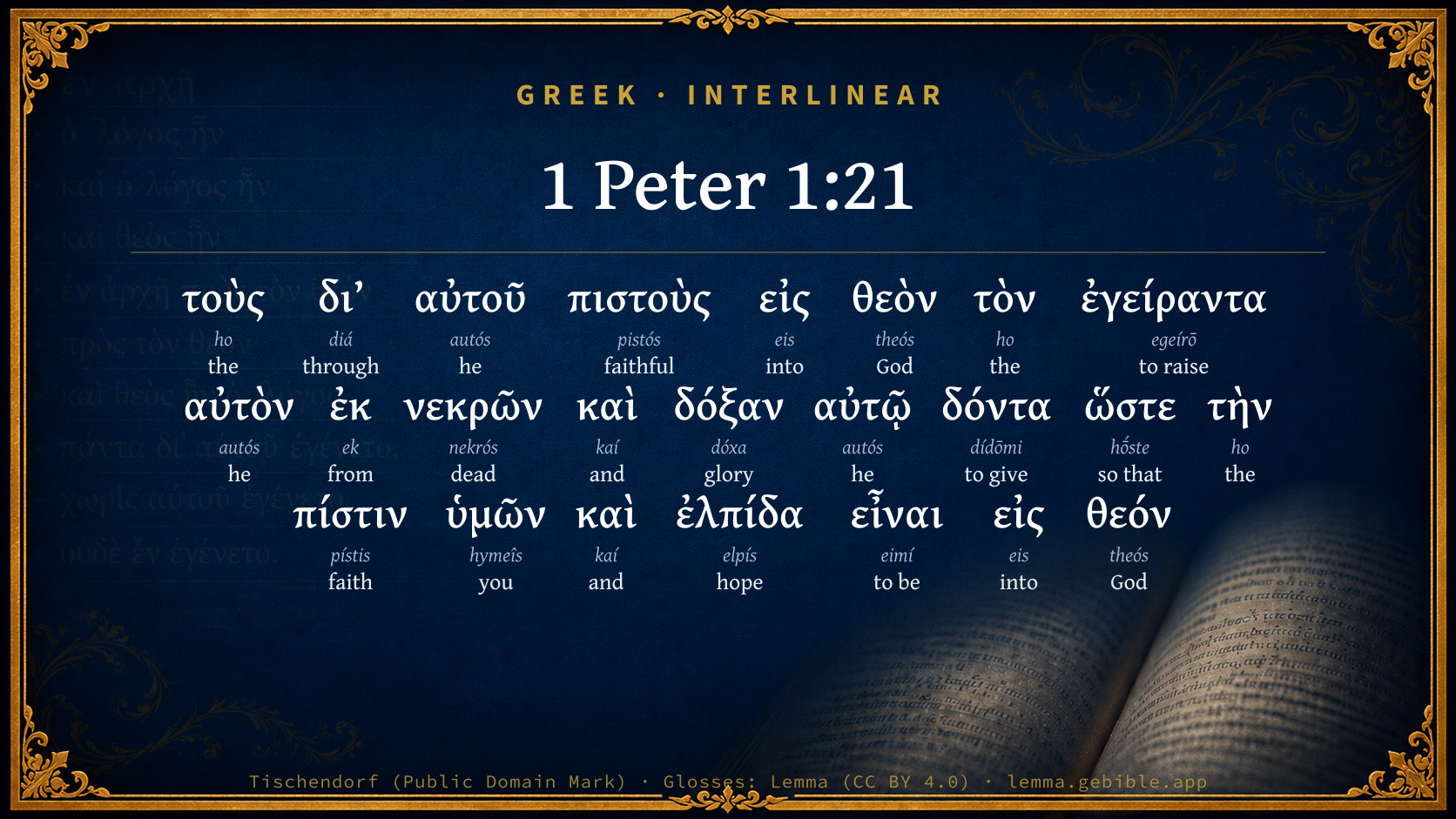
who through him are believers in God, who raised him from the dead, and gave him glory; so that your faith and hope might be in God.
Download a study sheet
One document with this verse’s original text, its word-by-word gloss line, the meaning frame, cross-references with their text, attributed commentary, and full source and license credits — printable, and it pastes into notes with its structure intact.
This verse Autodidact and up
A passage Seminary Student
Up to 50 verses in one chapter. A passage sheet keeps up to 6 commentary sources and 12 cross-references per verse, in the order this page ranks them, and says so on the sheet whenever that leaves anything out. Ask for a single verse and you get the Autodidact verse sheet above.
Everything on this page stays free to read, with no account — the sheet is a download of what is already on screen, not access to it.
Compare translations 3
The same verse in 3 English versions, stacked beneath the original-language interlinear above. Click any original word for its lexicon entry.
Each is an independent rendering of the whole verse — the interlinear is not word-aligned to these translations.
Highlighted words mark where these versions differ — a whole-verse word diff, not a word-by-word alignment.
-
World English Bible Public Domain
who through him are believers in God, who raised him from the dead, and gave him glory; so that your faith and hope might be in God.
-
King James Version Public Domain
Who by him do believe in God, that raised him up from the dead, and gave him glory; that your faith and hope might be in God.
-
unfoldingWord Literal Text CC BY-SA 4.0
those through him believing in God, who has raised him from dead ones and has given him glory, so that your faith and hope are in God.
unfoldingWord Literal Text — © unfoldingWord, licensed CC BY-SA 4.0. Word-aligned USFM3 via Door43 (git.door43.org/unfoldingWord/en_ult).
Show all 19 translations
Every available English version of this verse, each an independent rendering of the whole verse.
-
World English Bible Public Domain
who through him are believers in God, who raised him from the dead, and gave him glory; so that your faith and hope might be in God.
-
Berean Standard Bible Public Domain
Through Him you believe in God, who raised Him from the dead and glorified Him; and so your faith and hope are in God.
-
Majority Standard Bible Public Domain
Through Him you believe in God, who raised Him from the dead and glorified Him; and so your faith and hope are in God.
-
King James Version Public Domain
Who by him do believe in God, that raised him up from the dead, and gave him glory; that your faith and hope might be in God.
-
American Standard Version (1901) Public Domain
who through him are believers in God, that raised him from the dead, and gave him glory; so that your faith and hope might be in God.
-
Revised Version (1885) Public Domain
who through him are believers in God, which raised him from the dead, and gave him glory; so that your faith and hope might be in God.
-
Geneva Bible (1599) Public Domain
Which by his meanes doe beleeue in God that raised him from the dead, and gaue him glorie, that your faith and hope might bee in God,
-
Douay-Rheims (1899) Public Domain
Who through him are faithful in God, who raised him up from the dead, and hath given him glory, that your faith and hope might be in God.
-
Young's Literal Translation Public Domain
who through him do believe in God, who did raise out of the dead, and glory to him did give, so that your faith and hope may be in God.
-
Literal Standard Version CC BY-SA 4.0
who through Him believe in God who raised [Him] out of the dead, and gave glory to Him, so that your faith and hope may be in God.
-
Unlocked Literal Bible CC BY-SA 4.0
Through him you believe in God, who raised him from the dead and gave him glory, so that your faith and hope would be in God.
-
unfoldingWord Literal Text CC BY-SA 4.0
those through him believing in God, who has raised him from dead ones and has given him glory, so that your faith and hope are in God.
-
Darby Bible Public Domain
who by him do believe on God, who has raised him from among [the] dead and given him glory, that your faith and hope should be in God.
-
World Messianic Bible Public Domain
who through him are believers in God, who raised him from the dead and gave him glory, so that your faith and hope might be in God.
-
Webster's Bible Public Domain
Who by him do believe in God, that raised him from the dead, and gave him glory; that your faith and hope might be in God.
-
Free Bible Version CC BY-SA 4.0
Through him you trust in God who raised him from the dead, and glorified him, so that you could have confidence and hope in God.
-
Bible in Basic English Public Domain
Who through him have faith in God who took him up again from the dead into glory; so that your faith and hope might be in God.
-
Text-Critical English NT CC BY 4.0
Through him you believe in God, who raised him from the dead and gave him glory, so that your faith and hope might be in God.
-
Tyndale New Testament (1534) Public Domain
which by his meanes have beleved on god that raysed him from deth and glorified him that youre fayth and hope myght be in god.
Literal Standard Version (2020), Covenant Press — licensed CC BY-SA 4.0. Text via the HelloAO Bible API (eBible.org). Unlocked Literal Bible (unfoldingWord) — licensed CC BY-SA 4.0. Text via the HelloAO Bible API (eBible.org). unfoldingWord Literal Text — © unfoldingWord, licensed CC BY-SA 4.0. Word-aligned USFM3 via Door43 (git.door43.org/unfoldingWord/en_ult). Free Bible Version, Dr. Jonathan Gallagher — licensed CC BY-SA 4.0. Text via the HelloAO Bible API (eBible.org).
Word by word
More ways to search: Search by grammar → Find every occurrence → Compare this word →
Practice this passage: Drill this verse → Learn its vocabulary →
- Appears 53× in the Greek New Testament
- First appears at Acts 2:26
- Part of Speech
- Noun
- Case
- Accusative
- Number
- Singular
- Gender
- Feminine
Full Thayer's Definition
- τοὺς ho G3588 “the” Article, Accusative, Plural, Masculine
- δι’ diá G1223 “through” Preposition
- αὐτοῦ autós G846 “he” Personal pronoun, Genitive, Singular, Masculine
- πιστοὺς pistós G4103 “faithful” Adjective, Accusative, Plural, Masculine
- εἰς eis G1519 “into” Preposition
- θεὸν theós G2316 “God” Noun, Accusative, Singular, Masculine
- τὸν ho G3588 “the” Article, Accusative, Singular, Masculine
- ἐγείραντα egeírō G1453 “to raise” Verb, Aorist, Active, Participle, Accusative, Singular, Masculine
- αὐτὸν autós G846 “he” Personal pronoun, Accusative, Singular, Masculine
- ἐκ ek G1537 “from” Preposition
- νεκρῶν nekrós G3498 “dead” Adjective, Genitive, Plural, Masculine
- καὶ kaí G2532 “and” Conjunction
- δόξαν dóxa G1391 “glory” Noun, Accusative, Singular, Feminine
- αὐτῷ autós G846 “he” Personal pronoun, Dative, Singular, Masculine
- δόντα dídōmi G1325 “to give” Verb, Aorist, Active, Participle, Accusative, Singular, Masculine
- ὥστε hṓste G5620 “so that” Conjunction
- τὴν ho G3588 “the” Article, Accusative, Singular, Feminine
- πίστιν pístis G4102 “faith” Noun, Accusative, Singular, Feminine
- ὑμῶν hymeîs G5210 “you” Personal pronoun, 2nd person, Genitive, Plural
- καὶ kaí G2532 “and” Conjunction
- ἐλπίδα elpís G1680 “hope” Noun, Accusative, Singular, Feminine
- εἶναι eimí G1510 “to be” Verb, Present, Active, Infinitive
- εἰς eis G1519 “into” Preposition
- θεόν theós G2316 “God” Noun, Accusative, Singular, Masculine
About this verse
These counts appear in no published source. They are computed here, from the morphology-tagged text and Lemma’s own curated glosses. What Lemma adds →
- 24
- words
- 17
- distinct lemmas
- General Epistles
- section
Shared distinctive vocabulary
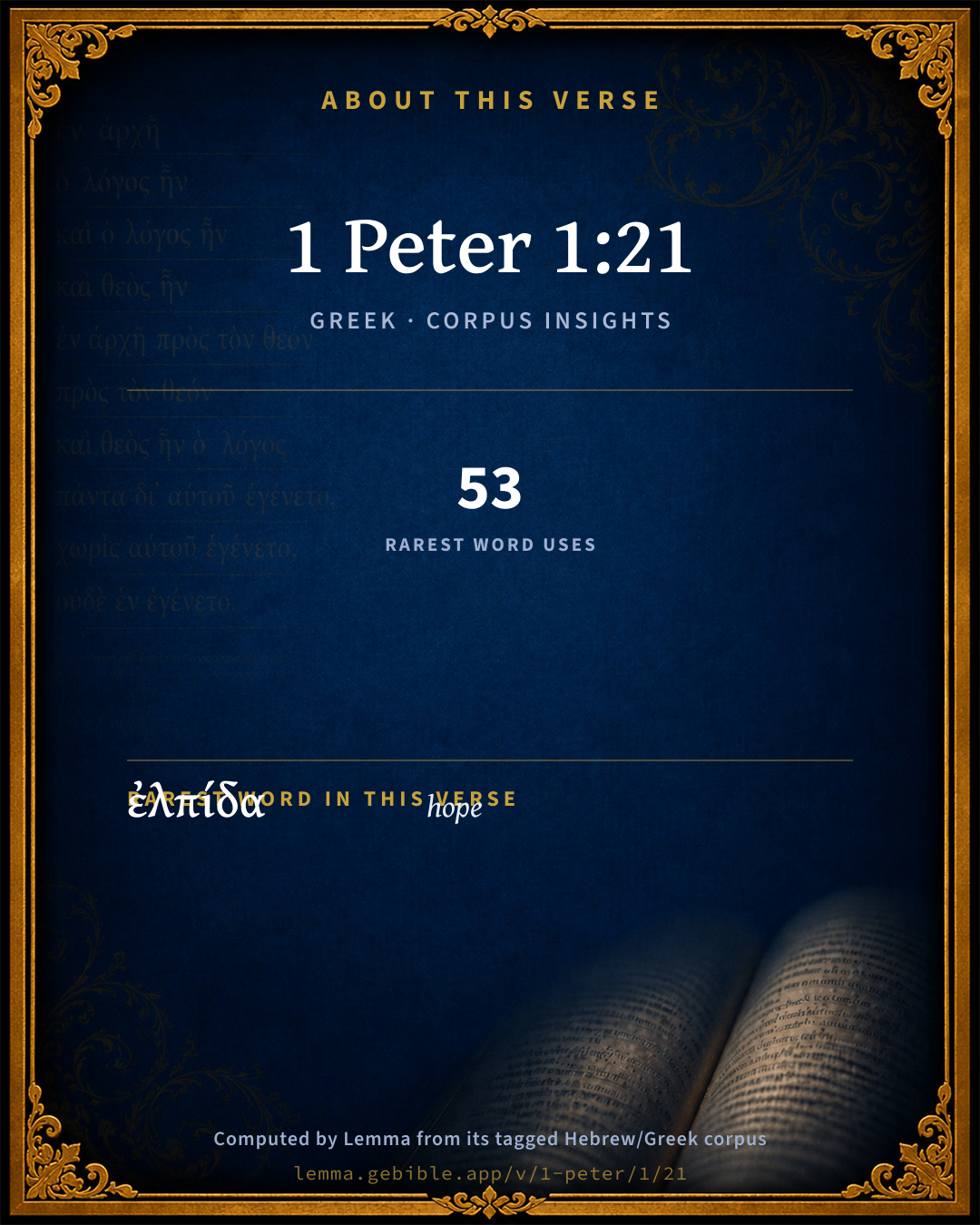
ἐλπίδα hope G1680 occurs in 48 verses of the Greek New Testament. Also found in:
Cross-references
29Topical passages linked to 1 Peter 1:21 in the Treasury of Scripture Knowledge — connected by theme and wording, ordered by reader-vote popularity; previews shown in the World English Bible.
- Acts 2:24 whom God raised up, having freed him from the agony of death, because it was not possible that he should be held by it.
- Hebrews 2:9 But we see him who has been made a little lower than the angels, Jesus, because of the suffering of death crowned with glory and honor, that by the grace of God he should taste of death for everyone.
- John 12:44 Jesus cried out and said, "Whoever believes in me, believes not in me, but in him who sent me.
- Acts 2:32–33 This Jesus God raised up, to which we all are witnesses.
- Hebrews 7:25 Therefore he is also able to save to the uttermost those who draw near to God through him, seeing he ever lives to make intercession for them.
- Ephesians 1:15 For this cause I also, having heard of the faith in the Lord Jesus which is among you, and the love which you have toward all the saints,
- 1 Peter 1:11 searching for who or what kind of time the Spirit of Christ, which was in them, pointed to, when he predicted the sufferings of Christ, and the glories that would follow them.
- 1 Peter 3:22 who is at the right hand of God, having gone into heaven, angels and authorities and powers being made subject to him.
- Psalms 42:5 Why are you in despair, my soul? Why are you disturbed within me? Hope in God! For I shall still praise him for the saving help of his presence.
- Psalms 146:3–5 Don't put your trust in princes, Each a son of man in whom there is no help.
- Jeremiah 17:7 Blessed is the man who trusts in Yahweh, and whose trust Yahweh is.
- Matthew 28:18 Jesus came to them and spoke to them, saying, "All authority has been given to me in heaven and on earth.
- John 3:34 For he whom God has sent speaks the words of God; for God gives the Spirit without measure.
- John 5:22–24 For the Father judges no one, but he has given all judgment to the Son,
- John 13:31–32 When he had gone out, Jesus said, "Now the Son of Man has been glorified, and God has been glorified in him.
- John 14:1 "Don't let your heart be troubled. Believe in God. Believe also in me.
- John 14:6 Jesus said to him, "I am the way, the truth, and the life. No one comes to the Father, except through me.
- John 17:1 Jesus said these things, and lifting up his eyes to heaven, he said, "Father, the time has come. Glorify your Son, that your Son may also glorify you;
- Acts 3:13 The God of Abraham, Isaac, and Jacob, the God of our fathers, has glorified his Servant Jesus, whom you delivered up, and denied in the presence of Pilate, when he had determined to release him.
- Acts 3:15 and killed the Prince of life, whom God raised from the dead, to which we are witnesses.
- Acts 4:10 be it known to you all, and to all the people of Israel, that in the name of Jesus Christ of Nazareth, whom you crucified, whom God raised from the dead, in him does this man stand here before you whole.
- Romans 4:24 but for our sake also, to whom it will be accounted, who believe in him who raised Jesus, our Lord, from the dead,
- Romans 10:9 that if you will confess with your mouth the Lord Jesus, and believe in your heart that God raised him from the dead, you will be saved.
- Ephesians 1:12–13 to the end that we should be to the praise of his glory, we who had before hoped in Christ:
- Ephesians 1:20–23 which he worked in Christ, when he raised him from the dead, and made him to sit at his right hand in the heavenly places,
- Philippians 2:9–11 Therefore God also highly exalted him, and gave to him the name which is above every name;
- Colossians 1:27 to whom God was pleased to make known what are the riches of the glory of this mystery among the Gentiles, which is Christ in you, the hope of glory;
- 1 Timothy 1:1 Paul, an apostle of Christ Jesus according to the commandment of God our Savior, and Christ Jesus our hope;
- Hebrews 6:1 Therefore leaving the doctrine of the first principles of Christ, let us press on to perfection--not laying again a foundation of repentance from dead works, of faith toward God,
Cross-references courtesy of OpenBible.info (CC BY 4.0).
Lesson kit
Teaching starters — assembled from the data on this page, not authored interpretation. Every prompt links to the verse data it draws on. Edit before teaching.
1 Peter, in the General Epistles, opens this verse with 24 words (17 distinct Greek lemmas). Its most distinctive word is elpís (“hope”). A historical commentator’s framing appears above. Read the whole chapter for the surrounding context.
Discussion questions
- The word elpís carries the sense “hope.” How does it shape the verse?
- How does Acts 2:26, which shares the word «hope», read alongside this verse?
- What does the repetition of “into” (2× in this one verse) do in this verse?
- The translations on this page render this verse differently — a whole-verse word diff, not a word-by-word alignment. What might account for the different wordings?
- Compare how Bengel's Gnomon and Meyer's Critical & Exegetical Commentary read this verse. Where do they agree or differ?
Things to notice
- These translations choose different wording for 11 words in this verse.
- “into” occurs 2× in this single verse.
- 17 distinct Greek lemmas span 24 words in this verse.
Commentary
Notes on 1 Peter 1:21 from classic Christian and Jewish commentators (each source and its license shown beneath its notes). The classic Christian expositions comment on the surrounding passage and are grouped to its opening verse, so a note may address several verses; the Jewish commentaries on the Tanakh (Rashi and others) are per-verse, so they appear only where the commentator wrote on this verse.
Lemma curates 59 commentaries, every one of them public domain or Creative Commons licensed, each selected and text-cleaned for this edition rather than reprinted as found. About our sources →
Bengel's Gnomon
Johann Albrecht Bengel
Bengel's Gnomon of the New Testament — English translation (T&T Clark, Edinburgh, 1860) — public domain. Text from a community e-Sword module.
Meyer's Critical & Exegetical Commentary
Heinrich August Wilhelm Meyer
Meyer — Critical and Exegetical Commentary on the New Testament — English translation by Peter Christie, edited by Frederick Crombie (T&T Clark, 1880) — public domain. Text from a community e-Sword module.
Expositor's Greek Testament
ed. W. Robertson Nicoll
The Expositor's Greek Testament, edited by W. Robertson Nicoll (1897–1910) — public domain. Text from a community e-Sword module.
Jamieson, Fausset & Brown
Robert Jamieson, A. R. Fausset & David Brown
Jamieson, Fausset & Brown — Commentary Critical and Explanatory on the Whole Bible (1871) — public domain (CC PDM 1.0). Text via the HelloAO Bible API.
Adam Clarke's Commentary
Adam Clarke's Commentary on the Bible (1810–1826) — public domain. Text from a community e-Sword/MySword module.
John Calvin's Commentaries
John Calvin's Commentaries (1540-1563) — public domain. Text from the Calvin Translation Society English edition (1840s-50s) via the Christian Classics Ethereal Library (ccel.org). Calvin's coverage is partial (roughly two-thirds of the Bible); uncommented books and verses are honest gaps, never fabricated. The 19th-century editor's footnotes and remarks are omitted so the notes are faithfully Calvin's own voice.
Ellicott's Commentary for English Readers
A Bible Commentary for English Readers, edited by Charles John Ellicott (1878–1897) — public domain. Text from a community e-Sword module.
The Cambridge Bible for Schools and Colleges
gen. ed. J. J. S. Perowne
The Cambridge Bible for Schools and Colleges (gen. ed. J. J. S. Perowne; Cambridge University Press, 1878–1918) — public domain. Text from a community e-Sword module.
John Gill's Exposition
John Gill's Exposition of the Whole Bible (1746–1763) — public domain (CC PDM 1.0). Text via the HelloAO Bible API.
Trapp's Complete Commentary
John Trapp
John Trapp, A Commentary or Exposition upon All the Books of the Old and New Testament (1647–1656) — public domain. Text from a community e-Sword module.
Albert Barnes' Notes on the Bible
Albert Barnes' Notes on the Bible (1834–1885) — public domain. Text from a community e-Sword/MySword module.
Matthew Poole's English Annotations
Matthew Poole's English Annotations on the Holy Bible (1683–1685) — public domain. Text from a community e-Sword/MySword module.
Whedon's Commentary on the Bible
Daniel D. Whedon
Daniel D. Whedon (gen. ed.), Commentary on the Old and New Testaments (1874–1909) — public domain. Text from a community e-Sword module.
The Pulpit Commentary
The Pulpit Commentary (1880–1919), ed. H.D.M. Spence-Jones & Joseph S. Exell — public domain. Text from a community e-Sword module.
John Wesley's Explanatory Notes
John Wesley, Explanatory Notes Upon the Whole Bible (1754–1765) — public domain. Text via the GEBible commentary corpus.
The People's New Testament
B. W. Johnson
B. W. Johnson's The People's New Testament with Notes (1889–1891) — public domain. Electronic text from the Christian Classics Ethereal Library (CCEL) ThML edition.
Cambridge Greek Testament for Schools and Colleges
Cambridge Greek Testament for Schools and Colleges (Cambridge University Press, 1896; 21 vols, various authors incl. Carr, Maclear, Plummer, Farrar, Lumby, Moule, M. R. James, Simcox) — public domain. Text from a community e-Sword module.
Alford’s Greek Testament
Henry Alford
Henry Alford, The Greek Testament (1849–1861) — public domain. Text from a community e-Sword module.
Vincent's Word Studies in the New Testament
Marvin R. Vincent
Marvin R. Vincent, Word Studies in the New Testament (1887–1900) — public domain. Text from a community e-Sword/MySword module.