Isaiah 34:3

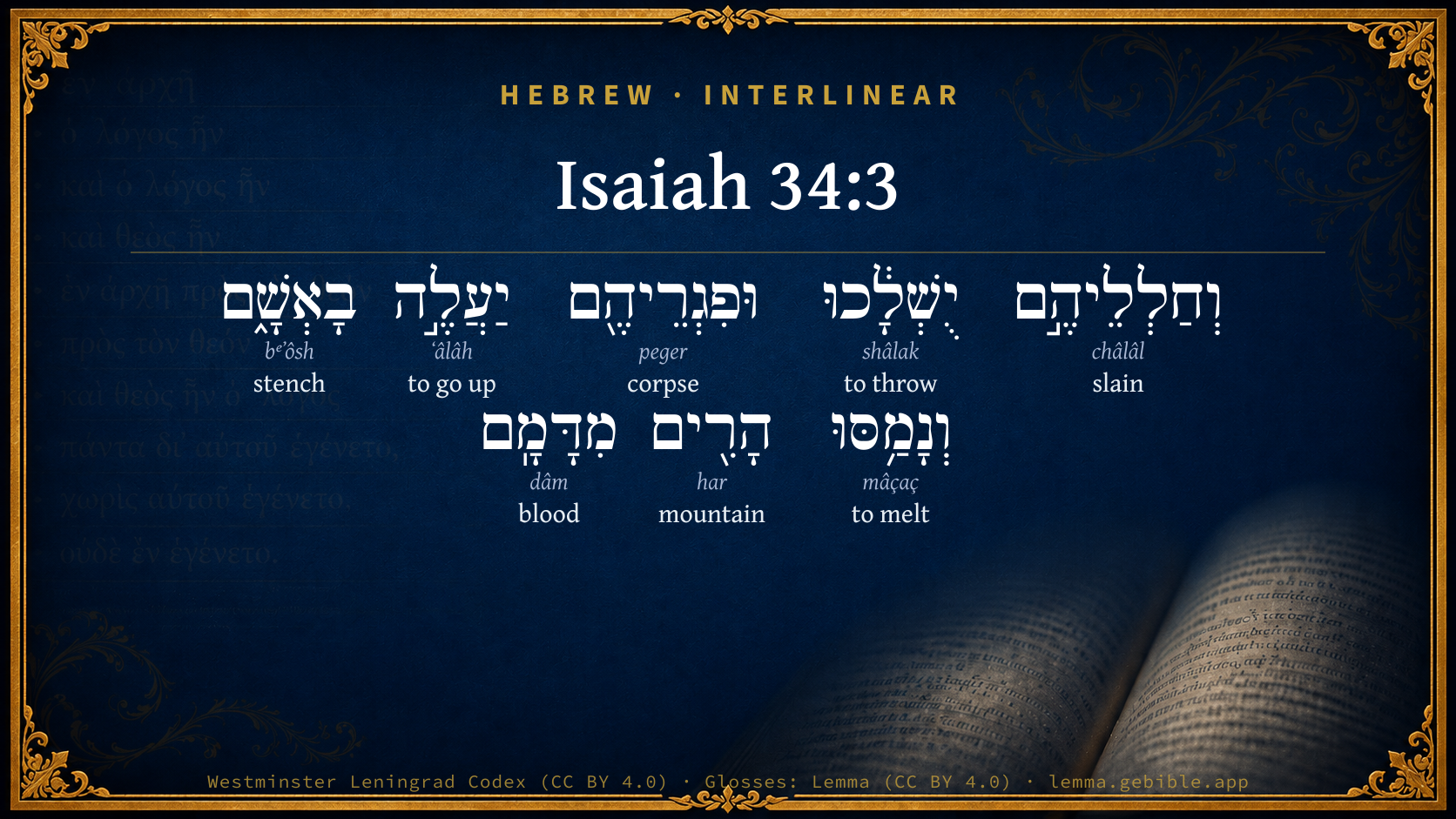
Hebrew (Westminster Leningrad Codex) Isaiah 34:3 appears in the Hebrew Old Testament. The text above is from the Westminster Leningrad Codex. Each word links to its Strong’s number, a concise gloss, and parsing drawn from the Open Scriptures Hebrew Bible morphology. Click any word for its full Brown-Driver-Briggs (BDB) entry.
Download image
Cite this verse

Isaiah 34:3 (World English Bible). Public Domain. Lemma interlinear Bible study tool, https://lemma.gebible.app/v/isaiah/34/3.

Show BibTeX & RIS
BibTeX
RIS
English Translation
Their slain also shall be cast out, and the stench of their dead bodies shall come up; and the mountains shall be melted with their blood.
World English Bible · Public Domain
Highlights
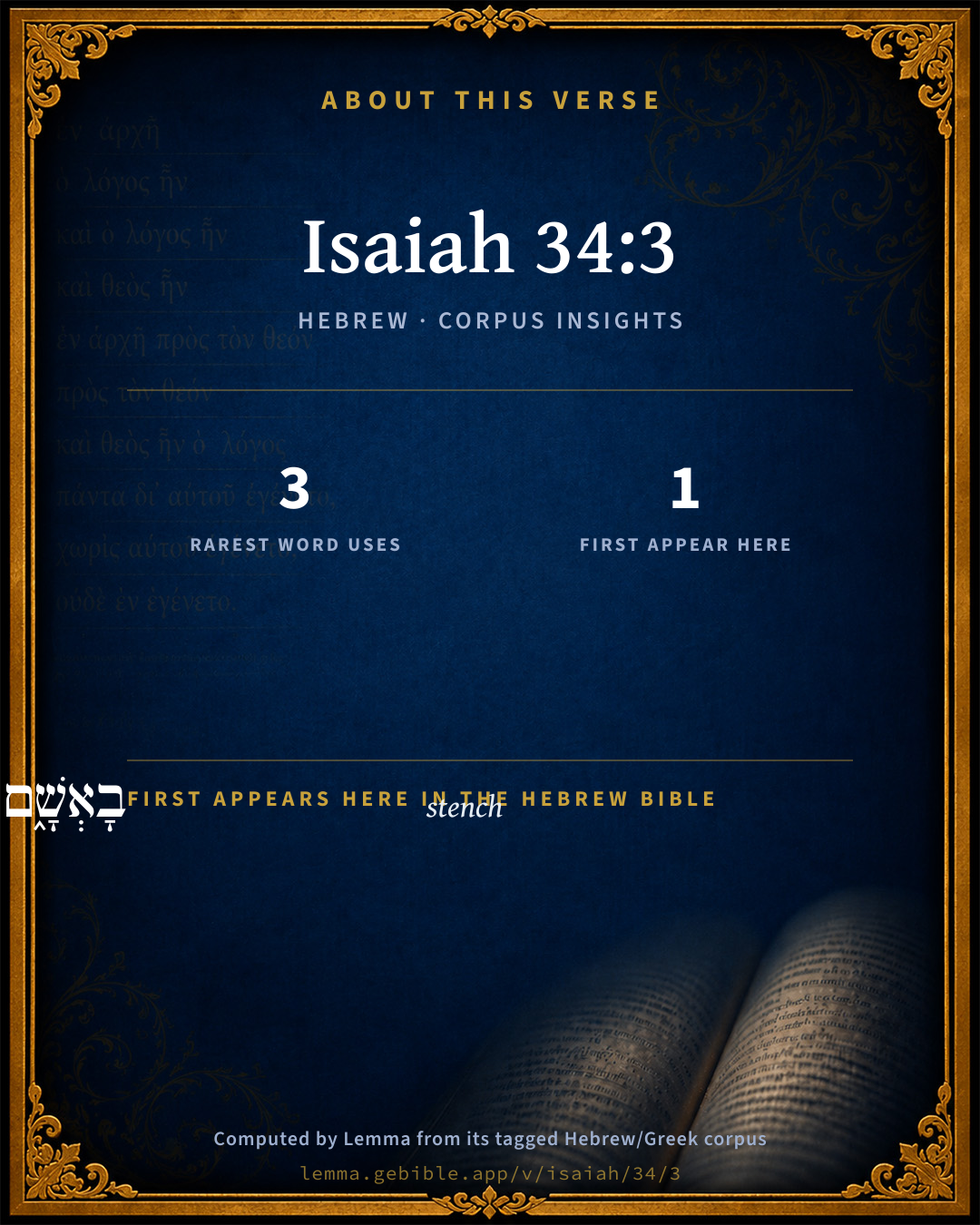
  • 1 first appearance in the Hebrew Bible
Full analysis ↓
Download a study sheet

One document with this verse’s original text, its word-by-word gloss line, the meaning frame, cross-references with their text, attributed commentary, and full source and license credits — printable, and it pastes into notes with its structure intact.

This verse Autodidact and up

Study sheet (.html) Plain text (.txt)

A passage Seminary Student

Up to 50 verses in one chapter. A passage sheet keeps up to 6 commentary sources and 12 cross-references per verse, in the order this page ranks them, and says so on the sheet whenever that leaves anything out. Ask for a single verse and you get the Autodidact verse sheet above.

Everything on this page stays free to read, with no account — the sheet is a download of what is already on screen, not access to it.

Want to remove ads? Support Godless Engineer
Compare translations 3

The same verse in 3 English versions, stacked beneath the original-language interlinear above. Click any original word for its lexicon entry.

Each is an independent rendering of the whole verse — the interlinear is not word-aligned to these translations.

Highlighted words mark where these versions differ — a whole-verse word diff, not a word-by-word alignment.

  • World English Bible Public Domain
    Their slain also shall be cast out, and the stench of their dead bodies shall come up; and the mountains shall be melted with their blood.
  • King James Version Public Domain
    Their slain also shall be cast out, and their stink shall come up out of their carcases, and the mountains shall be melted with their blood.
  • unfoldingWord Literal Text CC BY-SA 4.0
    And their slain will be thrown out, and their stench will arise their corpses, and the mountains will be melted with their blood.

unfoldingWord Literal Text — © unfoldingWord, licensed CC BY-SA 4.0. Word-aligned USFM3 via Door43 (git.door43.org/unfoldingWord/en_ult).

Versions to compare (up to 4)

3 of 4 selected

Show all 18 translations

Every available English version of this verse, each an independent rendering of the whole verse.

  • World English Bible Public Domain
    Their slain also shall be cast out, and the stench of their dead bodies shall come up; and the mountains shall be melted with their blood.
  • Berean Standard Bible Public Domain
    Their slain will be left unburied, and the stench of their corpses will rise; the mountains will flow with their blood.
  • Majority Standard Bible Public Domain
    Their slain will be left unburied, and the stench of their corpses will rise; the mountains will flow with their blood.
  • King James Version Public Domain
    Their slain also shall be cast out, and their stink shall come up out of their carcases, and the mountains shall be melted with their blood.
  • American Standard Version (1901) Public Domain
    Their slain also shall be cast out, and the stench of their dead bodies shall come up; and the mountains shall be melted with their blood.
  • Revised Version (1885) Public Domain
    Their slain also shall be cast out, and the stink of their carcases shall come up, and the mountains shall be melted with their blood.
  • Geneva Bible (1599) Public Domain
    And their slaine shalbe cast out, and their stincke shall come vp out of their bodies, and the mountaines shalbe melted with their blood.
  • Douay-Rheims (1899) Public Domain
    Their slain shall be cast forth, and out of their carcasses shall rise a slink: the mountains shall be melted with their blood.
  • Young's Literal Translation Public Domain
    And their wounded are cast out, And their carcases cause their stench to ascend, And melted have been mountains from their blood.
  • Literal Standard Version CC BY-SA 4.0
    And their wounded are cast out, || And their carcasses cause their stench to ascend, || And mountains have been melted from their blood.
  • Unlocked Literal Bible CC BY-SA 4.0
    The bodies of their dead will be thrown out. The stench of the dead bodies will be everywhere; and the mountains will soak up their blood.
  • unfoldingWord Literal Text CC BY-SA 4.0
    And their slain will be thrown out, and their stench will arise their corpses, and the mountains will be melted with their blood.
  • Darby Bible Public Domain
    And their slain shall be cast out, and their stink shall come up from their carcases, and the mountains shall be melted with their blood.
  • World Messianic Bible Public Domain
    Their slain will also be cast out, and the stench of their dead bodies will come up. The mountains will melt in their blood.
  • Webster's Bible Public Domain
    Their slain also shall be cast out, and their ill smell shall come up from their carcases, and the mountains shall be melted with their blood.
  • Free Bible Version CC BY-SA 4.0
    Those who are killed won't be buried; the stink of their bodies will rise; mountains will be washed away with their blood.
  • Bible in Basic English Public Domain
    Their dead bodies will be thick on the face of the earth, and their smell will come up, and the mountains will be flowing with their blood, and all the hills will come to nothing.
  • JPS Tanakh (1917) Public Domain
    Their slain also shall be cast out, and the stench of their carcasses shall come up, and the mountains shall be melted with their blood.

Literal Standard Version (2020), Covenant Press — licensed CC BY-SA 4.0. Text via the HelloAO Bible API (eBible.org). Unlocked Literal Bible (unfoldingWord) — licensed CC BY-SA 4.0. Text via the HelloAO Bible API (eBible.org). unfoldingWord Literal Text — © unfoldingWord, licensed CC BY-SA 4.0. Word-aligned USFM3 via Door43 (git.door43.org/unfoldingWord/en_ult). Free Bible Version, Dr. Jonathan Gallagher — licensed CC BY-SA 4.0. Text via the HelloAO Bible API (eBible.org).

Word by word

More ways to search: Search by grammar → Find every occurrence → Compare this word →

Practice this passage: Drill this verse → Learn its vocabulary →

בָאְשָׁ֑ם
bᵉʼôsh
H889
“stench · their”
Noun, Common, Masculine, Singular, Construct + Suffix, Personal, 3rd Person, Masculine, Plural
Part of Speech
Noun
Type
Common
Gender
Masculine
Number
Singular
State
Construct
Full BDB Definition

Origin: from H877

TWOT: 195a

stench, foul odour
  1. וְחַלְלֵיהֶ֣ם châlâl H2491 “and · slain · their” Conjunction + Adjective, Adjective, Masculine, Plural, Construct + Suffix, Personal, 3rd Person, Masculine, Plural
  2. יֻשְׁלָ֔כוּ shâlak H7993 “to throw” Verb, Hophal, Imperfect, 3rd Person, Masculine, Plural
  3. וּפִגְרֵיהֶ֖ם peger H6297 “and · corpses · their” Conjunction + Noun, Common, Masculine, Plural, Construct + Suffix, Personal, 3rd Person, Masculine, Plural
  4. יַעֲלֶ֣ה ʻâlâh H5927 “to go up” Verb, Qal, Imperfect, 3rd Person, Masculine, Singular
  5. וְנָמַ֥סּוּ mâçaç H4549 “and · to melt” Conjunction + Verb, Niphal, Sequential Perfect, 3rd Person, Common, Plural
  6. הָרִ֖ים har H2022 “mountains” Noun, Common, Masculine, Plural, Absolute
  7. מִדָּמָֽם dâm H1818 “from · blood · their” Preposition + Noun, Common, Masculine, Singular, Construct + Suffix, Personal, 3rd Person, Masculine, Plural

About this verse

These counts appear in no published source. They are computed here, from the morphology-tagged text and Lemma’s own curated glosses. What Lemma adds →

8
words
8
distinct lemmas
Prophets
section

Notable vocabulary

The rarest word here is בָאְשָׁ֑ם stench H889 — appearing just 3 times in the whole Hebrew Bible.

First appearance in Scripture

This word makes its first canonical appearance in the Hebrew Bible here:

  • בָאְשָׁ֑ם stench H889

Shared distinctive vocabulary

בָאְשָׁ֑ם stench H889 occurs in 3 verses of the Hebrew Bible. Also found in:

Grammatical profile

  • 3 verbs
  • 4 nouns
  • 1 adjective

Verb forms

  • יֻשְׁלָ֔כוּ Hophal · Imperfect
  • יַעֲלֶ֣ה Qal · Imperfect
  • וְנָמַ֥סּוּ Niphal · Sequential Perfect

Hebrew & Septuagint length

In English translation the verse runs 26 words from the Hebrew and 27 from the Septuagint (LXX English) — closely comparable.

A rough comparison of the two English renderings, which tokenize alike — not a word-level alignment.

Word counts can differ between the Hebrew and the Greek without any difference in meaning — e.g. the Hebrew direct-object marker אֵת has no separate Greek word, and Greek often adds the article ὁ.

Cross-references

15

Topical passages linked to Isaiah 34:3 in the Treasury of Scripture Knowledge — connected by theme and wording, ordered by reader-vote popularity; previews shown in the World English Bible.

  • Joel 2:20 But I will remove the northern army far away from you, And will drive it into a barren and desolate land, Its front into the eastern sea, And its back into the western sea; And its stench will come up, And its bad smell will rise." Surely he has done great things.
  • Isaiah 34:7 The wild-oxen shall come down with them, and the bulls with the bulls: and their land shall be drunken with blood, and their dust made fat with fatness.
  • Ezekiel 39:4 You shall fall on the mountains of Israel, you, and all your hordes, and the peoples who are with you: I will give you to the ravenous birds of every sort, and to the animals of the field to be devoured.
  • 2 Kings 9:35–37 They went to bury her; but they found no more of her than the skull, and the feet, and the palms of her hands.
  • Isaiah 14:19–20 But you are cast forth away from your tomb like an abominable branch, clothed with the slain, who are thrust through with the sword, who go down to the stones of the pit; as a dead body trodden under foot.
  • Jeremiah 8:1–2 At that time, says Yahweh, they shall bring out the bones of the kings of Judah, and the bones of his princes, and the bones of the priests, and the bones of the prophets, and the bones of the inhabitants of Jerusalem, out of their graves;
  • Jeremiah 22:19 He shall be buried with the burial of a donkey, drawn and cast forth beyond the gates of Jerusalem.
  • Ezekiel 14:19 Or if I send a pestilence into that land, and pour out my wrath on it in blood, to cut off from it man and animal;
  • Ezekiel 32:5–6 I will lay your flesh on the mountains, and fill the valleys with your height.
  • Ezekiel 35:6 therefore, as I live, says the Lord Yahweh, I will prepare you to blood, and blood shall pursue you: since you have not hated blood, therefore blood shall pursue you.
  • Ezekiel 38:22 With pestilence and with blood will I enter into judgment with him; and I will rain on him, and on his hordes, and on the many peoples who are with him, an overflowing shower, and great hailstones, fire, and sulfur.
  • Ezekiel 39:11 It shall happen in that day, that I will give to Gog a place for burial in Israel, the valley of those who pass through on the east of the sea; and it shall stop those who pass through: and there shall they bury Gog and all his multitude; and they shall call it The valley of Hamon Gog.
  • Amos 4:10 I sent plagues among you like I did Egypt. I have slain your young men with the sword, And have carried away your horses; And I filled your nostrils with the stench of your camp Yet you haven't returned to me," says Yahweh.
  • Revelation 14:20 The winepress was trodden outside of the city, and blood came out from the winepress, even to the bridles of the horses, as far as one thousand six hundred stadia.
  • Revelation 16:3–4 The second angel poured out his bowl into the sea, and it became blood as of a dead man. Every living thing in the sea died.

Cross-references courtesy of OpenBible.info (CC BY 4.0).

Hebrew and Greek witnesses Masoretic Hebrew ↔ Greek Septuagint

The same verse in the two great witnesses to the Old Testament, shown verse-for-verse.

These are two independent witnesses, not word-aligned to each other, and the Septuagint is shown in lemma (dictionary) form.

Hebrew Isaiah 34:3 Masoretic · Westminster Leningrad Codex

וְחַלְלֵיהֶ֣ם יֻשְׁלָ֔כוּ וּפִגְרֵיהֶ֖ם יַעֲלֶ֣ה בָאְשָׁ֑ם וְנָמַ֥סּוּ הָרִ֖ים מִדָּמָֽם

Their slain also shall be cast out, and the stench of their dead bodies shall come up; and the mountains shall be melted with their blood.

World English Bible · Public Domain

Greek LXX Isaiah 34:3 Septuagint · lemma form

ὁ δέ τραυματίας αὐτός ῥίπτω καί ὁ νεκρός καί ἀναβαίνω αὐτός ὁ ὀσμή καί βρέχω ὁ ὄρος ἀπό ὁ αἷμα αὐτός

And their slain shall be cast forth, and their corpses; and their ill savor shall come up, and the mountains shall be made wet with their blood.

LXX2012 (modern English Septuagint) · Public Domain

Hebrew: Westminster Leningrad Codex (CC BY 4.0). Greek: Septuagint (public domain); English from LXX2012 (modern English Septuagint) (Public Domain). How the Septuagint differs from the Hebrew →

Targum (Aramaic paraphrase)

1

The Targum is the ancient Jewish Aramaic paraphrase of the Hebrew Scriptures — an interpretive translation, not the Hebrew text itself. Onkelos (literal) and Pseudo-Jonathan (expansive) render the Torah, and Jonathan the Prophets. Coverage is partial: where no permissively-licensed English translation exists for a verse, only the Aramaic is shown. This is verse-level text, not a word-by-word alignment to the Hebrew.

  1. Targum Jonathan Prophets (Joshua–Malachi)
    וּקְטִילֵיהוֹן יִתְרְמוּן וּפִגְרֵיהוֹן יִסַק תְּנָנְהוֹן וְיִתְיַמְסוּן טוּרַיָא מִדָמְהוֹן:

    And their slain shall be cast out; and their stink shall ascend from their carcases; and the mountains shall be melted with their blood.

    Targum Jonathan — Aramaic: “Mikraot Gedolot” (public domain). English: “Sefaria Community Translation” (CC0 1.0 (public-domain dedication)); “London "Chaldee Paraphrase," 1871” (public domain). Text via Sefaria.

Commentary

Notes on Isaiah 34:3 from classic Christian and Jewish commentators (each source and its license shown beneath its notes). The classic Christian expositions comment on the surrounding passage and are grouped to its opening verse, so a note may address several verses; the Jewish commentaries on the Tanakh (Rashi and others) are per-verse, so they appear only where the commentator wrote on this verse.

Lemma curates 59 commentaries, every one of them public domain or Creative Commons licensed, each selected and text-cleaned for this edition rather than reprinted as found. About our sources →

Trapp's Complete Commentary

John Trapp

Isa 34:3 Their slain also shall be cast out, and their stink shall come up out of their carcases, and the mountains shall be melted with their blood.

Ver. 3. Their slain also shall be cast out.] Buried with the burial of an ass, {Jer 22:19} which Cicero somewhere calleth sepulturam insepultam and unburied grave. This may also befall such as for God’s sake are slain all the day long; but to them it is no such judgment: Coelo tegitur qui caret urna.

And their stink shall come up out of their carcases.] They stink alive as goats, as whited tombs, as walking dunghills; and now their dead carcases also shall stink above ground.

And the mountains shall be melted with their blood.] Iuste omnino, because they moistened the earth with the blood of God’s people, and dunged the land with their dead carcases.

John Trapp, A Commentary or Exposition upon All the Books of the Old and New Testament (1647–1656) — public domain. Text from a community e-Sword module.

Tyndale Open Study Notes

Tyndale Open Resources

34:3 It was a disgrace for a corpse to remain unburied.

Tyndale Open Study Notes — © Tyndale Open Resources, licensed CC BY-SA 4.0. Text via the HelloAO Bible API.

Jamieson, Fausset & Brown

Robert Jamieson, A. R. Fausset & David Brown

cast out--unburied (Isa 14:19).

melted--washed away as with a descending torrent.

Jamieson, Fausset & Brown — Commentary Critical and Explanatory on the Whole Bible (1871) — public domain (CC PDM 1.0). Text via the HelloAO Bible API.

The Cambridge Bible for Schools and Colleges

gen. ed. J. J. S. Perowne

3. Cf. Joe_2:20; Amo_4:10.

The Cambridge Bible for Schools and Colleges (gen. ed. J. J. S. Perowne; Cambridge University Press, 1878–1918) — public domain. Text from a community e-Sword module.

John Gill's Exposition

Their slain also shall be cast out,.... Upon the open fields, and there lie unburied, and become meat for the fowls of heaven, who are invited to them as to a supper, even the supper of the great God, Rev 19:17,

and their stink shall come up out of their carcasses; so that they shall become loathsome and abominable to the living, and none shall care to come near thereto bury them; an emblem of their loathsome and abominable sins, the cause of this destruction:

and the mountains shall be melted with their blood; an hyperbolical expression, denoting the great number of the slain upon the mountains, and the great quantity of blood shed there; which should run down in large streams, and carry part of them along with it, as large and hasty showers of rain wash away the earth, and carry it along with them; such an hyperbole see in Rev 14:20.

John Gill's Exposition of the Whole Bible (1746–1763) — public domain (CC PDM 1.0). Text via the HelloAO Bible API.

Albert Barnes' Notes on the Bible

Their slain also shall be cast out - They would lie unburied. The slaughter Would be so extensive, and the desolation would be so entire, that there would not remain enough to bury the dead (compare the notes at Isa 14:19).

And the mountains shall be melted with their blood - The expression here is evidently hyperbolical, and means that as mountains and hills are wasted away by descending showers and impetuous torrents, so the hills would be washed away by the vast quantity of blood that would be shed by the anger of Yahweh.

Albert Barnes' Notes on the Bible (1834–1885) — public domain. Text from a community e-Sword/MySword module.

Matthew Poole's English Annotations

Shall be cast out into the fields, where they shall lie unburied, and be left for a prey to all ravenous birds and beasts; whereby he implies, either the vast numbers which shall be slain, so as they could not have time or place to bury them; or the curse of God upon them, and the people’s contempt and abhorrency of them.

The mountains about Jerusalem, where they are supposed to be gathered to fight against Jerusalem, as the Assyrians now were, and as other enemies afterward would be, Zec 12:2; 14:2.

Shall be melted with their blood; shall be filled with their blood, which shall run down abundantly from the mountains with great force, and dissolve and carry down part of the earth of the mountains with it, as great showers of rain frequently do.

Matthew Poole's English Annotations on the Holy Bible (1683–1685) — public domain. Text from a community e-Sword/MySword module.

The Pulpit Commentary

Cast out; i.e. refused burial thrown to the dogs and vultures. (Jer_22:19 Jer_36:30) Such treatment of the dead was regarded as a shame and a disgrace. It was on some occasions an intentional insult; (Jer_22:19) but here the idea is rather that it would be impossible to bury the slain on account of their number. In ancient times corpses often lay unburied on battle-fields (Herod., 3:12). The mountains shall be molted with their blood. When the feelings of the prophet are excited, he shrinks from no hyperbole. Here he represents the blood of God"s enemies as shed in such torrents that mountains are melted by it.

The Pulpit Commentary (1880–1919), ed. H.D.M. Spence-Jones & Joseph S. Exell — public domain. Text from a community e-Sword module.

John Wesley's Explanatory Notes

Cast out - Into the fields.

John Wesley, Explanatory Notes Upon the Whole Bible (1754–1765) — public domain. Text via the GEBible commentary corpus.

J. A. Alexander on Isaiah

Joseph Addison Alexander

“And their slain shall be cast out.” The Hebrew word strictly means-their wounded, but usage gives it the specific sense of wounded mortally, and for the most part in battle. Cast out (i.e., unburied). This suggests the several ideas of contemptuous neglect, of a multitude too vast to be interred, and perhaps of survivors too few to perform the duty. (Compare Isa 14:18-20). They shall not lie unburied merely for a time, but until they rot upon the ground. “And (as to) their corpses (or carcasses), their stench shall go up. And mountains shall be melted with (or by) their blood,” as they are sometimes washed away by rains or torrents.

Joseph Addison Alexander, The Prophecies of Isaiah (1846–1847; New York: Scribner, 1870–1878) — public domain. Text from a community e-Sword module.

unfoldingWord translationNotes

Door43 World Missions Community

The bodies of their dead will be thrown out

This can be stated in active form. AT: "No one will bury their dead" (See: Active or Passive)

their dead

This refers to the dead people. AT: "those who died" (See: Nominal Adjectives)

the mountains will soak up their blood

"the mountains will be covered in their blood"

the sky will be rolled up like a scroll

This can be stated in active form. This compares what Yahweh will do to the sky to a person rolling up a scroll. AT: "Yahweh will roll up the sky in the same way that a person rolls up a scroll" (See: Active or Passive and Simile)

all their stars will fade away, as the leaf fades from off the vine, and as the overripe figs from the fig tree

This emphasizes even the things in the sky that people thought would be there forever will fall as easily as a leaf. AT: "all the stars will fall from the sky like a leaf falls from a vine or a fig falls from a tree" (See: Simile)

translationWords

blood

scroll

vine

fig

unfoldingWord translationNotes — © Distant Shores Media and the Door43 World Missions Community, licensed CC BY-SA 4.0. Source: git.door43.org/Door43/en_tn.

Ibn Ezra

Rabbi Abraham ibn Ezra

באשם Their stink. It is a noun derived from באש after the form of קׂדֶשׁ holiness.

ונמסו And shall be melted. Niphal of מסס to melt.

Ibn Ezra on the Tanakh — English translations: “Sefaria Community Translation” (CC0 1.0 (public-domain dedication)); “Yalkut, Sifsei Chachomim Chumash, Metsudah Publications, 2009” (CC BY 4.0); and “Commentary of Ibn Ezra on Isaiah - trans. by M. Friedlander, 1873” (public domain). Text via Sefaria.

Lesson kit

Teaching starters — assembled from the data on this page, not authored interpretation. Every prompt links to the verse data it draws on. Edit before teaching.

Isaiah, in the Prophets, opens this verse with 8 words (8 distinct Hebrew lemmas). Its most distinctive word is bᵉʼôsh (“stench”). A historical commentator’s framing appears above. Read the whole chapter for the surrounding context.

Discussion questions

  1. How does “stench” (bᵉʼôsh) shape what this verse is saying?
  2. This is the first place “stench” appears in Scripture (first appears here). What does its debut here establish?
  3. How does Joel 2:20, which shares the word «stench», read alongside this verse?
  4. These translations render this verse differently; the difference is in the English rendering, not the original. What questions does that raise?
  5. «יֻשְׁלָ֔כוּ» is a Hophal Imperfect verb. How does that grammatical form shape the action described?
  6. Compare how Trapp's Complete Commentary and Tyndale Open Study Notes read this verse. Where do they agree or differ?

Things to notice

Reading settings

Reading text

Shown beneath each verse's original-language words.

Old Testament
Old Testament edition

Read the OT as the Masoretic Hebrew (MT) or the Greek Septuagint (LXX).

English shown for the Greek Septuagint (in the Hebrew ↔ Greek comparison).

Comparing translations? Open the Compare panel on any verse page to stack up to four side by side.