
Ephesians 5:14

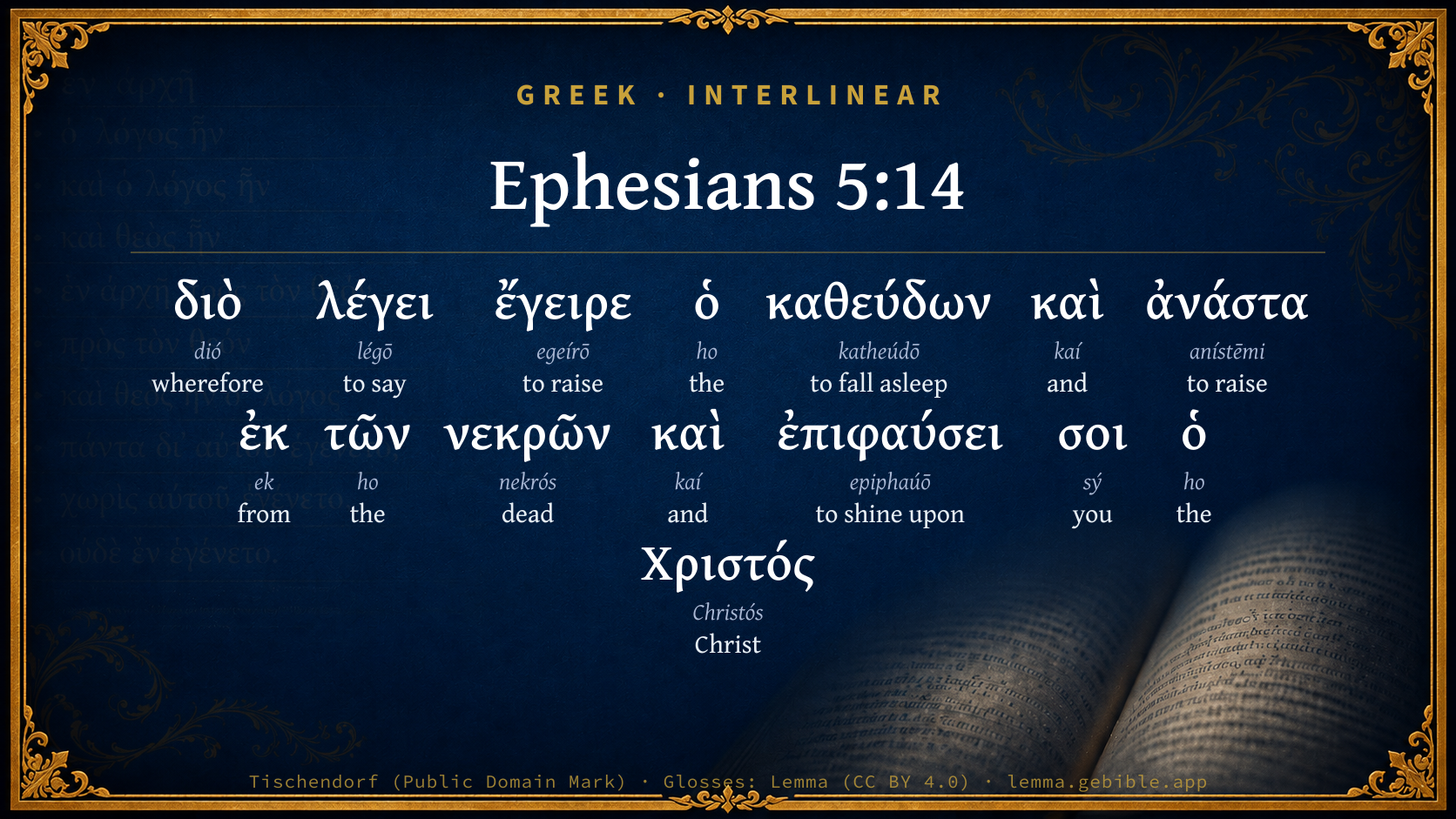
Greek (Tischendorf 8th ed.) Ephesians 5:14 appears in the Greek New Testament. The text above is from the Tischendorf 8th edition. Each word links to its Strong’s number and a concise gloss. Click any word for its full Thayer’s Greek Lexicon entry.
Download image
Cite this verse

Ephesians 5:14 (World English Bible). Public Domain. Lemma interlinear Bible study tool, https://lemma.gebible.app/v/ephesians/5/14.

Show BibTeX & RIS
BibTeX
RIS
English Translation
Therefore he says, "Awake, you who sleep, and arise from the dead, and Christ will shine on you."
World English Bible · Public Domain
Highlights
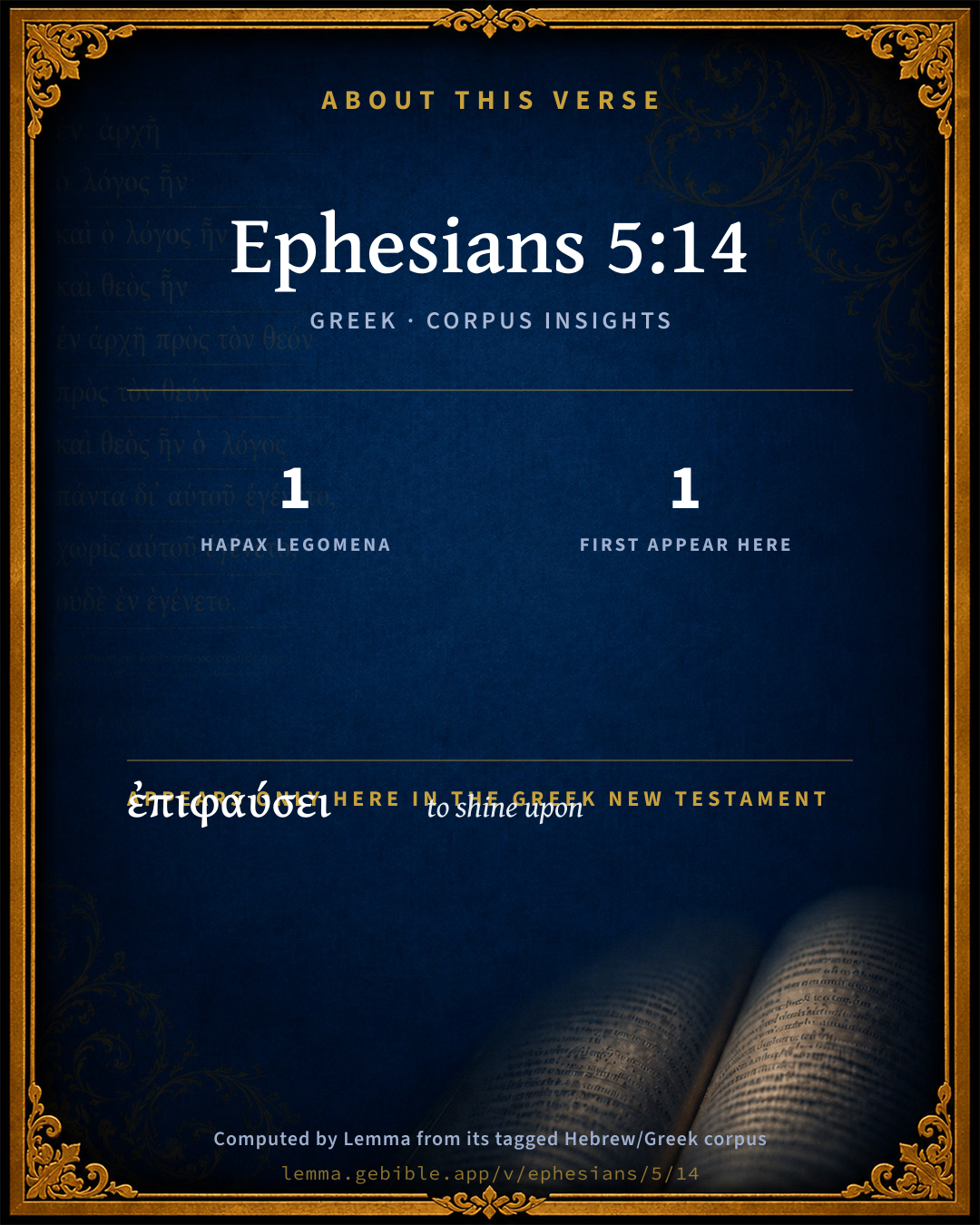
  • 1 hapax legomenon — only here in the Greek New Testament
  • 1 first appearance in the Greek New Testament
Full analysis ↓
Download a study sheet

One document with this verse’s original text, its word-by-word gloss line, the meaning frame, cross-references with their text, attributed commentary, and full source and license credits — printable, and it pastes into notes with its structure intact.

This verse Autodidact and up

Study sheet (.html) Plain text (.txt)

A passage Seminary Student

Up to 50 verses in one chapter. A passage sheet keeps up to 6 commentary sources and 12 cross-references per verse, in the order this page ranks them, and says so on the sheet whenever that leaves anything out. Ask for a single verse and you get the Autodidact verse sheet above.

Everything on this page stays free to read, with no account — the sheet is a download of what is already on screen, not access to it.

Want to remove ads? Support Godless Engineer
Compare translations 3

The same verse in 3 English versions, stacked beneath the original-language interlinear above. Click any original word for its lexicon entry.

Each is an independent rendering of the whole verse — the interlinear is not word-aligned to these translations.

Highlighted words mark where these versions differ — a whole-verse word diff, not a word-by-word alignment.

  • World English Bible Public Domain
    Therefore he says, "Awake, you who sleep, and arise from the dead, and Christ will shine on you."
  • King James Version Public Domain
    Wherefore he saith, Awake thou that sleepest, and arise from the dead, and Christ shall give thee light.
  • unfoldingWord Literal Text CC BY-SA 4.0
    Therefore it says, “Awake, O sleeper, and arise from the dead, and Christ will shine on you.”

unfoldingWord Literal Text — © unfoldingWord, licensed CC BY-SA 4.0. Word-aligned USFM3 via Door43 (git.door43.org/unfoldingWord/en_ult).

Versions to compare (up to 4)

3 of 4 selected

Show all 19 translations

Every available English version of this verse, each an independent rendering of the whole verse.

  • World English Bible Public Domain
    Therefore he says, "Awake, you who sleep, and arise from the dead, and Christ will shine on you."
  • Berean Standard Bible Public Domain
    So it is said: “Wake up, O sleeper, rise up from the dead, and Christ will shine on you.”
  • Majority Standard Bible Public Domain
    So it is said: “Wake up, O sleeper, rise up from the dead, and Christ will shine on you.”
  • King James Version Public Domain
    Wherefore he saith, Awake thou that sleepest, and arise from the dead, and Christ shall give thee light.
  • American Standard Version (1901) Public Domain
    Wherefore `he' saith, Awake, thou that sleepest, and arise from the dead, and Christ shall shine upon thee.
  • Revised Version (1885) Public Domain
    Wherefore he saith, Awake, thou that sleepest, and arise from the dead, and Christ shall shine upon thee.
  • Geneva Bible (1599) Public Domain
    Wherefore hee sayeth, Awake thou that sleepest, and stande vp from the deade, and Christ shall giue thee light.
  • Douay-Rheims (1899) Public Domain
    Wherefore he saith: Rise thou that sleepest, and arise from the dead: and Christ shall enlighten thee.
  • Young's Literal Translation Public Domain
    wherefore he saith, `Arouse thyself, thou who art sleeping, and arise out of the dead, and the Christ shall shine upon thee.'
  • Literal Standard Version CC BY-SA 4.0
    for this reason it says, “Arouse yourself, you who are sleeping, and arise out of the dead, and the Christ will shine on you.”
  • Unlocked Literal Bible CC BY-SA 4.0
    For anything that becomes visible is light. Therefore it says, “Awake, you sleeper, and arise from the dead, and Christ will shine on you.”
  • unfoldingWord Literal Text CC BY-SA 4.0
    Therefore it says, “Awake, O sleeper, and arise from the dead, and Christ will shine on you.”
  • Darby Bible Public Domain
    Wherefore he says, Wake up, [thou] that sleepest, and arise up from among the dead, and the Christ shall shine upon thee.
  • World Messianic Bible Public Domain
    Therefore he says, “Awake, you who sleep, and arise from the dead, and Messiah will shine on you.”
  • Webster's Bible Public Domain
    Wherefore he saith, Awake, thou that sleepest, and arise from the dead, and Christ will give thee light.
  • Free Bible Version CC BY-SA 4.0
    That's why it's said, “Wake up, those of you who are sleeping, rise up from the dead, and Christ will shine on you.”
  • Bible in Basic English Public Domain
    For this reason he says, Be awake, you who are sleeping, and come up from among the dead, and Christ will be your light.
  • Text-Critical English NT CC BY 4.0
    Therefore it says, “Awake, O sleeper, and arise from the dead, and Christ will shine upon yoʋ.”
  • Tyndale New Testament (1534) Public Domain
    Wherfore he sayth: awake thou that slepest and stond vp from deeth and Christ shall geve the light.

Literal Standard Version (2020), Covenant Press — licensed CC BY-SA 4.0. Text via the HelloAO Bible API (eBible.org). Unlocked Literal Bible (unfoldingWord) — licensed CC BY-SA 4.0. Text via the HelloAO Bible API (eBible.org). unfoldingWord Literal Text — © unfoldingWord, licensed CC BY-SA 4.0. Word-aligned USFM3 via Door43 (git.door43.org/unfoldingWord/en_ult). Free Bible Version, Dr. Jonathan Gallagher — licensed CC BY-SA 4.0. Text via the HelloAO Bible API (eBible.org).

Word by word

More ways to search: Search by grammar → Find every occurrence → Compare this word →

Practice this passage: Drill this verse → Learn its vocabulary →

ἐπιφαύσει
epiphaúō
G2017
“to shine upon”
Verb, Future, Active, Indicative, 3rd person, Singular
Part of Speech
Verb
Tense
Future
Voice
Active
Mood
Indicative
Person
3rd person
Number
Singular
Full Thayer's Definition

Origin: a form of G2014

TDNT: 9:310,*

1. to shine upon a. Christ will pour upon you the divine truth as the sun gives light to men aroused from sleep
  1. διὸ dió G1352 “wherefore” Conjunction
  2. λέγει légō G3004 “to say” Verb, Present, Active, Indicative, 3rd person, Singular
  3. ἔγειρε egeírō G1453 “to raise” Verb, Present, Active, Imperative, 2nd person, Singular
  4. ὁ ho G3588 “the” Article, Nominative, Singular, Masculine
  5. καθεύδων katheúdō G2518 “to fall asleep” Verb, Present, Active, Participle, Nominative, Singular, Masculine
  6. καὶ kaí G2532 “and” Conjunction
  7. ἀνάστα anístēmi G450 “to raise” Verb, Aorist, Active, Imperative, 2nd person, Singular
  8. ἐκ ek G1537 “from” Preposition
  9. τῶν ho G3588 “the” Article, Genitive, Plural, Masculine
  10. νεκρῶν nekrós G3498 “dead” Adjective, Genitive, Plural, Masculine
  11. καὶ kaí G2532 “and” Conjunction
  12. σοι sý G4771 “you” Personal pronoun, 2nd person, Dative, Singular
  13. ὁ ho G3588 “the” Article, Nominative, Singular, Masculine
  14. Χριστός Christós G5547 “Christ” Noun, Nominative, Singular, Masculine

About this verse

These counts appear in no published source. They are computed here, from the morphology-tagged text and Lemma’s own curated glosses. What Lemma adds →

15
words
12
distinct lemmas
Pauline Epistles
section

Notable vocabulary

1 hapax legomenon — a word that appears only here in the entire Greek New Testament:

  • ἐπιφαύσει to shine upon G2017

First appearance in Scripture

This word makes its first canonical appearance in the Greek New Testament here:

  • ἐπιφαύσει to shine upon G2017

Shared distinctive vocabulary

καθεύδων to fall asleep G2518 occurs in 20 verses of the Greek New Testament. Also found in:
Repetition

Words recur within this verse:

Cross-references

21

Topical passages linked to Ephesians 5:14 in the Treasury of Scripture Knowledge — connected by theme and wording, ordered by reader-vote popularity; previews shown in the World English Bible.

  • Isaiah 60:1 Arise, shine; for your light is come, and the glory of Yahweh is risen on you.
  • Romans 13:11–12 Do this, knowing the time, that it is already time for you to awaken out of sleep, for salvation is now nearer to us than when we first believed.
  • Isaiah 26:19 Your dead shall live; my dead bodies shall arise. Awake and sing, you who dwell in the dust; for your dew is [as] the dew of herbs, and the earth shall cast forth the dead.
  • 1 Thessalonians 5:6 so then let's not sleep, as the rest do, but let's watch and be sober.
  • Isaiah 52:1 Awake, awake, put on your strength, Zion; put on your beautiful garments, Jerusalem, the holy city: for henceforth there shall no more come into you the uncircumcised and the unclean.
  • 2 Corinthians 4:6 seeing it is God who said, "Light will shine out of darkness," who has shone in our hearts, to give the light of the knowledge of the glory of God in the face of Jesus Christ.
  • John 5:25–29 Most assuredly, I tell you, the hour comes, and now is, when the dead will hear the Son of God's voice; and those who hear will live.
  • Colossians 3:1 If then you were raised together with Christ, seek the things that are above, where Christ is, seated on the right hand of God.
  • Isaiah 51:17 Awake, awake, stand up, Jerusalem, that have drunk at the hand of Yahweh the cup of his wrath; you have drunken the bowl of the cup of staggering, and drained it.
  • John 9:5 While I am in the world, I am the light of the world."
  • John 8:12 Again, therefore, Jesus spoke to them, saying, "I am the light of the world. He who follows me will not walk in the darkness, but will have the light of life."
  • Romans 6:4–5 We were buried therefore with him through baptism to death, that just like Christ was raised from the dead through the glory of the Father, so we also might walk in newness of life.
  • Romans 6:13 Neither present your members to sin as instruments of unrighteousness, but present yourselves to God, as alive from the dead, and your members as instruments of righteousness to God.
  • 1 Corinthians 15:34 Wake up righteously, and don't sin, for some have no knowledge of God. I say this to your shame.
  • Ephesians 2:5 even when we were dead through our trespasses, made us alive together with Christ (by grace you have been saved),
  • 2 Timothy 1:10 but has now been revealed by the appearing of our Savior, Christ Jesus, who abolished death, and brought life and immortality to light through the Gospel.
  • Acts 13:47 For so has the Lord commanded us, saying, 'I have set you as a light for the Gentiles, That you should bring salvation to the uttermost parts of the earth.'"
  • Ezekiel 37:4–10 Again he said to me, Prophesy over these bones, and tell them, you dry bones, hear the word of Yahweh.
  • 2 Timothy 2:26 and they may recover themselves out of the devil's snare, having been taken captive by him to his will.
  • Luke 1:78 Because of the tender mercy of our God, Whereby the dawn from on high will visit us,
  • John 11:43–44 When he had said this, he cried with a loud voice, "Lazarus, come out!"

Cross-references courtesy of OpenBible.info (CC BY 4.0).

Commentary

Notes on Ephesians 5:14 from classic Christian and Jewish commentators (each source and its license shown beneath its notes). The classic Christian expositions comment on the surrounding passage and are grouped to its opening verse, so a note may address several verses; the Jewish commentaries on the Tanakh (Rashi and others) are per-verse, so they appear only where the commentator wrote on this verse.

Lemma curates 59 commentaries, every one of them public domain or Creative Commons licensed, each selected and text-cleaned for this edition rather than reprinted as found. About our sources →

The Cambridge Bible for Schools and Colleges

gen. ed. J. J. S. Perowne

14. Wherefore] With regard to the fact that whatever is really brought to light, in the sense of true spiritual conviction, becomes light.

he saith] Or possibly it (the Scripture) saith. See note on Eph_4:8.

Awake, &c.] These words occur nowhere in the O.T. verbatim. St Jerome, on the verse, makes many suggestions; as that St Paul may have used an “apocryphal” passage, exactly as he used words from pagan writers (e.g. Tit_1:12); or that he utters an immediate inspiration granted to himself, in prophetic form. Thomas Aquinas (quoted by Vallarsius on St Jerome) suggests that we have here the essence of Isa_60:1; where the Lat. reads “Rise, be enlightened, O Jerusalem, for thy light is come &c.” Surely this is the true solution, if we add to it the probability that other prophecies contributed to the phraseology here. Dr Kay (in the Speaker’s Commentary) on Isa_60:1 writes, “In Eph_5:14 this verse is combined, in a paraphrase form, with Isa_51:17, Isa_52:1-2. The Ephesians had been walking in darkness, as dead men … but the Redeemer had come and the Spirit been given. Therefore they were to awake (ch. Isa_51:17, Isa_52:1) out of sleep, and arise from the dead, that Christ the Lord might shine upon them, and they again shed His light on the Gentiles round.”

To the believer in the Divine plan and coherence of Scripture it will be abundantly credible that “the Lord” (Jehovah) of Isaiah should be the “Christ” of St Paul (cp. Isa_6:5 with Joh_12:41), and that the “Jerusalem” of Isaiah should have an inner reference to the True Israel (Gal_3:29; Gal_6:16), in its actual or potential members.

Dr Edersheim (Temple and its Services, p. 262), suggests that the Apostle may have had present to his mind language used in synagogue worship at the Feast of Trumpets. Rabbinic writers explain the trumpet blasts as, inter alia, a call to repentance; and one of them words the call, “Rouse ye from your slumber, awake from your sleep, &c.” Some such formula may have been in public use. Bengel makes a similar suggestion here. But this would not exclude, only supplement, the reference to Isaiah.

Another suggestion is that the words are a primitive Christian “psalm” (1Co_14:26); perhaps “the morning hymn used each day by the Christians in Rome in St Paul’s lodging,” or “a baptismal hymn.” Here again we have an interesting possibility, for such a “psalm” may have given or influenced the phrase here. But the introductory word “He, or it, saith,” seems to us to weigh decidedly for the view that the words are, in essence, a Scripture quotation.

sleepest … the dead] The sleep is more than sleep; the sleep of death. But death itself is but as sleep that can be broken (Mat_9:24) to the Lord of Life. On spiritual death see above, on Eph_2:1.

shall give thee light] Better, as R.V., shall shine upon thee.—The idea, by context, is not so much of the light of conviction, as of that of spiritual transfiguration (2Co_3:18; 2Co_4:4-6). The thought of “being light in the Lord” runs through the passage. It is a light consequent upon awaking and arising.—Another, but certainly mistaken, reading gives, “thou shalt touch Christ” The “Old Latin” followed it. It is due, in part at least, to the close similarity in form of two widely different Gr. verbs.

The Cambridge Bible for Schools and Colleges (gen. ed. J. J. S. Perowne; Cambridge University Press, 1878–1918) — public domain. Text from a community e-Sword module.

The Biblical Illustrator

Joseph S. Exell

Eph_5:14

Wherefore he saith, Awake thou that sleepest, and arise from the dead, and Christ shall give thee light.

A call to slumbering souls

I. The character of those addressed.

1. If you allow yourself in the practice of known wickedness, your conscience is asleep.

2. If you live in the customary neglect of self-examination, you are in a state of slumber.

3. If you have never been in any degree affected with a sense of your guilt, and of your dependence on the mercy of God in Christ, you are among those who are asleep.

4. If you have no conflicts with sin and temptation, you are in a state of slumber.

5. The prevalence of a sensual and carnal disposition is a sign of spiritual death.

6. Stupidity under the warnings of Gods word and providence, indicates such a state of soul as the Scripture compares to sleep.

II. Apply the call.

1. This awakening must suppose and imply a conviction of your sin, and a sense of your danger.

2. This awakening from sleep, and arising from the dead, implies a repentance of sin and turning to God.

3. They who have awoke from their sleep and risen from the dead will experience the properties, and maintain the exercises of a holy and spiritual life.

III. The encouragement--Christ shall give thee light, shall shine upon and enlighten thee.

1. This may be understood as a promise of pardon and eternal life on your repentance.

2. The words farther import Gods gracious attention to awakened souls, when they frame their doings to turn to Him. The call is, Awake, arise from the dead, repair to the Saviour. Say not, We are unable to discern the way. Christ will shine upon you and give you light. Say not, We are unable to rise and walk. He will meet you with His grace. Arise, He calleth you. He will guide your steps. (J. Lathrop, D. D.)

Awake

I. Images of the sinners state.

1. Sleep. This state, though usually benign and refreshing, is sometimes one of great danger. The traveller who sleeps when exposed to excessive frost, the sailor who sleeps upon the mast, are examples.

2. Darkness. This is emblematical of ignorance, error, and iniquity, and especially of the want of any certain prospect for the future.

3. Death. The insensibility, powerlessness, and immovableness of the corpse are an awful representation of the sinners state.

II. Representations of the sinners need.

1. Awakening.

2. Enlightening.

3. Raising to life.

The ministry of our Lord Jesus affords us many and striking instances of the exercise of a Divine power in these ways.

III. A revelation of the sinners hope.

1. A Divine command: Awake! arise! There is something for man to do in order that he may enjoy the blessings of the gospel.

2. A Divine promise: Christ will enlighten thee. (Clerical World.)

The Church aroused

I. The state of mind into which a Christian may sometimes get.

1. The insidious character of it,

(1) A Christian may be asleep and not know it. Indeed, if he did know it, he would not be asleep.

(2) A man who is asleep may be kept in very good countenance by his neighbours. They may be in the same state, and sleeping people are not likely to be very active in rebuking one another.

(3) One who is asleep may have taken care before he went to sleep to prevent anybody coming in to wake him. There is a way of bolting the door of your heart against anybody.

(4) A man can do a great deal while asleep that will make him look as if he were quite awake. For instance, some people talk in their sleep, and many professors will talk just as if they were the most active, the most earnest, the most gracious, the most warm-hearted people anywhere.

2. What is the evil itself? It is an unconsciousness of ones own state, and a carelessness of such a kind as not to want to be conscious of it. The man takes everything for granted in religion. He seems, too, to be perfectly immovable to all appeals. The best argument is lost on a sleeping man, and then this slumbering spirit spreads itself over everything else. There is a heartlessness in the manner in which everything is gone about.

3. Now, two or three words upon what makes this evil of Christians being asleep a great deal worse.

(1) It is this: they are Christs servants, and they ought not to be asleep. If a servant is set to do a certain duty, you do not continue him in your service if he drops off asleep.

(2) It is so bad for us to be asleep, too, because it is quite certain that the enemy is awake. You recollect old Hugh Latimers sermon, in which he says that the devil is the busiest bishop in the kingdom.

(3) And meanwhile souls are being lost.

4. What is it that sends us to sleep?

(1) We are inclined to slumber from the evil of our nature.

(2) It is easy to send a man to sleep if you give him the chloroform of bad doctrine.

(3) The sultry sum of prosperity sends many to sleep. Fulness of bread is a strong temptation.

(4) In some people it is the intoxication of pride.

(5) In others it is the want of heart which is at the bottom of everything they do. They never were intense, they never were earnest, and consequently they have such little zeal that that zeal soon goes to sleep. This is the age of the Enchanted Ground. He that can go through this age and not sleep must have something more than mortal about him. God must be with him, keeping him awake. You cannot be long in the soporific air of this particular period of time without feeling that in spiritual things you grow lax, for it is a lax age--lax in doctrine, lax in principle, lax in morals, lax in everything--and only God can come in and help the Pilgrim to keep awake in this Enchanted Ground.

II. Christs message to those of His people who are asleep.

1. Jesus speaks this in love. He would not say awake, were it not the kindest thing He could say to you. Sometimes a mothers love lulls her child to sleep, but if there is a house on fire the mothers love would take another expression and startle it from its slumbers; and Christs love takes that turn when He says to you, Awake! Awake! awake!

2. It is His wisdom as well as His love that makes Him say it. He knows that you are losing much by sleeping.

3. It is a voice, too, which you ought to own, for it is backed up by the authority of the person from whom it comes.

4. It is a voice which has been very often repeated. Christ has been saying, Awake! Awake! to some of us many hundreds of times. You were sick, were you, a few months ago? That was Christ, as it were, shaking you in your sleep, and saying, Awake, My beloved, awake out of thine unhealthy slumbers!

5. A personal cry--Thou. Not, Awake all of you; but, Awake thou! Shall I pick you out one by one?

6. He puts it very pressingly in the present tense. Awake! awake now. Not a few years hence, but now. This moment.

III. The promise with which Christ encourages us to awake--Christ shall give thee light. What means this?

1. Instruction.

2. The light of joy. (C. H. Spurgeon.)

Christ the Spiritual Light

I. The characters here addressed. Asleep, dead--expressions applicable to the natural state of man.

II. But to such the gracious invitation is given--Awake thou that sleepest, and arise from the dead, and Christ shall give thee light. This invitation or command, very naturally divides itself into two branches--the external call of the gospel, and the internal call of the Holy Spirit.

III. The promise that is made--And Christ shall give thee light. We have already observed, that sin has darkened the understanding, depraved the affections, and rendered us insensible to every form of moral worth. It is altogether the result of Divine power, therefore, to enlighten the understanding, to purify the heart, and to bring us into subjection to the obedience of Christ. In closing our discourse, we observe--

1. That none will be able to urge, at the last clay, that they were compelled to sin, or prevented from forsaking it, by the providential arrangements of God.

2. Nor can you say that you have not sufficient means and opportunities for obtaining the blessings of redemption.

3. None will be able to say that they humbly, earnestly, and perseveringly sought the assistance of the Holy Spirit, without obtaining it.

4. Neither can you plead your inability to obey God, as an excuse for continuing in sin. (A. Gilmour.)

The sinner called

1. These words plainly suppose the person to whom they are addressed, to be in a state of darkness. For they who sleep, as the apostle elsewhere observeth, sleep in the night. He that followeth not Christ walketh in darkness, because the light of life shineth no longer upon his tabernacle.

2. The text plainly intimates to us that the sinner, or man of the world, to whom it addresses itself as to one sleeping, is in a state of insensibility. For no sooner has sleep taken possession of anyone, but forthwith all the senses are locked up, and he neither seeth, heareth, smelleth, tasteth, or feeleth anything. Present the most finished and beautiful picture before the eyes of a person asleep; he sees no more of it than if it was not there.

3. It appears from the text before us, that the world is in a state of delusion; for such is the state of them that sleep. And to what can the life of many a man be so fitly compared, as to a dream? Awake, thou that sleepest, and arise from the dead, and Christ shall give thee light. And first, the sincere penitent, who really and truly turns from sin to righteousness, and from the world to Christ, passes from darkness to light. Secondly, the sinner, by repentance, is brought out of a state of insensibility into one of sensibility. Thirdly, the penitent is translated from a state of delusion to a sound judgment and right apprehension of things, from shadows to realities: even as one awaketh from the romantic scenery of a dream, to behold all things as they really are, and to do his duty in that station in which God has placed him. (Bishop Home.)

Of the state of spiritual death and the misery thereof

First: The miserable state of the unregenerate, represented under the notions of sleep and death; both expressions intending one and the same thing, though with some variety of notion. The Christless and unregenerate world is in a deep sleep; a spirit of slumber, senselessness, and security is fallen upon them, though they lie exposed immediately to eternal wrath. Just as a man that is fast asleep in a house on fire, and whilst the consuming flames are round about him, his fancy is sporting itself in some pleasant dream; this is a very lively resemblance of the unregenerate soul. But yet he that sleeps hath the principle of life entire in him, though his senses be bound, and the actions of life suspended by sleep. Lest, therefore, we should think it is only so with the unregenerate, the expression is designedly varied, and those that were said to be asleep, are positively affirmed to be dead; on purpose to inform us that it is not a simple suspension of the acts and exercise, but a total privation of the principle of spiritual life, which is the misery of the unregenerate. Secondly: We have here the duty of the unregenerate, which is to awake out of sleep, and arise from the dead. And the order of these duties is very natural. First awake, then arise. Startling and rousing convictions make way for spiritual life; till God awake us by convictions of our misery, we will never be persuaded to arise, and move towards Christ for remedy and safety. Secondly: But you will say, if unregenerate men be dead men, to what purpose is it to persuade them to arise and stand up? And that this is the state of all Christless and unsanctified persons, will, undeniably, appear two ways.

1. The causes of spiritual life have not wrought upon them.

2. The effects and signs of spiritual life do not appear in them; and therefore they are in the state and under the power of spiritual death.

1. If all Christless and unregenerate souls be dead souls, then how little pleasure can Christians take in the society of the unregenerate! Certainly tis no pleasures for the living to converse among the dead. It was a cruel torment, invented by Mezentius the tyrant, to tie a dead and living man together. The pleasure of society arises from the harmony of spirits, and the hopes of mutual enjoyment in the world to come; neither of which can sweeten the society of the godly with the wicked in this world.

2. How great and wholly supernatural, marvellous, and wonderful is that change which regeneration makes upon the souls of men! It is a change from death to life: This My Son was dead and is alive again. Regeneration is life from the dead (Luk_15:24). (J. Flavel.)

Conviction

Conviction is the first step in the new life. It is essential to conversion, as the action of winter is necessary to the growth of spring.

I. Conviction is produced by the power of the truth.

II. Conviction awakens the guilty conscience.

III. Sometimes conviction is transient. A mere play on the feelings cannot produce a permanent change.

IV. There are instances of special means used to produce conviction. St. Pauls conversion.

V. Conviction is genuine when salvation is sought. The gaoler at Philippi.

VI. Conviction sometimes comes too late to save. Belshazzar. Dives. (The Weekly Pulpit.)

Men asleep and dead in sins, called to awake

I. The state we are here supposed to be in by nature.

1. A state of sleep. This implies--

(1) Ignorance.

(2) Insensibility.

(3) Security, carelessness, unconcern.

(4) Indolence and sloth.

II. The exhortation given to such. God calls thee by His Word; by His ministers, whom He raises up, qualifies, and sends forth, chiefly for this end; by His providence, affliction, health, adversity, prosperity, the sickness or death of friends and relations; by His Spirit, which enlightens thy mind, awakens and informs thy conscience.

III. The gracious promise made to those who take the exhortation. Christ shall give thee--

1. The light of knowledge as to Divine things.

2. The light of comfort and happiness.

3. The light of life. (I. Barrow, D. D.)

Our natural state, and its remedy

I. What the text calls us to believe.

1. That our natural state is a state of darkness. Light in the external world is the element or medium by which we see other objects. Darkness precludes light, not by extinguishing the sense, but by rendering it useless. Three gradations may be stated, three degrees of darkness, as it affects the soul and its perceptions.

(1) That in which the soul has no perception at all of spiritual objects or the things of God, which are, to it, as though they were not.

(2) That in which it sees the objects as existing, but is blind to their distinguishing qualities and relative proportions.

(3) That in which the qualities are seen, but not appreciated; they are seen to exist, but not seen to be excellent or the reverse. Not so much a darkness of the mind as of the heart--a blindness of the affections as to spiritual objects.

2. A state of sleep. This is more than darkness. The man who is asleep has his senses sealed; not his sight merely, but his other senses. External objects are to him as though they were not. All that lies beyond this life and its interests is veiled from his view, and might as well not be. But while his senses are suspended, his imagination is awake and active. The more insensible he is of that which really surrounds him, the more prolific is his fancy in ideal objects. His life is but a dream. His illusions may be of a pleasing and agreeable nature; that will only make the awakening more dreadful. It is related by one of those who witnessed and experienced a late explosion, that when it occurred he was asleep, and that his first sensation was a pleasant one, as though he had been flying through the air. He opened his eyes, and he was in the sea! May there not be something analogous to this in the sensations of the sinner who dies with his soul asleep, and soars, as he imagines, towards the skies, but instantaneously awakes amidst the roar of tempests and the lash of waves upon the ocean of Gods wrath?

3. A state of death.

(1) The suspension of the faculties is permanent.

(2) No power of self-resuscitation.

(3) The whole frame hastening to putrescence.

4. A state of guilt. Alienation from the love of God.

5. A state of danger. Exposed to the wrath of God.

II. What the text calls us to do. The real ground of mens indifference to this matter is their unbelief. They do not really believe what they are told as to their state by nature. Where this faith really exists, it shows itself in anxious fears, if not in active efforts. The souls first impulse is to break the spell which binds it. But this it cannot do; in itself it is helpless. Hence the exhortation has added to it the necessary promise--Christ shall give thee light. Repentance and faith are conditions of salvation; but the Author of our salvation is the Giver of repentance, the Author and Finisher of our faith. God forgives us freely if we repent and believe, but we can just as well make expiation for our sins, as repent and believe without Divine assistance. But (it may be asked) will not this doctrine tend to paralyze the efforts of the sinner for salvation? And what then? The more completely his self-righteous strength is paralyzed, the better. No man can trust God and himself at once. Your self-reliance must be destroyed, or it will destroy you. But if, by a paralysis of effort, be intended a stagnation of feeling, and indifference to danger, I reply that this doctrine has no tendency to breed it. Suppose it should be suddenly announced to this assembly that a deadly malady had just appeared, and had begun to sweep off thousands in its course; and that the only possibility of safety depended on the use of a specific remedy, simple and easy in its application, and already within the reach of every individual, who had nothing to do at any moment but to use it, and infallibly secure himself against infection. And suppose that while your minds were resting on this last assurance, it should be authoritatively contradicted, and the fact announced, with evidence not to be gainsaid, that this specific, simple and infallibly successful, was beyond the reach of every person present, and could only be applied by a superior power. I put it to yourselves, which of these statements would produce serenity, and which alarm? Which would lead you to fold your hands in indolent indifference, and which would rouse you to an agonizing struggle for the means of safety? I speak as unto wise men; judge ye what I say. Oh, my friends, if there is any cure for spiritual sloth and false security, it is a heartfelt faith in the necessity of superhuman help. The man who makes his helplessness a pretext for continuance in sin, whatever he may say, does not really believe that he is helpless. No man believes it till he knows it by experience.

1. Light dispels that blindness of the heart and affections which disables us from seeing the true qualities of spiritual objects. That which before seemed repulsive becomes lovely; that which was mean is glorious. That which was pleasing or indifferent is now seen to be loathsome. The beauty of holiness and the ugliness of sin are now revealed in their true colours. Nor is this all. The light which beams upon us not only rectifies our views of what we law before, but shows us what we never saw.

2. Light, then, is the remedy; but how shall we obtain it? It must be given to us. If it comes at all, it comes as a free gift.

3. Christ alone can give it. This world, to the believer, is a dark, perplexing labyrinth, and in its mazes he would lose himself for over were it not that ever and anon, at certain turnings in the crooked path, he gets a glimpse of Calvary. These glimpses may be transitory, but they feed his hopes, and often unexpectedly return to cheer his drooping spirits. Sometimes he is ready to despair of his escape, and to lie down in the darkness of the labyrinth and die. But as he forms the resolution an unlooked for turn presents a distant prospect, and beyond all other objects, and above them, he discerns the cross and Christ upon it. Look to Christ then! look to Him for light to dissipate your darkness, to arouse you from sleep, and to raise you from the dead. (J. A. Alexander, D. D.)

Christ the Light Giver

That the great intent of Christ in the gospel is to call people out of their woeful estate by sin into the marvellous light of His salvation. This is the great truth here represented; and to clear it up to you--

I. Observe how woeful and dangerous the present case of carnal unregenerate men is. It is represented to us under the notions of spiritual sleep and spiritual death; which I shall speak of both generally and apart, and then conjointly and together. First: To speak of them generally, and apart.

1. They are asleep in sin, whereas the regenerate are awakened (1Th_5:5-6). Here, then, is their misery upon the first account, they sleep in sin; and a great misery it is.

(1) Because their insensibility and security make their other sins more dangerous.

(2) Though they sleep, their damnation sleepeth not (2Pe_2:3).

(3) The sun is up, and shines into their windows (Rom_13:11).

2. The next notion is spiritual death; for we are bidden to Arise from the dead, which showeth this sleep is deadly (Eph_2:1). How are we dead? Two ways--

(1) Dead as we are destitute of spiritual life;

(2) Dead as we are destitute of the favour and peace of God.

Secondly: Let us speak of these terms conjunctly; the one helpeth to explain the other. When we hear that man sleepeth in sin, possibly we might be apt to be conceited that mans heart is not so corrupt as it is, and are ready to say of it, as Christ did of the damsel whom He raised to life, She is not dead, but sleepeth (Mat_9:24). Therefore we must take in the ether expression to help it. We do not only sleep in sin, but are dead in trespasses and sins. So, on the other side, when we hear that we are in the state of the dead, we may misconceive of Gods work in conversion, and press the rigour of the notion too far, as if He wrought upon us only as stocks and stones; therefore we must take in the other expression; we sleep in sins. Life natural is still left us; there is reason and conscience still to work upon, though we are wholly disabled from doing anything pleasing to God; that is to say--

1. We have reason. Thou art a man, and hast reason, and therefore art to be dealt with by way of exhortations. God influenceth all things according to their natural inclination, as He enlighteneth the world by the sun, burneth with fire, so he reasoneth with man.

2. We have conscience (which is reason applying things to our case), and can judge of our actions morally considered with respect to reward and punishment, and accuse or excuse as the nature of the action deserveth (Rom_2:14-15).

3. That we have a natural self-love and desire of happiness (Psa_4:6), There be many that say, Who will show us any good? (Mat_13:45-46). So that, though we are dead, so as to do nothing savingly and acceptably, yet we must remember that we are also asleep, ignorant, slight, careless, do not improve our natural reason, conscience, and desires of happiness to any saving purpose, and will not mind things. Both together giveth us a right apprehension of our woeful condition by nature, that we are corrupt, and so are said to be dead; and senseless and secure, so we are said to be asleep, mindless of our danger and remedy.

II. The manner of our recovery out of this wretched estate.

1. In the general, it is by calling of us. Awake, arise (see 1Pe_2:9; 2Th_2:14).

2. More particularly, the order of this calling is set down in the text, in these two injunctions, Awake, and Arise from the dead. We are reduced and brought home to God two ways--either

(1) Preparatively and dispositively; or

(2) Formally and constitutively.

III. The next thing is, what a blessed estate Christ calleth them into; He doth not only rescue them out of the power of darkness, but He will give them light. Many things are intended hereby.

1. By light is meant the lively light of the Spirit, or a clear affective knowledge both of our misery and remedy.

2. Light is put for Gods favour, and the solid consolation which floweth from thence (Psa_4:6-7).

3. It implies eternal glory and happiness, to which we have a right now, and for which we are prepared and fitted by grace. A tender waking conscience is a great mercy, whereas a dead and stupid conscience is a heavy judgment; for then neither reason nor grace is of any use to us; we can neither do the functions of a man or a Christian while we are asleep. First: Awake thou that sleepest.

Consider these motives--

1. Doth it become any to sleep in your ease, while you know not God to be a friend or an enemy? yea, when you have so much reason to think that He is an enemy to you, for you are enemies to Him by your minds in evil works (Col_1:21).

2. You sleep in that ship that is swiftly carried to eternity, and are just upon the entrance into another world: Lest coming suddenly He find you sleeping (Mar_13:36).

3. Yon have slept out too much precious time already: The time past of our life may suffice us (1Pe_4:3).

4. Thou hast been long and often called upon. If God had not sought to awaken you, you had the better excuse: How long wilt thou sleep, O sluggard? when wilt thou arise out of sleep? yet a little sleep, a little slumber, a little folding of the hands to sleep. (Pro_6:9-10).

5. Now is your time and season: He that gathereth in summer is a wise son; but he that sleepeth in harvest is a son that causeth shame (Pro_10:5). To lose time is sad, but to lose the season worst of all, and a season that bringeth profit as well as labour, as harvest doth.

6. Others care for their souls, and are hard at work for God; their diligence should awaken us (Act_26:7).

7. The devil is awake, and will you sleep? (1Pe_5:8).

8. If nature were well awake, it would disprove your courses as much as religion. Secondly: Arise from the dead; that is, be converted to God; for the voice of Christ doth not only conduce to awaken us, but to raise us from the dead (Joh_5:25). Look about you, then; entertain serious thoughts of getting out of a state of sin into a state of grace.

Take two motives to quicken you to this--

1. Better never be awakened if still we continue in our sins, for this aggravateth them (Joh_3:19).

2. Better never rise in the last day if we be not raised from the death of sin.

(1) Do not say, It is too soon; for we can never soon enough get out of so great a danger.

(2) Do not say, It is too late; for the work is yet possible, as short as your time is like to be in the world; and it will be your fault if it be not done. (T. Manton, D. D.)

Inattention to warning

It is said of birds that build in steeples, being used to the continual ringing of bells, the sound disquiets them not at all; or as those that dwell near the fall of the river Nilus (Nile), the noise of the water deafens them so, that they mind it not. Thus it is that the commonness of the death of others is made but, as it were, a formal thing: many have been so often at the grave, that now the grave is worn out of their hearts; they have gone so often to the house of mourning, that they are grown familiar with death; they look upon it as a matter of custom for men to die and be buried, and when the solemnity is over, the thoughts of death are over also; as soon as the grave is out of their sight, preparation for the grave is out of their mind: then they go to their worldly business, yea, to coveting and sinning, as if the last man that ever should be were buried. (Caryl.)

Insensible to Divine influence

The person here spoken of is first said to be asleep; and surely this gives the idea of one who may be surrounded by danger without knowing it; may be approached by enemies without perceiving it; may have the assassins blow aimed at his heart without attempting to repel it. In like manner, those by whom he is best loved may watch beside his pillow, and he is unconscious of their presence. A feast of fat things, a feast of wines on the lees, of fat things full of marrow, of wines on the lees well refined, may be spread before him, yet his appetite is not awakened; riches and honours may be placed within his reach, yet his hand is not stretched forth to grasp them. And why? Because he is asleep. His eyes are closed, his ears are dulled, his senses are locked up by the power of slumber; and forgetfulness of his best interest, and inattention to outward objects, have come upon him. And thus is it with the unconverted man. He is surrounded by dangers which he heeds not; by enemies whom he regards not. The murderer of souls has struck at his heart and he has made no resistance. He may be active in worldly matters, and eager for worldly objects; but he has no eagerness, no activity for spiritual concerns. Wrath, and that eternal, is even now pursuing him; the bottomless abyss has yawned at his very feet, and is ready to engulph him; the thunders of the law are pealing forth their denunciations against him; and this immortal being remains heedless and unconcerned when there is but one step between him and the lake of fire. And there is an eye of love watching over him for good; there is a voice of mercy appealing to his soul; there is the marriage supper of the Lamb spread, and he is invited thereto; there are the unsearchable riches of Christ placed within his reach, with this encouraging inscription, Ask, and ye shall receive; yet he hears not the voice which cries, Look unto Me, and be ye saved; he sees not the bleeding form which stands between us and the stroke of Divine justice; the famished wretch hastens not to taste the feast; the beggars hand is not put forth to lay hold on the boundless treasures. He is asleep; and feels not, sees not, hears not, knows not these things. And yet he is often not devoid of strong feeling with respect to the things of this world; nor destitute of regard for the decencies of life. He may find, or think he finds, happiness in this very forgetfulness of God; nay, in his own way, he may make a profession of religion, and have a dreamy prospect of salvation to be hereafter received. He thinks that he may now give his faculties to earthly objects and to self-indulgence, that he may offer to God the service of the lip whilst his own passions and inclinations receive the adoration of the heart; and he flatters himself that he is happy now, and that he shall, unconverted and separated from the love of God as he is, be happy in His presence eternally. Alas! how delusive is this dream, springing as it does from the sleep of carnal security. When for a moment he thinks seriously, he finds himself not really happy, and when that hour comes in which the unawakened sinner shall be called into the presence of his Judge, where shall be all the joys either on earth or in heaven, which he promised to himself? It shall even be as when an hungry man dreameth, and, behold, he eateth; but he awaketh, and his soul is empty; or as when a thirsty man dreameth, and, behold, he is faint and his soul hath appetite. His anticipations were but a dream, founded on self-delusion, and ending in bitter and irretrievable disappointment. (Bishop Ryle.)

Light

It is a remarkable illustration of the truth that material phenomena are designed to convey to us lessons of spiritual realities, that the language in common use to describe the latter is that of the former. For example, in this sentence we have the expressions sleep, death, light. All these are material conditions or things. Probably none of these symbolical expressions for spiritual things is so frequently used as that of light. Without entering into the disputed question as to the source whence this quotation is taken, whether it be a free adaptation of a passage in the book of the prophet Isaiah or whether (as some imagine) a fragment from some ancient Christian hymn, we can refer to not a few passages in the Old Testament in which a right spiritual condition is described as being a condition of light. In the New Testament, which is a record of the advent of Him who is the source of spiritual light, these passages are still more numerous. He is heralded as the Dayspring from on high who shall give light to them that sit in darkness. He is declared to be a light to lighten the Gentiles. He claims for Himself that He is the Light of the world. In Him is light, and they who receive of Him are no longer darkness but light in the Lord, for in Him the darkness is past and the true light now shineth.

1. Light was the first creation of God. His first recorded word is, Let there be light. Proceeding out of this creation of light comes all other creation until the end is reached and man is made in the image of God. In like manner light is the first creation of the gospel, which is the re-creation of the world.

2. Light needs no evidence of its presence. It proves itself. To the blind, indeed, it has no existence, and no explanation of it can make them understand it. But to such as have eyes to see, the presence of light makes itself known at once. The gospel light commends itself by its own light to those who are possessed of a clear spiritual eyesight.

3. Light is given in order that we may see where we are and amidst what surroundings we are placed. Apart from the gospel of Christ we can possess no, true view of life; we are overwhelmed by unsolved mysteries.

4. Light exists not merely that we may rejoice in the revelation of which it is the author, but that we may walk in it.

5. God called the light, day, and the day is given for work. Man goeth forth to his work and to his labour until the evening. I must work the works of Him that sent Me while it is day, the night cometh when no man can work.

6. Darkness is always fruitless (verse 11) while light is fruit-producing. The fruit of the light (for such is the true reading of verse 9, which is recognized in the Revised Version) is in goodness, righteousness, truth. Light is a necessary element in the formation of the fruit of a tree or a plant. Such if deprived of light becomes barren. How true a picture of the human soul upon which the Light of Life is not shining! (Canon Vernon Hutton.)

The Awakener is in every sleeper

God would not mock man by bidding him to awake out of death, and to arise to a new life, if the Awakener were not in the very midst of his soul to help him. God calls man from within himself. The Resurrection and the Life stirs in him, saying, Arise from the dead! and the man is already at the dawn of the heavenly life. As sunrise pricks the sleeper, and says to him, Arise! even so the hour cometh when the dead soul hears the voice of the Son of Man, and, hearing, lives. The gentleness of the Divine love opens a new day within the man, and ten thousand noiseless arrows penetrate and startle his soul. They are the life glances of the Quickener, to which the inner man responds, trembling in the pangs of the new birth, and, at the same time, blessing God with unspeakable gladness that he is alive from the dead and an heir of heaven. It happens daily that after the light has penetrated the eyelid of the sleeper, he recognizes it for a moment, turns himself, closes his lid, and sleeps again. Take heed, lest after the arrows of Christ, which are gentler than the light, have wakened your soul, you do not sleep on in death. (J. Pulsford.)

Christ our Light

The motto of the Northcotes is, The Cross of Christ is my Light.

A light needed

A man is out on a night that is as dark as pitch--a lamp is placed in his hand to guide him on his journey. Instead, however, of taking advantage of the light the lamp affords, the man says, I do not require this lamp; I know every step of the way; I will trust to my own judgment. That man, in a certain sense, does his best; he strives to keep the beaten track, and for that purpose he moves carefully and cautiously along. When, however, he makes a false step and tumbles into a ditch, or falls over a precipice, no one dreams of saying, Poor fellow! he could not help himself, he did his best. The man did not do his best. Had he done his best, and not been rash and foolhardy in refusing to avail himself of the lamp, he would have escaped the wounds and bruises that now burden him. (P. Robertson.)

Christ our Light

Christ is our only defence at the last. John Holland, in his concluding moment, swept his hand over the Bible, and said: Come, let us gather a few flowers from this garden. As it was eventime he said to his wife: Have you lighted the candles? No, she said, we have not lighted the candles. Then, said he, it must be the brightness of the face of Jesus that I see. (Dr. Talmage.)

The Biblical Illustrator, edited by Joseph S. Exell (c. 1880s–1900s) — public domain. Text from a community e-Sword module.

Bengel's Gnomon

Johann Albrecht Bengel

Eph 5:14. Διὸ λέγει, Wherefore He says) The chief part of this exhortation is in Isa 60:1, φωτίζου φωτίζου, Ἱερουσαλήμ· ἥκει γάρ σου τὸ φῶς, Heb. קומי אורי; so ibid. Isa 52:1-2, ἐξεγείρου· ἀνάστηθι. But the apostle speaks more expressly in accordance with (out of) the light of the New Testament, and according to the state of him who requires to be awakened. At the same time he seems to have had in his mind the particular phraseology which had been ordinarily used at the feast of trumpets: Arise, Arise out of your sleep; awake from your sleep, ye who deal in vain things, for very heavy sleep is sent to you; see Hotting. ad Godw., p. 601. And perhaps he wrote this epistle at that time of the year: comp. 1Co 5:7, note.—ἔγειραι—ἀνάστα) Ammonius: ἀναστῆναι, ἐπὶ ἔργον· ἐγερθῆναι, ἐξ ὓπνου, to rise up, viz. so as to engage in work; to be awakened, viz. out of sleep.—ἐκ τῶν νεκρῶν, from the dead) ch. Eph 2:1.—ἐπιφαύσει) will begin to shine on thee, as the sun, Isa 60:2. The primitive word, ἐπιφαύσκω, is in the LXX.; so from γηράσκω, γηράσω, ἀρέσκω, αρέσω.

Bengel's Gnomon of the New Testament — English translation (T&T Clark, Edinburgh, 1860) — public domain. Text from a community e-Sword module.

Meyer's Critical & Exegetical Commentary

Heinrich August Wilhelm Meyer

Eph_5:14. This necessity and salutariness of the ἔλεγξις, which Paul has just set forth in Eph_5:12-13 (not of the mere subsidiary thought, πᾶν γὰρ κ.τ.λ.), he now further confirms by a word of God out of the Scripture.

διό] wherefore,because the ἐγέγχετε is so highly necessary as I have shown in Eph_5:12, and of such salutary effect as is seen from Eph_5:13,wherefore he saith: Up, thou sleeper, and arise from the dead, and Christ shall shine upon thee. This call of God to the υἱοὶ τῆς ἀπειθείας to awake out of the sleep and death of sin confirms the necessity of the ἔλεγξις, and this promise: Christ shall shine upon thee, confirms the salutary influence of the light, under which they are placed by the ἐλέγχειν. Beza refers back διό to Eph_5:8, which is erroneous for this reason, if there were no other, that the citation addresses the as yet unconverted. According to Rückert (comp. Erasmus, Paraphr.), the design is to give support to the hope expressed in Eph_5:13, namely, that the sinner, earnestly reproved and convicted, may possibly be brought over from darkness into light. But see on Eph_5:13. With the correct interpretation of πᾶν γὰρ κ.τ.λ., the expositions are untenable, which are given by Meier: on that account, because only what is enlightened by the light of truth can be improved; and by Olshausen: because the action of the light upon the darkness cannot fail of its effect. Harless indicates the connection only with the words of Plutarch (tom. xiv. p. 364, ed. Hutt.): χαίρειν χρὴ τοῖς ἐλέγχουσιν· … ἡμᾶς γὰρ λυποῦντες διεγείρουσιν. Inexact, andinasmuch as with Plutarch χαίρειν and λυποῦντες stand in emphatic correlation, and λυποῦντες thus is essentialinappropriate.

λέγει] introduces, with the supplying of ὁ Θεός (as Eph_4:8), a passage of Scripture, of which the Hebrew words would run: עוּרָה יָשֵׁן וְהָקִיצָה מִן־הַמֵּתִים וְהֵאִיר לְךָ מָשִׁיחַ. But what passage is that? Already Jerome says: Nunquam hoc scriptum reperi. Most expositors answer: Isa_60:1. So Thomas, Cajetanus, Calvin, Piscator, Estius, Calovius, Surenhusius, Wolf, Wetstein, Bengel,[263] and others, including Harless and Olshausen; while others at the same time bring in Isa_26:19 (Beza, Calixtus, Clericus, Meier, Baumgarten-Crusius, and others), as also Isa_52:1 (Schenkel) and Isa_9:1 (Baumgarten, Holzhausen). But all these passages are so essentially different from ours, that we cannot with unbiassed judgment discover the latter in any of them, and should have to hold our citationif it is assumed to contain Old Testament wordsas a mingling of Old Testament reminiscences, nothing similar to which is met with, even apart from the fact that this citation bears in itself the living impress of unity and originality; hence the less is there room to get out of the difficulty by means of Bengels expedient: apostolus expressius loquitur ex luce N.T. Doubtless Harless says that the apostle was here concerned not about the word, but about the matter in general, and that he cites the word of pre-announcement with the modification which it has itself undergone through fulfilment, and adduces by way of analogy Rom_10:6 ff. But in opposition to this may be urged, first generally, that such a modification of Isa_60:1 would have been not a mere modification, but would have quite done away with the identity of the passage; secondly, in particular, that the passage Isa_60:1, specially according to the LXX. (φωτίζου, φωτίζου Ἰηρουσαλὴμ, ἥκει γάρ σου τὸ φῶς, καὶ ἡ δόξα κυρίου ἐπὶ σὲ ἀνατέταλκεν), needed no change whatever in order to serve for the intended Scriptural confirmation, for which, moreover, various other passages from the O. T. would have stood at the command of the apostle, without needing any change; and lastly, that Rom_10:6 is not analogous, because there the identity with Deu_30:12-14 is unmistakeably evident in the words themselves, and the additions concerning Christ are not there given as constituent parts of the Scripture utterance, but expressly indicated as elucidations of the apostle (by means of τοῦτʼ ἔστι). Quite baseless is the view of de Wette, that the author is quoting, as at Eph_4:8 (where, indeed, the citation is quite undoubted), an O. T. passage in an application which, by frequency of use, has become so familiar to him that he is no longer precisely conscious of the distinction between text and application. Others, including Morus, have discovered here a quotation from an apocryphal book, under which character Epiphanius names the prophecy of Elias, Georgius Syncellus an apocryphal authority of Jeremiah, and Godex G on the margin, the book (Secretum) of Enoch. See, in general, Fabricius, Cod. Pseudepigr. V. T. pp. 1074, 1105; Apocr. N.T. I. p. 524. That, however, Paul wittingly cited an apocryphal book,[264] is to be decisively rejected, inasmuch as this is never done by him, but, on the contrary, the formula of citation always means canonical passages. Hence, also, we have not, with Heumann (Poicile, II. p. 390), Michaelis, Storr, Stolz, Flatt, to guess at an early hymn of the Church as the source.[265] Others have found therein a saying of Christ, like Oeder in Syntagm. Obss. sacr. p. 697 ff., in opposition to which may be urged, not indeed the following ὁ Χριστός, which Jesus might doubtless have said of Himself, but rather the fact that the subject ΧΡΙΣΤΌς to ΛΈΓΕΙ could not be at all divined, as indeed Paul has never adduced sayings of Christ in his Epistles. This also in opposition to the opinion mentioned in Jerome (comp. also Bugenhagen and Calixtus), that Paul here, after the manner of the prophets (comp. the prophetic: thus saith the Lord), προσωποποιΐαν Spiritus sancti figuraverit. Grotius (comp. Koppe) regards even ΤῸ Φῶς as subject: Lux illa, i.e. homo luce perfusus, dicit alteri. As if previously the φῶς were homo luce perfusus! and as if every reader could not but have recognised a citation as well in διὸ λέγει as in the character of the saying itself! Erroneously Bornemann also, Schol. in Luc. p. xlviii. f., holds that λέγει is to be taken impersonaliter; in this respect it is said, one may say, so that no passage of Scripture is cited, but perhaps allusion is made to Mar_5:41. This impersonal use is found only with φησί. See the instances cited by Bornemann, and Bernhardy, p. 419. In view of all these opinions, my conclusion, as at 1Co_2:9, is to this effect: From ΔΙῸ ΛΈΓΕΙ it is evident that Paul desired to adduce a passage of canonical Scripture, butas the passage is not canonicalin virtue of a lapsus memoriae he adduces an apocryphal saying, which, citing from memory, he held as canonical. From what Apocryphal writing the passage is drawn, we do not know.

ἔγειρε] up! Comp. ἄγε, ἜΠΕΙΓΕ. See, in opposition to the form of the Recepta ἔγειραι (so also Lachmann), Fritzsche, ad Marc. p. 55 f.

ὁ καθεύδων] and then ἘΚ ΝΕΚΡῶΝ form a climactic twofold description of the state of man under the dominion of sin, in which state the true spiritual life, the moral vital activity, is suppressed and gone, as is the physical life in the sleeping (comp. Rom_13:11) and in the dead respectively. Comp. Isa_59:10. How often with the classical writers, too, the expression dead is employed for the expression of moral insensibility, see on Mat_8:22; Luk_15:14; Musgrave, ad Oed. R. 45; Bornemann, in Luc. p. 97. On ὁ καθεύδων, comp. Sohar. Levit. f. 33, c. 130: Quotiescunque lex occurrit, toties omnia hominum genera excitat, verum omnes somno sepulti jacent in peccatis, nihil intelligunt neque attendunt.

ἀνάστα] On the form, see Winer, p. 73 [E. T. 94]; Matthiae, p. 484.

ἘΠΙΦΑΎΣΕΙ] from ἘΠΙΦΑΎΣΚΩ, see Winer, p. 82 [E. T. 110]; Job_25:5; Job_31:26. The readings ἘΠΙΨΑΎΣΕΙ ΣΟΙ Ὁ ΧΡ. and ἘΠΙΨΑΎΣΕΙς ΤΟῦ ΧΡ. are ancient (see Chrysostom and Jerome ad loc.), and are not to be explained merely from an accidental interchange in copying, but are connected with the preposterous fiction that the words were addressed to Adam buried under the cross of Christ, whom Christ would touch with His body and blood, thereby causing him to become alive and to rise. See Jerome. The words themselves: Christ shall shine upon thee, signify not: He will be gracious to thee (so, at variance with the context, Bretschneider), but: He will by the gracious operation of His Spirit annul in thee the ethical darkness (λύων τὴν νύκτα τῆς ἁμαρτίας, Gregory of Nazianzus), and impart to thee the divine ἈΛΉΘΕΙΑ, of which He is the possessor and bearer (Christ, the light of the world). Observe, moreover, that the arising is not an act of ones own, independent of God and anticipating His gracious operation, but that it takes place just through Gods effectual awakening call. On this effectual calling then ensues the Christian enlightening.

[263] Who, however, at the same time following older expositors in Wolf (comp. Rosenmüller, Morgenland, VI. p. 142), called to his aid a reminiscence of the formula in festo buccinarum adhiberi solita. See, in opposition to the error as to the existence of such a formula, based upon a passage of Maimonides, Wolf, Curae.

[264] According to Jerome, he is held not to have done it, quod apocrypha comprobaret, sed quod et Arati et Epimenidis et Menandri versibus sit abusus ad ea, quae voluerat, in tempore comprobanda.

[265] This opinion is already mentioned by Theodoret: τινὲς δὲ τῶν ἑρμηνευτῶν ἔφασαν πνευματικῆς χάριτος ἀξιωθέντας τινὰς ψαλμοὺς συγγράψαι, in connection with which they had appealed to 1Co_14:26. Bleek, too, ad loc. and already in the Stud. u. Krit. 1853, p. 331, finds it probable that the saying is taken from a writing composed by a Christian poet of that early age.

Meyer — Critical and Exegetical Commentary on the New Testament — English translation by Peter Christie, edited by Frederick Crombie (T&T Clark, 1880) — public domain. Text from a community e-Sword module.

Expositor's Greek Testament

ed. W. Robertson Nicoll

Eph 5:14 . διὸ λέγει , Ἔγειραι ὁ καθεύδων καὶ ἀνάστα ἑκ τῶν νεκρῶν , καὶ ἐπιφαύσει σοι ὁ χριστός : Wherefore he saith, Awake thou that sleepest and arise from the dead, and Christ shall shine upon thee . So the RV, better on the whole than the “shall give thee light” of the AV. The verse contains a quotation, but the great difficulty is in ascertaining its source and understanding its precise point. It is introduced by the subordinating, co-ordinating, and causal particle διό (on which see under Eph 2:11 , and cf. Buttm., Gram. of N. T. Greek , p. 233; Blass, Gram. of N. T. Greek , p. 274) = διʼ ὅ , “on which account,” i.e. , “things being as I have stated them we have the Divine word, ‘Arise,’ ” etc. The λέγει is taken by some (Haupt, Abb.) as = it is said ; but in Paul’s general use it is personal, ὁ Θεός or similar subject being understood; while φησὶ is the formula that may be used impersonally. (See on Eph 4:8 , and cf. Bernh., Synt. , xii., 4, p. 419.) For ἔγειραι of the TR, which is the reading of the cursives, ἔγειρε , which is supported by [549] [550] [551] [552] [553] [554] [555] and practically all uncials, must be accepted. It requires no σεαυτόν to be supplied; neither is it to be explained as an Active with a Middle sense; but is best understood as a formula like ἄγε , with the force of up! The imper. ἀνάστα for ἀνάστηθι occurs again in Act 12:7 , as also in Theocr., 24, 36; Menander (Mein.), p. 48, etc.; cf. ἀνάβα (Rev 4:1 ), κατάβα (Mar 15:30 ; but with a v. l. ). The verb ἑπιφαύσει means properly to dawn , corresponding to the ordinary Greek ἐπιφώσκω , which is used also in the narratives of the Resurrection in Mat 28:1 ; Luk 23:54 . This is the only occurrence in the NT of the form ἐπιφαύσκω , which is found occasionally, however, in the LXX (Job 25:5 ; Job 31:6 ; Job 41:10 , etc.). The noun ὑπόφαυσις also occurs in Herod., vii., 30. Instead of ἐπιφαύσει σοι ὁ Χριστός [556] * and certain manuscripts mentioned by Chrys., Theod., Jer., etc., read ἑπιψαύσει σοι ὁ Χριστός or ἐπιψαύσει τοῦ Χριστός . This reading was connected with the legend that our Lord’s Cross was planted above Adam’s burial-place, and that our first father was to be raised from the dead by the touch of the Saviour’s body and blood. The clause as we have it means not merely “Christ will cause His face to shine graciously upon thee,” but “Christ will shine upon thee with the light of His truth and bring thee out of the pagan darkness of ignorance and immorality”.

[549] Codex Vaticanus (sæc. iv.), published in photographic facsimile in 1889 under the care of the Abbate Cozza-Luzi.

[550] Codex Sinaiticus (sæc. iv.), now at St. Petersburg, published in facsimile type by its discoverer, Tischendorf, in 1862.

[551] Codex Alexandrinus (sæc. v.), at the British Museum, published in photographic facsimile by Sir E. M. Thompson (1879).

[552] Codex Claromontanus (sæc. vi.), a Græco-Latin MS. at Paris, edited by Tischendorf in 1852.

[553] Codex Boernerianus (sæc. ix.), a Græco-Latin MS., at Dresden, edited by Matthæi in 1791. Written by an Irish scribe, it once formed part of the same volume as Codex Sangallensis ( δ ) of the Gospels. The Latin text, g, is based on the O.L. translation.

[554] Codex Mosquensis (sæc. ix.), edited by Matthæi in 1782.

[555] Codex Angelicus (sæc. ix.), at Rome, collated by Tischendorf and others.

[556] Codex Claromontanus (sæc. vi.), a Græco-Latin MS. at Paris, edited by Tischendorf in 1852.

So much for the terms. But whence does the passage come? The answer which first suggests itself, and which is given by many (Calv., Est., Beng., Harl., Olsh., Hofm., Weiss, Alf., Ell., etc.), is that it is a quotation from the OT, as the formula λέγει indicates, and in fact a very free reproduction and application of Isa 60:1 . The difficulty lies in the extreme freedom with which the original words are handled. There is but a very slender resemblance between what we have here and the LXX version of the prophetic verse, viz. , φωτίζου , φωτίζου , Ἰερουσαλήμ , ἥκει γάρ σου τὸ φῶς καὶ ἡ δόξα Κυρίου ἐπί σε ἀνατέταλκεν . Nor should we have a different condition, if we supposed Paul in this case to have followed the Hebrew text. Hence some (Beza, etc.) imagine that Paul has combined with Isa 60:1 other Isaianic passages ( e.g. , Isa 9:1 , Isa 26:19 , Isa 52:1 ). But while it is true that Paul does elsewhere use great liberty in modifying, combining, and applying OT passages, it cannot be said either that these words of Isaiah have much relation to the quotation, or that we have in Paul’s writings (even Rom 10:6 , etc., not excepted) any case quite parallel to this. Others, therefore, conclude that the passage is from some apocryphal writing, the Apocalypse of Elias (Epiph.), a prophecy under the name of Jeremiah (Geor. Syncell.), one of the writings attributed to Enoch (Cod. [557] , margin). But though Paul might have quoted from an apocryphal book, and some think he has done it, e.g. , in 1Co 2:9 , it is certain that his habit is to quote only from the OT, and further this formula of citation appears always to introduce an OT passage. Meyer tries to solve the difficulty by the somewhat far-fetched supposition that Paul really quoted from some apocryphal writing, but by a lapse of memory took it for a part of canonical Scripture. Others suggest that he is quoting a saying of our Lord not recorded in the Gospels ( cf. Resch., Agrapha , pp. 222, 289), or a baptismal formula , or some hymn (Mich., Storr, etc.). The choice must be between the first-mentioned explanation and the last. Notwithstanding the confessed difficulties of the case, there is not a little to incline us to the idea that, although in a very inexact and unusual form, we have a biblical quotation before us here. On the other hand it is urged ( e.g. , by Haupt) with some force that the rhythmical character of the passage favours the supposition that we have here a snatch from some very ancient hymn or liturgical composition. The question must be confessed to be still open. But what in any case is the point of the quotation here? The passage is introduced in connection with the reference to the effects of a faithful ἔλεγξεις and under the impression of the figure of the light . It takes the form of an appeal to wake out of the pagan condition of sin, described by the two-fold figure of sleep and death , and of a promise that then Christ will shine upon the sinner with the saving light of His truth. The quotation comes in relevantly, therefore, as a further enforcement both of the need for the reproof which is enjoined, and of the good effects of such a reproof faithfully exercised.

[557] Codex Boernerianus (sæc. ix.), a Græco-Latin MS., at Dresden, edited by Matthæi in 1791. Written by an Irish scribe, it once formed part of the same volume as Codex Sangallensis ( δ ) of the Gospels. The Latin text, g, is based on the O.L. translation.

The Expositor's Greek Testament, edited by W. Robertson Nicoll (1897–1910) — public domain. Text from a community e-Sword module.

Hodge's Commentary on Romans, Ephesians & First Corinthians

Charles Hodge

Eph_5:14

As light is thus efficacious, and as it is accessible, or may be obtained, therefore the Scriptures call even upon the sleeping and the dead to arise and meet its life-giving beams. Διὸ λέγει, scil. ἡ γραφή. As this formula of quotation is never used in the New Testament except when citations are made from the Old Testament, it cannot properly be assumed that the apostle here quotes some Christian hymn with which the believers in Ephesus were familiar; or some apocryphal book; or some inspired book no longer extant. We must understand him either as referring to many exhortations of the Old Testament Scriptures, the substance of which he condenses in the few words here used; or as giving the spirit of some one passage, though not its words. Both these methods of explanation may be sustained by appeal to similar passages. The apostles in quoting the Old Testament sometimes combined several passages in the same quotation and sometimes give as the teaching of the prophets what is nowhere taught or asserted in express terms, but is abundantly or clearly implied in what they say. At other times again, the reference is obviously to some one passage, and yet neither the Hebrew nor Septuagint is accurately followed, but the general idea is reproduced. We without the authority and divine guidance of the apostles deal in the same way with the word of God, of which almost every sermon would furnish examples. It is generally assumed that Paul here refers to Isa_60:1, Arise, shine; for thy light is come, and the glory of the Lord is risen upon thee. Or, as De Wette renders it; Auf, werde licht, denn es kommt dein Licht, und die Herrlichkeit Jehovahs gehet uber dir auf. Up, become light; for thy light comes, and the glory of Jehovah riseth over thee. The analogy between this passage and the quotation of the apostle is plain. There are in both

1. The call to those who are asleep or dead to rise.

2. To receive the light.

3. The promise that Jehovah, Lord, or Christ, equivalent terms in the mind of the apostle, would give them light.

There can, therefore, be little doubt that it was the language of Isaiah Paul intended in substance to quote. Beza thinks that Isa_26:19, Awake and sing, ye that dwell in the dust, etc., is to be included in the reference; and others join Isa_9:2, The people that walked in darkness have seen a great light; they that dwell in the land of the shadow of death, upon them hath the light shined. It is true that in these, as well as in other passages, the power of light, i.e. of divine truth, its advent in the person of Christ, and the call to those who are in darkness to accept it, are included. But the probability is that Isa_60:1, was the passage most distinctly in the apostles mind.

Those asleep and the dead are in darkness, and therefore those involved in spiritual darkness are addressed as sleeping. The light which comes from Christ has power to reach even the dead as our Lord, in the use of another figure, says, The hour is coming, and now is, that the dead shall hear the voice of the Son of God, and they that hear shall live, Joh_5:25. This does not mean that the dead must be revived before they hear the voice of the Son of God, but his voice causes them to hear and live. So the passage before us does not mean that those asleep must arise from the dead and come to Christ for light; but that the light which Christ sheds around him, has power to awake the sleeping dead. Thus the passage is a confirmation of what is said in the preceding verse, viz., that everything made manifest by the light, is light.

Charles Hodge — Commentary on Romans (1835), First Corinthians (1857), and Ephesians (1856) — public domain. Text from a community e-Sword module.

Geneva Bible (1599)

Geneva Bible translators

He speaketh of the death of sin.

The Scripture, or God in the Scripture.

Geneva Bible (1599) marginal notes — public domain. Text via Bolls.life.

Jamieson, Fausset & Brown

Robert Jamieson, A. R. Fausset & David Brown

Wherefore--referring to the whole foregoing argument (Eph 5:8, Eph 5:11, Eph 5:13). Seeing that light (spiritual) dispels the pre-existing darkness, He (God) saith . . . (compare the same phrase, Eph 4:8).

Awake--The reading of all the oldest manuscripts is "Up!" or, "Rouse thee!" a phrase used in stirring men to activity. The words are a paraphrase of Isa 60:1-2, not an exact quotation. The word "Christ," shows that in quoting the prophecy, he views it in the light thrown on it by its Gospel fulfilment. As Israel is called on to "awake" from its previous state of "darkness" and "death" (Isa 59:10; Isa 60:2), for that her Light is come; so the Church, and each individual is similarly called to awake. Believers are called on to "awake" out of sleep; unbelievers, to "arise" from the dead (compare Mat 25:5; Rom 13:11; Th1 5:6, with Eph 2:1).

Christ--"the true light," "the Sun of righteousness."

give thee light--rather, as Greek, "shall shine upon thee" (so enabling thee by being "made manifest" to become, and be, by the very fact, "light," Eph 5:13; then being so "enlightened," Eph 1:18, thou shalt be able, by "reproving," to enlighten others).

Jamieson, Fausset & Brown — Commentary Critical and Explanatory on the Whole Bible (1871) — public domain (CC PDM 1.0). Text via the HelloAO Bible API.

Adam Clarke's Commentary

Verse 14. Wherefore he saith] It is a matter of doubt and controversy whence this saying is derived. Some think it taken from Isa 26:19: Thy dead men shall live; with my dead body shall they arise; Awake and sing, ye that dwell in the dust, c. Others think that it is taken from Isa 60:1-3: Arise, shine for thy light is come, c. But these passages neither give the words nor the meaning of the apostle. Epiphanius supposed them to be taken from an ancient prophecy of Elijah, long since lost: Syncellus and Euthalius think they were taken from an apocryphal work attributed to Jeremiah the prophet: others, that they made part of a hymn then used in the Christian Church for that there were, in the apostle's time, hymns and spiritual songs, as well as psalms, we learn from himself, in Eph 5:19, and from Col 3:16. The hymn is supposed to have begun thus:-

Εγειραι ὁ καθευδων,

Και αναστα εκ των νεκρων,

Επιφαυσει σοι ὁ Χριστος.

Awake, O thou who sleepest,

And from the dead arise thou,

And Christ shall shine upon thee.

See Rosenmuller, Wolf, and others. But it seems more natural to understand the words he saith as referring to the light, i.e. the Gospel, mentioned Eph 5:13. And the διο λεγει should be translated, Wherefore IT saith, Awake thou, c. that is: This is the general, the strong, commanding voice of the Gospel in every part-Receive instruction leave thy sins, which are leading thee to perdition; believe on the Lord Jesus Christ, and he will enlighten and save thee.

As a man asleep neither knows nor does any thing that can be called good or useful, so the Gentiles and all others, while without the knowledge of Christianity, had not only no proper knowledge of vice and virtue, but they had no correct notion of the true God.

As the dead can perform no function of life, so the Gentiles and the unconverted were incapable of performing any thing worthy either of life or being. But though they were asleep-in a state of complete spiritual torpor, yet they might be awoke by the voice of the Gospel; and though dead to all goodness, and to every function of the spiritual life, yet, as their animal life was whole in them, and perception and reason were still left, they were capable of hearing the Gospel, and under that influence which always accompanies it when faithfully preached, they could discern its excellency, and find it to be the power of God to their salvation. And they are addressed by the apostle as possessing this capacity; and, on their using it properly, have the promise that Christ shall enlighten them.

Adam Clarke's Commentary on the Bible (1810–1826) — public domain. Text from a community e-Sword/MySword module.

John Calvin's Commentaries

14. Wherefore he saith. Interpreters are at great pains to discover the passage of Scripture which Paul appears to quote, and which is nowhere to be found. I shall state my opinion. He first exhibits Christ as speaking by his ministers; for this is the ordinary message which is every day delivered by preachers of the gospel. What other object do they propose than to raise the dead to life?

“The hour is coming, and now is, when the dead shall hear the voice of the Son of God, and they that hear shall live” (John 5:25.)

Let us now attend to the context. “Unbelievers,” Paul had said, “must be reproved, that, being brought forth to the light, they may begin to acknowledge their wickedness.” He therefore represents Christ as uttering a voice which is constantly heard in the preaching of the gospel,

Arise, thou that sleepest. The allusion, I have no doubt, is to the prophecies which relate to Christ’s kingdom; such as that of Isaiah,

“Arise, shine; for thy light is come, and the glory of Jehovah is risen upon thee” (Isaiah 60:1.)

Let us therefore endeavor, as far as lies in our power, to rouse the sleeping and dead, that we may bring them to the light of Christ.

And Christ shall give thee light. This does not mean that, when we have risen from death to life, his light begins to shine upon us, as if our performances came before his grace. All that is intended is to show that, when Christ enlightens us, we rise from death to life, — and thus to confirm the former statement, that unbelievers must be recovered from their blindness, in order to be saved. Instead of ἐπιφαύσει, he shall give light, some copies read ἐφάψεται, he shall touch; but this reading is an evident blunder, and may be dismissed without any argument.

John Calvin's Commentaries (1540-1563) — public domain. Text from the Calvin Translation Society English edition (1840s-50s) via the Christian Classics Ethereal Library (ccel.org). Calvin's coverage is partial (roughly two-thirds of the Bible); uncommented books and verses are honest gaps, never fabricated. The 19th-century editor's footnotes and remarks are omitted so the notes are faithfully Calvin's own voice.

Ellicott's Commentary for English Readers

(14) Wherefore he (or, it) saith.—This phrase is used (as also in Jas_4:6) in Eph_4:8 to introduce a scriptural quotation; and the most natural completion of the elliptical expression is by the supply of the nominative, “God,” or “the scripture,” from the ordinary phrase of quotation or citation. But no scriptural passage can be adduced which, with the fullest allowance for the apostolic freedom of quotation, comes near enough to be a satisfactory original of this passage. The nearest is Isa_60:1, “Arise, shine; for thy light is come, and the glory of the Lord is risen upon thee;” and this is certainly very far off indeed. Nor is the case much helped by blending other passages (as, for example, Isa_26:19) with this. Some additional verbal coincidences may be gained, but at the expense of still greater diversity from the spirit of the passage as a whole. Hence we are driven to conclude that the quotation is not from Holy Scripture. Yet the very form shows that it is from something well known. An apocryphal quotation is imagined by some, but with no knowledge of any quotation at all resembling it. Others have supposed it a traditional saying of our Lord (like Act_20:35); but the form seems decisive against this. On the whole, it seems most likely that it is from some well-known Christian hymn. In the original a rhythmical character, rough, but by no means indistinct, strikes us at once. The growth of defined and formal expressions—mostly, it is true, of embryo creeds of Christian faith, as in 1Co_15:3-4; Heb_6:1-2; 1Ti_3:16, in the last of which the acknowledged difficulty of etymological construction in the true reading may perhaps be best explained by the supposition of quotation—is notable in the later Epistles, and especially in the “faithful sayings” of the Pastoral Epistles. The use of some liturgical forms is traced with high probability to a very early date. The embodiment of popular faith in hymns, always natural, was peculiarly natural as adapted to the imperfect education of many early converts, and to the practice of trusting so much to memory, and so comparatively little to writing. Some such usage certainly appears to be referred to in the celebrated letter of Pliny to Trajan, the first heathen description of Christian worship.

Awake, thou that sleepest, and arise from the dead.—The word “awake” is used in our version to render two different words: one which properly means “to wake,” or “be awake,” or “watch,” as in 1Co_15:34; 1Th_5:6; 1Th_5:8; 2Ti_4:5; 1Pe_1:12; 1Pe_4:7; 1Pe_5:8); the other, as here, which properly means “Up!” “Rouse thyself!” preparatory to “arising” and coming forth. The exhortation in both forms is common enough (see especially the famous passage in Rom_13:11-14); but the following words, “Arise from the dead,” are a bold and unique exhortation. Generally we are said to be raised up from the death of sin by God, as in Rom_8:11, “He that raised up Christ from the dead shall quicken your mortal bodies;” or Rom_6:11, “Reckon yourselves to be dead unto sin, but alive unto God;” or Col_3:1, “If ye are risen in Christ.” Here the soul is described as hearing the Saviour’s call, “Come forth,” and as itself rising at that call from the grave. If distinction between the two clauses is to be drawn, we may be rightly said to “awake” out of lethargy and carelessness, and to “arise” out of the deadness of sin.

Christ shall give thee light.—Properly, Christ shall dawn upon thee. The word is virtually the same which is used for the literal dawn in Mat_28:1, Luk_23:54. The same idea is strikingly enunciated in 2Pe_1:19, where prophecy, looking forward to Christ, is compared to “a light shining in a dark place,” “till the day dawn, and the Day-star arise in your hearts”—He, that is, who is “the bright and morning star” (Rev_22:16). Christ, as the “Day-star,” or as the “Sun of Righteousness,” is already risen. The soul needs only to come out of the darkness of the grave, and the new rays shine down upon it, till (see Eph_5:7) they pervade it and transfigure it into light.

(3 c.) In Eph_5:15-21 the Apostle passes from lust and impurity to the cognate spirit of reckless levity, and the love of excitement, of which drunkenness is the commonest expression. He opposes to this the united forces of soberness and sacred enthusiasm, each tempering and yet strengthening the other.

A Bible Commentary for English Readers, edited by Charles John Ellicott (1878–1897) — public domain. Text from a community e-Sword module.

John Gill's Exposition

Redeeming the time,.... Or "buying time"; a like expression is used in Dan 2:8, which we render, gain time: but in the Chaldee text it is, "buy time": and so Jacchiades, a Jewish commentator on the place, renders it, , "ye buy this opportunity"; and the Septuagint version uses the same phrase the apostle does here; but there it seems to signify a study to prolong time, to put off the business to another season; but here taking time for a space of time, it denotes a careful and diligent use of it, an improvement of it to the best advantage; and shows that it is valuable and precious, and is not to be trifled with, and squandered away, and be lost, as it may be; for it can neither be recalled nor prolonged: and taking it for an opportunity of doing good to ourselves or others, it signifies that no opportunity of discharging our duty to God and man, of attending on the word and ordinances of the Gospel, and to the private and public exercises of religion, of gaining advantage to our own souls, or of gaining the souls of others, and of doing good either to the bodies or souls of men, should be neglected; but even all risks should be run, and means used to enjoy it: in the Syriac and Chaldee languages, "time", comes from "to redeem": the reason the apostle gives for the redemption of time is,

because the days are evil; as such are, in which iniquity abounds, and many wicked men live, and errors and heresies prevail, and are days of affliction or persecution; see Gen 47:9.

John Gill's Exposition of the Whole Bible (1746–1763) — public domain (CC PDM 1.0). Text via the HelloAO Bible API.

Trapp's Complete Commentary

John Trapp

14 Wherefore he saith, Awake thou that sleepest, and arise from the dead, and Christ shall give thee light.

Ver. 14. Wherefore he saith] Or, the Scriptare saith. See the like, Jas 4:6; "But he giveth (or the Scripture giveth) more grace." It convinceth not only, but converteth; it discovereth not only, but cureth corrupt hearts. These waters of the sanctuary are healing, Isa 9:2; Isa 26:19; Isa 60:1. Some there are that interpret this "he" of our Saviour Christ, and take this saying for a sentence of his; such as was that, Act 20:35. Others read, Therefore the light saith, &c.

Awake, thou that sleepest] Lex iabet, gratia iuvat: praecipit Deus quod ipse praestat, God giveth us to do what he biddeth us to do.

John Trapp, A Commentary or Exposition upon All the Books of the Old and New Testament (1647–1656) — public domain. Text from a community e-Sword module.

Albert Barnes' Notes on the Bible

Wherefore he saith - Margin, or “it.” Διὸ λέγει Dio legei. The meaning may be, either that the Lord says, or the Scripture. Much difficulty has been experienced in endeavoring to ascertain “where” this is said. It is agreed on all hands that it is not found, in so many words, in the Old Testament. Some have supposed that the allusion is to Isa 26:19, “Thy dead men shall live - awake and sing, ye that dwell in the dust, for thy dew is as the dew of herbs,” etc. But the objections to this are obvious and conclusive.

(1) This is not a quotation of that place, nor has it a “resemblance” to it, except in the word “awake.”

(2) The passage in Isaiah refers to a different matter, and has a different sense altogether; see the notes on the passage.

To make it refer to those to whom the gospel comes, is most forced and unnatural. Others have supposed that the reference is to Isa 60:1-3, “Arise, shine; for thy light is come,” etc. But the objection to this is not less decisive.

(1) It is “not” a quotation of that passage, and the resemblance is very remote, if it can be seen at all.

(2) “that” is addressed to the church, calling on her to let her light shine; “this,” to awake and arise from the dead, with the assurance that Christ would give them light. The exhortation here is to Christians, to “avoid the vices of the pagan around them;” the exhortation in Isaiah is to the church, to “rejoice and exult” in view of the fact that the day of triumph had come, and that the pagan were to be converted, and to come in multitudes and devote themselves to God. In the “design” of the two passages there is no resemblance. Some have supposed that the words are taken from some book among the Hebrews which is now lost. Epiphanius supposed that it was a quotation from a prophecy of Elijah; Syncellus and Euthalius, from some writing of Jeremiah; Hippolytus, from the writing of some now unknown prophet. Jerome supposed it was taken from some apocryphal writings. Grotius supposes that it refers to the word “light” in Eph 5:13, and that the sense is,” That light says; that is, that a man who is pervaded by that light, let him so say to another.” Heumann, and after him Storr, Michaelis, and Jennings (Jewish Ant. 2:252), suppose that the reference is to a song or hymn that was sung by the early Christians, beginning in this manner, arid that the meaning is, “Wherefore, as it is said in the hymns which we sing,

‘Awake, thou that sleepest;

Arise from the dead;

Christ shall give thee light.’

Others have supposed that there is an allusion to a sentiment which prevailed among the Jews, respecting the significancy of blowing the trumpet on the first day of the month, or the feast of the new moon. Maimonides conjectures that that call of the trumpet, especially in the month Tisri, in which the great day of atonement occurred, was designed to signify a special call to repentance; meaning, “You who sleep, arouse from your slumbers; search and try yourselves; think on your Creator, repent, and attend to the salvation of the soul.” “Burder,” in Ros. Alt. u. neu. Morgenland, in loc. But all this is evidently conjecture. I see no evidence that Paul meant to make a quotation at all. Why may we not suppose that he speaks as an inspired man, and that he means to say, simply, that God now gives this command, or that God now speaks in this way? The sense then would be, “Be separate from sinners. Come out from among the pagan. Do not mingle with their abominations; do not name them. You are the children of light; and God says to you, awake from false security, rouse from the death of sin, and Christ shall enlighten you.” Whatever be the origin of the sentiment in this verse, it is worthy of inspiration, and accords with all that is elsewhere said in the Scriptures.

(The grand objection to this view of our author is, that the apostle evidently introduces a citation. In the writings of Paul, the form διὸ λέγει dio legei is never used in any other sense. Whence then is the quotation taken? There is nothing absurd in supposing, with Scott and Guyse, that the apostle gives the general sense of the Old Testament prophecies con cerning the calling of the Gentiles. But Isa 60:1-3, bears a sufficiently close resemblance to the passage in Ephesians, to vindicate the very commonly received opinion, that the apostle quotes that prophecy, in which the subject is the increase of the Church by the accession of the pagan nations. The church is called to arise and shine, and the apostle reminds the converted Ephesians of their lofty vocation. It forms no very serious objection, that between the place in Isaiah and that in Ephesians, there are certain verbal discrepancies. No one will make much of this, who remembers, nat in a multitude of cases similar variations occur, the apostles contenting themselves with giving the sense of the places to which they refer. “Accordingly,” says Dr. Dodridge, “the sense of tire passage before us is so fairly deducible from the words of Isaiah, that I do not see any necessity of having recourse to this supposition,” namely, that the quotation was from an apocryphal book ascribed to Jeremiah.)

Awake thou that sleepest - Arouse from a state of slumber and false security. “Sleep and death” are striking representations of the state in which people are by nature. In “sleep” we are, though living, insensible to any danger that may be near; we are unconscious of what may he going on around us; we hear not the voice of our friends; we see not the beauty of the grove or the landscape; we are forgetful of our real character and condition. So With the sinner. It is as if his faculties were locked in a deep slumber. He hears not when God calls; he has no sense of danger; he is insensible to the beauties and glories of the heavenly world; he is forgetful of his true character and condition. To see all this, he must be first awakened; and hence this solemn command is addressed to man. He must rouse from this condition, or he cannot be saved. But can he awaken himself? Is it not the work of God to awaken a sinner? Can he rouse himself to a sense of his condition and danger? How do we do in other things? The man that is sleeping on the verge of a dangerous precipice we would approach, and say, “Awake, you are in danger.” The child that is sleeping quietly in its bed, while the flames are bursting into the room, we would rouse, and say, “Awake, or you will perish.” Why not use the same language to the sinner slumbering on the verge of ruin, in a deep sleep, while the flames of wrath are kindling around him? We have no difficulty in calling on sleepers elsewhere to awake when in danger; how can we have any difficulty when speaking to the sinner?

And arise from the dead - The state of the sinner, is often compared to death; see the notes on Eph 2:1. People are by nature dead in sins; yet they must rouse from this condition, or they will perish. How singular, it may be said, to call upon the dead to rise! How could they raise themselves up? Yet God speak thus to people, and commands them to rise from the death of sin. Therefore, learn:

(1) That people are not dead in sin in any such sense that they are not moral agents, or responsible.

(2) That they are not dead in any such sense that they have no power of any kind.

(3) That it is right to call on sinners to arouse from their condition, and live.

(4) That they must put forth their efforts as if they were to “begin” the work themselves, without waiting for God to do it for them. “They” are to awake; “they” are to arise. It is not God who is to awake; it is not Christ who is to arise. It is the sinner who is to awake from his slumber, and arise from the state of death nor is he to wait for God to do the work for him.

And Christ shall give thee light - Christ is the light of the world; see the Joh 1:4, note, 9, note; Joh 8:12, note notes; Heb 1:3, note. The idea here is, that it they will use all the powers with which God has endowed them, and arouse from their spiritual slumber, and make an appropriate effort for salvation, then they may expect that Christ will shine upon them, and bless them in their efforts. This is just the promise that we need, and it is all that we need. All that man can ask is, that if he will make efforts to be saved, God will bless those efforts, so that they shall not be in vain. Faculties of mind have been given us to be employed in securing our salvation; and if we will employ them as they were intended to be employed, we may look for the divine aid; if not, we cannot expect it. “God helps those who help themselves;” and they who will make no effort for their salvation must perish as they wire will make no effort to provide food must starve. This command was indeed addressed at first to Christians; but it involves a principle which is applicable to all. Indeed, the “language” here is rather descriptive of the condition of impenitent sinners, than of Christians. In a far more important sense they are “asleep,” and are “dead;” and with the more earnestness, therefore, should they be entreated to awake, and to rise from the dead, that Christ may give them light.

Albert Barnes' Notes on the Bible (1834–1885) — public domain. Text from a community e-Sword/MySword module.

Haydock's Catholic Bible Commentary

Rise, thou that sleepest. The sense may be taken from Isaias lx. 1. St. Jerome thinks they may be cited from work not canonical. (Witham)

George Leo Haydock (1774–1849), Haydock's Catholic Family Bible and Commentary, 1859 edition — public domain. Excludes Psalms (Douay-Rheims chapter numbering differs from Protestant) and Deuterocanonical books (Catholic canon only).

Matthew Poole's English Annotations

He saith; either God by the prophets, of whose preaching this is the sum; it may allude in particular to Isa 60:1. Or, Christ by his ministers, in the preaching of the gospel, who daily calls men to arise from the death of sin by repentance, and encourageth them with the promise of eternal life.

Awake thou that sleepest, and arise from the dead; the same thing in two different expressions. Sinners in some respects are said to be asleep, in others, to be dead. They are as full of dreams and vain imaginations, and as unfit for any good action, as they that are asleep are for natural; and they are as full of stench and loathsomeness as they that are dead. Here therefore they are bid to awake from sin as a sleep, and to arise from it as a death. The meaning is, that they should arise by faith and repentance out of that state of spiritual death in which they lie while in their sins.

And Christ shall give thee light; the light of peace and joy here, and eternal glory hereafter. The apostle intimates, that what is the way of Christ in the gospel should likewise be the practice of these Ephesians, whom he calls light in the Lord, viz. to reprove the unfruitful works of darkness, and awaken sleeping, dead sinners, and bring them to the light of Christ.

Matthew Poole's English Annotations on the Holy Bible (1683–1685) — public domain. Text from a community e-Sword/MySword module.

Whedon's Commentary on the Bible

Daniel D. Whedon

14. Wherefore—Inasmuch as this duty of bringing the darkness to light is imperative, the following call upon those in darkness, sleep, and death, is issued.

He saith—Or, as in the margin, it saith. Clarke, after Grotius, plausibly refers the it to light, synonymous with the gospel. But, in all cases of the use of this formula of St. Paul, some reference is made to an Old Testament passage. Alford and Eadie think it a reference to Isa_60:1 : “Arise, shine; for thy light is come, and the glory of the Lord is risen upon thee.” Here are the three thoughts of a condition of darkness, an arising, (according to the best interpretation,) and a consequent illumination from the Jehovah-Messiah. Another opinion, as old as Theodoret, is, that the three clauses are three lines of an early Christian hymn:

Awake, thou that sleepest,

And arise from the dead,

And Christ shall give thee light.

Both the rhythm and the poetic imagery confirm the supposition that we have here one of the earliest fragments of Christian hymnology. With great plausibility, therefore, Braune blends the two suppositions, that the words are a versified paraphrase of Isaiah’s words. This view, though unsusceptible of demonstration, removes all difficulty. There is no more improbability that St. Paul should quote a paraphrase of Isaiah from an early hymn of the Church than from the Septuagint, as he more than once does.

Awake—The concrete darkness which St. Paul’s Ephesians once were (Eph_5:8) is now transformed to human beings wrapt in night and darkness. They are lying in what Meyer expressively calls the sin-sleep and the sin-death. A double stratum of slumber and deadness lies upon them, the slumber denoting the indifference, and the death the moral incapability of depraved man to arouse himself into holiness and salvation. For the sin-sleep there is an awake; for the sin-death, there is an arise, a resurrection. For, with the call and in the call a power is imparted. Each dead man may revive; each sleeper may awake, if he desires and wills the bliss of life. All are alike called; and it is the free obedience of man that renders the call “effectual.”

Light—The gracious light by which they themselves may become light, and walk fearlessly in the full light of the literal day.

Daniel D. Whedon (gen. ed.), Commentary on the Old and New Testaments (1874–1909) — public domain. Text from a community e-Sword module.

The Pulpit Commentary

Therefore he saith, Awake thou that sleepest, and arise from the dead, and Christ shall give thee light. This is evidently intended to give an additional impulse to the Ephesians to walk as children of the light; but a difficulty arises as to the source of the quotation. There is no difficulty with the formula, "he saith," which, like the same expression Eph_4:8, is clearly to be referred to God. But no such words occur in the Old Testament. The passage that comes nearest to them is Isa_60:1," Arise, shine; for thy light is come, and the glory of the Lord hath risen upon thee." The simplest and best explanation is, not that the apostle quoted from any lost book, but flint he did not mean to give the words, but only the spirit of the passage. This is evident from his introducing the word "Christ." It must be owned that the apostle makes a very free use of the prophet"s words. But the fundamental idea in the prophecy is, that when the Church gets the light of heaven, she is not to lie still, as it" she were asleep or dead, but is to be active, is to make use of the light, is to use it for illuminating the world. The apostle maintains that the Ephesian Church had got the light of heaven; she, therefore, was not to sleep or loiter, but spring forth as if from the grave, and pour light on the world. The changes which the apostle makes on the form of the prophecy are remarkable, and show that it was to its spirit and substance rather than to its precise form and letter that he attached the authority of inspiration.

The trumpet-call of the gospel.

Since it is light that manifests, there must be a rousing voice to awake the sleeper, that the light of life may be poured fully upon him.

I THE PERSON ADDRESSED. "Thou that sleepest." Sleep is an apt figure to describe the sinner.

1. He lives in an unreal world, full of dreams and fancies, quite unconscious of the real world around him. The sinner dreams of safety and peace. He is carnally secure (Rom_13:10; 1Th_5:6) He may even walk in his sleep.

2. He is wholly unprotected against danger. If he knew of his danger, he would not be asleep. He needs, therefore, to be roused.

3. His work is wholly suspended. So long as the sinner sleeps in spiritual death he does no good, he gets no good, he cares for nothing. The figure of the text is, therefore, very expressive.

II THE COMMAND ADDRESSED TO THE SLEEPER. "Awake ... and arise from the dead." The first thing is to open the eyes; but we are not to suppose that the sinner has any power of himself to open them, any more than the man with the withered hand had power to stretch it forth before Christ said, "Stretch forth thine hand." It is the light which Christ is to shed upon the sleeper that will awake him. Just as the sun in the natural heavens, shining upon the eye of a sleeper, awakes him, so the beams of the Sun of righteousness end the sleep of death.

1. The cry, "Awake!" is the voice of love. A mother"s love will lull her child to sleep, but if the house is on fire, it will take another turn, and startle the child from its slumbers.

2. The cry, "Awake!" is the voice of wisdom. The sinner loses much by sleeping. The thief pilfers by night. The tare-sower goes forth in darkness to sow his seed. If you sleep on till death, you lose everything.

3. The cry is a voice of command. Who commands? It is he who redeemed you with his precious blood.

4. It is a voice you have often heard in sermons, in sickness, in sorrows, in calamities.

III THE PROMISE TO THE SLEEPER. "And Christ shall give thee light." The light that comes from Christ can reach even the dead: "The hour is coming, and now is, when the dead shall hear the voice of the Son of God: and they that hear shall live". (Joh_5:25) The dead are not quickened before they hear his voice, but his voice causes them to hear and live. Christ will give you light to carry you out of the society of the dead into the companionship of the children of light, because it has already introduced you into the fellowship of the Father and the Son. "Let us therefore cast off the works of darkness, and put on the amour of light. T.C.

Ver. 14.

Awake!

I A DESCRIPTION. A particular kind of man is here addressed that sleepest;" the dead.

1. The man is asleep. His sleep is spiritual indifference. Whether or no he has an abstract belief in religion is not of the slightest moment. He may be an atheist or he may be orthodox of the orthodox. So long as he is sleeping it matters little what he might have been doing had he been awake. The sleeper may have his eyes open to secular interests; he may have a quick intellect in speculation or a vigorous energy in business. Yet angels who see that he is unconscious of the greatest realities must regard him as a dreamer or at best as a restless sleep-walker.

2. This sleep is a sign of death. It is more than sleep. It is unnatural and impossible to a soul in full energy. Spiritual perceptions must have been dulled and spiritual powers paralyzed to admit of this blindness and stupor in regard to Divine things.

II A CALL. Awake! Up! Arise! A loud voice disturbs the sleeper.

1. God calls, sometimes

(1) in providence, rousing the careless soul by the shock of some sudden change; and often

(2) in the gospel, for it is the duty of the preacher to speak in trumpet-notes, not merely to teach the attentive but also to rouse the listless.

2. It is important to respond to this call; for sleep is

(1) a sinful neglect of duty;

(2) a foolish loss of blessings he who sleeps till the full day never sees the glory of the sunrise; and

(3) a dangerous condition the longer a man sleeps the more difficult will it be to awake, and meanwhile death and judgment may be upon him.

3. It is possible to awake. The spiritual sleep is partly voluntary and semiconscious. As a man sometimes knows that he is dreaming so he may be made aware that he is spiritually asleep and may rouse himself if he will. There is rousing power, too, in the Divine voice. It vexes a man to have his rest disturbed, but as one who wakes the sleeper when his house is on fire it comes for his deliverance and he will do well to bestir himself.

III A PROMISE. "Christ shall shine upon thee." There is something to wake up for. Christ is the Light of the world. His people are now "light in the Lord." He brings to the waking soul truth, purity, and joy. When the storm rages and the dark night lingers, and to wake is only to take up again the burden of sorrow and grope in the hopeless gloom, a man has some excuse for sleeping. Despair may sleep. But the Christian finds a bright morning responding to his opening eyes. We are not to wake only to kindle a poor light for ourselves. We are rewarded for waking by the cheering brightness of Christ. We must rouse ourselves, however, to enjoy it. The people that sit in darkness see the great light only when they awake and arise from the dead. W.F.A.

The Pulpit Commentary (1880–1919), ed. H.D.M. Spence-Jones & Joseph S. Exell — public domain. Text from a community e-Sword module.

John Wesley's Explanatory Notes

Wherefore he - God. Saith - In the general tenor of his word, to all who are still in darkness. Awake thou that steepest - In ignorance of God and thyself; in stupid insensibility. And arise from the dead - From the death of sin. And Christ shall give thee light - Knowledge, holiness, happiness.

John Wesley, Explanatory Notes Upon the Whole Bible (1754–1765) — public domain. Text via the GEBible commentary corpus.

Burkitt's Expository Notes on the New Testament

William Burkitt

The last argument which our apostle offers to consideration, for enforcing the duty of reproving the unfruitful workers and works of darkness, is drawn from the example of God himself, whose great design it is, by his holy word, to awaken men out of the deep sleep of sin and death, that Christ may give them light.

Here note, The dangerous and deplorable, though not hopeless and desperate state, of an unconverted and impenitent sinner, namely, spiritual sleep and death. Every man by nature is in a dead sleep till the renovating change; he apprehends things as a man asleep; all his thoughts of God and Christ, of heaven and hell, of sin and holiness, are slight and hovering notions, not real and thorough apprehensions; the most substantial realities are with them but phantasms and imaginations.

Imaginary dangers startle them, like men in a dream; but real dangers, though never so near, do not affect them. As in natural sleep, all the senses of the body, so in spiritual sleep, are all the senses of the soul bound up; and accordingly, this sleep is not casual, but connatural to our present sinful state; a soul drenched in sensuality sleeps, as it were, by choice and not by chance.

But how, O sinner, canst thou sleep under such a load of sin and guilt, with so many wounds in thy conscience, with so many ulcers in thy soul? Can a diseased man sleep? Can a condemned man sleep? Can a man in debt sleep?

All this the sinner is: and yet though God thunders above, and hell gapes from beneath, and the sinner hangs over it by the fretted thread of this life, yet he is in a profound sleep; but his damnation slumbers not, if he doth not speedily awake, and arise from the dead, that Christ may give him light.

William Burkitt's Expository Notes on the New Testament (1700–1703) — public domain. Text from a community e-Sword module.

The People's New Testament

B. W. Johnson

14. Wherefore he saith. Who says, or where, is uncertain. There is a similar thought in Isaiah 60:1,2 and Isaiah 26:19. He probably means that God, in substance, says. Awake, thou that sleepest. The sleeper represents one not converted. Arise from the dead. From death in sin (2:1). Conversion is often described as a spiritual resurrection (Rom. 6:4–6; Col. 2:12). And Christ. Christ gives light to all who come to him. The Greek quotation is in verse, and has been translated, Sleeper, awake; rise from the dead,

And Christ on thee his light shall shed.

B. W. Johnson's The People's New Testament with Notes (1889–1891) — public domain. Electronic text from the Christian Classics Ethereal Library (CCEL) ThML edition.

Cambridge Greek Testament for Schools and Colleges

14. διὸ λέγει. ‘Wherefore one saith.’ The quotation is not taken from the O.T. though Isa 60:1 f. has some points of contact with the thought of it. Nor is it apparently taken from any Apocryphal source. In all probability it is part of an early (most probably baptismal) hymn like the Odes of Solomon. Baptism is early spoken of as φωτισμός, cf. Heb 6:4.

ὁ καθεύδων. Cf. Rom 13:11; 1Th 5:6 f. καὶ ἀνάστα (= ἀνάστηθι) ἐκ τῶν νεκρῶν. Cf. Eph 2:5, a baptismal thought, cf. Rom 6:13.

καὶ ἐπιφαύσει σοι ὁ Χριστός. ‘And Christ shall give light for thee.’ ἐπιφαύσκω is found only in the LXX. of Job 25:5; Job 31:26; Job 41:9. For the dative, cf. Mal. 3:20 (Eph 4:2) ἀνατελεῖ ὑμῖν τοῖς φοβουμένοις τὸ ὄνομα ἥλιος δικαιοσύνης. The point of the quotation is the promise of light for the new life of the believer radiating from the Christ. The only other passage in St Paul in which light comes from the Person of Christ is 2Co 4:6. Yet the thought of Christ as ‘the Glory of God’ is closely akin to it. See Additional Note on ὁ πατὴρ τῆς δόξης.

Eph 5:15-21. THE CALL TO DISCIPLINED ENTHUSIASM

Cambridge Greek Testament for Schools and Colleges (Cambridge University Press, 1896; 21 vols, various authors incl. Carr, Maclear, Plummer, Farrar, Lumby, Moule, M. R. James, Simcox) — public domain. Text from a community e-Sword module.

Alford’s Greek Testament

Henry Alford

14.] wherefore (this being so—seeing that every thing that is made manifest becomes light,—is shone upon by the detecting light of Christ,—objectively,—it only remains that the man should be shone upon inwardly by the same Christ revealed in his awakened heart. We have then in Scripture an exhortation to that effect) He (viz. God, in the Scripture: see ch. 4:8 note: all other supplies, such as ‘the Spirit in the Christian’ (Stier),—‘the Christian speaking to the Heathen’ (Flatt),—‘one may say’ (Bornemann) &c. are mere lame helps out of the difficulty:—as are all ideas of St. Paul having quoted a Christian hymn (some in Thdrt.), an apocryphal writing (some in Jer., Epiph., al.), a baptismal formula (Michaelis),—one of our Lord’s unrecorded sayings (Rhenferd),—or that he means, ‘thus saith the Lord’ (some in Jer. al.), or alludes to the general tenor of Scripture (Wesley),—or does not quote at all (Barnes), &c. &c.) saith, Awake, thou that sleepest, and arise from the dead, and Christ shall shine upon thee (where is this citation to be found? In the first place, by the introduction of ὁ χριστός, it is manifestly a paraphrase, not an exact citation. The Apostle cites, and had a perfect right to cite, the language of prophecy in the light of the fulfilment of prophecy: and that he is here doing so, the bare word ‘Christ’ shews us beyond dispute. I insist on this, that it may be plainly shewn to be no shift in a difficulty, no hypothesis among hypotheses,—but the necessary inference from the form of the citation. This being so,—of what passage of the O. T. is this a paraphrase? I answer, of Isa 60:1, Isa 60:2. There, the church is set forth as being in a state of darkness and of death (cf. 59:10), and is exhorted to awake, and become light, for that her light is come, and the glory of Jehovah has arisen upon her. Where need we go further for that of which we are in search? It is not true (as Stier), that there is ‘no allusion to sleep or death’ in the prophet: nor is it true again, that ἐπὶ σὲ φανήσεται κύριος κ. ἡ δόξα αὐτοῦ ἐπὶ σὲ ὀφθήσεται is not represented by ἐπιφαύσει σοι ὁ χριστός. The fact is, that Stier has altogether mistaken the context, in saying,—“The Apostle quotes here, not to justify the exhortation—‘convict, that they may become light;’—but to exhort—‘Become light, that ye may be able to convict (shine):’ ” the refutation of which see above, on ver. 13).

Henry Alford, The Greek Testament (1849–1861) — public domain. Text from a community e-Sword module.

International Critical Commentary

14. Διὸ λέγει. “Wherefore it is said.” It is generally held that this formula introduces a quotation from canonical Scripture. Here the difficulty arises that this is not a quotation from canonical Scripture. Jerome admits this, saying, “omnes editiones veterum scripturarum ipsaque Hebraeorum volumina eventilans nunquam hoc scriptum reperi.” He therefore suggests that it is from an apocryphal writing; not that the apostle accepted such a writing as authoritative, but that he quoted it as he has quoted Aratus, etc. He, at the same time, mentions others who supposed the words to be spoken by the apostle himself under inspiration. Many moderns, however, think that the original text is Isa 10:1, “Arise, shine, for thy light is come, and the glory of the lord is risen upon thee,” the words being, it is said, quoted, not verbally, but in essence. It would be more correct to say that the resemblance is verbal rather than in essence; for the differences are important. The very word ὁ Χριστός is fatal to the idea of a quotation. Alford, indeed, says that it is a necessary inference from the form of the citation (viz. ὁ Χρ.) that St. Paul is citing the language of prophecy in the light of the fulfilment of prophecy, which obviously assumes the point in question. It is said, moreover, that no surprise can be felt at finding Christ substituted for the Lord (Jehovah) of the O.T., and the true Israel for Jerusalem. True: if the question were of the application of words from the O.T., as in 1Pe 3:15, or of interpretation added to the quotation, as in Rom 11:6-8. Moreover, the words here are not addressed to the Church (ὁ καθεύδων), they seem rather addressed either to recent converts or to those who do not yet believe. And, further, there is nothing in Isaiah about awaking from sleep or arising from the dead (though Alford asserts the contrary); nor is the idea, “shall give thee light,” at all the same as Isaiah’s, “the glory of the Lord has risen upon thee.”

Hence other commentators find it necessary to suppose a reference to other passages either separately or combined with this, viz. Isa 9:2, Isa 26:19, Isa 52:1. Such conjectures, in fact, refute themselves; for when the words of a prophet are so completely changed, we can no longer speak of a quotation, and λέγει would be quite out of place. Nor can we overlook the fact that the point of the connexion seems to lie in the word ἐπιφαύσει.

Others have adopted Jerome’s suggestion as to an apocryphal source, some even going so far as to suggest the actual name of the book, Epiphanius naming the Prophecy of Elijah; George Syncellus, a book of Jeremiah; the margin of Codex G, the Book of Enoch. It is hardly sufficient to allege against this view that λέγει always introduces a quotation from canonical Scripture. But ὁ Χριστός is inconsistent with the idea of an O.T. apocryphon, and apart from that the whole expression has a Christian stamp.

Meyer endeavours to reconcile the assertion that λέγει introduces a citation from canonical Scripture with the fact that this is not such a citation, by the supposition that by a lapse of memory the apostle cites an apocryphon as if it were canonical. But was St. Paul’s knowledge of the Scriptures so imperfect that he did not know, for example, that the promised deliverer is never in the O.T. distinctly called ὁ Χριστός?

Others conjecture that it may be a saying of Christ Himself that is quoted. The use of Χριστός in the third person is not inconsistent with this; nor, again, the fact that St. Paul does not elsewhere quote the sayings of Christ. Why might he not do it once? But it is impossible to supply ὁ Χριστός or Ἰησοῦς as a subject without something to suggest it. It is too forced to meet this by taking φῶς as the subject.

The difficulties disappear when we recognise that λέγει need not be taken to mean ὁ Θεὸς λέγει,—an assertion which has been shown in 4:8 to be untenable. It means “it says,” or “it is said,” and the quotation may probably be from some liturgical formula or hymn,—a supposition with which its rhythmical character agrees very well. That the words were suggested originally by Isa 60:1 may be admitted. Theodoret mentions this opinion: τινὲς δὲ τῶν ἑρμηνευτῶν ἔφασαν πνευματικῆς χάριτος ἀξιωθέντας τινὰς ψαλμοὺς συγγράψαι, referring to 1Co 14:26. He seems to have taken this from Severianus (Cramer, vi. 197), who concludes: δῆλον οὗν ὃτι ἐν ἑνὶ τούτων τῶν πνευματικῶν ψαλμῶν ἤτοι προσευχῶν ἔκειτο τοῦτο ὃ ἐμνημόνευσεν (compare also Origen in the Catena, ib.). Stier adopts a similar view, but endeavours to save the supposed limitation of the use of λέγει by saying that in the Church the Spirit speaks. As there are in the Church prophets and prophetic speakers and poets, so there are liturgical expressions and hymns which are holy words. Comparing vv. 18, 19, Col 3:16, it may be said that the apostle is here giving us an example of this self-admonition by new spiritual songs.

The view that the words are from a liturgical source is adopted by Barry, Ewald, Braune, v. Soden, the last-mentioned suggesting (after some older writers) that they may have been used in the reception after baptism. Compare 1Ti 3:16, which is not improbably supposed to have a similar source.

ἔγειρε is the reading of a decisive preponderance of authorities, א A B D G K L P, apparently all uncials, ἔγειραι being found only in cursives. In the other places where the word occurs (Mat 9:5; Mar 2:9, Mar 2:11, Mar 2:3:3, Mar 2:5:41; Luk 5:23; Joh 5:8), ἔγειρε is likewise supported by preponderant authority, a third variation ἐγείρον occurring in some places. Fritzsche on Mar 2:9 has ably defended the propriety of ἔγειρε, which is not to be understood either as active for middle or as if σεαυτόν were understood, but as a “formula excitandi,” “Up !” like ἄγε, ἔπειγε (Eurip. Orest. 789). So in Eurip. Iph. Aul. 624, ἔγειρʼ ἀδελφῆς ἐφʼ ὑμέναιον εὐτυχῶς; and Aristoph. Ran. 340, ἔγειρε φλογέας λαμπάδας ἐν χερσἰ … τινάσσων. This use is limited to the single form ἔγειρε. ἔγειραι, says Fritzsche, would mean “excita mihi aliquem.”

ἀνάστα for ἀνάστηθι = Act 12:7. This short form is also found in Theocritus and Menander. Compare κατάβα, Mar 15:30 (in some MSS. including A C), and ἀνάβα, Rev 4:1.

καὶ ἐπιφαύσει σοι ὁ Χριστός. ἐπιφαύσει from ἐπιφαύσκω, which is found several times in Job (Sept.); D* d e and MSS. mentioned by Chrysostom and by Jerome read ἐπιψαύσεις τοῦ Χριστοῦ. Jerome (quoted by Tisch.) relates that he heard some one disputing in the church, in order to please the people with something new, saying that this was said with reference to Adam, who was buried on Calvary, and that when the Lord on the Cross hung above his grave, the prophecy was fulfilled, “Rise Adam, who sleepest, and rise from the dead and Christ shall touch thee, ἐπιψαύσει,” i.e. that by the touch of Christ’s body and blood he should be brought to life. This story probably indicates how this reading arose.

15—21. General exhortation to regulate their conduct with wisdom, to make their market of the opportunity, and, avoiding riotous indulgence, to express their joy and thankfulness in spiritual songs

International Critical Commentary — older volumes (1896–1929), various authors — public domain. Text from a community e-Sword module.

Vincent's Word Studies in the New Testament

Marvin R. Vincent

He saith. God. This use of the personal pronoun is frequent in Paul 's writings. See Gal 3:16; Eph 4:8; 1Co 6:16. Awake. etc. The quotation is probably a combination and free rendering of Isa 60:1; Isa 26:19. For similar combinations see on Rom 3:10; Rom 9:33. By some the words are regarded as the fragment of a hymn.

Shall give thee light. Rev., correctly, shall shine upon thee.

Marvin R. Vincent, Word Studies in the New Testament (1887–1900) — public domain. Text from a community e-Sword/MySword module.

Lesson kit

Teaching starters — assembled from the data on this page, not authored interpretation. Every prompt links to the verse data it draws on. Edit before teaching.

Ephesians, in the Pauline Epistles, opens this verse with 15 words (12 distinct Greek lemmas). Its most distinctive word is epiphaúō (“to shine upon”). A historical commentator’s framing appears above. Read the whole chapter for the surrounding context.

Discussion questions

  1. How does “to shine upon” (epiphaúō) shape what this verse is saying?
  2. This verse holds 1 word here found nowhere else in the Greek New Testament. What might the rare word draw attention to?
  3. The word “to shine upon” first appears here in Scripture. What is being introduced at this debut?
  4. Matthew 8:24 shares the word «to fall asleep» with this verse. How do the two illuminate each other?
  5. “the” occurs 3× in this one verse. What is the effect of the repetition?
  6. The translations on this page render this verse differently — a whole-verse word diff, not a word-by-word alignment. What might account for the different wordings?
  7. Reading how The Cambridge Bible for Schools and Colleges and The Biblical Illustrator read this verse, where do the two commentators agree and where do they part?

Things to notice

  • 1 word in this verse appears nowhere else in the Greek New Testament.
  • 1 word makes its first canonical appearance in Scripture here.
  • These translations choose different wording for 14 words in this verse.
  • “the” occurs 3× in this single verse.
  • 12 distinct Greek lemmas span 15 words in this verse.

Reading settings

Reading text

Shown beneath each verse's original-language words.

Old Testament
Old Testament edition

Read the OT as the Masoretic Hebrew (MT) or the Greek Septuagint (LXX).

English shown for the Greek Septuagint (in the Hebrew ↔ Greek comparison).

Comparing translations? Open the Compare panel on any verse page to stack up to four side by side.