1 Peter 4:5

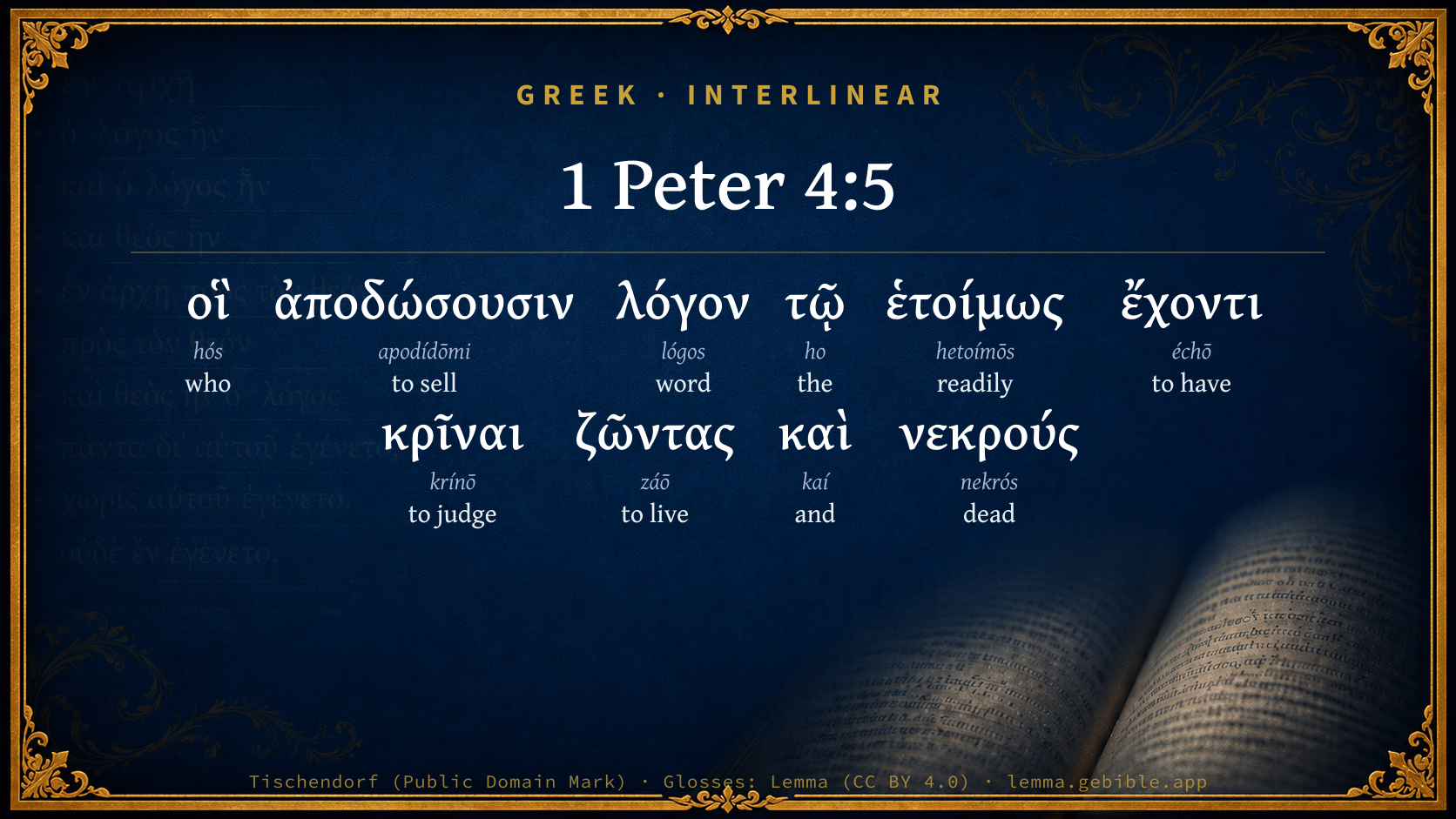
Greek (Tischendorf 8th ed.) 1 Peter 4:5 appears in the Greek New Testament. The text above is from the Tischendorf 8th edition. Each word links to its Strong’s number and a concise gloss. Click any word for its full Thayer’s Greek Lexicon entry.
Download image
Cite this verse

1 Peter 4:5 (World English Bible). Public Domain. Lemma interlinear Bible study tool, https://lemma.gebible.app/v/1-peter/4/5.

Show BibTeX & RIS
BibTeX
RIS
English Translation
who will give account to him who is ready to judge the living and the dead.
World English Bible · Public Domain
Download a study sheet

One document with this verse’s original text, its word-by-word gloss line, the meaning frame, cross-references with their text, attributed commentary, and full source and license credits — printable, and it pastes into notes with its structure intact.

This verse Autodidact and up

Study sheet (.html) Plain text (.txt)

A passage Seminary Student

Up to 50 verses in one chapter. A passage sheet keeps up to 6 commentary sources and 12 cross-references per verse, in the order this page ranks them, and says so on the sheet whenever that leaves anything out. Ask for a single verse and you get the Autodidact verse sheet above.

Everything on this page stays free to read, with no account — the sheet is a download of what is already on screen, not access to it.

Want to remove ads? Support Godless Engineer
Compare translations 3

The same verse in 3 English versions, stacked beneath the original-language interlinear above. Click any original word for its lexicon entry.

Each is an independent rendering of the whole verse — the interlinear is not word-aligned to these translations.

Highlighted words mark where these versions differ — a whole-verse word diff, not a word-by-word alignment.

  • World English Bible Public Domain
    who will give account to him who is ready to judge the living and the dead.
  • King James Version Public Domain
    Who shall give account to him that is ready to judge the quick and the dead.
  • unfoldingWord Literal Text CC BY-SA 4.0
    they will give a word to the one being ready to judge those living and dead ones.

unfoldingWord Literal Text — © unfoldingWord, licensed CC BY-SA 4.0. Word-aligned USFM3 via Door43 (git.door43.org/unfoldingWord/en_ult).

Versions to compare (up to 4)

3 of 4 selected

Show all 19 translations

Every available English version of this verse, each an independent rendering of the whole verse.

  • World English Bible Public Domain
    who will give account to him who is ready to judge the living and the dead.
  • Berean Standard Bible Public Domain
    But they will have to give an account to Him who is ready to judge the living and the dead.
  • Majority Standard Bible Public Domain
    But they will have to give an account to Him who is ready to judge the living and the dead.
  • King James Version Public Domain
    Who shall give account to him that is ready to judge the quick and the dead.
  • American Standard Version (1901) Public Domain
    who shall give account to him that is ready to judge the living and the dead.
  • Revised Version (1885) Public Domain
    who shall give account to him that is ready to judge the quick and the dead.
  • Geneva Bible (1599) Public Domain
    Which shall giue accounts to him, that is readie to iudge quicke and dead.
  • Douay-Rheims (1899) Public Domain
    Who shall render account to him, who is ready to judge the living and the dead.
  • Young's Literal Translation Public Domain
    who shall give an account to Him who is ready to judge living and dead,
  • Literal Standard Version CC BY-SA 4.0
    who will give an account to Him who is ready to judge [the] living and [the] dead,
  • Unlocked Literal Bible CC BY-SA 4.0
    They will give an account to the one who is ready to judge the living and the dead.
  • unfoldingWord Literal Text CC BY-SA 4.0
    they will give a word to the one being ready to judge those living and dead ones.
  • Darby Bible Public Domain
    who shall render account to him who is ready to judge [the] living and [the] dead.
  • World Messianic Bible Public Domain
    They will give account to him who is ready to judge the living and the dead.
  • Webster's Bible Public Domain
    Who shall give account to him that is ready to judge the living and the dead.
  • Free Bible Version CC BY-SA 4.0
    That's why the good news was shared with those who've already died—
  • Bible in Basic English Public Domain
    But they will have to give an account of themselves to him who is ready to be the judge of the living and the dead.
  • Text-Critical English NT CC BY 4.0
    But they will give an account to him who is ready to judge the living and the dead.
  • Tyndale New Testament (1534) Public Domain
    which shall geve a comptes to him that is redy to iudge quycke and deed.

Literal Standard Version (2020), Covenant Press — licensed CC BY-SA 4.0. Text via the HelloAO Bible API (eBible.org). Unlocked Literal Bible (unfoldingWord) — licensed CC BY-SA 4.0. Text via the HelloAO Bible API (eBible.org). unfoldingWord Literal Text — © unfoldingWord, licensed CC BY-SA 4.0. Word-aligned USFM3 via Door43 (git.door43.org/unfoldingWord/en_ult). Free Bible Version, Dr. Jonathan Gallagher — licensed CC BY-SA 4.0. Text via the HelloAO Bible API (eBible.org).

Word by word

More ways to search: Search by grammar → Find every occurrence → Compare this word →

Practice this passage: Drill this verse → Learn its vocabulary →

About this verse

These counts appear in no published source. They are computed here, from the morphology-tagged text and Lemma’s own curated glosses. What Lemma adds →

10
words
10
distinct lemmas
General Epistles
section

Notable vocabulary

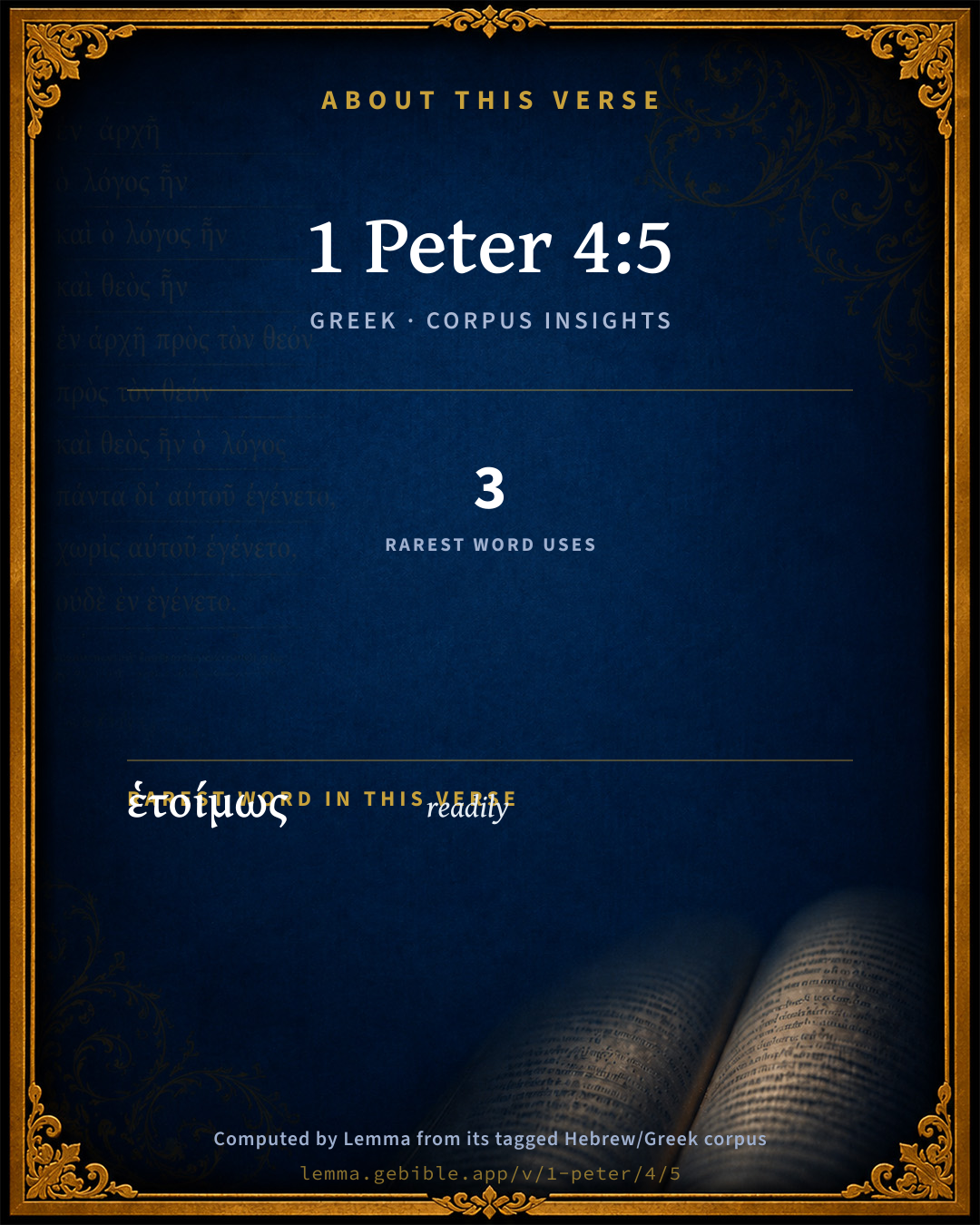
The rarest word here is ἑτοίμως readily G2093 — appearing just 3 times in the whole Greek New Testament.

Shared distinctive vocabulary

ἑτοίμως readily G2093 occurs in 3 verses of the Greek New Testament. Also found in:

Cross-references

16

Topical passages linked to 1 Peter 4:5 in the Treasury of Scripture Knowledge — connected by theme and wording, ordered by reader-vote popularity; previews shown in the World English Bible.

  • James 5:9 Don't grumble, brothers, against one another, so that you won't be judged. Behold, the judge stands at the door.
  • Acts 10:42 He charged us to preach to the people and to testify that this is he who is appointed by God as the Judge of the living and the dead.
  • 2 Timothy 4:1 I charge you therefore before God and the Lord Jesus Christ, who will judge the living and the dead at his appearing and his Kingdom:
  • Romans 14:10–12 But you, why do you judge your brother? Or you again, why do you despise your brother? For we will all stand before the judgment seat of Christ.
  • John 5:22–23 For the Father judges no one, but he has given all judgment to the Son,
  • Matthew 12:36 I tell you that every idle word that men speak, they will give account of it in the day of judgment.
  • Acts 17:31 because he has appointed a day in which he will judge the world in righteousness by the man whom he has ordained; of which he has given assurance to all men, in that he has raised him from the dead."
  • Jude 1:14–15 About these also Enoch, the seventh from Adam, prophesied, saying, "Behold, the Lord came with ten thousands of his holy ones,
  • Psalms 1:6 For Yahweh knows the way of the righteous, But the way of the wicked shall perish.
  • Malachi 3:13–15 "Your words have been stout against me," says Yahweh. "Yet you say, 'What have we spoken against you?'
  • John 5:28–29 Don't marvel at this, for the hour comes, in which all that are in the tombs will hear his voice,
  • 1 Corinthians 15:51–52 Behold, I tell you a mystery. We will not all sleep, but we will all be changed,
  • Ecclesiastes 12:14 For God will bring every work into judgment, with every hidden thing, whether it is good, or whether it is evil.
  • Ezekiel 18:30 Therefore I will judge you, house of Israel, everyone according to his ways, says the Lord Yahweh. Return you, and turn yourselves from all your transgressions; so iniquity shall not be your ruin.
  • Matthew 25:31–46 "But when the Son of Man comes in his glory, and all the holy angels with him, then he will sit on the throne of his glory.
  • Luke 16:2 He called him, and said to him, 'What is this that I hear about you? Give an accounting of your management, for you can no longer be manager.'

Cross-references courtesy of OpenBible.info (CC BY 4.0).

Commentary

Notes on 1 Peter 4:5 from classic Christian and Jewish commentators (each source and its license shown beneath its notes). The classic Christian expositions comment on the surrounding passage and are grouped to its opening verse, so a note may address several verses; the Jewish commentaries on the Tanakh (Rashi and others) are per-verse, so they appear only where the commentator wrote on this verse.

Lemma curates 59 commentaries, every one of them public domain or Creative Commons licensed, each selected and text-cleaned for this edition rather than reprinted as found. About our sources →

The Cambridge Bible for Schools and Colleges

gen. ed. J. J. S. Perowne

5. who shall give account] The phrase is one of the many echoes in this Epistle of our Lord’s teaching (Luk_16:2). The thought of the Final Judgment from which there will be no appeal is made here, as in 1Co_4:5, a motive for patience and courage under the false accusations and unjust judgments of men. They who now demand an account (chap. 1Pe_3:15) will one day have to render it. Christ holds Himself in readiness to judge both the living and the dead. There is nothing in the context to lead us to any other than a literal interpretation of the familiar phraseology. Commentators who have taken the words of those who are spiritually living and spiritually dead have been led, for the most part, by their unwillingness to accept the natural meaning of the words that follow.

The Cambridge Bible for Schools and Colleges (gen. ed. J. J. S. Perowne; Cambridge University Press, 1878–1918) — public domain. Text from a community e-Sword module.

Bengel's Gnomon

Johann Albrecht Bengel

1Pe 4:5. Ἀποδώσουσι λόγου, shall give account) in particular of their evil speaking: Jud 1:15.—τῷ) to Christ.—ἑτοίμως ἔχοντι, who is ready) The apostles, when they do not professedly treat of the time of Christ’s coming, set forth that coming as close at hand to their expectation and piety: hence it is that Peter comprehends those who then reviled under the living, as though shortly about to be judged.

Bengel's Gnomon of the New Testament — English translation (T&T Clark, Edinburgh, 1860) — public domain. Text from a community e-Sword module.

Meyer's Critical & Exegetical Commentary

Heinrich August Wilhelm Meyer

1Pe_4:5 points to the judgment which awaits the evil-speaking heathen: οἱ ἀποδώσουσι λόγον] ἀποδ. λόγον (Mat_12:36; Heb_13:17; Act_19:40). Antithesis to αἰτεῖν λόγον, chap. 1Pe_3:15.

τῷ ἑτοίμως ἔχοντι] that is, the Saviour risen, and seated at the right hand, chap. 1Pe_3:22, de Wette.

The expression: ἑτοίμως ἔχειν, to be ready, with the exception of here, only in Act_21:13; 2Co_12:14.

κρῖναι ξῶντας καὶ νεκρούς] As often in the N. T. of the last judgment, which by ἑτοίμ. ἔχ. is pointed out as near at hand; comp. 1Pe_4:7. ζῶντας καὶ νεκρούς does not denote some dead and some alive, but the aggregate of all, whether they be living or already dead when the day of judgment comes; comp. Act_10:42; 2Ti_4:1.[239] It is erroneous to understand by the quick and the dead the Christians only (Wichelhaus, Schott), or those who speak evil only. Peter, by naming Him to whom the evil-speakers shall render an account, the Judge of the quick and the dead, implies thereby that they are not to remain unpunished, whether they die before the day of judgment or not. And this, as a testimony to the justice of God, should serve to comfort the Christians under the calumnies which they had to endure, and exhort them not to be led aside by them to a denial of their Christian walk.

It must further be observed, that this passage adds the last to those elements of the glory of the exalted Saviour mentioned at the close of the last chapter, namely, the office of judge which He will execute at the end of the days.

[239] Gerhard: vivos, quos judex veniens reperiet vivos, mortuos, quos ex sepulcris in vitam revocabit. Several commentators erroneously understand the words ζῶντας καὶ νεκρούς in a figurative sense; Joh. Huss: vivos in gratia ad beatitudinem, mortuos in culpa ad damnationem; Bened. Arias: vivos adhuc in carne illa Adami: mortuos in Christo.

Meyer — Critical and Exegetical Commentary on the New Testament — English translation by Peter Christie, edited by Frederick Crombie (T&T Clark, 1880) — public domain. Text from a community e-Sword module.

Expositor's Greek Testament

ed. W. Robertson Nicoll

1Pe 4:5 . ἀποδώσουσιν λόγον , will render account if of their blasphemy, cf. Mat 12:36 , if of their ἀσωτία (see note) cf. the steward of Luk 16:2 . τῷ ἑτοίμως κρίνοντι , i.e. , to Christ rather than to God (as 1Pe 1:17 ). The Christians took over the Jewish doctrine that every man must give an account of his life (Rom 14:10 ). As already Enoch (lxix. 27 = Joh 5:22 ; Joh 5:27 ) taught that this judgment was delegated to Messiah. So St. Peter said at Caesarea this is he that hath been appointed by God judge of living and dead (Act 10:43 ). Compare Mat 25:31 ff. for a more primitive and pictorial statement. The use of ἑτοίμως probably represents עתיד (see 1Pe 1:5 ) i.e. , the future judge ; Greek readers would understand the imminent judge ( cf. use of ἑτοίμως = ready, sure to come , Homer, Il. , xviii. 96, etc.). The 5., ἑ . ἔχοντι κρῖναι softens the rugged original.

The Expositor's Greek Testament, edited by W. Robertson Nicoll (1897–1910) — public domain. Text from a community e-Sword module.

Jamieson, Fausset & Brown

Robert Jamieson, A. R. Fausset & David Brown

They who now call you to account falsely, shall have to give account themselves for this very evil-speaking (Jde 1:15), and be condemned justly.

ready--very speedily (Pe1 4:7; Pe2 3:10). Christ's coming is to the believer always near.

Jamieson, Fausset & Brown — Commentary Critical and Explanatory on the Whole Bible (1871) — public domain (CC PDM 1.0). Text via the HelloAO Bible API.

Adam Clarke's Commentary

Verse 5. To judge the quick and the dead.] They shall give account of these irregularities to Him who is prepared to judge both the Jews and the Gentiles. The Gentiles, previously to the preaching of the Gospel among them, were reckoned to be dead in trespasses and sins, Eph 2:1-5; under the sentence of death, because they had sinned. The Jews had at least, by their religious profession, a name to live; and by that profession were bound to give to God.

Adam Clarke's Commentary on the Bible (1810–1826) — public domain. Text from a community e-Sword/MySword module.

Ellicott's Commentary for English Readers

(5) Who shall give account.—Perhaps said with a reference to 1Pe_3:15, where these very persons call the Christians to give “account” (the Greek word is the same). The side-purpose of the clause (as in the similar threat, 1Pe_2:8) is to warn the readers against sharing their fate by sharing their sins.

To him that is ready to judge.—This carries on the history of Jesus Christ a step further still. The last thing was His sitting on the right hand of God. This is the order of the Apostles’ Creed. Bengel wisely remarks: “The Apostles, when they are not expressly treating of the date of Christ’s advent, set forth that advent to their longing and devotion as close at hand. Hence Peter includes the slanderers of his day among the living, as just about to be judged.”

A Bible Commentary for English Readers, edited by Charles John Ellicott (1878–1897) — public domain. Text from a community e-Sword module.

John Gill's Exposition

Who shall give account to him,.... "To God himself", as the Syriac version reads; of all their blasphemies, and hard speeches spoken by them against God, Christ, the Gospel, and good men, and receive their just punishment. This the apostle says, to calm the minds of God's people, and make them to sit easy under all censures, reproaches, and calumnies, and not think of avenging themselves, but commit themselves to him that will judge righteously; even to him,

that is ready to judge the quick and the dead; that is, all men, such as will be found alive when he comes, and those that have died before, who will then be raised from the dead, to receive their judgment; and by whom is meant the Lord Jesus Christ, to whom all judgment is committed; and who is ordained to be the Judge of quick and dead, and will judge both at his appearing and kingdom; yea, the day is appointed when this judgment will proceed by him, and he is at the door; so that he may be truly said to be ready for it, as he is every way equal to it, and will finish it with righteousness.

John Gill's Exposition of the Whole Bible (1746–1763) — public domain (CC PDM 1.0). Text via the HelloAO Bible API.

Trapp's Complete Commentary

John Trapp

5 Who shall give account to him that is ready to judge the quick and the dead.

Ver. 5. Who shall give account] Of their ungodly deeds and hard speeches, Jdg 1:15. Angels did their first execution in the world upon luxurious Sodomites; they will be very active doubtless against such at the last day. See 2Pe 2:10, and mark that word, chiefly.

John Trapp, A Commentary or Exposition upon All the Books of the Old and New Testament (1647–1656) — public domain. Text from a community e-Sword module.

Albert Barnes' Notes on the Bible

Who shall give account - That is, they shall not do this with impunity. They are guilty in this of a groat wrong and they must answer for it to God.

That is ready to judge - That is, “who is prepared to judge” - τῷ ἑτοίμως ἔχοντι tō hetoimōs echonti. See the phrase used in Act 21:13; “I am ready not to be bound only, but also to die at Jerusalem.” 2Co 12:14; “the third time I am ready to come to you.” Compare the word “ready” - ἑτοιμος hetoimos - in Mat 22:4, Mat 22:8; Mat 24:44; Mat 25:10; Luk 12:40; Luk 22:33; 1Pe 1:5. The meaning is, not that he was about to do it, or that the day of judgment was near at hand - whatever the apostle may have supposed to be true on that point - but that he was prepared for it; all the arrangements were made with reference to it; there was nothing to hinder it.

To judge the quick and the dead - The living and the dead; that is, those who shall be alive when he comes, and those in their graves. This is a common phrase to denote all who shall be brought before the bar of God for judgment. See the Act 10:42 note; 1Th 4:16-17 notes; 2Ti 4:1 note. The meaning in this connection seems to be, that they should bear their trials and the opposition which they would meet with patiently, not feeling that they were forgotten, nor attempting to avenge themselves; for the Lord would vindicate them when he should come to judgment, and call those who had injured them to an account for all the wrongs which they had done to the children of God.

Albert Barnes' Notes on the Bible (1834–1885) — public domain. Text from a community e-Sword/MySword module.

Matthew Poole's English Annotations

Who shall give account to him; of their evil speaking as well as of other sins, Jud 1:15; it is a metaphor taken from stewards giving account to their masters, Mat 18:23; Luk 16:2.

That is ready; not only prepared for it, but at hand to do it, Jam 5:9.

To judge the quick and the dead; those that shall be alive at Christ’s coming, and those that died before, but then shall be raised, and brought to judgment. Hereby he intimates, for their comfort, that though their enemies and ill-willers might outlive them, yet they shall not escape God’s judgment.

Matthew Poole's English Annotations on the Holy Bible (1683–1685) — public domain. Text from a community e-Sword/MySword module.

Whedon's Commentary on the Bible

Daniel D. Whedon

5. Give account—Since these profligates and revilers must render an account to Christ, his maligned and suffering people may safely leave their vindication in his hands, following his own example, 1Pe_2:23.

Ready to judge—The blessed side of Christ’s readiness for his second advent, St. Peter sets forth in his speech in Solomon’s porch. Act_3:19-20. And he is, on his part, fully prepared to take his seat on the judgment throne, as he has ever been since the apostle wrote. Not the nearness of the event, but its certainty, is intended.

The quick and the dead—It obviates no difficulty to take these words figuratively. They must, we think, be taken in their usual sense, as in Act_10:42, Rom_14:9, and 2Ti_4:1, meaning those who are living when Christ comes, and those who are then dead.

Daniel D. Whedon (gen. ed.), Commentary on the Old and New Testaments (1874–1909) — public domain. Text from a community e-Sword module.

The Pulpit Commentary

Who shall give account to him that is ready to judge the quick and the dead. The judgment is at hand; the Judge standeth before the door; all men, quick and dead alike, must give account to him. It is better to suffer now for well-doing than then for evil-doing. Men call you to give account now; (1Pe_3:15) they themselves must give account to God.

The Pulpit Commentary (1880–1919), ed. H.D.M. Spence-Jones & Joseph S. Exell — public domain. Text from a community e-Sword module.

John Wesley's Explanatory Notes

Who shall give account - Of this, as well as all their other ways. To him who is ready - So faith represents him now.

John Wesley, Explanatory Notes Upon the Whole Bible (1754–1765) — public domain. Text via the GEBible commentary corpus.

Godbey's Commentary on the New Testament

William B. Godbey

ARGUMENT 19

THE GOSPEL PREACHED TO ALL, LIVING AND DEAD

5. This certifies the general judgment, where all living and dead shall stand before the great white throne.

6. “For unto this was the Gospel also preached to the dead in order that they may be judged according to men in the flesh, and live according to God in the Spirit.” There is no argument here for second probation and not the slightest inference that the Gospel was preached to any one after death, but to the dead generations, while they were living. How is this Christ himself is the Gospel, the true light, “which lighteth every man that cometh into the world” (John 19). The Holy Ghost, who shines on every human soul in all ages and nations, is the Spirit of Christ. Hence Paul says (Romans 1), “The heathens are left without excuse,” as salvation is, and always has been, possible to every human being. 1Jn 1:7, “If we walk in the light... The blood cleanses from all sin,” applies to every human being, regardless of age, race or religion. Those who walk in all the light they have, not only receive pardon, but complete purification from sin and readiness for heaven. In the final judgment, those who have lived under the former dispensation will be judged by the Old Testament only, Christian nations by the whole Bible, while the heathen will only be judged by the laws of nature. Thus the Holy Spirit, the Revelator of Christ, so shines upon every human soul as to leave none with an apology before the judgment bar, where they will only be responsible for the light they have rejected.

William B. Godbey, Commentary on the New Testament (1896–1900) — public domain. Text from a community e-Sword module.

The People's New Testament

B. W. Johnson

5. Who shall give account. Those sinners, who not only persist in their unholy lives, but persecute the saints because they will not sin with them. Christ shall judge living and the dead.

B. W. Johnson's The People's New Testament with Notes (1889–1891) — public domain. Electronic text from the Christian Classics Ethereal Library (CCEL) ThML edition.

Cambridge Greek Testament for Schools and Colleges

5. οἵ. For this abrupt and emphatic use of the relative, cf. Rom 3:8.

δίδοναι or ἀποδίδοναι λόγον is used of rendering account in Mat 12:36; Luk 16:2; Act 19:40; Rom 14:12; Heb 4:13; Heb 13:17.

τῷ ἑτοίμως κρίνοντι. The T.R. reads ἑτοίμως ἔχοντι κρῖναι for which phrase cf. Act 21:13; 2Co 12:14 and ἐν ἑτοίμῳ ἔχειν, 2Co 10:6.

Bengel explains “Paratus est Judex; nam evangelio praedicato nil nisi finis restat.” The living will soon have heard the Gospel, the dead have already done so, therefore all is ready for the judgment. But the reading of the best MSS. ἑτοίμως κρίνοντι means not so much that the judgment is ready to be executed but that God judges readily “with the unerring precision of perfect knowledge” (Chase, Hastings D. of B. III. 795). He knows the opportunities which He has afforded to all and their consequent responsibility in accepting or rejecting His message.

ζῶντας καὶ νεκρούς, the judgment of “the quick and the dead” is referred to again only in St Peter’s speech to Cornelius, Act 10:42, where Christ is the appointed Judge and in 2Ti 4:1, but cf. Rom 14:9. Here the personality of the Judge is not stated, but in 1Pe 1:17, 1Pe 2:23 God is spoken of as judging.

Cambridge Greek Testament for Schools and Colleges (Cambridge University Press, 1896; 21 vols, various authors incl. Carr, Maclear, Plummer, Farrar, Lumby, Moule, M. R. James, Simcox) — public domain. Text from a community e-Sword module.

Alford’s Greek Testament

Henry Alford

5.] who (your blasphemers. The consideration is propounded for the comfort and stay of Christians unjustly slandered) shall render account (reff.) to Him that is ready (reff.) to judge (aor.: once for all, decisively) living and dead.

Henry Alford, The Greek Testament (1849–1861) — public domain. Text from a community e-Sword module.

Vincent's Word Studies in the New Testament

Marvin R. Vincent

That is ready [ετοιμως εχοντι] . Lit, having himself in readiness; there at God 's right hand in heaven, wither he has gone (ch. 3 22). Implying, also, a near judgment. Compare ver. 7.

Marvin R. Vincent, Word Studies in the New Testament (1887–1900) — public domain. Text from a community e-Sword/MySword module.

Lesson kit

Teaching starters — assembled from the data on this page, not authored interpretation. Every prompt links to the verse data it draws on. Edit before teaching.

1 Peter, in the General Epistles, opens this verse with 10 words (10 distinct Greek lemmas). Its most distinctive word is hetoímōs (“readily”). A historical commentator’s framing appears above. Read the whole chapter for the surrounding context.

Discussion questions

  1. What does “readily” (hetoímōs) contribute to the verse as a whole?
  2. Acts 21:13 shares the word «readily» with this verse. How do the two illuminate each other?
  3. The translations on this page render this verse differently — a whole-verse word diff, not a word-by-word alignment. What might account for the different wordings?
  4. Reading how The Cambridge Bible for Schools and Colleges and Bengel's Gnomon read this verse, where do the two commentators agree and where do they part?

Things to notice

Reading settings

Reading text

Shown beneath each verse's original-language words.

Old Testament
Old Testament edition

Read the OT as the Masoretic Hebrew (MT) or the Greek Septuagint (LXX).

English shown for the Greek Septuagint (in the Hebrew ↔ Greek comparison).

Comparing translations? Open the Compare panel on any verse page to stack up to four side by side.