Revelation 1:18

Greek (Tischendorf 8th ed.) Revelation 1:18 appears in the Greek New Testament. The text above is from the Tischendorf 8th edition. Each word links to its Strong’s number and a concise gloss. Click any word for its full Thayer’s Greek Lexicon entry.
Download image
Cite this verse

Revelation 1:18 (World English Bible). Public Domain. Lemma interlinear Bible study tool, https://lemma.gebible.app/v/revelation/1/18.

Show BibTeX & RIS
BibTeX
RIS
English Translation
and the Living one. I was dead, and behold, I am alive forevermore. Amen. I have the keys of Death and of Hades.
World English Bible · Public Domain
Download a study sheet

One document with this verse’s original text, its word-by-word gloss line, the meaning frame, cross-references with their text, attributed commentary, and full source and license credits — printable, and it pastes into notes with its structure intact.

This verse Autodidact and up

Study sheet (.html) Plain text (.txt)

A passage Seminary Student

Up to 50 verses in one chapter. A passage sheet keeps up to 6 commentary sources and 12 cross-references per verse, in the order this page ranks them, and says so on the sheet whenever that leaves anything out. Ask for a single verse and you get the Autodidact verse sheet above.

Everything on this page stays free to read, with no account — the sheet is a download of what is already on screen, not access to it.

Want to remove ads? Support Godless Engineer
Compare translations 3

The same verse in 3 English versions, stacked beneath the original-language interlinear above. Click any original word for its lexicon entry.

Each is an independent rendering of the whole verse — the interlinear is not word-aligned to these translations.

Highlighted words mark where these versions differ — a whole-verse word diff, not a word-by-word alignment.

  • World English Bible Public Domain
    and the Living one. I was dead, and behold, I am alive forevermore. Amen. I have the keys of Death and of Hades.
  • King James Version Public Domain
    I am he that liveth, and was dead; and, behold, I am alive for evermore, Amen; and have the keys of hell and of death.
  • unfoldingWord Literal Text CC BY-SA 4.0
    and the one living; and I became dead, but behold, I am living to the ages of the ages, and I have the keys of death and of Hades.

unfoldingWord Literal Text — © unfoldingWord, licensed CC BY-SA 4.0. Word-aligned USFM3 via Door43 (git.door43.org/unfoldingWord/en_ult).

Versions to compare (up to 4)

3 of 4 selected

Show all 19 translations

Every available English version of this verse, each an independent rendering of the whole verse.

  • World English Bible Public Domain
    and the Living one. I was dead, and behold, I am alive forevermore. Amen. I have the keys of Death and of Hades.
  • Berean Standard Bible Public Domain
    the Living One. I was dead, and behold, now I am alive forever and ever! And I hold the keys of Death and of Hades.
  • Majority Standard Bible Public Domain
    the Living One. I was dead, and behold, now I am alive forever and ever. Amen. And I hold the keys of Death and of Hades.
  • King James Version Public Domain
    I am he that liveth, and was dead; and, behold, I am alive for evermore, Amen; and have the keys of hell and of death.
  • American Standard Version (1901) Public Domain
    and the Living one; and I was dead, and behold, I am alive for evermore, and I have the keys of death and of Hades.
  • Revised Version (1885) Public Domain
    and the Living one; and I was dead, and behold, I am alive for evermore, and I have the keys of death and of Hades.
  • Geneva Bible (1599) Public Domain
    And am aliue, but I was dead: and beholde, I am aliue for euermore, Amen: and I haue the keyes of hell and of death.
  • Douay-Rheims (1899) Public Domain
    And alive, and was dead, and behold I am living for ever and ever, and have the keys of death and of hell.
  • Young's Literal Translation Public Domain
    and he who is living, and I did become dead, and, lo, I am living to the ages of the ages. Amen! and I have the keys of the hades and of the death.
  • Literal Standard Version CC BY-SA 4.0
    and He who is living, and I became dead, and behold, I am living through the ages of the ages. Amen! And I have the keys of Hades and of death.
  • Unlocked Literal Bible CC BY-SA 4.0
    and the one who lives. I was dead, but look, I live forever! And I have the keys of death and of Hades.
  • unfoldingWord Literal Text CC BY-SA 4.0
    and the one living; and I became dead, but behold, I am living to the ages of the ages, and I have the keys of death and of Hades.
  • Darby Bible Public Domain
    and the living one: and I became dead, and behold, I am living to the ages of ages, and have the keys of death and of hades.
  • World Messianic Bible Public Domain
    and the Living one. I was dead, and behold, I am alive forever and ever. Amen. I have the keys of Death and of Sheol.
  • Webster's Bible Public Domain
    I am he that liveth, and was dead; and behold, I am alive for evermore, Amen; and have the keys of hell and of death.
  • Free Bible Version CC BY-SA 4.0
    the living one. I was dead, but look! Now I am alive for ever and ever, and I hold the keys of death and the grave.
  • Bible in Basic English Public Domain
    And I was dead, and see, I am living for ever, and I have the keys of death and of Hell.
  • Text-Critical English NT CC BY 4.0
    the living one. I was dead, but behold, I am alive forevermore. Amen. I have the keys of Death and Hades.
  • Tyndale New Testament (1534) Public Domain
    and am alyve and was deed. And beholde I am alyve for ever more and have the kayes of hell and of deeth.

Literal Standard Version (2020), Covenant Press — licensed CC BY-SA 4.0. Text via the HelloAO Bible API (eBible.org). Unlocked Literal Bible (unfoldingWord) — licensed CC BY-SA 4.0. Text via the HelloAO Bible API (eBible.org). unfoldingWord Literal Text — © unfoldingWord, licensed CC BY-SA 4.0. Word-aligned USFM3 via Door43 (git.door43.org/unfoldingWord/en_ult). Free Bible Version, Dr. Jonathan Gallagher — licensed CC BY-SA 4.0. Text via the HelloAO Bible API (eBible.org).

Word by word

More ways to search: Search by grammar → Find every occurrence → Compare this word →

Practice this passage: Drill this verse → Learn its vocabulary →

κλεῖς
kleís
G2807
“key”
Noun, Accusative, Plural, Feminine
Part of Speech
Noun
Case
Accusative
Number
Plural
Gender
Feminine
Full Thayer's Definition

Origin: from G2808

TDNT: 15:24,4

1. a key a. since the keeper of the keys has the power to open and to shut b. metaph. in the NT to denote power and authority of various kinds
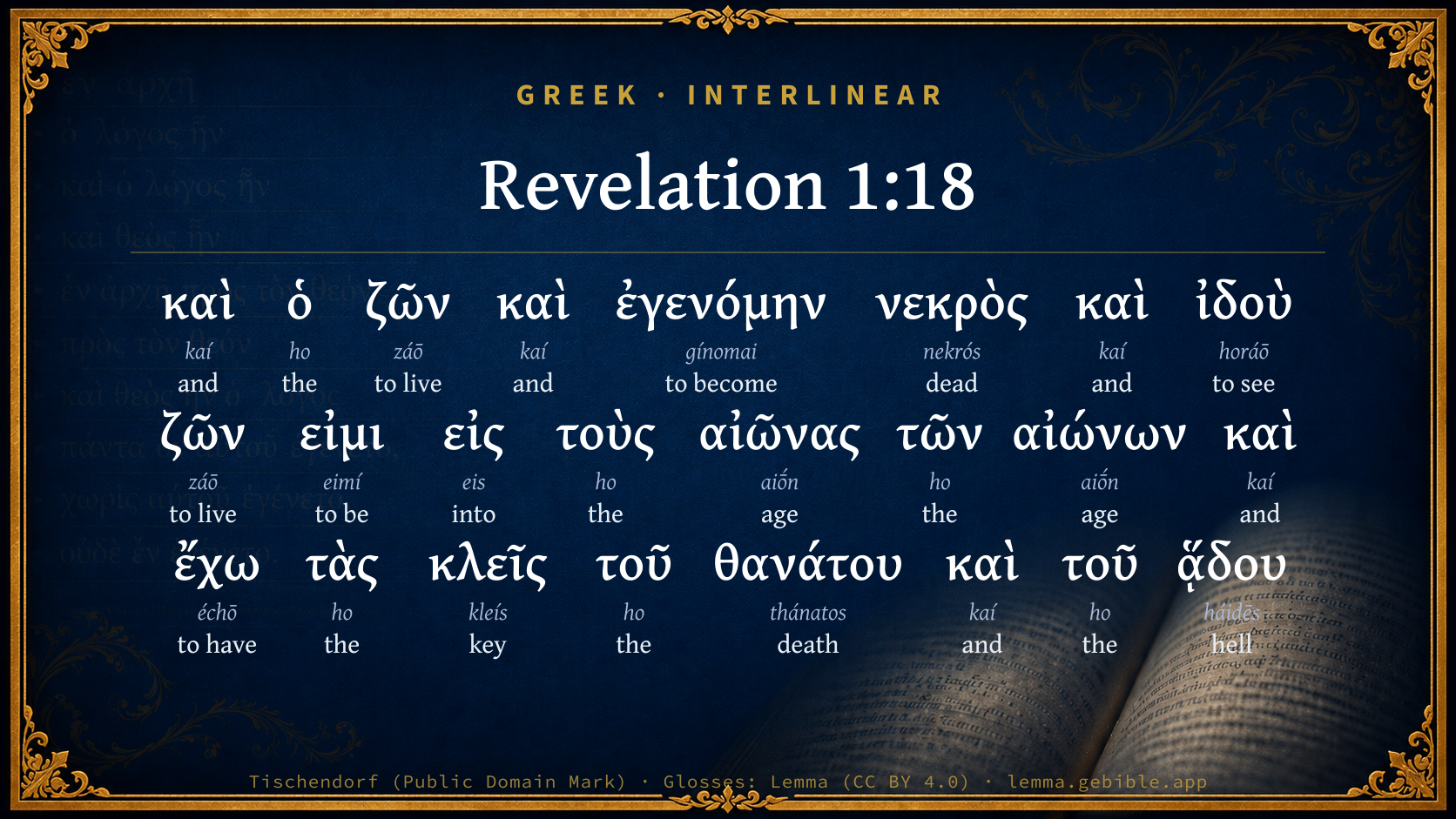
  1. καὶ kaí G2532 “and” Conjunction
  2. ὁ ho G3588 “the” Article, Nominative, Singular, Masculine
  3. ζῶν záō G2198 “to live” Verb, Present, Active, Participle, Nominative, Singular, Masculine
  4. καὶ kaí G2532 “and” Conjunction
  5. ἐγενόμην gínomai G1096 “to become” Verb, Aorist, Middle deponent, Indicative, 1st person, Singular
  6. νεκρὸς nekrós G3498 “dead” Adjective, Nominative, Singular, Masculine
  7. καὶ kaí G2532 “and” Conjunction
  8. ἰδοὺ horáō G3708 “to see” Verb, Aorist, Middle, Imperative, 2nd person, Singular
  9. ζῶν záō G2198 “to live” Verb, Present, Active, Participle, Nominative, Singular, Masculine
  10. εἰμι eimí G1510 “to be” Verb, Present, Active, Indicative, 1st person, Singular
  11. εἰς eis G1519 “into” Preposition
  12. τοὺς ho G3588 “the” Article, Accusative, Plural, Masculine
  13. αἰῶνας aiṓn G165 “age” Noun, Accusative, Plural, Masculine
  14. τῶν ho G3588 “the” Article, Genitive, Plural, Masculine
  15. αἰώνων aiṓn G165 “age” Noun, Genitive, Plural, Masculine
  16. καὶ kaí G2532 “and” Conjunction
  17. ἔχω échō G2192 “to have” Verb, Present, Active, Indicative, 1st person, Singular
  18. τὰς ho G3588 “the” Article, Accusative, Plural, Feminine
  19. τοῦ ho G3588 “the” Article, Genitive, Singular, Masculine
  20. θανάτου thánatos G2288 “death” Noun, Genitive, Singular, Masculine
  21. καὶ kaí G2532 “and” Conjunction
  22. τοῦ ho G3588 “the” Article, Genitive, Singular, Masculine
  23. ᾅδου háidēs G86 “hell” Noun, Genitive, Singular, Masculine

About this verse

These counts appear in no published source. They are computed here, from the morphology-tagged text and Lemma’s own curated glosses. What Lemma adds →

24
words
13
distinct lemmas
Revelation
section

Notable vocabulary

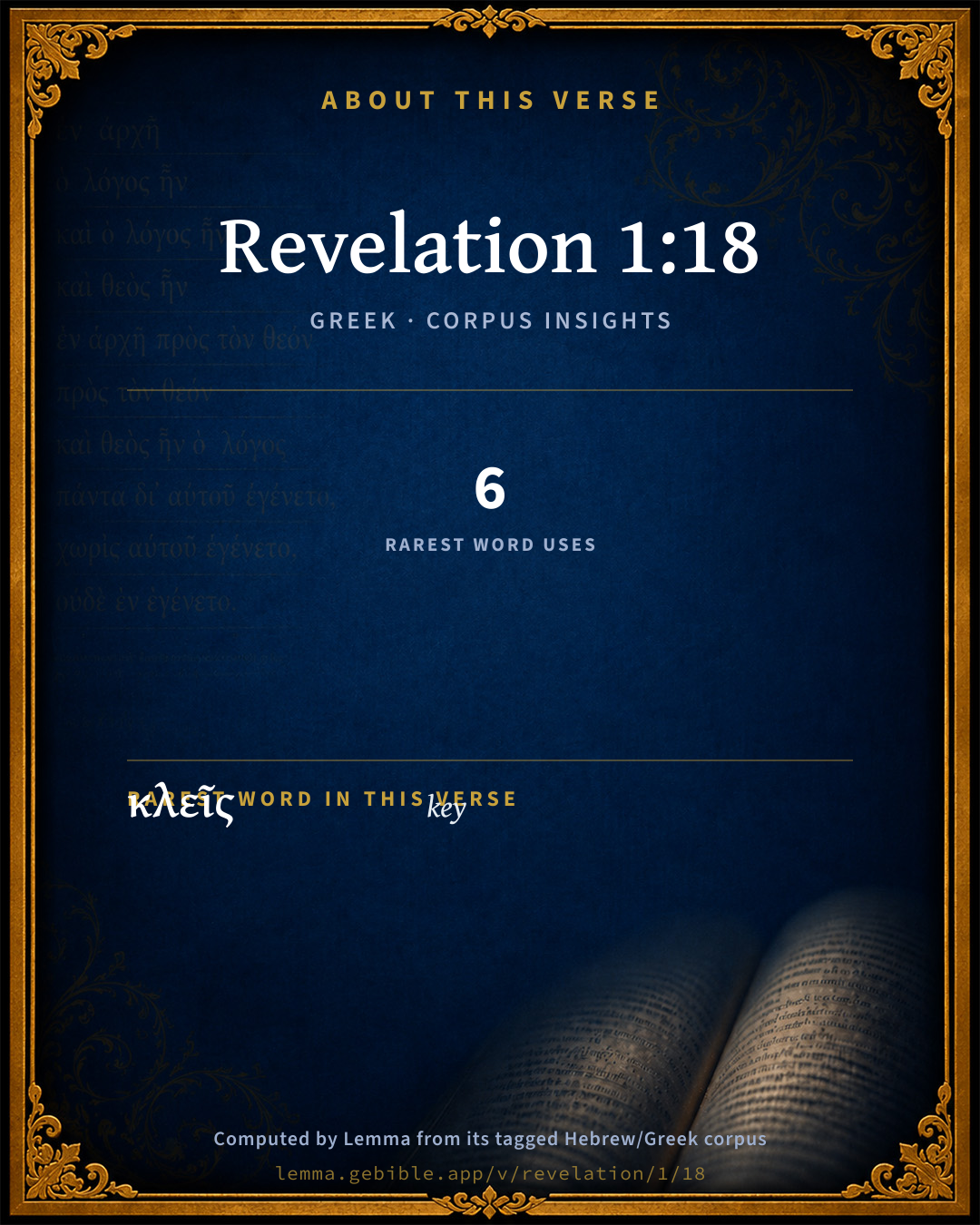
The rarest word here is κλεῖς key G2807 — appearing just 6 times in the whole Greek New Testament.

Shared distinctive vocabulary

κλεῖς key G2807 occurs in 6 verses of the Greek New Testament. Also found in:

Repetition

Words recur within this verse:

  • ζῶν to live G2198 ×2
  • αἰῶνας age G165 ×2
  • ὁ the G3588 ×6
  • καὶ and G2532 ×5

Cross-references

22

Topical passages linked to Revelation 1:18 in the Treasury of Scripture Knowledge — connected by theme and wording, ordered by reader-vote popularity; previews shown in the World English Bible.

  • Romans 6:9 knowing that Christ, being raised from the dead, dies no more. Death no more has dominion over him!
  • Hebrews 7:25 Therefore he is also able to save to the uttermost those who draw near to God through him, seeing he ever lives to make intercession for them.
  • Romans 14:8–9 For if we live, we live to the Lord. Or if we die, we die to the Lord. If therefore we live or die, we are the Lord's.
  • Psalms 68:20 God is to us a God of deliverance. To Yahweh, the Lord, belongs escape from death.
  • Isaiah 22:22 The key of the house of David will I lay on his shoulder; and he shall open, and none shall shut; and he shall shut, and none shall open.
  • Revelation 3:7 "To the angel of the assembly in Philadelphia write: "He who is holy, he who is true, he who has the key of David, he who opens and no one can shut, and who shuts and no one opens, says these things:
  • Matthew 16:19 I will give to you the keys of the Kingdom of Heaven, and whatever you bind on earth will be bound in heaven; and whatever you release on earth will be released in heaven."
  • Hebrews 12:2 looking to Jesus, the author and perfecter of faith, who for the joy that was set before him endured the cross, despising shame, and has sat down at the right hand of the throne of God.
  • Hebrews 7:16 who has been made, not after the law of a fleshly commandment, but after the power of an endless life:
  • Revelation 20:1–2 I saw an angel coming down out of heaven, having the key of the abyss and a great chain in his hand.
  • Galatians 2:20 I have been crucified with Christ, and it is no longer I that live, but Christ living in me. That life which I now live in the flesh, I live by faith in the Son of God, who loved me, and gave himself up for me.
  • Hebrews 1:3 His Son is the radiance of his glory, the very image of his substance, and upholding all things by the word of his power, when he had by himself made purification for our sins, sat down on the right hand of the Majesty on high;
  • Job 19:25 But as for me, I know that my Redeemer lives. In the end, he will stand upon the earth.
  • 2 Corinthians 5:14–15 For the love of Christ constrains us; because we judge thus, that one died for all, therefore all died.
  • 2 Corinthians 13:4 For he was crucified through weakness, yet he lives through the power of God. For we also are weak in him, but we will live with him through the power of God toward you.
  • Revelation 4:9 When the living creatures give glory, honor, and thanks to him who sits on the throne, to him who lives forever and ever,
  • Revelation 20:14 Death and Hades were thrown into the lake of fire. This is the second death, the lake of fire.
  • John 14:19 Yet a little while, and the world will see me no more; but you will see me. Because I live, you will live also.
  • Psalms 18:46 Yahweh lives; and blessed be my rock. Exalted be the God of my salvation,
  • Colossians 3:3 For you died, and your life is hidden with Christ in God.
  • Revelation 9:1 The fifth angel sounded, and I saw a star from the sky which had fallen to the earth. The key to the pit of the abyss was given to him.
  • Revelation 5:14 The four living creatures said, "Amen!" The elders fell down and worshiped.

Cross-references courtesy of OpenBible.info (CC BY 4.0).

Where the printed editions differ

1 variant

Places in this verse where the major printed Greek editions disagree on the wording in a way that affects the translation — a comparison of editions, not a manuscript-by-manuscript collation. The editions are the modern critical texts (Nestlé-Aland 28/27, SBL, Westcott-Hort, Tregelles, Tyndale House) and the traditional texts behind the KJV (the Textus Receptus and the Byzantine/Majority text). It is not a claim about which reading is original.

  1. Extra text
    ἀμήν

    “Amen”

    In TRByz Not in NA28NA27TynSBLWHTreg

    ἀμήν (amēn) 'Amen' is only in traditional manuscripts (TR+Byz)

Textual data: Translators Amalgamated Greek New Testament (STEPBible TAGNT) · CC BY 4.0.

Commentary

Notes on Revelation 1:18 from classic Christian and Jewish commentators (each source and its license shown beneath its notes). The classic Christian expositions comment on the surrounding passage and are grouped to its opening verse, so a note may address several verses; the Jewish commentaries on the Tanakh (Rashi and others) are per-verse, so they appear only where the commentator wrote on this verse.

Lemma curates 59 commentaries, every one of them public domain or Creative Commons licensed, each selected and text-cleaned for this edition rather than reprinted as found. About our sources →

MacLaren's Expositions of Holy Scripture

Alexander MacLaren

Revelation

THE LIVING ONE WHO BECAME DEAD

Rev 1:18.

If we had been in ‘the isle which is called Patmos’ when John saw the glorified Lord, and heard these majestic words from His mouth, we should probably have seen nothing but the sunlight glinting on the water, and heard only the wave breaking on the shore. The Apostle tells us that he ‘was in the Spirit’; that is, in a state in which sense is lulled to sleep and the inner man made aware of supersensual realities. The communication was none the less real because it was not perceived by the outward eye or ear. It was not born in, though it was perceived by, the Apostle’s spirit. We must hold fast by the objective reality of the communication, which is not in the slightest degree affected by the assumption that sense had no part in it.

Further what John once saw always is; the vision was a transient revelation of a permanent reality. The snowy summits are there, behind the cloud-wrack that hides them, as truly as they were when the sunshine gleamed on their peaks. The veil has fallen again, but all behind it is as it was. So this revelation, both in regard of the magnificent symbolic image imprinted on the Apostle’s consciousness, and in regard of the words which he reports to us as impressed upon him by Christ Himself, is meant for us just as it was for him, or for those to whom it was originally transmitted. ‘He that hath an ear, let him hear what the Spirit saith to the churches.’ And as we meditate upon this proclamation by the kingly Christ Himself of His own style and titles, I think we shall best gain its full sublimity and force if we simply take the words, clause by clause, as they stand in the text.

I. First, then, the royal Christ proclaims His absolute life.

Observe that, as the Revised Version will show those who use it, there is a much closer connection between the words of our text and those of the preceding verse than our Authorized Version gives. We must strike out that intrusive and wholly needless supplement,’ I am,’ and read the sentence unbrokenly: ‘I am the first, and the last and the living One.’

Now that close connection of clauses in itself suggests that this expression, ‘the Living One,’ means something more than the mere declaration that He was alive. That follows appropriately, as we shall see, in the last clause of the verse, which cannot be cleared from the charge of tautology, unless we attach a far deeper meaning than the mere declaration of life to this first solemn clause. What can stand worthily by the side of these majestic words, ‘I am the first and the last’? These claim a Divine attribute and are a direct quotation from ancient prophecy, where they are spoken as by the great Jehovah of the old covenant, and appear in a connection which makes any tampering with them the more impossible. For there follow upon them the great words, ‘and beside Me there is no God.’ But this royal Christ from the heavens puts out an unpresumptuous hand, and draws to Himself, as properly belonging to Him, the very style and signature of the Divine nature, ‘I am the first’-before all creatural being, ‘and the last,’ as He to whom it all tends-its goal and aim. And therefore I say that this connection of clauses, apart altogether from other consideration, absolutely forbids our taking this great word, ‘the Living One,’ as meaning less than the similar lofty and profound signification. It means, as I believe, exactly what Jesus Christ meant when, in the hearing of this same Apostle, He said upon earth, ‘As the Father hath life in Himself so hath He given’- strange paradox-’ so hath He given to the Son to have life in Himself.’ A life which, considered in contrast with all the life of creatures, is underived, independent, self-feeding, and, considered in contrast with the life of the Father with whom that Son stands in ineffable and unbroken union, is bestowed. It is a paradox, I know, but until we assume that we have sounded all the depths and climbed all the heights, and gone round the boundless boundaries of the circumference of that Divine nature, we have no business to say that it is impossible. And this, as I take it, is what the great words that echoed from Heaven in the Apostle’s hearing upon Patmos meant-the claim by the glorified Christ to possess absolute fontal life, and to be the Source of all creation, ‘in whom was life.’ He was not only ‘the Living One,’ but, as Himself has said, He was ‘the Life.’ And so He was the agent of all creation, as Scripture teaches us.

Now I am not going to dwell upon this great thought, but I simply wish, in one sentence, to leave with you my own earnest conviction that it is the teaching of all Scripture, that it is distinctly the teaching of Christ Himself when on earth; that it is repeated in a real revelation from Himself to the recipient seer in this vision before us, that it is fundamental to all true understanding of Christ’s person and work, since none of His acts on earth shine in their full lustre of beauty unless the thought of His pre-incarnate and essential life is held fast to heighten all the marvels of His condescension, and to invest with power all the sweetness of His pity. ‘I am the first, and the last, and the Living One.’

II. Secondly, the royal Christ proclaims His submission to death.

The language of the original is, perhaps, scarcely capable of smooth transference into English, but it is to be held fast notwithstanding, for what is said is not ‘I was dead,’ as describing a past condition, but ‘I became dead,’ as describing a past act. There is all the difference between these two, and avoidance of awkwardness is dearly purchased by obliteration of the solemn teaching of that profound word ‘ became.’

I need not dwell upon this at any length, but I suggest to you one or two plain considerations. Such a statement implies our Lord’s assumption of flesh. The only possibility of death, for ‘ the Living One,’ lies in His enwrapping Himself with that which can die. As you might put a piece of asbestos into a twist of cotton wool, over which the flame could have power, or as a sun might plunge into thick envelopes of darkness, so this eternal, absolute Life gathered to itself by voluntary accretion the surrounding which was capable of mortality. It is very significant that the same word which the seer in Patmos employs to describe the Lord’s submission to death is the word which, in his character of evangelist, he employs to describe the same Lord’s incarnation: ‘The Word became flesh,’ and so the Life ‘became dead.’ And this expression implies, too, another thing, on which I need not dwell, because I was touching on it in a previous sermon, and that is the entirely voluntary character of our Lord’s submission to the great law of mortality. He ‘became ‘ dead, and it was His act that He became so.

Thus we are brought into the presence of the most stupendous fact in the world’s history. Brethren, as I said that the firm grasp of the other truth of Christ’s absolute life was fundamental to all understanding of His earthly career, so I say that this fundamental truth of His voluntarily becoming dead is fundamental to all understanding of His Cross. Without that thought His death becomes mere surplusage, in so far as His power over men is concerned. With it, what adoration can be too lowly, what gratitude can be disproportionate? He arrays Himself in that which can die, as if the sun plunged into the shadow of eclipse. Let us bow before that mystery of Divine love, the death of the Lord of Life. The motive which impelled Him, the consequences which followed, are | not in view here. These are full of blessedness and of wonder, but we are now to concentrate our thoughts on the bare fact, and to find in it food for endless adoration and for perpetual praise.

But there is another consideration that I may suggest. The eternal Life became dead. Then the awful solitude-awful when we think of it for ourselves, awful when we stand by the bed, and feel so near, and yet so infinitely remote from the dear one that may be lying there-the awful solitude is solitary no longer. ‘All alone, so Heaven has willed, we die’; but as travelers are cheered on a solitary road when they see the footprints that they know belonged to loved and trusted ones who have trodden it before, that desolate loneliness is less lonely when we think that He became dead. He will come to the shrinking, single j soul as He joined Himself to the sad travelers on the I road to Emmaus, and ‘our hearts’ may burn within us, even in that last hour of their beating, if we can remember who has become dead and trodden the road before us.

III. The royal Christ proclaims His eternal life in glory.

‘Behold!’-as if calling attention to a wonder-’ I am alive for evermore.’ Again, I say, we have here a distinctly Divine prerogative claimed by the exalted Christ, as properly belonging to Himself. For that eternal life of which He speaks is by no means the communicated immortality which He imparts to them that in His love go down to death, but it is the inherent eternal life of the Divine nature.

But, mark, who is the ‘I’ that speaks? The seer has told us: ‘One like unto the Son of Man’-which title, whether it repeats the name which our Lord habitually used, or whether, as some persons suppose, it should be read ‘ a Son of Man,’ and merely declares that the vision of the glorified One was manlike, is equally relevant for my present purpose. For that is to ask you to mark that the ‘I’ of my text is the Divine human Jesus. The manhood is so intertwined with the Deity that the absolute life of the latter has, as it were, flowed over and glorified the former; and it is a Man who lays His hand upon the Divine prerogative, and says, ‘I live for evermore.’

Now why do I dwell upon thoughts like this? Not for the purpose merely of putting accurately what I believe to be the truth, but for the sake of opening out to you and to myself the infinite treasures of consolation and strength which lie in that thought that He who ‘is alive for evermore’ is not merely Divine in His absolute life, but, as Son of Man, lives for ever. And so,’ because I live, ye shall live also.’ We cannot die as long as Christ is alive. And if we knit our hearts to Him, the Divine glory which flows over His Manhood will trickle down to ours, and we, too, though by derivation, shall possess as immortal - and, in its measure, as glorious-a life as that of the Brother who reigns in Heaven, the Man Christ Jesus.

His resurrection is not only the demonstration of what manhood is capable and so, as I believe, the one irrefragable and all-satisfying proof of immortality, but it is also the actual source of that immortal life to all of us, if we will trust ourselves to Him. For it is only because ‘He both died and rose and revived’ that He, in the truest and properest sense, becomes the gift of life to us men. The alabaster box was broken, and the house was filled with the odour of the ointment. Christ’s death is the world’s life. Christ’s resurrection is the pledge and the source of eternal life for us.

IV. And so, lastly, the royal Christ proclaims His authority over the dim regions of the dead.

Much to be regretted are two things in our Authorized Version’s rendering of the final words of our text. One is the order in which, following an inferior reading, it has placed the two things specified. And the other is that deplorable mistranslation, as it has come to be, of the word hades by the word ‘hell.’ The true original does not read ‘hell and death,’ but ‘death and hades,’ the dim unseen regions in which all the dead, whatsoever their condition may be, are gathered. The hades of the New Testament includes the paradise into which the penitent thief was promised entrance, as well as the Gehenna which threatened to open for the impenitent.

Here it is figured as being a great gloomy fortress, with bars and gates and locks, of which that’ shadow feared of man’ is the warder, and keeps the portals. But he does not keep the keys. The kingly Christ has these in His own hand. So, brethren, He has authority to open and to shut; and death is not merely a terror nor is it altogether accounted for, when we say either that it is the fruit of sin, or that it is the result of physical laws. For behind the laws is the will-the will of the loving Christ. It is His hand that opens the dark door, and they who listen aright may hear Him say, when He does it,’ Come! My people; enter thou into thy chamber until these calamities be over past.’ ‘He openeth, and no man shutteth; He shutteth, and no man openeth.’ So is not the terror gone; and ‘the raven plumes of that darkness smoothed until it smiles’?

If we believe that He has the keys, how shall we dread when ourselves or our dear ones have to enter into the portal? There are two gates to the prison house, and when the one that looks earthwards opens, the other, that gives on the heavens, opens too, and the prison becomes a thoroughfare, and the light shines through the short tunnel even to the hither side.

Because He has the keys, He will not leave His holy ones in the fetters. And for ourselves, and for our dearest, we have the right to think that the darkness is so short as to be but like an imperceptible wink of the eye; and ere we know that we have passed into it, we shall have passed out.

‘This is the gate of the Lord, into which the righteous shall enter.’ And it may be with us as it was with the Apostle who was awakened out of his sleep by the angel-only we shall be awakened out of ours by the angel’s Master-and who did not come to himself, and know that he had been delivered, until he had passed through the iron gate ‘that opened to him of its own accord’; and then, bewildered, he recovered himself when he found that, with the morning breaking over his head, he stood, delivered, in the city.

Alexander MacLaren, Expositions of Holy Scripture (1904–1910) — public domain. Text from a community e-Sword module.

Tyndale Open Study Notes

Tyndale Open Resources

1:18 the living one: Because the Son of Man (1:13) has conquered death, he holds the keys of death and controls the outcome of our greatest fear (see 20:14; Heb 2:14-15). Jesus has complete authority to provide hope in a hostile world. • the grave: Greek Hades. See study note on Rev 6:7-8.

Tyndale Open Study Notes — © Tyndale Open Resources, licensed CC BY-SA 4.0. Text via the HelloAO Bible API.

Bengel's Gnomon

Johann Albrecht Bengel

Rev 1:18. Ἐγενόμην νεκρὸς, I became dead) It might have been said, ἀπέθανον, I died: but in this passage with singular elegance it is said, I became dead, to denote a difference of times, and of the events in them.—αἰώνων) Both the formula εἰς τοὺς αἰῶνας τῶν αἰώνων, and the word ἀμὴν, are of very frequent use in Doxologies. Therefore the copyists with ready pen completed that formula by writing this word (ἀμὴν[22]), though there is no Doxology, as I have observed in my Apparatus. [See Ed. II. on this passage, where a memorable caution is given respecting a too great estimation of the Editions.]

[22] Rec. Text has ἀμήν, with B and Syr. But AC Vulg. h, Memph. Orig. Iren. omit it.—E.

Bengel's Gnomon of the New Testament — English translation (T&T Clark, Edinburgh, 1860) — public domain. Text from a community e-Sword module.

Expositor's Greek Testament

ed. W. Robertson Nicoll

Rev 1:18 . Not “it is I, the first and the last” (which would require ἐγώ εἰμι before μὴ φοβοῦ ), but “I am, etc.” The eternal life of the exalted Christ is a comfort both in method and result; ἐγενόμην νεκρός (not ὡς ; really dead), his experience assuring men of sympathy and understanding; καὶ ἰδοὺ , κ . τ . λ ., his victory and authority over death = an assurance of his power to rescue his own people from the grim prison of the underworld (Hades, cf. 3Ma 5:50 , the intermediate abode of the dead, being as usual personified in connexion with death). A background for this conception lies in the primitive idea of Janus, originally an Italian sun-god, as the key-holder ( cf. Ovid’s Fasti , i. 129, 130, Hor. Carm. Sec. 9, 10) who opens and closes the day (sun = deus clauiger), rather than in Mithraism which only knew keys of heaven, or in Mandæan religion (Cheyne’s Bible Problems , 102 106). The key was a natural Oriental symbol for authority and power ( cf. in this book, Rev 3:7 , Rev 9:1 , Rev 20:1 ). Jewish belief (see Gfrörer, i. 377 378) assigned three keys or four exclusively to God (“quos neque angelo neque seraphino committit”); these included, according to different views, “clauis sepulchorum,” “clavis uitae,” “clauis resurrectionis mortuorum”. To ascribe this divine prerogative to Jesus as the divine Hero who had mastered death is, therefore, another notable feature in the high Christology of this book. For the whole conception see E. B. D. ch. 64. (fifth century B.C.?): “I am Yesterday and To-day and To-morrow … I am the Lord of the men who are raised again; the Lord who cometh forth from out of the darkness.” It is based on the theophany of the Ancient of Days in Dan 7:9 f. (yet cf. Rev 10:5-6 ), who bestows on the ideal Israel ( ὡς υἱὸς ἀνθ .) dominion. John changes this into a Christophany, like the later Jewish tradition which saw in υἱὸς ἀ . a personal, divine messiah. When one remembers the actual position of affairs, the confident faith of such passages is seen to have been little short of magnificent. To this Christian prophet, spokesman of a mere ripple upon a single wave of dissent in the broad ocean of paganism, history and experience find unity and meaning nowhere but in the person of a blameless Galilean peasant who had perished as a criminal in Jerusalem. So would such early Christian expectations appear to an outsider. He would be staggered by the extraordinary claims advanced on behalf of its God by this diminutive sect, perhaps more than staggered by the prophecy that imperial authority over the visible and invisible worlds lay ultimately in the hands of this deity, whose power was not limited to his own adherents. Christophanies were commissions either to practical service (Act 10:19 , etc.), or, as here, so composition.

The Expositor's Greek Testament, edited by W. Robertson Nicoll (1897–1910) — public domain. Text from a community e-Sword module.

Jamieson, Fausset & Brown

Robert Jamieson, A. R. Fausset & David Brown

Translate as Greek, "And THE LIVING ONE": connected with last sentence, Rev 1:17.

and was--Greek, "and (yet) I became."

alive for evermore--Greek, "living unto the ages of ages": not merely "I live," but I have life, and am the source of it to My people. "To Him belongs absolute being, as contrasted with the relative being of the creature; others may share, He only hath immortality: being in essence, not by mere participation, immortal" [THEODORET in TRENCH]. One oldest manuscript, with English Version, reads Amen." Two others, and most of the oldest versions and Fathers, omit it. His having passed through death as one of us, and now living in the infinite plenitude of life, reassures His people, since through Him death is the gate of resurrection to eternal life.

have . . . keys of hell--Greek, "Hades"; Hebrew, "Sheol." "Hell" in the sense, the place of torment, answers to a different Greek word, namely, Gehenna. I can release from the unseen world of spirits and from DEATH whom I will. The oldest manuscripts read by transposition, "Death and Hades," or Hell." It is death (which came in by sin, robbing man of his immortal birthright, Rom 5:12) that peoples Hades, and therefore should stand first in order. Keys are emblems of authority, opening and shutting at will "the gates of Hades" (Psa 9:13-14; Isa 38:10; Mat 16:18).

Jamieson, Fausset & Brown — Commentary Critical and Explanatory on the Whole Bible (1871) — public domain (CC PDM 1.0). Text via the HelloAO Bible API.

Adam Clarke's Commentary

Verse 18. I am he that liveth, and was dead] I am Jesus the Saviour, who, though the fountain of life, have died for mankind; and being raised from the dead I shall die no more, the great sacrifice being consummated. And have the keys of death and the grave, so that I can destroy the living and raise the dead. The key here signifies the power and authority over life, death, and the grave. This is also a rabbinical form of speech. In the Jerusalem Targum, on Ge 30:22, are these words: "There are four KEYS in the hand of God which he never trusts to angel or seraph. 1. The key of the rain; 2. The key of provision; 3. The key of the grave; and 4. The key of the barren womb."

In Sanhedrin, fol. 113, 1, it is said: "When the son of the woman of Sarepta died, Elijah requested that to him might be given the key of the resurrection of the dead. They said to him, there are three KEYS which are not given into the hand of the apostle, the key of life, the key of the rain, and the key of the resurrection of the dead." From these examples it is evident that we should understand αδης, hades, here, not as hell, nor the place of separate spirits, but merely as the grave; and the key we find to be merely the emblem of power and authority. Christ can both save and destroy, can kill and make alive. Death is still under his dominion, and he can recall the dead whensoever he pleases. He is the resurrection and the life.

Adam Clarke's Commentary on the Bible (1810–1826) — public domain. Text from a community e-Sword/MySword module.

Ellicott's Commentary for English Readers

(18) I am he that liveth, and was dead.—Better, and the living One (omit the words “I am”); and I became dead; and, behold, I am alive (or, I am living) unto the ages of ages (or, for evermore), “Amen” is omitted in the best MSS. This verse must be carefully kept in connection with the preceding, as the description should go on without pause. He is the living One—not merely one who once was alive, or is now alive—but the One who has “life in Himself, and the fountain and source of life to others, Joh_1:4; Joh_14:6; the One who hath immortality,” 1Ti_6:16 (Trench). Yet He became dead. There are two wonders here: the living One becomes dead, and the dead One is alive for evermore. It is another form of the glorious truth and paradox of which the Apostles were so fond (Php_2:8-9; Heb_2:9). Comp. Christ’s words, Luk_9:24, and Luke 13:43, which contain promises which He only could make who could say, “I have the keys of death and of Hades.” The order of these words has been transposed in our English version. The true order is the more appropriate order, “For Hades is the vast unseen realm into which men are ushered by death; dark and mysterious as that realm was, and dreaded as was its monarch, our risen Lord has both under His power. The keys are the emblems of His right and authority.” (Comp. Rev_3:7-8.) It is not of the second death that He speaks; our Lord is here seen as the conqueror of that clouded region, and that resistless foe which man dreaded. (Comp. Joh_11:25; Heb_2:15.) Comp. Henry Vaughan’s quaint poem “An Easter Hymn”—

“Death and darkness get you packing,

Nothing now to man is lacking;

All your triumphs now are ended,

And what Adam marred is mended;

Graves are beds now for the weary,

Death a nap to wake more merry.

Christ had spoken before of the gates of hell (Mat_16:18), and of the keys. (Comp. also 1Pe_3:19.) The key of the grave was one of the four keys which the Eternal King committed to no ministering angel, but reserved for himself (so Targum and Talmud). The whole verse affirms the undying power and inalienable authority of our Master, and is a fitting prelude to a book which is to show the inherent divine tenacity of Christianity. The Church lives on because Christ its Head lives on (Joh_14:19). The resurrection power which the Lord showed is to be reflected in the history of His Church. “The greatest honour is due to Christianity,” says Goethe, “for continually proving its pure and noble origin by coming forth again, after the great aberrations into which human perversity has led it, more speedily than was expected, with its primitive special charm as a mission. . . . for the relief of human necessity”

A Bible Commentary for English Readers, edited by Charles John Ellicott (1878–1897) — public domain. Text from a community e-Sword module.

The Cambridge Bible for Schools and Colleges

gen. ed. J. J. S. Perowne

18. I am he] Literally, I am the First and the Last, and He that liveth; and I was dead and am alive.

l am alive] The words “was” and “am” are emphatic—contrasting His temporal and temporary death with His eternal life: see on Rev_1:4.

Amen] Should be omitted.

of hell and of death] Read, of death and of hell. “Hell” is Hades, the receptacle of the dead: usually personified in this book, as indeed is death, Rev_6:8, Rev_20:13-14. But here they are rather conceived as places, prisons wherein the dead are confined, and from which Christ can deliver them. We read of “the gates of death” in Psa_9:13; Job_38:17, and “the gates of hell” in Isa_38:10; Mat_16:18.

The Cambridge Bible for Schools and Colleges (gen. ed. J. J. S. Perowne; Cambridge University Press, 1878–1918) — public domain. Text from a community e-Sword module.

John Gill's Exposition

I am he that liveth,.... As the eternal God, who has life in himself, originally, essentially, and inderivatively, and is the fountain and author of life to others; and who ever lived as the Mediator and Redeemer, and still does, and ever will, yea, even when he was dead as man:

and was dead; he died the death of the cross, for the sins of his people, in due time, and but once; and it was but a short time he was held under the power of death, and will never die any more:

and behold I am alive for evermore, Amen; he was always alive as God, or he was always the living God, and ever will be; and he is now alive as man, and will for ever continue so; and he is alive to God, he lives by him, with him, and to his glory; and he is alive to the benefit and advantage of his redeemed ones, for whom he died; he ever lives to make intercession for them; he rose again from the dead for their justification; their being quickened together with him, and their being begotten again to a lively hope, are owing to his being alive; and as their reconciliation is by his death, so their salvation, or the application of it to them, is by his interceding life; and his resurrection is the cause of theirs: this is very fitly said to John, who was fallen as dead at the feet of Christ, and might be to animate him against the fears of death, or whatever he was to meet with on account of Christ; as well as to make himself known unto him, who had before known him, living, dying, and risen again. The word "Amen" is left out in the Alexandrian copy, the Vulgate Latin, Syriac, and Ethiopic versions; but is in others, and is rightly retained, either as an asseveration of Christ to the truth of what is before said, or as an assent of John's unto it, who was a proper witness both of the death and resurrection of Christ:

and have the keys of hell and death; or "of death and hell"; as the words are transposed in the Alexandrian copy and Complutensian edition, in the Vulgate Latin and in all the Oriental versions, agreeably to Rev 6:8, by which phrase is expressed the power of Christ over both: his power over death is seen in taking away persons by death when he pleases, the instances of Ananias and Sapphira are proofs of this; and in delivering persons from death when near it, as the centurion's servant, Peter's wife's mother, and the nobleman's son of Capernaum; and in raising persons from the dead, as Jairus's daughter, the widow of Naam's son, and Lazarus, when he was here on earth; and in his raising up his own body when dead, and which will also appear in raising all the dead at the last day: and his power over "hell", by which may be meant the grave, or the place of the departed, and separate souls, or the place of the damned and of the devils which are there, will be seen in opening the graves at the time of the resurrection, when death and hell, or the grave, will deliver up the dead in them, at his command; and in retaining or sending out the separate souls "in hades"; and in opening the doors of hell, and casting in the wicked, and destroying them, soul and body, there; and in shutting them up, that they cannot come out from thence who are once in; and in binding Satan, and casting him into the bottomless pit, and shutting him up there, the key of which he has in his hand; and in preserving his church and people from his power and malice, so that the gates of hell cannot prevail against them. This is an expression of the sovereignty, power, and authority of Christ; and is designed to encourage and support John under his present concern and anxiety of mind about the person he saw in this vision: , "the key of the grave", and of the resurrection of the dead, is frequently said by the Jews to be one of the keys which are in the hands of the holy blessed God, and his only; not in the hands of an angel or a seraph, or any other (u),

(u) Bereshit Rabba, sect. 73. fol. 64. 3. Targum Jerus. in Gen. xxx. 21. & Jon in Deut. xxviii. 12. Zohar in Gen. fol. 67. 3. Pirke Eliezer, c. 34. T. Bab. Taanith, fol. 2. 1. & Sandedrin, fol. 113. 1.

John Gill's Exposition of the Whole Bible (1746–1763) — public domain (CC PDM 1.0). Text via the HelloAO Bible API.

Trapp's Complete Commentary

John Trapp

18 I am he that liveth, and was dead; and, behold, I am alive for evermore, Amen; and have the keys of hell and of death.

Ver. 18. That liveth and was dead] So can every regenerate man say, Luk 16:31; Eph 2:1. {See Trapp on "Eph 2:1"} All saints are "heirs of the grace of life," 1Pe 3:7.

And have the keys] The pope, therefore, is not key keeper, as he falsely boasteth, telling us, that God hath put under his feet the beasts of the field, the fowls of the air, and the fish of the sea; that is (as he interprets it), all the souls in earth, heaven, and purgatory. Christ, as a conqueror, hath the keys of hell and death delivered unto him.

John Trapp, A Commentary or Exposition upon All the Books of the Old and New Testament (1647–1656) — public domain. Text from a community e-Sword module.

Albert Barnes' Notes on the Bible

I am he that liveth, and was dead - I was indeed once dead, but now I live, and shall continue to live forever. This would at once identify him who thus appeared as the Lord Jesus Christ, for to no one else could this apply. He had been put to death; but he had risen from the grave. This also is given as a reason why John should not fear; and nothing would allay his fears more than this. He now saw that he was in the presence of that Saviour whom more than half a century before he had so tenderly loved when in the flesh, and whom, though now long absent, he had faithfully served, and for whose cause he was now in this lonely island. His faith in his resurrection had not been a delusion; he saw the very Redeemer before him who had once been laid in the tomb.

Behold, I am alive forevermore - I am to live forever. Death is no more to cut me down, and I am never again to slumber in the grave. As he was always to live, he could accomplish all his promises, and fulfil all his purposes. The Saviour is never to die again. He can, therefore, always sustain us in our troubles; he can be with us in our death. Whoever of our friends die, he will not die; when we die, he will still be on the throne.

Amen - A word here of strong affirmation - as if he had said, it is “truly,” or “certainly so.” See the notes on Rev 1:7. This expression is one that the Saviour often used when he wished to give emphasis, or to express anything strongly. Compare Joh 3:3; Joh 5:25.

And have the keys of hell and of death - The word rendered “hell” - ᾅδης Hadēs, “Hades” - refers properly to the underworld; the abode of departed spirits; the region of the dead. This was represented as dull and gloomy; as enclosed with walls; as entered through gates which were fastened with bolts and bars. For a description of the views which prevailed among the ancients on the subject, see the Luk 16:23 note, and Job 10:21-22 notes. To hold the key of this, was to hold the power over the invisible world. It was the more appropriate that the Saviour should represent himself as having this authority, as he had himself been raised from the dead by his own power (compare Joh 10:18), thus showing that the dominion over this dark world was entrusted to him.

And of death - A personification. Death reigns in that world. But to his wide-extended realms the Saviour holds the key, and can have access to his empire when he pleases, releasing all whom he chooses, and confining there still such as he shall please. It is probably in part from such hints as these that Milton drew his sublime description of the gates of hell in the “Paradise Lost.” As Christ always lives; as he always retains this power over the regions of the dead, and the whole world of spirits, it may be further remarked that we have nothing to dread if we put our trust in him. We need not fear to enter a world which he has entered, and from which he has emerged, achieving a glorious triumph; we need not fear what the dread king that reigns there can do to us, for his power extends not beyond the permission of the Saviour, and in his own time that Saviour will call us forth to life, to die no more.

Albert Barnes' Notes on the Bible (1834–1885) — public domain. Text from a community e-Sword/MySword module.

Haydock's Catholic Bible Commentary

And alive, and was dead; always living as God, and as man was dead, died on the cross for the salvation of all men, rose again, triumphed over hell, death, and sin, and am living for ever and ever, and have the keys of death and of hell, power over all, all things being made subject to me, even as man, or as God and man. (Witham)

George Leo Haydock (1774–1849), Haydock's Catholic Family Bible and Commentary, 1859 edition — public domain. Excludes Psalms (Douay-Rheims chapter numbering differs from Protestant) and Deuterocanonical books (Catholic canon only).

Matthew Poole's English Annotations

I am he that liveth, and was dead; and, behold, I am alive for evermore; the living God, who had life in myself, and gave life to the world, but assumed the human nature, and was made man, and in that nature died; but I rose again from the dead, and shall die no more, but ever live to make intercession for my people.

Amen; this is a great truth.

And have the keys of hell and of death; and have a power to kill, and cast into hell; or, I have the power over death, and the state of the dead, so as I can raise those that are dead to life again: I have the command of death, whether temporal or eternal; as he who hath the keys of a house can let in and shut out of it whom he pleaseth, so I bring to heaven and throw to hell whom I please.

Matthew Poole's English Annotations on the Holy Bible (1683–1685) — public domain. Text from a community e-Sword/MySword module.

Whedon's Commentary on the Bible

Daniel D. Whedon

18. He that liveth—With an underived essential life, the fountain of life, from which all finite life is a stream.

Was dead—Became dead. A contradiction in terms, harmonized in the real history.

Alive for evermore—Death shall never come into his future history. Through death he has attained a dominion over human destiny.

Keys—The symbols of possession or authority over treasures, or cities, or kingdoms.

Of hell… death—This reading, which is spurious, reverses the true order, which is, death and hell, or hades, the invisible region of departed spirits. See our note on 1Th_4:17. The words death and hades are not personifications, but designations of two realms. The realm of death includes “the pale nations of the dead,” the kingdom of material graves and corpses. To hold the keys of this realm is to be lord of life and death.

Hades is the realm of departed spirits, who wait the resurrection and judgment day. Of both these realms the dying and ever-living Christ has attained the right of lordship. Hengstenberg wishes to understand by hades, hell or gehenna; since Christ is lord of the destiny of the finally damned.

But that is included in his lordship over hades, inasmuch as he is lord of the destiny of the dwellers in hades.

Daniel D. Whedon (gen. ed.), Commentary on the Old and New Testaments (1874–1909) — public domain. Text from a community e-Sword module.

The Pulpit Commentary

I am he that liveth. This should be joined with what precedes. "I am the First and the Last, and the Living One; and I became dead, and behold I am alive forevermore, and I have the keys of death and of Hades. "Became" or "came to be" (egenomhn), as in vers. 9 and 10, indicates an exceptional condition. The "Amen" has been improperly inserted after "forevermore" (see on "forever and ever," in ver. 6) from liturgical usage. Most English versions omit it. The keys, as so often, are the sign of authority. (Rev_3:7 Rev_9:1 Rev_20:1 Mat_16:19) Christ, as the absolutely Living One, who "has life in himself" and is the Source of life in others, has control, not merely over the passage from this world to the other, but over the other world itself. He can recall departed souls from their resting place. The error of rendering Aidhv "hell" has often been pointed out; it is not a place of punishment, but the temporary home of the departed, who are awaiting the day of judgment. "Death," in all the best manuscripts and versions precedes "Hades;" and this is the logical order.

The extent of the Saviour"s mediatorial dominion.

As we pursue our studies of the Divine messages to the seven Churches, we shall find that our Lord addresses himself in some one distinctive aspect of his character and work to each Church, in accordance with the main burden of the letter which is to follow. But ere the letters to the separate Churches begin, our Lord makes an announcement respecting his mediatorial glory, which is of equal application to all the Churches, wherever they may be, and whatever may be their spiritual condition. It is this, I have the keys of Hades and of death. " We will inquire

I WHAT IS THE PREROGATIVE WHICH OUR LORD HERE DECLARES TO BE HIS? It is evident that there is some office of authority indicated by the word "keys." Keys are the symbol of authority, the token of office. (cf. Rev_3:7) The authority of our Saviour is here said to be over "Hades;" not over "hell," the region of the bad; but over Hades, the realm of the departed, good or bad. Both. The word "Hades" carries with it no moral significance at all, except as the connection in which it is used gives it a moral aspect. (Luk_16:23) The authority of our Saviour is over "death" also. This is, as it were, the gate opening to the invisible realm. The meaning of the words is that our Saviour has entire control over human destiny. Death is the last step, the one out of this life. Hades is the realm in which the departed are. All mankind, at death, pass into "the spacious world unseen." They go over "to the majority." To this realm death is the entrance gate. Over the realm itself, and the entrance to it, Christ has the supreme control the "keys" hang at his girdle. Let us indicate a few of the details of this doctrine.

1. The time of the departure of every individual from this world is under Christ"s control. Christ gives us our moments, and withdraws them. And when our time has come, ready or not ready, through the strange avenue of death we must go.

2. The entrance of a spirit into the invisible realm is under Christ"s control. In this unknown region there are two great moral divisions, even as here. There is no confusion of souls. The believer departs to be "with Christ"; (Php_1:23) the unbelieving and ungodly, to "torments." Their spirit carries with it its own sin and unrest. All are under Christ"s sway. He is Lord of the dead and of the living. The state of any spirit in the invisible world will he according to its attitude with reference to the Lord Jesus Christ.

3. Every believer will be, in Hades, as much in the guardianship of Christ as when on earth. "Christ died for us, that whether we wake or sleep, we should live together with him.

4. During the entire period until the completion of the mediatorial kingdom, the Redeemer will have sole authority in Hades. To this end he died, and rose, and re-lived.

5. At the time appointed by the Lord Jesus, the gates of both death and Hades shall be reopened. Bodies shall rise, spirits shall put on the new and mysterious vesture. All must stand before the tribunal of Christ, to receive through the body the things done. (2Co_5:10) All this the Lord Jesus will direct and control. Death and Hades will no longer exist. (Rev_20:14) The great separation day shall have come; and as men hear the "Come!" or "Depart!" will heaven or hell be theirs! But at every stage in the advance of souls Christ is Lord of all!

II THE LORD JESUS CHRIST FITTINGLY HOLDS AN OFFICE SO SUBLIME.

1. The right to do so is his.

(1) As the eternal Son of God, all creation is his dominion. And by virtue of his supreme and eternal sovereignty over all, he must be the Head of the human race, as well as of every other order of created beings. But if he be the Head of our race, by eternal, native right, he must sustain such relationship to it in every stage of its existence. Be it so that this mysterious invisible realm of departed spirits would not have existed except as the result of the Fall; be it so that it is a part of the mischief which has smitten our race; yet, that such a state does exist is the clear teaching of Scripture, and that Christ is Lord of it is in accord with what we know of his position in the universe; for in all things he has become the Pre-eminent One.

(2) He has also an acquired right as the Son of man, owing to his death struggle on behalf of humanity, in which he spoiled principalities and powers. Who else should sway man in the unseen realms, but he who died for men? How long wilt it be ere believers apprehend the vastness of the mediatorial dominion of the Lord Jesus? He is Lord both of the dead and of the living!

(3) It is an appointment of God the Father, that in all stages of man"s being the Lord Jesus should have dominion over him. Who can read Joh_6:37-40 without seeing that there is a great entrustment made over to our Lord as Mediator? This entrustment, according to Joh_17:2, is twofold.

(a) He has power over all flesh.

(b) He gives eternal life to those who are made over to him. We know not, indeed, Christ"s method of governing souls between death and the resurrection. What we know not now we shall know hereafter. It is enough for us that Christ rules all, and will do, till the end.

2. Those attributes are his that fit him for such sway.

(1) Omniscience. He knows

(a) the Father"s plans,

(b) what is in man,

(c) the appointed time for the consummation,

(d) how to bring it about with unfailing certainty.

(2) Omnipotence is his. He is able to keep us from falling, and to present us faultless before the presence of his glory with exceeding joy. He is all-sufficient.

(3) Faithfulness. The great trust which he so perfectly comprehends, and is so able to fulfil, will find his faithfulness equal to his knowledge and power. His own self sacrifice for the Church is guarantee of this.

(4) He is the Living One. He is "the same yesterday, and today, and forever." He has an unchangeable priesthood, and is able to save to the uttermost because he ever liveth.

III THE DOCTRINE OF THE TEXT IS OF INFINITE VALUE TO US.

1. Let us in faith and love adore him who makes the majestic claim of ruling life and death.

2. We have here a clue to the wondrous mystery of human existence. In a lecture reported to have been delivered in the Senate House, Cambridge, on Wednesday, May 26, 1880, by Dr. Humphry, Professor of Anatomy, on the topic, "Man, Prehistoric, Present, and Future," the lecturer closed with the following words: "After all, to the burning questions, whence? and where? whence comest thou, O man, and whither dost thou go? to which it might have been expected, by those who do not fully know their difficulties, that I should make, as regards the body at least, some answer, I am compelled to reply that we find ourselves simply floating on the streams of time. Sufficient for the day must be the knowledge thereof. Whether we peer fore or aft, it is obscurity. We are still crying in the night, Children crying for the light, And with no language but a cry.

But where science is compelled to leave off, the Saviour begins. And our faith, weaned from those who confess they know nothing, is transferred to him who is the Light of the world.

3. In regard to questions which still remain unanswered, we have perfect rest in Jesus.

4. We have abounding comfort concerning the death of believers, and entire peace as concerns our own. The writer was preaching from this text in the north of London, thirty years ago. A Christian lady was present who had been all her lifetime subject to bondage, through fear of death. The theme led the preacher to dilate on the guardianship of Christ over departed souls. The fearful one heard, was soothed, and on going home said, "Oh! my dread of death is gone. I have no fear now. Whenever my Father calls me, I am ready!" That night she was seized with a fit, and passed away. "Absent from the body, at home with the Lord." Finally, it is in this direction that the great difficulties which confront us as to the ultimate destiny of the great human family receive the only approximate solution. The great Redeemer"s sway is over the whole race. But only a minute fraction of the race is on earth at any one moment! Where, where are the countless millions on millions who have gone hence? We can only answerThey are all under Christ"s sway. He is guarding all his own with infinite love, and governing all others with absolute equity, getting all things in readiness to judge the living and the dead. This is all we know. It is enough. For fuller disclosures we can wait. As yet we could not bear to know more. Christ is Lord of all. "Hail to the Prince of life and death, Who holds the keys of death and hell! The spacious world unseen is his, And sovereign power becomes him well.

The Pulpit Commentary (1880–1919), ed. H.D.M. Spence-Jones & Joseph S. Exell — public domain. Text from a community e-Sword module.

John Wesley's Explanatory Notes

And he that liveth - Another peculiar title of God. And I have the keys of death and of hades - That is, the invisible world. In the intermediate state, the body abides in death, the soul in hades. Christ hath the keys of, that is, the power over, both; killing or quickening of the body, and disposing of the soul, as it pleaseth him. He gave St. Peter the keys of the kingdom of heaven; but not the keys of death or of hades. How come then his supposed successor at Rome by the keys of purgatory? From the preceding description, mostly, are taken the titles given to Christ in the following letters, particularly the four first.

John Wesley, Explanatory Notes Upon the Whole Bible (1754–1765) — public domain. Text via the GEBible commentary corpus.

Scofield Reference Notes

C. I. Scofield

hell

Hades, (See Scofield "Luk 16:23").

The Scofield Reference Bible (1917 edition), notes by C. I. Scofield — public domain. Text from a community e-Sword module.

Godbey's Commentary on the New Testament

William B. Godbey

18. “I have the keys of death and Hades.” Here we see that no person can die until God permits. People vainly talk about a Christian dying unsanctified. Such a thing never occurs. From the moment of your conversion, the holy Sanctifier is with you, holding the keys of death and Hades. He will not permit death to touch you till He finishes His work in your entire sanctification, which He can do in the twinkling of an eye if you are true. If you will not permit Him to sanctify you, but grieve Him away, you become a backslider, and drop into hell. Hades is a compound Greek word, meaning the unseen world, and including both heaven and hell. Gehenna is the Greek word which always means hell, and nothing else.

William B. Godbey, Commentary on the New Testament (1896–1900) — public domain. Text from a community e-Sword module.

The People's New Testament

B. W. Johnson

18. He that liveth, and was dead. Put to death but living. Have the keys of death and of Hades. Not only a victor over death, but the very gates of death and Hades are under his control. Hence he can deliver from the dead whom he will.

B. W. Johnson's The People's New Testament with Notes (1889–1891) — public domain. Electronic text from the Christian Classics Ethereal Library (CCEL) ThML edition.

Cambridge Greek Testament for Schools and Colleges

18. ἐγενόμην is emphatic in intentional contrast to ἐγώ εἰμι ὁ πρῶτος, and still more to ζῶν εἰμί, setting His temporal and temporary death against His eternal life; see on Rev 1:4.

τοῦ θανάτου καὶ τοῦ ἅδου. Hades is the receptacle of the dead: usually personified in this book, as indeed is death, Rev 6:8, Rev 20:13-14. But here they are rather conceived as places, prisons wherein the dead are confined, and from which Christ can deliver them. We read of “the gates of death “in Psa 9:13, Job 38:17; and “the gates of hell” in Isa 38:10, Mat 16:18.

Cambridge Greek Testament for Schools and Colleges (Cambridge University Press, 1896; 21 vols, various authors incl. Carr, Maclear, Plummer, Farrar, Lumby, Moule, M. R. James, Simcox) — public domain. Text from a community e-Sword module.

Alford’s Greek Testament

Henry Alford

18.] And when I saw Him, I fell at his feet as dead (the effect of the divine appearance: see Exo 33:20; Job 42:6; Isa 6:5; Eze 1:28; Dan 8:17 ff., Dan 10:7 ff. There is no discrepancy in this bodily action with the spiritual nature of the vision, as De W. thinks, either here or in the places where similar physical effects are described, ch. 5:4, 19:10, 22:8 (Dan 7:15). Düsterd. well remarks in reply, that the ἐν πν. of ver. 10 does not supersede existence in the body. Just as dreamers express their bodily feelings by physical acts, e. g. by starting or weeping, so might St. John while in this ecstasy: cf. Act 9:3). And he placed his right hand upon me, saying, Fear not (see, besides reff., Luk 2:10, Mat 17:7, Mar 16:6. These places, and the whole character of our Lord’s words, shew that the Apostle’s falling down as dead was purely from fear, not, as Ebrard imagines, as an expression of ecstatic love); I am the first and the last (reff.: = α and ω above: not as the semi-Socinian Commentators, Grot., Wetst., “summus dignitate … contemtissimus:” it is the eternity of God which is expressed—of Him who is before all and after all, from and to everlasting), and the living One (not = ὁ ζωοποιῶν, however true the fact may be; nor here signifying alive from the dead: but is the well-known attribute of God, the Eternal, not in bare duration, but in personal Life, The ζωοποιεῖν is included, but the word expresses far more. The E. V. is wrong in connecting these words with those that follow); and I was (not ἦν, but ἐγενόμην,—I became: it was a state which I passed into) dead, and behold I am alive for evermore (see Rom 6:9, Act 13:34. ζῶν εἰμί expresses, more emphatically than would the simple verb, the residence and effluence of life. By this mention of His own death and revival, the Lord reassures his Apostle. He is not only the living One in His majesty, but He has passed through death as one of us, and is come to confer life even in and through death), and I have the keys of death and of Hades (I can bring up from death, yea even from the mysterious place of the spirits of the departed. The figure of the keys is often used in this book; see reff. Wetst. quotes from the Targum of Jonathan on Deu 28:12, “Quatuor sunt claves in manu Domini, … clavis vitæ et sepulchrorum et ciborum et pluviæ;” and other testimonies of the same kind. We have the gates of death as opposed to the gates of the daughter of Zion, Psa 9:14; cf. also Job 38:17; and the gates of Hades, Mat 16:18. Isa 38:10).

Henry Alford, The Greek Testament (1849–1861) — public domain. Text from a community e-Sword module.

Lesson kit

Teaching starters — assembled from the data on this page, not authored interpretation. Every prompt links to the verse data it draws on. Edit before teaching.

Revelation, in the Revelation, opens this verse with 24 words (13 distinct Greek lemmas). Its most distinctive word is kleís (“key”). A historical commentator’s framing appears above. Read the whole chapter for the surrounding context.

Discussion questions

  1. What does “key” (kleís) contribute to the verse as a whole?
  2. How does Matthew 16:19, which shares the word «key», read alongside this verse?
  3. What does the repetition of “to live” (2× in this one verse) do in this verse?
  4. These translations render this verse differently; the difference is in the English rendering, not the original. What questions does that raise?
  5. Compare how MacLaren's Expositions of Holy Scripture and Tyndale Open Study Notes read this verse. Where do they agree or differ?

Things to notice

Reading settings

Reading text

Shown beneath each verse's original-language words.

Old Testament
Old Testament edition

Read the OT as the Masoretic Hebrew (MT) or the Greek Septuagint (LXX).

English shown for the Greek Septuagint (in the Hebrew ↔ Greek comparison).

Comparing translations? Open the Compare panel on any verse page to stack up to four side by side.