Leviticus 21:5

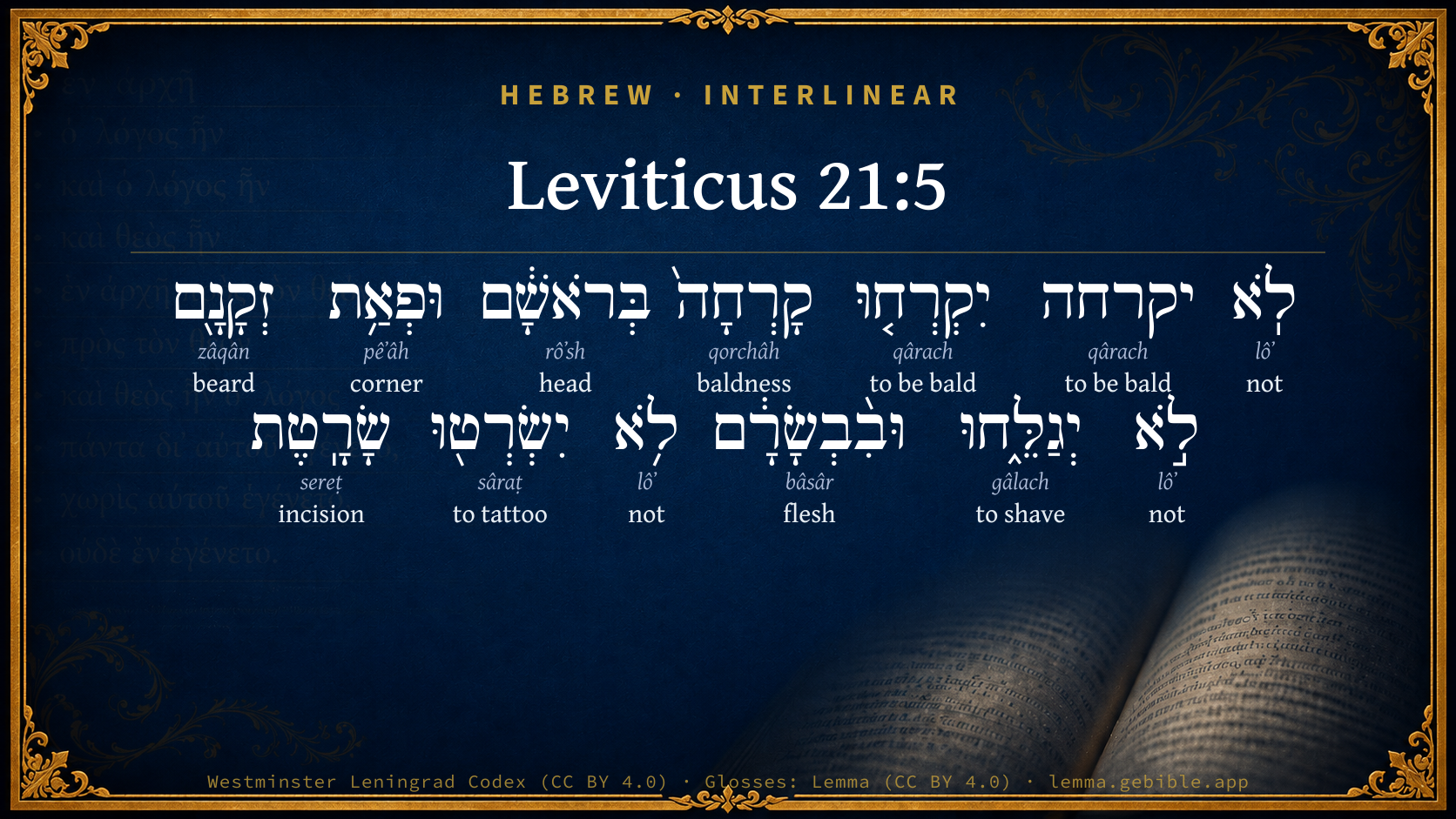
Hebrew (Westminster Leningrad Codex) Leviticus 21:5 appears in the Hebrew Old Testament. The text above is from the Westminster Leningrad Codex. Each word links to its Strong’s number, a concise gloss, and parsing drawn from the Open Scriptures Hebrew Bible morphology. Click any word for its full Brown-Driver-Briggs (BDB) entry.
Download image
Cite this verse

Leviticus 21:5 (World English Bible). Public Domain. Lemma interlinear Bible study tool, https://lemma.gebible.app/v/leviticus/21/5.

Show BibTeX & RIS
BibTeX
RIS
English Translation
"'They shall not shave their heads, neither shall they shave off the corners of their beards, nor make any cuttings in their flesh.
World English Bible · Public Domain
Highlights
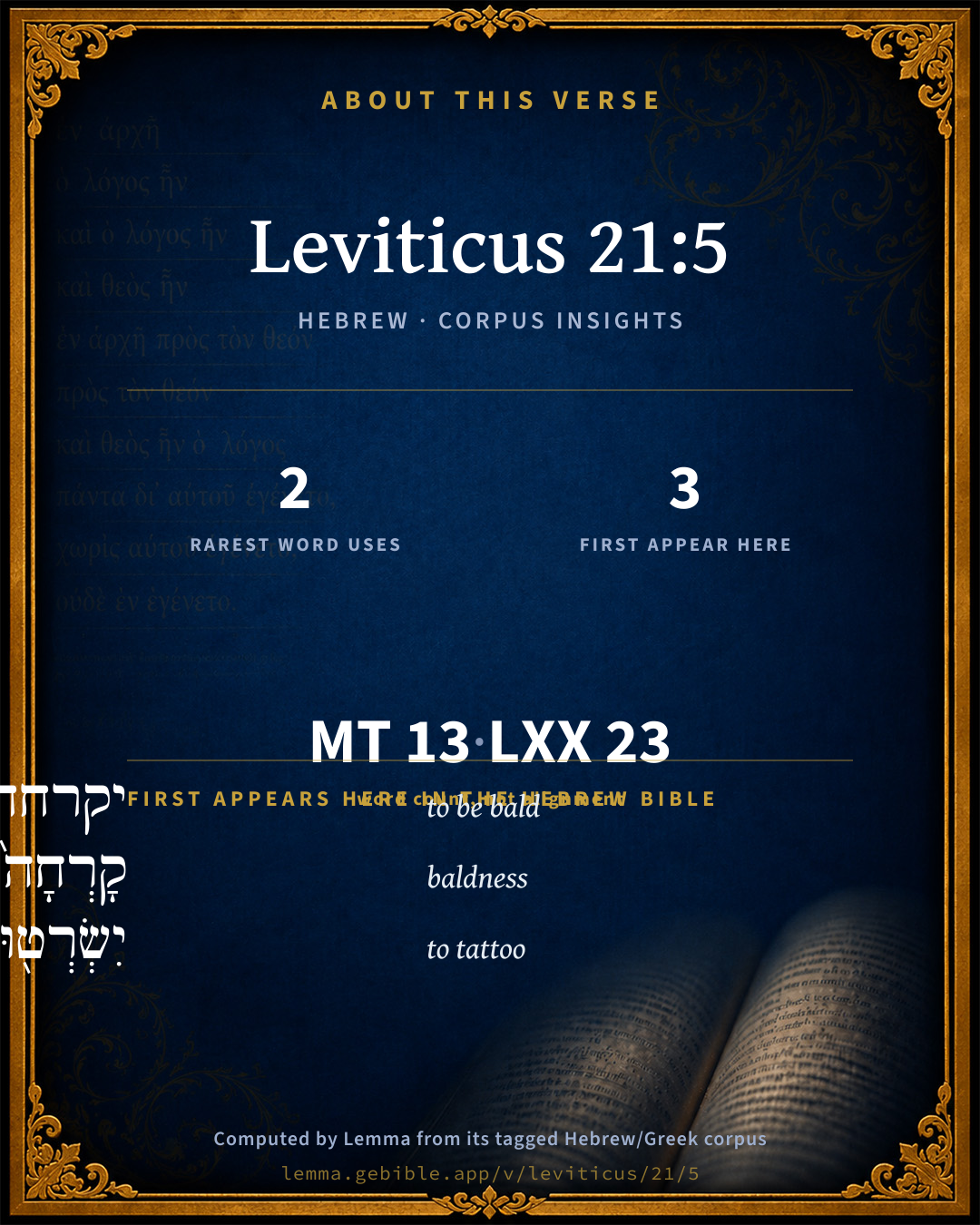
  • 3 first appearances in the Hebrew Bible
Full analysis ↓
Download a study sheet

One document with this verse’s original text, its word-by-word gloss line, the meaning frame, cross-references with their text, attributed commentary, and full source and license credits — printable, and it pastes into notes with its structure intact.

This verse Autodidact and up

Study sheet (.html) Plain text (.txt)

A passage Seminary Student

Up to 50 verses in one chapter. A passage sheet keeps up to 6 commentary sources and 12 cross-references per verse, in the order this page ranks them, and says so on the sheet whenever that leaves anything out. Ask for a single verse and you get the Autodidact verse sheet above.

Everything on this page stays free to read, with no account — the sheet is a download of what is already on screen, not access to it.

Want to remove ads? Support Godless Engineer
Compare translations 3

The same verse in 3 English versions, stacked beneath the original-language interlinear above. Click any original word for its lexicon entry.

Each is an independent rendering of the whole verse — the interlinear is not word-aligned to these translations.

Highlighted words mark where these versions differ — a whole-verse word diff, not a word-by-word alignment.

  • World English Bible Public Domain
    "'They shall not shave their heads, neither shall they shave off the corners of their beards, nor make any cuttings in their flesh.
  • King James Version Public Domain
    They shall not make baldness upon their head, neither shall they shave off the corner of their beard, nor make any cuttings in their flesh.
  • unfoldingWord Literal Text CC BY-SA 4.0
    They shall not bald a bald patch on their heads, and the edges of their beard they shall not shave, and they shall not cut a cut in their flesh.

unfoldingWord Literal Text — © unfoldingWord, licensed CC BY-SA 4.0. Word-aligned USFM3 via Door43 (git.door43.org/unfoldingWord/en_ult).

Versions to compare (up to 4)

3 of 4 selected

Show all 18 translations

Every available English version of this verse, each an independent rendering of the whole verse.

  • World English Bible Public Domain
    "'They shall not shave their heads, neither shall they shave off the corners of their beards, nor make any cuttings in their flesh.
  • Berean Standard Bible Public Domain
    Priests must not make bald spots on their heads, shave off the edges of their beards, or make cuts in their bodies.
  • Majority Standard Bible Public Domain
    Priests must not make bald spots on their heads, shave off the edges of their beards, or make cuts in their bodies.
  • King James Version Public Domain
    They shall not make baldness upon their head, neither shall they shave off the corner of their beard, nor make any cuttings in their flesh.
  • American Standard Version (1901) Public Domain
    They shall not make baldness upon their head, neither shall they shave off the corner of their beard, nor make any cuttings in their flesh.
  • Revised Version (1885) Public Domain
    They shall not make baldness upon their head, neither shall they shave off the corner of their beard, nor make any cuttings in their flesh.
  • Geneva Bible (1599) Public Domain
    They shall not make balde partes vpon their head, nor shaue off the locks of their beard, nor make any cuttings in their flesh.
  • Douay-Rheims (1899) Public Domain
    Neither shall they shave their head, nor their beard, nor make incisions in their flesh.
  • Young's Literal Translation Public Domain
    they do not make baldness on their head, and the corner of their beard they do not shave, and in their flesh they do not make a cutting;
  • Literal Standard Version CC BY-SA 4.0
    they do not make baldness on their head, and they do not shave the corner of their beard, and they do not make a cutting in their flesh;
  • Unlocked Literal Bible CC BY-SA 4.0
    Priests must not shave their heads or shave off the corners of their beards, nor cut their bodies.
  • unfoldingWord Literal Text CC BY-SA 4.0
    They shall not bald a bald patch on their heads, and the edges of their beard they shall not shave, and they shall not cut a cut in their flesh.
  • Darby Bible Public Domain
    They shall not make any baldness upon their head, neither shall they shave off the corners of their beard, nor make any cuttings in their flesh.
  • World Messianic Bible Public Domain
    “‘They shall not shave their heads or shave off the corners of their beards or make any cuttings in their flesh.
  • Webster's Bible Public Domain
    They shall not make baldness upon their head, neither shall they shave off the corner of their beard, nor make any cuttings in their flesh.
  • Free Bible Version CC BY-SA 4.0
    Priests are not to shave bald spots on their heads, trim the sides of their beards, or cut their bodies.
  • Bible in Basic English Public Domain
    They are not to have their hair cut off for the dead, or the hair on their chins cut short, or make cuts in their flesh.
  • JPS Tanakh (1917) Public Domain
    They shall not make baldness upon their head, neither shall they shave off the corners of their beard, nor make any cuttings in their flesh.

Literal Standard Version (2020), Covenant Press — licensed CC BY-SA 4.0. Text via the HelloAO Bible API (eBible.org). Unlocked Literal Bible (unfoldingWord) — licensed CC BY-SA 4.0. Text via the HelloAO Bible API (eBible.org). unfoldingWord Literal Text — © unfoldingWord, licensed CC BY-SA 4.0. Word-aligned USFM3 via Door43 (git.door43.org/unfoldingWord/en_ult). Free Bible Version, Dr. Jonathan Gallagher — licensed CC BY-SA 4.0. Text via the HelloAO Bible API (eBible.org).

Word by word

More ways to search: Search by grammar → Find every occurrence → Compare this word →

Practice this passage: Drill this verse → Learn its vocabulary →

שָׂרָֽטֶת
sereṭ
H8296
“incision”
Noun, Common, Feminine, Singular, Absolute
Part of Speech
Noun
Type
Common
Gender
Feminine
Number
Singular
State
Absolute
Full BDB Definition

Origin: from H8295

TWOT: 2289a

incision, cut
  1. לֹֽא lôʼ H3808 “not” Particle, Negative
  2. יקרחה qârach H7139 “to be bald” Verb, Qal, Imperfect, 3rd Person, Feminine, Singular
  3. יִקְרְח֤וּ qârach H7139 “to be bald” Verb, Qal, Imperfect, 3rd Person, Masculine, Plural
  4. קָרְחָה֙ qorchâh H7144 “baldness” Noun, Common, Feminine, Singular, Absolute
  5. בְּרֹאשָׁ֔ם rôʼsh H7218 “in/at · head · their” Preposition + Noun, Common, Masculine, Singular, Construct + Suffix, Personal, 3rd Person, Masculine, Plural
  6. וּפְאַ֥ת pêʼâh H6285 “and · corner of” Conjunction + Noun, Common, Feminine, Singular, Construct
  7. זְקָנָ֖ם zâqân H2206 “beard · their” Noun, Common, Both, Singular, Construct + Suffix, Personal, 3rd Person, Masculine, Plural
  8. לֹ֣א lôʼ H3808 “not” Particle, Negative
  9. יְגַלֵּ֑חוּ gâlach H1548 “to shave” Verb, Piel, Imperfect, 3rd Person, Masculine, Plural
  10. וּבִ֨בְשָׂרָ֔ם bâsâr H1320 “and · in/at · flesh · their” Conjunction + Preposition + Noun, Common, Masculine, Singular, Construct + Suffix, Personal, 3rd Person, Masculine, Plural
  11. לֹ֥א lôʼ H3808 “not” Particle, Negative
  12. יִשְׂרְט֖וּ sâraṭ H8295 “to tattoo” Verb, Qal, Imperfect, 3rd Person, Masculine, Plural

About this verse

These counts appear in no published source. They are computed here, from the morphology-tagged text and Lemma’s own curated glosses. What Lemma adds →

13
words
10
distinct lemmas
Pentateuch
section

Notable vocabulary

The rarest word here is שָׂרָֽטֶת incision H8296 — appearing just 2 times in the whole Hebrew Bible.

First appearance in Scripture

These words make their first canonical appearance in the Hebrew Bible here:

  • יקרחה to be bald H7139
  • קָרְחָה֙ baldness H7144
  • יִשְׂרְט֖וּ to tattoo H8295

Shared distinctive vocabulary

שָׂרָֽטֶת incision H8296 occurs in 2 verses of the Hebrew Bible. Also found in:

Grammatical profile

  • 4 verbs
  • 6 nouns
  • 3 particles

Verb forms

  • יקרחה Qal · Imperfect
  • יִקְרְח֤וּ Qal · Imperfect
  • יְגַלֵּ֑חוּ Piel · Imperfect
  • יִשְׂרְט֖וּ Qal · Imperfect

Repetition

Words recur within this verse — often emphatic in Hebrew:

  • יקרחה to be bald H7139 ×2
  • לֹֽא not H3808 ×3

Hebrew & Septuagint length

In English translation the verse runs 23 words from the Hebrew and 31 from the Septuagint (LXX English) — closely comparable.

A rough comparison of the two English renderings, which tokenize alike — not a word-level alignment.

Word counts can differ between the Hebrew and the Greek without any difference in meaning — e.g. the Hebrew direct-object marker אֵת has no separate Greek word, and Greek often adds the article ὁ.

In the original languages it is 13 Hebrew tokens and 23 Greek tokens — but the two are counted differently (Hebrew bundles its prefixes and suffixes into one token; the Greek is in lemma form), so that isn’t a like-for-like length.

Cross-references

10

Topical passages linked to Leviticus 21:5 in the Treasury of Scripture Knowledge — connected by theme and wording, ordered by reader-vote popularity; previews shown in the World English Bible.

  • Deuteronomy 14:1 You are the children of Yahweh your God: you shall not cut yourselves, nor make any baldness between your eyes for the dead.
  • Ezekiel 44:20 Neither shall they shave their heads, nor allow their locks to grow long; they shall only cut off the hair of their heads.
  • Leviticus 19:27–28 You shall not cut the hair on the sides of your heads, neither shall you clip off the edge of your beard.
  • Leviticus 10:6 Moses said to Aaron, and to Eleazar and to Ithamar, his sons, "Don't let the hair of your heads go loose, neither tear your clothes; that you don't die, and that he not be angry with all the congregation: but let your brothers, the whole house of Israel, bewail the burning which Yahweh has kindled.
  • Isaiah 15:2 They are gone up to Bayith, and to Dibon, to the high places, to weep: Moab wails over Nebo, and over Medeba; on all their heads is baldness, every beard is cut off.
  • Isaiah 22:12 In that day did the Lord, Yahweh of Hosts, call to weeping, and to mourning, and to baldness, and to girding with sackcloth:
  • Jeremiah 16:6 Both great and small shall die in this land; they shall not be buried, neither shall men lament for them, nor cut themselves, nor make themselves bald for them;
  • Jeremiah 48:37 For every head is bald, and every beard clipped: on all the hands are cuttings, and on the loins sackcloth.
  • Amos 8:10 I will turn your feasts into mourning, And all your songs into lamentation; And I will make you wear sackcloth on all your bodies, And baldness on every head. I will make it like the mourning for an only son, And the end of it like a bitter day.
  • Micah 1:16 Shave your heads, And cut off your hair for the children of your delight. Enlarge your baldness like the vulture; For they have gone into captivity from you!

Cross-references courtesy of OpenBible.info (CC BY 4.0).

Hebrew and Greek witnesses Masoretic Hebrew ↔ Greek Septuagint

The same verse in the two great witnesses to the Old Testament, shown verse-for-verse.

These are two independent witnesses, not word-aligned to each other, and the Septuagint is shown in lemma (dictionary) form.

Hebrew Leviticus 21:5 Masoretic · Westminster Leningrad Codex

לֹֽא יקרחה יִקְרְח֤וּ קָרְחָה֙ בְּרֹאשָׁ֔ם וּפְאַ֥ת זְקָנָ֖ם לֹ֣א יְגַלֵּ֑חוּ וּבִ֨בְשָׂרָ֔ם לֹ֥א יִשְׂרְט֖וּ שָׂרָֽטֶת

"'They shall not shave their heads, neither shall they shave off the corners of their beards, nor make any cuttings in their flesh.

World English Bible · Public Domain

Greek LXX Leviticus 21:5 Septuagint · lemma form

καί φαλάκρωμα οὐ ξυράω ὁ κεφαλή ἐπί νεκρός καί ὁ ὄψις ὁ πώγων οὐ ξυράω καί ἐπί ὁ σάρξ αὐτός οὐ κατατέμνω ἐντομίς

And you⌃ shall not shave your head for the dead with a baldness on the top; and they shall not shave their beard, neither shall they make gashes on their flesh.

LXX2012 (modern English Septuagint) · Public Domain

Hebrew: Westminster Leningrad Codex (CC BY 4.0). Greek: Septuagint (public domain); English from LXX2012 (modern English Septuagint) (Public Domain). How the Septuagint differs from the Hebrew →

Targum (Aramaic paraphrase)

2

The Targum is the ancient Jewish Aramaic paraphrase of the Hebrew Scriptures — an interpretive translation, not the Hebrew text itself. Onkelos (literal) and Pseudo-Jonathan (expansive) render the Torah, and Jonathan the Prophets. Coverage is partial: where no permissively-licensed English translation exists for a verse, only the Aramaic is shown. This is verse-level text, not a word-by-word alignment to the Hebrew.

  1. Targum Onkelos Torah (Genesis–Deuteronomy)
    לָא יִמְרְטוּן מְרַט בְּרֵישְׁהוֹן וּפָאתָא דְדִקְנְהוֹן לָא יְגַלְחוּן וּבְבִשְׂרְהוֹן לָא יְחַבְּלוּן חִבּוּל

    (no public-domain English translation for this verse)

    Targum Onkelos — Aramaic: “Onkelos Genesis” (public domain); “Onkelos Exodus” (public domain); “Onkelos Leviticus” (public domain); “Onkelos Numbers” (public domain); “Onkelos Deuteronomy” (public domain). English: “Sefaria Community Translation” (CC0 1.0 (public-domain dedication)); “J.W. Etheridge. The Targums of Onkelos and Jonathan Ben Uzziel on the Pentateuch. London: Longmans, Green, 1862” (public domain). Text via Sefaria.

  2. Targum Pseudo-Jonathan Torah (Genesis–Deuteronomy)
    לָא יְרַשְׁמוּן בֵּין עֵינֵיהוֹן וְלָא רוֹשַׁם בְּרֵישֵׁיהוֹן וְאוּמָנָא דִיקָנֵיהוֹן לָא יִסְפְּרוּן וּבִבְשָרֵיהוֹן לָא יְחַבְּלוּן חִבּוּל

    They shall not mark themselves between their eyes, nor set a mark upon their heads, nor cut away the corners of their beards, nor make any incision in their flesh:

    Targum Pseudo-Jonathan — Aramaic: “Targum Jonathan on Genesis” (public domain); “Targum Jonathan on Exodus” (public domain); “Targum Jonathan on Leviticus” (public domain); “Targum Jonathan on Numbers” (public domain); “Targum Jonathan on Deuteronomy” (public domain). English: “The Targum of Jonathan ben Uzziel, trans. J. W. Etheridge, London, 1862” (public domain). Text via Sefaria.

Commentary

Notes on Leviticus 21:5 from classic Christian and Jewish commentators (each source and its license shown beneath its notes). The classic Christian expositions comment on the surrounding passage and are grouped to its opening verse, so a note may address several verses; the Jewish commentaries on the Tanakh (Rashi and others) are per-verse, so they appear only where the commentator wrote on this verse.

Lemma curates 59 commentaries, every one of them public domain or Creative Commons licensed, each selected and text-cleaned for this edition rather than reprinted as found. About our sources →

Trapp's Complete Commentary

John Trapp

Lev 21:5 They shall not make baldness upon their head, neither shall they shave off the corner of their beard, nor make any cuttings in their flesh.

Ver. 5. They shall not make baldness, &c.] So Lev 19:27. Howbeit in humiliation for sin the Lord God of hosts called them all, both priests and people, to weeping and mourning, {Joe 2:17} yea to baldness and sackcloth. {Isa 22:12} Here we cannot easily overdo.

John Trapp, A Commentary or Exposition upon All the Books of the Old and New Testament (1647–1656) — public domain. Text from a community e-Sword module.

Joseph Benson's Commentary

Lev 21:5. They shall not make baldness — In funerals, as the heathen did. Though I allow them to defile themselves for some of the dead, yet in no case shall they use these superstitious rites, which also the people were forbidden to do; but the priests in a more peculiar manner, because they were by word and example to teach the people their duty.

Joseph Benson's Commentary on the Old and New Testaments (1811–1818) — public domain. Text from a community e-Sword module.

Tyndale Open Study Notes

Tyndale Open Resources

21:5 shave . . . trim: See study notes on 10:6; 19:27. • cut their bodies: See study note on 19:28. Self-mutilation was a pagan custom. Just as defects of any kind precluded most animals as offerings (22:19-25), a defect similarly precluded a priest from officiating (see 21:17-23). For example, a eunuch could not serve as a priest (Deut 23:1) because he was not an adequate representative of the people. However, his priestly lineage was recognized as qualifying him to eat his priestly share (see Lev 21:22). On the other hand, uncleanness disqualified any priest from ministry and from eating the priest’s share as long as the condition persisted (22:2-8).

Tyndale Open Study Notes — © Tyndale Open Resources, licensed CC BY-SA 4.0. Text via the HelloAO Bible API.

Jamieson, Fausset & Brown

Robert Jamieson, A. R. Fausset & David Brown

They shall not make baldness upon their heads . . . nor . . . cuttings in their flesh--The superstitious marks of sorrow, as well as the violent excesses in which the heathen indulged at the death of their friends, were forbidden by a general law to the Hebrew people (Lev 19:28). But the priests were to be laid under a special injunction, not only that they might exhibit examples of piety in the moderation of their grief, but also by the restraint of their passions, be the better qualified to administer the consolations of religion to others, and show, by their faith in a blessed resurrection, the reasons for sorrowing not as those who have no hope.

Jamieson, Fausset & Brown — Commentary Critical and Explanatory on the Whole Bible (1871) — public domain (CC PDM 1.0). Text via the HelloAO Bible API.

Adam Clarke's Commentary

Verse 5. They shall not make baldness] See the note on "Le 19:27". It is supposed that these things were particularly prohibited, because used superstitiously by the Egyptian priests, who, according to Herodotus, shaved the whole body every third day, that there might be no uncleanness about them when they ministered in their temples. This appears to have been a general custom among the heathen. In the book of Baruch, 6:31, the priests of Babylon are represented sitting in their temples, with their clothes rent, and their heads and beards shaven, and having nothing upon their heads. Every person knows the tonsure of the Catholic priests. Should not this be avoided as an approach to a heathenish custom?

Adam Clarke's Commentary on the Bible (1810–1826) — public domain. Text from a community e-Sword/MySword module.

Ellicott's Commentary for English Readers

(5) Make baldness upon their head.—The natural expression of grief, however, which the priests were to manifest for the above-named departed relations, was not to show itself in the practices which disfigure their bodily appearance, and which obtained among other nations of antiquity in connection with funeral ceremonies. Thus, in the graphic description of the idolatrous priests mourning, we are told “the priests sit in their temples, having their clothes rent, and their heads and beards shaven, and nothing upon their heads.” (Bar_6:31.) The three things here prohibited to the priests are also forbidden to the people at large under other circumstances. (See Lev_19:27-28; Deu_14:1.) The ordinary Israelites, however, indulged in the same practices. (See Jer_16:6; Eze_7:18; Amo_8:10.)

A Bible Commentary for English Readers, edited by Charles John Ellicott (1878–1897) — public domain. Text from a community e-Sword module.

The Cambridge Bible for Schools and Colleges

gen. ed. J. J. S. Perowne

5. See on Lev_19:27-28.

The Cambridge Bible for Schools and Colleges (gen. ed. J. J. S. Perowne; Cambridge University Press, 1878–1918) — public domain. Text from a community e-Sword module.

John Gill's Exposition

They shall not make baldness upon their head,.... For the dead, as Jarchi, Aben Ezra, and Ben Gersom; not shave their heads, or round the corners of them, or make baldness between their eyes on that account; as those things were forbid the Israelites, so the priests also; this and what follow being superstitious customs used among the Heathens in their mournings for the dead, particularly by the Chaldeans, as Aben Ezra observes; and so by the Grecians; when Hephestion, one of Alexander's captains, died, he shaved his soldiers and himself, imitating Achilles in Homer (t); so the Egyptians, mourning for the loss of Osiris, annually shaved their heads (u); and the priests of Isis, mourning for her lost son, are called by Minutius Felix (w) her bald priests; see Lev 19:27,

neither shall they shave off the corner of their beard: the five corners of it; See Gill on Lev 19:27. This the Israelites in common might not do, and particularly their priests; though the Egyptian priests shaved both their heads and beards, as Herodotus (x) relates: and so they are represented in the Table of Isis (y):

nor make any cuttings in their flesh; either with their nails, tearing their cheeks and breasts, or with an instrument cutting their flesh in any part of their bodies, as was the custom of Heathen nations; such were made by the Egyptians in their mournings (z); See Gill on Lev 19:28.

(t) Aelian. Var. Hist. l. 7. c. 8. (u) Julius Firmicus de Error. Proph. p. 2. (w) In Octavio, p. 22. Vid. Lactant. de fals. Relig. l. 1. c. 21. (x) Euterpe, sive, l. 2. c. 36. (y) Vid. Pignorii Mens. Isiac. liter. S. (z) Julius Firmicus, ut supra. (u))

John Gill's Exposition of the Whole Bible (1746–1763) — public domain (CC PDM 1.0). Text via the HelloAO Bible API.

Albert Barnes' Notes on the Bible

These prohibitions given to the people at large (compare the margin reference.) had a special fitness for the Hebrew priests. They were the instruments of the divine will for averting death, all their sacrifices were a type of the death of Christ, which swallowed up death in victory 1Co 15:54-57, and it would therefore have been unsuitable that they should have the same freedom as other people to become mourners.

Albert Barnes' Notes on the Bible (1834–1885) — public domain. Text from a community e-Sword/MySword module.

Haydock's Catholic Bible Commentary

Flesh. This would indicate an important grief, and want of patience. (Haydock) --- They were not allowed to put on the usual signs of mourning, as the common people were, provided they did it not in honour of an idol, chap. xix. 27.

George Leo Haydock (1774–1849), Haydock's Catholic Family Bible and Commentary, 1859 edition — public domain. Excludes Psalms (Douay-Rheims chapter numbering differs from Protestant) and Deuterocanonical books (Catholic canon only).

Matthew Poole's English Annotations

To wit, in funerals, as the heathens did: q. d. Though I allow them to defile themselves for some of the dead, yet in no case shall they use these superstitious and heathenish rites, which also the people are forbidden to do, Lev 19:27; Deu 14:1, but the priests in a more peculiar manner, because they are by word and example to teach the people their duty not to sorrow for the dead as persons without hope.

Matthew Poole's English Annotations on the Holy Bible (1683–1685) — public domain. Text from a community e-Sword/MySword module.

Whedon's Commentary on the Bible

Daniel D. Whedon

5. Not make baldness — This forbids the priests to shave a bald place above the forehead “between the eyes” — a practice customary in mourning for the dead, as is seen in Deu_14:1, where it is forbidden to all Israelites. It was allowed to the Nazarite when his time of separation had expired. Num_6:18; Act_18:18; Act_21:24.

Beard… cuttings in their flesh — See Lev_19:27-28, notes. St. Paul, not without indignation, refers to this prohibition (ου κατατεμνουσιν) when he stigmatizes the antichristian Jews as την κατατομην, the mutilation.

Php_3:2. In Jer_9:26; Jer_25:23 we have a valuable marginal reading, “having the corners of their hair polled,” or “those with whiskers cropped,” as descriptive of the Arabians. It seems to have been the purpose of the lawgiver to keep the Israelites distinct from other nations in their very countenances.

Daniel D. Whedon (gen. ed.), Commentary on the Old and New Testaments (1874–1909) — public domain. Text from a community e-Sword module.

John Wesley's Explanatory Notes

They shall not make baldness - In funerals, as the Heathens did. Though I allow them to defile themselves for some of the dead, yet in no case shall they use these superstitious rites, which also the people were forbidden to do; but the priests in a more peculiar manner, because they are by word and example to teach the people their duty.

John Wesley, Explanatory Notes Upon the Whole Bible (1754–1765) — public domain. Text via the GEBible commentary corpus.

Rashi

Rabbi Shlomo Yitzchaki (Rashi)

לא יקרחו קרחה THEY SHALL NOT MAKE BALDNESS [UPON THEIR HEAD] for the dead. But were not the ordinary Israelites also forbidden in respect of this? Why then is this law especially stated with reference to the priests? But because in the prohibition addressed to the ordinary Israelites it is stated, (Deuteronomy 14:1) “[Ye shall not make anybaldness] between your eyes [for the dead]”, I might think that one is not liable to punishment for making baldness on any other part of the whole head, Scripture therefore states here: “upon their heads”; and now that we have both commands, the law regarding the Israelites may be derived from that addressed to the priests from a similarity of terms used in both prohibitions: the term “קרחה” is used here, and in the prohibition regarding the Israelites it also uses the term “קרחה”; what is the case here? The prohibition applies to the whole head! So, also, there the whole head is included in the prohibition. And, on the other hand, how is the case there? The prohibition is limited to making baldness for the dead! So here too it applies only to such baldness as is made for the dead (Makkot 20a; Kiddushin 36a).

ופאת זקנם לא יגלחו NEITHER SHALL THEY RAZE THE CORNER OF THEIR BEARD — Because it is written in the prohibition addressed to the ordinary Israelites, (Leviticus 19:27) “thou shalt not destroy (תשחית) [the corners of thy beard]”, I might think if one took it (the hair) off with a מלקט or a רהיטני, tweezers or plane-like or file-like tools that may be used for destroying the hair, he is guilty of violating the law! Scripture therefore states here "they shall not raze off (לא יגלחו) the corner of their beard", the two statements supplementing each other, thus teaching that one is liable only for the use of an instrument the employment of which is termed גילוח (razing), and,which at the same time, involves the destruction of the hair, and this results only from the use of a razor (Makkot 21a).

ובבשרם לא ישרטו שרטת NOR SHALL THEY MAKE ANY INCISION IN THEIR FLESH — This is stated in addition to the law in Leviticus 19:28 for the following reason: Because it is said there of the ordinary Israelites “and ye shall not make a cutting in your flesh for the dead”, I might think that if one made five incisions at the same time he is liable to the punishment of lashes only once, Scripture therefore states here: לא ישרטו שרטת “they shall not incise an incision" to make one liable for each and every incision — for this word (שרטת) would be redundant if it added nothing to the previous prohibition and must therefore have been added for the purpose of deriving an Halacha, since it ought to have written only לא ישרטו and I would then have known that it refers to making incisions and consequently the intention of Scripture by using the term "they shall not incise an incision" is to make one liable to punishment for each incision (cf. Sifra, Emor, Chapter 1 4).

Rashi on the Tanakh — English translations: “The Judaica Press complete Tanach with Rashi, translated by A. J. Rosenberg” (CC BY 4.0); “Pentateuch with Rashi's commentary by M. Rosenbaum and A.M. Silbermann, 1929-1934” (public domain); “The Metsudah Tanach series, Lakewood, N.J” (CC BY 4.0); and “The Book of Joshua, Metsudah Publications, 1997” (CC BY 4.0). Text via Sefaria.

Lesson kit

Teaching starters — assembled from the data on this page, not authored interpretation. Every prompt links to the verse data it draws on. Edit before teaching.

Leviticus, in the Pentateuch, opens this verse with 13 words (10 distinct Hebrew lemmas). Its most distinctive word is sereṭ (“incision”). A historical commentator’s framing appears above. Read the whole chapter for the surrounding context.

Discussion questions

  1. What does “incision” (sereṭ) contribute to the verse as a whole?
  2. 3 words here appear for the first time in Scripture. What is being introduced at this debut?
  3. Leviticus 19:28 shares the word «incision» with this verse. How do the two illuminate each other?
  4. “to be bald” occurs 2× in this one verse. What is the effect of the repetition?
  5. These translations render this verse differently. What is at stake in choosing one wording over another?
  6. The verb «יקרחה» is Qal Imperfect. How does its form color the action?
  7. Reading how Trapp's Complete Commentary and Joseph Benson's Commentary read this verse, where do the two commentators agree and where do they part?

Things to notice

Reading settings

Reading text

Shown beneath each verse's original-language words.

Old Testament
Old Testament edition

Read the OT as the Masoretic Hebrew (MT) or the Greek Septuagint (LXX).

English shown for the Greek Septuagint (in the Hebrew ↔ Greek comparison).

Comparing translations? Open the Compare panel on any verse page to stack up to four side by side.