Colossians 2:13

Greek (Tischendorf 8th ed.) Colossians 2:13 appears in the Greek New Testament. The text above is from the Tischendorf 8th edition. Each word links to its Strong’s number and a concise gloss. Click any word for its full Thayer’s Greek Lexicon entry.
Download image
Cite this verse

Colossians 2:13 (World English Bible). Public Domain. Lemma interlinear Bible study tool, https://lemma.gebible.app/v/colossians/2/13.

Show BibTeX & RIS
BibTeX
RIS
English Translation
You were dead through your trespasses and the uncircumcision of your flesh. He made you alive together with him, having forgiven us all our trespasses,
World English Bible · Public Domain
Download a study sheet

One document with this verse’s original text, its word-by-word gloss line, the meaning frame, cross-references with their text, attributed commentary, and full source and license credits — printable, and it pastes into notes with its structure intact.

This verse Autodidact and up

Study sheet (.html) Plain text (.txt)

A passage Seminary Student

Up to 50 verses in one chapter. A passage sheet keeps up to 6 commentary sources and 12 cross-references per verse, in the order this page ranks them, and says so on the sheet whenever that leaves anything out. Ask for a single verse and you get the Autodidact verse sheet above.

Everything on this page stays free to read, with no account — the sheet is a download of what is already on screen, not access to it.

Want to remove ads? Support Godless Engineer
Compare translations 3

The same verse in 3 English versions, stacked beneath the original-language interlinear above. Click any original word for its lexicon entry.

Each is an independent rendering of the whole verse — the interlinear is not word-aligned to these translations.

Highlighted words mark where these versions differ — a whole-verse word diff, not a word-by-word alignment.

  • World English Bible Public Domain
    You were dead through your trespasses and the uncircumcision of your flesh. He made you alive together with him, having forgiven us all our trespasses,
  • King James Version Public Domain
    And you, being dead in your sins and the uncircumcision of your flesh, hath he quickened together with him, having forgiven you all trespasses;
  • unfoldingWord Literal Text CC BY-SA 4.0
    And you, being dead in the trespasses and the uncircumcision of your flesh, he made you alive together with him, having forgiven us all of our trespasses,

unfoldingWord Literal Text — © unfoldingWord, licensed CC BY-SA 4.0. Word-aligned USFM3 via Door43 (git.door43.org/unfoldingWord/en_ult).

Versions to compare (up to 4)

3 of 4 selected

Show all 19 translations

Every available English version of this verse, each an independent rendering of the whole verse.

  • World English Bible Public Domain
    You were dead through your trespasses and the uncircumcision of your flesh. He made you alive together with him, having forgiven us all our trespasses,
  • Berean Standard Bible Public Domain
    When you were dead in your trespasses and in the uncircumcision of your sinful nature, God made you alive with Christ. He forgave us all our trespasses,
  • Majority Standard Bible Public Domain
    When you were dead in your trespasses and in the uncircumcision of your sinful nature, God made you alive with Christ. He forgave us all our trespasses,
  • King James Version Public Domain
    And you, being dead in your sins and the uncircumcision of your flesh, hath he quickened together with him, having forgiven you all trespasses;
  • American Standard Version (1901) Public Domain
    And you, being dead through your trespasses and the uncircumcision of your flesh, you, `I say', did he make alive together with him, having forgiven us all our trespasses;
  • Revised Version (1885) Public Domain
    And you, being dead through your trespasses and the uncircumcision of your flesh, you, I say, did he quicken together with him, having forgiven us all our trespasses;
  • Geneva Bible (1599) Public Domain
    And you which were dead in sinnes, and in the vncircumcision of your flesh, hath he quickened together with him, forgiuing you all your trespasses,
  • Douay-Rheims (1899) Public Domain
    And you, when you were dead in your sins, and the uncircumcision of your flesh; he hath quickened together with him, forgiving you all offences:
  • Young's Literal Translation Public Domain
    And you -- being dead in the trespasses and the uncircumcision of your flesh -- He made alive together with him, having forgiven you all the trespasses,
  • Literal Standard Version CC BY-SA 4.0
    And you—being dead in the trespasses and the uncircumcision of your flesh—He made alive together with Him, having forgiven you all the trespasses,
  • Unlocked Literal Bible CC BY-SA 4.0
    When you were dead in your trespasses and in the uncircumcision of your flesh, he made you alive together with him and forgave us all of our trespasses.
  • unfoldingWord Literal Text CC BY-SA 4.0
    And you, being dead in the trespasses and the uncircumcision of your flesh, he made you alive together with him, having forgiven us all of our trespasses,
  • Darby Bible Public Domain
    And you, being dead in offences and in the uncircumcision of your flesh, he has quickened together with him, having forgiven us all the offences;
  • World Messianic Bible Public Domain
    You were dead through your trespasses and the uncircumcision of your flesh. He made you alive together with him, having forgiven us all our trespasses,
  • Webster's Bible Public Domain
    And you, being dead in your sins and the uncircumcision of your flesh, hath he made alive together with him, having forgiven you all trespasses;
  • Free Bible Version CC BY-SA 4.0
    And even though you were dead because of your sins and being physically “uncircumcised,” he brought you to life together with him. He has forgiven us all our sins.
  • Bible in Basic English Public Domain
    And you, being dead through your sins and the evil condition of your flesh, to you, I say, he gave life together with him, and forgiveness of all our sins;
  • Text-Critical English NT CC BY 4.0
    And although you were dead in your trespasses and the uncircumcision of your flesh, God made you alive together with Christ. He forgave us all our trespasses
  • Tyndale New Testament (1534) Public Domain
    And ye which weare deed in synne thorow the vncircumcision of youre flesshe hath he quyckened with him and hath forgeve vs all oure trespases

Literal Standard Version (2020), Covenant Press — licensed CC BY-SA 4.0. Text via the HelloAO Bible API (eBible.org). Unlocked Literal Bible (unfoldingWord) — licensed CC BY-SA 4.0. Text via the HelloAO Bible API (eBible.org). unfoldingWord Literal Text — © unfoldingWord, licensed CC BY-SA 4.0. Word-aligned USFM3 via Door43 (git.door43.org/unfoldingWord/en_ult). Free Bible Version, Dr. Jonathan Gallagher — licensed CC BY-SA 4.0. Text via the HelloAO Bible API (eBible.org).

Word by word

More ways to search: Search by grammar → Find every occurrence → Compare this word →

Practice this passage: Drill this verse → Learn its vocabulary →

συνεζωοποίησεν
syzōopoiéō
G4806
“to make alive together”
Verb, Aorist, Active, Indicative, 3rd person, Singular
Part of Speech
Verb
Tense
Aorist
Voice
Active
Mood
Indicative
Person
3rd person
Number
Singular
Full Thayer's Definition

Origin: from G4862 and G2227

TDNT: 20:07,1

1. to make one alive together a. of Christians, with Christ
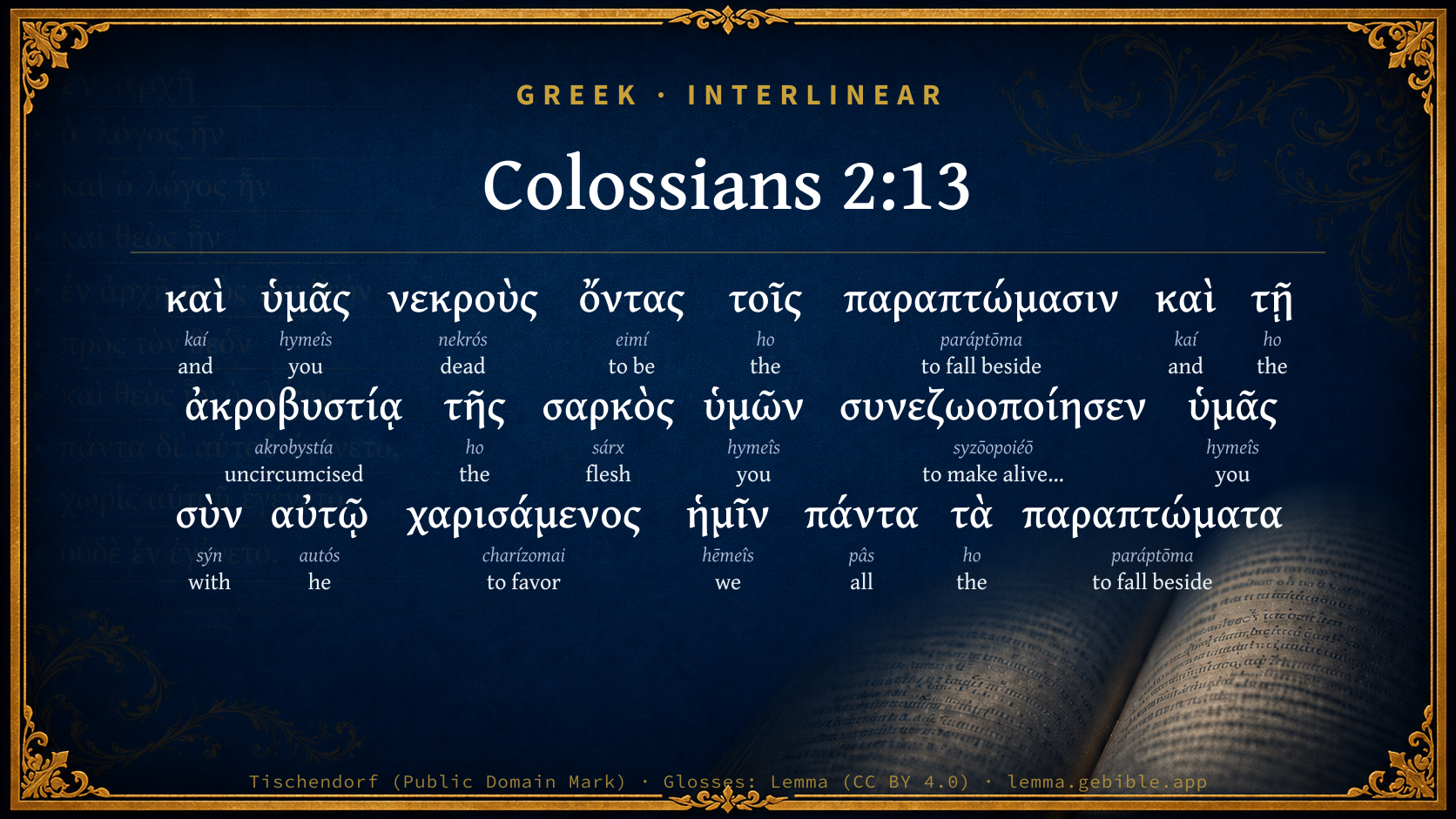
  1. καὶ kaí G2532 “and” Conjunction
  2. ὑμᾶς hymeîs G5210 “you” Personal pronoun, 2nd person, Accusative, Plural
  3. νεκροὺς nekrós G3498 “dead” Adjective, Accusative, Plural, Masculine
  4. ὄντας eimí G1510 “to be” Verb, Present, Active, Participle, Accusative, Plural, Masculine
  5. τοῖς ho G3588 “the” Article, Dative, Plural, Neuter
  6. παραπτώμασιν paráptōma G3900 “to fall beside” Noun, Dative, Plural, Neuter
  7. καὶ kaí G2532 “and” Conjunction
  8. τῇ ho G3588 “the” Article, Dative, Singular, Feminine
  9. ἀκροβυστίᾳ akrobystía G203 “uncircumcised” Noun, Dative, Singular, Feminine
  10. τῆς ho G3588 “the” Article, Genitive, Singular, Feminine
  11. σαρκὸς sárx G4561 “flesh” Noun, Genitive, Singular, Feminine
  12. ὑμῶν hymeîs G5210 “you” Personal pronoun, 2nd person, Genitive, Plural
  13. ὑμᾶς hymeîs G5210 “you” Personal pronoun, 2nd person, Accusative, Plural
  14. σὺν sýn G4862 “with” Preposition
  15. αὐτῷ autós G846 “he” Personal pronoun, Dative, Singular, Masculine
  16. χαρισάμενος charízomai G5483 “to favor” Verb, Aorist, Middle deponent, Participle, Nominative, Singular, Masculine
  17. ἡμῖν hēmeîs G2249 “we” Personal pronoun, 1st person, Dative, Plural
  18. πάντα pâs G3956 “all” Adjective, Accusative, Plural, Neuter
  19. τὰ ho G3588 “the” Article, Accusative, Plural, Neuter
  20. παραπτώματα paráptōma G3900 “to fall beside” Noun, Accusative, Plural, Neuter

About this verse

These counts appear in no published source. They are computed here, from the morphology-tagged text and Lemma’s own curated glosses. What Lemma adds →

21
words
14
distinct lemmas
Pauline Epistles
section

Notable vocabulary

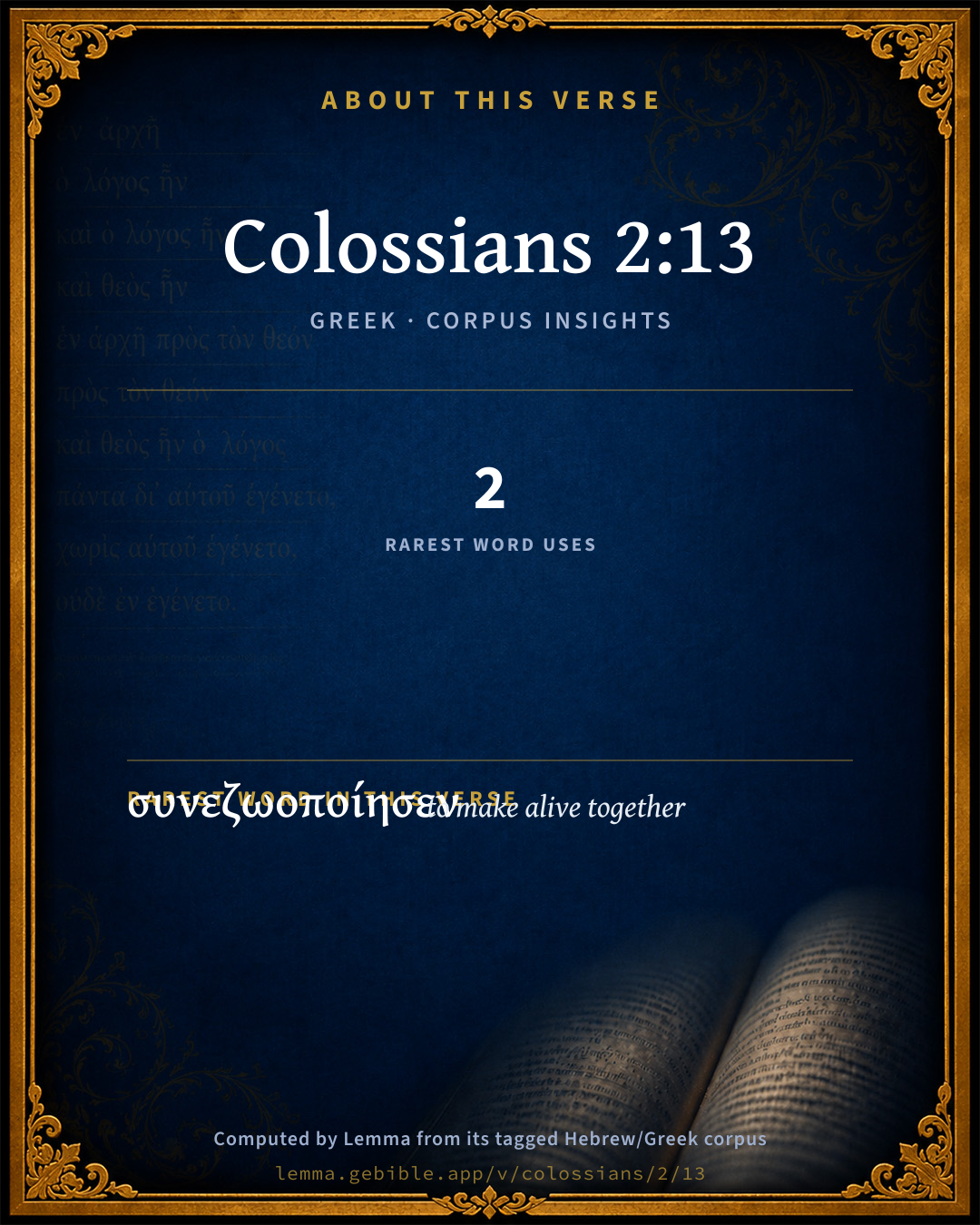
The rarest word here is συνεζωοποίησεν to make alive together G4806 — appearing just 2 times in the whole Greek New Testament.

Shared distinctive vocabulary

συνεζωοποίησεν to make alive together G4806 occurs in 2 verses of the Greek New Testament. Also found in:

Repetition

Words recur within this verse:

  • παραπτώμασιν to fall beside G3900 ×2
  • τοῖς the G3588 ×4
  • ὑμᾶς you G5210 ×3
  • καὶ and G2532 ×2

Cross-references

30

Topical passages linked to Colossians 2:13 in the Treasury of Scripture Knowledge — connected by theme and wording, ordered by reader-vote popularity; previews shown in the World English Bible.

  • Ephesians 2:5–6 even when we were dead through our trespasses, made us alive together with Christ (by grace you have been saved),
  • Romans 8:11 But if the Spirit of him who raised up Jesus from the dead dwells in you, he who raised up Christ Jesus from the dead will also give life to your mortal bodies through his Spirit who dwells in you.
  • Ephesians 2:1 You were made alive when you were dead in transgressions and sins,
  • 2 Corinthians 5:19 namely, that God was in Christ reconciling the world to himself, not reckoning to them their trespasses, and having committed to us the word of reconciliation.
  • Hebrews 9:14 how much more will the blood of Christ, who through the eternal Spirit offered himself without blemish to God, cleanse your conscience from dead works to serve the living God?
  • 2 Corinthians 3:6 who also made us sufficient as servants of a new covenant; not of the letter, but of the Spirit. For the letter kills, but the Spirit gives life.
  • Ephesians 2:11 Therefore remember that once you, the Gentiles in the flesh, who are called "uncircumcision" by that which is called "circumcision," (in the flesh, made by hands);
  • 1 John 1:7–9 But if we walk in the light, as he is in the light, we have fellowship with one another, and the blood of Jesus Christ, his Son, cleanses us from all sin.
  • Psalms 71:20 You, who have shown us many and bitter troubles, You will let me live. You will bring us up again from the depths of the earth.
  • Luke 15:24 for this, my son, was dead, and is alive again. He was lost, and is found.' They began to celebrate.
  • Luke 15:32 But it was appropriate to celebrate and be glad, for this, your brother, was dead, and is alive again. He was lost, and is found.'"
  • Romans 6:13 Neither present your members to sin as instruments of unrighteousness, but present yourselves to God, as alive from the dead, and your members as instruments of righteousness to God.
  • 1 Corinthians 15:45 So also it is written, "The first man, Adam, became a living soul." The last Adam became a life-giving spirit.
  • 2 Corinthians 5:14–15 For the love of Christ constrains us; because we judge thus, that one died for all, therefore all died.
  • Ephesians 5:14 Therefore he says, "Awake, you who sleep, and arise from the dead, and Christ will shine on you."
  • James 2:26 For as the body apart from the spirit is dead, even so faith apart from works is dead.
  • 1 John 2:12 I write to you, little children, because your sins are forgiven you for his name's sake.
  • Psalms 119:50 This is my comfort in my affliction, For your word has revived me.
  • Isaiah 55:7 let the wicked forsake his way, and the unrighteous man his thoughts; and let him return to Yahweh, and he will have mercy on him; and to our God, for he will abundantly pardon.
  • Luke 9:60 But Jesus said to him, "Leave the dead to bury their own dead, but you go and announce the Kingdom of God."
  • John 5:21 For as the Father raises the dead and gives them life, even so the Son also gives life to whom he desires.
  • Acts 13:38–39 Be it known to you therefore, brothers, that through this man is proclaimed to you remission of sins,
  • 1 Corinthians 15:36 You foolish one, that which you yourself sow is not made alive unless it dies.
  • Romans 4:17 As it is written, "I have made you a father of many nations." This is in the presence of him whom he believed: God, who gives life to the dead, and calls the things that are not, as though they were.
  • 1 Timothy 5:6 But she who gives herself to pleasure is dead while she lives.
  • Hebrews 6:1 Therefore leaving the doctrine of the first principles of Christ, let us press on to perfection--not laying again a foundation of repentance from dead works, of faith toward God,
  • Isaiah 1:18 "Come now, and let us reason together," says Yahweh: "Though your sins be as scarlet, they shall be as white as snow. Though they be red like crimson, they shall be as wool.
  • Jeremiah 31:34 and they shall teach no more every man his neighbor, and every man his brother, saying, Know Yahweh; for they shall all know me, from the least of them to the greatest of them, says Yahweh: for I will forgive their iniquity, and their sin will I remember no more.
  • Ezekiel 37:1–10 The hand of Yahweh was on me, and he brought me out in the Spirit of Yahweh, and set me down in the midst of the valley; and it was full of bones.
  • John 6:63 It is the spirit who gives life. The flesh profits nothing. The words that I speak to you are spirit, and are life.

Cross-references courtesy of OpenBible.info (CC BY 4.0).

Where the printed editions differ

1 variant

Places in this verse where the major printed Greek editions disagree on the wording in a way that affects the translation — a comparison of editions, not a manuscript-by-manuscript collation. The editions are the modern critical texts (Nestlé-Aland 28/27, SBL, Westcott-Hort, Tregelles, Tyndale House) and the traditional texts behind the KJV (the Textus Receptus and the Byzantine/Majority text). It is not a claim about which reading is original.

  1. Extra text
    ὑμᾶς

    “you”

    In NA28NA27TynSBLWHTregByz Not in TR

    ὑμᾶς (humas) 'you' is only in older manuscripts (NA28+NA27+Tyn+SBL+WH+Treg+Byz)

Textual data: Translators Amalgamated Greek New Testament (STEPBible TAGNT) · CC BY 4.0.

Commentary

Notes on Colossians 2:13 from classic Christian and Jewish commentators (each source and its license shown beneath its notes). The classic Christian expositions comment on the surrounding passage and are grouped to its opening verse, so a note may address several verses; the Jewish commentaries on the Tanakh (Rashi and others) are per-verse, so they appear only where the commentator wrote on this verse.

Lemma curates 59 commentaries, every one of them public domain or Creative Commons licensed, each selected and text-cleaned for this edition rather than reprinted as found. About our sources →

Matthew Henry's Commentary

The apostle here represents the privileges we Christians have above the Jews, which are very great.

I. Christ's death is our life: And you, being dead in your sins and the uncircumcision of your flesh, hath he quickened together with him, Col 2:13. A state of sin is a state of spiritual death. Those who are in sin are dead in sin. As the death of the body consists in its separation from the soul, so the death of the soul consists in its separation from God and the divine favour. As the death of the body is the corruption and putrefaction of it, so sin is the corruption or depravation of the soul. As a man who is dead is unable to help himself by any power of his own, so an habitual sinner is morally impotent: though he has a natural power, or the power of a reasonable creature, he has not a spiritual power, till he has the divine life or a renewed nature. It is principally to be understood of the Gentile world, who lay in wickedness. They were dead in the uncircumcision of their flesh, being aliens to the covenant of promise, and without God in the world, Eph 2:11, Eph 2:12. By reason of their uncircumcision they were dead in their sins. It may be understood of the spiritual uncircumcision or corruption of nature; and so it shows that we are dead in law, and dead in state. Dead in law, as a condemned malefactor is called a dead man because he is under a sentence of death; so sinners by the guilt of sin are under the sentence of the law and condemned already, Joh 3:18. And dead in state, by reason of the uncircumcision of our flesh. An unsanctified heart is called an uncircumcised heart: this is our state. Now through Christ we, who were dead in sins, are quickened; that is, effectual provision is made for taking away the guilt of sin, and breaking the power and dominion of it. Quickened together with him - by virtue of our union to him, and in conformity to him. Christ's death was the death of our sins; Christ's resurrection is the quickening of our souls.

II. Through him we have the remission of sin: Having forgiven you all trespasses. This is our quickening. The pardon of the crime is the life of the criminal: and this is owing to the resurrection of Christ, as well as his death; for, as he died for our sins, so he rose again for our justification, Rom 4:25.

III. Whatever was in force against us is taken out of the way. He has obtained for us a legal discharge from the hand-writing of ordinances, which was against us (Col 2:14), which may be understood, 1. Of that obligation to punishment in which consists the guilt of sin. The curse of the law is the hand-writing against us, like the hand-writing on Belshazzar's wall. Cursed is every one who continues not in every thing. This was a hand-writing which was against us, and contrary to us; for it threatened our eternal ruin. This was removed when he redeemed us from the curse of the law, being made a curse for us, Gal 3:13. He cancelled the obligation for all who repent and believe. "Upon me be the curse, my father." He vacated and disannulled the judgment which was against us. When he was nailed to the cross, the curse was as it were nailed to the cross. And our indwelling corruption is crucified with Christ, and by virtue of his cross. When we remember the dying of the Lord Jesus, and see him nailed to the cross, we should see the hand-writing against us taken out of the way. Or rather, 2. It must be understood of the ceremonial law, the hand-writing of ordinances, the ceremonial institutions or the law of commandments contained in ordinances (Eph 2:15), which was a yoke to the Jews and a partition-wall to the Gentiles. The Lord Jesus took it out of the way, nailed it to his cross; that is, disannulled the obligation of it, that all might see and be satisfied that it was no more binding. When the substance came, the shadows fled away. It is abolished (Co2 3:13), and that which decayeth and waxeth old is ready to vanish away, Heb 8:13. The expressions are in allusion to the ancient methods of cancelling a bond, either by crossing the writing or striking it through with a nail.

IV. He has obtained a glorious victory for us over the powers of darkness: And, having spoiled principalities and powers, he made a show of them openly, triumphing over them in it, Col 2:15. As the curse of the law was against us, so the power of Satan was against us. He treated with God as the Judge, and redeemed us out of the hands of his justice by a price; but out of the hands of Satan the executioner he redeemed us by power and with a high hand. He led captivity captive. The devil and all the powers of hell were conquered and disarmed by the dying Redeemer. The first promise pointed at this; the bruising of the heel of Christ in his sufferings was the breaking of the serpent's head, Gen 3:15. The expressions are lofty and magnificent: let us turn aside and see this great sight. The Redeemer conquered by dying. See his crown of thorns turned into a crown of laurels. He spoiled them, broke the devil's power, and conquered and disabled him, and made a show of them openly - exposed them to public shame, and made a show of them to angels and men. Never had the devil's kingdom such a mortal blow given to it as was given by the Lord Jesus. He tied them to his chariot-wheels, and rode forth conquering and to conquer - alluding to the custom of a general's triumph, who returned victorious. - Triumphing over them in it; that is, either in his cross and by his death; or, as some read it, in himself, by his own power; for he trod the wine-press alone, and of the people there was none with him.

Matthew Henry's Commentary on the Whole Bible (1708–1710) — public domain (CC PDM 1.0). Text via the HelloAO Bible API.

The Biblical Illustrator

Joseph S. Exell

Col_2:13-14

And you being dead in your sins.

Spiritual death

I. To what extent and to what persons this condition applies.

1. The terms of the text include Jews and Gentiles. The Jews were spiritually dead notwithstanding the ordinance of circumcision; the Gentiles in their uncircumcision. The great error of Judaism as the rabbis made it was to mistake religious ordinances for religion; equally fatal is the same error in its pseudo-Christian shape.

2. It is clear that this state is not predicated of heathen and profligates only; it is the normal condition in which men are born, and in which they live and die without grace. This is clear from Col_1:13; Mat_21:1-46; Mat_22:1-46; Joh_6:53-63; 1Jn_3:14.

3. Whatever privileges of pious parentage, godly training, gospel ministrations, etc., we may have been favoured, over and above these we must be born again.

II. Some of the particulars involved in this condition. In death is implied--

1. Deprivation--there is something lost. We do not say that a stone is dead, it never lived. Hence the view of a stone on the highway excites no emotion or sympathy; but how different with regard to a dead bird, much more a dead man or a dead friend. Once there was spiritual life in man. He was made a living soul; now he is dead in trespasses and sins, having lost it. And yet how strange that the spectacle of this most terrible of deaths scarcely moves us.

2. Corruption. Life has its degrees: vegetable, animal, rational, but in death there are no degrees; all the dead are equally corrupt. There are differences in the sight of man, comparing man with man; there are some better characters than others, of more natural virtue, and society owes them reverence; but society was not our maker and is not our judge. This reflection should humble us. Who maketh thee to differ from another?

3. Helplessness. A living dog is better than a dead lion, who is as incapable as his own shadow. The dead soul is equally helpless; without foreign aid it must lie like the tree where it has fallen. Spiritual life must be communicated before the soul can move.

4. Resurrection. The decayed vegetable dies, but to be reproduced in another form. Every falling leaf that strews the earth in autumn with the silent evidences of the fall of man, seems to catch a whisper from the breeze, Thou shalt rise again. So when man dies the principle of his existence is not destroyed but withdrawn. But, alas for the soul that has lain in the death of sin before the body has reached the grave; that shall indeed rise again, but to shame and everlasting contempt. (J. B. Owen, M. A.)

The dead soul

The dead, as insusceptible as their kindred dust, cannot be won back to the activities of life. No voice reaches them, no spectacle arouses them, no terror seizes them. The analogies of death in souls spiritually dead are full of painful truth. They are insensible to the attractions and momentousness of Divine and eternal realities. They are not touched by that which is tender in Divine love nor awed by that which is terrible in Divine law. Alienation from God ever produces spiritual callousness. With an eye to discern sensible beauty in the marvels of creation and the triumphs of art, there is no perception of the grander beauties of holiness, no apprehension of the character and glory of the Almighty. With an ear to hear and a taste to appreciate the rich harmonies of sound, and the eloquence of human tongues, there is no ear to hear the voice of God or the whisperings of His gracious Spirit, the only true and saving Teacher of men. With a heart that can feel for the woes and miseries of our fellow-creatures, and that can cherish kindness towards them, there is no conscious love to God, and no cheerful response to His claims. The mind may be acute, the disposition amiable, the character virtuous, and yet the soul be dead, alien from God, and blind to its own greatest needs. (J. Spence, D. D.)

The transition from death to life

The physical order is a descent from life to death; the spiritual order an ascent from death to life.

I. The natural condition of humanity is one of spiritual death. Man is in a condition of--

1. Spiritual insensibility. The dead know nothing, appreciate nothing; nor does the sinner of the things of God.

2. Moral corruption. And the uncircumcision of your flesh. Death unbinds the forces that brace up the body in life, and leaves it a prey to the power of corruption.

3. Condemnation.

(1) The Divine ordinances record an indictment against the transgressor.

(a) Handwriting. The primary reference is to the Jews, who might be said to have signed the contract when they bound themselves, by a curse, to observe all the enactments of the law (Deu_27:14-26.

(b) Ordinances, though referring primarily to the Mosaic ordinances, include all forms of positive decrees in which moral or social principles are embodied or religious duties defined. Man everywhere is under law, written or unwritten; and he is morally obligated to obey it.

(2) The Divine ordinances are hostile towards the transgressor. Which was contrary to us. We are often painfully reminded of our broken bond, as the debtor is often reminded of his undischarged obligation.

II. The believer is raised into a condition of spiritual life.

1. This life begins in the consciousness of liberty. Having forgiven you all trespasses.

2. It implies a freedom from all condemnation.

III. The transition of the soul from death to life is a Divine work.

1. God only can raise the dead.

2. He does so by a blessed union with Christ.

3. Which issues in immortal life. (G. Barlow.)

Quickened.

Characteristics of the new life

I. Spontaneity. Life is neither mechanical nor forced, but proceeds from the principle of vitality within. When man by grace begins to live anew, what was formerly a burden, if it received any attention at all, becomes a pleasure. Commandments which were grievous are now joyous, and the newborn energy finds its spontaneous manifestation in loving loyalty to Gods will.

II. Assimilation. Life is nourished by that which may seem foreign to its nature. The rose can draw beauty and fragrance from pestilent manure, juices of the soil, radiance of sunshine and showers from heaven. So the new life derives strength even from trial and the bread of sorrow. All things work together for its good, not excepting the entanglements of the flesh and the cares of the world.

III. Growth. All life grows, and the Christian who does not has an unhealthy life. His privilege is to be like a tree (Psa_1:3).

IV. Aspiration. Life everywhere seeks to reach the perfection of its nature. Spiritual life comes from above and seeks to rise to the level of its source. It cannot rest satisfied with the world, but puts forth its tendrils Godwards.

V. Individuality. No two plants, blades of grass, animals, men, are exactly alike. God loves variety in grace as well as nature. So some Christians are intellectual, some emotional, some practical; yet all are one in Christ. (J. Spence, D. D.)

The great deliverance

I. The miserable condition of our nature.

1. All the children of Adam are reckoned as dead.

(1) Because Divine grace, the soul, as it were, of the soul, being withdrawn, a polluting mass of deadly vices succeeded in their room.

(2) Because they lie under the sentence of eternal death (Eph_2:3).

2. The causes of this death are--

(1) Actual transgressions of the Divine law--The wages of sin is death, The soul that sinneth it shall die.

(a) This is the death of grace inasmuch as sin by its impurity dissolves the gracious union of the soul to God in which our life consists (Isa_59:2).

(b) The death of hell (Rom_2:9).

(2) The uncircumcision of your flesh, i.e., original sin, which is derived by carnal propagation and renders the very soul, as it were, carnal (Deu_10:16; Jer_9:25). Every natural man is dead in this his native corruption.

(a) The understanding, which is the eye of the soul, is darkened and blinded as to spiritual things (1Co_2:14), and rushes into errors and deceivings (Gal_5:20).

(b) The will is depraved, its good desires weak, its unlawful desires strong (Gen_6:5; Rom_3:1-31.).

(c) The inferior powers of the soul are disordered, so that they refuse to obey the law of the mind (Rom_7:23). Hence the affections control, and are not controlled by reason.

3. Lessons:

(1) Since every man in a state of nature is dead, it is not in the power of free will, by its own strength, to prepare for conversion, even as a dead man cannot dispose himself for his resurrection (Lam_5:21).

(2) No man can dispose himself to any motion to quicken himself unless his mind be formed to the life of grace by God. For as every natural operation supposes a natural power, so every spiritual motion a spiritual power (Eze_11:19).

(3) Since the cause of death is sin, the; madness of men is discovered who administer that deadly poison to the soul and are guilty of its murder.

II. The Deliverer; God in Christ, by Christ, and with Christ. God alone could impart animal life to this earth; He alone, therefore, can impart spiritual life to carnal men, which is a greater work than creation (Eph_2:10). Hence we may learn--

1. The eternal love of God the Father. We shudder to touch the dead bodies of our friends; but God is not only ready to touch but to embrace and restore our dead souls. This should inflame us with love to Him.

2. The infinite guilt of sin which could not be acquitted, and we justified but by the death and resurrection of Christ. This should excite our hatred and avoidance of sin.

III. The deliverance.

1. The forgiveness of our trespasses. In this it is to be noticed that it is--

(1) Gratuitous, χαρισαμενοϚ, being derived from grace itself. It is gratuitous on our part, for we are absolved without any price paid by ourselves; but on the part of Christ we are redeemed with the price of His precious blood (Rom_3:24), and indeed either a gratuitous remission or none at all must be admitted. As to ourselves, we are not able to pay, since the debt is infinite; nor can we blot out our sins by suffering, because no suffering of the guilty is deletive of sin.

(2) Universal--All trespasses. For it does not accord with Divine majesty and goodness to remit some of our debts and require the rest from us. Because--

(a) The blood of Christ being received as a ransom, it would be unjust not to remit all, since that outweighs all.

(b) To forgive is an act of paternal love and cannot dwell with enmity; but enmity remains with unremitted sin, and those who admit a partial remission make God at once reconciled and hostile.

(c) Unless we reckon on full remission, remission is vain; for its end is life eternal, which a partial remission cannot yield the hope of, because death is the wages of even one sin (Jer_33:8; Mic_7:19; 1Jn_1:9).

2. Hence we derive these corollaries--

(1) To forgive sins is the property of God alone; for who can forgive another his debt while the will of the creditor is not yet understood (Isa_43:25).

(2) As universal remission is granted on Gods part there ought to be a universal detestation of it on ours.

(3) Troubled consciences may be sustained, for though sin be not destroyed upon faith it is forgiven. (Bishop Davenant.)

The Holy Spirit is the quickener

The same shower blesses various lands in different degrees, according to their respective susceptibilities. It makes the grass to spring up in the mead, the grain to vegetate in the field, the shrub to grow on the plain, and the flowers to blossom in the garden; and these are garnished with every hue of loveliness--the lily and the violet, the rose and the daisy: all these worketh the same Spirit that renews the face of the earth. The influences of the Holy Spirit, descending on the moral soil, produce blessing in variety--convictions in the guilty, illumination in the ignorant, holiness in the defiled, strength in the feeble, and comfort in the distressed. As the Spirit of holiness, He imparts a pure taste; as the Spirit of glory, He throws a radiance over the character; as the Spirit of life, He revives religion; as the Spirit of truth, He gives transparency to the conduct; as the Spirit of prayer, He melts the soul into devotion; and, as the Spirit of grace, He imbues with benevolence, and covers the face of the earth with the works of faith and labours of love. (T. W. Jenkyn, D. D.)

The Biblical Illustrator, edited by Joseph S. Exell (c. 1880s–1900s) — public domain. Text from a community e-Sword module.

Joseph Benson's Commentary

Col 2:13-15. And you — Believing Gentiles; being formerly dead in your sins — Under the guilt and power of your sins, (see on Eph 2:1; Eph 2:5,) and the uncircumcision of your flesh — Your corrupt and unrenewed nature, your uncircumcised heart and affections; hath he — God the Father; quickened — Brought you out of that state by infusing into you spiritual life: together with him — Through the merit of Christ’s death, and in conformity to his resurrection; having forgiven you all trespasses — In consequence of his having atoned for them. Blotting out the handwriting — Where a debt is contracted, it is usually testified by some handwriting. And when the debt is forgiven, the handwriting is destroyed, either by blotting it out, taking it away, or tearing it. The apostle expresses in all these three ways God’s destroying the handwriting which was contrary to us. And perhaps, as Macknight thinks, in the expression, nailing it to the cross, he alludes to “an ancient custom of abrogating laws, by driving a nail through the tables on which they were written, and hung up to public view.” The word δογματα, here rendered ordinances, is used by the LXX., Eze 20:26, for the rites of the ceremonial law, as it is also Eph 2:15, and that law is evidently here meant. St. Paul says, it was against us; meaning, 1st, The Jews, who had been under an obligation to fulfil it, and whose guilt and liableness to punishment it testified. It was also, 2d, Against and contrary to the Gentiles, as being a middle wall of partition, hindering them from coming to God, and putting an enmity between them and the Jews. This Christ took away by abolishing the obligation of it, and admitting the believing Gentiles to be fellow-heirs with the believing Jews, of the promises and blessings of the gospel, without their becoming subject to it. See notes on Eph 2:14-18. And having spoiled principalities and powers — The evil angels, of their usurped dominion, in consequence of his having conquered them. For in the original expression, απεκδυσαμενος, which signifies having stripped off, there is an allusion to the ancient custom of victors, who were wont to strip the vanquished of their arms and clothes. Hence the word is taken to signify spoiling in general. That the evil angels are here said to be spoiled by Christ’s dying on the cross, seems evident from what we read elsewhere. Christ, speaking of his death, said to his disciples, (Joh 12:31,) Now shall, ο αρχων, the prince, or ruler, of this world be cast out; and, Joh 16:11, ο αρχων, the prince of this world is judged. See also Eph 4:8. And by spoiling them we may understand, with Hammond, Whitby, and others, the destruction of idolatry, the silencing the heathen oracles, and the banishing of those grievous superstitions, with which mankind had been so long oppressed. Some others, however, by these principalities and powers understand the Jewish rulers and great men, who in the first age grievously persecuted the disciples of Christ. But this interpretation seems unnatural, and certainly was not verified by fact at the time when the apostle wrote this epistle, the Jewish sanhedrim and rulers being still in power. He — God the Father; made a show of them openly — Before all the hosts of hell and heaven; triumphing over them in or by it — Even that cross whereby they hoped to have triumphed over him, God turning their counsels against themselves, and ruining their empire by that death of his Son which they had been so eager to accomplish. Or the clause may be rendered, triumphing over them in him; in Christ. By turning the heathen from the power of Satan to God, it was shown that the evil spirits, who formerly ruled them, were vanquished and stripped of their power. It is supposed, that in this and the preceding clause there is an allusion to the Roman triumphs, of which see on 2Co 2:14; and that St. Paul represents Christ himself, or his apostles, as riding in triumph through the world, with the evil spirits following the triumphant car in chains, and exposed to public view as vanquished enemies.

Joseph Benson's Commentary on the Old and New Testaments (1811–1818) — public domain. Text from a community e-Sword module.

The Preacher's Complete Homiletical Commentary

Joseph S. Exell (gen. ed.)

CRITICAL AND EXPLANATORY NOTES

Col_2:14. Blotting out the handwriting.—“Wiping out the old score,” as we might say. All that bond which was valid against them Christ had for ever rendered nugatory whilst they confided in His salvation. Against us, which was contrary to us.—We have here the author of those hot protests against work-righteousness. The threatening aspect of the law is expressed in this reiteration. The law not only menaces wrong-doers; it proceeds against them with punishment. Nailing it to His cross.—The bond is discharged and may be filed. We are reminded of St. Peter’s equally bold expression: “Who His own self bare our sins in His own body [to, and] on the tree” (1Pe_2:24).

Col_2:15. Having spoiled principalities.—R.V. “having put off from Himself.” The authorities are divided between the A.V. and R.V. The English reader must not conclude that he has again the word and idea of Col_2:8. The apostle says that Christ had flung off from Himself the powers of wickedness. As these Colossians needed no intercessions of good angels, so, on the other hand, they need fear nothing from the maleficent powers of darkness, now vanquished.

MAIN HOMILETICS OF THE PARAGRAPH.—Col_2:13-14

The Transition from Death to Life.

In relation to man, the physical order is a descent from life to death, the spiritual order an ascent from death to life. The soul of man is held captive in the dark and dismal prison-house of sin, and the divine law—at once its judge and gaoler—has declared its condemnation to death. The great Mediator offers Himself a ransom for human sin. He is accepted. The sentence of condemnation is cancelled, and spiritual liberty proclaimed.

I. That the natural condition of humanity is one of moral and spiritual death.—

1. Man is in a condition of spiritual insensibility. “You, being dead in your sins” (Col_2:13). The dead know not anything. They are as unconscious as the dust in the midst of which they slumber. The sweetest sounds or the brightest scenes appeal in vain to the locked-up senses. This figure strikingly depicts the moral condition of man. The soul may be keenly alive to the relations and interests of the outer world, and at the same time dead to the grandest spiritual realities. He is insensible to the character and claims of God, to the sublimest truths, to the most ravishing prospects. With faculties to appreciate all that is lovely in nature and wonderful in art, he is insensible and unresponsive to the highest moral beauty.

2. Man is in a condition of moral corruption.—“And the uncircumcision of your flesh” (Col_2:13). Death unbinds the forces that brace up the body in life and health, and leaves it a prey to the ever-active power of corruption. The flesh is the carnal principle—the old corrupt nature; and its uncircumcision indicates that it has not been cut off, mortified, or conquered. It is the loathsome, putrid fruit of a nature spiritually dead—the outworkings of a wicked, unrenewed heart, through all the channels of unchecked appetites and passions—moral putrescence fattening on itself. No description of sin can surpass the revolting spectacle of its own self-registered results.

3. Man is in a condition of condemnation.—

(1) The divine ordinances record an indictment against the transgressor. “The handwriting of ordinances that was against us” (Col_2:14). A handwriting imports what any one writes with his own hand, and is usually applied to a note of hand, a bond, or obligation, as having the signature of the debtor or contracting party. The primary reference in the terms used is to the Jews, who might be said to have signed the contract when they bound themselves, by a curse, to observe all the enactments of the law (Deu_27:14-26). Ordinances, though referring primarily to the Mosaic ordinances, include all forms of positive decrees (ordinances) in which moral or social principles are embodied or religious duties defined. Man everywhere is under law, written or unwritten; and he is morally obligated to obey it. That law has been universally violated, and its ordinances and sanctions are against us. We are involved in legal condemnation; we owe to God what we can never pay.

(2) The divine ordinances are hostile towards the transgressor. “Which was contrary to us” (Col_2:14). We are often painfully reminded of our broken bond, as the debtor is often distressingly reminded of his undischarged obligation. Our peace is disturbed, our conscience troubled, our prospects darkened. The sense of condemnation pursues us in every part of life; and haunts us with visions of terrible vengeance to come.

II. That the believer is raised into a condition of spiritual life.—

1. Spiritual life begins in the consciousness of liberty. “Having forgiven you all trespasses” (Col_2:13). Sin enthrals the soul in an intolerable bondage, and smites it with a deathly blow. There is no return to life until liberty is bestowed. Forgiveness confers that liberty. Pardon is the point at which spiritual life begins. The sense of liberty is the first glad thrill in the soul of a new and nobler life. The pardon is ample; it is all-comprehensive—having forgiven you all trespasses. Every legal barrier is removed. All guilt is cancelled. Every stain is purged away. Every vestige of corruption disappears. The divine mercy triumphs in the prompt, generous, loving, full forgiveness of sins.

2. Spiritual life implies a freedom from all condemnation.—

(1) The indictment recorded in the divine ordinances is cancelled and abolished. “Blotting out the handwriting of ordinances that was against us, which was contrary to us, and took it out of the way, nailing it to His cross” (Col_2:14). Every assurance is given to the trembling believer that his guilt is pardoned and his condemnation removed. The handwriting is blotted out—as it were, cross-strokes are drawn through it; and that all suspicion it may again become legible, may be allayed, it is added, “and took it out of the way”; it is entirely removed. But lest, haply, it should again be found and produced, it is declared—it is destroyed, torn, nailed to the cross, and so made utterly useless ever to witness anything against the believer. “Now we are delivered from the law, that being dead wherein we were held” (Rom_7:6). The handwriting against us is removed and destroyed by the sacrificial death of Christ on the cross. There we behold the cancelled sentence torn and rent by the very nails that pierced the sacred body of the world’s Redeemer.

(2) Freedom from condemnation is effected by the cross. “His cross.” Much as the doctrine of salvation through the vicarious sufferings of Christ may be misunderstood and despised, it is the only method by which pardon can be bestowed, condemnation removed, and spiritual life imparted. “Christ hath reedeemed us from the curse of the law, being made a curse for us.”

III. That the transition of the soul from death to spiritual life is a divine work.—“You hath He quickened together with Him” (Col_2:13). God only can raise the dead. He who first fashioned us in His own image, who raised from the dead Jesus, the great Shepherd of the sheep, rescues man from the gloomy domain of spiritual death, and inspires him with a new and holier life. It is a life of blessed union with the divine. Its activities are spontaneous and Godward in their tendencies. It has the power of growth and endless development. Its aspirations are the purest and noblest. It is intensely individual. It is the movement of the divine in the sphere of the human, not defacing or destroying the human, but exalting and perfecting its worthiest traits.

Lessons.—

1. All men are dead in sin.

2. Law condemns but cannot deliver.

3. Pardon of sin is the gateway of spiritual life.

4. Pardon is obtained only by looking to the cross.

GERM NOTES ON THE VERSES

Col_2:13. Death and Spiritual Life.

I. Man by sin is spiritually dead and disabled from exercising spiritual acts.

II. Man is quickened into spiritual life by virtue of the resurrection of Christ.

III. Spiritual life is obtainable only by the pardon of sin.

Col_2:14. The Handwriting of Ordinances—

I. Describes our condemnation.

II. Must be cancelled in order to pardon.

III. Cancelled by the sufferings on the cross.

IV. Is blotted out against us when we accept the Crucified.

MAIN HOMILETICS OF Col_2:15

The Triumph of the Cross.

The apostle has shown the worthlessness of the Jewish ceremonies and the galling tyranny of their yoke. He has exposed the emptiness of the philosophy that was of human fabrication, with its illusive theories about angel mediators, its vast accretions of conflicting traditions, and its intolerable impositions. He has declared that they are all transfixed to the cross—torn, lacerated, illegible, cancelled—and exhibited there as a spectacle for the perpetual consolation and assurance of the believer. And now the apostle, rising with the grandeur of his theme, compares the scene of the cross to the splendid triumph of a Roman general, in which the captives taken in battle were led in gorgeous procession through the city as substantial trophies of the victor.

I. The triumph of the cross was over the powers of evil.—“Principalities and Powers.”

1. The existence of evil is a painful fact.—We meet with it everywhere and in everything. It mars the beauty of external creation, and loads it with a burden of unutterable woe. It flings its shadow over the brightest sky, transforms the music of life into a doleful monotone, and translates the softest zephyrs into sighs. It impregnates man’s moral nature, deflects the purest principles, shatters the noblest powers, arrests the loftiest aspirations, and drags the soul down to the lowest hell.

2. Evil is embodied in invisible and potent personalities.—They are here called principalities because of their excellency, their deep penetration, vast knowledge, and exalted station. They are called powers because of their ability, the mighty influence they can wield, and the terrible havoc they can work. Their dominion extends over the whole realm of sin. They exist in vast numbers (2Pe_2:2; Jud_1:6), but they are inspired and guided by one great master-spirit—the prince of the power of the air. They are animated and bound together by one spirit—a spirit of bitter hatred and savage hostility towards God, and of contemptuous scorn for His authority. They are eager to obey the slightest behest of their malignant leader.

“He spake: and to confirm his words outflew

Millions of flaming swords, drawn from the thighs

Of mighty cherubim: the sudden blaze

Far round illumined hell: highly they raged

Against the Highest, and fierce with grasped arms

Clashed on their sounding shields the din of war,

Hurling defiance towards the vault of heaven.”

These hosts of evil spirits are the great foes of man with which he has incessantly to contend (Eph_6:12). The struggle would be hopeless had not Christ defeated them.

II. The triumph of the cross was achieved after severe conflict.—“Having spoiled.”

1. The conflict was continuous.—It was fought from the earliest period between Satan and man, and the day was lost. The woeful issues of that conquest are with us to-day. The battle has been raging ever since. The enmity existing between the serpent and the seed of the woman is still active. The symbols and foreshadowings of the great strife appeared on many occasions during the Mosaic period. But when Christ assumed our humanity and stepped upon the field as the great Captain of our salvation, the conflict reached its climax.

2. The conflict was fierce.—Hosts of demons swarmed around the solitary Warrior, and with incredible fury sought to gain a victory over the human nature He had assumed. Again and again they rushed to the attack; but each fresh assault ended with a new defeat. In the wilderness He was tempted by Satan; but the arch-tempter was compelled to retire, baffled and conquered. Through the voice of His chief disciple the temptation was renewed, and He was urged to decline His appointed sufferings and death (Mat_16:23). But Satan was again foiled.

3. The conflict was deadly.—Then came the final hour—the great crisis when the power of darkness made itself felt, when the prince of this world threw his last fatal shaft and asserted his tyranny (Luk_22:53; Joh_12:30). The closing act in the conflict began with the agony of Gethsemane; it ended with the cross of Calvary. The Son of God expires on the accursed tree. But, lo! strange reversal of all human conflicts—the moment of apparent defeat is the moment of victory! By dying Christ has conquered death, and wrested from the enemy his most potent weapon of terror. The principalities and powers of evil, that clung around the humanity of Christ like a fatal Nessus tunic, were spoiled—torn off and cast aside for ever. Evil assailed the great Redeemer from without, but never penetrated Him as it does humanity. In the act of dying the crucified One stripped off and flung to the ground the great potentates of evil never more to be in the ascendant.

III. The triumph of the cross was signal and complete.—

1. It was signal. “He made a show of them openly.” The overthrow of the principalities and powers of evil was boldly declared to the universe. They were declared to be liars, traitors, deceivers, usurpers, and murderers! It was not a private but a public victory, in which the universe was interested, and in which all men may well rejoice. The victory of mankind is involved in the victory of Christ. In His cross we too are divested of the poisonous, clinging garments of temptation, sin, and death—we spoil, strip off, put away from us the powers of evil, and are liberated from the dominion of the flesh.

2. It was complete.—“Triumphing over them in it.” Christ proved Himself on the cross the Conqueror of death and hell. Here the paradox of the Crucifixion is placed in the strongest light—triumph in helplessness, glory in shame, the vanquished become the conqueror. The gloom of the convict’s gibbet is transformed into the splendour of the victor’s chariot. In the cross we see the greatest triumph of our Immanuel—the law fulfilled; God’s moral government vindicated; death robbed of its prey; Satan, “the prince of this world” cast out; principalities and powers dragged in procession as captives; a show of them boldly made; the imprisoned world set free; and the final victory over every enemy assured.

Lessons.—

1. Christ has conquered the powers of evil.

2. To the believer ultimate victory is certain.

3. Keep up a brave heart in the fiercest conflict.

The Preacher's Complete Homiletical Commentary (gen. ed. Joseph S. Exell; Funk & Wagnalls, c. 1892) — public domain (pre-1929). A full-Bible homiletical/sermon-outline anthology covering 65 of 66 books (2 John is absent from the source module). Text from a community e-Sword module.

Bengel's Gnomon

Johann Albrecht Bengel

Col 2:13. Καὶ ὑμᾶς, and you) The discourse, Col 2:10-12, was indefinite under the form of the second person, whereas now he speaks strictly in the second person; and, indeed, there is a remarkable Asyndeton [want of the copulative conjunction], by which Col 2:13-15, are connected.—νεκροὺς ὄντας, being dead) Eph 2:1-2.—τῇ ἀκροβυστίᾳ τῆς σαρκὸς, in the uncircumcision of the flesh) An exquisite term for original sin.—συνεζωοποίησε σὺν αὐτῷ) God hath quickened you together with Christ; comp Eph 2:4-5. The words, took away (ἦρκεν, Col 2:14), and made a show (ἐδειγμάτισεν, Col 2:15), which have no copulative conjunction connecting them, either with one another or with συνεζωοποίησεν,[8] depend on this expression, along with the annexed participles, all of which (viz. both the verbs and the participles) are to be referred to God the Father.—χαρισάμενος) The aorist is determined by the tense of the verb, to which it is added. Now, I adopt this reading, χαρισάμενος ὑμῖν,[9] and connect this clause with the preceding words. In this view, Col 2:13, along with those that precede it, addresses the Gentiles; and Col 2:14 introduces the Jews speaking.—παραπτώματα, offences) from which death had arisen. Deliverance from the reproach of sin, Col 2:14, and deliverance from the power of darkness, Col 2:15, are united with this deliverance from sin.

[8] For the καὶ before αὐτὸ qualifies it, and is not a copulative of the verbs, as the Engl. Vers. makes it.—ED.

[9] For the reading ὑμῖν, in the larger Ed., is considered not so certain: whereas by the margin of 2d Ed., with the concurrence of the Germ. Vers., it is reckoned among those that are more certain.—E. B.

Ἡμῖν is read by ABCDGfg Hilar. 204, 773. Ὑμῖν is supported by Vulg. Hilar. 990, 1067, and according to Lachm. by B (but Tisch. claims B for ἡμῖν).—ED.

Bengel's Gnomon of the New Testament — English translation (T&T Clark, Edinburgh, 1860) — public domain. Text from a community e-Sword module.

Meyer's Critical & Exegetical Commentary

Heinrich August Wilhelm Meyer

Col_2:13. Since that συνηγέρθητε was the awaking to eternal life, Paul now goes on to give special prominence to this great blessing, the making alive, and that in reference to the Gentile-Christian position of the readers; and to this he annexes, in Col_2:14 f., an anti-Judaistic triumphant statement reminding them of the cancelling of their debt-bond with the law.

To attach καὶ ὑμᾶς … σαρκὸς ὑμῶν still to Col_2:12, and to make it depend on ἐγείραντος (Steiger), is rendered impossible by the right explanation of τῆς πίστεως τῆς ἐνεργείας τ. Θ. in Col_2:12,[101] to say nothing of the abrupt position in which συνεζωοπ. would thus appear. Καὶ ὑμᾶς goes along with συνεζωοπ., so that ὑμᾶς is then repeated (see Fritzsche, Quaest. Luc. p. 14; Bornemann in the Sächs. Stud. 1846, p. 66; Kühner, II. 1, p. 568; Winer, p. 139 [E. T. 184]), the repetition being here occasioned by the emphasis of the συνεζωοπ.: You also, when ye were dead … He made you alive together with Him. The καί therefore is not the copula and, but, in harmony with the ὑμᾶς placed in the front emphatically: also, as in Eph_2:1. It has its reference in this, that the readers had been Gentiles liable to eternal death, but the συνεζωοπ. had been extended, as to all believers, so also to them. The correctness of this reference is shown by the context as well through τῇ ἀκροβυστίᾳ τῆς σαρκ. ὑμ., as through the pronoun of the first person which is introduced after χαρισάμ. Extremely arbitrary is the view of Olshausen, who thinks that in Col_2:11 f. the readers are addressed as representatives of the collective community, but by καὶ ὑμᾶς in Col_2:13 personally; while Baumgarten-Crusius, in complete antagonism to the position of the words, joins καί, not to ὑμᾶς, but to the verb: also He has called you to the new life that abideth.

To arrive at a proper understanding of what follows we must observe: (1) That συνεζωοποίησεν is not to be taken, any more than συνηγέρθητε previously, in an ethical sense, as referring to regeneration (so usually since Oecumenius, as e.g. Grotius: sicut Christo novam contulit vitam ex morte corporis, ita et nobis novam ex morte animorum; comp. also Bleek and Hofmann), but in its proper sense, and that (comp. Kaeuffer, de ζωῆς αἰων. not. p. 94 f.) as referring to the everlasting life to which God[102] raised up Christ, and which He has thereby also provided for believers in virtue of their fellowship with Christ (as an ideal possession now, but to be realized at the Parousia). See also Eph_2:5. The reconciliation (which de Wette understands) is not the ζωοποίησις itself, as is plain from the compound συνεζωοπ., but its precursor and medium. The συζωοποιεῖν stands in the same relation to the συνεγείρειν as the nature of the act to its process; but the reason why συνηγέρθ. here stands before the συζωοποιεῖν (it is different in Eph_2:5) is, that the συνηγέρθητε was correlative with the συνταφέντες in Col_2:12, hence that word is used first, while in Eph. l.c. the being dead preceded, with which the συζωοποιεῖν primarily corresponds. (2) Like συνεζωοπ., so also νεκρούς is not to be taken in an ethical sense (so usually both here and in Eph_2:1, as e.g. Calvin, who thinks that the alienatio a Deo is meant), but, with Chrysostom and Theodoret, in its proper sense; the readers have beenthis is the conceptionprior to their conversion to Christ a prey of death. This is by no means to be understood, however, in the sense of physical death (for that comes from Adams sin, see on Rom_5:12), but in that of eternal death, to which they were liable through their sins, so that they could not have become partakers of the eternal ζωή (comp. on Rom_7:9 f.). See also on Eph_2:1. What is meant, therefore, is not a death which would have only become their eternal death in the absence of the quickening (Hofmann), but the eternal death itself, in which they already lay, and out of which they would not have come without that deliverance, nay, which on the contraryand here we have a prolepsis of the thoughtwould only have completed itself in the future αἰών.[103] (3) This being dead occurred in the state (ἐν) of their sins (τοῖς indicates the sins which they had committed) and of the uncircumcision of their flesh, i.e. when as respects their sinful materially-psychical nature they were still uncircumcised, and had not yet put off by conversion their Gentile fleshly constitution.[104] The ἈΚΡΟΒΥΣΤΊΑ in itself they even now had as Gentile Christians, but according to Col_2:11 it was no longer ἀκρόβ. τῆς σαρκός in their case, but was now indifferent (Col_3:11; 1Co_7:19; Gal_5:6; Gal_6:15), since they had been provided with the ethical circumcision of Christ and emptied of the σῶμα τῆς σαρκός. The ethical reference of the expression does not lie, therefore, in ἈΚΡΟΒΥΣΤΊΑ itself, but in the characteristic Τῆς ΣΑΡΚῸς ὙΜῶΝ (genitive of the subject); in this uncircumcision they were as Gentiles prior to their conversion, but were so no longer as Christians. Consequently ἀκροβ. is not to be taken figuratively (Deu_10:16; Eze_44:7; Jer_4:4) as a designation of vitiositas (so Theodoret, Beza, Grotius, Bähr, Bleek, and most expositors), but in its proper sense, in which the readers as ἀκρόβυστοι could not but have understood it, and therein withal not as a symbol of uncleanness (Huther), or of the alienatio a Deo (Calvin, comp. Hofmann), or the like; on the contrary, the entire ethical stress lies on τῆς σαρκ. ὑμ. The idea of original sin (Flacius and other dogmatic expositors, comp. Bengel: exquisita appellatio peccati origin.) is likewise involved, and that according to its N. T. meaning (Rom_7:14 ff.), not in ἀκροβυστ., but doubtless in Τῆς ΣΑΡΚ. ὙΜῶΝ. Nevertheless this Τῆς ΣΑΡΚ. ὙΜῶΝ belongs only to Τῇ ἈΚΡΟΒΥΣΤΊᾼ, and not to ΤΟῖς ΠΑΡΑΠΤΏΜΑΣΙ as well (Hofmann); comp. Eph_2:11. Otherwise we should have, quite unnecessarily, two references heterogeneous in sense for the genitive; besides, the notion of ΠΑΡΆΠΤΩΜΑ presupposes not the ΣΆΡΞ, but the Ego in its relation to the divine law as the subject; hence also the expression παράπτ. τῆς σαρκ. (or ἉΜΑΡΤΊΑ Τ. Σ.) does not occur, while we find ἜΡΓΑ Τῆς ΣΑΡΚΌς in Gal_5:19. Holtzmann, p. 71, ascribes the words ΚΑῚ Τῇ ἈΚΡΟΒ. Τ. ΣΑΡΚῸς ὙΜ. to the interpolators love for synonyms and tautological expressions, and wishes to condemn them also in consequence of what in Col_2:11 belongs to the latter (p. 155). But they are not at all tautological; and see on Col_2:11.

ΧΑΡΙΣΆΜΕΝΟς Κ.Τ.Λ.] after having granted to us, i.e. forgiven, etc. This blotting out of our whole debt of sin was necessarily prior to the συνεζωοπ. ὑμᾶς σὺν αὐτῷ. By the fact, namely, that He remitted to us all the sins which we had committed (πάντα τὰ παραπτ.), the causa efficiens of the being (eternally) dead was done away. Comp. Chrysostom: τὰ παραπτώματα, ἃ τὴν νεκρότητα ἐτοίει. This ΧΑΡΙΣΆΜΕΝΟς Κ.Τ.Λ. is the appropriation of the reconciliation on the part of God, which believers experienced when they believed and were baptized; the objective expiatory act through the death of Christ had preceded, and is described in Col_2:14.

ἡμῖν] applies to believers generally.[105] This extension, embracing himself in common with others, is prepared for by καὶ ὑμᾶς, but could not have been introduced, if χαρισάμ. κ.τ.λ. had been conceived as synchronous with συνεζωοπ., in which case Paul must logically have used ὑμῖν (not ἡμῖν), as the reading is in B א** Vulg. Hilary. On χαρίζεσθαι, comp. 2Co_2:10; 2Co_12:13; Eph_4:32. On the subject-matter: 2Co_5:19 ff.

[101] This applies also in opposition to Hofmann, who takes ver. 13 likewise as a continuation of the description of God given in τοῦ ἐγείρ. αὐτὸν ἐκ νεκρ., and therein makes the apostle guilty of a clumsy change of construction, viz. that he intended to make συζωοποιήσαντος follow, but, because this word would have been inconvenient after νεκροὺς ὄντας κ.τ.λ., exchanged it for an independent sentence. But συζωοποιήσαντος would have been inserted without any inconvenience whatever: on the contrary, it would only have expressed the alleged idea conformably to the construction clearly and definitely. The comparison of Col_1:26 is unsuitable. Holtzmann follows substantially the view of Hofmann, but regards the change of structure as the result of dictation. There is no change of structure in the passage at all.

[102] God is the subject of συνεζωοποίησεν, not Christ (Ewald and the older expositors); for God has raised up Christ, and God is, according to the present context (it is different in Col_3:13), the forgiver of sins, and has brought about the remission of sins through the ἱλαστήριον of Christ (ver. 14). Hence also it is not to be written σ. αὑτῷ (with the aspirate). Just as God was obviously the acting subject in περιετμήθητε, in συνταφέντες, and in συνηγέρθ., so also He is introduced in the same character emphatically in ver. 12, and remains so till the close of ver. 15.

[103] Quite correlative is the conception of the ζωή as eternal life, which the righteous man already has, although he has still in prospect the glorious perfection of it in the future αἰών.

[104] The ἐν is not repeated before τῆ ἀκροβ. because the two elements coupled by καί are conceived together so as to form the single idea of unconversion; Kühner, II. 1, p. 476. This applies also in opposition to Holtzmann, p. 156.

[105] Not specially to Jewish Christians (Hofmann, who discovers here the same idea that is expressed in Heb_9:15, and makes a new period begin with χαρισάμενος), since Paul does not express a contrast with the Gentile-Christians, but very often passes from the second person, which refers to the readers, to the first, in which he, in accordance with the sense and connection, continues the discourse from the standpoint of the common Christian consciousness. Comp. Col_1:12; Gal_4:5-6; Eph_2:1; Eph_2:4, et al.; Winer, p. 539 [E. T. 725]. Nor does the idea of the figurative χειρόγραφον, which Hofmann urges, by any means require such a limitationwhich there is nothing to indicateof the ἡμῖν embracing himself and others.

Meyer — Critical and Exegetical Commentary on the New Testament — English translation by Peter Christie, edited by Frederick Crombie (T&T Clark, 1880) — public domain. Text from a community e-Sword module.

Expositor's Greek Testament

ed. W. Robertson Nicoll

Col 2:13 . Partially parallel to Eph 2:1 ; Eph 2:5 . καὶ ὑμᾶς : “and you”. Frequently this is taken to mean “you also,” i.e. , you Gentiles. But since Paul has been using the second person before, he can hardly be introducing a contrast. We should therefore take καὶ as simply copulative. It means “you as well as Christ,” as is shown also by the verbal parallel between ἐκ τ . νεκρῶν and νεκροὺς ὄντας . νεκροὺς . Here Paul varies the sense of death. In the preceding verses it is death to the old life, here the old life itself is described as a condition of spiritual death. It is not of liability to eternal death (Mey.), or to physical death as the certain consequence of sin that he is speaking, but of a state of actual death, which can only be spiritual ( cf. “sin revived and I died,” Rom 7:9 ). τοῖς παραπτώμασιν : “by your trespasses”. The dative is probably one of Cause, but it could be translated by “in”. παραπτ . are individual acts of transgression, of which ἁμαρτία is the principle. τῇ ἀκροβυστίᾳ της σαρκὸς ὑμῶν : “by the uncircumcision of your flesh”. This is often supposed to refer to literal uncircumcision, i.e. , to the fact that they were Gentiles. But we have already seen that there is no emphasis on this fact. And the implied contrast that Jews were not, while Gentiles were, spiritually dead, is impossible in Paul. He cannot have said that they were dead by reason of uncircumcision, and, if the dative is taken otherwise, yet the coupling of τῇ ἀκρ . with τ . παραπτ . shows that physical uncircumcision is not referred to, but an ethical state. And this would not, as Abbott thinks, be unintelligible to Gentile readers, for he had already explained the metaphor in Col 2:11 . τ . σαρκὸς is accordingly to be taken as an epexegetical genitive, “the uncircumcision which consisted in your flesh”. συνεζωοποίησεν : to be taken in the same sense as συνηγέρθητε , not in any of the senses wrongly attributed to that word, which are reintroduced here. Chrysostom (followed by Ew., Ell.) makes Christ the subject. This is defended by Ellicott on the ground of the prominence of Christ through the passage, of the difficulty of supplying Θεός from Θεοῦ , and of referring the acts in Col 2:14-15 to the Father. But this last difficulty, urged also by Lightfoot, rests on a probably wrong interpretation of Col 2:15 . Neither of the others is of any weight against the argument from Pauline usage, which always refers such actions to God. This view would also involve the awkwardness of making Christ raise Himself and us with Him, whereas in Col 2:12 His resurrection is referred to God. It is therefore best to regard ὁ Θεός as the subject, as in the parallel Eph 2:4-5 . χαρισάμενος : “forgiving”. Forgiveness is contemporary with quickening. ἡμῖν : the change from the second person may be due to Paul’s wish gratefully to acknowledge his own participation in this blessing. It must not (with Hofm.) be referred to Jewish Christians.

The Expositor's Greek Testament, edited by W. Robertson Nicoll (1897–1910) — public domain. Text from a community e-Sword module.

International Critical Commentary

13. καὶ ὑμᾶς, νεκροὺς ὄντας τοῖς παραπτώμασι … ὑμῶν. See Eph 2:1.

καὶ τῇ ἀκροβυστίᾳ τῆς σαρκὸς ὑμῶν. Some commentators understand σαρκός as a genitive of apposition, or “epexegetical,” “the uncircumcision which consisted in your carnal, sinful nature”; “exquisita appellatio peccati originalis,” Bengel. But the apostle could hardly have said νεκροὺς τῇ σαρκὶ ὑμῶν without some further definition. If, indeed, he were addressing Jews, the expression in this sense would be intelligible, since it would be at once obvious that ἀκροβ. was figuratively used, and therefore σαρκός also. But though intelligible it would be very strange, as it would imply a hidden contrast between the literal and figurative meanings of σάρξ. As addressed to Gentiles, who had the literal ἀκροβυστία τῆς σαρκός, the words can hardly be understood otherwise than as referring to the external fact. But it is referred to only on account of its symbolical significance. Dead in your trespasses and your alienation from God, of which the uncircumcision of your flesh was a symbol. τῆς σαρκός appears to be added in contrast to the περιτομὴ ἀχειροποίητος, and at the same time to suggest the symbolical sense. Hence the apostle does not say ἡμῶν, although presently after he introduces the first person.

The Rec. Text has ἐν before τοῖς παραπτώμασιν, with אa A C D F G K P and most MSS. It is omitted by Tisch., Lightfoot, with א* B L 17 and some other MSS. Chrys., D*, G and a few others, with the Latin d e g, prefix ἐν to τῇ ἀκροβυστία also.

συνεζωοποίησεν ὑμᾶς. ὑμᾶς is repeated for emphasis.

So א* A C K L and about fifty cursives, Syr. Eth. etc. B 17 37 and more than twenty other cursives read ἡμᾶς, conforming to the following ἡμῖν. אc D G P and many MSS. Old Lat., Vulg., Boh., Chrys., etc. omit. The reasons for omission may have been the desire to simplify the grammar, and to avoid the proximity of ὑμᾶς and ἡμῖν.

As B reads ἡμᾶς here for ὑμᾶς, so אc L P and many others, with Vulg., Eth., Theodoret, al., have ὑμῖν for ἡμῖν.

On συνεζωοποίησε, see Eph 2:5. What is the subject? Ellicott, following Chrysostom, replies: Christ; partly on account, first, of “the logical difficulty of supplying a nom. from the subordinate gen. Θεοῦ”; secondly, of the prominence given to Christ throughout the preceding context, the acts described in the participles (ἐξαλ. κ.τ.λ., compared with Eph 2:15, and χαρις. with Col 3:13); and, lastly, the difficulty of referring vv. 14 and 15 to God the Father. On the other hand, the reasons for adopting ὁ Θεός as the subject seem decisive. (1) There is really less logical difficulty in supplying ὁ Θεός from τοῦ Θεοῦ τοῦ ἐγείραντος than in supplying ὁ Χριστός from αὐτῷ or αὐτόν, where it is the object, or from τοῦ Χριστοῦ. (2) καὶ ὑμᾶς makes it almost necessary to understand the same subject to συνεζωοποίησε as to ἐγείραντος. (3) This is further confirmed by the συν in συνεζωοποίησεν, and by σὺν αὐτῷ. He that quickened you along with Him must surely be the same who is said to have raised Him. (4) In St. Paul it is always God, not Christ, who is the subject of ἐγείρει, συνεγείρει, ζωοποιεῖ, συνζωοποιεῖ. (5) Lastly, in Eph 2:4, which is so closely parallel, ὁ Θεός is the subject of συνεζωοποίησε. Hence we seem compelled to take ὁ Θεός here as the subject, whatever the difficulty of vv. 14, 15. And so Meyer, Alford, Lightfoot, v. Soden.

χαρισάμενος, “having forgiven.” Moule prefers “forgiving,” i.e. in the act of quickening. There is no grammatical objection to this; but logically, at least, the χαρίζεσθαι must precede the ζωοποιεῖν. The verb χαρίζεσθαι properly means “to grant as a favour” (see on Eph 4:32). Compare in the N.T. Luk 7:21, ἐχαρίσατο βλέπειν: Act 3:14, φονέα χαρισθῆναι: 25:11, οὐδείς με δύναται αὐτοῖς χαρίσασθαι; ib. 16, 27:24, κεχάρισταί σοι ὁ Θεὸς πάντας τοὺς πλέοντας μετὰ σοῦ. Php 1:29; Phm 1:22.

It does not seem necessary to suppose that its use in the sense “forgive an offence” is derived from that of “forgiving a debt”; but even if so, there is no reason to think that it continued to suggest the latter idea. Here at all events, notwithstanding χειρόγραφον, it would appear not to have been so intended, else παραπτώματα would hardly be used, which would interfere with the figure. See on Luk 7:21, Luk 7:42.

ἡμῖν is here the right reading, with א* A B C D G K and most MSS., d e g Goth., Syr. (both), Boh., Arm., Chrys., al.

ὑμῖν is read by אc L P and many MSS. f, Vulg., Eth. The apostle at the earliest moment, as we may say, includes himself, claiming his share in the transgression and in the forgiveness. Such transition is frequent with him; cf. 1:10-13, 3:3, 4; Eph 2:2, Eph 2:3, Eph 2:13, Eph 2:14, Eph 2:4:31, 32, Eph 2:5:2. For the converse transition see Gal 3:25, Gal 3:26, Gal 3:4:5, Gal 3:6. If χαρισάμενος were simultaneous with συνεζωοποίησεν, St. Paul must have used ὑμῖν here.

International Critical Commentary — older volumes (1896–1929), various authors — public domain. Text from a community e-Sword module.

Geneva Bible (1599)

Geneva Bible translators

Another end of Baptism is, that we which were dead in sin, might obtain free remission of sins and eternal life through faith in Christ who died for us.

A new argument which lieth in these few words, and it is thus: Uncircumcision was no hindrance to you, why you being justified in Christ should not obtain life therefore you need not circumcision to the argument of salvation.

Geneva Bible (1599) marginal notes — public domain. Text via Bolls.life.

Jamieson, Fausset & Brown

Robert Jamieson, A. R. Fausset & David Brown

you, being dead--formerly (Eph 2:1-2); even as Christ was among the dead, before that God raised Him "from the dead" (Col 2:12).

sins--rather as Greek is translated at end of this verse, "trespasses," literally, "failings aside" from God's ways; actual transgressions, as that of Adam.

uncircumcision of your flesh--your not having put off the old fleshly nature, the carnal foreskin, or original sin, which now by spiritual circumcision, that is, conversion and baptism, you have put off.

he quickened--GOD "quickened together with Him (CHRIST)." Just as Christ's resurrection proved that He was delivered from the sin laid on Him, so our spiritual quickening proves that we have been forgiven our sins (Pe1 3:22; Pe1 4:1-2).

forgiven you--So Vulgate and HILARY. But the oldest manuscripts read, "us," passing from the particular persons, the Colossians, to the general Church (Col 1:14; Eph 1:7).

all trespasses--Greek, "all our trespasses."

Jamieson, Fausset & Brown — Commentary Critical and Explanatory on the Whole Bible (1871) — public domain (CC PDM 1.0). Text via the HelloAO Bible API.

Adam Clarke's Commentary

Verse 13. And you, being dead in your sins] See Clarke on Eph 2:1:, &c.

The uncircumcision of your flesh] This must refer to that part of the Colossian Church which was made up of converted heathens, for the heathens alone were uncircumcised.

Adam Clarke's Commentary on the Bible (1810–1826) — public domain. Text from a community e-Sword/MySword module.

John Calvin's Commentaries

13. And you, when ye were dead. He admonishes the Colossians to recognize, what he had treated of in a general way, as applicable to themselves, which is by far the most effectual way of teaching. Farther, as they were Gentiles when they were converted to Christ, he takes occasion from this to shew them how absurd it is to pass over from Christ to the ceremonies of Moses. Ye were, says he, dead in Uncircumcision. This term, however, may be understood either in its proper signification, or figuratively. If you understand it in its proper sense, the meaning will be, “Uncircumcision is the badge of alienation from God; for where the covenant of grace is not, there is pollution, and, consequently, curse and ruin. But God has called you to himself from uncircumcision, and, therefore, from death.” In this way he would not represent uncircumcision as the cause of death, but as a token that they were estranged from God. We know, however, that men cannot live otherwise than by cleaving to their God, who alone is their life. Hence it follows, that all wicked persons, however they may seem to themselves to be in the highest degree lively and flourishing, are, nevertheless, spiritually dead. In this manner this passage will correspond with Ephesians 2:11, where it is said,

Remember that, in time past, when ye were Gentiles, and called uncircumcision, by that circumcision which is made with hands in the flesh, ye were at that time without Christ, alienated from the commonwealth of Israel, and strangers to the promises.

Taking it metaphorically, there would, indeed, be an allusion to natural uncircumcision, but at the same time Paul would here be speaking of the obstinacy of the human heart, in opposition to God, and of a nature that is defiled by corrupt affections. I rather prefer the former exposition, because it corresponds better with the context; for Paul declares that uncircumcision was no hinderance in the way of their becoming partakers of Christ’s life. Hence it follows, that circumcision derogated from the grace of God, which they had already obtained.

As to his ascribing death to uncircumcision, this is not as though it were the cause of it, but as being the badge of it, as also in that other passage in the Epistle to the Ephesians, which we have quoted. It is also customary in Scripture to denote deprivation of the reality by deprivation of the sign, as in Genesis 3:22, —

Lest peradventure Adam eat of the fruit of life, and live.

For the tree did not confer life, but its being taken away was a sign of death. Paul has in this place briefly expressed both. He says that these were dead in sins: this is the cause, for our sins alienate us from God. He adds, in the uncircumcision of your flesh. This was outward pollution, an evidence of spiritual death.

By forgiving you. God does not quicken us by the mere remission of sins, but he makes mention here of this particularly, because that free reconciliation with God, which overthrows the righteousness of works, is especially connected with the point in hand, where he treats of abrogated ceremonies, as he discourses of more at large in the Epistle to the Galatians. For the false apostles, by establishing ceremonies, bound them with a halter, from which Christ has set them free.

John Calvin's Commentaries (1540-1563) — public domain. Text from the Calvin Translation Society English edition (1840s-50s) via the Christian Classics Ethereal Library (ccel.org). Calvin's coverage is partial (roughly two-thirds of the Bible); uncommented books and verses are honest gaps, never fabricated. The 19th-century editor's footnotes and remarks are omitted so the notes are faithfully Calvin's own voice.

Ellicott's Commentary for English Readers

(13) And you . . .—Here, exactly as in Eph_2:1-18, there is a remarkable intermixture of the word “we” and the word “you,” the former conveying the universal statement of the gospel message of mercy, the other applying it emphatically to the Gentiles, as Gentiles. The two passages should be read side by side. There is, as always, strong similarity, yet complete independence. Through the passage of the Ephesian Epistle there runs a two-fold idea, the reconcilement of Jew and Gentile to God, and the union of both in one Catholic Church. In this Epistle it is only on the reconcilement to God in Christ that stress is laid. Even the detailed expressions of the two passages illustrate each other at once by likeness and by variety.

Dead in your sins and the uncircumcision of your flesh.—See Eph_2:1, “You who were dead in trespasses and sins . . . who are called Uncircumcision by that which is called Circumcision in the flesh.” Here the “deadness” is spoken of, as coming both from the actual power of “sins” (transgressions), and from the alienation from God marked by uncircumcision. In the other passage the uncircumcision is looked upon only as a name of reproach.

Hath he quickened.—It is difficult to determine what is the subject in this sentence. According to all analogy it should be “God,” yet in the latter clauses (as in Col_2:14-15) it must surely be “Christ.” Now, when we turn to the fuller parallel passage, we see an overt change of subject. It is said (Eph_2:5), “God quickened us together with Christ”; “God in Christ forgave us” (Eph_4:32); but “Christ abolished the Law,” “reconciled us to God on the cross.” This suggests a similar change of subject here also, which must be at the words “and took it away,” or (for the tense here is changed) “and He (Christ) hath taken it away.” This, speaking grammatically, introduces an anomaly; but such anomalies are not uncommon in St. Paul, especially in passages of high spiritual teaching.

Having forgiven you . . .—There is no corresponding clause in the parallel passage; but in a different context (corresponding to Col_3:13 of this Epistle) we read, “forgiving one another, even as God in Christ forgave you” (Eph_4:32).

A Bible Commentary for English Readers, edited by Charles John Ellicott (1878–1897) — public domain. Text from a community e-Sword module.

The Cambridge Bible for Schools and Colleges

gen. ed. J. J. S. Perowne

13. And you] It is as if the Apostle would have written, “and you with Him” carrying on the last sentence. But he pauses on the word “you,” and makes a new statement.

dead in your sins] See Eph_2:1; Eph_2:5, for a close parallel written about the same time.

“Dead”:—devoid of spiritual and eternal life, in its Christian sense. For the truth that unregenerate man is thus “dead” see Eph_5:14; Joh_5:24; 1Jn_3:14; 1Jn_5:12; and cp. Joh_3:3; Joh_6:53. See also Gen_2:17. The state indicated is one not of dormancy, or imperfect development, but one in which a living principle necessary for organization, growth and energy, in reference to God and holiness, is entirely lacking, and in which there is no innate tendency to develop such a principle. The “life eternal” must come ab extra.

in your sins] Better, in respect of your trespasses; the conditions and the symptoms of the “death.”—On the word rendered “trespass” see Trench, N. T. Synonyms, on ἁμαρτία, and our note on Eph_2:1. It has a slight tendency by usage to denote sin in its less grievous aspects; but this must not be pressed here.

the uncircumcision of your flesh] A phrase explained by the previous passage (Col_2:11) where the spiritual circumcision is in view, and “the body of the flesh.” It is the unregenerate state, in which man is separated neither from the guilt of sin nor from its power.

hath he quickened] Better, He quickened, He raised to life; ideally, when your Lord rose, actually when you came into union with Him by faith.

The word “you” should be repeated after “quickened,” by the best documentary evidence.

having forgiven] Better, forgiving; at the moment, in the act, of the “quickening.” The Lord’s Resurrection was the expression of the fact of His acceptance by the Father; our entrance on union with Him as the Risen One was the expression of our acceptance in Him.

you] Better, us; all believers, not Gentiles only. “St Paul is eager to claim his share in the transgression, that he may claim it also in the forgiveness” (Lightfoot).

all trespasses] Lit., all the trespasses; with reference to the recent mention of “your trespasses” (see last note but three).—Observe the Divine fulness of the remission.

The Cambridge Bible for Schools and Colleges (gen. ed. J. J. S. Perowne; Cambridge University Press, 1878–1918) — public domain. Text from a community e-Sword module.

John Gill's Exposition

And you being dead in your sins,.... Not corporeally, though sin had subjected them to a corporeal death, and their bodies were really mortal, and in a little time must die; but morally, sin had brought a death upon them in a moral sense, they were separated from God, as at death the body is from the soul, and so were alienated from the life of God, and consequently must be dead; they had lost the image of God, which consisted in knowledge, righteousness, and holiness; and were dead as to the understanding of what was good, as to their affections for it, or will and capacity to do it; and, like dead men, were insensible of their state, their sin, and misery; and altogether inactive and helpless in spiritual things, being destitute of spiritual life, strength, and motion; and were moreover in themselves deserving of eternal death, and according to the law of works, under the sentence of it, and so liable and exposed unto it; and all this for, and on account of their sins, their actual sins and transgressions here meant; which separated them from God, deformed his image in them, and hardened their hearts, that they had no true sight and sense of themselves; as also on account of the corruption of their nature, signified in the next clause:

and the uncircumcision of your flesh; which is to be taken not literally, for the prepuce, or foreskin of their flesh, which was a sign and token of the corruption of nature, but figuratively that itself; it being usual with the Jews to call the vitiosity of nature "uncircumcision"; which, they say (y), is one of the seven names of , "the evil imagination", or corrupt nature, denoting the pollution, loathsomeness, and abominableness of it:

hath he quickened together with him; that is, with Christ; this may be understood either of the quickening of them in conversion and sanctification; for as they were dead in sin in a moral sense, in conversion a principle of life was implanted in them, or grace, as a living principle, was wrought in their souls by the Spirit of life from Christ; so that they could see their lost state, their need of Christ, the glory of his person and righteousness, the fulness and suitableness of his grace; feel their burdens, and handle the word of life; could hear the Gospel, speak the language of Canaan, breathe in prayer and spiritual desires, walk in Christ, and do all things through him; and this was God's act and not theirs, and owing to his rich mercy and great love: and this may be said to be done "with Christ", because this is in consequence of his being quickened, or raised from the dead; and by it they were made partakers of the life of Christ, they became one spirit with him; and it was not so much they that lived, but Christ lived in them; and besides, they were quickened, in order to live a life of grace and communion with him here, and of glory hereafter: or it may be interpreted of the quickening of them in justification; and the rather, because of what is said in the next clause; and that either openly, as when a sinner is convinced that he is dead in a legal sense, and faith is wrought in him to behold pardon and righteousness in Christ; upon which he prays for the one, and pleads the other; and the Spirit of God seals unto him the pardon of his sins, brings near the righteousness of Christ, enables him to lay hold on it as his, and pronounces him justified by it; and may well be called justification of life, for he is then alive in a legal sense, in his own comfortable view and apprehension of things: or secretly in Christ, as the head and representative of all his people; who when he was quickened, they were quickened with him; when he rose from the dead, they rose with him; and when he was justified, they were instilled in him, and this seems to be the true sense of this passage:

having forgiven you all trespasses. This was a past act, being done and over; not only at first conversion, when a discovery of it was made, but at the death of Christ, whose blood was shed for the remission of sin; yea, even as early as Christ became a surety, when the sins of his people were not imputed to them, but to him: and this was a single act, and done and complete at once; forgiveness of sin is not done by piecemeals, or at different times, or by divers acts, but is done at once, and includes sin past, present, and to come; and is universal, reaches to all sin, original and actual, before and after conversion; sins of thought, word, and action: and this is God's act, and his only; not men, nor ministers, nor angels, can forgive sin; this is the peculiar prerogative of God, and is owing to his abundant mercy and free grace, and which is signified by the word here used. The Syriac and Arabic versions read, "having forgiven us all our trespasses"; and so the Alexandrian copy, and some others, read "us" instead of "you",

(y) Zohar in Exod. fol. 106. 1. Caphtor, fol. 52. 2.

John Gill's Exposition of the Whole Bible (1746–1763) — public domain (CC PDM 1.0). Text via the HelloAO Bible API.

Trapp's Complete Commentary

John Trapp

13 And you, being dead in your sins and the uncircumcision of your flesh, hath he quickened together with him, having forgiven you all trespasses;

Ver. 13. And you being dead] {See Trapp on "Eph 2:1"}

Hath he quickened] The first springing in the womb of grace is precious before God.

John Trapp, A Commentary or Exposition upon All the Books of the Old and New Testament (1647–1656) — public domain. Text from a community e-Sword module.

Albert Barnes' Notes on the Bible

And you, being dead in your sins - Notes, Eph 2:1.

And the uncircumcision of your flesh - That is, Gentiles, and giving unrestrained indulgence to the desires of the flesh. They lived as those who had not by any religious rite or covenant brought themselves under obligations to lead holy lives.

Hath he quickened - Notes, Eph 2:1.

Together with him - In virtue of his being restored to life. That is, the resurrection of the Lord Jesus was the means of imparting to us spiritual life.

Albert Barnes' Notes on the Bible (1834–1885) — public domain. Text from a community e-Sword/MySword module.

Matthew Poole's English Annotations

And you, being dead in your sins: he further shows they had no need of circumcision in the flesh, Eph 2:11, having all in Christ for justification as well as sanctification, though they (as well as the Ephesians, see Eph 2:1,5) were by nature spiritually dead in sins, deprived of the life of grace, and separated from the life of glory.

And the uncircumcision of your flesh; and having the foreskin of their flesh in paganism; which was true literally, but, considering the internal circumcision, Col 2:11, the apostle’s expression here is to be expounded of the internal corruption of our nature, the uncircumcised heart, original corruption derived unto all by carnal propagation, which is predominant in the unregenerate. These being dead as to the life of grace, Mat 8:22; Joh 5:25; Rom 8:7; 1Co 2:14; 1Ti 5:6.

Hath he quickened together with him; you who were strangers from the life of God, Eph 4:18, hath he now quickened or revived to a spiritual life with him here, and hereafter to eternal life, 1Co 15:22.

Having forgiven you all trespasses; having freely pardoned to you (the word noting a free affection to give and forgive, 2Co 2:10; Eph 4:32) all your sins, after as well as before baptism, which is the sign and seal of it, Psa 103:3; so that the Spirit of Christ doth not only infuse a principle of grace, and implant a living and abiding seed to work out vicious habits, but God, upon the account of Christ’s plenary satisfaction, doth freely remove all the guilt that binds over to eternal death, and doth not impute to believers any of their sins in whole or in part, but treateth them as if they had committed none at all, Mat 26:28; Act 10:43; Eph 1:7; Heb 9:15, and will remember them no more, so that when they are sought for they shall not be found, Jer 31:34; 50:20; Heb 10:17. What the papists say of the fault being remitted, when the punishment may be exacted either in whole or in part, that they may have a pretence for human satisfactions, (the groundlessness of which was hinted, Col 1:24), is a mere figment of the schools, against Scripture and reason.

Matthew Poole's English Annotations on the Holy Bible (1683–1685) — public domain. Text from a community e-Sword/MySword module.

Whedon's Commentary on the Bible

Daniel D. Whedon

13. And you—This is an appeal again to their experience, as in Col_1:20. It is the argumentum ad hominem, showing that what has been said generally in Col_2:11-12, is true in them specially. Their old state was one of spiritual death: they were wicked and heathen— uncircumcised Gentiles. God quickened them, made them alive through the life of the risen Christ. To complete and point the argument, it is further added that with this new life was given them the free, gracious forgiveness of all their transgressions, and which, without the imposition of the physical rite of circumcision, as the next verse shows, was no longer in force. Through Christ alone, without accessories, they were saved.

Daniel D. Whedon (gen. ed.), Commentary on the Old and New Testaments (1874–1909) — public domain. Text from a community e-Sword module.

The Pulpit Commentary

And you, being dead by reason of (or, in) your trespasses and the uncircumcision of your flesh, he made you alive together with him, having forgiven us all our trespasses (Eph_2:1-5 Eph_1:7; Rom_5:12-21 Rom_6:23 Rom_7:9-13, 24 8:1, 2, 6, 10; Joh_5:24 Joh_6:51; 1Jn_3:14; Gen_2:17) (For the transition from "having raised" (ver. 12) to this verse, (comp. Eph_1:20-23; Eph_2:1" also Col_1:20, Col_1:21) Again the participle gives place to the finite verb: a colon is a sufficient stop at the end of ver. 12. Death, in St. Paul"s theology, is "a collective expression for the entire judicial consequences of sin" (see Cromer"s "Lexicon," on qanatov and nekrozv), of which the primary spiritual element is the sundering of the soul"s fellowship with God, from which flew all other evils contained, in it. Life, therefore, begins with justification,. (Rom_5:18) "Trespasses" are particular acts of sin (Eph_1:7 Eph_2:1, Eph_2:5; Rom_5:15-20 Rom_11:11) "uncircumcision of the flesh" is general sinful impurity of nature. The false teachers probably stigmatized the uncircumcised state as unholy. The apostle adopts the expression, but refers it to the pro-Christian life of his readers (see vers. 11, 12), when their Gentile uncircumcision was a true type of their moral condition (Rom_2:25; Eph_2:11) These sinful acts and this sinful condition were the cause of their former state of death. (Rom_5:12) The Revisers rightly restore the second emphatic "you uncircumcised Gentiles" (comp. Col_1:21, Col_1:22, Col_1:27; Eph_1:13 Eph_2:11-18; Rom_15:9) It is God who "made you alive" as he "raised him (Christ)," (ver. 12); the second act being the consequence and counterpart of the first, and faith the subjective link between them. Carizomai to show grace, used of Divine forgiveness only in this and the Ephesian Epistle (Col_3:13; Eph_4:32; Luk_7:42, Luk_7:43; 2Co_2:7, 10 12:13) points to the cause or principle of forgiveness in the Divine grace (Eph_2:4, Eph_2:5; Rom_3:26 Rom_5:17) In "having forgiven us" the writer significantly passes from the second to the first person: so in Eph_2:1-5 (Rom_3:9, Rom_3:30; 1Ti_1:15) The thought of the new life bestowed on the Colossians with himself in their individual forgiveness calls to his mind the great act of Divine mercy from which it sprang (the connection corresponds, in reverse order, to that of Col_1:20; 2Co_5:19, 20 and he continues

Vers. 13-15.

The atonement and its blessed results.

you, being dead through your trespasses and the uncircumcision of your flesh, you, I say, did he quicken together with him, having forgiven us all our trespasses." These words add no new thoughts to the passage, but are a more detailed explanation of the matters involved in the work of Christ in the soul.

I CONSIDER THE PERSONAL QUICKENING OUT OF A STATE OF DEATH AND DEFILEMENT.

1. The condition of all men by nature spiritual death. This death is viewed in two aspects.

(1) In relation to definite acts of transgression, as showing the power of sin and the fruit of an evil nature.

(2) In relation to the root of the evil uncircumcision of your flesh;" your unsanctified, fleshly nature marked by alienation from God. (see homiletical hints on Eph_2:1)

2. The quickening energy of God. "You did he quicken together with him." Spiritual death is put away by the quickening energy of God, which flowed into your hearts out of the risen life of Christ. You are brought up with him objectively in his resurrection, subjectively in his application of the power of his resurrection. (see homiletical hints on Eph_2:1)

II CONSIDER THE GROUND AND CONDITION OF THIS QUICKENING. The pardon of sin. "Having forgiven us all our trespasses." Thus spiritual life is connected with pardon, and presupposes pardon. The sins of men must be pardoned before life could properly enter. Our Lord could not have been quickened till we, for whom he died, were potentially discharged. (Rom_4:25) So, indeed, the quickening presupposes at once pardon, the blotting out of the handwriting, and the victory over Satan.

III CONSIDER THE INDISPENSABLE ACCOMPANIMENT OF THIS PARDON. The removal of the condemning power of the Law. "Having blotted out the handwriting in ordinances that was against us, which was contrary to us, and took it out of the way, nailing it to his cross.

1. The mature and effects of this handwriting in ordinances.

(1) It is not the mere ceremonial law, though its ritual observances were symbols of deserved punishment or an acknowledgment of guilt. We cannot limit it to this law, though the outward observances of ver. 20 were specially in view; for the apostle is not here distinguishing between Jews and Gentiles.

(2) It is the whole Law, moral and ceremonial Law of commandments contained in ordinances which fastens upon us the charge of guilt, and is the great barrier against forgiveness. It was immediately against the Jews, mediately against the Gentiles. It is the Law, in the full compass of its requirements.

(3) The hostility of this Law to us. It was "against us; it was contrary to us.

(a) Not that the Law was in itself offensive, for it was holy and just and; (Rom_7:12) but

(b) because our inability to fulfil it or satisfy its righteous demands exposed us to the penalty attached to an undischarged obligation. It was, in a word, a bill of indictment against us.

2. The blotting out of the handwriting. It was blotted out, so far as it was an accusing witness against us, by Christ wiping it out, taking it "out of the way, and nailing it to his cross." It was not done by an arbitrary abolition of the Law; moral obligations cannot be removed in this manner; but by the just satisfaction which Christ rendered by his "obedience unto death." It was nailed to his cross, and thus its condemnatory power was brought to an end. Strictly speaking, there was nothing but Christ"s body nailed to the cross; but, as he was made sin, taking the very place of sin, "bearing our sins in his own body on the tree," the handwriting, with the curse involved in it, was identified with him, and thus God condemned sin in Christ"s flesh. (Rom_8:3) Christ exchanged places with us, and thus was cancelled the bill of indictment which involved us in guilt and condemnation.

IV CONSIDER THE RELATION OF THE ATONEMENT TO THE VICTORY OVER SATAN. "Having put off from himself the principalities and the powers, he made a show of them openly, triumphing over them in it." It was the cross that gave the victory over the principalities and powers of darkness, because sin was the ground of their dominion over man and the secret of their strength. But no sooner had Christ died and extinguished the guilt lying on us, than the ground of their successful agency was undermined, and, instead of being at liberty to ravage and destroy, their weapons of warfare perished. Christ on the cross, as the word signifies, reft from him and from his people those powers of darkness who could afflict humanity by pressing homo the consequences of their sin. He cast them off like baffled foes, (Joh_12:31) made such a show of them openly as angels, if not men, could probably apprehend. He made the cross a scene of triumph to the irretrievable ruin of Satan"s kingdom. T. C.

The Pulpit Commentary (1880–1919), ed. H.D.M. Spence-Jones & Joseph S. Exell — public domain. Text from a community e-Sword module.

John Wesley's Explanatory Notes

And you who were dead - Doubly dead to God, not only wallowing in trespasses, outward sins, but also in the uncircumcision of your flesh - A beautiful expression for original sin, the inbred corruption of your nature, your uncircumcised heart and affections. Hath he - God the Father. Quickened together with him - Making you partakers of the power of his resurrection. It is evident the apostle thus far speaks, not of justification, but of sanctification only.

John Wesley, Explanatory Notes Upon the Whole Bible (1754–1765) — public domain. Text via the GEBible commentary corpus.

Burkitt's Expository Notes on the New Testament

William Burkitt

Still our apostle proceeds in proving, that we are complete in Christ, and that the Colossians had no need of circumcision in the flesh, having all in Christ that was necessary for justification as well as sanctification.

To satisfy them herein, observe, 1. He acquaints them with their deplorable condition by nature, you being dead in your sins, without any hope of spiritual life, and by reason of uncircumcision of your flesh, aliens from the church of God (and strangers to all the promises made unto it) hath he quickened and pardoned, having freely forgiven you all your trespasses.

O blessed privilege of justification, to have sin forgiven, trespasses universally forgiven, all trespasses freely forgiven!

Observe, 2. What it cost Christ to purchase pardon for us, to discharge us from our obligation to wrath, and our obnoxiousness to the curse and condemnation of the law; no less then his precious life laid down upon the cross, blotting out the handwriting of ordinances against us, and contrary to us, &c. An allusion to a practice amongst men, who cancel bills and bonds, and all obligations, wherein they stood bound, when once the debt is satisfied.

Now, says the apostle, your debt of sin is paid to the justice of God, by the death of Christ; and seeing the obligation is cancelled, it would be madness and impiety to renew it again, as those do who plead for circumcision and practise the legal ceremonies.

Note here, There was an obligation upon every man to undergo the curse of the law; for violating the commands of the law, there was an handwriting against us. The obligation must be cancelled, before the condemning power of the law can be abolished, and sin pardoned: None but Christ could cancel this obligation? and not he neither, without paying the full sum payable from us; Christ when hanging on the cross, did nail this handwriting to his cross, which shall never be produced in judgment against the penitent believer; but this obligation remains upon the file uncancelled, with respect to all sinners who live and die in their sins, and they shall always lie in prison, ever satisfying, but never able fully to satisfy this obligation.

Observe, 3. That Christ hath not only by his death cancelled this handwriting, and nailed it to his cross, but has vanquished and triumphed over all our spiritual enemies; Satan, and all the powers of hell are led as so many pinioned captives before the triumphant chariot of his cross, making them a spectacle of scorn and shame in the eyes of God, angels and men; having spoiled principalities and powers, he made a shew of them, openly, &c.

Note here, 1. Christ’s bloody cross was a chariot of triumph unto him. Lord! whilst thou were bleeding and racking upon the gibbet for us, thou wert then rejoicing and triumphing for the benefits redounding to us.

Note, 2. That Satan, that great conqueror, was conquered by Christ, and led in triumph before the chariot of the cross. O Satan, thou wert never thus baffled, befooled, and disappointed before! When thou and thy agents were spoiling Christ, even then was he spoiling principalities and powers, and triumphing over them, when they were insulting over him: The serpent now bruised our Lord’s heel, but had his own head and power forever broken; triumphing over them in it, that is, in and by his cross.

William Burkitt's Expository Notes on the New Testament (1700–1703) — public domain. Text from a community e-Sword module.

Godbey's Commentary on the New Testament

William B. Godbey

ARGUMENT 11

THE CROSS IS UNIVERSAL VICTORY

13. “—Quickened along with him.” “Quickened” is zoopoiese, from zoe, life, and poieo, to create. Hence, to create life in the dead soul. Regeneration is a stupendous work—a de novo creation—as literal as the creation of a world. The great trouble with the Churches is at this point. All regenerated people long for holiness. Others do not want more, because they have never had a taste. A dead man does not want his dinner.

14. “Having blotted out the handwriting which was against us in creeds, which was detrimental to us, and took it from the midst, nailing it to the cross.” “Ordinances” in E. V., here does not mean Divine ordinances like baptism and the Eucharist, but human ordinances; i.e., human creeds, decrees, opinions, and authorities, which in all ages have enslaved the mind, conscience, soul, and spirit of generations. All these—i.e., all human authorities—Christ nailed to the cross when he died to redeem us from chains of sin, bound on us by men or devils in all ages. Why don’t you claim your perfect enfranchisement, and go to shouting, since Christ has snapped every chain and smashed every fetter, and made you free as an angel; i.e., free to do everything good and nothing bad? When human authority corroborates the Divine, you incidentally obey; when there is a conflict, your perfect freedom puts you on God’s side.

15. “Having spoiled governments and authorities, he publicly exposed them, triumphing over them on it;” i.e., on the cross. Unutterable and transcendent victory! When Christ died on the cross he publicly exhibited to a gazing world the utter ruin of all human governments and authorities, political and ecclesiastical. This victory is to be verified in the fulfillment of the Father’s promise, “I will make thine enemies thy footstool.” O the chains of slavery with which Babylon has bound the consciences and blinded the minds of earth’s millions the last fifteen hundred years! How many people this day enjoy the wondrous freedom which Jesus purchased with his blood? He said, “My yoke is easy, and my burden is light.” Yet to this day the world is in bondage to the devil and the priest. Even the Protestant Churches en masse are in legal bondage, new institutions unheard of in the Bible being constantly invented to tighten the yoke and add to the burden, prejudicing the world against the very name of religion.

William B. Godbey, Commentary on the New Testament (1896–1900) — public domain. Text from a community e-Sword module.

The People's New Testament

B. W. Johnson

13–15. Being dead in your sins. He that is dead in sins is without spiritual or eternal life. To be dead to sin is to be delivered from its power. The uncircumcision of your flesh. “The body of the sins of the flesh” not having been put off. See verse 11. Hath he quickened. By the power of the gospel. We are buried with Christ, quickened with him, rise with him. Having forgiven. The gospel comes with the offer of forgiveness. See Acts 2:38.

B. W. Johnson's The People's New Testament with Notes (1889–1891) — public domain. Electronic text from the Christian Classics Ethereal Library (CCEL) ThML edition.

unfoldingWord translationNotes

Door43 World Missions Community

When you were dead

Paul speaks of unresponsiveness to God as if it were death. AT: "When you Colossian believers were unable to respond to God" (See: Metaphor)

you were dead ... he made you alive

With this metaphor Paul speaks of coming into new spiritual life as if it were coming back to life physically. (See: Metaphor)

dead in your trespasses and in the uncircumcision of your flesh

You were dead on two accounts: 1) you were spiritually dead, living a life of sin against Christ and 2) you were not circumcised according to the law of Moses.

forgave us all of our trespasses

"he forgave us, both us Jews and you Gentiles, of all our trespasses"

He canceled the written record of debts that stood against us

Paul speaks of the way God forgives our sins as if it were the way a person, to whom many people owe money or goods, destroys the record of that debt so they do not have to pay him back. (See: Metaphor)

made a public spectacle of them

In Roman times, it was common practice for the Roman armies to have a victory parade when they returned home, displaying all the prisoners they had captured and goods they had obtained. God was victorious over the evil powers and authorities. (See: Metaphor)

by the cross

Here "the cross" stands for Christ's death on the cross. (See: Metonymy)

translationWords

die

trespass

circumcise

forgive

cross

authority

unfoldingWord translationNotes — © Distant Shores Media and the Door43 World Missions Community, licensed CC BY-SA 4.0. Source: git.door43.org/Door43/en_tn.

Cambridge Greek Testament for Schools and Colleges

13. St Paul still dwells upon the magnitude of the change wrought in the Colossians through Christ, though he now ceases to place this directly under the figure of circumcision.

καὶ ὑμᾶς, “and you too”; cf. Col 1:21. To be connected closely in thought with the end of Col 2:12. God raised Christ from the dead—and you too when you were dead He quickened with Christ. Thus the καί primarily contrasts the Colossians with Christ, not with Jewish believers, who have not been solely or even directly mentioned at all. That however the Colossians had in fact been Gentiles is indicated by τῇ ἀκροβυστίᾳ κ.τ.λ.; vide infra.

νεκροὺς. Observe the change of thought. In Col 2:11-12, the Colossian believers are said to have died with Christ. Here the thought is that before they turned to Christ they were in the truest sense already dead. For νεκρούς is not proleptic (“liable to eternal death,” Meyer on Eph 2:1) but describes the present state of those who are without Christ as being without eternal life; cf. Mat 8:22; 1Jn 5:12.

St Paul says this partly to humble the Colossian Christians, partly to make them the better realise how much they have received in Christ, and thus to strengthen them against the false teaching. Cf. Eph 2:1; Eph 2:5.

τοῖς παραπτώμασιν. The ἐν of the Textus Receptus brought the phrase into similarity to Col 1:21 and marked the sphere in which death showed itself. The dative alone may be (1) the dat. of respect (“in respect of,” Moule, Studies), which suits in particular καὶ τῇ ἀκροβ., or (2) the instrumental dative; cf. Rom 11:20, τῇ ἀπιστίᾳ ἐξεκλάσθησαν. On the whole the latter is the more probable. They were dead not only in respect of sins, but wholly, and this condition was caused by their sins and by their unregenerate nature.

On παραπτωμα, and the attempts to define it as essentially weaker than ἁμαρτία. see Trench, Synon. § lxvi.

καὶ τῇ ἀκροβυστίᾳ τῆς σαρκὸς ὑμῶν, cf. Col 3:11. “Uncircumcision” is here primarily physical, but their physical condition was a true symbol of their spiritual state. They were outside the covenant of God’s people, and unconsecrated to God (cf. Col 2:11, περιετμήθητε, note), and were living without Him. St Paul here, apparently, regards the sinfulness that this implies as the joint instrument with their actual transgressions of their spiritual death.

τῆς σαρκὸς, apparently the connotation is not primarily of the flesh as sinful (Col 2:11) but of their bodies as such; cf. Col 1:22.

συνεζωοποίησεν. “He made you alive together with Him.” The subject is surely He whose activity (and that of precisely the same kind) was last mentioned—τοῦ ἐγείραντος αὐτὸν ἐκ νεκρῶν, i.e. God. And this is in accordance with the parallel passage, Eph 2:4-5 (vide supra), and St Paul’s uniform mode of speaking elsewhere in his use of ἐγείρειν, συνεγείρειν, ζωοποιεῖν (cf. esp. Rom 8:11). Also σὺν αὐτῷ would come in very awkwardly (see Col 1:20) if the subject of συνεζ. were Christ. On the change of subject at ἦρκεν (Col 2:14) see there.

As compared with συνηγέρθητε, Col 2:12, St Paul there mentioned the transition from burial to resurrection, but here speaks of the contrast between death and life. There the thought was of the moment of change; here of the continued energy. Thus although St Paul is not purposely giving a fresh stage in Christian experience from burial to resurrection and on to active life, because the intervening νεκρούς does not describe the state included under “burial” (vide supra), yet practically it comes to mean this, from the abiding character of the change denoted by συνεζωοποίησεν in contrast to νεκρούς.

σὺν αὐτῷ. συνεζωοποίησεν … σύν. For a similar redundancy see, probably, Mat 27:44, οἱ συνσταυρωθέντες σὺν αὐτῷ (|| Mar 15:32); cf. συνκαθήμενος μετά, Mar 14:54; συνεπέμψαμεν δὲ μετʼ αὐτοῦ, 2Co 8:18. On the use of σύν in preference to μετά see Col 2:5, note.

χαρισάμενος. W.H. text place a colon at σὺν αὐτῷ, and begin at χαρισάμενος a new sentence which lasts till the end of Col 2:14, τῷ σταυρῷ. Presumably this is caused by the desire to understand Christ as the subject of χαρισάμενος and ἐξαλείψας. But it is exceedingly unnatural for χαρισάμενος to begin a sentence in this way. Hence we prefer the usual punctuation of a comma after αὐτῷ (W.H.mg.). Thus the subject of χαρισ. and ἐξαλείψας is God: contrast Col 3:13.

χαρίζεσθαι (Col 3:13 bis) is properly to grant a kindness (so e.g. Luk 7:21), then to make a present to a man of his debts (so e.g. Luk 7:42), then to forgive. Hence Vulg. donans; cf. our own “forgive,” where “for” seems to be intensive.

The force of the tense is uncertain. (1) It may be synchronous with συνεζωοποίησεν, and describe what takes place in the case of individuals at baptism; so Winer, § XLV. p. 430; see infra Col 3:9. (2) It may be antecedent, and refer to the Passion in which the forgiveness of all was virtually obtained. But the former is more probable, for two aorists naturally refer to the same time, unless there appears to be a clear reason to the contrary. Cf. also Col 1:20.

ἡμῖν. St Paul frequently returns to the first person when he is speaking of blessings given in Christ, especially such as imply his own weakness or sinfulness; cf. Col 1:13, Col 3:4.

πάντα τὰ παραπτώματα, “all our transgressions.” Evidently taking up the preceding τ. παραπτώμασιν. It was impossible for him as a Jew to take up καὶ τῇ ἀκροβυστίᾳ κ.τ.λ.

Cambridge Greek Testament for Schools and Colleges (Cambridge University Press, 1896; 21 vols, various authors incl. Carr, Maclear, Plummer, Farrar, Lumby, Moule, M. R. James, Simcox) — public domain. Text from a community e-Sword module.

Alford’s Greek Testament

Henry Alford

13-15.] Application, first to the (Gentile) Colossians, then to all believers, of the whole blessedness of this participation in Christ’s resurrection, and assertion of the antiquation of the law, and subjection of all secondary powers to Christ. And you, who were (or perhaps more strictly, when you were) dead (allusion to ἐκ [τῶν] νεκρῶν immediately preceding) in your trespasses (see Eph 2:1, notes) and (in) the uncircumcision of (i.e. which consisted in: this is better than, with Ellic., to regard the gen. as simply possessive) your flesh (i.e. having on you still your fleshly sinful nature, the carnal præputium which now, as spiritual, you have put away. So that, as Mey. very properly urges, it is not in ἀκροβυστία, but in τῆς σαρκός, that the ethical significance lies—ἀκροβυστία being their state still, but now indifferent), He (God—who, not Christ, is the subject of the whole sentence, vv. 13-15. See the other side ingeniously, but to me not convincingly defended in Ellic.’s note here. He has to resort to the somewhat lame expedient of altering αὐτῷ into αὑτῷ: and even then the sentence would labour under the theological indecorum of making our Lord not the Resumer of His own Life merely, but the very Worker of acts which are by Himself and His Apostles always predicated of the Father. It will be seen by the whole translation and exegesis which follows, that I cannot for a moment accept the view which makes Christ the subject of these clauses) quickened you (this repetition of the personal pronoun is by no means unexampled, cf. Aristoph. Acharn. 391,—νῦν οὖν με πρῶτον πρὶν λέγειν ἐάσατε | ἐνσκευάσασθαί μʼ οἷον ἀθλιώτατον: see also Soph. Œd. Col. 1407: Demosth. p. 1225. 16-19. Bernhardy, p. 275 f.) together with Him (Christ: brought you up,—objectively at His Resurrection, and subjectively when you were received among His people,—out of this death. The question as to the reference, whether to spiritual or physical resurrection, is answered by remembering that the former includes the latter), having forgiven (the aorist participle (which aor. ‘having forgiven’ is in English, we having but one past active participle) is here not contemporaneous with συνεζωοπ. but antecedent: this forgiveness was an act of God wrought once for all in Christ, cf. ἡμῖν below, and 2Co 5:19; Eph 4:32) us (he here passes from the particular to the general—from the Colossian Gentiles to all believers) all our transgressions (ἃ τὴν νεκρότητα ἐποίει, Chrys.: but this, though true, makes the χαρισάμ. apply to the συνεζ., which it does not), having wiped out (contemporary with χαρισάμενος—in fact the same act explained in its conditions and details. On the word, see reff., and Plato, Rep. vi. p. 501, τὸ μὲν ἄν, οἶμαι, ἐξαλείφοιεν, τὸ δὲ πάλιν ἐγγράφοιεν: Dem. 468. 1, εἶθʼ ὑμεῖς ἔτι σκοπεῖτε εἰ χρὴ τοῦτον (τὸν νόμον) ἐξαλεῖψαι, καὶ οὐ πάλαι βεβούλευσθε;) the handwriting in decrees (cf. the similar expression τὸν νόμον τῶν ἐντολῶν ἐν δόγμασιν, Eph 2:15, and notes. Here, the force of -γραφον passes on to the dative, as if it were τὸ γεγραμμένον τοῖς δόγμασιν—cf. Plato, Ep. vii. p. 343 a, κ. ταῦτα εἰς ἀμετακίνητον, ὃ δὴ πάσχει τὰ γεγραμμένα τύποις. This explanation of the construction is negatived by Ellicott, on the ground of χειρόγραφος being “a synthetic compound, and apparently incapable of such a decomposition:” referring to Donaldson, Gram. § 369 (it is § 377). But there it is laid down that in synthetic compounds of this kind, the accent makes the difference between transitive and intransitive, without any assertion that the verbal element may not pass on in the construction. If χειρόγραφον means written by hands, then surely the element in which the writing consists may follow. Meyer would make the dative instrumental: but it can be so only in a very modified sense, the contents taken as the instrument whereby the sense is conveyed. The χειρόγρ. represents the whole law, the obligatory bond which was against us (see below), and is apparently used because the Decalogue, representing that law, was written on tables of stone with the finger of God. The most various interpretations of it have been given. Calv., Beza, al., understand it of the mere ritual law: Calov., of the moral, against πάντα τὰ παραπτ. above: Luther, Zwingl., al., of the law of conscience. Thdrt.’s view is very curious: he interprets τὸ χειρόγρ. to mean our human body,—ὁ τοίνυν θεὸς λόγος, τὴν ἡμετέραν φύσιν ἀναλαβών, πάσης αὐτὴν ἁμαρτίας ἐλευθέραν ἐφύλαξε, κ. ἐξήλειψε τὰ κακῶς ὑφʼ ἡμῶν ἐν αὐτῇ γενόμενα τῶν ὀφλημάτων γράμματα. He urges as an objection to the usual interpretation, that the law was for Jews, not Gentiles, whereas the Apostle says καθʼ ἡμῶν. But this is answered by remembering, that the law was just as much against the Gentiles as against the Jews: it stood in their way of approach to God, see Rom 3:19: through it they would be compelled to come to Him, and by it, whether written on stone or on fleshy tablets, they were condemned before Him. Chrys., Œc., Thl., al., would understand τὸ χειρόγραφον ὃ ἐποίησε πρὸς Ἀδὰμ ὁ θεὸς εἰπὼν ᾗ ἂν ἡμέρα̣ φάγῃς ἀπὸ τοῦ ξύλου, ἀποθάνῃ—but this is against the whole anti-judaistic turn of the sentence) which was hostile to us (the repetition of the sentiment already contained in καθʼ ἡμῶν seems to be made by way of stronger emphasis, as against the false teachers, reasserting and invigorating the fact that the law was no help, but a hindrance to us. There does not appear to be any force of ‘subcontrarius’ in ὑπεναντίος; Mey. refers, besides reff., to Herod. iii. 80, τὸ δʼ ὑπεναντίον τούτου εἰς τοὺς πολιήτας πέφυκε—to ὑπεναντιότης, Diog. Laert. x. 77: ὑπεναντιότης, Aristot. poet. xxvi. 22 ὑπεναντίωσις, Demosth. 1405. 18), and (not only so, but) has taken it (the handwriting itself, thus obliterated) away (i.e. ‘from out of the way,’ cf. reff.: Dem. de corona, p. 323, τὸ καταψεύδεσθαι κ. διʼ ἔχθραν τι λέγειν ἀνελόντας ἐκ μέσου: other places in Kypke, ii. 323: and the contrary expression, Dem. 682. 1,—οὐδὲν ἂν ἦν ἐν μέσῳ πολεμεῖν ἡμὰς πρὸς Καρδιανοὺς ἤδη), by nailing (contemporary with the beginning of ἦρκεν) it to the cross (“since by the death of Christ on the cross the condemnatory law lost its hold on us, inasmuch as Christ by this death bore the curse of the law for mankind (Gal 3:13),—in the fact of Christ being nailed to the Cross the Law was nailed thereon, in so far as, by Christ’s crucifixion, it lost its obligatory power and ceased to be ἐν μέσῳ.” Meyer. Chrys. finely says, οὐδαμοῦ οὕτως μεγαλοφώνως ἐφθέγξατο. δρᾷς σπουδὴν τοῦ ἀφανισθῆναι τὸ χειρ. ὅσην ἐποιήσατο; οἷον πάντες ἦμεν ὑφʼ ἁμαρτίαν κ. κόλασιν, αὐτὸς κολασθεὶς ἔλυσε κ. τὴν ἁμαρτίν κ. τὴν κόλασιν· ἐκολάσθη δὲ ἐν τῷ σταυρῷ).

Henry Alford, The Greek Testament (1849–1861) — public domain. Text from a community e-Sword module.

Vincent's Word Studies in the New Testament

Marvin R. Vincent

Dead [νεκρους] . Morally, as Eph 2:1 Eph 1:5; Rom 6:11. In your sins [εν τοις παραπτωμασιν] . The best texts omit ejn in, and the dative is instrumental, through or by. Rev., through your trespasses. See on Mt 6:14.

The uncircumcision of your flesh. That sinful, carnal nature of which uncircumcision was the sign, and which was the source of the trespasses. Compare Eph 2:11.

He quickened together [συνεζωοποιησεν] . Only here and Eph 2:5. Endowed with a new spiritual life, as ver. 12. This issues in immortal life. Compare Eph 2:6.

Having forgiven us [χαρισαμενος ημιν] . Freely (cariv grace, free gift), as Luk 7:42; 2Co 2:7, 10; Col 3:13. Note the change of pronoun from you to us, believers generally, embracing himself. This change from the second to the first person, or, vice versa, is common in Paul 's writings. See ch. Col 1:10 - 13; Col 3:3, 4; Eph 2:2, 3, 13, 14; Eph 4:31, 32.

Marvin R. Vincent, Word Studies in the New Testament (1887–1900) — public domain. Text from a community e-Sword/MySword module.

Lightfoot's Colossians and Philemon

J. B. Lightfoot

13. In the sentence which follows it seems necessary to assume a change of subject. There can be little doubt that ὁ Θεὸς is the nominative to συνεζωοποίησεν: for (1) The parallel passage Ephes. ii. 4, 5 directly suggests this. (2) This is uniformly St Paul’s mode of speaking elsewhere. It is always God who ἐγέιρει, συνεγέιρει, ζωοποιεῖ, συνζωοποιεῖ, etc., with or in or through Christ. (3) Though it might be possible to assign σὺν αὐτῷ to the subject of συνεζωοποίησεν (see the note on i. 20), yet a reference to some other person is more natural. These reasons seem to decide the subject of συνεζωοποίησεν. But at the same time it appears quite impossible to continue the same subject, ὁ Θεός, to the end of the sentence. No grammatical meaning can be assigned to ἀπεκδυσάμενος, by which it could be understood of God the Father. We must suppose therefore that a new subject, ὁ Χριστός, is introduced meanwhile, either with ἦρκεν or with ἀπεκδυσάμενος itself; and of the two the former seems the easier point of transition. For a similar instance of abrupt transition, which is the more natural owing to the intimate connexion of the work of the Son with the work of the Father, see e.g. i. 17 sq.

καὶ ὑμᾶς] i.e. ‘you Gentiles’. This will appear from a study of the parallel passages iii. 7, 8, Ephes. i. 13, ii. 1 sq., 11, 13, 17, 22, iii. 2, iv. 17; see the notes on Ephes. i. 13, and on τῇ ἀκροβυστίᾳ just below.

τοῖς παραπτώμασιν κ.τ.λ.] ‘by reason of your transgressions etc.’ The παραπτώματα are the actual definite transgressions, while the ἀκροβυστία τῆς σαρκός is the impure carnal disposition which prompts to them. For the dative comp. Ephes. ii. 1, 5, where the same expression occurs; see Winer Gramm. § xxxi. p. 270. On the other hand in Rom. vi. 11 νεκροὺς μὲν τῇ ἁμαρτίᾳ, ζῶντας δὲ τῷ Θεῷ, the dative has a wholly different meaning, as the context shows. The ἐν of the received text, though highly supported, is doubtless an interpolation for the sake of grammatical clearness.

τῇ ἀκροβυστίᾳ κ.τ.λ.] The external fact is here mentioned, not for its own sake but for its symbolical meaning. The outward uncircumcision of the Gentiles is a type of their unchastened carnal mind. In other words, though the literal meaning is not excluded, the spiritual reference is most prominent, as appears from ver. 11 ἐν τῆι ἀπεκδύσει τοῦ σώματος. Hence Theodore’s comment, ἀκροβυστίαν (ἐκάλεσεν) τὸ περικεῖσθαι ἔτι τὴν θνητότητα. At the same time the choice of the expression shows that the Colossian converts addressed by St Paul were mainly Gentiles.

συνεζωοποίησεν] It has been questioned whether the life here spoken of should be understood in a spiritual sense of the regeneration of the moral being, or in a literal sense of the future life of immortality regarded as conferred on the Christian potentially now, though only to be realised hereafter. But is not such an issue altogether superfluous? Is there any reason to think that St Paul would have separated these two ideas of life? To him the future glorified life is only the continuation of the present moral and spiritual life. The two are the same in essence, however the accidents may differ. Moral and spiritual regeneration is salvation, is life.

ὑμᾶς] The pronoun is repeated for the sake of emphasis. The omission in some good copies is doubly explained; (1) By the desire to simplify the grammar; (2) By the wish to relieve the awkwardness of the close proximity between ὑμᾶς and ἡμῖν. This latter consideration has led a few good authorities to substitute ἡμᾶς for ὑμᾶς, and others to substitute ὑμῖν for ἡμῖν. For instances of those emphatic repetitions in St Paul see the note on i. 20 δι’ αὐτοῦ.

σὺν αὐτῳ] ‘with Christ’, as in Ephes. ii. 5 συνεζωοποίησεν τῷ Χριστῷ. On the inadmissibility of the reading ἁυτῷ see the note on εἰς αὐτὸν i. 20.

χαρισάμενος] ‘having forgiven’, as in Luke vii. 42 sq., 2 Cor. ii. 7, 10, xii. 13, Ephes. iv. 32; see also the note on iii. 13 below. The idea of sin as a debt incurred to God (Matt. vi. 12 τὰ ὀφειλήματα ἡμῶν, comp. Luke xi. 4) underlies this expression, as it does also the commoner term for pardon, ἄφεσις ‘remission’. The image is carried out in the cancelled bond, ver. 14.

ἡμῖν] The person is changed; ‘not to you Gentiles only, but to us all alike’. St Paul is eager to claim his share in the transgression, that he may claim it also in the forgiveness. For other examples of the change from the second to the first person, see i. 10–13, iii. 3, 4, Ephes. ii. 2, 3, 13, 14, iv. 31, 32, v. 2 (the correct reading), 1 Thess. v. 5, where the motive of the change is similar. See also Gal. iii. 25, 26, iv. 5, 6, where there is the converse transition.

J. B. Lightfoot, St Paul's Epistles to the Colossians and Philemon: a revised text with introductions, notes and dissertations (London: Macmillan, 1875) — public domain. Electronic text from Project Gutenberg (ebook #50857). Covers Colossians and Philemon only (the verse-by-verse notes; introductions and dissertations are omitted); Lightfoot's companion Galatians and Philippians volumes are not included, as the available public-domain scans carry garbled Greek that cannot be faithfully reproduced.

Lesson kit

Teaching starters — assembled from the data on this page, not authored interpretation. Every prompt links to the verse data it draws on. Edit before teaching.

Colossians, in the Pauline Epistles, opens this verse with 21 words (14 distinct Greek lemmas). Its most distinctive word is syzōopoiéō (“to make alive together”). A historical commentator’s framing appears above. Read the whole chapter for the surrounding context.

Discussion questions

  1. The word syzōopoiéō carries the sense “to make alive together.” How does it shape the verse?
  2. Ephesians 2:5 shares the word «to make alive together» with this verse. How do the two illuminate each other?
  3. “to fall beside” occurs 2× in this one verse. What is the effect of the repetition?
  4. The translations on this page render this verse differently — a whole-verse word diff, not a word-by-word alignment. What might account for the different wordings?
  5. Reading how Matthew Henry's Commentary and The Biblical Illustrator read this verse, where do the two commentators agree and where do they part?

Things to notice

  • These translations choose different wording for 7 words in this verse.
  • “to fall beside” occurs 2× in this single verse.
  • 14 distinct Greek lemmas span 21 words in this verse.

Reading settings

Reading text

Shown beneath each verse's original-language words.

Old Testament
Old Testament edition

Read the OT as the Masoretic Hebrew (MT) or the Greek Septuagint (LXX).

English shown for the Greek Septuagint (in the Hebrew ↔ Greek comparison).

Comparing translations? Open the Compare panel on any verse page to stack up to four side by side.