
John 21:14

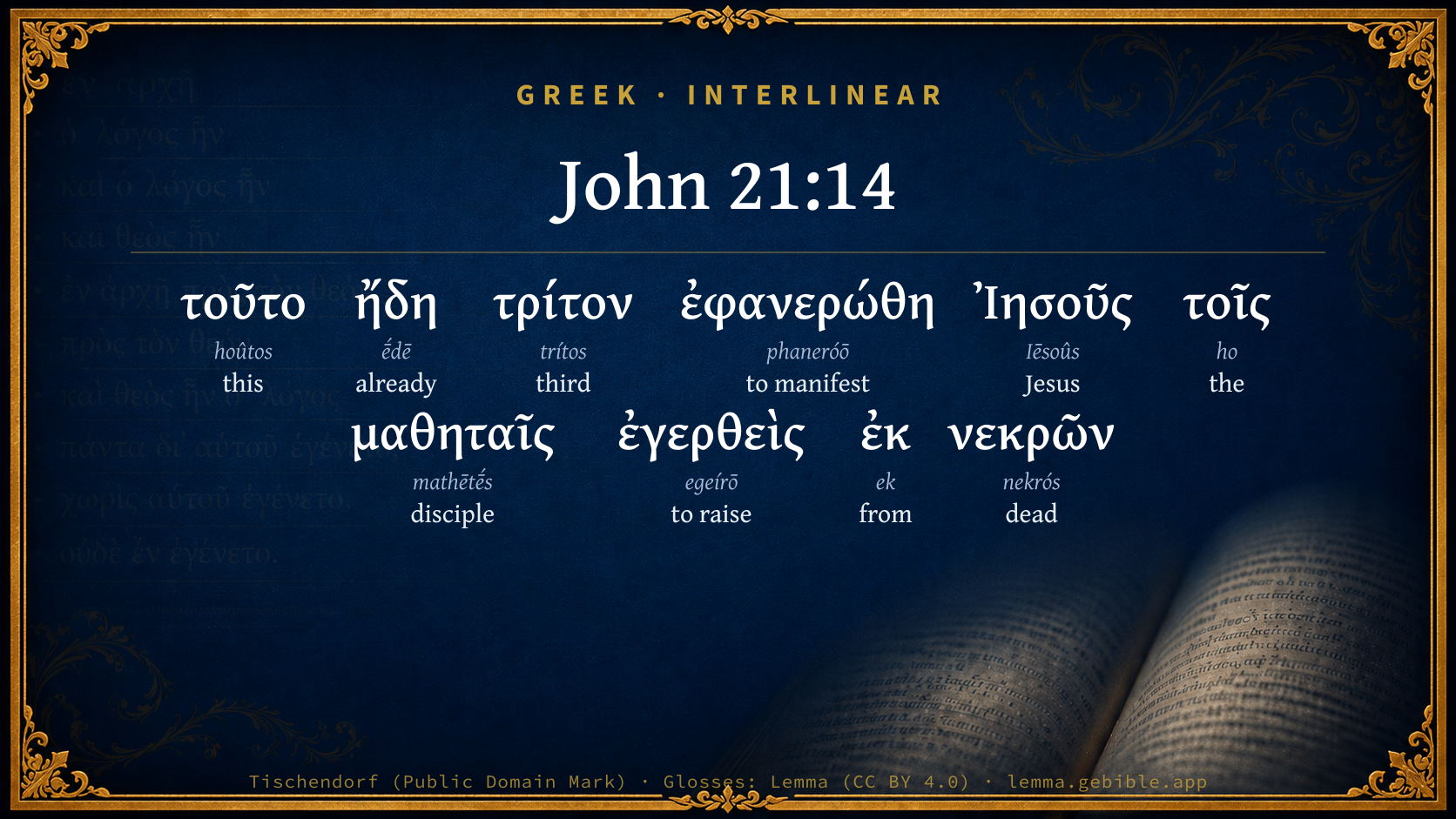
Greek (Tischendorf 8th ed.) John 21:14 appears in the Greek New Testament. The text above is from the Tischendorf 8th edition. Each word links to its Strong’s number and a concise gloss. Click any word for its full Thayer’s Greek Lexicon entry.
Download image
Cite this verse

John 21:14 (World English Bible). Public Domain. Lemma interlinear Bible study tool, https://lemma.gebible.app/v/john/21/14.

Show BibTeX & RIS
BibTeX
RIS
English Translation
This is now the third time that Jesus was revealed to his disciples, after he had risen from the dead.
World English Bible · Public Domain
Download a study sheet

One document with this verse’s original text, its word-by-word gloss line, the meaning frame, cross-references with their text, attributed commentary, and full source and license credits — printable, and it pastes into notes with its structure intact.

This verse Autodidact and up

Study sheet (.html) Plain text (.txt)

A passage Seminary Student

Up to 50 verses in one chapter. A passage sheet keeps up to 6 commentary sources and 12 cross-references per verse, in the order this page ranks them, and says so on the sheet whenever that leaves anything out. Ask for a single verse and you get the Autodidact verse sheet above.

Everything on this page stays free to read, with no account — the sheet is a download of what is already on screen, not access to it.

Want to remove ads? Support Godless Engineer
Compare translations 3

The same verse in 3 English versions, stacked beneath the original-language interlinear above. Click any original word for its lexicon entry.

Each is an independent rendering of the whole verse — the interlinear is not word-aligned to these translations.

Highlighted words mark where these versions differ — a whole-verse word diff, not a word-by-word alignment.

  • World English Bible Public Domain
    This is now the third time that Jesus was revealed to his disciples, after he had risen from the dead.
  • King James Version Public Domain
    This is now the third time that Jesus shewed himself to his disciples, after that he was risen from the dead.
  • unfoldingWord Literal Text CC BY-SA 4.0
    This already the third time that Jesus was revealed to the disciples, having been raised from the dead.

unfoldingWord Literal Text — © unfoldingWord, licensed CC BY-SA 4.0. Word-aligned USFM3 via Door43 (git.door43.org/unfoldingWord/en_ult).

Versions to compare (up to 4)

3 of 4 selected

Show all 19 translations

Every available English version of this verse, each an independent rendering of the whole verse.

  • World English Bible Public Domain
    This is now the third time that Jesus was revealed to his disciples, after he had risen from the dead.
  • Berean Standard Bible Public Domain
    This was now the third time that Jesus appeared to the disciples after He was raised from the dead.
  • Majority Standard Bible Public Domain
    This was now the third time that Jesus appeared to His disciples after He was raised from the dead.
  • King James Version Public Domain
    This is now the third time that Jesus shewed himself to his disciples, after that he was risen from the dead.
  • American Standard Version (1901) Public Domain
    This is now the third time that Jesus was manifested to the disciples, after that he was risen from the dead.
  • Revised Version (1885) Public Domain
    This is now the third time that Jesus was manifested to the disciples, after that he was risen from the dead.
  • Geneva Bible (1599) Public Domain
    This is now the third time that Iesus shewed himselfe to his disciples, after that he was risen againe from the dead.
  • Douay-Rheims (1899) Public Domain
    This is now the third time that Jesus was manifested to his disciples, after he was risen from the dead.
  • Young's Literal Translation Public Domain
    this `is' now a third time Jesus was manifested to his disciples, having been raised from the dead.
  • Literal Standard Version CC BY-SA 4.0
    this [is] now a third time Jesus was revealed to His disciples, having been raised from the dead.
  • Unlocked Literal Bible CC BY-SA 4.0
    This was the third time that Jesus showed himself to the disciples after he had risen from the dead.
  • unfoldingWord Literal Text CC BY-SA 4.0
    This already the third time that Jesus was revealed to the disciples, having been raised from the dead.
  • Darby Bible Public Domain
    This is already the third time that Jesus had been manifested to the disciples, being risen from among [the] dead.
  • World Messianic Bible Public Domain
    This is now the third time that Yeshua was revealed to his disciples after he had risen from the dead.
  • Webster's Bible Public Domain
    This is now the third time that Jesus showed himself to his disciples, after he had risen from the dead.
  • Free Bible Version CC BY-SA 4.0
    This was the third time Jesus had appeared to the disciples after being raised from the dead.
  • Bible in Basic English Public Domain
    Now this was the third time that Jesus let himself be seen by the disciples after he had come back from the dead.
  • Text-Critical English NT CC BY 4.0
    This was now the third time that Jesus had been revealed to his disciples after he had been raised from the dead.
  • Tyndale New Testament (1534) Public Domain
    And this is now the thyrde tyme that Iesus appered to his disciples after that he was rysen agayne from deeth.

Literal Standard Version (2020), Covenant Press — licensed CC BY-SA 4.0. Text via the HelloAO Bible API (eBible.org). Unlocked Literal Bible (unfoldingWord) — licensed CC BY-SA 4.0. Text via the HelloAO Bible API (eBible.org). unfoldingWord Literal Text — © unfoldingWord, licensed CC BY-SA 4.0. Word-aligned USFM3 via Door43 (git.door43.org/unfoldingWord/en_ult). Free Bible Version, Dr. Jonathan Gallagher — licensed CC BY-SA 4.0. Text via the HelloAO Bible API (eBible.org).

Word by word

More ways to search: Search by grammar → Find every occurrence → Compare this word →

Practice this passage: Drill this verse → Learn its vocabulary →

ἐφανερώθη
phaneróō
G5319
“to manifest”
Verb, Aorist, Passive, Indicative, 3rd person, Singular
Part of Speech
Verb
Tense
Aorist
Voice
Passive
Mood
Indicative
Person
3rd person
Number
Singular
Full Thayer's Definition

Origin: from G5318

TDNT: 09:03,1

1. to make manifest or visible or known what has been hidden or unknown, to manifest, whether by words, or deeds, or in any other way a. make actual and visible, realised b. to make known by teaching c. to become manifest, be made known d. of a person 1. expose to view, make manifest, to show one's self, appear e. to become known, to be plainly recognised, thoroughly understood 1. who and what one is
  1. τοῦτο hoûtos G3778 “this” Demonstrative pronoun, Nominative, Singular, Neuter
  2. ἤδη ḗdē G2235 “already” Adverb
  3. τρίτον trítos G5154 “third” Adjective, Accusative, Singular, Neuter
  4. Ἰησοῦς Iēsoûs G2424 “Jesus” Noun, Nominative, Singular, Masculine
  5. τοῖς ho G3588 “the” Article, Dative, Plural, Masculine
  6. μαθηταῖς mathētḗs G3101 “disciple” Noun, Dative, Plural, Masculine
  7. ἐγερθεὶς egeírō G1453 “to raise” Verb, Aorist, Passive, Participle, Nominative, Singular, Masculine
  8. ἐκ ek G1537 “from” Preposition
  9. νεκρῶν nekrós G3498 “dead” Adjective, Genitive, Plural, Masculine

About this verse

These counts appear in no published source. They are computed here, from the morphology-tagged text and Lemma’s own curated glosses. What Lemma adds →

10
words
10
distinct lemmas
Gospels
section

Shared distinctive vocabulary

ἐφανερώθη to manifest G5319 occurs in 43 verses of the Greek New Testament. Also found in:
Cross-references

2

Topical passages linked to John 21:14 in the Treasury of Scripture Knowledge — connected by theme and wording, ordered by reader-vote popularity; previews shown in the World English Bible.

  • John 20:26 After eight days again his disciples were inside, and Thomas was with them. Jesus came, the doors being locked, and stood in the midst, and said, "Peace be to you."
  • John 20:19 When therefore it was evening, on that day, the first day of the week, and when the doors were locked where the disciples were assembled, for fear of the Jews, Jesus came and stood in the midst, and said to them, "Peace be to you."

Cross-references courtesy of OpenBible.info (CC BY 4.0).

Commentary

Notes on John 21:14 from classic Christian and Jewish commentators (each source and its license shown beneath its notes). The classic Christian expositions comment on the surrounding passage and are grouped to its opening verse, so a note may address several verses; the Jewish commentaries on the Tanakh (Rashi and others) are per-verse, so they appear only where the commentator wrote on this verse.

Lemma curates 59 commentaries, every one of them public domain or Creative Commons licensed, each selected and text-cleaned for this edition rather than reprinted as found. About our sources →

Whedon's Commentary on the Bible

Daniel D. Whedon

14. The third time—That he had shown himself to his disciples alone. The two previous being 5 and 6 in the following enumeration: “This was the seventh time in which he had manifested himself after he arose from the dead. (1.) He appeared to Mary of Magdala, Mar_16:9; Joh_20:15-16. (2.) To the holy women who came from the tomb, Mat_28:9. (3.) To the two disciples who went to Emmaus, Luk_24:13, etc. (4.) To St. Peter alone, Luk_24:34. (5.) To the ten, in the absence of Thomas, chap. Joh_20:19. (6.) Eight days after to the eleven, Thomas being present, Joh_21:14. (7.) To the seven, mentioned in Joh_21:2 of this chapter, which was between the eighth and fortieth day after his resurrection. Besides these seven appearances, he showed himself, eighthly, to the disciples on a certain mountain in Galilee, Matthew xxiii, 16. If the appearance mentioned by St. Paul (1Co_15:6) to upwards of five hundred brethren at once be not the same with his appearance on a mountain in Galilee, it must be considered the ninth. According to the same apostle he was seen of James, (1Co_15:7,) which may have been the tenth appearance. And after this to all the apostles, when, at Bethany, he ascended to heaven in their presence. See Mar_16:19-20; Luk_24:50-53; Act_1:3-12; 1Co_15:7. This appears to have been the eleventh time.”—A. Clarke.

Daniel D. Whedon (gen. ed.), Commentary on the Old and New Testaments (1874–1909) — public domain. Text from a community e-Sword module.

Tyndale Open Study Notes

Tyndale Open Resources

21:14 This scene on the beach was the third time Jesus had appeared (see 20:11-23, 26-29).

Tyndale Open Study Notes — © Tyndale Open Resources, licensed CC BY-SA 4.0. Text via the HelloAO Bible API.

Bengel's Gnomon

Johann Albrecht Bengel

Joh 21:14. Τρίτον, the third time) He is speaking of the more solemn appearances, viz. those here recorded, which were vouchsafed to the disciples conjointly. [In fact, already in ch. Joh 20:14; Joh 20:19; Joh 20:26, John had recorded three appearances of the Saviour, if that which was vouchsafed to Mary Magdalene be taken into account. But in this ch. 21, when he thought it advisable to subjoin some particulars concerning Peter and John by way of an Appendix, he adds one appearance also, in order that of those appearances which were vouchsafed to a number of the apostles together, there might be three in all on record in this Gospel.—Harm., p. 609.] Thomas also was present on two of these occasions.

Bengel's Gnomon of the New Testament — English translation (T&T Clark, Edinburgh, 1860) — public domain. Text from a community e-Sword module.

Meyer's Critical & Exegetical Commentary

Heinrich August Wilhelm Meyer

Joh_21:14. Τοῦτο ἤδη τρίτον] This time already for the third time. See on 2Co_13:1.

ἤδη presupposes, on the one hand, that, according to John, until now any other appearances before the disciples had not taken place, with the exception of the three related (Joh_20:19 ff., Joh_20:26 ff., Joh_21:1 ff.); but, on the other hand, that at a later date several other appearances occurred. Since he, moreover, refers his τρίτον only to the appearances that were made to the circle of disciples (not to individual persons), a wider scope is thereby given to harmonists; in no case, however, can they succeed in reconciling the three appearances with the statements of Paul, 1Co_15:5 ff., especially as there εἶτα and ἔπειτα (in opposition to Wieseler) denote chronological sequence. The Apostle Paul is charged, on the supposition that his account is to be understood in an internal way, with a great arbitrariness, when it is asserted that the three appearances related by John are comprized in εἶτα τοῖς δώδεκα in Paul (Luthardt, Lange). Not even can ὤφθη Κηφᾷ in Paul be reconciled with John. To John, however, must be accorded the preference over the tradition followed by Paul, so far as the latter does not agree with the former.

NOTE.

To the draught of fishes, to contest the historical truth of which, in a manner which evinced arbitrariness, and in part even malice, the similarity of the earlier history, Luk_5:2 ff., afforded a welcome opportunity (Strauss, Weisse, Schenkel, and several others), a symbolical destination has, since the most ancient times (Chrysostom and his followers, Cyril, Augustine, and many others), been ascribed, and in general justly, since the word of Jesus, Mat_4:19, parall., gives, naturally enough, the psychological solution why He, as the Risen One, performs, precisely in this fashion, a miraculous work in the presence of His disciples. The tradition in which, from the above word, the draught of fishes, Luke 5, took shape (see on Luk_5:1 ff.), has, although pushing forward the later occurrence, nevertheless apprehended with right feeling the idea which it contained. The disciples themselves could not but find in the words of that first call, Matt. loc. cit., the key to the symbolical significance of the miraculous fact, in which that word, which Jesus had spoken at the beginning, was now, on the boundary of their earthly intercourse with Him, and before the restoration (a renewed calling, as it were) of Peter, set forth and sealed as a fact with the highest appropriateness. Only in respect of the interpretation of this symbolism, we have no right to go beyond Mat_4:14, and read more therein than the rich blessing of the apostolical office, of which the men fishers of Jesus were to be the possessors. To go further, and, with Augustine, to expound all the individual features of the history allegorically (so recently, especially Weitzel in the Stud. u. Krit. 1849, p. 618 f., Luthardt, Lange, Hengstenberg), is groundless and arbitrary, and without any definable limits. Especially is an interpretation of the fish meal, which refers it to the heavenly supper,[282] which the Lord prepares for His own with Abraham, Isaac, and Jacob in the kingdom of God (Olshausen, after Augustine), all the less authorized, since this supper of the kingdom does not concern the apostles as such, and consequently something that is remote would be mixed up with the reference. It is certainly in the present passage only an ἄριστον, a breakfast, which was merely to serve as a handle for the appearance, and for the draught of fishes, as well as for the further scene with Peter. In a manner which serves as a special warning have the allegorical tendencies of the Fathers, in respect of the number of fishes, displayed themselves, as, e.g., Severus, Ammonius, Theophylact (also τινές in Euth. Zigabenus) see depicted in the 100 fishes the Gentiles, in the 50 the Jews, and in the 3 the Trinity; whilst Jerome, who is followed by Köstlin in the Theol. Jahrb. 1851, p. 195, and Hilgenfeld recognises in the 153 fishes, in spite of the fact that they were large ones only, all genera piscium, and thereby the universality of the apostolic activity,[283] which Ruperti derives from the text even by an arithmetical analysis[284] of the number; whilst Hengstenberg, on the other hand (after Grotius), thinks to find the key in the 153,600 strangers, 2Ch_2:17, so that John counts a fish for every thousand (with which the surplus of 600 falls away)!

That John says nothing regarding the symbolical determination of the draught of fishes, is sufficiently explained from the fact that Jesus Himself does not expressly declare it, but allows the thing to speak its silent symbolic language for itself, as He also has not Himself interpreted the symbolism of the withered fig-tree (Mat_21:21).

[282] Even the Lords Supper was found by Augustine to be signified, and he went so far as to say: piscis assus Christus est passus.

[283] Hilgenfeld in his ZeitsChr. 1868, p. 446: The copious take …, i.e. the spiritual harvest from the Gentile world, is now added to the provision of fish and bread already lying ready, I think, for the feeding of the Jewish people (comp. Joh_6:12). The fundamental thought is, he thinks, in Joh_10:16.

[284] Recently enigmatic numeration has been attempted in the case of these fishes, so that according to the Hebrew numerical letters, 118 + 35 =שמען יובה is = Σίμων ʼΙωνᾶ. See Theol. Jahrb. 1854, p. 135; on the other hand: Ewald, Jahrb. vi. p. 161. Volkmar also (Mos. Prophetie, p. 61 f.) gives the enigmatic solution of the number as Simeon Bar Jona Kepha.Calvin already correctly observes: quantum ad piscium numerum spectat, non est sublime aliquod in eo quaerendum mysterium.

Meyer — Critical and Exegetical Commentary on the New Testament — English translation by Peter Christie, edited by Frederick Crombie (T&T Clark, 1880) — public domain. Text from a community e-Sword module.

Expositor's Greek Testament

ed. W. Robertson Nicoll

Joh 21:14 . A note is added, perhaps indicating no more than John’s orderliness of mind, explaining that this was the third manifestation given by Jesus to His disciples after rising from the dead. For the form of expression, τοῦτο ἤδη τρίτον , see 2Co 13:1 .

The Expositor's Greek Testament, edited by W. Robertson Nicoll (1897–1910) — public domain. Text from a community e-Sword module.

Jamieson, Fausset & Brown

Robert Jamieson, A. R. Fausset & David Brown

This is the third time that Jesus showed himself--was manifested.

to his disciples--His assembled disciples; for if we reckon His appearances to individual disciples, they were more.

Jamieson, Fausset & Brown — Commentary Critical and Explanatory on the Whole Bible (1871) — public domain (CC PDM 1.0). Text via the HelloAO Bible API.

Adam Clarke's Commentary

Verse 14. This is now the third time] That is, this was the third time he appeared unto the apostles, when all or most of them were together. He appeared to ten of them, Joh 20:19; again to eleven of them, Joh 20:26; and at this time to seven of them, Joh 21:2. But, when the other evangelists are collated, we shall find that this was the seventh time in which he had manifested himself after he arose from the dead.

1st. He appeared to Mary of Magdala, Mr 16:9; Joh 20:15-16.

2ndly, To the holy women who came from the tomb. Mt 28:9.

3dly, To the two disciples who went to Emmaus, Lu 24:13, c.

4thly, To St. Peter alone, Lu 24:34.

5thly, To the ten, in the absence of Thomas, Joh 20:19.

6thly, Eight days after to the eleven, Thomas being present Joh 20:26.

7thly, To the seven, mentioned in Joh 21:2; which was between the eighth and fortieth day after his resurrection. Besides these seven appearances, he showed himself,

8thly, To the disciples on a certain mountain in Galilee, Mt 28:16.

If the appearance mentioned by St. Paul, 1Co 15:6, to upwards of 500 brethren at once - if this be not the same with his appearance on a mountain in Galilee, it must be considered the ninth. According to the same apostle, he was seen of James, 1Co 15:7, which may have been the tenth appearance. And, after this, to all the apostles, when, at Bethany, he ascended to heaven in their presence. See Mr 16:19-20; Lu 24:50-53; Ac 1:3-12; 1Co 15:7. This appears to have been the eleventh time in which he distinctly manifested himself after his resurrection. But there might have been many other manifestations, which the evangelists have not thought proper to enumerate, as not being connected with any thing of singular weight or importance.

Adam Clarke's Commentary on the Bible (1810–1826) — public domain. Text from a community e-Sword/MySword module.

John Calvin's Commentaries

14. The third time. The number three refers to the distance of time. Christ had already appeared to his disciples more than seven times, but all that had been transacted in one day is included in one manifestation. The Evangelist, therefore, means that Christ had been seen by the disciples at intervals, in order to confirm their belief of his resurrection.

John Calvin's Commentaries (1540-1563) — public domain. Text from the Calvin Translation Society English edition (1840s-50s) via the Christian Classics Ethereal Library (ccel.org). Calvin's coverage is partial (roughly two-thirds of the Bible); uncommented books and verses are honest gaps, never fabricated. The 19th-century editor's footnotes and remarks are omitted so the notes are faithfully Calvin's own voice.

Ellicott's Commentary for English Readers

(14) This is now the third time that Jesus shewed himself to his disciples.—Better, . . . that Jesus was manifested . . .—Comp. Note on Joh_21:1. The writer is giving his own witness. He passes over, therefore, the appearances to Mary Magdalene and others, and counting only those “to the disciples”—to the Ten on the first Easter day, and to the Eleven on its octave—gives this appearance as the third. (Comp. Note on 1Co_15:5-7.)

A Bible Commentary for English Readers, edited by Charles John Ellicott (1878–1897) — public domain. Text from a community e-Sword module.

The Cambridge Bible for Schools and Colleges

gen. ed. J. J. S. Perowne

14. This is now the third time] We have a similar construction 2Pe_3:1. The two previous manifestations are probably those related Joh_20:19-23; Joh_20:26-29 : but we have not sufficient knowledge to arrange the different appearances in chronological order. See on Luk_24:49.

shewed himself] Manifested Himself: see on Joh_21:1.

The Cambridge Bible for Schools and Colleges (gen. ed. J. J. S. Perowne; Cambridge University Press, 1878–1918) — public domain. Text from a community e-Sword module.

John Gill's Exposition

This is now the third time,.... Or day of Christ's appearance to his disciples: he appeared to them first on the same day he rose, and then a second time eight days after, or that day a week later, and now at the sea of Tiberias; for within this compass of time he had made more appearances than three, though to particular persons, and not to such a number of the disciples as at these three times:

that Jesus showed himself to his disciples after that he was risen from the dead: and thus, as by the mouth of two or three witnesses, everything is established; so by these three principal appearances of Christ to his disciples, his resurrection from the dead was confirmed.

John Gill's Exposition of the Whole Bible (1746–1763) — public domain (CC PDM 1.0). Text via the HelloAO Bible API.

Trapp's Complete Commentary

John Trapp

14 This is now the third time that Jesus shewed himself to his disciples, after that he was risen from the dead.

Ver. 14. This is now the third time, &c.] Adam died, and we hear no more of him; not so the second Adam. "If a man die, shall he live again?" Job 14:14. Not till the general resurrection surely. Many devices there are in the minds of some, that there shall be a first resurrection of the martyrs only, and that they shall reign on earth a thousand years. Alsted saith, this thousand years shall begin in the year 1694. But these, saith a divine, are but the mistakes of some high expressions in Scripture; which describe the judgments poured out upon God’s enemies in making a way to the Jews’ conversion by the pattern of the last judgment. (Cotton upon the Seven Vials.)

John Trapp, A Commentary or Exposition upon All the Books of the Old and New Testament (1647–1656) — public domain. Text from a community e-Sword module.

Albert Barnes' Notes on the Bible

The third time - See the “Harmony of the Accounts of the Resurrection of Jesus.”

Albert Barnes' Notes on the Bible (1834–1885) — public domain. Text from a community e-Sword/MySword module.

Haydock's Catholic Bible Commentary

This is now the third time that Jesus was manifested to his disciples. He had appeared to them more than thrice, even the very day of his resurrection. (Matthew xxviii. 16.) Here it is called the third time either because it was the third different day; or because it was the third time that he had them appeared to a considerable number together. After this, he appeared to them frequently, and conversed with them for forty days, till his ascension. See Acts i. 3. and 1 Corinthians xv. 5. (Witham) --- This must be understood of the third day, or of the third time, that our Saviour appeared to his apostles assembled: the first day, being the day of his resurrection; the second, eight days after, when St. Thomas saw, and believed; and on this day of their fishing. (St. Augustine, tract. 122. in Joan.) --- The evangelists relates ten different manifestations of our Saviour, after his resurrection. First, he was seen by the women at the sepulchre; 2ndly, he was again seen by the same holy women, returning from the sepulchre; 3rdly, by St. Peter; 4thly, by the two going to Emmaus; 5thly, by many at Jerusalem, when Thomas was not with them; 6thly, at the time when St. Thomas saw him; 7thly, at the sea of Tiberias; 8thly, by the eleven, on a mountain of Galilee, according to St. Matthew; 9thly, according to St. Mark, by the disciples, at their refreshment, because he was going to sup with them no more; and 10thly, on the day of his ascension, raised from the earth into heaven. (St. Augustine, de Concord. Ev. lib. iii. chap. 25.)

George Leo Haydock (1774–1849), Haydock's Catholic Family Bible and Commentary, 1859 edition — public domain. Excludes Psalms (Douay-Rheims chapter numbering differs from Protestant) and Deuterocanonical books (Catholic canon only).

Matthew Poole's English Annotations

The third time; that is, the third day, for upon his resurrection day he showed himself,

1. To Mary Magdalene, Joh 20:14.

2. To the two disciples going to Emmaus, Luk 24:15,31.

3. To the women going to tell his disciples, Mat 28:9.

4. In the evening to his disciples, met, Joh 20:19.

All these are by John counted for one time, because they were upon one and the same day. That day seven night he appeared to them again, Joh 20:26. After this at the sea of Tiberias, mentioned in this chapter.

Matthew Poole's English Annotations on the Holy Bible (1683–1685) — public domain. Text from a community e-Sword/MySword module.

The Pulpit Commentary

This is now or, as Meyer puts it, this time already isthe third time that Jesus was manifested (passive, not active, as in ver. 1) to the disciples, after that he was risen from the dead; or, when he had been raised from the dead. The implication is that there had up to this time been no other manifestation to groups of his disciples than those which John bad related. Therefore those other occurrences mentioned by Luke, Matthew, and Paul must be supposed to lie still in the future. That there were other manifestations is not obscurely hinted by the word hdh . The appearances to the women, to Cephas and James, are not of the class so carefully described by John. The eita toiv dwdeka of 1Co_15:5, etc., might be regarded as this third manifestation to the disciples (Luthardt). Godet agrees that the two appearances in Luke (Emmaus and Peter) are not reckoned by John, any more than that made to Mary Magdalene. The statement, "to the disciples," is clearly the explanation. Paul mentions the appearance

(1) to Simon Peter;

(2) then to the twelve; (Joh_20:19, Joh_20:26)

(3) to the five hundred, at the head of whom may have been the eleven of Mat_28:16-20;

(4) James;

(5) the twelve (the ascension not described by John).

Since Luke and Paul (Godet) omitted the narrative before us, John is here repairing the omissions of tradition. It seems quite as reasonable to place this third revelation to a group of apostles as the third of Paul"s enumerations. John is explicit in recording appearances to the special, combined, and chosen witnesses, while he not only implies, but mentions, other manifestations. Paul recites the special manifestations of various kinds, and gives most important details dropped by other traditions. The apocryphal " Gospel according to the Hebrews," as related by Jerome ("Cat. Script. Eccl. "Jacobus quotes the passage which refers to the interview between James and the risen Lord. Gregory of Tours ("Hist. Francorum," 1:21) refers to the tradition as though he had taken it from some analogous but not identical source (see a full discussion of the passage in Nicholson"s "Gospel according to the Hebrews," pp. 62-68). If the previous manifestations of the risen Lord were made to love, to thought, to earnest though trembling inquiry, to spiritual vision only, so here we find that, amid the ordinary duties of life and the activities and disappointments of daily service, the Lord manifests himself. The eye of love and the heart of rock are made ready for special assurances of the Master"s presence and power to help and guide disciples throughout that mysterious future in which they are to feel and realize his words, "Lo! I am with you always, even to the end of the world."

The Pulpit Commentary (1880–1919), ed. H.D.M. Spence-Jones & Joseph S. Exell — public domain. Text from a community e-Sword module.

John Wesley's Explanatory Notes

The third time - That he appeared to so many of the apostles together.

John Wesley, Explanatory Notes Upon the Whole Bible (1754–1765) — public domain. Text via the GEBible commentary corpus.

The People's New Testament

B. W. Johnson

14. The third time that Jesus shewed himself to his disciples. John does not say that this was the third appearance of Jesus, but the third time he had showed himself to the disciples, or apostles, for that is the sense in which disciples is here, and often, used. The first time was his appearance to the ten apostles, on the evening of the day of the resurrection (John 20:19). The second was to the eleven (Thomas was now present) one week later (John 20:26).

B. W. Johnson's The People's New Testament with Notes (1889–1891) — public domain. Electronic text from the Christian Classics Ethereal Library (CCEL) ThML edition.

Cambridge Greek Testament for Schools and Colleges

14. τοῦτο ἤδη τρίτον. Comp. Joh 2:11, Joh 4:54. The remark in all three cases guards against a possible misunderstanding of the Synoptic narrative [20]. We have a similar construction 2Pe 3:1. The two previous manifestations are probably those related Joh 20:19-23; Joh 20:26-29, that to the Magdalene not being counted, as not granted to the disciples: but we have not sufficient knowledge to arrange the different appearances in chronological order. See on Luk 24:49.

Cambridge Greek Testament for Schools and Colleges (Cambridge University Press, 1896; 21 vols, various authors incl. Carr, Maclear, Plummer, Farrar, Lumby, Moule, M. R. James, Simcox) — public domain. Text from a community e-Sword module.

Alford’s Greek Testament

Henry Alford

14. τοῦτο ἤδη τρίτον] Compare τοῦτο [δὲ] πάλιν δεύτερον, ch. 4:54: and 2Co 13:1. The number here is clearly not that of all appearances of Jesus up to this time, for that to Mary Magdalen is not reckoned; but only those to the disciples,—i.e. any considerable number of them together. This one internal trait of consistency speaks much for the authenticity and genuineness of the addition.

ἐγερθείς] The participle is not found elsewhere in John, but the participial construction is found in ch. 4:54.

Without agreeing with all the allegorical interpretations of the Fathers, I cannot but see much depth and richness of meaning in this whole narrative. The Lord appears to His disciples, busied about their occupation for their, daily bread; speaks and acts in a manner wonderfully similar to His words and actions on a former memorable occasion, when we know that by their toiling long and taking nothing, but at his word enclosing a multitude of fishes, was set forth what should befall them as fishers of men. Can we miss that application at this far more important epoch of their apostolic mission? Besides, He graciously provides for their present wants, and invites them to be His guests: why, but to shew them that in their work hereafter they should never want but He would provide? And as connected with the parable, Mat 13:47 ff., has the net enclosing a great multitude and yet not broken, no meaning? Has the ‘taking the bread and giving to them, and the fish likewise’ no meaning, which so closely binds together the miraculous feeding, and the institution of the Lord’s Supper, with their future meetings in His Name and round His Table? Any one who recognizes the teaching character of the acts of the Lord, can hardly cast all such applications from him;—and those who do not, have yet the first rudiments of the Gospels to learn.

Henry Alford, The Greek Testament (1849–1861) — public domain. Text from a community e-Sword module.

International Critical Commentary

14. With the constr. τοῦτο ἤδη τρίτον, cf. τοῦτο πάλιν δεύτερον σημεῖον (4:54), and see 2:11. In both these passages (2:11, 4:54), Jn. implies a correction of Mk.’s narrative, and it is probable that here too a correction of the Galilæan tradition as to the appearance by the lake-side is intended. Jesus did not first manifest Himself to the apostles in Galilee (Mat 28:16); He manifested Himself to them twice at Jerusalem (20:19, 26), and not until after that (τρίτον) did He show Himself in Galilee. V. 14 seems to be an addition made by Jn. to his source.

ἐφανερώθη Ἰησοῦς. Cf. v. 1 and see on 1:31.

After μαθηταῖς the rec. has αὐτοῦ, but om. אABCDLWO.

ἐγερθεὶς ἐκ νεκρῶν. Cf. 2:22, 12:9, 17. ἀναστῆναι was the verb used 20:9.

The Restoration of Peter to His Apostolic Office (vv. 15-17)

International Critical Commentary — older volumes (1896–1929), various authors — public domain. Text from a community e-Sword module.

Vincent's Word Studies in the New Testament

Marvin R. Vincent

The third time. The two former occasions being recorded in Joh 20:19,

Joh 21:26The appearance to Mary Magdalene is not counted, because the Evangelist expressly says to His disciples.

Marvin R. Vincent, Word Studies in the New Testament (1887–1900) — public domain. Text from a community e-Sword/MySword module.

Lesson kit

Teaching starters — assembled from the data on this page, not authored interpretation. Every prompt links to the verse data it draws on. Edit before teaching.

John, in the Gospels, opens this verse with 10 words (10 distinct Greek lemmas). Its most distinctive word is phaneróō (“to manifest”). A historical commentator’s framing appears above. Read the whole chapter for the surrounding context.

Discussion questions

  1. How does “to manifest” (phaneróō) shape what this verse is saying?
  2. How does Mark 4:22, which shares the word «to manifest», read alongside this verse?
  3. These translations render this verse differently. What is at stake in choosing one wording over another?
  4. Compare how Whedon's Commentary on the Bible and Tyndale Open Study Notes read this verse. Where do they agree or differ?

Things to notice

Reading settings

Reading text

Shown beneath each verse's original-language words.

Old Testament
Old Testament edition

Read the OT as the Masoretic Hebrew (MT) or the Greek Septuagint (LXX).

English shown for the Greek Septuagint (in the Hebrew ↔ Greek comparison).

Comparing translations? Open the Compare panel on any verse page to stack up to four side by side.