Jeremiah 7:33

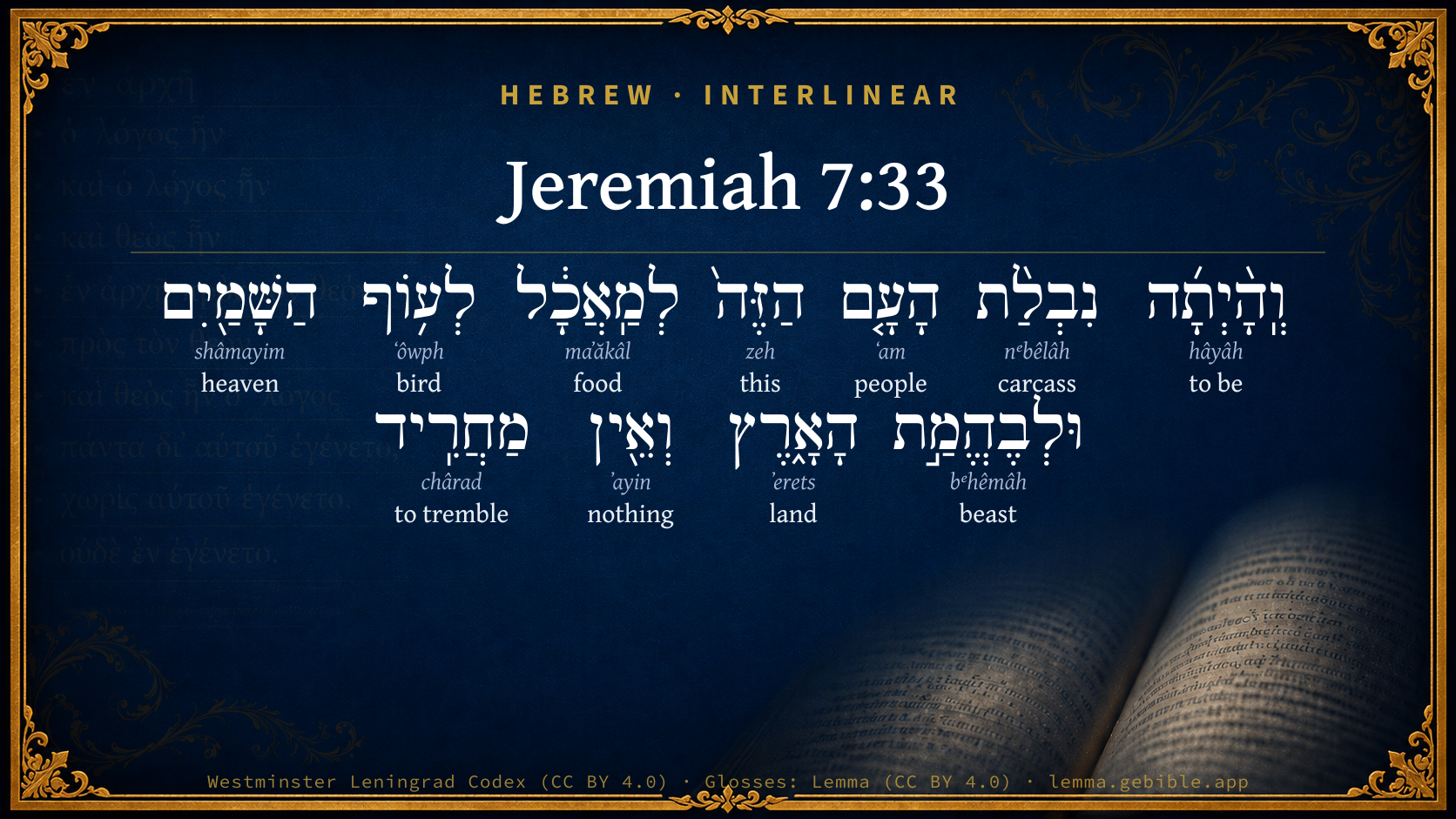
Hebrew (Westminster Leningrad Codex) Jeremiah 7:33 appears in the Hebrew Old Testament. The text above is from the Westminster Leningrad Codex. Each word links to its Strong’s number, a concise gloss, and parsing drawn from the Open Scriptures Hebrew Bible morphology. Click any word for its full Brown-Driver-Briggs (BDB) entry.
Download image
Cite this verse

Jeremiah 7:33 (World English Bible). Public Domain. Lemma interlinear Bible study tool, https://lemma.gebible.app/v/jeremiah/7/33.

Show BibTeX & RIS
BibTeX
RIS
English Translation
The dead bodies of this people shall be food for the birds of the sky, and for the animals of the earth; and none shall frighten them away.
World English Bible · Public Domain
Download a study sheet

One document with this verse’s original text, its word-by-word gloss line, the meaning frame, cross-references with their text, attributed commentary, and full source and license credits — printable, and it pastes into notes with its structure intact.

This verse Autodidact and up

Study sheet (.html) Plain text (.txt)

A passage Seminary Student

Up to 50 verses in one chapter. A passage sheet keeps up to 6 commentary sources and 12 cross-references per verse, in the order this page ranks them, and says so on the sheet whenever that leaves anything out. Ask for a single verse and you get the Autodidact verse sheet above.

Everything on this page stays free to read, with no account — the sheet is a download of what is already on screen, not access to it.

Want to remove ads? Support Godless Engineer
Compare translations 3

The same verse in 3 English versions, stacked beneath the original-language interlinear above. Click any original word for its lexicon entry.

Each is an independent rendering of the whole verse — the interlinear is not word-aligned to these translations.

Highlighted words mark where these versions differ — a whole-verse word diff, not a word-by-word alignment.

  • World English Bible Public Domain
    The dead bodies of this people shall be food for the birds of the sky, and for the animals of the earth; and none shall frighten them away.
  • King James Version Public Domain
    And the carcases of this people shall be meat for the fowls of the heaven, and for the beasts of the earth; and none shall fray them away.
  • unfoldingWord Literal Text CC BY-SA 4.0
    And the corpses of this people will be for food for the bird of the skies and for the beast of the earth, and there will be none to frighten.

unfoldingWord Literal Text — © unfoldingWord, licensed CC BY-SA 4.0. Word-aligned USFM3 via Door43 (git.door43.org/unfoldingWord/en_ult).

Versions to compare (up to 4)

3 of 4 selected

Show all 18 translations

Every available English version of this verse, each an independent rendering of the whole verse.

  • World English Bible Public Domain
    The dead bodies of this people shall be food for the birds of the sky, and for the animals of the earth; and none shall frighten them away.
  • Berean Standard Bible Public Domain
    The corpses of this people will become food for the birds of the air and the beasts of the earth, and there will be no one to scare them away.
  • Majority Standard Bible Public Domain
    The corpses of this people will become food for the birds of the air and the beasts of the earth, and there will be no one to scare them away.
  • King James Version Public Domain
    And the carcases of this people shall be meat for the fowls of the heaven, and for the beasts of the earth; and none shall fray them away.
  • American Standard Version (1901) Public Domain
    And the dead bodies of this people shall be food for the birds of the heavens, and for the beasts of the earth; and none shall frighten them away.
  • Revised Version (1885) Public Domain
    And the carcases of this people shall be meat for the fowls of the heaven, and for the beasts of the earth; and none shall fray them away.
  • Geneva Bible (1599) Public Domain
    And ye carkeises of this people shalbe meat for the foules of the heauen and for the beastes of the earth, and none shall fraie them away.
  • Douay-Rheims (1899) Public Domain
    And the carcasses of this people shall be meat for the fowls of the air, and for the beasts of the earth, and there shall be non to drive them away.
  • Young's Literal Translation Public Domain
    And the carcase of this people hath been for food To a fowl of the heavens, and to a beast of the earth, And there is none troubling.
  • Literal Standard Version CC BY-SA 4.0
    And the carcass of this people has been for food || To a bird of the heavens, and to a beast of the earth, || And there is none troubling.
  • Unlocked Literal Bible CC BY-SA 4.0
    The corpses of this people will be food for the birds of the skies and the beasts of the earth, and there will be no one to frighten them away.
  • unfoldingWord Literal Text CC BY-SA 4.0
    And the corpses of this people will be for food for the bird of the skies and for the beast of the earth, and there will be none to frighten.
  • Darby Bible Public Domain
    And the carcases of this people shall be food for the fowl of the heavens, and for the beasts of the earth; and none shall scare [them] away.
  • World Messianic Bible Public Domain
    The dead bodies of this people will be food for the birds of the sky, and for the animals of the earth. No one will frighten them away.
  • Webster's Bible Public Domain
    And the carcasses of this people shall be food for the fowls of heaven, and for the beasts of the earth; and none shall frighten them away.
  • Free Bible Version CC BY-SA 4.0
    The dead bodies of these people will be food for birds of prey and wild animals, and there won't be anyone to scare them away.
  • Bible in Basic English Public Domain
    And the bodies of this people will be food for the birds of heaven and for the beasts of the earth; and there will be no one to send them away.
  • JPS Tanakh (1917) Public Domain
    And the carcasses of this people shall be food for the fowls of the heaven, and for the beasts of the earth; and none shall frighten them away.

Literal Standard Version (2020), Covenant Press — licensed CC BY-SA 4.0. Text via the HelloAO Bible API (eBible.org). Unlocked Literal Bible (unfoldingWord) — licensed CC BY-SA 4.0. Text via the HelloAO Bible API (eBible.org). unfoldingWord Literal Text — © unfoldingWord, licensed CC BY-SA 4.0. Word-aligned USFM3 via Door43 (git.door43.org/unfoldingWord/en_ult). Free Bible Version, Dr. Jonathan Gallagher — licensed CC BY-SA 4.0. Text via the HelloAO Bible API (eBible.org).

Word by word

More ways to search: Search by grammar → Find every occurrence → Compare this word →

Practice this passage: Drill this verse → Learn its vocabulary →

לְמַֽאֲכָ֔ל
maʼăkâl
H3978
“to/for · food”
Preposition + Noun, Common, Masculine, Singular, Absolute
Part of Speech
Preposition + Noun
Type
Common
Gender
Masculine
Number
Singular
State
Absolute
Full BDB Definition

Origin: from H398

TWOT: 85d

food, fruit, meat
  1. וְֽהָ֨יְתָ֜ה hâyâh H1961 “and · to be” Conjunction + Verb, Qal, Sequential Perfect, 3rd Person, Feminine, Singular
  2. נִבְלַ֨ת nᵉbêlâh H5038 “carcass of” Noun, Common, Feminine, Singular, Construct
  3. הָעָ֤ם ʻam H5971 “the · people” Particle, Definite Article + Noun, Common, Masculine, Singular, Absolute
  4. הַזֶּה֙ zeh H2088 “the · this” Particle, Definite Article + Pronoun, Demonstrative, Masculine, Singular
  5. לְע֥וֹף ʻôwph H5775 “to/for · bird of” Preposition + Noun, Common, Masculine, Singular, Construct
  6. הַשָּׁמַ֖יִם shâmayim H8064 “the · heaven(s)” Particle, Definite Article + Noun, Common, Masculine, Plural, Absolute
  7. וּלְבֶהֱמַ֣ת bᵉhêmâh H929 “and · to/for · beast of” Conjunction + Preposition + Noun, Common, Feminine, Singular, Construct
  8. הָאָ֑רֶץ ʼerets H776 “the · land” Particle, Definite Article + Noun, Common, Both, Singular, Absolute
  9. וְאֵ֖ין ʼayin H369 “and · nothing” Conjunction + Particle, Negative
  10. מַחֲרִֽיד chârad H2729 “trembling” Verb, Hiphil, Participle Active, Masculine, Singular, Absolute

About this verse

These counts appear in no published source. They are computed here, from the morphology-tagged text and Lemma’s own curated glosses. What Lemma adds →

11
words
11
distinct lemmas
Prophets
section

Shared distinctive vocabulary

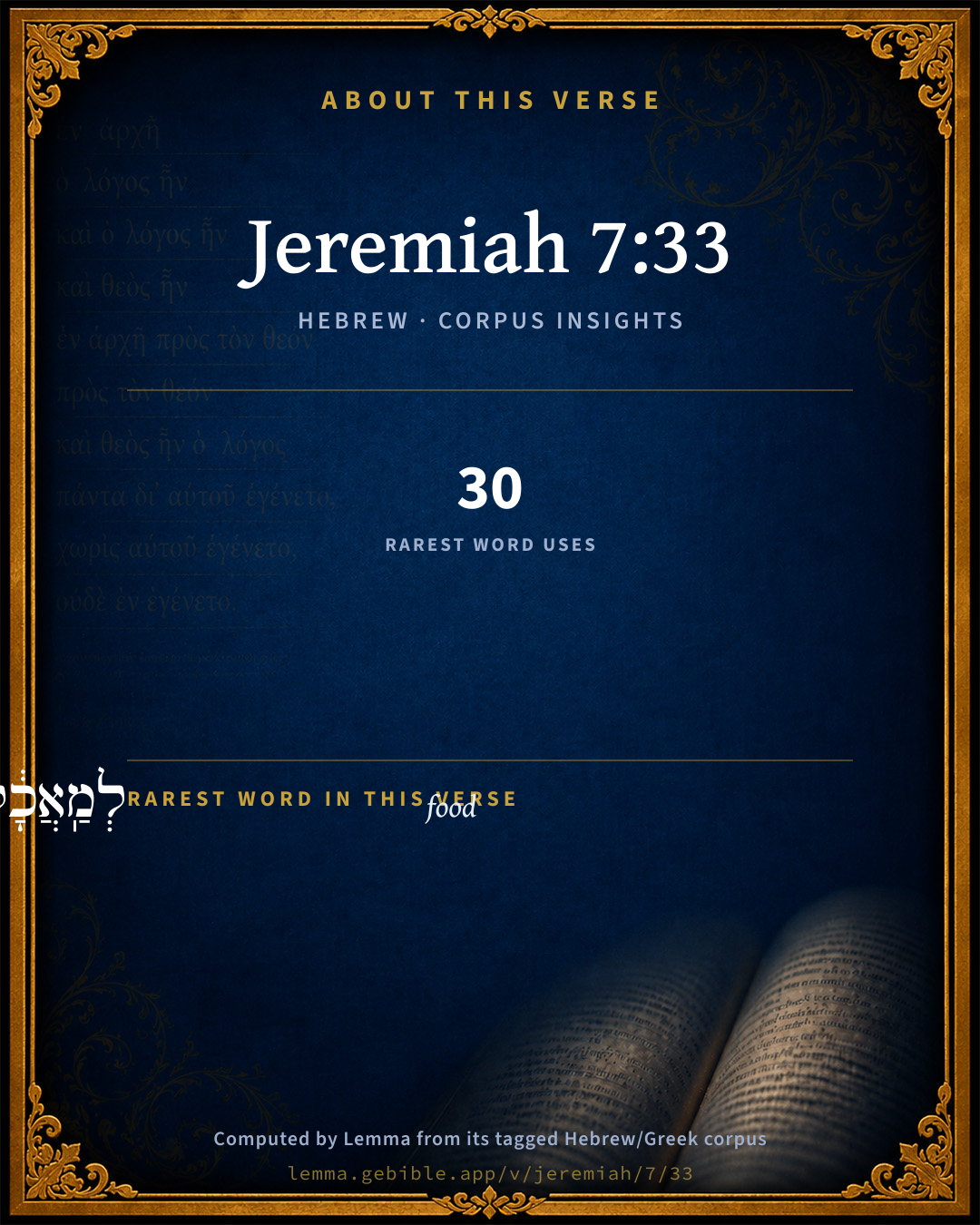
לְמַֽאֲכָ֔ל food H3978 occurs in 29 verses of the Hebrew Bible. Also found in:

Grammatical profile

  • 2 verbs
  • 7 nouns
  • 1 pronoun
  • 1 particle

Verb forms

  • וְֽהָ֨יְתָ֜ה Qal · Sequential Perfect
  • מַחֲרִֽיד Hiphil · Participle Active

Cross-references

13

Topical passages linked to Jeremiah 7:33 in the Treasury of Scripture Knowledge — connected by theme and wording, ordered by reader-vote popularity; previews shown in the World English Bible.

  • Deuteronomy 28:26 Your dead body shall be food to all birds of the sky, and to the animals of the earth; and there shall be none to frighten them away.
  • Jeremiah 12:9 Is my heritage to me as a speckled bird of prey? are the birds of prey against her round about? go you, assemble all the animals of the field, bring them to devour.
  • Revelation 19:17–18 I saw an angel standing in the sun. He cried with a loud voice, saying to all the birds that fly in the sky, "Come! Be gathered together to the great supper of God,
  • Psalms 79:2–3 They have given the dead bodies of your servants to be food for the birds of the sky, The flesh of your saints to the animals of the earth.
  • Jeremiah 8:1–2 At that time, says Yahweh, they shall bring out the bones of the kings of Judah, and the bones of his princes, and the bones of the priests, and the bones of the prophets, and the bones of the inhabitants of Jerusalem, out of their graves;
  • Jeremiah 9:22 Speak, Thus says Yahweh, The dead bodies of men shall fall as dung on the open field, and as the handful after the harvester; and none shall gather [them].
  • Jeremiah 16:4 They shall die grievous deaths: they shall not be lamented, neither shall they be buried; they shall be as dung on the surface of the ground; and they shall be consumed by the sword, and by famine; and their dead bodies shall be food for the birds of the sky, and for the animals of the earth.
  • Jeremiah 19:7 I will make void the counsel of Judah and Jerusalem in this place; and I will cause them to fall by the sword before their enemies, and by the hand of those who seek their life: and their dead bodies will I give to be food for the birds of the sky, and for the animals of the earth.
  • Jeremiah 22:19 He shall be buried with the burial of a donkey, drawn and cast forth beyond the gates of Jerusalem.
  • Jeremiah 25:33 The slain of Yahweh shall be at that day from one end of the earth even to the other end of the earth: they shall not be lamented, neither gathered, nor buried; they shall be dung on the surface of the ground.
  • Jeremiah 34:20 I will even give them into the hand of their enemies, and into the hand of those who seek their life; and their dead bodies shall be for food to the birds of the sky, and to the animals of the earth.
  • Ezekiel 39:4 You shall fall on the mountains of Israel, you, and all your hordes, and the peoples who are with you: I will give you to the ravenous birds of every sort, and to the animals of the field to be devoured.
  • Ezekiel 39:18–20 You shall eat the flesh of the mighty, and drink the blood of the princes of the earth, of rams, of lambs, and of goats, of bulls, all of them fatlings of Bashan.

Cross-references courtesy of OpenBible.info (CC BY 4.0).

Hebrew and Greek witnesses Masoretic Hebrew ↔ Greek Septuagint

The same verse in the two great witnesses to the Old Testament, shown verse-for-verse.

These are two independent witnesses, not word-aligned to each other, and the Septuagint is shown in lemma (dictionary) form.

Hebrew Jeremiah 7:33 Masoretic · Westminster Leningrad Codex

וְֽהָ֨יְתָ֜ה נִבְלַ֨ת הָעָ֤ם הַזֶּה֙ לְמַֽאֲכָ֔ל לְע֥וֹף הַשָּׁמַ֖יִם וּלְבֶהֱמַ֣ת הָאָ֑רֶץ וְאֵ֖ין מַחֲרִֽיד

The dead bodies of this people shall be food for the birds of the sky, and for the animals of the earth; and none shall frighten them away.

World English Bible · Public Domain

Greek LXX Structure differs

In the Septuagint, Jeremiah is about an eighth shorter than the Hebrew and arranges its material differently — the Oracles Against the Nations (Hebrew chapters 46–51) appear in the middle of the Greek book, after 25:13. Because the chapter and verse boundaries do not line up, a verse-for-verse comparison with the Hebrew is not shown.

A verse-for-verse comparison isn’t shown here because the chapters and verses don’t line up. Switch to the LXX edition with the MT / LXX toggle above to read the Greek directly.

Hebrew: Westminster Leningrad Codex (CC BY 4.0). Greek: Septuagint (public domain); English from a public-domain English Septuagint. How the Septuagint differs from the Hebrew →

Targum (Aramaic paraphrase)

1

The Targum is the ancient Jewish Aramaic paraphrase of the Hebrew Scriptures — an interpretive translation, not the Hebrew text itself. Onkelos (literal) and Pseudo-Jonathan (expansive) render the Torah, and Jonathan the Prophets. Coverage is partial: where no permissively-licensed English translation exists for a verse, only the Aramaic is shown. This is verse-level text, not a word-by-word alignment to the Hebrew.

  1. Targum Jonathan Prophets (Joshua–Malachi)
    וּתְהֵי נְבֵילְתָּא דְעַמָא הָדֵין מְשַׁגְרָא לְמֵיכַל לְעוֹפָא דִשְׁמַיָא וְלִבְעִירָא דְאַרְעָא וְלֵית דְמָנִיד:

    (no public-domain English translation for this verse)

    Targum Jonathan — Aramaic: “Mikraot Gedolot” (public domain). English: “Sefaria Community Translation” (CC0 1.0 (public-domain dedication)); “London "Chaldee Paraphrase," 1871” (public domain). Text via Sefaria.

Commentary

Notes on Jeremiah 7:33 from classic Christian and Jewish commentators (each source and its license shown beneath its notes). The classic Christian expositions comment on the surrounding passage and are grouped to its opening verse, so a note may address several verses; the Jewish commentaries on the Tanakh (Rashi and others) are per-verse, so they appear only where the commentator wrote on this verse.

Lemma curates 59 commentaries, every one of them public domain or Creative Commons licensed, each selected and text-cleaned for this edition rather than reprinted as found. About our sources →

Trapp's Complete Commentary

John Trapp

Jer 7:33 And the carcases of this people shall be meat for the fowls of the heaven, and for the beasts of the earth; and none shall fray [them] away.

Ver. 33. And the carcases of this people,] {a} Their murrain carcases, as the Vulgate rendereth it.

Shall be meat for the fowls of the heaven.] Whereby we may also understand the devils of hell, saith Oecolampadius.

{a} Et erit morticinum populi.

John Trapp, A Commentary or Exposition upon All the Books of the Old and New Testament (1647–1656) — public domain. Text from a community e-Sword module.

Jamieson, Fausset & Brown

Robert Jamieson, A. R. Fausset & David Brown

fray--scare or frighten (Deu 28:26). Typical of the last great battle between the Lord's host and the apostasy (Rev 19:17-18, Rev 19:21).

Jamieson, Fausset & Brown — Commentary Critical and Explanatory on the Whole Bible (1871) — public domain (CC PDM 1.0). Text via the HelloAO Bible API.

John Calvin's Commentaries

Jeremiah threatens them with something more grievous than death itself, — that God would impress the marks of his wrath even on their dead bodies. It is indeed true what a heathen poet says,

“That the loss of a grave is not great,” (Virgil, aeneid;)

but we must on the other hand remember that burying has been held as a sacred custom in all ages; for it was a symbol of the last resurrection. Barbarous then were the words, “Give me a stick, if you fear that birds will eat my dead body;” as the cynic, who had ordered his body to be cast into the field, derided what was said in answer to him, “The wild beasts and birds will devour thee:” “Oh,” said he, “let me have a stick, and I will drive them away;” intimating by such a saying, that he would then be without any feeling; but he shewed that he entertained no hope of immortality. But it was God’s will that the custom of burying should prevail among all nations, that in death itself there might be some evidence or intimation of the last resurrection. When therefore the Prophet declares here and in other places that the Jews would be without a burial, he doubtless enhances the vengeance of God.

We indeed know that some of the most holy men had not been buried; for the prophets were sometimes exposed to wild beasts and birds: and the whole Church complains in Psalm 79:2, that the dead bodies of the saints were exposed and became food for birds and wild beasts. This has sometimes happened; for God often mixes the good with the evil in temporal punishments, as he makes his sun to rise on the good and the evil: but yet of itself and for the most part, it is an evidence of a curse, when a man’s body is cast away without any burial.

It is this then that the Prophet means when he says, The carcase of this people shall be meat for the birds of the air and for the beasts of the earth, and there will be none to terrify them; that is, there will be no one to perform the humane office of driving the beasts away, the very thing which nature itself would lead one to do. If any one now objects and says, that in this case the faithful could not be distinguished from the reprobate, the answer is plainly this, — that when the honor of a burial is denied to the faithful, God will become the avenger. But this does not prove that God does not in this way inflict a visible punishment on the reprobate, and thus expose them to reproach by whom he has been despised. He afterwards adds —

John Calvin's Commentaries (1540-1563) — public domain. Text from the Calvin Translation Society English edition (1840s-50s) via the Christian Classics Ethereal Library (ccel.org). Calvin's coverage is partial (roughly two-thirds of the Bible); uncommented books and verses are honest gaps, never fabricated. The 19th-century editor's footnotes and remarks are omitted so the notes are faithfully Calvin's own voice.

Ellicott's Commentary for English Readers

(33) None shall fray them away.—No picture could be more appalling in its horrors—streets and valleys filled with the bodies of the slain, vultures and jackals feeding on them, and not one hand raised, like that of Rizpah (2Sa_21:10), to protect the dead from that extremest desecration. Here, again, we have an almost literal quotation from Deut. (Deu_28:26).

A Bible Commentary for English Readers, edited by Charles John Ellicott (1878–1897) — public domain. Text from a community e-Sword module.

The Cambridge Bible for Schools and Colleges

gen. ed. J. J. S. Perowne

33. fray] frighten. The word is obsolete, except as a provincialism. It is the root of affray (participle, afraid). Cp. “he thought hir to affraye.” Chaucer’s Clerk’s Tale. (Bible Word-Book.)

The Cambridge Bible for Schools and Colleges (gen. ed. J. J. S. Perowne; Cambridge University Press, 1878–1918) — public domain. Text from a community e-Sword module.

John Gill's Exposition

And the carcasses of this people shall be meat for the fowls of the heaven, and for the beasts of the earth,.... That is, those which remain unburied, for which there will be found no place to bury them in; all places, particularly Tophet, being so full of dead bodies; not to have a burial, which is here threatened, was accounted a great judgment:

and none shall fray them away; or frighten them away; that is, drive away the fowls and the beasts from the carcasses. The sense is, either that there should be such a vast consumption of men, that there would be none left to do this, and so the fowls and beasts might prey upon the carcasses without any disturbance; or else that those that were left would be so devoid of humanity, as not to do this office for the dead.

John Gill's Exposition of the Whole Bible (1746–1763) — public domain (CC PDM 1.0). Text via the HelloAO Bible API.

Matthew Poole's English Annotations

The birds and beasts of prey shall feed on them, being exposed to open view for want of interment, Jer 19:7,

and none shall fray them away; ( a piece of humanity that even nature itself teacheth;) either by reason of the enemy’s presence, for fear of whom they durst not; or rather, because there will be none left to do it: and this is reckoned among the curses, Deu 28:26.

Matthew Poole's English Annotations on the Holy Bible (1683–1685) — public domain. Text from a community e-Sword/MySword module.

The Pulpit Commentary

And the carcasses etc.; almost verbally identical with Deu_28:26.

The Pulpit Commentary (1880–1919), ed. H.D.M. Spence-Jones & Joseph S. Exell — public domain. Text from a community e-Sword module.

Scofield Reference Notes

C. I. Scofield

Marg

carcases See Jer 19:11; 2Ki 23:10; Eze 6:5. Fulfilled in part in all the destructions of Jerusalem, but with a final look toward Rev 19:17-21.

The Scofield Reference Bible (1917 edition), notes by C. I. Scofield — public domain. Text from a community e-Sword module.

unfoldingWord translationNotes

Door43 World Missions Community

Connecting Statement:

Yahweh continues to speak of his judgment on the people of Judah.

The corpses

"The dead bodies"

this people

"the people of Judah"

the birds of the skies

See how you translated "the birds of the heavens" in Jeremiah 4:25.

the beasts of the earth

"the wild animals of the land"

to frighten them away

"to scare them away"

I will put an end to

"I will remove from"

the sound of joy and the sound of gladness

These two phrases mean almost the same thing and are repeated for emphasis. The abstract nouns "joy" and "gladness" can be translated using the verb "rejoicing" and the adjective "glad." AT: "the sounds of people rejoicing and being glad" (See: Doublet and Abstract Nouns)

the sound of the groom and the sound of the bride

This is a metonym for what happens at marriage ceremonies. AT: "and people celebrating marriage" (See: Metonymy)

will become a desolation

The abstract noun "desolation" can be translated using the adjective "desolate." AT: "will become desolate" (See: Abstract Nouns)

translationWords

heaven

beast

kingdom of Judah

Jerusalem

bridegroom

bride

desolate

unfoldingWord translationNotes — © Distant Shores Media and the Door43 World Missions Community, licensed CC BY-SA 4.0. Source: git.door43.org/Door43/en_tn.

Rashi

Rabbi Shlomo Yitzchaki (Rashi)

and no one will frighten them i.e., no one will frighten the fowl from the carcasses.

Rashi on the Tanakh — English translations: “The Judaica Press complete Tanach with Rashi, translated by A. J. Rosenberg” (CC BY 4.0); “Pentateuch with Rashi's commentary by M. Rosenbaum and A.M. Silbermann, 1929-1934” (public domain); “The Metsudah Tanach series, Lakewood, N.J” (CC BY 4.0); and “The Book of Joshua, Metsudah Publications, 1997” (CC BY 4.0). Text via Sefaria.

Lesson kit

Teaching starters — assembled from the data on this page, not authored interpretation. Every prompt links to the verse data it draws on. Edit before teaching.

Jeremiah, in the Prophets, opens this verse with 11 words (11 distinct Hebrew lemmas). Its most distinctive word is maʼăkâl (“food”). A historical commentator’s framing appears above. Read the whole chapter for the surrounding context.

Discussion questions

  1. What does “food” (maʼăkâl) contribute to the verse as a whole?
  2. Genesis 2:9 shares the word «food» with this verse. How do the two illuminate each other?
  3. The translations on this page render this verse differently — a whole-verse word diff, not a word-by-word alignment. What might account for the different wordings?
  4. The verb «וְֽהָ֨יְתָ֜ה» is Qal Sequential Perfect. How does its form color the action?
  5. Reading how Trapp's Complete Commentary and Jamieson, Fausset & Brown read this verse, where do the two commentators agree and where do they part?

Things to notice

Reading settings

Reading text

Shown beneath each verse's original-language words.

Old Testament
Old Testament edition

Read the OT as the Masoretic Hebrew (MT) or the Greek Septuagint (LXX).

English shown for the Greek Septuagint (in the Hebrew ↔ Greek comparison).

Comparing translations? Open the Compare panel on any verse page to stack up to four side by side.