

Hebrews 13:20
Greek (Tischendorf 8th ed.) Hebrews 13:20 appears in the Greek New Testament. The text above is from the Tischendorf 8th edition. Each word links to its Strong’s number and a concise gloss. Click any word for its full Thayer’s Greek Lexicon entry.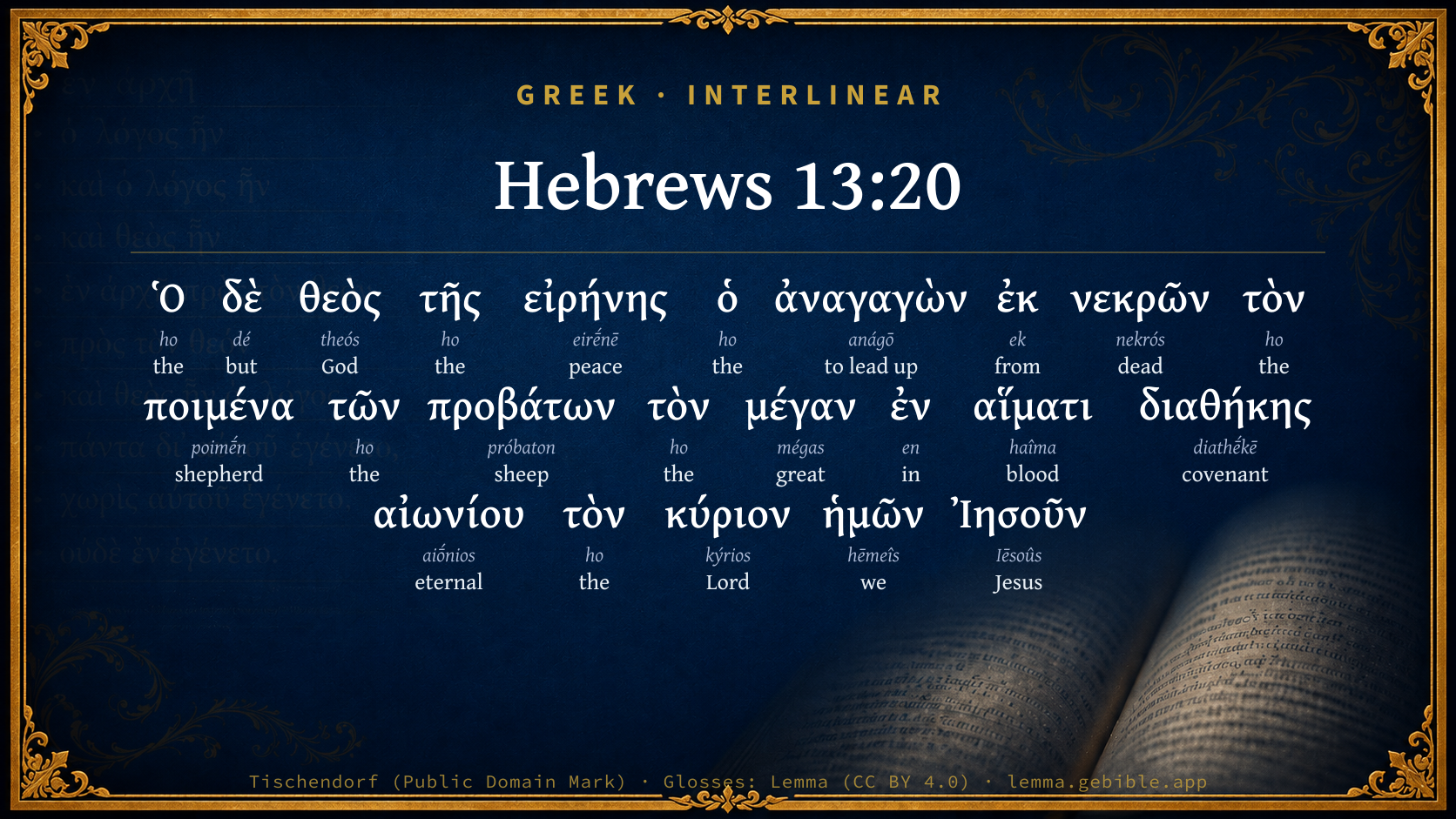
Now may the God of peace, who brought again from the dead the great shepherd of the sheep with the blood of an eternal covenant, our Lord Jesus,
Download a study sheet
One document with this verse’s original text, its word-by-word gloss line, the meaning frame, cross-references with their text, attributed commentary, and full source and license credits — printable, and it pastes into notes with its structure intact.
This verse Autodidact and up
A passage Seminary Student
Up to 50 verses in one chapter. A passage sheet keeps up to 6 commentary sources and 12 cross-references per verse, in the order this page ranks them, and says so on the sheet whenever that leaves anything out. Ask for a single verse and you get the Autodidact verse sheet above.
Everything on this page stays free to read, with no account — the sheet is a download of what is already on screen, not access to it.
Compare translations 3
The same verse in 3 English versions, stacked beneath the original-language interlinear above. Click any original word for its lexicon entry.
Each is an independent rendering of the whole verse — the interlinear is not word-aligned to these translations.
Highlighted words mark where these versions differ — a whole-verse word diff, not a word-by-word alignment.
-
World English Bible Public Domain
Now may the God of peace, who brought again from the dead the great shepherd of the sheep with the blood of an eternal covenant, our Lord Jesus,
-
King James Version Public Domain
Now the God of peace, that brought again from the dead our Lord Jesus, that great shepherd of the sheep, through the blood of the everlasting covenant,
-
unfoldingWord Literal Text CC BY-SA 4.0
Now the God of peace, the one having brought up from the dead ones the great shepherd of the sheep, our Lord Jesus, by the blood of the eternal covenant,
unfoldingWord Literal Text — © unfoldingWord, licensed CC BY-SA 4.0. Word-aligned USFM3 via Door43 (git.door43.org/unfoldingWord/en_ult).
Show all 19 translations
Every available English version of this verse, each an independent rendering of the whole verse.
-
World English Bible Public Domain
Now may the God of peace, who brought again from the dead the great shepherd of the sheep with the blood of an eternal covenant, our Lord Jesus,
-
Berean Standard Bible Public Domain
Now may the God of peace, who through the blood of the eternal covenant brought back from the dead our Lord Jesus, that great Shepherd of the sheep,
-
Majority Standard Bible Public Domain
Now may the God of peace, who through the blood of the eternal covenant brought back from the dead our Lord Jesus, that great Shepherd of the sheep,
-
King James Version Public Domain
Now the God of peace, that brought again from the dead our Lord Jesus, that great shepherd of the sheep, through the blood of the everlasting covenant,
-
American Standard Version (1901) Public Domain
Now the God of peace, who brought again from the dead the great shepherd of the sheep with the blood of an eternal covenant, `even' our Lord Jesus,
-
Revised Version (1885) Public Domain
Now the God of peace, who brought again from the dead the great shepherd of the sheep with the blood of the eternal covenant, even our Lord Jesus,
-
Geneva Bible (1599) Public Domain
The God of peace that brought againe from the dead our Lord Iesus, the great shepheard of the sheepe, through the blood of the euerlasting Couenant,
-
Douay-Rheims (1899) Public Domain
And may the God of peace, who brought again from the dead the great pastor of the sheep, our Lord Jesus Christ, in the blood of the everlasting testament,
-
Young's Literal Translation Public Domain
And the God of the peace, who did bring up out of the dead the great shepherd of the sheep -- in the blood of an age-during covenant -- our Lord Jesus,
-
Literal Standard Version CC BY-SA 4.0
And the God of peace, who brought up the Great Shepherd of the sheep out of the dead—by the blood of a perpetual covenant—our Lord Jesus,
-
Unlocked Literal Bible CC BY-SA 4.0
Now may the God of peace, who brought back from the dead the great shepherd of the sheep, our Lord Jesus, by the blood of the eternal covenant,
-
unfoldingWord Literal Text CC BY-SA 4.0
Now the God of peace, the one having brought up from the dead ones the great shepherd of the sheep, our Lord Jesus, by the blood of the eternal covenant,
-
Darby Bible Public Domain
But the God of peace, who brought again from among [the] dead our Lord Jesus, the great shepherd of the sheep, in [the power of the] blood of [the] eternal covenant,
-
World Messianic Bible Public Domain
Now may the God of peace, who brought again from the dead the great shepherd of the sheep with the blood of an eternal covenant, our Lord Yeshua,
-
Webster's Bible Public Domain
Now the God of peace, that brought again from the dead our Lord Jesus, that great Shepherd of the sheep, through the blood of the everlasting covenant,
-
Free Bible Version CC BY-SA 4.0
Now may the God of peace who raised our Lord Jesus, the great shepherd of the sheep, from the dead, with the blood of an eternal agreement—
-
Bible in Basic English Public Domain
Now may the God of peace, who made that great keeper of his flock, even our Lord Jesus, come back from the dead through the blood of the eternal agreement,
-
Text-Critical English NT CC BY 4.0
Now may the God of peace, who by the blood of the eternal covenant brought back from the dead our Lord Jesus, the great Shepherd of the sheep,
-
Tyndale New Testament (1534) Public Domain
The god of peace that brought agayne from deth oure lorde Iesus the gret shepperde of the shepe thorowe the bloud of the everlastynge testament
Literal Standard Version (2020), Covenant Press — licensed CC BY-SA 4.0. Text via the HelloAO Bible API (eBible.org). Unlocked Literal Bible (unfoldingWord) — licensed CC BY-SA 4.0. Text via the HelloAO Bible API (eBible.org). unfoldingWord Literal Text — © unfoldingWord, licensed CC BY-SA 4.0. Word-aligned USFM3 via Door43 (git.door43.org/unfoldingWord/en_ult). Free Bible Version, Dr. Jonathan Gallagher — licensed CC BY-SA 4.0. Text via the HelloAO Bible API (eBible.org).
Word by word
More ways to search: Search by grammar → Find every occurrence → Compare this word →
Practice this passage: Drill this verse → Learn its vocabulary →
- Appears 18× in the Greek New Testament
- First appears at Matthew 9:36
- Part of Speech
- Noun
- Case
- Accusative
- Number
- Singular
- Gender
- Masculine
Full Thayer's Definition
- Ὁ ho G3588 “the” Article, Nominative, Singular, Masculine
- δὲ dé G1161 “but” Conjunction
- θεὸς theós G2316 “God” Noun, Nominative, Singular, Masculine
- τῆς ho G3588 “the” Article, Genitive, Singular, Feminine
- εἰρήνης eirḗnē G1515 “peace” Noun, Genitive, Singular, Feminine
- ὁ ho G3588 “the” Article, Nominative, Singular, Masculine
- ἀναγαγὼν anágō G321 “to lead up” Verb, Aorist, Active, Participle, Nominative, Singular, Masculine
- ἐκ ek G1537 “from” Preposition
- νεκρῶν nekrós G3498 “dead” Adjective, Genitive, Plural, Masculine
- τὸν ho G3588 “the” Article, Accusative, Singular, Masculine
- ποιμένα poimḗn G4166 “shepherd” Noun, Accusative, Singular, Masculine
- τῶν ho G3588 “the” Article, Genitive, Plural, Neuter
- προβάτων próbaton G4263 “sheep” Noun, Genitive, Plural, Neuter
- τὸν ho G3588 “the” Article, Accusative, Singular, Masculine
- μέγαν mégas G3173 “great” Adjective, Accusative, Singular, Masculine
- ἐν en G1722 “in” Preposition
- αἵματι haîma G129 “blood” Noun, Dative, Singular, Neuter
- διαθήκης diathḗkē G1242 “covenant” Noun, Genitive, Singular, Feminine
- αἰωνίου aiṓnios G166 “eternal” Adjective, Genitive, Singular, Feminine
- τὸν ho G3588 “the” Article, Accusative, Singular, Masculine
- κύριον kýrios G2962 “Lord” Noun, Accusative, Singular, Masculine
- ἡμῶν hēmeîs G2249 “we” Personal pronoun, 1st person, Genitive, Plural
- Ἰησοῦν Iēsoûs G2424 “Jesus” Noun, Accusative, Singular, Masculine
About this verse
These counts appear in no published source. They are computed here, from the morphology-tagged text and Lemma’s own curated glosses. What Lemma adds →
- 23
- words
- 17
- distinct lemmas
- General Epistles
- section
Notable vocabulary
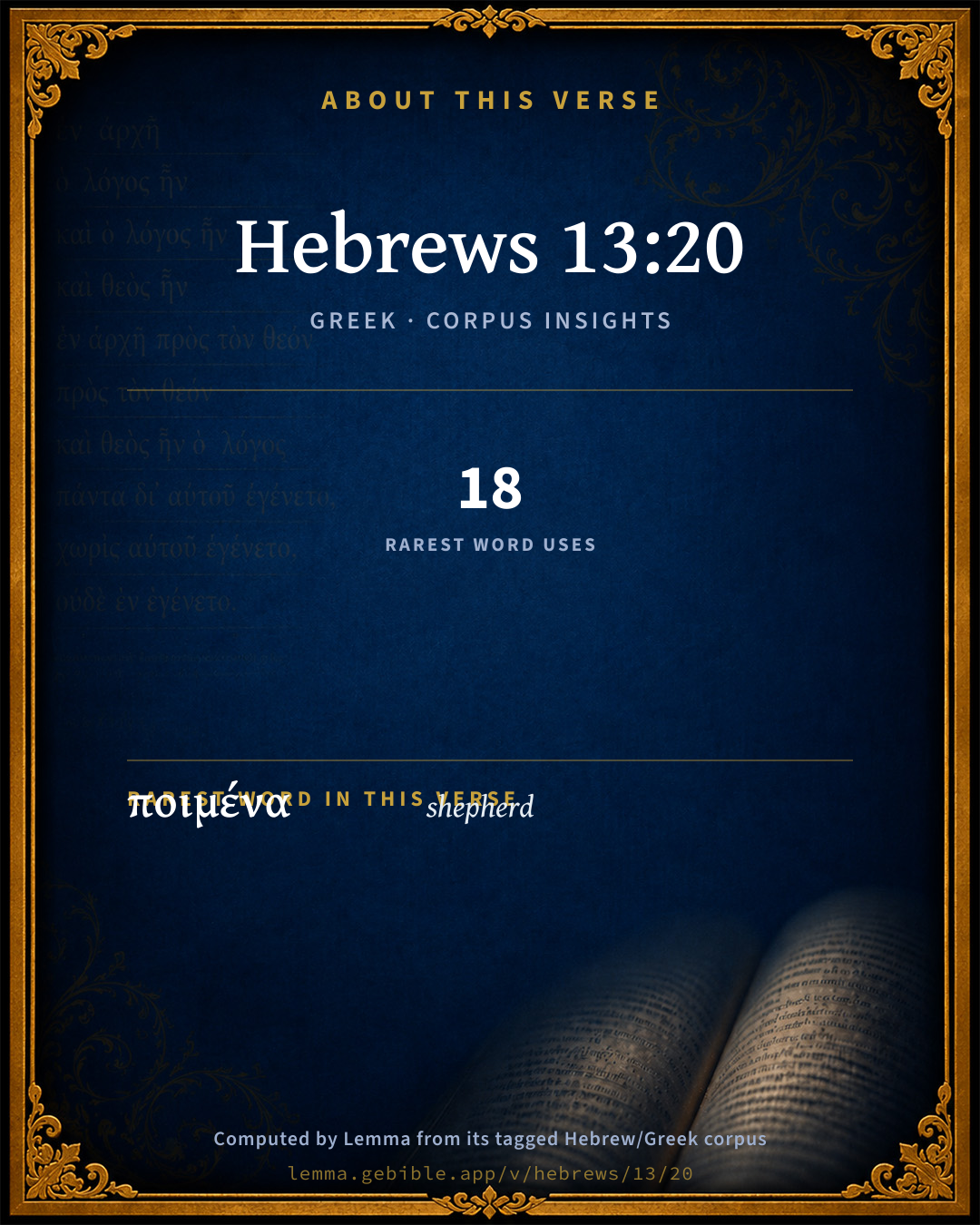
The rarest word here is ποιμένα shepherd G4166 — appearing just 18 times in the whole Greek New Testament.
Shared distinctive vocabulary
ποιμένα shepherd G4166 occurs in 17 verses of the Greek New Testament. Also found in:
Repetition
A word recurs within this verse:
- Ὁ the G3588 ×7
Cross-references
51Topical passages linked to Hebrews 13:20 in the Treasury of Scripture Knowledge — connected by theme and wording, ordered by reader-vote popularity; previews shown in the World English Bible.
- John 10:11 I am the good shepherd. The good shepherd lays down his life for the sheep.
- Hebrews 10:22 let's draw near with a true heart in fullness of faith, having our hearts sprinkled from an evil conscience, and having our body washed with pure water,
- Psalms 23:1 Yahweh is my shepherd: I shall lack nothing.
- Romans 15:33 Now the God of peace be with you all. Amen.
- John 10:14 I am the good shepherd. I know my own, and I'm known by my own;
- 2 Thessalonians 3:16 Now may the Lord of peace himself give you peace at all times in all ways. The Lord be with you all.
- Ezekiel 37:26 Moreover I will make a covenant of peace with them; it shall be an everlasting covenant with them; and I will place them, and multiply them, and will set my sanctuary in the midst of them forevermore.
- Zechariah 9:11 As for you also, Because of the blood of your covenant, I have set free your prisoners from the pit in which is no water.
- Exodus 24:8 Moses took the blood, and sprinkled it on the people, and said, "Look, this is the blood of the covenant, which Yahweh has made with you concerning all these words."
- Acts 2:24 whom God raised up, having freed him from the agony of death, because it was not possible that he should be held by it.
- Isaiah 55:3 Turn your ear, and come to me; hear, and your soul shall live: and I will make an everlasting covenant with you, even the sure mercies of David.
- 1 Peter 2:25 For you were going astray like sheep; but are now returned to the Shepherd and Overseer of your souls.
- Isaiah 40:11 He will feed his flock like a shepherd, he will gather the lambs in his arm, and carry them in his bosom, [and] will gently lead those who have their young.
- Isaiah 63:11 Then he remembered the days of old, Moses [and] his people, [saying], Where is he who brought them up out of the sea with the shepherds of his flock? where is he who put his holy Spirit in the midst of them?
- Jeremiah 32:40 and I will make an everlasting covenant with them, that I will not turn away from following them, to do them good; and I will put my fear in their hearts, that they may not depart from me.
- Acts 3:15 and killed the Prince of life, whom God raised from the dead, to which we are witnesses.
- Hebrews 9:16–17 For where a last will and testament is, there must of necessity be the death of him who made it.
- 1 Chronicles 16:17 Confirmed the same to Jacob for a statute, To Israel for an everlasting covenant,
- Colossians 2:12 having been buried with him in baptism, in which you were also raised with him through faith in the working of God, who raised him from the dead.
- 1 Thessalonians 1:10 and to wait for his Son from heaven, whom he raised from the dead-- Jesus, who delivers us from the wrath to come.
- 1 Peter 1:21 who through him are believers in God, who raised him from the dead, and gave him glory; so that your faith and hope might be in God.
- 1 Peter 5:4 When the chief Shepherd is revealed, you will receive the crown of glory that doesn't fade away.
- 2 Samuel 23:5 Most assuredly my house is not so with God; Yet he has made with me an everlasting covenant, Ordered in all things, and sure: For it is all my salvation, and all [my] desire, Although he doesn't make it grow.
- Ezekiel 34:23 I will set up one shepherd over them, and he shall feed them, even my servant David; he shall feed them, and he shall be their shepherd.
- Matthew 26:28 for this is my blood of the new covenant, which is poured out for many for the remission of sins.
- Acts 5:30 The God of our fathers raised up Jesus, whom you killed, hanging him on a tree.
- Romans 8:11 But if the Spirit of him who raised up Jesus from the dead dwells in you, he who raised up Christ Jesus from the dead will also give life to your mortal bodies through his Spirit who dwells in you.
- Philippians 4:9 The things which you learned, received, heard, and saw in me: do these things, and the God of peace will be with you.
- 1 Thessalonians 5:23 May the God of peace himself sanctify you completely. May your whole spirit, soul, and body be preserved blameless at the coming of our Lord Jesus Christ.
- Hebrews 9:20 saying, "This is the blood of the covenant which God has commanded you."
- Hebrews 10:29 How much worse punishment, do you think, will he be judged worthy of, who has trodden under foot the Son of God, and has counted the blood of the covenant with which he was sanctified an unholy thing, and has insulted the Spirit of grace?
- Isaiah 61:8 For I, Yahweh, love justice, I hate robbery with iniquity; and I will give them their recompense in truth, and I will make an everlasting covenant with them.
- Ezekiel 37:24 My servant David shall be king over them; and they all shall have one shepherd: they shall also walk in my ordinances, and observe my statutes, and do them.
- Mark 14:24 He said to them, "This is my blood of the new covenant, which is poured out for many.
- Luke 22:20 Likewise, he took the cup after supper, saying, "This cup is the new covenant in my blood, which is poured out for you.
- Acts 2:32 This Jesus God raised up, to which we all are witnesses.
- Acts 10:40–41 God raised him up the third day, and gave him to be revealed,
- Acts 13:30 But God raised him from the dead,
- Acts 17:31 because he has appointed a day in which he will judge the world in righteousness by the man whom he has ordained; of which he has given assurance to all men, in that he has raised him from the dead."
- Romans 4:24–25 but for our sake also, to whom it will be accounted, who believe in him who raised Jesus, our Lord, from the dead,
- 1 Corinthians 6:14 Now God raised up the Lord, and will also raise us up by his power.
- 1 Corinthians 14:33 for God is not a God of confusion, but of peace. As in all the assemblies of the saints,
- 1 Corinthians 15:15 Yes, we are found false witnesses of God, because we testified about God that he raised up Christ, whom he didn't raise up, if it is so that the dead are not raised.
- 2 Corinthians 4:14 knowing that he who raised the Lord Jesus will raise us also with Jesus, and will present us with you.
- 2 Corinthians 13:11 Finally, brothers, rejoice. Be perfected, be comforted, be of the same mind, live in peace, and the God of love and peace will be with you.
- Galatians 1:1 Paul, an apostle (not from men, neither through man, but through Jesus Christ, and God the Father, who raised him from the dead),
- Ephesians 1:20 which he worked in Christ, when he raised him from the dead, and made him to sit at his right hand in the heavenly places,
- Psalms 80:1 Hear us, Shepherd of Israel, You who lead Joseph like a flock, You who sit above the cherubim, shine forth.
- Acts 4:10 be it known to you all, and to all the people of Israel, that in the name of Jesus Christ of Nazareth, whom you crucified, whom God raised from the dead, in him does this man stand here before you whole.
- Romans 1:4 who was declared to be the Son of God with power, according to the Spirit of holiness, by the resurrection from the dead, Jesus Christ our Lord,
- Romans 16:20 And the God of peace will quickly crush Satan under your feet. The grace of our Lord Jesus Christ be with you.
Cross-references courtesy of OpenBible.info (CC BY 4.0).
Lesson kit
Teaching starters — assembled from the data on this page, not authored interpretation. Every prompt links to the verse data it draws on. Edit before teaching.
Hebrews, in the General Epistles, opens this verse with 23 words (17 distinct Greek lemmas). Its most distinctive word is poimḗn (“shepherd”). A historical commentator’s framing appears above. Read the whole chapter for the surrounding context.
Discussion questions
- What does “shepherd” (poimḗn) contribute to the verse as a whole?
- Matthew 9:36 shares the word «shepherd» with this verse. How do the two illuminate each other?
- “the” occurs 7× in this one verse. What is the effect of the repetition?
- These translations render this verse differently. What is at stake in choosing one wording over another?
- Reading how Matthew Poole's English Annotations and The Biblical Illustrator read this verse, where do the two commentators agree and where do they part?
Things to notice
- These translations choose different wording for 10 words in this verse.
- “the” occurs 7× in this single verse.
- 17 distinct Greek lemmas span 23 words in this verse.
Commentary
Notes on Hebrews 13:20 from classic Christian and Jewish commentators (each source and its license shown beneath its notes). The classic Christian expositions comment on the surrounding passage and are grouped to its opening verse, so a note may address several verses; the Jewish commentaries on the Tanakh (Rashi and others) are per-verse, so they appear only where the commentator wrote on this verse.
Lemma curates 59 commentaries, every one of them public domain or Creative Commons licensed, each selected and text-cleaned for this edition rather than reprinted as found. About our sources →
Matthew Poole's English Annotations
Matthew Poole's English Annotations on the Holy Bible (1683–1685) — public domain. Text from a community e-Sword/MySword module.
The Biblical Illustrator
Joseph S. Exell
The Biblical Illustrator, edited by Joseph S. Exell (c. 1880s–1900s) — public domain. Text from a community e-Sword module.
Joseph Benson's Commentary
Joseph Benson's Commentary on the Old and New Testaments (1811–1818) — public domain. Text from a community e-Sword module.
MacLaren's Expositions of Holy Scripture
Alexander MacLaren
Alexander MacLaren, Expositions of Holy Scripture (1904–1910) — public domain. Text from a community e-Sword module.
Godbey's Commentary on the New Testament
William B. Godbey
William B. Godbey, Commentary on the New Testament (1896–1900) — public domain. Text from a community e-Sword module.
Tyndale Open Study Notes
Tyndale Open Resources
Tyndale Open Study Notes — © Tyndale Open Resources, licensed CC BY-SA 4.0. Text via the HelloAO Bible API.
Bengel's Gnomon
Johann Albrecht Bengel
Bengel's Gnomon of the New Testament — English translation (T&T Clark, Edinburgh, 1860) — public domain. Text from a community e-Sword module.
Meyer's Critical & Exegetical Commentary
Heinrich August Wilhelm Meyer
Meyer — Critical and Exegetical Commentary on the New Testament — English translation by Peter Christie, edited by Frederick Crombie (T&T Clark, 1880) — public domain. Text from a community e-Sword module.
Jamieson, Fausset & Brown
Robert Jamieson, A. R. Fausset & David Brown
Jamieson, Fausset & Brown — Commentary Critical and Explanatory on the Whole Bible (1871) — public domain (CC PDM 1.0). Text via the HelloAO Bible API.
Adam Clarke's Commentary
Adam Clarke's Commentary on the Bible (1810–1826) — public domain. Text from a community e-Sword/MySword module.
John Calvin's Commentaries
John Calvin's Commentaries (1540-1563) — public domain. Text from the Calvin Translation Society English edition (1840s-50s) via the Christian Classics Ethereal Library (ccel.org). Calvin's coverage is partial (roughly two-thirds of the Bible); uncommented books and verses are honest gaps, never fabricated. The 19th-century editor's footnotes and remarks are omitted so the notes are faithfully Calvin's own voice.
Ellicott's Commentary for English Readers
A Bible Commentary for English Readers, edited by Charles John Ellicott (1878–1897) — public domain. Text from a community e-Sword module.
The Cambridge Bible for Schools and Colleges
gen. ed. J. J. S. Perowne
The Cambridge Bible for Schools and Colleges (gen. ed. J. J. S. Perowne; Cambridge University Press, 1878–1918) — public domain. Text from a community e-Sword module.
John Gill's Exposition
John Gill's Exposition of the Whole Bible (1746–1763) — public domain (CC PDM 1.0). Text via the HelloAO Bible API.
Trapp's Complete Commentary
John Trapp
John Trapp, A Commentary or Exposition upon All the Books of the Old and New Testament (1647–1656) — public domain. Text from a community e-Sword module.
Albert Barnes' Notes on the Bible
Albert Barnes' Notes on the Bible (1834–1885) — public domain. Text from a community e-Sword/MySword module.
Haydock's Catholic Bible Commentary
George Leo Haydock (1774–1849), Haydock's Catholic Family Bible and Commentary, 1859 edition — public domain. Excludes Psalms (Douay-Rheims chapter numbering differs from Protestant) and Deuterocanonical books (Catholic canon only).
Whedon's Commentary on the Bible
Daniel D. Whedon
Daniel D. Whedon (gen. ed.), Commentary on the Old and New Testaments (1874–1909) — public domain. Text from a community e-Sword module.
The Pulpit Commentary
The Pulpit Commentary (1880–1919), ed. H.D.M. Spence-Jones & Joseph S. Exell — public domain. Text from a community e-Sword module.
John Wesley's Explanatory Notes
John Wesley, Explanatory Notes Upon the Whole Bible (1754–1765) — public domain. Text via the GEBible commentary corpus.
Burkitt's Expository Notes on the New Testament
William Burkitt
William Burkitt's Expository Notes on the New Testament (1700–1703) — public domain. Text from a community e-Sword module.
The People's New Testament
B. W. Johnson
B. W. Johnson's The People's New Testament with Notes (1889–1891) — public domain. Electronic text from the Christian Classics Ethereal Library (CCEL) ThML edition.
unfoldingWord translationNotes
Door43 World Missions Community
unfoldingWord translationNotes — © Distant Shores Media and the Door43 World Missions Community, licensed CC BY-SA 4.0. Source: git.door43.org/Door43/en_tn.
Cambridge Greek Testament for Schools and Colleges
Cambridge Greek Testament for Schools and Colleges (Cambridge University Press, 1896; 21 vols, various authors incl. Carr, Maclear, Plummer, Farrar, Lumby, Moule, M. R. James, Simcox) — public domain. Text from a community e-Sword module.
Alford’s Greek Testament
Henry Alford
Henry Alford, The Greek Testament (1849–1861) — public domain. Text from a community e-Sword module.
Vincent's Word Studies in the New Testament
Marvin R. Vincent
Marvin R. Vincent, Word Studies in the New Testament (1887–1900) — public domain. Text from a community e-Sword/MySword module.