
Isaiah 8:19

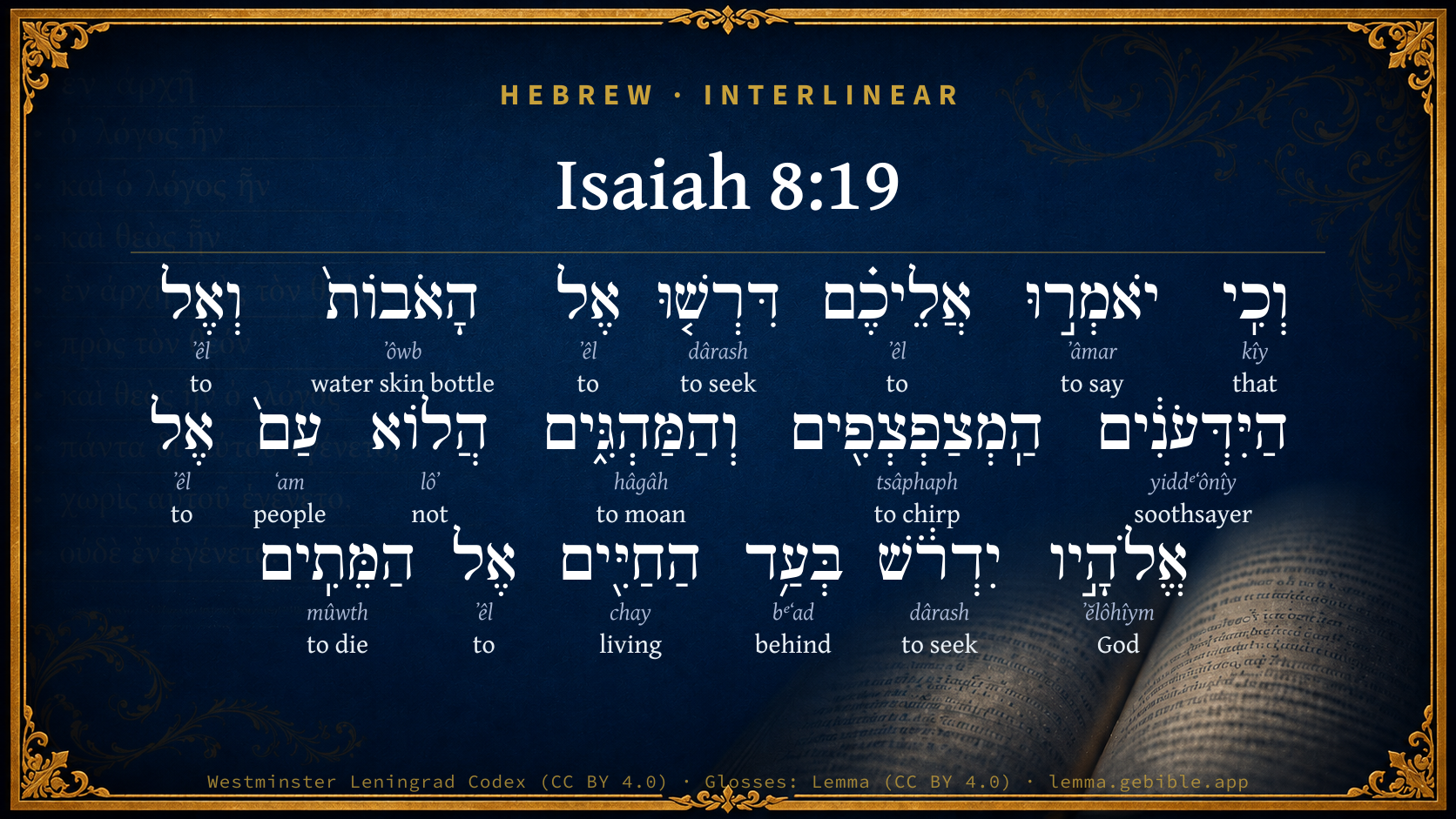
Hebrew (Westminster Leningrad Codex) Isaiah 8:19 appears in the Hebrew Old Testament. The text above is from the Westminster Leningrad Codex. Each word links to its Strong’s number, a concise gloss, and parsing drawn from the Open Scriptures Hebrew Bible morphology. Click any word for its full Brown-Driver-Briggs (BDB) entry.
Download image
Cite this verse

Isaiah 8:19 (World English Bible). Public Domain. Lemma interlinear Bible study tool, https://lemma.gebible.app/v/isaiah/8/19.

Show BibTeX & RIS
BibTeX
RIS
English Translation
When they shall tell you, "Consult with those who have familiar spirits and with the wizards, who chirp and who mutter:" shouldn't a people consult with their God? on behalf of the living [should they consult] with the dead?
World English Bible · Public Domain
Highlights
  • 1 first appearance in the Hebrew Bible
Full analysis ↓
Download a study sheet

One document with this verse’s original text, its word-by-word gloss line, the meaning frame, cross-references with their text, attributed commentary, and full source and license credits — printable, and it pastes into notes with its structure intact.

This verse Autodidact and up

Study sheet (.html) Plain text (.txt)

A passage Seminary Student

Up to 50 verses in one chapter. A passage sheet keeps up to 6 commentary sources and 12 cross-references per verse, in the order this page ranks them, and says so on the sheet whenever that leaves anything out. Ask for a single verse and you get the Autodidact verse sheet above.

Everything on this page stays free to read, with no account — the sheet is a download of what is already on screen, not access to it.

Want to remove ads? Support Godless Engineer
Compare translations 3

The same verse in 3 English versions, stacked beneath the original-language interlinear above. Click any original word for its lexicon entry.

Each is an independent rendering of the whole verse — the interlinear is not word-aligned to these translations.

Highlighted words mark where these versions differ — a whole-verse word diff, not a word-by-word alignment.

  • World English Bible Public Domain
    When they shall tell you, "Consult with those who have familiar spirits and with the wizards, who chirp and who mutter:" shouldn't a people consult with their God? on behalf of the living [should they consult] with the dead?
  • King James Version Public Domain
    And when they shall say unto you, Seek unto them that have familiar spirits, and unto wizards that peep, and that mutter: should not a people seek unto their God? for the living to the dead?
  • unfoldingWord Literal Text CC BY-SA 4.0
    And when they say to you, “Seek to ritual pits and to familiar spirits, the ones chirping and muttering,” should not a people seek to its God? To the dead, on behalf of the living?

unfoldingWord Literal Text — © unfoldingWord, licensed CC BY-SA 4.0. Word-aligned USFM3 via Door43 (git.door43.org/unfoldingWord/en_ult).

Versions to compare (up to 4)

3 of 4 selected

Show all 18 translations

Every available English version of this verse, each an independent rendering of the whole verse.

  • World English Bible Public Domain
    When they shall tell you, "Consult with those who have familiar spirits and with the wizards, who chirp and who mutter:" shouldn't a people consult with their God? on behalf of the living [should they consult] with the dead?
  • Berean Standard Bible Public Domain
    When men tell you to consult the spirits of the dead and the spiritists who whisper and mutter, shouldn’t a people consult their God instead? Why consult the dead on behalf of the living?
  • Majority Standard Bible Public Domain
    When men tell you to consult mediums and spiritists who whisper and mutter, shouldn’t a people consult their God instead? Why consult the dead on behalf of the living?
  • King James Version Public Domain
    And when they shall say unto you, Seek unto them that have familiar spirits, and unto wizards that peep, and that mutter: should not a people seek unto their God? for the living to the dead?
  • American Standard Version (1901) Public Domain
    And when they shall say unto you, Seek unto them that have familiar spirits and unto the wizards, that chirp and that mutter: should not a people seek unto their God? on behalf of the living `should they seek' unto the dead?
  • Revised Version (1885) Public Domain
    And when they shall say unto you, Seek unto them that have familiar spirits and unto the wizards, that chirp and that mutter: should not a people seek unto their God? on behalf of the living should they seek unto the dead?
  • Geneva Bible (1599) Public Domain
    And when they shall say vnto you, Enquire at them that haue a spirit of diuination, and at the soothsayers, which whisper and murmure, Should not a people enquire at their God? from the liuing to the dead?
  • Douay-Rheims (1899) Public Domain
    And when they shall say to you: Seek of pythons, and of diviners, who mutter in their enchantments: should not the people seek of their God, for the living of the dead?
  • Young's Literal Translation Public Domain
    And when they say unto you, `Seek unto those having familiar spirits, And unto wizards, who chatter and mutter, Doth not a people seek unto its God? -- For the living unto the dead!
  • Literal Standard Version CC BY-SA 4.0
    And when they say to you, “Seek to those having familiar spirits, || And to wizards, who chatter and mutter,” || Does a people not seek to its God? To the dead on behalf of the living?
  • Unlocked Literal Bible CC BY-SA 4.0
    They will say to you, “Consult with the mediums and spiritists,” those who chirp and mutter incantations. But should a people not consult their God? Should they consult the dead on behalf of the living?
  • unfoldingWord Literal Text CC BY-SA 4.0
    And when they say to you, “Seek to ritual pits and to familiar spirits, the ones chirping and muttering,” should not a people seek to its God? To the dead, on behalf of the living?
  • Darby Bible Public Domain
    And when they shall say unto you, Seek unto the necromancers and unto the soothsayers, who chirp and who mutter, [say,] Shall not a people seek unto their God? [Will they go] for the living unto the dead?
  • World Messianic Bible Public Domain
    When they tell you, “Consult with those who have familiar spirits and with the wizards, who chirp and who mutter,” shouldn’t a people consult with their God? Should they consult the dead on behalf of the living?
  • Webster's Bible Public Domain
    And when they shall say to you, Seek to them that have familiar spirits, and to wizards that peep, and that mutter: should not a people seek to their God? for the living to the dead?
  • Free Bible Version CC BY-SA 4.0
    When someone suggests to you, “Go and ask mediums and spiritists who whisper and mutter,” shouldn't people ask their God? Why should they ask the dead on behalf of the living?
  • Bible in Basic English Public Domain
    And when they say to you, Make request for us to those who have control of spirits, and to those wise in secret arts, who make hollow bird-like sounds; is it not right for a people to make request to their gods, to make request for the living to the dead?
  • JPS Tanakh (1917) Public Domain
    And when they shall say unto you: 'Seek unto the ghosts and the familiar spirits, that chirp and that mutter; should not a people seek unto their God? on behalf of the living unto the dead

Literal Standard Version (2020), Covenant Press — licensed CC BY-SA 4.0. Text via the HelloAO Bible API (eBible.org). Unlocked Literal Bible (unfoldingWord) — licensed CC BY-SA 4.0. Text via the HelloAO Bible API (eBible.org). unfoldingWord Literal Text — © unfoldingWord, licensed CC BY-SA 4.0. Word-aligned USFM3 via Door43 (git.door43.org/unfoldingWord/en_ult). Free Bible Version, Dr. Jonathan Gallagher — licensed CC BY-SA 4.0. Text via the HelloAO Bible API (eBible.org).

Word by word

More ways to search: Search by grammar → Find every occurrence → Compare this word →

Practice this passage: Drill this verse → Learn its vocabulary →

הַֽמְצַפְצְפִ֖ים
tsâphaph
H6850
“the · chirping”
Particle, Definite Article + Verb, Pilpel, Participle Active, Masculine, Plural, Absolute
Part of Speech
Particle + Verb
Stem
Pilpel
Form
Participle Active
Gender
Masculine
Number
Plural
State
Absolute
Full BDB Definition

Origin: a primitive root

TWOT: 1957

(Pilpel) to chirp, peep - of birds - of ghosts
  1. וְכִֽי kîy H3588 “and · that” Conjunction + Conjunction
  2. יֹאמְר֣וּ ʼâmar H559 “to say” Verb, Qal, Imperfect, 3rd Person, Masculine, Plural
  3. אֲלֵיכֶ֗ם ʼêl H413 “to · you” Preposition + Suffix, Personal, 2nd Person, Masculine, Plural
  4. דִּרְשׁ֤וּ dârash H1875 “seek” Verb, Qal, Imperative, 2nd Person, Masculine, Plural
  5. אֶל ʼêl H413 “to” Preposition
  6. הָאֹבוֹת֙ ʼôwb H178 “the · water skin bottles” Particle, Definite Article + Noun, Common, Masculine, Plural, Absolute
  7. וְאֶל ʼêl H413 “and · to” Conjunction + Preposition
  8. הַיִּדְּעֹנִ֔ים yiddᵉʻônîy H3049 “the · soothsayers” Particle, Definite Article + Noun, Common, Masculine, Plural, Absolute
  9. וְהַמַּהְגִּ֑ים hâgâh H1897 “and · the · moaning” Conjunction + Particle, Definite Article + Verb, Hiphil, Participle Active, Masculine, Plural, Absolute
  10. הֲלוֹא lôʼ H3808 “not” Particle, Interrogative + Particle, Negative
  11. עַם֙ ʻam H5971 “people” Noun, Common, Masculine, Singular, Absolute
  12. אֶל ʼêl H413 “to” Preposition
  13. אֱלֹהָ֣יו ʼĕlôhîym H430 “God(s) · his” Noun, Common, Masculine, Plural, Construct + Suffix, Personal, 3rd Person, Masculine, Singular
  14. יִדְרֹ֔שׁ dârash H1875 “to seek” Verb, Qal, Imperfect, 3rd Person, Masculine, Singular
  15. בְּעַ֥ד bᵉʻad H1157 “behind” Preposition
  16. הַחַיִּ֖ים chay H2416 “the · living” Particle, Definite Article + Adjective, Adjective, Masculine, Plural, Absolute
  17. אֶל ʼêl H413 “to” Preposition
  18. הַמֵּתִֽים mûwth H4191 “the · dying” Particle, Definite Article + Verb, Qal, Participle Active, Masculine, Plural, Absolute

About this verse

These counts appear in no published source. They are computed here, from the morphology-tagged text and Lemma’s own curated glosses. What Lemma adds →

19
words
14
distinct lemmas
Prophets
section

Notable vocabulary

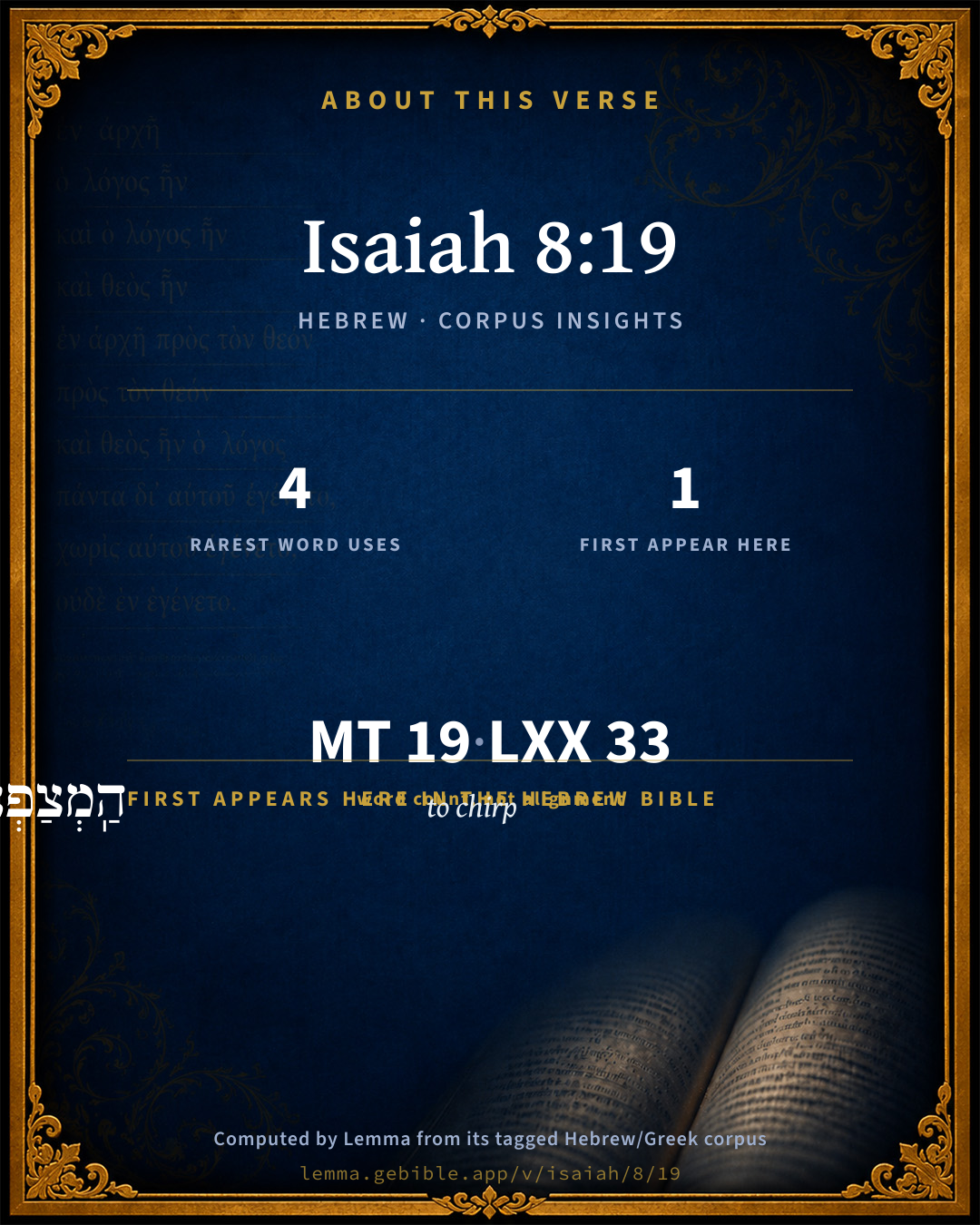
The rarest word here is הַֽמְצַפְצְפִ֖ים to chirp H6850 — appearing just 4 times in the whole Hebrew Bible.

First appearance in Scripture

This word makes its first canonical appearance in the Hebrew Bible here:

  • הַֽמְצַפְצְפִ֖ים to chirp H6850

Shared distinctive vocabulary

הַֽמְצַפְצְפִ֖ים to chirp H6850 occurs in 4 verses of the Hebrew Bible. Also found in:

Grammatical profile

  • 6 verbs
  • 4 nouns
  • 1 adjective
  • 6 prepositions
  • 1 conjunction
  • 1 particle

Verb forms

  • יֹאמְר֣וּ Qal · Imperfect
  • דִּרְשׁ֤וּ Qal · Imperative
  • הַֽמְצַפְצְפִ֖ים Pilpel · Participle Active
  • וְהַמַּהְגִּ֑ים Hiphil · Participle Active
  • יִדְרֹ֔שׁ Qal · Imperfect
  • הַמֵּתִֽים Qal · Participle Active

Repetition

Words recur within this verse — often emphatic in Hebrew:

  • דִּרְשׁ֤וּ to seek H1875 ×2
  • אֲלֵיכֶ֗ם to H413 ×5

Hebrew & Septuagint length

In English translation the verse runs 39 words from the Hebrew and 54 from the Septuagint (LXX English) — closely comparable.

A rough comparison of the two English renderings, which tokenize alike — not a word-level alignment.

Word counts can differ between the Hebrew and the Greek without any difference in meaning — e.g. the Hebrew direct-object marker אֵת has no separate Greek word, and Greek often adds the article ὁ.

In the original languages it is 19 Hebrew tokens and 33 Greek tokens — but the two are counted differently (Hebrew bundles its prefixes and suffixes into one token; the Greek is in lemma form), so that isn’t a like-for-like length.

Cross-references

17

Topical passages linked to Isaiah 8:19 in the Treasury of Scripture Knowledge — connected by theme and wording, ordered by reader-vote popularity; previews shown in the World English Bible.

  • 1 Chronicles 10:13 So Saul died for his trespass which he committed against Yahweh, because of the word of Yahweh, which he didn't keep; and also because he asked counsel of one who had a familiar spirit, to inquire [thereby],
  • Leviticus 20:6 "'The person that turns to those who are mediums, and to the wizards, to play the prostitute after them, I will even set my face against that person, and will cut him off from among his people.
  • 2 Chronicles 33:6 He also made his children to pass through the fire in the valley of the son of Hinnom; and he practiced sorcery, and used enchantments, and practiced sorcery, and dealt with those who had familiar spirits, and with wizards: he worked much evil in the sight of Yahweh, to provoke him to anger.
  • Psalms 106:28 They joined themselves also to Baal Peor, And ate the sacrifices of the dead.
  • Leviticus 19:31 "'Don't turn to those who are mediums, nor to the wizards. Don't seek them out, to be defiled by them. I am Yahweh your God.
  • Deuteronomy 18:11 or a charmer, or a consulter with a familiar spirit, or a wizard, or a necromancer.
  • 1 Samuel 28:8 Saul disguised himself, and put on other clothing, and went, he and two men with him, and they came to the woman by night: and he said, Please divine to me by the familiar spirit, and bring me up whoever I shall name to you.
  • Isaiah 19:3 The spirit of Egypt shall fail in the midst of it; and I will destroy the counsel of it: and they shall seek to the idols, and to the charmers, and to those who have familiar spirits, and to the wizards.
  • Isaiah 29:4 You shall be brought down, and shall speak out of the ground, and your speech shall be low out of the dust; and your voice shall be as of one who has a familiar spirit, out of the ground, and your speech shall whisper out of the dust.
  • Jeremiah 10:10 But Yahweh is the true God; he is the living God, and an everlasting King: at his wrath the earth trembles, and the nations are not able to abide his indignation.
  • 2 Kings 1:3 But the angel of Yahweh said to Elijah the Tishbite, Arise, go up to meet the messengers of the king of Samaria, and tell them, Is it because there is no God in Israel, that you go to inquire of Baal Zebub, the god of Ekron?
  • 2 Kings 21:6 He made his son to pass through the fire, and practiced sorcery, and used enchantments, and dealt with those who had familiar spirits, and with wizards: he worked much evil in the sight of Yahweh, to provoke him to anger.
  • 2 Kings 23:24 Moreover those who had familiar spirits, and the wizards, and the teraphim, and the idols, and all the abominations that were seen in the land of Judah and in Jerusalem, did Josiah put away, that he might confirm the words of the law which were written in the book that Hilkiah the priest found in the house of Yahweh.
  • 1 Samuel 28:16 Samuel said, Why then do you ask of me, seeing Yahweh is departed from you, and is become your adversary?
  • 1 Samuel 28:11 Then said the woman, Whom shall I bring up to you? He said, Bring me up Samuel.
  • 2 Peter 2:1 But there also arose false prophets among the people, as among you also there will be false teachers, who will secretly bring in destructive heresies, denying even the Master who bought them, bringing on themselves swift destruction.
  • 1 Thessalonians 1:9 For they themselves report concerning us what kind of a reception we had from you; and how you turned to God from idols, to serve a living and true God,

Cross-references courtesy of OpenBible.info (CC BY 4.0).

Hebrew and Greek witnesses Masoretic Hebrew ↔ Greek Septuagint

The same verse in the two great witnesses to the Old Testament, shown verse-for-verse.

These are two independent witnesses, not word-aligned to each other, and the Septuagint is shown in lemma (dictionary) form.

Hebrew Isaiah 8:19 Masoretic · Westminster Leningrad Codex

וְכִֽי יֹאמְר֣וּ אֲלֵיכֶ֗ם דִּרְשׁ֤וּ אֶל הָאֹבוֹת֙ וְאֶל הַיִּדְּעֹנִ֔ים הַֽמְצַפְצְפִ֖ים וְהַמַּהְגִּ֑ים הֲלוֹא עַם֙ אֶל אֱלֹהָ֣יו יִדְרֹ֔שׁ בְּעַ֥ד הַחַיִּ֖ים אֶל הַמֵּתִֽים

When they shall tell you, "Consult with those who have familiar spirits and with the wizards, who chirp and who mutter:" shouldn't a people consult with their God? on behalf of the living [should they consult] with the dead?

World English Bible · Public Domain

Greek LXX Isaiah 8:19 Septuagint · lemma form

καί ἐάν εἶπον πρός σύ ζητέω ὁ ἀπό ὁ γῆ φωνέω καί ὁ ἐγγαστρίμυθος ὁ κενολογέω ὅς ἐκ ὁ κοιλία φωνέω οὐ ἔθνος πρός θεός αὐτός τίς ἐκζητέω περί ὁ ζάω ὁ νεκρός

And if they should say to you, Seek those who have in them a divining spirit, and them that speak out of the earth, them that speak vain words, who speak out of their belly: shall not a nation diligently seek to their God? why do they seek to the dead concerning the living?

LXX2012 (modern English Septuagint) · Public Domain

On this verse, The Biblical Illustrator discusses the Septuagint’s reading. Read the note in Commentary ↓

Hebrew: Westminster Leningrad Codex (CC BY 4.0). Greek: Septuagint (public domain); English from LXX2012 (modern English Septuagint) (Public Domain). How the Septuagint differs from the Hebrew →

Targum (Aramaic paraphrase)

1

The Targum is the ancient Jewish Aramaic paraphrase of the Hebrew Scriptures — an interpretive translation, not the Hebrew text itself. Onkelos (literal) and Pseudo-Jonathan (expansive) render the Torah, and Jonathan the Prophets. Coverage is partial: where no permissively-licensed English translation exists for a verse, only the Aramaic is shown. This is verse-level text, not a word-by-word alignment to the Hebrew.

  1. Targum Jonathan Prophets (Joshua–Malachi)
    וַאֲרֵי יֵימְרוּן לְכוֹן עַמְמַיָא דְאַתּוּן בֵּינֵיהוֹן תְּבָעוּ מִן בִּדִין וּמִן זְכוּרוּ דִמְנַצְפִין וְדִמְנַהֲמִין הֲלָא כֵן אוֹרַח עַמְמַיָא פַלְחֵי טַעֲוָתָא עַמָא מִן טַעֲוָתֵיהּ תַּבְעִין חַיָא מִן מֵיתַיָא:

    And when the nations amongst whom you shall be shall say to you, Seek of necromancers, and of the wizards, that peep, and that mutter. Is not this the way of nations, the worshippers of idols? A people seek from their idol, the living from the dead.

    Targum Jonathan — Aramaic: “Mikraot Gedolot” (public domain). English: “Sefaria Community Translation” (CC0 1.0 (public-domain dedication)); “London "Chaldee Paraphrase," 1871” (public domain). Text via Sefaria.

Commentary

Notes on Isaiah 8:19 from classic Christian and Jewish commentators (each source and its license shown beneath its notes). The classic Christian expositions comment on the surrounding passage and are grouped to its opening verse, so a note may address several verses; the Jewish commentaries on the Tanakh (Rashi and others) are per-verse, so they appear only where the commentator wrote on this verse.

Lemma curates 59 commentaries, every one of them public domain or Creative Commons licensed, each selected and text-cleaned for this edition rather than reprinted as found. About our sources →

Trapp's Complete Commentary

John Trapp

Isa 8:19 And when they shall say unto you, Seek unto them that have familiar spirits, and unto wizards that peep, and that mutter: should not a people seek unto their God? for the living to the dead?

Ver. 19. And when they shall say unto you.] The prophet’s wholesome advice to his disciples. God had hid his face and withdrawn his favour from this people; therefore they would help themselves as they could, by doing as Saul did when forsaken of God, by running to witches and wizards, resolving with her in the poet -

“ Flectere si nequo superos, Acheronta movebo. ”

That peep and that mutter.] Utter their predictions in broken and low language, grunting or grumbling them out in dark and doubtful expressions, as distrusting their own art.

Should not a people seek unto their God?] See Jer 2:11 Mic 4:5. Our God is a rewarder of all that diligently seek him, or that "seek him out" {Heb 11:6} - viz., when he hath withdrawn himself and hid his face. {as Isa 8:17}

For the living to the dead,] q.d., Is that handsome? is it agreeable to right reason? O stultam commutationem! vocat nos Deus vivus, et nos recurrimus ad mortuos. {a}

{a} Oecolamp.

John Trapp, A Commentary or Exposition upon All the Books of the Old and New Testament (1647–1656) — public domain. Text from a community e-Sword module.

The Biblical Illustrator

Joseph S. Exell

Isa_8:19-20

And when they shall say unto you, Seek unto them that have familiar spirits

Wizards

Wizards and they that have familiar spirits, are what we should now call mediums, through whom the dead speak.

(A. B. Davidson, D. D.)

Wizards that peep and mutter

Peep (i.e., chirp) and mutter refer to the faint voice, like that of a little bird, which antiquity ascribed to the shades of the departed: The sheeted dead did squeak and gibber in the streets of Rome (see Isa_29:4). The LXX suggests that the voice of the ghost was imitated by ventriloquism, which is not unlikely. (Prof. J. Skinner, D. D.)

Religion and superstition

Religion and superstition contrasted (Isa_8:19-20). (Prof. J. Skinner, D. D.)

Should not a people seek unto their God?--

Gripping old truths and seeing new visions

We must learn to recognise the friends and foes of our life even when they are presented to us in an Oriental and old-world dress.

I. WE HAVE HERE A PLEA FOR THE LIBERTY AND INDEPENDENCE OF THE LIVING PRESENT. On behalf of the living should they seek unto the dead? Such is the sarcastic question that the disciples of the great prophet are required to ask the people when the latter desire to resort to wizards and witches to help them out of their straits. The retort goes much further than merely striking a blow at the silly superstition of seeking by enchantment to bring back and question the shades of the dead. It contains a principle which lies at the very foundation of the worlds development,--a principle the reverent recognition of which will enable us to work out unfettered the full mission of our lives, and give us unbounded faith in the future of the race which Christ has come to redeem. Every new generation has its own special mission to fulfil; it is a new life charged with the duty of working out its own salvation. It is a new stage in the manifestation of the Divine through the human. The living present claims for itself a dignity and a mission, and, if we are lax in upholding the former, we are likely to fall short of fulfilling the latter. There is a way of worshipping the past, and of appealing to it which puts the present in chains, or, at least, compels it to be stationary. Has human life in very deed exhausted the thought of God? Surely the very history of the past itself ought to teach us the essential liberty and power of life. What epochs of the past are those that call forth our highest admiration and homage! Not such a period as that of the middle Ages when the living fortified and entrenched themselves in the sepulchres of the dead; but rather such times as those of the Lutheran reformation, when men felt the holy freedom of their own life, cast away the swathings of the past, and fearlessly took a new step in the name of God. I believe that God reigns through the rich movements of life, and not through traditional and external fetters. Given an earnest generation, awake to the responsibilities of its own life, and I can trust God to direct the flowing tide to a sacred shore. We cannot assert that an active and earnest generation will not make any mistakes. Every age has its own peculiar dangers, the vices which are the excess of its virtues. There are shallow lives that lose their gravity with the slightest movement, and dash themselves into thin vapour around the deeper movement of the time. And there are the men that pride themselves upon being fearless spirits in the realm of thought; which often means that they take advantage of a new movement to rush into one-sided and extreme conclusions upon the most precarious basis--conclusions which a truer judgment will anon reverse or correct. And even the most earnest and reliable spirits find it difficult to discover the golden mean between the bondage of the old and the violence of the new.

II. THAT THE TRUE LIFE OF THE PRESENT CAN BE ATTAINED ONLY BY LIVING CONTACT WITH THE LIVING GOD. The prophets message has not ended with the declaration that life is essentially movement and a force, having a Divine right to cast off the encrusting forms of the dead past. In order to prevent this awful liberty from being abused, and this vast movement from being misdirected, he must supply it with a guiding Spirit, and a directing force. It is a dangerous thing for men to become suddenly conscious of a vast and unused power unless they at the same time feel the grip of the eternal principles along which this power should move. Every movement of life presupposes an appointed orbit, without which it runs wild, and ends in a crash. The prophet, therefore, directs the people to root and ground their liberty in living contact with God--Should not a people seek unto their God? In examining, therefore, any particular case of movement in the moral and religious sphere it is all-important to inquire whether it exhibits the living energy of the Divine life in the human, whether it enriches men with a profounder apprehension of the beating, quickening life of God here in our very midst; in fine, whether the movement is marked with the sacred brand of living contact with the living God. Every true life movement brings God nearer--never drives Him further away. Let us apply this test in one particular and crucial case--the great question of the inspiration of the Holy Scriptures. Perhaps our formal deflations may undergo a slight change; but of this I feel sure--that it will never be necessary or rational for me to accept a theory of inspiration which will make the Bible less Divine than I hold it to be at present. There is no truly onward movement which is not also upward. Lifes true mission is fulfilled and lifes true path pursued, only in proportion as a people seek to their God.

III. So we are led to our last thought: THAT THE TRUTHS WHICH WERE THE ESSENTIAL BASIS OF THE BEST LIFE OF THE PAST MUST BE THE BASIS OF THE ENLARGING LIFE OF THE PRESENT. To the law and to the testimony. If they speak not according to this word, surely there is no morning for them. So the cycle of thought is completed. True progress and true conservatism are not opposed to one another, but are rather supplementary. The only true liberty is that which runs along the lines of eternal law. The world was not begun yesterday, and we have not been deputed to lay its foundations anew. So Isaiahs last position is not only consistent with his first; it is necessarily involved in it. The living, says the prophet, need not consult the shades of the dead, for they have a living God to guide them and to give them ever larger supplies of power. True; but God is one. He does not change with each new generation. The great principles by which He ennobles human life are well known, for they have been writ large in His self-manifestations in the past. God will not reveal Himself in the present to those that are too blind to recognise His glory as revealed in the past. God has revealed Himself to the world long ago. If we would have more light in the present, we must be true to the radiance that lights up the history of the past. (J. Thomas, M. A.)

God to be sought by nations

The history of our own coronary coincides with the record which the Holy Spirit has given of the history of Judah and of Israel, in illustrating the important fact that God in the dispensations of His providence, deals with nations in their collective capacity according to their faithfulness in His service. The condition of Judah in the time of Isaiah demanded this remonstrance. There prevailed much of avowed irreligion and immorality.

I. IN WHAT MANNER CAN WE PERSONALLY INFLUENCE THE CHARACTER AND CONDUCT OF THE NATION AT LARGE? The nation is made up of the aggregate of its individual members. Each person, therefore, may justly consider his own character and conduct in a two-fold view: as it affects himself, and as it affects the whole country. The influence of each distinct member on the whole community, as contributing to the formation of its character, whether for good or for evil, is a subject of deep importance. In this respect, indeed, the more prominent the station in which a man is placed, the greater is his responsibility. But the religious character of the nation does not rest with these alone: piety or impiety in all other men of influence, of wealth, of talent, are likewise the constituent parts of the nations excellence or the nations, guilt, while they are also productive of a corresponding character in the various subordinate ranks of life. Nor is there any single person, however subordinate his station, who does not in the same manner contribute towards the formation of the general character of the nation of which he constitutes a part.

II. IN WHAT DOES THIS SEEKING UNTO GOD CONSIST? Nations and individuals seek unto the Lord--

1. By applying to Him for true knowledge and instruction (verse 20; Joh_5:39).

2. By taking refuge in Him as their confidence and hope.

(1) Nationally, we have examples of this confidence in God, in the sacred records concerning Jehoshaphat and Hezekiah, in sevens of public alarm, and difficulty.

(2) Every man is called on to seek to the Lord for the foundation of his personal hope and comfort, not merely as to the concerns of this life, but in reference, also, to his eternal welfare. And, according as the hope of the people in general is well or ill grounded, will be the state and condition of the Church or of the nation professing the religion of Christ.

3. By following His guidance as to their character and conduct. (J. Hill, B. D.)

The duty of seeking unto God

I. THE REASONS WHY WE OUGHT TO SEEK UNTO OUR GOD.

1. We should seek to Him for light and guidance in perplexity and doubt. No state is more painfully trying to man than to have the mind tossed and agitated like a bark on the stormy waves, without chart and compass. There is an eager impatience in such a state, which lays men open to imposition. They become the easy dupes of crafty deceivers. Hence magicians and necromancers, in an age of ignorance and credulity, gamed such an ascendency over the vulgar. You have read what history records of the oracles of Greece, and the sibyls of Italy. But a superstition, very similar, prevailed over all Asia, and at times penetrated into Judea. Now all such practices were dishonouring and forsaking Jehovah. The mind of a sincere believer may, both on points of faith and practice, be in a state of doubt and suspense. And to whom should he look, but to the Father of lights who can scatter every cloud?

2. For support and consolation in sorrow and distress (Job_5:8; Psa_50:15).

3. For protection and defence amidst difficulties and dangers.

4. For strength to fit us for all the active duties of life and religion.

II. HOW WE ARE TO SEEK UNTO OUR GOD.

1. By diligently and impartially consulting His revealed will in the Holy Scriptures.

2. By constantly and seriously frequenting the public ordinances of His house.

3. By carefully marking and observing the openings and leadings of Providence. In particular cases, says Mr. Newton, the Lord opens and shuts for His people, breaks down walls of difficulty which obstruct their path, or hedges up their way with thorns, when they are in danger of going wrong, by the dispensations of His providence. They know that their concernments are in His hand; they are willing to follow whither and when He leads, but they are afraid of going before Him.

4. By offering up humble sad earnest petitions at the throne of His heavenly grace. (Essex Congregational Remembrancer.)

From light to darkness: from darkness to light

(Isa_8:18-22; Isa_9:2):--The experience of Israel is here described in three pictures, eachmarking a distinct stage in that experience--

I. ISRAEL REJECTING THE LIGHT. The prophet comes with a Divine message to his people. The people will not believe--

1. From inability, being unused to exercise simple trust in God.

2. From pride, for the mingling of judgment with mercy in Isaiahs message offends them.

3. Disbelieving Isaiah, and finding no help in human wisdom, they turn like Saul in his extremity, with the proverbial credulity of unbelief, to the oracles of necromancy. The old watchword, of religion, To the law and to the testimony! Should not a people, seek unto their God? are forgotten. For those who act thus, says Isaiah, there is no morning dawn, for they wilfully turn from the light.

II. A TIME COMES WHEN ISAIAHS WARNINGS ARE FULFILLED. Calamity, famine, distress drive the people to despair. Them is no voice of hope from their wizards and soothsayers. Haunted by the memory of the time when the watchword of faith might have saved them, they feel that they have grieved the Spirit and He is gone! Hardly bestead and hungry they pass through the land and curse their king and their God.

III. IN THE MIDST OF THEIR DESPAIR THEY LOOK UPWARDS, SCARCE KNOWING WHY. All other helpers failing, they direct towards heaven a despairing glance, as if hardly daring to think of Gods help, and then at last light shines through the gloom.

IV. SUCH ALSO MAY BE THE EXPERIENCE OF AN INDIVIDUAL SOUL. First, the Divine warning is despised, and the Word of God neglected, set aside as a worn-out superstition. The voice of religion seems to have lost its hold upon such a soul. Then all manner of refuges are tried, alliance with the world power--immersion in secular business; the superstition of unbelief, agnosticism, etc. All in their turn fail to alleviate the weary heartache which prompts the cry, Who will show us any good? The whole universe seems out of joint, and the soul hardly bestead and hungry curses its king and its God, the whole order of things in the world, and every form of religion the fake and the true. At length, in very despair, as if feeling it is no use, for me there is no morning dawn; the soul looks upwards. The darkness is past, the true light now shineth, the soul that walked in darkness and the shadow of death sees the salvation of the Lord. (Hugh H. Currie, B. D.)

Superstition

In the years which preceded the French Revolution, Cagliostro was the companion of princes--at the dissolution of paganism, the practisers of curious arts, the witches and the necromancers, were the sole objects of reverence in the known world; and so before the Reformation, archbishops and cardinals saw an inspired prophetess in a Kentish servant girl; Oxford heads of colleges sought out heretics with the help of astrology; Anne Boleyn blessed a bason of rings, her royal fingers pouring such virtue into the metal that no disorder could resist it; Wolsey had a magic crystal, and Thomas Cromwell, while in Wolseys household, did haunt to the company of a wizard. These things were the counterpart of a religion which taught that slips of paper, duly paid for, could secure indemnity for sin. (A. Freud)

The Biblical Illustrator, edited by Joseph S. Exell (c. 1880s–1900s) — public domain. Text from a community e-Sword module.

Joseph Benson's Commentary

Isa 8:19. And when, &c. — The prophet, having foretold the coming of the Messiah, and spoken of the disciples he should have, takes this occasion of addressing the Jews, and reminding them of their duty, as he had done, Isa 2:6, compared with Isa 8:1-2. He saw the nation much inclined to foreign superstitions, particularly to the divinations, soothsayings, and astrology of the Syrians, Egyptians, &c., but not regarding the pure doctrine of God’s word as they ought: he therefore warns them against placing any dependance on such follies, and exhorts them to disregard all merely human teaching and assistance, and to apply solely to the divine law and testimony. When they — Those Israelites, to whom I and my children are for signs and wonders, and who are fallen from God into superstition and idolatry; shall say unto you — Who are the true people of God; Seek unto them that have familiar spirits — For advice and help; and unto wizards — Of whom, and of familiar spirits, see on Lev 19:31; Lev 20:27; Deu 18:11; that peep and mutter — That speak with a low voice, as the two words here used signify, which they affected to do, speaking rather inwardly in their bellies, than audibly with their mouths. Should not a people seek unto their God? — This answer the prophet puts into their mouths; doth not every nation, in cases of difficulty, seek to their gods? Much more should we do so, that have the only true God for our God. For the living to the dead — That is, for living men to inquire of the living God, is proper and reasonable; but it is highly absurd for them to forsake him, and to seek dead idols, either to the images, or to the spirits of dead men, which are supposed to speak in them.

Joseph Benson's Commentary on the Old and New Testaments (1811–1818) — public domain. Text from a community e-Sword module.

The Preacher's Complete Homiletical Commentary

Joseph S. Exell (gen. ed.)

NECROMANCY

Isa_8:19-22. Seek unto them, &c.

As bearing upon the doctrine of necromancy, an exhaustive discussion of these verses would involve the following points:

1. Under the instigation of a prurient curiosity, or under the pressure of affliction, godless men are wont to seek knowledge and help from the spirits of the dead.

2. Hence, in every age of the world and in every nation of universal history, there have been necromancers, wizards, &c., known by various names, practising various arts of divination and legerdemain; playing with the credulity of men and women, and claiming access to supernatural knowledge and power. The spirits of modern times are the latest species of this genus of necromancers.

3. This passage implies irresistibly that God frowns upon and condemns necromancy in whatever form.

4. The expostulations, rebukes, and threatenings of the Lord, through His prophet in this passage, assumes it to be impossible for man to get knowledge or help for the living from the dead. The power of God to send back to earth the spirits of the dead is quite another thing; yet as to this the practical question is—Does He see fit to use it?

5. Hence, to discard the light of God’s revealed Word and to seek light and help from the dead, is to hurl oneself against the impermeable and impassable wall with which God has shut in the living of our world, and involves both positive conflict against God and contemptuous rejection of His Divine Word.

6. As Satan has a natural sympathy with everything abhorrent to God and ruinous to man, we ought to look for his hand in these agencies of necromancy, to whatever extent God may give him scope and range for action. What these limits may be, who can tell? It is man’s wisdom to keep himself utterly aloof from the sphere of Satan’s agencies and temptations.

7. Necromancers and spirits practically league themselves with Satan against God, and should be aware that his lot must be theirs, and their end be as their works, no dawn of day ever breaking forth on the midnight of their gloom.—Henry Cowles, D.D. Commentary on Isaiah, pp. 68, 69.

The Preacher's Complete Homiletical Commentary (gen. ed. Joseph S. Exell; Funk & Wagnalls, c. 1892) — public domain (pre-1929). A full-Bible homiletical/sermon-outline anthology covering 65 of 66 books (2 John is absent from the source module). Text from a community e-Sword module.

Keil & Delitzsch

C. F. Keil & F. Delitzsch

It is to this ecclesiola in ecclesia that the prophet's admonition is addressed. "And when they shall say to you, Inquire of the necromancers, and of the soothsayers that chirp and whisper:-Should not a people inquire of its God? for the living to the dead?" The appeal is supposed to be made by Judaeans of the existing stamp; for we know from Isa 2:6; Isa 3:2-3, that all kinds of heathen superstitions had found their way into Jerusalem, and were practised there as a trade. The persons into whose mouths the answer is put by the prophet (we may supply before Isa 8:19, "Thus shall ye say to them;" cf., Jer 10:11), are his own children and disciples. The circumstances of the times were very critical; and the people were applying to wizards to throw light upon the dark future. 'Ob signified primarily the spirit of witchcraft, then the possessor of such a spirit (equivalent to Baal ob), more especially the necromancer. Yidd‛oni, on the other hand, signified primarily the possessor of a prophesying or soothsaying spirit (πύθων or πνεῦμα τοῦ πύθωνος), Syr. yodūa‛ (after the intensive from pâ‛ul with immutable vowels), and then the soothsaying spirit itself (Lev 20:27), which was properly called yiddâ'ōn (the much knowing), like δαίμων, which, according to Plato, is equivalent to δαήμων. These people, who are designated by the lxx, both here and elsewhere, as ἐγγαστρόμυθοι, i.e., ventriloquists, imitated the chirping of bats, which was supposed to proceed from the shadows of Hades, and uttered their magical formulas in a whispering tone.

(Note: The Mishnah Sanhedrin 65a gives this definition: "Baal'ob is a python, i.e., a soothsayer ('with a spirit of divination'), who speaks from his arm-pit; yidd‛oni, a man who speaks with his mouth." The baal ob, so far as he had to do with the bones of the dead, is called in the Talmud obâ temayya', e.g., the witch of Endor (b. Sabbath 152b). On the history of the etymological explanation of the word, see Bttcher, de inferis, 205-217. If 'ob, a skin or leather bottle, is a word from the same root (rendered "bellows" by the lxx at Job 32:19), as it apparently is, it may be applied to a bottle as a thing which swells or can be blown out, and to a wizard of spirit of incantation on account of this puffing and gasping. The explanation "le revenant," from אוּב = Arab. âba, to return, has only a very weak support in the proper name איוב = avvâb (the penitent, returning again and again to God: see again at Isa 29:4).)

What an unnatural thing, for the people of Jehovah to go and inquire, not of their won God, but of such heathenish and demoniacal deceivers and victims as these (dârash 'el, to go and inquire of a person, Isa 11:10, synonymous with shâ'ar b', Sa1 28:6)! What blindness, to consult the dead in the interests of the living! By "the dead" (hammēthim) we are not to understand "the idols" in this passage, as in Psa 106:28, but the departed, as Deu 18:11 (cf., 1 Sam 28) clearly proves; and בּעד is not to be taken, either here or elsewhere, as equivalent to tachath ("instead of"), as Knobel supposes, but, as in Jer 21:2 and other passages, as signifying "for the benefit of." Necromancy, which makes the dead the instructors of the living, is a most gloomy deception.

Keil & Delitzsch — Biblical Commentary on the Old Testament (1861–1891) — public domain (CC PDM 1.0). Text via the HelloAO Bible API. (Old Testament only.)

Tyndale Open Study Notes

Tyndale Open Resources

8:19-22 Isaiah contrasts his counsel with that of his ungodly contemporaries. Isaiah’s message gives light, whereas the message of the spiritists led to darkness and death. • Mediums used various means of divination, including summoning the dead, in the attempt to determine the future (see 19:3). God had banned these useless activities (47:9; Deut 18:9-11).

Tyndale Open Study Notes — © Tyndale Open Resources, licensed CC BY-SA 4.0. Text via the HelloAO Bible API.

Geneva Bible (1599)

Geneva Bible translators

Answer the wicked thus, Should not God’s people seek succor only at him?

This is, will they refuse to be taught of the Prophet, who is the mouth of God, and seek help at the dead, which is the illusion of Satan?

Geneva Bible (1599) marginal notes — public domain. Text via Bolls.life.

Jamieson, Fausset & Brown

Robert Jamieson, A. R. Fausset & David Brown

Seek unto--Consult in your national difficulties.

them . . . familiar spirits--necromancers, spirit charmers. So Saul, when he had forsaken God (Sa1 28:7, &c.), consulted the witch of En-dor in his difficulties. These follow in the wake of idolatry, which prevailed under Ahaz (Kg2 16:3-4, Kg2 16:10). He copied the soothsaying as he did the idolatrous "altar" of Damascus (compare Lev 20:6, which forbids it, Isa 19:3).

wizards--men claiming supernatural knowledge; from the old English, "to wit," that is, know.

peep--rather "chirp faintly," as young birds do; this sound was generally ascribed to departed spirits; by ventriloquism the soothsayers caused a low sound to proceed as from a grave, or dead person. Hence the Septuagint renders the Hebrew for "necromancers" here "ventriloquists" (compare Isa 29:4).

mutter--moan.

should not, &c.--The answer which Isaiah recommends to be given to those advising to have recourse to necromancers.

for the living, &c.--"should one, for the safety of the living, seek unto (consult) the dead?" [GESENIUS]. LOWTH renders it, "In place of (consulting) the living, should one consult the dead?"

Jamieson, Fausset & Brown — Commentary Critical and Explanatory on the Whole Bible (1871) — public domain (CC PDM 1.0). Text via the HelloAO Bible API.

Adam Clarke's Commentary

Verse 19. Should not a people seek - "Should they seek"] After ידרש yidrosh, the Septuagint, repeating the word, read הידרש hayidrosh: Ουκ εθνος προς Θεον αυτου εκζητησουσι; τι εκζητησουσι περι των ζωντων τους νεκρους; Should not a nation seek unto its God? Why should you seek unto the dead concerning the living? and this repetition of the verb seems necessary to the sense; and, as Procopius on the place observes, it strongly expresses the prophet's indignation at their folly.

Adam Clarke's Commentary on the Bible (1810–1826) — public domain. Text from a community e-Sword/MySword module.

Ellicott's Commentary for English Readers

(19) And when they shall say unto you . . .—This then was the temptation to which the disciples of Isaiah were exposed, and to which they were all but yielding. Why should not they do as others did, and consult the soothsayers, who were in such great demand (Isa_2:6), as to the anxious secrets of the coming years. The words point to some of the many forms of such soothsaying (Deu_18:10). The “familiar spirit” (the English term being a happy paraphrase rather than a translation), is closely connected, as in the case of the witch of Endor (1Sa_28:1-20), with the idea of necromancy, i.e., with the claim to have a demon or spirit of divination (Act_16:16), on the part of the wizards (comp. Hom. Il. xxiii. 10; Virg. Ӕn., vi. 492) that “peep” (old English for “pipe,” “chirp,” “whisper”) “and mutter.” This peculiar intonation, thrilling each nerve with a sense of expectant awe, seems to have been characteristic of the soothsayers of Isaiah’s time (Isa_29:4).

Should not a people seek unto their God? . . .—That, the prophet says, is the only true pathway to such knowledge as is good for man. The latter part of the question is abruptly elliptical: Are men to seek on behalf of the living to the dead? What ground, he seems to ask, have we for thinking that the spirits of the dead can be recalled to earth, or, if that were possible, that they know more than the living do? May it not even be that they know less? The prophet views the state of the departed as Hezekiah views it (Isa_38:18), as one, not of annihilation, but of dormant or weakened powers.

A Bible Commentary for English Readers, edited by Charles John Ellicott (1878–1897) — public domain. Text from a community e-Sword module.

The Cambridge Bible for Schools and Colleges

gen. ed. J. J. S. Perowne

19. And when they (the infatuated, God-forsaken people) shall say unto you (believers in divine revelation).

them that have familiar spirits] Hebr. simply hâ’ôbhôth. Strictly, the ’ôbh is the “familiar spirit” itself (Lev_20:27, &c.), i.e. the disembodied spirit after death; the necromancer or “medium” through whom it holds communication with the living is ba‘al ’ôbh or ba‘ǎlath ’ôbh (1Sa_28:8)—the possessor of an ’ôbh.

wizards that peep, and that mutter] “Wizards,” lit. “knowing ones,” practitioners of an occult science. Peep (i.e. chirp) and mutter refer to the faint voice, like that of a little bird, which antiquity ascribed to the shades of the departed: “The sheeted dead did squeak and gibber in the streets of Rome.” See ch. Isa_29:4, where the word “peep” is again used, and comp. Aen. 6:492 f.; Il. 23:101. The LXX. (τοὺς ἐνγαστριμύθους and οἳ ἐκ τῆς κοιλίας φωνοῦσιν) suggests that the voice of the ghost was imitated by ventriloquism, which is not unlikely.

should not a people … dead?] This seems to be the answer which the prophet’s disciples are to return to the people.

for the living to the dead?] i.e. “should one enquire of the dead (ghost) on behalf of the living?”

19, 20. Religion and superstition contrasted.

The Cambridge Bible for Schools and Colleges (gen. ed. J. J. S. Perowne; Cambridge University Press, 1878–1918) — public domain. Text from a community e-Sword module.

John Gill's Exposition

And when they shall say unto you,.... These are the words of Christ continued, as making his appearance in Israel; and are an address to his people among them, even to his children, disciples, and followers, advising them what they should do, when those among whom they dwelt should press them to

seek unto them that have familiar spirits, and unto wizards, that peep, and that mutter; meaning the Scribes and Pharisees, the doctors among the Jews, who sat in Moses's chair, and who were very much given to sorcery, and the magic art, and used enchantments, which were performed by "muttering"; hence we read of muttering over a wound for the healing of it; and muttering over serpents and scorpions at the driving of them away (y); and of such a Rabbi muttering in the name of such an one (z); and of such and such a doctor skilled in wonders or miraculous operations: See Gill on Mat 24:24 yea, even such as were chosen into the sanhedrim, or great council, were to be skilled in the arts of soothsayers, diviners, and wizards, and the like, that they might know how to judge them (a); now the Jews would have had the disciples of Christ to have applied to these men to direct their judgments in religious affairs, and be determined by them concerning the Messiah and other things:

should not a people seek unto their God? "to" Christ, who is the Lord God omniscient and omnipotent, who knows all things, and whose name is called Wonderful, Counsellor, the Angel of the great council; and who is able to give the best counsel and direction in matters of moment and consequence, and able to do everything for his people they stand in need of; and who being present with them, God manifest in the flesh, it would be egregious folly to apply to any other, and especially such as are here described; see Joh 6:68,

for the living to the dead? that is, should men seek to such who are no other than dead men, for the sake or on the account of such who are living? The disciples of Christ, the children that God had given him, were quickened and made alive by the grace of God, had principles of grace and spiritual life implanted in them, had passed from death to life, lived by faith on Christ, lived holy lives, and were heirs of eternal life; and therefore it does not become them, nor any of them, to consult persons dead in trespasses and sins, who knew no more, and were no more capable of judging of spiritual things, than dead men are. See Co1 2:14.

(y) T. Bab. Sanhedrin, fol. 101. 1. (z) T. Hieros. Avoda Zara, fol. 40. 4. (a) Maimon. Hilchot Sanhedrin, c. 2. sect. 1.

John Gill's Exposition of the Whole Bible (1746–1763) — public domain (CC PDM 1.0). Text via the HelloAO Bible API.

Albert Barnes' Notes on the Bible

And when they shall say - When the people, instead of putting confidence in God, shall propose to apply to necromancers. In the time of Ahaz the people were, as they were often, much inclined to idolatry; 2Ki 16:10. In their troubles and embarrassments, instead of looking to Yahweh, they imitated the example of surrounding nations, and applied for relief to those who professed to be able to hold converse with spirits. That it was common for idolatrous people to seek direction from those who professed that they had the power of divining, is well known; see Isa 19:3; Isa 29:4. It was expressly forbidden to the Jews to have recourse to those who made such professions; Lev 20:6; Deu 18:10-11. Yet, notwithstanding this express command, it is evident that it was no uncommon thing for the Jews to make application for such instructions; see the case of Saul, who made application to the woman of Endor, who professed to have a familiar spirit, in 1 Sam. 28:7-25. Among pagan nations, nothing was more common than for persons to profess to have contact with spirits, and to be under the influence of their inspiration. The oracle at Delphi, of this nature, was celebrated throughout Greece, and throughout the world. Kings and princes, warriors and nations, sought of the priestess who presided there, responses in undertaking any important enterprise, and were guided by her instructions; see the Travels of Anacharsis, vol. ii. 376ff.

Seek unto - Apply to for direction.

That hath familiar spirits - Hebrew, אבות 'obôth. The word ‘familiar,’ applied to spirit, is supposed to have been used by our translators to imply that they were attended by an invisible spirit that was subject to their call, or that would inspire them when they sought his direction. The Hebrew word is used to denote a necromancer, a conjuror; particularly one who was supposed to have power to call up the dead, to learn Of them respecting future events; see 1Sa 28:7-19; Deu 18:11. The word is most commonly applied to women; as it was almost entirely confined to women to profess this power; Lev 19:31; Lev 20:6; 1 Sam. 28. The idea was, that they could call up the spirits of the dead who were supposed to have seen objects invisible to the living, and who could, therefore, inform them in regard to things which mortals on earth could not see. The Vulgate renders this by ‘Pythons and diviners.’ A Python, among the Greeks and Romans, denoted one that had the spirit of prophesying, and was particularly applied to the priestess of Apollo at Delphi. The Septuagint renders the place thus: ‘And if they say to you, Seek the “ventriloquists,” ἐγγαστριμύθους engastrimuthous, and those speaking from the earth, and speaking vain things, who speak from the belly,’ οἵ ἐκ τῆς κοιλίας φωνοῦσιν hoi ek tēs koilias phōnousin. From this it is evident, that the art of the ventriloquist, so well known now, was known then; and it is highly probable that the secret of the art of soothsayers consisted very much in being able to throw the voice, with various modifications, into different places, so that it would seem to come from a grave, or from an image of a dead person, that was made to appear at the proper time.

And unto wizards - The word used here - ידענים yidde‛ônı̂ym - is derived from the verb ידע yâda‛ to know; and means a wise man, a soothsayer, a magician, or one possessed with a spirit of divination. The arts of the magician, or soothsayer, were often the arts of one skilled in natural magic; acquainted somewhat with the laws of chemistry; and able, therefore, to produce appearances among an ignorant people that would surprise them; see Brewster’s Natural Magic, where this art is fully explained.

That peep - This word is properly used of young birds, and means to chirp, to pip; and also to make a small noise by the gentle opening of the mouth. It is then applied to the gentle whispering which the ancients ascribed to departed spirits; the small, low, shrill voice which they were supposed to use, and which, probably, those attempted to imitate who claimed the power of raising them to the earth. It was believed among all the ancient nations, that departed spirits did not speak out openly and clearly, but with an indistinct, low, gentle, suppressed voice. Thus, in Virgil:

- Pars tollere vocem

Exiguam.

AEneid, vi. 492.

- gemitus lachrymabilis imo

Auditur tumulo, et vox reddita ferter ad aures.

AEneid, iii. 39.

Thus Horace:

Umbrae cum Sagana resonarint triste et acutum.

Sat. lib i. 8, 40.

Thus Homer, speaking of the shade or spirit of Patroclus, says that it went with a whizzing sound: ̓Ωχετο τετριγυῖα Ǒcheto tetriguia. - Iliad, ψ- 101.

He said, and with his longing arms essay’d

In vain to grasp the visionary shade;

Like a thin smoke he sees the spirit fly

And hears a feeble, lamentable cry.

This night my friend, so late in battle lost,

Stood at my side a pensive, plaintive ghost.

Pope.

So, also, Lucian says of the infernal regions, ‘The whizzing shades of the dead fly around us;’ see Gesenius in loc. and Rosenmuller; also Bochart’s Hieroz., Part i. B. iii. ch. ii. p. 731.

And that mutter - The word used here - הגה hâgâh - usually means to meditate, to consider; and then to speak, to utter. It also means to sigh, to mourn, Jer 48:31; Isa 16:7; to coo, as a dove, Isa 37:14; Isa 59:11; and then to roar like a lion; not the loud roar, but the grumbling, the suppressed roar (Bochart); Isa 31:4. The idea here is, probably, that of gently sighing, or mourning - uttering feeble, plaintive lamentations or sighs, as departed shades were supposed to do; and this was; probably, imitated by necromancers. By thus feigning that they conversed with the dead, they imposed on the ignorant populace, and led them to suppose that they had supernatural powers.

Should not a people seek ... - Is it not proper that a people should inquire of the God that is worshipped, in order to be directed in perplexing and embarrassing events? Some have understood this to be a question of the idolaters, asking whether it was not right and proper for a people to seek counsel of those whom they worshipped as God. I understand it, however, as a question asked by the prophet, and as the language of strong and severe rebulge. ‘You are seeking to idols, to the necromancers, and to the dead, But Yahweh is your God. And should not a people so signally favored, a people under his special care, apply to him, and seek his direction?’

For the living - On account of the affairs of the living. To ascertain what will be their lot, what is their duty, or what will occur to them.

To the dead - The necromancers pretended to have contact with the spirits of the dead. The prophet strongly exposes the absurdity of this. What could the dead know of this? How could they declare the future events respecting the living? Where was this authorized? People should seek God - the living God - and not pretend to hold consultation with the dead.

Albert Barnes' Notes on the Bible (1834–1885) — public domain. Text from a community e-Sword/MySword module.

Haydock's Catholic Bible Commentary

Seek of pythons. That is, people pretending to tell future things by a prophesying spirit. --- Should not the people seek of their God, for the living of the dead? Here is signified, that it is to God we should pray to be directed, and not to seek of the dead, (that is, of fortune-tellers dead in sin) for the health of the living. (Challoner) --- Mutter. Literally, "use a shrill note," strident. (Haydock) --- so Horace, (1 Sat. viii.) says--- Umbræ cum sagana resonarent triste et acutum.

--- Should. Make this reply: Should, &c.

George Leo Haydock (1774–1849), Haydock's Catholic Family Bible and Commentary, 1859 edition — public domain. Excludes Psalms (Douay-Rheims chapter numbering differs from Protestant) and Deuterocanonical books (Catholic canon only).

Matthew Poole's English Annotations

When they, the Israelites, to whom I and my children are signs and wonders, who are fallen from God, and his true religion and worship, into superstition and idolatry, and will endeavour to seduce you into the same impiety, shall say unto you, my children, whom the prophet here arms against the common temptation.

Seek unto them for advice and help, and seek no more to the prophets, who have hitherto deluded you with vain words. This was the counsel of the ungodly and unbelieving Jews.

Wizards; of whom see Lev 19:31; 20:27; Deu 18:11.

That peep, and that mutter; that speak with a puling and low voice, as these two words signify; which they affected to do, speaking rather inwardly in their bellies, than outwardly and audibly with their mouths and voice, as the title of ventriloqui, commonly given to them, signifies.

Should not a people seek unto their God? this answer the prophet puts into their mouths, to the foregoing counsel. Doth not every nation, in cases of difficulty or distress, seek to their own gods for relief? Much more should we do so, that have the only true God for our God.

For the living to the dead; shall they seek (which words are easily understood out of the foregoing clause) for the living, &c? That living men should inquire of the living God is proper and reasonable; but it is highly absurd for them to forsake him, and to seek to dead idols, either to the images, or to the spirits of dead men, which are supposed to dwell and speak in them.

Matthew Poole's English Annotations on the Holy Bible (1683–1685) — public domain. Text from a community e-Sword/MySword module.

Whedon's Commentary on the Bible

Daniel D. Whedon

19. Distrusting Jehovah, and afraid of Assyria, some of the people were resorting to sorcerers for counsel. The blended folly and impiety of this our prophet now exposes.

Familiar spirits — These were necromancers, conjurers, supposed to be able to call up the dead, who could give information of the future world or future events. Obhath is the plural of a word meaning hollow, and in its secondary or concrete tropical sense it means the conjurers themselves evoking, as with ventriloquising voice, spirits from the regions of the dead. Deu_18:11; 1Sa_28:8, etc.

Wizards — Knowing ones, or sorcerers, magicians, adduced along with obhath, and spoken of lying prophets, Lev_19:31; Deu_18:11.

That peep… mutter — In the original, chirp, whisper, tricks of ventriloquism, no doubt.

Should not a people seek unto their God — This is the reply which the believers in Jehovah. who “wait upon him” and “look for him” in times of peril, are instructed to give to the half-idolatrous ones tempting them to consult necromancers and the like. The prophet says to his adherents: “When they call you off to such responses by means of their miserable tricks of spiritism, [for this is not a modern invention,] should you not seek answers from your own living, almighty Jehovah?”

For the living to the dead — A continued expression of the prophet’s astonishment. “Go to the dead to inquire in behalf of the living!” The meaning turns on the preposition בעד, (bead,) instead of, or better, in behalf of. The best critics adopt the latter; so, literally, the phrase is, In behalf of the living to the dead!

Daniel D. Whedon (gen. ed.), Commentary on the Old and New Testaments (1874–1909) — public domain. Text from a community e-Sword module.

The Pulpit Commentary

Vers. 19-22. ISAIAH RECOMMENDS LOOKING TO GOD AND THE REVEALED WORD RATHER THAN TO NECROMANCY. AFFLICTION WILL BRING ISRAEL TO GOD. Isaiah returns, in ver. 19, to the consideration of his disciples. In the terrible times impending, they will be recommended to have recourse to necromancy; he urges that they should look to God and the Law. He then further suggests that, in the coming affliction which he describes (vers. 21, 22), men will generally turn for relief to the same quarter (ver. 20).

Seek unto them that have familiar spirits. In times of great distress the Israelites seem always to have been tempted to consult those among them who pretended to magic and divination. So Saul in the Philistine war resorted to the witch of Endor; (1Sa_28:7-20) Manasseh, threatened by Esar-haddon, "used enchantments, and dealt with familiar spirits and wizards". (2Ki_21:6) Israel generally, oppressed by Syria and Assyria, "used divination and enchantments". (2Ki_17:17) There was the same inclination now on the part of many Jews. The vexed question of the actual powers possessed by such persons cannot be discussed within the limits of a footnote. It has, moreover, already been treated in the present Commentary, in connection with Lev_19:31. Wizards that peep, and that mutter; rather, that chirp and mutter. Tricks of the ventriloquists, probably, who disguised their voices, and represented that they were the voices of ghosts. (comp. Isa_29:4) The natural speech of some tribes has been compared to the "chirping of birds" (Herod., 4:183; Hornemann, "Travels," p. 119). Should not a people, etc.? Very abrupt and elliptical Isaiah means to say, "Do not attend to them; but answer, Should not a people," etc.? For the living. This may either mean instead of the living," or "on behalf of the living seek to the dead?" or, Would not that be plainly preposterous?

Seeking for the living to the dead.

The necromancy of ancient times was a system of appeal to the dead on behalf of the living. The shades or ghosts of dead men were supposed to be brought up from Hades by the necromancer, who compelled them to answer his questions, and was supposed to make their answers useful to the living. A system not very dissimilar has prevailed of recent years in many parts both of England and of America, whereby "spirits" are believed to be brought into communication with living men for the presumed benefit of the latter. To all such cases the reproach of the prophet would seem to apply: "Should men seek for the living to the dead?" What help is it likely that the dead can give more than the living, even if they can be communicated with, which must always be doubtful? Why appeal to them when we do not know whether they can hear, nor whether, if they hear, they can render aid? We can usually appeal for the living to the living, who can certainly hear, and in most instances can help to some extent. And there is one living One on whom it is always possible to call, who always hears, and can always help if he sees fit. Thus every form of necromancy is folly, since

(1) we have no assured ground for believing that any good can result from it, and

(2) we can resort to One who is certainly able to do all and more than all that we require.

Vers. 19-22. The confession of ungodliness, etc.

The prevalence of the evil and sinister arts of necromancy is exceedingly significant. The attempt to supply knowledge for the living by appealing to the dead (ver. 19) has been made in every latitude and longitude, in every age, in every condition of society. What is the significance of this fact? We have here

I THE CONFESSION OF UNGODLINESS AND ITS DEGRADATION. When men have thrown off their allegiance to God, when they have denied the existence of their Creator, when they have explicitly refused to seek and to serve him "in whom they live and move and have their being," they may imagine themselves to be free from all spiritual bonds; but they are miserably mistaken. They forsake a homage which is honorable and a service which is ennobling, to fall into a superstition which is contemptible and degrading. So closely, so inseparably is man associated with the spiritual world, that, try how he may, he cannot escape from it. He that will not serve God must honor demons or consult spirits, or engage in some "cultus" which is discreditable to his intelligence and injurious to his moral nature. It is notorious that Rome never sank so low as when, losing its faith in the gods, it sank into debasing superstitions of this kind. And in this respect a corrupted civilization and an unredeemed barbarism "meet together." The penalty of ungodliness is terrible. Corruptio optimi pessima.

II THE DEMAND OF INTELLIGENT PIETY. "Should not a people seek unto their God?... To the Law and to the testimony" (Vers. 19, 20). A right-minded, rational people, possessed of that fear of God which is the beginning and also the end of wisdom, wilt askWhat does God say? For they will consider that:

1. He who made them knows, as they cannot know, what are the capacities of their nature, and what is the purpose of their life.

2. He who has all power in his hand, and who makes large requirements of his creatures, both can anal will bless those whom he approves, and ban those whom he condemns.

3. Therefore it is infinitely desirable to secure his approbation and his help. Such a people will, consequently, askWhat does his Word state? What can we gather from his "Law" as to his will concerning us? An intelligent piety will resort to "the Law and to the testimony," not that it may find minute correspondences and detailed injunctions, but that it may light on living principles which it may itself apply to all new forms and changing conditions.

III THE HOPELESSNESS OF SIN. If we read the prophet thus, "There is no light in them," we reach the truth that sin brings men down to a condition in which the light that has shone from reason, conscience, revelation, has gone out; in that ease the sources of enlightenment are stopped, and our Lord"s graphic and painful picture is realized. (Mat_6:22, Mat_6:23) But if we take the words of the text thus, They are a people for whom no morning dawns," then we arrive at another, though a kindred truth, that sin leads down to utter spiritual hopelessness, to evil without prospect of amendment, to death without hope of life, to darkness without gleam of morning light. Men do, by the path of refusal and delay, reach a moral condition in which:

1. Privilege does not benefit them; additional services only add to their accountability without touching their soul.

2. Chastisement does not awaken, but only aggravate them. (see Isa_1:5)

3. Direct Divine influence fails to lead them into the path of life. The night of spiritual death only deepens and darkens; there dawns no morning of the eternal life which is in Christ Jesus. C.

The Pulpit Commentary (1880–1919), ed. H.D.M. Spence-Jones & Joseph S. Exell — public domain. Text from a community e-Sword module.

John Wesley's Explanatory Notes

And when they - The Israelites, who are fallen from God, into superstition and idolatry. You - My children, whom the prophet arms against the common temptation. Mutter - That speak with a low voice, as these two words signify, which they affected to do, speaking rather inwardly in their bellies, than audibly with their mouths. Should not - This answer the prophet puts into their mouths, doth not every nation, in cases of difficulty, seek to their gods? Much more should we do so, that have the only true God for our God. For the living - That is, for living men to inquire of the living God, is proper and reasonable; but it is highly absurd for them to forsake him, and to seek dead idols, either to the images, or to the spirits of dead men, which are supposed to speak in them.

John Wesley, Explanatory Notes Upon the Whole Bible (1754–1765) — public domain. Text via the GEBible commentary corpus.

J. A. Alexander on Isaiah

Joseph Addison Alexander

“And when they (indefinitely any one, or definitely the unbelievers) shall say to you (the disciples and children of Messiah, who is still speaking), seek unto (i.e., consult as an oracle) the spirits (or the spirit-masters, those who have subject or familiar spirits at command) and to the wizards (wise or knowing ones), the chippers and the mutterers (alluding to the way in which the heathen necromancers invoked their spirits, or uttered their responses) should not a people seek to (or consult) its God, for the living (i.e., in behalf of the living should it resort) to the dead?” The last clause is the reply of the believing Jews to those who tempted them. ‘When you, my disciples, are invited by superstitious sinners to consult pretended wizards, consider (or reply) that as the heathen seek responses from their gods, so you ought to consult Jehovah, and not be guilty of the folly of consulting senseless idols or dead men for the instruction of the living.’

Joseph Addison Alexander, The Prophecies of Isaiah (1846–1847; New York: Scribner, 1870–1878) — public domain. Text from a community e-Sword module.

unfoldingWord translationNotes

Door43 World Missions Community

General Information:

Isaiah is speaking.

They will say to you, "Consult with the mediums and spiritists," those who chirp and mutter incantations. But should a people not consult their God? Should they consult the dead on behalf of the living? To the law and to the testimony!

Other possible meanings are 1) "They will say to you, 'Consult with the mediums and spiritists, those who chirp and mutter incantations. Should a people not consult their gods? They should consult the dead on behalf of the living for teaching and for testimony.'" or 2) "When they say to you, 'Consult with the mediums and spiritists, those who chirp and mutter incantations,' should a people not consult their God? Should they consult the dead on behalf of the living? To the law and to the testimony!"

They will say to you

The word "they" refers to those who do not trust Yahweh. The word "you" is plural and refers to those who trust Yahweh. (See: Forms of You)

Consult with the mediums and spiritists

"Ask the mediums and spiritists what you should do"

mediums and spiritists

people who claim to speak with those who have died

those who chirp and mutter incantations

The words "chirp" and "mutter" refer to the sounds mediums and spiritists made when trying to speak to dead people. AT: "those who whisper and mutter their magic words to try and speak to dead people"

chirp

make sounds like birds

But should a people not consult their God? Should they consult the dead on behalf of the living?

These questions are to show that people should consult God instead of foolishly trying to talk to dead people. AT: "But people should ask Yahweh to guide them. They should not seek answers from those who have died." (See: Rhetorical Question)

To the law and to the testimony

Possible meanings are 1) "Pay attention to God's instructions and teaching" or 2) "Then you must remember the teaching and testimony I gave." (Isaiah 8:16).

the law

This is the same word translated "official record" in Isaiah 8:16.

the testimony

See how you translated this in Isaiah 8:16.

If they do not say such things

"If they do not speak of the law and the testimony"

it is because they have no light of dawn

Isaiah speaks of people who do not know God as if they were people walking in darkness without any light. AT: "it is because they are like a person lost in the dark" (See: Metaphor)

translationWords

magic

God

die

life

law

testimony

light

unfoldingWord translationNotes — © Distant Shores Media and the Door43 World Missions Community, licensed CC BY-SA 4.0. Source: git.door43.org/Door43/en_tn.

Rashi

Rabbi Shlomo Yitzchaki (Rashi)

And when they say to you Said Rabbi Simon: Beeri, the father of Hosea son of Beeri, prophesied these two verses, but, since they were not enough for a Book, they were attached to “Isaiah.” And he prophesied them concerning the exile of the ten tribes, when Sennacherib exiled the Reubenites and the Gadites, and he exiled him with them, as it is said (I Chron. 5:6): “Beerah his son, whom Tilgathpilneser exiled; he was the prince of the Reubenites.”

And when they say to you [i.e., when] the nations [say to you].

Inquire of the necromancers...who chirp and who moan This is a derogatory expression, for they have not even any speech, but like these birds who chirp with their voice. The expression of chirping and moaning applies to birds, as below (48:14): “Like a swift or a crane I chirp, I moan like a dove.” Similarly, we find the expression of chirping in regards to a low voice, as it is said (infra 29:4): “And your voice shall be like a necromancer from the earth, and from the dust shall your speech chirp.”

Does not this people inquire of its God? This shall be your reply: Does not a people like us, who has a God like our God, inquire of its God? Would you tell us to be like you, to inquire of the needs of the living from the dead?

Rashi on the Tanakh — English translations: “The Judaica Press complete Tanach with Rashi, translated by A. J. Rosenberg” (CC BY 4.0); “Pentateuch with Rashi's commentary by M. Rosenbaum and A.M. Silbermann, 1929-1934” (public domain); “The Metsudah Tanach series, Lakewood, N.J” (CC BY 4.0); and “The Book of Joshua, Metsudah Publications, 1997” (CC BY 4.0). Text via Sefaria.

Ibn Ezra

Rabbi Abraham ibn Ezra

To you. He addresses his pupils.

המצפצפים That peep. צִפְצֵף has a meaning similar to רִּבֵּר; comp. אצפצף I shall peep (38:14).

והמהגים. Hiphil. And they that cause others to mutter.

Surely a people that seeketh unto their God, etc. This is the reply. Surely such is a people that seeketh unto his God! sarcastically and ironically said. How could one seek unto the lifeless idols for the benefit of the living.

Ibn Ezra on the Tanakh — English translations: “Sefaria Community Translation” (CC0 1.0 (public-domain dedication)); “Yalkut, Sifsei Chachomim Chumash, Metsudah Publications, 2009” (CC BY 4.0); and “Commentary of Ibn Ezra on Isaiah - trans. by M. Friedlander, 1873” (public domain). Text via Sefaria.

Lesson kit

Teaching starters — assembled from the data on this page, not authored interpretation. Every prompt links to the verse data it draws on. Edit before teaching.

Isaiah, in the Prophets, opens this verse with 19 words (14 distinct Hebrew lemmas). Its most distinctive word is tsâphaph (“to chirp”). A historical commentator’s framing appears above. Read the whole chapter for the surrounding context.

Discussion questions

  1. The word tsâphaph carries the sense “to chirp.” How does it shape the verse?
  2. This is the first place “to chirp” appears in Scripture (first appears here). What does its debut here establish?
  3. How does Isaiah 10:14, which shares the word «to chirp», read alongside this verse?
  4. What does the repetition of “to seek” (2× in this one verse) do in this verse?
  5. These translations render this verse differently. What is at stake in choosing one wording over another?
  6. «יֹאמְר֣וּ» is a Qal Imperfect verb. How does that grammatical form shape the action described?
  7. Compare how Trapp's Complete Commentary and The Biblical Illustrator read this verse. Where do they agree or differ?

Things to notice

Reading settings

Reading text

Shown beneath each verse's original-language words.

Old Testament
Old Testament edition

Read the OT as the Masoretic Hebrew (MT) or the Greek Septuagint (LXX).

English shown for the Greek Septuagint (in the Hebrew ↔ Greek comparison).

Comparing translations? Open the Compare panel on any verse page to stack up to four side by side.