
Ecclesiastes 9:3

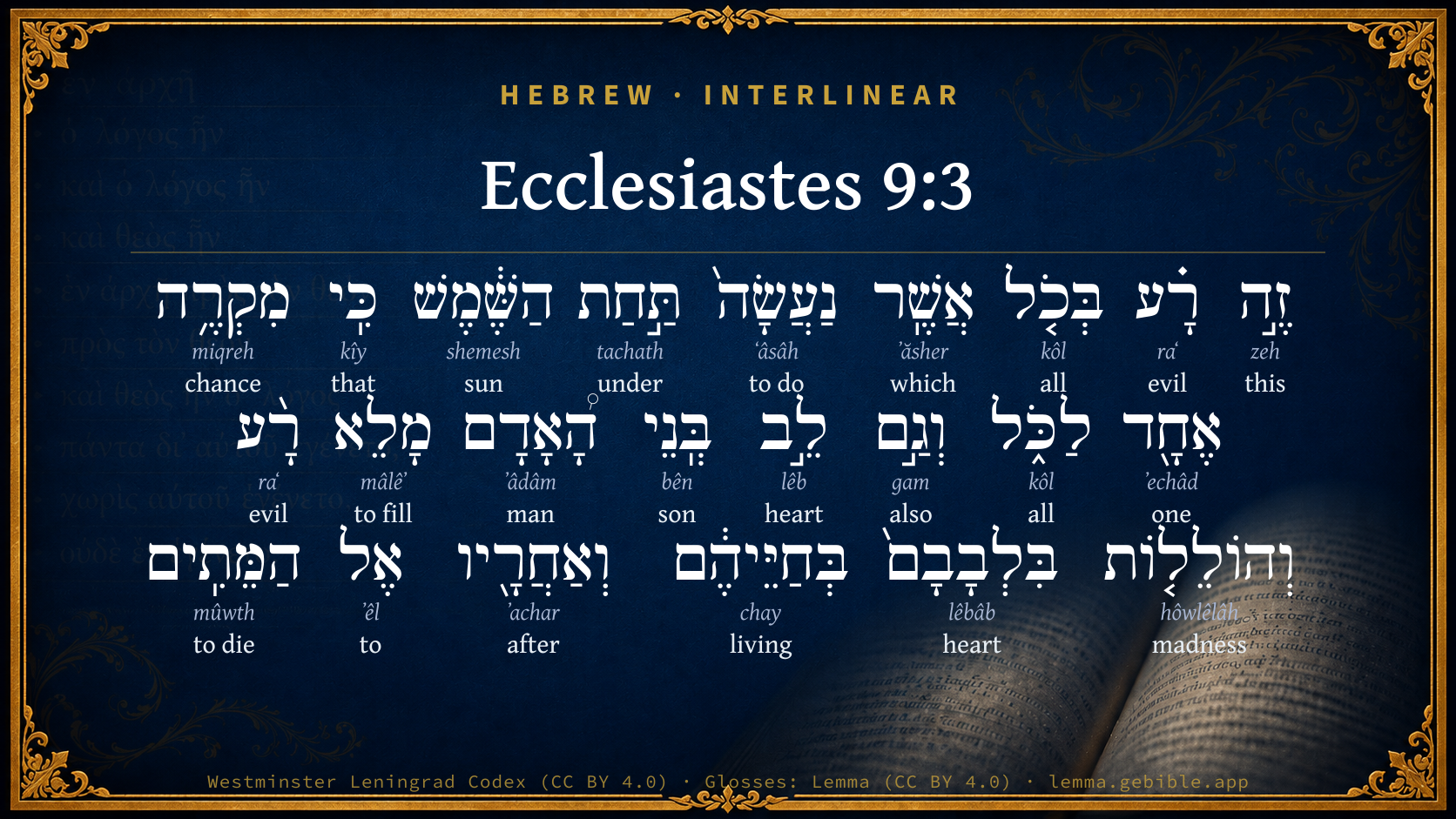
Hebrew (Westminster Leningrad Codex) Ecclesiastes 9:3 appears in the Hebrew Old Testament. The text above is from the Westminster Leningrad Codex. Each word links to its Strong’s number, a concise gloss, and parsing drawn from the Open Scriptures Hebrew Bible morphology. Click any word for its full Brown-Driver-Briggs (BDB) entry.
Download image
Cite this verse

Ecclesiastes 9:3 (World English Bible). Public Domain. Lemma interlinear Bible study tool, https://lemma.gebible.app/v/ecclesiastes/9/3.

Show BibTeX & RIS
BibTeX
RIS
English Translation
This is an evil in all that is done under the sun, that there is one event to all: yes also, the heart of the sons of men is full of evil, and madness is in their heart while they live, and after that they go to the dead.
World English Bible · Public Domain
Download a study sheet

One document with this verse’s original text, its word-by-word gloss line, the meaning frame, cross-references with their text, attributed commentary, and full source and license credits — printable, and it pastes into notes with its structure intact.

This verse Autodidact and up

Study sheet (.html) Plain text (.txt)

A passage Seminary Student

Up to 50 verses in one chapter. A passage sheet keeps up to 6 commentary sources and 12 cross-references per verse, in the order this page ranks them, and says so on the sheet whenever that leaves anything out. Ask for a single verse and you get the Autodidact verse sheet above.

Everything on this page stays free to read, with no account — the sheet is a download of what is already on screen, not access to it.

Want to remove ads? Support Godless Engineer
Compare translations 3

The same verse in 3 English versions, stacked beneath the original-language interlinear above. Click any original word for its lexicon entry.

Each is an independent rendering of the whole verse — the interlinear is not word-aligned to these translations.

Highlighted words mark where these versions differ — a whole-verse word diff, not a word-by-word alignment.

  • World English Bible Public Domain
    This is an evil in all that is done under the sun, that there is one event to all: yes also, the heart of the sons of men is full of evil, and madness is in their heart while they live, and after that they go to the dead.
  • King James Version Public Domain
    This is an evil among all things that are done under the sun, that there is one event unto all: yea, also the heart of the sons of men is full of evil, and madness is in their heart while they live, and after that they go to the dead.
  • unfoldingWord Literal Text CC BY-SA 4.0
    This a misfortune about everything that is done under the sun: That one happening to everyone. And also, the heart of the sons of humanity full of evil, and madness in their heart during their lives—and after him, to the dead!

unfoldingWord Literal Text — © unfoldingWord, licensed CC BY-SA 4.0. Word-aligned USFM3 via Door43 (git.door43.org/unfoldingWord/en_ult).

Versions to compare (up to 4)

3 of 4 selected

Show all 18 translations

Every available English version of this verse, each an independent rendering of the whole verse.

  • World English Bible Public Domain
    This is an evil in all that is done under the sun, that there is one event to all: yes also, the heart of the sons of men is full of evil, and madness is in their heart while they live, and after that they go to the dead.
  • Berean Standard Bible Public Domain
    This is an evil in everything that is done under the sun: There is one fate for everyone. Furthermore, the hearts of men are full of evil and madness while they are alive, and afterward they join the dead.
  • Majority Standard Bible Public Domain
    This is an evil in everything that is done under the sun: There is one fate for everyone. Furthermore, the hearts of men are full of evil and madness while they are alive, and afterward they join the dead.
  • King James Version Public Domain
    This is an evil among all things that are done under the sun, that there is one event unto all: yea, also the heart of the sons of men is full of evil, and madness is in their heart while they live, and after that they go to the dead.
  • American Standard Version (1901) Public Domain
    This is an evil in all that is done under the sun, that there is one event unto all: yea also, the heart of the sons of men is full of evil, and madness is in their heart while they live, and after that `they go' to the dead.
  • Revised Version (1885) Public Domain
    This is an evil in all that is done under the sun, that there is one event unto all: yea also, the heart of the sons of men is full of evil, and madness is in their heart while they live, and after that they go to the dead.
  • Geneva Bible (1599) Public Domain
    This is euill among all that is done vnder the sunne, that there is one condition to all, and also the heart of the sonnes of men is full of euill, and madnes is in their heartes whiles they liue, and after that, they goe to the dead.
  • Douay-Rheims (1899) Public Domain
    This is a very great evil among all things that are done under the sun, that the same things happen to all men: whereby also the hearts of the children of men are filled with evil, and with contempt while they live, and afterwards they shall be brought down to hell.
  • Young's Literal Translation Public Domain
    This `is' an evil among all that hath been done under the sun, that one event `is' to all, and also the heart of the sons of man is full of evil, and madness `is' in their heart during their life, and after it -- unto the dead.
  • Literal Standard Version CC BY-SA 4.0
    This [is] an evil among all that has been done under the sun, that one event [is] to all, and also the heart of the sons of man is full of evil, and madness [is] in their heart during their life, and after it—to the dead.
  • Unlocked Literal Bible CC BY-SA 4.0
    There is an evil fate for everything that is done under the sun, the same event happens to them all. The hearts of human beings are full of evil, and madness is in their hearts while they live. So after that they go to the dead.
  • unfoldingWord Literal Text CC BY-SA 4.0
    This a misfortune about everything that is done under the sun: That one happening to everyone. And also, the heart of the sons of humanity full of evil, and madness in their heart during their lives—and after him, to the dead!
  • Darby Bible Public Domain
    This is an evil among all that is done under the sun, that one thing befalleth all: yea, also the heart of the children of men is full of evil, and madness is in their heart while they live; and after that, [they have to go] to the dead.
  • World Messianic Bible Public Domain
    This is an evil in all that is done under the sun, that there is one event to all. Yes also, the heart of the sons of men is full of evil, and madness is in their heart while they live, and after that they go to the dead.
  • Webster's Bible Public Domain
    This is an evil among all things that are done under the sun, that there is one event to all: yes, also the heart of the sons of men is full of evil, and madness is in their heart while they live, and after that they go to the dead.
  • Free Bible Version CC BY-SA 4.0
    This is just so wrong—that everyone here on earth should suffer the same fate! On top of that, people's minds are filled with evil. They spend their lives thinking about stupid things, and then they die.
  • Bible in Basic English Public Domain
    This is evil in all things which are done under the sun: that there is one fate for all, and the hearts of the sons of men are full of evil; while they have life their hearts are foolish, and after that--to the dead.
  • JPS Tanakh (1917) Public Domain
    This is an evil in all that is done under the sun, that there is one event unto all; yea also, the heart of the sons of men is full of evil, and madness is in their heart while they live, and after that they go to the dead.

Literal Standard Version (2020), Covenant Press — licensed CC BY-SA 4.0. Text via the HelloAO Bible API (eBible.org). Unlocked Literal Bible (unfoldingWord) — licensed CC BY-SA 4.0. Text via the HelloAO Bible API (eBible.org). unfoldingWord Literal Text — © unfoldingWord, licensed CC BY-SA 4.0. Word-aligned USFM3 via Door43 (git.door43.org/unfoldingWord/en_ult). Free Bible Version, Dr. Jonathan Gallagher — licensed CC BY-SA 4.0. Text via the HelloAO Bible API (eBible.org).

Word by word

More ways to search: Search by grammar → Find every occurrence → Compare this word →

Practice this passage: Drill this verse → Learn its vocabulary →

וְהוֹלֵל֤וֹת
hôwlêlâh
H1947
“and · madness”
Conjunction + Noun, Common, Feminine, Plural, Absolute
Part of Speech
Conjunction + Noun
Type
Common
Gender
Feminine
Number
Plural
State
Absolute
Full BDB Definition

Origin: act. participle of H1984

TWOT: 501a

madness
  1. זֶ֣ה zeh H2088 “this” Pronoun, Demonstrative, Masculine, Singular
  2. רָ֗ע raʻ H7451 “evil” Adjective, Adjective, Masculine, Singular, Absolute
  3. בְּכֹ֤ל kôl H3605 “in/at · all” Preposition + Noun, Common, Masculine, Singular, Absolute
  4. אֲשֶֽׁר ʼăsher H834 “which” Particle, Relative
  5. נַעֲשָׂה֙ ʻâsâh H6213 “to do” Verb, Niphal, Perfect, 3rd Person, Masculine, Singular
  6. תַּ֣חַת tachath H8478 “under” Preposition
  7. הַשֶּׁ֔מֶשׁ shemesh H8121 “the · sun” Particle, Definite Article + Noun, Common, Both, Singular, Absolute
  8. כִּֽי kîy H3588 “that” Conjunction
  9. מִקְרֶ֥ה miqreh H4745 “chance” Noun, Common, Masculine, Singular, Absolute
  10. אֶחָ֖ד ʼechâd H259 “one” Adjective, Cardinal number, Masculine, Singular, Absolute
  11. לַכֹּ֑ל kôl H3605 “to/for the · all” Preposition, Determined + Noun, Common, Masculine, Singular, Absolute
  12. וְגַ֣ם gam H1571 “and · also” Conjunction + Particle, Accusative
  13. לֵ֣ב lêb H3820 “heart of” Noun, Common, Masculine, Singular, Construct
  14. בְּֽנֵי bên H1121 “sons of” Noun, Common, Masculine, Plural, Construct
  15. הָ֠אָדָם ʼâdâm H120 “the · man” Particle, Definite Article + Noun, Common, Masculine, Singular, Absolute
  16. מָלֵא mâlêʼ H4390 “to fill” Verb, Qal, Perfect, 3rd Person, Masculine, Singular
  17. רָ֨ע raʻ H7451 “evil” Adjective, Adjective, Masculine, Singular, Absolute
  18. בִּלְבָבָם֙ lêbâb H3824 “in/at · heart · their” Preposition + Noun, Common, Masculine, Singular, Construct + Suffix, Personal, 3rd Person, Masculine, Plural
  19. בְּחַיֵּיהֶ֔ם chay H2416 “in/at · living things · their” Preposition + Noun, Common, Masculine, Plural, Construct + Suffix, Personal, 3rd Person, Masculine, Plural
  20. וְאַחֲרָ֖יו ʼachar H310 “and · after · him” Conjunction + Preposition + Suffix, Personal, 3rd Person, Masculine, Singular
  21. אֶל ʼêl H413 “to” Preposition
  22. הַמֵּתִֽים mûwth H4191 “the · dying” Particle, Definite Article + Verb, Qal, Participle Active, Masculine, Plural, Absolute

About this verse

These counts appear in no published source. They are computed here, from the morphology-tagged text and Lemma’s own curated glosses. What Lemma adds →

23
words
21
distinct lemmas
Wisdom
section

Notable vocabulary

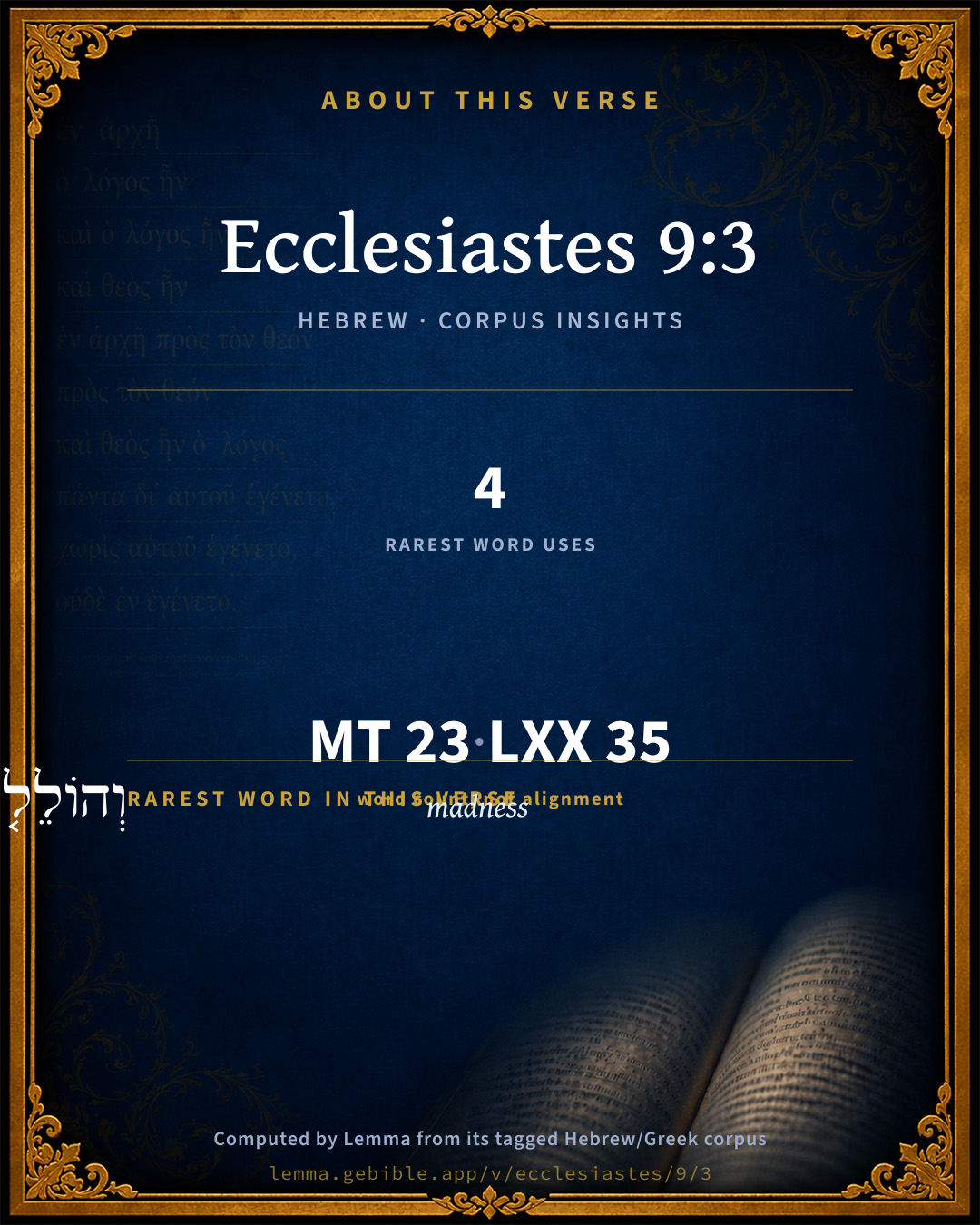
The rarest word here is וְהוֹלֵל֤וֹת madness H1947 — appearing just 4 times in the whole Hebrew Bible.

Shared distinctive vocabulary

וְהוֹלֵל֤וֹת madness H1947 occurs in 4 verses of the Hebrew Bible. Also found in:

Grammatical profile

  • 3 verbs
  • 10 nouns
  • 3 adjectives
  • 1 pronoun
  • 3 prepositions
  • 1 conjunction
  • 2 particles

Verb forms

  • נַעֲשָׂה֙ Niphal · Perfect
  • מָלֵא Qal · Perfect
  • הַמֵּתִֽים Qal · Participle Active

Repetition

Words recur within this verse — often emphatic in Hebrew:

  • רָ֗ע evil H7451 ×2
  • בְּכֹ֤ל all H3605 ×2

Hebrew & Septuagint length

In English translation the verse runs 49 words from the Hebrew and 48 from the Septuagint (LXX English) — closely comparable.

A rough comparison of the two English renderings, which tokenize alike — not a word-level alignment.

Word counts can differ between the Hebrew and the Greek without any difference in meaning — e.g. the Hebrew direct-object marker אֵת has no separate Greek word, and Greek often adds the article ὁ.

In the original languages it is 23 Hebrew tokens and 35 Greek tokens — but the two are counted differently (Hebrew bundles its prefixes and suffixes into one token; the Greek is in lemma form), so that isn’t a like-for-like length.

Cross-references

21

Topical passages linked to Ecclesiastes 9:3 in the Treasury of Scripture Knowledge — connected by theme and wording, ordered by reader-vote popularity; previews shown in the World English Bible.

  • Jeremiah 17:9 The heart is deceitful above all things, and it is exceedingly corrupt: who can know it?
  • Ecclesiastes 8:11 Because sentence against an evil work is not executed speedily, therefore the heart of the sons of men is fully set in them to do evil.
  • Ecclesiastes 1:17 I applied my heart to know wisdom, and to know madness and folly. I perceived that this also was a chasing after wind.
  • Job 15:16 How much less one who is abominable and corrupt, A man who drinks iniquity like water!
  • Psalms 51:5 Behold, I was brought forth in iniquity. In sin my mother conceived me.
  • Romans 1:29–31 being filled with all unrighteousness, sexual immorality, wickedness, covetousness, maliciousness; full of envy, murder, strife, deceit, evil habits, secret slanderers,
  • Titus 3:3 For we were also once foolish, disobedient, deceived, serving various lusts and pleasures, living in malice and envy, hateful, and hating one another.
  • Genesis 8:21 Yahweh smelled the sweet savor. Yahweh said in his heart, "I will not again curse the ground any more for man's sake, because the imagination of man's heart is evil from his youth; neither will I ever again strike everything living, as I have done.
  • Proverbs 14:32 The wicked is brought down in his calamity, But in death, the righteous has a refuge.
  • Ecclesiastes 7:25 I turned around, and my heart sought to know and to search out, and to seek wisdom and the scheme of things, and to know that wickedness is stupidity, and that foolishness is madness.
  • Ecclesiastes 9:2 All things come alike to all. There is one event to the righteous and to the wicked; to the good, to the clean, to the unclean, to him who sacrifices, and to him who doesn't sacrifice. As is the good, so is the sinner; he who takes an oath, as he who fears an oath.
  • Ecclesiastes 12:7 And the dust returns to the earth as it was, And the spirit returns to God who gave it.
  • Mark 7:21–23 For from within, out of the hearts of men, proceed evil thoughts, adulteries, sexual sins, murders, thefts,
  • Luke 6:11 But they were filled with rage, and talked with one another about what they might do to Jesus.
  • Luke 15:17 But when he came to himself he said, 'How many hired servants of my father's have bread enough to spare, and I'm dying with hunger!
  • Acts 12:23 Immediately an angel of the Lord struck him, because he didn't give God the glory, and he was eaten by worms and died.
  • Acts 26:24 As he thus made his defense, Festus said with a loud voice, "Paul, you are crazy! Your great learning is driving you insane!"
  • 2 Peter 2:16 but he was rebuked for his own disobedience. A mute donkey spoke with man's voice and stopped the madness of the prophet.
  • Genesis 6:5 Yahweh saw that the wickedness of man was great in the earth, and that every imagination of the thoughts of his heart was only evil continually.
  • Matthew 15:19–20 For out of the heart come forth evil thoughts, murders, adulteries, sexual sins, thefts, false testimony, and blasphemies.
  • Acts 26:11 Punishing them often in all the synagogues, I tried to make them blaspheme. Being exceedingly enraged against them, I persecuted them even to foreign cities.

Cross-references courtesy of OpenBible.info (CC BY 4.0).

Hebrew and Greek witnesses Masoretic Hebrew ↔ Greek Septuagint

The same verse in the two great witnesses to the Old Testament, shown verse-for-verse.

These are two independent witnesses, not word-aligned to each other, and the Septuagint is shown in lemma (dictionary) form.

Hebrew Ecclesiastes 9:3 Masoretic · Westminster Leningrad Codex

זֶ֣ה רָ֗ע בְּכֹ֤ל אֲשֶֽׁר נַעֲשָׂה֙ תַּ֣חַת הַשֶּׁ֔מֶשׁ כִּֽי מִקְרֶ֥ה אֶחָ֖ד לַכֹּ֑ל וְגַ֣ם לֵ֣ב בְּֽנֵי הָ֠אָדָם מָלֵא רָ֨ע וְהוֹלֵל֤וֹת בִּלְבָבָם֙ בְּחַיֵּיהֶ֔ם וְאַחֲרָ֖יו אֶל הַמֵּתִֽים

This is an evil in all that is done under the sun, that there is one event to all: yes also, the heart of the sons of men is full of evil, and madness is in their heart while they live, and after that they go to the dead.

World English Bible · Public Domain

Greek LXX Ecclesiastes 9:3 Septuagint · lemma form

οὗτος πονηρός ἐν πᾶς ποιέω ὑπό ὁ ἥλιος ὅτι συνάντημα εἷς ὁ πᾶς καί γέ καρδία υἱός ὁ ἄνθρωπος πληρόω πονηρός καί περιφέρεια ἐν καρδία αὐτός ἐν ζωή αὐτός καί ὀπίσω αὐτός πρός ὁ νεκρός

There is this evil in all that is done under the sun, that there is one event to all: yes, the heart of the sons of men is filled with evil, and madness is in their heart during their life, and after that they go to the dead.

LXX2012 (modern English Septuagint) · Public Domain

On this verse, The Pulpit Commentary discusses the Septuagint’s reading. Read the note in Commentary ↓

Hebrew: Westminster Leningrad Codex (CC BY 4.0). Greek: Septuagint (public domain); English from LXX2012 (modern English Septuagint) (Public Domain). How the Septuagint differs from the Hebrew →

Commentary

Notes on Ecclesiastes 9:3 from classic Christian and Jewish commentators (each source and its license shown beneath its notes). The classic Christian expositions comment on the surrounding passage and are grouped to its opening verse, so a note may address several verses; the Jewish commentaries on the Tanakh (Rashi and others) are per-verse, so they appear only where the commentator wrote on this verse.

Lemma curates 59 commentaries, every one of them public domain or Creative Commons licensed, each selected and text-cleaned for this edition rather than reprinted as found. About our sources →

Trapp's Complete Commentary

John Trapp

Ecc 9:3 This [is] an evil among all [things] that are done under the sun, that [there is] one event unto all: yea, also the heart of the sons of men is full of evil, and madness [is] in their heart while they live, and after that [they go] to the dead.

Ver. 3. This is an evil.] Hoc est pessimum - so Jerome, the Vulgate, and Tremellius render it; this is the worst evil, this is wickedness with a witness, - scil., That since "there is one event to all," graceless men should thence conclude that it is a bootless business, a course of no profit to serve God. Hence they walk about the world with hearts as full as hell of lewd and lawless lusts. Hence they run a-madding after the pleasures of sin, which with a restless giddiness they earnestly pursue; yea, they live and die in so doing, saith the wise man here, noting their final impenitence, that hate of heaven, and gate to hell.

John Trapp, A Commentary or Exposition upon All the Books of the Old and New Testament (1647–1656) — public domain. Text from a community e-Sword module.

The Biblical Illustrator

Joseph S. Exell

Ecc_9:3

The heart of the sons of men is full of evil.

Scriptural statement of the doctrines of human corruption, and of the renewal of the heart to holiness

I. Mans natural corruption.

1. One prevailing misconception on the subject of human corruption respects the seat of the disorder. What is the daily language of numbers? Our lives, it is true, are not exempt from blame. We are guilty of many indiscretions. But our heart is good. In opposition to this language, the text asserts that the origin of all the evil is within. The heart of the sons of men is full of evil. Not the streams alone are filthy and defiled; but the fountain is polluted (Gen_8:21; Jer_7:24; Jer_17:9; Jam_4:1; Mat_12:34; Mat_15:19).

2. Another ground of misconception on the subject of human corruption respects the degree and extent of the disorder. The text says that this corruption is not only radical but total. Generosity, gratitude, fidelity, and the exercise of many other pleasing qualities between man and man; the spontaneous applause of virtue; the decided condemnation of immorality may all exist, without any tendency in man to what is truly good (Isa_1:5-6; Rom_7:18; Rom_8:7; Gen_6:5).

3. The declaration in the text is also absolute. No exception is stated or implied on account of any difference of outward dispensation under which mankind may be placed. The Gospel uniformly proceeds on the supposition that man is born in sin; that his corruption is not accidental, but innate; not acquired, but hereditary. That which is born of the flesh is flesh.

II. The renewal of the heart to holiness. If, as the Scriptures teach, without holiness no man shall see the Lord, then every text which points out the nature and extent of human corruption, points out by implication the nature and extent of that moral change which man must undergo.

1. Let us thankfully receive the information vouchsafed.

2. Let us also profitably use the information vouchsafed.

While the text sets before us the picture of mankind in general, let us remember that it sets before us our picture in particular. Let us seek to acquire a deep, an experimental conviction of the truth. Let our experience of the inveteracy of the malady lead us earnestly to seek for help from Him who alone can heal our disordered souls. (E. Cooper.)

The unconverted world

I. Their guilt. The heart--full of evil (Mar_7:21). It applies to all. The most peaceable man alive has often probably committed murder in his heart. The man of purity and chastity may often, in the heart, have been guilty of adultery. Passions, vile and loathsome as the pit from which they spring, only wait their opportunity. Is the man provoked? He is enraged. Is he admired? He is proud and puffed up. Does God afflict him? He is rebellious. Does God cross him? He is discontented and impatient.

II. Their madness.

1. It is a well-known symptom of natural madness that the poor creature who is thus afflicted is apt to entertain most extravagant notions of his own greatness and importance. Whilst the chains are on his hands, whilst he is confined within the narrow limits of his gloomy cell, he often struts about, and thinks himself a king. Is this acknowledged to be madness? and is there none, then, in the conduct of those men Who, being spiritually wretched, and miserable, and poor, and blind, and naked, are saying of themselves, I am rich and increased with goods, and I have need of nothing?

2. Men who are mad, in the ordinary sense of the expression, are, for the most part, utterly insensible of danger, and incapable of fleeing from it. They walk on unconcerned, where men possessed of reason and of foresight would be shifting for their safety. Are those men, then, to be set down for sober who show an equal unconcern when the danger is eternal?

3. But mark another painful symptom of the man who labours under a natural derangement, he knows not his best friend. Those whom, were he in his senses, he would hasten to embrace, he looks on with a cold, unfeeling eye. Nay, perhaps he turns away from them, he counts them enemies. It is also the worst symptom of that spiritual derangement with which the men of this world are afflicted. They also know not their best Friend. They turn away from Him who speaketh to them from heaven.

III. Their miserable end. After that, they go to the dead. After what? After all the evil and the madness of their earthly course--after having wasted all their years in worldliness and folly--then, they go to the dead. Their souls are gathered to the place where all who lived and died like them are gone before. And what place? Can we doubt that hell is meant? Where else do they go who forget God? What other wages hath sin, the worldly mans master, to bestow upon its servants? (A. Robertson, M. A.)

Madness is in their heart while they live.--

Moral madness

There is a worse madness than mental. Many men intellectually sane are moral maniacs. Wherein does the madness of the unregenerate appear?

I. In practically ignoring the greatest being.

II. In ignoring the greatest interests.

III. In ignoring the greatest dignities. The dignity of a pure character, moral conquests, and self-sacrificing deeds. These they never recognize. (Homiliest.)

Moral insanity

This affirmation is not made of one or two men, nor of some men merely; but of the sons of men, as if of them all.

1. The insanity spoken of in the text is moral, that of the heart. By the heart here is meant the will--the voluntary power.

2. Who are the morally insane? Those who, not being intellectually insane, yet act as if they were. The conduct of impenitent men is the perfection of irrationality. You see this in the ends to which they devote themselves, and in the means which they employ to secure them. An end madly chosen--sought by means madly devised; this is the life-history of the masses who reject God.

3. This moral insanity is a state of unmingled wickedness.

(1) It is voluntary--not from the loss but from the abuse of reason.

(2) It is often deliberate.

(3) It is a total rejection of both Gods law and Gospel.

The law he will not obey; the Gospel of pardon he will not accept. He seems determined to brave the Omnipotence of Jehovah. Is he not mad upon his idols? Is it saying too much when the Bible affirms--Madness is in their heart while they live? Remarks:--

1. Sinners strangely accuse saints of being mad and crazy. Yet those very sinners admit the Bible to be true, and admit those things which Christians believe as true to be really so.

2. If intellectual insanity be a shocking fact, how much more so is moral? Suppose the case of a Webster. His brain becomes softened; he is an idler I There is not a man in all the land but would feel solemn. What! Daniel Webster--that great man, an idiot I How have the mighty fallen! What a horrible slight! But how much more horrible to see him become a moral idiot--to see a selfish heart run riot with the clear decisions of his gigantic intellect--to see his moral principles fading away before the demands of selfish ambition--to see such a man become a drunkard, a debauchee, a loafer. Intellectual idiocy is not to be named in the comparison!

3. Although some sinners may be externally fair, and may seem to be amiable in temper and character, yet every real sinner is actually insane. Eternity so vast, and its issues so dreadful, yet this sinner drives furiously to hell as if he were on the high-road to heaven! And all this only because he is infatuated with the pleasures of sin for a season. (C. G. Finney, D. D.)

The Biblical Illustrator, edited by Joseph S. Exell (c. 1880s–1900s) — public domain. Text from a community e-Sword module.

Tyndale Open Study Notes

Tyndale Open Resources

9:3 When punishments, including death, are delayed, people continue their own mad course, perhaps intensifying their sin and foolishness.

Tyndale Open Study Notes — © Tyndale Open Resources, licensed CC BY-SA 4.0. Text via the HelloAO Bible API.

Geneva Bible (1599)

Geneva Bible translators

In outward things, as riches and poverty, sickness and health, there is no difference between the godly and the wicked: but the difference is that the godly are assured by faith of God’s favor and assistance.

Geneva Bible (1599) marginal notes — public domain. Text via Bolls.life.

Jamieson, Fausset & Brown

Robert Jamieson, A. R. Fausset & David Brown

Translate, "There is an evil above all (evils) that are done," &c., namely, that not only "there is one event to all," but "also the heart of the sons of men" makes this fact a reason for "madly" persisting in "evil while they live, and after that," &c., sin is "madness."

the dead-- (Pro 2:18; Pro 9:18).

Jamieson, Fausset & Brown — Commentary Critical and Explanatory on the Whole Bible (1871) — public domain (CC PDM 1.0). Text via the HelloAO Bible API.

Adam Clarke's Commentary

Verse 3. The heart of the sons of men is full of evil] No wonder then that the curse of God should be frequent in the earth.

Adam Clarke's Commentary on the Bible (1810–1826) — public domain. Text from a community e-Sword/MySword module.

Ellicott's Commentary for English Readers

(3) We have again the sentiments expressed in Ecc_2:14-16; Ecc_3:19; Ecc_5:15; Ecc_6:12.

A Bible Commentary for English Readers, edited by Charles John Ellicott (1878–1897) — public domain. Text from a community e-Sword module.

The Cambridge Bible for Schools and Colleges

gen. ed. J. J. S. Perowne

3. This is an evil among all things] The pessimism of the thinker returns once more upon him, and he falls into the strain which we have heard before in chs. Ecc_2:14-16, Ecc_3:19, Ecc_5:15, Ecc_6:12. The great leveller comes and sweeps away all distinctions, and there is no assured hope of immortality. Life is “evil” even while it lasts, and death is the same for all, when the curtain drops on the great drama.

madness is in their heart while they live] The “madness” is that of chs. Ecc_1:17, Ecc_2:12. All man’s life, in its vain strivings, its fond hopes, its wild desires, seems to the pessimist but as the “delirantium somnia.” The English version seems to imply that the writer laid stress on the fact that the evildoers did not continue in existence to bear the penalty they deserved, but rested in the grave like others;

“After life’s fitful fever they sleep well,”

but it is rather the Epicurean thought of death as the common lot, and the sigh with which it is uttered is, as it were, the unconscious protest of the philosophising Hebrew against the outcome of his philosophy. In what he heard of as a “short life and merry” he finds an insanity that ends in nothingness.

The Cambridge Bible for Schools and Colleges (gen. ed. J. J. S. Perowne; Cambridge University Press, 1878–1918) — public domain. Text from a community e-Sword module.

John Gill's Exposition

This is an evil among all things that are done under the sun, that there is one event unto all,.... A very great evil, a very sore one, the worst of evils. Not an evil, as the providence of God is concerned with it, who does no evil; nor is there any unrighteousness in him; he is righteous in all his ways: but this is an evil, and distressing thing, to the minds of good men; see Psa 73:2; and is what bad men make an ill use of, to harden themselves in sin, and to despise religion as an unprofitable thing, Job 21:14;

yea, also the heart of the sons of men is full of evil: they are naturally full of evil, of all unrighteousness and wickedness, what comes out of them show it; and because the same things happen to good and bad men, and the wicked pass with impunity, and are outwardly happy as others, or more so, their hearts are fully set in them to do evil, Ecc 8:11;

and madness is in their heart while they live; or "madnesses" (x): every sin is madness; for who but a madman would stretch out his hand against God, and strengthen himself against the Almighty, and run upon him? who but a madman would rush into sin in the manner he does, and expose himself to dangers and death, even eternal death? Wicked men are mad upon their lusts, and mad against the saints, and all that is good; this insanity is in their hearts, and shows itself in their lives, and continues with them as long as they live, unless called by grace;

and after that they go to the dead; after all the madness of their lives, they die and go into the state of the dead, and are among which refers not so much to the interment of bodies in the grave, as the company with which their separate spirits are; they go not to the righteous dead, but to the wicked; see Pro 2:18; so Alshech; they go to the dead; not to the righteous, who, in their death, or when dead are called living, but, as Jarchi observes, at their end they go down to hell. The Targum is,

"after the end of a man, it is reserved for him that he be corrected with the dead, according to the judgment (or desert) of sins.''

(x) "insaniae", Montanus, Mercerus, Drusius, Amama, Gejerus, Rambachius; "omnis insania", Junius & Tremellius.

John Gill's Exposition of the Whole Bible (1746–1763) — public domain (CC PDM 1.0). Text via the HelloAO Bible API.

Albert Barnes' Notes on the Bible

Compare Ecc 8:11. The seeming indiscriminateness of the course of events tends to encourage evil-disposed men in their folly.

Albert Barnes' Notes on the Bible (1834–1885) — public domain. Text from a community e-Sword/MySword module.

Haydock's Catholic Bible Commentary

Evil. People hence take occasion to indulge in vice, (chap. viii. 14.) though the conduct of God be irreproachable. (Calmet) --- Shall. Hebrew, "they go to the dead." (Haydock) --- Many think that these are the sentiments of the impious.

George Leo Haydock (1774–1849), Haydock's Catholic Family Bible and Commentary, 1859 edition — public domain. Excludes Psalms (Douay-Rheims chapter numbering differs from Protestant) and Deuterocanonical books (Catholic canon only).

Matthew Poole's English Annotations

An evil; a great trouble and temptation to a considerate and good man.

The heart of the sons of men, of wicked men, such as the generality of mankind are,

is full of evil; either,

1. Of grief upon this occasion. Or rather,

2. Of wickedness, as appears from the next clause, and by comparing this place with Ecc 8:11.

Madness is in their heart; upon this account they go on madly and desperately in evil courses, without any fear of an after-reckoning.

After that the go to the dead; after all their mad and wicked pranks in the whole course of their life, they die in the same manner as the best men do. So hitherto there is no difference. For Solomon here forbears the consideration of the future life. Only he seems to intimate, that as the madness, so the happiness of the wicked is ended by death, which is more fully expressed in the following words.

Matthew Poole's English Annotations on the Holy Bible (1683–1685) — public domain. Text from a community e-Sword/MySword module.

Whedon's Commentary on the Bible

Daniel D. Whedon

3. An evil among all — That is, the greatest, saddest “evil.”

Also — Better, though. Even the worst — most furious — sinner, comes to simply the same event as the good man. “There are no bands in their death.” And after that, should be, get after it. It might satisfy one’s ideas of justice if there were some marked and reliable difference between the good and the bad; but none can be seen.

Daniel D. Whedon (gen. ed.), Commentary on the Old and New Testaments (1874–1909) — public domain. Text from a community e-Sword module.

The Pulpit Commentary

This is an evil among all things that are done under the sun. The "evil" is explained in the following words, which speak of the common fate. The Vulgate (followed by Ginsburg and others) lakes the first words as equivalent to a superlative: Hoc est pessimum inter omnia, "This is the greatest evil of all that is done under the sun." But the article would have been used in this case; nor would this accurately express Koheleth"s sentiments. He looks upon death only as one of the evils appertaining to men"s career on earth one of the phases of that identity of treatment so certain and so inexplicable, which leads to disastrous results. (Ecc_8:11) That there is one event unto all. The "one event," as the end of the verse shows, is death. We have here the old strain repeated which is found in Ecc_2:14-16 Ecc_3:19 Ecc_5:15 Ecc_6:12; "Omnes eodem cogimur" (Horace, "Carm.," 2:3. 25). Yea, also the heart of the sons of men is full of evil. In consequence of this indiscriminating destiny men sin recklessly, are encouraged in their wickedness. Madness is in their heart while they live. The "madness" is conduct opposed to the dictates of wisdom and reason, asreia, Ecc_1:17 Ecc_2:2, Ecc_2:12. All their life long men follow their own lusts and passions, and care little for God"s will and law, or their own best interests. This is well called "want of reason (perife) Septuagint). And after that they go to the dead. The verb is omitted in the Hebrew, being implied by the preposition yKi, "to;" the omission is very forcible. Delitzsch, Wright, and others render, "after him," i.e. after man"s life is ended, which seems rather to say, "after they die, they die." The idea, however, appears to be, both good and evil go to the same place, pass away into nothingness, are known no more in this world. Here at present Koheleth leaves the question of the future life, having already intimated his belief in Ecclesiastes 3. and 8:11, etc.

The Pulpit Commentary (1880–1919), ed. H.D.M. Spence-Jones & Joseph S. Exell — public domain. Text from a community e-Sword module.

John Wesley's Explanatory Notes

An evil - A great trouble to a good man. Is full - Of wickedness. Madness - They go on madly and desperately in evil courses. They go - After all, they die in the same manner as the best men do.

John Wesley, Explanatory Notes Upon the Whole Bible (1754–1765) — public domain. Text via the GEBible commentary corpus.

Keil & Delitzsch

C. F. Keil & F. Delitzsch

"This is an evil in all that is done under the sun, that one event happeneth to all: and also the heart of the children of men is full of evil; and madness possesseth their heart during their life, and after it they go to the dead." As זה, Ecc 9:1, points to the asher following, in which it unfolds itself, so here to the ki following. We do not translate: This is the worst thing (Jerome: hoc est pessimum), which, after Jos 14:15; Jdg 6:15; Sol 1:8, would have required the words בכל הרע - the author does not designate the equality of fate as the greatest evil, but as an evil mixed with all earthly events. It is an evil in itself, as being a contradiction to the moral order of the world; and it is such also on account of its demoralizing influences. The author here repeats what he had already, Ecc 8:11, said in a more special reference, that because evil is not in this world visibly punished, men become confident and bold in sinning. Vegam (referable to the whole clause, at the beginning of which it is placed) stands beside zeh ra', connecting with that which is evil in itself its evil influences. מלא might be an adj., for this (only once, Jer 6:11), like the verb, is connected with the accus., e.. Deu 33:23. But, since not a statement but a factum had to be uttered, it is finite, as at Ecc 8:11. Thus Jerome, after Symm.: sed et cor filiorum hominum repletur malitia et procacitate juxta cor eorum in vita sua. Keeping out of view the false sed, this translation corresponds to the accenting which gives the conjunctive Kadma to רע. But without doubt an independent substantival clause begins with והו: and madness is in their heart (vid., Ecc 1:17) their life long; for, without taking heed to God's will and to what is pleasing to God, or seeking after instruction, they think only of the satisfaction of their inclinations and lusts.

"And after that they go to the dead" - they who had so given themselves up to evil, and revelled in fleshly lusts with security, go the way of all flesh, as do the righteous, and the wise, and just, because they know that they go beyond all restraining bounds. Most modern interpreters (Hitz., Ew., etc.) render aharav, after Jer 51:46, adverbially, with the suffix understood neut.: afterwards (Jerome, post haec). but at Ecc 3:22; Ecc 6:12; Ecc 7:14, the suffix refers to man: after him, him who liveth here = after he has laid down his life. Why should it not be thus understood also here? It is true בּחיּ precedes it; but in the reverse say, sing. and plur. also interchange in Ecc 9:1; cf. Ecc 3:12. Rightly the Targ., as with Kleinert and others, we also explain: after their (his) lifetime. A man's life finally falls into the past, it lies behind him, and he goes forth to the dead; and along with self-consciousness, all the pleasures and joy of life at the same time come to an end.

Keil & Delitzsch — Biblical Commentary on the Old Testament (1861–1891) — public domain (CC PDM 1.0). Text via the HelloAO Bible API. (Old Testament only.)

unfoldingWord translationNotes

Door43 World Missions Community

everything that is done

This can be stated in active form. AT: "everything that happens" (See: Active or Passive)

under the sun

This refers to things that are done on earth. See how you translated this in Ecclesiastes 1:3. AT: "on the earth" (See: Idiom)

the same event

death

The hearts of human beings are full of evil, and madness is in their hearts

Here the word "hearts" refers to the thoughts and emotions. AT: "Human beings are full of evil, and their thoughts are of madness" (See: Metonymy)

madness

"folly"

they go to the dead

The phrase "the dead" refers to dead people. Here dead people represent the place where people go after they die. AT: "they go to the place where dead people are" or "they die and go to the grave" (See: Nominal Adjectives and Metonymy)

translationWords

destine

heart

life

unfoldingWord translationNotes — © Distant Shores Media and the Door43 World Missions Community, licensed CC BY-SA 4.0. Source: git.door43.org/Door43/en_tn.

Rashi

Rabbi Shlomo Yitzchaki (Rashi)

the heart of the children of men is full of evil for they say: There is no judgment of retribution for the wicked. Everything is pure happenstance. Sometimes [bad things happen] to the righteous, and sometimes to the wicked.

and after that, they go to the dead and they ultimately descend to Gehinnom.

Rashi on the Tanakh — English translations: “The Judaica Press complete Tanach with Rashi, translated by A. J. Rosenberg” (CC BY 4.0); “Pentateuch with Rashi's commentary by M. Rosenbaum and A.M. Silbermann, 1929-1934” (public domain); “The Metsudah Tanach series, Lakewood, N.J” (CC BY 4.0); and “The Book of Joshua, Metsudah Publications, 1997” (CC BY 4.0). Text via Sefaria.

Lesson kit

Teaching starters — assembled from the data on this page, not authored interpretation. Every prompt links to the verse data it draws on. Edit before teaching.

Ecclesiastes, in the Wisdom, opens this verse with 23 words (21 distinct Hebrew lemmas). Its most distinctive word is hôwlêlâh (“madness”). A historical commentator’s framing appears above. Read the whole chapter for the surrounding context.

Discussion questions

  1. What does “madness” (hôwlêlâh) contribute to the verse as a whole?
  2. Ecclesiastes 1:17 shares the word «madness» with this verse. How do the two illuminate each other?
  3. “evil” occurs 2× in this one verse. What is the effect of the repetition?
  4. These translations render this verse differently; the difference is in the English rendering, not the original. What questions does that raise?
  5. The verb «נַעֲשָׂה֙» is Niphal Perfect. How does its form color the action?
  6. Reading how Trapp's Complete Commentary and The Biblical Illustrator read this verse, where do the two commentators agree and where do they part?

Things to notice

Reading settings

Reading text

Shown beneath each verse's original-language words.

Old Testament
Old Testament edition

Read the OT as the Masoretic Hebrew (MT) or the Greek Septuagint (LXX).

English shown for the Greek Septuagint (in the Hebrew ↔ Greek comparison).

Comparing translations? Open the Compare panel on any verse page to stack up to four side by side.