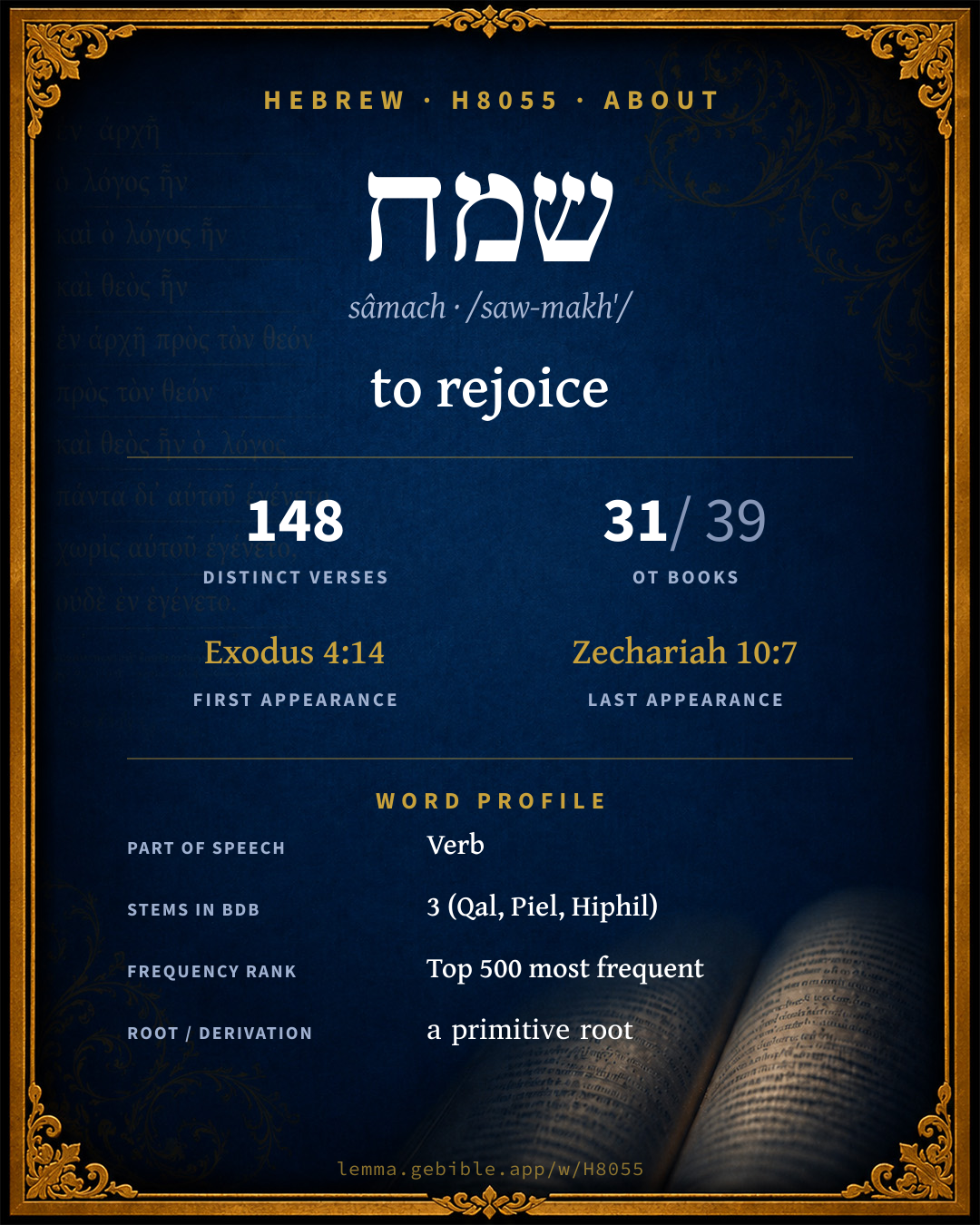
שָׂמַח
to rejoice
‘to rejoice’ is one of 3 main senses fuller range ↓
Full lexicon entry — Brown-Driver-Briggs (BDB)
From Brown-Driver-Briggs (BDB)
Where this word appears
See every Qal verb in the Hebrew Bible →
Grammar key — what these labels mean
Part of speech
- Verb
- An action or state-of-being word.
- Preposition
- A relational word (e.g. “in,” “to,” “from”) governing a noun.
Stem
- Qal
- The basic, simple active stem — the plain form of the verb (“he wrote”). Here: ‘in common life’
- Piel
- An intensive or resultative active stem.
- Hiphil
- The causative active stem (“he caused / brought about”).
Form
- Imperfect
- An incomplete, ongoing, or future action (“he will / would write”).
- Sequential Imperfect
- An imperfect with prefixed waw — the standard past-narrative form (waw-consecutive imperfect).
- Sequential Perfect
- A perfect with prefixed waw continuing a preceding imperfect or command (waw-consecutive perfect).
- Cohortative
- A first-person volitional form expressing wish or resolve (“let me / let us write”).
- Perfect
- A completed action or state — Hebrew marks aspect (completeness) more than strict tense (“he wrote”).
- Imperative
- A direct command (“write!”).
- Infinitive Construct
- A bound verbal noun, frequently with prepositions (“to write / in writing”).
- Jussive
- A third- or second-person volitional form expressing wish or command (“let him write”).
- Participle Active
- A verbal adjective expressing ongoing or characteristic action (“writing / one who writes”).
- Infinitive Absolute
- An unbound verbal noun, often intensifying or standing in for a finite verb.
State
- Absolute
- The independent form of a noun, not bound to a following word.
- Construct
- A noun bound to a following noun in a possessive / “of” relationship (the construct chain).
Person
- 3rd Person
- The one spoken about (“he / she / it / they”).
- 2nd Person
- The one addressed (“you”).
- 1st Person
- The speaker (“I / we”).
Gender
- Masculine
- Grammatically masculine.
- Common
- Either gender — not distinguished for this form.
- Feminine
- Grammatically feminine.
Number
- Singular
- One.
- Plural
- More than one (in Hebrew, generally three or more).
Grammatical forms 44 distinct
- Verb, Qal, Imperfect, 3rd Person, Masculine, Singular 23 times (15%)
- Verb, Qal, Imperfect, 3rd Person, Masculine, Plural 19 times (12%)
- Verb, Qal, Sequential Imperfect, 3rd Person, Masculine, Plural 10 times (6%)
- Verb, Piel, Imperfect, 3rd Person, Masculine, Singular 8 times (5%)
- Verb, Qal, Sequential Imperfect, 3rd Person, Masculine, Singular 7 times (4%)
- Verb, Qal, Sequential Perfect, 2nd Person, Masculine, Singular 6 times (4%)
- Verb, Qal, Cohortative, 1st Person, Common, Plural 5 times (3%)
- Verb, Qal, Perfect, 3rd Person, Common, Plural 5 times (3%)
+36 more forms (75 occurrences)
Parsed forms decoded from the imported morphology (morphhb / Westminster Leningrad Codex — WLC text public domain, morphhb tagging CC BY 4.0), counted across 158 parsed occurrences — not distinct verses.
Every verse where H8055 appears — 148 distinct verses across 31 books. Click any verse to open its interlinear word-by-word view. Verse text shown in the World English Bible for context — . Each verse’s Hebrew form is shown with its reference; the English is not keyword-highlighted, since the data carries no word-level English alignment. Use “Compare translations” on any verse to read it across multiple English versions. This concordance covers the Hebrew Bible; Septuagint (Greek Old Testament) occurrences are not indexed here.
Exodus 1 verse
Leviticus 1 verse
Deuteronomy 10 verses
- Deuteronomy 12:7 וּ/שְׂמַחְתֶּ֗ם conj + Qal wpf 2mp and there you shall eat before Yahweh your God, and you shall rejoice in all that you put your hand to, you and your households, in which Yahweh your God has blessed you.
- Deuteronomy 12:12 וּ/שְׂמַחְתֶּ֗ם conj + Qal wpf 2mp You shall rejoice before Yahweh your God, you, and your sons, and your daughters, and your men-servants, and your maid-servants, and the Levite who is within your gates, because he has no portion nor inheritance with you.
- Deuteronomy 12:18 וְ/שָׂמַחְתָּ֗ conj + Qal wpf 2ms but you shall eat them before Yahweh your God in the place which Yahweh your God shall choose, you, and your son, and your daughter, and your man-servant, and your maid-servant, and the Levite who is within your gates: and you shall rejoice before Yahweh your God in all that you put your hand to.
- Deuteronomy 14:26 וְ/שָׂמַחְתָּ֖ conj + Qal wpf 2ms and you shall bestow the money for whatever your soul desires, for oxen, or for sheep, or for wine, or for strong drink, or for whatever your soul asks of you; and you shall eat there before Yahweh your God, and you shall rejoice, you and your household.
- Deuteronomy 16:11 וְ/שָׂמַחְתָּ֞ conj + Qal wpf 2ms and you shall rejoice before Yahweh your God, you, and your son, and your daughter, and your man-servant, and your maid-servant, and the Levite who is within your gates, and the foreigner, and the fatherless, and the widow, who are in the midst of you, in the place which Yahweh your God shall choose, to cause his name to dwell there.
- Deuteronomy 16:14 וְ/שָׂמַחְתָּ֖ conj + Qal wpf 2ms and you shall rejoice in your feast, you, and your son, and your daughter, and your man-servant, and your maid-servant, and the Levite, and the foreigner, and the fatherless, and the widow, who are within your gates.
- Deuteronomy 24:5 וְ/שִׂמַּ֖ח conj + Piel wpf 3ms When a man takes a new wife, he shall not go out in the host, neither shall he be charged with any business: he shall be free at home one year, and shall cheer his wife whom he has taken.
- Deuteronomy 26:11 וְ/שָׂמַחְתָּ֣ conj + Qal wpf 2ms and you shall rejoice in all the good which Yahweh your God has given to you, and to your house, you, and the Levite, and the foreigner who is in the midst of you.
- Deuteronomy 27:7 וְ/שָׂ֣מַחְתָּ֔ conj + Qal wpf 2ms and you shall sacrifice peace-offerings, and shall eat there; and you shall rejoice before Yahweh your God.
- Deuteronomy 33:18 שְׂמַ֥ח Qal impv 2ms Of Zebulun he said, Rejoice, Zebulun, in your going out; Issachar, in your tents.
Judges 3 verses
- Judges 9:13 הַֽ/מְשַׂמֵּ֥חַ ptcl def.art + Piel ptcp.act ms The vine said to them, Should I leave my new wine, which cheers God and man, and go to wave back and forth over the trees?
- Judges 9:19 שִׂמְחוּ֙ וְ/יִשְׂמַ֥ח Qal impv 2mp conj + Qal impf 3ms if you then have dealt truly and righteously with Jerubbaal and with his house this day, then rejoice you in Abimelech, and let him also rejoice in you:
- Judges 19:3 וַ/יִּשְׂמַ֖ח conj + Qal wimpf 3ms Her husband arose, and went after her, to speak kindly to her, to bring her again, having his servant with him, and a couple of donkeys: and she brought him into her father's house; and when the father of the young lady saw him, he rejoiced to meet him.
1 Samuel 5 verses
- 1 Samuel 2:1 שָׂמַ֖חְתִּי Qal pf 1cs Hannah prayed, and said: My heart exults in Yahweh; My horn is exalted in Yahweh; My mouth is enlarged over my enemies; Because I rejoice in your salvation.
- 1 Samuel 6:13 וַֽ/יִּשְׂמְח֖וּ conj + Qal wimpf 3mp They of Beth-shemesh were reaping their wheat harvest in the valley; and they lifted up their eyes, and saw the ark, and rejoiced to see it.
- 1 Samuel 11:9 וַ/יִּשְׂמָֽחוּ conj + Qal wimpf 3mp They said to the messengers who came, Thus shall you tell the men of Jabesh Gilead, Tomorrow, by the time the sun is hot, you shall have deliverance. The messengers came and told the men of Jabesh; and they were glad.
- 1 Samuel 11:15 וַ/יִּשְׂמַ֨ח conj + Qal wimpf 3ms All the people went to Gilgal; and there they made Saul king before Yahweh in Gilgal; and there they offered sacrifices of peace-offerings before Yahweh; and there Saul and all the men of Israel rejoiced greatly.
- 1 Samuel 19:5 וַ/תִּשְׂמָ֑ח conj + Qal wimpf 2ms for he put his life in his hand, and struck the Philistine, and Yahweh worked a great victory for all Israel: you saw it, and did rejoice; why then will you sin against innocent blood, to kill David without a cause?
2 Samuel 1 verse
1 Kings 1 verse
2 Kings 1 verse
1 Chronicles 2 verses
- 1 Chronicles 16:10 יִשְׂמַ֕ח Qal impf 3ms Glory you in his holy name; Let the heart of them rejoice who seek Yahweh.
- 1 Chronicles 29:9 וַ/יִּשְׂמְח֤וּ שָׂמַ֖ח conj + Qal wimpf 3mp Qal pf 3ms Then the people rejoiced, because they offered willingly, because with a perfect heart they offered willingly to Yahweh: and David the king also rejoiced with great joy.
2 Chronicles 7 verses
- 2 Chronicles 6:41 יִשְׂמְח֥וּ Qal impf 3mp Now therefore arise, Yahweh God, into your resting-place, you, and the ark of your strength: let your priests, Yahweh God, be clothed with salvation, and let your saints rejoice in goodness.
- 2 Chronicles 15:15 וַ/יִּשְׂמְח֨וּ conj + Qal wimpf 3mp All Judah rejoiced at the oath; for they had sworn with all their heart, and sought him with their whole desire; and he was found of them: and Yahweh gave them rest round about.
- 2 Chronicles 20:27 שִׂמְּחָ֥/ם Piel pf 3ms + sfx pers 3mp Then they returned, every man of Judah and Jerusalem, and Jehoshaphat in the forefront of them, to go again to Jerusalem with joy; for Yahweh had made them to rejoice over their enemies.
- 2 Chronicles 23:21 וַ/יִּשְׂמְח֥וּ conj + Qal wimpf 3mp So all the people of the land rejoiced, and the city was quiet. Athaliah they had slain with the sword.
- 2 Chronicles 24:10 וַ/יִּשְׂמְח֥וּ conj + Qal wimpf 3mp All the princes and all the people rejoiced, and brought in, and cast into the chest, until they had made an end.
- 2 Chronicles 29:36 וַ/יִּשְׂמַ֤ח conj + Qal wimpf 3ms Hezekiah rejoiced, and all the people, because of that which God had prepared for the people: for the thing was done suddenly.
- 2 Chronicles 30:25 וַֽ/יִּשְׂמְח֣וּ conj + Qal wimpf 3mp All the assembly of Judah, with the priests and the Levites, and all the assembly who came out of Israel, and the foreigners who came out of the land of Israel, and who lived in Judah, rejoiced.
Ezra 1 verse
Nehemiah 1 verse
Esther 1 verse
Job 5 verses
- Job 3:22 הַ/שְּׂמֵחִ֥ים ptcl def.art + Adjective Adjective mp Who rejoice exceedingly, Are glad, when they can find the grave?
- Job 21:12 וְ֝/יִשְׂמְח֗וּ conj + Qal impf 3mp They sing to the tambourine and harp, And rejoice at the sound of the pipe.
- Job 22:19 וְ/יִשְׂמָ֑חוּ conj + Qal impf 3mp The righteous see it, and are glad; The innocent ridicule them,
- Job 31:25 אֶ֭שְׂמַח Qal impf 1cs If I have rejoiced because my wealth was great, And because my hand had gotten much;
- Job 31:29 אֶ֭שְׂמַח Qal impf 1cs "If I have rejoiced at the destruction of him who hated me, Or lifted up myself when evil found him;
Psalms 52 verses
- Psalms 5:11 וְ/יִשְׂמְח֨וּ conj + Qal impf 3mp But let all those who take refuge in you rejoice, Let them always shout for joy, because you defend them. Let them also who love your name be joyful in you.
- Psalms 9:2 אֶשְׂמְחָ֣ה Qal coh 1cs I will be glad and rejoice in you. I will sing praise to your name, O Most High.
- Psalms 14:7 יִשְׂמַ֥ח Qal impf 3ms Oh that the salvation of Israel would come out of Zion! When Yahweh restores the fortunes of his people, Then Jacob shall rejoice, and Israel shall be glad.
- Psalms 16:9 שָׂמַ֣ח Qal pf 3ms Therefore my heart is glad, and my tongue rejoices. My body shall also dwell in safety.
- Psalms 19:8 מְשַׂמְּחֵי Piel ptcp.act mp cs Yahweh's precepts are right, rejoicing the heart. Yahweh's commandment is pure, enlightening the eyes.
- Psalms 21:1 יִשְׂמַח Qal impf 3ms The king rejoices in your strength, Yahweh! How greatly he rejoices in your salvation!
- Psalms 30:1 שִׂמַּ֖חְתָּ Piel pf 2ms I will extol you, Yahweh, for you have raised me up, And have not made my foes to rejoice over me.
- Psalms 31:7 וְ/אֶשְׂמְחָ֗ה conj + Qal coh 1cs I will be glad and rejoice in your loving kindness, For you have seen my affliction. You have known my soul in adversities.
- Psalms 32:11 שִׂמְח֬וּ Qal impv 2mp Be glad in Yahweh, and rejoice, you righteous! Shout for joy, all you who are upright in heart!
- Psalms 33:21 יִשְׂמַ֣ח Qal impf 3ms For our heart rejoices in him, Because we have trusted in his holy name.
- Psalms 34:2 וְ/יִשְׂמָֽחוּ conj + Qal impf 3mp My soul shall boast in Yahweh. The humble shall hear of it, and be glad.
- Psalms 35:15 שָׂמְח֪וּ Qal pf 3cp But in my adversity, they rejoiced, and gathered themselves together. The attackers gathered themselves together against me, and I didn't know it. They tore at me, and didn't cease.
- Psalms 35:19 יִשְׂמְחוּ Qal juss 3mp Don't let those who are my enemies wrongfully rejoice over me; Neither let them wink with the eye who hate me without a cause.
- Psalms 35:24 יִשְׂמְחוּ Qal juss 3mp Vindicate me, Yahweh my God, according to your righteousness; Don't let them gloat over me.
- Psalms 35:27 וְ/יִשְׂמְחוּ֮ conj + Qal impf 3mp Let them shout for joy and be glad, who favor my righteous cause. Yes, let them say continually, "Yahweh be magnified, Who has pleasure in the prosperity of his servant!"
- Psalms 38:16 יִשְׂמְחוּ Qal impf 3mp For I said, "Don't let them gloat over me, Or exalt themselves over me when my foot slips."
- Psalms 40:16 וְ/יִשְׂמְח֨וּ conj + Qal impf 3mp Let all those who seek you rejoice and be glad in you. Let such as love your salvation say continually, "Let Yahweh be exalted!"
- Psalms 45:8 שִׂמְּחֽוּ/ךָ Piel pf 3cp + sfx pers 2ms All your garments smell like myrrh, aloes, and cassia. Out of ivory palaces stringed instruments have made you glad.
- Psalms 46:4 יְשַׂמְּח֥וּ Piel impf 3mp There is a river, the streams of which make the city of God glad, The holy place of the tents of the Most High.
- Psalms 48:11 יִשְׂמַ֤ח Qal impf 3ms Let Mount Zion be glad! Let the daughters of Judah rejoice, Because of your judgments.
- Psalms 53:6 יִשְׂמַ֥ח Qal impf 3ms Oh that the salvation of Israel would come out of Zion! When God brings back the captivity of his people, Then Jacob shall rejoice. Israel shall be glad.
- Psalms 58:10 יִשְׂמַ֣ח Qal impf 3ms The righteous shall rejoice when he sees the vengeance. He shall wash his feet in the blood of the wicked;
- Psalms 63:11 יִשְׂמַ֪ח Qal impf 3ms But the king shall rejoice in God. Everyone who swears by him will praise him, For the mouth of those who speak lies shall be silenced.
- Psalms 64:10 יִשְׂמַ֬ח Qal impf 3ms The righteous shall be glad in Yahweh, And shall take refuge in him. All the upright in heart shall praise him!
- Psalms 66:6 נִשְׂמְחָה Qal coh 1cp He turned the sea into dry land. They went through the river on foot. There, we rejoiced in him.
- Psalms 67:4 יִֽשְׂמְח֥וּ Qal impf 3mp Oh let the nations be glad and sing for joy, For you will judge the peoples with equity, And govern the nations on earth. Selah.
- Psalms 68:3 יִשְׂמְח֣וּ Qal impf 3mp But let the righteous be glad. Let them rejoice before God. Yes, let them rejoice with gladness.
- Psalms 69:32 יִשְׂמָ֑חוּ Qal impf 3mp The humble have seen it, and are glad. You who seek after God, let your heart live.
- Psalms 70:4 וְ/יִשְׂמְח֨וּ conj + Qal impf 3mp Let all those who seek you rejoice and be glad in you. Let those who love your salvation continually say, "Let God be exalted!"
- Psalms 85:6 יִשְׂמְחוּ Qal impf 3mp Won't you revive us again, That your people may rejoice in you?
- Psalms 86:4 שַׂ֭מֵּחַ Piel impv 2ms Bring joy to the soul of your servant, For to you, Lord, do I lift up my soul.
- Psalms 89:42 הִ֝שְׂמַ֗חְתָּ Hiphil pf 2ms You have exalted the right hand of his adversaries. You have made all of his enemies rejoice.
- Psalms 90:14 וְ֝/נִשְׂמְחָ֗ה conj + Qal coh 1cp Satisfy us in the morning with your loving kindness, That we may rejoice and be glad all our days.
- Psalms 90:15 שַׂ֭מְּחֵ/נוּ Piel impv 2ms + sfx pers 1cp Make us glad for as many days as you have afflicted us, For as many years as we have seen evil.
- Psalms 92:4 שִׂמַּחְתַּ֣/נִי Piel pf 2ms + sfx pers 1cs For you, Yahweh, have made me glad through your work. I will triumph in the works of your hands.
- Psalms 96:11 יִשְׂמְח֣וּ Qal impf 3mp Let the heavens be glad, and let the earth rejoice. Let the sea roar, and it's fullness!
- Psalms 97:1 יִ֝שְׂמְח֗וּ Qal impf 3mp Yahweh reigns! Let the earth rejoice! Let the multitude of islands be glad!
- Psalms 97:8 וַ/תִּשְׂמַ֨ח conj + Qal wimpf 3fs Zion heard and was glad. The daughters of Judah rejoiced, Because of your judgments, Yahweh.
- Psalms 97:12 שִׂמְח֣וּ Qal impv 2mp Be glad in Yahweh, you righteous people! Give thanks to his holy Name.
- Psalms 104:15 יְשַׂמַּ֬ח Piel impf 3ms Wine that makes glad the heart of man, Oil to make his face to shine, And bread that strengthens man's heart.
- Psalms 104:31 יִשְׂמַ֖ח Qal impf 3ms Let the glory of Yahweh endure forever. Let Yahweh rejoice in his works.
- Psalms 104:34 אֶשְׂמַ֥ח Qal impf 1cs Let your meditation be sweet to him. I will rejoice in Yahweh.
- Psalms 105:3 יִ֝שְׂמַ֗ח Qal impf 3ms Glory in his holy name. Let the heart of those who seek Yahweh rejoice.
- Psalms 105:38 שָׂמַ֣ח Qal pf 3ms Egypt was glad when they departed, For the fear of them had fallen on them.
- Psalms 106:5 לִ֭/שְׂמֹחַ prep + Qal inf.cs That I may see the prosperity of your chosen, That I may rejoice in the gladness of your nation, That I may glory with your inheritance.
- Psalms 107:30 וַ/יִּשְׂמְח֥וּ conj + Qal wimpf 3mp Then they are glad because it is calm, So he brings them to their desired haven.
- Psalms 107:42 וְ/יִשְׂמָ֑חוּ conj + Qal impf 3mp The upright will see it, and be glad. All the wicked will shut their mouths.
- Psalms 109:28 יִשְׂמָֽח Qal impf 3ms They may curse, but you bless. When they arise, they will be shamed, But your servant shall rejoice.
- Psalms 118:24 וְ/נִשְׂמְחָ֣ה conj + Qal coh 1cp This is the day that Yahweh has made. We will rejoice and be glad in it!
- Psalms 119:74 וְ/יִשְׂמָ֑חוּ conj + Qal impf 3mp Those who fear you will see me and be glad, Because I have put my hope in your word.
- Psalms 122:1 שָׂ֭מַחְתִּי Qal pf 1cs I was glad when they said to me, "Let's go to Yahweh's house!"
- Psalms 149:2 יִשְׂמַ֣ח Qal impf 3ms Let Israel rejoice in him who made them. Let the children of Zion be joyful in their King.
Proverbs 16 verses
- Proverbs 5:18 וּ֝/שְׂמַ֗ח conj + Qal impv 2ms Let your spring be blessed. Rejoice in the wife of your youth.
- Proverbs 10:1 יְשַׂמַּח Piel impf 3ms The proverbs of Solomon. A wise son makes a glad father; But a foolish son brings grief to his mother.
- Proverbs 12:25 יְשַׂמְּחֶֽ/נָּה Piel impf 3ms + sfx pers 3fs Anxiety in a man's heart weighs it down, But a kind word makes it glad.
- Proverbs 13:9 יִשְׂמָ֑ח Qal impf 3ms The light of the righteous shines brightly, But the lamp of the wicked is snuffed out.
- Proverbs 15:20 יְשַׂמַּח Piel impf 3ms A wise son makes a father glad, But a foolish man despises his mother.
- Proverbs 15:30 יְשַׂמַּֽח Piel impf 3ms The light of the eyes rejoices the heart. Good news gives health to the bones.
- Proverbs 17:21 יִ֝שְׂמַ֗ח Qal impf 3ms He who becomes the father of a fool grieves. The father of a fool has no joy.
- Proverbs 23:15 יִשְׂמַ֖ח Qal impf 3ms My son, if your heart is wise, Then my heart will be glad, even mine:
- Proverbs 23:24 ו/ישמח יִשְׂמַח בּֽ/וֹ conj + Qal impf 3ms Qal impf 3ms prep + sfx pers 3ms The father of the righteous has great joy. Whoever fathers a wise child delights in him.
- Proverbs 23:25 יִֽשְׂמַח Qal juss 3ms Let your father and your mother be glad! Let her who bore you rejoice!
- Proverbs 24:17 תִּשְׂמָ֑ח Qal juss 2ms Don't rejoice when your enemy falls. Don't let your heart be glad when he is overthrown;
- Proverbs 27:9 יְשַׂמַּֽח Piel impf 3ms Perfume and incense bring joy to the heart; So does earnest counsel from a man's friend.
- Proverbs 27:11 וְ/שַׂמַּ֣ח conj + Piel impv 2ms Be wise, my son, And bring joy to my heart, Then I can answer my tormentor.
- Proverbs 29:2 יִשְׂמַ֣ח Qal impf 3ms When the righteous thrive, the people rejoice; But when the wicked rule, the people groan.
- Proverbs 29:3 יְשַׂמַּ֣ח Piel impf 3ms Whoever loves wisdom brings joy to his father; But a companion of prostitutes squanders his wealth.
- Proverbs 29:6 וְ/שָׂמֵֽחַ conj + Qal wpf 3ms An evil man is snared by his sin, But the righteous can sing and be glad.
Ecclesiastes 8 verses
- Ecclesiastes 3:12 לִ/שְׂמ֔וֹחַ prep + Qal inf.cs I know that there is nothing better for them than to rejoice, and to do good as long as they live.
- Ecclesiastes 3:22 יִשְׂמַ֤ח Qal impf 3ms Therefore I saw that there is nothing better, than that a man should rejoice in his works; for that is his portion: for who can bring him to see what will be after him?
- Ecclesiastes 4:16 יִשְׂמְחוּ Qal impf 3mp There was no end of all the people, even of all them over whom he was--yet those who come after shall not rejoice in him. Surely this also is vanity and a chasing after wind.
- Ecclesiastes 5:19 וְ/לִ/שְׂמֹ֖חַ conj + prep + Qal inf.cs Every man also to whom God has given riches and wealth, and has given him power to eat of it, and to take his portion, and to rejoice in his labor--this is the gift of God.
- Ecclesiastes 8:15 וְ/לִ/שְׂמ֑וֹחַ conj + prep + Qal inf.cs Then I commended mirth, because a man has no better thing under the sun, than to eat, and to drink, and to be joyful: for that will accompany him in his labor all the days of his life which God has given him under the sun.
- Ecclesiastes 10:19 יְשַׂמַּ֣ח Piel impf 3ms A feast is made for laughter, And wine makes the life glad; And money is the answer for all things.
- Ecclesiastes 11:8 יִשְׂמָ֑ח Qal juss 3ms Yes, if a man lives many years, let him rejoice in them all; But let him remember the days of darkness, for they shall be many. All that comes is vanity.
- Ecclesiastes 11:9 שְׂמַ֧ח Qal impv 2ms Rejoice, young man, in your youth, And let your heart cheer you in the days of your youth, And walk in the ways of your heart, And in the sight of your eyes; But know that for all these things God will bring you into judgment.
Song of Solomon 1 verse
Isaiah 9 verses
- Isaiah 9:3 שָׂמְח֤וּ Qal pf 3cp You have multiplied the nation, you have increased their joy: they joy before you according to the joy in harvest, as men rejoice when they divide the spoil.
- Isaiah 9:17 יִשְׂמַ֣ח Qal impf 3ms Therefore the Lord will not rejoice over their young men, neither will he have compassion on their fatherless and widows; for everyone is profane and an evil-doer, and every mouth speaks folly. For all this his anger is not turned away, but his hand is stretched out still.
- Isaiah 14:8 שָׂמְח֥וּ Qal pf 3cp Yes, the fir trees rejoice at you, [and] the cedars of Lebanon, [saying], Since you are laid low, no lumberjack is come up against us.
- Isaiah 14:29 תִּשְׂמְחִ֤י Qal juss 2fs Don't rejoice, O Philistia, all of you, because the rod that struck you is broken; for out of the serpent's root shall come forth an adder, and his fruit shall be a fiery flying serpent.
- Isaiah 25:9 וְ/נִשְׂמְחָ֖ה conj + Qal coh 1cp It shall be said in that day, Behold, this is our God; we have waited for him, and he will save us: this is Yahweh; we have waited for him, we will be glad and rejoice in his salvation.
- Isaiah 39:2 וַ/יִּשְׂמַ֣ח conj + Qal wimpf 3ms Hezekiah was glad of them, and shown them the house of his precious things, the silver, and the gold, and the spices, and the precious oil, and all the house of his armor, and all that was found in his treasures: there was nothing in his house, nor in all his dominion, that Hezekiah didn't show them.
- Isaiah 56:7 וְ/שִׂמַּחְתִּי/ם֙ conj + Piel pf 1cs + sfx pers 3mp even them will I bring to my holy mountain, and make them joyful in my house of prayer: their burnt offerings and their sacrifices shall be accepted on my altar; for my house shall be called a house of prayer for all peoples.
- Isaiah 65:13 יִשְׂמָ֖חוּ Qal impf 3mp Therefore thus says the Lord Yahweh, Behold, my servants shall eat, but you shall be hungry; behold, my servants shall drink, but you shall be thirsty; behold, my servants shall rejoice, but you shall be disappointed;
- Isaiah 66:10 שִׂמְח֧וּ Qal impv 2mp Rejoice you with Jerusalem, and be glad for her, all you who love her: rejoice for joy with her, all you who mourn over her;
Jeremiah 4 verses
- Jeremiah 20:15 שַׂמֵּ֖חַ שִׂמֳּחָֽ/הוּ Piel inf.abs Piel pf 3ms + sfx pers 3ms Cursed be the man who brought news to my father, saying, A man-child is born to you; making him very glad.
- Jeremiah 31:13 תִּשְׂמַ֤ח וְ/שִׂמַּחְתִּ֖י/ם Qal impf 3fs conj + Piel pf 1cs + sfx pers 3mp Then shall the virgin rejoice in the dance, and the young men and the old together; for I will turn their mourning into joy, and will comfort them, and make them rejoice from their sorrow.
- Jeremiah 41:13 וַ/יִּשְׂמָֽחוּ conj + Qal wimpf 3mp Now it happened that, when all the people who were with Ishmael saw Johanan the son of Kareah, and all the captains of the forces who were with him, then they were glad.
- Jeremiah 50:11 תשמחי תִשְׂמְחוּ֙ Qal impf 2fs Qal impf 2mp Because you are glad, because you rejoice, O you who plunder my heritage, because you are wanton as a heifer that treads out [the grain], and neigh as strong horses;
Lamentations 2 verses
- Lamentations 2:17 וַ/יְשַׂמַּ֤ח conj + Piel wimpf 3ms Yahweh has done that which he purposed; he has fulfilled his word that he commanded in the days of old; He has thrown down, and has not pitied: He has caused the enemy to rejoice over you; he has exalted the horn of your adversaries.
- Lamentations 4:21 וְ/שִׂמְחִי֙ conj + Qal impv 2fs Rejoice and be glad, daughter of Edom, that dwell in the land of Uz: The cup shall pass through to you also; you shall be drunken, and shall make yourself naked.
Ezekiel 3 verses
- Ezekiel 7:12 יִשְׂמָ֔ח Qal juss 3ms The time is come, the day draws near: don't let the buyer rejoice, nor the seller mourn; for wrath is on all the multitude of it.
- Ezekiel 25:6 וַ/תִּשְׂמַ֤ח conj + Qal wimpf 2ms For thus says the Lord Yahweh: Because you have clapped your hands, and stamped with the feet, and rejoiced with all the despite of your soul against the land of Israel;
- Ezekiel 35:14 כִּ/שְׂמֹ֨חַ֙ prep + Qal inf.cs Thus says the Lord Yahweh: When the whole earth rejoices, I will make you desolate.
Hosea 2 verses
- Hosea 7:3 יְשַׂמְּחוּ Piel impf 3mp They make the king glad with their wickedness, And the princes with their lies.
- Hosea 9:1 תִּשְׂמַ֨ח Qal juss 2ms Don't rejoice, Israel, to jubilation like the nations; For you were unfaithful to your God. You love the wages of a prostitute at every grain threshing floor.
Joel 2 verses
- Joel 2:21 וּ/שְׂמָ֔חִי conj + Qal impv 2fs Land, don't be afraid. Be glad and rejoice, for Yahweh has done great things.
- Joel 2:23 וְ/שִׂמְחוּ֙ conj + Qal impv 2mp "Be glad then, you children of Zion, And rejoice in Yahweh, your God; For he gives you the former rain in just measure, And he causes the rain to come down for you, The former rain and the latter rain, As before.
Amos 1 verse
Obadiah 1 verse
Jonah 1 verse
Micah 1 verse
Habakkuk 1 verse
Zephaniah 1 verse
Zechariah 3 verses
- Zechariah 2:10 וְ/שִׂמְחִ֖י conj + Qal impv 2fs Sing and rejoice, daughter of Zion; for, behold, I come, and I will dwell in the midst of you,' says Yahweh.
- Zechariah 4:10 וְ/שָׂמְח֗וּ conj + Qal wpf 3cp Indeed, who despises the day of small things? For these seven shall rejoice, and shall see the plumb line in the hand of Zerubbabel. These are the eyes of Yahweh, which run back and forth through the whole earth."
- Zechariah 10:7 וְ/שָׂמַ֥ח וְ/שָׂמֵ֔חוּ conj + Qal pf 3ms conj + Qal pf 3cp Ephraim will be like a mighty man, And their heart will rejoice as through wine; Yes, their children will see it, and rejoice. Their heart will be glad in Yahweh.
About this entry
At a glance — auto-summarized from this page’s data, not written by a person. Every figure links to its source below. This summary describes the numbers; it doesn’t interpret them.
“to rejoice” is the headline sense of the Hebrew verb שמח (sâmach). First canonically at Exodus 4:14, it enters the text early. With 148 verses in 31 books, it is a common word in the Hebrew Bible. It concentrates in Psalms, which alone accounts for 35% of its uses. Read the stem: it spans 3 stems, including Qal and Piel. The sections below give every sense, occurrence, and version rendering.
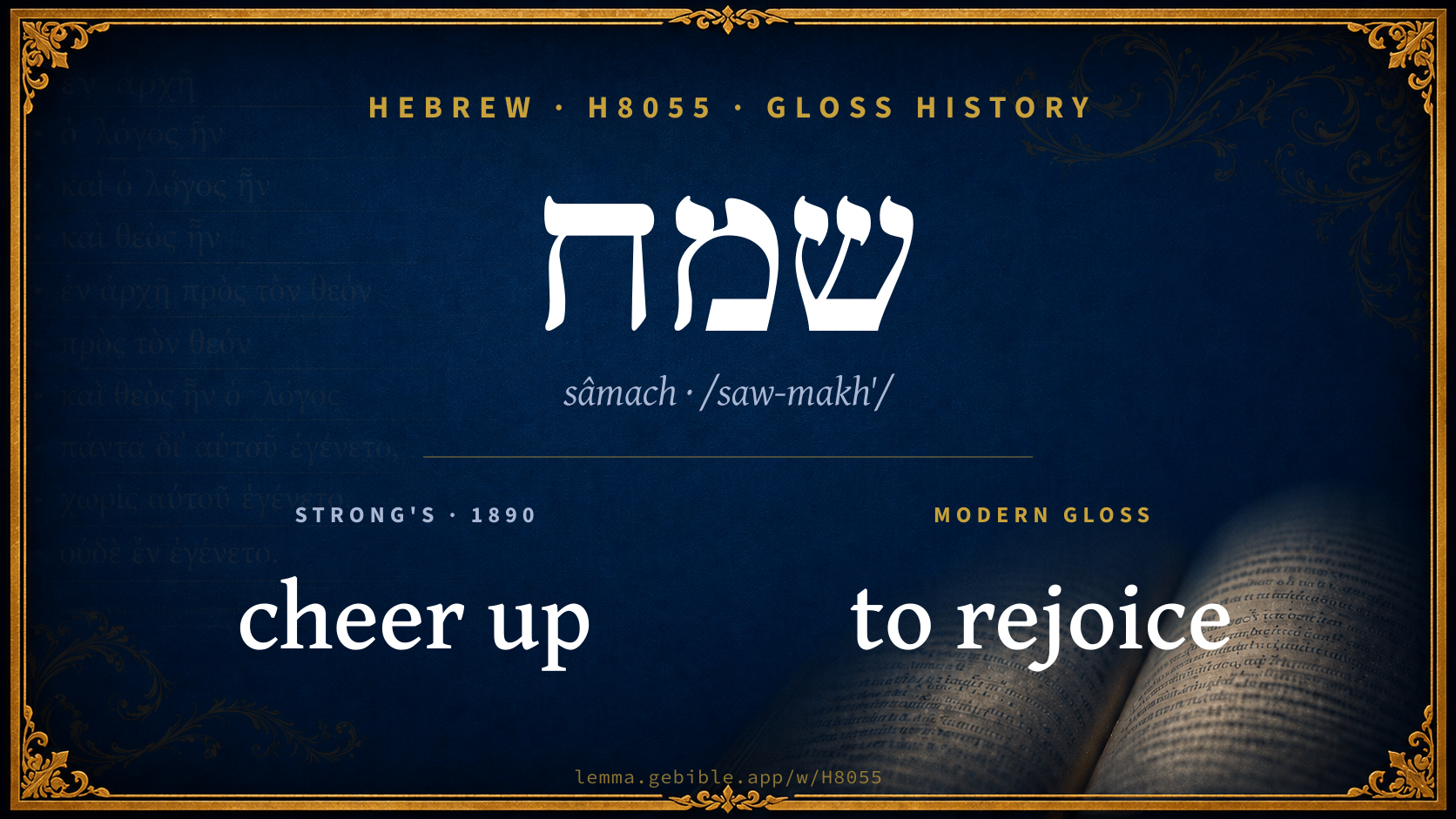
Gloss history
Strong's 1890 vs modern scholarship
About this word
Strong's H8055 catalogs a Hebrew word from the Hebrew Old Testament.
These counts are not copied from any lexicon or concordance. They are computed here, from the morphology-tagged Hebrew Old Testament. What Lemma adds →
- 148
- distinct verses
- The word appears in 148 distinct verses.
- 31 / 39
- OT books
- The word appears in 31 of 39 Old Testament books.
- #290
- by frequency
- Top 500 most frequent Hebrew words (rank 290 of 8,640 Hebrew words by occurrence).
View all 148 occurrences in the concordance →
Most concentrated in
- Psalms 52 verses 35%
- Proverbs 16 verses 11%
- Deuteronomy 10 verses 7%
By section of the Old Testament
By traditional corpus
Conventional, traditional groupings — biblical authorship is debated, so this is a traditional corpus grouping, not an authorship claim. Each share is this word’s portion of its verses in that division of the Hebrew canon. Each figure is a share of the word’s 148 distinct verses.
- Writings (Ketuvim) 96 verses · 65%
- Prophets (Nevi'im) 40 verses · 27%
- Torah (Pentateuch) 12 verses · 8%
How translations render this word
Counts come from each version’s own published word-to-Strong’s tagging or interlinear alignment — an approximate guide to how each version renders this word, not a word-level alignment the data otherwise carries. Because each total is that version’s own tagged count, the per-version totals vary from one another and need not match the appearance or distinct-verse counts above. These counts may also differ from a printed concordance because Lemma counts each distinctly tagged rendering and does not collapse phrase taggings into a single head-word total. This is a fixed set of word-tagged versions (KJV, ASV, BSB, ULT) and does not change with the reading translation you choose elsewhere. Each version’s license is shown beside its name below (and on Sources).
- King James Version: Rejoice 39×, Be glad 14×, Rejoiced 13×
- American Standard Version: Rejoice 32×, Be glad 14×, Rejoiced 13×
- Berean Standard Bible: Rejoice 33×, Be glad 18×, Rejoiced 13×
- unfoldingWord Literal Text: Rejoice 44×, Rejoiced 14×, Be glad 13×
King James Version Public Domain
Renders H8055 across 152 tagged occurrences — most commonly:
Plus other, less common renderings. Plus 48 renderings that appear only once — usually multi-word phrases or single function words the recovered tagging swept in, not distinct renderings.
American Standard Version Public Domain
Renders H8055 across 151 tagged occurrences — most commonly:
Plus other, less common renderings. Plus 52 renderings that appear only once — usually multi-word phrases or single function words the recovered tagging swept in, not distinct renderings.
Berean Standard Bible Public Domain
Renders H8055 across 152 tagged occurrences — most commonly:
Plus other, less common renderings. Plus 41 renderings that appear only once — usually multi-word phrases or single function words the recovered tagging swept in, not distinct renderings. Not rendered by a distinct English word in 3 further occurrences.
unfoldingWord Literal Text CC BY-SA 4.0
Renders H8055 across 186 tagged occurrences — most commonly:
Plus other, less common renderings. Plus 39 renderings that appear only once — usually multi-word phrases or single function words the recovered tagging swept in, not distinct renderings.
8 senses and sub-senses in the full BDB
Hebrew verbs can shift meaning by stem (binyan): Qal is the basic action, Niphal is often passive or reflexive, Piel often intensifies or makes it factitive, and Hiphil is typically causative. The senses below are grouped under the stem BDB assigns to each.
What do BDB’s symbols mean?
BDB uses these scholarly abbreviations:
| Symbol | Meaning |
|---|---|
| 𝔊 | the Septuagint (the ancient Greek translation, LXX) |
| 𝔙 | the Vulgate (the Latin translation) |
| 𝔖 | the Syriac version (the Peshitta) |
| 𝔗 | the Targum (the Aramaic translation) |
| ψ | the Psalms |
| √ | root (the underlying root or stem) |
| ‖ | parallel passage (a synonymous or contrasted parallel) |
| † | the dagger: every passage where the word occurs is cited |
The 8 senses and sub-senses the full Brown-Driver-Briggs lexicon distinguishes for this word, in lexicon order (not ranked by frequency), with BDB’s own verbatim wording and sub-sense lettering. Shown in Hebrew script with BDB’s own scholarly abbreviations. The condensed entry is in the Lexicon Entry tab. See also the Forms in the corpus table below.
Qal
- Pf. 3 ms. שָׂמַח ψ 16:9 +; וְשָׂמֵ֑חַ consec. Pr 29:6; 3 fs. שָׂמֵ֑חָה Est 8:15; 2 ms. וְשָׂמַחְתָּ֫ Dt 12:18 +; 3 mpl. שָׂמֵ֑חוּ Ne 12:43, etc.; Impf. יִשְׂמַח Is 9:16 +, 3 mpl. יִשְׂמָ֑חוּ 65:13 ψ 69:33, 3 fpl. תִּשְׂמַחְנָה 2 S 1:20, etc.; Imv. ms. שְׂמַח Dt 33:18 +, fs. שִׂמְחִי Zp 3:14 +, שְׂמָ֑חִי Jo 2:21, etc.; Inf. cstr. שְׂמֹחַ Ez 35:14 +, etc.; Pt. v. שָׂמֵחַ adj.;—24 times ‖ גיל, less often ‖ רָנַן, עָלַז, שִׂישׂ, etc.;— e.g. Psalms 16:9
- 1. in common life:
- a. rejoice, c. ב pers. vel rei take pleasure in Ju 9:19(×2); Dt 33:18; Ec 3:22 + 7 times + (prob.) בְּכָל־יָמֵינוּ ψ 90:14 (others ב temp.), cf. Ec 11:8; עַל pers. Is 39:2 + ‖ 2 K 20:13 (וישׂמח for MT וישׁמע Vrss mod.), עַל rei Jon 4:6; 2 Ch 15:15; c. cl. temp. Je 41:13 + 6 times + (of heart) Pr 23:15, in one’s heart Ex 4:14 (J); c. כִּי because Is 14:29 + 3 times; c. אֵת with Is 66:10; c. מִן pers. get pleasure from Pr 5:18; abs. 1 S 11:9; Ec 3:12; Pr 13:9 (fig. of prosperity; subj. אוֹר; opp. דָּעַךְ), + 8 times; c. ל rei at Jb 21:12. e.g. Judges 9:19
- b. rejoice arrogantly, exult at, ל pers., Mi 7:8; Is 14:8; Ob 12 ψ 35:19, 24; 38:17, c. אֶל־ rei Ez 25:6, ב rei Jb 31:29 ψ 35:15; Pr 24:17; abs. Ho 9:1 (+ אֶל־גִּיל), 2 S 1:20 + 3 times, + (said of righteous by Eliphaz) Jb 22:19. e.g. Micah 7:8
- 2.
- a. rejoice religiously, c. ב rei 1 S 2:1; Dt 12:7 ψ 21:2 + 7 times; c. בי׳, etc., Jo 2:23 ψ 32:11 + 10 times ψψ + 9:3 (+ אֶעֶלְצָה בָ֑ךְ); c. עַל rei 2 Ch 29:36, עַל inf. 1 Ch 29:9 a; c. לְמַעַן rei ψ 48:12; c. כִּי because 119:74; abs. Zc 2:14; 4:10; Jo 2:21; 1 Ch 29:9 b (c. acc. cogn.), 16:31 (of heavens) = ψ 96:11, ψ 97:1 (isles) + 18 times (12 times ψψ), + (of heart) Zc 10:7a ψ 16:9; 1 Ch 16:10, בְּכָל־לֵב Zp 3:14 (cf. Ex 4:14 1 a supr.); c. לִפְנֵי י׳ Is 9:2 and (of joyous feasting etc., at sanctuary) Lv 23:40 (H), Dt 12:12, 18; 16:11; 27:7, cf. 14:26; 1 S 11:15. e.g. 1 Samuel 2:1
- b. subj. י׳, c. עַל pers. Is 9:16 (‖ רחם; PerlesRÉJ xxxv. 63 be gentle, Arabic سَمُحَ), ב rei ψ 104:31. e.g. Isaiah 9:16
Piel
- Pf. 3 ms. וְשִׂמַּח consec. Dt 24:5, sf. שִׂמְּחָהוּ Je 20:15, etc.; Impf. 3 ms. יְשַׂמַּח ψ 104:15 +, etc.; Imv. ms. שַׂמֵּחַ ψ 86:4, שַׂמַּח Pr 27:11, etc.; Inf. abs. שַׂמֵּחַ Je 20:15; Pt. מְשַׂמֵּחַ Ju 9:13, pl. cstr. מְשַׂמְּחֵי ψ 19:9;—cause to rejoice, gladden, c. acc. pers. (or equiv.), subj. pers. Dt 24:5; Je 20:15 (+ Inf. abs.), Pr 10:1; 15:20; 27:11; 29:3 (Ho 7:3 v. משׁח 2); especially subj. י׳ (God) Je 31:13 (c. מִן separ.) Is 56:7; 2 Ch 20:27 (c. מִן of source, v. Qal 1 a), Ezr 6:22; Ne 12:43 (+ acc. cogn.) ψ 86:4; 90:15; 92:5 (ב instr.), also, c. ל pers. cause to exult at ψ 30:2, id. c. עַל pers. La 2:17; subj. rei Ju 9:13 ψ 19:9; 45:9; 46:5; 104:15; Ec 10:19; Pr 12:25; 15:30; 27:9. e.g. Deuteronomy 24:5
Hiphil
- = Pi. Pf. 2 ms. הִשְׂמַחְתָּ ψ 89:43 (subj. י׳). e.g. Psalms 89:43
Senses from the full Brown-Driver-Briggs lexicon (Brown, Driver, Briggs; Oxford 1906 — public domain), digitized via Sefaria, supplemented by the OpenScriptures HebrewLexicon (CC BY 4.0). Full attribution on Sources.
Word origin
vb. rejoice, be glad (NH id.; cf. perhaps Assyrian šamâḫu, flourish, Arabic شَمَخَ be high, proud; Pun. n.pr. f. שמחת);—
— Brown-Driver-Briggs (Oxford 1906, public domain), digitized via Sefaria, supplemented by the OpenScriptures HebrewLexicon (CC BY 4.0). See Sources.
Origin: a primitive root
Jastrow Dictionary
A second Hebrew/Aramaic lexicon for comparison, covering Aramaic and post-biblical (Talmudic, Targumic, Midrashic) usage that the biblical-Hebrew BDB does not. Matched by lemma rather than by Strong’s number, so a lemma may carry more than one Jastrow headword (shown separately below), and the entries cover usage well beyond the Bible.
שָׂמַח
- (b. h.) to be merry, rejoice. Meg. 13ᵇ ש׳ שמחה גדולה he rejoiced exceedingly. M. Kat. 18ᵇ ראה … וש׳ he saw others do wrong and rejoiced over it; a. fr.
- to make glad, cheer. B. Bath. 10ᵇ יְשַׂמֵּחַ את אשתו בדבר מצוה Ms. M. (v. Rabb. D. S. a. l.) let him make his wife cheerful by means of a good deed. R. Hash. 6ᵇ אשה בעלה מְשַׂמְּחָהּ as to a woman’s festive joy, her husband must rejoice her (with dresses &c.); Kidd. 34ᵇ. Pes. 109ᵃ חייב אדם לְשַׂמֵּחַ וכ׳ man is bound to gladden his children and the members of his household on the festival; במה מְשַׂמְּחָם wherewith should he gladden them? Keth. 8ᵃ (in marriage benedictions) מְשַׂמֵּחַ ציון בבניה who gladdens Zion through (restoring to her) her children; משמח חתן וכלה who gladdens bridegroom and bride; מש׳ חתן עם הכלה who gladdens the bridegroom with the bride; שַׂמֵּח תְּשַׂמַּח … כשַׂמֵּחֲךָ וכ׳ mayest thou gladden the beloved friends, as thou didst gladden thy creature (Adam) &c.; a. fr.
שָׂמֵחַ
- preced.) bright, joyful, joyous. Kidd. 66ᵃ היה ש׳ שמחה וכ׳ he rejoiced greatly (prepared a great festival), and invited &c. Ber. 5ᵃ, v. עָצֵב. Ib. 9ᵇ אדם … וש׳ במצות he is a great man and glad when he can do good. Meg. 10ᵇ אין הקב"ה ש׳ וכ׳ the Lord does not rejoice over the downfall of the wicked; a. v. fr.—Pl. שְׂמֵחִים, שְׂמֵחִין, שְׂמֵי׳. Sabb. 145ᵇ, v. מוֹעֵד. Yoma 21ᵇ עניים ש׳ … עצבין the poor are glad (because provisions will be cheap), and the property owners are sorry; B. Bath. 147ᵃ. Cant. R. to I, 10; Y. Ḥag. II, 77ᵇ bot. והיו הדברים ש׳ וכ׳ and the words (of the Law which they quoted at the festive board) were as bright as when they were delivered from Sinai; a. fr.—Fem. שְׂמֵחָה, שְׂמֵי׳. Pesik. R. s. 20 כשנתן … ארץ ש׳ ושמים בוכין when the Lord gave Israel the Law, the earth was glad, and the heavens wept; a. fr.—Pl. שְׂמֵחוֹת, שְׂמֵי׳. Pesik. R. s. 21 בפנים ש׳ with a cheerful contenance; a. e.
A Dictionary of the Targumim, the Talmud Babli and Yerushalmi, and the Midrashic Literature (Marcus Jastrow; London, Luzac, 1903) — Public Domain. Digitized via Sefaria. Digitized via Sefaria. Full attribution on Sources.
Forms in the corpus
The 123 distinct written forms H8055 takes in the Hebrew Bible, most frequent first — each parse links to that stem’s occurrences in the concordance. Hebrew forms include their vowel points and cantillation, so a single lemma takes many written forms.
The 60 most common forms are shown; 63 rarer forms follow in the full concordance.
Same root — word family
Other BDB entries built from the same root as H8055, grouped by Strong’s listed origin. These share a root / origin per the lexicon — not necessarily a shared meaning. Each links to that word’s own entry.
Derived from this word
Compare all same-root words → They share a root, not necessarily a meaning.
Septuagint verse parallels
This word appears in 132 verses that also exist in the Greek Old Testament (Septuagint), out of the 148 Hebrew verses it occurs in. You can read those verses in Greek by switching the Old Testament edition to the Septuagint.
Read these verses in the Septuagint
- Exodus 4:14
- Leviticus 23:40
- Deuteronomy 12:7
- Judges 9:13
- 1 Samuel 2:1
- 2 Samuel 1:20
- 2 Kings 11:20
- 1 Chronicles 16:10
- 2 Chronicles 6:41
- Ezra 6:22
- Esther 8:15
- Job 3:22
This is a verse-level parallel only — the same verses exist in both the Hebrew and Greek Old Testaments. No word-level Hebrew↔Greek correspondence is claimed: the data carries no such alignment, so no Greek word is shown as this Hebrew word’s translation. Coverage is not total — the Septuagint omits the deuterocanon and renumbers the Psalms, so some Hebrew verses have no direct Greek parallel.