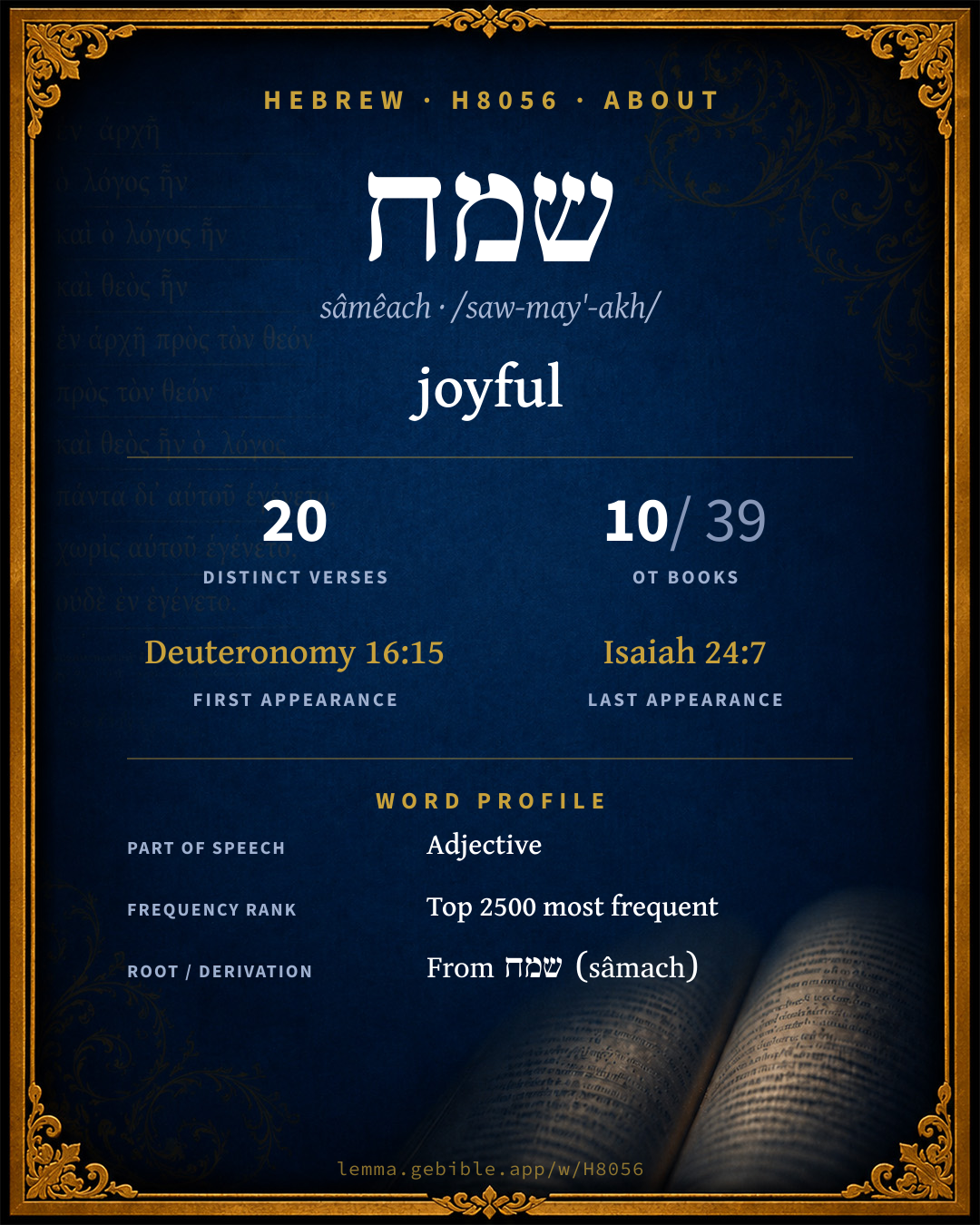
שָׂמֵחַ
joyful
also: merry, glad fuller range ↓
Full lexicon entry — Brown-Driver-Briggs (BDB)
From Brown-Driver-Briggs (BDB)
Where this word appears
See every Absolute-state word in the Hebrew Bible →
Grammar key — what these labels mean
Part of speech
- Adjective
- A word that describes or qualifies a noun.
- Verb
- An action or state-of-being word.
Stem
- Qal
- The basic, simple active stem — the plain form of the verb (“he wrote”). Here: ‘in common life’
Form
- Participle Active
- A verbal adjective expressing ongoing or characteristic action (“writing / one who writes”).
- Imperfect
- An incomplete, ongoing, or future action (“he will / would write”).
State
- Absolute
- The independent form of a noun, not bound to a following word.
- Construct
- A noun bound to a following noun in a possessive / “of” relationship (the construct chain).
Person
- 3rd Person
- The one spoken about (“he / she / it / they”).
Gender
- Masculine
- Grammatically masculine.
- Feminine
- Grammatically feminine.
Number
- Singular
- One.
- Plural
- More than one (in Hebrew, generally three or more).
Grammatical forms
- Adjective, Adjective, Masculine, Singular, Absolute 9 times (45%)
- Adjective, Adjective, Masculine, Plural, Absolute 6 times (30%)
- Adjective, Adjective, Masculine, Plural, Construct 2 times (10%)
- Adjective, Adjective, Feminine, Singular, Absolute 1 time (5%)
- Verb, Qal, Participle Active, Masculine, Plural, Absolute 1 time (5%)
- Verb, Qal, Imperfect, 3rd Person, Masculine, Plural 1 time (5%)
Parsed forms decoded from the imported morphology (morphhb / Westminster Leningrad Codex — WLC text public domain, morphhb tagging CC BY 4.0), counted across 20 parsed occurrences — not distinct verses.
Every verse where H8056 appears — 20 distinct verses across 10 books. Click any verse to open its interlinear word-by-word view. Verse text shown in the World English Bible for context — . Each verse’s Hebrew form is shown with its reference; the English is not keyword-highlighted, since the data carries no word-level English alignment. Use “Compare translations” on any verse to read it across multiple English versions. This concordance covers the Hebrew Bible; Septuagint (Greek Old Testament) occurrences are not indexed here.
Deuteronomy 1 verse
1 Kings 4 verses
- 1 Kings 1:40 וּ/שְׂמֵחִ֖ים conj + Qal ptcp.act mp All the people came up after him, and the people piped with pipes, and rejoiced with great joy, so that the earth shook with the sound of them.
- 1 Kings 1:45 שְׂמֵחִ֔ים adj Adjective mp and Zadok the priest and Nathan the prophet have anointed him king in Gihon; and they are come up from there rejoicing, so that the city rang again. This is the noise that you have heard.
- 1 Kings 4:20 וּ/שְׂמֵחִֽים conj + Adjective Adjective mp Judah and Israel were many as the sand which is by the sea in multitude, eating and drinking and making merry.
- 1 Kings 8:66 שְׂמֵחִים֙ adj Adjective mp On the eighth day he sent the people away; and they blessed the king, and went to their tents joyful and glad of heart for all the goodness that Yahweh had shown to David his servant, and to Israel his people.
2 Kings 1 verse
1 Chronicles 1 verse
2 Chronicles 2 verses
- 2 Chronicles 7:10 שְׂמֵחִים֙ adj Adjective mp On the three and twentieth day of the seventh month he sent the people away to their tents, joyful and glad of heart for the goodness that Yahweh had shown to David, and to Solomon, and to Israel his people.
- 2 Chronicles 23:13 שָׂמֵ֗חַ adj Adjective ms and she looked, and, behold, the king stood by his pillar at the entrance, and the captains and the trumpets by the king; and all the people of the land rejoiced, and blew trumpets; the singers also [played] on instruments of music, and led the singing of praise. Then Athaliah tore her clothes, and said, Treason! treason!
Esther 2 verses
- Esther 5:9 שָׂמֵ֖חַ adj Adjective ms Then went Haman forth that day joyful and glad of heart: but when Haman saw Mordecai in the king's gate, that he didn't stand up nor move for him, he was filled with wrath against Mordecai.
- Esther 5:14 שָׂמֵ֑חַ adj Adjective ms Then said Zeresh his wife and all his friends to him, Let a gallows be made fifty cubits high, and in the morning speak you to the king that Mordecai may be hanged thereon: then go you in merrily with the king to the banquet. The thing pleased Haman; and he caused the gallows to be made.
Psalms 3 verses
- Psalms 35:26 שְׂמֵחֵ֪י adj Adjective mp cs Let them be disappointed and confounded together who rejoice at my calamity. Let them be clothed with shame and dishonor who magnify themselves against me.
- Psalms 113:9 שְׂמֵחָ֗ה adj Adjective fs He settles the barren woman in her home, As a joyful mother of children. Praise Yah!
- Psalms 126:3 שְׂמֵחִֽים adj Adjective mp Yahweh has done great things for us, And we are glad.
Proverbs 4 verses
- Proverbs 2:14 הַ֭/שְּׂמֵחִים ptcl def.art + Adjective Adjective mp Who rejoice to do evil, And delight in the perverseness of evil;
- Proverbs 15:13 שָׂ֭מֵחַ adj Adjective ms A glad heart makes a cheerful face; But an aching heart breaks the spirit.
- Proverbs 17:5 שָׂמֵ֥חַ adj Adjective ms Whoever mocks the poor reproaches his Maker. He who is glad at calamity shall not be unpunished.
- Proverbs 17:22 שָׂ֭מֵחַ adj Adjective ms A cheerful heart makes good medicine, But a crushed spirit dries up the bones.
Ecclesiastes 1 verse
Isaiah 1 verse
About this entry
At a glance — auto-summarized from this page’s data, not written by a person. Every figure links to its source below. This summary describes the numbers; it doesn’t interpret them.
שמח (sâmêach) is a Hebrew adjective most often rendered “joyful.” It first appears in Deuteronomy 16:15. It turns up in 20 verses across 10 books, an uncommon footprint. It also covers “merry” and “glad”, alongside “joyful” — see its full sense range. From the same root come שמח and שמחה. For the data behind this summary, explore the sense tree and the renderings breakdown below.
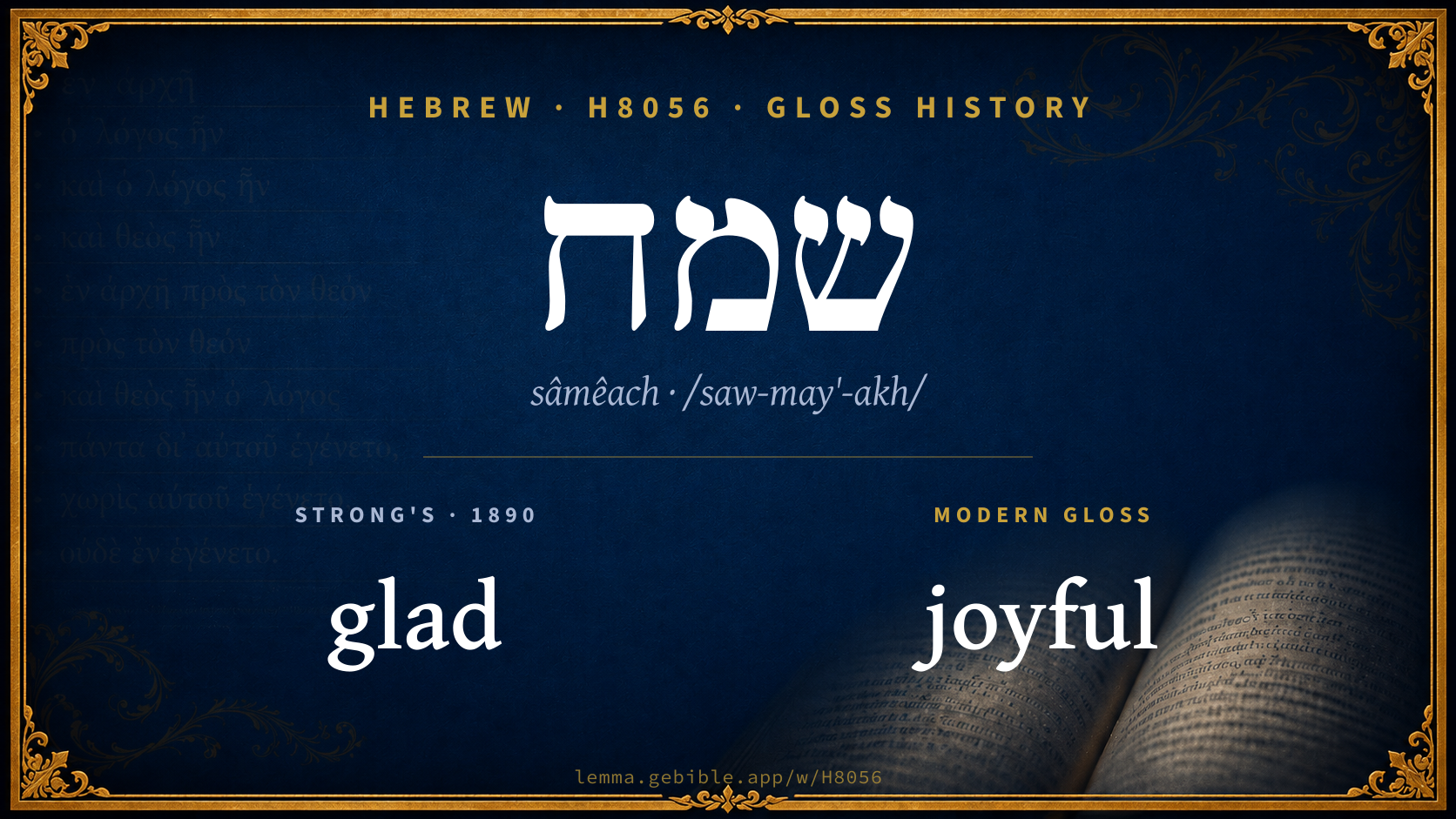
Gloss history
Strong's 1890 vs modern scholarship
About this word
Strong's H8056 catalogs a Hebrew word from the Hebrew Old Testament.
These counts are not copied from any lexicon or concordance. They are computed here, from the morphology-tagged Hebrew Old Testament. What Lemma adds →
- 20
- distinct verses
- The word appears in 20 distinct verses.
- 10 / 39
- OT books
- The word appears in 10 of 39 Old Testament books.
- #1,513
- by frequency
- Top 2500 most frequent Hebrew words (rank 1,513 of 8,640 Hebrew words by occurrence).
View all 20 occurrences in the concordance →
By section of the Old Testament
By traditional corpus
Conventional, traditional groupings — biblical authorship is debated, so this is a traditional corpus grouping, not an authorship claim. Each share is this word’s portion of its verses in that division of the Hebrew canon. Each figure is a share of the word’s 20 distinct verses.
- Writings (Ketuvim) 13 verses · 65%
- Prophets (Nevi'im) 6 verses · 30%
- Torah (Pentateuch) 1 verse · 5%
How translations render this word
Counts come from each version’s own published word-to-Strong’s tagging or interlinear alignment — an approximate guide to how each version renders this word, not a word-level alignment the data otherwise carries. Because each total is that version’s own tagged count, the per-version totals vary from one another and need not match the appearance or distinct-verse counts above. These counts may also differ from a printed concordance because Lemma counts each distinctly tagged rendering and does not collapse phrase taggings into a single head-word total. This is a fixed set of word-tagged versions (KJV, ASV, BSB, ULT) and does not change with the reading translation you choose elsewhere. Each version’s license is shown beside its name below (and on Sources).
BDB lists this Strong’s number as 2 distinct words (homographs). Each count above pools all of them and is not split by sense — see the Senses section below. A low-frequency rendering may belong to a different one of those words, not the primary meaning.
- King James Version†: Rejoice 4×, Rejoiced 4×, Joyful 2×
- American Standard Version†: Rejoice 4×, Rejoiced 4×, Glad 2×
- Berean Standard Bible†: Joyful 5×, Rejoicing 3×, Were rejoicing 2×
- unfoldingWord Literal Text†: Joyful 8×, Rejoicing 5×
King James Version Public Domain
Renders H8056 across 23† tagged occurrences — most commonly:
Plus 11 renderings that appear only once — usually multi-word phrases or single function words the recovered tagging swept in, not distinct renderings.
American Standard Version Public Domain
Renders H8056 across 23† tagged occurrences — most commonly:
Plus 11 renderings that appear only once — usually multi-word phrases or single function words the recovered tagging swept in, not distinct renderings.
Berean Standard Bible Public Domain
Renders H8056 across 21† tagged occurrences — most commonly:
Plus 11 renderings that appear only once — usually multi-word phrases or single function words the recovered tagging swept in, not distinct renderings.
unfoldingWord Literal Text CC BY-SA 4.0
Renders H8056 across 21† tagged occurrences — most commonly:
Plus 8 renderings that appear only once — usually multi-word phrases or single function words the recovered tagging swept in, not distinct renderings.
11 senses and sub-senses in the full BDB
Hebrew verbs can shift meaning by stem (binyan): Qal is the basic action, Niphal is often passive or reflexive, Piel often intensifies or makes it factitive, and Hiphil is typically causative. The senses below are grouped under the stem BDB assigns to each.
What do BDB’s symbols mean?
BDB uses these scholarly abbreviations:
| Symbol | Meaning |
|---|---|
| 𝔊 | the Septuagint (the ancient Greek translation, LXX) |
| 𝔙 | the Vulgate (the Latin translation) |
| 𝔖 | the Syriac version (the Peshitta) |
| 𝔗 | the Targum (the Aramaic translation) |
| ψ | the Psalms |
| √ | root (the underlying root or stem) |
| ‖ | parallel passage (a synonymous or contrasted parallel) |
| † | the dagger: every passage where the word occurs is cited |
The 11 senses and sub-senses the full Brown-Driver-Briggs lexicon distinguishes for this word, in lexicon order (not ranked by frequency), with BDB’s own verbatim wording and sub-sense lettering. Shown in Hebrew script with BDB’s own scholarly abbreviations. The condensed entry is in the Lexicon Entry tab. See also the Forms in the corpus table below.
שמח I rejoice, be glad (NH id.
Qal
- Pf. 3 ms. שָׂמַח ψ 16:9 +; וְשָׂמֵ֑חַ consec. Pr 29:6; 3 fs. שָׂמֵ֑חָה Est 8:15; 2 ms. וְשָׂמַחְתָּ֫ Dt 12:18 +; 3 mpl. שָׂמֵ֑חוּ Ne 12:43, etc.; Impf. יִשְׂמַח Is 9:16 +, 3 mpl. יִשְׂמָ֑חוּ 65:13 ψ 69:33, 3 fpl. תִּשְׂמַחְנָה 2 S 1:20, etc.; Imv. ms. שְׂמַח Dt 33:18 +, fs. שִׂמְחִי Zp 3:14 +, שְׂמָ֑חִי Jo 2:21, etc.; Inf. cstr. שְׂמֹחַ Ez 35:14 +, etc.; Pt. v. שָׂמֵחַ adj.;—24 times ‖ גיל, less often ‖ רָנַן, עָלַז, שִׂישׂ, etc.;— e.g. Psalms 16:9
- 1. in common life:
- a. rejoice, c. ב pers. vel rei take pleasure in Ju 9:19(×2); Dt 33:18; Ec 3:22 + 7 times + (prob.) בְּכָל־יָמֵינוּ ψ 90:14 (others ב temp.), cf. Ec 11:8; עַל pers. Is 39:2 + ‖ 2 K 20:13 (וישׂמח for MT וישׁמע Vrss mod.), עַל rei Jon 4:6; 2 Ch 15:15; c. cl. temp. Je 41:13 + 6 times + (of heart) Pr 23:15, in one’s heart Ex 4:14 (J); c. כִּי because Is 14:29 + 3 times; c. אֵת with Is 66:10; c. מִן pers. get pleasure from Pr 5:18; abs. 1 S 11:9; Ec 3:12; Pr 13:9 (fig. of prosperity; subj. אוֹר; opp. דָּעַךְ), + 8 times; c. ל rei at Jb 21:12. e.g. Judges 9:19
- b. rejoice arrogantly, exult at, ל pers., Mi 7:8; Is 14:8; Ob 12 ψ 35:19, 24; 38:17, c. אֶל־ rei Ez 25:6, ב rei Jb 31:29 ψ 35:15; Pr 24:17; abs. Ho 9:1 (+ אֶל־גִּיל), 2 S 1:20 + 3 times, + (said of righteous by Eliphaz) Jb 22:19. e.g. Micah 7:8
- 2.
- a. rejoice religiously, c. ב rei 1 S 2:1; Dt 12:7 ψ 21:2 + 7 times; c. בי׳, etc., Jo 2:23 ψ 32:11 + 10 times ψψ + 9:3 (+ אֶעֶלְצָה בָ֑ךְ); c. עַל rei 2 Ch 29:36, עַל inf. 1 Ch 29:9 a; c. לְמַעַן rei ψ 48:12; c. כִּי because 119:74; abs. Zc 2:14; 4:10; Jo 2:21; 1 Ch 29:9 b (c. acc. cogn.), 16:31 (of heavens) = ψ 96:11, ψ 97:1 (isles) + 18 times (12 times ψψ), + (of heart) Zc 10:7a ψ 16:9; 1 Ch 16:10, בְּכָל־לֵב Zp 3:14 (cf. Ex 4:14 1 a supr.); c. לִפְנֵי י׳ Is 9:2 and (of joyous feasting etc., at sanctuary) Lv 23:40 (H), Dt 12:12, 18; 16:11; 27:7, cf. 14:26; 1 S 11:15. e.g. 1 Samuel 2:1
- b. subj. י׳, c. עַל pers. Is 9:16 (‖ רחם; PerlesRÉJ xxxv. 63 be gentle, Arabic سَمُحَ), ב rei ψ 104:31. e.g. Isaiah 9:16
Piel
- Pf. 3 ms. וְשִׂמַּח consec. Dt 24:5, sf. שִׂמְּחָהוּ Je 20:15, etc.; Impf. 3 ms. יְשַׂמַּח ψ 104:15 +, etc.; Imv. ms. שַׂמֵּחַ ψ 86:4, שַׂמַּח Pr 27:11, etc.; Inf. abs. שַׂמֵּחַ Je 20:15; Pt. מְשַׂמֵּחַ Ju 9:13, pl. cstr. מְשַׂמְּחֵי ψ 19:9;—cause to rejoice, gladden, c. acc. pers. (or equiv.), subj. pers. Dt 24:5; Je 20:15 (+ Inf. abs.), Pr 10:1; 15:20; 27:11; 29:3 (Ho 7:3 v. משׁח 2); especially subj. י׳ (God) Je 31:13 (c. מִן separ.) Is 56:7; 2 Ch 20:27 (c. מִן of source, v. Qal 1 a), Ezr 6:22; Ne 12:43 (+ acc. cogn.) ψ 86:4; 90:15; 92:5 (ב instr.), also, c. ל pers. cause to exult at ψ 30:2, id. c. עַל pers. La 2:17; subj. rei Ju 9:13 ψ 19:9; 45:9; 46:5; 104:15; Ec 10:19; Pr 12:25; 15:30; 27:9. e.g. Deuteronomy 24:5
Hiphil
- = Pi. Pf. 2 ms. הִשְׂמַחְתָּ ψ 89:43 (subj. י׳). e.g. Psalms 89:43
שמח II verb. glad, joyful, merry
- 1.
- a. as adj. joyful, shewing joy, 1 K 1:45; Est 5:9 (+ טוֹב לֵב), v 14; אֵם שְׂמֵחָה ψ 113:9; לֵב שׂ׳ Pr 15:13; 17:22; at feast of tab. Dt 16:15, in thankfulness to י׳ ψ 126:3 (both pred. c. הָיָה), 1 K 8:66 (+ טוֹבֵי לֵב) = 2 Ch 7:10. e.g. 1 Kings 1:45
- b. = pt. 1 K 1:40 (‖ מְחַלְּלִים piping), 4:20; 2 K 11:14 (+ תֹּקֵעַ ב) = 2 Ch 23:13, מִן rei Ec 2:10. e.g. 1 Kings 1:40
- 2. as subst. הַשׂ׳ Am 6:13 (+ ל rei), Pr 2:14 (ל inf.), Jb 3:22 (+ אֱלֵי־גִיל; ‖ יָשִׂישׂוּ); שִׂמְחֵי־לֵב Is 24:7; of malicious joy שׂ׳ Pr 17:5 (ל rei), שְׂמֵחֵי רָעָתִי ψ 35:26. e.g. Amos 6:13
Senses from the full Brown-Driver-Briggs lexicon (Brown, Driver, Briggs; Oxford 1906 — public domain), digitized via Sefaria, supplemented by the OpenScriptures HebrewLexicon (CC BY 4.0). Full attribution on Sources.
Word origin
I. vb. rejoice, be glad (NH id.; cf. perhaps Assyrian šamâḫu, flourish, Arabic شَمَخَ be high, proud; Pun. n.pr. f. שמחת);—
I. adj.verb. glad, joyful, merry;—abs. שׂ׳ Dt 16:15 +, f. שְׂמֵחָה ψ 119:9; pl. שְׂמֵחִים 1 K 1:45 +, cstr. שִׂמְחֵי Is 24:17, שְׂמֵחֵי ψ 35:26;—
— Brown-Driver-Briggs (Oxford 1906, public domain), digitized via Sefaria, supplemented by the OpenScriptures HebrewLexicon (CC BY 4.0). See Sources.
Derived from שמח (sâmach) (H8055) — to rejoice.
Jastrow Dictionary
A second Hebrew/Aramaic lexicon for comparison, covering Aramaic and post-biblical (Talmudic, Targumic, Midrashic) usage that the biblical-Hebrew BDB does not. Matched by lemma rather than by Strong’s number, so a lemma may carry more than one Jastrow headword (shown separately below), and the entries cover usage well beyond the Bible.
שָׂמַח
- (b. h.) to be merry, rejoice. Meg. 13ᵇ ש׳ שמחה גדולה he rejoiced exceedingly. M. Kat. 18ᵇ ראה … וש׳ he saw others do wrong and rejoiced over it; a. fr.
- to make glad, cheer. B. Bath. 10ᵇ יְשַׂמֵּחַ את אשתו בדבר מצוה Ms. M. (v. Rabb. D. S. a. l.) let him make his wife cheerful by means of a good deed. R. Hash. 6ᵇ אשה בעלה מְשַׂמְּחָהּ as to a woman’s festive joy, her husband must rejoice her (with dresses &c.); Kidd. 34ᵇ. Pes. 109ᵃ חייב אדם לְשַׂמֵּחַ וכ׳ man is bound to gladden his children and the members of his household on the festival; במה מְשַׂמְּחָם wherewith should he gladden them? Keth. 8ᵃ (in marriage benedictions) מְשַׂמֵּחַ ציון בבניה who gladdens Zion through (restoring to her) her children; משמח חתן וכלה who gladdens bridegroom and bride; מש׳ חתן עם הכלה who gladdens the bridegroom with the bride; שַׂמֵּח תְּשַׂמַּח … כשַׂמֵּחֲךָ וכ׳ mayest thou gladden the beloved friends, as thou didst gladden thy creature (Adam) &c.; a. fr.
שָׂמֵחַ
- preced.) bright, joyful, joyous. Kidd. 66ᵃ היה ש׳ שמחה וכ׳ he rejoiced greatly (prepared a great festival), and invited &c. Ber. 5ᵃ, v. עָצֵב. Ib. 9ᵇ אדם … וש׳ במצות he is a great man and glad when he can do good. Meg. 10ᵇ אין הקב"ה ש׳ וכ׳ the Lord does not rejoice over the downfall of the wicked; a. v. fr.—Pl. שְׂמֵחִים, שְׂמֵחִין, שְׂמֵי׳. Sabb. 145ᵇ, v. מוֹעֵד. Yoma 21ᵇ עניים ש׳ … עצבין the poor are glad (because provisions will be cheap), and the property owners are sorry; B. Bath. 147ᵃ. Cant. R. to I, 10; Y. Ḥag. II, 77ᵇ bot. והיו הדברים ש׳ וכ׳ and the words (of the Law which they quoted at the festive board) were as bright as when they were delivered from Sinai; a. fr.—Fem. שְׂמֵחָה, שְׂמֵי׳. Pesik. R. s. 20 כשנתן … ארץ ש׳ ושמים בוכין when the Lord gave Israel the Law, the earth was glad, and the heavens wept; a. fr.—Pl. שְׂמֵחוֹת, שְׂמֵי׳. Pesik. R. s. 21 בפנים ש׳ with a cheerful contenance; a. e.
A Dictionary of the Targumim, the Talmud Babli and Yerushalmi, and the Midrashic Literature (Marcus Jastrow; London, Luzac, 1903) — Public Domain. Digitized via Sefaria. Digitized via Sefaria. Full attribution on Sources.
Forms in the corpus
The 18 distinct written forms H8056 takes in the Hebrew Bible, most frequent first — each parse links to that state’s occurrences in the concordance. Hebrew forms include their vowel points and cantillation, so a single lemma takes many written forms.
Same root — word family
Other BDB entries built from the same root as H8056, grouped by Strong’s listed origin. These share a root / origin per the lexicon — not necessarily a shared meaning. Each links to that word’s own entry.
Derives from
Derived from this word
Compare all same-root words → They share a root, not necessarily a meaning.
Septuagint verse parallels
This word appears in 17 verses that also exist in the Greek Old Testament (Septuagint), out of the 20 Hebrew verses it occurs in. You can read those verses in Greek by switching the Old Testament edition to the Septuagint.
Read these verses in the Septuagint
- Deuteronomy 16:15
- 1 Kings 1:40
- 2 Kings 11:14
- 1 Chronicles 16:31
- 2 Chronicles 7:10
- Esther 5:9
- Psalms 113:9
- Proverbs 2:14
- Ecclesiastes 2:10
- Isaiah 24:7
This is a verse-level parallel only — the same verses exist in both the Hebrew and Greek Old Testaments. No word-level Hebrew↔Greek correspondence is claimed: the data carries no such alignment, so no Greek word is shown as this Hebrew word’s translation. Coverage is not total — the Septuagint omits the deuterocanon and renumbers the Psalms, so some Hebrew verses have no direct Greek parallel.