Amos 6:13

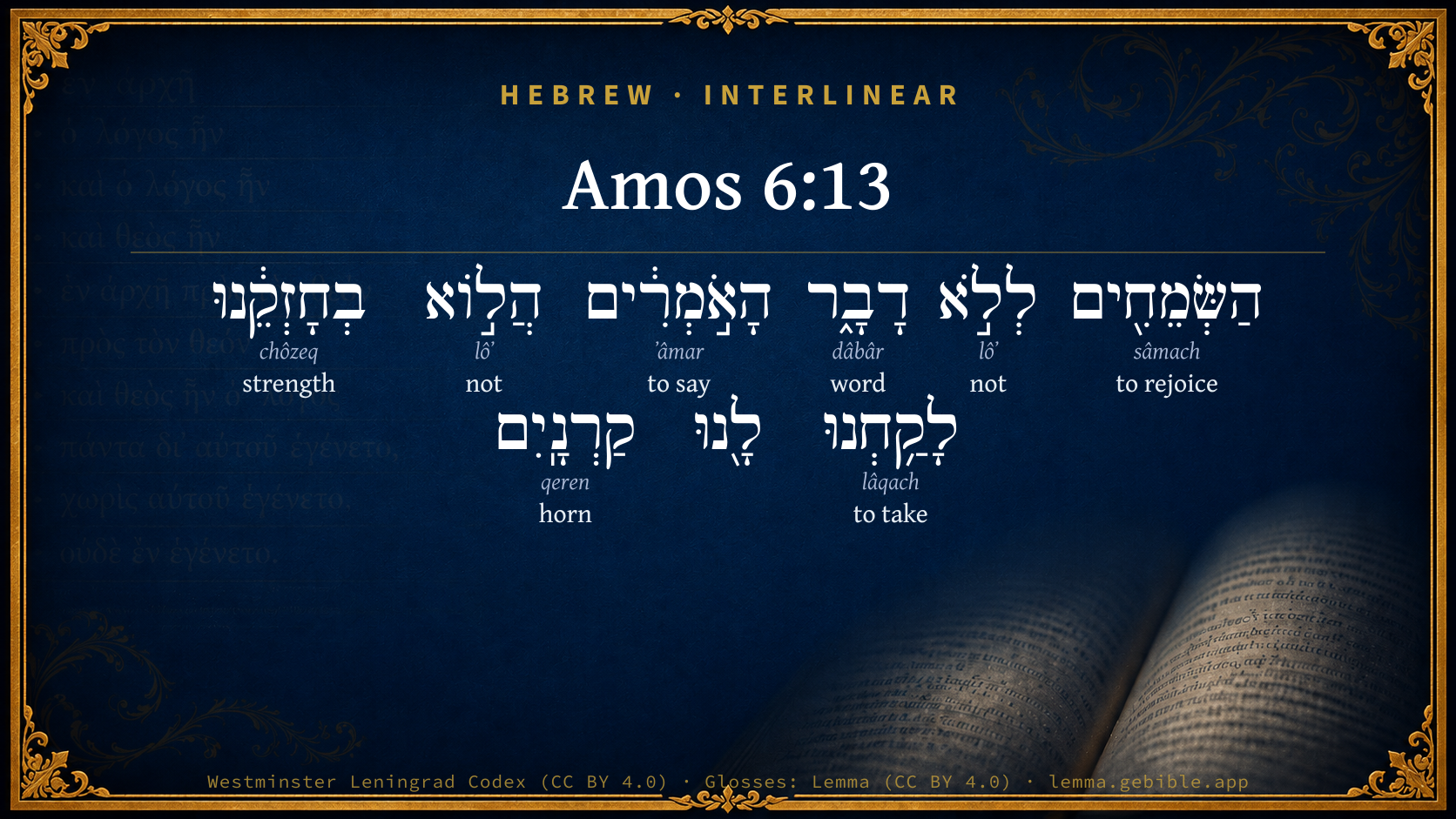
Hebrew (Westminster Leningrad Codex) Amos 6:13 appears in the Hebrew Old Testament. The text above is from the Westminster Leningrad Codex. Each word links to its Strong’s number, a concise gloss, and parsing drawn from the Open Scriptures Hebrew Bible morphology. Click any word for its full Brown-Driver-Briggs (BDB) entry.
Download image
Cite this verse

Amos 6:13 (World English Bible). Public Domain. Lemma interlinear Bible study tool, https://lemma.gebible.app/v/amos/6/13.

Show BibTeX & RIS
BibTeX
RIS
English Translation
You who rejoice in a thing of nothing, who say, 'Haven't we taken for ourselves horns by our own strength?'
World English Bible · Public Domain
Download a study sheet

One document with this verse’s original text, its word-by-word gloss line, the meaning frame, cross-references with their text, attributed commentary, and full source and license credits — printable, and it pastes into notes with its structure intact.

This verse Autodidact and up

Study sheet (.html) Plain text (.txt)

A passage Seminary Student

Up to 50 verses in one chapter. A passage sheet keeps up to 6 commentary sources and 12 cross-references per verse, in the order this page ranks them, and says so on the sheet whenever that leaves anything out. Ask for a single verse and you get the Autodidact verse sheet above.

Everything on this page stays free to read, with no account — the sheet is a download of what is already on screen, not access to it.

Want to remove ads? Support Godless Engineer
Compare translations 3

The same verse in 3 English versions, stacked beneath the original-language interlinear above. Click any original word for its lexicon entry.

Each is an independent rendering of the whole verse — the interlinear is not word-aligned to these translations.

Highlighted words mark where these versions differ — a whole-verse word diff, not a word-by-word alignment.

  • World English Bible Public Domain
    You who rejoice in a thing of nothing, who say, 'Haven't we taken for ourselves horns by our own strength?'
  • King James Version Public Domain
    Ye which rejoice in a thing of nought, which say, Have we not taken to us horns by our own strength?
  • unfoldingWord Literal Text CC BY-SA 4.0
    You who rejoice over Lo Debar, who say, “Have we not taken Karnaim by our own strength?”

unfoldingWord Literal Text — © unfoldingWord, licensed CC BY-SA 4.0. Word-aligned USFM3 via Door43 (git.door43.org/unfoldingWord/en_ult).

Versions to compare (up to 4)

3 of 4 selected

Show all 18 translations

Every available English version of this verse, each an independent rendering of the whole verse.

  • World English Bible Public Domain
    You who rejoice in a thing of nothing, who say, 'Haven't we taken for ourselves horns by our own strength?'
  • Berean Standard Bible Public Domain
    you who rejoice in Lo-debar and say, ‘Did we not take Karnaim by our own strength?’
  • Majority Standard Bible Public Domain
    you who rejoice in Lo-debar and say, ‘Did we not take Karnaim by our own strength?’
  • King James Version Public Domain
    Ye which rejoice in a thing of nought, which say, Have we not taken to us horns by our own strength?
  • American Standard Version (1901) Public Domain
    ye that rejoice in a thing of nought, that say, Have we not taken to us horns by our own strength?
  • Revised Version (1885) Public Domain
    ye which rejoice in a thing of nought, which say, Have we not taken to us horns by our own strength?
  • Geneva Bible (1599) Public Domain
    Ye reioyce in a thing of nought: yee say, Haue not wee gotten vs hornes by our owne strength?
  • Douay-Rheims (1899) Public Domain
    Can horses run upon the rocks, or can any one plough with buffles? for you have turned judgment into bitterness, and the fruit of justice into wormwood.
  • Young's Literal Translation Public Domain
    O ye who are rejoicing at nothing, Who are saying, `Have we not by our strength taken to ourselves horns?'
  • Literal Standard Version CC BY-SA 4.0
    O you who are rejoicing at nothing, || Who are saying, “Have we not taken to ourselves horns by our strength?”
  • Unlocked Literal Bible CC BY-SA 4.0
    You who rejoice over Lo Debar, who say, “Have we not taken Karnaim by our own strength?”
  • unfoldingWord Literal Text CC BY-SA 4.0
    You who rejoice over Lo Debar, who say, “Have we not taken Karnaim by our own strength?”
  • Darby Bible Public Domain
    -- ye that rejoice in a thing of nought, that say, Have we not taken to us power by our own strength?
  • World Messianic Bible Public Domain
    you who rejoice in a thing of nothing, who say, ‘Haven’t we taken for ourselves horns by our own strength?’
  • Webster's Bible Public Domain
    Ye who rejoice in a thing of naught, who say, Have we not taken to us horns by our own strength?
  • Free Bible Version CC BY-SA 4.0
    You joyfully celebrate your conquest of Lodebar, and say “Didn't we in our own strength capture Karnaim?”
  • Bible in Basic English Public Domain
    You whose joy is in a thing of no value, who say, Have we not taken for ourselves horns by the strength which is ours?
  • JPS Tanakh (1917) Public Domain
    Ye that rejoice in a thing of nought, that say: 'Have we not taken to us horns by our own strength?'

Literal Standard Version (2020), Covenant Press — licensed CC BY-SA 4.0. Text via the HelloAO Bible API (eBible.org). Unlocked Literal Bible (unfoldingWord) — licensed CC BY-SA 4.0. Text via the HelloAO Bible API (eBible.org). unfoldingWord Literal Text — © unfoldingWord, licensed CC BY-SA 4.0. Word-aligned USFM3 via Door43 (git.door43.org/unfoldingWord/en_ult). Free Bible Version, Dr. Jonathan Gallagher — licensed CC BY-SA 4.0. Text via the HelloAO Bible API (eBible.org).

Word by word

More ways to search: Search by grammar → Find every occurrence → Compare this word →

Practice this passage: Drill this verse → Learn its vocabulary →

בְחָזְקֵ֔נוּ
chôzeq
H2392
“in/at · strength · our”
Preposition + Noun, Common, Masculine, Singular, Construct + Suffix, Personal, 1st Person, Common, Plural
Part of Speech
Preposition + Noun
Type
Common
Gender
Masculine
Number
Singular
State
Construct
Full BDB Definition

Origin: from H2388

TWOT: 636c

strength
  1. הַשְּׂמֵחִ֖ים sâmach H8055 “the · rejoicing” Particle, Definite Article + Adjective, Adjective, Masculine, Plural, Absolute
  2. לְלֹ֣א lôʼ H3808 “to/for · not” Preposition + Noun, Proper
  3. דָבָ֑ר dâbâr H1697 “word” Noun, Proper
  4. הָאֹ֣מְרִ֔ים ʼâmar H559 “the · saying” Particle, Definite Article + Verb, Qal, Participle Active, Masculine, Plural, Absolute
  5. הֲל֣וֹא lôʼ H3808 “not” Particle, Interrogative + Particle, Negative
  6. לָקַ֥חְנוּ lâqach H3947 “to take” Verb, Qal, Perfect, 1st Person, Common, Plural
  7. קַרְנָֽיִם qeren H7161 “horn” Noun, Proper

About this verse

These counts appear in no published source. They are computed here, from the morphology-tagged text and Lemma’s own curated glosses. What Lemma adds →

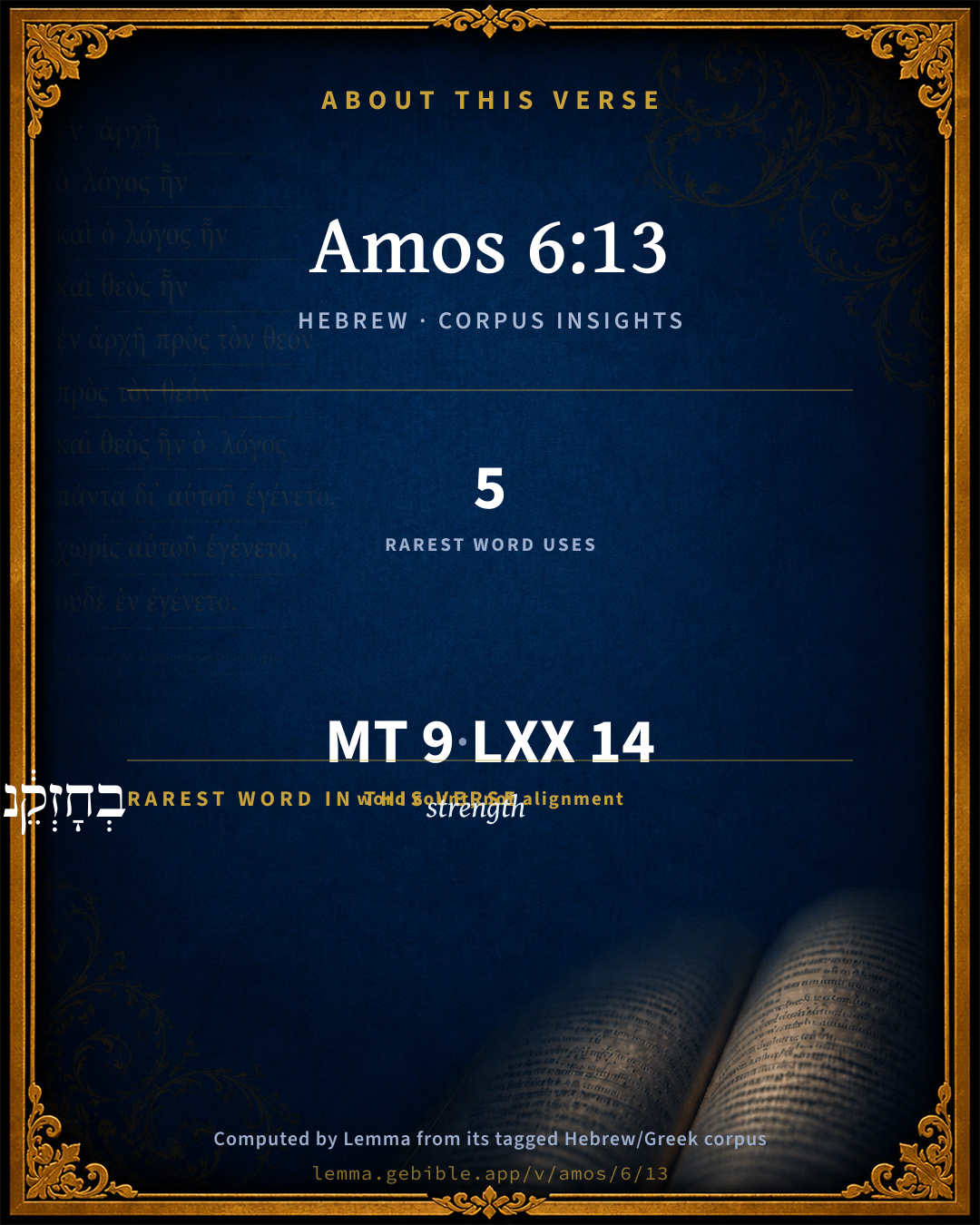
9
words
7
distinct lemmas
Prophets
section

Notable vocabulary

The rarest word here is בְחָזְקֵ֔נוּ strength H2392 — appearing just 5 times in the whole Hebrew Bible.

Shared distinctive vocabulary

בְחָזְקֵ֔נוּ strength H2392 occurs in 5 verses of the Hebrew Bible. Also found in:

Grammatical profile

  • 2 verbs
  • 4 nouns
  • 1 adjective
  • 1 preposition
  • 1 particle

Verb forms

  • הָאֹ֣מְרִ֔ים Qal · Participle Active
  • לָקַ֥חְנוּ Qal · Perfect

Repetition

A word recurs within this verse — often emphatic in Hebrew:

  • לְלֹ֣א not H3808 ×2

Hebrew & Septuagint length

In English translation the verse runs 20 words from the Hebrew and 26 from the Septuagint (LXX English) — closely comparable.

A rough comparison of the two English renderings, which tokenize alike — not a word-level alignment.

Word counts can differ between the Hebrew and the Greek without any difference in meaning — e.g. the Hebrew direct-object marker אֵת has no separate Greek word, and Greek often adds the article ὁ.

In the original languages it is 9 Hebrew tokens and 14 Greek tokens — but the two are counted differently (Hebrew bundles its prefixes and suffixes into one token; the Greek is in lemma form), so that isn’t a like-for-like length.

Cross-references

28

Topical passages linked to Amos 6:13 in the Treasury of Scripture Knowledge — connected by theme and wording, ordered by reader-vote popularity; previews shown in the World English Bible.

  • Isaiah 28:14–15 Why hear the word of Yahweh, you scoffers, that rule this people that is in Jerusalem:
  • Luke 12:19–20 I will tell my soul, "Soul, you have many goods laid up for many years. Take your ease, eat, drink, be merry."'
  • 2 Kings 14:25 He restored the border of Israel from the entrance of Hamath to the sea of the Arabah, according to the word of Yahweh, the God of Israel, which he spoke by his servant Jonah the son of Amittai, the prophet, who was of Gath Hepher.
  • James 4:16 But now you glory in your boasting. All such boasting is evil.
  • Exodus 32:18–19 He said, "It isn't the voice of those who shout for victory, neither is it the voice of those who cry for being overcome; but the noise of those who sing that I hear."
  • Judges 9:19–20 if you then have dealt truly and righteously with Jerubbaal and with his house this day, then rejoice you in Abimelech, and let him also rejoice in you:
  • Judges 9:27 They went out into the field, and gathered their vineyards, and trod [the grapes], and held festival, and went into the house of their god, and did eat and drink, and cursed Abimelech.
  • Judges 16:23–25 The lords of the Philistines gathered them together to offer a great sacrifice to Dagon their god, and to rejoice; for they said, Our god has delivered Samson our enemy into our hand.
  • 1 Samuel 4:5 When the ark of the covenant of Yahweh came into the camp, all Israel shouted with a great shout, so that the earth rang again.
  • 2 Kings 13:25 Jehoash the son of Jehoahaz took again out of the hand of Benhadad the son of Hazael the cities which he had taken out of the hand of Jehoahaz his father by war. Three times did Joash strike him, and recovered the cities of Israel.
  • 2 Kings 14:12–14 Judah was put to the worse before Israel; and they fled every man to his tent.
  • 2 Chronicles 28:6–8 For Pekah the son of Remaliah killed in Judah one hundred twenty thousand in one day, all of them valiant men; because they had forsaken Yahweh, the God of their fathers.
  • Job 8:15 He shall lean on his house, but it shall not stand. He shall cling to it, but it shall not endure.
  • Job 31:25 If I have rejoiced because my wealth was great, And because my hand had gotten much;
  • Job 31:29 "If I have rejoiced at the destruction of him who hated me, Or lifted up myself when evil found him;
  • Ecclesiastes 11:9 Rejoice, young man, in your youth, And let your heart cheer you in the days of your youth, And walk in the ways of your heart, And in the sight of your eyes; But know that for all these things God will bring you into judgment.
  • Isaiah 7:1 It happened in the days of Ahaz the son of Jotham, the son of Uzziah, king of Judah, that Rezin the king of Syria, and Pekah the son of Remaliah, king of Israel, went up to Jerusalem to war against it, but could not prevail against it.
  • Isaiah 7:4 Tell him, 'Be careful, and keep calm. Don't be afraid, neither let your heart be faint because of these two tails of smoking firebrands, for the fierce anger of Rezin and Syria, and of the son of Remaliah.
  • Isaiah 8:6 Because this people have refused the waters of Shiloah that go softly, and rejoice in Rezin and Remaliah's son;
  • Isaiah 17:3–4 The fortress shall cease from Ephraim, and the kingdom from Damascus, and the remnant of Syria; they shall be as the glory of the children of Israel, says Yahweh of Hosts.
  • Jeremiah 9:23 Thus says Yahweh, Don't let the wise man glory in his wisdom, neither let the mighty man glory in his might, don't let the rich man glory in his riches;
  • Jeremiah 50:11 Because you are glad, because you rejoice, O you who plunder my heritage, because you are wanton as a heifer that treads out [the grain], and neigh as strong horses;
  • Daniel 4:30 The king spoke and said, Is not this great Babylon, which I have built for the royal dwelling-place, by the might of my power and for the glory of my majesty?
  • Jonah 4:6 Yahweh God prepared a vine, and made it to come up over Jonah, that it might be a shade over his head, to deliver him from his discomfort. So Jonah was exceedingly glad because of the vine.
  • Habakkuk 1:15–16 He takes up all of them with the hook. He catches them in his net, and gathers them in his dragnet. Therefore he rejoices and is glad.
  • Zephaniah 3:11 In that day you will not be disappointed for all your doings, in which you have transgressed against me; for then I will take away out of the midst of you your proudly exulting ones, and you will no more be haughty in my holy mountain.
  • John 16:20 Most assuredly I tell you, that you will weep and lament, but the world will rejoice. You will be sorrowful, but your sorrow will be turned into joy.
  • Revelation 11:10 Those who dwell on the earth rejoice over them, and they will be glad. They will give gifts to one another, because these two prophets tormented those who dwell on the earth.

Cross-references courtesy of OpenBible.info (CC BY 4.0).

Hebrew and Greek witnesses Masoretic Hebrew ↔ Greek Septuagint

The same verse in the two great witnesses to the Old Testament, shown verse-for-verse.

These are two independent witnesses, not word-aligned to each other, and the Septuagint is shown in lemma (dictionary) form.

Hebrew Amos 6:13 Masoretic · Westminster Leningrad Codex

הַשְּׂמֵחִ֖ים לְלֹ֣א דָבָ֑ר הָאֹ֣מְרִ֔ים הֲל֣וֹא בְחָזְקֵ֔נוּ לָקַ֥חְנוּ לָ֖נוּ קַרְנָֽיִם

You who rejoice in a thing of nothing, who say, 'Haven't we taken for ourselves horns by our own strength?'

World English Bible · Public Domain

Greek LXX Amos 6:13 Septuagint · lemma form

ὁ εὐφραίνω ἐπί οὐδείς λόγος ὁ λέγω οὐ ἐν ὁ ἰσχύς ἐγώ ἔχω κέρας

Will horses run upon rocks? will they refrain from neighing at mares? for you⌃ have turned judgment into poison, and the fruit of righteousness into bitterness:

LXX2012 (modern English Septuagint) · Public Domain

On this verse, Haydock's Catholic Bible Commentary discusses the Septuagint’s reading. Read the note in Commentary ↓

Hebrew: Westminster Leningrad Codex (CC BY 4.0). Greek: Septuagint (public domain); English from LXX2012 (modern English Septuagint) (Public Domain). How the Septuagint differs from the Hebrew →

Targum (Aramaic paraphrase)

1

The Targum is the ancient Jewish Aramaic paraphrase of the Hebrew Scriptures — an interpretive translation, not the Hebrew text itself. Onkelos (literal) and Pseudo-Jonathan (expansive) render the Torah, and Jonathan the Prophets. Coverage is partial: where no permissively-licensed English translation exists for a verse, only the Aramaic is shown. This is verse-level text, not a word-by-word alignment to the Hebrew.

  1. Targum Jonathan Prophets (Joshua–Malachi)
    דְחָדוּן לְלָא מִדַעַם דְאָמְרִין הֲלָא בְּתוּקְפָנָא קְנֵינָא לָנָא נִכְסִין:

    (no public-domain English translation for this verse)

    Targum Jonathan — Aramaic: “Mikraot Gedolot” (public domain). English: “Sefaria Community Translation” (CC0 1.0 (public-domain dedication)); “London "Chaldee Paraphrase," 1871” (public domain). Text via Sefaria.

Commentary

Notes on Amos 6:13 from classic Christian and Jewish commentators (each source and its license shown beneath its notes). The classic Christian expositions comment on the surrounding passage and are grouped to its opening verse, so a note may address several verses; the Jewish commentaries on the Tanakh (Rashi and others) are per-verse, so they appear only where the commentator wrote on this verse.

Lemma curates 59 commentaries, every one of them public domain or Creative Commons licensed, each selected and text-cleaned for this edition rather than reprinted as found. About our sources →

Trapp's Complete Commentary

John Trapp

Amo 6:13 Ye which rejoice in a thing of nought, which say, Have we not taken to us horns by our own strength?

Ver. 13. Ye which rejoice in a thing of nought] In the creature, saith a Lapide, which is a mere nothing: in your wealth and strength (called horns in the next clause), which are an uncertainty, an obscurity (αδηλοτης), as the apostle deemed them, 1Ti 6:17, and have no solid subsistence, said Solomon, Pro 23:5, though the foolish world call them substance and goods. Indeed, it is only opinion that sets the price upon them, as when gold is raised from twenty shillings to twenty-two, the gold is the same; estimation only raiseth it. It is said of the people of the East Indies, in the Isle Ceylon, that having an ape’s tooth gotten from them, which was a consecrated thing by them, they offered an incredible mass of treasure to recover it. Such things of nought are highly prized and pursued by the world’s ουτιδανοι, by worthless persons, such as Antiochus was in all his state, Dan 11:21, and Agrippa in all his pomp (or as the Greek hath it, in all his phantasy or vain show, μετα παλλης φαντασιας, Act 25:23), and as these voluptuaries in the text, who had their wine and their music, fat calves and choicest ointments, wherein they held themselves happy, Amo 6:4-6, but the prophet telleth them that in rejoicing in these low things they rejoiced in a thing of nought; they fed altogether upon ashes, a deceived heart had turned them aside, so that they could not deliver themselves from these empty vanities, nor say (as wise men would have done), "Is there not a lie in my right hand?" Isa 44:20.

Which say, Have we not taken to us horns] Yet, no doubt, but such as God, by his carpenters, can soon cut off, Zec 1:20-21, or without them, by his own bare hand, Psa 75:10. But what an arrogant brag is here! Have we not taken? and to us? and horns? and by our own strength? Hic Deus nihil fecit, Here God did nothing; they were all the doers; so small a wind blows up a bubble,

“ Sic leve sic parvum est, animum quod laudis avarum

Subruit, aut reficit. - ”

It is a notable witty expression of Luther; By men’s boasting of what they have done, saith he, Haec ego feci, haec ego feci, This and that I have done, they become nothing else but faeces, that is, dregs: if themselves were anything they would not thus rejoice in a thing of nothing; they would not crack in this sort.

John Trapp, A Commentary or Exposition upon All the Books of the Old and New Testament (1647–1656) — public domain. Text from a community e-Sword module.

The Biblical Illustrator

Joseph S. Exell

Amo_6:13

Ye which rejoice in a thing of nought, which say, Have we not taken to us horns by our own strength?

Human joy in the unsubstantial

Horns are signs and symbols of power; here they stand for the military resources with which they fancied that they could conquer every foe. These delusions of God-forgetting pride the prophet cast down, by saying that Jehovah, the God of hosts, will raise up a nation against them, which will crush them down in the whole length and breadth of the kingdom. This nation was Assyria (Delitzsch).

I. To rejoice in worldly wealth, is to rejoice in a thing of nought.

II. To rejoice in personal beauty, is to rejoice in a thing of nought. But is this beauty a thing to rejoice in? Those who possess it do rejoice in it; many pride themselves on their good looks and fine figures. But what is beauty? It is a thing of nought.

III. To rejoice in ancestral distinction, is to rejoice in a thing of nought. There are those who are constantly exulting in their pedigree. But even had we come from the loins of the intellectual and moral peers of the race, what in this is there for rejoicing? It is truly a thing of nought. Our ancestry is independent of us, we are not responsible for it. It is not a matter either of blame or praise.

IV. To rejoice in moral meritoriousness, is to rejoice in a thing of nought. There are many who rejoice in their morality. Like the Pharisee in the temple, they thank God they are not as other men. Moral merit in a sinner, is a baseless vision, a phantom of a proud heart. No, our righteousness is a thing of nought. (Homilist.)

Our own strength a thing of nought

The Christian life is something more than what we call a moral life. The mere moral life is one which begins to be and grows simply by voluntary, conscious, self-originating deeds and choices. It is self righteousness in Pauls sense of the word. The Christian life no less has conscious choices, but something more is builded into it, something spiritual and real out of God. Here is an illustration. Plant a grain of wheat in a wet sponge kept moist by a bowl of water. It will grow and grow rapidly, fed on itself and water, but directly its tall stem leans, limp and weak, to break at last., and wither and die before it bears fruit. It was self-nourished; its growth was out of itself. Now plant another like grain of wheat in the earth. It grows, not so quickly; but it is having builded into it lime and phosphorus and iron out of the earth, and its tall stein bends at last also, but with the weight of the full corn in the ear, the fruit of its union with the strength of the earth. So the Christian life and growth are the strength of God, builded by Him into the character. It is the spiritual element, thus wrought into our life by the higher Nourisher of our souls, which gives us character and moral strength; and that process, though unconscious, is a real happening. (S. B. Meeser.)

We take to ourselves the credit of our good things

Why is it we are so slow to realise this? Partly, I think, because we are wont from so much of our life to shut God out. It is ever the nature of Galloway, says Mr. Crockett in one of his stories, to share the credit of any victory with providence, but to charge it wholly with any disaster. Wasna that cleverly done? we say when we succeed. We maun juist submit, we say when we fail. And Galloway nature is very much like human nature all the world over. We make God responsible for our evil things; the credit of our good things we put down to ourselves. (Helping Words.)

The Biblical Illustrator, edited by Joseph S. Exell (c. 1880s–1900s) — public domain. Text from a community e-Sword module.

Joseph Benson's Commentary

Amo 6:13-14. Ye which rejoice in a thing of naught — Ye who place confidence in your strength, which will avail you nothing when God withdraws his blessing from you; which say, Have we not taken to us horns by our strength? — Have we not, by our strength, been victors over our neighbours? This boast seems chiefly founded upon the success which Jeroboam II. had in restoring the ancient dominion of Israel, and recovering it from the Syrians, who had brought them very low: see 2Ki 13:3; 2Ki 13:7; 2Ki 14:15. But behold, I will raise up against you a nation, &c. — The Assyrians were the nation here spoken of, who, it is here denounced, should afflict them from one end of the land to the other; which they accordingly did some time after, making an entire conquest of the country. Hamath was the boundary of the land of Israel to the north: see Num 34:8; 2Ki 14:25 : and the river of the wilderness, by which is meant the river Nile, or, as it is called, Jos 15:47, the river of Egypt, was the southern boundary.

Joseph Benson's Commentary on the Old and New Testaments (1811–1818) — public domain. Text from a community e-Sword module.

Whedon's Commentary on the Bible

Daniel D. Whedon

13. Will their own resources be sufficient? Certainly not.

Rejoice — In a spirit of boasting.

A thing of naught — Literally, no-thing. Something that has no real existence. Here not equivalent to idol (Deu_32:21), but their own wealth and resources, which are only temporary, and will fail when most needed.

Horns — Symbols of power (Deu_33:17; 1Ki_22:11; Jer_48:25). Take horns — acquire power.

By our own strength — Without assistance from God or man. The marvelous successes of Jeroboam II (2Ki_14:25 ff.; see Introduction, p. 197) might cause the unthinking to boast in the national strength; Amos declares it will speedily vanish; he places, indeed, a low estimate upon the strength of Israel. He justifies his pessimism in Amo_6:14 by once more calling attention to the determination of Jehovah to overthrow Israel by an enemy against whom resistance will be vain. This interpretation of Amo_6:13 is quite satisfactory, but a few recent commentators, following Graetz, take the two words translated “a thing of naught” and “horns” as proper nouns, names of two cities east of the Jordan, in whose conquest the Israelites boasted. The first — Hebrews lo-dabhar — is identified with Lo-debar (2Sa_9:4-5; 2Sa_17:27), the second — Hebrews karnayim — with Karnaim (1Ma_5:26), called Ashteroth Karnaim in Gen_14:5. It is thought that the two places were among the recent conquests of Jeroboam, and that these were selected rather than more important localities on account of the suggestiveness of their names.

Daniel D. Whedon (gen. ed.), Commentary on the Old and New Testaments (1874–1909) — public domain. Text from a community e-Sword module.

Tyndale Open Study Notes

Tyndale Open Resources

6:13 Lo-debar and Karnaim that were part of the territory regained from the Arameans by Jeroboam II (2 Kgs 14:25-28). Amos makes puns on their names (see NLT textual footnote).

Tyndale Open Study Notes — © Tyndale Open Resources, licensed CC BY-SA 4.0. Text via the HelloAO Bible API.

Geneva Bible (1599)

Geneva Bible translators

That is, power and glory.

Geneva Bible (1599) marginal notes — public domain. Text via Bolls.life.

Jamieson, Fausset & Brown

Robert Jamieson, A. R. Fausset & David Brown

rejoice in a thing of naught--that is, in your vain and fleeting riches.

Have we not taken to us horns--that is, acquired power, so as to conquer our neighbors (Kg2 14:25). Horns are the Hebrew symbol of power, being the instrument of strength in many animals (Psa 75:10).

Jamieson, Fausset & Brown — Commentary Critical and Explanatory on the Whole Bible (1871) — public domain (CC PDM 1.0). Text via the HelloAO Bible API.

Adam Clarke's Commentary

Verse 13. Ye which rejoice in a thing of naught] In your idols: for an idol is nothing in the world.

Have we not taken to us horns] We have arrived to power and dignity by our strength. Horns were the symbols of power and authority. So Horace: -

Vina parant animos: tum pauper cornua sumet.

"Wine repairs our strength, and furnishes the

poor with horns."

At such times they think themselves as great as the greatest.

Adam Clarke's Commentary on the Bible (1810–1826) — public domain. Text from a community e-Sword/MySword module.

John Calvin's Commentaries

This verse will seem better connected with the last, if we bear in mind the view to which I have referred: for the Prophet inveighs again against the careless contempt with which the Israelites were filled. Ye rejoice, he says, in a thing of nought A thing of nought he calls those fallacies, by which they were wont to deceive, not only others, but also their own selves. For hypocrites not only falsely pretend the name of God, but also deceive themselves by self flatteries, when they arrogate to themselves the name of Church, and the empty title of adoption and other things. We see this to be the case at this day with the Papists, who are puffed up with nothing; who not only with sacrilegious audacity twist the Word of God against us, that they may appear to be the true Church, but also harden themselves: and though they are ill at ease with themselves, they yet lull themselves asleep by such deceptions as these, “God could not have suffered his Church to err; we have indeed succeeded the apostles: and though there are among us many vices and corruptions, yet God abides with us; and all who think not with us are schismatic; nay, though we may be supported by no reasons, yet their defection is not to be borne with. Let us then continue in our own state, for the Lord approves of our hierarchy.” Thus the Papists not only deal in trifles to deceive the ignorant, but also harden themselves against God. Such was the blindness of the people of Israel. Hence the Prophet here reproves them, because they rejoiced in nothing; ‘In no word,’ he says, for so it is; but it means that they rejoiced in nothing; for they involved themselves in mere fallacies, and thus set up their empty delusions in opposition to God and his judgments.

Who say, have we not in our own strength raised up for ourselves horns? Horns, we know are taken in Hebrew for eminence, for strength, for elevation, or for any sort of defense. Hence the expression means the same as though they had said, “Are we not more than sufficiently fortified by our own strength?” It is however certain that they did not say this openly; but as the Prophet possessed the discernment of the Holy Spirit, he penetrated into their hearts and brought out what was hid within. We indeed know this to be the power of the word, as the apostle teaches in the fourth chapter to the Hebrews: for the word partakes of the nature of God himself, from whom it has proceeded; and as God is a searcher of hearts, so also the word penetrates to the marrow, to the inmost thoughts of men, and distinguishes between the feelings and the imaginations. This spiritual jurisdiction ought therefore to be noticed, when the Prophets allege against the ungodly such gross blasphemies; for it is certain that they had not actually pronounced the words used by the Prophet; but yet their pride had no other meaning, than that they had raised horns to themselves by their own strength. They were indeed separated from the Lord; in the meantime they wished to abide safe through their own power. What did they mean? They had become alienated from God, and yet they sought to be in a state of safety, and thought themselves to be beyond any danger. Whence came this privilege? For they certainly ought to have sheltered themselves under God’s shadow, if they wished to be safe. But as they renounced God, and despised all his instructions, nay, as they were manifestly his enemies, whence was this safety to come, which they promised to themselves, except they sought to derive their strength from themselves?

We now perceive the Prophet’s design: He reproves the Israelites for being content with a false and empty title and for heedlessly despising God, and for only pretending a form of religion instead of its reality; it was this so gross a vice that he condemned in them: and he shows at the same time, that they put on horns by which they assailed God; for while they were separated from him, they promised to themselves a secure and happy state. It at length follows —

John Calvin's Commentaries (1540-1563) — public domain. Text from the Calvin Translation Society English edition (1840s-50s) via the Christian Classics Ethereal Library (ccel.org). Calvin's coverage is partial (roughly two-thirds of the Bible); uncommented books and verses are honest gaps, never fabricated. The 19th-century editor's footnotes and remarks are omitted so the notes are faithfully Calvin's own voice.

Ellicott's Commentary for English Readers

(13) A thing of nought refers to the calf-worship, the idol that Israel is glorying and trusting in, the idolatrous travesty of the Eternal that they call “the excellency of Jacob.” (Comp. Amo_6:8, and Amo_8:7.)

Taken to us horns—i.e., instruments of resistance and aggression, the horn being symbolic of strength (Jer_48:25; Psa_75:10; Psa_89:17; Psa_92:10; 1Sa_2:10). The sacred historian takes quite a different view of the success of Jeroboam II. (2Ki_14:26-27). These boasters reckoned the success of arms as due to their own ingenuity or “power.” (Comp. the language put into the mouth of Pharaoh by Eze_29:3 : “My river is my own: I made it for myself.”)

A Bible Commentary for English Readers, edited by Charles John Ellicott (1878–1897) — public domain. Text from a community e-Sword module.

The Cambridge Bible for Schools and Colleges

gen. ed. J. J. S. Perowne

13. Ye which rejoice in a thing of nought] Lit. in a no-thing, a non-entity, what has no substantial existence, and is destined to pass away when the hour of trial comes, i.e. their boasted, but unreal, material prosperity. Hebrew poets, by prefixing to a term the negative lô, sometimes express the pointed and emphatic negation of an idea: cf. a not-people, a not-god, Deu_32:17; Deu_32:21, a not-man, Isa_31:8, i.e. something as different as possible from a people, a god, or a man. See Kautzsch’s edition of Gesenius’s Heb. Grammar, § 152. 1 note.

which say, Have we not, &c.] The Israelites are represented as priding themselves on the power which they had newly acquired under Jeroboam II., and the acquisition of which they attribute to their own exertions. For a similar overweening speech, placed in the mouth of the people of Ephraim, see Isa_9:10. The horn is a figure often used in Hebrew poetry to denote the strength which repels and tosses away whatever is opposed to it: cf. Deu_33:17 (of the double tribe of Joseph); Psa_75:5; Psa_75:10; Psa_89:17[180].

[180] Wellhausen, following Grätz, takes the Hebrew expressions rendered respectively a thing of nought and horns as two proper names, viz. Lo-debar (2Sa_9:4 f., 2Sa_17:27) and Ḳarnaim (1Ma_5:26, and perhaps in the ‘Ashteroth-Karnaim, i. e. “ ‘Ashtaroth of (or near) Ḳarnaim,” of Gen_14:5), two towns, both on the east of Jordan, the conquest of which by Jeroboam II. he supposes to be the subject of the Israelites’ boast: so G. A. Smith, p. 176 f. But these towns (though Ḳarnaim was strongly situated) hardly seem to have been places of great importance; nor is it the manner of the Hebrew prophets to mention specially such successes; lâḳaḥ, also, is not the word properly used of taking a town (lâkhad), whereas to take for oneself (with the reflexive ל) is an idiom constantly used in the sense of providing oneself with (Lev_23:40; Isa_8:1; Jer_36:2; Jer_36:28; Eze_4:1; Eze_5:1; Zec_11:15 &c.). At most the conquests of these places may be alluded to, in the words used.

The Cambridge Bible for Schools and Colleges (gen. ed. J. J. S. Perowne; Cambridge University Press, 1878–1918) — public domain. Text from a community e-Sword module.

John Gill's Exposition

Ye which rejoice in a thing of nought,.... In their wealth and riches, which are things that are not, because of the uncertainty of them; and, in comparison of true riches, have no solidity and substance in them, Pro 23:5; or in any of the things of this world, the lusts of it, the honours of it, human wisdom or strength; all are things of nought, of no worth, give no satisfaction, and are of no continuance, and not to be gloried in, Jer 9:23; or in their idols, for an idol is nothing in the world, Co1 8:4; and yet they rejoiced in them, Act 7:41; or in their own works of righteousness, as men of a pharisaical temper do, as these people were; these indeed are something, when done in obedience to the will of God, and according to that, and from right principles, and in the exercise of faith and love, and with a view to the glory of God, and as they are evidences of true grace, and profitable to men, and tend to glorify God, and serve the interest of religion; but they are things of nought, and not to be rejoiced and gloried in, in the business of justification before God, and in the affair of salvation: the same may be said of a mere outward profession of religion depended on, and all external rites and ceremonies, or submission to outward ordinances, whether legal or evangelical. The phrase may be rendered, "in that which is no word" (i); is not the word of God, nor according to it; indeed everything short of Christ and his righteousness, and salvation by him, are things of nought, and not to be rejoiced in, Phi 3:3;

which say, have we not taken to us horns by our own strength? by which we have pushed our enemies, got victory over them, and obtained power, dominion, and authority; all which horns are an emblem of. So Sanchoniatho (k) says, Astarte put upon her own head a bull's head, as an ensign of royalty, or a mark of sovereignty; by which, as Bishop Cumberland (l) thinks, is plainly meant the bull's horns, since it is certain that a horn, in the eastern languages, is an emblem or expression noting royal power, as in Sa1 2:10; and in other places; see Dan 7:24; thus the kings of Egypt wore horns, as Diodorus relates; and perhaps for the same reason the Egyptians adorned Isis with horns (m). And all this they ascribed not to God, but to themselves. The Targum interprets "horns" by riches; but it rather signifies victory (n), and power and government, which they took to themselves, and imputed to their own strength, valour, and courage: very probably here is an allusion to their ensigns, banners, shields, or helmets, on which horns might be figured or engraven, being the arms of Ephraim, the son of Joseph, the chief of the ten tribes, who are here spoken of Ephraim is often put for the ten tribes, or the kingdom of Israel; and Joseph, whose son he was, "his glory was like the firstling of a bullock, and his horns" are said to be like "the horns of unicorns: with them", it is promised, "he shall push the people together, to the ends of the earth, and they are the ten thousands of Ephraim, and they are the thousands of Manasseh", Deu 33:17; and it may be, as the lion seems to be the ensign of the tribe of Judah, to which he is by Jacob compared; so the ox or the unicorn might be the ensign of the tribe of Ephraim: and so the ancient Jews, as Aben Ezra on Num 2:2; observes, say, that the form of a man was on the standard of Reuben; and the form of a lion on the standard of Judah; and the form of an ox on the standard of Ephraim, &c. and others (o) of them say that the standard of Joseph was dyed very black, and was figured for the two princes of Ephraim and Manasseh; upon the standard of Ephraim was figured an ox, because "the firstling of a bullock"; and on the standard of Manasseh was figured an unicorn, because "his horns are like the horns of unicorns". Now the Israelites, or those of the ten tribes, at the head of which Ephraim was, set up their banners, not in the name of the Lord, but in their own strength; and attributed their conquests and dominions to their own conduct and courage, the horns of their own strength, and not to God (p). And this also is the language of such persons, who ascribe regeneration and conversion, faith, repentance, the cleansing of a man's heart, and the reformation of his life, yea, his whole salvation, to the power and strength of his free will, when man has no strength at all to effect any of these things; these are all vain boasts, and very disagreeable and offensive to the Lord; and for such like things persons stand here reproved by him, and threatened with woes; for woe must be here supplied from Amo 6:1.

(i) "in non verbo", Montanus. (k) Apud Euseb. Evangel. Prepar. l. 2. p. 38. (l) Sanchoniatho's History, p. 35. (m) Vid. Pignorii Mensa Isiaca, p. 30. (n) "Vieimus, et domitum pedibus calcamus amorem, Venerunt capiti cornua sera meo". Ovid. Amor. l. 3. Eleg. 10. (o) Bemidbar Rabba, sect. 2. fol. 178. 3. (p) Vid. Lydium de Re Militari, l. 4. c. 4. p. 164.

John Gill's Exposition of the Whole Bible (1746–1763) — public domain (CC PDM 1.0). Text via the HelloAO Bible API.

Albert Barnes' Notes on the Bible

Who rejoice - (Literally, “the rejoicers!” Amos, as is his wont, speaks of them with contempt and wonder at their folly, “the rejoicers!” much as we say, the cowards! the renegades!) “in a thing of nought,” literally, “a non-thing,” (“no-whit, nought”) not merely in a thing valueless, but in a “non-thing,” that has no existence at all, as nothing has any substantial existence out of God. This “non-thing” was their power, strength, empire, which they thought they had, but which was soon to shrivel away as a scroll.

Which say - , (as before, “the sayers!” they who have this saying habitually in their month) have we not taken to ourselves horn? The horn is the well-known symbol of strength which repels and tosses away what opposes it, as the bull doth its assailant. Moses, in his blessing, had used this symbol, of the strength of the tribe of Joseph, and as being a blessing, he spoke of it, as the gift of God. “His glory is like the firstling of his bullock, and his horns are like the horns of buffalos; with them he shall push the people together to the ends of the earth; and they are the ten thousands of Ephraim, and they are the thousands of Manasseh” Deu 33:17. To this blessing, doubtless, Zedekiah the false prophet referred , when he “made him horns of iron, and said” to Ahab, “Thus saith the Lord, with these shalt thou push the Syrians, until thou hast consumed them.” The Psalmist said, “through Thee will we push down our enemies,” as with a horn Psa 44:5-7; and adds, “For I will not trust in my bow, neither shall my sword save me. For Thou hast saved us from our enemies.” Israel ascribed God’s gift to himself. He had been repeatedly and greatly victorious; he had conquered every enemy, with whom he had of old been at strife; he ascribed it to himself, and forfeited it. “By our own strength,” he said, instead of, “by the help of God;” as if we were to ascribe our Indian victories to our generals or our armies, and to substitute self-praise for Te Deums on days of thanksgiving.

Lap.: “The sinner rejoiceth in a non-thing. Sin is a ‘non-thing’:

(1) as being a thing of nought, that is, vain and valueless.

(2) Its pleasure is fleeting; from where the Psalmist says, “all the men, whose hands are mighty, have found nothing” Psa 76:5.

(3) Sin brings the sinner to nothing, that is, destruction and death, temporal and eternal.

(4) Sin is the privation of good; but privation is a mere negative; that is, nothing.

(5) Sin deprives of God who is All and the Creator of all.

(6) Sin is nothing, because it cleaves to and joys in creatures and opposes them and prefers them to the Creator.

For creatures, compared to the Creator, are shadows of things, not the very things, and so are nothing. For the Being and Name of God is, I am that I am, that is, I am He who alone have true, full, solid, eternal, infinite, Being; but creatures participate from Me a shadow of their true being, for their being is so poor, brief, fleeting, unstable, perishing, that, compared to Mine, they may rather be said, not to be, than to be. So then as creatures have no true being, so neither have they true good, but only a shadow of good. So also as to truth, wisdom, power, justice, holiness and other attributes. These have in God their real being; in creatures a shadow of being only. Whence God is called in Scripture alone wise Rom 16:27, alone mighty 1Ti 6:15, alone immortal 1Ti 6:16, alone Lord Isa 37:20, alone holy Rev 15:4, alone good Luk 18:19; because He alone has true, full, uncreated and infinite wisdom, power, goodness, etc. But the sinner, in that he delights in creatures not in the Creator, delights in a shadow, a nothing, not in the true Being. But, because these shadows of creatures amid the dimness of this life appear great to man in his blindness, (as the mountains, at sunset, cast broad and deep shadows,) he admires and pursues these shadows, like the dog in the fable, who, seeing the shadow of the meat in the water, magnified in the water, snatched at it, and so lost the meat and did not attain the shadow. O Lord, dispel our darkness, lighten our eyes, that we may love and seek, not the shadows of honors, riches, and pleasures, which, like meteors, (dazzle here on earth our mind’s eye, but may with fixed gaze, behold, love, and compass the real honors, riches, pleasures themselves, which Thou hast from eternity laid up and prepared in heaven for those who love Thee.”

Albert Barnes' Notes on the Bible (1834–1885) — public domain. Text from a community e-Sword/MySword module.

Haydock's Catholic Bible Commentary

Buffles, which cannot be tamed. Hebrew, "with oxen." We must understand, on rocks. (Calmet) --- Septuagint, "Shall they be silent when they are with females?" (Haydock) --- To turn the works of justice into sins, is no less unnatural than to plough with wild buffles. (Worthington)

George Leo Haydock (1774–1849), Haydock's Catholic Family Bible and Commentary, 1859 edition — public domain. Excludes Psalms (Douay-Rheims chapter numbering differs from Protestant) and Deuterocanonical books (Catholic canon only).

Matthew Poole's English Annotations

Ye which rejoice, glorying with a joy and satisfaction, with hope and confidence,

in a thing of nought; in your victories, alliances, fortifications, and idols, all which draw you away from God, and from seeking him as he will be found.

Which say, tell the prophets that reprove you and foretell your downfall, you say to them, notwithstanding all that God threatens,

Have we not taken to us horns by our own strength? you have raised yourselves to dominion and greatness by your wisdom, courage, and success, and by the same you will maintain it and so you put off the day of evil.

Matthew Poole's English Annotations on the Holy Bible (1683–1685) — public domain. Text from a community e-Sword/MySword module.

The Pulpit Commentary

In a thing of nought; a nothing a thing which does not really exist, viz. your prosperity and power. Horns; symbols of strength (Deu_33:17; 1Ki_22:11) the idea being derived from the wild bull, the strongest animal of their fauna. Their boast was a consequence of the successful wars with the Syrians. (2Ki_14:25-28) The prophet proceeds to demolish their proud vaunt.

Joy in the unreal always precarious.

It is quite unaccountable. It is almost incredible. But it is unquestionably true. Men reject the staff, and lean upon the broken reed. Whatever is worthy of trust they doubt, whatever is utterly unreliable they confide in. This was the way of Israel, and it is the way of humanity. They do not see the reality of things. They attribute to them qualities they do not possess, qualities sometimes the very opposite of the actual ones. Then they act on their theory of things, and rejoice in a figment, the creation of their own fancy, whilst repudiating or disregarding real and reliable objects of trust.

I THE THINGS THAT ARE "THINGS OF NOUGHT." The arm of flesh, or human help, as against God"s strength, is the "non-thing" or nonentity referred to primarily. But the expression is capable of wider application. Among the nonentities are:

1. All things sinful. This is an extreme case. Sin is an ephemera, offering only what fleets away. It is a negation, the privation of all good. It is a phantasm, having an appearance of good with no reality below it. It is a deception, having a lie at the bottom of it. It is a non-thing in a unique sense.

2. All things material. The positivist only believes in material phenomena, as those of which alone he has positive knowledge. But these are really the most uncertain phenomena there are. The bodily sense that notes them is more certain, and the thinking mind that has cognizance of the bodily sense is more certain than either, and the ultimate test of the existence of both. What we know most surely and directly is spirit. Observation may be incorrect, and lead us astray, but consciousness speaks only truth. If there are things which "are not as they seem," they are physical, as distinguished from psychical things.

3. All things temporal. These are evanescent in their nature. "The world passeth away." They are still more evanescent in their form: "The fashion of this world passeth away." They are doubly evanescent in their character as a means of happiness; for not alone the world, but the "lust thereof," passeth away. This evanescence means unreality. The thing that perishes in the using is conspicuously a thing of nought. Such a thing is human nature, and each of its temporal blessings and relations in other words, human life. It is a vapour on the hill, a bubble on the stream, a ripple on the wave, a meteor in the sky, an unsubstantial thing that passes and leaves no trace.

4. All things created. God, the "I Am," is essential Existence. He alone hath immortality, exists of himself and from himself. The existence of creatures is derived, an existence from God and in him. It is not, therefore, real as God"s is. We are phantoms, he is reality. We are shadows, he is substance. Creation as contrasted with the Creator is a "non-thing," a thing of nought.

II THE CHARACTER THAT FINDS ITS JOY IN UNREALITY. This character is one with a wide geographical range. It might almost be said to belong to sinful man as such. As to its qualities, it is:

1. Blind. Such a man "cannot see afar off." He does not see things through and through. He does not see things as they are. He sees things through coloured glasses. He dwells in the superficies of things. He is deceived by appearances. He confounds the qualities of things. He cannot, in fact, be said to "know anything as he ought." The blindness of our heart is a universal infirmity. Sin blinds, and prejudice blinds, and infirmity blinds us all; and the most convincing proof of the fact is that we choose the worst and poorest in the universe, and often and long reject the true riches.

2. Prejudiced. The blindness that permits us to rejoice in the flesh must have prejudice behind it. It involves a wrong condition of heart. "The carnal mind is enmity against God" is a maxim which explains the rejection of him by the sinner. "They that are after the flesh do mind the things of the flesh" is one which explains his choice of sin. In the spiritual, as in other departments, things follow their affinities.

3. Prowl. Well says the poet

What the weak head with strangest bias rules Is pride, the never-failing vice of fools.

It misreads altogether the proportions of things. It has an overweening estimate of self. "Thinking of ourselves more highly than we ought to think," and "thinking God to be altogether such a one as ourselves," the transfer of trust from heaven to earth, is not alone natural, but inevitable.

III THE JOY WHAT FLAMES WITHOUT FUEL. That there should be such joy at all is an abnormal thing. A priori it is not what we should expect. And we are prepared to find something anomalous about a joy that could exist in such circumstances. This we do.

1. It is a passing joy. It cannot last. The meteor irradiating the sky, the thorns crackling under the pot, both blaze and both burn quickly out. The fire has too little to feed on. It is only a puff, and done with. So with joy in the earthly. It has an unsubstantial and unenduring basis. The thing it rests on perishes, and it cannot itself endure.

2. It is an unreal joy. It is not alone that it has reference to an ephemeral thing, but to an unsubstantial thing. It is a mere figment of the mind; an appearance rather than an existence; not a fire in the proper sense, but a phosphorescence.

3. Its unreality is the parent of real woe. To rejoice in a nonentity is a course on which disappointment clearly waits. It also involves distrust, and so incurs the wrath of God. No man can deceive himself with impunity. The line of action into which his false notion wilt lead him mast end in calamity. Mistaken opinion associates itself with unfitting action, and this in turn with undesired results. He who follows the fen fire lands in the fen.

4. Of all who rejoice in a thing of nought the most hopelessly deceived are the self-righteous. With others the trust is something apart from religion, and adopted in preference to it. But with the self-righteous it masquerades in the name of religion itself. There is an idea, either that nothing is wrong, or that the man can help himself. In either case Divine help is despised. God"s right is spurned. The one only way is refused. And on the moral impossibility of escaping if they neglect so great salvation, the self-deluded soul makes shipwreck. "Behold, all ye that kindle a fire," etc.

Human joy in the unsubstantial.

which rejoice in a thing of nought, which say, Have we not taken to us horns by our own strength?" "Horns" are signs and symbols of power; here they stand for the military resources with which they fancied that they could conquer every foe. "These delusions of God-forgetting pride the prophet casts down, by saying that Jehovah, the God of hosts, will raise up a nation against them, which will crush them down in the whole length and breadth of the kingdom. This nation was Assyria" (Delitzsch). What these ancient Hebrews did is an evil prevalent in all times and lands rejoicing in the things of nought, taking pleasure in the unreal, the empty, and the fleeting.

I TO REJOICE IN WORLDLY WEALTH is to "rejoice in a thing of nought." Rich men everywhere are always disposed to rejoice in their wealth. Houses, lands, and funded treasures, of these worldly men are ever boasting, in these they proudly exult. But what is earthly wealth? It is, in truth, so far as the possessor is concerned, "a thing of nought." It was not his a few years ago, and may not be his tomorrow. "Wilt thou set thine eyes upon that which is not? for riches certainly make themselves wings; they fly away as an eagle towards heaven". (Pro_23:5) Wealth, at best, is a most unsubstantial thing; it is a mere air bubble rising on the stream of life, glittering for a moment, and then departing forever. Great fortunes are but bubbles; they vanish before a ripple on the stream or a gust in the atmosphere. "Wealth," says old Adams, "is like a bird; it hops all day from man to man as the bird from tree to tree, and none can say where it will roost or rest at night.

Go, enter the mart where the merchantmen meet, Get rich, and retire to some rural retreat: Ere happiness comes, comes the season to die; Quickly. then will thy riches all vanish and fly. Go, sit with the mighty in purple and gold; Thy mansions be stately, thy treasures untold; But soon shalt thou dwell in the damp house of clay, While thy riches make wings to themselves and away.

II TO REJOICE IN PERSONAL BEAUTY is to "rejoice in a thing of nought." Nature has endowed some with personal charms which it has denied to others finely chiselled features, a radiant countenance, commanding brow, symmetrical form, majestic presence. He who is thus blest has many advantages; he commands admiration and exerts an influence upon human hearts. But is this beauty a thing to rejoice in? Those who possess it do rejoice in it; many pride themselves on their good looks and fine figures. But what is beauty? It is "a thing of nought." Why rejoice in that for which we can take no credit? Does the moss rose deserve praise for unfolding more beauty and emitting more fragrance than the nettle? Who can make one hair white or black, or add one cubit to his stature? Why rejoice, too, in that which is so evanescent? Socrates called beauty "a short-lived tyranny;" and Theophrastus, "a silent cheat." One old divine says it is like an almanac it "lasts for one year, as it were." Men are like the productions of the fields and the meadows. In the summer the variety is striking, some herbs and flowers appear in more stately form and attractive hues than others; but when old winter comes round, who sees the distinctions? Where are the plants of beauty? They are faded and gone. "All flesh is grass, and all the goodliness thereof as the flower of the field.

Beauty is but a vain and doubtful good, A shining gloss, that fadeth suddenly; A flower that dies, when first it "gins to bud; A brittle glass, that"s broken presently: A doubtful good, a gloss, a glass, a flower, Lost, faded, broken, dead within an hour.

And as good lost is seldom or never found, As fading gloss no rubbing will refresh, As flowers dead lie withered on the ground, As broken glass no cement can redress, So beauty, blemished once, forever"s lost, In spite of physic, painting, pain, and cost. (Shakespeare.)

III TO REJOICE IN ANCESTRAL DISTINCTION is to "rejoice in a thing of nought." There are those who are constantly exulting in their pedigree. Some who in this country can go back to the days of William the Conqueror, how delighted they are! But who were the men that William brought over with him, and between whom he divided this England of ours? Cobblers, tailors, smiths, plunderers, men of rapine and blood, most of them destitute alike of intellectual culture and morality. But even had we come from the loins of the intellectual and moral peers of the race, what cause in this is there for rejoicing? it is truly "a thing of nought." Our ancestry is independent of us; we are not responsible for it. It is not a matter either of blame or praise. Each man is complete in himself an accountable unity, a moral cause. A prime minister has a number of earnest servile lackeys they are printers, jewellers, clothmakers, tailors, and such-like; in the zenith of his power he rewards them by causing them to be titled "sir," "lord," "baron," etc. In this their children rejoice. But is it not "a thing of nought"? What is there in it? Nothing.

Knighthoods and honours borne Without desert, are titles but of scorn. (Shakespeare.)

IV TO REJOICE IN MORAL MERITORIOUSNESS is to "rejoice in a thing of nought." There are many who rejoice in their morality. Like the Pharisee in the temple, they thank God they are not as "other men," They consider they are "rich, and increased with goods, and have need of nothing," whereas they are "wretched, and miserable, and poor, and blind, and naked." Moral merit in a sinner is a baseless vision, a phantom of a proud heart. The man exulting in his own self-righteousness acts as foolishly as the man who endeavours to secure himself from the scorching rays of the sun under his own shadow. He seeks to bring his shadow between him and the sun, but cannot. If he runs, the shadow is before or behind him; if he falls down, the shadow falls with him, and leaves him in contact with the burning beam. No; our righteousness is "a thing of nought;" it is "filthy rags.

Beware of too sublime a sense Of your own worth and consequence. The man who deems himself so great, And his importance of such weight, That all around, in all that"s done, Must move and act for him alone, Will learn in school of tribulation The folly of his expectation. (Cowper.)

CONCLUSION. Ah me! how many on all hands are rejoicing in "a thing of nought"! Wealth, beauty, ancestry, self-righteousness, what are these? Fleeting shadows, dying echoes. They are clouds without water; to the eye they may for a minute or two appear in gorgeous forms, but before a breeze they melt into thin air and are lost. Rejoice in the real, the spiritual, the eternal, the Divine. D.T.

The Pulpit Commentary (1880–1919), ed. H.D.M. Spence-Jones & Joseph S. Exell — public domain. Text from a community e-Sword module.

John Wesley's Explanatory Notes

Who rejoice - In your victories, alliances, and idols. Have we not - We have raised ourselves to greatness by our wisdom and courage.

John Wesley, Explanatory Notes Upon the Whole Bible (1754–1765) — public domain. Text via the GEBible commentary corpus.

Rashi

Rabbi Shlomo Yitzchaki (Rashi)

over a thing of naught—Over their greatness and their wealth, which is nought, since it will not endure.

horns—Strength and might to gore the poor and needy with the horns.

Rashi on the Tanakh — English translations: “The Judaica Press complete Tanach with Rashi, translated by A. J. Rosenberg” (CC BY 4.0); “Pentateuch with Rashi's commentary by M. Rosenbaum and A.M. Silbermann, 1929-1934” (public domain); “The Metsudah Tanach series, Lakewood, N.J” (CC BY 4.0); and “The Book of Joshua, Metsudah Publications, 1997” (CC BY 4.0). Text via Sefaria.

Lesson kit

Teaching starters — assembled from the data on this page, not authored interpretation. Every prompt links to the verse data it draws on. Edit before teaching.

Amos, in the Prophets, opens this verse with 9 words (7 distinct Hebrew lemmas). Its most distinctive word is chôzeq (“strength”). A historical commentator’s framing appears above. Read the whole chapter for the surrounding context.

Discussion questions

  1. How does “strength” (chôzeq) shape what this verse is saying?
  2. Exodus 13:3 shares the word «strength» with this verse. How do the two illuminate each other?
  3. “not” occurs 2× in this one verse. What is the effect of the repetition?
  4. The translations on this page render this verse differently — a whole-verse word diff, not a word-by-word alignment. What might account for the different wordings?
  5. The verb «הָאֹ֣מְרִ֔ים» is Qal Participle Active. How does its form color the action?
  6. Reading how Trapp's Complete Commentary and The Biblical Illustrator read this verse, where do the two commentators agree and where do they part?

Things to notice

Reading settings

Reading text

Shown beneath each verse's original-language words.

Old Testament
Old Testament edition

Read the OT as the Masoretic Hebrew (MT) or the Greek Septuagint (LXX).

English shown for the Greek Septuagint (in the Hebrew ↔ Greek comparison).

Comparing translations? Open the Compare panel on any verse page to stack up to four side by side.