
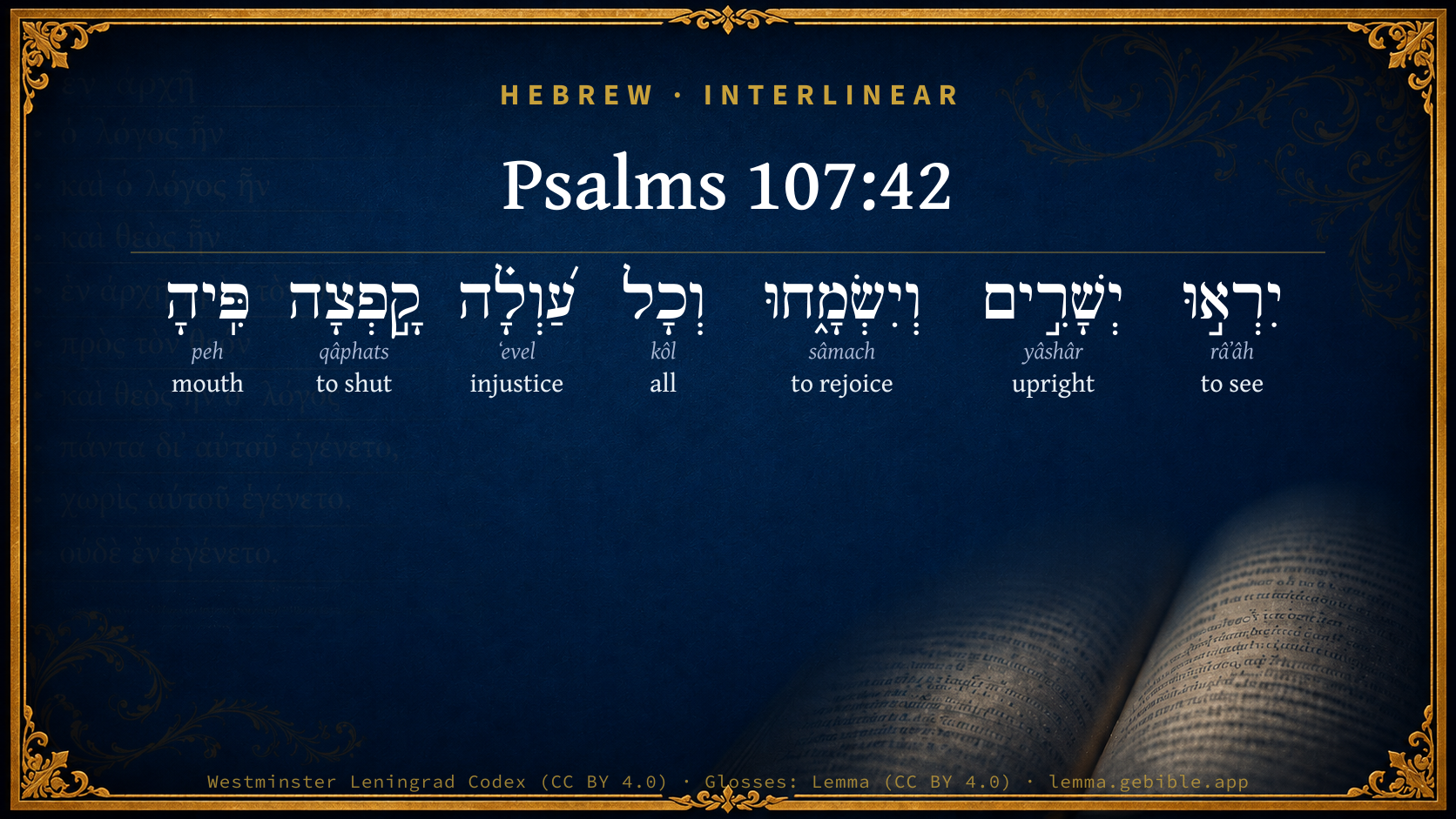
Psalms 107:42

Hebrew (Westminster Leningrad Codex) Psalms 107:42 appears in the Hebrew Old Testament. The text above is from the Westminster Leningrad Codex. Each word links to its Strong’s number, a concise gloss, and parsing drawn from the Open Scriptures Hebrew Bible morphology. Click any word for its full Brown-Driver-Briggs (BDB) entry.
Download image
Cite this verse

Psalms 107:42 (World English Bible). Public Domain. Lemma interlinear Bible study tool, https://lemma.gebible.app/v/psalms/107/42.

Show BibTeX & RIS
BibTeX
RIS
English Translation
The upright will see it, and be glad. All the wicked will shut their mouths.
World English Bible · Public Domain
Download a study sheet

One document with this verse’s original text, its word-by-word gloss line, the meaning frame, cross-references with their text, attributed commentary, and full source and license credits — printable, and it pastes into notes with its structure intact.

This verse Autodidact and up

Study sheet (.html) Plain text (.txt)

A passage Seminary Student

Up to 50 verses in one chapter. A passage sheet keeps up to 6 commentary sources and 12 cross-references per verse, in the order this page ranks them, and says so on the sheet whenever that leaves anything out. Ask for a single verse and you get the Autodidact verse sheet above.

Everything on this page stays free to read, with no account — the sheet is a download of what is already on screen, not access to it.

Want to remove ads? Support Godless Engineer
Compare translations 3

The same verse in 3 English versions, stacked beneath the original-language interlinear above. Click any original word for its lexicon entry.

Each is an independent rendering of the whole verse — the interlinear is not word-aligned to these translations.

Highlighted words mark where these versions differ — a whole-verse word diff, not a word-by-word alignment.

  • World English Bible Public Domain
    The upright will see it, and be glad. All the wicked will shut their mouths.
  • King James Version Public Domain
    The righteous shall see it, and rejoice: and all iniquity shall stop her mouth.
  • unfoldingWord Literal Text CC BY-SA 4.0
    The upright see and rejoice, and all wickedness shuts its mouth.

unfoldingWord Literal Text — © unfoldingWord, licensed CC BY-SA 4.0. Word-aligned USFM3 via Door43 (git.door43.org/unfoldingWord/en_ult).

Versions to compare (up to 4)

3 of 4 selected

Show all 18 translations

Every available English version of this verse, each an independent rendering of the whole verse.

  • World English Bible Public Domain
    The upright will see it, and be glad. All the wicked will shut their mouths.
  • Berean Standard Bible Public Domain
    The upright see and rejoice, and all iniquity shuts its mouth.
  • Majority Standard Bible Public Domain
    The upright see and rejoice, and all iniquity shuts its mouth.
  • King James Version Public Domain
    The righteous shall see it, and rejoice: and all iniquity shall stop her mouth.
  • American Standard Version (1901) Public Domain
    The upright shall see it, and be glad; And all iniquity shall stop her mouth.
  • Revised Version (1885) Public Domain
    The upright shall see it, and be glad; and all iniquity shall stop her mouth.
  • Geneva Bible (1599) Public Domain
    The righteous shall see it, and reioyce, and all iniquitie shall stoppe her mouth.
  • Douay-Rheims (1899) Public Domain
    The just shall see, and shall rejoice, and all iniquity shall stop their mouth.
  • Young's Literal Translation Public Domain
    The upright do see and rejoice, And all perversity hath shut her mouth.
  • Literal Standard Version CC BY-SA 4.0
    The upright see and rejoice, || And all perversity has shut her mouth.
  • Unlocked Literal Bible CC BY-SA 4.0
    The upright will see this and rejoice, and all wickedness shuts its mouth.
  • unfoldingWord Literal Text CC BY-SA 4.0
    The upright see and rejoice, and all wickedness shuts its mouth.
  • Darby Bible Public Domain
    The upright shall see it, and rejoice; and all unrighteousness shall stop its mouth.
  • World Messianic Bible Public Domain
    The upright will see it, and be glad. All the wicked will shut their mouths.
  • Webster's Bible Public Domain
    The righteous shall see it, and rejoice: and all iniquity shall stop her mouth.
  • Free Bible Version CC BY-SA 4.0
    Those who live right will observe what is happening and be glad, but the wicked will be silenced.
  • Bible in Basic English Public Domain
    The upright see it and are glad: the mouth of the sinner is stopped.
  • JPS Tanakh (1917) Public Domain
    The upright see it, and are glad; and all iniquity stoppeth her mouth.

Literal Standard Version (2020), Covenant Press — licensed CC BY-SA 4.0. Text via the HelloAO Bible API (eBible.org). Unlocked Literal Bible (unfoldingWord) — licensed CC BY-SA 4.0. Text via the HelloAO Bible API (eBible.org). unfoldingWord Literal Text — © unfoldingWord, licensed CC BY-SA 4.0. Word-aligned USFM3 via Door43 (git.door43.org/unfoldingWord/en_ult). Free Bible Version, Dr. Jonathan Gallagher — licensed CC BY-SA 4.0. Text via the HelloAO Bible API (eBible.org).

Word by word

More ways to search: Search by grammar → Find every occurrence → Compare this word →

Practice this passage: Drill this verse → Learn its vocabulary →

About this verse

These counts appear in no published source. They are computed here, from the morphology-tagged text and Lemma’s own curated glosses. What Lemma adds →

7
words
7
distinct lemmas
Wisdom
section

Notable vocabulary

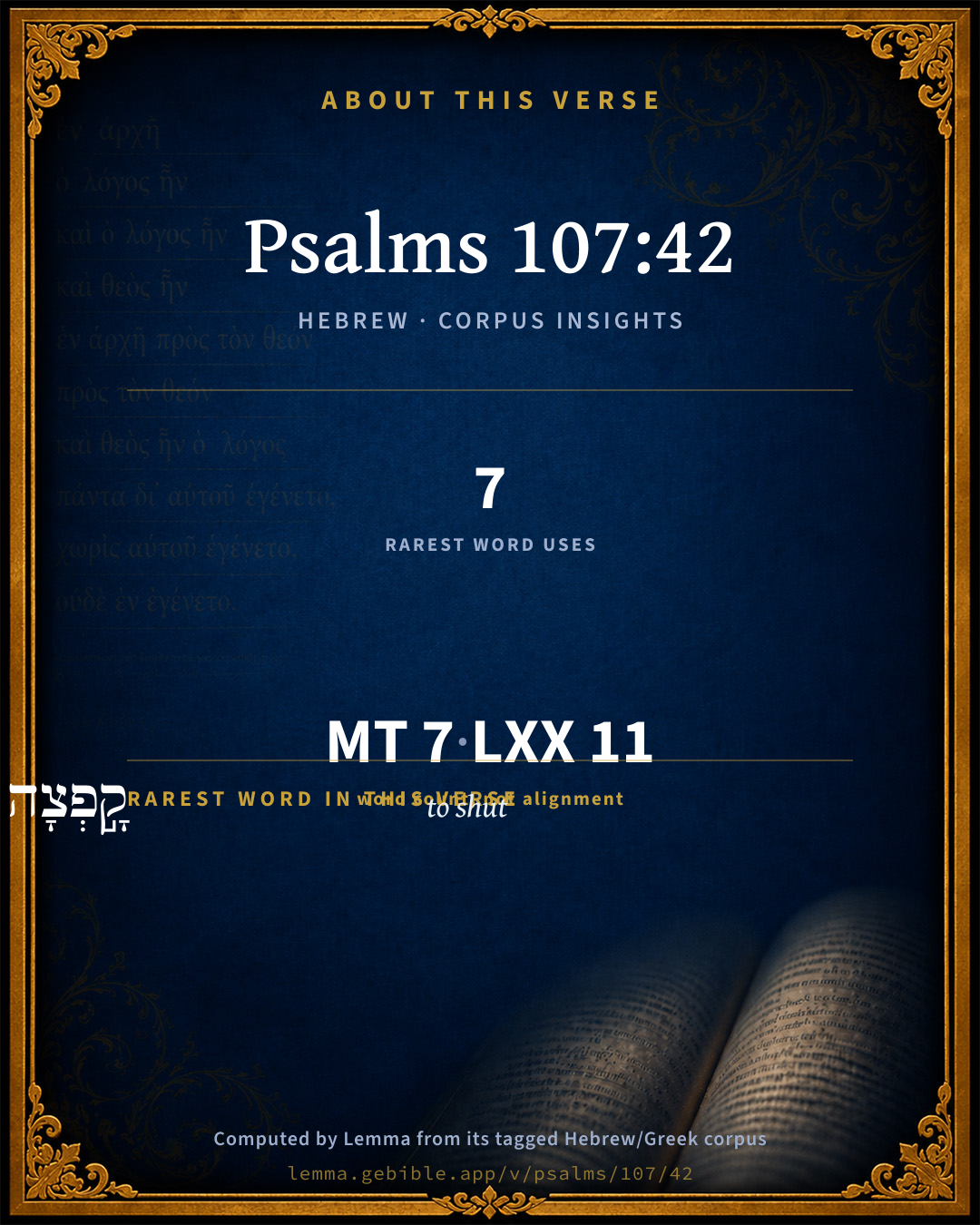
The rarest word here is קָ֣פְצָה to shut H7092 — appearing just 7 times in the whole Hebrew Bible.

Shared distinctive vocabulary

קָ֣פְצָה to shut H7092 occurs in 7 verses of the Hebrew Bible. Also found in:

Grammatical profile

  • 3 verbs
  • 3 nouns
  • 1 adjective

Verb forms

  • יִרְא֣וּ Qal · Imperfect
  • וְיִשְׂמָ֑חוּ Qal · Imperfect
  • קָ֣פְצָה Qal · Perfect

Hebrew & Septuagint length

In English translation the verse runs 15 words from the Hebrew and 13 from the Septuagint (LXX English) — closely comparable.

A rough comparison of the two English renderings, which tokenize alike — not a word-level alignment.

Word counts can differ between the Hebrew and the Greek without any difference in meaning — e.g. the Hebrew direct-object marker אֵת has no separate Greek word, and Greek often adds the article ὁ.

In the original languages it is 7 Hebrew tokens and 11 Greek tokens — but the two are counted differently (Hebrew bundles its prefixes and suffixes into one token; the Greek is in lemma form), so that isn’t a like-for-like length.

Cross-references

11

Topical passages linked to Psalms 107:42 in the Treasury of Scripture Knowledge — connected by theme and wording, ordered by reader-vote popularity; previews shown in the World English Bible.

  • Job 22:19 The righteous see it, and are glad; The innocent ridicule them,
  • Psalms 63:11 But the king shall rejoice in God. Everyone who swears by him will praise him, For the mouth of those who speak lies shall be silenced.
  • Romans 3:19 Now we know that whatever things the law says, it speaks to those who are under the law, that every mouth may be closed, and all the world may be brought under the judgment of God.
  • Psalms 52:6 The righteous also will see it, and fear, And laugh at him, saying,
  • Job 5:15–16 But he saves from the sword of their mouth, Even the needy from the hand of the mighty.
  • Exodus 11:7 But against any of the children of Israel a dog won't even bark or move its tongue, against man or animal; that you may know that Yahweh makes a distinction between the Egyptians and Israel.
  • Psalms 58:10–11 The righteous shall rejoice when he sees the vengeance. He shall wash his feet in the blood of the wicked;
  • Psalms 112:10 The wicked will see it, and be grieved. He shall gnash with his teeth, and melt away. The desire of the wicked will perish.
  • Proverbs 10:11 The mouth of the righteous is a spring of life, But violence covers the mouth of the wicked.
  • Isaiah 66:10–11 Rejoice you with Jerusalem, and be glad for her, all you who love her: rejoice for joy with her, all you who mourn over her;
  • Isaiah 66:14 You shall see [it], and your heart shall rejoice, and your bones shall flourish like the tender grass: and the hand of Yahweh shall be known toward his servants; and he will have indignation against his enemies.

Cross-references courtesy of OpenBible.info (CC BY 4.0).

Hebrew and Greek witnesses Masoretic Hebrew ↔ Greek Septuagint

The same verse in the two great witnesses to the Old Testament, shown verse-for-verse.

You’re reading Greek Psalm 106 (Hebrew Psalm 107). The Septuagint counts the superscription, so verse numbers can differ from the Hebrew — chapter-level alignment, not verse-by-verse. Numbering follows Rahlfs.

These are two independent witnesses, not word-aligned to each other, and the Septuagint is shown in lemma (dictionary) form.

Hebrew Psalms 107:42 Masoretic · Westminster Leningrad Codex

יִרְא֣וּ יְשָׁרִ֣ים וְיִשְׂמָ֑חוּ וְכָל עַ֝וְלָ֗ה קָ֣פְצָה פִּֽיהָ

The upright will see it, and be glad. All the wicked will shut their mouths.

World English Bible · Public Domain

Greek LXX Greek Psalm 106:42 Septuagint · lemma form

ὁράω εὐθύς καί εὐφραίνω καί πᾶς ἀνομία ἐνφράσσω ὁ στόμα αὐτός

The upright shall see and rejoice; and all iniquity shall stop her mouth.

LXX2012 (modern English Septuagint) · Public Domain

Hebrew: Westminster Leningrad Codex (CC BY 4.0). Greek: Septuagint (public domain); English from LXX2012 (modern English Septuagint) (Public Domain). How the Septuagint differs from the Hebrew →

Commentary

Notes on Psalms 107:42 from classic Christian and Jewish commentators (each source and its license shown beneath its notes). The classic Christian expositions comment on the surrounding passage and are grouped to its opening verse, so a note may address several verses; the Jewish commentaries on the Tanakh (Rashi and others) are per-verse, so they appear only where the commentator wrote on this verse.

Lemma curates 59 commentaries, every one of them public domain or Creative Commons licensed, each selected and text-cleaned for this edition rather than reprinted as found. About our sources →

Trapp's Complete Commentary

John Trapp

Psa 107:42 The righteous shall see [it], and rejoice: and all iniquity shall stop her mouth.

Ver. 42. The righteous shall see it, and rejoice] It shall cheer them up to see that the reins of government are in God’s hand; and to behold such love in such providence.

And all iniquity shall stop her mouth] Shall be down in the mouth, as we use to say, {see Job 5:16} and have her tongue chambered.

John Trapp, A Commentary or Exposition upon All the Books of the Old and New Testament (1647–1656) — public domain. Text from a community e-Sword module.

Joseph Benson's Commentary

Psa 107:42. The righteous shall see it — Or rather, shall see these things, as it is expressed in the next verse. They shall diligently observe these wonderful works of God’s mercy and justice; and rejoice — In the glorification of his attributes, and the manifestation of his dominion over the children of men. They will rejoice, not only in the mercies of God vouchsafed or offered to them and other persons, in want and misery, but also in his judgments upon his implacable enemies, because by these it is evinced, beyond dispute, that there is a God that judgeth in the earth, his honour, and the honour of piety and virtue, are advanced, impious pride is brought low, and the progress of vice and misery is checked or prevented. They will rejoice especially that, according to what is set forth by the foregoing similitudes, there is no spiritual evil out of which God is not both able and willing to deliver mankind, when they call upon him. “Are we ignorant of the way to the heavenly city? He will guide and conduct us thither. Are we bound with the chains of sin and death? He will loose and deliver us. Are our minds diseased and languid? He will heal and invigorate them. Are we in danger of being overwhelmed by the troubles of the world? He will preserve us in the midst of them until he bid them cease. Of his power and inclination to do these things for our souls he hath given assurance to all men, by those pledges of his love, the benefits and blessings conferred on the bodies of his people,” above referred to, namely, “in leading them through the wilderness to Canaan; in rescuing them so often from the miseries of captivity; in healing their diseases; and in saving those of them who did business in great waters, from the perils of the sea.” Surely these and such like particular instances of the divine mercy and goodness must afford especial matter of rejoicing to good men. And iniquity shall stop her mouth — Unrighteous and ungodly men will be put to silence. They who used to speak loftily and wickedly, and to reproach God and his providence, as either inattentive or unrighteous in the government of the world, shall now be forced to acknowledge his power and justice in those judgments which he hath brought upon them.

Joseph Benson's Commentary on the Old and New Testaments (1811–1818) — public domain. Text from a community e-Sword module.

J. A. Alexander on Psalms

Joseph Addison Alexander

42. (Psa 107:42) The righteous shall see and rejoice, and all iniquity stop her mouth. The righteous are the true Israel, as in Psa 33:1, Num 23:10, Dan 11:17. With the last clause compare Job 5:16, Isa 52:15.

Joseph Addison Alexander, The Psalms Translated and Explained (1850) — public domain. Text from a community e-Sword module.

Tyndale Open Study Notes

Tyndale Open Resources

107:42-43 Justice prevails in God’s world (1:6), and Israel’s history demonstrates God’s faithful love.

Tyndale Open Study Notes — © Tyndale Open Resources, licensed CC BY-SA 4.0. Text via the HelloAO Bible API.

Geneva Bible (1599)

Geneva Bible translators

They, whose faith is lightened by God’s spirit, shall rejoice to see God’s judgments against the wicked and ungodly.

Geneva Bible (1599) marginal notes — public domain. Text via Bolls.life.

Adam Clarke's Commentary

Verse 42. The righteous shall see it] The wicked are as inconsiderate as they are obstinate and headstrong.

And rejoice] To have such ample proofs that God ruleth in the earth, and that none that trust in him shall be desolate.

All iniquity shall stop her mouth. ] God's judgments and mercies are so evident, and so distinctly marked, that atheism, infidelity, and irreligion are confounded, and the cause of error and falsehood has become hopeless. It was only the mouth that could do any thing; and that only by lies, calumnies, and blasphemies: but God closes this mouth, pours contempt upon the head and judgment upon the heart. This may also be applied to the case of the Israelites and the Babylonians. The former, when they turned to God, became righteous; the latter were a personification of all iniquity.

Adam Clarke's Commentary on the Bible (1810–1826) — public domain. Text from a community e-Sword/MySword module.

John Calvin's Commentaries

42 The righteous shall see that, and shall rejoice The prophet now draws the conclusion, that so many evident tokens of God’s superintending and overruling providence could not transpire before the righteous without attracting their notice, and that their vision being illuminated by faith, these scenes are contemplated by them with unfeigned delight; while the wicked remain perplexed and mute. For he very judiciously makes a distinction between these two classes of persons. In whatever manner the wicked may be constrained to recognize God as the supreme ruler of the universe, nevertheless, in seeing they see not, and derive nothing from the sight, except that their conduct is rendered the more inexcusable. But the righteous are not only able to form a good and sound judgment of these events, they also spontaneously open their eyes to contemplate the equity, goodness, and wisdom of God, the sight and knowledge of which are refreshing to them. For the joy which they experience in this exercise is a pledge that their thus observing these things was the spontaneous effusion of their hearts. With regard to the despisers of God, it is not meant that they are so deeply impressed as truly to acknowledge that the world is under his superintending care, but that they are merely so far kept in check as not to presume to deny the existence of that providence as their natural inclination would lead them to do; or, at least, that they meet with a vigorous repulse whenever they attempt to speak in opposition to it. Although the judgments of God are before their eyes, yet is their understanding so darkened, that they cannot perceive the clear light. And this manner of speaking is more energetic than if it had been said, that the wicked themselves are become mute. In fact, they do not cease from murmuring against God’s dispensations of providence; for we see with what arrogance and contempt they set themselves in opposition to our faith, and have the hardihood to pour forth horrid blasphemies against God. This does not impeach the veracity of the prophet’s statement, that the mouth of wickedness is stopped, because, in fact, the more proudly and violently they assail God, the more notorious does their impiety appear. Besides, the joy here mentioned arises from this, that there is nothing more calculated to increase our faith, than the knowledge of the providence of God; because, without it, we would be harassed with doubts and fears, being uncertain whether or not the world was governed by chance. For this reason, it follows that those who aim at the subversion of this doctrine, depriving the children of God of true comfort, and vexing their minds by unsettling their faith, forge for themselves a hell upon earth. For what can be more awfully tormenting than to be constantly racked with doubt and anxiety? And we will never be able to arrive at a calm state of mind until we are taught to repose with implicit confidence in the providence of God. Moreover, it is declared in this verse, that God manifests his goodness to all men without exception, and yet there are comparatively few of them who benefit by it. Wherefore, when he formerly called upon all to celebrate the goodness of God, it was in order that the ingratitude of the majority of them might the more plainly appear.

John Calvin's Commentaries (1540-1563) — public domain. Text from the Calvin Translation Society English edition (1840s-50s) via the Christian Classics Ethereal Library (ccel.org). Calvin's coverage is partial (roughly two-thirds of the Bible); uncommented books and verses are honest gaps, never fabricated. The 19th-century editor's footnotes and remarks are omitted so the notes are faithfully Calvin's own voice.

Ellicott's Commentary for English Readers

(42) Again the dependence on the book of Job is seen. (See marginal reference.)

A Bible Commentary for English Readers, edited by Charles John Ellicott (1878–1897) — public domain. Text from a community e-Sword module.

The Cambridge Bible for Schools and Colleges

gen. ed. J. J. S. Perowne

42. The upright see and are glad;

And all unrighteousness stoppeth her mouth.

All mockery of Israel and blasphemy of Israel’s God are silenced. Cp. Psa_115:2. The first line is from Job_22:19; the second from Job_5:16.

The Cambridge Bible for Schools and Colleges (gen. ed. J. J. S. Perowne; Cambridge University Press, 1878–1918) — public domain. Text from a community e-Sword module.

Albert Barnes' Notes on the Bible

The righteous shall see it, and rejoice - Shall see all these changes; shall see in their own case the proofs of the divine favor. They shall thus have occasion for praise.

And all iniquity shall stop her mouth - The wicked shall be silenced; they shall be dumb. The righteous shall find, in these varied scenes, occasion for praise and joy; the wicked shall be able to find no occasion for complaining or murmuring. The divine dealings shall be manifestly so just, and so worthy of universal approval, that, even though the wicked are disposed to complain against God, they will be able to find nothing which will justify them in such complaints.

Albert Barnes' Notes on the Bible (1834–1885) — public domain. Text from a community e-Sword/MySword module.

Matthew Poole's English Annotations

Shall see it; or rather, these things, as it is expressed in the next verse. They shall diligently observe these wonderful works of God’s mercy and justice.

Rejoice; not only in the mercies of God vouchsafed to them and to other persons in want and misery, but also in God’s judgments upon his implacable enemies, which afford matter of rejoicing to good men, as hath been once and again declared in this book, both for the honour which God hath by them, and for the sins and calamities of others, which by this means are prevented. Iniquity, i.e. unrighteous or ungodly men, the abstract being put for the concrete, as faithfulnesses for the faithful, Psa 12:1, and pride for the proud, Psa 36:11. Shall stop her mouth; shall be put to silence. So this or the like phrase is used, Jdg 18:19; Job 5:16; 21:5; 29:9. They who used to speak loftily and wickedly, and to set their mouth against the heavens, as they did, Psa 73:8,9, to reproach God and his providence, as either negligent or unrighteous in the management of the world, shall now be forced to acknowledge his power and justice in those judgments which he hath brought upon them.

Matthew Poole's English Annotations on the Holy Bible (1683–1685) — public domain. Text from a community e-Sword/MySword module.

The Treasury of David

Charles H. Spurgeon

Ver. 42. The righteous shall see it, and rejoice. Divine providence causes joy to God's true people; they see the hand of the Lord in all things, and delight to study the ways of his justice and of his grace.

And all iniquity shall stop her mouth. What can she say? God's providence is often so conclusive in its arguments of fact, that there is no replying or questioning. It is not long that the impudence of ungodliness can be quiet, but when God's judgments are abroad it is driven to hold its tongue.

Ver. 42. The righteous shall see it. The word here rendered "righteous" is not what the Scripture commonly uses to signify righteous or justified persons; but it is another word, and conveys another idea. It signifies to direct, to set right; and the "righteous" here mentioned are they, who are directed in the right way, and walk, as Enoch did, with God in his way, and not in the way of the world. And these "shall see" the goodness and mercy of God's dealings with the fallen race of man. They shall have eyes to see the ways of his providence. The same grace which set them right, will manifest to them the reasonableness of the plan of redemption. They shall see and admire, and be thankful for the wonders of his redeeming love, which are recorded in this divine hymn. William Romaine.

Ver. 42. "All iniquity shall stop her mouth." "Iniquity" is here personified, and denotes the iniquitous; but the abstract is more poetical, "Stop her mouth." Tongue tied, literally, moistly shut; which, perhaps, might be not improperly vernaculized. Alexander Geddes.

Ver. 42-43. Such surprising turns are of use,

1. For the solacing of saints; they observe these dispensations with pleasure: "The righteous shall see it, and rejoice", in the glorifying of God's attributes, and the manifestation of his dominion over the children of men.

2. For the silencing of sinners: "all iniquity shall stop her mouth"; i.e. it shall be a full conviction of the folly of those that deny the divine presence.

3. For the satisfying of all concerning the divine goodness: "Whoso is wise, and will observe these things" these various dispensations of divine providence, "even they shall understand the lovingkindness of the Lord." M. Henry.

Psalms 107:43*

Charles H. Spurgeon's The Treasury of David (1869–1885) — public domain. Psalms only. Text from a community e-Sword/MySword module.

Whedon's Commentary on the Bible

Daniel D. Whedon

42. This verse is quoted from Job_22:19; Job_5:16.

Iniquity shall stop her mouth—Shall cease to reproach and revile, God’s favour to the righteous being so evident. See Psa_86:17

Daniel D. Whedon (gen. ed.), Commentary on the Old and New Testaments (1874–1909) — public domain. Text from a community e-Sword module.

The Pulpit Commentary

The righteous shall see it, and rejoice. Experience will justify God"s ways to man. "The righteous his people will see that the general course of God"s providence is such as described (vers. 33-41), and will "rejoice" that it is so. And all iniquity shall stop her mouth. The gain sayers, unable to impugn the righteousness of the Divine proceedings, shall have no resource but to sit still and hold their tongues.

The Pulpit Commentary (1880–1919), ed. H.D.M. Spence-Jones & Joseph S. Exell — public domain. Text from a community e-Sword module.

Rashi

Rabbi Shlomo Yitzchaki (Rashi)

shuts Heb. קפצה, closes up, like (Deut. 15:7): “and not close up (תקפץ) your hand.”

Rashi on the Tanakh — English translations: “The Judaica Press complete Tanach with Rashi, translated by A. J. Rosenberg” (CC BY 4.0); “Pentateuch with Rashi's commentary by M. Rosenbaum and A.M. Silbermann, 1929-1934” (public domain); “The Metsudah Tanach series, Lakewood, N.J” (CC BY 4.0); and “The Book of Joshua, Metsudah Publications, 1997” (CC BY 4.0). Text via Sefaria.

Lesson kit

Teaching starters — assembled from the data on this page, not authored interpretation. Every prompt links to the verse data it draws on. Edit before teaching.

Psalms, in the Wisdom, opens this verse with 7 words (7 distinct Hebrew lemmas). Its most distinctive word is qâphats (“to shut”). A historical commentator’s framing appears above. Read the whole chapter for the surrounding context.

Discussion questions

  1. What does “to shut” (qâphats) contribute to the verse as a whole?
  2. Deuteronomy 15:7 shares the word «to shut» with this verse. How do the two illuminate each other?
  3. The translations on this page render this verse differently — a whole-verse word diff, not a word-by-word alignment. What might account for the different wordings?
  4. The verb «יִרְא֣וּ» is Qal Imperfect. How does its form color the action?
  5. Reading how Trapp's Complete Commentary and Joseph Benson's Commentary read this verse, where do the two commentators agree and where do they part?

Things to notice

Reading settings

Reading text

Shown beneath each verse's original-language words.

Old Testament
Old Testament edition

Read the OT as the Masoretic Hebrew (MT) or the Greek Septuagint (LXX).

English shown for the Greek Septuagint (in the Hebrew ↔ Greek comparison).

Comparing translations? Open the Compare panel on any verse page to stack up to four side by side.