
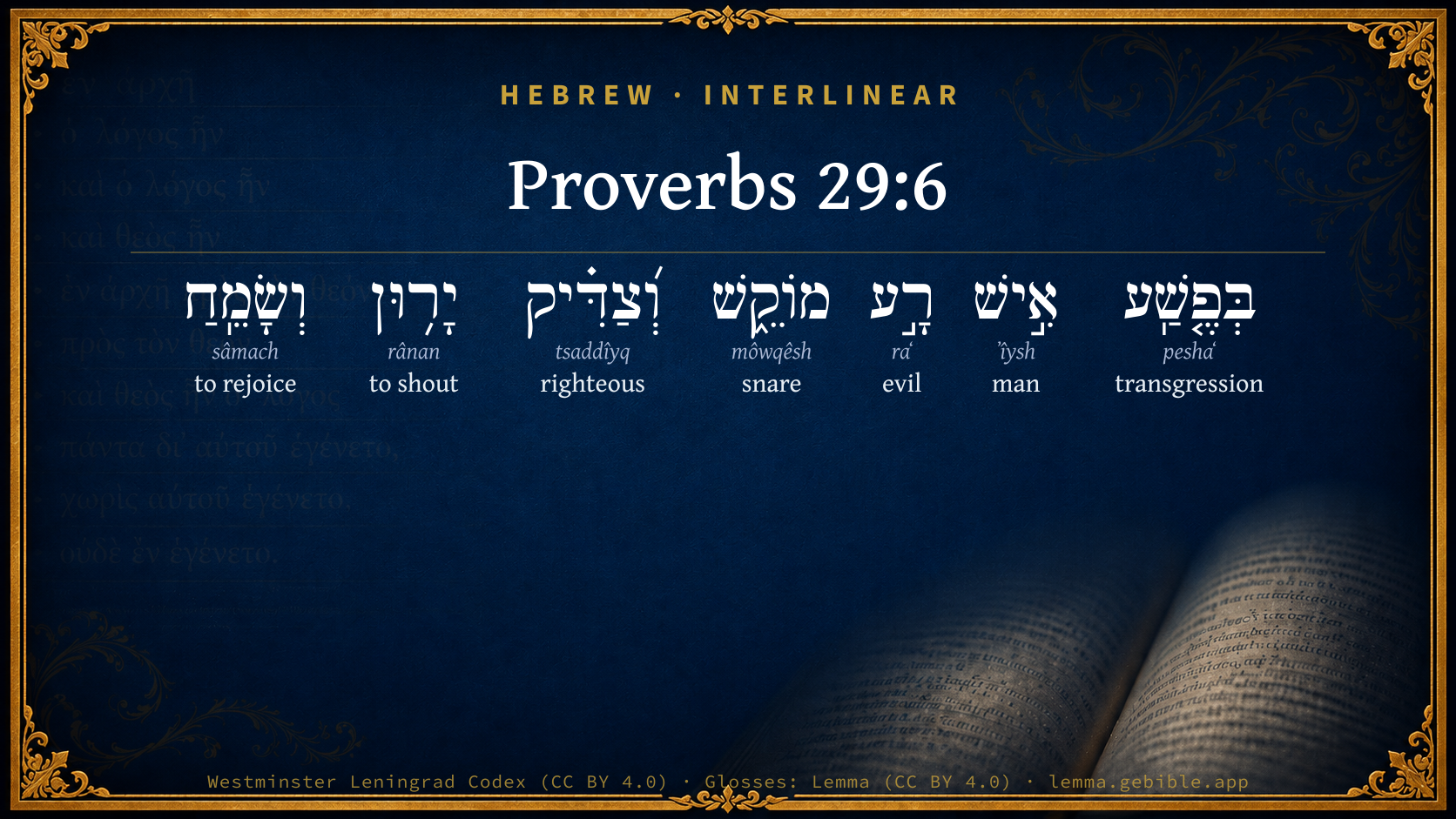
Proverbs 29:6

Hebrew (Westminster Leningrad Codex) Proverbs 29:6 appears in the Hebrew Old Testament. The text above is from the Westminster Leningrad Codex. Each word links to its Strong’s number, a concise gloss, and parsing drawn from the Open Scriptures Hebrew Bible morphology. Click any word for its full Brown-Driver-Briggs (BDB) entry.
Download image
Cite this verse

Proverbs 29:6 (World English Bible). Public Domain. Lemma interlinear Bible study tool, https://lemma.gebible.app/v/proverbs/29/6.

Show BibTeX & RIS
BibTeX
RIS
English Translation
An evil man is snared by his sin, But the righteous can sing and be glad.
World English Bible · Public Domain
Download a study sheet

One document with this verse’s original text, its word-by-word gloss line, the meaning frame, cross-references with their text, attributed commentary, and full source and license credits — printable, and it pastes into notes with its structure intact.

This verse Autodidact and up

Study sheet (.html) Plain text (.txt)

A passage Seminary Student

Up to 50 verses in one chapter. A passage sheet keeps up to 6 commentary sources and 12 cross-references per verse, in the order this page ranks them, and says so on the sheet whenever that leaves anything out. Ask for a single verse and you get the Autodidact verse sheet above.

Everything on this page stays free to read, with no account — the sheet is a download of what is already on screen, not access to it.

Want to remove ads? Support Godless Engineer
Compare translations 3

The same verse in 3 English versions, stacked beneath the original-language interlinear above. Click any original word for its lexicon entry.

Each is an independent rendering of the whole verse — the interlinear is not word-aligned to these translations.

Highlighted words mark where these versions differ — a whole-verse word diff, not a word-by-word alignment.

  • World English Bible Public Domain
    An evil man is snared by his sin, But the righteous can sing and be glad.
  • King James Version Public Domain
    In the transgression of an evil man there is a snare: but the righteous doth sing and rejoice.
  • unfoldingWord Literal Text CC BY-SA 4.0
    In the transgression of an evil man—a snare, but a righteous shouts for joy and is glad.

unfoldingWord Literal Text — © unfoldingWord, licensed CC BY-SA 4.0. Word-aligned USFM3 via Door43 (git.door43.org/unfoldingWord/en_ult).

Versions to compare (up to 4)

3 of 4 selected

Show all 18 translations

Every available English version of this verse, each an independent rendering of the whole verse.

  • World English Bible Public Domain
    An evil man is snared by his sin, But the righteous can sing and be glad.
  • Berean Standard Bible Public Domain
    An evil man is caught by his own sin, but a righteous one sings and rejoices.
  • Majority Standard Bible Public Domain
    An evil man is caught by his own sin, but a righteous one sings and rejoices.
  • King James Version Public Domain
    In the transgression of an evil man there is a snare: but the righteous doth sing and rejoice.
  • American Standard Version (1901) Public Domain
    In the transgression of an evil man there is a snare; But the righteous doth sing and rejoice.
  • Revised Version (1885) Public Domain
    In the transgression of an evil man there is a snare: but the righteous doth sing and rejoice.
  • Geneva Bible (1599) Public Domain
    In the transgression of an euill man is his snare: but the righteous doeth sing and reioyce.
  • Douay-Rheims (1899) Public Domain
    A snare shall entangle the wicked man when he sinneth: and the just shall praise and rejoice.
  • Young's Literal Translation Public Domain
    In the transgression of the evil `is' a snare, And the righteous doth sing and rejoice.
  • Literal Standard Version CC BY-SA 4.0
    A snare [is] in the transgression of the evil, || And the righteous sing and rejoice.
  • Unlocked Literal Bible CC BY-SA 4.0
    In the sin of an evil person is a trap, but the righteous person sings and rejoices.
  • unfoldingWord Literal Text CC BY-SA 4.0
    In the transgression of an evil man—a snare, but a righteous shouts for joy and is glad.
  • Darby Bible Public Domain
    In the transgression of an evil man there is a snare; but the righteous shall sing and rejoice.
  • World Messianic Bible Public Domain
    An evil man is snared by his sin, but the righteous can sing and be glad.
  • Webster's Bible Public Domain
    In the transgression of an evil man there is a snare: but the righteous doth sing and rejoice.
  • Free Bible Version CC BY-SA 4.0
    Evil people are trapped by their own sins, but those who do right sing and celebrate.
  • Bible in Basic English Public Domain
    In the steps of an evil man there is a net for him, but the upright man gets away quickly and is glad.
  • JPS Tanakh (1917) Public Domain
    In the transgression of an evil man there is a snare; but the righteous doth sing and rejoice.

Literal Standard Version (2020), Covenant Press — licensed CC BY-SA 4.0. Text via the HelloAO Bible API (eBible.org). Unlocked Literal Bible (unfoldingWord) — licensed CC BY-SA 4.0. Text via the HelloAO Bible API (eBible.org). unfoldingWord Literal Text — © unfoldingWord, licensed CC BY-SA 4.0. Word-aligned USFM3 via Door43 (git.door43.org/unfoldingWord/en_ult). Free Bible Version, Dr. Jonathan Gallagher — licensed CC BY-SA 4.0. Text via the HelloAO Bible API (eBible.org).

Word by word

More ways to search: Search by grammar → Find every occurrence → Compare this word →

Practice this passage: Drill this verse → Learn its vocabulary →

About this verse

These counts appear in no published source. They are computed here, from the morphology-tagged text and Lemma’s own curated glosses. What Lemma adds →

7
words
7
distinct lemmas
Wisdom
section

Shared distinctive vocabulary

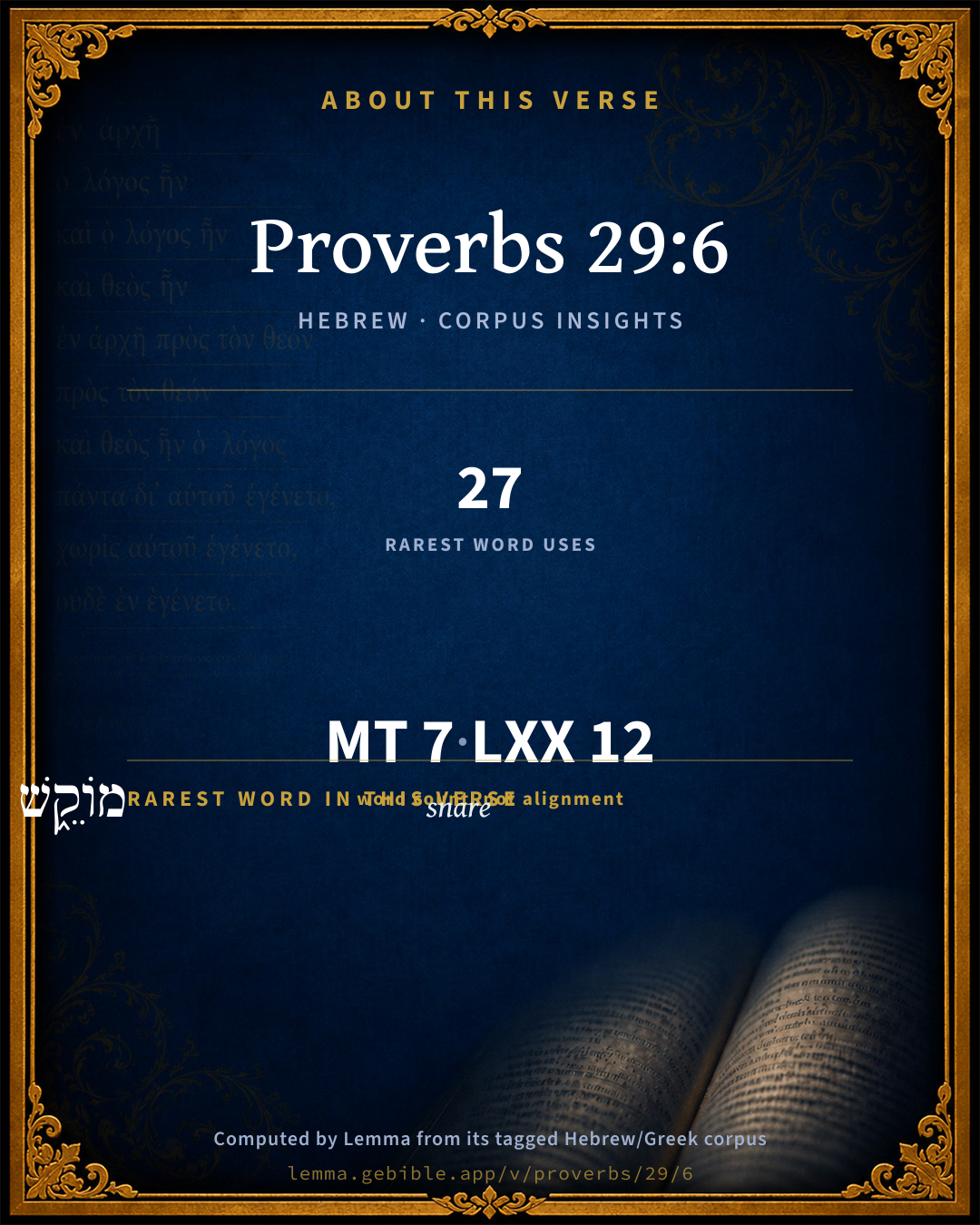
מוֹקֵ֑שׁ snare H4170 occurs in 27 verses of the Hebrew Bible. Also found in:

Grammatical profile

  • 2 verbs
  • 3 nouns
  • 2 adjectives

Verb forms

  • יָר֥וּן Qal · Imperfect
  • וְשָׂמֵֽחַ Qal · Sequential Perfect

Hebrew & Septuagint length

In English translation the verse runs 16 words from the Hebrew and 17 from the Septuagint (LXX English) — closely comparable.

A rough comparison of the two English renderings, which tokenize alike — not a word-level alignment.

Word counts can differ between the Hebrew and the Greek without any difference in meaning — e.g. the Hebrew direct-object marker אֵת has no separate Greek word, and Greek often adds the article ὁ.

In the original languages it is 7 Hebrew tokens and 12 Greek tokens — but the two are counted differently (Hebrew bundles its prefixes and suffixes into one token; the Greek is in lemma form), so that isn’t a like-for-like length.

Cross-references

16

Topical passages linked to Proverbs 29:6 in the Treasury of Scripture Knowledge — connected by theme and wording, ordered by reader-vote popularity; previews shown in the World English Bible.

  • Exodus 15:1 Then Moses and the children of Israel sang this song to Yahweh, and said, "I will sing to Yahweh, for he has triumphed gloriously: The horse and his rider he has thrown into the sea.
  • Ecclesiastes 9:12 For man also doesn't know his time. As the fish that are taken in an evil net, and as the birds that are caught in the snare, even so are the sons of men snared in an evil time, when it falls suddenly on them.
  • 2 Timothy 2:26 and they may recover themselves out of the devil's snare, having been taken captive by him to his will.
  • Job 18:7–10 The steps of his strength shall be shortened, His own counsel shall cast him down.
  • Psalms 11:6 On the wicked he will rain blazing coals; Fire, sulfur, and scorching wind shall be the portion of their cup.
  • Psalms 97:11 Light is sown for the righteous, And gladness for the upright in heart.
  • Psalms 118:15 The voice of rejoicing and salvation is in the tents of the righteous. "The right hand of Yahweh does valiantly.
  • Psalms 132:16 Her priests I will also clothe with salvation. Her saints will shout aloud for joy.
  • Romans 5:2–3 through whom we also have our access by faith into this grace in which we stand. We rejoice in hope of the glory of God.
  • 1 Peter 1:8 whom not having known you love; in whom, though now you don't see him, yet believing, you rejoice greatly with joy unspeakable and full of glory--
  • Proverbs 5:22 The evil deeds of the wicked ensnare him. The cords of his sin hold him firmly.
  • Proverbs 12:13 An evil man is trapped by sinfulness of lips, But the righteous shall come out of trouble.
  • Isaiah 8:14–15 He shall be for a sanctuary; but for a stone of stumbling and for a rock of offense to both the houses of Israel, for a gin and for a snare to the inhabitants of Jerusalem.
  • James 1:2 Count it all joy, my brothers, when you fall into various temptations,
  • Proverbs 11:5–6 The righteousness of the blameless will direct his way, But the wicked shall fall by his own wickedness.
  • 1 John 1:4 And we write these things to you, that our joy may be fulfilled.

Cross-references courtesy of OpenBible.info (CC BY 4.0).

Hebrew and Greek witnesses Masoretic Hebrew ↔ Greek Septuagint

The same verse in the two great witnesses to the Old Testament, shown verse-for-verse.

These are two independent witnesses, not word-aligned to each other, and the Septuagint is shown in lemma (dictionary) form.

Hebrew Proverbs 29:6 Masoretic · Westminster Leningrad Codex

בְּפֶ֤שַֽׁע אִ֣ישׁ רָ֣ע מוֹקֵ֑שׁ וְ֝צַדִּ֗יק יָר֥וּן וְשָׂמֵֽחַ

An evil man is snared by his sin, But the righteous can sing and be glad.

World English Bible · Public Domain

Greek LXX Proverbs 29:6 Septuagint · lemma form

ἁμαρτάνω ἀνήρ μέγας παγίς δίκαιος δέ ἐν χαρά καί ἐν εὐφροσύνη εἰμί

A great snare is spread for a sinner: but the righteous shall be in joy and gladness.

LXX2012 (modern English Septuagint) · Public Domain

On this verse, The Pulpit Commentary discusses the Septuagint’s reading. Read the note in Commentary ↓

Hebrew: Westminster Leningrad Codex (CC BY 4.0). Greek: Septuagint (public domain); English from LXX2012 (modern English Septuagint) (Public Domain). How the Septuagint differs from the Hebrew →

Commentary

Notes on Proverbs 29:6 from classic Christian and Jewish commentators (each source and its license shown beneath its notes). The classic Christian expositions comment on the surrounding passage and are grouped to its opening verse, so a note may address several verses; the Jewish commentaries on the Tanakh (Rashi and others) are per-verse, so they appear only where the commentator wrote on this verse.

Lemma curates 59 commentaries, every one of them public domain or Creative Commons licensed, each selected and text-cleaned for this edition rather than reprinted as found. About our sources →

Trapp's Complete Commentary

John Trapp

Pro 29:6 In the transgression of an evil man [there is] a snare: but the righteous doth sing and rejoice.

Ver. 6. In the transgression of an evil man there is a snare.] Or, A cord - viz., to strangle his joy with - to check and choke all his comforts. In the midst of his mirth he hath many a secret gripe, and little knows the world where his shoe pincheth him. Every fowl that hath a seemly feather hath not the sweetest flesh, nor doth every tree that bringeth a goodly leaf bear good fruit. Glass giveth a clearer sound than silver, and many things glitter besides gold. The wicked man’s jollity is but the hypocrisy of mirth; it may wet the mouth, but not warm the heart - smooth the brow, but not fill the breast. We may be sure, that as Jezebel had a cold heart under a painted complexion, so many a man’s heart aches and quakes within him when his face counterfeits a smile.

But the righteous sing and rejoice.] Good men only may be glad, and none have any reason to rejoice but they. {Hos 9:1} The Papists have a proverb, Spiritus Calvinianus est spiritus melancholicus, and the mad world are easily persuaded by the devil that there is no comfort in a Christian course - that your precise fellows live a melancholy and monkish kind of life, and have no joy of anything. Herein the devil deals like those inhospitable savages in America, that make great fires, and set forth terrible sights upon their country’s shore, purposely to frighten passengers from landing there. And as those wicked spies brought up an evil report of the land of Canaan, and thereby discouraged the people, so doth the devil and his imps of the purity of religion and power of godliness as uncouth and uncomfortable, when in truth there is no sound comfort without it - no true joy but in it. Though Saul could not be merry without a fiddler, Ahab without Naboth’s vineyard, Haman without Mordecai’s courtesy, yet a righteous man can be merry without all these. Yea, as the lily is fresh, beautiful, and looks pleasantly, though among thorns, so can he amidst troubles. Paul - than whom never any out of hell suffered more - did not only glory in tribulation, but "overabound exceedingly with joy." {2Co 7:4}

John Trapp, A Commentary or Exposition upon All the Books of the Old and New Testament (1647–1656) — public domain. Text from a community e-Sword module.

The Preacher's Complete Homiletical Commentary

Joseph S. Exell (gen. ed.)

CRITICAL NOTES.—

Pro_29:7. Considereth. Literally knoweth. Zöckler and Delitzsch translate the latter clause, “the godless discern, or understand not, knowledge.”

MAIN HOMILETICS OF Pro_29:6

A SNARE AND A SONG

I. Sin deceives men. If a man digs a pit for the purpose of entrapping a victim, his great aim is to make the path over it as inviting as possible, and entirely to hide from sight the snare which he has laid, for, as Solomon tells us elsewhere, “Surely in vain the net is spread in the sight of any bird.” (Chap. Pro_1:17.) So when the great deceiver of men tries to lead them into sin, he makes the way of transgression look very inviting, and persuades his victim that some great gain is to be gotten by the sin. He hides from view the pit of misery which lies at the end of every path of disobedience to God. He did not let Adam and Eve see beforehand the bitter consequences of breaking the Divine command or he would not have succeeded in accomplishing their downfall. And be does not let the young man whom he persuades to rob his master see the felon’s cell beyond, or his persuasions would be ineffectual. His great aim is to make men believe there is security where there is danger—a solid rock where there is a yawning pit—probable gain where there is certain loss. Seeing that sin is against the sinner’s own interests, and that there is in every man an instinct of self-preservation, we must conclude that if transgressors were not ensnared, Satan could take the captive in no other way.

II. Righteousness gladdens men. God, who is the Fountain and Source of all the joy in the universe, made man for happiness. This is the portion which He intended all His creatures to possess, and which they forfeit by their own act and deed. Before sin entered our world, song was man’s natural employment—it was as natural for him to rejoice in God’s love as it was to breathe God’s air. And in proportion as sin is banished from the human soul, and the right relation between it and God is re-established, joy and gladness re-enter the heart. The indissoluble connection which is found everywhere between righteousness of life and peace of mind is a revelation of the character of the Being who sits upon the throne of the universe, and although the song of the righteous in this world is not an unbroken one, and they have sorrow as well as joy, they are hastening to a world where “God shall wipe away all tears from their eyes, and there shall be no more sorrow nor crying, neither shall there be any more pain; for the former things are passed away.” (Rev_21:4.)

OUTLINES AND SUGGESTIVE COMMENTS

Or, a cord, viz., to strangle his joy with—to check and choke all his comforts. In the midst of his mirth he hath many a secret gripe, and little knows the world where the shoe pinches him. Every fowl that hath a seemly feather hath not the sweetest flesh, nor doth every tree that bringeth a goodly leaf bear good fruit. Glass giveth a clearer sound than silver, and many things glitter besides gold. The wicked man’s jollity may wet the mouth, but not warm the heart—smooth the brow, but not fill the breast … But though Saul could not be merry without a fiddler, Ahab without Naboth’s vineyard, Haman without Mordecai’s courtesy, yet a righteous man can be merry without all these.—Trapp.

For Homiletics of Pro_29:7 see on chap. Pro_14:31, page 389, and chap. Pro_24:11-12, page 680.

The Preacher's Complete Homiletical Commentary (gen. ed. Joseph S. Exell; Funk & Wagnalls, c. 1892) — public domain (pre-1929). A full-Bible homiletical/sermon-outline anthology covering 65 of 66 books (2 John is absent from the source module). Text from a community e-Sword module.

Geneva Bible (1599)

Geneva Bible translators

He is ever ready to fall into the snare that he layeth for others.

Geneva Bible (1599) marginal notes — public domain. Text via Bolls.life.

Matthew Henry's Commentary

Here is, 1. The peril of a sinful way. There is not only a punishment at the end of it, but a snare in it. One sin is a temptation to another, and there are troubles which, as a snare, come suddenly upon evil men in the midst of their transgressions; nay, their transgression itself often involves them in vexations; their sin is their punishment, and they are holden in the cords of their own iniquity, Pro 5:22. 2. The pleasantness of the way of holiness. The snare that is in the transgression of evil men spoils all their mirth, but righteous men are kept from those snares, or delivered out of them; they walk at liberty, walk in safety, and therefore they sing and rejoice. Those that make God their chief joy have him for their exceeding joy, and it is their own fault if they do not rejoice evermore. If there be any true joy on this side heaven, doubtless those have it whose conversation is in heaven.

Matthew Henry's Commentary on the Whole Bible (1708–1710) — public domain (CC PDM 1.0). Text via the HelloAO Bible API.

Jamieson, Fausset & Brown

Robert Jamieson, A. R. Fausset & David Brown

In--or, "By"

the transgression--he is brought into difficulty (Pro 12:13), but the righteous go on prospering, and so sing or rejoice.

Jamieson, Fausset & Brown — Commentary Critical and Explanatory on the Whole Bible (1871) — public domain (CC PDM 1.0). Text via the HelloAO Bible API.

Ellicott's Commentary for English Readers

(6) In the transgression of an evil man there is a snare.—For he knows not how by repentance to escape God’s wrath.

But the righteous doth sing and rejoice.—Being assured of God’s mercy to those who repent, lie rejoices because his conscience is clear, and the “peace of God” (Php_4:7) keeps his heart.

A Bible Commentary for English Readers, edited by Charles John Ellicott (1878–1897) — public domain. Text from a community e-Sword module.

The Cambridge Bible for Schools and Colleges

gen. ed. J. J. S. Perowne

6. a snare] in which, though perhaps he laid it for others (Psa_9:15-16), he himself shall be taken, and so have sorrow, in contrast to the “joy and singing” of the righteous.

The Cambridge Bible for Schools and Colleges (gen. ed. J. J. S. Perowne; Cambridge University Press, 1878–1918) — public domain. Text from a community e-Sword module.

John Gill's Exposition

In the transgression of an evil man there is a snare,.... Or, according to the accents in some copies, "in the transgression of a man is an evil snare", as Aben Ezra observes the words may be read; there is a snare in sin to man himself; one sin leads on to another, and a man is snared by the works of his own hands, and is implicated and held in the cords of his own iniquity, and falls into the snare of the devil, out of which he is not easily recovered; and the transgression of one man is a snare to another; he is drawn into sin by ill examples; and, by indulging himself in sin, the evil day comes upon him unawares as a snare; and sooner or later he is filled with horrors of conscience, anguish, and distress;

but the righteous doth sing and rejoice; not at the snares of others, their sin or punishment; for such a man rejoices not in iniquity, though he sometimes does at the punishment of sinners, because of the glory of the divine justice; and Gersom thinks this is here meant; see Psa 58:10; but rather, as he also observes, the righteous man rejoices at his deliverance from the snares of sin and Satan, and of the world; he rejoices in the righteousness by which he is denominated righteous; not his own, but the righteousness of Christ, it being so rich and glorious, so perfect and complete; he rejoices in salvation by him it being so suitable, so, real, so full, so free, and so much for the glory of God; he rejoices in the pardon of his sins through the blood of Christ, and in the expiation of them by his sacrifice; he rejoices in his person, in the greatness, fitness, fulness, and beauty of it; he rejoices in all his offices he bears and executes, and in all the relations he stands in to him; he rejoices in his word and ordinances, in the prosperity of his cause and interest, in the good of his people, and in hope of the glory of God; and even sings for joy in the view of electing, redeeming, and calling grace, and eternal life and happiness; he has peace of conscience now, fears no enemy, nor any danger, and expects a life of glory in the world to come; and oftentimes sings on the brink of the grave, in the view of death and eternity.

John Gill's Exposition of the Whole Bible (1746–1763) — public domain (CC PDM 1.0). Text via the HelloAO Bible API.

Albert Barnes' Notes on the Bible

While the offence of the wicked, rising out of a confirmed habit of evil, becomes snare for his destruction; the righteous, even if he offend, is forgiven and can still rejoice in his freedom from condemnation. The second clause is taken by some as entirely contrasted with the first; it expresses the joy of one whose conscience is void of offence, and who is in no danger of falling into the snare.

Albert Barnes' Notes on the Bible (1834–1885) — public domain. Text from a community e-Sword/MySword module.

Matthew Poole's English Annotations

There is a snare; his sin will bring him to dreadful horrors and certain ruin.

Doth sing and rejoice, because he hath sweet peace in his own conscience, and assurance of present safety and eternal happiness.

Matthew Poole's English Annotations on the Holy Bible (1683–1685) — public domain. Text from a community e-Sword/MySword module.

Whedon's Commentary on the Bible

Daniel D. Whedon

6. Transgression… a snare — In which he is himself taken and brought to sorrow.

But the righteous — He whose conduct is upright, escapes, and, as a consequence, he doth sing and rejoice.

Daniel D. Whedon (gen. ed.), Commentary on the Old and New Testaments (1874–1909) — public domain. Text from a community e-Sword module.

The Pulpit Commentary

In the transgression of an evil man there is a snare. (Pro_12:13) The snare is that the sinner is caught and held fast by his sin, and cannot escape, as he knows nothing of repentance, and has no will to cast off evil habits. (Pro_24:16) (For "snare," comp. Pro_18:7 Pro_20:25 Pro_22:25) Septuagint, "For a man sinning there lies a great snare." But the righteous doth sing and rejoice. The antithesis is not very obvious. It may mean that the good man has a conscience at peace, is free from the snare of sin, and therefore is glad; or that, in spite of a momentary fall, though he has transgressed, he knows that God forgives him on his repentance, and this makes him happy; or, generally that he rejoices in the happy life which his virtue procures for him here and hereafter. (Mat_5:12) In the original "sing" represents the sudden outburst of joy, "rejoice" the continued state of happiness. "The righteous shall be in joy and gladness (en cara kai en eufrosunh )," Septuagint.

The Pulpit Commentary (1880–1919), ed. H.D.M. Spence-Jones & Joseph S. Exell — public domain. Text from a community e-Sword module.

Keil & Delitzsch

C. F. Keil & F. Delitzsch

6 In the transgression of the wicked man lies a snare;

But the righteous rejoiceth jubelt and is glad.

Thus the first line is to be translated according to the sequence of the accents, Mahpach, Munach, Munach, Athnach, for the second Munach is the transformation of Dechi; אישׁ רע thus, like אנשׁי־רע, Pro 28:5, go together, although the connection is not, like this, genitival, but adjectival. But there is also this sequence of the accents, Munach, Dechi, Munach, Athnach, which separates רע and אישׁ. According to this, Ewald translates: "in the transgression of one lies an evil snare;" but in that case the word ought to have been מוקשׁ רע, as at Pro 12:13; for although the numeral רבים sometimes precedes its substantive, yet no other adjective ever does; passages such as Isa 28:21 and Isa 10:30 do not show the possibility of this position of the words. In this sequence of accents the explanation must be: in the wickedness of a man is the evil of a snare, i.e., evil is the snare laid therein (Bttcher); but a reason why the author did not write מוקשׁ רע would also not be seen there, and thus we must abide by the accentuation אישׁ רע. The righteous also may fall, yet he is again raised by means of repentance and pardon; but in the wickedness of a bad man lies a snare into which having once fallen, he cannot again release himself from it, Pro 24:16. In the second line, the form ירוּן, for ירן, is defended by the same metaplastic forms as ישׁוּד, Psa 91:6; ירוּץ, Isa 42:4; and also that the order of the words is not ישׂמח ורנּן (lxx ἐν χαρᾷ καὶ ἐν εὐθροσύνῃ; Luther: frewet sich und hat wonne [rejoices and has pleasure]), is supported by the same sequence of ideas, Zac 2:1-13 :14, cf. Jer 31:7 : the Jubeln is the momentary outburst of gladness; the Freude gladness, however, is a continuous feeling of happiness. To the question as to what the righteous rejoiceth over [jubelt] and is glad [greuet] because of, the answer is not: because of his happy release from danger (Zckler), but: because of the prosperity which his virtue procures for him (Fleischer). But the contrast between the first and second lines is not clear and strong. One misses the expression of the object or ground of the joy. Cocceius introduces into the second line a si lapsus fuerit. Schultens translates, justus vel succumbens triumphabit, after the Arab. rân f. o., which, however, does not mean succumbere, but subigere (vid., under Psa 78:65). Hitzig compares Arab. raym f. i., discedere, relinquere, and translates: "but the righteous passeth through and rejoiceth." Bttcher is inclined to read יראה ושׂמח, he sees it (what?) and rejoiceth. All these devices, however, stand in the background compared with Pinsker's proposal (Babylon.-Heb. Punktationssystem, p. 156):

"On the footsteps of the wicked man lie snares,

But the righteous runneth and is glad,"

i.e., he runneth joyfully (like the sun, Psa 19:6) on the divinely-appointed way (Psa 119:132), on which he knows himself threatened by no danger. The change of בפשׁע into בפשׂע has Pro 12:13 against it; but ירוץ may be regarded, after Pro 4:12, cf. Pro 18:10, as the original from which ירון is corrupted.

Keil & Delitzsch — Biblical Commentary on the Old Testament (1861–1891) — public domain (CC PDM 1.0). Text via the HelloAO Bible API. (Old Testament only.)

Bridges on Proverbs

Charles Bridges

There is always a snare in the ways of sin; always a song in the ways of God. Which then are "the ways of pleasantness and peace"?†1 The light-hearted sinner goes on in his flowery path. Soon he is "taken captive in the snare of the devil;"†2 often in a snare of his own toil.†3 Transgression is in fact the snare of the soul. Is it not wisdom to avoid a snare? Sinner — Think a moment. What are "the pleasures of sin" to the pleasures of Paradise? Remember — Sin and ruin are bound together; and who can put them asunder?

The righteous may be in the same outward lot with the evil man. But wide indeed is the gulf between their respective states. (Isa 65:13-14 .) Joseph’s brethren in prison, under the sting of conscience, sink in despondency. Paul and Silas in prison did sing and rejoice.†4 Little, however, can be judged by their external state. The ungodly are in prosperity, and the children of God "chastened every morning" (Psa 73:14 ); yet rising triumphant in the deepest exercise — "Rejoice not against me, O mine enemy; though I fall, I shall rise again; though I sit in darkness" — my cause apparently forgotten, my light obscured, my character defamed — "the LORD shall be a light unto me." (Mic 7:8 .) What is it to be possessor of all the promises of God? The wealth of this golden mine no tongue of man can express; no mind of angel comprehend. And how abundant is the solid ground and material of this rejoicing! The completeness of the Savior’s work; his constant love; the fullness of his Spirit; the sufficiency of his grace; his faithful promise; his watchful eye; his ready help; his perpetual intercession; and all this joy — not like that of the world, flowing and ebbing; but heightening and overflowing through all eternity.

But the righteous also sing — and only they. Yet often they have no skill for the song. Their harp is upon the willows, as if they could not "sing the LORD’s song in a strange land." (Psa 137:4 .) Unbelief remains unchecked. The promises therefore are so faintly applied, that distrust outweighs all encouragement. Their brighter seasons were enjoyed rather than improved. No materials were laid up as principles of life, love, and devotedness. And therefore "in the cloudy and dark day" they lose their time in feeble complaints, instead of striving for life.

Is it not worth pursuing this dishonorable evil to its sources, whether remote or proximate? Are we incapacitated, or only disinclined, to sing? Seek a clearer exercise of faith, to rouse from indolence, and to remove mistaken apprehensions. And in the active energy of faith, repent, return, watch and pray, mortify besetting sins. Enquire seriously — Are the materials for our song passed away? our stated grounds for praise sunk? Are there not a countless number of mercies yet remaining, and preserved entire, sufficient to swallow up the smart of the most bitter dispensation? Let faith be employed in putting them together, and counting them over; and surely under the deepest gloom that ever could rest upon the soul, the harp would be taken down from the willows, "and the righteous would sing and rejoice."†5

Add to which — Not only are these mercies left, while others are removed. But to the watchful eye of dutiful, affectionate faith, the value of our heavenly Father’s kindness continued to us, is seen in a clearer light, and more deeply enjoyed. And never is his grace seen so cheering , so triumphant, as when it raises us above our trials, and enables us to take up the song of victory on the field of battle;†6 rebuking unbelief far away, and strengthening our confidence for renewed conflict.

And indeed even in the most sinking frame, when wounded and disheartened with the sense of our own guilt and follies — Oh! we must be ignorant of the alphabet of the gospel; if, when we have told up the fearful account, and magnified it to its utmost — we do not grasp the glorious word — "Where sin abounded, grace doth much more abound." (Rom 5:20 .) Can we then want materials for our song? Shall not our harp reach an higher pitch? Praised be God! We are hasting to a world, where it will never be unstrung, the heart never out of tune, and the song ever new, when we shall rejoice and sing without one faltering note in our song; without one jarring note in the song of our brethren.†7

Footnotes:

†1 Pro 3:17, with Pro 13:5 .

†2 2Ti 2:26 . Job 18:9-11 .

†3 Pro 5:22; Pro 11:5-6 ; Pro 12:13 . Job 17:8 .

†4 Gen 42:21, with Act 16:25 .

†5 To some Christians of a morbid temperament, Bernard’s advice may be important - ’Let us mingle honey with wormwood, that the wholesome bitter may give health, when it is drunk tempered with a mixture of sweetness. While you think humbly of yourselves, think also of the goodness of the Lord.’ - In Cant. Serm. xi. ’Always are there evil days in the world; always good days in the Lord.’ - Augustine on Psa 33:1-22 .

†6 Rom 7:24-25. 1Co 15:55-57 .

†7 Isa 35:10. Rev 5:8-10 .

Charles Bridges, An Exposition of the Book of Proverbs (1846) — public domain. Text from a community e-Sword module.

Rashi

Rabbi Shlomo Yitzchaki (Rashi)

When a wicked man sins a snare will come.

and a righteous man who did not go in his ways, sings and rejoices.

Rashi on the Tanakh — English translations: “The Judaica Press complete Tanach with Rashi, translated by A. J. Rosenberg” (CC BY 4.0); “Pentateuch with Rashi's commentary by M. Rosenbaum and A.M. Silbermann, 1929-1934” (public domain); “The Metsudah Tanach series, Lakewood, N.J” (CC BY 4.0); and “The Book of Joshua, Metsudah Publications, 1997” (CC BY 4.0). Text via Sefaria.

Lesson kit

Teaching starters — assembled from the data on this page, not authored interpretation. Every prompt links to the verse data it draws on. Edit before teaching.

Proverbs, in the Wisdom, opens this verse with 7 words (7 distinct Hebrew lemmas). Its most distinctive word is môwqêsh (“snare”). A historical commentator’s framing appears above. Read the whole chapter for the surrounding context.

Discussion questions

  1. What does “snare” (môwqêsh) contribute to the verse as a whole?
  2. Exodus 10:7 shares the word «snare» with this verse. How do the two illuminate each other?
  3. These translations render this verse differently. What is at stake in choosing one wording over another?
  4. The verb «יָר֥וּן» is Qal Imperfect. How does its form color the action?
  5. Reading how Trapp's Complete Commentary and The Preacher's Complete Homiletical Commentary read this verse, where do the two commentators agree and where do they part?

Things to notice

Reading settings

Reading text

Shown beneath each verse's original-language words.

Old Testament
Old Testament edition

Read the OT as the Masoretic Hebrew (MT) or the Greek Septuagint (LXX).

English shown for the Greek Septuagint (in the Hebrew ↔ Greek comparison).

Comparing translations? Open the Compare panel on any verse page to stack up to four side by side.