
Ecclesiastes 3:12

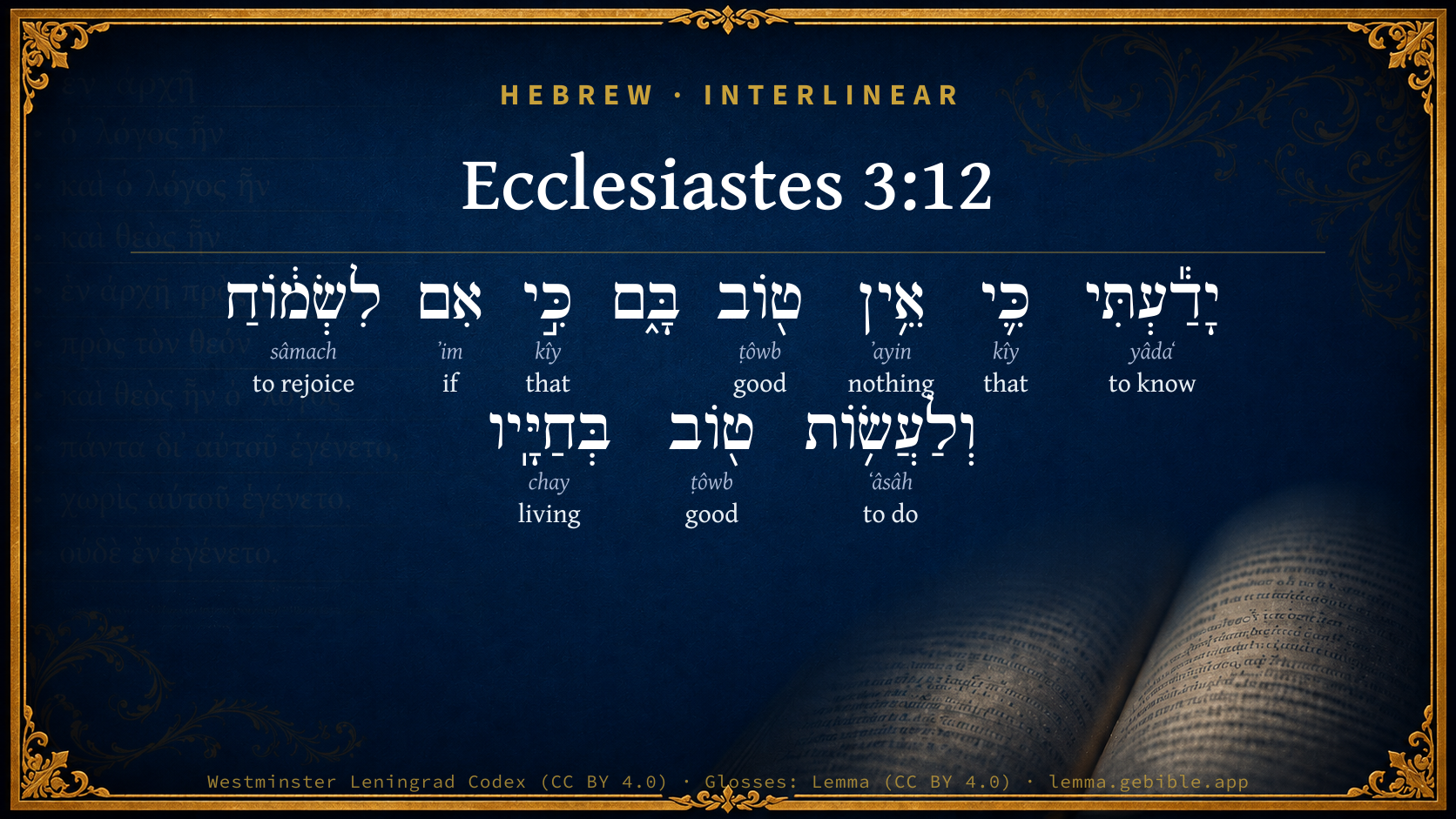
Hebrew (Westminster Leningrad Codex) Ecclesiastes 3:12 appears in the Hebrew Old Testament. The text above is from the Westminster Leningrad Codex. Each word links to its Strong’s number, a concise gloss, and parsing drawn from the Open Scriptures Hebrew Bible morphology. Click any word for its full Brown-Driver-Briggs (BDB) entry.
Download image
Cite this verse

Ecclesiastes 3:12 (World English Bible). Public Domain. Lemma interlinear Bible study tool, https://lemma.gebible.app/v/ecclesiastes/3/12.

Show BibTeX & RIS
BibTeX
RIS
English Translation
I know that there is nothing better for them than to rejoice, and to do good as long as they live.
World English Bible · Public Domain
Download a study sheet

One document with this verse’s original text, its word-by-word gloss line, the meaning frame, cross-references with their text, attributed commentary, and full source and license credits — printable, and it pastes into notes with its structure intact.

This verse Autodidact and up

Study sheet (.html) Plain text (.txt)

A passage Seminary Student

Up to 50 verses in one chapter. A passage sheet keeps up to 6 commentary sources and 12 cross-references per verse, in the order this page ranks them, and says so on the sheet whenever that leaves anything out. Ask for a single verse and you get the Autodidact verse sheet above.

Everything on this page stays free to read, with no account — the sheet is a download of what is already on screen, not access to it.

Want to remove ads? Support Godless Engineer
Compare translations 3

The same verse in 3 English versions, stacked beneath the original-language interlinear above. Click any original word for its lexicon entry.

Each is an independent rendering of the whole verse — the interlinear is not word-aligned to these translations.

Highlighted words mark where these versions differ — a whole-verse word diff, not a word-by-word alignment.

  • World English Bible Public Domain
    I know that there is nothing better for them than to rejoice, and to do good as long as they live.
  • King James Version Public Domain
    I know that there is no good in them, but for a man to rejoice, and to do good in his life.
  • unfoldingWord Literal Text CC BY-SA 4.0
    I know that there is no good for them except to rejoice and to do good during his life,

unfoldingWord Literal Text — © unfoldingWord, licensed CC BY-SA 4.0. Word-aligned USFM3 via Door43 (git.door43.org/unfoldingWord/en_ult).

Versions to compare (up to 4)

3 of 4 selected

Show all 18 translations

Every available English version of this verse, each an independent rendering of the whole verse.

  • World English Bible Public Domain
    I know that there is nothing better for them than to rejoice, and to do good as long as they live.
  • Berean Standard Bible Public Domain
    I know that there is nothing better for them than to rejoice and do good while they live,
  • Majority Standard Bible Public Domain
    I know that there is nothing better for them than to rejoice and do good while they live,
  • King James Version Public Domain
    I know that there is no good in them, but for a man to rejoice, and to do good in his life.
  • American Standard Version (1901) Public Domain
    I know that there is nothing better for them, than to rejoice, and to do good so long as they live.
  • Revised Version (1885) Public Domain
    I know that there is nothing better for them, than to rejoice, and to do good so long as they live.
  • Geneva Bible (1599) Public Domain
    I know that there is nothing good in them, but to reioyce, and to doe good in his life.
  • Douay-Rheims (1899) Public Domain
    And I have known that there was no better thing than to rejoice, and to do well in this life.
  • Young's Literal Translation Public Domain
    I have known that there is no good for them except to rejoice and to do good during their life,
  • Literal Standard Version CC BY-SA 4.0
    I have known that there is no good for them except to rejoice and to do good during their life,
  • Unlocked Literal Bible CC BY-SA 4.0
    I know that there is nothing better for anyone than to rejoice and to do good so long as he lives—
  • unfoldingWord Literal Text CC BY-SA 4.0
    I know that there is no good for them except to rejoice and to do good during his life,
  • Darby Bible Public Domain
    I know that there is nothing good for them but to rejoice and to do well in their life;
  • World Messianic Bible Public Domain
    I know that there is nothing better for them than to rejoice, and to do good as long as they live.
  • Webster's Bible Public Domain
    I know that there is no good in them, but for a man to rejoice, and to do good in his life.
  • Free Bible Version CC BY-SA 4.0
    I concluded that there's nothing better than being happy and looking for the good in life.
  • Bible in Basic English Public Domain
    I am certain that there is nothing better for a man than to be glad, and to do good while life is in him.
  • JPS Tanakh (1917) Public Domain
    I know that there is nothing better for them, than to rejoice, and to get pleasure so long as they live.

Literal Standard Version (2020), Covenant Press — licensed CC BY-SA 4.0. Text via the HelloAO Bible API (eBible.org). Unlocked Literal Bible (unfoldingWord) — licensed CC BY-SA 4.0. Text via the HelloAO Bible API (eBible.org). unfoldingWord Literal Text — © unfoldingWord, licensed CC BY-SA 4.0. Word-aligned USFM3 via Door43 (git.door43.org/unfoldingWord/en_ult). Free Bible Version, Dr. Jonathan Gallagher — licensed CC BY-SA 4.0. Text via the HelloAO Bible API (eBible.org).

Word by word

More ways to search: Search by grammar → Find every occurrence → Compare this word →

Practice this passage: Drill this verse → Learn its vocabulary →

לִשְׂמ֔וֹחַ
sâmach
H8055
“to rejoice”
Preposition + Verb, Qal, Infinitive Construct
Part of Speech
Preposition + Verb
Stem
Qal
Form
Infinitive Construct
Full BDB Definition

Origin: a primitive root

TWOT: 2268

to rejoice, be glad - (Qal) - to rejoice - to rejoice (arrogantly), exult (at) - to rejoice (religiously) - (Piel) to cause to rejoice, gladden, make glad - (Hiphil) to cause to rejoice, gladden, make glad
  1. יָדַ֕עְתִּי yâdaʻ H3045 “to know” Verb, Qal, Perfect, 1st Person, Common, Singular
  2. כִּ֛י kîy H3588 “that” Conjunction
  3. אֵ֥ין ʼayin H369 “nothing” Particle, Negative
  4. ט֖וֹב ṭôwb H2896 “good” Adjective, Adjective, Masculine, Singular, Absolute
  5. כִּ֣י kîy H3588 “that” Conjunction
  6. אִם ʼim H518 “if” Conjunction
  7. וְלַעֲשׂ֥וֹת ʻâsâh H6213 “and · to do” Conjunction + Preposition + Verb, Qal, Infinitive Construct
  8. ט֖וֹב ṭôwb H2896 “good” Adjective, Adjective, Masculine, Singular, Absolute
  9. בְּחַיָּֽיו chay H2416 “in/at · living things · his” Preposition + Noun, Common, Masculine, Plural, Construct + Suffix, Personal, 3rd Person, Masculine, Singular

About this verse

These counts appear in no published source. They are computed here, from the morphology-tagged text and Lemma’s own curated glosses. What Lemma adds →

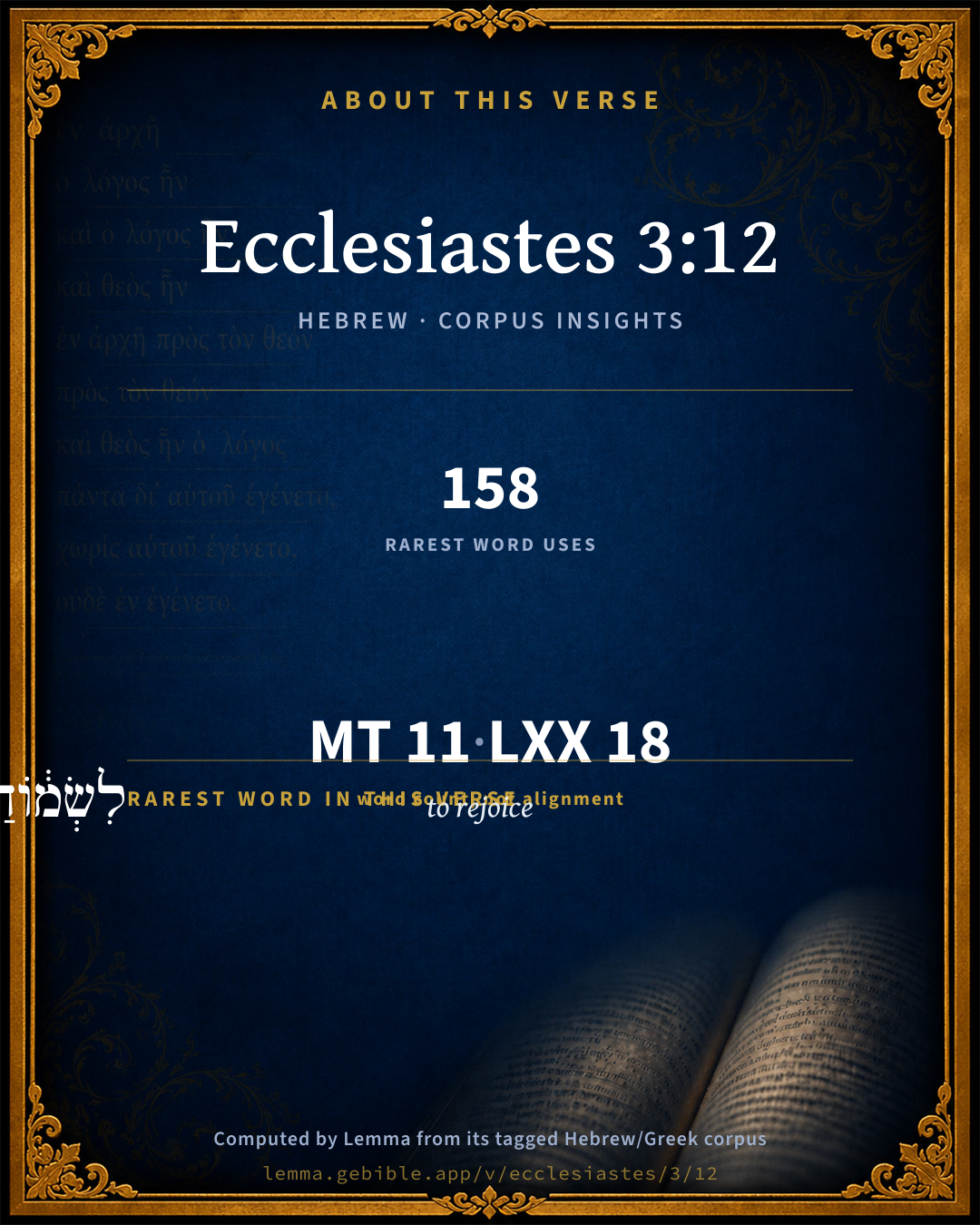
11
words
8
distinct lemmas
Wisdom
section

Grammatical profile

  • 3 verbs
  • 1 noun
  • 2 adjectives
  • 1 preposition
  • 3 conjunctions
  • 1 particle

Verb forms

  • יָדַ֕עְתִּי Qal · Perfect
  • לִשְׂמ֔וֹחַ Qal · Infinitive Construct
  • וְלַעֲשׂ֥וֹת Qal · Infinitive Construct

Repetition

Words recur within this verse — often emphatic in Hebrew:

  • ט֖וֹב good H2896 ×2
  • כִּ֛י that H3588 ×2

Hebrew & Septuagint length

In English translation the verse runs 21 words from the Hebrew and 22 from the Septuagint (LXX English) — closely comparable.

A rough comparison of the two English renderings, which tokenize alike — not a word-level alignment.

Word counts can differ between the Hebrew and the Greek without any difference in meaning — e.g. the Hebrew direct-object marker אֵת has no separate Greek word, and Greek often adds the article ὁ.

In the original languages it is 11 Hebrew tokens and 18 Greek tokens — but the two are counted differently (Hebrew bundles its prefixes and suffixes into one token; the Greek is in lemma form), so that isn’t a like-for-like length.

Cross-references

10

Topical passages linked to Ecclesiastes 3:12 in the Treasury of Scripture Knowledge — connected by theme and wording, ordered by reader-vote popularity; previews shown in the World English Bible.

  • Psalms 37:3 Trust in Yahweh, and do good. Dwell in the land, and enjoy safe pasture.
  • Ecclesiastes 3:22 Therefore I saw that there is nothing better, than that a man should rejoice in his works; for that is his portion: for who can bring him to see what will be after him?
  • 1 Timothy 6:18 that they do good, that they be rich in good works, that they be ready to distribute, willing to communicate;
  • Philippians 4:4–9 Rejoice in the Lord always! Again I will say, Rejoice!
  • 1 Thessalonians 5:15–16 See that no one returns evil for evil to anyone, but always follow after that which is good, for one another, and for all.
  • Isaiah 64:5 You meet him who rejoices and works righteousness, those who remember you in your ways: behold, you were angry, and we sinned: in them [have we been] of long time; and shall we be saved?
  • Luke 11:41 But give for gifts to the needy those things which are within, and behold, all things will be clean to you.
  • Acts 20:35 In all things I gave you an example, that so laboring you ought to help the weak, and to remember the words of the Lord Jesus, that he himself said, 'It is more blessed to give than to receive.'"
  • Deuteronomy 28:63 It shall happen that as Yahweh rejoiced over you to do you good, and to multiply you, so Yahweh will rejoice over you to cause you to perish, and to destroy you; and you shall be plucked from off the land where you go in to possess it.
  • Ecclesiastes 9:7–9 Go your way--eat your bread with joy, and drink your wine with a merry heart; for God has already accepted your works.

Cross-references courtesy of OpenBible.info (CC BY 4.0).

Hebrew and Greek witnesses Masoretic Hebrew ↔ Greek Septuagint

The same verse in the two great witnesses to the Old Testament, shown verse-for-verse.

These are two independent witnesses, not word-aligned to each other, and the Septuagint is shown in lemma (dictionary) form.

Hebrew Ecclesiastes 3:12 Masoretic · Westminster Leningrad Codex

יָדַ֕עְתִּי כִּ֛י אֵ֥ין ט֖וֹב בָּ֑ם כִּ֣י אִם לִשְׂמ֔וֹחַ וְלַעֲשׂ֥וֹת ט֖וֹב בְּחַיָּֽיו

I know that there is nothing better for them than to rejoice, and to do good as long as they live.

World English Bible · Public Domain

Greek LXX Ecclesiastes 3:12 Septuagint · lemma form

γιγνώσκω ὅτι οὐ εἰμί ἀγαθός ἐν αὐτός εἰ μή ὁ εὐφραίνω καί ὁ ποιέω ἀγαθός ἐν ζωή αὐτός

I know that there is no good in them, except for a man to rejoice, and to do good in his life.

LXX2012 (modern English Septuagint) · Public Domain

On this verse, The Pulpit Commentary discusses the Septuagint’s reading. Read the note in Commentary ↓

Hebrew: Westminster Leningrad Codex (CC BY 4.0). Greek: Septuagint (public domain); English from LXX2012 (modern English Septuagint) (Public Domain). How the Septuagint differs from the Hebrew →

Commentary

Notes on Ecclesiastes 3:12 from classic Christian and Jewish commentators (each source and its license shown beneath its notes). The classic Christian expositions comment on the surrounding passage and are grouped to its opening verse, so a note may address several verses; the Jewish commentaries on the Tanakh (Rashi and others) are per-verse, so they appear only where the commentator wrote on this verse.

Lemma curates 59 commentaries, every one of them public domain or Creative Commons licensed, each selected and text-cleaned for this edition rather than reprinted as found. About our sources →

Trapp's Complete Commentary

John Trapp

Ecc 3:12 I know that [there is] no good in them, but for [a man] to rejoice, and to do good in his life.

Ver. 12. I know that there is no good in them,] i.e., No other good, but for a man to rejoice and do good in his life - i.e., Frui praesentibus et facere quod infuturo prosit, {a} to enjoy things present, and to do that which may do him good a thousand years hence; to expend what he hath upon himself, and to extend it unto others that are in necessity, this is to "lay up in store for himself a good foundation against the time to come"; this is to "lay hold upon eternal life." {1Ti 6:18-19}

{a} Glossa Minor.

John Trapp, A Commentary or Exposition upon All the Books of the Old and New Testament (1647–1656) — public domain. Text from a community e-Sword module.

The Biblical Illustrator

Joseph S. Exell

Ecc_3:12

I know that there is no good in them, but for a man to rejoice, and to do good in his life.

Doing good and rejoicing

Solomon proposes two things to our practice, if we intend to live happily and comfortably in this world. First, that we do good; and, secondly, that we rejoice. I must invert the order in which the words stand in the text, because doing good is the reason why we rejoice; and to be sure there can be no true joy or comfort in possessing or using any worldly blessings, unless we can satisfy ourselves that we have done good with them. Doing good is a work of that known excellency in itself, yielding such sweetness and complacency in the practice of it, is so agreeable to the consent and opinion of all mankind in general, and so well pleasing and acceptable with God Himself, the grand Exemplar of doing good, that they must entirely have lost the principles of good nature, of improved reason, and revealed religion, who take care for none but themselves, regard not how it fares with others, so they may live in ease and plenty. Doing good is a public benefit, a great advantage to the world, and to the common state of mankind. Doing good, lastly, is a work of so large and comprehensive an extent, that high and low, rich and poor, learned or unlearned, may improve those talents God hath been pleased to entrust them with to His honour, and to the good of others; so that for me to go about to tell you what it is to do good, and wherein it consists, would be an endless task. However, superseding the most common acceptation of the phrase, of doing good by charity, and giving of alms, I shall reduce it to doing good to the benefit and advantage of the public; a subject no way unseasonable at all times, but more especially in these.

1. Men may do good by being diligent and industrious in their proper callings and particular employments, thereby rendering themselves very profitable members of a commonwealth. If we consult history, we shall find that the best men have all along been the most industrious in their respective places and offices; the worthy patriarchs, the holy prophets, the blessed apostles have been very exemplary and eminent in their doings for the service of God, and the benefit of mankind; nay, the angels are ever on the wing, in a readiness to receive and go upon Gods commands.

2. Men in public authority may do good by being careful, diligent and conscientious in the faithful discharge of those trusts and offices unto which they are called. That man who has a heart to act according to his duty is a public blessing, a man of great courage and resolution, aiming at nothing more than the glory of God and the public good; being always disposed in all his dealings to have a principal regard to the rules of his duty, and the dictates of his conscience, without being swayed by any appetite or passion, by any sinister respect to his own private interest, to the commission of any unworthy or base action, but acteth from good principles, and aims at good ends, without partiality, or distinguishing between public or private; can satisfy himself in his own conscience, and justify to all the world that his designs are truly good, and that whatever he doth, he doth all to the glory of God, and to the benefit of those over whom he presides. This is a reason why our Heavenly Father in His dispensations entrusts some with greater outward advantages than others, that they may have fairer opportunities of doing good. They are set up in the world as burning lights and visible examples to others, to recommend goodness to the minds and consciences of men by their own practice and conversation. I come now to the consequence of doing good, for a man to rejoice. By rejoicing, here we mean a constant habit of joy and cheerfulness, being always contented and well pleased, always free from those anxieties and uncomfortable reflections which render the life of man miserable and uneasy; virtue and innocence, a behaving ourselves so in the world that our consciences shall not reproach us. It is in vain to think of any true joy or peace without doing good. How pleasant and comfortable is it to us while we live, that sensible impression of delight which accompanies the duty at present, is proportionable to the necessity and strict injunction laid upon us to perform it; there is a sweet complacency in doing good, and being kind to those that want, for if even the bare wishes and desires of doing good, when out of our power, afford the well-wisher some degree of peace and content, and we can satisfy ourselves with the sincerity of our designs and purposes, then certainly when we can bring those wishes and desires to good effect, there cannot but be a spring of joy and pleasure arising in the soul, such an overflowing of the spirits as is not to be expressed in terms or words, and no one can fully understand it, but they that have been ravished with it. Our Saviour, we may observe throughout the Gospel, went about doing good; He coveted to spend His beams, rejoiced to spread His healing wings over every place He came to. And what delight do we find when we imitate Him! What inward peace and serenity of mind doth it raise, when love fills the heart, and stretches out the hand, when we carry about us the mercies of the Lord, are sent from the mercy-seat with comfort and relief to them that want both. How are we ourselves filled with joy and gladness, having had the honour and privilege of being in Gods stead to our brother at time of need; neither is this joy and satisfaction peculiar only to charity and relieving the poor and needy, but to all other actions and designs of doing good, upon what account soever, especially to those which are done for the public, for the honour and prosperity of Church and State. It is a favour that God gives us opportunities as well as abilities of doing good, and He hath allowed us to reap the profit and pleasure which redound from such good actions as long as we live; He seldom fails in this world amply to repay what good we do by outward blessings in the ordinary dispensations of His providence either one way or other, or it may be to our children after us. But it ends not here; this world lasts but a while, and we have souls that must live for ever. If, therefore, men have any kindness for them, if they mean not to undo them to all eternity, it is absolutely necessary that they should do good; let us then be all persuaded to labour and study to do good; let us be daily giving evidences to the public of our good dispositions towards it. (W. Baldwin, M. A.)

Life enjoyed and improved

All our temporal possessions are only valuable as they are expended upon ourselves or others; either as they aid our own comfort or advance the welfare of our fellow-creatures. Let me then call upon you--

I. To rejoice in them.

1. Let me begin with two cautions.

(1) The first regards justice. See that what you enjoy is your own. Owe no man anything. It was well said by Lord Mansfield, that for one cruel creditor, there were a hundred cruel debtors.

(2) The second regards moderation. You can never suppose that God requires, or even allows, intemperance. Watch and pray, lest ye enter into temptation.

2. After having cautioned you, allow me to admonish. If you would rejoice in the good things which God gives you under the sun--

(1) Cherish a grateful sensibility. Some receive all their mercies like the beasts that perish. The animal only is gratified in them.

(2) Guard against habitual discontent. To possess is not to enjoy. Many possess much and enjoy nothing.

(3) Shun avaricious and distrustful anxiety.

(4) Entertain no harsh and superstitious views of religion.

(5) Seek after a knowledge of your reconciliation with God.

II. To do good.

1. What good can these things enable us to do?--It is of three kinds.

(1) They enable us to do religious good. This is the chief.

(2) They enable us also to do intellectual good.

(3) They enable us to do corporeal good: by which we mean, that which immediately regards the body, though the mind will also derive comfort from it.

2. In what manner are we to do it?

(1) Immediately, and with diligence.

(2) Extensively, and with impartiality.

(3) Perseveringly, and without declension.

3. Why we should be concerned to accomplish it.

(1) Because the bounties of Providence were conferred upon us for this very purpose.

(2) Because God hath commanded it.

(3) Gratitude requires it.

(4) Profit requires it. What is it that attaches one man so powerfully to another, and gives him a resource in the tears, the prayers, the attentions of his fellow-creatures in the day of evil?

(5) Pleasure requires it. If you are strangers to the pleasures of benevolence, you are to be pitied; for you are strangers to the most pure, the most durable, the most delicious, the most satisfactory, the most God-like, pleasures to be enjoyed on this side heaven. (W. Jay.)

The Biblical Illustrator, edited by Joseph S. Exell (c. 1880s–1900s) — public domain. Text from a community e-Sword module.

Joseph Benson's Commentary

Ecc 3:12-13. I know — By clear reason, and my own long and certain experience; that there is no good in them — No other satisfaction or felicity that a man can enjoy in creatures or worldly things; but for a man to rejoice and to do good — To employ them freely and cheerfully in acts of charity and liberality toward others, or to use them to the glory of God, living in his fear, which is necessary to the happiness of this as well as of the other life. And also that every one should eat, &c. — Use what God hath given him. See the note on Ecc 2:24.

Joseph Benson's Commentary on the Old and New Testaments (1811–1818) — public domain. Text from a community e-Sword module.

The Preacher's Complete Homiletical Commentary

Joseph S. Exell (gen. ed.)

CRITICAL NOTES.—

Ecc_3:12. For who knoweth the Spirit of man that goeth upward.] Man has no distinct and certain knowledge of his own future destiny, or of that of other forms of life. The subject is altogether beyond the range of human experience. Like God Himself, the future state is unseen and unknown by us. We can indeed apprehend both these truths by faith; yet, from the mere human standpoint, we may reason with equal plausibility, so far as outward appearances are concerned, for or against immortality.

Ecc_3:14. It shall be forever.] God’s order is fixed—His law is eternal.

Ecc_3:15. God requireth that which is past.] Literally, God seeketh that which was crowded out. Thus God seeks out again what the revolutions of history have pushed back into the past, as if it were entirely done with. The meaning is—that the past ages of wrong and unjust suffering shall be called up again. God will investigate the case of those who have been persecuted.

MAIN HOMILETICS OF THE PARAGRAPH.—Ecc_3:12-15

THE WAY TO FRONT OUR DESTINY

I.—By a cheerful acceptance of our Providential lot. We should wisely use the gifts of God, and rejoice in them. (Ecc_3:12-13.) This will give to life the smoothness of contentment, and the comfort of resignation. Such is the greatest good that we can extract from life. Whatever our lot may be, let us accept it with cheerfulness, and receive whatever good it offers. This is the wisest course for man.

1. To fret and worry ourselves is useless. We cannot contend with the inevitable, nor rectify the apparent perversity of things. It will be best to allow God to arrange all for us.

2. A rebellious temper hinders the course of true happiness. If we murmur against the appointments of God, we are only adding an unnecessary burden to life, and sending the iron of affliction deeper into the soul. Unless we have sympathy with the Supreme Ruler, all must be unpleasant to us. A sour, complaining disposition would make true happiness impossible.

3. The power to enjoy the good of this life is the gift of God. There may be even a refined enjoyment of life, which is not godly. But the sober and joyful use of the provisions of Providence, while keeping in mind the higher aims of existence, is a special gift of heaven.

II.—By a practical recognition of the high claims of duty. “To do good in his life.” (Ecc_3:12.) This will make the appointments of Providence grateful and delightful to us. We can make even our trials and vexations the occasions of cheerful and devoted service—the school wherein our graces are refined and perfected. Thus we can maintain an heroic bearing against the hardest fate.

1. Doing good brings a man into sympathy with the Supreme Disposer of all things. We are thus imitating God Himself, and, in any case, this must put us into the best position. To do good is to enjoy some of the pleasures of the Highest.

2. Whatever else may be mysterious, our present duty is always clear. The reasons of God’s dealings are obscure, and the ways of Providence seem altogether a tangled maze: but our duty is written in clear outline, quite obvious and familiar. To follow therefore what is clearly known is the surest means to lead us to further knowledge, and solution of mystery. If we are faithful to the light we have, a superior light will be granted us, in which all things will be transfigured.

3. The faithful discharge of duty is the only lasting foundation for solid joy. There is a joy of the world which glitters, but it is not lasting. It is like the sparkle of shallow streams as the water flows over the pebbles, or like the dispersion of it in foam. But the joy that God gives is powerful and deep. The reason is, that the only lasting joy is that which arises from a good conscience. Righteousness gives peace, and peace is the true home of joy.

III.—By an acknowledgment of the inflexible rule of the Divine Government. (Ecc_3:14.) God’s ways in the government of the world are not by the method of trial and failure, by added light from experience. They are all fixed from the beginning.

1. God’s counsels are for ever. They are sure from eternity, and cannot be set aside. This seems an iron rule only to the rebellious. The good have nothing to fear from the wise ordering of Him who is perfect in knowledge, and infinite in mercy. Such are ready with joy to front their destiny.

2. God’s counsels are so certain that they are not complicated with our human distinctions of time. (Ecc_3:15.) We speak of time—past, present, and future. Our weak faculties need such a device as this. But to the Infinite Intelligence “an eternal now does ever last.” All things are eternally present to Him, and with one quick glance He sees from the beginning to the end. The past lives now—the future is already here.

IV.—By recognising the righteous ends contemplated by the Divine Government. (Ecc_3:14-15, latter part.) There are certain ends which the Supreme Ruler proposes to Himself in His administration. These are of a practical nature; they relate to human conduct, and as such are revealed. The methods of the Divine Government are designed—

1. To tame and subdue the heart of man. Men are “to fear before Him.” This want of mastery over the future tends to bring man to submission. He is convicted of ignorance, and the pride of knowledge is abated. He can never presume to be the God of God when his rebellion is proved to be a vain and hopeless attempt, and the future is kept in terrible reserve. The only sane result of the contemplation of the ways of Providence is resignation, humility, and the fear of God. It is madness for a man to dash his head against the iron walls of destiny. The course of Providence in the world is the great tamer of the human breast.

2. To vindicate the wrongs of His people. That which has fled away, and seemed to have escaped altogether, God will summon to His presence again. He will cause the great gulf of time to deliver up all that is in it. The past ages of wrong shall be called up again—reviewed and judged. Men think when they have persecuted the righteous that all is done with. They have silenced the testimony of truth. They have triumphed over the meek. But the end will come, and a day of reckoning, when the wrongs and oppressions of the past shall utter their voice, emphatic, decisive, and terrible. The Christian knows that his “Vindicator” liveth—that the time must come when all wrongs shall be adjusted, and all precedency set right.

SUGGESTIVE COMMENTS ON THE VERSES

Ecc_3:12. There is no lasting good in the things of this life; yet a joyful heart lends a beauty and grace to those fading and vanishing delights.

Doing good should always go hand in hand with joy; because good deeds spring from love, and joy is but the recreation of love.

Duty is the watchword of humanity, the herald of progress, the pledge of final emancipation. In the confusion and general uproar of things that amaze our ears, the voice of duty is clearly heard, and calls us to the skies.

When good actions become pleasant to us, then joy is the very sinews of duty.

Active goodness and joy are Godlike properties, for He is the unwearied worker of good, and the Blessed One.

They whose hearts are cheered by the proofs of the Lord’s bounty in His dealing with them, and do express that cheerfulness by their activity in duties that may honour Him; they have found that true good which is attainable in this life [Nisbet].

Ecc_3:13. The purest earthly joys are those which are won by toil. What we passively receive stirs up only a languid feeling. The idle and luxurious blunt the edge of joy.

It requires peculiar skill to use creature comforts wisely and well. This power is the gift of God.

The means of our common sustenance are turned into manna by a joyful spirit, and the remembrance of the giver.

When the gifts of God are not cheerfully acknowledged and enjoyed, our table becomes a snare.

Ecc_3:14. As the omnipotency of God is without defect, so the counsel of God is without change. For how can there be any change in Him to whom nothing is past, or to come, but all things are present? [Jermin.]

Men form opinions which change in the different situations of the mind through the course of time. It has been said that opinion is but knowledge in the making. It is but provisional where absolute certainty cannot be attained. But the thoughts of God stand “to all generations.”

The whole scheme of an Oriental court, and eminently that of the Great King, was laid out on the idea that it was the visible representation of the court of heaven, and the king himself a visible incarnation of the highest God. The sense of this speaks out in every arrangement, in the least, as in the greatest, and is the key to them all. Thus, the laws of that kingdom, when once uttered, could not be reversed or changed (Dan_6:8), because the king who gave them was the incarnation of God, and God cannot repent, or alter the thing which has gone out from His lips [Trench].

The thought of the perfection of God’s plan raises our admiration, but, at the same time, inspires a wholesome fear. There is behind all a mysterious and terrible power which we may well fear to offend.

Fear should be the instrument of caution, and the sentinel of loving obedience.

The works of God are so perfect that no improvement can be made, and, left to themselves, they will be perpetual. How true is this regarding God’s greatest work—redemption! What more could He have done to make it a great salvation than what He has already done? Or what feature of the glorious plan could we afford to want? And now that He has Himself pronounced it a “finished” work, what is there that man can put to it? What is there that he dare take from it? And in doing it He has done it “for ever” [Dr. J. Hamilton].

Ecc_3:15. In all the seeming irregularities of Divine Providence, there are fixed principles which are never departed from. And thus it is that a science of history is possible. So certain is God’s method of procedure, that though we know not the special events of the future, we can predict the results of great principles.

The future will be but a repetition of the past. Thus the course of humanity through time may be likened to the movements of the solar system. The planets run their fixed cycles, and go over the same paths again. Yet there is with all these movements another by which the whole system is itself travelling in space. So human history, though revealing a perfect sameness from age to age, may yet be travelling towards some certain goal.

The deeds of oppression, cruelty, and wrong have not passed away for ever. God will seek them out again, and measure their deserts. The persecutors of the righteous cannot hide themselves even in the abyss of time.

THE IMPOTENCE OF TIME

Time has not done much, notwithstanding all; “for that which hath been is now.” This language will apply—

I. To all the elements of material existence. The forms of the material world are constantly changing, but the elements, of which the first types of all were formed, are the same. The raw materials, out of which the principle of life constructs its organs, and weaves its garments from age to age, are always here. Time, through all its mighty revolutions, cannot destroy an atom.

II. To all the spirits of mankind. All human souls that ever have been are now. Not one of the mighty millions who spent his short and misty day of life under these heavens is lost. All are thinking, feeling, acting, still. Their bodies are dust, but their bodies were theirs, not they; their instruments, not themselves.

“Distinct as is the swimmer from the flood,

The lyrist from his lyre.”

III. To all the general types of human character. All the varieties of human character may be traced to five or six different regal sympathies. There is the inordinate love of pleasure, the undue love of gain, the vain love of show, the mere love of inquiry, the inordinate love of power, the false love of religion, the holy love of God. All these great types of character have been here almost from the earliest dawn of history. Herods and Hamans, Athenians and Pharisees, seem to be living again in every age.

IV. To all the principles of the Divine Government. All the principles by which both the physical and moral provinces have been controlled from the beginning are the same now as ever. Harmony with God’s laws is the creature’s highest de stiny. Rebellion against them is his inevitable ruin. They neither pause nor change, either for angels or men.

V. To the grand design of all things. This must ever be the holy development of creature-minds in gratitude, reverence, love, and assimilation to Himself.

VI. To the recollections of the human memory. Memory gathers up every fragment of all “that hath been,” so that none may be lost. The history of man is recorded, not in books, but in souls.

VII. To all the conditions of man’s well-being. Physical, intellectual, spiritual [Homilist].

The Preacher's Complete Homiletical Commentary (gen. ed. Joseph S. Exell; Funk & Wagnalls, c. 1892) — public domain (pre-1929). A full-Bible homiletical/sermon-outline anthology covering 65 of 66 books (2 John is absent from the source module). Text from a community e-Sword module.

Tyndale Open Study Notes

Tyndale Open Resources

3:12-13 be happy and enjoy: Though life and work can be burdensome, the Teacher’s conclusion (repeated from 2:24) can still hold true.

Tyndale Open Study Notes — © Tyndale Open Resources, licensed CC BY-SA 4.0. Text via the HelloAO Bible API.

Jamieson, Fausset & Brown

Robert Jamieson, A. R. Fausset & David Brown

in them--in God's works (Ecc 3:11), as far as relates to man's duty. Man cannot fully comprehend them, but he ought joyfully to receive ("rejoice in") God's gifts, and "do good" with them to himself and to others. This is never out of season (Gal 6:9-10). Not sensual joy and self-indulgence (Phi 4:4; Jam 4:16-17).

Jamieson, Fausset & Brown — Commentary Critical and Explanatory on the Whole Bible (1871) — public domain (CC PDM 1.0). Text via the HelloAO Bible API.

Adam Clarke's Commentary

Verse 12. I know that there is no good in them, but, c.] Since God has so disposed the affairs of this world, that the great events of providence cannot be accelerated or retarded by human cares and anxieties, submit to God make a proper use of what he has given: do thyself no harm, and endeavour as much as possible to do others good.

Enjoy, and bless thyself; let others share

The transient blessing: 'tis the gift of God.

Adam Clarke's Commentary on the Bible (1810–1826) — public domain. Text from a community e-Sword/MySword module.

Ellicott's Commentary for English Readers

(12) I know.—Literally, I knew: i.e., I came to know. The writer is relating the conclusions at which he successively arrived.

To do good.—This phrase is always used elsewhere in a moral sense: “to act rightly.” When enjoyment is meant, the phrase used is, as in the next verse, “to see good;” but the context seems to require that this sense should be given to the phrase in this verse also.

A Bible Commentary for English Readers, edited by Charles John Ellicott (1878–1897) — public domain. Text from a community e-Sword module.

The Cambridge Bible for Schools and Colleges

gen. ed. J. J. S. Perowne

12. for a man to rejoice, and to do good] There is no instance in O. T. language of the phrase “do good” being used, like the Greek εὖ πράττειν, in the sense of “prospering,” or “enjoying one’s self,” and in ch. Ecc_7:20 it can only have its full ethical meaning, such as it has in Psa_34:14; Psa_37:3; Isa_38:3. On the whole, therefore, we are led to assign that meaning to it here. Over and above the life of honest labour and simple joys which had been recognised as good before, the seeker has learnt that “honesty is the best policy,” that “doing good” (the term is more comprehensive in its range than our “beneficence”) is in some sense the best way of getting good. It is not the highest ethical view of the end of life, but it was an advance on his previous conclusion.

The Cambridge Bible for Schools and Colleges (gen. ed. J. J. S. Perowne; Cambridge University Press, 1878–1918) — public domain. Text from a community e-Sword module.

John Gill's Exposition

I know that there is no good in them,.... In these things; as the Arabic version; in the creatures, as Jarchi; in all sublunary enjoyments; in everything the wise man had made a trial of before, as natural Wisdom and knowledge, worldly pleasure, riches, and wealth; the "summun bonum", or happiness of men, did not lie in these things; this he knew by experience, and had the strongest assurance of it: or in them, that is, the children of men, as the Targum: there is no real good thing in them, nor comes out of them, nor is done by them; they cannot think a good thought, nor do a good action, of themselves. Or rather the sense is, I know there is nothing better for them than what follows:

but for a man to rejoice; not in sin and sinful pleasures, in a riotous, voluptuous, and epicurean manner; but to be cheerful, and enjoy the blessings of life in a comfortable way, and with a thankful heart; and especially to rejoice in spiritual things, and above all in Christ; and not in any self-boastings or carnal confidences, all such rejoicing is evil; see Ecc 9:7. The Targum is,

"but that they rejoice in the joy of the law;''

but it is much better to rejoice in the things of the Gospel, which is indeed a joyful sound;

and to do good in his life: to himself and family, by making use of the good things of life, and not withholding and hoarding them up; and to others, to all men, as opportunity offers, and especially to the household of faith; and not only by liberality and alms deeds, but by doing all good works, from right principles and to right ends, and that always, as long as he lives, Gal 6:9.

John Gill's Exposition of the Whole Bible (1746–1763) — public domain (CC PDM 1.0). Text via the HelloAO Bible API.

Albert Barnes' Notes on the Bible

In them - i. e., in the sons of men.

To do good - In a moral sense. Physical enjoyment is referred to in Ecc 3:13.

Albert Barnes' Notes on the Bible (1834–1885) — public domain. Text from a community e-Sword/MySword module.

Haydock's Catholic Bible Commentary

Well; virtuously: or, perhaps, as literally, to enjoy himself, ver. 13. (Calmet) --- Thus thinks the man of pleasure, Isaias xxii. 31. (St. Jerome)

George Leo Haydock (1774–1849), Haydock's Catholic Family Bible and Commentary, 1859 edition — public domain. Excludes Psalms (Douay-Rheims chapter numbering differs from Protestant) and Deuterocanonical books (Catholic canon only).

Matthew Poole's English Annotations

I know, by clear reason, and my own long and certain experience,

that there is no good, no other satisfaction or felicity which a man can enjoy, in them, in creatures or worldly enjoyments. To do good; either,

1. To himself, as it is fully expressed, Psa 49:18. Or,

2. To others; to employ them in acts of charity and liberality towards others. Or,

3. Towards God; to use them, and to live in the fear of God, which is necessary to the happiness of this as well as of the other life.

Matthew Poole's English Annotations on the Holy Bible (1683–1685) — public domain. Text from a community e-Sword/MySword module.

Whedon's Commentary on the Bible

Daniel D. Whedon

12. I know — Hebrew, I came to know. Koheleth continues to state the result of his inspection. In them should be for “them,” as occurs in other places in this book; that is, for the children of men. To do good, here, is not to do right, or to be beneficent, but to do well to one’s self.

Daniel D. Whedon (gen. ed.), Commentary on the Old and New Testaments (1874–1909) — public domain. Text from a community e-Sword module.

The Pulpit Commentary

I know that there is no good in them, but for a man to rejoice; rather, I knew, perceived, that there was no good for them; i.e. for men. From the facts adduced, Koheleth learned this practical result that man had nothing in his own power (see on Ecc_2:24) which would conduce to his happiness, but to make the best of life such as he finds it. Vulgate, Cognovi quod non esset melius nisi laetari. To do good in his life; Tou poiein ajgaqon; (Septuagint); Facere bene (Vulgate). This has been taken by many in the sense of "doing one"s self good, prospering, enjoying one"s self." like the Greek eu prattein, and therefore nearly equivalent to "rejoice" in the former part of the verse. But the expression is best taken here, as when it occurs elsewhere (e.g., Ecc_7:20) in a moral sense, and it thus teaches the great truth that virtue is essential to happiness, that to "trust in the Lord to depart from evil, and to do good", (Psa_36:3) will bring peace and content, (see in the epilogue, Ecc_12:13, Ecc_12:14) There is no Epicureanism in this verse; the enjoyment spoken of is not licentiousness, but a happy appreciation of the innocent pleasures which the love of God offers to those who live in accordance with the laws of their higher nature.

Vers. 12, 13, 22. (with Ecc_2:24)

The conclusion of folly or the faith of the wise?

In what catalogue shall we place these words of the text? On whose lips are they to be found? Are they

I THE REFUGE OF THE SKEPTIC? They may be such. The epicure who has lost his faith in God says, "Let us eat and drink; for to-morrow we die." There is no sacredness in the present, and no solid hope for the future. What is the use of aiming at a high ideal? Why waste breath and strength on duty, on aspiration, on piety? Why attempt to rise to the pursuit of the eternal and the Divine? Better lose ourselves in that which is at hand, in that which we can grasp as a present certainty. The best thing, the only certain good, is to eat and drink and to labor; is to minister to our senses, and to work upon the material which is visible to our eye and responsive to our touch. So speaks the skeptic; this is his miserable conclusion; thus he owns himself defeated and (we may say) dishonored. For what is human life worth when the element of sacredness is expunged, when piety and hope are left out of it? It is no wonder that the ages of unbelief have been the times when men have bad no regard for other people"s dues, and very little for their own. Or shall we rather find here

II AN ARTICLE, OF A WISE MAN"S FAITH? It is not certain what was the mood in which the Preacher wrote; but let us prefer to think that behind his words, actuating and inspiring him, was a true spirit of faith in God and in Divine providence; let us take him to mean what we know to be true that, in spite of all evidence to the contrary, a wise and loyal-hearted man will hold that there is much that is worth pursuing and possessing in the simple pleasures, in the daily duties, and in the ordinary services which are open to us all.

1. Daily God invites us to eat and drink, to partake of the bounties of his hand; let us appreciate his benefits with moderation and gratitude.

2. Daily he bids us go forth to "our work and to our labor until the evening;" let us enter upon it and carry it out in the spirit of conscientiousness and fidelity toward both God and man. (Col_3:23)

3. Daily God gives us the means of getting good to ourselves and doing good to others; let us eagerly embrace our opportunity, let us gladly avail ourselves of our privilege; so doing we shall make our life peaceful, happy, worthy.

In the light that shines into our hearts from the truth of Christ we judge:

1. That these lesser things pleasure, activity, acquisition are well in their way and in their measure. "Bodily exercise profiteth a little." But:

2. That human life has possibilities and obligations which immeasurably transcend these things; such, that to put these into the front rank and to fill our life with them is a fatal error. Made subordinate to that which is higher, they take their place and they render their service a place and a service not to be despised; but made primary and supreme, they are usurpers that do untold injury, and that must be relentlessly dethroned. C.

Vers. 12, 13.

Another condition of pure happiness.

In these words we have a repetition of the conclusion already announced (Ecc_2:24) as to the method by which some measure of happiness can be secured by man, but there is a very important addition made to the former declaration. Our author is referring to temporal things, and tells the secret by which the happiness they may procure for us is to be won. It consists of two particulars:

(1) a cheerful enjoyment of the gifts of God, and

(2) a benevolent use of them.

This latter is the addition to which I have referred. It is a distinct advance upon the previous utterance, as it introduces the idea of an unselfish use of the gifts which God has bestowed upon us an employment of them for the benefit of others less fortunately circumstanced than ourselves. "Over and above the life of honest labor and simple joys which had been recognized as good before, the seeker has learnt that "doing good" is in some sense the best way of getting good" (Plumptre). It may be that beneficence is only a part of what is meant by" doing good," but in the connection in which the phrase is here employed it must be a large part, because it evidently suggests something more as desirable than a selfish enjoyment of the good things of life. This twofold duty of accepting with gratitude the gifts of God and of applying them to good uses was prescribed by the Law of Moses; (Deu_26:1-14) and, to a truly pious mind, the one part of the duty will suggest the other. The thought that God in his bounty has enriched us, who are unworthy of the least of all his mercies, will lead us to be compassionate to those who are in want, and we shall find in relieving their necessities the purest and most exquisite of all joys. We shall in this way discover for ourselves the truth of that saying of our Lord"s, "It is mere blessed to give than to receive". (Act_20:35) While those who selfishly keep all they have for themselves fled that, however their goods increase, their satisfaction in them cannot be increased nay, rather that it rapidly diminishes. Hence it is that the apostle counsels the rich "to do good, to be rich in good works, to be ready to distribute, willing to communicate". (1Ti_6:17-19) The general teaching of the Scriptures, therefore, is in. harmony with the results of our own experience, and leads to the same conclusion, that "doing good" is a condition of pure happiness. J.W.

The Pulpit Commentary (1880–1919), ed. H.D.M. Spence-Jones & Joseph S. Exell — public domain. Text from a community e-Sword module.

John Wesley's Explanatory Notes

Them - In creatures or worldly enjoyments. To do good - To employ them in acts of charity and liberality.

John Wesley, Explanatory Notes Upon the Whole Bible (1754–1765) — public domain. Text via the GEBible commentary corpus.

Keil & Delitzsch

C. F. Keil & F. Delitzsch

"Thus I then perceived that among them (men) there is nothing better than to enjoy themselves, and indulge themselves in their life." The resignation would acquire a reality if לע טוב meant "to do good," i.e., right (lxx, Targ., Syr., Jer., Venet.); and this appears of necessity to be its meaning according to Ecc 7:20. But, with right, Ginsburg remarks that nowhere else - neither at Ecc 2:24, nor Ecc 3:22; Ecc 5:17; Ecc 8:15; Ecc 9:7 - is this moral rendering given to the ultimatum; also טוב ור, 13a, presupposes for לע טוב a eudemonistic sense. On the other hand, Zckler is right in saying that for the meaning of עשות תוב, in the sense of "to be of good cheer" (Luth.), there is no example. Zirkel compares εὖ πράττειν, and regards it as a Graecism. But it either stands ellipt. for לע לו טוב (= להיטיב לו), or, with Grtz, we have to read טוב לראות; in any case, an ethical signification is here excluded by the nearest connection, as well as by the parallels; it is not contrary to the view of Koheleth, but this is not the place to express it. Bam is to be understood after baadam, Ecc 2:24. The plur., comprehending men, here, as at Ecc 3:11, wholly passes over into the individualizing sing.

But this enjoyment of life also, Koheleth continues, this advisedly the best portion in the limited and restrained condition of man, is placed beyond his control: -

Keil & Delitzsch — Biblical Commentary on the Old Testament (1861–1891) — public domain (CC PDM 1.0). Text via the HelloAO Bible API. (Old Testament only.)

Kretzmann's Popular Commentary

Paul E. Kretzmann

The Nature of Human Happiness

v. 12. I know that there is no good in them, in the works of God given to men, but for a man to rejoice, in a cheerful use of the blessings of the Lord, and to do good In his life, to himself and to others in the proper use of God’s gifts, for this is one essential part of true human happiness.

v. 13. And also that every man should eat and drink, and enjoy the good of all his labor, it is the gift of God, and should be acknowledged as such with the proper thanksgiving.

v. 14. I know that, whatsoever God doeth, it shall be forever, for His works are established and upheld by His almighty power; nothing can be put to it, by the weak attempts of frail human beings, nor anything taken from it, they cannot interfere with His government; and God doeth it that men should fear before Him, for the contemplation of God’s works brings about a feeling of awe and reverence, together with the knowledge that the omniscience of God is familiar with even those things which men often believe hidden from His eyes.

v. 15. That which hath been is now, it was established by God’s creative act; and that which is to I, hath already been, in agreement with God’s plans before the creation of the world; and God requireth that which is past, literally, "God seeketh that which was driven away," restoring that which seemed changed and crowded out by the cycle of events in the history of the world.

v. 16. And, moreover, I saw under the sun the place of judgment, where the judges and rulers of men should dispense justice only, that wickedness was there; and the place of righteousness, that iniquity was there, perversion of justice by persons in authority being all too common.

v. 17. I said in mine heart, in meditating upon a possible change in the unfortunate conditions obtaining, God shall judge the righteous and the wicked, if not on this side of the grave, then in the last great Judgment; for there is a time there, in heaven above, for every purpose and for every work, for God is still supreme Sovereign in the universe.

v. 18. I said in mine heart concerning the estate of the sons of men, fallen mankind in general, that God might manifest them, that is, sift, test, prove them, and that they might see that they themselves are beasts, so far as their physical life and its end is concerned, they are on a level with brutes, that being the curse of vanity, the result of sin.

v. 19. For that which befalleth the sons of men befalleth beasts; even one thing befalleth them: as the one, according to their bodily, physical nature only, dieth, so dieth the other; yea, they have all one breath, their physical life is of the same kind; so that a man hath no preeminence above a beast, so far as his outward, physical life comes into consideration; for all is vanity.

v. 20. All go unto one place, to the realm of death; all are of the dust, and all turn to dust again, Gen 3:19.

v. 21. Who knoweth the spirit of man that goeth upward, and the spirit of the beast that goeth downward to the earth? How can we expect the ordinary person, without the illumination of the Word, to distinguish between the death of a human being and an animal? For it certainly seems as though there is no difference, death ensuing as soon as the breath stops.

v. 22. Wherefore I perceive that there is nothing better than that a man should rejoice in his own works, take pleasure and delight in the labor which falls to his lot in life; for that is his portion, so much is allotted to him in this life; for who shall bring him to see what shall be after him? The lesson for the believers is this, that they do not chase after shadows, thereby losing the reality, but that they enjoy the blessings of God with a carefree heart, leaving the future in the hands of their heavenly Father.

Paul E. Kretzmann, Popular Commentary of the Bible (1921–1924) — public domain. Text from a community e-Sword module.

unfoldingWord translationNotes

Door43 World Missions Community

should understand how to enjoy

"should learn how to enjoy" or "should enjoy"

translationWords

joy

good

gift

unfoldingWord translationNotes — © Distant Shores Media and the Door43 World Missions Community, licensed CC BY-SA 4.0. Source: git.door43.org/Door43/en_tn.

Rashi

Rabbi Shlomo Yitzchaki (Rashi)

I knew now, since the time of visitation is concealed, that there is no [other] good for man but to rejoice with his portion and to do that which is good in the sight of his Creator, as long as he lives.

Rashi on the Tanakh — English translations: “The Judaica Press complete Tanach with Rashi, translated by A. J. Rosenberg” (CC BY 4.0); “Pentateuch with Rashi's commentary by M. Rosenbaum and A.M. Silbermann, 1929-1934” (public domain); “The Metsudah Tanach series, Lakewood, N.J” (CC BY 4.0); and “The Book of Joshua, Metsudah Publications, 1997” (CC BY 4.0). Text via Sefaria.

Lesson kit

Teaching starters — assembled from the data on this page, not authored interpretation. Every prompt links to the verse data it draws on. Edit before teaching.

Ecclesiastes, in the Wisdom, opens this verse with 11 words (8 distinct Hebrew lemmas). Its most distinctive word is sâmach (“to rejoice”). A historical commentator’s framing appears above. Read the whole chapter for the surrounding context.

Discussion questions

  1. What does “to rejoice” (sâmach) contribute to the verse as a whole?
  2. Psalms 37:3 shares this passage’s theme. How do the two illuminate each other?
  3. “good” occurs 2× in this one verse. What is the effect of the repetition?
  4. The translations on this page render this verse differently — a whole-verse word diff, not a word-by-word alignment. What might account for the different wordings?
  5. The verb «יָדַ֕עְתִּי» is Qal Perfect. How does its form color the action?
  6. Reading how Trapp's Complete Commentary and The Biblical Illustrator read this verse, where do the two commentators agree and where do they part?

Things to notice

Reading settings

Reading text

Shown beneath each verse's original-language words.

Old Testament
Old Testament edition

Read the OT as the Masoretic Hebrew (MT) or the Greek Septuagint (LXX).

English shown for the Greek Septuagint (in the Hebrew ↔ Greek comparison).

Comparing translations? Open the Compare panel on any verse page to stack up to four side by side.