
Isaiah 9:16

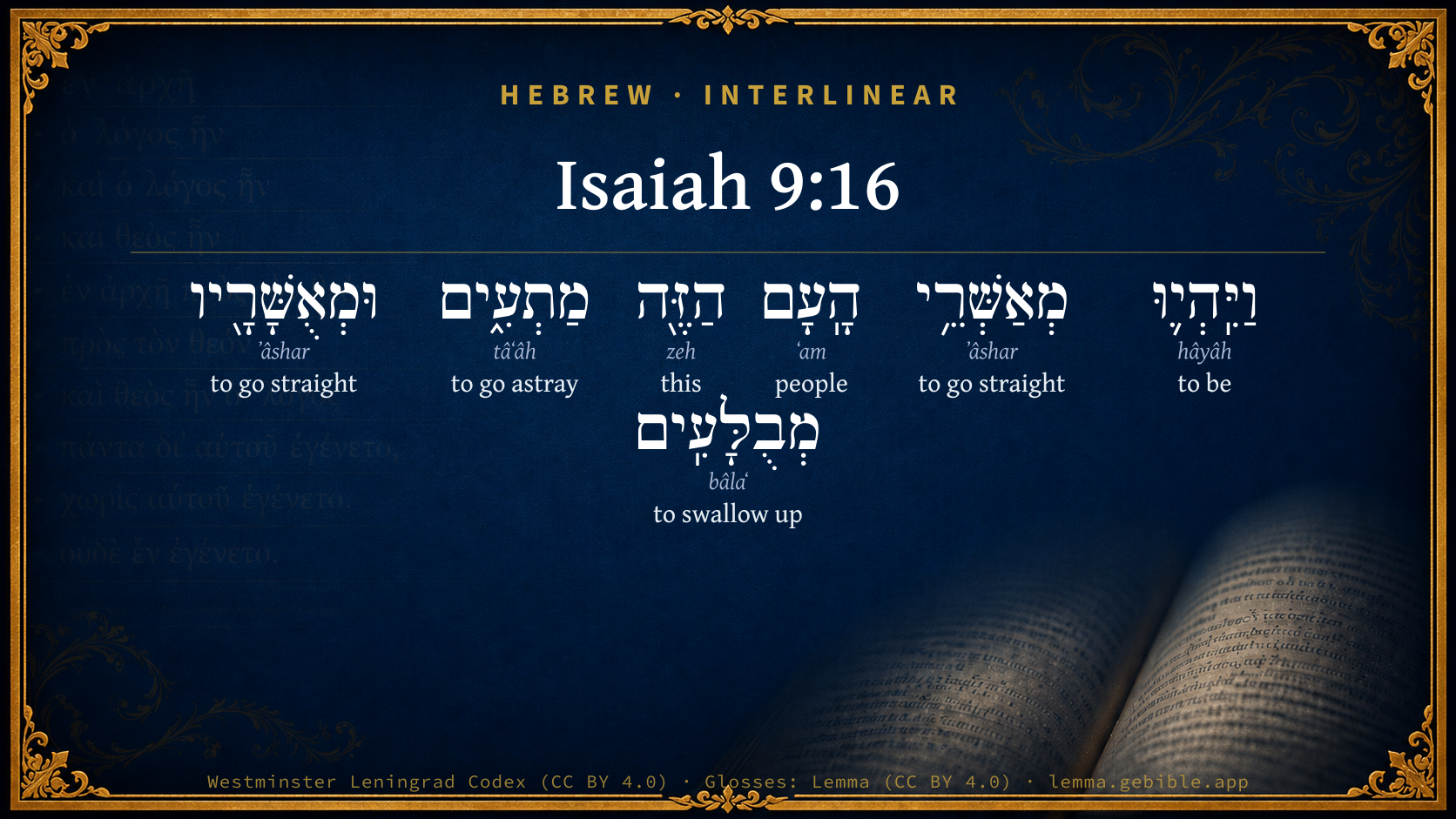
Hebrew (Westminster Leningrad Codex) Isaiah 9:16 appears in the Hebrew Old Testament. The text above is from the Westminster Leningrad Codex. Each word links to its Strong’s number, a concise gloss, and parsing drawn from the Open Scriptures Hebrew Bible morphology. Click any word for its full Brown-Driver-Briggs (BDB) entry.
Download image
Cite this verse

Isaiah 9:16 (World English Bible). Public Domain. Lemma interlinear Bible study tool, https://lemma.gebible.app/v/isaiah/9/16.

Show BibTeX & RIS
BibTeX
RIS
English Translation
For those who lead this people cause them to err; and those who are led of them are destroyed.
World English Bible · Public Domain
Download a study sheet

One document with this verse’s original text, its word-by-word gloss line, the meaning frame, cross-references with their text, attributed commentary, and full source and license credits — printable, and it pastes into notes with its structure intact.

This verse Autodidact and up

Study sheet (.html) Plain text (.txt)

A passage Seminary Student

Up to 50 verses in one chapter. A passage sheet keeps up to 6 commentary sources and 12 cross-references per verse, in the order this page ranks them, and says so on the sheet whenever that leaves anything out. Ask for a single verse and you get the Autodidact verse sheet above.

Everything on this page stays free to read, with no account — the sheet is a download of what is already on screen, not access to it.

Want to remove ads? Support Godless Engineer
Compare translations 3

The same verse in 3 English versions, stacked beneath the original-language interlinear above. Click any original word for its lexicon entry.

Each is an independent rendering of the whole verse — the interlinear is not word-aligned to these translations.

Highlighted words mark where these versions differ — a whole-verse word diff, not a word-by-word alignment.

  • World English Bible Public Domain
    For those who lead this people cause them to err; and those who are led of them are destroyed.
  • King James Version Public Domain
    For the leaders of this people cause them to err; and they that are led of them are destroyed.
  • unfoldingWord Literal Text CC BY-SA 4.0
    For the guides of this people are misleading, and its guided ones are being swallowed up.

unfoldingWord Literal Text — © unfoldingWord, licensed CC BY-SA 4.0. Word-aligned USFM3 via Door43 (git.door43.org/unfoldingWord/en_ult).

Versions to compare (up to 4)

3 of 4 selected

Show all 18 translations

Every available English version of this verse, each an independent rendering of the whole verse.

  • World English Bible Public Domain
    For those who lead this people cause them to err; and those who are led of them are destroyed.
  • Berean Standard Bible Public Domain
    For those who guide this people mislead them, and those they mislead are swallowed up.
  • Majority Standard Bible Public Domain
    For those who guide this people mislead them, and those they mislead are swallowed up.
  • King James Version Public Domain
    For the leaders of this people cause them to err; and they that are led of them are destroyed.
  • American Standard Version (1901) Public Domain
    For they that lead this people cause them to err; and they that are led of them are destroyed.
  • Revised Version (1885) Public Domain
    For they that lead this people cause them to err; and they that are led of them are destroyed.
  • Geneva Bible (1599) Public Domain
    For the leaders of the people cause them to erre: and they that are led by them are deuoured.
  • Douay-Rheims (1899) Public Domain
    And they that call this people blessed, shall cause them to err: and they that are called blessed, shall be thrown down headlong.
  • Young's Literal Translation Public Domain
    And the eulogists of this people are causing to err, And its eulogised ones are consumed.
  • Literal Standard Version CC BY-SA 4.0
    And the eulogists of this people are causing to err, || And its eulogized ones are consumed.
  • Unlocked Literal Bible CC BY-SA 4.0
    Those who lead this people lead them astray, and those who are led by them are swallowed up.
  • unfoldingWord Literal Text CC BY-SA 4.0
    For the guides of this people are misleading, and its guided ones are being swallowed up.
  • Darby Bible Public Domain
    For the guides of this people mislead [them]; and they that are guided by them are swallowed up.
  • World Messianic Bible Public Domain
    For those who lead this people lead them astray; and those who are led by them are destroyed.
  • Webster's Bible Public Domain
    For the leaders of this people cause them to err; and they that are led by them are destroyed.
  • Free Bible Version CC BY-SA 4.0
    The people's leaders have misled them; those who were guided by them are confused.
  • Bible in Basic English Public Domain
    For the guides of this people are the cause of their wandering from the right way, and those who are guided by them come to destruction.
  • JPS Tanakh (1917) Public Domain
    (9-15) For they that lead this people cause them to err; and they that are led of them are destroyed.

Literal Standard Version (2020), Covenant Press — licensed CC BY-SA 4.0. Text via the HelloAO Bible API (eBible.org). Unlocked Literal Bible (unfoldingWord) — licensed CC BY-SA 4.0. Text via the HelloAO Bible API (eBible.org). unfoldingWord Literal Text — © unfoldingWord, licensed CC BY-SA 4.0. Word-aligned USFM3 via Door43 (git.door43.org/unfoldingWord/en_ult). Free Bible Version, Dr. Jonathan Gallagher — licensed CC BY-SA 4.0. Text via the HelloAO Bible API (eBible.org).

Word by word

More ways to search: Search by grammar → Find every occurrence → Compare this word →

Practice this passage: Drill this verse → Learn its vocabulary →

מְאַשְּׁרֵ֥י
ʼâshar
H833
“going straight”
Verb, Piel, Participle Active, Masculine, Plural, Construct
Part of Speech
Verb
Stem
Piel
Form
Participle Active
Gender
Masculine
Number
Plural
State
Construct
Full BDB Definition

Origin: a primitive root

TWOT: 183

to go straight, walk, go on, advance, make progress - (Qal) to go straight on, make progress - (Piel) - to go straight on, advance - to lead on (causative) - to set right, righten - to pronounce happy, call blessed - (Pual) - to be advanced, be led on - to be made happy, be blessed
  1. וַיִּֽהְי֛וּ hâyâh H1961 “and · to be” Conjunction + Verb, Qal, Sequential Imperfect, 3rd Person, Masculine, Plural
  2. הָֽעָם ʻam H5971 “the · people” Particle, Definite Article + Noun, Common, Masculine, Singular, Absolute
  3. הַזֶּ֖ה zeh H2088 “the · this” Particle, Definite Article + Pronoun, Demonstrative, Masculine, Singular
  4. מַתְעִ֑ים tâʻâh H8582 “going astray” Verb, Hiphil, Participle Active, Masculine, Plural, Absolute
  5. וּמְאֻשָּׁרָ֖יו ʼâshar H833 “and · gone straight · him” Conjunction + Verb, Pual, Participle Passive, Masculine, Plural, Construct + Suffix, Personal, 3rd Person, Masculine, Singular
  6. מְבֻלָּעִֽים bâlaʻ H1104 “swallowed up” Verb, Pual, Participle Passive, Masculine, Plural, Absolute

About this verse

These counts appear in no published source. They are computed here, from the morphology-tagged text and Lemma’s own curated glosses. What Lemma adds →

7
words
6
distinct lemmas
Prophets
section

Notable vocabulary

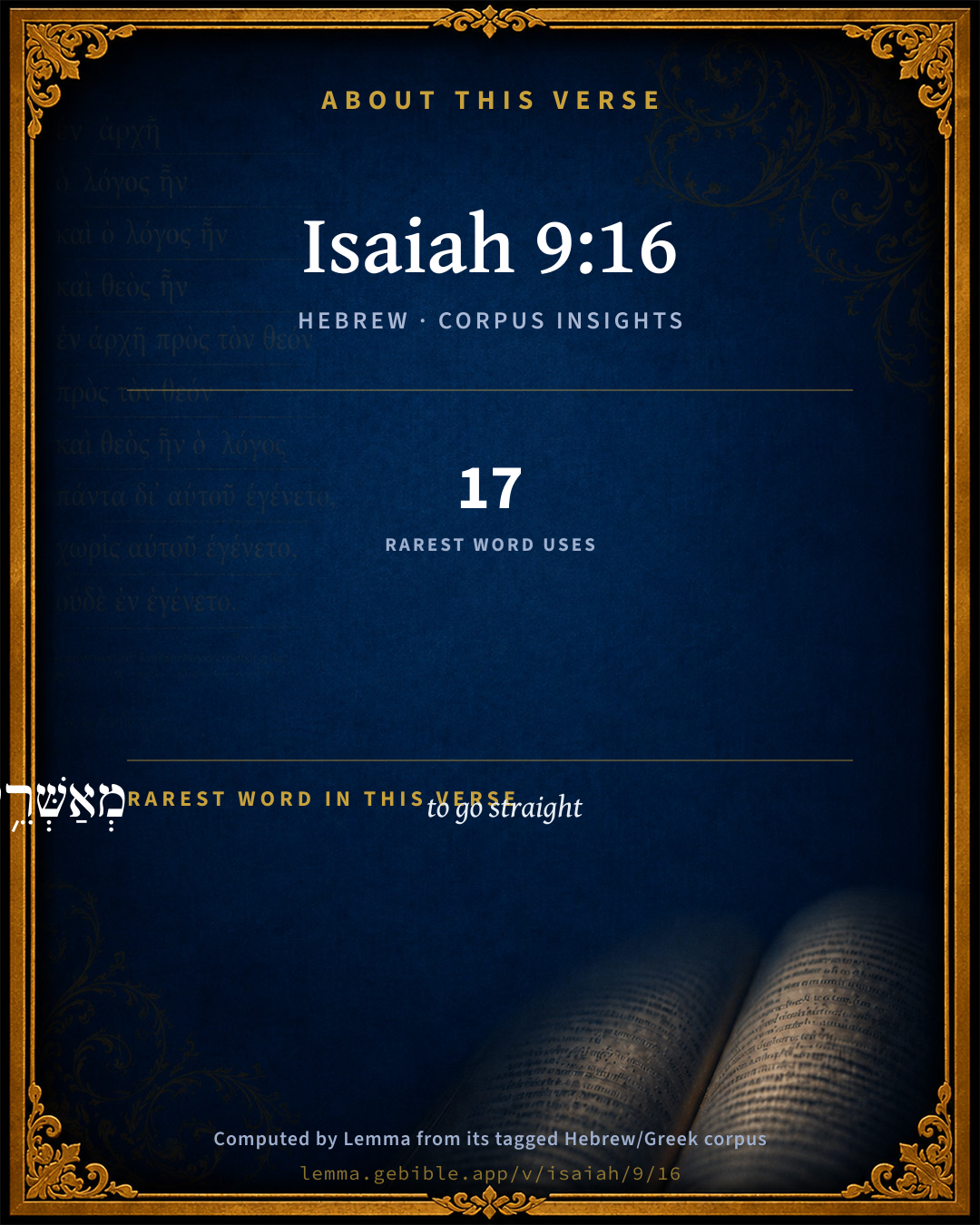
The rarest word here is מְאַשְּׁרֵ֥י to go straight H833 — appearing just 17 times in the whole Hebrew Bible.

Shared distinctive vocabulary

מְאַשְּׁרֵ֥י to go straight H833 occurs in 15 verses of the Hebrew Bible. Also found in:

Grammatical profile

  • 5 verbs
  • 1 noun
  • 1 pronoun

Verb forms

  • וַיִּֽהְי֛וּ Qal · Sequential Imperfect
  • מְאַשְּׁרֵ֥י Piel · Participle Active
  • מַתְעִ֑ים Hiphil · Participle Active
  • וּמְאֻשָּׁרָ֖יו Pual · Participle Passive
  • מְבֻלָּעִֽים Pual · Participle Passive

Repetition

A word recurs within this verse — often emphatic in Hebrew:

  • מְאַשְּׁרֵ֥י to go straight H833 ×2

Hebrew & Septuagint length

In English translation the verse runs 19 words from the Hebrew and 19 from the Septuagint (LXX English) — the same length.

A rough comparison of the two English renderings, which tokenize alike — not a word-level alignment.

Word counts can differ between the Hebrew and the Greek without any difference in meaning — e.g. the Hebrew direct-object marker אֵת has no separate Greek word, and Greek often adds the article ὁ.

Cross-references

7

Topical passages linked to Isaiah 9:16 in the Treasury of Scripture Knowledge — connected by theme and wording, ordered by reader-vote popularity; previews shown in the World English Bible.

  • Isaiah 3:12 As for my people, children are their oppressors, And women rule over them. My people, those who lead you cause you to err, And destroy the way of your paths.
  • Matthew 15:14 Leave them alone. They are blind guides of the blind. If the blind guide the blind, both will fall into a pit."
  • Matthew 23:16–36 "Woe to you, you blind guides, who say, 'Whoever swears by the temple, it is nothing; but whoever swears by the gold of the temple, he is obligated.'
  • Numbers 6:23–26 "Speak to Aaron and to his sons, saying, 'This is how you shall bless the children of Israel.' You shall tell them,
  • 1 Kings 8:55–56 He stood, and blessed all the assembly of Israel with a loud voice, saying,
  • 2 Chronicles 30:27 Then the priests the Levites arose and blessed the people: and their voice was heard, and their prayer came up to his holy habitation, even to heaven.
  • Hebrews 7:7 But without any dispute the less is blessed by the better.

Cross-references courtesy of OpenBible.info (CC BY 4.0).

Hebrew and Greek witnesses Masoretic Hebrew ↔ Greek Septuagint

The same verse in the two great witnesses to the Old Testament, shown verse-for-verse.

These are two independent witnesses, not word-aligned to each other, and the Septuagint is shown in lemma (dictionary) form.

Hebrew Isaiah 9:16 Masoretic · Westminster Leningrad Codex

וַיִּֽהְי֛וּ מְאַשְּׁרֵ֥י הָֽעָם הַזֶּ֖ה מַתְעִ֑ים וּמְאֻשָּׁרָ֖יו מְבֻלָּעִֽים

For those who lead this people cause them to err; and those who are led of them are destroyed.

World English Bible · Public Domain

Greek LXX Isaiah 9:16 Septuagint · lemma form

διά οὗτος ἐπί ὁ νεανίσκος αὐτός οὐ εὐφραίνω ὁ θεός καί ὁ ὀρφανός αὐτός καί ὁ χήρα αὐτός οὐ ἐλεέω ὅτι πᾶς ἄνομος καί πονηρός καί πᾶς στόμα λαλέω ἄδικος ἐπί πᾶς οὗτος οὐ ἀποστρέφω ὁ θυμός ἀλλά ἔτι ὁ χείρ ὑψηλός

And they that pronounce this people blessed shall mislead them; and they mislead them that they may devour them.

LXX2012 (modern English Septuagint) · Public Domain

On this verse, John Gill's Exposition discusses the Septuagint’s reading. Read the note in Commentary ↓

Hebrew: Westminster Leningrad Codex (CC BY 4.0). Greek: Septuagint (public domain); English from LXX2012 (modern English Septuagint) (Public Domain). How the Septuagint differs from the Hebrew →

Targum (Aramaic paraphrase)

1

The Targum is the ancient Jewish Aramaic paraphrase of the Hebrew Scriptures — an interpretive translation, not the Hebrew text itself. Onkelos (literal) and Pseudo-Jonathan (expansive) render the Torah, and Jonathan the Prophets. Coverage is partial: where no permissively-licensed English translation exists for a verse, only the Aramaic is shown. This is verse-level text, not a word-by-word alignment to the Hebrew.

  1. Targum Jonathan Prophets (Joshua–Malachi)
    עַל כֵּן עַל עוּלֵימוֹהִי לָא יֶחְדֵי יְיָ וְעַל יַתְמוֹהִי וְעַל אַרְמְלָתוֹהִי לָא יְרַחֵם אֲרֵי כוּלְהוֹן חֲנִיפִין וּבִישִׁין וְכָל פּוּמְהוֹן מְמַלְלִין שְׁקַר בְּכָל דָא לָא תָבוּ מֵחוֹבֵיהוֹן דִיתוּב רוּגְזֵיהּ מִנְהוֹן וְעַד כְּעַן מַתְקְפִין מִרְדֵיהוֹן וְעוֹד מֶחֶתֵיהּ עֲתִידָא לְאִתְפְּרָעָא מִנְהוֹן:

    Therefore the Lord shall have no joy in their young men, neither shall have mercy on their fatherless and widows: for all of them are hypocrites and evildoers, and all their mouths speak lies. For all this they do not turn away from their sins, that His anger might turn away from them; but still they hold fast their rebellion, and yet His stroke is ready to take vengeance on them.

    Targum Jonathan — Aramaic: “Mikraot Gedolot” (public domain). English: “Sefaria Community Translation” (CC0 1.0 (public-domain dedication)); “London "Chaldee Paraphrase," 1871” (public domain). Text via Sefaria.

Commentary

Notes on Isaiah 9:16 from classic Christian and Jewish commentators (each source and its license shown beneath its notes). The classic Christian expositions comment on the surrounding passage and are grouped to its opening verse, so a note may address several verses; the Jewish commentaries on the Tanakh (Rashi and others) are per-verse, so they appear only where the commentator wrote on this verse.

Lemma curates 59 commentaries, every one of them public domain or Creative Commons licensed, each selected and text-cleaned for this edition rather than reprinted as found. About our sources →

Trapp's Complete Commentary

John Trapp

Isa 9:16 For the leaders of this people cause [them] to err; and [they that are] led of them [are] destroyed.

Ver. 16. For the leaders of this people cause them to err.] By their ill counsel and example. Exempla enim non ibi consistunt, ubi cceperunt. The ancients placed the statues of their princes and patriots near the fountains, to show that they were the spring heads of good or evil to the public. Some read the words thus: Those that bless this people, viz., the false prophets, have been misleaders: ductoresfuerunt seductores. Pope Plus II hath this memorable saying, Nihil excellenter malum in Ecclesia, Catholica patratur cuius prima origo a sacerdotibus non dependeat, in forte occulto quodam Dei concilio fiat. {a} Nothing exceedingly bad is done in the Catholic Church, unless it is first started by the priests, it becomes hidden in the plan of God.

And they that are led of them.] Or, Blessed by them.

Are destroyed.] Or, Swallowed up; or, Blindfolded. {b}

{a} In Hist. Auster.

{b} Objecti. - Tremel.

John Trapp, A Commentary or Exposition upon All the Books of the Old and New Testament (1647–1656) — public domain. Text from a community e-Sword module.

The Biblical Illustrator

Joseph S. Exell

Isa_9:16

For the leaders of this people cause them to err

Leaders misleading

Render: And the leaders of this people have become misleaders.

(Prof. J. Skinner, D. D.)

Leaders responsibility for the peoples faults

1. By conniving at their wickedness.

2. By countenancing wicked people.

3. By setting them ill examples. (M. Henry.)

Unfaithful physicians

It is ill with a people when their physicians are their worse disease. (M. Henry.)

A shameless ruler

(Charles II):--A king might be pardoned for amusing his leisure with wine, wit, and beauty, but it was intolerable that he should sink into a mere saunterer and voluptuary; that the gravest affairs of State should be neglected, and that the public service should be starved, and the finances deranged in order that harlots and parasites might grow rich. (Macaulays England.)

The responsibility of leaders

The ancients placed the statues of their princes and patriots near the fountains, to show that they were the spring heads of good or evil to the public. (J. Trapp.)

Leadership

I. The world is so constituted that LEADERS OF THE PEOPLE ARE AT PRESENT A NECESSITY.

II. LEADERSHIP INVOLVES FOR THE LEADERS THE HIGHEST HONOUR OR THE DEEPEST SHAME.

1. The man who leads his fellow men well is entitled to the highest honour.

2. But leadership does not necessarily involve any honour at all.

3. Through leadership a man may reach the most utter degradation and shame.

(1) Through his incompetence.

(2) Through his dishonesty.

III. LEADERSHIP INVOLVES FOR THE LED SALVATION OR DESTRUCTION. (R. A. Bertram.)

The Biblical Illustrator, edited by Joseph S. Exell (c. 1880s–1900s) — public domain. Text from a community e-Sword module.

Joseph Benson's Commentary

Isa 9:16-17. For, &c. — “We have here a defence of the divine judgment, taken from the universal corruption of the people, wherein God sets forth the justice of his proceedings, and shows, that not from choice, but from the iniquities of the people, he is compelled to punish. The leaders of this people — Their governors, both civil and ecclesiastical, especially the latter, their teachers, or the false prophets, last-mentioned; cause them to err — Their governors compelling them by power, and their teachers deceiving them by false doctrines, and evil counsels and persuasions. They that are led, &c., are destroyed — Shall certainly perish; nor will it avail them to plead, in their excuse, that they followed the counsel and conduct of their leaders. The Lord shall have no joy in their young men — Shall not rejoice over them to do them good, as he doth over his faithful people, Isa 62:5; Zep 3:17. Neither shall have mercy on their fatherless — Who generally are the special objects of his care and pity, and much less upon others. For every one — Not precisely; for there were seven thousand pious persons among them, when they seemed to Elijah to be universally corrupt; but the body or generality of the people are intended; is a hypocrite — For though they professed to worship the true God, yet indeed they had forsaken him. Every mouth speaketh folly — That is, wickedness, which is commonly called folly. They are not ashamed to proclaim their own wickedness; and the corruption of their hearts breaks forth into ungodly speeches.

Joseph Benson's Commentary on the Old and New Testaments (1811–1818) — public domain. Text from a community e-Sword module.

Jamieson, Fausset & Brown

Robert Jamieson, A. R. Fausset & David Brown

leaders, &c.--(See Isa 3:12, Margin, and see on Isa 3:12.)

Jamieson, Fausset & Brown — Commentary Critical and Explanatory on the Whole Bible (1871) — public domain (CC PDM 1.0). Text via the HelloAO Bible API.

The Cambridge Bible for Schools and Colleges

gen. ed. J. J. S. Perowne

16. Render: And the leaders of this people have become misleaders, and they of it that are led are swallowed up (or perhaps as Isa_3:12 confused).

The Cambridge Bible for Schools and Colleges (gen. ed. J. J. S. Perowne; Cambridge University Press, 1878–1918) — public domain. Text from a community e-Sword module.

John Gill's Exposition

For the leaders of this people cause them to err,.... Or, "who bless this people", as the Septuagint and Arabic versions; and so the Targum,

"who praise this people;''

that call them blessed, pronounce them happy, see Mal 3:15 and promise them happiness, both in this world and that to come, though guilty of notorious sins, and live a vicious course of life; and so harden them in their iniquities, and cause them to wander more and more from the way of truth and righteousness; and lead them unto, and leave them in, fatal mistakes about their state and condition. These seem to design the ecclesiastical leaders of the people, the blind leaders of the blind, see Isa 3:12,

and they that are led of them are destroyed; or, "they" that "are blessed of them are swallowed up" (c); and so irrecoverably lost; the deceivers and the deceived perish together; as it is sinful in teachers and leaders of the people to teach them false things, and lead them out of the way, it is criminal in the people to be led and taught by them, who ought to take care what they hear and receive; and therefore both are righteously punished; for the words are a reason why the Lord would cut off both the one and the other.

(c) "qui ex hoc populo beati dicuntur, absorbebuntur", Vatablus.

Next: Isaiah Chapter 10

John Gill's Exposition of the Whole Bible (1746–1763) — public domain (CC PDM 1.0). Text via the HelloAO Bible API.

Albert Barnes' Notes on the Bible

For the leaders of this people ... - Note, Isa 3:12. Hebrew ‘They that call this people blessed’ - referring more particularly to the false prophets.

They that are led of them - Hebrew, ‘They that are called blessed by them.’

Are destroyed - Hebrew, ‘Are swallowed up;’ see the note at Isa 3:12. They are ruined; or swallowed up as in a vast whirlpool or vortex.

Albert Barnes' Notes on the Bible (1834–1885) — public domain. Text from a community e-Sword/MySword module.

Haydock's Catholic Bible Commentary

Headlong. If the blind lead the blind, both fall into the ditch, Matthew xv. 14. (Haydock)

George Leo Haydock (1774–1849), Haydock's Catholic Family Bible and Commentary, 1859 edition — public domain. Excludes Psalms (Douay-Rheims chapter numbering differs from Protestant) and Deuterocanonical books (Catholic canon only).

Matthew Poole's English Annotations

The leaders; their governors, both civil and ecclesiastical, and especially the latter, their teachers, even the false prophets last mentioned. Or, they that bless or praise them, to wit, the false prophets, that flatter them in their wicked ways, with hopes and promises of peace, as their manner was, Jer 6:14; 28:9. Both ways the sense is the same.

Cause them to err; either compelling them by power, or deceiving them by false doctrines and evil counsels and persuasions.

Are destroyed; shall certainly perish; nor will it excuse them that they followed the counsel and conduct of their leaders.

Matthew Poole's English Annotations on the Holy Bible (1683–1685) — public domain. Text from a community e-Sword/MySword module.

Whedon's Commentary on the Bible

Daniel D. Whedon

16. The leaders… led — See Isa_3:12. The “leaders” and the “led” are both swallowed up in misery: the former because of their bad leadership, the latter as the result of their wrong following. Num_16:30.

Daniel D. Whedon (gen. ed.), Commentary on the Old and New Testaments (1874–1909) — public domain. Text from a community e-Sword module.

The Pulpit Commentary

The leaders of this people cause them to err. (comp. Isa_3:12) Both the peoples were led into idolatry by their rulers, butIsrael especially. Jeroboam, the first king, introduced the calf-worship, and his successors from first to last persisted in his sin. Ahab added the still grosset idolatry of Baal. Those who held high position under the kings were equally bad examples to the people. (see above, Isa_1:2:3) Are destroyed. First, morally corrupted and debased, then physically given over to destruction slaughtered by Philistines, Syrians, and Assyrians.

Ver. 16. The sin of leading others astray.

The point of the expression is, that the leaders of the nation are really misleaders. The persons referred to are described in ver. 15 as "the ancient and honorable, "and as "the prophet that teacheth lies, "evidently including those having influence by reason of their social status, and having influence by reason of their official positions. It is well for us to remember the responsibility of positions as well as of talents. Society is directly affected by the morality, the prevailing tone, the intelligence, and the religiousness of the upper and the learned classes. Leadership is also a talent or endowment, given by God to individual men and women, and so it is to be regarded as, and used as, a Divine trust. A man"s power of leadership among his fellow-men is to be laid on God"s altar, and used in God"s service.

I EVERYBODY HAS SOME INFLUENCE ON OTHERS; by virtue of:

1. Relationship, as masters, husbands, fathers, etc.

2. Position, one class of society becoming ideals to the class below them.

3. Character, natural and trained.

4. Education, involving superior knowledge and mental control.

II SOME HAVE VERY SPECIAL POWERS OF LEADERSHIP. Illustrate by the first Napoleon. Some men seem to master our wills, and compel us to do what they wish. We find such persons in all spheres of life. The Power is one of the secrets of success in business. It is often the genius of secretaries, and of teachers. Illustrate from T. Moore"s poem in "Lalla Rookh," "The Veiled Prophet of Khorassan.

III SUCH INFLUENCE MAY BE MADE A CURSE. Leadership may cover and excuse wrong-doing. Personal relations may disturb moral distinctions.

IV SUCH INFLUENCE MAY BE MADE A BLESSING. Leadership may present the example of righteousness and obedience. Personal relations with others may be Christ-like, and so a leading towards goodness and God. Special Divine judgments come on those who determinedly lead others astray. The enticer and seducer who wile into the ways that lead down to the pit, God surely hateth and watcheth. His hand will be heavy on them some day. R.T.

The Pulpit Commentary (1880–1919), ed. H.D.M. Spence-Jones & Joseph S. Exell — public domain. Text from a community e-Sword module.

John Wesley's Explanatory Notes

The leaders - Their false prophets. Cause - By false doctrines and evil counsels and persuasions. Destroyed - Shall certainly perish.

John Wesley, Explanatory Notes Upon the Whole Bible (1754–1765) — public domain. Text via the GEBible commentary corpus.

J. A. Alexander on Isaiah

Joseph Addison Alexander

This verse gives a reason, not why all classes were to be destroyed, but why the rulers and false prophets had been specially mentioned. It arises, therefore, naturally out of the fourteenth, and thus incidentally proves it to be genuine. The truth expressed and implied is, that the leaders of the people had destroyed them and should perish with them. “The leaders of this people have been seducers, and those led by them (are) swallowed up (or ruined).”

Joseph Addison Alexander, The Prophecies of Isaiah (1846–1847; New York: Scribner, 1870–1878) — public domain. Text from a community e-Sword module.

unfoldingWord translationNotes

Door43 World Missions Community

Those who lead this people lead them astray

The leaders causing people to disobey is spoken of as if the leaders led them on the wrong path. AT: "The leaders of Israel have caused the people to disobey God" (See: Metaphor)

those who are led by them are swallowed up

This is a metaphor that can be stated in active form. Possible meanings are 1) AT: "those that they lead become confused" or 2) AT: "Yahweh destroys those that they lead" (See: Metaphor and Active or Passive)

every mouth speaks foolish things

The word "mouth" refers to the person. AT: "every person speaks foolish things" (See: Synecdoche)

In all these things, his anger does not subside; instead, his hand

"Even though all these things have happened, he is still angry, and his hand." See how you translated this in Isaiah 5:25.

his hand is still stretched out

Isaiah speaks as if Yahweh were a person about to hit another person with his fist. This is a metaphor for Yahweh punishing Israel. See how you translated this in Isaiah 5:25. AT: "he will still be ready to punish them" (See: Metaphor)

translationWords

people group

astray

joy

compassion

godly

evildoer

fool

anger

hand

unfoldingWord translationNotes — © Distant Shores Media and the Door43 World Missions Community, licensed CC BY-SA 4.0. Source: git.door43.org/Door43/en_tn.

Rashi

Rabbi Shlomo Yitzchaki (Rashi)

and evildoers Wicked. Comp. (1:4) “Evildoing seed.”

Rashi on the Tanakh — English translations: “The Judaica Press complete Tanach with Rashi, translated by A. J. Rosenberg” (CC BY 4.0); “Pentateuch with Rashi's commentary by M. Rosenbaum and A.M. Silbermann, 1929-1934” (public domain); “The Metsudah Tanach series, Lakewood, N.J” (CC BY 4.0); and “The Book of Joshua, Metsudah Publications, 1997” (CC BY 4.0). Text via Sefaria.

Ibn Ezra

Rabbi Abraham ibn Ezra

The Lord will rejoice. Anthropomorphism; as human beings are accustomed to rejoice when their work is in a good condition.

חנף Hypocrite. A man who is virtuous in outward appearance, but vicious at heart.

Ibn Ezra on the Tanakh — English translations: “Sefaria Community Translation” (CC0 1.0 (public-domain dedication)); “Yalkut, Sifsei Chachomim Chumash, Metsudah Publications, 2009” (CC BY 4.0); and “Commentary of Ibn Ezra on Isaiah - trans. by M. Friedlander, 1873” (public domain). Text via Sefaria.

Lesson kit

Teaching starters — assembled from the data on this page, not authored interpretation. Every prompt links to the verse data it draws on. Edit before teaching.

Isaiah, in the Prophets, opens this verse with 7 words (6 distinct Hebrew lemmas). Its most distinctive word is ʼâshar (“to go straight”). A historical commentator’s framing appears above. Read the whole chapter for the surrounding context.

Discussion questions

  1. What does “to go straight” (ʼâshar) contribute to the verse as a whole?
  2. How does Genesis 30:13, which shares the word «to go straight», read alongside this verse?
  3. What does the repetition of “to go straight” (2× in this one verse) do in this verse?
  4. These translations render this verse differently; the difference is in the English rendering, not the original. What questions does that raise?
  5. «וַיִּֽהְי֛וּ» is a Qal Sequential Imperfect verb. How does that grammatical form shape the action described?
  6. Compare how Trapp's Complete Commentary and The Biblical Illustrator read this verse. Where do they agree or differ?

Things to notice

  • These translations choose different wording for 14 words in this verse.
  • “to go straight” occurs 2× in this single verse.
  • 6 distinct Hebrew lemmas span 7 words in this verse.

Reading settings

Reading text

Shown beneath each verse's original-language words.

Old Testament
Old Testament edition

Read the OT as the Masoretic Hebrew (MT) or the Greek Septuagint (LXX).

English shown for the Greek Septuagint (in the Hebrew ↔ Greek comparison).

Comparing translations? Open the Compare panel on any verse page to stack up to four side by side.