
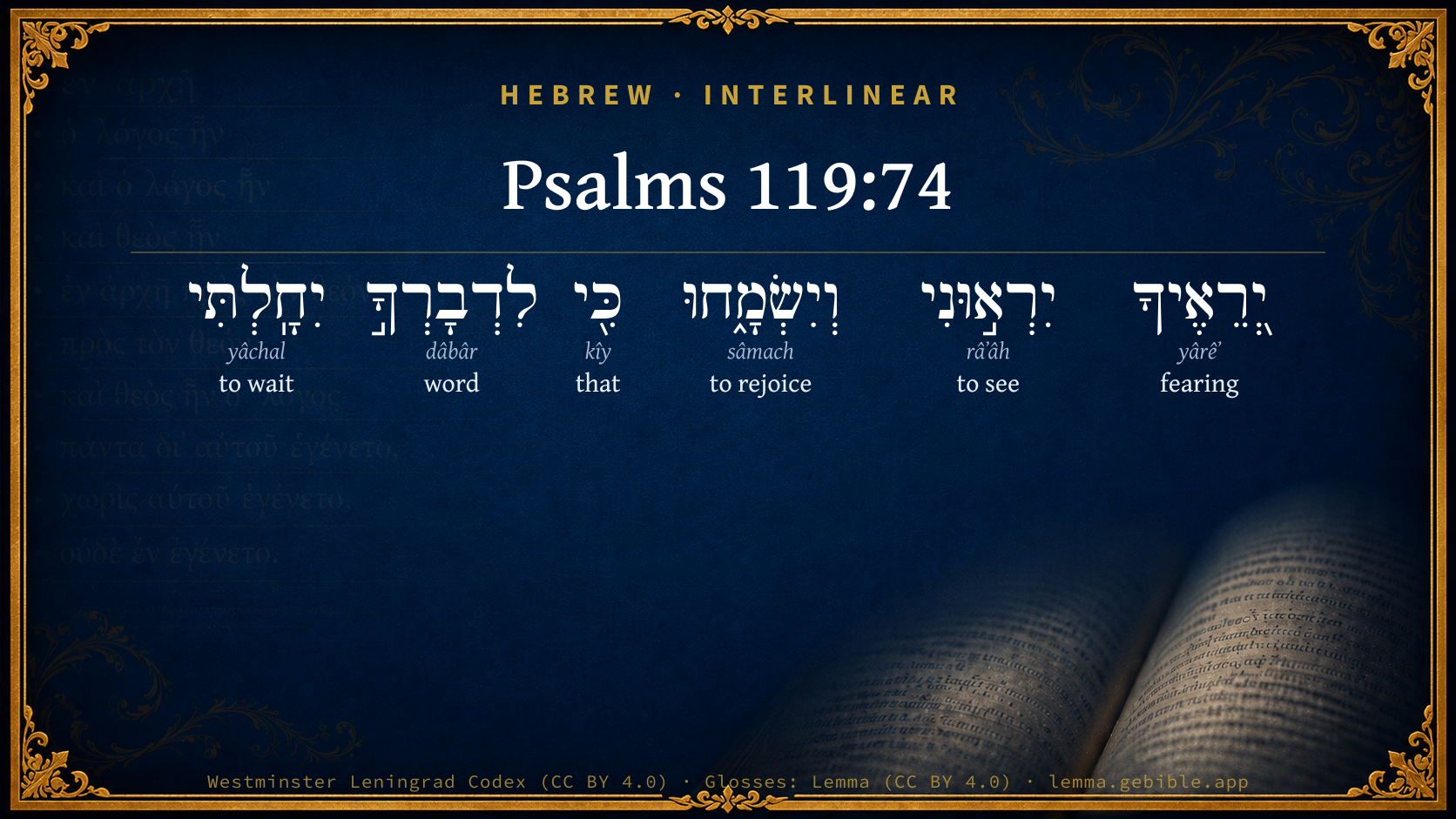
Psalms 119:74

Hebrew (Westminster Leningrad Codex) Psalms 119:74 appears in the Hebrew Old Testament. The text above is from the Westminster Leningrad Codex. Each word links to its Strong’s number, a concise gloss, and parsing drawn from the Open Scriptures Hebrew Bible morphology. Click any word for its full Brown-Driver-Briggs (BDB) entry.
Download image
Cite this verse

Psalms 119:74 (World English Bible). Public Domain. Lemma interlinear Bible study tool, https://lemma.gebible.app/v/psalms/119/74.

Show BibTeX & RIS
BibTeX
RIS
English Translation
Those who fear you will see me and be glad, Because I have put my hope in your word.
World English Bible · Public Domain
Download a study sheet

One document with this verse’s original text, its word-by-word gloss line, the meaning frame, cross-references with their text, attributed commentary, and full source and license credits — printable, and it pastes into notes with its structure intact.

This verse Autodidact and up

Study sheet (.html) Plain text (.txt)

A passage Seminary Student

Up to 50 verses in one chapter. A passage sheet keeps up to 6 commentary sources and 12 cross-references per verse, in the order this page ranks them, and says so on the sheet whenever that leaves anything out. Ask for a single verse and you get the Autodidact verse sheet above.

Everything on this page stays free to read, with no account — the sheet is a download of what is already on screen, not access to it.

Want to remove ads? Support Godless Engineer
Compare translations 3

The same verse in 3 English versions, stacked beneath the original-language interlinear above. Click any original word for its lexicon entry.

Each is an independent rendering of the whole verse — the interlinear is not word-aligned to these translations.

Highlighted words mark where these versions differ — a whole-verse word diff, not a word-by-word alignment.

  • World English Bible Public Domain
    Those who fear you will see me and be glad, Because I have put my hope in your word.
  • King James Version Public Domain
    They that fear thee will be glad when they see me; because I have hoped in thy word.
  • unfoldingWord Literal Text CC BY-SA 4.0
    May the fearful of you see me and rejoice because I hope in your word.

unfoldingWord Literal Text — © unfoldingWord, licensed CC BY-SA 4.0. Word-aligned USFM3 via Door43 (git.door43.org/unfoldingWord/en_ult).

Versions to compare (up to 4)

3 of 4 selected

Show all 17 translations

Every available English version of this verse, each an independent rendering of the whole verse.

  • World English Bible Public Domain
    Those who fear you will see me and be glad, Because I have put my hope in your word.
  • Berean Standard Bible Public Domain
    May those who fear You see me and rejoice, for I have hoped in Your word.
  • Majority Standard Bible Public Domain
    May those who fear You see me and rejoice, for I have hoped in Your word.
  • King James Version Public Domain
    They that fear thee will be glad when they see me; because I have hoped in thy word.
  • American Standard Version (1901) Public Domain
    They that fear thee shall see me and be glad, Because I have hoped in thy word.
  • Revised Version (1885) Public Domain
    They that fear thee shall see me and be glad; because I have hoped in thy word.
  • Geneva Bible (1599) Public Domain
    So they that feare thee, seeing mee shall reioyce, because I haue trusted in thy worde.
  • Young's Literal Translation Public Domain
    Those fearing Thee see me and rejoice, Because for Thy word I have hoped.
  • Literal Standard Version CC BY-SA 4.0
    Those fearing You see me and rejoice, || Because I have hoped for Your word.
  • Unlocked Literal Bible CC BY-SA 4.0
    Those who honor you will be glad when they see me because I find hope in your word.
  • unfoldingWord Literal Text CC BY-SA 4.0
    May the fearful of you see me and rejoice because I hope in your word.
  • Darby Bible Public Domain
    They that fear thee will see me, and rejoice; because I have hoped in thy word.
  • World Messianic Bible Public Domain
    Those who fear you will see me and be glad, because I have put my hope in your word.
  • Webster's Bible Public Domain
    They that fear thee will be glad when they see me; because I have hoped in thy word.
  • Free Bible Version CC BY-SA 4.0
    May those who worship you be happy when they see me, for I place my confidence in your word.
  • Bible in Basic English Public Domain
    Your worshippers will see me and be glad; because my hope has been in your word.
  • JPS Tanakh (1917) Public Domain
    They that fear Thee shall see me and be glad, because I have hope in Thy word.

Literal Standard Version (2020), Covenant Press — licensed CC BY-SA 4.0. Text via the HelloAO Bible API (eBible.org). Unlocked Literal Bible (unfoldingWord) — licensed CC BY-SA 4.0. Text via the HelloAO Bible API (eBible.org). unfoldingWord Literal Text — © unfoldingWord, licensed CC BY-SA 4.0. Word-aligned USFM3 via Door43 (git.door43.org/unfoldingWord/en_ult). Free Bible Version, Dr. Jonathan Gallagher — licensed CC BY-SA 4.0. Text via the HelloAO Bible API (eBible.org).

Word by word

More ways to search: Search by grammar → Find every occurrence → Compare this word →

Practice this passage: Drill this verse → Learn its vocabulary →

About this verse

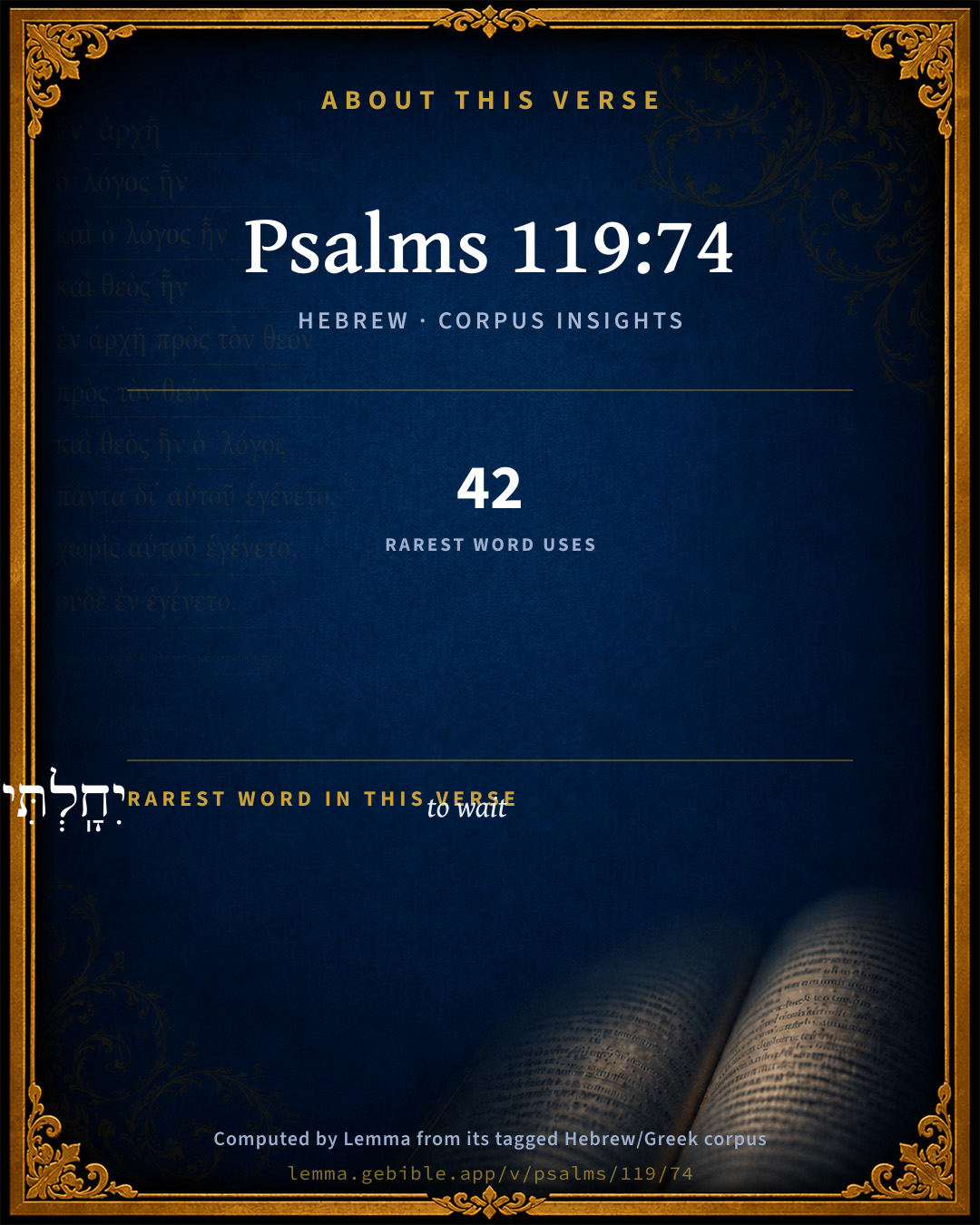
These counts appear in no published source. They are computed here, from the morphology-tagged text and Lemma’s own curated glosses. What Lemma adds →

6
words
6
distinct lemmas
Wisdom
section

Shared distinctive vocabulary

יִחָֽלְתִּי to wait H3176 occurs in 41 verses of the Hebrew Bible. Also found in:

Grammatical profile

  • 3 verbs
  • 1 noun
  • 1 adjective
  • 1 conjunction

Verb forms

  • יִרְא֣וּנִי Qal · Imperfect
  • וְיִשְׂמָ֑חוּ Qal · Imperfect
  • יִחָֽלְתִּי Piel · Perfect

Hebrew & Septuagint length

In English translation the verse runs 19 words from the Hebrew and 16 from the Septuagint (LXX English) — closely comparable.

A rough comparison of the two English renderings, which tokenize alike — not a word-level alignment.

Word counts can differ between the Hebrew and the Greek without any difference in meaning — e.g. the Hebrew direct-object marker אֵת has no separate Greek word, and Greek often adds the article ὁ.

Cross-references

9

Topical passages linked to Psalms 119:74 in the Treasury of Scripture Knowledge — connected by theme and wording, ordered by reader-vote popularity; previews shown in the World English Bible.

  • Psalms 66:16 Come, and hear, all you who fear God. I will declare what he has done for my soul.
  • Psalms 34:2–6 My soul shall boast in Yahweh. The humble shall hear of it, and be glad.
  • Psalms 119:79 Let those who fear you turn to me. They will know your statutes.
  • Psalms 119:42 So I will have an answer for him who reproaches me, For I trust in your word.
  • Genesis 32:11–12 Please deliver me from the hand of my brother, from the hand of Esau: for I fear him, lest he come and strike me, and the mothers with the children.
  • Luke 21:33 Heaven and earth will pass away, but my words will by no means pass away.
  • Psalms 108:7 God has spoken from his sanctuary: "In triumph, I will divide Shechem, and measure out the valley of Succoth.
  • Malachi 3:16 Then those who feared Yahweh spoke one with another; and Yahweh listened, and heard, and a book of memory was written before him, for those who feared Yahweh, and who honored his name.
  • Psalms 119:147 I rise before dawn and cry for help. I put my hope in your words.

Cross-references courtesy of OpenBible.info (CC BY 4.0).

Hebrew and Greek witnesses Masoretic Hebrew ↔ Greek Septuagint

The same verse in the two great witnesses to the Old Testament, shown verse-for-verse.

You’re reading Greek Psalm 118 (Hebrew Psalm 119). The Septuagint counts the superscription, so verse numbers can differ from the Hebrew — chapter-level alignment, not verse-by-verse. Numbering follows Rahlfs.

These are two independent witnesses, not word-aligned to each other, and the Septuagint is shown in lemma (dictionary) form.

Hebrew Psalms 119:74 Masoretic · Westminster Leningrad Codex

יְ֭רֵאֶיךָ יִרְא֣וּנִי וְיִשְׂמָ֑חוּ כִּ֖י לִדְבָרְךָ֣ יִחָֽלְתִּי

Those who fear you will see me and be glad, Because I have put my hope in your word.

World English Bible · Public Domain

Greek LXX Greek Psalm 118:74 Septuagint · lemma form

ὁ φοβέω σύ ὁράω ἐγώ καί εὐφραίνω ὅτι εἰς ὁ λόγος σύ ἐπιἐλπίζω

They that fear you will see me and rejoice: for I have hoped in your words.

LXX2012 (modern English Septuagint) · Public Domain

Hebrew: Westminster Leningrad Codex (CC BY 4.0). Greek: Septuagint (public domain); English from LXX2012 (modern English Septuagint) (Public Domain). How the Septuagint differs from the Hebrew →

Commentary

Notes on Psalms 119:74 from classic Christian and Jewish commentators (each source and its license shown beneath its notes). The classic Christian expositions comment on the surrounding passage and are grouped to its opening verse, so a note may address several verses; the Jewish commentaries on the Tanakh (Rashi and others) are per-verse, so they appear only where the commentator wrote on this verse.

Lemma curates 59 commentaries, every one of them public domain or Creative Commons licensed, each selected and text-cleaned for this edition rather than reprinted as found. About our sources →

Trapp's Complete Commentary

John Trapp

Psa 119:74 They that fear thee will be glad when they see me; because I have hoped in thy word.

Ver. 74. They that fear thee will be glad, &c.] As hoping that they shall also in like sort be delivered and advanced.

Because I have hoped in thy word] And have not been disappointed. The Vulgate rendereth it super speravi, I have overly hoped; and Aben Ezra glosseth, I have hoped in all thy decree, even that of afflicting me, as in the next verse.

John Trapp, A Commentary or Exposition upon All the Books of the Old and New Testament (1647–1656) — public domain. Text from a community e-Sword module.

The Biblical Illustrator

Joseph S. Exell

Psa_119:74-79

They that fear Thee will be glad when they nee me; because I have hoped in Thy Word.

The good man

I. The spiritual interest of the good in each other (verse 74). In what, concerning each other, are they most profoundly interested? Their ripe moral condition. Because I have hoped in Thy Word. Hope in Thy Word implies--

1. That Thy Word has truth.

2. That Thy Word has good. We only hope for the good. Good men rejoice in each other, not merely because of secular or intellectual advancement, hut because of spiritual soundness and progress.

II. The confidence of the good in God (verse 75).

1. Confidence in the rectitude of the Divine procedure. I know it, not merely from the declarations of Thy Word, the testimonies of the good, but from my own experience. I know that all is right.

2. Confidence in the Divine kindness in affliction. In faithfulness Thou hast afflicted me. As many as I love, I rebuke and chasten, etc.

III. The appeal of the good to Him.

1. Here is a prayer for comfort in affliction (verse 76).

2. A prayer for the preservation from dangers (verse 77). I am not only in sorrow and require comfort, hut in danger and require protection.

3. A prayer for the humiliation of enemies (verse 78). Convince them of the wrongness of their conduct towards me.

4. A prayer for the sympathy of the good (verse 79).

IV. The joy of the good in life. For Thy law is my delight. I will meditate in Thy precepts. The law of God stands for His ideas, His purposes, His sympathies, His plans, as revealed in nature and in the writings of inspired men. (Homilist.)

The Biblical Illustrator, edited by Joseph S. Exell (c. 1880s–1900s) — public domain. Text from a community e-Sword module.

Joseph Benson's Commentary

Psa 119:74. They that fear thee will be glad, &c. — This verse is thus paraphrased by Bishop Patrick: “It will be a very great comfort and encouragement to all good men, when they see me delivered out of all these troubles; for thereby they will be confirmed in their belief of thy faithfulness to thy promises, on which it will appear I have not vainly depended.” Certainly, as they who fear God, that is, who are truly pious, are naturally glad when they see one like themselves, so they are more especially so “when it is one whose faith and patience have carried him through troubles, and rendered him victorious over temptations; one who hath hoped in God’s word, and hath not been disappointed. Every such instance affords fresh encouragement to all those who, in the course of their warfare, are to undergo like troubles, and to encounter like temptations.” — Horne.

Joseph Benson's Commentary on the Old and New Testaments (1811–1818) — public domain. Text from a community e-Sword module.

J. A. Alexander on Psalms

Joseph Addison Alexander

74. (Psa 119:74) Thy fearers shall see me and rejoice; for in thy word have I hoped. Compare Psa 5:11; Psa 34:2. They shall rejoice in my case, as a new proof that they who trust in God cannot be disappointed. The literal meaning of the last clause is, because for thy word I have waited, i.e. patiently and trustfully awaited its fulfilment.

Joseph Addison Alexander, The Psalms Translated and Explained (1850) — public domain. Text from a community e-Sword module.

Geneva Bible (1599)

Geneva Bible translators

When God showeth his grace toward any, he testifieth to others, that he faileth not them that trust in him.

Geneva Bible (1599) marginal notes — public domain. Text via Bolls.life.

Matthew Henry's Commentary

Here is, 1. The confidence of this good man in the hope of God's salvation: "I have hoped in thy word; and I have not found it in vain to do so; it has not failed me, nor have I been disappointed in my expectations from it. It is a hope that maketh not ashamed; but is present satisfaction, and fruition at last." 2. The concurrence of other good men with him in the joy of that salvation: "Those that fear thee will be glad when they see me relieved by my hope in thy word and delivered according to my hope." The comforts which some of God's children have in God, and the favours they have received from him, should be matter of joy to others of them. Paul often expressed the hope that for God's grace to him thanks would be rendered by many, Co2 1:11; Co2 4:15. Or it may be taken more generally; good people are glad to see one another; they are especially pleased with those who are eminent for their hope in God's word.

Matthew Henry's Commentary on the Whole Bible (1708–1710) — public domain (CC PDM 1.0). Text via the HelloAO Bible API.

Adam Clarke's Commentary

Verse 74. They that fear thee] They who are truly religious will be glad - will rejoice, at this farther proof of the saving power of God.

Adam Clarke's Commentary on the Bible (1810–1826) — public domain. Text from a community e-Sword/MySword module.

John Calvin's Commentaries

74. They who fear thee shall see me and be glad. This verse is either connected with the preceding, or it includes other benefits of God, besides the blessing mentioned in that verse. Whether the Psalmist adverts only to one particular species of blessing, or speaks generally, he by these words highly extols the benefits with which God had honored him, that all genuine saints in common might experience joy on that account. He does not mean to say that this joy proceeds solely from the trust which he reposed in God, but that it also proceeds from this, — that, having been preserved by him in a remarkable way, and loaded with many benefits, his hope had received an ample reward. As God invites all his servants in common to trust in him, it follows, that, whenever he exhibits a token of his grace towards any one of them, he testifies to all that he is faithful to his promises, and that they have no reason to be afraid of his disappointing those who trust in him.

John Calvin's Commentaries (1540-1563) — public domain. Text from the Calvin Translation Society English edition (1840s-50s) via the Christian Classics Ethereal Library (ccel.org). Calvin's coverage is partial (roughly two-thirds of the Bible); uncommented books and verses are honest gaps, never fabricated. The 19th-century editor's footnotes and remarks are omitted so the notes are faithfully Calvin's own voice.

Ellicott's Commentary for English Readers

(74) They . . . will be glad.—The great truth of spiritual communion, and the mutual help and consolation derived from it, is latent here. In its primary sense, that the preservation and deliverance of the righteous, who are victims of persecution, afford comfort and joy to all truly good, the verse has been amply confirmed by history. Mat_5:16, “Let your light so shine,” &c

A Bible Commentary for English Readers, edited by Charles John Ellicott (1878–1897) — public domain. Text from a community e-Sword module.

The Cambridge Bible for Schools and Colleges

gen. ed. J. J. S. Perowne

74. Let them that fear thee see me and he glad: let them rejoice when they see in me an example of the reward of trustful patience. Cp. Psa_69:32.

The Cambridge Bible for Schools and Colleges (gen. ed. J. J. S. Perowne; Cambridge University Press, 1878–1918) — public domain. Text from a community e-Sword module.

John Gill's Exposition

Let the proud be ashamed,.... The same persons he before speaks of as accursed, who had him in derision, and forged a lie against him. Here he prays that they might be ashamed of their scoffs and jeers, of their lies and calumnies, the evils and injuries they had done him; that they might be brought to a sense of them, and repentance for them; when they would be ashamed of them in the best manner: or that they might be disappointed of their ends, in what they had done, and so be confounded and ashamed, as men are when they cannot gain their point; or be brought to shame and confusion eternally;

for they dealt perversely with me without a cause; or, "they perverted me with falsehood" (w); that is, they endeavoured to pervert him with lies and falsehood, and lead him out of the right way; or they attempted, by their lies and calumnies, to make him out to be a perverse and wicked man, and pronounced and condemned him as such, without any foundation or just cause for it;

but I will meditate in thy precepts; he was determined, in the strength of grace, that those ill usages should not take off his thoughts from religious things, or divert him from his duty to his God: none of these things moved him; he still went on in the ways of God, in his worship and service, as Daniel did, when in like circumstances.

(w) "mendacio me opprimere quaerunt", Tigurine version; "mendaciis", Piscator, Cocceius, Michaelis.

John Gill's Exposition of the Whole Bible (1746–1763) — public domain (CC PDM 1.0). Text via the HelloAO Bible API.

Albert Barnes' Notes on the Bible

They that fear thee - Those who worship thee; thy friends; the pious and the good.

Will be glad when they see me - They will welcome me to their society; they will regard and treat me as a friend and brother. It is implied here that he considered this to be an honor - a thing to be desired. He valued the friendship and affection of those who feared and served God, and he made it an object so to live as to be worthy of their affection. Wicked men - men of the world - do not value that. They are satisfied with the friendship of those who, like themselves, have no fear of God. To a truly pious mind, the friendship of those who love God is of more value than that of any others; though in the one case they are poor and despised, and though in the other they are rich and of exalted rank. See the notes at Psa 119:63. “Because I have hoped in thy word.” See the notes at Psa 119:49.

Albert Barnes' Notes on the Bible (1834–1885) — public domain. Text from a community e-Sword/MySword module.

Matthew Poole's English Annotations

Will be glad; partly for my sake, of whose innocency and piety they are convinced, and therefore sympathize with me; and partly for their own sakes, both for the encouragement they have by my example to trust in God, and for the manifold benefits, both spiritual and temporal, which they expect from my government.

See me, to wit, alive and in safety, notwithstanding all the force and malice of mine enemies, and advanced to the kingdom.

I have hoped in thy word; in thy promise, and have not been disappointed of my hope, which is a great confirmation of their faith and hope in God, that, they shall obtain all the good things which God hath promised them.

Matthew Poole's English Annotations on the Holy Bible (1683–1685) — public domain. Text from a community e-Sword/MySword module.

The Treasury of David

Charles H. Spurgeon

Ver. 74. They that fear thee will be glad when they see me: because I have hoped in thy word. When a man of God obtains grace for himself he becomes a blessing to others, especially if that grace has made him a man of sound understanding and holy knowledge. God fearing men are encouraged when they meet with experienced believers. A hopeful man is a God send when things are declining or in danger. When the hopes of one believer are fulfilled his companions are cheered and established, and led to hope also. It is good for the eyes to see a man whose witness is that the Lord is true; it is one of the joys of saints to hold converse with their more advanced brethren. The fear of God is not a left handed grace, as some have called it; it is quite consistent with gladness; for if even the sight of a comrade gladdens the God fearing, how glad must they be in the presence of the Lord himself! We do not only meet to share each others' burdens, but to partake in each others' joys, and some men contribute largely to the stock of mutual gladness. Hopeful men bring gladness with them. Despondent spirits spread the infection of depression, and hence few are glad to see them, while those whose hopes are grounded upon God's word carry sunshine in their faces, and are welcomed by their fellows. There are professors whose presence scatters sadness, and the godly quietly steal out of their company: may this never be the case with us.

Ver. 74. They that fear thee will be glad, etc. They who "fear God" are naturally "glad when they see" and converse with one like themselves; but more especially so, when it is one whose faith and patience have carried him through troubles, and rendered him victorious over temptations; one who hath "hoped in God's word, "and hath not been disappointed. Every such instance affords fresh encouragement to all those, who, in the course of their warfare, are to undergo like troubles, and to encounter like temptations. In all our trials let us, therefore, remember, that our brethren, as well as ourselves, are deeply interested in the event, which may either strengthen or weaken the hands of the multitudes. George Horne.

Ver. 74. They that far thee will be glad when they see me, etc. How comfortable it is for the heirs of promise to see one another, or meet together: aspectus boni viri delectat, the very look of a good man is delightful: it is a pleasure to converse with those that are careful to please God, and fearful to offend him. How much affected they are with one another's mercies: "they will be glad when they see me, "since I have obtained an event answerable to my hope. They shall come and look upon me as a monument and spectacle of the mercy and truth of God. But what mercy had he received? The context seemeth to carry it for grace to obey God's commandments; that was the prayer immediately preceding, to be instructed and taught in God's law (Ps 119:73). Now they will rejoice to see my holy behaviour, how I have profited and glorified God in that behalf. The Hebrew writers render the reason, "Because then I shall be able to instruct them in those statutes, when they shall see me, their king, study the law of God." It may be expounded of any other blessing or benefit God had given according to his hope; and I rather understand it thus, they will be glad to see him sustained, supported, and borne out in his troubles and sufferings. "They will be glad when they shall see in me a notable example of the fruit of hoping in thy grace." Thomas Manton.

Ver. 74. Because I have hoped in thy word. And have not been disappointed. The Vulgate rendereth it supersperavi, I have over hoped; and then Aben Ezra glosses, "I have hoped in all thy decree"; even that of afflicting me, as in the next verse. John Trapp.

Ver. 74.

1. The encouraging influence of good men upon others.

2. The instructive influence of others upon them: G.R.

Ver. 74. Converse with a tried but steadfast believer is a source of gladness to the children of God.

1. He has a thrilling talc of experience to tell.

2. He has valuable counsels and cautions to give.

3. He is a monument of God's faithfulness, confirming the hope of others.

4. He is an epistle of Christ, written expressly to illustrate the preciousness and the power of the gospel. J.F.

Psalms 119:75*

Charles H. Spurgeon's The Treasury of David (1869–1885) — public domain. Psalms only. Text from a community e-Sword/MySword module.

The Pulpit Commentary

They that fear thee will be glad when they see me; literally, will see me and be glad. I shall be a fresh proof to them that God does not forsake his servants. Because I have hoped in thy Word. I have not fallen from grace I have continued to trust in thy promises.

The Pulpit Commentary (1880–1919), ed. H.D.M. Spence-Jones & Joseph S. Exell — public domain. Text from a community e-Sword module.

John Wesley's Explanatory Notes

Glad - For the encouragement they have by my example to trust in God. See me - Alive and in safety. Word - In thy promise, and have not been disappointed of my hope.

John Wesley, Explanatory Notes Upon the Whole Bible (1754–1765) — public domain. Text via the GEBible commentary corpus.

Scofield Reference Notes

C. I. Scofield

fear

(See Scofield "Psa 19:9").

The Scofield Reference Bible (1917 edition), notes by C. I. Scofield — public domain. Text from a community e-Sword module.

Rashi

Rabbi Shlomo Yitzchaki (Rashi)

Those who fear You will see me in prosperity and rejoice, because what was bestowed upon me will be bestowed upon them, for I am among those who fear You, and I hoped for Your word.

Rashi on the Tanakh — English translations: “The Judaica Press complete Tanach with Rashi, translated by A. J. Rosenberg” (CC BY 4.0); “Pentateuch with Rashi's commentary by M. Rosenbaum and A.M. Silbermann, 1929-1934” (public domain); “The Metsudah Tanach series, Lakewood, N.J” (CC BY 4.0); and “The Book of Joshua, Metsudah Publications, 1997” (CC BY 4.0). Text via Sefaria.

Lesson kit

Teaching starters — assembled from the data on this page, not authored interpretation. Every prompt links to the verse data it draws on. Edit before teaching.

Psalms, in the Wisdom, opens this verse with 6 words (6 distinct Hebrew lemmas). Its most distinctive word is yâchal (“to wait”). A historical commentator’s framing appears above. Read the whole chapter for the surrounding context.

Discussion questions

  1. The word yâchal carries the sense “to wait.” How does it shape the verse?
  2. Genesis 8:12 shares the word «to wait» with this verse. How do the two illuminate each other?
  3. The translations on this page render this verse differently — a whole-verse word diff, not a word-by-word alignment. What might account for the different wordings?
  4. The verb «יִרְא֣וּנִי» is Qal Imperfect. How does its form color the action?
  5. Reading how Trapp's Complete Commentary and The Biblical Illustrator read this verse, where do the two commentators agree and where do they part?

Things to notice

Reading settings

Reading text

Shown beneath each verse's original-language words.

Old Testament
Old Testament edition

Read the OT as the Masoretic Hebrew (MT) or the Greek Septuagint (LXX).

English shown for the Greek Septuagint (in the Hebrew ↔ Greek comparison).

Comparing translations? Open the Compare panel on any verse page to stack up to four side by side.