Psalms 31:7

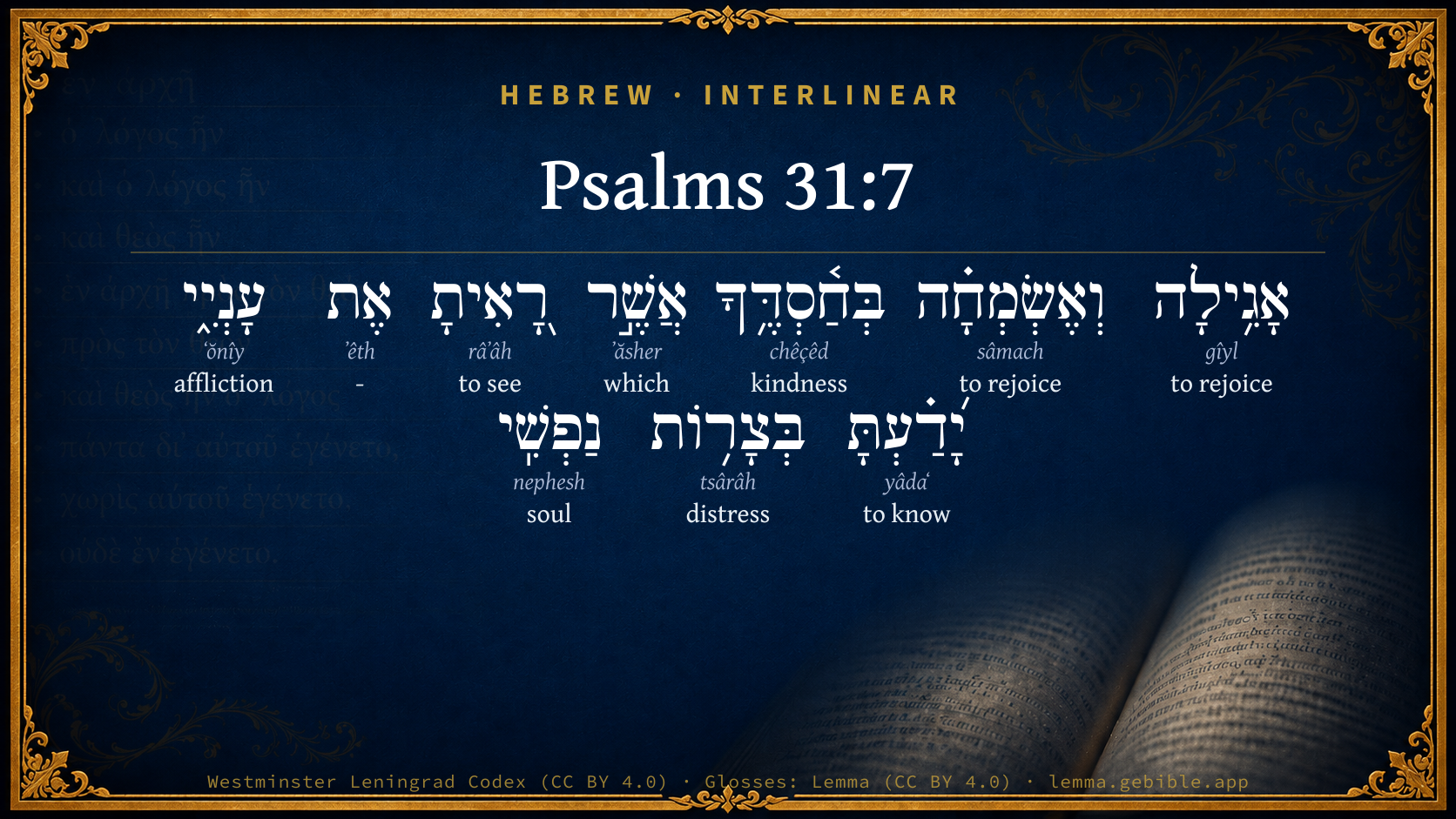
Hebrew (Westminster Leningrad Codex) Psalms 31:7 appears in the Hebrew Old Testament. The text above is from the Westminster Leningrad Codex. Each word links to its Strong’s number, a concise gloss, and parsing drawn from the Open Scriptures Hebrew Bible morphology. Click any word for its full Brown-Driver-Briggs (BDB) entry.
Download image
Cite this verse

Psalms 31:7 (World English Bible). Public Domain. Lemma interlinear Bible study tool, https://lemma.gebible.app/v/psalms/31/7.

Show BibTeX & RIS
BibTeX
RIS
English Translation
I will be glad and rejoice in your loving kindness, For you have seen my affliction. You have known my soul in adversities.
World English Bible · Public Domain
Download a study sheet

One document with this verse’s original text, its word-by-word gloss line, the meaning frame, cross-references with their text, attributed commentary, and full source and license credits — printable, and it pastes into notes with its structure intact.

This verse Autodidact and up

Study sheet (.html) Plain text (.txt)

A passage Seminary Student

Up to 50 verses in one chapter. A passage sheet keeps up to 6 commentary sources and 12 cross-references per verse, in the order this page ranks them, and says so on the sheet whenever that leaves anything out. Ask for a single verse and you get the Autodidact verse sheet above.

Everything on this page stays free to read, with no account — the sheet is a download of what is already on screen, not access to it.

Want to remove ads? Support Godless Engineer
Compare translations 3

The same verse in 3 English versions, stacked beneath the original-language interlinear above. Click any original word for its lexicon entry.

Each is an independent rendering of the whole verse — the interlinear is not word-aligned to these translations.

Highlighted words mark where these versions differ — a whole-verse word diff, not a word-by-word alignment.

  • World English Bible Public Domain
    I will be glad and rejoice in your loving kindness, For you have seen my affliction. You have known my soul in adversities.
  • King James Version Public Domain
    I will be glad and rejoice in thy mercy: for thou hast considered my trouble; thou hast known my soul in adversities;
  • unfoldingWord Literal Text CC BY-SA 4.0
    I will be glad and rejoice in your covenant faithfulness, for you have seen my affliction; you have known the troubles of my soul,

unfoldingWord Literal Text — © unfoldingWord, licensed CC BY-SA 4.0. Word-aligned USFM3 via Door43 (git.door43.org/unfoldingWord/en_ult).

Versions to compare (up to 4)

3 of 4 selected

Show all 18 translations

Every available English version of this verse, each an independent rendering of the whole verse.

  • World English Bible Public Domain
    I will be glad and rejoice in your loving kindness, For you have seen my affliction. You have known my soul in adversities.
  • Berean Standard Bible Public Domain
    I will be glad and rejoice in Your loving devotion, for You have seen my affliction; You have known the anguish of my soul.
  • Majority Standard Bible Public Domain
    I will be glad and rejoice in Your loving devotion, for You have seen my affliction; You have known the anguish of my soul.
  • King James Version Public Domain
    I will be glad and rejoice in thy mercy: for thou hast considered my trouble; thou hast known my soul in adversities;
  • American Standard Version (1901) Public Domain
    I will be glad and rejoice in thy lovingkindness; For thou hast seen my affliction: Thou hast known my soul in adversities;
  • Revised Version (1885) Public Domain
    I will be glad and rejoice in thy mercy: for thou hast seen my affliction; thou hast known my soul in adversities:
  • Geneva Bible (1599) Public Domain
    I wil be glad and reioyce in thy mercie: for thou hast seene my trouble: thou hast knowen my soule in aduersities,
  • Douay-Rheims (1899) Public Domain
    Thou hast hated them that regard vanities, to no purpose. But I have hoped in the Lord:
  • Young's Literal Translation Public Domain
    I rejoice, and am glad in Thy kindness, In that Thou hast seen mine affliction, Thou hast known in adversities my soul.
  • Literal Standard Version CC BY-SA 4.0
    I rejoice, and am glad in Your kindness, || In that You have seen my affliction, || You have known my soul in adversities.
  • Unlocked Literal Bible CC BY-SA 4.0
    I will be glad and rejoice in your covenant faithfulness, for you saw my affliction; you knew the distress of my soul.
  • unfoldingWord Literal Text CC BY-SA 4.0
    I will be glad and rejoice in your covenant faithfulness, for you have seen my affliction; you have known the troubles of my soul,
  • Darby Bible Public Domain
    I will be glad and rejoice in thy loving-kindness, for thou hast seen mine affliction; thou hast known the troubles of my soul,
  • World Messianic Bible Public Domain
    I will be glad and rejoice in your loving kindness, for you have seen my affliction. You have known my soul in adversities.
  • Webster's Bible Public Domain
    \\31:6\\I have hated them that regard lying vanities: but I trust in the LORD.
  • Free Bible Version CC BY-SA 4.0
    I will celebrate, happy in your love that never fails, for you have seen the problems I face and have paid attention to my troubles.
  • Bible in Basic English Public Domain
    I will be glad and have delight in your mercy; because you have seen my trouble; you have had pity on my soul in its sorrows;
  • JPS Tanakh (1917) Public Domain
    (31-8) I will be glad and rejoice in Thy lovingkindness; for Thou hast seen mine affliction, Thou hast taken cognizance of the troubles of my soul,

Literal Standard Version (2020), Covenant Press — licensed CC BY-SA 4.0. Text via the HelloAO Bible API (eBible.org). Unlocked Literal Bible (unfoldingWord) — licensed CC BY-SA 4.0. Text via the HelloAO Bible API (eBible.org). unfoldingWord Literal Text — © unfoldingWord, licensed CC BY-SA 4.0. Word-aligned USFM3 via Door43 (git.door43.org/unfoldingWord/en_ult). Free Bible Version, Dr. Jonathan Gallagher — licensed CC BY-SA 4.0. Text via the HelloAO Bible API (eBible.org).

Word by word

More ways to search: Search by grammar → Find every occurrence → Compare this word →

Practice this passage: Drill this verse → Learn its vocabulary →

עָנְיִ֑י
ʻŏnîy
H6040
“affliction · my”
Noun, Common, Masculine, Singular, Construct + Suffix, Personal, 1st Person, Common, Singular
Part of Speech
Noun
Type
Common
Gender
Masculine
Number
Singular
State
Construct
Full BDB Definition

Origin: from H6031

TWOT: 1652e

affliction, poverty, misery - affliction - poverty
  1. אָגִ֥ילָה gîyl H1523 “to rejoice” Verb, Qal, Cohortative, 1st Person, Common, Singular
  2. וְאֶשְׂמְחָ֗ה sâmach H8055 “and · to rejoice” Conjunction + Verb, Qal, Cohortative, 1st Person, Common, Singular
  3. בְּחַ֫סְדֶּ֥ךָ chêçêd H2617 “in/at · kindness · your” Preposition + Noun, Common, Masculine, Singular, Construct + Suffix, Personal, 2nd Person, Masculine, Singular
  4. אֲשֶׁ֣ר ʼăsher H834 “which” Particle, Relative
  5. רָ֭אִיתָ râʼâh H7200 “to see” Verb, Qal, Perfect, 2nd Person, Masculine, Singular
  6. אֶת ʼêth H853 “-” Particle, Direct Object
  7. יָ֝דַ֗עְתָּ yâdaʻ H3045 “to know” Verb, Qal, Perfect, 2nd Person, Masculine, Singular
  8. בְּצָר֥וֹת tsârâh H6869 “in/at · distresses of” Preposition + Noun, Common, Feminine, Plural, Construct
  9. נַפְשִֽׁי nephesh H5315 “soul · my” Noun, Common, Both, Singular, Construct + Suffix, Personal, 1st Person, Common, Singular

About this verse

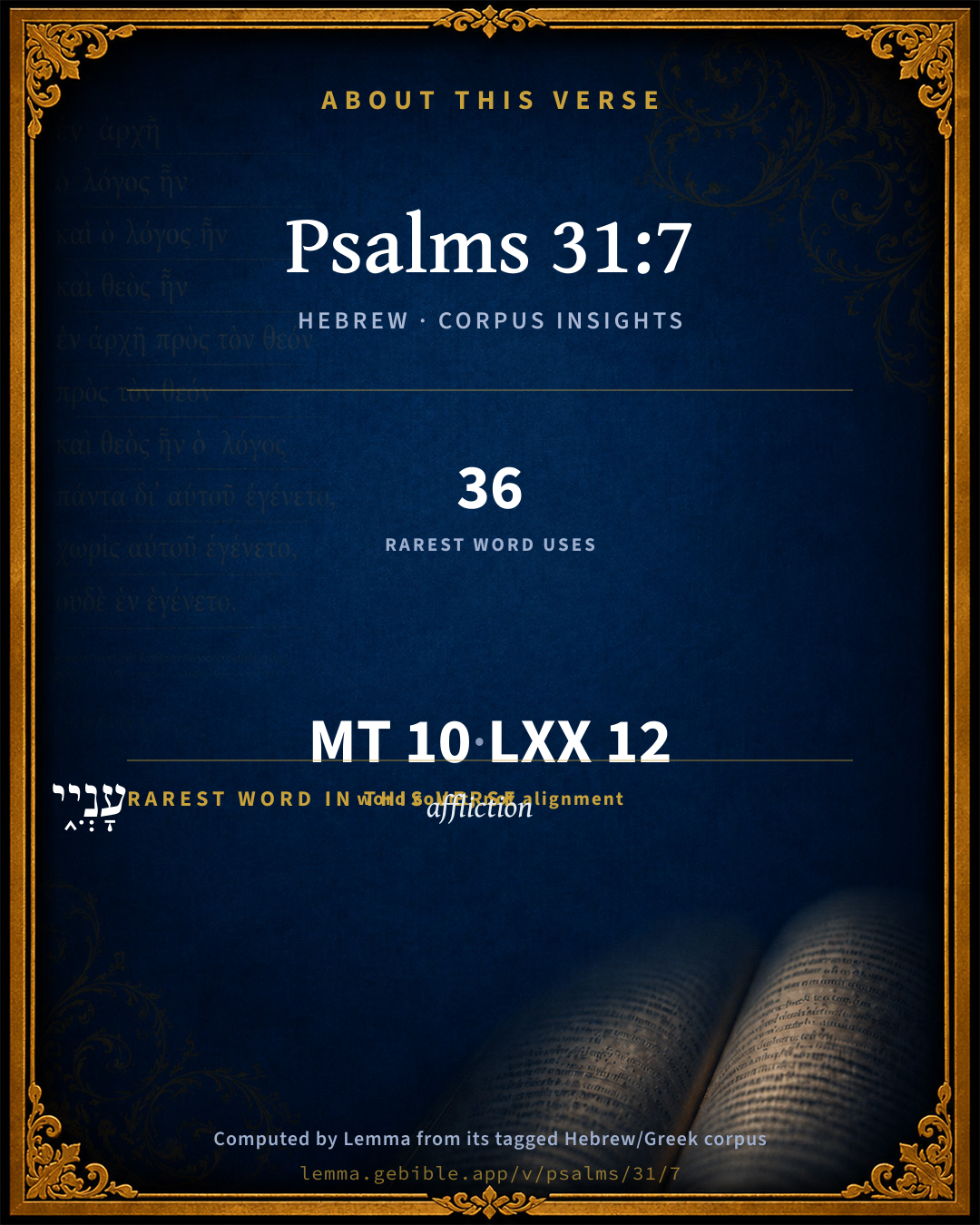
These counts appear in no published source. They are computed here, from the morphology-tagged text and Lemma’s own curated glosses. What Lemma adds →

10
words
10
distinct lemmas
Wisdom
section

Shared distinctive vocabulary

עָנְיִ֑י affliction H6040 occurs in 36 verses of the Hebrew Bible. Also found in:

Grammatical profile

  • 4 verbs
  • 4 nouns
  • 2 particles

Verb forms

  • אָגִ֥ילָה Qal · Cohortative
  • וְאֶשְׂמְחָ֗ה Qal · Cohortative
  • רָ֭אִיתָ Qal · Perfect
  • יָ֝דַ֗עְתָּ Qal · Perfect

Hebrew & Septuagint length

In English translation the verse runs 23 words from the Hebrew and 23 from the Septuagint (LXX English) — the same length.

A rough comparison of the two English renderings, which tokenize alike — not a word-level alignment.

Word counts can differ between the Hebrew and the Greek without any difference in meaning — e.g. the Hebrew direct-object marker אֵת has no separate Greek word, and Greek often adds the article ὁ.

In the original languages it is 10 Hebrew tokens and 12 Greek tokens — but the two are counted differently (Hebrew bundles its prefixes and suffixes into one token; the Greek is in lemma form), so that isn’t a like-for-like length.

Cross-references

23

Topical passages linked to Psalms 31:7 in the Treasury of Scripture Knowledge — connected by theme and wording, ordered by reader-vote popularity; previews shown in the World English Bible.

  • Isaiah 49:13 Sing, heavens; and be joyful, earth; and break forth into singing, mountains: for Yahweh has comforted his people, and will have compassion on his afflicted.
  • Isaiah 63:9 In all their affliction he was afflicted, and the angel of his presence saved them: in his love and in his pity he redeemed them; and he bore them, and carried them all the days of old.
  • Psalms 119:153 Consider my affliction, and deliver me, For I don't forget your law.
  • 2 Timothy 2:19 However God's firm foundation stands, having this seal, "The Lord knows those who are his," and, "Let every one who names the name of the Lord depart from unrighteousness."
  • Isaiah 63:16 For you are our Father, though Abraham doesn't know us, and Israel does not acknowledge us: you, Yahweh, are our Father; our Redeemer from everlasting is your name.
  • John 10:27–30 My sheep hear my voice, and I know them, and they follow me.
  • Galatians 4:9 But now that you have come to know God, or rather to be known by God, why do you turn back again to the weak and miserable elements, to which you desire to be in bondage all over again?
  • Isaiah 43:2 When you pass through the waters, I will be with you; and through the rivers, they shall not overflow you: when you walk through the fire, you shall not be burned, neither shall the flame kindle on you.
  • Psalms 71:20 You, who have shown us many and bitter troubles, You will let me live. You will bring us up again from the depths of the earth.
  • Psalms 142:3 When my spirit was overwhelmed within me, You knew my path. In the way in which I walk, They have hidden a snare for me.
  • Lamentations 3:50 Until Yahweh look down, and see from heaven.
  • Job 23:10 But he knows the way that I take. When he has tried me, I shall come forth like gold.
  • Psalms 1:6 For Yahweh knows the way of the righteous, But the way of the wicked shall perish.
  • Psalms 9:13 Have mercy on me, Yahweh. See my affliction by those who hate me, And lift me up from the gates of death;
  • Psalms 13:5 But I trust in your loving kindness. My heart rejoices in your salvation.
  • Nehemiah 9:32 Now therefore, our God, the great, the mighty, and the awesome God, who keep covenant and loving kindness, don't let all the travail seem little before you, that has come on us, on our kings, on our princes, and on our priests, and on our prophets, and on our fathers, and on all your people, since the time of the kings of Assyria to this day.
  • Psalms 90:14 Satisfy us in the morning with your loving kindness, That we may rejoice and be glad all our days.
  • Job 10:9 Remember, I beg you, that you have fashioned me as clay. Will you bring me into dust again?
  • Psalms 10:14 But you do see trouble and grief; You consider it to take it into your hand. You help the victim and the fatherless.
  • Psalms 25:18 Consider my affliction and my travail. Forgive all my sins.
  • Jeremiah 33:11 the voice of joy and the voice of gladness, the voice of the bridegroom and the voice of the bride, the voice of those who say, Give thanks to Yahweh of Hosts, for Yahweh is good, for his loving kindness endures forever; [and of them] who bring [sacrifices of] thanksgiving into the house of Yahweh. For I will cause the captivity of the land to return as at the first, says Yahweh.
  • 1 Corinthians 8:3 But if anyone loves God, the same is known by him.
  • Lamentations 5:1 Remember, Yahweh, what has come on us: Look, and see our reproach.

Cross-references courtesy of OpenBible.info (CC BY 4.0).

Hebrew and Greek witnesses Masoretic Hebrew ↔ Greek Septuagint

The same verse in the two great witnesses to the Old Testament, shown verse-for-verse.

You’re reading Greek Psalm 30 (Hebrew Psalm 31). The Septuagint counts the superscription, so verse numbers can differ from the Hebrew — chapter-level alignment, not verse-by-verse. Numbering follows Rahlfs.

These are two independent witnesses, not word-aligned to each other, and the Septuagint is shown in lemma (dictionary) form.

Hebrew Psalms 31:7 Masoretic · Westminster Leningrad Codex

אָגִ֥ילָה וְאֶשְׂמְחָ֗ה בְּחַ֫סְדֶּ֥ךָ אֲשֶׁ֣ר רָ֭אִיתָ אֶת עָנְיִ֑י יָ֝דַ֗עְתָּ בְּצָר֥וֹת נַפְשִֽׁי

I will be glad and rejoice in your loving kindness, For you have seen my affliction. You have known my soul in adversities.

World English Bible · Public Domain

Greek LXX Greek Psalm 30:7 Septuagint · lemma form

μισέω ὁ διαφυλάσσω ματαιότης διά κενός ἐγώ δέ ἐπί ὁ κύριος ἐλπίζω

I will exult and be glad in your mercy: for you have looked upon my affliction; you have saved my soul from distresses.

LXX2012 (modern English Septuagint) · Public Domain

Hebrew: Westminster Leningrad Codex (CC BY 4.0). Greek: Septuagint (public domain); English from LXX2012 (modern English Septuagint) (Public Domain). How the Septuagint differs from the Hebrew →

Commentary

Notes on Psalms 31:7 from classic Christian and Jewish commentators (each source and its license shown beneath its notes). The classic Christian expositions comment on the surrounding passage and are grouped to its opening verse, so a note may address several verses; the Jewish commentaries on the Tanakh (Rashi and others) are per-verse, so they appear only where the commentator wrote on this verse.

Lemma curates 59 commentaries, every one of them public domain or Creative Commons licensed, each selected and text-cleaned for this edition rather than reprinted as found. About our sources →

Trapp's Complete Commentary

John Trapp

Psa 31:7 I will be glad and rejoice in thy mercy: for thou hast considered my trouble; thou hast known my soul in adversities;

Ver. 7. I will be glad and rejoice] In the midst of trouble faith will find matter of joy; as extracting abundance of comfort in most desperate distresses from the precious promises and former experiences.

Thou hast known my soul in adversity] God knows our souls best, Psa 1:6, and we know him best, in adversity. Isa 63:16, the Church thought she should know him in the midst of all his austerities.

John Trapp, A Commentary or Exposition upon All the Books of the Old and New Testament (1647–1656) — public domain. Text from a community e-Sword module.

The Biblical Illustrator

Joseph S. Exell

Psa_31:7

I will be glad and rejoice in Thy mercy, for Thou hast considered my trouble.

Divine chastisements

I. That the souls of all Gods people must have their day of adversity, This, indeed, follows from the universal methods by which God governs and upholds the world. The present life is not a state of retribution, or a place where God professes to discriminate visibly between the good and the evil. If God make His sun to shine both on the just and the unjust, what shall forbid His judgments from alighting also on both?

II. whatever our troubles may be there is one to consider our calamities and to know how long we can bear them, Thou hast considered and known my soul in adversities. Affliction often appears to move both God and man; it moves God to consider mans infirmities, and it moves man to consider his own soul. Behold, then, why we count them happy which endure--because endurance has a tendency to bring God and the sinner together. Prosperity, health, and comfort too often form a great gulf betwixt us and God--a gulf which must either be crossed by a bridge of sighs, or else filled up with the fragments of those earthly idols which our hearts had worshipped instead of God. And when the poor sinner is thus brought unto God, the first petition he prefers is, Lord, consider my affliction; look upon my distress; let Thine eye fasten itself upon my misery and pain. For his faith tells him all will be well, if God can be brought to take notice of his low estate. Our faith in the Divine promises warms and brightens by the very earnestness with which we plead them; we move God to pity, by moving ourselves to feel that we need pity, and are enabled to draw nigh to God, by the very act of asking God to draw nigh to us.

III. that our heavenly Fathers consideration of the troubles of his people should supply us with matter for joy and praise. I will be glad and rejoice in Thy mercy. We are all more forward to ask for blessings than we are to render God thanks when we have received them. Ten lepers would ask the Saviour for health, but one alone returned to thank Him for it. A day could be taken from our labours to humble ourselves under a scourge, but a day could not be afforded to return thanks for our deliverance. Brethren, this backwardness in thanksgiving ought not so to be. We are hastening to a world where praise is all we shall have to do, and it surely were but fitting that we should begin our rehearsal now. Here we can forbear, and hope, and believe, and pray; but what room will there be for such like works in heaven? (Daniel Moore, M. A.)

The Biblical Illustrator, edited by Joseph S. Exell (c. 1880s–1900s) — public domain. Text from a community e-Sword module.

Joseph Benson's Commentary

Psa 31:7-8. Thou hast known my soul in adversities — Hast not stood aloof from me, and acted toward me as a stranger, but hast loved me, and cared for me. For knowledge often implies affection. And hast not shut me up — Or, suffered me to be shut up; into the hand — Or power; of the enemy — Of which I was in great and imminent danger, if thou hadst not delivered me. Thou hast set my foot in a large room — Made way for me to escape when I was encompassed by them, and set me at liberty.

Joseph Benson's Commentary on the Old and New Testaments (1811–1818) — public domain. Text from a community e-Sword module.

J. A. Alexander on Psalms

Joseph Addison Alexander

8. (Psa 31:7). I will triumph and joy in thy mercy, thou who hast seen my affliction, hast known the pangs of my soul. In the strength of his faith he sees deliverance already present.—Hast known in the pangs of my soul, i.e. in the time of my distress hast been aware of it, which seems to be the meaning of this verb and preposition elsewhere (Gen 19:33; Gen 19:35, Job 35:5). Luther and others give a different construction, hast known my soul in distress, but the other is favoured by the occurrence of the phrase distress (or agonies) of soul in Gen 42:21, and Psa 25:17. The sight and knowledge here applied to God imply a corresponding action. "Thou hast seen and known my state, and dealt with me accordingly." With the first clause compare Psa 9:3 (2).

Joseph Addison Alexander, The Psalms Translated and Explained (1850) — public domain. Text from a community e-Sword module.

Jamieson, Fausset & Brown

Robert Jamieson, A. R. Fausset & David Brown

hast known my soul, &c.--had regard to me in trouble.

Jamieson, Fausset & Brown — Commentary Critical and Explanatory on the Whole Bible (1871) — public domain (CC PDM 1.0). Text via the HelloAO Bible API.

Adam Clarke's Commentary

Verse 7. Thou hast known my soul in adversities] When all forsook me; when none could help me; when I could not save my own life; when my enemies were sure that I could not escape; then I found thee to be my Friend and Supporter. When friend, so called, finds it convenient not to know his friend in affliction and poverty, then thou didst acknowledge me as thine own, all worthless as I was. Human friendships may fail; but the Friend of sinners never fails. Cicero defines a real friend, Amicus certus in re incerta cernitor: "A friend in need is a friend indeed." Reader, such a Friend is the Lord.

Adam Clarke's Commentary on the Bible (1810–1826) — public domain. Text from a community e-Sword/MySword module.

John Calvin's Commentaries

7. I will be glad and rejoice in thy goodness. Here is inserted a thanksgiving, although many are rather of opinion that David’s prayer is suspended, and that he makes a vow, when he shall be delivered from present danger. But as no condition is annexed, I am rather inclined to think that stopping all at once in the middle of his prayer, he promises himself a deliverance, for which he will have abundant matter for giving thanks. Nor is it to be wondered at that different feelings are mingled in the psalms in which David has set forth his own temptations, as well as the resistance which his faith made to them, considering also that when he sung the praises of God, after having already obtained deliverance from him, he embraces different periods in his song, as he here says, that God had regarded his affliction, intimating by this the effect of the assistance which God had afforded him. And that he may the better confirm this, he adds, that he had not been delivered into the hands of his enemies: in which words there is an implied antithesis, namely, that when he was encompassed on every side by severe afflictions, he was marvellously delivered by God. This is also farther intimated by the following sentence, Thou hast set my feet in a large place, “There is a contrast in the expression between the straits to which he had been confined, and the freedom which was now bestowed upon him.” — Walford.

John Calvin's Commentaries (1540-1563) — public domain. Text from the Calvin Translation Society English edition (1840s-50s) via the Christian Classics Ethereal Library (ccel.org). Calvin's coverage is partial (roughly two-thirds of the Bible); uncommented books and verses are honest gaps, never fabricated. The 19th-century editor's footnotes and remarks are omitted so the notes are faithfully Calvin's own voice.

The Cambridge Bible for Schools and Colleges

gen. ed. J. J. S. Perowne

7. Let me be glad and rejoice in thy lovingkindness:

For thou hast seen my affliction;

Thou hast taken knowledge of the distresses of my soul.

An entreaty, based upon past experience. Here, and in Psa_31:8, as well as in 5 b, it is more natural to understand the perfect tenses to refer to past mercies, rather than as a confident anticipation of future deliverance. With the second line cp. Psa_9:13.

The Cambridge Bible for Schools and Colleges (gen. ed. J. J. S. Perowne; Cambridge University Press, 1878–1918) — public domain. Text from a community e-Sword module.

John Gill's Exposition

I will be glad, and rejoice in thy mercy,.... Both because of the nature of it, which is large and abundant, free and sovereign, from everlasting to everlasting, and is communicated in and through Christ, and is a good ground of hope and trust; and because of the effects of it, or what it has produced; for to it are owing the covenant of grace, and all the sure mercies of it; the mission of Christ, and redemption by him; regeneration, and the forgiveness of sins, and even eternal life and glory; besides a multitude of blessings, deliverances, and salvations in Providence; on account of all which there is great reason for joy and gladness; of which the following are particulars;

for thou hast considered my trouble; inward, arising from indwelling sin, doubts and fears, desertions and darkness, and Satan's temptations; and outward, from the world, and the men of it, and by reason of bodily afflictions: now the Lord looks upon the troubles of his people, and upon them in them, with an eye of pity and compassion; he sympathizes with them; he considers the nature of their trouble, their weakness to bear it, and the best way, in tans, and time to deliver out of it; he working all things after the counsel of his own will; see Exo 3:7;

thou hast known my soul in adversities; that is, the Lord had took notice of him, approved of him, loved him, had visited him, and made known his love to him, and owned him for his own, and had chosen him in the furnace of affliction; a time and season when oftentimes friends and acquaintance are shy, and will not look upon men, know them, and own them; but the Lord does otherwise, and which is another reason of joy and gladness in his mercy.

John Gill's Exposition of the Whole Bible (1746–1763) — public domain (CC PDM 1.0). Text via the HelloAO Bible API.

Albert Barnes' Notes on the Bible

I will be glad and rejoice in thy mercy - I will triumph and joy in thy mercy; that is, in the mercy which he had already experienced, and in that which he still hoped to enjoy. He had had abundant proofs of that mercy; he hoped for still further proofs of it; and he says that he would find his joy in that, and not in what idols could give.

For thou hast considered my trouble - In times past and now. He felt assured that his prayer would be regarded, and that God would relieve and deliver him.

Thou hast known my soul in adversities - In the troubles that have come upon me. That is, God had seen and known all the feelings of his heart in the time of adversity; his sorrow and anxiety; his hope and trust; his uncomplaining spirit; his feeling of entire dependence on God, and his belief that He would interpose to save him. God had not turned away from him, but had shown that he regarded with interest all his feelings, his desires, his hopes. It is much, in the time of trouble, to know that all our feelings are understood by God, that He sees all our sorrows, and that He will not be regardless of them. There are no states of mind more interesting than those which occur in adversities; there is no one who can fully understand the soul in adversities but God; there is no one but God who can entirely meet the needs of the soul in such seasons.

Albert Barnes' Notes on the Bible (1834–1885) — public domain. Text from a community e-Sword/MySword module.

Matthew Poole's English Annotations

Thou hast known, i.e. loved me, and cared for me; for words of knowledge commonly imply affection.

Matthew Poole's English Annotations on the Holy Bible (1683–1685) — public domain. Text from a community e-Sword/MySword module.

The Treasury of David

Charles H. Spurgeon

Ver. 7. I will be glad and rejoice in thy mercy. For mercy past he is grateful, and for mercy future, which he believingly anticipates, he is joyful. In our most importunate intercessions, we must find breathing time to bless the Lord: praise is never a hindrance to prayer, but rather a lively refreshment therein. It is delightful at intervals to hear the notes of the high sounding cymbals when the dolorous sackbut rules the hour. Those two words, glad and rejoice, are an instructive reduplication, we need not stint ourselves in our holy triumph; this wine we may drink in bowls without fear of excess. For thou hast considered my trouble. Thou hast seen it, weighed it, directed it, fixed a bound to it, and in all ways made it a matter of tender consideration. A man's consideration means the full exercise of his mind; what must God's consideration be? Thou hast known my soul in adversities. God owns his saints when others are ashamed to acknowledge them; he never refuses to know his friends. He thinks not the worse of them for their rags and tatters. He does not misjudge them and cast them off when their faces are lean with sickness, or their hearts heavy with despondency. Moreover, the Lord Jesus knows us in our pangs in a peculiar sense, by having a deep sympathy towards us in them all; when no others can enter into our griefs, from want of understanding them experimentally, Jesus dives into the lowest depths with us, comprehending the direst of our woes, because he has felt the same. Jesus is a physician who knows every case; nothing is new to him. When we are so bewildered as not to know our own state, he knows us altogether. He has known us and will know us: O for grace to know more of him! "Man, know thyself, "is a good philosophic precept, but "Man, thou art known of God, "is a superlative consolation. Adversities in the plural "Many are the afflictions of the righteous."

Ver. 7. I will be glad and rejoice in thy mercy. In the midst of trouble faith will furnish matter of joy, and promise to itself gladness, especially from the memory of by past experiences of God's mercy; as here, I will be glad and rejoice in thy mercy....The ground of our gladness, when we have found a proof of God's kindness to us should not be in the benefit so much as in the fountain of the benefit; for this giveth us hope to drink again of the like experience from the fountain which did send forth that benefit. Therefore David says, I will be glad and rejoice in thy mercy. David Dickson.

Ver. 7. Thou hast considered my trouble:

Man's plea to man, is, that he never more

Will beg, and that he never begged before:

Man's plea to God, is, that he did obtain

A former suit, and, therefore sues again.

How good a God we serve, that when we sue,

Makes his old gifts the examples of his new!

Francis Quarles.

Ver. 7. Thou hast known my soul in adversities. One day a person who, by the calamities of war, sickness, and other affliction, had been reduced from a state of affluence to penury, came to Gotthold in great distress. He complained that he had just met one of his former acquaintances, who was even not distantly related to him, but that he had not condescended to bow, far less to speak to him, and he had turned his eyes away, and passed him as if he had been a stranger. O sir, he exclaimed with a sigh, how it pained me! I felt as if a dagger had pierced my heart! Gotthold replied, Do not think it strange at all. It is the way of the world to look high, and to pass unnoticed that which is humble and lowly. I know, however, of One who, though he dwelleth on high, humbleth himself to behold the things that are in heaven and in the earth Ps 113:5-6, and of whom the royal prophet testifies: Thou hast known my soul in adversities. Yes; though we have lost our rich attire, and come to him in rags; though our forms be wasted because of grief, and waxed old (Ps 6:7, Luther's Version); though sickness and sorrow have consumed our beauty like a moth Ps 39:11; though blushes, and tears, and dust, overspread our face Ps 69:7, he still recognises, and is not ashamed to own us. Comfort yourself with this, for what harm will it do you at last, though men disown, if God the Lord have not forgotten you? Christian Scriver.

Ver. 7.

1. An endearing attribute rejoiced in.

2. An interesting experience related.

3. A directly personal favour from God delighted in.

Ver. 7. (centre clause). Consider the measure, the effects, the time, the tempering, the ending, and the recompense.

Ver. 7. (last clause). The Lord's familiarity with his afflicted.

Psalms 31:8*

Charles H. Spurgeon's The Treasury of David (1869–1885) — public domain. Psalms only. Text from a community e-Sword/MySword module.

Whedon's Commentary on the Bible

Daniel D. Whedon

7. For thou hast considered my trouble—The psalmist comforts himself with the thought that God has thoroughly known both his affliction and deportment under trials, and, by implication, would do what was befitting the case.

Daniel D. Whedon (gen. ed.), Commentary on the Old and New Testaments (1874–1909) — public domain. Text from a community e-Sword module.

The Pulpit Commentary

I will be glad and rejoice in thy mercy. Anticipating the "mercy" which he has craved (vers. 2-4), the psalmist determines to "be glad and rejoice in it." For thou hast considered my trouble. When God looks upon trouble and considers it, he is sure to compassionate the sufferer, and to grant him some relief. Thou hast known my soul in adversities. (comp. Psa_1:6, "The Lord knoweth the way of the righteous God is said to "know" those on whom he looks with approval.

The Pulpit Commentary (1880–1919), ed. H.D.M. Spence-Jones & Joseph S. Exell — public domain. Text from a community e-Sword module.

John Wesley's Explanatory Notes

Known - Loved me, and cared for me.

John Wesley, Explanatory Notes Upon the Whole Bible (1754–1765) — public domain. Text via the GEBible commentary corpus.

Rashi

Rabbi Shlomo Yitzchaki (Rashi)

those who await worthless vanities Who await the salvation of pagan deities.

Rashi on the Tanakh — English translations: “The Judaica Press complete Tanach with Rashi, translated by A. J. Rosenberg” (CC BY 4.0); “Pentateuch with Rashi's commentary by M. Rosenbaum and A.M. Silbermann, 1929-1934” (public domain); “The Metsudah Tanach series, Lakewood, N.J” (CC BY 4.0); and “The Book of Joshua, Metsudah Publications, 1997” (CC BY 4.0). Text via Sefaria.

Lesson kit

Teaching starters — assembled from the data on this page, not authored interpretation. Every prompt links to the verse data it draws on. Edit before teaching.

Psalms, in the Wisdom, opens this verse with 10 words (10 distinct Hebrew lemmas). Its most distinctive word is ʻŏnîy (“affliction”). A historical commentator’s framing appears above. Read the whole chapter for the surrounding context.

Discussion questions

  1. How does “affliction” (ʻŏnîy) shape what this verse is saying?
  2. How does Genesis 16:11, which shares the word «affliction», read alongside this verse?
  3. The translations on this page render this verse differently — a whole-verse word diff, not a word-by-word alignment. What might account for the different wordings?
  4. «אָגִ֥ילָה» is a Qal Cohortative verb. How does that grammatical form shape the action described?
  5. Compare how Trapp's Complete Commentary and The Biblical Illustrator read this verse. Where do they agree or differ?

Things to notice

Reading settings

Reading text

Shown beneath each verse's original-language words.

Old Testament
Old Testament edition

Read the OT as the Masoretic Hebrew (MT) or the Greek Septuagint (LXX).

English shown for the Greek Septuagint (in the Hebrew ↔ Greek comparison).

Comparing translations? Open the Compare panel on any verse page to stack up to four side by side.