
Psalms 68:3

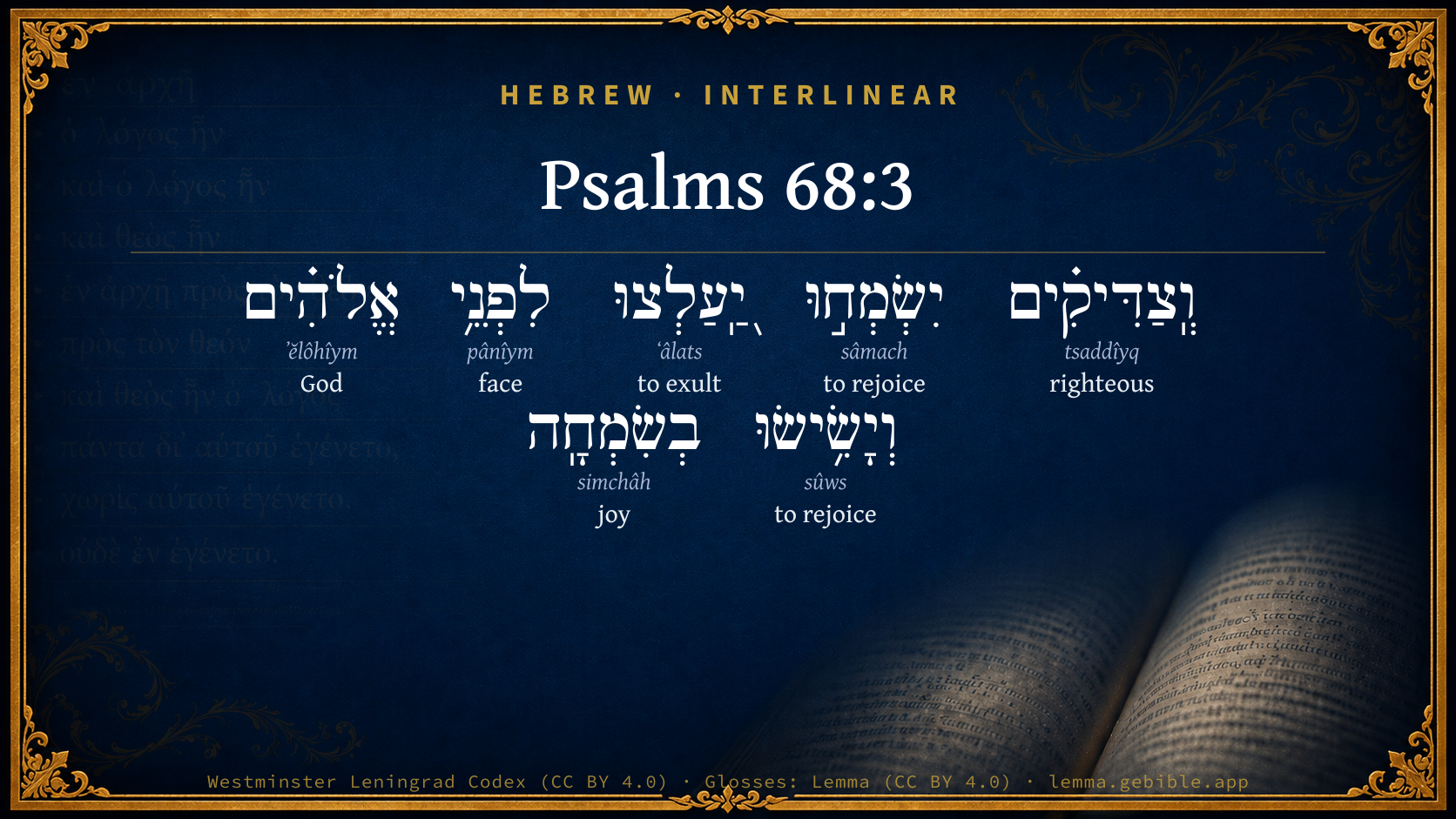
Hebrew (Westminster Leningrad Codex) Psalms 68:3 appears in the Hebrew Old Testament. The text above is from the Westminster Leningrad Codex. Each word links to its Strong’s number, a concise gloss, and parsing drawn from the Open Scriptures Hebrew Bible morphology. Click any word for its full Brown-Driver-Briggs (BDB) entry.
Download image
Cite this verse

Psalms 68:3 (World English Bible). Public Domain. Lemma interlinear Bible study tool, https://lemma.gebible.app/v/psalms/68/3.

Show BibTeX & RIS
BibTeX
RIS
English Translation
But let the righteous be glad. Let them rejoice before God. Yes, let them rejoice with gladness.
World English Bible · Public Domain
Download a study sheet

One document with this verse’s original text, its word-by-word gloss line, the meaning frame, cross-references with their text, attributed commentary, and full source and license credits — printable, and it pastes into notes with its structure intact.

This verse Autodidact and up

Study sheet (.html) Plain text (.txt)

A passage Seminary Student

Up to 50 verses in one chapter. A passage sheet keeps up to 6 commentary sources and 12 cross-references per verse, in the order this page ranks them, and says so on the sheet whenever that leaves anything out. Ask for a single verse and you get the Autodidact verse sheet above.

Everything on this page stays free to read, with no account — the sheet is a download of what is already on screen, not access to it.

Want to remove ads? Support Godless Engineer
Compare translations 3

The same verse in 3 English versions, stacked beneath the original-language interlinear above. Click any original word for its lexicon entry.

Each is an independent rendering of the whole verse — the interlinear is not word-aligned to these translations.

Highlighted words mark where these versions differ — a whole-verse word diff, not a word-by-word alignment.

  • World English Bible Public Domain
    But let the righteous be glad. Let them rejoice before God. Yes, let them rejoice with gladness.
  • King James Version Public Domain
    But let the righteous be glad; let them rejoice before God: yea, let them exceedingly rejoice.
  • unfoldingWord Literal Text CC BY-SA 4.0
    But let the righteous rejoice, let them exult to the face of God, and let them be glad with rejoicing.

unfoldingWord Literal Text — © unfoldingWord, licensed CC BY-SA 4.0. Word-aligned USFM3 via Door43 (git.door43.org/unfoldingWord/en_ult).

Versions to compare (up to 4)

3 of 4 selected

Show all 18 translations

Every available English version of this verse, each an independent rendering of the whole verse.

  • World English Bible Public Domain
    But let the righteous be glad. Let them rejoice before God. Yes, let them rejoice with gladness.
  • Berean Standard Bible Public Domain
    But the righteous will be glad and rejoice before God; they will celebrate with joy.
  • Majority Standard Bible Public Domain
    But the righteous will be glad and rejoice before God; they will celebrate with joy.
  • King James Version Public Domain
    But let the righteous be glad; let them rejoice before God: yea, let them exceedingly rejoice.
  • American Standard Version (1901) Public Domain
    But let the righteous be glad; let them exult before God: Yea, let them rejoice with gladness.
  • Revised Version (1885) Public Domain
    But let the righteous be glad; let them exult before God: yea, let them rejoice with gladness.
  • Geneva Bible (1599) Public Domain
    But the righteous shalbe glad, and reioyce before God: yea, they shall leape for ioye.
  • Douay-Rheims (1899) Public Domain
    As smoke vanisheth, so let them vanish away: as wax melteth before the fire, so let the wicked perish at the presence of God.
  • Young's Literal Translation Public Domain
    And the righteous rejoice, they exult before God, And they joy with gladness.
  • Literal Standard Version CC BY-SA 4.0
    And the righteous rejoice, they exult before God, || And they rejoice with gladness.
  • Unlocked Literal Bible CC BY-SA 4.0
    But let the righteous be glad; let them exult before God; may they rejoice and be happy.
  • unfoldingWord Literal Text CC BY-SA 4.0
    But let the righteous rejoice, let them exult to the face of God, and let them be glad with rejoicing.
  • Darby Bible Public Domain
    But the righteous shall rejoice: they shall exult before God and be glad with joy.
  • World Messianic Bible Public Domain
    But let the righteous be glad. Let them rejoice before God. Yes, let them rejoice with gladness.
  • Webster's Bible Public Domain
    \\68:2\\As smoke is driven away, so drive them away: as wax melteth before the fire, so let the wicked perish at the presence of God.
  • Free Bible Version CC BY-SA 4.0
    But those who are right with God are happy, and they celebrate in God's presence, full of joy.
  • Bible in Basic English Public Domain
    But let the upright be glad; let them have delight before God; let them be full of joy.
  • JPS Tanakh (1917) Public Domain
    (68-4) But let the righteous be glad, let them exult before God; yea, let them rejoice with gladness.

Literal Standard Version (2020), Covenant Press — licensed CC BY-SA 4.0. Text via the HelloAO Bible API (eBible.org). Unlocked Literal Bible (unfoldingWord) — licensed CC BY-SA 4.0. Text via the HelloAO Bible API (eBible.org). unfoldingWord Literal Text — © unfoldingWord, licensed CC BY-SA 4.0. Word-aligned USFM3 via Door43 (git.door43.org/unfoldingWord/en_ult). Free Bible Version, Dr. Jonathan Gallagher — licensed CC BY-SA 4.0. Text via the HelloAO Bible API (eBible.org).

Word by word

More ways to search: Search by grammar → Find every occurrence → Compare this word →

Practice this passage: Drill this verse → Learn its vocabulary →

About this verse

These counts appear in no published source. They are computed here, from the morphology-tagged text and Lemma’s own curated glosses. What Lemma adds →

7
words
7
distinct lemmas
Wisdom
section

Notable vocabulary

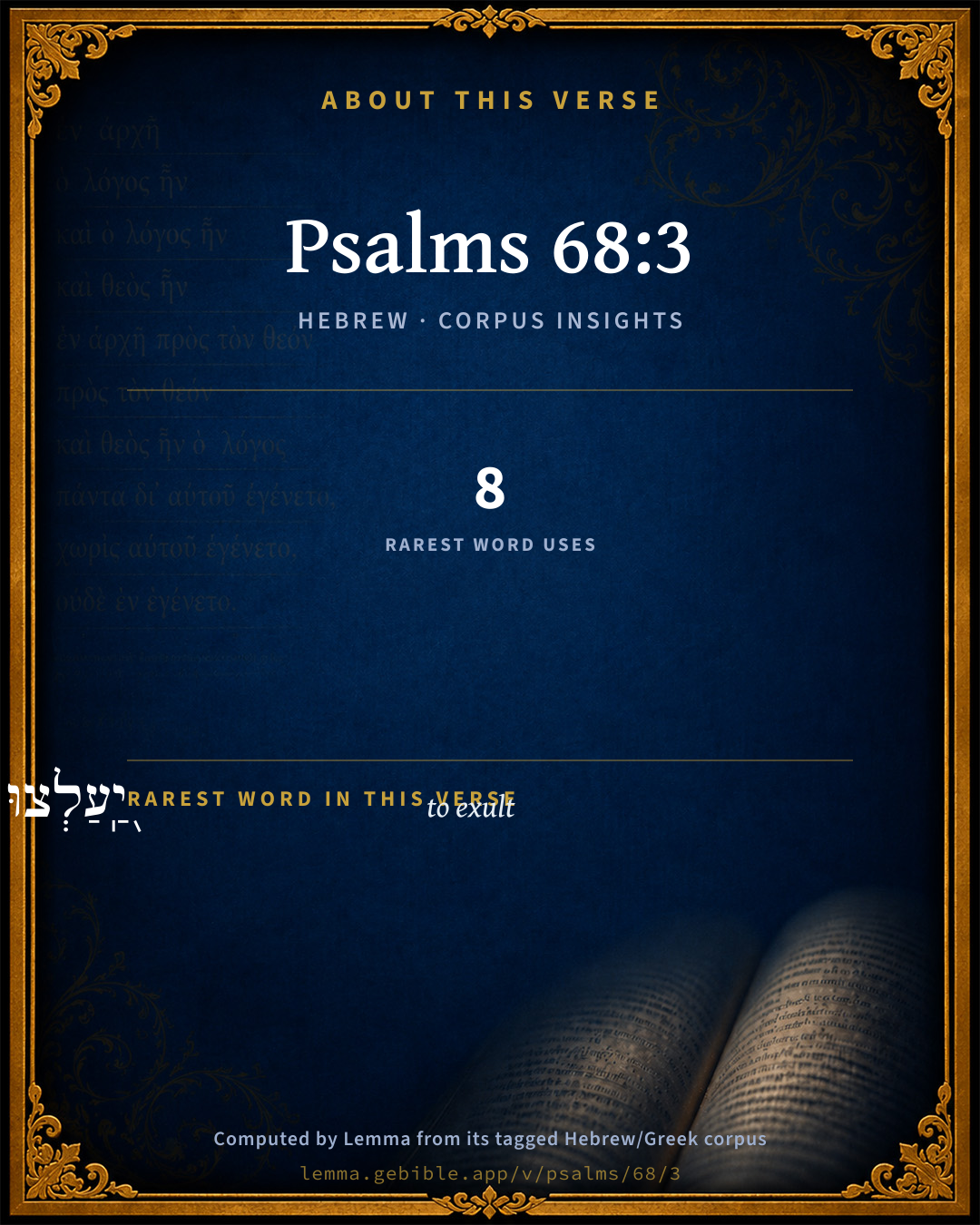
The rarest word here is יַֽ֭עַלְצוּ to exult H5970 — appearing just 8 times in the whole Hebrew Bible.

Shared distinctive vocabulary

יַֽ֭עַלְצוּ to exult H5970 occurs in 8 verses of the Hebrew Bible. Also found in:

Grammatical profile

  • 3 verbs
  • 3 nouns
  • 1 adjective

Verb forms

  • יִשְׂמְח֣וּ Qal · Imperfect
  • יַֽ֭עַלְצוּ Qal · Imperfect
  • וְיָשִׂ֥ישׂוּ Qal · Imperfect

Hebrew & Septuagint length

In English translation the verse runs 17 words from the Hebrew and 16 from the Septuagint (LXX English) — closely comparable.

A rough comparison of the two English renderings, which tokenize alike — not a word-level alignment.

Word counts can differ between the Hebrew and the Greek without any difference in meaning — e.g. the Hebrew direct-object marker אֵת has no separate Greek word, and Greek often adds the article ὁ.

Cross-references

14

Topical passages linked to Psalms 68:3 in the Treasury of Scripture Knowledge — connected by theme and wording, ordered by reader-vote popularity; previews shown in the World English Bible.

  • Psalms 64:10 The righteous shall be glad in Yahweh, And shall take refuge in him. All the upright in heart shall praise him!
  • 1 Thessalonians 5:16 Rejoice always.
  • Psalms 100:1–2 Shout for joy to Yahweh, all you lands!
  • Revelation 18:20 Rejoice over her, O heaven, you saints, apostles, and prophets; for God has judged your judgment on her."
  • Psalms 95:1–2 Oh come, let's sing to Yahweh. Let's shout aloud to the rock of our salvation!
  • 1 Peter 1:8 whom not having known you love; in whom, though now you don't see him, yet believing, you rejoice greatly with joy unspeakable and full of glory--
  • Deuteronomy 12:12 You shall rejoice before Yahweh your God, you, and your sons, and your daughters, and your men-servants, and your maid-servants, and the Levite who is within your gates, because he has no portion nor inheritance with you.
  • Psalms 43:4 Then I will go to the altar of God, To God, my exceeding joy. I will praise you on the harp, God, my God.
  • Psalms 97:12 Be glad in Yahweh, you righteous people! Give thanks to his holy Name.
  • Psalms 98:8–9 Let the rivers clap their hands. Let the mountains sing for joy together.
  • Revelation 19:7 Let us rejoice and be exceedingly glad, and let us give the glory to him. For the marriage of the Lamb has come, and his wife has made herself ready."
  • Psalms 21:1 The king rejoices in your strength, Yahweh! How greatly he rejoices in your salvation!
  • Psalms 32:11–33:1 Be glad in Yahweh, and rejoice, you righteous! Shout for joy, all you who are upright in heart!
  • Psalms 58:10 The righteous shall rejoice when he sees the vengeance. He shall wash his feet in the blood of the wicked;

Cross-references courtesy of OpenBible.info (CC BY 4.0).

Hebrew and Greek witnesses Masoretic Hebrew ↔ Greek Septuagint

The same verse in the two great witnesses to the Old Testament, shown verse-for-verse.

You’re reading Greek Psalm 67 (Hebrew Psalm 68). The Septuagint counts the superscription, so verse numbers can differ from the Hebrew — chapter-level alignment, not verse-by-verse. Numbering follows Rahlfs.

These are two independent witnesses, not word-aligned to each other, and the Septuagint is shown in lemma (dictionary) form.

Hebrew Psalms 68:3 Masoretic · Westminster Leningrad Codex

וְֽצַדִּיקִ֗ים יִשְׂמְח֣וּ יַֽ֭עַלְצוּ לִפְנֵ֥י אֱלֹהִ֗ים וְיָשִׂ֥ישׂוּ בְשִׂמְחָֽה

But let the righteous be glad. Let them rejoice before God. Yes, let them rejoice with gladness.

World English Bible · Public Domain

Greek LXX Greek Psalm 67:3 Septuagint · lemma form

ὡς ἐκλείπω καπνός ἐκλείπω ὡς τήκω κηρός ἀπό πρόσωπον πύρ οὕτως ἀποὀλλύω ὁ ἁμαρτωλός ἀπό πρόσωπον ὁ θεός

But let the righteous rejoice; let them exult before God: let them be delighted with joy.

LXX2012 (modern English Septuagint) · Public Domain

Hebrew: Westminster Leningrad Codex (CC BY 4.0). Greek: Septuagint (public domain); English from LXX2012 (modern English Septuagint) (Public Domain). How the Septuagint differs from the Hebrew →

Commentary

Notes on Psalms 68:3 from classic Christian and Jewish commentators (each source and its license shown beneath its notes). The classic Christian expositions comment on the surrounding passage and are grouped to its opening verse, so a note may address several verses; the Jewish commentaries on the Tanakh (Rashi and others) are per-verse, so they appear only where the commentator wrote on this verse.

Lemma curates 59 commentaries, every one of them public domain or Creative Commons licensed, each selected and text-cleaned for this edition rather than reprinted as found. About our sources →

Trapp's Complete Commentary

John Trapp

Psa 68:3 But let the righteous be glad; let them rejoice before God: yea, let them exceedingly rejoice.

Ver. 3. But let the righteous be glad] When he seeth the vengeance, Psa 58:10 {See Trapp on "Psa 58:10"} while this wise King scattereth the wicked, and bringeth the wheel over them, Pro 20:26.

Let them rejoice before God] Heb. At the presence of God, from which the wicked must flee, Psa 68:1. See Isa 33:14.

Yea, let them exceedingly rejoice] Heb. rejoice with gladness; overabound exceedingly with joy, as St Paul did, 2Co 7:4. Joy is the just man’s portion, which the wicked may not meddle with, Hos 9:1.

John Trapp, A Commentary or Exposition upon All the Books of the Old and New Testament (1647–1656) — public domain. Text from a community e-Sword module.

J. A. Alexander on Psalms

Joseph Addison Alexander

4. (Psa 68:3). And the righteous shall be glad; they shall triumph before God, and shall joy with gladness. This is true not only of righteous individuals but of righteous nations, and especially of Israel, as such considered,although many of its members were unrighteous. But these are not considered as really belonging to the church or chosen people, but are classed among the wicked enemies of God. Before God shall the righteous rejoice, as the wicked flee before him.

Joseph Addison Alexander, The Psalms Translated and Explained (1850) — public domain. Text from a community e-Sword module.

Tyndale Open Study Notes

Tyndale Open Resources

68:3 The lot of the godly contrasts with that of the wicked (see 1:6).

Tyndale Open Study Notes — © Tyndale Open Resources, licensed CC BY-SA 4.0. Text via the HelloAO Bible API.

Geneva Bible (1599)

Geneva Bible translators

He showeth that when God declareth his power against the wicked, that it is for the commodity and salvation of his Church, which praise him therefore.

Geneva Bible (1599) marginal notes — public domain. Text via Bolls.life.

Jamieson, Fausset & Brown

Robert Jamieson, A. R. Fausset & David Brown

the righteous--all truly pious, whether of Israel or not.

Jamieson, Fausset & Brown — Commentary Critical and Explanatory on the Whole Bible (1871) — public domain (CC PDM 1.0). Text via the HelloAO Bible API.

John Calvin's Commentaries

3 But the righteous shall be glad It is here intimated by David, that when God shows himself formidable to the wicked, this is with the design of securing the deliverance of his Church. He would seem indirectly to contrast the joy of which he now speaks with the depression and grief felt by well affected men under the reign of Saul — suggesting, that God succeeds a season of temporary trouble with returns of comfort, to prevent his people from being overwhelmed by despondency. He leaves us also to infer, that one reason of that joy which they experience is derived from knowing that God is propitious to them, and interests himself in their safety. The Hebrew words, מפני, mipne, and לפני, liphne, admit of the same meaning; but I think that the Psalmist intended to note a distinction. The wicked flee from the presence of God, as what inspires them with terror; the righteous again rejoice in it, because nothing delights them more than to think that God is near them. When commenting upon the passage, Psalm 18:26, we saw why the Divine presence terrifies some and comforts others; for “with the pure he will show himself pure, and with the froward he will show himself froward.” One expression is heaped by the Psalmist upon another, to show how great the joy of the Lord’s people is, and how entirely it possesses and occupies their affections.

John Calvin's Commentaries (1540-1563) — public domain. Text from the Calvin Translation Society English edition (1840s-50s) via the Christian Classics Ethereal Library (ccel.org). Calvin's coverage is partial (roughly two-thirds of the Bible); uncommented books and verses are honest gaps, never fabricated. The 19th-century editor's footnotes and remarks are omitted so the notes are faithfully Calvin's own voice.

The Cambridge Bible for Schools and Colleges

gen. ed. J. J. S. Perowne

3. But the righteous shall be glad, shall exult at the presence of God;

Yea, they shall rejoice with gladness.

The righteous are the people of God, viewed in the light of their calling: the wicked are the heathen, regarded in the light of their general antagonism to God and His people. Cp. Hab_1:13. In the contrast between Israel and the heathen the unrighteousness of many in Israel fades out of sight. The A.V. rendering before in this verse and Psa_68:4 fails to bring out the significant contrast with Psa_68:1-2. The Presence which brings dismay and destruction to the wicked, brings joy and blessing to the righteous. Cp. Psa_67:1; Exo_33:14; Isa_63:9; 2Th_1:9-10.

The Cambridge Bible for Schools and Colleges (gen. ed. J. J. S. Perowne; Cambridge University Press, 1878–1918) — public domain. Text from a community e-Sword module.

John Gill's Exposition

But let the righteous be glad,.... At the incarnation of Christ, which is matter of joy to all people that believe in him; as did Zacharias and Elisabeth, who were both righteous, and also Simeon; and at his resurrection from the dead, since it is for their justification, by which they are denominated righteous; as did the disciples of Christ, and as do saints in all ages; who know the power of his resurrection, and the influence it has on the regeneration of their souls, the justification of their persons now, and the resurrection of their bodies hereafter; and at the destruction of the enemies of Christ and theirs;

let them rejoice before God; in the presence of him; enjoying communion with him; having views of interest in him; as they do when this is the case, and as they will when they shall appear before him, and stand at his right hand at the last day, clothed with his righteousness, and having palms in their hands;

yea, let them exceedingly rejoice; as they have just reason to do, in his person, grace, righteousness, and salvation. All these expressions denote the greatness, frequency, fervency, fulness, and continuance of their joy. They may be rendered in the future, "but the righteous shall be glad" (p), &c. so the Targum.

(p) "laetabuntur, exultabunt, et gaudebunt", Pagninus, Montanus, Piscator, Cocceius, Michaelis.

John Gill's Exposition of the Whole Bible (1746–1763) — public domain (CC PDM 1.0). Text via the HelloAO Bible API.

Albert Barnes' Notes on the Bible

But let the righteous be glad - That is, Let them be prosperous and happy; let them be under thy protecting care, and partake of thy favor. While the wicked are driven away like smoke, let the righteous live, and flourish, and be safe. Compare Psa 32:11.

Let them rejoice beore God - In the presence of God; or as admitted to his presence. The wicked will be driven far off; the righteous will be admitted to his presence, and will rejoice before him.

Yea, let them exceedingly rejoice - Margin, as in Hebrew, rejoice with gladness. The expression is designed to express great joy; joy that is multiplied and prolonged. It is joy of heart accompanied with all the outward expressions of joy.

Albert Barnes' Notes on the Bible (1834–1885) — public domain. Text from a community e-Sword/MySword module.

Matthew Poole's English Annotations

For God’s gracious appearance on their behalf, and for his settled presence with them.

Matthew Poole's English Annotations on the Holy Bible (1683–1685) — public domain. Text from a community e-Sword/MySword module.

The Treasury of David

Charles H. Spurgeon

Ver. 3. But let the righteous be glad. The presence of God on the throne of grace is an overflowing source of delight to the godly; and let them not fail to drink of the streams which are meant to make them glad.

Let them rejoice before God. The courtiers of the happy God should wear the garments of gladness, for in his presence is fulness of joy. That presence, which is the dread and death of the wicked, is the desire and delight of the saints.

Yea, let them exceedingly rejoice. Let them dance with all their might, as David did, for very joy. No bounds should be set to joy in the Lord. "Again, I say, rejoice, "says the apostle, as if he would have us add joy to joy without measure or pause. When God is seen to shine propitious from above the mercyseat in the person of our Immanuel, our hearts must needs leap within us with exultation, if we are indeed among those made righteous in his righteousness, and sanctified by his Spirit. Move on, O army of the living God, with shouts of abounding triumph, for Jesus leads the van.

Ver. 3. But let the righteous be glad. The wicked flee from the presence of God, since it inspires them with terror; the righteous on the other hand rejoice in it, because nothing delights them more than to think that God is near them. John Calvin.

Charles H. Spurgeon's The Treasury of David (1869–1885) — public domain. Psalms only. Text from a community e-Sword/MySword module.

The Pulpit Commentary

But let the righteous be glad; let them rejoice before God: yea, let them exceedingly rejoice. When the wicked are destroyed, the righteous receive relief, and cannot but rejoice at God"s goodness to them. (comp. Psa_52:6 Psa_58:10 Psa_64:7-10, etc.)

Vers. 3, 4. Joy in God.

"Let the righteous be glad," etc. The Bible, like human life, has its dark as well as bright side. Rather say, shows human life thus double-sided half in light of happiness, knowledge, goodness; half in night of weeping. And as the earth in her path round the sun makes her own night, rolling into her own shadow; so the darkness of life results from man"s turning away from God, the source of light, life, joy. No depths of sorrow so dark as those the Bible reveals. No heights of joy so bright. Almost the first page records the incoming of sin and death. Almost the last page, the forecast of doom. But before the record of sin, the declaration that man was created in God"s image; and that all which God had made was good. After prophecy of judgments, the promise of new heavens and earth the unclouded glory of the heavenly city. The text, in harmony with large part of Psalter, brings before us the bright side of life joy in God.

I GROUNDS OF THIS JOY.

1. Deepest and highest of all reasons for joy in Godhis character: righteousness, truth, mercy, or (as same word beautifully translated) loving kindness; eternal opposition to evil, and delight in good. All this is summed up in two words: "holiness," "love." These do not divide God"s character; each describes the whole. In regard to his own perfection pattern and fountain of all goodnessGod is holy. In regard to his creatures, God is love. Peculiar inalienable glory of Bible it lays this moral spiritual basis for religion. Worship, which regards the infinite greatness and glory of the Creator; obedience ("the fear of God"), which regards his authority and power as Lord of all; these are everywhere inseparably joined with faith (trust), which goodness alone can command or warrant. The more we disinter the relics of ancient religions (inscriptions, sacred books, etc.), the more evident how widely the knowledge of the true God was once diffused; how gradually the darkness swallowed up the light. (Rom_1:1) We meet with wonderful and beautiful settings forth of Divine glory. Yet the contrast with religious teaching of Bible only grows more marked. One reason nowhere else do we find a practical revelation, even the very notion or pretence, of Gods character by continuous course of dealings and messages, parallel with human history. Nowhere else any hint, much less lull unfolding, of a Divine message to the whole human race, "God so loved the world;" to every individual, "Be ye reconciled to God.

2. Second ground of joyour personal relation to God. Now Testament full of this. "Children of God". (Gal_3:26 1Jn_3:1) Modern heresy of substituting what is called "the universal Fatherhood of God" for message of gospel, substitutes a general for a personal relation. Throws back religion into Genesis. Each Hebrew, under Law of Moses, was brought into personal relation to God:

(1) by the covenant at Sinai, to which "his Name Jah" (equivalent to "Jehovah") referred;

(2) by sacrifices, which had direct reference to his own sins. Conversion to God cannot be more truly described than as coming consciously, joyfully, trustfully, though penitently, into personal relation with God, in and through Christ. The vital question for every one is, "On what footing am I with the Father of spirits?" Is it possible not even on speaking terms? Or, if not so bad as that, yet so that you cannot, dare not, say, My God; my Father"? Then you cannot rejoice in God.

3. Third reason for joy in Godhis unchangeableness. This is what gives value to all past revelations; trustworthiness to promises; security for the future; for eternity.

4. Fourth reasonthe assured triumph of right over wrong; good over evil, because God reigns. A severe side to this. Perfect goodness cannot but have its severe side, in world swarming with injustice, cruelty, falsehood, last. Powerful tendency of present day to ignore this; look only on soft side of goodness. But perfect love must include perfect hatred of all that debases and rains human life. Illust.: Father sees child maimed or blinded, through carelessness or cruelty; Christian meekness represses desire of vengeance; but not to feel righteous anger would be monstrous insensibility. And welfare of society may demand exemplary punishment. God"s character assures us that he has "no pleasure in the death of a sinner;" but equally, that "the wages of sin is death.

II INFLUENCE OF THIS JOY IN GOD. Suppose the agnostic right; revelation an illusion; faith a blind conjecture flung out into void of ignorance. Even so, it would remain true that the believer has spring of unselfish motive, inspiration of pure, lofty aim, fount of comfort and joy, the world cannot give or take away. but "we have not followed... fables." If deprived of this wonderful Book of Psalms, of whole story of God"s dealings and messages down to nineteen hundred years ago, this would not alter Glory or certainty of fact that God was in Christ reconciling the world to himself."

The Pulpit Commentary (1880–1919), ed. H.D.M. Spence-Jones & Joseph S. Exell — public domain. Text from a community e-Sword module.

Rashi

Rabbi Shlomo Yitzchaki (Rashi)

As smoke is driven away as it is driven away. As the smoke is driven away so will You drive [them] away.

from before God From before the Ark in the days of Moses. (And it came to pass when the Ark traveled, that Moses said, “Arise, O Lord, and Your enemies will scatter.”Shem Ephraim) And when it rested, he would say, “Return, O Lord, etc.”

Rashi on the Tanakh — English translations: “The Judaica Press complete Tanach with Rashi, translated by A. J. Rosenberg” (CC BY 4.0); “Pentateuch with Rashi's commentary by M. Rosenbaum and A.M. Silbermann, 1929-1934” (public domain); “The Metsudah Tanach series, Lakewood, N.J” (CC BY 4.0); and “The Book of Joshua, Metsudah Publications, 1997” (CC BY 4.0). Text via Sefaria.

Lesson kit

Teaching starters — assembled from the data on this page, not authored interpretation. Every prompt links to the verse data it draws on. Edit before teaching.

Psalms, in the Wisdom, opens this verse with 7 words (7 distinct Hebrew lemmas). Its most distinctive word is ʻâlats (“to exult”). A historical commentator’s framing appears above. Read the whole chapter for the surrounding context.

Discussion questions

  1. What does “to exult” (ʻâlats) contribute to the verse as a whole?
  2. How does 1 Samuel 2:1, which shares the word «to exult», read alongside this verse?
  3. The translations on this page render this verse differently — a whole-verse word diff, not a word-by-word alignment. What might account for the different wordings?
  4. «יִשְׂמְח֣וּ» is a Qal Imperfect verb. How does that grammatical form shape the action described?
  5. Compare how Trapp's Complete Commentary and J. A. Alexander on Psalms read this verse. Where do they agree or differ?

Things to notice

Reading settings

Reading text

Shown beneath each verse's original-language words.

Old Testament
Old Testament edition

Read the OT as the Masoretic Hebrew (MT) or the Greek Septuagint (LXX).

English shown for the Greek Septuagint (in the Hebrew ↔ Greek comparison).

Comparing translations? Open the Compare panel on any verse page to stack up to four side by side.