
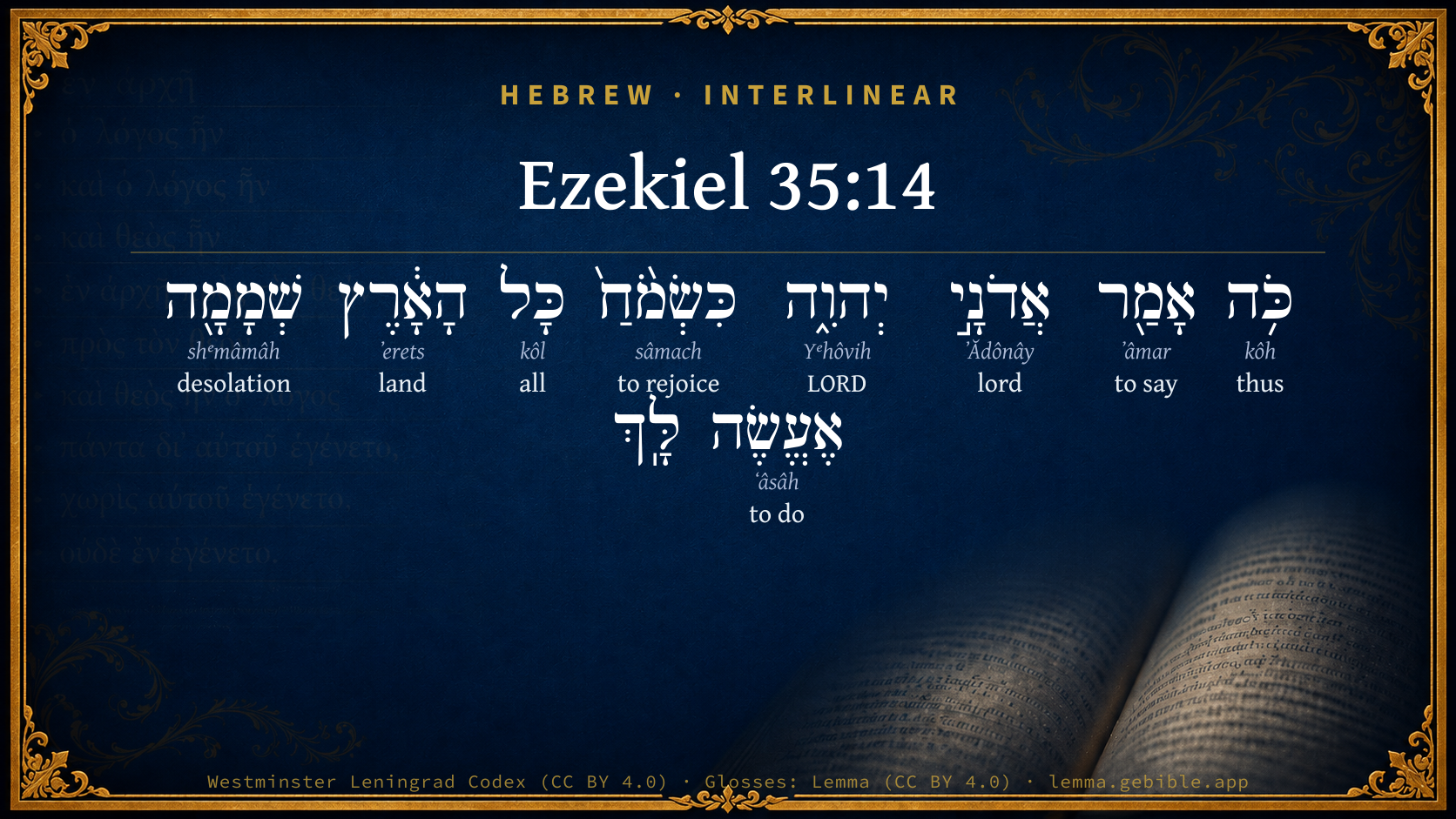
Ezekiel 35:14

Hebrew (Westminster Leningrad Codex) Ezekiel 35:14 appears in the Hebrew Old Testament. The text above is from the Westminster Leningrad Codex. Each word links to its Strong’s number, a concise gloss, and parsing drawn from the Open Scriptures Hebrew Bible morphology. Click any word for its full Brown-Driver-Briggs (BDB) entry.
Download image
Cite this verse

Ezekiel 35:14 (World English Bible). Public Domain. Lemma interlinear Bible study tool, https://lemma.gebible.app/v/ezekiel/35/14.

Show BibTeX & RIS
BibTeX
RIS
English Translation
Thus says the Lord Yahweh: When the whole earth rejoices, I will make you desolate.
World English Bible · Public Domain
Download a study sheet

One document with this verse’s original text, its word-by-word gloss line, the meaning frame, cross-references with their text, attributed commentary, and full source and license credits — printable, and it pastes into notes with its structure intact.

This verse Autodidact and up

Study sheet (.html) Plain text (.txt)

A passage Seminary Student

Up to 50 verses in one chapter. A passage sheet keeps up to 6 commentary sources and 12 cross-references per verse, in the order this page ranks them, and says so on the sheet whenever that leaves anything out. Ask for a single verse and you get the Autodidact verse sheet above.

Everything on this page stays free to read, with no account — the sheet is a download of what is already on screen, not access to it.

Want to remove ads? Support Godless Engineer
Compare translations 3

The same verse in 3 English versions, stacked beneath the original-language interlinear above. Click any original word for its lexicon entry.

Each is an independent rendering of the whole verse — the interlinear is not word-aligned to these translations.

Highlighted words mark where these versions differ — a whole-verse word diff, not a word-by-word alignment.

  • World English Bible Public Domain
    Thus says the Lord Yahweh: When the whole earth rejoices, I will make you desolate.
  • King James Version Public Domain
    Thus saith the Lord GOD; When the whole earth rejoiceth, I will make thee desolate.
  • unfoldingWord Literal Text CC BY-SA 4.0
    The Lord Yahweh says this: I will make you a desolation, while the entire earth rejoices.

unfoldingWord Literal Text — © unfoldingWord, licensed CC BY-SA 4.0. Word-aligned USFM3 via Door43 (git.door43.org/unfoldingWord/en_ult).

Versions to compare (up to 4)

3 of 4 selected

Show all 18 translations

Every available English version of this verse, each an independent rendering of the whole verse.

  • World English Bible Public Domain
    Thus says the Lord Yahweh: When the whole earth rejoices, I will make you desolate.
  • Berean Standard Bible Public Domain
    This is what the Lord GOD says: While the whole earth rejoices, I will make you desolate.
  • Majority Standard Bible Public Domain
    This is what the Lord GOD says: While the whole earth rejoices, I will make you desolate.
  • King James Version Public Domain
    Thus saith the Lord GOD; When the whole earth rejoiceth, I will make thee desolate.
  • American Standard Version (1901) Public Domain
    Thus saith the Lord Jehovah: When the whole earth rejoiceth, I will make thee desolate.
  • Revised Version (1885) Public Domain
    Thus saith the Lord GOD: When the whole earth rejoiceth, I will make thee desolate.
  • Geneva Bible (1599) Public Domain
    Thus sayth the Lord God, So shall all the world reioyce when I shall make thee desolate.
  • Douay-Rheims (1899) Public Domain
    Thus saith the Lord God: When the whole earth shall rejoice, I will make thee a wilderness.
  • Young's Literal Translation Public Domain
    Thus said the Lord Jehovah: According to the rejoicing of the whole land, A desolation I make of thee.
  • Literal Standard Version CC BY-SA 4.0
    Thus said Lord YHWH: According to the rejoicing of the whole land, || I make a desolation of you.
  • Unlocked Literal Bible CC BY-SA 4.0
    The Lord Yahweh says this: I will make you a desolation, while the entire earth rejoices.
  • unfoldingWord Literal Text CC BY-SA 4.0
    The Lord Yahweh says this: I will make you a desolation, while the entire earth rejoices.
  • Darby Bible Public Domain
    Thus saith the Lord Jehovah: When the whole earth rejoiceth, I will make thee a desolation.
  • World Messianic Bible Public Domain
    The Lord GOD says: “When the whole earth rejoices, I will make you desolate.
  • Webster's Bible Public Domain
    Thus saith the Lord GOD; When the whole earth rejoiceth, I will make thee desolate.
  • Free Bible Version CC BY-SA 4.0
    This is what the Lord God says: I will destroy you as everyone else in the world celebrates.
  • Bible in Basic English Public Domain
    This is what the Lord has said: Because you were glad over my land when it was a waste, so will I do to you:
  • JPS Tanakh (1917) Public Domain
    Thus saith the Lord GOD: When the whole earth rejoiceth, I will make thee desolate.

Literal Standard Version (2020), Covenant Press — licensed CC BY-SA 4.0. Text via the HelloAO Bible API (eBible.org). Unlocked Literal Bible (unfoldingWord) — licensed CC BY-SA 4.0. Text via the HelloAO Bible API (eBible.org). unfoldingWord Literal Text — © unfoldingWord, licensed CC BY-SA 4.0. Word-aligned USFM3 via Door43 (git.door43.org/unfoldingWord/en_ult). Free Bible Version, Dr. Jonathan Gallagher — licensed CC BY-SA 4.0. Text via the HelloAO Bible API (eBible.org).

Word by word

More ways to search: Search by grammar → Find every occurrence → Compare this word →

Practice this passage: Drill this verse → Learn its vocabulary →

About this verse

These counts appear in no published source. They are computed here, from the morphology-tagged text and Lemma’s own curated glosses. What Lemma adds →

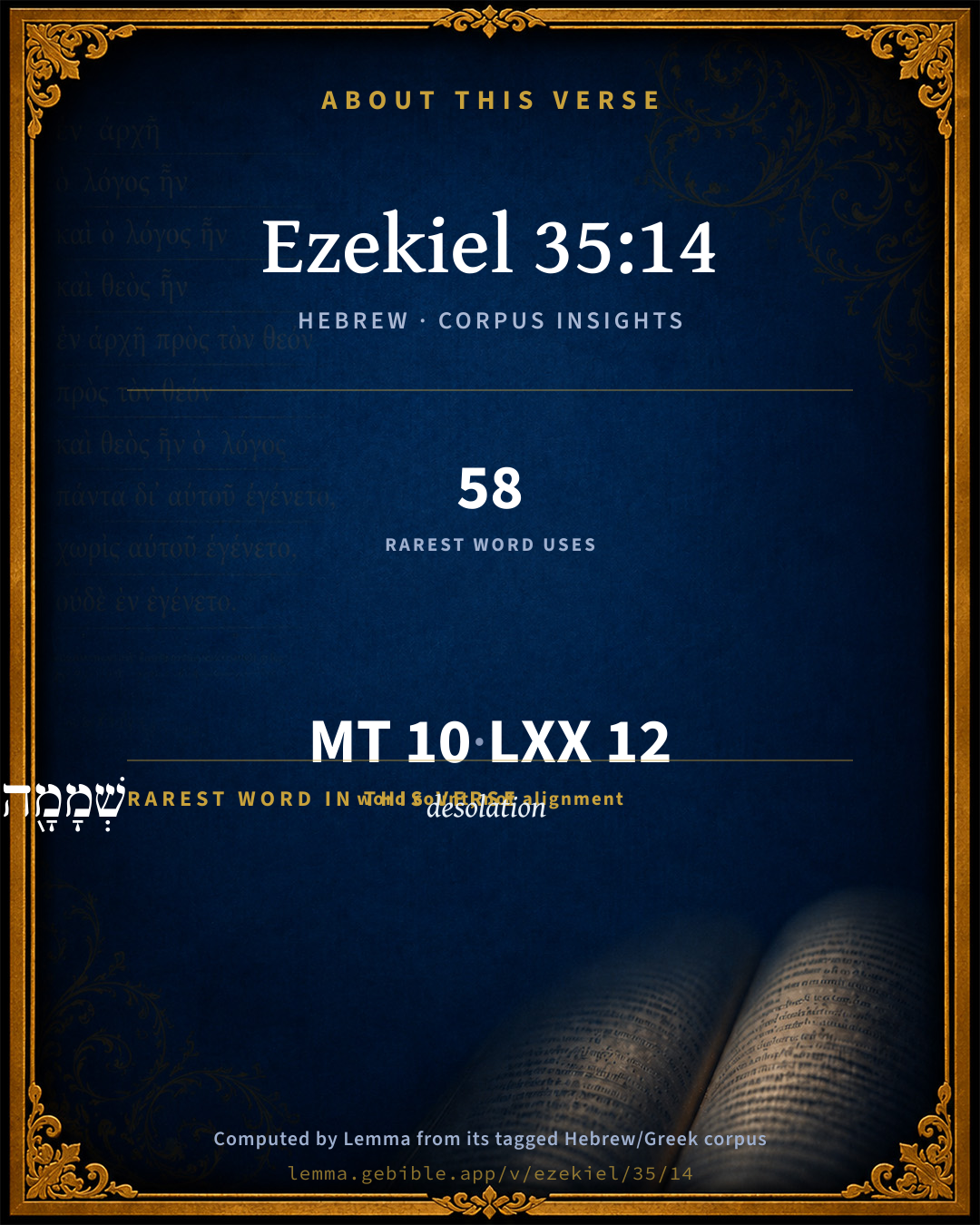
10
words
9
distinct lemmas
Prophets
section

Shared distinctive vocabulary

שְׁמָמָ֖ה desolation H8077 occurs in 54 verses of the Hebrew Bible. Also found in:

Grammatical profile

  • 3 verbs
  • 5 nouns
  • 1 preposition
  • 1 adverb

Verb forms

  • אָמַ֖ר Qal · Perfect
  • כִּשְׂמֹ֨חַ֙ Qal · Infinitive Construct
  • אֶעֱשֶׂה Qal · Imperfect

Hebrew & Septuagint length

In English translation the verse runs 15 words from the Hebrew and 15 from the Septuagint (LXX English) — the same length.

A rough comparison of the two English renderings, which tokenize alike — not a word-level alignment.

Word counts can differ between the Hebrew and the Greek without any difference in meaning — e.g. the Hebrew direct-object marker אֵת has no separate Greek word, and Greek often adds the article ὁ.

In the original languages it is 10 Hebrew tokens and 12 Greek tokens — but the two are counted differently (Hebrew bundles its prefixes and suffixes into one token; the Greek is in lemma form), so that isn’t a like-for-like length.

Cross-references

3

Topical passages linked to Ezekiel 35:14 in the Treasury of Scripture Knowledge — connected by theme and wording, ordered by reader-vote popularity; previews shown in the World English Bible.

  • Isaiah 14:7–8 The whole earth is at rest, [and] is quiet: they break forth into singing.
  • Isaiah 65:13–15 Therefore thus says the Lord Yahweh, Behold, my servants shall eat, but you shall be hungry; behold, my servants shall drink, but you shall be thirsty; behold, my servants shall rejoice, but you shall be disappointed;
  • Jeremiah 51:48 Then the heavens and the earth, and all that is therein, shall sing for joy over Babylon; for the destroyers shall come to her from the north, says Yahweh.

Cross-references courtesy of OpenBible.info (CC BY 4.0).

Hebrew and Greek witnesses Masoretic Hebrew ↔ Greek Septuagint

The same verse in the two great witnesses to the Old Testament, shown verse-for-verse.

These are two independent witnesses, not word-aligned to each other, and the Septuagint is shown in lemma (dictionary) form.

Hebrew Ezekiel 35:14 Masoretic · Westminster Leningrad Codex

כֹּ֥ה אָמַ֖ר אֲדֹנָ֣י יְהוִ֑ה כִּשְׂמֹ֨חַ֙ כָּל הָאָ֔רֶץ שְׁמָמָ֖ה אֶעֱשֶׂה לָּֽךְ

Thus says the Lord Yahweh: When the whole earth rejoices, I will make you desolate.

World English Bible · Public Domain

Greek LXX Ezekiel 35:14 Septuagint · lemma form

ὅδε λέγω κύριος ἐν ὁ εὐφροσύνη πᾶς ὁ γῆ ἔρημος ποιέω σύ

Thus says the Lord; When all the earth is rejoicing, I will make you desert.

LXX2012 (modern English Septuagint) · Public Domain

Hebrew: Westminster Leningrad Codex (CC BY 4.0). Greek: Septuagint (public domain); English from LXX2012 (modern English Septuagint) (Public Domain). How the Septuagint differs from the Hebrew →

Targum (Aramaic paraphrase)

1

The Targum is the ancient Jewish Aramaic paraphrase of the Hebrew Scriptures — an interpretive translation, not the Hebrew text itself. Onkelos (literal) and Pseudo-Jonathan (expansive) render the Torah, and Jonathan the Prophets. Coverage is partial: where no permissively-licensed English translation exists for a verse, only the Aramaic is shown. This is verse-level text, not a word-by-word alignment to the Hebrew.

  1. Targum Jonathan Prophets (Joshua–Malachi)
    כִּדְנַן אֲמַר יְיָ אֱלֹהִים כְּמֶחְדֵי כָּל אַרְעָא צָדוּ אַעְבֵיד לָךְ:

    (no public-domain English translation for this verse)

    Targum Jonathan — Aramaic: “Mikraot Gedolot” (public domain). English: “Sefaria Community Translation” (CC0 1.0 (public-domain dedication)); “London "Chaldee Paraphrase," 1871” (public domain). Text via Sefaria.

Commentary

Notes on Ezekiel 35:14 from classic Christian and Jewish commentators (each source and its license shown beneath its notes). The classic Christian expositions comment on the surrounding passage and are grouped to its opening verse, so a note may address several verses; the Jewish commentaries on the Tanakh (Rashi and others) are per-verse, so they appear only where the commentator wrote on this verse.

Lemma curates 59 commentaries, every one of them public domain or Creative Commons licensed, each selected and text-cleaned for this edition rather than reprinted as found. About our sources →

Trapp's Complete Commentary

John Trapp

Eze 35:14 Thus saith the Lord GOD; When the whole earth rejoiceth, I will make thee desolate.

Ver. 14. When the whole earth rejoiceth,] scil, For my people’s deliverances. Or, When the whole land, scil., of Israel, rejoiceth; as it is sometimes hale and well with the Church, when the wicked are in the suds. Judea was the world of the world, as Athens was the "Epitome of Greece," the "Greece of Greece."

John Trapp, A Commentary or Exposition upon All the Books of the Old and New Testament (1647–1656) — public domain. Text from a community e-Sword module.

Jamieson, Fausset & Brown

Robert Jamieson, A. R. Fausset & David Brown

(Isa 65:13-14). "The whole earth" refers to Judea and the nations that submit themselves to Judea's God; when these rejoice, the foes of God and His people, represented by Edom as a nation, shall be desolate. Things shall be completely reversed; Israel, that now for a time mourns, shall then rejoice and for ever. Edom, that now rejoices over fallen Israel, shall then, when elsewhere all is joy, mourn, and for ever (Isa 65:17-19; Mat 5:4; Luk 6:25). HAVERNICK loses this striking antithesis by translating, "According to the joy of the whole land (of Edom), so I will make thee desolate"; which would make Eze 35:15 a mere repetition of this.

Jamieson, Fausset & Brown — Commentary Critical and Explanatory on the Whole Bible (1871) — public domain (CC PDM 1.0). Text via the HelloAO Bible API.

Adam Clarke's Commentary

Verse 14. When the whole earth rejoiceth] When the whole land shall rejoice in the restoration of the Jews, I will make thee desolate. Probably this refers to the time of the Maccabees.

Adam Clarke's Commentary on the Bible (1810–1826) — public domain. Text from a community e-Sword/MySword module.

Ellicott's Commentary for English Readers

(14) The whole earth.—This is taken by some writers—as, indeed, Hebrew usage very well allows—of the whole land, viz., of Israel. It seems better, however, to keep the sense of our version, for the thought is not confined to Edom. When all the earth shall rejoice in the salvation of God, and “the earth shall be full of the knowledge of the Lord,” then Edom, the hostile power of the world, shall be desolate.

A Bible Commentary for English Readers, edited by Charles John Ellicott (1878–1897) — public domain. Text from a community e-Sword module.

The Cambridge Bible for Schools and Colleges

gen. ed. J. J. S. Perowne

14. When the … rejoiceth] Probably: to the rejoicing of the whole earth will I make thee desolate. This gives the requisite antithesis to Eze_35:15 : as Edom rejoiced over the destruction of Judah, the whole earth will be overjoyed at her desolation.

The Cambridge Bible for Schools and Colleges (gen. ed. J. J. S. Perowne; Cambridge University Press, 1878–1918) — public domain. Text from a community e-Sword module.

John Gill's Exposition

Thus saith the Lord God, when the whole earth rejoiceth,.... When it shall go well with the world in general, and the inhabitants of it; when they shall enjoy great peace and prosperity. Jarchi has a very good note upon this clause,

"when I shall take my kingdom; for then the earth will rejoice, as it is said, the Lord reigns, let the earth rejoice;''

so when Christ takes to himself his great power, and reigns, his church and people will rejoice, Rev 11:16, as well as at the destruction of antichrist, as follows:

I will make thee desolate; for so some render it, "the whole earth rejoiceth when I make thee desolate"; or, "so shall all the earth rejoice in the desolation which I shall make for thee" (c); see Rev 18:20 and which agrees with what follows:

(c) "Sic laetabitur omnis terra in desolatione quam faciam tibi", Vatablus.

John Gill's Exposition of the Whole Bible (1746–1763) — public domain (CC PDM 1.0). Text via the HelloAO Bible API.

Haydock's Catholic Bible Commentary

Rejoice. After the captivity, the Machabees shall conquer Edom.

George Leo Haydock (1774–1849), Haydock's Catholic Family Bible and Commentary, 1859 edition — public domain. Excludes Psalms (Douay-Rheims chapter numbering differs from Protestant) and Deuterocanonical books (Catholic canon only).

Matthew Poole's English Annotations

The whole earth; the inhabitants of the countries round about thee, the whole that thou knowest.

Rejoiceth; is in peace and plenty, and enjoy both, thou shalt want all; and then envy at the welfare of others shall break thy heart. Envy was thy sin, and now what is the object of envy shall be thy grief, viz. the prosperity of others.

Matthew Poole's English Annotations on the Holy Bible (1683–1685) — public domain. Text from a community e-Sword/MySword module.

The Pulpit Commentary

When the whole earth rejoiceth, I will make thee desolate. By "the whole earth," Fairbairn, Haverniek, and Schroder understand "the whole land of Edom." In this ease the sense is that, as the whole land of Edom had previously exulted with joy, so should it in the future be made completely desolate. Ewald, Hengstenberg, Keil, Kliefoth, Smend, and Plumptre, however, more correctly interpret the phrase as signifying the whole human race, with the exception of Edom. Accordingly, the thought seems to be, not that of Ewald and Smend, that Jehovah would make Edom"s devastation a sport or comedy (freudespiel) to the whole world; or that of Kliefoth and Hitzig, that God would make Edom desolate, whilst all the earth rejoiced over her downfall; but that of Keil, Plumptre, and others, that just as Jehovah was preparing for the whole earth of redeemed humanity a glorious future of joy, so certainly would Edom and all whom Edom represented be excluded from participation in that joy.

Desolate in the midst of general joyfulness.

I THERE IS TO BE A SEASON OF GENERAL JOYFULNESS. "When the whole earth rejoiceth that is a glimpse of a wonderful future. At present the earth mourns and languishes. Tyranny oppresses nations of slaves. Penury holds multitudes in weary drudgery on the verge of starvation. War devastates fields and towns and countries. Sorrow sighs from the heart of humanity. But this shall not continue forever.

1. There will be joy in a glorious future. The Bible is full of hope. Its golden age always lies before us, not behind us.

2. This joy will be attained through the gospel of Christ. The angels sang for joy at his birth on earth. Gladness comes to the heart in which he is revealed afresh. When the old earth is subject to the rule of Christ, and the sin that is its curse is blotted out, a new Divine joy must take possession of men.

3. This joy will be for the whole earth. At first, only a remnant is to be. (Rom_9:27) But this remnant does not represent the whole harvest of Divine salvation. It is but the firstfruits. The gospel is for the wide world. All the nations are to enter into the heritage of the future. Christ "shall see of the travail of his soul, and shall be satisfied". (Isa_53:11) No scanty salvage from the huge wreck of humanity could satisfy the great soul of Jesus.

II IT IS POSSIBLE FOR ANY ONE TO BE EXCLUDED FROM THIS GENERAL JOYFULNESS. Edom is to be shut out when the whole earth rejoices.

1. The joy of the whole earth is the joy of its several inhabitants. The sheet of sunshine that lies broadly over meadow and hillside is woven out of innumerable rays of light. The flood of music that fills the valley with melody consists in a succession of distinct notes. The blaze of color that flashes on us in the summer garden comes from the several hues of separate flowers. The general joy is the joy of many hearts. Each must share it individually if all are to display it collectively.

2. The individual participation in the general joy depends on an individual condition of receptiveness. It is supremely the joy of reconciliation. Now, Christ died to make atonement for the whole world. Yet each soul has to be separately reconciled to God. And when the old rebellion of man against God is virtually quelled, if but a single soul held out, that soul must be excluded from the joy which comes in with the great peace.

III IT IS UNSPEAKABLY DREADFUL TO BE DESOLATE AMIDST GENERAL JOYFULNESS.

1. The perception of contrast is intensely distressing. The one heavy heart is in painful contrast to the many light hearts. Sorrowful people shun merry gatherings, shrinking from them as people with pained eyes shrink from bright lights. It is an acute grief to the desolate soul to be alone in a joyous festivity when all others are of one mind. For a lost soul to be placed in the midst of the blessedness of heaven would be far worse than the torments of hell.

2. The discovery of needless failure is especially grievous. The rejoicing is practically universal. Why, then, should one poor soul be excluded? Nearly all are in when the door is shut, but one miserable creature is left out in the darkness. If salvation were only intended for a few, the many might learn to acquiesce in their dismal lot. But when a man sees that it is intended for the whole world, and yet by his own folly he is excluded, he must torture himself with bitter regrets.

The Pulpit Commentary (1880–1919), ed. H.D.M. Spence-Jones & Joseph S. Exell — public domain. Text from a community e-Sword module.

John Wesley's Explanatory Notes

The whole earth - The inhabitants of all the countries round about thee. Rejoiceth - Is in peace and plenty.

John Wesley, Explanatory Notes Upon the Whole Bible (1754–1765) — public domain. Text via the GEBible commentary corpus.

unfoldingWord translationNotes

Door43 World Missions Community

General Information:

This continues the message that Ezekiel is to speak to Mount Seir. The message is for all the people of Edom.

The Lord Yahweh says this

This can be stated in first person. AT: "This is what I, the Lord Yahweh, say" (See: First, Second, or Third Person)

I will make you a desolation

Here "you" refers to Mount Seir, but the message is for the people of Edom. The abstract noun "desolation" can be stated as an adjective. AT: "Because of what your people did I will make you desolate" (See: Personification and Abstract Nouns)

the entire earth rejoices

Here "earth" represents the people of the earth. The word "entire" is a generalization that refers only to people near Mount Seir. AT: "people who know that I have destroyed you rejoice" (See: Metonymy)

As you rejoiced over the inheritance of the people of Israel because of its desolation

This speaks of the land that Yahweh gave to the Israelites as their inheritance. AT: "As you rejoiced when I made the land of the Israelites desolate" (See: Metaphor)

I will do the same to you

Possible meanings are 1) I will make your land desolate" or 2) "I will rejoice when your land is desolate" or 3) "I will make other people rejoice because of your desolation."

You will become a desolation, Mount Seir, and all of Edom

Yahweh continues telling Ezekiel to speak to Mount Seir as if it could hear him. The message is for the people of Edom. AT: "I will make you, Mount Seir, and all of Edom desolate" (See: Personification)

Then they will know

The word "they" possibly refers to 1) "the people of the earth" or 2) "the people of Israel and Judah."

translationWords

Lord Yahweh

desolate

joy

inherit

Edom

unfoldingWord translationNotes — © Distant Shores Media and the Door43 World Missions Community, licensed CC BY-SA 4.0. Source: git.door43.org/Door43/en_tn.

Rashi

Rabbi Shlomo Yitzchaki (Rashi)

When the whole earth rejoices when I claim My kingdom, for then the whole earth will rejoice, as the idea is stated (Ps. 97:1): “The Lord has reigned; the earth will exult.” Then I will make you a desolation.

Rashi on the Tanakh — English translations: “The Judaica Press complete Tanach with Rashi, translated by A. J. Rosenberg” (CC BY 4.0); “Pentateuch with Rashi's commentary by M. Rosenbaum and A.M. Silbermann, 1929-1934” (public domain); “The Metsudah Tanach series, Lakewood, N.J” (CC BY 4.0); and “The Book of Joshua, Metsudah Publications, 1997” (CC BY 4.0). Text via Sefaria.

Lesson kit

Teaching starters — assembled from the data on this page, not authored interpretation. Every prompt links to the verse data it draws on. Edit before teaching.

Ezekiel, in the Prophets, opens this verse with 10 words (9 distinct Hebrew lemmas). Its most distinctive word is shᵉmâmâh (“desolation”). A historical commentator’s framing appears above. Read the whole chapter for the surrounding context.

Discussion questions

  1. How does “desolation” (shᵉmâmâh) shape what this verse is saying?
  2. Exodus 23:29 shares the word «desolation» with this verse. How do the two illuminate each other?
  3. These translations render this verse differently; the difference is in the English rendering, not the original. What questions does that raise?
  4. The verb «אָמַ֖ר» is Qal Perfect. How does its form color the action?
  5. Reading how Trapp's Complete Commentary and Jamieson, Fausset & Brown read this verse, where do the two commentators agree and where do they part?

Things to notice

Reading settings

Reading text

Shown beneath each verse's original-language words.

Old Testament
Old Testament edition

Read the OT as the Masoretic Hebrew (MT) or the Greek Septuagint (LXX).

English shown for the Greek Septuagint (in the Hebrew ↔ Greek comparison).

Comparing translations? Open the Compare panel on any verse page to stack up to four side by side.