
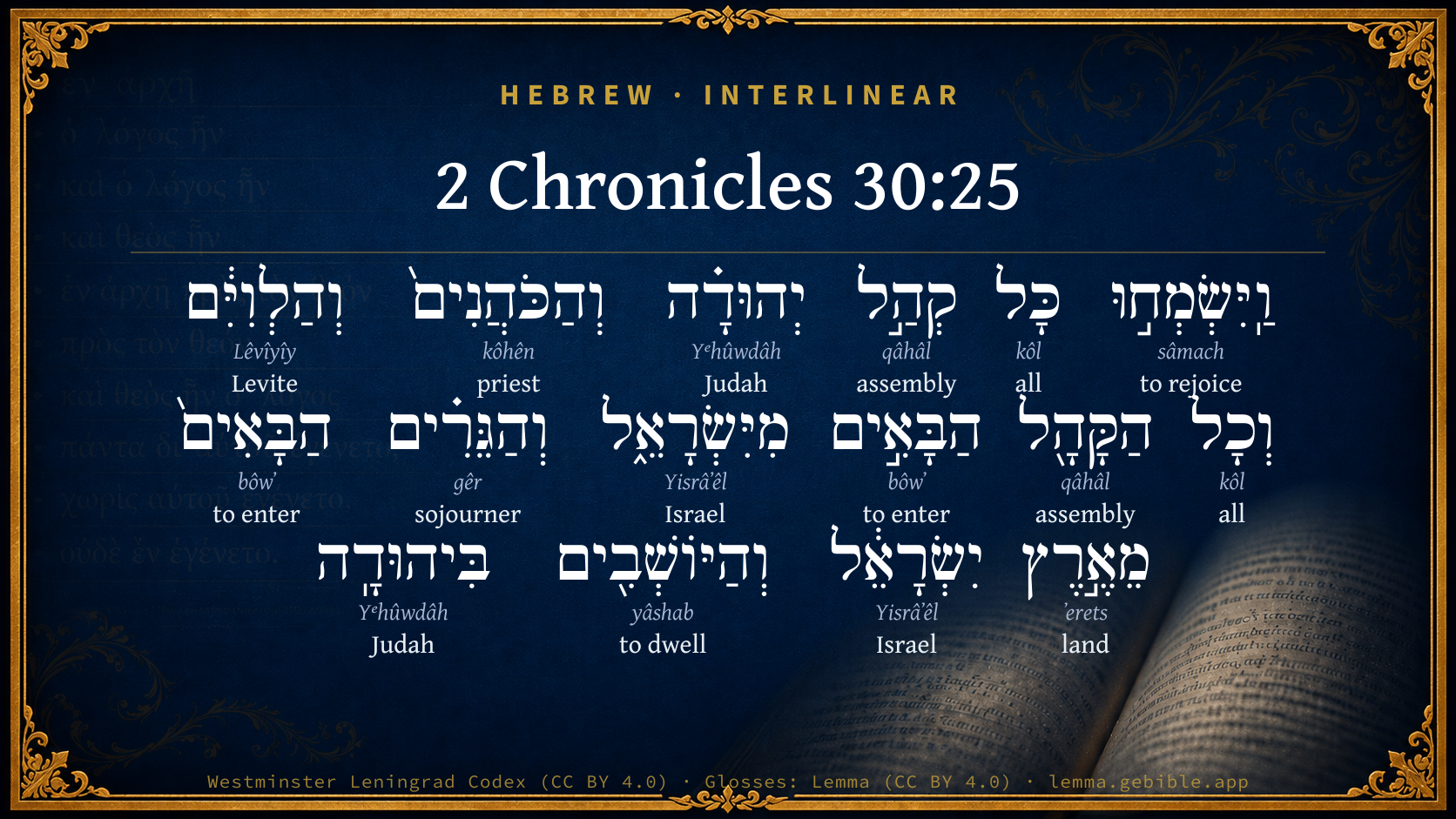
2 Chronicles 30:25

Hebrew (Westminster Leningrad Codex) 2 Chronicles 30:25 appears in the Hebrew Old Testament. The text above is from the Westminster Leningrad Codex. Each word links to its Strong’s number, a concise gloss, and parsing drawn from the Open Scriptures Hebrew Bible morphology. Click any word for its full Brown-Driver-Briggs (BDB) entry.
Download image
Cite this verse

2 Chronicles 30:25 (World English Bible). Public Domain. Lemma interlinear Bible study tool, https://lemma.gebible.app/v/2-chronicles/30/25.

Show BibTeX & RIS
BibTeX
RIS
English Translation
All the assembly of Judah, with the priests and the Levites, and all the assembly who came out of Israel, and the foreigners who came out of the land of Israel, and who lived in Judah, rejoiced.
World English Bible · Public Domain
Download a study sheet

One document with this verse’s original text, its word-by-word gloss line, the meaning frame, cross-references with their text, attributed commentary, and full source and license credits — printable, and it pastes into notes with its structure intact.

This verse Autodidact and up

Study sheet (.html) Plain text (.txt)

A passage Seminary Student

Up to 50 verses in one chapter. A passage sheet keeps up to 6 commentary sources and 12 cross-references per verse, in the order this page ranks them, and says so on the sheet whenever that leaves anything out. Ask for a single verse and you get the Autodidact verse sheet above.

Everything on this page stays free to read, with no account — the sheet is a download of what is already on screen, not access to it.

Want to remove ads? Support Godless Engineer
Compare translations 3

The same verse in 3 English versions, stacked beneath the original-language interlinear above. Click any original word for its lexicon entry.

Each is an independent rendering of the whole verse — the interlinear is not word-aligned to these translations.

Highlighted words mark where these versions differ — a whole-verse word diff, not a word-by-word alignment.

  • World English Bible Public Domain
    All the assembly of Judah, with the priests and the Levites, and all the assembly who came out of Israel, and the foreigners who came out of the land of Israel, and who lived in Judah, rejoiced.
  • King James Version Public Domain
    And all the congregation of Judah, with the priests and the Levites, and all the congregation that came out of Israel, and the strangers that came out of the land of Israel, and that dwelt in Judah, rejoiced.
  • unfoldingWord Literal Text CC BY-SA 4.0
    And they rejoiced, all the assembly of Judah and the priests and the Levites, and all the assembly who came from Israel, and the sojourners who came from the land of Israel and the inhabitants of Judah.

unfoldingWord Literal Text — © unfoldingWord, licensed CC BY-SA 4.0. Word-aligned USFM3 via Door43 (git.door43.org/unfoldingWord/en_ult).

Versions to compare (up to 4)

3 of 4 selected

Show all 18 translations

Every available English version of this verse, each an independent rendering of the whole verse.

  • World English Bible Public Domain
    All the assembly of Judah, with the priests and the Levites, and all the assembly who came out of Israel, and the foreigners who came out of the land of Israel, and who lived in Judah, rejoiced.
  • Berean Standard Bible Public Domain
    Then the whole assembly of Judah rejoiced along with the priests and Levites and the whole assembly that had come from Israel, including the foreigners who had come from Israel and those who lived in Judah.
  • Majority Standard Bible Public Domain
    Then the whole assembly of Judah rejoiced along with the priests and Levites and the whole assembly that had come from Israel, including the foreigners who had come from Israel and those who lived in Judah.
  • King James Version Public Domain
    And all the congregation of Judah, with the priests and the Levites, and all the congregation that came out of Israel, and the strangers that came out of the land of Israel, and that dwelt in Judah, rejoiced.
  • American Standard Version (1901) Public Domain
    And all the assembly of Judah, with the priests and the Levites, and all the assembly that came out of Israel, and the sojourners that came out of the land of Israel, and that dwelt in Judah, rejoiced.
  • Revised Version (1885) Public Domain
    And all the congregation of Judah, with the priests and the Levites, and all the congregation that came out of Israel, and the strangers that came out of the land of Israel, and that dwelt in Judah, rejoiced.
  • Geneva Bible (1599) Public Domain
    And all the Congregation of Iudah reioyced with the Priestes and the Leuites, and all the Congregation that came out of Israel, and the strangers that came out of the land of Israel, and that dwelt in Iudah.
  • Douay-Rheims (1899) Public Domain
    For Ezechias the king of Juda had given to the multitude a thousand bullocks, and seven thousand sheep: and the princes had given the people a thousand bullocks, and ten thousand sheep: and a great number of priests was sanctified.
  • Young's Literal Translation Public Domain
    And all the assembly of Judah rejoice, and the priests, and the Levites, and all the assembly, those coming in from Israel, and the sojourners, those coming in from the land of Israel, and those dwelling in Judah,
  • Literal Standard Version CC BY-SA 4.0
    And all the assembly of Judah rejoices, and the priests, and the Levites, and all the assembly, those coming in from Israel, and the sojourners—those coming in from the land of Israel and those dwelling in Judah,
  • Unlocked Literal Bible CC BY-SA 4.0
    All the assembly of Judah, with the priests and the Levites, and all the people who came together from Israel, as well as the foreigners who came from the land of Israel and those who lived in Judah—they all rejoiced.
  • unfoldingWord Literal Text CC BY-SA 4.0
    And they rejoiced, all the assembly of Judah and the priests and the Levites, and all the assembly who came from Israel, and the sojourners who came from the land of Israel and the inhabitants of Judah.
  • Darby Bible Public Domain
    And the whole congregation of Judah, with the priests and the Levites, and all the congregation that came out of Israel, and the strangers that came out of the land of Israel, and that dwelt in Judah, rejoiced.
  • World Messianic Bible Public Domain
    All the assembly of Judah, with the priests and the Levites, and all the assembly who came out of Israel, and the foreigners who came out of Eretz-Israel and who lived in Judah, rejoiced.
  • Webster's Bible Public Domain
    And all the congregation of Judah, with the priests and the Levites, and all the congregation that came out of Israel, and the strangers that came from the land of Israel, and that dwelt in Judah, rejoiced.
  • Free Bible Version CC BY-SA 4.0
    The whole assembly of Judah celebrated, together with the priests and Levites, and also with the whole assembly that had come from Israel, including the foreigners from Israel and those living in Judah.
  • Bible in Basic English Public Domain
    And all the people of Judah, with the priests and the Levites, and those who had come from Israel, and men from other lands who had come from Israel or who were living in Judah, were glad with great joy.
  • JPS Tanakh (1917) Public Domain
    And all the congregation of Judah, with the priests and the Levites, and all the congregation that came out of Israel, and the strangers that came out of the land of Israel, and that dwelt in Judah, rejoiced.

Literal Standard Version (2020), Covenant Press — licensed CC BY-SA 4.0. Text via the HelloAO Bible API (eBible.org). Unlocked Literal Bible (unfoldingWord) — licensed CC BY-SA 4.0. Text via the HelloAO Bible API (eBible.org). unfoldingWord Literal Text — © unfoldingWord, licensed CC BY-SA 4.0. Word-aligned USFM3 via Door43 (git.door43.org/unfoldingWord/en_ult). Free Bible Version, Dr. Jonathan Gallagher — licensed CC BY-SA 4.0. Text via the HelloAO Bible API (eBible.org).

Word by word

More ways to search: Search by grammar → Find every occurrence → Compare this word →

Practice this passage: Drill this verse → Learn its vocabulary →

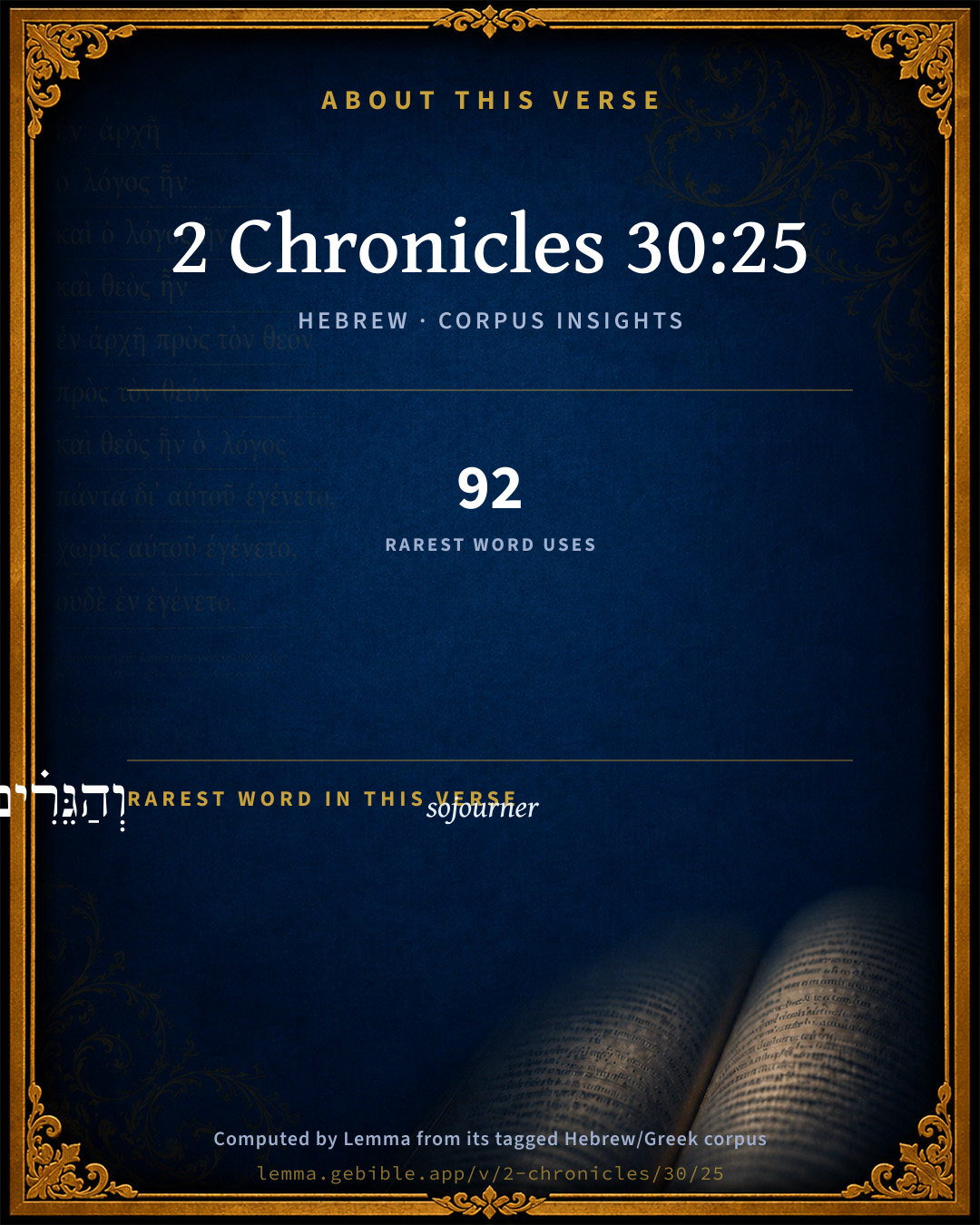
וְהַגֵּרִ֗ים
gêr
H1616
“and · the · sojourners”
Conjunction + Particle, Definite Article + Noun, Common, Masculine, Plural, Absolute
Part of Speech
Conjunction + Particle + Noun
Type
Common
Gender
Masculine
Number
Plural
State
Absolute
Full BDB Definition

Origin: from H1481

TWOT: 330a

sojourner - a temporary inhabitant, a newcomer lacking inherited rights - of foreigners in Israel, though conceded rights
  1. וַֽיִּשְׂמְח֣וּ sâmach H8055 “and · to rejoice” Conjunction + Verb, Qal, Sequential Imperfect, 3rd Person, Masculine, Plural
  2. כָּל kôl H3605 “all of” Noun, Common, Masculine, Singular, Construct
  3. קְהַ֣ל qâhâl H6951 “assembly of” Noun, Common, Masculine, Singular, Construct
  4. יְהוּדָ֗ה Yᵉhûwdâh H3063 “Judah” Noun, Proper
  5. וְהַכֹּהֲנִים֙ kôhên H3548 “and · the · priests” Conjunction + Particle, Definite Article + Noun, Common, Masculine, Plural, Absolute
  6. וְהַלְוִיִּ֔ם Lêvîyîy H3881 “and · the · Levites” Conjunction + Particle, Definite Article + Noun, Gentilic, Masculine, Plural, Absolute
  7. וְכָל kôl H3605 “and · all of” Conjunction + Noun, Common, Masculine, Singular, Construct
  8. הַקָּהָ֖ל qâhâl H6951 “the · assembly” Particle, Definite Article + Noun, Common, Masculine, Singular, Absolute
  9. הַבָּאִ֣ים bôwʼ H935 “the · entering” Particle, Definite Article + Verb, Qal, Participle Active, Masculine, Plural, Absolute
  10. מִיִּשְׂרָאֵ֑ל Yisrâʼêl H3478 “from · Israel” Preposition + Noun, Proper
  11. הַבָּאִים֙ bôwʼ H935 “the · entering” Particle, Definite Article + Verb, Qal, Participle Active, Masculine, Plural, Absolute
  12. מֵאֶ֣רֶץ ʼerets H776 “from · land of” Preposition + Noun, Common, Both, Singular, Construct
  13. יִשְׂרָאֵ֔ל Yisrâʼêl H3478 “Israel” Noun, Proper
  14. וְהַיּוֹשְׁבִ֖ים yâshab H3427 “and · the · dwelling” Conjunction + Particle, Definite Article + Verb, Qal, Participle Active, Masculine, Plural, Absolute
  15. בִּיהוּדָֽה Yᵉhûwdâh H3063 “in/at · Judah” Preposition + Noun, Proper

About this verse

These counts appear in no published source. They are computed here, from the morphology-tagged text and Lemma’s own curated glosses. What Lemma adds →

16
words
11
distinct lemmas
Historical
section

Grammatical profile

  • 4 verbs
  • 12 nouns

Verb forms

  • וַֽיִּשְׂמְח֣וּ Qal · Sequential Imperfect
  • הַבָּאִ֣ים Qal · Participle Active
  • הַבָּאִים֙ Qal · Participle Active
  • וְהַיּוֹשְׁבִ֖ים Qal · Participle Active

Repetition

Words recur within this verse — often emphatic in Hebrew:

  • כָּל all H3605 ×2
  • קְהַ֣ל assembly H6951 ×2
  • יְהוּדָ֗ה Judah H3063 ×2
  • הַבָּאִ֣ים to enter H935 ×2
  • מִיִּשְׂרָאֵ֑ל Israel H3478 ×2

Hebrew & Septuagint length

In English translation the verse runs 37 words from the Hebrew and 38 from the Septuagint (LXX English) — closely comparable.

A rough comparison of the two English renderings, which tokenize alike — not a word-level alignment.

Word counts can differ between the Hebrew and the Greek without any difference in meaning — e.g. the Hebrew direct-object marker אֵת has no separate Greek word, and Greek often adds the article ὁ.

Cross-references

6

Topical passages linked to 2 Chronicles 30:25 in the Treasury of Scripture Knowledge — connected by theme and wording, ordered by reader-vote popularity; previews shown in the World English Bible.

  • 2 Chronicles 30:11 Nevertheless certain men of Asher and Manasseh and of Zebulun humbled themselves, and came to Jerusalem.
  • 2 Chronicles 30:18 For a multitude of the people, even many of Ephraim and Manasseh, Issachar and Zebulun, had not cleansed themselves, yet did they eat the Passover otherwise than it is written. For Hezekiah had prayed for them, saying, The good Yahweh pardon everyone
  • Exodus 12:43–49 Yahweh said to Moses and Aaron, "This is the ordinance of the Passover. There shall no foreigner eat of it,
  • 1 Chronicles 16:10–11 Glory you in his holy name; Let the heart of them rejoice who seek Yahweh.
  • Psalms 92:4 For you, Yahweh, have made me glad through your work. I will triumph in the works of your hands.
  • Psalms 104:34 Let your meditation be sweet to him. I will rejoice in Yahweh.

Cross-references courtesy of OpenBible.info (CC BY 4.0).

Hebrew and Greek witnesses Masoretic Hebrew ↔ Greek Septuagint

The same verse in the two great witnesses to the Old Testament, shown verse-for-verse.

These are two independent witnesses, not word-aligned to each other, and the Septuagint is shown in lemma (dictionary) form.

Hebrew 2 Chronicles 30:25 Masoretic · Westminster Leningrad Codex

וַֽיִּשְׂמְח֣וּ כָּל קְהַ֣ל יְהוּדָ֗ה וְהַכֹּהֲנִים֙ וְהַלְוִיִּ֔ם וְכָל הַקָּהָ֖ל הַבָּאִ֣ים מִיִּשְׂרָאֵ֑ל וְהַגֵּרִ֗ים הַבָּאִים֙ מֵאֶ֣רֶץ יִשְׂרָאֵ֔ל וְהַיּוֹשְׁבִ֖ים בִּיהוּדָֽה

All the assembly of Judah, with the priests and the Levites, and all the assembly who came out of Israel, and the foreigners who came out of the land of Israel, and who lived in Judah, rejoiced.

World English Bible · Public Domain

Greek LXX 2 Chronicles 30:25 Septuagint · lemma form

καί εὐφραίνω πᾶς ὁ ἐκκλησία ὁ ἱερεύς καί ὁ λευείτης καί πᾶς ὁ ἐκκλησία ἰουδά καί ὁ εὑρίσκω ἐκ ἰσραήλ καί ὁ προσήλυτος ὁ ἔρχομαι ἀπό γῆ ἰσραήλ καί ὁ καταοἰκέω ἐν ἰουδά

And all the congregation, the priests and the Levites, rejoiced, and all the congregation of Juda, and they that were present of Jerusalem, and the strangers that came from the land of Israel, and the dwellers in Juda.

LXX2012 (modern English Septuagint) · Public Domain

On this verse, The Cambridge Bible for Schools and Colleges discusses the Septuagint’s reading. Read the note in Commentary ↓

Hebrew: Westminster Leningrad Codex (CC BY 4.0). Greek: Septuagint (public domain); English from LXX2012 (modern English Septuagint) (Public Domain). How the Septuagint differs from the Hebrew →

Commentary

Notes on 2 Chronicles 30:25 from classic Christian and Jewish commentators (each source and its license shown beneath its notes). The classic Christian expositions comment on the surrounding passage and are grouped to its opening verse, so a note may address several verses; the Jewish commentaries on the Tanakh (Rashi and others) are per-verse, so they appear only where the commentator wrote on this verse.

Lemma curates 59 commentaries, every one of them public domain or Creative Commons licensed, each selected and text-cleaned for this edition rather than reprinted as found. About our sources →

Trapp's Complete Commentary

John Trapp

2Ch 30:25 And all the congregation of Judah, with the priests and the Levites, and all the congregation that came out of Israel, and the strangers that came out of the land of Israel, and that dwelt in Judah, rejoiced.

Ver. 25. And all the congregation … rejoiced.] This was right; for all God’s worships were to be celebrated with joy; {Deu 12:7} and joy is a condition of an acceptable service. {Deu 26:14} Sacrifices offered in mourning were an abomination, {Hos 9:4} yea, accursed of God. {Deu 28:47}

John Trapp, A Commentary or Exposition upon All the Books of the Old and New Testament (1647–1656) — public domain. Text from a community e-Sword module.

Tyndale Open Study Notes

Tyndale Open Resources

30:25 In this joyful celebration, no one was regarded as a foreigner, and those who had been estranged were reunited.

Tyndale Open Study Notes — © Tyndale Open Resources, licensed CC BY-SA 4.0. Text via the HelloAO Bible API.

Adam Clarke's Commentary

Verse 25. The strangers that come out of the land of Israel] That is, the proselytes of the covenant who had embraced Judaism, and had submitted to the rite of circumcision, for none others could be permitted to eat of the passover.

Adam Clarke's Commentary on the Bible (1810–1826) — public domain. Text from a community e-Sword/MySword module.

Ellicott's Commentary for English Readers

(25) And all the congregation.—Three classes of persons took part in the festival—(1) the Judseans, including the priests and Levites; (2) their Israelite guests; (3) the “strangers”—gêrîm—i.e., the proselytes, both those who came from the northern kingdom arid those who dwelt in Judah. The word gêrîm is not the same as gârîm (2Ch_15:9), with which Lange’s comment confuses it. (Comp. Lev_17:12.)

A Bible Commentary for English Readers, edited by Charles John Ellicott (1878–1897) — public domain. Text from a community e-Sword module.

The Cambridge Bible for Schools and Colleges

gen. ed. J. J. S. Perowne

25. the strangers] i.e. men of alien descent dwelling in Israel with certain conceded, not inherited, rights, and with most of the obligations of the native Israelite. LXX. οἱ προσήλυτοι. Cp. 2Ch_2:17; 1Ch_22:2 for the unfavourable side of a “stranger’s” position.

The Cambridge Bible for Schools and Colleges (gen. ed. J. J. S. Perowne; Cambridge University Press, 1878–1918) — public domain. Text from a community e-Sword module.

John Gill's Exposition

So there was great joy in Jerusalem,.... Not merely carnal, expressed in eating and drinking, and making merry with one another, but spiritual, on account of the restoration of temple service, and the feasts of the Lord:

for since the time of Solomon the son of David, king of Israel, there was not the like in Jerusalem; not the like joy, so spiritual, sincere, and hearty; nor such a number of persons rejoicing together on such an occasion; nor for so many days together, which were as many as at the dedication of the temple by Solomon.

John Gill's Exposition of the Whole Bible (1746–1763) — public domain (CC PDM 1.0). Text via the HelloAO Bible API.

Albert Barnes' Notes on the Bible

The strangers - See the 2Ch 15:9 note.

Albert Barnes' Notes on the Bible (1834–1885) — public domain. Text from a community e-Sword/MySword module.

Haydock's Catholic Bible Commentary

Proselytes, who had embraced the Jewish law: the rest were not allowed to partake of the paschal victims, Ex. xii. 48.

George Leo Haydock (1774–1849), Haydock's Catholic Family Bible and Commentary, 1859 edition — public domain. Excludes Psalms (Douay-Rheims chapter numbering differs from Protestant) and Deuterocanonical books (Catholic canon only).

The Pulpit Commentary

The strangers. Some consider this describes "proselytes from Israel, who were non-Israelites." But this seems a most gratuitous supposition. The Hebrew does, in fact, purport only "sojourners," and is frequently so translated, and our next clause corroborates this view. The interesting aspect of it is, that probably the persons described had emigrated from their own tribes, as they longed for Jerusalem, "their chief joy."

The Pulpit Commentary (1880–1919), ed. H.D.M. Spence-Jones & Joseph S. Exell — public domain. Text from a community e-Sword module.

unfoldingWord translationNotes

Door43 World Missions Community

All the assembly of Judah

Here "Judah" probably refers to the southern tribes of Israel.

all the people who came together from Israel

Here "Israel" probably refers to the northern tribes of Israel. The people are members of those tribes. They came to Jerusalem, which is in Judah. AT: "all the people who came together from Israel in the north" (See: Assumed Knowledge and Implicit Information)

the foreigners who came from the land of Israel

Here "the land of Israel" probably refers to the land owned by the northern tribes of Israel. AT: "the foreigners who came from the land of Israel in the north" (See: Assumed Knowledge and Implicit Information)

those who lived in Judah

Here "Judah" probably refers to the land owned by the southern tribes of Israel. AT: "the foreigners who lived in Judah" (See: Assumed Knowledge and Implicit Information)

since the time of Solomon son of David, king of Israel

"since the time when Solomon son of David ruled as king of Israel" or "since the Passover Festival that the people held when Solomon son of David was king of Israel"

there had not been anything like it in Jerusalem

"there had not been any Passover Festival in Jerusalem like this Passover Festival"

Their voice was heard ... their prayer went up to heaven, the holy place where God lives

These two phrases mean the same thing and imply that God responded favorably to their prayer. AT: "God responded favorably to their prayer, which he heard in heaven, the holy place where he lives" or "God, who lives in the holy heaven, heard their prayer" (See: Parallelism)

Their voice was heard

This can be stated in active form. AT: "God heard their voice" or "God heard what they said to him" (See: Active or Passive)

their prayer went up to heaven

Their prayer going up to heaven represents God in heaven paying attention to them praying on earth. (See: Metaphor)

translationWords

alien

joy

Solomon

David

bless

pray

holy place

unfoldingWord translationNotes — © Distant Shores Media and the Door43 World Missions Community, licensed CC BY-SA 4.0. Source: git.door43.org/Door43/en_tn.

Lesson kit

Teaching starters — assembled from the data on this page, not authored interpretation. Every prompt links to the verse data it draws on. Edit before teaching.

2 Chronicles, in the Historical, opens this verse with 16 words (11 distinct Hebrew lemmas). Its most distinctive word is gêr (“sojourner”). A historical commentator’s framing appears above. Read the whole chapter for the surrounding context.

Discussion questions

  1. The word gêr carries the sense “sojourner.” How does it shape the verse?
  2. 2 Chronicles 30:11 shares this passage’s theme. How do the two illuminate each other?
  3. “all” occurs 2× in this one verse. What is the effect of the repetition?
  4. The translations on this page render this verse differently — a whole-verse word diff, not a word-by-word alignment. What might account for the different wordings?
  5. The verb «וַֽיִּשְׂמְח֣וּ» is Qal Sequential Imperfect. How does its form color the action?
  6. Reading how Trapp's Complete Commentary and Tyndale Open Study Notes read this verse, where do the two commentators agree and where do they part?

Things to notice

Reading settings

Reading text

Shown beneath each verse's original-language words.

Old Testament
Old Testament edition

Read the OT as the Masoretic Hebrew (MT) or the Greek Septuagint (LXX).

English shown for the Greek Septuagint (in the Hebrew ↔ Greek comparison).

Comparing translations? Open the Compare panel on any verse page to stack up to four side by side.