Jeremiah 20:15

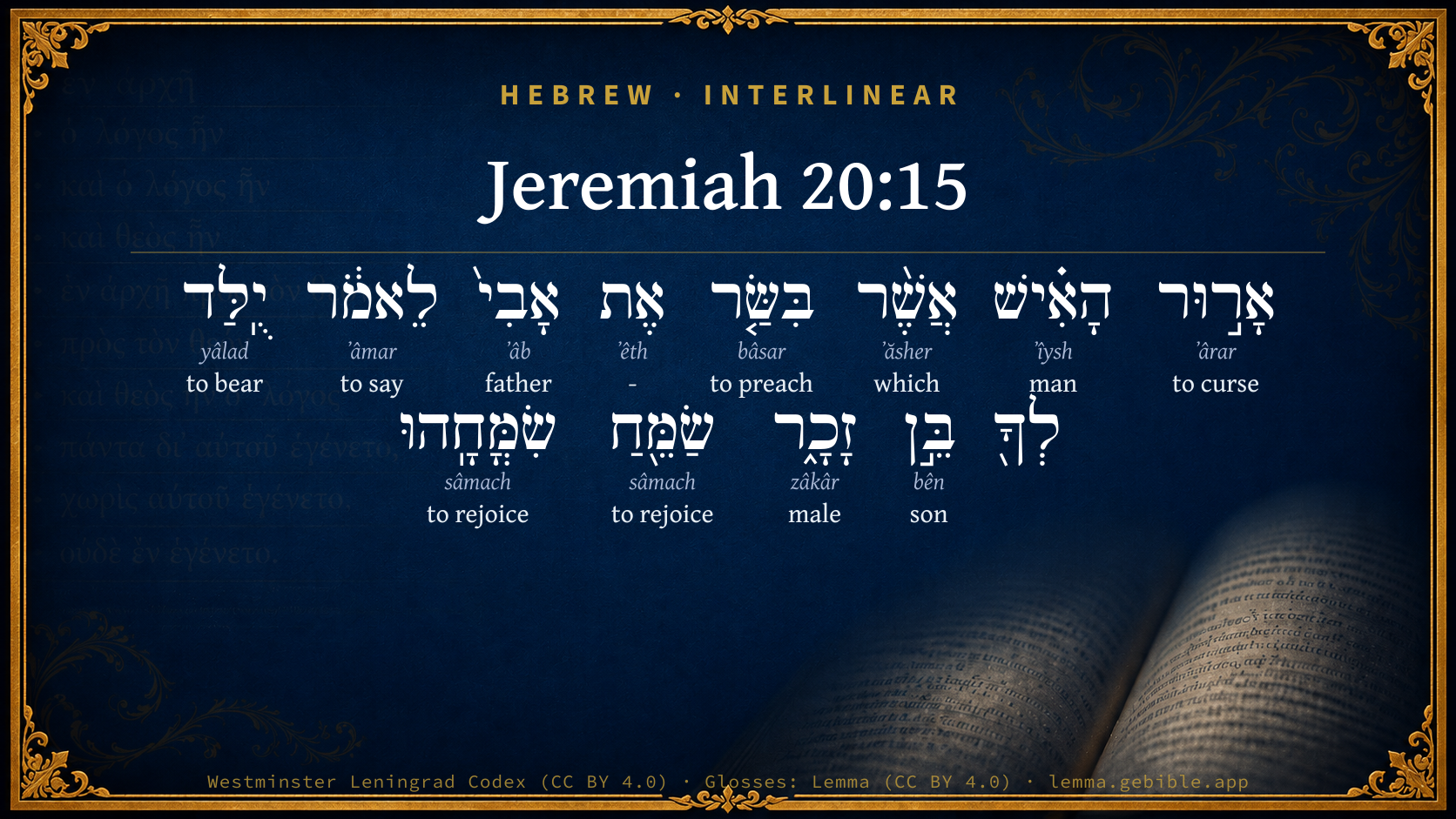
Hebrew (Westminster Leningrad Codex) Jeremiah 20:15 appears in the Hebrew Old Testament. The text above is from the Westminster Leningrad Codex. Each word links to its Strong’s number, a concise gloss, and parsing drawn from the Open Scriptures Hebrew Bible morphology. Click any word for its full Brown-Driver-Briggs (BDB) entry.
Download image
Cite this verse

Jeremiah 20:15 (World English Bible). Public Domain. Lemma interlinear Bible study tool, https://lemma.gebible.app/v/jeremiah/20/15.

Show BibTeX & RIS
BibTeX
RIS
English Translation
Cursed be the man who brought news to my father, saying, A man-child is born to you; making him very glad.
World English Bible · Public Domain
Download a study sheet

One document with this verse’s original text, its word-by-word gloss line, the meaning frame, cross-references with their text, attributed commentary, and full source and license credits — printable, and it pastes into notes with its structure intact.

This verse Autodidact and up

Study sheet (.html) Plain text (.txt)

A passage Seminary Student

Up to 50 verses in one chapter. A passage sheet keeps up to 6 commentary sources and 12 cross-references per verse, in the order this page ranks them, and says so on the sheet whenever that leaves anything out. Ask for a single verse and you get the Autodidact verse sheet above.

Everything on this page stays free to read, with no account — the sheet is a download of what is already on screen, not access to it.

Want to remove ads? Support Godless Engineer
Compare translations 3

The same verse in 3 English versions, stacked beneath the original-language interlinear above. Click any original word for its lexicon entry.

Each is an independent rendering of the whole verse — the interlinear is not word-aligned to these translations.

Highlighted words mark where these versions differ — a whole-verse word diff, not a word-by-word alignment.

  • World English Bible Public Domain
    Cursed be the man who brought news to my father, saying, A man-child is born to you; making him very glad.
  • King James Version Public Domain
    Cursed be the man who brought tidings to my father, saying, A man child is born unto thee; making him very glad.
  • unfoldingWord Literal Text CC BY-SA 4.0
    Cursed the man who brought news to my father, saying, “A male child has been born to you,” making glad, he made him glad.

unfoldingWord Literal Text — © unfoldingWord, licensed CC BY-SA 4.0. Word-aligned USFM3 via Door43 (git.door43.org/unfoldingWord/en_ult).

Versions to compare (up to 4)

3 of 4 selected

Show all 18 translations

Every available English version of this verse, each an independent rendering of the whole verse.

  • World English Bible Public Domain
    Cursed be the man who brought news to my father, saying, A man-child is born to you; making him very glad.
  • Berean Standard Bible Public Domain
    Cursed be the man who brought my father the news, saying, “A son is born to you,” bringing him great joy.
  • Majority Standard Bible Public Domain
    Cursed be the man who brought my father the news, saying, “A son is born to you,” bringing him great joy.
  • King James Version Public Domain
    Cursed be the man who brought tidings to my father, saying, A man child is born unto thee; making him very glad.
  • American Standard Version (1901) Public Domain
    Cursed be the man who brought tidings to my father, saying, A man-child is born unto thee; making him very glad.
  • Revised Version (1885) Public Domain
    Cursed be the man who brought tidings to my father, saying, A man child is born unto thee; making him very glad.
  • Geneva Bible (1599) Public Domain
    Cursed be the man, that shewed my father, saying, A man child is borne vnto thee, and comforted him.
  • Douay-Rheims (1899) Public Domain
    Cursed be the man that brought the tidings to my father, saying: A man child is born to thee: and made him greatly rejoice.
  • Young's Literal Translation Public Domain
    Cursed `is' the man who bore tidings `to' my father, saying, `Born to thee hath been a child -- a male,' Making him very glad!
  • Literal Standard Version CC BY-SA 4.0
    Cursed [is] the man who bore tidings [to] my father, || Saying, “A male child has been born to you,” || Making him very glad!
  • Unlocked Literal Bible CC BY-SA 4.0
    Let the man who informed my father be cursed, the one who said, 'A male child has been born to you,' causing great joy.
  • unfoldingWord Literal Text CC BY-SA 4.0
    Cursed the man who brought news to my father, saying, “A male child has been born to you,” making glad, he made him glad.
  • Darby Bible Public Domain
    Cursed be the man who brought tidings to my father, saying, A man child is born unto thee; making him very glad!
  • World Messianic Bible Public Domain
    Cursed is the man who brought news to my father, saying, “A boy is born to you,” making him very glad.
  • Webster's Bible Public Domain
    Cursed be the man who brought tidings to my father, saying, A male child is born to thee; making him very glad.
  • Free Bible Version CC BY-SA 4.0
    May the man be cursed who brought my father the news that made him really happy, saying, “You have a son.”
  • Bible in Basic English Public Domain
    A curse on the man who gave the news to my father, saying, You have a male child; making him very glad.
  • JPS Tanakh (1917) Public Domain
    Cursed be the man who brought tidings to my father, saying: 'A man-child is born unto thee'; making him very glad.

Literal Standard Version (2020), Covenant Press — licensed CC BY-SA 4.0. Text via the HelloAO Bible API (eBible.org). Unlocked Literal Bible (unfoldingWord) — licensed CC BY-SA 4.0. Text via the HelloAO Bible API (eBible.org). unfoldingWord Literal Text — © unfoldingWord, licensed CC BY-SA 4.0. Word-aligned USFM3 via Door43 (git.door43.org/unfoldingWord/en_ult). Free Bible Version, Dr. Jonathan Gallagher — licensed CC BY-SA 4.0. Text via the HelloAO Bible API (eBible.org).

Word by word

More ways to search: Search by grammar → Find every occurrence → Compare this word →

Practice this passage: Drill this verse → Learn its vocabulary →

בִּשַּׂ֤ר
bâsar
H1319
“to preach”
Verb, Piel, Perfect, 3rd Person, Masculine, Singular
Part of Speech
Verb
Stem
Piel
Form
Perfect
Person
3rd Person
Gender
Masculine
Number
Singular
Full BDB Definition

Origin: a primitive root

TWOT: 291

to bear news, bear tidings, publish, preach, show forth - (Piel) - to gladden with good news - to bear news - to announce (salvation) as good news, preach - (Hithpael) to receive good news
  1. אָר֣וּר ʼârar H779 “cursed” Verb, Qal, Participle Passive, Masculine, Singular, Absolute
  2. הָאִ֗ישׁ ʼîysh H376 “the · man” Particle, Definite Article + Noun, Common, Masculine, Singular, Absolute
  3. אֲשֶׁ֨ר ʼăsher H834 “which” Particle, Relative
  4. אֶת ʼêth H853 “-” Particle, Direct Object
  5. אָבִי֙ ʼâb H1 “father · my” Noun, Common, Masculine, Singular, Construct + Suffix, Personal, 1st Person, Common, Singular
  6. לֵאמֹ֔ר ʼâmar H559 “to say” Preposition + Verb, Qal, Infinitive Construct
  7. יֻֽלַּד yâlad H3205 “to bear” Verb, Pual, Perfect, 3rd Person, Masculine, Singular
  8. בֵּ֣ן bên H1121 “son” Noun, Common, Masculine, Singular, Absolute
  9. זָכָ֑ר zâkâr H2145 “male” Adjective, Adjective, Masculine, Singular, Absolute
  10. שַׂמֵּ֖חַ sâmach H8055 “to rejoice” Verb, Piel, Infinitive Absolute
  11. שִׂמֳּחָֽהוּ sâmach H8055 “to rejoice · him” Verb, Piel, Perfect, 3rd Person, Masculine, Singular + Suffix, Personal, 3rd Person, Masculine, Singular

About this verse

These counts appear in no published source. They are computed here, from the morphology-tagged text and Lemma’s own curated glosses. What Lemma adds →

13
words
11
distinct lemmas
Prophets
section

Notable vocabulary

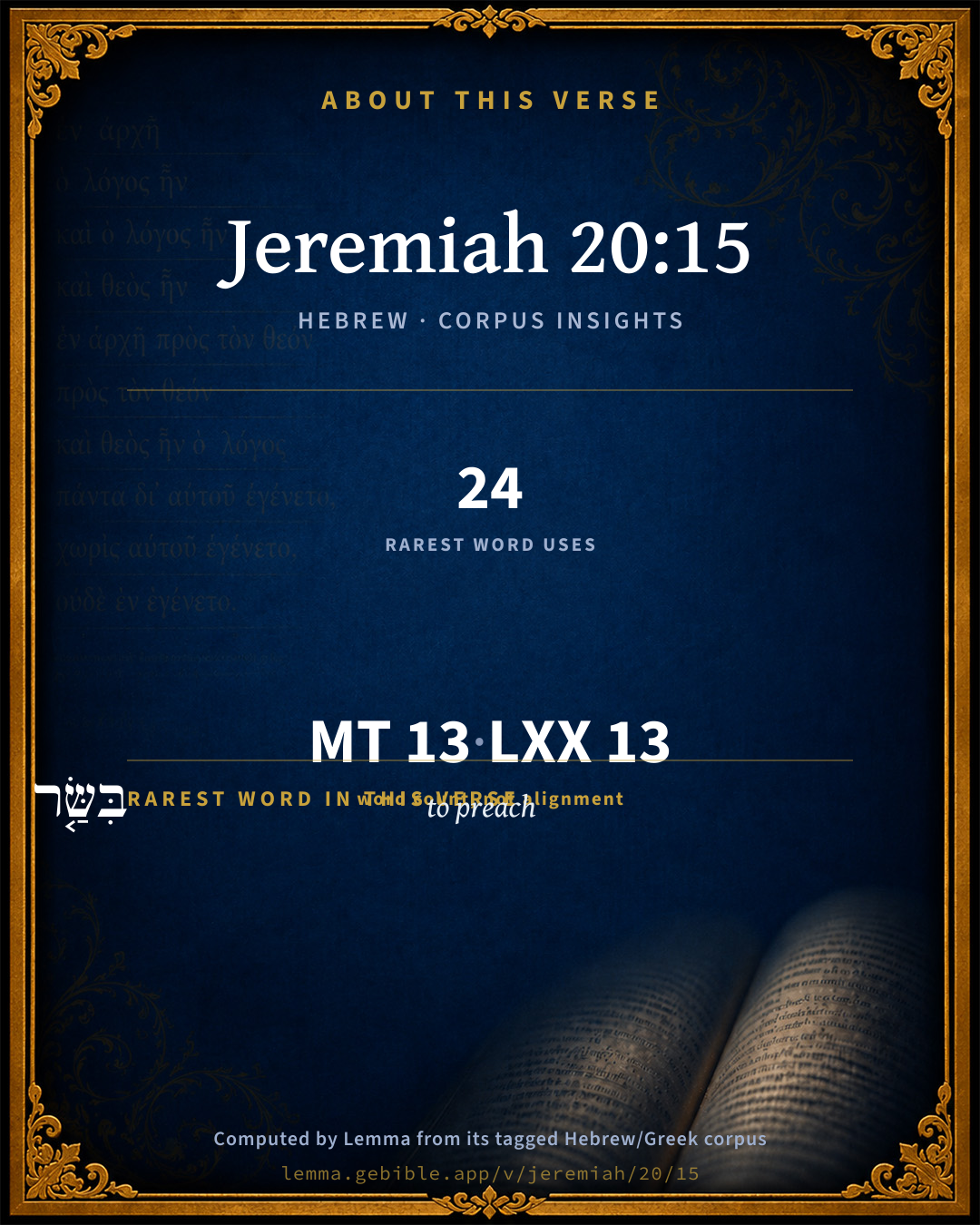
The rarest word here is בִּשַּׂ֤ר to preach H1319 — appearing just 24 times in the whole Hebrew Bible.

Shared distinctive vocabulary

בִּשַּׂ֤ר to preach H1319 occurs in 21 verses of the Hebrew Bible. Also found in:

Grammatical profile

  • 6 verbs
  • 3 nouns
  • 1 adjective
  • 1 preposition
  • 2 particles

Verb forms

  • אָר֣וּר Qal · Participle Passive
  • בִּשַּׂ֤ר Piel · Perfect
  • לֵאמֹ֔ר Qal · Infinitive Construct
  • יֻֽלַּד Pual · Perfect
  • שַׂמֵּ֖חַ Piel · Infinitive Absolute
  • שִׂמֳּחָֽהוּ Piel · Perfect

Repetition

A word recurs within this verse — often emphatic in Hebrew:

  • שַׂמֵּ֖חַ to rejoice H8055 ×2

Hebrew & Septuagint length

In the original languages it is 13 Hebrew tokens and 13 Greek tokens — but the two are counted differently (Hebrew bundles its prefixes and suffixes into one token; the Greek is in lemma form), so that isn’t a like-for-like length.

Cross-references

3

Topical passages linked to Jeremiah 20:15 in the Treasury of Scripture Knowledge — connected by theme and wording, ordered by reader-vote popularity; previews shown in the World English Bible.

  • Genesis 21:5–6 Abraham was one hundred years old when his son, Isaac, was born to him.
  • Jeremiah 1:5 Before I formed you in the belly I knew you, and before you came forth out of the womb I sanctified you; I have appointed you a prophet to the nations.
  • Luke 1:14 You will have joy and gladness; and many will rejoice at his birth.

Cross-references courtesy of OpenBible.info (CC BY 4.0).

Hebrew and Greek witnesses Masoretic Hebrew ↔ Greek Septuagint

The same verse in the two great witnesses to the Old Testament, shown verse-for-verse.

These are two independent witnesses, not word-aligned to each other, and the Septuagint is shown in lemma (dictionary) form.

Hebrew Jeremiah 20:15 Masoretic · Westminster Leningrad Codex

אָר֣וּר הָאִ֗ישׁ אֲשֶׁ֨ר בִּשַּׂ֤ר אֶת אָבִי֙ לֵאמֹ֔ר יֻֽלַּד לְךָ֖ בֵּ֣ן זָכָ֑ר שַׂמֵּ֖חַ שִׂמֳּחָֽהוּ

Cursed be the man who brought news to my father, saying, A man-child is born to you; making him very glad.

World English Bible · Public Domain

Greek LXX Structure differs

In the Septuagint, Jeremiah is about an eighth shorter than the Hebrew and arranges its material differently — the Oracles Against the Nations (Hebrew chapters 46–51) appear in the middle of the Greek book, after 25:13. Because the chapter and verse boundaries do not line up, a verse-for-verse comparison with the Hebrew is not shown.

A verse-for-verse comparison isn’t shown here because the chapters and verses don’t line up. Switch to the LXX edition with the MT / LXX toggle above to read the Greek directly.

On this verse, John Gill's Exposition discusses the Septuagint’s reading. Read the note in Commentary ↓

Hebrew: Westminster Leningrad Codex (CC BY 4.0). Greek: Septuagint (public domain); English from a public-domain English Septuagint. How the Septuagint differs from the Hebrew →

Targum (Aramaic paraphrase)

1

The Targum is the ancient Jewish Aramaic paraphrase of the Hebrew Scriptures — an interpretive translation, not the Hebrew text itself. Onkelos (literal) and Pseudo-Jonathan (expansive) render the Torah, and Jonathan the Prophets. Coverage is partial: where no permissively-licensed English translation exists for a verse, only the Aramaic is shown. This is verse-level text, not a word-by-word alignment to the Hebrew.

  1. Targum Jonathan Prophets (Joshua–Malachi)
    לִיט גַבְרָא דְבַשַׂר יַת אַבָּא לְמֵימַר אִתְיְלִיד לָךְ בַּר דְכַר חֲדָאָה חָדְיֵהּ:

    (no public-domain English translation for this verse)

    Targum Jonathan — Aramaic: “Mikraot Gedolot” (public domain). English: “Sefaria Community Translation” (CC0 1.0 (public-domain dedication)); “London "Chaldee Paraphrase," 1871” (public domain). Text via Sefaria.

Commentary

Notes on Jeremiah 20:15 from classic Christian and Jewish commentators (each source and its license shown beneath its notes). The classic Christian expositions comment on the surrounding passage and are grouped to its opening verse, so a note may address several verses; the Jewish commentaries on the Tanakh (Rashi and others) are per-verse, so they appear only where the commentator wrote on this verse.

Lemma curates 59 commentaries, every one of them public domain or Creative Commons licensed, each selected and text-cleaned for this edition rather than reprinted as found. About our sources →

Trapp's Complete Commentary

John Trapp

Jer 20:15 Cursed [be] the man who brought tidings to my father, saying, A man child is born unto thee; making him very glad.

Ver. 15. Cursed be the man.] Let him have a curse for a reward of his so good news. Thus the prophet, in a fit of impatience, carrieth himself as one who, being cut by a surgeon and extremely pained, striketh at and biteth those that hold him; or, like him in the poet,

“ Quem non incusavi amens hominum que deumque? ”

Aeneid, lib. ii.

Surely as the bird in a cage, because pent up, beats herself, so doth the discontented person. Look to it, therefore. Satan thrusteth in upon us sometimes praying, with a cloud of strange passions, such as are ready to gallow us out of that little wit and faith we have. Resist him betimes. The wildfire of passion will be burning while the incense of prayer is in offering; this scum will be rising up in the boiling pot, together with the meat. See Jon 4:1. {See Trapp on "Jon 4:1"}

John Trapp, A Commentary or Exposition upon All the Books of the Old and New Testament (1647–1656) — public domain. Text from a community e-Sword module.

Joseph Benson's Commentary

Jer 20:15-18. Cursed be the man, &c. — As in the forms of rejoicing upon a birth-day they blessed every person and thing concerned in the birth, and said, Blessed be the womb that bare thee, and the like, and he that brought the joyful news was always rewarded, so in the forms of sorrow for the miserable they used quite the contrary expressions. Let that man be as the cities, &c. — Namely, Sodom and Gomorrah; let him be looked upon as a sad spectacle. Let him hear the cry in the morning, &c. — By these expressions he means the cries, shouts, and noises that enemies make when they break in upon a place in a hostile manner. Because he slew me not, &c. — Or, because I was not slain; from the womb. Wherefore came I forth to see — That is, to experience; labour and sorrow? —

Seeing being frequently put to express any sensation. As if the prophet had said, “I speak thus in the bitterness of my soul; when I consider how much better it would have been that I had never been born, or that I had given up the ghost immediately on my birth, than to lead a life of continual sorrow and misery.” These various expressions show us to what a height the tide of perturbation swelled at this time in this good man’s heart, and what need we have to pray to be delivered from the power of our own passions.

Joseph Benson's Commentary on the Old and New Testaments (1811–1818) — public domain. Text from a community e-Sword module.

Jamieson, Fausset & Brown

Robert Jamieson, A. R. Fausset & David Brown

A man child--The birth of a son is in the East a special subject of joy; whereas that of a daughter is often not so.

Jamieson, Fausset & Brown — Commentary Critical and Explanatory on the Whole Bible (1871) — public domain (CC PDM 1.0). Text via the HelloAO Bible API.

Adam Clarke's Commentary

Verse 15. A man child is born] Borun is to thee a knave child.-Old MS. Bible. This is the old English word for man or servant; and is so used by Wiclif, Re 12:5.

Adam Clarke's Commentary on the Bible (1810–1826) — public domain. Text from a community e-Sword/MySword module.

John Calvin's Commentaries

We said yesterday that the Prophet’s confused state of mind is described in this passage; for he would have no doubt himself confessed, that he was carried away by an intemperate feeling, so as not to be himself; for it is to cast reproach on God when any one curses his own birth-day. And he goes farther than this, for he adds, Cursed be the man who declared to my father, that a male child was born Here he not only fights against God, but is also ungrateful towards men; for what but thanks did he deserve who first told his father that he had a son born to him? It was then an ingratitude in no way excusable And hence we also learn that the Prophet had no control over his feelings, but was wholly led away by a blind impulse, which made him to utter very inconsiderate words; for in this sentence there is no piety nor humanity; but as I have said, the Prophet was ungrateful to men as well as to God; and his hyperbolical language also more fully expresses how intemperate his feelings were, who declared to my father that a male child was born He seems here, as though he avowedly despised God’s favor, for we know that males are preferred to females. But the Prophet mentions here the word male, as though he wished to complain of what he ought to have been thankful for.

John Calvin's Commentaries (1540-1563) — public domain. Text from the Calvin Translation Society English edition (1840s-50s) via the Christian Classics Ethereal Library (ccel.org). Calvin's coverage is partial (roughly two-thirds of the Bible); uncommented books and verses are honest gaps, never fabricated. The 19th-century editor's footnotes and remarks are omitted so the notes are faithfully Calvin's own voice.

Ellicott's Commentary for English Readers

(15) Making him very glad.—The memory, or rather the thought of that day, the joy of father and another when their child was born (Joh_16:21) was wanted, as in the irony of destiny, to add the keenest pang to the misery of the present. The “sorrow’s crown of sorrow” was found in remembering happier days. We note the same tenderness turned to bitterness as in Jer_15:10. The day of his birth was to him a day of darkness and not of light.

A Bible Commentary for English Readers, edited by Charles John Ellicott (1878–1897) — public domain. Text from a community e-Sword module.

The Cambridge Bible for Schools and Colleges

gen. ed. J. J. S. Perowne

15. “No man of course can curse his father or his mother, so Jeremiah curses the messenger, who brought the joyful news from the women’s quarters.” Du.

The Cambridge Bible for Schools and Colleges (gen. ed. J. J. S. Perowne; Cambridge University Press, 1878–1918) — public domain. Text from a community e-Sword module.

John Gill's Exposition

Cursed be the man who brought tidings to my father,.... The word signifies commonly good tidings, as the news of a child born, and especially a man child, is to its parent. The Septuagint use the same word the angel did, when he brought the tidings of the birth of Christ, Luk 2:10. This was still more foolish and sinful, to curse the man that carried the tidings of his birth to his father; who did a right thing, and what was acceptable, and perhaps might be a good man. Kimchi observes, that there are some that say, it was known to Jeremiah that this man was Pashur, the son of Immer, and therefore he cursed him; but this is without any foundation;

saying, a man child is born unto thee, making him very glad; as the birth of a man child usually makes glad its parent, whether father or mother; see Joh 16:21.

John Gill's Exposition of the Whole Bible (1746–1763) — public domain (CC PDM 1.0). Text via the HelloAO Bible API.

Matthew Poole's English Annotations

Parents are usually rejoiced when a son is born to them.

Matthew Poole's English Annotations on the Holy Bible (1683–1685) — public domain. Text from a community e-Sword/MySword module.

Rashi

Rabbi Shlomo Yitzchaki (Rashi)

making him glad The ‘mem’ is punctuated with a ‘dagesh,’ which is an expression of making others glad, for he made his father glad with his news.

Rashi on the Tanakh — English translations: “The Judaica Press complete Tanach with Rashi, translated by A. J. Rosenberg” (CC BY 4.0); “Pentateuch with Rashi's commentary by M. Rosenbaum and A.M. Silbermann, 1929-1934” (public domain); “The Metsudah Tanach series, Lakewood, N.J” (CC BY 4.0); and “The Book of Joshua, Metsudah Publications, 1997” (CC BY 4.0). Text via Sefaria.

Lesson kit

Teaching starters — assembled from the data on this page, not authored interpretation. Every prompt links to the verse data it draws on. Edit before teaching.

Jeremiah, in the Prophets, opens this verse with 13 words (11 distinct Hebrew lemmas). Its most distinctive word is bâsar (“to preach”). A historical commentator’s framing appears above. Read the whole chapter for the surrounding context.

Discussion questions

  1. The word bâsar carries the sense “to preach.” How does it shape the verse?
  2. How does 1 Samuel 4:17, which shares the word «to preach», read alongside this verse?
  3. What does the repetition of “to rejoice” (2× in this one verse) do in this verse?
  4. The translations on this page render this verse differently — a whole-verse word diff, not a word-by-word alignment. What might account for the different wordings?
  5. «אָר֣וּר» is a Qal Participle Passive verb. How does that grammatical form shape the action described?
  6. Compare how Trapp's Complete Commentary and Joseph Benson's Commentary read this verse. Where do they agree or differ?

Things to notice

Reading settings

Reading text

Shown beneath each verse's original-language words.

Old Testament
Old Testament edition

Read the OT as the Masoretic Hebrew (MT) or the Greek Septuagint (LXX).

English shown for the Greek Septuagint (in the Hebrew ↔ Greek comparison).

Comparing translations? Open the Compare panel on any verse page to stack up to four side by side.