
Psalms 90:15

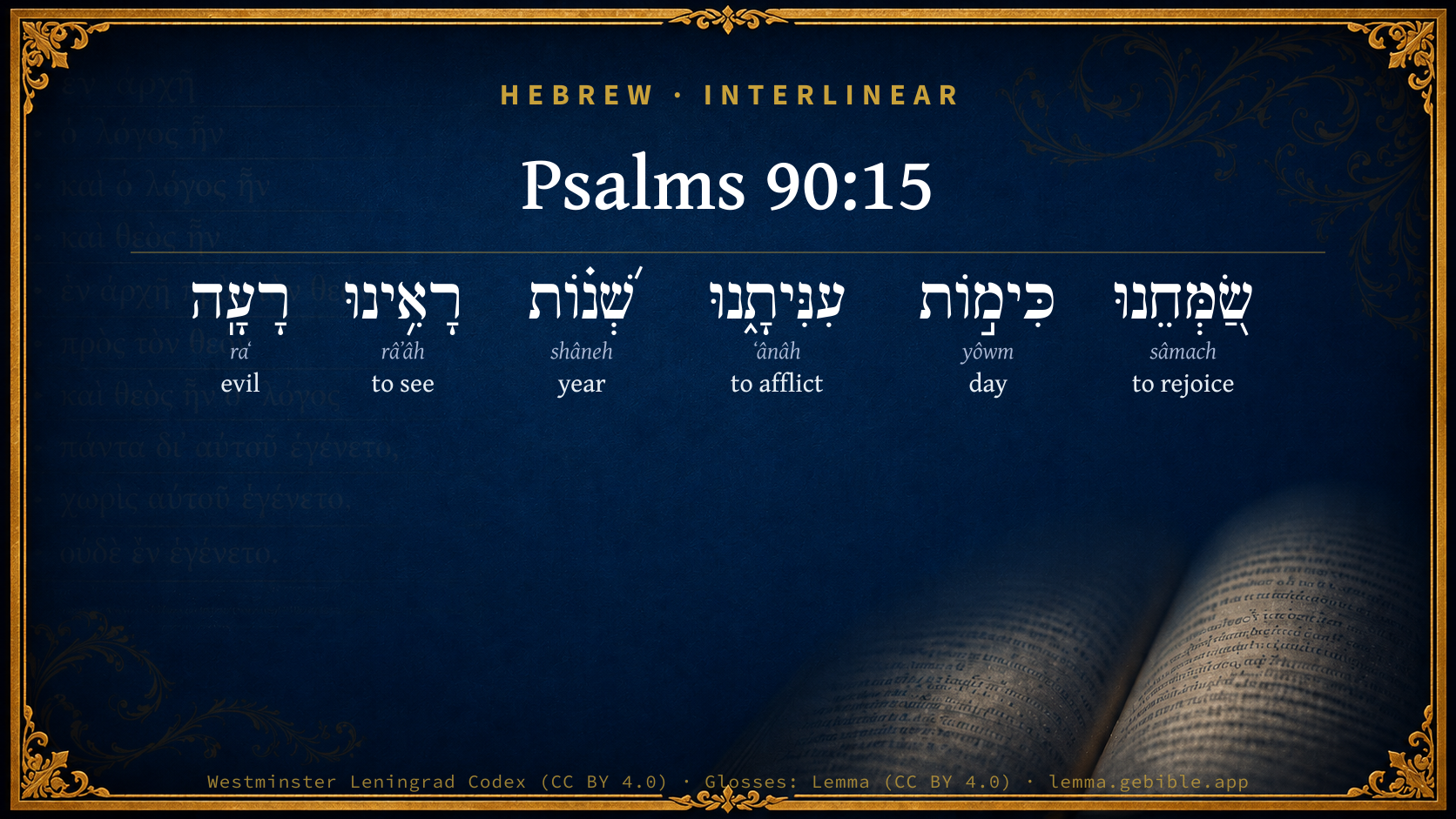
Hebrew (Westminster Leningrad Codex) Psalms 90:15 appears in the Hebrew Old Testament. The text above is from the Westminster Leningrad Codex. Each word links to its Strong’s number, a concise gloss, and parsing drawn from the Open Scriptures Hebrew Bible morphology. Click any word for its full Brown-Driver-Briggs (BDB) entry.
Download image
Cite this verse

Psalms 90:15 (World English Bible). Public Domain. Lemma interlinear Bible study tool, https://lemma.gebible.app/v/psalms/90/15.

Show BibTeX & RIS
BibTeX
RIS
English Translation
Make us glad for as many days as you have afflicted us, For as many years as we have seen evil.
World English Bible · Public Domain
Download a study sheet

One document with this verse’s original text, its word-by-word gloss line, the meaning frame, cross-references with their text, attributed commentary, and full source and license credits — printable, and it pastes into notes with its structure intact.

This verse Autodidact and up

Study sheet (.html) Plain text (.txt)

A passage Seminary Student

Up to 50 verses in one chapter. A passage sheet keeps up to 6 commentary sources and 12 cross-references per verse, in the order this page ranks them, and says so on the sheet whenever that leaves anything out. Ask for a single verse and you get the Autodidact verse sheet above.

Everything on this page stays free to read, with no account — the sheet is a download of what is already on screen, not access to it.

Want to remove ads? Support Godless Engineer
Compare translations 3

The same verse in 3 English versions, stacked beneath the original-language interlinear above. Click any original word for its lexicon entry.

Each is an independent rendering of the whole verse — the interlinear is not word-aligned to these translations.

Highlighted words mark where these versions differ — a whole-verse word diff, not a word-by-word alignment.

  • World English Bible Public Domain
    Make us glad for as many days as you have afflicted us, For as many years as we have seen evil.
  • King James Version Public Domain
    Make us glad according to the days wherein thou hast afflicted us, and the years wherein we have seen evil.
  • unfoldingWord Literal Text CC BY-SA 4.0
    Make us glad according to the days you afflicted us the years we have seen trouble.

unfoldingWord Literal Text — © unfoldingWord, licensed CC BY-SA 4.0. Word-aligned USFM3 via Door43 (git.door43.org/unfoldingWord/en_ult).

Versions to compare (up to 4)

3 of 4 selected

Show all 18 translations

Every available English version of this verse, each an independent rendering of the whole verse.

  • World English Bible Public Domain
    Make us glad for as many days as you have afflicted us, For as many years as we have seen evil.
  • Berean Standard Bible Public Domain
    Make us glad for as many days as You have afflicted us, for as many years as we have seen evil.
  • Majority Standard Bible Public Domain
    Make us glad for as many days as You have afflicted us, for as many years as we have seen evil.
  • King James Version Public Domain
    Make us glad according to the days wherein thou hast afflicted us, and the years wherein we have seen evil.
  • American Standard Version (1901) Public Domain
    Make us glad according to the days wherein thou hast afflicted us, And the years wherein we have seen evil.
  • Revised Version (1885) Public Domain
    Make us glad according to the days wherein thou hast afflicted us, and the years wherein we have seen evil.
  • Geneva Bible (1599) Public Domain
    Comfort vs according to the dayes that thou hast afflicted vs, and according to the yeeres that we haue seene euill.
  • Douay-Rheims (1899) Public Domain
    We have rejoiced for the days in which thou hast humbled us: for the years in which we have seen evils.
  • Young's Literal Translation Public Domain
    Cause us to rejoice according to the days Wherein Thou hast afflicted us, The years we have seen evil.
  • Literal Standard Version CC BY-SA 4.0
    Cause us to rejoice according to the days || Wherein You have afflicted us, || The years we have seen evil.
  • Unlocked Literal Bible CC BY-SA 4.0
    Make us glad in proportion to the days you afflicted us and to the years we have experienced trouble.
  • unfoldingWord Literal Text CC BY-SA 4.0
    Make us glad according to the days you afflicted us the years we have seen trouble.
  • Darby Bible Public Domain
    Make us glad according to the days [wherein] thou hast afflicted us, according to the years [wherein] we have seen evil.
  • World Messianic Bible Public Domain
    Make us glad for as many days as you have afflicted us, for as many years as we have seen evil.
  • Webster's Bible Public Domain
    Make us glad according to the days in which thou hast afflicted us, and the years in which we have seen evil.
  • Free Bible Version CC BY-SA 4.0
    Make us glad for as many days as you made us sad, for all the years we suffered!
  • Bible in Basic English Public Domain
    Make us glad in reward for the days of our sorrow, and for the years in which we have seen evil.
  • JPS Tanakh (1917) Public Domain
    Make us glad according to the days wherein Thou hast afflicted us, according to the years wherein we have seen evil.

Literal Standard Version (2020), Covenant Press — licensed CC BY-SA 4.0. Text via the HelloAO Bible API (eBible.org). Unlocked Literal Bible (unfoldingWord) — licensed CC BY-SA 4.0. Text via the HelloAO Bible API (eBible.org). unfoldingWord Literal Text — © unfoldingWord, licensed CC BY-SA 4.0. Word-aligned USFM3 via Door43 (git.door43.org/unfoldingWord/en_ult). Free Bible Version, Dr. Jonathan Gallagher — licensed CC BY-SA 4.0. Text via the HelloAO Bible API (eBible.org).

Word by word

More ways to search: Search by grammar → Find every occurrence → Compare this word →

Practice this passage: Drill this verse → Learn its vocabulary →

עִנִּיתָ֑נוּ
ʻânâh
H6031
“to afflict · us”
Verb, Piel, Perfect, 2nd Person, Masculine, Singular + Suffix, Personal, 1st Person, Common, Plural
Part of Speech
Verb
Stem
Piel
Form
Perfect
Person
2nd Person
Gender
Masculine
Number
Singular
Full BDB Definition

Origin: a primitive root [possibly rather ident. with H6030 through the idea of looking down or browbeating]

TWOT: 1651 , 1652

(Qal) to be occupied, be busied with - to afflict, oppress, humble, be afflicted, be bowed down - (Qal) - to be put down, become low - to be depressed, be downcast - to be afflicted - to stoop - (Niphal) - to humble oneself, bow down - to be afflicted, be humbled - (Piel) - to humble, mishandle, afflict - to humble, be humiliated - to afflict - to humble, weaken oneself - (Pual) - to be afflicted - to be humbled - (Hiphil) to afflict - (Hithpael) - to humble oneself - to be afflicted
  1. שַׂ֭מְּחֵנוּ sâmach H8055 “rejoice · us” Verb, Piel, Imperative, 2nd Person, Masculine, Singular + Suffix, Personal, 1st Person, Common, Plural
  2. כִּימ֣וֹת yôwm H3117 “like/as · days of” Preposition + Noun, Common, Masculine, Plural, Construct
  3. שְׁ֝נ֗וֹת shâneh H8141 “years of” Noun, Common, Feminine, Plural, Construct
  4. רָאִ֥ינוּ râʼâh H7200 “to see” Verb, Qal, Perfect, 1st Person, Common, Plural
  5. רָעָֽה raʻ H7451 “evil” Noun, Common, Feminine, Singular, Absolute

About this verse

These counts appear in no published source. They are computed here, from the morphology-tagged text and Lemma’s own curated glosses. What Lemma adds →

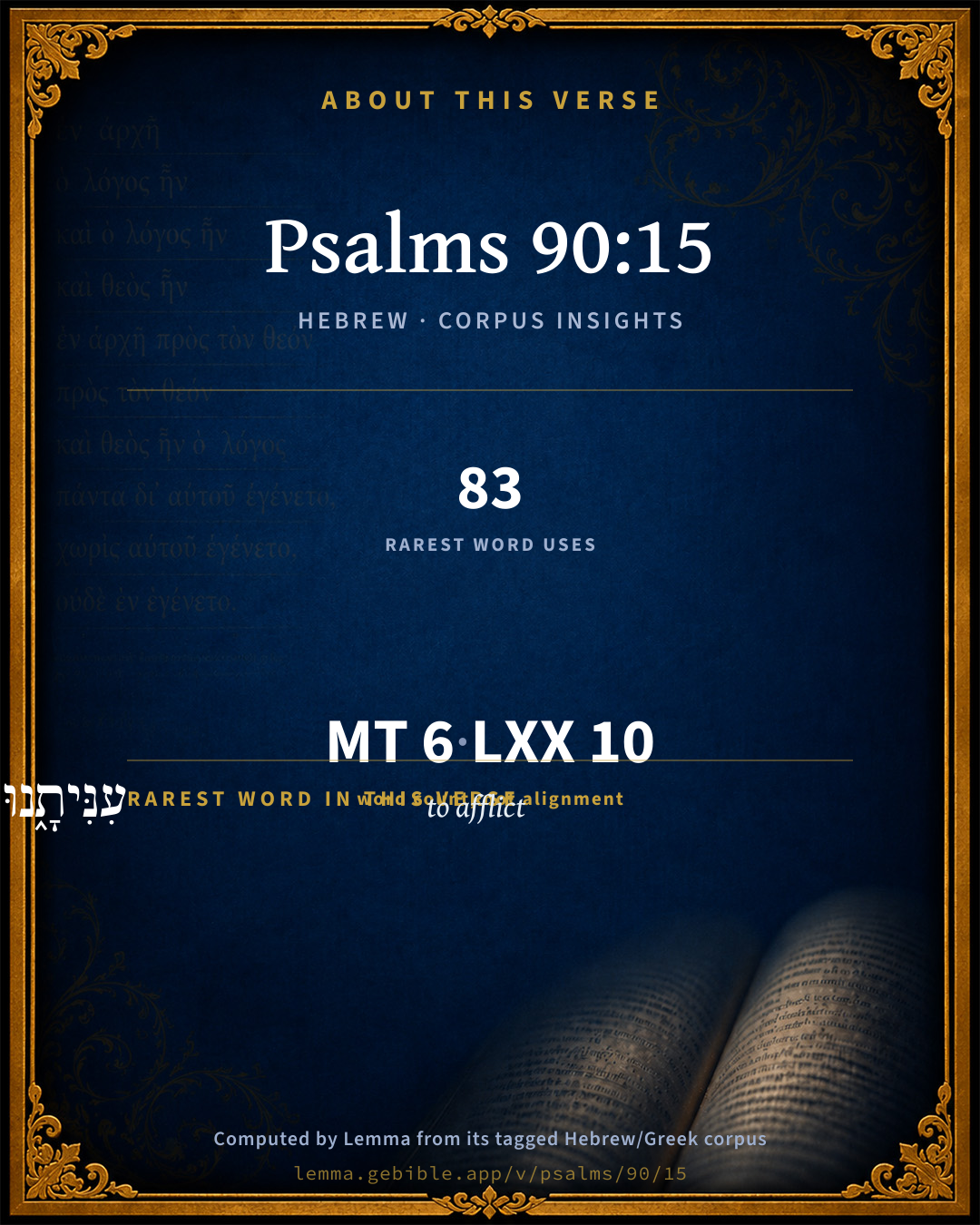
6
words
6
distinct lemmas
Wisdom
section

Grammatical profile

  • 3 verbs
  • 3 nouns

Verb forms

  • שַׂ֭מְּחֵנוּ Piel · Imperative
  • עִנִּיתָ֑נוּ Piel · Perfect
  • רָאִ֥ינוּ Qal · Perfect

Hebrew & Septuagint length

In English translation the verse runs 21 words from the Hebrew and 23 from the Septuagint (LXX English) — closely comparable.

A rough comparison of the two English renderings, which tokenize alike — not a word-level alignment.

Word counts can differ between the Hebrew and the Greek without any difference in meaning — e.g. the Hebrew direct-object marker אֵת has no separate Greek word, and Greek often adds the article ὁ.

In the original languages it is 6 Hebrew tokens and 10 Greek tokens — but the two are counted differently (Hebrew bundles its prefixes and suffixes into one token; the Greek is in lemma form), so that isn’t a like-for-like length.

Cross-references

11

Topical passages linked to Psalms 90:15 in the Treasury of Scripture Knowledge — connected by theme and wording, ordered by reader-vote popularity; previews shown in the World English Bible.

  • Psalms 30:5 For his anger is but for a moment; His favor is for a lifetime. Weeping may stay for the night, But joy comes in the morning.
  • Psalms 126:5–6 Those who sow in tears will reap in joy.
  • Isaiah 40:1–2 Comfort you, comfort you my people, says your God.
  • John 16:20 Most assuredly I tell you, that you will weep and lament, but the world will rejoice. You will be sorrowful, but your sorrow will be turned into joy.
  • Isaiah 12:1 In that day you will say, "I will give thanks to you, Yahweh; for though you were angry with me, your anger has turned away and you comfort me.
  • Jeremiah 31:12–13 They shall come and sing in the height of Zion, and shall flow to the goodness of Yahweh, to the grain, and to the new wine, and to the oil, and to the young of the flock and of the herd: and their soul shall be as a watered garden; and they shall not sorrow any more at all.
  • Isaiah 61:3 to appoint to those who mourn in Zion, to give to them a garland for ashes, the oil of joy for mourning, the garment of praise for the spirit of heaviness; that they may be called trees of righteousness, the planting of Yahweh, that he may be glorified.
  • Isaiah 65:18–19 But be you glad and rejoice forever in that which I create; for, behold, I create Jerusalem a rejoicing, and her people a joy.
  • Revelation 7:14–17 I told him, "My lord, you know." He said to me, "These are those who came out of the great tribulation. They washed their robes, and made them white in the Lamb's blood.
  • Matthew 5:4 Blessed are those who mourn, For they shall be comforted.
  • Deuteronomy 2:14–16 The days in which we came from Kadesh-barnea, until we were come over the brook Zered, were thirty-eight years; until all the generation of the men of war were consumed from the midst of the camp, as Yahweh swore to them.

Cross-references courtesy of OpenBible.info (CC BY 4.0).

Hebrew and Greek witnesses Masoretic Hebrew ↔ Greek Septuagint

The same verse in the two great witnesses to the Old Testament, shown verse-for-verse.

You’re reading Greek Psalm 89 (Hebrew Psalm 90). The Septuagint counts the superscription, so verse numbers can differ from the Hebrew — chapter-level alignment, not verse-by-verse. Numbering follows Rahlfs.

These are two independent witnesses, not word-aligned to each other, and the Septuagint is shown in lemma (dictionary) form.

Hebrew Psalms 90:15 Masoretic · Westminster Leningrad Codex

שַׂ֭מְּחֵנוּ כִּימ֣וֹת עִנִּיתָ֑נוּ שְׁ֝נ֗וֹת רָאִ֥ינוּ רָעָֽה

Make us glad for as many days as you have afflicted us, For as many years as we have seen evil.

World English Bible · Public Domain

Greek LXX Greek Psalm 89:15 Septuagint · lemma form

εὐφραίνω ἀντί ὅς ἡμέρα ταπεινόω ἐγώ ἔτος ὅς ὁράω κακός

let us rejoice in all our days, in return for the days wherein you did afflict us, the years wherein we saw evil.

LXX2012 (modern English Septuagint) · Public Domain

Hebrew: Westminster Leningrad Codex (CC BY 4.0). Greek: Septuagint (public domain); English from LXX2012 (modern English Septuagint) (Public Domain). How the Septuagint differs from the Hebrew →

Commentary

Notes on Psalms 90:15 from classic Christian and Jewish commentators (each source and its license shown beneath its notes). The classic Christian expositions comment on the surrounding passage and are grouped to its opening verse, so a note may address several verses; the Jewish commentaries on the Tanakh (Rashi and others) are per-verse, so they appear only where the commentator wrote on this verse.

Lemma curates 59 commentaries, every one of them public domain or Creative Commons licensed, each selected and text-cleaned for this edition rather than reprinted as found. About our sources →

Trapp's Complete Commentary

John Trapp

Psa 90:15 Make us glad according to the days [wherein] thou hast afflicted us, [and] the years [wherein] we have seen evil.

Ver. 15. Make us glad according] Let us have a proportion at least.

John Trapp, A Commentary or Exposition upon All the Books of the Old and New Testament (1647–1656) — public domain. Text from a community e-Sword module.

The Biblical Illustrator

Joseph S. Exell

Psa_90:15-17

Make us glad according to the days wherein Thou hast afflicted us, and the years wherein we have seen evil.

Gladness for sadness

Our prayer should be for--

I. Proportionate gladness; that our God who has filled one scale with grief would fill the other scale with grace till they balance each other. I have been told on the Scotch lakes that the depth of the lake is almost always the same as the height of the surrounding hills; and I think I have heard that the same is true of the great ocean; so that the greatest depth is probably the same as the greatest height. Doubtless, the law of equilibrium is manifest in a thousand ways. Take an instance in the adjustment of days and nights. A long night reigns over the north of Norway; in these wintry months they do not even see the sun; but mark and admire their summer; then the day banishes the night altogether, and you may read your Bible by the light of the midnight sun. Long wintry nights find compensation in a perpetual summer day. There is a balance about the conditions of the peoples of differing lands: each country has its drawbacks and its advantages. I believe it is so with the life of Gods people: therein also the Lord maintains a balance. As the sufferings of Christ abound in us, so our consolation also aboundeth by Christ. The good Lord measures out the dark and the light in due proportions, and the result is life sad enough to be safe, and glad enough to be desirable. A step further, and we have it thus, sorrow often prepares for joy. It might not be safe that you should enjoy worldly prosperity at the outset of life. Your adversities in business are meant to teach you the worthlessness of earthly things, so that when you have them you may not be tempted to make idols of them. In the spiritual life God does not run us up with glittering virtues all of a sudden; but deep prostration of spirit and thorough humiliation prepare the under-courses; and then, afterwards, stone upon stone, as with rows of jewels, we are built up to be a palace for the indwelling of God. Sorrow furnishes the house for joy. Once again, let me say to you, there is such a connection between sorrow and joy that no saint ever has a sorrow but what it has a joy wrapped up in it. It is a rough oyster, but a pearl lies within those shells if you will but look for it. Once more: the day will come when all the sorrows of Gods sending will be looked upon as joys. Perhaps in heaven, among all the things which have happened to us that will excite our wonder and delight, our furnace experience, and the hammer and the file will take the lead. Sorrow will contribute rich stanzas to our everlasting psalm.

II. Peculiar gladness.

1. Gladness at the sight of Gods work. When we are in deep tribulation it is a sweet quietus to survey the handiwork of our Father in Heaven. His work in providence, also, is often a consolation to us. Let us but see what God has done for His people and for ourselves in years past, and we are cheered. Trouble itself, when we see it to be Gods work, has lost its terror. A certain Persian nobleman found himself surrounded by soldiers, who sought to take him prisoner; he drew his sword and fought right valiantly, and might have escaped had not one of the company said, The king has sent us to convey you to himself. He sheathed his sword at once. Yes, we can contend against what we call a misfortune; but when we learn that the Lord hath done it, our contest is ended, for we joy and rejoice in what the Lord doeth; or, if we cannot get the length of rejoicing in it, we acquiesce in His will.

2. Gladness at the revelation of God to our children. No better comfort can be found for bereaved mothers than to see their sons and daughters converted.

3. Gladness at beauty bestowed. Sorrow mars the countenance and clothes the body with sackcloth; but if the Lord will come to us and adorn us with His beauty, then the stains of mourning will speedily disappear.

4. Gladness at our own work being established. To build up the Church and win souls for Jesus is first of all Gods work, and then our work. Why should a Christian work to win souls? Answer: because God works in him to win souls. God works to set us working: our work is the result of His work.

(1) The text prays for our work that it may succeed: Establish Thou the work of our hands. Oh, if God will but prosper us in our work for Him, how happy we shall be! It is web weather just now, the damp of sorrow is on all things, and so the seed sown in tears is speedily reaped in joy. Is not this something to comfort us? Let us pray God to send us more of it, that by conversions our work may prosper.

(2) Then we pray that our work may be lasting,--that is the chief point. (C. H. Spurgeon.)

The Biblical Illustrator, edited by Joseph S. Exell (c. 1880s–1900s) — public domain. Text from a community e-Sword module.

J. A. Alexander on Psalms

Joseph Addison Alexander

15. (Psa 90:15) Make us glad according to the days thou hast afflicted us, the years we have seen evil. According to, literally as or like. The meaning is, compensate all our sufferings by proportionate enjoyments. The ellipsis of the relative is common in both idioms. The English Bible, by supplying it, enfeebles the expression without making the sense clearer. Days and years, as in Psa 90:9. The plural forms in the Hebrew are unusual and borrowed from Deu 32:7, a Mosaic feature of the psalm which cannot possibly be reproduced in any version.

Joseph Addison Alexander, The Psalms Translated and Explained (1850) — public domain. Text from a community e-Sword module.

Tyndale Open Study Notes

Tyndale Open Resources

90:15 The psalmist calls upon the Lord to give the people gladness to replace their mourning (see 92:4-5).

Tyndale Open Study Notes — © Tyndale Open Resources, licensed CC BY-SA 4.0. Text via the HelloAO Bible API.

Adam Clarke's Commentary

Verse 15. Make us glad according to the days] Let thy people have as many years of prosperity as they have had of adversity. We have now suffered seventy years of a most distressful captivity.

Adam Clarke's Commentary on the Bible (1810–1826) — public domain. Text from a community e-Sword/MySword module.

Ellicott's Commentary for English Readers

(15) A prayer that prosperity may follow, proportionate to the mercy that has been endured.

A Bible Commentary for English Readers, edited by Charles John Ellicott (1878–1897) — public domain. Text from a community e-Sword module.

The Cambridge Bible for Schools and Colleges

gen. ed. J. J. S. Perowne

15. Make us glad according to the days &c.] Let the joy of restoration to Thy favour be proportioned to the depth of our humiliation. Cp. Isa_61:7. The form of the word for ‘days’ (y’môth) occurs elsewhere only in Deu_32:7; and the word for afflicted is the same as that rendered to humble thee in Deu_8:2-3; Deu_8:16.

The Cambridge Bible for Schools and Colleges (gen. ed. J. J. S. Perowne; Cambridge University Press, 1878–1918) — public domain. Text from a community e-Sword module.

John Gill's Exposition

Make us glad according to the days wherein thou hast afflicted us,.... The days of affliction are times of sorrow; and days of prosperity make glad and joyful; and the psalmist here seems to desire an equal number of the one as of the other; not that an exact precise number of the one with the other is intended; but that there might be a proper proportion of the one to the other; and commonly God does "set the one over against the other": there is a mixture of both in the believer's life, which is like unto a chequer of black and white, in which there is a proper proportion of both colours; and so prosperity and adversity are had in turns, "and work together for good" to them that love the Lord: and when it is said "make us glad", that is, with thy favour and presence, it suggests, that these are a sufficient recompence for all affliction and trouble; and if so here, what must the enjoyment of these be in heaven! Between this and present afflictions there is no proportion, neither with respect to the things themselves, nor the duration of them; see Rom 8:18 and "the years" wherein "we have seen evil"; afflictions are evils; they flow from the evil of sin, and to some are the evil of punishment; and even chastisements are not joyous, but grievous: this may have respect to the forty years' travel in the wilderness, in which the Israelites saw or had an experience of much affliction and trouble; and even to the four hundred years in which the seed of Abraham were afflicted in a land not their's; see Num 14:33. Hence the Jews (i) make the times of the Messiah to last four hundred years, answerable to those years of evil, and which they take to be the sense of the text; and so Jarchi's note on it is,

"make us glad in the days of the Messiah, according to the number of the days in which thou hast afflicted us in the captivities, and according to the number of the years in which we have seen evil.''

(i) T. Bab. Sanhedrin, fol. 99. 1.

Next: Psalms Chapter 91

John Gill's Exposition of the Whole Bible (1746–1763) — public domain (CC PDM 1.0). Text via the HelloAO Bible API.

Albert Barnes' Notes on the Bible

Make us glad according to the days wherein thou hast afflicted us - Let the one correspond with the other. Let our occasions of joy be measured by the sorrows which have come upon us. As our sufferings have been great, so let our joys and triumphs be.

And the years wherein we have seen evil - Affliction and sorrow. They have been continued through many wearisome years; so let the years of peace and joy be many also.

Albert Barnes' Notes on the Bible (1834–1885) — public domain. Text from a community e-Sword/MySword module.

Matthew Poole's English Annotations

Our afflictions have been sharp and long, let not our prosperity be small and short.

Matthew Poole's English Annotations on the Holy Bible (1683–1685) — public domain. Text from a community e-Sword/MySword module.

The Treasury of David

Charles H. Spurgeon

Ver. 15. Make us glad according to the days wherein thou hast afflicted us, and the years wherein we have seen evil. None can gladden the heart as thou canst, O Lord, therefore as thou hast made us sad be pleased to make us glad. Fill the other scale. Proportion thy dispensations. Give us the lamb, since thou has sent us the bitter herbs. Make our days as long as our nights. The prayer is original, childlike, and full of meaning; it is moreover based upon a great principle in providential goodness, by which the Lord puts the good over against the evil in due measure. Great trial enables us to bear great joy, and may be regarded as the herald of extraordinary grace. God's dealings are according to scale; small lives are small throughout; and great histories are great both in sorrow and happiness. Where there are high hills there are also deep valleys. As God provides the sea for leviathan, so does he find a pool for the minnow; in the sea all things are in fit proportion for the mighty monster, while in the little brook all things befit the tiny fish. If we have fierce afflictions we may look for overflowing delights, and our faith may boldly ask for them. God who is great in justice when he chastens will not be little in mercy when he blesses, he will be great all through: let us appeal to him with unstaggering faith.

Ver. 15.

1. The joy of faith is in proportion to the sorrow of repentance.

2. The joy of consolation is in proportion to suffering in affliction.

3. The joy of the returning smiles of God is in proportion to the terror of his frowns. —G.R.

Ver. 15. The Balance of life, or the manner in which our joys are set over against our sorrows.

Psalms 90:16*

Charles H. Spurgeon's The Treasury of David (1869–1885) — public domain. Psalms only. Text from a community e-Sword/MySword module.

Whedon's Commentary on the Bible

Daniel D. Whedon

15. According to the days… the years—The period of their sufferings seemed like endless years, and becomes the measurement of the gladness for which the psalmist prays. Let our consolations cause us to forget the length and severity of our sufferings. The symbolical day for a year is here hinted at in the parallelism. Compare Num_14:34

Daniel D. Whedon (gen. ed.), Commentary on the Old and New Testaments (1874–1909) — public domain. Text from a community e-Sword module.

The Pulpit Commentary

Make us glad according to the days wherein thou hast afflicted us. Proportion our time of joy to our time of sorrow: as the one has lasted many long years, so let the other. And the years wherein we have seen evil; or, "suffered adversity.

"Make us glad.

None can overestimate the blessing that God"s gift of gladness is to us. How it sweetens intercourse, encourages work, lightens our burdens, and helps us over many a difficult place! But there are forms of gladness to which no praise can be given. The laughter of fools is like "the crackling of thorns under a pot so says Ecclesiastes. And the gladness of evil men over evil has poison in it, notwithstanding all its loudness. And all mere man made gladness is without permanence or power to really help. The gladness that is of God"s making, that is what the psalmist prayed for, and for which we also may well pray. Therefore let us observe its elements, in what it consists. And the following verses of the psalm clearly tell this.

I GOD"S WORK MUST APPEAR TO US. That is, God"s salvation for that is emphatically his "work," and must be seen by us, and seen as our salvation. Here is the primary essential of all true gladness.

II HIS GLORY ALSO. "And thy glory unto," etc. That is, God must be seen to be the delight and joy of the soul. David speaks of God as "God, my exceeding joy." This is what is craved in Psalm 63, "To see thy power and thy glory, so as I have," etc. The soul must learn to delight itself in the Lord, as it will if the glory of God be seen.

III THE BEAUTY OF THE LORD OUR GOD MUST BE UPON US. That is, the graciousness, gentleness, and goodness of the Lord"s character; its purity, holiness, truth, and righteousness; these, which constitute the beauty of the Lord, and which are so mighty in their attraction, that one asks, "Whom have I in heaven but thee?" (Psalm 16); these must be upon us. They are the adornment of the doctrine of God our Saviour. They were, and are, all seen in Christ, and they irresistibly draw all men unto him. And unless in some measure they are upon us, God cannot make us glad. Their absence kills all gladness.

IV OUR WORK MUST BE ESTABLISHED. "Thework of our hands, establish thou it." To know that we are not labouring in vain, that when we let down the net Christ will give the draught, yea, does so; this is his establishing our work, and by it God does make us glad.

CONCLUSION. Pray this prayer for your own sake, for your work"s sake, for Christ"s sake; for gladness wins many hearts. S.C.

The Pulpit Commentary (1880–1919), ed. H.D.M. Spence-Jones & Joseph S. Exell — public domain. Text from a community e-Sword module.

Rashi

Rabbi Shlomo Yitzchaki (Rashi)

Cause us to rejoice according to the days that You afflicted us Cause us to rejoice in the days of our Messiah according to the number of days that You afflicted us in the exiles and according to the number of years that we experienced evil.

Rashi on the Tanakh — English translations: “The Judaica Press complete Tanach with Rashi, translated by A. J. Rosenberg” (CC BY 4.0); “Pentateuch with Rashi's commentary by M. Rosenbaum and A.M. Silbermann, 1929-1934” (public domain); “The Metsudah Tanach series, Lakewood, N.J” (CC BY 4.0); and “The Book of Joshua, Metsudah Publications, 1997” (CC BY 4.0). Text via Sefaria.

Lesson kit

Teaching starters — assembled from the data on this page, not authored interpretation. Every prompt links to the verse data it draws on. Edit before teaching.

Psalms, in the Wisdom, opens this verse with 6 words (6 distinct Hebrew lemmas). Its most distinctive word is ʻânâh (“to afflict”). A historical commentator’s framing appears above. Read the whole chapter for the surrounding context.

Discussion questions

  1. How does “to afflict” (ʻânâh) shape what this verse is saying?
  2. How does Psalms 30:5, which shares this passage’s theme, read alongside this verse?
  3. The translations on this page render this verse differently — a whole-verse word diff, not a word-by-word alignment. What might account for the different wordings?
  4. «שַׂ֭מְּחֵנוּ» is a Piel Imperative verb. How does that grammatical form shape the action described?
  5. Compare how Trapp's Complete Commentary and The Biblical Illustrator read this verse. Where do they agree or differ?

Things to notice

Reading settings

Reading text

Shown beneath each verse's original-language words.

Old Testament
Old Testament edition

Read the OT as the Masoretic Hebrew (MT) or the Greek Septuagint (LXX).

English shown for the Greek Septuagint (in the Hebrew ↔ Greek comparison).

Comparing translations? Open the Compare panel on any verse page to stack up to four side by side.