
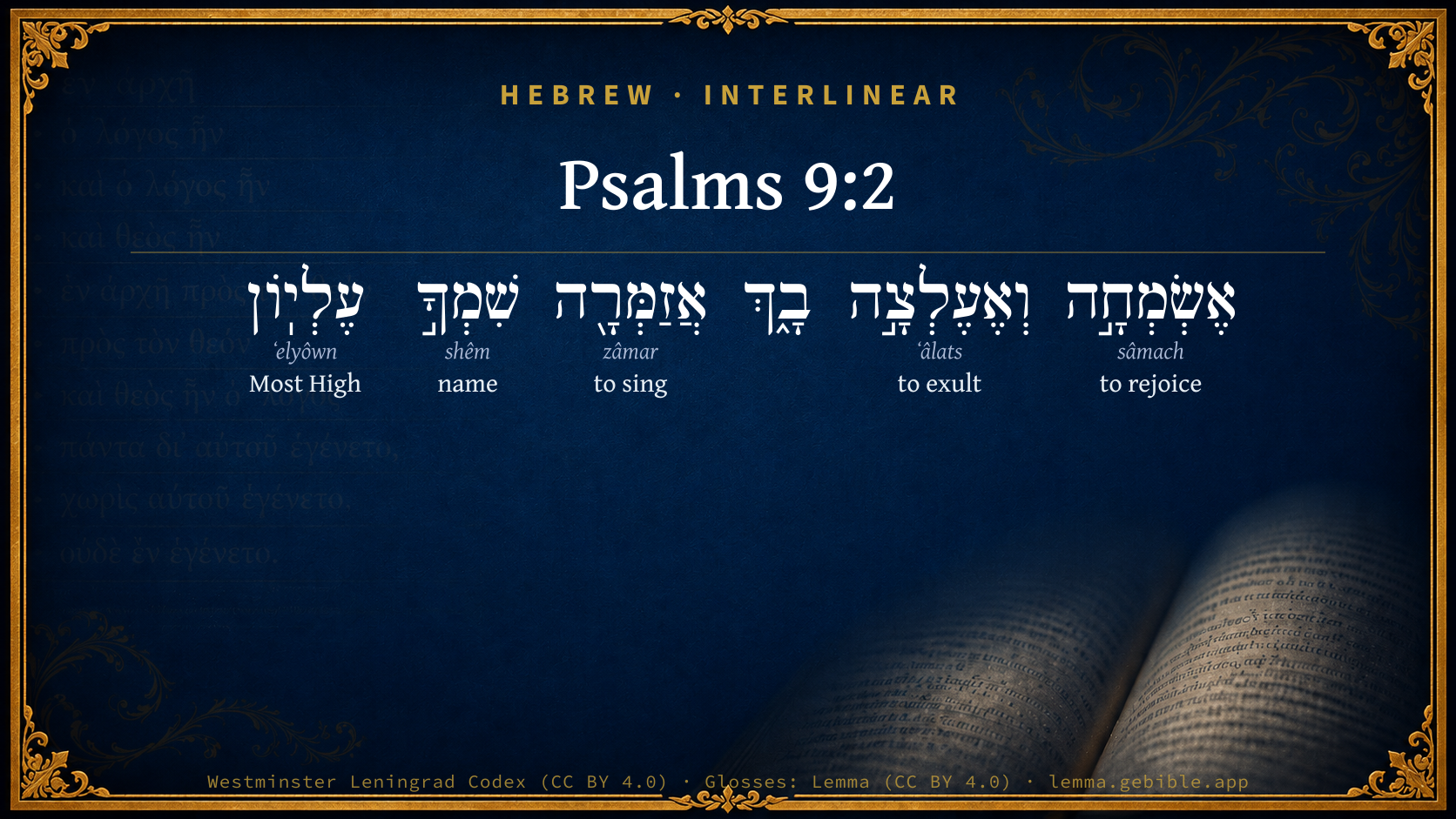
Psalms 9:2

Hebrew (Westminster Leningrad Codex) Psalms 9:2 appears in the Hebrew Old Testament. The text above is from the Westminster Leningrad Codex. Each word links to its Strong’s number, a concise gloss, and parsing drawn from the Open Scriptures Hebrew Bible morphology. Click any word for its full Brown-Driver-Briggs (BDB) entry.
Download image
Cite this verse

Psalms 9:2 (World English Bible). Public Domain. Lemma interlinear Bible study tool, https://lemma.gebible.app/v/psalms/9/2.

Show BibTeX & RIS
BibTeX
RIS
English Translation
I will be glad and rejoice in you. I will sing praise to your name, O Most High.
World English Bible · Public Domain
Download a study sheet

One document with this verse’s original text, its word-by-word gloss line, the meaning frame, cross-references with their text, attributed commentary, and full source and license credits — printable, and it pastes into notes with its structure intact.

This verse Autodidact and up

Study sheet (.html) Plain text (.txt)

A passage Seminary Student

Up to 50 verses in one chapter. A passage sheet keeps up to 6 commentary sources and 12 cross-references per verse, in the order this page ranks them, and says so on the sheet whenever that leaves anything out. Ask for a single verse and you get the Autodidact verse sheet above.

Everything on this page stays free to read, with no account — the sheet is a download of what is already on screen, not access to it.

Want to remove ads? Support Godless Engineer
Compare translations 3

The same verse in 3 English versions, stacked beneath the original-language interlinear above. Click any original word for its lexicon entry.

Each is an independent rendering of the whole verse — the interlinear is not word-aligned to these translations.

Highlighted words mark where these versions differ — a whole-verse word diff, not a word-by-word alignment.

  • World English Bible Public Domain
    I will be glad and rejoice in you. I will sing praise to your name, O Most High.
  • King James Version Public Domain
    I will be glad and rejoice in thee: I will sing praise to thy name, O thou most High.
  • unfoldingWord Literal Text CC BY-SA 4.0
    I will rejoice and exult in you, I will sing praise to your name, Most High!

unfoldingWord Literal Text — © unfoldingWord, licensed CC BY-SA 4.0. Word-aligned USFM3 via Door43 (git.door43.org/unfoldingWord/en_ult).

Versions to compare (up to 4)

3 of 4 selected

Show all 18 translations

Every available English version of this verse, each an independent rendering of the whole verse.

  • World English Bible Public Domain
    I will be glad and rejoice in you. I will sing praise to your name, O Most High.
  • Berean Standard Bible Public Domain
    I will be glad and rejoice in You; I will sing praise to Your name, O Most High.
  • Majority Standard Bible Public Domain
    I will be glad and rejoice in You; I will sing praise to Your name, O Most High.
  • King James Version Public Domain
    I will be glad and rejoice in thee: I will sing praise to thy name, O thou most High.
  • American Standard Version (1901) Public Domain
    I will be glad and exult in thee; I will sing praise to thy name, O thou Most High.
  • Revised Version (1885) Public Domain
    I will be glad and exult in thee: I will sing praise to thy name, O thou Most High.
  • Geneva Bible (1599) Public Domain
    I will bee glad, and reioyce in thee: I will sing praise to thy Name, O most High,
  • Douay-Rheims (1899) Public Domain
    I will give praise to thee, O Lord, with my whole heart: I will relate all thy wonders.
  • Young's Literal Translation Public Domain
    I rejoice and exult in Thee, I praise Thy Name, O Most High.
  • Literal Standard Version CC BY-SA 4.0
    I rejoice and exult in You, || I praise Your Name, O Most High.
  • Unlocked Literal Bible CC BY-SA 4.0
    I will be glad and rejoice in you; I will sing praise to your name, Most High!
  • unfoldingWord Literal Text CC BY-SA 4.0
    I will rejoice and exult in you, I will sing praise to your name, Most High!
  • Darby Bible Public Domain
    I will be glad and rejoice in thee; I will sing forth thy name, O Most High.
  • World Messianic Bible Public Domain
    I will be glad and rejoice in you. I will sing praise to your name, O Most High.
  • Webster's Bible Public Domain
    \\9:1\\To the chief Musician upon Muthlabben, A Psalm of David. I will praise thee, O LORD, with my whole heart; I will show forth all thy wonderful works.
  • Free Bible Version CC BY-SA 4.0
    I will be glad and celebrate in you; I will sing praises to your wonderful nature, Most High God.
  • Bible in Basic English Public Domain
    I will be glad and have delight in you: I will make a song of praise to your name, O Most High.
  • JPS Tanakh (1917) Public Domain
    (9-3) I will be glad and exult in Thee; I will sing praise to Thy name, O Most High:

Literal Standard Version (2020), Covenant Press — licensed CC BY-SA 4.0. Text via the HelloAO Bible API (eBible.org). Unlocked Literal Bible (unfoldingWord) — licensed CC BY-SA 4.0. Text via the HelloAO Bible API (eBible.org). unfoldingWord Literal Text — © unfoldingWord, licensed CC BY-SA 4.0. Word-aligned USFM3 via Door43 (git.door43.org/unfoldingWord/en_ult). Free Bible Version, Dr. Jonathan Gallagher — licensed CC BY-SA 4.0. Text via the HelloAO Bible API (eBible.org).

Word by word

More ways to search: Search by grammar → Find every occurrence → Compare this word →

Practice this passage: Drill this verse → Learn its vocabulary →

About this verse

These counts appear in no published source. They are computed here, from the morphology-tagged text and Lemma’s own curated glosses. What Lemma adds →

6
words
5
distinct lemmas
Wisdom
section

Notable vocabulary

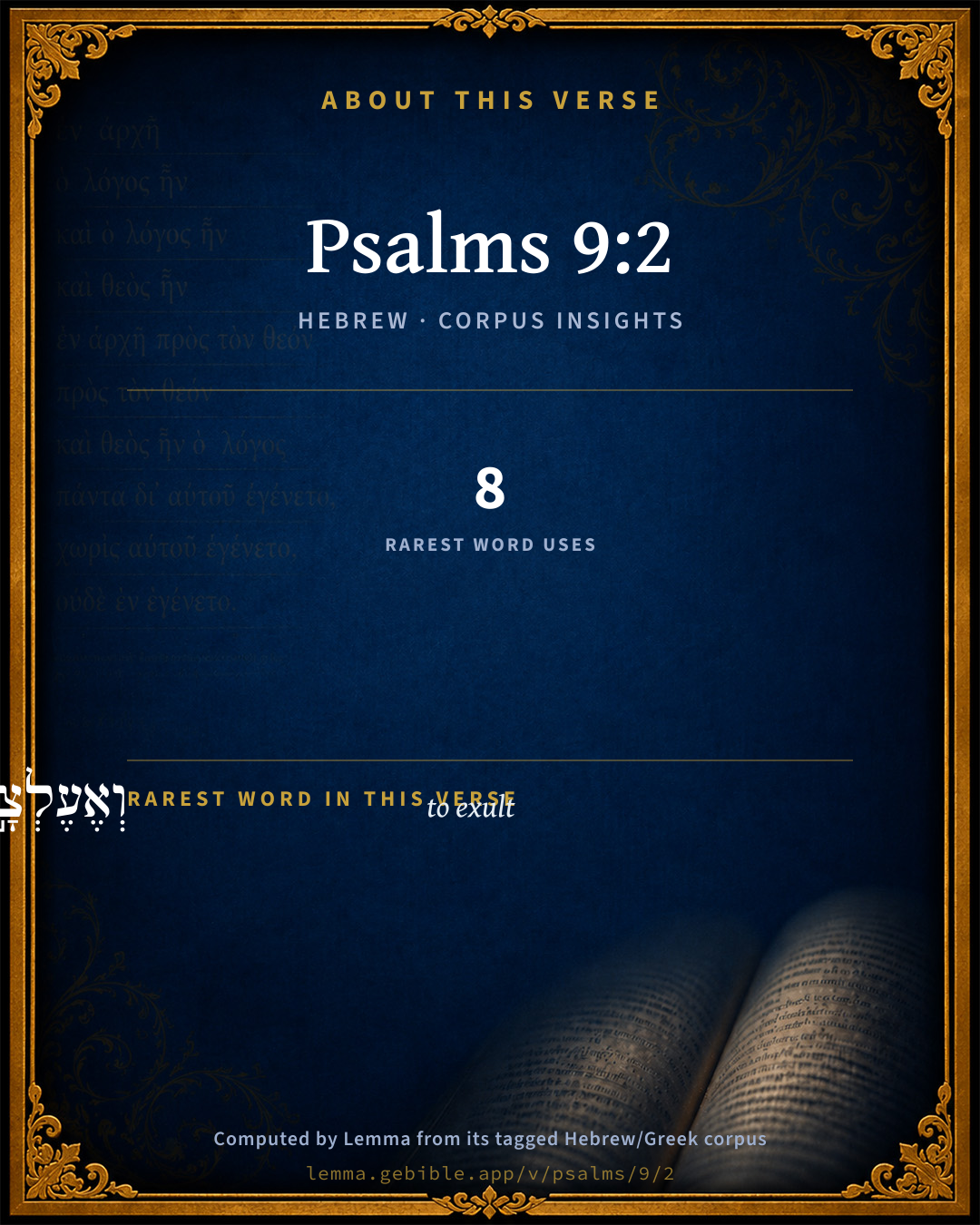
The rarest word here is וְאֶעֶלְצָ֣ה to exult H5970 — appearing just 8 times in the whole Hebrew Bible.

Shared distinctive vocabulary

וְאֶעֶלְצָ֣ה to exult H5970 occurs in 8 verses of the Hebrew Bible. Also found in:

Grammatical profile

  • 3 verbs
  • 1 noun
  • 1 adjective
  • 1 preposition

Verb forms

  • אֶשְׂמְחָ֣ה Qal · Cohortative
  • וְאֶעֶלְצָ֣ה Qal · Cohortative
  • אֲזַמְּרָ֖ה Piel · Cohortative

Hebrew & Septuagint length

In English translation the verse runs 18 words from the Hebrew and 18 from the Septuagint (LXX English) — the same length.

A rough comparison of the two English renderings, which tokenize alike — not a word-level alignment.

Word counts can differ between the Hebrew and the Greek without any difference in meaning — e.g. the Hebrew direct-object marker אֵת has no separate Greek word, and Greek often adds the article ὁ.

Cross-references

14

Topical passages linked to Psalms 9:2 in the Treasury of Scripture Knowledge — connected by theme and wording, ordered by reader-vote popularity; previews shown in the World English Bible.

  • Psalms 83:18 That they may know that you alone, whose name is Yahweh, Are the Most High over all the earth.
  • Psalms 5:11 But let all those who take refuge in you rejoice, Let them always shout for joy, because you defend them. Let them also who love your name be joyful in you.
  • Psalms 7:17 I will give thanks to Yahweh according to his righteousness, And will sing praise to the name of Yahweh Most High.
  • Psalms 28:7 Yahweh is my strength and my shield. My heart has trusted in him, and I am helped. Therefore my heart greatly rejoices. With my song I will thank him.
  • Psalms 97:9 For you, Yahweh, are most high above all the earth. You are exalted far above all gods.
  • Psalms 92:1 It is a good thing to give thanks to Yahweh, To sing praises to your name, Most High;
  • Philippians 4:4 Rejoice in the Lord always! Again I will say, Rejoice!
  • Psalms 97:12 Be glad in Yahweh, you righteous people! Give thanks to his holy Name.
  • Psalms 27:6 Now my head will be lifted up above my enemies around me. I will offer sacrifices of joy in his tent. I will sing, yes, I will sing praises to Yahweh.
  • Psalms 43:4 Then I will go to the altar of God, To God, my exceeding joy. I will praise you on the harp, God, my God.
  • Psalms 56:2–3 My enemies want to swallow me up all day long, For they are many who fight proudly against me.
  • Habakkuk 3:17–18 For though the fig tree doesn't flourish, Nor fruit be in the vines; The labor of the olive fails, The fields yield no food; The flocks are cut off from the fold, And there is no herd in the stalls:
  • Psalms 92:4 For you, Yahweh, have made me glad through your work. I will triumph in the works of your hands.
  • Daniel 5:18 You king, the Most High God gave Nebuchadnezzar your father the kingdom, and greatness, and glory, and majesty:

Cross-references courtesy of OpenBible.info (CC BY 4.0).

Hebrew and Greek witnesses Masoretic Hebrew ↔ Greek Septuagint

The same verse in the two great witnesses to the Old Testament, shown verse-for-verse.

You’re reading Greek Psalm 9 (Hebrew Psalm 9). The Septuagint counts the superscription, so verse numbers can differ from the Hebrew — chapter-level alignment, not verse-by-verse. Numbering follows Rahlfs.

These are two independent witnesses, not word-aligned to each other, and the Septuagint is shown in lemma (dictionary) form.

Hebrew Psalms 9:2 Masoretic · Westminster Leningrad Codex

אֶשְׂמְחָ֣ה וְאֶעֶלְצָ֣ה בָ֑ךְ אֲזַמְּרָ֖ה שִׁמְךָ֣ עֶלְיֽוֹן

I will be glad and rejoice in you. I will sing praise to your name, O Most High.

World English Bible · Public Domain

Greek LXX Greek Psalm 9:2 Septuagint · lemma form

ἐκὁμολογέω σύ κύριος ἐν ὅλος καρδία ἐγώ διαἡγέομαι πᾶς ὁ θαυμάσιος σύ

I will be glad and exult in you: I will sing to your name, O you Most High.

LXX2012 (modern English Septuagint) · Public Domain

Hebrew: Westminster Leningrad Codex (CC BY 4.0). Greek: Septuagint (public domain); English from LXX2012 (modern English Septuagint) (Public Domain). How the Septuagint differs from the Hebrew →

Commentary

Notes on Psalms 9:2 from classic Christian and Jewish commentators (each source and its license shown beneath its notes). The classic Christian expositions comment on the surrounding passage and are grouped to its opening verse, so a note may address several verses; the Jewish commentaries on the Tanakh (Rashi and others) are per-verse, so they appear only where the commentator wrote on this verse.

Lemma curates 59 commentaries, every one of them public domain or Creative Commons licensed, each selected and text-cleaned for this edition rather than reprinted as found. About our sources →

Trapp's Complete Commentary

John Trapp

Psa 9:2 I will be glad and rejoice in thee: I will sing praise to thy name, O thou most High.

Ver. 2. I will be glad and rejoice in thee] Spiritual cheerfulness is the mother of thankfulness, Jas 5:13. Birds, when got in the air, or on the top of trees, and have taken up a stand to their mind, sing most sweetly.

O thou most High] God was so first called by Melchizedek, upon a like occasion as here by David, Gen 14:19-20. The Greeks might have their ηλιος, for the sun, which they worshipped, from this Hebrew Helion, most High.

John Trapp, A Commentary or Exposition upon All the Books of the Old and New Testament (1647–1656) — public domain. Text from a community e-Sword module.

J. A. Alexander on Psalms

Joseph Addison Alexander

3. (Psa 9:2). I will joy and triumph in thee, not merely in thy presence, or because of thee, i. e. because of what thou hast done, but in communion with thee, and because of my personal interest in thee. The form of the verbs, both here and in the last clause of the preceding verse, expresses strong desire and fixed determination; see above, on Psa 2:3. I will praise, or celebrate in song; see above, on Ps. 7:18 (17). Thy name, thy manifested excellence; see above, on Psa 5:12 (11). (Thou) Highest, or Most High! --see above, on Ps. 7:18 (17). Here again there is special reference to the proofs of God's supremacy afforded by his recent dealings with the Psalmist and his enemies.

Joseph Addison Alexander, The Psalms Translated and Explained (1850) — public domain. Text from a community e-Sword module.

Tyndale Open Study Notes

Tyndale Open Resources

9:2 filled with joy . . . sing praises: The psalmist often connects joy with praises, as one leads to the other (5:11-12; 32:11; 67:4; 90:14; 92:4).

Tyndale Open Study Notes — © Tyndale Open Resources, licensed CC BY-SA 4.0. Text via the HelloAO Bible API.

Adam Clarke's Commentary

Verse 2. I will be glad and rejoice in thee] I am glad that thou hast heard my prayer, and showed me mercy; and I will rejoice in thee, in having thee as my portion, dwelling and working in my heart.

Adam Clarke's Commentary on the Bible (1810–1826) — public domain. Text from a community e-Sword/MySword module.

John Calvin's Commentaries

2. I will rejoice and exult in thee. Observe how the faithful praise God sincerely and without hypocrisy, when they do not rest on themselves for happiness, and are not intoxicated with foolish and carnal presumption, but rejoice in God alone; which is nothing else than to seek the matter of their joy from the favor of God, and from no other source, since in it perfect happiness consists. I will rejoice in thee We ought to consider how great is the difference and opposition between the character of the joy which men endeavor to find in themselves, and the character of the joy which they seek in God. David, the more forcibly to express how he renounces every thing which may keep hold of or occupy him with vain delight, adds the word exult, by which he means that he finds in God a full and an overflowing abundance of joy, so that he is not under the necessity of seeking even the smallest drop in any other quarter. Moreover, it is of importance to remember what I have previously observed, that David sets before himself the testimonies of the divine goodness which he had formerly experienced, in order to encourage himself with the more alacrity to lay open his heart “Afin de deseouvrir son coeur a Dieu plus alaigrement.” — Fr.

John Calvin's Commentaries (1540-1563) — public domain. Text from the Calvin Translation Society English edition (1840s-50s) via the Christian Classics Ethereal Library (ccel.org). Calvin's coverage is partial (roughly two-thirds of the Bible); uncommented books and verses are honest gaps, never fabricated. The 19th-century editor's footnotes and remarks are omitted so the notes are faithfully Calvin's own voice.

The Cambridge Bible for Schools and Colleges

gen. ed. J. J. S. Perowne

2. rejoice] R.V., exult; the same word as in Psa_5:11 c. The closing words of Psalms 7 are taken up and expanded in these two verses.

The Cambridge Bible for Schools and Colleges (gen. ed. J. J. S. Perowne; Cambridge University Press, 1878–1918) — public domain. Text from a community e-Sword module.

John Gill's Exposition

I will be glad and rejoice in thee,.... Not in himself, in any attainments or works of his; not in his wisdom, riches, and strength, nor in his warlike exploits, but in the Lord; not in second causes, in horses and chariots, in armies, and in the courage and valour of men, but in God, as the author of deliverance, victory, and salvation; not in God only as the God of nature and providence, but as the God of all grace, and as his covenant God and Father; and because of the blessings of this covenant, as forgiveness of sin, a justifying righteousness, &c. for he rejoiced not in his own righteousness, but in the righteousness of Christ, as well as in his person, grace, and sacrifice; so the Chaldee paraphrase renders it, "I will be glad and rejoice", "in thy Word", the Logos, the essential Word of God, of whom there were many types, promises, and prophecies in the former dispensation; two words being here used express the greatness of this joy, and especially the latter word denotes a very vehement joy, a joy unspeakable and full of glory; such as arises from a sight of Christ the object, and which the psalmist had now in view; and this was not a carnal and worldly joy, but joy in the Holy Ghost;

I will sing praise to thy name, O thou most High; that is, to the glory of his name, his being, and perfections, as displayed in his marvellous works, and in the revelation of his word, and especially in his son; and under the character of the "most high" God, the supreme Being over all creatures, angels and men; see Psa 7:17.

John Gill's Exposition of the Whole Bible (1746–1763) — public domain (CC PDM 1.0). Text via the HelloAO Bible API.

Albert Barnes' Notes on the Bible

I will be glad - I will rejoice, and will express my joy.

And rejoice in thee - I will exult; I will triumph. That is, he would express his joy in God - in knowing that there was such a Being; in all that he had done for him; in all the evidences of his favor and friendship.

Will sing praise to thy name - To thee; the name often being put for the person.

O thou Most High - Thou who art supreme - the God over all. See the notes at Psa 7:17.

Albert Barnes' Notes on the Bible (1834–1885) — public domain. Text from a community e-Sword/MySword module.

Matthew Poole's English Annotations

In thee, i.e. in thy favour and help vouschafed to me.

Matthew Poole's English Annotations on the Holy Bible (1683–1685) — public domain. Text from a community e-Sword/MySword module.

The Treasury of David

Charles H. Spurgeon

Ver. 2. Gladness and joy are the appropriate spirit in which to praise the goodness of the Lord. Birds extol the Creator in notes of overflowing joy, the cattle low forth his praise with tumult of happiness, and the fish leap up in his worship with excess of delight. Moloch may be worshipped with shrieks of pain, and Juggernaut may be honoured by dying groans and inhuman yells, but he whose name is Love is best pleased with the holy mirth, and sanctified gladness of his people. Daily rejoicing is an ornament to the Christian character, and a suitable robe for God's choristers to wear. God loveth a cheerful giver, whether it be the gold of his purse or the gold of his mouth which he presents upon his altar.

I will sing praise to thy name, O thou most High. Songs are the fitting expression of inward thankfulness, and it were well if we indulge ourselves and honoured our Lord with more of them. Mr. B. P. Power has well said, "The sailors give a cheery cry as they weigh anchor, the ploughman whistles in the morning as he drives his team; the milkmaid sings her rustic song as she sets about her early task; when soldiers are leaving friends behind them, they do not march out to the tune of the `Dead March in Saul, 'but to the quick notes of some lively air. A praising spirit would do for us all that their songs and music do for them; and if only we could determine to praise the Lord, we should surmount many a difficulty which our low spirits never would have been equal to, and we should do double the work which can be done if the heart be languid in its beating, if we be crushed and trodden down in soul. As the evil spirit in Saul yielded in olden time to the influence of the harp of the son of Jesse, so would the spirit of melancholy often take flight from us, if only we would take up the song of praise."

Ver. 2. Sacred song: its connection with holy gladness.

Charles H. Spurgeon's The Treasury of David (1869–1885) — public domain. Psalms only. Text from a community e-Sword/MySword module.

The Pulpit Commentary

I will be glad and rejoice in thee: I will sing praise to thy Name. (see the comment on Psa_8:9) O thou most High. (comp. Psa_7:17; and see also Gen_14:18, Gen_14:19, Gen_14:22) Ellen (wOyl) was a recognized name of God among the Phoenicians ("Religions of the Ancient World," p. 133).

The Pulpit Commentary (1880–1919), ed. H.D.M. Spence-Jones & Joseph S. Exell — public domain. Text from a community e-Sword module.

Rashi

Rabbi Shlomo Yitzchaki (Rashi)

all your wonders the final redemption, which is equal to all the miracles, as is stated (in Jer. 23: 7): “when they shall no longer say, As the Lord lives, Who brought up, etc.”

Rashi on the Tanakh — English translations: “The Judaica Press complete Tanach with Rashi, translated by A. J. Rosenberg” (CC BY 4.0); “Pentateuch with Rashi's commentary by M. Rosenbaum and A.M. Silbermann, 1929-1934” (public domain); “The Metsudah Tanach series, Lakewood, N.J” (CC BY 4.0); and “The Book of Joshua, Metsudah Publications, 1997” (CC BY 4.0). Text via Sefaria.

Radak

Rabbi David Kimhi (Radak)

I will give thanks unto the Lord with my whole heart: – for the death of Goliath the Philistine was a great deliverance to David and to Israel; and for this (reason) he says with my whole heart.

I will recount all Thy marvellous works: – for, in addition to every individual wonder, a man recounts other wonders which are past; as it says, “He hath made His wonderful works to be remembered” (Ps. 111:4).

Radak on the Tanakh — English translations: “Sefaria Community Translation” (CC0 1.0 (public-domain dedication)); “Eliyahu Munk, HaChut Hameshulash” (CC BY 4.0); “Rabbi Mike Feuer, Jerusalem Anthology” (CC BY 4.0); and “R. David Kimhi on the first book of Psalms, Translated by R.G. Finch, London, 1919” (public domain). Text via Sefaria.

Lesson kit

Teaching starters — assembled from the data on this page, not authored interpretation. Every prompt links to the verse data it draws on. Edit before teaching.

Psalms, in the Wisdom, opens this verse with 6 words (5 distinct Hebrew lemmas). Its most distinctive word is ʻâlats (“to exult”). A historical commentator’s framing appears above. Read the whole chapter for the surrounding context.

Discussion questions

  1. The word ʻâlats carries the sense “to exult.” How does it shape the verse?
  2. How does 1 Samuel 2:1, which shares the word «to exult», read alongside this verse?
  3. These translations render this verse differently. What is at stake in choosing one wording over another?
  4. «אֶשְׂמְחָ֣ה» is a Qal Cohortative verb. How does that grammatical form shape the action described?
  5. Compare how Trapp's Complete Commentary and J. A. Alexander on Psalms read this verse. Where do they agree or differ?

Things to notice

Reading settings

Reading text

Shown beneath each verse's original-language words.

Old Testament
Old Testament edition

Read the OT as the Masoretic Hebrew (MT) or the Greek Septuagint (LXX).

English shown for the Greek Septuagint (in the Hebrew ↔ Greek comparison).

Comparing translations? Open the Compare panel on any verse page to stack up to four side by side.