
Jeremiah 50:11

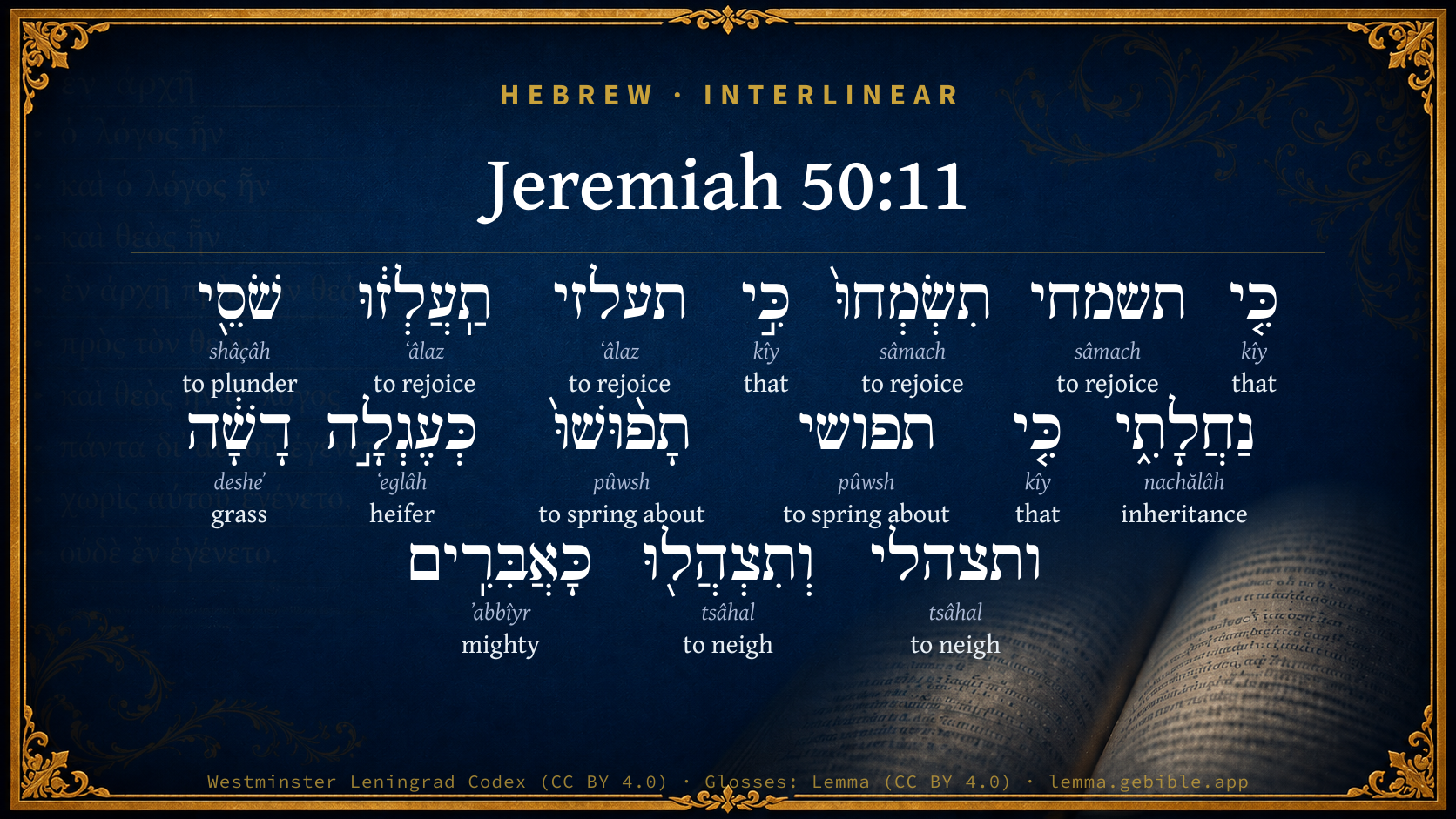
Hebrew (Westminster Leningrad Codex) Jeremiah 50:11 appears in the Hebrew Old Testament. The text above is from the Westminster Leningrad Codex. Each word links to its Strong’s number, a concise gloss, and parsing drawn from the Open Scriptures Hebrew Bible morphology. Click any word for its full Brown-Driver-Briggs (BDB) entry.
Download image
Cite this verse

Jeremiah 50:11 (World English Bible). Public Domain. Lemma interlinear Bible study tool, https://lemma.gebible.app/v/jeremiah/50/11.

Show BibTeX & RIS
BibTeX
RIS
English Translation
Because you are glad, because you rejoice, O you who plunder my heritage, because you are wanton as a heifer that treads out [the grain], and neigh as strong horses;
World English Bible · Public Domain
Highlights
  • 1 first appearance in the Hebrew Bible
Full analysis ↓
Download a study sheet

One document with this verse’s original text, its word-by-word gloss line, the meaning frame, cross-references with their text, attributed commentary, and full source and license credits — printable, and it pastes into notes with its structure intact.

This verse Autodidact and up

Study sheet (.html) Plain text (.txt)

A passage Seminary Student

Up to 50 verses in one chapter. A passage sheet keeps up to 6 commentary sources and 12 cross-references per verse, in the order this page ranks them, and says so on the sheet whenever that leaves anything out. Ask for a single verse and you get the Autodidact verse sheet above.

Everything on this page stays free to read, with no account — the sheet is a download of what is already on screen, not access to it.

Want to remove ads? Support Godless Engineer
Compare translations 3

The same verse in 3 English versions, stacked beneath the original-language interlinear above. Click any original word for its lexicon entry.

Each is an independent rendering of the whole verse — the interlinear is not word-aligned to these translations.

Highlighted words mark where these versions differ — a whole-verse word diff, not a word-by-word alignment.

  • World English Bible Public Domain
    Because you are glad, because you rejoice, O you who plunder my heritage, because you are wanton as a heifer that treads out [the grain], and neigh as strong horses;
  • King James Version Public Domain
    Because ye were glad, because ye rejoiced, O ye destroyers of mine heritage, because ye are grown fat as the heifer at grass, and bellow as bulls;
  • unfoldingWord Literal Text CC BY-SA 4.0
    You rejoice, you celebrate the plundering of my inheritance; you jump around like a calf stamping in its pasture; you neigh like a powerful horse.

unfoldingWord Literal Text — © unfoldingWord, licensed CC BY-SA 4.0. Word-aligned USFM3 via Door43 (git.door43.org/unfoldingWord/en_ult).

Versions to compare (up to 4)

3 of 4 selected

Show all 18 translations

Every available English version of this verse, each an independent rendering of the whole verse.

  • World English Bible Public Domain
    Because you are glad, because you rejoice, O you who plunder my heritage, because you are wanton as a heifer that treads out [the grain], and neigh as strong horses;
  • Berean Standard Bible Public Domain
    “Because you rejoice, because you sing in triumph—you who plunder My inheritance—because you frolic like a heifer treading grain and neigh like stallions,
  • Majority Standard Bible Public Domain
    “Because you rejoice, because you sing in triumph—you who plunder My inheritance—because you frolic like a heifer treading grain and neigh like stallions,
  • King James Version Public Domain
    Because ye were glad, because ye rejoiced, O ye destroyers of mine heritage, because ye are grown fat as the heifer at grass, and bellow as bulls;
  • American Standard Version (1901) Public Domain
    Because ye are glad, because ye rejoice, O ye that plunder my heritage, because ye are wanton as a heifer that treadeth out `the grain', and neigh as strong horses;
  • Revised Version (1885) Public Domain
    Because ye are glad, because ye rejoice, O ye that plunder mine heritage, because ye are wanton as an heifer that treadeth out the corn, and neigh as strong horses;
  • Geneva Bible (1599) Public Domain
    Because yee were glad and reioyced in destroying mine heritage, and because ye are growen fatte, as the calues in the grasse, and neied like strong horses,
  • Douay-Rheims (1899) Public Domain
    Because you rejoice, and speak great things, pillaging my inheritance: because you are spread abroad as calves upon the grass, and have bellowed as bulls.
  • Young's Literal Translation Public Domain
    Because thou rejoicest, because thou exultest, O spoilers of Mine inheritance, Because thou increasest as a heifer `at' the tender grass, And dost cry aloud as bulls,
  • Literal Standard Version CC BY-SA 4.0
    “Because you rejoice, because you exult, || O spoilers of My inheritance, || Because you increase as a heifer [at] the tender grass, || And cry aloud as bulls,
  • Unlocked Literal Bible CC BY-SA 4.0
    You rejoice, you celebrate the plundering of my inheritance; you jump around like a calf stamping in its pasture; you neigh like a powerful horse.
  • unfoldingWord Literal Text CC BY-SA 4.0
    You rejoice, you celebrate the plundering of my inheritance; you jump around like a calf stamping in its pasture; you neigh like a powerful horse.
  • Darby Bible Public Domain
    For ye rejoiced, for ye triumphed, ye plunderers of my heritage; for ye have been wanton as the heifer at grass, and neighed as steeds.
  • World Messianic Bible Public Domain
    “Because you are glad, because you rejoice, O you who plunder my heritage, because you are wanton as a heifer that treads out the grain, and neigh as strong horses,
  • Webster's Bible Public Domain
    Because ye were glad, because ye rejoiced, O ye destroyers of my heritage, because ye are grown fat as the heifer at grass, and bellow as bulls;
  • Free Bible Version CC BY-SA 4.0
    Though for now you Babylonians celebrate and sing triumphantly as you plunder my special people, though for now you jump around like a frisky young cow treading out the grain, and neigh like stallions,
  • Bible in Basic English Public Domain
    Because you are glad, because you are lifted up with pride, you wasters of my heritage, because you are playing like a young cow put out to grass, and you make a noise like strong horses;
  • JPS Tanakh (1917) Public Domain
    Because ye are glad, because ye rejoice, O ye that plunder My heritage, because ye gambol as a heifer at grass, and neigh as strong horses;

Literal Standard Version (2020), Covenant Press — licensed CC BY-SA 4.0. Text via the HelloAO Bible API (eBible.org). Unlocked Literal Bible (unfoldingWord) — licensed CC BY-SA 4.0. Text via the HelloAO Bible API (eBible.org). unfoldingWord Literal Text — © unfoldingWord, licensed CC BY-SA 4.0. Word-aligned USFM3 via Door43 (git.door43.org/unfoldingWord/en_ult). Free Bible Version, Dr. Jonathan Gallagher — licensed CC BY-SA 4.0. Text via the HelloAO Bible API (eBible.org).

Word by word

More ways to search: Search by grammar → Find every occurrence → Compare this word →

Practice this passage: Drill this verse → Learn its vocabulary →

תפושי
pûwsh
H6335
“to spring about”
Verb, Qal, Imperfect, 2nd Person, Feminine, Singular
Part of Speech
Verb
Stem
Qal
Form
Imperfect
Person
2nd Person
Gender
Feminine
Number
Singular
Full BDB Definition

Origin: a primitive root

TWOT: 1751 , 1752

to spring about - (Qal) to frisk, act proudly (figuratively) - (Niphal) to be scattered, be spread
  1. כִּ֤י kîy H3588 “that” Conjunction
  2. תשמחי sâmach H8055 “to rejoice” Verb, Qal, Imperfect, 2nd Person, Feminine, Singular
  3. תִשְׂמְחוּ֙ sâmach H8055 “to rejoice” Verb, Qal, Imperfect, 2nd Person, Masculine, Plural
  4. כִּ֣י kîy H3588 “that” Conjunction
  5. תעלזי ʻâlaz H5937 “to rejoice” Verb, Qal, Imperfect, 2nd Person, Feminine, Singular
  6. תַֽעֲלְז֔וּ ʻâlaz H5937 “to rejoice” Verb, Qal, Imperfect, 2nd Person, Masculine, Plural
  7. שֹׁסֵ֖י shâçâh H8154 “plundering” Verb, Qal, Participle Active, Masculine, Plural, Construct
  8. נַחֲלָתִ֑י nachălâh H5159 “inheritance · my” Noun, Common, Feminine, Singular, Construct + Suffix, Personal, 1st Person, Common, Singular
  9. כִּ֤י kîy H3588 “that” Conjunction
  10. תָפ֨וּשׁוּ֙ pûwsh H6335 “to spring about” Verb, Qal, Imperfect, 2nd Person, Masculine, Plural
  11. כְּעֶגְלָ֣ה ʻeglâh H5697 “like/as · heifer” Preposition + Noun, Common, Feminine, Singular, Absolute
  12. דָשָׁ֔ה desheʼ H1877 “grass” Verb, Qal, Participle Active, Feminine, Singular, Absolute
  13. ותצהלי tsâhal H6670 “and · to neigh” Conjunction + Verb, Qal, Imperfect, 2nd Person, Feminine, Singular
  14. וְתִצְהֲל֖וּ tsâhal H6670 “and · to neigh” Conjunction + Verb, Qal, Imperfect, 2nd Person, Masculine, Plural
  15. כָּאֲבִּרִֽים ʼabbîyr H47 “like/as the · mighty” Preposition, Determined + Adjective, Adjective, Masculine, Plural, Absolute

About this verse

These counts appear in no published source. They are computed here, from the morphology-tagged text and Lemma’s own curated glosses. What Lemma adds →

16
words
10
distinct lemmas
Prophets
section

Notable vocabulary

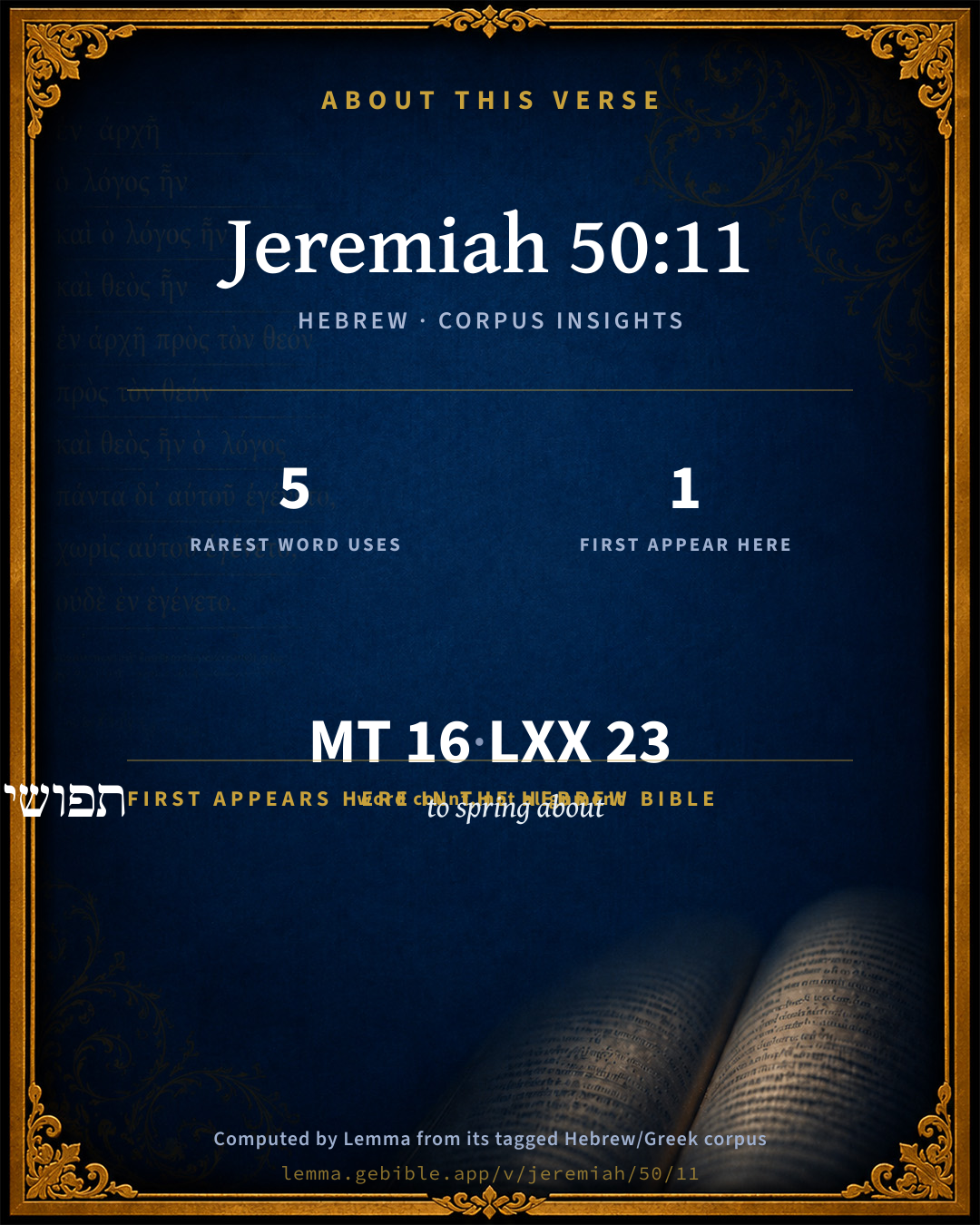
The rarest word here is תפושי to spring about H6335 — appearing just 5 times in the whole Hebrew Bible.

First appearance in Scripture

This word makes its first canonical appearance in the Hebrew Bible here:

  • תפושי to spring about H6335

Shared distinctive vocabulary

תפושי to spring about H6335 occurs in 4 verses of the Hebrew Bible. Also found in:

Grammatical profile

  • 10 verbs
  • 2 nouns
  • 1 adjective
  • 3 conjunctions

Verb forms

  • תשמחי Qal · Imperfect
  • תִשְׂמְחוּ֙ Qal · Imperfect
  • תעלזי Qal · Imperfect
  • תַֽעֲלְז֔וּ Qal · Imperfect
  • שֹׁסֵ֖י Qal · Participle Active
  • תפושי Qal · Imperfect
  • תָפ֨וּשׁוּ֙ Qal · Imperfect
  • דָשָׁ֔ה Qal · Participle Active
  • ותצהלי Qal · Imperfect
  • וְתִצְהֲל֖וּ Qal · Imperfect

Repetition

Words recur within this verse — often emphatic in Hebrew:

  • תשמחי to rejoice H8055 ×2
  • תעלזי to rejoice H5937 ×2
  • תפושי to spring about H6335 ×2
  • ותצהלי to neigh H6670 ×2
  • כִּ֤י that H3588 ×3

Hebrew & Septuagint length

In the original languages it is 16 Hebrew tokens and 23 Greek tokens — but the two are counted differently (Hebrew bundles its prefixes and suffixes into one token; the Greek is in lemma form), so that isn’t a like-for-like length.

Cross-references

26

Topical passages linked to Jeremiah 50:11 in the Treasury of Scripture Knowledge — connected by theme and wording, ordered by reader-vote popularity; previews shown in the World English Bible.

  • Isaiah 47:6 I was angry with my people, I profaned my inheritance, and gave them into your hand: you did show them no mercy; on the aged have you very heavily laid your yoke.
  • Deuteronomy 32:15 But Jeshurun grew fat, and kicked: You have grown fat, you are grown thick, you are become sleek; Then he forsook God who made him, Lightly esteemed the Rock of his salvation.
  • Psalms 22:12 Many bulls have surrounded me. Strong bulls of Bashan have encircled me.
  • Psalms 74:2–8 Remember your congregation, which you purchased of old, Which you have redeemed to be the tribe of your inheritance; Mount Zion, in which you have lived.
  • Psalms 79:1–4 God, the nations have come into your inheritance. They have defiled your holy temple. They have laid Jerusalem in heaps.
  • Psalms 83:1–5 God, don't keep silent. Don't keep silent, And don't be still, God.
  • Proverbs 17:5 Whoever mocks the poor reproaches his Maker. He who is glad at calamity shall not be unpunished.
  • Isaiah 10:6–7 I will send him against a profane nation, and against the people of my wrath will I give him a charge, to take the spoil, and to take the prey, and to tread them down like the mire of the streets.
  • Jeremiah 5:8 They were as fed horses roaming at large; everyone neighed after his neighbor's wife.
  • Jeremiah 5:28 They are grew fat, they shine: yes, they overpass in deeds of wickedness; they don't plead the cause, the cause of the fatherless, that they may prosper; and the right of the needy they don't judge.
  • Jeremiah 46:21 Also her hired men in the midst of her are like calves of the stall; for they also are turned back, they are fled away together, they didn't stand: for the day of their calamity is come on them, the time of their visitation.
  • Jeremiah 50:17 Israel is a hunted sheep; the lions have driven him away: first, the king of Assyria devoured him; and now at last Nebuchadrezzar king of Babylon has broken his bones.
  • Jeremiah 50:27 Kill all her bulls; let them go down to the slaughter: woe to them! for their day is come, the time of their visitation.
  • Jeremiah 51:34–35 Nebuchadrezzar the king of Babylon has devoured me, he has crushed me, he has made me an empty vessel, he has, like a monster, swallowed me up, he has filled his maw with my delicacies; he has cast me out.
  • Lamentations 1:21 They have heard that I sigh; there is none to comfort me; All my enemies have heard of my trouble; they are glad that you have done it: You will bring the day that you have proclaimed, and they shall be like me.
  • Lamentations 2:15–16 All that pass by clap their hands at you; They hiss and wag their head at the daughter of Jerusalem, [saying], Is this the city that men called The perfection of beauty, The joy of the whole earth?
  • Lamentations 4:21–22 Rejoice and be glad, daughter of Edom, that dwell in the land of Uz: The cup shall pass through to you also; you shall be drunken, and shall make yourself naked.
  • Ezekiel 25:3–8 and tell the children of Ammon, Hear the word of the Lord Yahweh: Thus says the Lord Yahweh, Because you said, Aha, against my sanctuary, when it was profaned; and against the land of Israel, when it was made desolate; and against the house of Judah, when they went into captivity:
  • Ezekiel 25:15–17 Thus says the Lord Yahweh: Because the Philistines have dealt by revenge, and have taken vengeance with despite of soul to destroy with perpetual enmity;
  • Ezekiel 26:2–3 Son of man, because Tyre has said against Jerusalem, Aha, she is broken: the gate of the peoples; she is turned to me; I shall be replenished, now that she is laid waste:
  • Hosea 10:11 Ephraim is a trained heifer that loves to thresh; So I will put a yoke on her beautiful neck. I will set a rider on Ephraim. Judah will plow. Jacob will break his clods.
  • Amos 4:1 Listen to this word, you cows of Bashan, who are on the mountain of Samaria, who oppress the poor, who crush the needy, who tell their lords, "Bring, and let us drink."
  • Obadiah 1:12 But don't look down on your brother in the day of his disaster, and don't rejoice over the children of Judah in the day of their destruction. Don't speak proudly in the day of distress.
  • Zechariah 2:8–9 For thus says Yahweh of hosts: 'For honor he has sent me to the nations which plundered you; for he who touches you touches the apple of his eye.
  • Zechariah 14:1–3 Behold, a day of Yahweh comes, when your spoil will be divided in your midst.
  • Zechariah 14:12 This will be the plague with which Yahweh will strike all the peoples who have warred against Jerusalem: their flesh will consume away while they stand on their feet, and their eyes will consume away in their sockets, and their tongue will consume away in their mouth.

Cross-references courtesy of OpenBible.info (CC BY 4.0).

Hebrew and Greek witnesses Masoretic Hebrew ↔ Greek Septuagint

The same verse in the two great witnesses to the Old Testament, shown verse-for-verse.

These are two independent witnesses, not word-aligned to each other, and the Septuagint is shown in lemma (dictionary) form.

Hebrew Jeremiah 50:11 Masoretic · Westminster Leningrad Codex

כִּ֤י תשמחי תִשְׂמְחוּ֙ כִּ֣י תעלזי תַֽעֲלְז֔וּ שֹׁסֵ֖י נַחֲלָתִ֑י כִּ֤י תפושי תָפ֨וּשׁוּ֙ כְּעֶגְלָ֣ה דָשָׁ֔ה ותצהלי וְתִצְהֲל֖וּ כָּאֲבִּרִֽים

Because you are glad, because you rejoice, O you who plunder my heritage, because you are wanton as a heifer that treads out [the grain], and neigh as strong horses;

World English Bible · Public Domain

Greek LXX Structure differs

In the Septuagint, Jeremiah is about an eighth shorter than the Hebrew and arranges its material differently — the Oracles Against the Nations (Hebrew chapters 46–51) appear in the middle of the Greek book, after 25:13. Because the chapter and verse boundaries do not line up, a verse-for-verse comparison with the Hebrew is not shown.

A verse-for-verse comparison isn’t shown here because the chapters and verses don’t line up. Switch to the LXX edition with the MT / LXX toggle above to read the Greek directly.

On this verse, Keil & Delitzsch discusses the Septuagint’s reading. Read the note in Commentary ↓

Hebrew: Westminster Leningrad Codex (CC BY 4.0). Greek: Septuagint (public domain); English from a public-domain English Septuagint. How the Septuagint differs from the Hebrew →

Targum (Aramaic paraphrase)

1

The Targum is the ancient Jewish Aramaic paraphrase of the Hebrew Scriptures — an interpretive translation, not the Hebrew text itself. Onkelos (literal) and Pseudo-Jonathan (expansive) render the Torah, and Jonathan the Prophets. Coverage is partial: where no permissively-licensed English translation exists for a verse, only the Aramaic is shown. This is verse-level text, not a word-by-word alignment to the Hebrew.

  1. Targum Jonathan Prophets (Joshua–Malachi)
    אֲרֵי תֶחְדוּן וַאֲרֵי תְבוּעוּן בָּזְזֵי אַחְסַנְתִּי אֲרֵי תְרוּצוּן כְּעֶגְלֵי רִבְקָא וּתְטוּלוּן כְּגִבָּרַיָא:

    (no public-domain English translation for this verse)

    Targum Jonathan — Aramaic: “Mikraot Gedolot” (public domain). English: “Sefaria Community Translation” (CC0 1.0 (public-domain dedication)); “London "Chaldee Paraphrase," 1871” (public domain). Text via Sefaria.

Commentary

Notes on Jeremiah 50:11 from classic Christian and Jewish commentators (each source and its license shown beneath its notes). The classic Christian expositions comment on the surrounding passage and are grouped to its opening verse, so a note may address several verses; the Jewish commentaries on the Tanakh (Rashi and others) are per-verse, so they appear only where the commentator wrote on this verse.

Lemma curates 59 commentaries, every one of them public domain or Creative Commons licensed, each selected and text-cleaned for this edition rather than reprinted as found. About our sources →

Trapp's Complete Commentary

John Trapp

Jer 50:11 Because ye were glad, because ye rejoiced, O ye destroyers of mine heritage, because ye are grown fat as the heifer at grass, and bellow as bulls;

Ver. 11. Because ye were glad, because ye rejoiced,] {a} scil., In a thing of naught, {as Amo 6:13} and in the miseries of my people ye were madly merry; therefore shall ye be let bleed in the vena cava, hollow vein.

Because ye are grown fat.] Ye have laughed yourselves fat, you have fatted yourselves as in a day of slaughter or of good cheer. It was at a feast that Babylon was taken.

And bellow as bulls.] Or, Neigh as steeds, lusty steeds.

{a} Causam ponit petulantiam et dicacitatem. - Oecol.

John Trapp, A Commentary or Exposition upon All the Books of the Old and New Testament (1647–1656) — public domain. Text from a community e-Sword module.

Whedon's Commentary on the Bible

Daniel D. Whedon

BABYLON’S HUMILIATION AND ISRAEL’S GLORY, Jer_50:11-20.

11. Ye were glad… ye destroyers of mine heritage — They not only executed God’s will of just judgment, but their own will of selfish ambition and bitter hate. This verse assigns the reason why Chaldea is given over to destruction.

Because ye are grown fat… bellow — Better, Though thou leapedst proudly like a heifer threshing, and neigh like strong horses.

Daniel D. Whedon (gen. ed.), Commentary on the Old and New Testaments (1874–1909) — public domain. Text from a community e-Sword module.

Keil & Delitzsch

C. F. Keil & F. Delitzsch

The devastation of Babylon and glory of Israel. - Jer 50:11. "Thou ye rejoice, though ye exult, O ye plunderers of mine inheritance, though ye leap proudly like a heifer threshing, and neigh like strong horses, Jer 50:12. Your mother will be very much ashamed; she who bare you will blush: behold, the last of the nations [will be] a wilderness, a desert, and a steppe. Jer 50:13. Because of the indignation of Jahveh it shall not be inhabited, and it shall become a complete desolation. Every one passing by Babylon will be astonished, and hiss because of all her plagues. Jer 50:14. Make preparations against Babylon round about, all ye that bend the bow; shoot at her, do not spare an arrow, for she hath sinned against Jahveh. Jer 50:15. Shout against her round about; she hath given herself up: her battlements are fallen, her walls are pulled down; for it is Jahveh's vengeance: revenge yourselves on her; as she hath done, do ye to her. Jer 50:16. Cut off the sower from Babylon, and him that handles the sickle in the time of harvest. From before the oppressing sword each one will turn to his own nation, and each one will flee to his own land. Jer 50:17. Israel is a scattered sheep [which] lions have driven away: the first [who] devoured him [was] the king of Babylon; and this, the last, Nebuchadnezzar king of Babylon, hath broken his bones. Jer 50:18. Therefore thus saith Jahveh of hosts, the God of Israel: Behold, I will punish the king of Babylon ad his land, as I have punished the king of Assyria. Jer 50:19. And I will bring back Israel to his pasture-ground, and he shall feed on Carmel and Bashan, and on the mountains of Ephraim his soul shall be satisfied. Jer 50:20. In those days, and at that time, saith Jahveh, the iniquity of Israel shall be sought for, but it shall not be; and the sins of Judah, but they shall not be found: for I will pardon those whom I will leave remaining."

Jer 50:11-13

Jer 50:11 does not permit of being so closely connected with what precedes as to separate it from Jer 50:12 (De Wette, Ngelsbach). Not only is the translation, "for thou didst rejoice," etc., difficult to connect with the imperfects of all the verbs in the verse, but the direct address also does not suit Jer 50:10, and rather demands connection with Jer 50:12, where it is continued. כּי, of course, introduces the reason, yet not in such a way that Jer 50:11 states the cause why Chaldea shall become a spoil, but rather so that Jer 50:11 and Jer 50:12 together give the reason for the threatening uttered. The different clauses of Jer 50:11 are the protases, to which Jer 50:12 brings the apodosis. "You may go on making merry over the defeat of Israel, but shame will follow for this." The change of the singular forms of the verbs into plurals (Qeri) has been caused by the plural 'שׁסי , but is unnecessary, because Babylon is regarded as a collective, and its people are gathered into the unity of a person; see on Jer 13:20. "Spoilers of mine inheritance," i.e., of the people and land of the Lord; cf. Jer 12:7; Isa 17:14. On פּוּשׁ, to gallop (of a horse, Hab 1:8), hop, spring (of a calf, Mal. 3:20), see on Hab 1:8. דּשׁא is rendered by the lxx ἐν βοτάνη, by the Vulgate super herbam; after these, Ewald also takes the meaning of springing like a calf through the grass, since he explains דּשׁא as exhibiting the correct punctuation, and remarks that פּוּשׁ, like הלך, can stand with an object directly after it; see 282, a. Most modern expositors, on the other hand, take דּשׁא as the fem. participle from דּוּשׁ, written with א instead of ה: "like a threshing heifer." On this, A Schultens, in his Animadv. philol., on this passage, remarks: Comparatio petita est a vitula, quae in area media inter frumenta, ore ex lege non ligato (Deu 25:10), prae pabuli abundantia gestit ex exsultat. This explanation also gives a suitable meaning, without compelling us to do violence to the language and to alter the text. As to אבּירים, stallions, strong horses (Luther), see on Jer 8:16 and Jer 47:3. "Your mother" is the whole body of the people, the nation considered as a unity (cf. Isa 50:1; Hos 2:4; Hos 4:5), the individual members of which are called her sons; cf. Jer 5:7, etc. In Jer 50:12, the disgrace that is to fall on Babylon is more distinctly specified. The thought is gathered up into a sententious saying, in imitation of the sayings of Balaam. "The last of the nations" is the antithesis of "the first of the nations," as Balaam calls Amalek, Num 24:20, because they were the first heathen nation that began to fight against the people of Israel. In like manner, Jeremiah calls Babylon the last of the heathen nations. As the end of Amalek is ruin (Num 24:20), so the end of the last heathen nation that comes forward against Israel will be a wilderness, desert, steppe. The predicates (cf. Jer 2:6) refer to the country and kingdom of Babylon. But if the end of the kingdom is a desert, then the people must have perished. The devastation of Babylon is further portrayed in Jer 50:13, together with a statement of the cause: "Because of the anger of Jahveh it shall not be inhabited;" cf. Isa 13:20. The words from והיתה onwards are imitated from Jer 49:17 and Jer 19:8.

Jer 50:14-16

In order to execute this judgment on Babylon, the nations are commanded to conquer and destroy the city. The archers are to place themselves round about Babylon, and shoot at the city unsparingly. ערך does not mean to prepare oneself, but to prepare מלחמה, the battle, combat. The archers are mentioned by synecdoche, because the point in question is the siege and bombardment of Babylon; cf. Isa 13:18, where the Medes are mentioned as archers. ידה is used only here, in Kal, of the throwing, i.e., the shooting of arrows, instead of ירה, which is elsewhere the usual word for this; and, indeed, some codices have the latter word in this passage. "Spare not the arrow," i.e., do not spare an arrow; cf. Jer 51:3. הריע, to cry aloud; here, to raise a battle-cry; cf. Jos 6:16. The effect and result of the cry is, "she hath given her hand," i.e., given herself up. נתן יד usually signifies the giving of the hand as a pledge of faithfulness (Kg2 10:15; Eze 17:18; Ezr 10:19), from which is derived the meaning of giving up, delivering up oneself; cf. Ch2 30:8. Cf. Cornelius Nepos, Hamilc. c. 1, donec victi manum dedissent. The ἁπ. λεγ. אשׁויתיה (the Kethib is either to be read אשׁויּתיה, as if from a noun אשׁוית, or to be viewed as an error in transcription for אשׁיותיה, which is the Qeri) signifies "supports," and comes from אשׁה, Arab. asâ, to support, help; then the supports of a building, its foundations; cf. אשּׁיּא, Ezr 4:12. Here the word signifies the supports of the city, i.e., the fortifications of Babylon, ἐπάλξεις, propugnacula, pinnae, the battlements of the city wall, not the foundations of the walls, for which נפל is unsuitable. "It (sc., the destruction of Babylon) is the vengeance of Jahveh." "The vengeance of Jahveh" is an expression derived from Num 31:3. "Avenge yourselves on her," i.e., take retribution for what Babylon has done to other nations, especially to the people of God; cf. 27f. and Jer 51:11. The words, "cut off out of Babylon the sower and the reaper," are not to be restricted to the fields, which, according to the testimonies of Diod. Sic. ii. 7, Pliny xviii. 17, and Curtius Jer 51:1, lay within the wall round Babylon, but "Babylon" is the province together with its capital; and the objection of Ngelsbach, that the prophet, in the whole context, is describing the siege of the city of Babylon, is invalid, because Jer 50:12 plainly shows that not merely the city, but the province of Babylon, is to become a wilderness, desert, and steppe. The further threat, also, "every one flees to his own people from before the oppressing sword" (cf. Jer 25:38; Jer 46:16), applies not merely to the strangers residing in Babylon, but generally to those in Babylonia. Hitzig would arbitrarily refer these words merely to the husbandmen and field-workers. The fundamental passage, Isa 13:14, which Jeremiah had before his mind and repeats verbatim, tells decidedly against this view; cf. also Jer 51:9, Jer 51:44.

Jer 50:17-19

This judgment comes on Babylon because of her oppression and scattering of the people of Israel, whom the Lord will now feed in peace again on their native soil. Israel is like שׂה פזוּרה, a sheep which, having been scared away out of its stall or fold, is hunted into the wide world; cf. פּזּרוּ בגּוים, Joe 3:2. Although פּזר, "to scatter," implies the conception of a flock, yet we cannot take שׂה as a collective (Graf), since it is nomen unitatis. The point in the comparison lies on the fact that Israel has been hunted, like a solitary sheep, up and down among the beasts of the earth; and pizeer is more exactly specified by the following clause, "lions have chased after it." The object of הדּיחוּ is easily derived from the context, so that we do not need to follow Hitzig in changing הדּיחוּ הראשׁון into הדּיחוּה ראשׁון. These kings are, the king of Assyria first, and the king of Babylon last. The former has dispersed the ten tribes among the heathen; the latter, by destroying the kingdom of Judah, and carrying away its inhabitants, has shattered the theocracy. The verbs apply to the figure of the lion, and the suffixes refer to Israel. אכל is used of the devouring of the flesh; עצּם is a denominative from עצם, and means the same as גּרם, Num 24:8, to break bones in pieces, not merely gnaw them. So long as the flesh only is eaten, the skeleton of bones remains; if these also be broken, the animal is quite destroyed.

Jer 50:18-20

The Assyrian has already received his punishment for that-the Assyrian kingdom has been destroyed; Babylon will meet with the same punishment, and then (Jer 50:19) Israel will be led back to his pasture-ground. נוה, pasture-ground, grass-plot, where sheep feed, is the land of Israel. Israel, led back thither, will feed on Carmel and Bashan, the most fertile tracts of the country, and the mountains of Ephraim and Gilead, which also furnish fodder in abundance for sheep. As to Gilead, see Num 32:1; Mic 7:14; and in regard to the mountains of Ephraim, Exo 34:13., where the feeding on the mountains of Israel and in the valleys is depicted as fat pasture. The mountains of Israel here signify the northern portion of the land generally, including the large and fertile plain of Jezreel, and the different valleys between the several ranges of mountains, which here and there show traces of luxuriant vegetation even yet; cf. Robinson's Physical Geography, p. 120. Then also the guilt of the sins of Israel and Judah shall be blotted out, because the Lord grants pardon to the remnant of His people. This promise points to the time of the New Covenant; cf. Jer 31:34 and Jer 33:8. The deliverance of Israel from Babylon coincides with the view given of the regeneration of the people by the Messiah, just as we find throughout the second portion of Isaiah. On the construction 'יבקּשׁ את־עון ישׂ, cf. 35:14, and Gesenius, 143, 1. On the form תּמּצאינה, with y after the manner of verbs ה''ל, cf. Ewald, 198, b.

Keil & Delitzsch — Biblical Commentary on the Old Testament (1861–1891) — public domain (CC PDM 1.0). Text via the HelloAO Bible API. (Old Testament only.)

Tyndale Open Study Notes

Tyndale Open Resources

50:11-16 These verses describe in vivid detail the defeat of Babylon by the Persian invasion (see ch 51; Isa 13:14; 21:1-10; 44:28; 47:1-5; Dan 5). Babylon was never an important kingdom again. The city of Babylon was leveled in 485 BC. Archaeological excavation of Babylon began in 1899, and the remains of Babylon were brought to light over several decades.

50:11 rejoice . . . frisk about: The Babylonians had been light-hearted and carefree because they had plundered the Lord’s people in Jerusalem. They gave no thought to the well-being of those they conquered.

Tyndale Open Study Notes — © Tyndale Open Resources, licensed CC BY-SA 4.0. Text via the HelloAO Bible API.

Geneva Bible (1599)

Geneva Bible translators

For joy of the victory, that ye had against my people.

Geneva Bible (1599) marginal notes — public domain. Text via Bolls.life.

Jamieson, Fausset & Brown

Robert Jamieson, A. R. Fausset & David Brown

(Isa 47:6).

grown fat--and so, skip wantonly.

at grass--fat and frisky. But there is a disagreement of gender in Hebrew reading thus. The Keri is better: "a heifer threshing"; the strongest were used for threshing, and as the law did not allow their mouth to be muzzled in threshing (Deu 25:4), they waxed wanton with eating.

bellow as bulls--rather, "neigh as steeds," literally, "strong ones," a poetical expression for steeds (see on Jer 8:16) [MAURER].

Jamieson, Fausset & Brown — Commentary Critical and Explanatory on the Whole Bible (1871) — public domain (CC PDM 1.0). Text via the HelloAO Bible API.

Adam Clarke's Commentary

Verse 11. As the heifer at grass] Ye were wanton in the desolations ye brought upon Judea.

Adam Clarke's Commentary on the Bible (1810–1826) — public domain. Text from a community e-Sword/MySword module.

John Calvin's Commentaries

God shows here, that though the Chaldeans insolently exulted for a time, yet their joy would not continue; and at the same time he points out the cause of their ruin, even because they dealt so arrogantly with the people of God. He then says in the former clause, Ye exulted and rejoiced in plundering my heritage; and then he adds, Ye became fat (for to be multiplied means here to become fat) as a heifer, well fed, or of the grass; for some think that the word is used for דשאה, deshae; but some render it, “herbified,” or fed on grass; while others derive the word from דוש, dush, to thresh or tread out corn. It is then added, Ye neighed like strong horses, or ye bellowed like bulls, as some render the words; for אבירים, abirim, sometimes mean bulls, and sometimes strong horses; and the verb צהל, tzal, means to cry aloud, but is taken sometimes in the sense of neighing, as we have seen in Jeremiah 5, “Every one neigheth on his neighbor’s wife;” the Prophet said so in condemning the people for their lusts; and they who apply this passage to bulls are obliged to change the meaning of the verb — for bellowing, and not neighing, is what belongs to bulls.

Now it was necessary, for two reasons, for the Prophet to speak thus; first, it was hardly credible, that the Chaldeans, after so many and so remarkable victories, could be broken down and laid prostrate by new enemies; for they had been terrible to the whole world, they had subdued all their neighbors, they had extended on all sides their borders; it was then the same as though they had set their nest in the clouds. Then the Prophet says here, that though they exulted and gave loose reins to their joy, yet this state of things would not be perpetual, because they should at length be brought to shame. This is one thing. And the second reason why the Prophet spoke thus was, because God intended that it should be testified to his own people, that though he permitted so much liberty to the Chaldeans, he had not yet forgotten his covenant; and for this reason he mentioned the word heritage. Though then the calamity of his people was apparently a sort of repudiation, as though God designed to have nothing more to do with them, yet he says that they were his own heritage; and thus he shows, that God would give a specimen of his favor towards the Jews, by thus severely chastising the Chaldeans. This then is the reason why he says, Ye have rejoiced in plundering my heritage, but your mother is ashamed. He expresses here more than if he had said, “Ye shall at length lie down confounded with shame;” but he names their mother, that he might intimate the destruction of the whole of that monarchy, which had been so terrible to all the neighboring nations.

John Calvin's Commentaries (1540-1563) — public domain. Text from the Calvin Translation Society English edition (1840s-50s) via the Christian Classics Ethereal Library (ccel.org). Calvin's coverage is partial (roughly two-thirds of the Bible); uncommented books and verses are honest gaps, never fabricated. The 19th-century editor's footnotes and remarks are omitted so the notes are faithfully Calvin's own voice.

Ellicott's Commentary for English Readers

(11) Destroyers of mine heritage.—Better, plunderers or robbers.

Ye are grown fat as the heifer at grass.—Better, the Hebrew text being in the singular, thou leapedst as the heifer while threshing. The rule of Deu_25:4 (“Thou shalt not muzzle the ox that treadeth out the corn “) made the image significant enough. The English version has, however, the support of the LXX. and Vulg.

And bellow as bulls.—Better, thou didst neigh as strong steeds. The verb is the same as in Jer_5:8, the noun the same as in Jer_8:16.

A Bible Commentary for English Readers, edited by Charles John Ellicott (1878–1897) — public domain. Text from a community e-Sword module.

The Cambridge Bible for Schools and Colleges

gen. ed. J. J. S. Perowne

11. an heifer] LXX render calves, which is better.

that treadeth out the corn] mg. at grass, vocalising (with LXX) the Hebrew differently. The cattle were without muzzles when treading the corn (Deu_25:4).

neigh] See on Jer_8:16.

The Cambridge Bible for Schools and Colleges (gen. ed. J. J. S. Perowne; Cambridge University Press, 1878–1918) — public domain. Text from a community e-Sword module.

John Gill's Exposition

Because ye were glad, because ye rejoiced, O ye destroyers of mine heritage,.... This is addressed to the Chaldeans who destroyed Jerusalem and the land of Judea, once the heritage of the Lord; when they rejoiced at the destruction of God's people, and insulted them in their miseries; and which is the cause and reason assigned of their ruin; for though they had a commission to destroy, yet they exceeded that, and especially by exulting at the ruin of that people, which showed great inhumanity. So the Papists will rejoice at the slaying of the witnesses, but will be repaid in their own coin, Rev 11:10;

because ye are grown fat as the heifer at grass: which feeds all the day, and so grows fat. Some copies read, "as the heifer that treads out" (k) the corn; which, according to the law, was not to be muzzled, and so was continually feeding, and grew plump and sleek; and so these Chaldeans, having enriched themselves with the spoils of Judea and other nations, gave themselves up to ease and luxury; and it was at one of their festivals their city was taken, to which there may be some allusion:

and bellow as bulls: or, "neigh as horses" (l); having got the victory, of which war horses are sensible; or it may denote their impetuous lust after women, whom they forced and ravished, when taken captives by them.

(k) "sicut vitula exterens", Tigurine version; "triturans", Cocceius, De Dieu. (l) "hinnistis sicut fortes (equi)", Munster, Vatablus, Piscator, Schmidt; "ut caballi", Cocceius.

John Gill's Exposition of the Whole Bible (1746–1763) — public domain (CC PDM 1.0). Text via the HelloAO Bible API.

Haydock's Catholic Bible Commentary

Bulls. You have rioted in Juda, and treated my people cruelly. (Haydock) --- In Hebrew four verbs have improperly i for v; but [in] chap. li. 34., v supplants i five times. (Kennicott)

George Leo Haydock (1774–1849), Haydock's Catholic Family Bible and Commentary, 1859 edition — public domain. Excludes Psalms (Douay-Rheims chapter numbering differs from Protestant) and Deuterocanonical books (Catholic canon only).

Matthew Poole's English Annotations

They

rejoiced at the ruin of the Jews; the same thing is laid to the charge of the Edomites, Ob 12. The Chaldeans were God’s rod to scourge the Jews; but when men are made use of by God, as his rod and scourge, they ought not to put off humanity, but to behave themselves decently, and as persons that are sensible of the miseries which their brethren suffer. God calls them his heritage, because they formerly were a people whom he owned above all other people. There is some difference amongst critical interpreters, whether the heifer here mentioned be to be understood of

a heifer at grass, ( as we translate it,) or a heifer used to tread out the corn; or whether the last words be to be understood of a horse neighing, (as the words may be interpreted,) or a

bull bellowing. But these are things of very small moment. The cause for which Babylon is threatened was doubtless their luxury of all sorts commonly attending great wealth, and prosperity meeting with hearts unsanctified.

Matthew Poole's English Annotations on the Holy Bible (1683–1685) — public domain. Text from a community e-Sword/MySword module.

The Pulpit Commentary

Vers. 11-20. Babylon"s desolation and Israel"s glorification.

Vers. 11, 12. Because ye were glad, etc.; rather, Truly ye may be glad; truly ye may rejoice, ye spoilers of mine heritage; truly ye may leap as a heifer at grass, and neigh as steeds; yet your mother, etc. Your triumph shall be of short duration; disgrace follows closely upon its heels. "Your mother" is a term for the nation regarded as a whole. (comp. Hos_2:2 Hos_4:5) "At grass" is the reading adopted by the Septuagint and Vulgate; the pointed text has (the vowels alone are different), "(a heifer) that thresheth," i.e. allowed to eat its fill of corn, agreeably to the direction in Deu_25:4. It is not clear why the Authorized Version deserted the received pointing. Behold, the hindermost of the nations shall be a wilderness; rather, Behold, the hindermost of the nations! a wilderness, etc. The subject understood in the first part is obviously the people, in the second the land, of Babylon.

The punishment of those who rejoice wrongly.

I THE SPIRIT IN WHICH BABYLON SHOULD HAVE DONE ITS DESTROYING WORK. Jehovah meant Babylon for the chastisement and the humiliation of his own people, that they might be enlightened and purified through the losses they thus sustained. They lost many things they loved, but at the same time they lost things which tempted and ensnared. The description here, "Destroyers of mine heritage;" indicates sufficiently the spirit in which Babylon acted. What God wanted was the thorough purification of his heritage, not at all its destruction. Babylon cared nothing as to whether Israel was better or worse for its afflictions. It could only rejoice over another nation conquered, another territory acquired, and a fresh degree of brightness added to its military glory. It is surely a terrible thing when men do good work unconsciously and not meaning it to be good work at all. When we have to engage in any work that inflicts suffering, shame, and loss on others, it ought to be under the sternest pressure of necessity and as the sorrowing ministers of violated law. There are times when we cannot escape being the agents of suffering to wicked and foolish men; but if we only act in the right spirit, keeping our hearts free from all that is vengeful and exulting, we may even have some share in turning them from their wickedness. Everything that savours of our personal satisfaction and gain must be kept away when we have to make others suffer.

II THE CERTAIN RETRIBUTION ON THOSE WHO REJOICE IN THE SUFFERINGS OF OTHERS. A disposition to rejoice in this way indicates, of course, a general iniquity of life which is sure to bring retribution. But retribution will take special forms according to the sin, and those who have gloated over the humiliations of others are taking a sure way to have others gloat over them in the day of their humiliation. Israel itself, which had been rejoiced over by Babylon, had first of all been rejoicing where it ought not to have rejoiced. If we exult and insult where we ought to pity, then nothing is more certain than that we shall meet with insult in turn.

III A DIRECTION SUGGESTED IN WHICH THERE MAY BE GREAT REJOICING. Man was made to rejoice; the pity is that so often his rejoicing comes from individual and selfish considerations. When the right spirit is in our hearts, we too shall rejoice that so many are cast down, hut it will be because of the opportunities given to lift them up. There should be the greatest of gladness in serving the lowly and the needy. Thus, while there never can be joy at suffering for its own sake, there can be much joy because of the opportunities given for glorifying Christ. Y.

The Pulpit Commentary (1880–1919), ed. H.D.M. Spence-Jones & Joseph S. Exell — public domain. Text from a community e-Sword module.

John Wesley's Explanatory Notes

Because - They rejoiced at the ruin of the Jews. Fat - The cause for which Babylon is threatened, was doubtless their luxury of all sorts commonly attending great wealth.

John Wesley, Explanatory Notes Upon the Whole Bible (1754–1765) — public domain. Text via the GEBible commentary corpus.

unfoldingWord translationNotes

Door43 World Missions Community

General Information:

Yahweh is speaking to the people of Babylon.

You rejoice, you celebrate

These terms mean the same thing and are used to emphasize how happy they were to conquer Israel. AT: "You people of Babylon rejoice, celebrate" (See: Doublet and Assumed Knowledge and Implicit Information)

You rejoice ... you jump ... you neigh ... bore you

Each instance of "You" or "you" is plural and refers to the people of Babylon. (See: Pronouns)

you jump around like a calf stamping in its pasture

The joy of the people of Babylon is compared to a calf who runs around joyfully in a pasture. (See: Simile)

stamping

the action a calf makes when kicking the ground

you neigh like a powerful horse

The people of Babylon are compared to stallions that are making loud noises because they are excited. (See: Simile)

So your mother will be greatly ashamed; the one who bore you will be embarrassed

These two phrases mean basically the same thing and emphasize the intensity of her embarrassment. The words "mother" and "the one who bore you" refer either to Babylonia or to the city of Babylon. (See: Doublet and Metaphor)

the least of nations

"the most unimportant nation"

a wilderness, a dry land, and a desert

These words have basically the same meaning and emphasize the complete barrenness of the land. Possible meanings are 1) this is a metaphor for an uninhabited place or 2) this refers to Babylon literally becoming a barren wilderness. (See: Doublet and Metaphor)

a complete devastation

The abstract noun "devastation" can be stated as a verb. AT: "completely destroyed" (See: Abstract Nouns)

shudder

shake violently due to fear

hiss

make a sound like a snake that means great disapproval

translationWords

joy

inherit

cow

horse

desert

anger

Babylon

unfoldingWord translationNotes — © Distant Shores Media and the Door43 World Missions Community, licensed CC BY-SA 4.0. Source: git.door43.org/Door43/en_tn.

Rashi

Rabbi Shlomo Yitzchaki (Rashi)

O spoilers of My heritage Heb. שֹּׁסֵי.

as you become fat Heb. תפושו, an expression of fat.

a threshing heifer Heb. דשא, a heifer that threshes the grain and eats constantly.

Rashi on the Tanakh — English translations: “The Judaica Press complete Tanach with Rashi, translated by A. J. Rosenberg” (CC BY 4.0); “Pentateuch with Rashi's commentary by M. Rosenbaum and A.M. Silbermann, 1929-1934” (public domain); “The Metsudah Tanach series, Lakewood, N.J” (CC BY 4.0); and “The Book of Joshua, Metsudah Publications, 1997” (CC BY 4.0). Text via Sefaria.

Lesson kit

Teaching starters — assembled from the data on this page, not authored interpretation. Every prompt links to the verse data it draws on. Edit before teaching.

Jeremiah, in the Prophets, opens this verse with 16 words (10 distinct Hebrew lemmas). Its most distinctive word is pûwsh (“to spring about”). A historical commentator’s framing appears above. Read the whole chapter for the surrounding context.

Discussion questions

  1. The word pûwsh carries the sense “to spring about.” How does it shape the verse?
  2. The word “to spring about” first appears here in Scripture. What is being introduced at this debut?
  3. Nahum 3:18 shares the word «to spring about» with this verse. How do the two illuminate each other?
  4. “to rejoice” occurs 2× in this one verse. What is the effect of the repetition?
  5. The translations on this page render this verse differently — a whole-verse word diff, not a word-by-word alignment. What might account for the different wordings?
  6. The verb «תשמחי» is Qal Imperfect. How does its form color the action?
  7. Reading how Trapp's Complete Commentary and Whedon's Commentary on the Bible read this verse, where do the two commentators agree and where do they part?

Things to notice

Reading settings

Reading text

Shown beneath each verse's original-language words.

Old Testament
Old Testament edition

Read the OT as the Masoretic Hebrew (MT) or the Greek Septuagint (LXX).

English shown for the Greek Septuagint (in the Hebrew ↔ Greek comparison).

Comparing translations? Open the Compare panel on any verse page to stack up to four side by side.