
Hosea 7:3

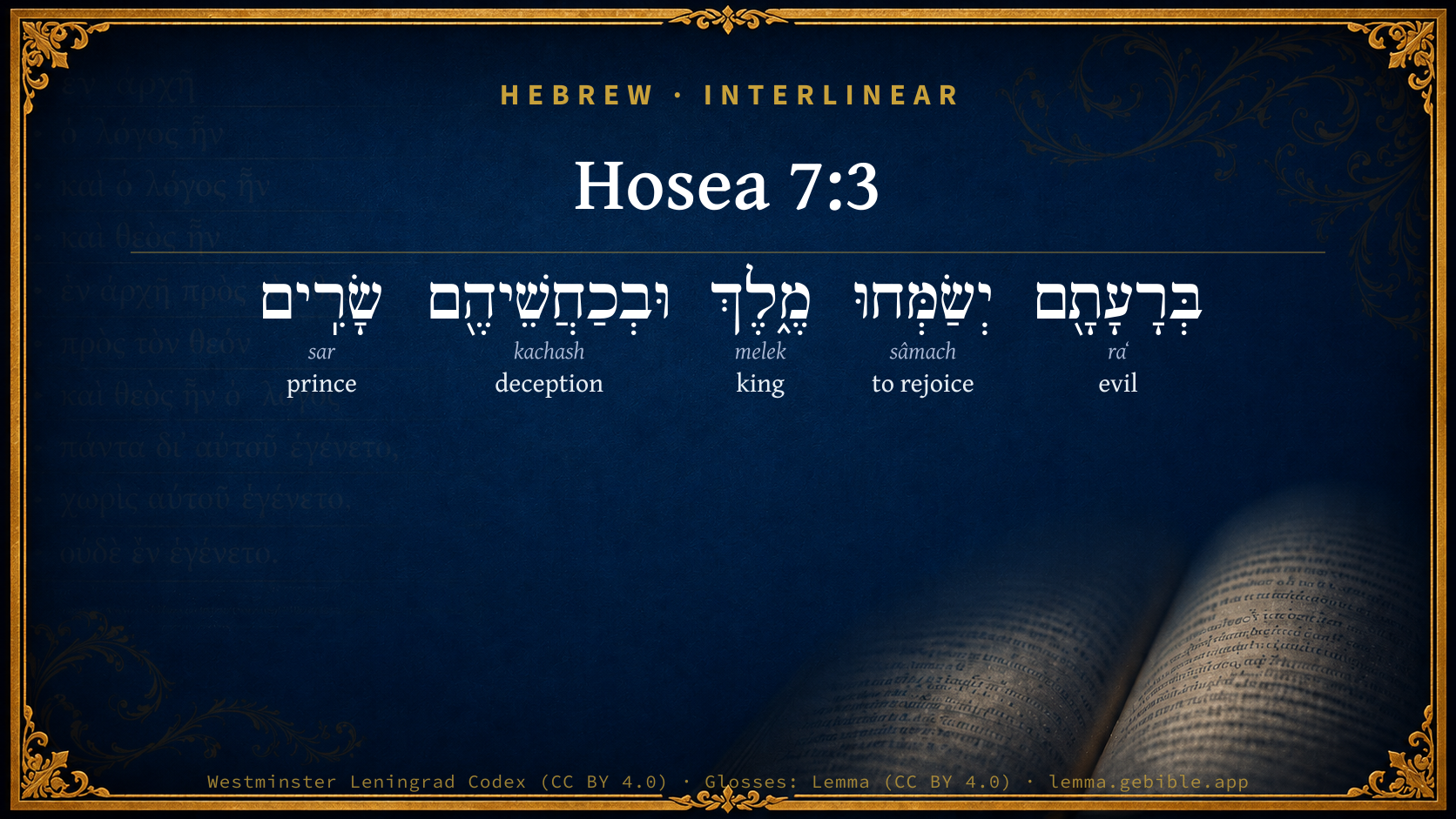
Hebrew (Westminster Leningrad Codex) Hosea 7:3 appears in the Hebrew Old Testament. The text above is from the Westminster Leningrad Codex. Each word links to its Strong’s number, a concise gloss, and parsing drawn from the Open Scriptures Hebrew Bible morphology. Click any word for its full Brown-Driver-Briggs (BDB) entry.
Download image
Cite this verse

Hosea 7:3 (World English Bible). Public Domain. Lemma interlinear Bible study tool, https://lemma.gebible.app/v/hosea/7/3.

Show BibTeX & RIS
BibTeX
RIS
English Translation
They make the king glad with their wickedness, And the princes with their lies.
World English Bible · Public Domain
Download a study sheet

One document with this verse’s original text, its word-by-word gloss line, the meaning frame, cross-references with their text, attributed commentary, and full source and license credits — printable, and it pastes into notes with its structure intact.

This verse Autodidact and up

Study sheet (.html) Plain text (.txt)

A passage Seminary Student

Up to 50 verses in one chapter. A passage sheet keeps up to 6 commentary sources and 12 cross-references per verse, in the order this page ranks them, and says so on the sheet whenever that leaves anything out. Ask for a single verse and you get the Autodidact verse sheet above.

Everything on this page stays free to read, with no account — the sheet is a download of what is already on screen, not access to it.

Want to remove ads? Support Godless Engineer
Compare translations 3

The same verse in 3 English versions, stacked beneath the original-language interlinear above. Click any original word for its lexicon entry.

Each is an independent rendering of the whole verse — the interlinear is not word-aligned to these translations.

Highlighted words mark where these versions differ — a whole-verse word diff, not a word-by-word alignment.

  • World English Bible Public Domain
    They make the king glad with their wickedness, And the princes with their lies.
  • King James Version Public Domain
    They make the king glad with their wickedness, and the princes with their lies.
  • unfoldingWord Literal Text CC BY-SA 4.0
    By their evil they make king glad, and by their lies, princes.

unfoldingWord Literal Text — © unfoldingWord, licensed CC BY-SA 4.0. Word-aligned USFM3 via Door43 (git.door43.org/unfoldingWord/en_ult).

Versions to compare (up to 4)

3 of 4 selected

Show all 18 translations

Every available English version of this verse, each an independent rendering of the whole verse.

  • World English Bible Public Domain
    They make the king glad with their wickedness, And the princes with their lies.
  • Berean Standard Bible Public Domain
    They delight the king with their evil, and the princes with their lies.
  • Majority Standard Bible Public Domain
    They delight the king with their evil, and the princes with their lies.
  • King James Version Public Domain
    They make the king glad with their wickedness, and the princes with their lies.
  • American Standard Version (1901) Public Domain
    They make the king glad with their wickedness, and the princes with their lies.
  • Revised Version (1885) Public Domain
    They make the king glad with their wickedness, and the princes with their lies.
  • Geneva Bible (1599) Public Domain
    They make the King glad with their wickednesse, and the princes with their lies.
  • Douay-Rheims (1899) Public Domain
    They have made the king glad with their wickedness: and the princes with their lies.
  • Young's Literal Translation Public Domain
    With their wickedness they make glad a king, And with their lies -- princes.
  • Literal Standard Version CC BY-SA 4.0
    With their wickedness they make a king glad, || And with their lies—princes.
  • Unlocked Literal Bible CC BY-SA 4.0
    With their evil they make the king glad, and by their lies the officials.
  • unfoldingWord Literal Text CC BY-SA 4.0
    By their evil they make king glad, and by their lies, princes.
  • Darby Bible Public Domain
    They make the king glad with their wickedness, and the princes with their lies.
  • World Messianic Bible Public Domain
    They make the king glad with their wickedness, and the princes with their lies.
  • Webster's Bible Public Domain
    They make the king glad with their wickedness, and the princes with their lies.
  • Free Bible Version CC BY-SA 4.0
    They make their king happy with their wickedness, and the princes with their lies.
  • Bible in Basic English Public Domain
    In their sin they make a king for themselves, and rulers in their deceit.
  • JPS Tanakh (1917) Public Domain
    They make the king glad with their wickedness, and the princes with their lies.

Literal Standard Version (2020), Covenant Press — licensed CC BY-SA 4.0. Text via the HelloAO Bible API (eBible.org). Unlocked Literal Bible (unfoldingWord) — licensed CC BY-SA 4.0. Text via the HelloAO Bible API (eBible.org). unfoldingWord Literal Text — © unfoldingWord, licensed CC BY-SA 4.0. Word-aligned USFM3 via Door43 (git.door43.org/unfoldingWord/en_ult). Free Bible Version, Dr. Jonathan Gallagher — licensed CC BY-SA 4.0. Text via the HelloAO Bible API (eBible.org).

Word by word

More ways to search: Search by grammar → Find every occurrence → Compare this word →

Practice this passage: Drill this verse → Learn its vocabulary →

About this verse

These counts appear in no published source. They are computed here, from the morphology-tagged text and Lemma’s own curated glosses. What Lemma adds →

5
words
5
distinct lemmas
Prophets
section

Notable vocabulary

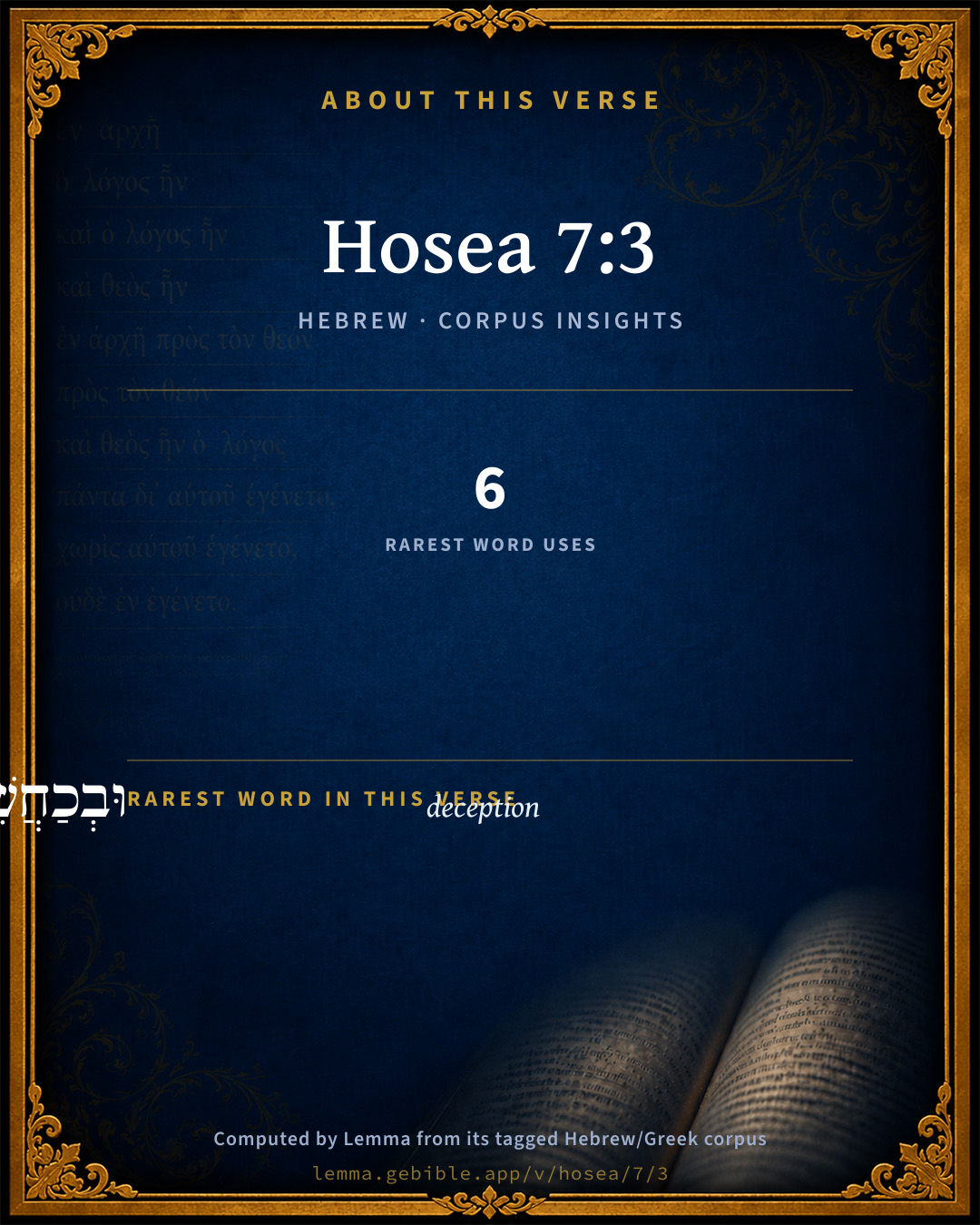
The rarest word here is וּבְכַחֲשֵׁיהֶ֖ם deception H3585 — appearing just 6 times in the whole Hebrew Bible.

Shared distinctive vocabulary

וּבְכַחֲשֵׁיהֶ֖ם deception H3585 occurs in 6 verses of the Hebrew Bible. Also found in:

Grammatical profile

  • 1 verb
  • 4 nouns

Verb forms

  • יְשַׂמְּחוּ Piel · Imperfect

Hebrew & Septuagint length

In English translation the verse runs 14 words from the Hebrew and 11 from the Septuagint (LXX English) — closely comparable.

A rough comparison of the two English renderings, which tokenize alike — not a word-level alignment.

Word counts can differ between the Hebrew and the Greek without any difference in meaning — e.g. the Hebrew direct-object marker אֵת has no separate Greek word, and Greek often adds the article ὁ.

Cross-references

14

Topical passages linked to Hosea 7:3 in the Treasury of Scripture Knowledge — connected by theme and wording, ordered by reader-vote popularity; previews shown in the World English Bible.

  • Romans 1:32 who, knowing the ordinance of God, that those who practice such things are worthy of death, not only do the same, but also approve of those who practice them.
  • Micah 7:3 Their hands are on that which is evil to do it diligently. The ruler and judge ask for a bribe; And the powerful man dictates the evil desire of his soul. Thus they conspire together.
  • Jeremiah 28:1–4 It happened the same year, in the beginning of the reign of Zedekiah king of Judah, in the fourth year, in the fifth month, that Hananiah the son of Azzur, the prophet, who was of Gibeon, spoke to me in the house of Yahweh, in the presence of the priests and of all the people, saying,
  • 1 Kings 22:6 Then the king of Israel gathered the prophets together, about four hundred men, and said to them, Shall I go against Ramoth-gilead to battle, or shall I forbear? They said, Go up; for the Lord will deliver it into the hand of the king.
  • 1 Kings 22:13 The messenger who went to call Micaiah spoke to him, saying, See now, the words of the prophets [declare] good to the king with one mouth: please let your word be like the word of one of them, and speak you good.
  • Jeremiah 5:31 the prophets prophesy falsely, and the priests bear rule by their means; and my people love to have it so: and what will you do in the end of it?
  • Jeremiah 9:2 Oh that I had in the wilderness a lodging-place of wayfaring men; that I might leave my people, and go from them! for they are all adulterers, an assembly of treacherous men.
  • Jeremiah 37:19 Where now are your prophets who prophesied to you, saying, The king of Babylon shall not come against you, nor against this land?
  • Hosea 4:2 There is cursing, lying, murder, stealing, and committing adultery; They break boundaries, and bloodshed causes bloodshed.
  • Hosea 5:11 Ephraim is oppressed, He is crushed in judgment; Because he is intent in his pursuit of idols.
  • Hosea 7:5 On the day of our king, the princes made themselves sick with the heat of wine. He joined his hand with mockers.
  • Amos 7:10–13 Then Amaziah the priest of Beth El sent to Jeroboam king of Israel, saying, "Amos has conspired against you in the midst of the house of Israel. The land is not able to bear all his words.
  • Micah 6:16 For the statutes of Omri are kept, And all the works of the house of Ahab. You walk in their counsels, That I may make you a ruin, And her inhabitants a hissing; And you will bear the reproach of my people."
  • 1 John 4:5 They are of the world. Therefore they speak of the world, and the world hears them.

Cross-references courtesy of OpenBible.info (CC BY 4.0).

Hebrew and Greek witnesses Masoretic Hebrew ↔ Greek Septuagint

The same verse in the two great witnesses to the Old Testament, shown verse-for-verse.

These are two independent witnesses, not word-aligned to each other, and the Septuagint is shown in lemma (dictionary) form.

Hebrew Hosea 7:3 Masoretic · Westminster Leningrad Codex

בְּרָעָתָ֖ם יְשַׂמְּחוּ מֶ֑לֶךְ וּבְכַחֲשֵׁיהֶ֖ם שָׂרִֽים

They make the king glad with their wickedness, And the princes with their lies.

World English Bible · Public Domain

Greek LXX Hosea 7:3 Septuagint · lemma form

ἐν ὁ κακία αὐτός εὐφραίνω βασιλεύς καί ἐν ὁ ψεῦδος αὐτός ἄρχων

They gladdened kings with their wickedness, and princes with their lies.

LXX2012 (modern English Septuagint) · Public Domain

On this verse, John Gill's Exposition discusses the Septuagint’s reading. Read the note in Commentary ↓

Hebrew: Westminster Leningrad Codex (CC BY 4.0). Greek: Septuagint (public domain); English from LXX2012 (modern English Septuagint) (Public Domain). How the Septuagint differs from the Hebrew →

Targum (Aramaic paraphrase)

1

The Targum is the ancient Jewish Aramaic paraphrase of the Hebrew Scriptures — an interpretive translation, not the Hebrew text itself. Onkelos (literal) and Pseudo-Jonathan (expansive) render the Torah, and Jonathan the Prophets. Coverage is partial: where no permissively-licensed English translation exists for a verse, only the Aramaic is shown. This is verse-level text, not a word-by-word alignment to the Hebrew.

  1. Targum Jonathan Prophets (Joshua–Malachi)
    בִּסְרִיקַתְהוֹן מַחֲדַן מַלְכָּא וּבְכַדִיבֵיהוֹן רַבְרְבִין:

    (no public-domain English translation for this verse)

    Targum Jonathan — Aramaic: “Mikraot Gedolot” (public domain). English: “Sefaria Community Translation” (CC0 1.0 (public-domain dedication)); “London "Chaldee Paraphrase," 1871” (public domain). Text via Sefaria.

Commentary

Notes on Hosea 7:3 from classic Christian and Jewish commentators (each source and its license shown beneath its notes). The classic Christian expositions comment on the surrounding passage and are grouped to its opening verse, so a note may address several verses; the Jewish commentaries on the Tanakh (Rashi and others) are per-verse, so they appear only where the commentator wrote on this verse.

Lemma curates 59 commentaries, every one of them public domain or Creative Commons licensed, each selected and text-cleaned for this edition rather than reprinted as found. About our sources →

Trapp's Complete Commentary

John Trapp

Hos 7:3 They make the king glad with their wickedness, and the princes with their lies.

Ver. 3. They make the king glad with their wickedness] A sad commentary surely of king and people, exhilarating themselves and each other in wickedness. Their kings were well paid of their people’s compliances with their unlawful edicts; and the people no less well pleased to gratify and flatter their kings, as the Romans did Tiberius and other tyrants, who therefore said of them, that they were servum pecus, servile souls, et homines ad servitutem parati, men-made slaves. Tyrants care not how wicked their subjects are; for then they know they will swallow down any command, though never so impious, without scrupling or conscience-making. They like to have such about them as will down with anything, digest iron for a need, with the ostrich; and say, as that wretched man said (when one complained he could not do such a thing for his conscience), "I am master of my conscience, I can do anything for all that." Thus Balaam resolved to curse, whatever came of it; he went not aside as at other times, neither built he any more altars, but set his face towards the wilderness, as fully bent to do it, and nothing should hinder him now, Num 24:1-2 cf. Luk 9:51. He also gave wicked counsel to King Balak (and so made him glad at parting, though before he had angered him) to lay a stumblingblock before the children of Israel, viz. to set fair women to tempt them to corporal and spiritual fornication, that God might see sin flagrant in Jacob, some transgression in Israel, and so fall foul upon them with his plagues, Num 23:21. Parasites propound to kings suavia potius quam sana consilia, pleasing, but pestilent counsel; they also act for them, and under them, as Doeg did for Saul, and so gratify them, letify them, as here, make them glad; but it proves to be no better than risus Sardonius, such a mirth as brings bitterness in the end. Woe to such mirthmongers and mirth makers, for if they shall do thus wickedly, they shall be consumed, both they and their king, 1Sa 12:25.

And the princes with their lies] With calumnies and false accusations, wherewith they load God’s innocent servants, and that against their own consciences. Thus Doeg dealt by David, the priests and prophets by Jeremiah, the Persian courtiers by Daniel and his companions, Amaziah by Amos, Haman by the whole nation of the Jews, Tertullus by Paul, the heathen idolaters by the primitive Christians, which caused those many apologies made for them by Tertullian, Athenagoras, and others. If a ruler hearken to lies (and that is a common fault among them, as David tells Saul, 1Sa 24:9) all his servants will be wicked, Pro 29:12; he shall have his Aiones and Negones that will say as he says, and fit his humour to a hair; he shall have plenty of such as will slander the saints and cast an odium upon the conscientious. I once saw (saith Melancthon) an old coin, on the one side whereof was Zopyrus, on the other Zoilus; he adds, fuit imago aulae, comitantur calumniae bene merentes, It was a picture of princes’ courts, where are store of such as, by flattery, daub white upon black, and, by calumny, sprinkle black upon white.

John Trapp, A Commentary or Exposition upon All the Books of the Old and New Testament (1647–1656) — public domain. Text from a community e-Sword module.

Joseph Benson's Commentary

Hos 7:3. They make the king glad with their wickedness — They study to please their kings and great men, by complying with the idolatry they have set up. The Seventy (with whom agree the Syriac and Arabic) read βασιλεις, kings, in the plural number, meaning the succession of the kings of Israel from Jeroboam. And the princes with their lies — Which they speak to please and flatter them. But the word lie sometimes signifies an idol, and the practice of idolatry, as being set up in direct opposition to the true God and his truth. Bishop Horsley renders the verse, By their evil doings they pleasure the king, and by their perfidies the rulers, namely, their perfidies toward God, in deserting his service for idolatry.

Joseph Benson's Commentary on the Old and New Testaments (1811–1818) — public domain. Text from a community e-Sword module.

The Expositor's Bible

4. WICKEDNESS IN HIGH PLACES

Hos_7:3-7

There follows now a very difficult passage. The text is corrupt, and we have no means of determining what precise events are intended. The drift of meaning, however, is evident. The disorder and licentiousness of the people are favored in high places; the throne itself is guilty.

"With their evil they make a king glad, and princes with their falsehoods: all of them are adulterers, like an oven heated by the baker"

"On the day of our king"-some coronation or kings birthday-"the princes were sick with fever from wine. He stretched forth his hand with loose fellows," presumably made them his associates. "Like an oven have they made their hearts with their intriguing. All night their anger sleepeth in the morning it blazes like a flame of fire. All of them glow like an oven, and devour their rulers: all their kings have fallen, without one of them calling on Me."

An obscure passage upon obscure events; yet so lurid with the passion of that fevered people in the flagrant years 743-735 that we can make out the kind of crimes described. A king surrounded by loose and unscrupulous nobles: adultery, drunkenness, conspiracies, assassination: every man striking for himself; none appealing to God.

From the court, then, downwards, by princes, priests, and prophets, to the common fathers of Israel and their households, immorality prevails. There is no redeeming feature, and no hope of better things. For repentance itself the capacity is gone.

In making so thorough an indictment of the moral condition of Israel, it would have been impossible for Hosea not to speak also of the political stupidity and restlessness which resulted from it. But he has largely reserved these for that part of his discourse which now follows, and which we will take in the next chapter.

William Robertson Nicoll, ed., The Expositor's Bible (London: Hodder & Stoughton, 1887–1910) — public domain. 65 of 66 books (1 Corinthians is not separately keyed, as that volume carries no machine-parseable verse references); section-level commentary keyed to the opening verse. Introductory and overview sections not keyed to a specific passage are excluded.

Tyndale Open Study Notes

Tyndale Open Resources

7:3-7 The northern kingdom of Israel saw a succession of seven different kings during the final twenty-five years of its existence, four of whom were assassinated by usurpers. This passage refers to the vicious and bloody political intrigue that characterized these years.

7:3 The prophet did not record the name of this king, but many believe he was Hoshea, the northern kingdom’s last monarch.

Tyndale Open Study Notes — © Tyndale Open Resources, licensed CC BY-SA 4.0. Text via the HelloAO Bible API.

Geneva Bible (1599)

Geneva Bible translators

They esteem their wicked king Jeroboam above God, and seek but how to flatter and please him.

Geneva Bible (1599) marginal notes — public domain. Text via Bolls.life.

Jamieson, Fausset & Brown

Robert Jamieson, A. R. Fausset & David Brown

Their princes, instead of checking, "have pleasure in them that do" such crimes (Rom 1:32).

Jamieson, Fausset & Brown — Commentary Critical and Explanatory on the Whole Bible (1871) — public domain (CC PDM 1.0). Text via the HelloAO Bible API.

Adam Clarke's Commentary

Verse 3. They make the king glad] They pleased Jeroboam by coming readily into his measures, and heartily joining with him in his idolatry. And they professed to be perfectly happy in their change, and to be greatly advantaged by their new gods; and that the religion of the state now was better than that of Jehovah. Thus, they made all their rulers, "glad with their lies."

Adam Clarke's Commentary on the Bible (1810–1826) — public domain. Text from a community e-Sword/MySword module.

John Calvin's Commentaries

The Prophet now arraigns all the citizens of Samaria, and in their persons the whole people, because they rendered obedience to the king by flattery, and to the princes in wicked things, respecting which their own conscience convicted them. He had already in the fifth chapter mentioned the defection of the people in this respect, that they had obeyed the royal edict. It might indeed have appeared a matter worthy of praise, that the people had quietly embraced what the king commanded. This is the case with many at this day, who bring forward a pretext of this kind. Under the papacy they dare not withdraw themselves from their impious superstitions, and they adduce this excuse, that they ought to obey their princes. But, as I have already said, the Prophet has before condemned this sort of obedience, and now he shows that the defection which then reigned through all Israel, ought not to be ascribed to the king or to few men, but that it was a common evil, which involved all in one and the same guilt, without exception. How so? By their wickedness, he says, they have exhilarated the king, and by their lies the princes; that is, If they wish to cast the blame on their governors, it will be done in vain; for whence came then such a promptitude? As soon as Jeroboam formed the calves, as soon as he built temples, religion instantly collapsed, and whatever was before pure, degenerated; how was the change so sudden? Even because the people had inwardly concocted their wickedness, which, when an occasion was offered, showed itself; for hypocrisy did lie hid in all, and was then discovered. We now perceive what the Prophet had in view.

And this place ought to be carefully noticed: for it often happens that some vice creeps in, which proceeds from one man or from a few; but when all readily embrace what a few introduce, it is quite evident that they have no living root of piety or of the fear of God. They then who are so prone to adopt vices were before hypocrites; and we daily find this to be the case. When pious men have the government of a city, and act prudently, then the whole people will give some hope that they will fear the Lord; and when any king, influenced by a desire of advancing the glory of God, endeavors to preserve all his subjects in the pure worship of God, then the same feeling of piety will be seen in all: but when an ungodly king succeeds him, the greater part will immediately fall back again; and when a magistrate neglects his duty, the greater portion of the people will break out into open impiety. I wish there were no proofs of these things; but throughout the world the Lord has designed that there should exist examples of them.

This purpose of God ought therefore to be noticed; for he accuses the people of having made themselves too obsequious and pliant. When king Jeroboam set up vicious worship, the people immediately offered themselves as ready to obey: hence impiety became quite open. They then delighted the king by their wickedness, and the princes by their lies; as though he said, “They cannot transfer the blame to the king and princes. Why? Because they delighted them by their wickedness; that is, they haltered the king by their wickedness and delighted the princes by their lies.” It follows —

John Calvin's Commentaries (1540-1563) — public domain. Text from the Calvin Translation Society English edition (1840s-50s) via the Christian Classics Ethereal Library (ccel.org). Calvin's coverage is partial (roughly two-thirds of the Bible); uncommented books and verses are honest gaps, never fabricated. The 19th-century editor's footnotes and remarks are omitted so the notes are faithfully Calvin's own voice.

Ellicott's Commentary for English Readers

(3) Glad.—The evil awakens no alarm, but rather sympathy and gladness, in the breasts of their kings and rulers, who are ready to follow suit in all deeds of violence.

A Bible Commentary for English Readers, edited by Charles John Ellicott (1878–1897) — public domain. Text from a community e-Sword module.

The Cambridge Bible for Schools and Colleges

gen. ed. J. J. S. Perowne

3–6. The highest personages are not too refined for the most sensual pleasures. A consuming passion inflames them as if with the heat of a furnace. Their way of celebrating a royal commemoration is to indulge in monstrous excess.

The Cambridge Bible for Schools and Colleges (gen. ed. J. J. S. Perowne; Cambridge University Press, 1878–1918) — public domain. Text from a community e-Sword module.

John Gill's Exposition

They make the king glad with their wickedness,.... Not any particular king; not Jeroboam the first, as Kimchi; nor Jehu, as Grotius; if any particular king, rather Jeroboam the second; but their kings in general, as the Septuagint render it, in succession, one after another; who were highly delighted and pleased with the priests in offering sacrifice to the calves, and with the people in attending to that idolatrous worship, by which they hoped to secure the kingdom of Israel to themselves, and prevent the people going to Jerusalem to worship: it made them glad to the heart to hear them say that God was as well pleased with sacrifices offered at Dan and Bethel, as at Jerusalem:

and the princes with their lies; with their idols and idolatrous practices, which are vanity and a lie; though some interpret this of their flatteries, either of them, or their favourites; and of their calumnies and detractions of such they had a dislike of.

John Gill's Exposition of the Whole Bible (1746–1763) — public domain (CC PDM 1.0). Text via the HelloAO Bible API.

Albert Barnes' Notes on the Bible

They make the king glad with their wickedness - Wicked sovereigns and a wicked people are a curse to each other, each encouraging the other in sin. Their king, being wicked, had pleasure in their wickedness; and they, seeing him to be pleased by it, set themselves the more, to do what was evil, and to amuse him with accounts of their sins. Sin is in itself so shameful, that even the great cannot, by themselves, sustain themselves in it, without others to flatter them. A good and serious man is a reproach to them. And so, the sinful great corrupt others, both as aiding them in their debaucheries, and in order not to be reproached by their virtues, and because the sinner has a corrupt pleasure and excitement in hearing of tales of sin, as the good joy to hear of good. Whence Paul says, “who, knowing the judgment of God that they which commit such things are worthy of death, not only do the same, but have pleasure in them that do them” Rom 1:32.

But whereas, they all, kings, princes, and people, thus agreed and conspired in sin, and the sin of the great is the rarest destructive, the prophet here upbraids the people most for this common sin, apparently because they were free from the greater temptations of the great, and so their sin was the more willful. “An unhappy complaisance was the ruling character of Israel. It preferred its kings to God. Conscience was versatile, accommodating. Whatever was authorized by those in power, was approved.” Ahab added the worship of Baal to that of the calves; Jehu confined himself to the sin of Jeroboam. The people acquiesced in the legalized sin. Much as if now, marriages, which by God’s law are incest, or remarriages of the divorced, which our Lord pronounces adultery, were to be held allowable, because man’s law ceases to annex any penalty to them.

Albert Barnes' Notes on the Bible (1834–1885) — public domain. Text from a community e-Sword/MySword module.

Haydock's Catholic Bible Commentary

Glad, &c. To please Jeroboam and their other kings, they have given themselves up to the worship of idols, which are mere falsehood and lies. (Challoner) --- We do not find one good king of Israel. (Calmet) --- But Jeroboam principally caused Israel to sin. (Haydock) --- His infernal policy changed the religion of his subjects.

George Leo Haydock (1774–1849), Haydock's Catholic Family Bible and Commentary, 1859 edition — public domain. Excludes Psalms (Douay-Rheims chapter numbering differs from Protestant) and Deuterocanonical books (Catholic canon only).

Matthew Poole's English Annotations

They, either the subjects in general, or rather the courtiers in particular who were about the king,

make the king glad with their wickedness: the kings of Israel, every one of them from first to last, were addicted to vicious practices, and their minds were vitiated, deeply tainted with all kind of sins, and they it seems took pleasure in sins, both in their own and other men’s; and here are a parcel of flagitious fellows that make it their work to invent pleasing wickedness, to acquaint their king with it, who is so far from doing his duty in discountenancing it, that it is one of his delights to hear or see it.

The princes; great men about the court.

With their lies; with false accusations brought in against the more innocent, or by false reports made of their words and actions, representing them as ridiculous or foolish, drolling them into infamy.

Matthew Poole's English Annotations on the Holy Bible (1683–1685) — public domain. Text from a community e-Sword/MySword module.

The Pulpit Commentary

They make the king glad with their wickedness, and the princes with their lies. The moral corruption and depravity of Israel were extreme and universal. They reached from the rabble to royalty, from the common people to the princes of the court. The king and princes were in full accord with fellows of the basest sort, taking pleasure in their wickedness trod applauding their lies.

(1) Rosenm quotes the explanation of Abarbanel to the following purport: "He (the prophet) means to say that the violent men of that ago were accustomed to narrate their atrocities to their kings, that the latter might thence derive entertainment." It is much the same whether the king and princes of that time took pleasure in the villanies which were perpetrated, or in the narratives of those villanies to which they listened,

(2) A somewhat different rendering, and consequently different exposition, have much to recommend them: "In their wickedness they make the king merry, and in their feigning the princes;" their wickedness was their diabolical design to assassinate king and princes; with this object in view they make the king merry with wine so that he might fall an easy and unsuspecting victim; their feigning was their fell purpose of assassination under the profession of friendship. Such was the desperate treachery of those miscreant conspirators. This view tallies well with the context.

The Pulpit Commentary (1880–1919), ed. H.D.M. Spence-Jones & Joseph S. Exell — public domain. Text from a community e-Sword module.

John Wesley's Explanatory Notes

They - The courtiers in particular make it their work to invent pleasing wickedness, and to acquaint the king with it. With their lies - With false accusations against the innocent.

John Wesley, Explanatory Notes Upon the Whole Bible (1754–1765) — public domain. Text via the GEBible commentary corpus.

unfoldingWord translationNotes

Door43 World Missions Community

General Information:

Yahweh is speaking. The Hebrew text is not clear in various places. However, many people interpret it as describing the royal officials as being unfaithful to God, and also as planning to assassinate the king, and then carrying out their plans. This seems to have happened more than once. These crimes are mentioned as illustrations of the wickedness into which the nation has sunk.

They are all adulterers

The people committed spiritual adultery by worshiping idols and being unfaithful to Yahweh. They were probably also being unfaithful to their husbands or wives by sleeping with other people. (See: Metaphor)

like an oven heated by the baker

This can be stated in active form. This means the people had strong desires to do evil. AT: "like an oven which the baker heats" (See: Simile and Active or Passive)

kneading of the dough

This is a part of the process of making bread.

On the day of our king

This is perhaps a festival held by the king.

He reached out with his hand

This probably means to unite or join with someone. It may mean that the king joins with his officials to mock things or people that should not be mocked, even God himself. (See: Idiom)

translationWords

evil

king

adultery

wine

mock

unfoldingWord translationNotes — © Distant Shores Media and the Door43 World Missions Community, licensed CC BY-SA 4.0. Source: git.door43.org/Door43/en_tn.

Rashi

Rabbi Shlomo Yitzchaki (Rashi)

they make the king glad Their king desires the evil that they do.

Rashi on the Tanakh — English translations: “The Judaica Press complete Tanach with Rashi, translated by A. J. Rosenberg” (CC BY 4.0); “Pentateuch with Rashi's commentary by M. Rosenbaum and A.M. Silbermann, 1929-1934” (public domain); “The Metsudah Tanach series, Lakewood, N.J” (CC BY 4.0); and “The Book of Joshua, Metsudah Publications, 1997” (CC BY 4.0). Text via Sefaria.

Lesson kit

Teaching starters — assembled from the data on this page, not authored interpretation. Every prompt links to the verse data it draws on. Edit before teaching.

Hosea, in the Prophets, opens this verse with 5 words (5 distinct Hebrew lemmas). Its most distinctive word is kachash (“deception”). A historical commentator’s framing appears above. Read the whole chapter for the surrounding context.

Discussion questions

  1. How does “deception” (kachash) shape what this verse is saying?
  2. Job 16:8 shares the word «deception» with this verse. How do the two illuminate each other?
  3. These translations render this verse differently; the difference is in the English rendering, not the original. What questions does that raise?
  4. The verb «יְשַׂמְּחוּ» is Piel Imperfect. How does its form color the action?
  5. Reading how Trapp's Complete Commentary and Joseph Benson's Commentary read this verse, where do the two commentators agree and where do they part?

Things to notice

Reading settings

Reading text

Shown beneath each verse's original-language words.

Old Testament
Old Testament edition

Read the OT as the Masoretic Hebrew (MT) or the Greek Septuagint (LXX).

English shown for the Greek Septuagint (in the Hebrew ↔ Greek comparison).

Comparing translations? Open the Compare panel on any verse page to stack up to four side by side.