
Ecclesiastes 5:19

Hebrew (Westminster Leningrad Codex) Ecclesiastes 5:19 appears in the Hebrew Old Testament. The text above is from the Westminster Leningrad Codex. Each word links to its Strong’s number, a concise gloss, and parsing drawn from the Open Scriptures Hebrew Bible morphology. Click any word for its full Brown-Driver-Briggs (BDB) entry.
Download image
Cite this verse

Ecclesiastes 5:19 (World English Bible). Public Domain. Lemma interlinear Bible study tool, https://lemma.gebible.app/v/ecclesiastes/5/19.

Show BibTeX & RIS
BibTeX
RIS
English Translation
Every man also to whom God has given riches and wealth, and has given him power to eat of it, and to take his portion, and to rejoice in his labor--this is the gift of God.
World English Bible · Public Domain
Download a study sheet

One document with this verse’s original text, its word-by-word gloss line, the meaning frame, cross-references with their text, attributed commentary, and full source and license credits — printable, and it pastes into notes with its structure intact.

This verse Autodidact and up

Study sheet (.html) Plain text (.txt)

A passage Seminary Student

Up to 50 verses in one chapter. A passage sheet keeps up to 6 commentary sources and 12 cross-references per verse, in the order this page ranks them, and says so on the sheet whenever that leaves anything out. Ask for a single verse and you get the Autodidact verse sheet above.

Everything on this page stays free to read, with no account — the sheet is a download of what is already on screen, not access to it.

Want to remove ads? Support Godless Engineer
Compare translations 3

The same verse in 3 English versions, stacked beneath the original-language interlinear above. Click any original word for its lexicon entry.

Each is an independent rendering of the whole verse — the interlinear is not word-aligned to these translations.

Highlighted words mark where these versions differ — a whole-verse word diff, not a word-by-word alignment.

  • World English Bible Public Domain
    Every man also to whom God has given riches and wealth, and has given him power to eat of it, and to take his portion, and to rejoice in his labor--this is the gift of God.
  • King James Version Public Domain
    Every man also to whom God hath given riches and wealth, and hath given him power to eat thereof, and to take his portion, and to rejoice in his labour; this is the gift of God.
  • unfoldingWord Literal Text CC BY-SA 4.0
    Also, each person who the God gives to him wealth and possessions and has empowered him to eat from it and to accept his portion and to rejoice in his toiling—this, it a gift of God.

unfoldingWord Literal Text — © unfoldingWord, licensed CC BY-SA 4.0. Word-aligned USFM3 via Door43 (git.door43.org/unfoldingWord/en_ult).

Versions to compare (up to 4)

3 of 4 selected

Show all 18 translations

Every available English version of this verse, each an independent rendering of the whole verse.

  • World English Bible Public Domain
    Every man also to whom God has given riches and wealth, and has given him power to eat of it, and to take his portion, and to rejoice in his labor--this is the gift of God.
  • Berean Standard Bible Public Domain
    Furthermore, God has given riches and wealth to every man, and He has enabled him to enjoy them, to accept his lot, and to rejoice in his labor. This is a gift from God.
  • Majority Standard Bible Public Domain
    Furthermore, God has given riches and wealth to every man, and He has enabled him to enjoy them, to accept his lot, and to rejoice in his labor. This is a gift from God.
  • King James Version Public Domain
    Every man also to whom God hath given riches and wealth, and hath given him power to eat thereof, and to take his portion, and to rejoice in his labour; this is the gift of God.
  • American Standard Version (1901) Public Domain
    Every man also to whom God hath given riches and wealth, and hath given him power to eat thereof, and to take his portion, and to rejoice in his labor-this is the gift of God.
  • Revised Version (1885) Public Domain
    Every man also to whom God hath given riches and wealth, and hath given him power to eat thereof, and to take his portion, and to rejoice in his labour; this is the gift of God.
  • Geneva Bible (1599) Public Domain
    Surely hee will not much remember the dayes of his life, because God answereth to the ioy of his heart.
  • Douay-Rheims (1899) Public Domain
    For he shall not much remember the days of his life, because God entertaineth his heart with delight,
  • Young's Literal Translation Public Domain
    Every man also to whom God hath given wealth and riches, and hath given him power to eat of it, and to accept his portion, and to rejoice in his labour, this is a gift of God.
  • Literal Standard Version CC BY-SA 4.0
    Every man also to whom God has given wealth and riches, and has given him power to eat of it, and to accept his portion, and to rejoice in his labor, this is a gift of God.
  • Unlocked Literal Bible CC BY-SA 4.0
    Anyone to whom God has given riches and wealth and the ability to receive his share and rejoice in his work—this is a gift from God.
  • unfoldingWord Literal Text CC BY-SA 4.0
    Also, each person who the God gives to him wealth and possessions and has empowered him to eat from it and to accept his portion and to rejoice in his toiling—this, it a gift of God.
  • Darby Bible Public Domain
    Every man also to whom God hath given riches and wealth, and power to eat thereof, and to take his portion and to rejoice in his labour: that is a gift of God.
  • World Messianic Bible Public Domain
    Every man also to whom God has given riches and wealth, and has given him power to eat of it, and to take his portion, and to rejoice in his labor—this is the gift of God.
  • Webster's Bible Public Domain
    \\5:20\\For he shall not much remember the days of his life; because God answereth him in the joy of his heart.
  • Free Bible Version CC BY-SA 4.0
    In addition, everyone to whom God gives wealth and possessions he also gives the ability to enjoy these gifts, to be grateful for what they are given, and to enjoy the work they do. This is also God's gift to us.
  • Bible in Basic English Public Domain
    He will not give much thought to the days of his life; because God lets him be taken up with the joy of his heart.
  • JPS Tanakh (1917) Public Domain
    (5-18) Every man also to whom God hath given riches and wealth, and hath given him power to eat thereof, and to take his portion, and to rejoice in his labour — this is the gift of God.

Literal Standard Version (2020), Covenant Press — licensed CC BY-SA 4.0. Text via the HelloAO Bible API (eBible.org). Unlocked Literal Bible (unfoldingWord) — licensed CC BY-SA 4.0. Text via the HelloAO Bible API (eBible.org). unfoldingWord Literal Text — © unfoldingWord, licensed CC BY-SA 4.0. Word-aligned USFM3 via Door43 (git.door43.org/unfoldingWord/en_ult). Free Bible Version, Dr. Jonathan Gallagher — licensed CC BY-SA 4.0. Text via the HelloAO Bible API (eBible.org).

Word by word

More ways to search: Search by grammar → Find every occurrence → Compare this word →

Practice this passage: Drill this verse → Learn its vocabulary →

וּנְכָסִ֜ים
nekeç
H5233
“and · treasures”
Conjunction + Noun, Common, Masculine, Plural, Absolute
Part of Speech
Conjunction + Noun
Type
Common
Gender
Masculine
Number
Plural
State
Absolute
Full BDB Definition

Origin: from an unused root meaning to accumulate

TWOT: 1367

riches, treasures
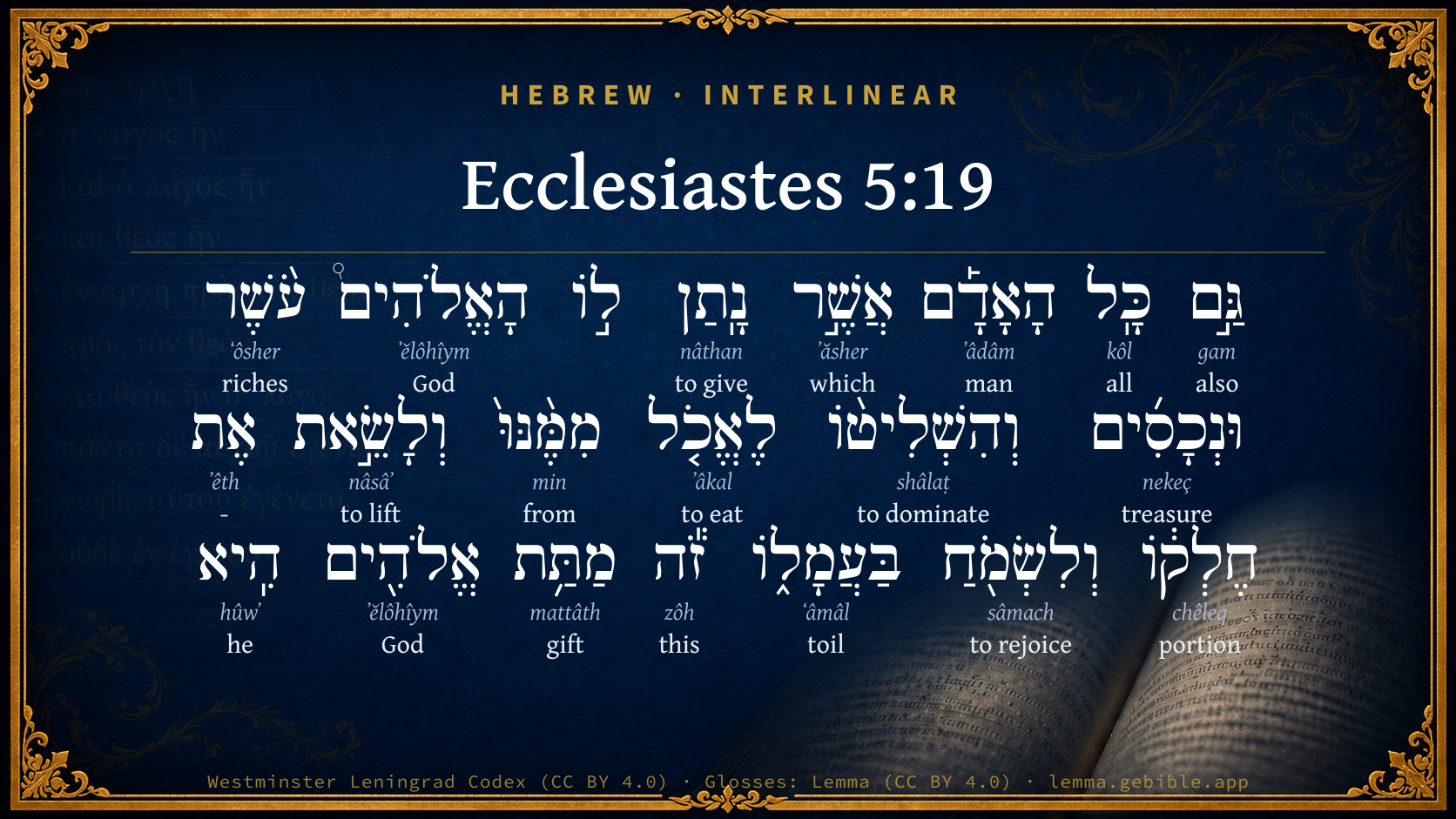
  1. גַּ֣ם gam H1571 “also” Particle, Accusative
  2. כָּֽל kôl H3605 “all of” Noun, Common, Masculine, Singular, Construct
  3. הָאָדָ֡ם ʼâdâm H120 “the · man” Particle, Definite Article + Noun, Common, Masculine, Singular, Absolute
  4. אֲשֶׁ֣ר ʼăsher H834 “which” Particle, Relative
  5. נָֽתַן nâthan H5414 “to give” Verb, Qal, Perfect, 3rd Person, Masculine, Singular
  6. הָאֱלֹהִים֩ ʼĕlôhîym H430 “the · God(s)” Particle, Definite Article + Noun, Common, Masculine, Plural, Absolute
  7. עֹ֨שֶׁר ʻôsher H6239 “riches” Noun, Common, Masculine, Singular, Absolute
  8. וְהִשְׁלִיט֨וֹ shâlaṭ H7980 “and · to dominate · him” Conjunction + Verb, Hiphil, Perfect, 3rd Person, Masculine, Singular + Suffix, Personal, 3rd Person, Masculine, Singular
  9. לֶאֱכֹ֤ל ʼâkal H398 “to eat” Preposition + Verb, Qal, Infinitive Construct
  10. מִמֶּ֨נּוּ֙ min H4480 “from · us” Preposition + Suffix, Personal, 1st Person, Common, Plural
  11. וְלָשֵׂ֣את nâsâʼ H5375 “and · to lift” Conjunction + Preposition + Verb, Qal, Infinitive Construct
  12. אֶת ʼêth H853 “-” Particle, Direct Object
  13. חֶלְק֔וֹ chêleq H2506 “portion · his” Noun, Common, Masculine, Singular, Construct + Suffix, Personal, 3rd Person, Masculine, Singular
  14. וְלִשְׂמֹ֖חַ sâmach H8055 “and · to rejoice” Conjunction + Preposition + Verb, Qal, Infinitive Construct
  15. בַּעֲמָל֑וֹ ʻâmâl H5999 “in/at · toil · his” Preposition + Noun, Common, Both, Singular, Construct + Suffix, Personal, 3rd Person, Masculine, Singular
  16. זֹ֕ה zôh H2090 “this” Pronoun, Demonstrative, Masculine, Singular
  17. מַתַּ֥ת mattâth H4991 “gift of” Noun, Common, Feminine, Singular, Construct
  18. אֱלֹהִ֖ים ʼĕlôhîym H430 “God(s)” Noun, Common, Masculine, Plural, Absolute
  19. הִֽיא hûwʼ H1931 “he” Pronoun, Personal, 3rd Person, Feminine, Singular

About this verse

These counts appear in no published source. They are computed here, from the morphology-tagged text and Lemma’s own curated glosses. What Lemma adds →

21
words
19
distinct lemmas
Wisdom
section

Notable vocabulary

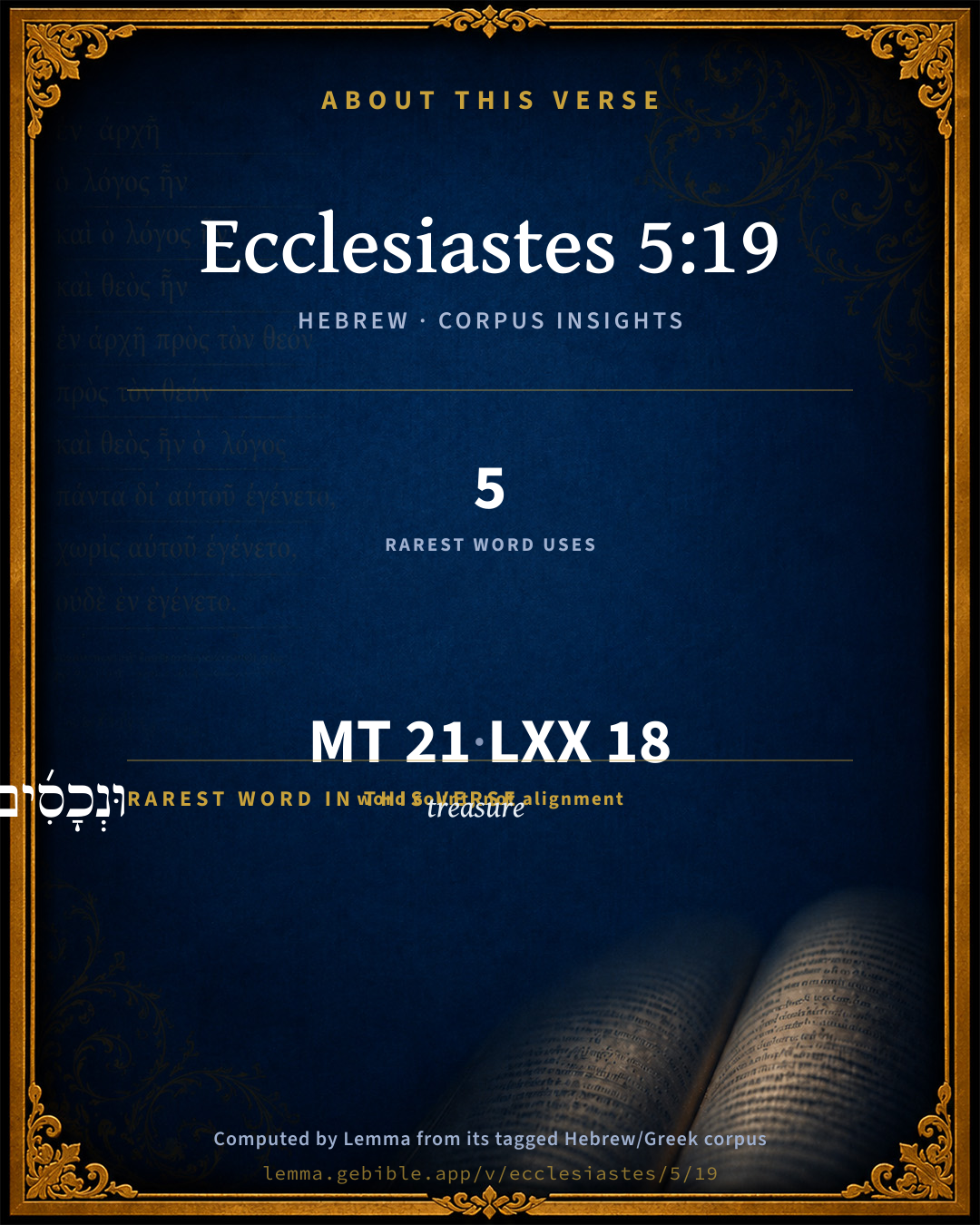
The rarest word here is וּנְכָסִ֜ים treasure H5233 — appearing just 5 times in the whole Hebrew Bible.

Shared distinctive vocabulary

וּנְכָסִ֜ים treasure H5233 occurs in 5 verses of the Hebrew Bible. Also found in:

Grammatical profile

  • 5 verbs
  • 9 nouns
  • 2 pronouns
  • 2 prepositions
  • 3 particles

Verb forms

  • נָֽתַן Qal · Perfect
  • וְהִשְׁלִיט֨וֹ Hiphil · Perfect
  • לֶאֱכֹ֤ל Qal · Infinitive Construct
  • וְלָשֵׂ֣את Qal · Infinitive Construct
  • וְלִשְׂמֹ֖חַ Qal · Infinitive Construct

Repetition

A word recurs within this verse — often emphatic in Hebrew:

  • הָאֱלֹהִים֩ God H430 ×2

Hebrew & Septuagint length

In English translation the verse runs 36 words from the Hebrew and 21 from the Septuagint (LXX English) — the Septuagint runs noticeably shorter here. See the side-by-side →

A rough comparison of the two English renderings, which tokenize alike — not a word-level alignment.

Word counts can differ between the Hebrew and the Greek without any difference in meaning — e.g. the Hebrew direct-object marker אֵת has no separate Greek word, and Greek often adds the article ὁ.

In the original languages it is 21 Hebrew tokens and 18 Greek tokens — but the two are counted differently (Hebrew bundles its prefixes and suffixes into one token; the Greek is in lemma form), so that isn’t a like-for-like length.

Cross-references

6

Topical passages linked to Ecclesiastes 5:19 in the Treasury of Scripture Knowledge — connected by theme and wording, ordered by reader-vote popularity; previews shown in the World English Bible.

  • Deuteronomy 8:18 But you shall remember Yahweh your God, for it is he who gives you power to get wealth; that he may establish his covenant which he swore to your fathers, as at this day.
  • Ecclesiastes 3:13 Also that every man should eat and drink, and enjoy good in all his labor, is the gift of God.
  • Ecclesiastes 6:2 a man to whom God gives riches, wealth, and honor, so that he lacks nothing for his soul of all that he desires, yet God gives him no power to eat of it, but an alien eats it. This is vanity, and it is an evil disease.
  • 2 Chronicles 1:12 wisdom and knowledge is granted to you; and I will give you riches, and wealth, and honor, such as none of the kings have had who have been before you; neither shall there any after you have the like.
  • Ecclesiastes 2:24–26 There is nothing better for a man than that he should eat and drink, and make his soul enjoy good in his labor. This also I saw, that it is from the hand of God.
  • 1 Kings 3:13 I have also given you that which you have not asked, both riches and honor, so that there shall not be any among the kings like you, all your days.

Cross-references courtesy of OpenBible.info (CC BY 4.0).

Hebrew and Greek witnesses Masoretic Hebrew ↔ Greek Septuagint

The same verse in the two great witnesses to the Old Testament, shown verse-for-verse.

Here the Septuagint runs noticeably shorter than the Hebrew — LXX2012 (modern English Septuagint) 21 words vs World English Bible 36. A rough length comparison of the two English translations, not a word-level alignment — read both below.

These are two independent witnesses, not word-aligned to each other, and the Septuagint is shown in lemma (dictionary) form.

Hebrew Ecclesiastes 5:19 Masoretic · Westminster Leningrad Codex

גַּ֣ם כָּֽל הָאָדָ֡ם אֲשֶׁ֣ר נָֽתַן ל֣וֹ הָאֱלֹהִים֩ עֹ֨שֶׁר וּנְכָסִ֜ים וְהִשְׁלִיט֨וֹ לֶאֱכֹ֤ל מִמֶּ֨נּוּ֙ וְלָשֵׂ֣את אֶת חֶלְק֔וֹ וְלִשְׂמֹ֖חַ בַּעֲמָל֑וֹ זֹ֕ה מַתַּ֥ת אֱלֹהִ֖ים הִֽיא

Every man also to whom God has given riches and wealth, and has given him power to eat of it, and to take his portion, and to rejoice in his labor--this is the gift of God.

World English Bible · Public Domain

Greek LXX Ecclesiastes 5:19 Septuagint · lemma form

ὅτι οὐ πολύς μιμνήσκω ὁ ἡμέρα ὁ ζωή αὐτός ὅτι ὁ θεός περισπάω αὐτός ἐν εὐφροσύνη καρδία αὐτός

For he shall not much remember the days of his life; for God troubles him in the mirth of his heart.

LXX2012 (modern English Septuagint) · Public Domain

Hebrew: Westminster Leningrad Codex (CC BY 4.0). Greek: Septuagint (public domain); English from LXX2012 (modern English Septuagint) (Public Domain). How the Septuagint differs from the Hebrew →

Commentary

Notes on Ecclesiastes 5:19 from classic Christian and Jewish commentators (each source and its license shown beneath its notes). The classic Christian expositions comment on the surrounding passage and are grouped to its opening verse, so a note may address several verses; the Jewish commentaries on the Tanakh (Rashi and others) are per-verse, so they appear only where the commentator wrote on this verse.

Lemma curates 59 commentaries, every one of them public domain or Creative Commons licensed, each selected and text-cleaned for this edition rather than reprinted as found. About our sources →

Jamieson, Fausset & Brown

Robert Jamieson, A. R. Fausset & David Brown

As Ecc 5:18 refers to the "laboring" man (Ecc 5:12), so Ecc 5:19 to the "rich" man, who gets wealth not by "oppression" (Ecc 5:8), but by "God's gift." He is distinguished also from the "rich" man (Ecc 6:2) in having received by God's gift not only "wealth," but also "power to eat thereof," which that one has not.

to take his portion--limits him to the lawful use of wealth, not keeping back from God His portion while enjoying his own.

Jamieson, Fausset & Brown — Commentary Critical and Explanatory on the Whole Bible (1871) — public domain (CC PDM 1.0). Text via the HelloAO Bible API.

Trapp's Complete Commentary

John Trapp

Ecc 5:19 Every man also to whom God hath given riches and wealth, and hath given him power to eat thereof, and to take his portion, and to rejoice in his labour; this [is] the gift of God.

Ver. 19. This is the gift of God.] A gift of his right hand, donum throni, non scabelli, - Godliness only hath contentedness. {1Ti 6:6} The comfort of wealth comes in by no other door than by the assurance of God’s love in bestowing it, and of his grace in sanctifying it. "God give thee the dew of heaven." {Gen 27:28} Esau likewise had the like, but not with a "God give thee." A carnal heart cares not how, so he may have it; hence his so little comfort and enjoyment. A godly man will have God with it, or else he is all amort. Moses would not be put off with an angel to go along with them. Luther protested, when great gifts were offered him, that he would not be satisfied or quieted with those rattles. {a}

{a} Valde protestatus sum me nolle sic satiari. -Luth.

John Trapp, A Commentary or Exposition upon All the Books of the Old and New Testament (1647–1656) — public domain. Text from a community e-Sword module.

Joseph Benson's Commentary

Ecc 5:19-20. Every man also, &c. — “And whosoever he be whom God hath blessed, not only with plenty of worldly goods, but also with such a noble and generous mind that he is not their slave, but truly master of them,” (so the Hebrew, השׂלישׂוsignifies,) “being able to enjoy them innocently, and that with cheerfulness, and to delight in doing good to others with them; let him be very thankful to Almighty God for so great a happiness, and acknowledge it to be a singular gift of his bounty.” For be shall not much remember the days of his life — “For he that is thus highly favoured by God, will not think life tedious or irksome; but, forgetting his past toils, and taking no” anxious “care for the future, will spend his time most comfortably; because God hath given him his hearths desire, in that inward tranquillity of mind, or, rather, joy and gladness of heart, wherewith God hath compensated all his pains, and testified his extraordinary kindness to him.” — Bishop Patrick. See notes on Ecc 2:24; and Ecc 3:12-13.

Joseph Benson's Commentary on the Old and New Testaments (1811–1818) — public domain. Text from a community e-Sword module.

Geneva Bible (1599)

Geneva Bible translators

He will take no great thought for the pains that he hath endured in time past.

Geneva Bible (1599) marginal notes — public domain. Text via Bolls.life.

The Cambridge Bible for Schools and Colleges

gen. ed. J. J. S. Perowne

19. this is the gift of God] The words indicate a return to the sense of dependence on the Divine bounty, which we have seen in chs. Ecc_2:24, Ecc_3:13. Life itself, and the outward goods of life, few or many, and the power to enjoy these, all are alike God’s gifts.

The Cambridge Bible for Schools and Colleges (gen. ed. J. J. S. Perowne; Cambridge University Press, 1878–1918) — public domain. Text from a community e-Sword module.

John Gill's Exposition

Every man also to whom God hath given riches and wealth,.... Which include the whole of a man's substance; all his estate, personal and real; and all his goods and possessions, movable and immovable, as gold, silver, cattle, fields, and farms; which are all the gift of God, by whatsoever means they may be acquired or possessed;

and hath given him power; or, "caused him to have dominion" (r), over his wealth and riches, and not be a slave to them, as many are: but to have so much command of them and of himself, as

to eat thereof; comfortably enjoy them; and dispose of them to his own good, the good of others, and the glory of God. It follows,

and to take his portion; which God hath allotted him; to take it thankfully, and use it freely and comfortably;

and to rejoice in his labour; in the things he has been labouring for, in a cheerful use of them; blessing God for them, and taking the comfort of them;

this is the gift of God; to have such power over his substance, and not be a slave to it, and to enjoy the fruits of his labour, in a cheerful and comfortable manner; this is as much the gift of God as riches themselves (s).

(r) "eumque dominari eum fecerit", Tigurine version; "imperare fecit eum", Gejerus; "dominari eum fecerit", Rambachius. (s) "Di tibi divitias dederunt, artemque fruendi", Horat. Ep. l. 1. Ep. 4. v. 7.

John Gill's Exposition of the Whole Bible (1746–1763) — public domain (CC PDM 1.0). Text via the HelloAO Bible API.

Haydock's Catholic Bible Commentary

Delight, while he observes due moderation. His life passes away sweetly. (Calmet)

George Leo Haydock (1774–1849), Haydock's Catholic Family Bible and Commentary, 1859 edition — public domain. Excludes Psalms (Douay-Rheims chapter numbering differs from Protestant) and Deuterocanonical books (Catholic canon only).

Matthew Poole's English Annotations

Hath given him power, Heb. hath given him the dominion; who is the lord and master of his estate, not a slave to it. Of this and the former verse, See Poole "Ecc 2:24"; See Poole "Ecc 3:12", See Poole "Ecc 3:13". To take his portion to his own use, to use what God hath given him.

Matthew Poole's English Annotations on the Holy Bible (1683–1685) — public domain. Text from a community e-Sword/MySword module.

Whedon's Commentary on the Bible

Daniel D. Whedon

19. Every man also — In this verse the “also” should be the first word, as this confirms the latter part of Ecc_2:24, and has a logical connexion with the preceding. This second part, now restated, is, that man’s blessings proceed from God, who intends them to be cheerfully and thankfully enjoyed.

Daniel D. Whedon (gen. ed.), Commentary on the Old and New Testaments (1874–1909) — public domain. Text from a community e-Sword module.

The Pulpit Commentary

Every man also. The sentence is anacoluthic, like. Ecc_3:13, and may best be rendered, Also for every man to whom... this is a gift of God. Ginsburg connects the verse closely with the preceding one, supplying, "I have also seen that a man," etc. Whichever way we take the sentence, it comes to the same tiling, implying man"s absolute dependence upon God"s bounty. To whom God hath given riches and wealth. Before he can enjoy his possessions a man must first receive them from God"s hands. The two terms here used are not quite synonymous. While the former word, osher; is used for wealth of any kind whatever, the latter, nekasim, means properly "wealth in cattle," like the Latin pecunia, and thence used generally for riches (volek) Hath given him power to eat thereof. Abundance is useless without the power to enjoy it. This is the gift of God, a great and special bounty from a loving and gracious God. Thus Horace, "Epist.," 1:4. 7

Di tibi divitias dederunt artemque fruendi.

The gods have given you wealth, and (what is more) Have given you wisdom to enjoy your store. (Howes. )

The Pulpit Commentary (1880–1919), ed. H.D.M. Spence-Jones & Joseph S. Exell — public domain. Text from a community e-Sword module.

John Wesley's Explanatory Notes

To take - To use what God hath given him.

John Wesley, Explanatory Notes Upon the Whole Bible (1754–1765) — public domain. Text via the GEBible commentary corpus.

Keil & Delitzsch

C. F. Keil & F. Delitzsch

This verse, expressing the same, is constructed anakolouthistically, altogether like Ecc 3:13 : "Also for every man to whom God hath given riches and treasures, and hath given him power to eat thereof, and to take his portion, and to rejoice in his labour; just this is a gift of God." The anakolouthon can be rendered into English here as little as it can at Ecc 3:13; for if we allow the phrase, "also every man," the "also" remains fixed to the nearest conception, while in the Heb it governs the whole long sentence, and, at the nearest, belongs to זה. Cheerful enjoyment is in this life that which is most advisable; but also it is not made possible in itself by the possession of earthly treasures, - it is yet a special gift of God added thereto. Nechasim, besides here, occurs also in Jos 22:8; Ch2 1:11.; and in the Chald. of the Book of Ezra; Ezr 6:8; Ezr 7:26. Also hishlit, to empower, to make possible, is Aram., Dan 2:38, Dan 2:48, as well as Heb., Psa 119:133; the prevalence of the verbal stem שלט is characteristic of the Book of Koheleth. Helqo, "his portion," is just the cheerful enjoyment as that which man has here below of life, if he has any of it at all.

Keil & Delitzsch — Biblical Commentary on the Old Testament (1861–1891) — public domain (CC PDM 1.0). Text via the HelloAO Bible API. (Old Testament only.)

unfoldingWord translationNotes

Door43 World Missions Community

riches and wealth

These two words mean basically the same thing. They refer to money and the things that a person can buy with money. (See: Doublet)

to receive his share

"to accept what he is given"

he does not call to mind

Here the word "he" refers to the person to whom God has given a gift. The phrase "call to mind" is an idiom. AT: "he does not remember" or "he does not think about" (See: Idiom)

the days of his life

This refers to the things that happened during his lifetime. This can be stated clearly. AT: "the things that have happened during his lifetime" (See: Idiom)

keep busy

"stay busy"

translationWords

receive

joy

gift

mind

unfoldingWord translationNotes — © Distant Shores Media and the Door43 World Missions Community, licensed CC BY-SA 4.0. Source: git.door43.org/Door43/en_tn.

Rashi

Rabbi Shlomo Yitzchaki (Rashi)

are not many for there is no longevity in this world.

For let him remember that the days of his life for they are few and not many; so why should he toil to accumulate wealth? Let him toil in his lifetime with a thing that endures for him in the World to Come.

for God is testimony, etc. The Holy One, blessed be He, [testifies] a constant testimony about this forever.

of the joy of his heart that he rejoiced to do good in his lifetime, and I saw in the Midrash (Ecc. Rabbah): This refers to Elkanah, who led Israel up to Shiloh on the festivals, and on the way that he brought them up on one year he did not bring them up the foll owing year, in order to publicize the matter and to accustom them [to perform the pilgrimage]. Therefore, Scripture praises him (I Sam. 1:3): “And that man was wont to go up from his city, etc.” I believe [lit., I say] that this Midrash is [based on] the end of the verse: “for God is testimony of the joy of his heart.” This is Elkanah, whom the Holy One, blessed be He, established in the Scriptures, and testified about him: “And that man was wont to go up from his city.”

testimony Heb. מַעֲנֶה. This is vowelized with a “pattah kattan” (seggol). Therefore, I explain it as a noun, like (Job 32:5): “for there was no answer (מַעֲנֶה) in the mouth of the three men.”

of the joy of his heart that he was happy on the festival.

Rashi on the Tanakh — English translations: “The Judaica Press complete Tanach with Rashi, translated by A. J. Rosenberg” (CC BY 4.0); “Pentateuch with Rashi's commentary by M. Rosenbaum and A.M. Silbermann, 1929-1934” (public domain); “The Metsudah Tanach series, Lakewood, N.J” (CC BY 4.0); and “The Book of Joshua, Metsudah Publications, 1997” (CC BY 4.0). Text via Sefaria.

Lesson kit

Teaching starters — assembled from the data on this page, not authored interpretation. Every prompt links to the verse data it draws on. Edit before teaching.

Ecclesiastes, in the Wisdom, opens this verse with 21 words (19 distinct Hebrew lemmas). Its most distinctive word is nekeç (“treasure”). The Greek Septuagint runs shorter here. A historical commentator’s framing appears above. Read the whole chapter for the surrounding context.

Discussion questions

  1. How does “treasure” (nekeç) shape what this verse is saying?
  2. How does Joshua 22:8, which shares the word «treasure», read alongside this verse?
  3. What does the repetition of “God” (2× in this one verse) do in this verse?
  4. The Septuagint runs shorter here than the Hebrew. What might account for the difference?
  5. The translations on this page render this verse differently — a whole-verse word diff, not a word-by-word alignment. What might account for the different wordings?
  6. «נָֽתַן» is a Qal Perfect verb. How does that grammatical form shape the action described?
  7. Compare how Jamieson, Fausset & Brown and Trapp's Complete Commentary read this verse. Where do they agree or differ?

Things to notice

Reading settings

Reading text

Shown beneath each verse's original-language words.

Old Testament
Old Testament edition

Read the OT as the Masoretic Hebrew (MT) or the Greek Septuagint (LXX).

English shown for the Greek Septuagint (in the Hebrew ↔ Greek comparison).

Comparing translations? Open the Compare panel on any verse page to stack up to four side by side.