
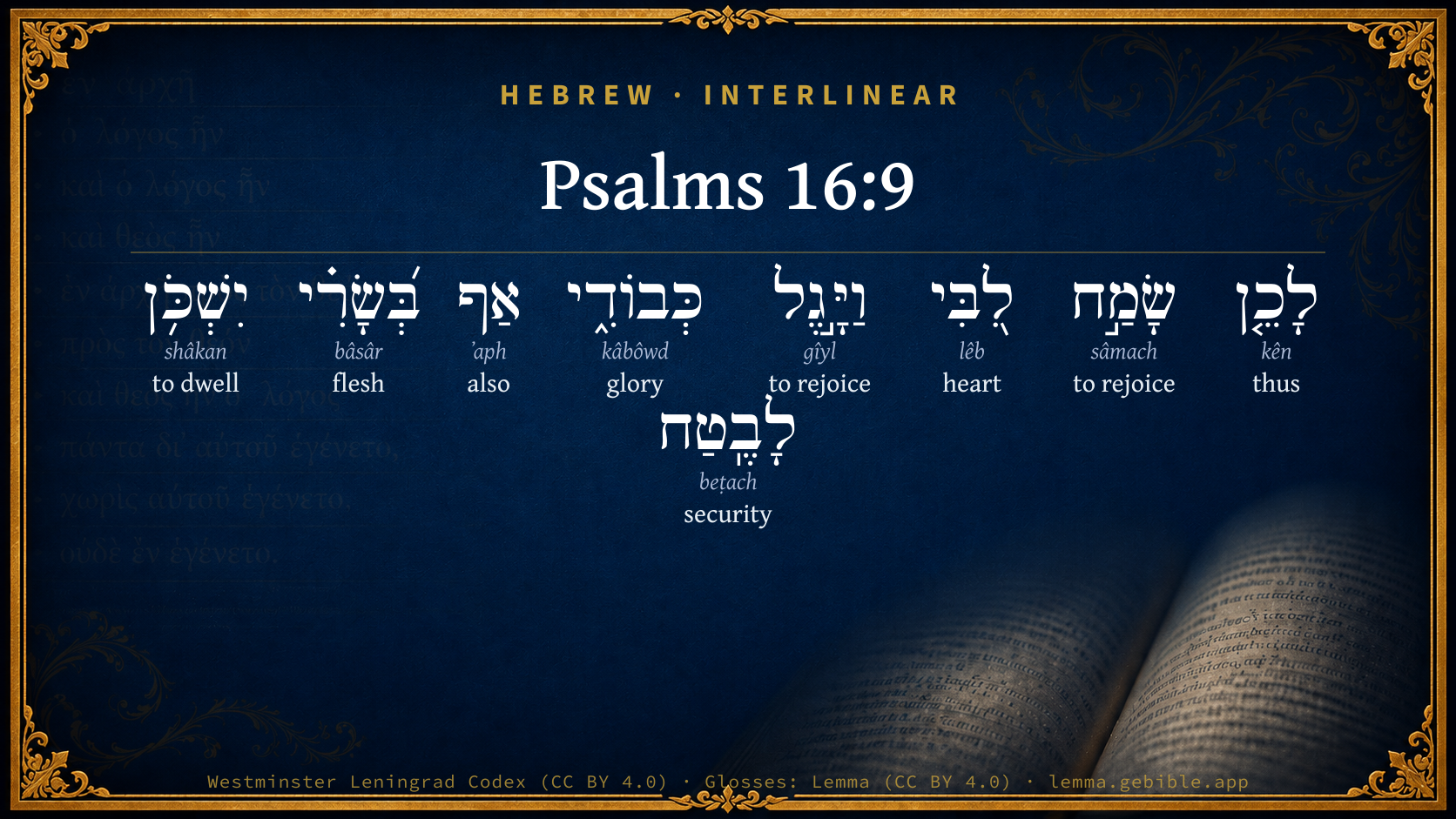
Psalms 16:9

Hebrew (Westminster Leningrad Codex) Psalms 16:9 appears in the Hebrew Old Testament. The text above is from the Westminster Leningrad Codex. Each word links to its Strong’s number, a concise gloss, and parsing drawn from the Open Scriptures Hebrew Bible morphology. Click any word for its full Brown-Driver-Briggs (BDB) entry.
Download image
Cite this verse

Psalms 16:9 (World English Bible). Public Domain. Lemma interlinear Bible study tool, https://lemma.gebible.app/v/psalms/16/9.

Show BibTeX & RIS
BibTeX
RIS
English Translation
Therefore my heart is glad, and my tongue rejoices. My body shall also dwell in safety.
World English Bible · Public Domain
Download a study sheet

One document with this verse’s original text, its word-by-word gloss line, the meaning frame, cross-references with their text, attributed commentary, and full source and license credits — printable, and it pastes into notes with its structure intact.

This verse Autodidact and up

Study sheet (.html) Plain text (.txt)

A passage Seminary Student

Up to 50 verses in one chapter. A passage sheet keeps up to 6 commentary sources and 12 cross-references per verse, in the order this page ranks them, and says so on the sheet whenever that leaves anything out. Ask for a single verse and you get the Autodidact verse sheet above.

Everything on this page stays free to read, with no account — the sheet is a download of what is already on screen, not access to it.

Want to remove ads? Support Godless Engineer
Compare translations 3

The same verse in 3 English versions, stacked beneath the original-language interlinear above. Click any original word for its lexicon entry.

Each is an independent rendering of the whole verse — the interlinear is not word-aligned to these translations.

Highlighted words mark where these versions differ — a whole-verse word diff, not a word-by-word alignment.

  • World English Bible Public Domain
    Therefore my heart is glad, and my tongue rejoices. My body shall also dwell in safety.
  • King James Version Public Domain
    Therefore my heart is glad, and my glory rejoiceth: my flesh also shall rest in hope.
  • unfoldingWord Literal Text CC BY-SA 4.0
    Therefore my heart is glad, and my glory rejoices. Also, my flesh will dwell in security.

unfoldingWord Literal Text — © unfoldingWord, licensed CC BY-SA 4.0. Word-aligned USFM3 via Door43 (git.door43.org/unfoldingWord/en_ult).

Versions to compare (up to 4)

3 of 4 selected

Show all 18 translations

Every available English version of this verse, each an independent rendering of the whole verse.

  • World English Bible Public Domain
    Therefore my heart is glad, and my tongue rejoices. My body shall also dwell in safety.
  • Berean Standard Bible Public Domain
    Therefore my heart is glad and my tongue rejoices; my body also will dwell securely.
  • Majority Standard Bible Public Domain
    Therefore my heart is glad and my tongue rejoices; my body also will dwell securely.
  • King James Version Public Domain
    Therefore my heart is glad, and my glory rejoiceth: my flesh also shall rest in hope.
  • American Standard Version (1901) Public Domain
    Therefore my heart is glad, and my glory rejoiceth; My flesh also shall dwell in safety.
  • Revised Version (1885) Public Domain
    Therefore my heart is glad, and my glory rejoiceth: my flesh also shall dwell in safety.
  • Geneva Bible (1599) Public Domain
    Wherefore mine heart is glad and my tongue reioyceth: my flesh also doeth rest in hope.
  • Douay-Rheims (1899) Public Domain
    Therefore my heart hath been glad, and my tongue hath rejoiced: moreover my flesh also shall rest in hope.
  • Young's Literal Translation Public Domain
    Therefore hath my heart been glad, And my honour doth rejoice, Also my flesh dwelleth confidently:
  • Literal Standard Version CC BY-SA 4.0
    Therefore my heart has been glad, || And my glory rejoices, || Also my flesh dwells confidently:
  • Unlocked Literal Bible CC BY-SA 4.0
    Therefore my heart is glad; my glory is rejoicing. Surely I will live in security.
  • unfoldingWord Literal Text CC BY-SA 4.0
    Therefore my heart is glad, and my glory rejoices. Also, my flesh will dwell in security.
  • Darby Bible Public Domain
    Therefore my heart rejoiceth, and my glory exulteth; my flesh moreover shall dwell in hope.
  • World Messianic Bible Public Domain
    Therefore my heart is glad, and my tongue rejoices. My body shall also dwell in safety.
  • Webster's Bible Public Domain
    Therefore my heart is glad, and my glory rejoiceth: my flesh also shall rest in hope.
  • Free Bible Version CC BY-SA 4.0
    That's why I'm so happy! That's why I am full of joy! That's why my body lives in hope!
  • Bible in Basic English Public Domain
    Because of this my heart is glad, and my glory is full of joy: while my flesh takes its rest in hope.
  • JPS Tanakh (1917) Public Domain
    Therefore my heart is glad, and my glory rejoiceth; my flesh also dwelleth in safety;

Literal Standard Version (2020), Covenant Press — licensed CC BY-SA 4.0. Text via the HelloAO Bible API (eBible.org). Unlocked Literal Bible (unfoldingWord) — licensed CC BY-SA 4.0. Text via the HelloAO Bible API (eBible.org). unfoldingWord Literal Text — © unfoldingWord, licensed CC BY-SA 4.0. Word-aligned USFM3 via Door43 (git.door43.org/unfoldingWord/en_ult). Free Bible Version, Dr. Jonathan Gallagher — licensed CC BY-SA 4.0. Text via the HelloAO Bible API (eBible.org).

Word by word

More ways to search: Search by grammar → Find every occurrence → Compare this word →

Practice this passage: Drill this verse → Learn its vocabulary →

לָבֶֽטַח
beṭach
H983
“to/for · security”
Preposition + Noun, Common, Masculine, Singular, Absolute
Part of Speech
Preposition + Noun
Type
Common
Gender
Masculine
Number
Singular
State
Absolute
Full BDB Definition

Origin: from H982

TWOT: 233a

security, safety - securely
  1. לָכֵ֤ן kên H3651 “to/for · thus” Preposition + Adverb
  2. שָׂמַ֣ח sâmach H8055 “to rejoice” Verb, Qal, Perfect, 3rd Person, Masculine, Singular
  3. לִ֭בִּי lêb H3820 “heart · my” Noun, Common, Masculine, Singular, Construct + Suffix, Personal, 1st Person, Common, Singular
  4. וַיָּ֣גֶל gîyl H1523 “and · to rejoice” Conjunction + Verb, Qal, Sequential Imperfect, 3rd Person, Masculine, Singular
  5. כְּבוֹדִ֑י kâbôwd H3519 “glory · my” Noun, Common, Both, Singular, Construct + Suffix, Personal, 1st Person, Common, Singular
  6. אַף ʼaph H637 “also” Particle, Accusative
  7. בְּ֝שָׂרִ֗י bâsâr H1320 “flesh · my” Noun, Common, Masculine, Singular, Construct + Suffix, Personal, 1st Person, Common, Singular
  8. יִשְׁכֹּ֥ן shâkan H7931 “to dwell” Verb, Qal, Imperfect, 3rd Person, Masculine, Singular

About this verse

These counts appear in no published source. They are computed here, from the morphology-tagged text and Lemma’s own curated glosses. What Lemma adds →

9
words
9
distinct lemmas
Wisdom
section

Shared distinctive vocabulary

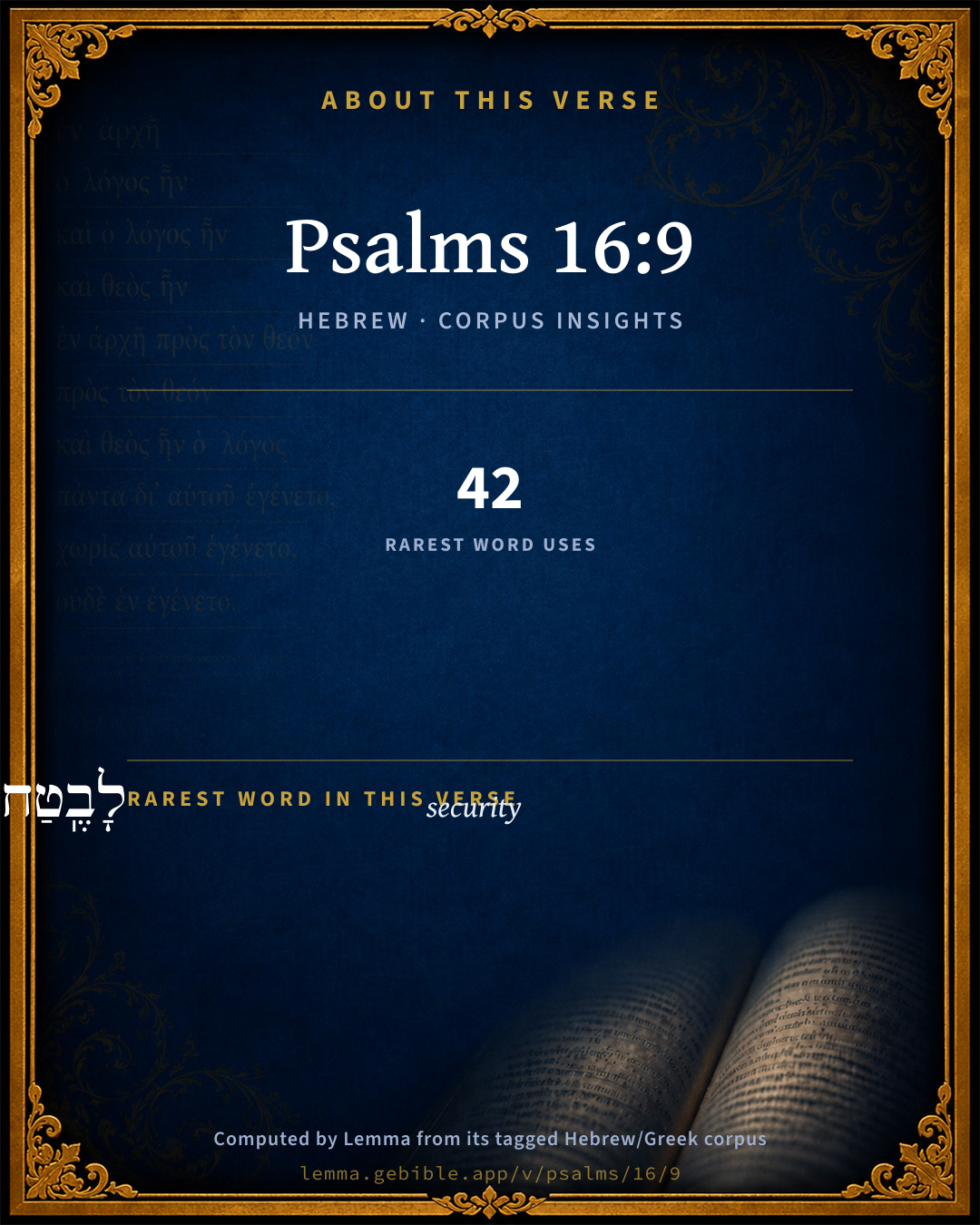
לָבֶֽטַח security H983 occurs in 41 verses of the Hebrew Bible. Also found in:

Grammatical profile

  • 3 verbs
  • 4 nouns
  • 1 adverb
  • 1 particle

Verb forms

  • שָׂמַ֣ח Qal · Perfect
  • וַיָּ֣גֶל Qal · Sequential Imperfect
  • יִשְׁכֹּ֥ן Qal · Imperfect

Hebrew & Septuagint length

In English translation the verse runs 16 words from the Hebrew and 16 from the Septuagint (LXX English) — the same length.

A rough comparison of the two English renderings, which tokenize alike — not a word-level alignment.

Word counts can differ between the Hebrew and the Greek without any difference in meaning — e.g. the Hebrew direct-object marker אֵת has no separate Greek word, and Greek often adds the article ὁ.

Cross-references

12

Topical passages linked to Psalms 16:9 in the Treasury of Scripture Knowledge — connected by theme and wording, ordered by reader-vote popularity; previews shown in the World English Bible.

  • Acts 2:26 Therefore my heart was glad, and my tongue rejoiced. Moreover my flesh also will dwell in hope;
  • Psalms 30:12 To the end that my heart may sing praise to you, and not be silent. Yahweh my God, I will give thanks to you forever!
  • Psalms 57:8 Wake up, my glory! Wake up, psaltery and harp! I will wake up the dawn.
  • Psalms 4:7–8 You have put gladness in my heart, More than when their grain and their new wine are increased.
  • Psalms 108:1 My heart is steadfast, God. I will sing and I will make music with my soul.
  • Job 14:14–15 If a man dies, shall he live again? All the days of my warfare would I wait, Until my release should come.
  • Job 19:26–27 After my skin is destroyed, Then in my flesh shall I see God,
  • Luke 10:21–22 In that same hour Jesus rejoiced in the Holy Spirit, and said, "I thank you, O Father, Lord of heaven and earth, that you have hidden these things from the wise and understanding, and revealed them to little children. Yes, Father, for so it was well-pleasing in your sight."
  • 1 Thessalonians 4:13–14 But we don't want you to be ignorant, brothers, concerning those who have fallen asleep, so that you don't grieve like the rest, who have no hope.
  • Isaiah 26:19 Your dead shall live; my dead bodies shall arise. Awake and sing, you who dwell in the dust; for your dew is [as] the dew of herbs, and the earth shall cast forth the dead.
  • James 3:5–9 So the tongue is also a little member, and boasts great things. See how a small fire can spread to a large forest!
  • Proverbs 14:32 The wicked is brought down in his calamity, But in death, the righteous has a refuge.

Cross-references courtesy of OpenBible.info (CC BY 4.0).

Hebrew and Greek witnesses Masoretic Hebrew ↔ Greek Septuagint

The same verse in the two great witnesses to the Old Testament, shown verse-for-verse.

You’re reading Greek Psalm 15 (Hebrew Psalm 16). The Septuagint counts the superscription, so verse numbers can differ from the Hebrew — chapter-level alignment, not verse-by-verse. Numbering follows Rahlfs.

These are two independent witnesses, not word-aligned to each other, and the Septuagint is shown in lemma (dictionary) form.

Hebrew Psalms 16:9 Masoretic · Westminster Leningrad Codex

לָכֵ֤ן שָׂמַ֣ח לִ֭בִּי וַיָּ֣גֶל כְּבוֹדִ֑י אַף בְּ֝שָׂרִ֗י יִשְׁכֹּ֥ן לָבֶֽטַח

Therefore my heart is glad, and my tongue rejoices. My body shall also dwell in safety.

World English Bible · Public Domain

Greek LXX Greek Psalm 15:9 Septuagint · lemma form

διά οὗτος εὐφραίνω ὁ καρδία ἐγώ καί ἀγαλλιάομαι ὁ γλῶσσα ἐγώ ἔτι δέ καί ὁ σάρξ ἐγώ κατασκηνόω ἐπί ἐλπίς

Therefore my heart rejoiced and my tongue exulted; moreover also my flesh shall rest in hope:

LXX2012 (modern English Septuagint) · Public Domain

On this verse, J. A. Alexander on Psalms discusses the Septuagint’s reading. Read the note in Commentary ↓

Hebrew: Westminster Leningrad Codex (CC BY 4.0). Greek: Septuagint (public domain); English from LXX2012 (modern English Septuagint) (Public Domain). How the Septuagint differs from the Hebrew →

Commentary

Notes on Psalms 16:9 from classic Christian and Jewish commentators (each source and its license shown beneath its notes). The classic Christian expositions comment on the surrounding passage and are grouped to its opening verse, so a note may address several verses; the Jewish commentaries on the Tanakh (Rashi and others) are per-verse, so they appear only where the commentator wrote on this verse.

Lemma curates 59 commentaries, every one of them public domain or Creative Commons licensed, each selected and text-cleaned for this edition rather than reprinted as found. About our sources →

Trapp's Complete Commentary

John Trapp

Psa 16:9 Therefore my heart is glad, and my glory rejoiceth: my flesh also shall rest in hope.

Ver. 9. Therefore my heart is glad, &c.] That is, I am all over in very good plight, as well as heart can wish or need require; I do overly abound exceedingly with joy. God forgive me mine unthankfulness and unworthiness of so great glory (as that martyr, Mr Philpot, said). In all the days of my life I was never so merry as now I am in this dark dungeon, &c. Wicked men rejoice in appearance, and not in heart, 2Co 5:12; their joy is but skin deep, their mirth frothy and flashy, such as wetteth the mouth, but warmeth not the heart. But David is totus totus, quantus quantus exultabundus, his heart, glory, flesh (answerable, as some think, to that of the apostle, 1Th 5:23, spirit, soul, and body), were all over joyed.

My flesh shall also rest (or confidently dwell) in hope] Namely, in this world, as in a way faring lodging; then in the grave, as a place of safeguard and repose; and at last in heaven, as in its true and eternal mansion (Diodati).

John Trapp, A Commentary or Exposition upon All the Books of the Old and New Testament (1647–1656) — public domain. Text from a community e-Sword module.

The Biblical Illustrator

Joseph S. Exell

Psa_16:9-10

Therefore my heart is glad.

Christ joyful in suffering

The remainder of this Psalm we are to consider as spoken by David in reference to the Messiah, of whom he was both a prophet and a type.

I. This passage reminds us of the sufferings of Christ. Old Testament types, promises, and predictions describe Christ as a suffering Saviour. The view of Him thus given through the medium of prophecy is completely realised in His actual history. Well may such an emphasis be laid on the sufferings and death of Christ; for this was the instituted method of redemption.

II. This passage affirms the constancy and cheerfulness with which Christ was to bear His sorrows. My heart is glad, and my glory, that is, my tongue, rejoiceth: So said David, personating the Messiah; and all this was realised in Messiahs actual deportment. Remarkable was the constancy and cheerfulness with which our blessed Saviour bore His sufferings. And we cannot but admire the character in which this excellence was so conspicuously displayed. To our admiration of His unequalled magnanimity we must add the more valuable tribute of our gratitude; for it was in love to our souls that His engagement to suffer and to die had its origin. If we ought to love Him, because He so loved us, oh how deep seated should our affection be!

III. What was it supported and cheered our Saviour in the midst of His sufferings?

1. He set the Lord always before Him, as the great object of His regard.

2. He was cheered by the assurance that God was at His right band. The arm of Jehovah was stretched out for His stay and deliverance.

3. He was supported by the hope of a resurrection of life and blessedness. (A. Thomson, D. D.)

My flesh also shall rest in hope.

Dying welt and comfortably

Doctrine: That it is a sweet, desirable, and Christlike way of dying, to be inwardly willing and joyful, and outwardly triumphing and praising God, from a confidence and hope of His promises.

I. Grounds of comfort.

1. Your God will be with you, and at your right hand, that you shall not be moved.

2. Death is your friend, to bring you to rest. Jesus has, by His death, removed everything from your death that is legally penal and a curse.

3. You shall be raised again to everlasting glory and happiness.

4. Your Lord after the judgment will present you faultless before the presence of His glory.

II. The foundations upon which these consolations against death are built.

1. The Psalmist looks to the acts of Christs mediation as the foundation of all His consolations against death.

2. These consolations are certain in themselves, and to you, from the promises of the covenant of grace, and are founded on them.

III. You must do your part, that you may be comforted, rejoice and triumph when you come to die.

1. You must have faith to believe these reasons of comfort.

2. You must have a lively hope in exercise. What must you do?--

(1) Come speedily out of a state of nature into a state of grace.

(2) Impartially and accurately examine your state, whether in Christ or not.

(3) Live a life of faith.

(4) Keep your consciences pure and void of offence, both towards God and man, and labour to be holy in your lives and conversations.

(5) Be much in the exercise of love.

(6) Live with your hearts weaned from a present world.

(7) Carry well towards the Spirit of joy and comfort, and keep communion with Him. He is the Comforter.

(8) Be frequent in actual preparation for death--promises ready, evidences ready, experiences ready. (James Robe, M. A.)

Immortality

This is an idea which has been growing in the Old Testament. Now and again some word has been interjected into the story that did not seem to belong to it, or was of another quality--a word with a colour, a flush, as if light from an unknown source had struck upon it and lighted it up into new beauty. Job had said one or two words for the explanation of which we must wait; the Psalmist now speaks of his flesh resting in hope, of his soul not being left in an unseen place, and of the Holy One not seeing corruption To impair the doctrine of immortality is to strike at the goodness of God. In denying immortality we may be said to deny the Creator. We cannot treat immortality as a doctrine only; it is really part of the Divine nature. Given God, and immortality in some form is a necessity. Has He created us simply to let us die? Has He given us all these gifts merely to mock us at the last, by allowing us to drop into oblivion and nothingness? Does He permit us to climb to the very door of heaven, and to hear the songs that are sung inside, simply that He may thunder to us--You cannot have part or lot in this inheritance; your destiny is obliteration? Some argument must be founded upon instinct, impulse, yearning, longing, speechless unconsciousness. When we are all, body, soul, and spirit, lifting ourselves up to Him, is it like Him to deny the aspiration? Or like Him to give us that further movement which will connect us consciously with His own eternity? To this latter faith I incline. God has not created aspiration which He cannot satisfy. There is more in us than we can tell, and to these wordless impulses God sends this revelation of immortality. (Joseph Parker, D. D.)

The flesh and its three states

We would speak on the fortunes of the flesh in its three stages of existence.

I. On this side the grave. Note the word also. It carries our thought back to the higher joy of the soul. Neither the essence of sin nor of glory is in the flesh at all. We therefore do not exclude the soul, but rather make it the great centre of all, though we speak more of the flesh. The Redeemer shall satisfy our whole nature. There is no danger, ordinarily, of our forgetting the flesh. It makes its presence predominant enough. Nothing but the regenerated spirit can keep it under. How we admire the heroic deeds of those who in some holy struggle for liberty or for love assert the superiority of the spirit over the flesh. They can die, die in torture, and that gladly, by the power of the spirit within them. But yet the Gospel does not forget even the flesh. How all the natural feelings are deeply touched. This is an argument for the after life of the body. How close is the link between the soul and the body. How they act and react on one another. It, therefore, can never be a matter of indifference to the soul what becomes of the body. And our Lord became flesh, was incarnate, and He has taken it, now glorified, permanently into union with His Godhead. We have no hint that He will ever put it off. It is the same human body which was nursed at the heart of an earthly mother, and which hung upon the Cross in death. Therefore, how can we despise the body? And the hope of the flesh is bound up even with the glory of God Himself. For He did not, at first, mean those bodies to die. There was no death in His counsels. That came by sin. Thus the Divine will was contradicted by Satan. But redemption was to undo Satans work. Yes, each one may cry out in joy, My flesh also shall rest in hope.

II. In the grave. It is a state of rest. The word implies both labours past and repose present. Hence sleep is the condition in which faith loves to regard the body in the grave. And like as in sleep, the body in the grave is free from pain and toil, from sin and suffering, from want and weariness and all pining. And it is a state of unconsciousness, so far as the flesh is concerned, an unconsciousness of the very state in which it lies. The resurrection will appear to follow instantaneously upon death, as our awaking after deep sleep seems to follow close upon our falling asleep. And like sleep, it is but for a while; there will be an awakening. The principle of life is held in abeyance: in sleep, by a natural change; in death, by the immediate will of Him who has all life to give and withhold as He wills. What a holy and loving charm do these thoughts throw around even the decaying flesh: what a light upon the grave.

III. Beyond the grave. It is far more easy to realise with something like precision the future glory of the flesh than that of the spirit. And yet even the bodys glory is far more than we can conceive, because we have no experience of a body free from the penalties of sin. But we have known, at times, fulness of life, of buoyant vigour, and of such pleasure in movement and living that we have been filled with delight. Imagine that eternal. And add new capacities and powers. (Edward Garbitt, M. A.)

The Biblical Illustrator, edited by Joseph S. Exell (c. 1880s–1900s) — public domain. Text from a community e-Sword module.

Joseph Benson's Commentary

Psa 16:9. Therefore — Upon this ground and confidence; my heart is glad — I feel, not only a perfect satisfaction, but joy and triumph in my heart. And my glory — My tongue, as St. Peter explains it, Act 2:26. For the Hebrews give the tongue the name of glory, Psa 30:12; Psa 57:8; Psa 108:1, because it was bestowed upon us that we might thereby glorify God and because it is our glory, as being the instrument of expressing our thoughts by words, a privilege not vouchsafed to any of the inferior creatures; rejoiceth — Hebrew, יגל, jagel, exulteth; declares my inward joy. For this word signifies, not so much inward joy, as the outward demonstrations of it. My flesh also shall rest in hope — My body shall quietly and sweetly rest in the grave, to which I am hastening, in confident assurance of its not suffering corruption there, and of its resurrection to immortal life. The flesh, or body, is in itself but a dead lump of clay; yet hope is here ascribed to it figuratively, as it is to the brute creatures, Rom 8:19, because there is a sufficient cause and foundation for such hope, if it were capable of it, the good promised and expected being future and certain.

Joseph Benson's Commentary on the Old and New Testaments (1811–1818) — public domain. Text from a community e-Sword module.

J. A. Alexander on Psalms

Joseph Addison Alexander

9. (Psa 16:9) Therefore has rejoiced my heart and exulted my glory; yea, my flesh shall dwell in security (or confidence).—Therefore, because God is my ever-present helper. Glory seems here to mean his nobler part, his soul, but not as wholly separate from the body, as appears from what follows. See above, on Psa 7:6 (5).—Flesh may either mean the body, as distinguished from the soul, or the whole person as including both. Compare Psa 63:2 (1), Psa 84:3 (2).—The idea of dwelling in security or confidence of safety is borrowed from the Pentateuch. See Deu 33:12; Deu 33:28, and compare Jdg 18:7, Jer 23:6; Jer 33:16. A similar allusion has been found already in Ps. 4:9 (8). The Septuagint version of the sentence, although it substitutes tongue for glory, is substantially correct, and therefore retained in Act 2:26.—The second clause is not simply parallel and equivalent to the first, but is rather an actual performance of the duty there described. Having there said that his heart did triumph in the certainty of God's protection, he here proves the truth of his assertion, by professing his assured hope that his whole person, not excepting his material part, shall dwell in safety under that protection. This is applicable both to preservation from death and preservation in death, and may therefore without violence be understood, in a lower sense, of David, who did die and see corruption, but whose body is to rise again, as well as in a higher sense of Christ, whose body, though it died, was raised again before it saw corruption.

Joseph Addison Alexander, The Psalms Translated and Explained (1850) — public domain. Text from a community e-Sword module.

Tyndale Open Study Notes

Tyndale Open Resources

16:9-11 Knowing that not even death can separate him from the Lord strengthens the psalmist’s confidence. He fears a separation (see 13:3-4), but he remains confident of seeing the Lord (see 11:7).

Tyndale Open Study Notes — © Tyndale Open Resources, licensed CC BY-SA 4.0. Text via the HelloAO Bible API.

Geneva Bible (1599)

Geneva Bible translators

That is, I rejoice both in body and in soul.

Geneva Bible (1599) marginal notes — public domain. Text via Bolls.life.

Jamieson, Fausset & Brown

Robert Jamieson, A. R. Fausset & David Brown

glory--as heart (Psa 7:5), for self. In Act 2:26, after the Septuagint, "my tongue" as "the glory of the frame"--the instrument for praising God.

flesh--If taken as opposed to soul (Psa 16:10), it may mean the body; otherwise, the whole person (compare Psa 63:1; Psa 84:2).

rest in hope--(compare Margin).

Jamieson, Fausset & Brown — Commentary Critical and Explanatory on the Whole Bible (1871) — public domain (CC PDM 1.0). Text via the HelloAO Bible API.

Adam Clarke's Commentary

Verse 9. Therefore my heart is glad] Unutterably happy in God; always full of the Divine presence; because whatsoever I do pleaseth him. The man Christ Jesus must be constantly in communion with God, because he was without spot and blemish.

My glory rejoiceth] My tongue, so called by the Hebrews, (see Ps 57:8; Ps 30:12,) because it was bestowed on us to glorify God, and because it is our glory, being the instrument of expressing our thoughts by words. See Dodd. But soul bids as fair to be the meaning. See Clarke on Ac 2:25, c.

My flesh also shall rest in hope.] There is no sense in which these and the following words can be spoken of David. Jesus, even on the cross, and breathing out his soul with his life, saw that his rest in the grave would be very short: just a sufficiency of time to prove the reality of his death, but not long enough to produce corruption and this is well argued by St. Peter, Ac 2:31.

Adam Clarke's Commentary on the Bible (1810–1826) — public domain. Text from a community e-Sword/MySword module.

John Calvin's Commentaries

9. Therefore my heart is glad. In this verse the Psalmist commends the inestimable fruit of faith, of which Scripture every where makes mention, in that, by placing us under the protection of God, it makes us not only to live in the enjoyment of mental tranquillity, but, what is more, to live joyful and cheerful. The principal, the essential part of a happy life, as we know, is to possess tranquillity of conscience and of mind; as, on the contrary, there is no greater infelicity than to be tossed amidst a multiplicity of cares and fears.

But the ungodly, however much intoxicated with the spirit of thoughtlessness or stupidity, never experience true joy or serene mental peace; they rather feel terrible agitations within, which often come upon them and trouble them, so much as to constrain them to awake from their lethargy. In short, calmly to rejoice is the lot of no man but of him who has learned to place his confidence in God alone, and to commit his life and safety to his protection. When, therefore, encompassed with innumerable troubles on all sides, let us be persuaded, that the only remedy is to direct our eyes towards God; and if we do this, faith will not only tranquillise our minds, but also replenish them with fullness of joy. David, however, not only affirms that he is glad inwardly; he also makes his tongue, yea, even his flesh, sharers of this joy. And not without cause, for true believers not only have this spiritual joy in the secret affection of their heart, but also manifest it by the tongue, inasmuch as they glory in God as He who protects them and secures their salvation. The word כבוד, kabod, properly signifies glory and excellence. I have, however, no doubt of its being here taken for the tongue, The reading of the Septuagint is, “γλωσσα μου” “my tongue.” This is unquestionably the meaning. David uses the word glory for the organ by which God is glorified or praised. The Apostle Peter, in quoting this passage, (Acts 2:26,) reads, “my tongue.” See also Psalm 36:12

John Calvin's Commentaries (1540-1563) — public domain. Text from the Calvin Translation Society English edition (1840s-50s) via the Christian Classics Ethereal Library (ccel.org). Calvin's coverage is partial (roughly two-thirds of the Bible); uncommented books and verses are honest gaps, never fabricated. The 19th-century editor's footnotes and remarks are omitted so the notes are faithfully Calvin's own voice.

Ellicott's Commentary for English Readers

(9) Glory.—Heb., khabôd; but probably the poet wrote khabed, i.e., liver, or (comp. “reins” above, and the common use of the word “bowels”) heart. The LXX. paraphrase tongue. The passage was so quoted in Act_2:25. (Comp. Psa_57:8; Psa_108:1.) “With the best member that I have” (Prayer Book).

Shall rest in hope.—This follows the Vulg. The LXX. also have “shall tabernacle in hope.” The true rendering, however, is shall rest in security. In “heart, soul, flesh,” the poet comprises the whole living man. (Comp. 1Th_5:23.) The psalmist feels that the body must share with the soul the immunity from evil which is insured by fellowship with God. Carried out to its full issue, the logical conclusion of this is the doctrine of immortality; but we must not see a conscious reference to it here.

A Bible Commentary for English Readers, edited by Charles John Ellicott (1878–1897) — public domain. Text from a community e-Sword module.

The Cambridge Bible for Schools and Colleges

gen. ed. J. J. S. Perowne

9. my glory] i.e. my soul. See note on Psa_7:5. The LXX renders freely my tongue.

my flesh also shall rest in hope] So the Vulg., insurer et caro mea requiescet in spe. Beautiful and suggestive as this rendering is, it is inaccurate and misleading, and must be replaced by that of R.V.

My flesh also shall dwell in safety (marg. securely).

Cp. Jer., et caro mea habitavit [v.l. habitabit] confidenter.

Dwell in safety is a phrase repeatedly used of a life of undisturbed security in the promised land. See Deu_33:12; Deu_33:28; Pro_1:33; Jer_23:6; Jer_33:16. Fellowship with Jehovah guarantees outward security as well as inward joy. The words do not refer, primarily at least, to the rest of the body in the grave in the hope of a joyful resurrection. Flesh does not denote the dead corpse, but the living organism in and through which the soul works: together with heart and soul it makes up the whole man (Psa_63:1; Psa_73:26; Psa_84:2; cp. 1Th_5:23).

9–11. The blessed outcome of this fellowship is joy, confidence, progress.

The Cambridge Bible for Schools and Colleges (gen. ed. J. J. S. Perowne; Cambridge University Press, 1878–1918) — public domain. Text from a community e-Sword module.

John Gill's Exposition

Therefore my heart is glad,.... Because he had the Lord always in view; he was at his right hand, for his support and assistance, as well as because of what is expressed in the next verses: this is the same with rejoicing in spirit, Luk 10:21; it denotes an inward joy, and fulness of it, because of the Lord's presence with him; see Act 2:28;

and my glory rejoiceth; meaning either his soul, which is the most glorious and noble part of man, as Aben Ezra, Kimchi, and Ben Melech interpret it; or rather his tongue, as in Act 2:26; the faculty of speaking in man being what gives him a superior glory and excellency to other creatures, and is that whereby he glorifies God; and so the word is often used in this book; see Psa 30:12; and here the phrase designs Christ's glorifying God, and singing his praise with joyful lips, among his disciples, a little before his sufferings and death;

my flesh also shall rest in hope; in the grave, which, as it is a resting place to the members of Christ, from all their sorrow, toil, and labour here; so it was to Christ their head, who rested in it on the Jewish sabbath, that day of rest, and that berth "in safety" (t), as the word used may signify, and in of his resurrection from the dead, as follows.

(t) "in tuto", Tigurine version; "secure", Junius & Tremellius, Piscator, Cocceius; "in confidence", Ainsworth.

John Gill's Exposition of the Whole Bible (1746–1763) — public domain (CC PDM 1.0). Text via the HelloAO Bible API.

Albert Barnes' Notes on the Bible

Therefore my heart is glad - In view of this fact, that my confidence is in God alone, and my belief that he is my Protector and Friend. See the notes at Act 2:26.

And my glory rejoiceth - The Septuagint translate this, “my tongue,” and this translation is followed by Peter in his quotation of the passage in Act 2:26. See the notes at that passage. The meaning here is, that whatever there was in him that was honorable, dignified, or glorious - all the faculties of his soul, as well as his heart - had occasion to rejoice in God. His whole nature - his undying soul - his exalted powers as he was made by God - all - all, found cause of exultation in the favor and friendship of God. The heart - the uuderstanding - the imagination - the whole immortal soul, found occasion for joy in God.

My flesh also - My body. Or, it may mean, his whole person, he himself, though the direct allusion is to the body considered as lying in the grave, Psa 16:10. The language is such as one would use of himself when he reflected on his own death, and it is equivalent to saying, “I myself, when I am dead, shall rest in hope; my soul will not be left to abide in the gloomy place of the dead; nor will my body remain permanently in the grave under the power of corruption. In reference to my soul and my body - my whole nature - I shall descend to the grave in the hope of a future life.”

Shall rest - Margin, “dwell confidently.” The Hebrew is literally “shall dwell in confidence” or hope. The word here rendered “shall rest” means properly to let oneself down; to lie down, Num 9:17; Exo 24:16; then, to lay oneself down, to lie down, as, for example, a lion lying down, Deu 33:20; or a people in tents, Num 24:2; and hence, to rest, to take rest, Jdg 5:17; and then to abide, to dwell. Gesenius, Lexicon. Perhaps the sense here is that of “lying down,” considered as lying in the grave, and the expression is equivalent to saying, “When I die I shall lie down in the grave in hope or confidence, not in despair. I shall expect to rise and live again.”

In hope - The word used here means “trust, confidence, security.” It is the opposite of despair. As used here, it would refer to a state of mind in which there was an expectation of living again, as distinguished from that state of mind in which it was felt that the grave was the end of man. What is particularly to be remarked here is, that this trust or confidence extended to the “flesh” as well as to the “soul;” and the language is such as would be naturally used by one who believed in the resurrection of the body. Language of this kind occurs elsewhere in the Old Testament, showing that the doctrine of the resurrection of the body was one to which the sacred writers were not strangers, and that although the doctrine was not as explicitly and formally stated in the Old Testament as in the New, yet that it was a doctrine which had been at some time communicated to man. See Isa 26:19, note; Dan 12:2, note. As applicable to David, the language used here is expressive of his belief that “he” would rise again, or would not perish in the grave when his body died; as applicable to the Messiah, as applied by Peter Act 2:26, it means that when “he” should die it would be with the hope and expectation of being raised again without seeing corruption. The language is such as to be applicable to both cases; and, in regard to the interpretation of the “language,” it makes no difference whether it was supposed that the resurrection would occur before the body should moulder back to dust, or whether it would occur at a much more remote period, and long after it had gone to decay. In either case it would be true that it was laid in the grave “in hope.”

Albert Barnes' Notes on the Bible (1834–1885) — public domain. Text from a community e-Sword/MySword module.

Matthew Poole's English Annotations

Therefore; upon this ground and confidence. My heart; the proper seat of joy, and of all the affections.

My glory; either,

1. My soul, which isindeed the glory of a man. Or rather,

2. My tongue, which also is a man’s glory and privilege above all other living creatures, and the instrument of glorifying both God and man; and which is oft called a man’s glory, as Gen 49:6; Psa 30:12; 57:8; 108:1; 149:5. And so this very word is translated Act 2:26. And thus the distinction between heart, and glory, and

flesh is more certain and evident. Rejoiceth; or, exulteth, i.e. declares or expresseth my inward joy. For this verb signifies not so much internal joy, as the outward and visible demonstrations of it in words or gestures and carriages.

My flesh shall rest, i.e. my body shall quietly and sweetly rest in the grave, to which I am hastening.

In hope, i.e. in confident assurance of its incorruption there, and of its resurrection to a blessed and immortal life, as it is explained, Psa 16:10,11. The flesh or body is in itself but a dead and senseless lump of clay, yet hope is here ascribed to it figuratively, as it is to the brute creatures, Rom 8:19, because there is matter and foundation for such hope, if it were capable of it, the good promised and expected being certainly future.

Matthew Poole's English Annotations on the Holy Bible (1683–1685) — public domain. Text from a community e-Sword/MySword module.

The Treasury of David

Charles H. Spurgeon

Ver. 9-10. The summing or reckoning of the gold. The believer rejoicing and praising God for the promise of a rest in hope and resurrection into glory.

Ver. 9. He clearly foresaw that he must die, for he speaks of his flesh resting, and of his soul in the abode of separate spirits; death was full before his face, or he would not have mentioned corruption; but such was his devout reliance upon his God, that he sang over the tomb, and rejoiced in vision of the sepulchre. He knew that the visit of his soul to Sheol, or the invisible world of disembodied spirits, would be a very short one, and that his body in a very brief space would leave the grave, uninjured by its sojourn there; all this made him say,

my heart is glad, and moved his tongue, the

glory of his frame, to

rejoice in God, the strength of his salvation. Oh, for such holy faith in the prospect of trial and of death! It is the work of faith, not merely to create a peace which passeth all understanding, but to fill the heart full of gladness until the tongue, which, as the organ of an intelligent creature, is our glory, bursts forth in notes of harmonious praise. Faith gives us living joy, and bestows dying rest.

My flesh also shall rest in hope.

Ver. 9. My heart is glad. Men may for a time be hearers of the gospel, men may for order's sake pray, sing, receive the sacraments; but if it be without joy, will not that hypocrisy in time break out? Will they not begin to be weary? Nay, will they not be as ready to hear any other doctrine? Good things cannot long find entertainment in our corruptions, unless the Holy Ghost hath changed us from our old delights to conceive pleasure in these things. Richard Greenham.

Ver. 9. My heart is glad, and my glory rejoiceth. His inward joy was not able to contain itself. We testify our pleasure on lower occasions, even at the gratification of our senses; when our ear is filled with harmonious melody, when our eye is fixed upon admirable and beauteous objects, when our smell is recreated with agreeable odours, and our taste also by the delicacy and rareness of provisions; and much more will our soul show its delight, when its faculties, that are of a more exquisite constitution, meet with things that are in all respects agreeable and pleasant to them; and in God they meet with all those: with his light our understanding is refreshed, and so is our will with his goodness and his love. Timothy Rogers.

Ver. 9. Therefore my heart is glad, etc. That is, I am all over in very good plight, as well as heart can wish, or require; I do over abound exceedingly with joy; "God forgive me mine unthankfulness and unworthiness of so great glory" (as that martyr said): "In all the days of my life I was never so merry as now I am in this dark dungeon, " etc. Wicked men rejoice in appearance, and not in heart (2Co 5:12); their joy is but skin deep, their mirth frothy and flashy, such as wetteth the mouth, but warmeth not the heart. But David is totus totus, quantus quantus exultabundus; his heart, glory, flesh, (answerable, as some think to that of the apostle, 1Th 5:23; spirit, soul, and body) were all overjoyed. John Trapp.

Ver. 9. My flesh shall rest in hope. If a Jew pawned his bed clothes, God provided mercifully that it should be restored before night: "For, "saith he, "that is his covering: wherein shall he sleep?" Ex 22:27. Truly, hope is the saint's covering, wherein he wraps himself, when he lays his body down to sleep in the grave: "My flesh, "saith David, "shall rest in hope." O Christian, bestir thyself to redeem thy hope before this sun of thy temporal life goes down upon thee, or else thou art sure to lie down in sorrow. A sad going to the bed of the grave he hath who hath no hope of a resurrection to life. William Gurnall.

Ver. 9. My flesh shall rest in hope. That hope which is grounded on the word, gives rest to the soul; It is an anchor to keep it steady. Heb 6:13. Which shows the unmovableness of that which our anchor is fastened to. The promise sustains our faith, and our faith is that which supports us. He that hopes in the Word as David did (Ps 119:81), lays a mighty stress upon it; as Samson did when he leaned upon the pillars of the house, so as to pull it down upon the Philistines. A believer throws the whole weight of all his affairs and concerns, temporal, spiritual, and eternal, upon the promises of God, like a man resolved to stand or fall with them. He ventures himself, and all that belongs to him, entirely upon this bottom, which is in effect to say, if they will not bear me up, I am content to sink; I know that there shall be a performance of those things which have been told me from the Lord, and therefore I will incessantly look for it. Timothy Cruso.

Ver. 9. (last clause).

1. The saint's Sabbath (rest).

2. His sarcophagus (in hope).

3. His salvation (for which he hopes).

Ver. 9-10. Jesus cheered in prospect of death by the safety of his soul and body; our consolation in him as to the same.

Psalms 16:10*

Ver. 9-10. Jesus cheered in prospect of death by the safety of his soul and body; our consolation in him as to the same.

Charles H. Spurgeon's The Treasury of David (1869–1885) — public domain. Psalms only. Text from a community e-Sword/MySword module.

Whedon's Commentary on the Bible

Daniel D. Whedon

9. My glory—The word generally means honour, majesty, renown; but here, the soul, as the most excellent part of man.

My flesh… shall rest in hope—כשׂר, (flesh,) is the organic body, and the enumeration of heart, glory, (soul,) flesh, nearly answers to the Greek trichotomy, “spirit, soul, and body,” 1Th_5:23, where see note. When applied to the human body the word commonly means the living body, as opposed to one dead, and it has been hence urged that it could not apply, as a prophecy, to the dead body of Christ. But against this it may be urged, first, To restrict the whole to the personal history of David would give only the sense, “My body shall dwell in safety,” that is, I shall be preserved alive—a rendering too insipid and pointless to comport with the dignity of the psalm. Secondly, The scope of the passage requires us to understand the author as speaking of the state after death. See on Psa_16:10-11. Thirdly, It would be perfectly natural for him, in speaking of the future state and destiny of the body, to use a term that designates that living body, as if he had said, “This body, now alive, shall rest in hope,” etc. Fourthly, The word not unfrequently denotes the body as frail, mortal, perishable, (as 2Ch_32:8; Psa_56:4; Psa_78:39,) in which sense it is exactly suitable to this connexion, just as the apostle, “This corruptible (equal to mortal body) shall put on interruption.” 1Co_15:53. Fifthly, The word is certainly applied to a dead body. Zec_11:9; Ezekiel 37:68. Sixthly, The “also” (“also my flesh,” etc.) signifies something additional to what had been hitherto said or applied. But the rendering objected to gives no accession to, but a fatal falling off, of the sense. Above all, it directly contradicts the literal application of the passage made by the apostle in Act_2:25-35, where see notes.

Daniel D. Whedon (gen. ed.), Commentary on the Old and New Testaments (1874–1909) — public domain. Text from a community e-Sword module.

The Pulpit Commentary

Therefore my heart is glad, and my glory rejoiceth. The thought of God"s continual presence at his right hand causes David"s "heart" to be "glad," and his "gloryi.e. his soul, or spirit, (Gen_49:6) man"s true glory to rejoice. My flesh also shall rest in hope. His "flesh his corporeal nature, united closely with his "heart" and "spirit rests, and will rest, secure, confident that God will watch over it, and make the whole complex man body, soul, and spirit to "dwell in safety". (Psa_4:8)

The Pulpit Commentary (1880–1919), ed. H.D.M. Spence-Jones & Joseph S. Exell — public domain. Text from a community e-Sword module.

John Wesley's Explanatory Notes

My glory - My tongue, which is a man's glory and privilege, above all other living creatures. Rejoiceth - Declares my inward joy. For this word signifies not so much eternal joy, as the outward demonstrations of it. My flesh - My body shall quietly rest in the grave. Shall rest - in confident assurance of its incorruption there, and of its resurrection to an immortal life: the flesh or body is in itself, but a dead lump of clay; yet hope is here ascribed to it figuratively, as it is to the brute creatures, Rom. viii, 19.

John Wesley, Explanatory Notes Upon the Whole Bible (1754–1765) — public domain. Text via the GEBible commentary corpus.

Keil & Delitzsch

C. F. Keil & F. Delitzsch

Thus then, as this concluding strophe, as it were like seven rays of light, affirms, he has the most blessed prospect before him, without any need to fear death. Because Jahve is thus near at hand to help him, his heart becomes joyful (שׂמח) and his glory, i.e., his soul (vid., on Psa 7:6) rejoices, the joy breaking forth in rejoicing, as the fut. consec. affirms. There is no passage of Scripture that so closely resembles this as Th1 5:23. לב is πνεῦμα (νοῦς), כבוד, ψυχή (vid., Psychol. S. 98; tr. p. 119), בּשׂר (according to its primary meaning, attrectabile, that which is frail), σῶμα. The ἀμέμπτως τηρηθῆναι which the apostle in the above passage desires for his readers in respect of all three parts of their being, David here expresses as a confident expectation; for אף implies that he also hopes for his body that which he hopes for his spirit-life centred in the heart, and for his soul raised to dignity both by the work of creation and of grace. He looks death calmly and triumphantly in the face, even his flesh shall dwell or lie securely, viz., without being seized with trembling at its approaching corruption. David's hope rests on this conclusion: it is impossible for the man, who, in appropriating faith and actual experience, calls God his own, to fall into the hands of death. For Psa 16:10 shows, that what is here thought of in connection with שׁכן לבטח, dwelling in safety under the divine protection (Deu 33:12, Deu 33:28, cf. Pro 3:24), is preservation from death. שׁחת is rendered by the lxx διαφθορά, as though it came from שׁחת διαφθείρειν, as perhaps it may do in Job 17:14. But in Psa 7:16 the lxx has βόθρος, which is the more correct: prop. a sinking in, from שׁוּח to sink, to be sunk, like נחת from נוּח, רחת from רוּח. To leave to the unseen world (עזב prop. to loosen, let go) is equivalent to abandoning one to it, so that he becomes its prey. Psa 16:10 - where to see the grave (Psa 49:10), equivalent to, to succumb to the state of the grave, i.e., death (Psa 89:49; Luk 2:26; Joh 8:51) is the opposite of "seeing life," i.e., experiencing and enjoying it (Ecc 9:9, Joh 3:36), the sense of sight being used as the noblest of the senses to denote the sensus communis, i.e., the common sense lying at the basis of all feeling and perception, and figuratively of all active and passive experience (Psychol. S. 234; tr. p. 276) - shows, that what is said here is not intended of an abandonment by which, having once come under the power of death, there is no coming forth again (Bttcher). It is therefore the hope of not dying, that is expressed by David in Psa 16:10. for by חסידך David means himself. According to Norzi, the Spanish MSS have חסידיך with the Masoretic note יתיר יוד, and the lxx, Targ., and Syriac translate, and the Talmud and Midrash interpret it, in accordance with this Ker. There is no ground for the reading חסידיך, and it is also opposed by the personal form of expression surrounding it.

(Note: Most MSS and the best, which have no distinction of Ker and Chethb here, read חסידך, as also the Biblia Ven. 1521, the Spanish Polyglott and other older printed copies. Those MSS which give חסידיך (without any Ker), on the other hand, scarcely come under consideration.)

The positive expression of hope in Psa 16:11 comes as a companion to the negative just expressed: Thou wilt grant me to experience (הודיע, is used, as usual, of the presentation of a knowledge, which concerns the whole man and not his understanding merely) ארח חיּים, the path of life, i.e., the path to life (cf. Pro 5:6; Pro 2:19 with ib. Psa 10:17; Mat 7:14); but not so that it is conceived of as at the final goal, but as leading slowly and gradually onwards to life; חיּים in the most manifold sense, as, e.g., in Psa 36:10; Deu 30:15 : life from God, with God, and in God, the living God; the opposite of death, as the manifestation of God's wrath and banishment from Him. That his body shall not die is only the external and visible phase of that which David hopes for himself; on its inward, unseen side it is a living, inwrought of God in the whole man, which in its continuance is a walking in the divine life. The second part of Psa 16:11, which consists of two members, describes this life with which he solaces himself. According to the accentuation, - which marks חיים with Olewejored not with Rebia magnum or Pazer, - שׂבע שׂמחות is not a second object dependent upon תּודיעני, but the subject of a substantival clause: a satisfying fulness of joy is את־פּניך, with Thy countenance, i.e., connected with and naturally produced by beholding Thy face (את preposition of fellowship, as in Psa 21:7; 140:14); for joy is light, and God's countenance, or doxa, is the light of lights. And every kind of pleasurable things, נעמות, He holds in His right hand, extending them to His saints - a gift which lasts for ever; נצח equivalent to לנצח. נצח, from the primary notion of conspicuous brightness, is duration extending beyond all else - an expression for לעולם, which David has probably coined, for it appears for the first time in the Davidic Psalms. Pleasures are in Thy right hand continually - God's right hand is never empty, His fulness is inexhaustible.

The apostolic application of this Psalm (Act 2:29-32; Act 13:35-37) is based on the considerations that David's hope of not coming under the power of death was not realised in David himself, as is at once clear, to the unlimited extent in which it is expressed in the Psalm; but that it is fulfilled in Jesus, who has not been left to Hades and whose flesh did not see corruption; and that consequently the words of the Psalm are a prophecy of David concerning Jesus, the Christ, who was promised as the heir to his throne, and whom, by reason of the promise, he had prophetically before his mind. If we look into the Psalm, we see that David, in his mode of expression, bases that hope simply upon his relation to Jahve, the ever-living One. That it has been granted to him in particular, to express this hope which is based upon the mystic relation of the חסיד to Jahve in such language, - a hope which the issue of Jesus' life has sealed by an historical fulfilment, - is to be explained from the relation, according to the promise, in which David stands to his seed, the Christ and Holy One of God, who appeared in the person of Jesus. David, the anointed of God, looking upon himself as in Jahve, the God who has given the promise, becomes the prophet of Christ; but this is only indirectly, for he speaks of himself, and what he says has also been fulfilled in his own person. But this fulfilment is not limited to the condition, that he did not succumb to any peril that threatened his life so long as the kingship would have perished with him, and that, when he died, the kingship nevertheless remained (Hofmann); nor, that he was secured against all danger of death until he had accomplished his life's mission, until he had fulfilled the vocation assigned to him in the history of the plan of redemption (Kurtz) - the hope which he cherishes for himself personally has found a fulfilment which far exceeds this. After his hope has found in Christ its full realisation in accordance with the history of the plan of redemption, it receives through Christ its personal realisation for himself also. For what he says, extends on the one hand far beyond himself, and therefore refers prophetically to Christ: in decachordo Psalterio - as Jerome boldly expresses it - ab inferis suscitat resurgentem. But on the other hand that which is predicted comes back upon himself, to raise him also from death and Hades to the beholding of God. Verus justitiae sol - says Sontag in his Tituli Psalmorum, 1687 - e sepulcro resurrexit, στήλη seu lapis sepulcralis a monumento devolutus, arcus triumphalis erectus, victoria ab hominibus reportata. En vobis Michtam! En Evangelium! -

Keil & Delitzsch — Biblical Commentary on the Old Testament (1861–1891) — public domain (CC PDM 1.0). Text via the HelloAO Bible API. (Old Testament only.)

Scofield Reference Notes

C. I. Scofield

thy flesh

The 16th Psalm is a prediction of the resurrection of the King. As a prophet David understood that, not at His first advent, but at some time subsequent to His death and resurrection Messiah would assume the Davidic throne. See Act 2:25-31; Luk 1:32; Luk 1:33; Act 15:13-17. See "Davidic Covenant," (See Scofield "2Sa 7:14"); "Kingdom (O.T.)," See Scofield "Zec 12:8".

See Psalms 22, next in order of the Messianic Psalms.

The Scofield Reference Bible (1917 edition), notes by C. I. Scofield — public domain. Text from a community e-Sword module.

unfoldingWord translationNotes

Door43 World Missions Community

General Information:

David continues to speak to God.

my heart is glad

Here the "heart" represents the speaker's thoughts and emotions. AT: "Therefore I am glad" (See: Metonymy)

my glory is rejoicing

Possible meanings are 1) the word "glory" represents the honor a person feels. AT: "I am honored to rejoice in God" or 2) the word translated "glory" really means "liver" and represents the speaker's emotions. AT: "I am rejoicing"

translationWords

heart

life

soul

Hades

covenant faithfulness

pit

unfoldingWord translationNotes — © Distant Shores Media and the Door43 World Missions Community, licensed CC BY-SA 4.0. Source: git.door43.org/Door43/en_tn.

Rashi

Rabbi Shlomo Yitzchaki (Rashi)

Therefore, my heart rejoiced, etc. because I am confident that You will not forsake my soul to the grave. Since, concerning the iniquity of a grave transgression which I committed, You sent me the tidings (in II Sam. 12:13): “Also the Lord has removed your sin,” certainly from now on You will not forsake me [to cause me] to turn away from You.

Rashi on the Tanakh — English translations: “The Judaica Press complete Tanach with Rashi, translated by A. J. Rosenberg” (CC BY 4.0); “Pentateuch with Rashi's commentary by M. Rosenbaum and A.M. Silbermann, 1929-1934” (public domain); “The Metsudah Tanach series, Lakewood, N.J” (CC BY 4.0); and “The Book of Joshua, Metsudah Publications, 1997” (CC BY 4.0). Text via Sefaria.

Radak

Rabbi David Kimhi (Radak)

Therefore my heart is glad: – Because I have put Thee before me always my heart is glad.

and my glory exulteth: – that is, the soul, which is the glory of the body; for I am confident that when it is separated from the body it will cleave to its Creator.

My flesh also: – while I am still alive

shall dwell in security: – for Thou shalt deliver me from all harm. And in the Haggadic interpretation (Shoher Tob and Babli, Baba Bathra 17a) (the explanation is given): “after death, when worm and corruption shall have no power over it, (shall my flesh dwell in security).”

Radak on the Tanakh — English translations: “Sefaria Community Translation” (CC0 1.0 (public-domain dedication)); “Eliyahu Munk, HaChut Hameshulash” (CC BY 4.0); “Rabbi Mike Feuer, Jerusalem Anthology” (CC BY 4.0); and “R. David Kimhi on the first book of Psalms, Translated by R.G. Finch, London, 1919” (public domain). Text via Sefaria.

Lesson kit

Teaching starters — assembled from the data on this page, not authored interpretation. Every prompt links to the verse data it draws on. Edit before teaching.

Psalms, in the Wisdom, opens this verse with 9 words (9 distinct Hebrew lemmas). Its most distinctive word is beṭach (“security”). A historical commentator’s framing appears above. Read the whole chapter for the surrounding context.

Discussion questions

  1. How does “security” (beṭach) shape what this verse is saying?
  2. Genesis 34:25 shares the word «security» with this verse. How do the two illuminate each other?
  3. These translations render this verse differently. What is at stake in choosing one wording over another?
  4. The verb «שָׂמַ֣ח» is Qal Perfect. How does its form color the action?
  5. Reading how Trapp's Complete Commentary and The Biblical Illustrator read this verse, where do the two commentators agree and where do they part?

Things to notice

Reading settings

Reading text

Shown beneath each verse's original-language words.

Old Testament
Old Testament edition

Read the OT as the Masoretic Hebrew (MT) or the Greek Septuagint (LXX).

English shown for the Greek Septuagint (in the Hebrew ↔ Greek comparison).

Comparing translations? Open the Compare panel on any verse page to stack up to four side by side.