
Ecclesiastes 10:19

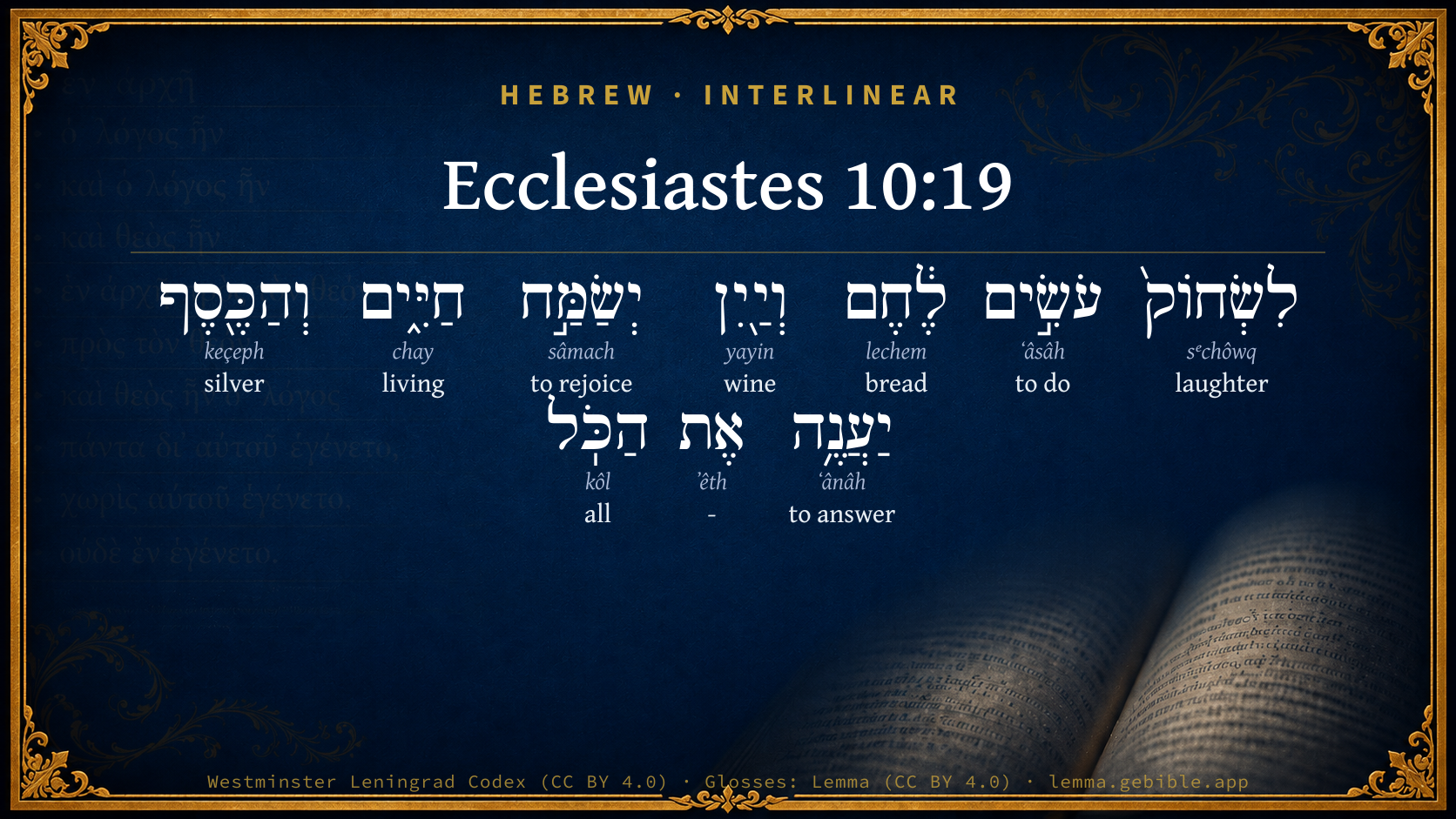
Hebrew (Westminster Leningrad Codex) Ecclesiastes 10:19 appears in the Hebrew Old Testament. The text above is from the Westminster Leningrad Codex. Each word links to its Strong’s number, a concise gloss, and parsing drawn from the Open Scriptures Hebrew Bible morphology. Click any word for its full Brown-Driver-Briggs (BDB) entry.
Download image
Cite this verse

Ecclesiastes 10:19 (World English Bible). Public Domain. Lemma interlinear Bible study tool, https://lemma.gebible.app/v/ecclesiastes/10/19.

Show BibTeX & RIS
BibTeX
RIS
English Translation
A feast is made for laughter, And wine makes the life glad; And money is the answer for all things.
World English Bible · Public Domain
Download a study sheet

One document with this verse’s original text, its word-by-word gloss line, the meaning frame, cross-references with their text, attributed commentary, and full source and license credits — printable, and it pastes into notes with its structure intact.

This verse Autodidact and up

Study sheet (.html) Plain text (.txt)

A passage Seminary Student

Up to 50 verses in one chapter. A passage sheet keeps up to 6 commentary sources and 12 cross-references per verse, in the order this page ranks them, and says so on the sheet whenever that leaves anything out. Ask for a single verse and you get the Autodidact verse sheet above.

Everything on this page stays free to read, with no account — the sheet is a download of what is already on screen, not access to it.

Want to remove ads? Support Godless Engineer
Compare translations 3

The same verse in 3 English versions, stacked beneath the original-language interlinear above. Click any original word for its lexicon entry.

Each is an independent rendering of the whole verse — the interlinear is not word-aligned to these translations.

Highlighted words mark where these versions differ — a whole-verse word diff, not a word-by-word alignment.

  • World English Bible Public Domain
    A feast is made for laughter, And wine makes the life glad; And money is the answer for all things.
  • King James Version Public Domain
    A feast is made for laughter, and wine maketh merry: but money answereth all things.
  • unfoldingWord Literal Text CC BY-SA 4.0
    For laughter, are making bread, and wine gladdens life, but silver answers everything. q1

unfoldingWord Literal Text — © unfoldingWord, licensed CC BY-SA 4.0. Word-aligned USFM3 via Door43 (git.door43.org/unfoldingWord/en_ult).

Versions to compare (up to 4)

3 of 4 selected

Show all 18 translations

Every available English version of this verse, each an independent rendering of the whole verse.

  • World English Bible Public Domain
    A feast is made for laughter, And wine makes the life glad; And money is the answer for all things.
  • Berean Standard Bible Public Domain
    A feast is prepared for laughter, and wine makes life merry, but money is the answer for everything.
  • Majority Standard Bible Public Domain
    A feast is prepared for laughter, and wine makes life merry, but money is the answer for everything.
  • King James Version Public Domain
    A feast is made for laughter, and wine maketh merry: but money answereth all things.
  • American Standard Version (1901) Public Domain
    A feast is made for laughter, and wine maketh glad the life; and money answereth all things.
  • Revised Version (1885) Public Domain
    A feast is made for laughter, and wine maketh glad the life: and money answereth all things.
  • Geneva Bible (1599) Public Domain
    They prepare bread for laughter, and wine comforteth the liuing, but siluer answereth to all.
  • Douay-Rheims (1899) Public Domain
    For laughter they make bread, and wine that the living may feast: and all things obey money.
  • Young's Literal Translation Public Domain
    For mirth they are making a feast, And wine maketh life joyful, And the silver answereth with all.
  • Literal Standard Version CC BY-SA 4.0
    For mirth they are making a feast, || And wine makes life joyful, || And the silver answers with all.
  • Unlocked Literal Bible CC BY-SA 4.0
    People prepare food for laughter, wine brings enjoyment to life, and money fills the need for everything.
  • unfoldingWord Literal Text CC BY-SA 4.0
    For laughter, are making bread, and wine gladdens life, but silver answers everything. q1
  • Darby Bible Public Domain
    A feast is made for laughter, and wine maketh life merry; but money answereth everything.
  • World Messianic Bible Public Domain
    A feast is made for laughter, and wine makes the life glad; and money is the answer for all things.
  • Webster's Bible Public Domain
    A feast is made for laughter, and wine maketh merry: but money answereth all things.
  • Free Bible Version CC BY-SA 4.0
    A good meal brings pleasure; wine makes life pleasant; money provides for all needs.
  • Bible in Basic English Public Domain
    A feast is for laughing, and wine makes glad the heart; but by the one and the other money is wasted.
  • JPS Tanakh (1917) Public Domain
    A feast is made for laughter, and wine maketh glad the life; and money answereth all things.

Literal Standard Version (2020), Covenant Press — licensed CC BY-SA 4.0. Text via the HelloAO Bible API (eBible.org). Unlocked Literal Bible (unfoldingWord) — licensed CC BY-SA 4.0. Text via the HelloAO Bible API (eBible.org). unfoldingWord Literal Text — © unfoldingWord, licensed CC BY-SA 4.0. Word-aligned USFM3 via Door43 (git.door43.org/unfoldingWord/en_ult). Free Bible Version, Dr. Jonathan Gallagher — licensed CC BY-SA 4.0. Text via the HelloAO Bible API (eBible.org).

Word by word

More ways to search: Search by grammar → Find every occurrence → Compare this word →

Practice this passage: Drill this verse → Learn its vocabulary →

לִשְׂחוֹק֙
sᵉchôwq
H7814
“to/for · laughter”
Preposition + Noun, Common, Masculine, Singular, Absolute
Part of Speech
Preposition + Noun
Type
Common
Gender
Masculine
Number
Singular
State
Absolute
Full BDB Definition

Origin: from H7832

TWOT: 1905d

laughter, laughing stock, mocking, derision - laughter - joyful - hollow - derision (of object) - sport
  1. עֹשִׂ֣ים ʻâsâh H6213 “doing” Verb, Qal, Participle Active, Masculine, Plural, Absolute
  2. לֶ֔חֶם lechem H3899 “bread” Noun, Common, Both, Singular, Absolute
  3. וְיַ֖יִן yayin H3196 “and · wine” Conjunction + Noun, Common, Masculine, Singular, Absolute
  4. יְשַׂמַּ֣ח sâmach H8055 “to rejoice” Verb, Piel, Imperfect, 3rd Person, Masculine, Singular
  5. חַיִּ֑ים chay H2416 “living” Adjective, Adjective, Masculine, Plural, Absolute
  6. וְהַכֶּ֖סֶף keçeph H3701 “and · the · silver” Conjunction + Particle, Definite Article + Noun, Common, Masculine, Singular, Absolute
  7. יַעֲנֶ֥ה ʻânâh H6030 “to answer” Verb, Qal, Imperfect, 3rd Person, Masculine, Singular
  8. אֶת ʼêth H853 “-” Particle, Direct Object
  9. הַכֹּֽל kôl H3605 “the · all” Particle, Definite Article + Noun, Common, Masculine, Singular, Absolute

About this verse

These counts appear in no published source. They are computed here, from the morphology-tagged text and Lemma’s own curated glosses. What Lemma adds →

10
words
10
distinct lemmas
Wisdom
section

Notable vocabulary

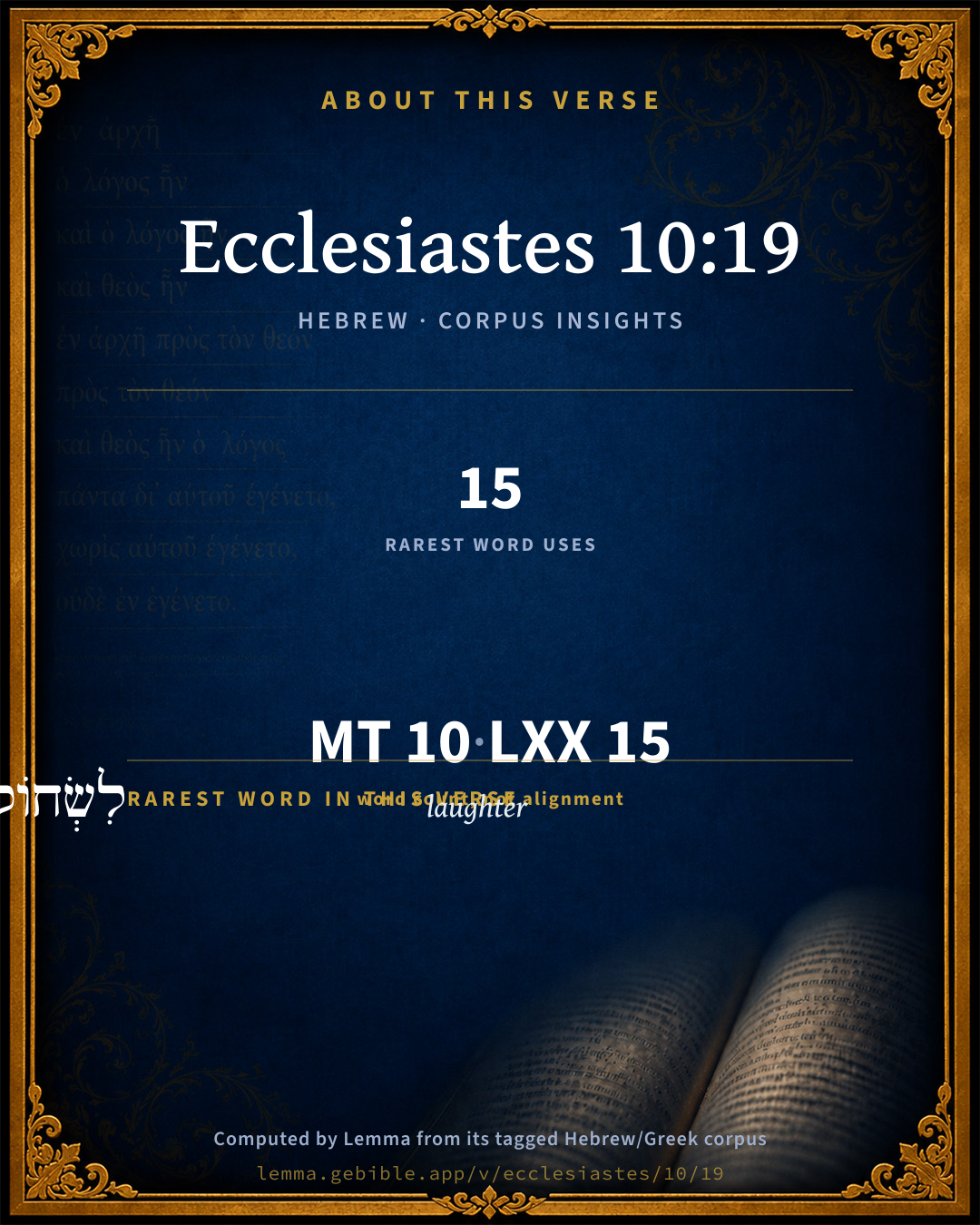
The rarest word here is לִשְׂחוֹק֙ laughter H7814 — appearing just 15 times in the whole Hebrew Bible.

Shared distinctive vocabulary

לִשְׂחוֹק֙ laughter H7814 occurs in 14 verses of the Hebrew Bible. Also found in:

Grammatical profile

  • 3 verbs
  • 5 nouns
  • 1 adjective
  • 1 particle

Verb forms

  • עֹשִׂ֣ים Qal · Participle Active
  • יְשַׂמַּ֣ח Piel · Imperfect
  • יַעֲנֶ֥ה Qal · Imperfect

Hebrew & Septuagint length

In English translation the verse runs 20 words from the Hebrew and 23 from the Septuagint (LXX English) — closely comparable.

A rough comparison of the two English renderings, which tokenize alike — not a word-level alignment.

Word counts can differ between the Hebrew and the Greek without any difference in meaning — e.g. the Hebrew direct-object marker אֵת has no separate Greek word, and Greek often adds the article ὁ.

In the original languages it is 10 Hebrew tokens and 15 Greek tokens — but the two are counted differently (Hebrew bundles its prefixes and suffixes into one token; the Greek is in lemma form), so that isn’t a like-for-like length.

Cross-references

30

Topical passages linked to Ecclesiastes 10:19 in the Treasury of Scripture Knowledge — connected by theme and wording, ordered by reader-vote popularity; previews shown in the World English Bible.

  • Psalms 104:15 Wine that makes glad the heart of man, Oil to make his face to shine, And bread that strengthens man's heart.
  • Psalms 112:9 He has dispersed, he has given to the poor. His righteousness endures forever. His horn will be exalted with honor.
  • Ecclesiastes 2:1–2 I said in my heart, "Come now, I will test you with mirth: therefore enjoy pleasure;" and, behold, this also was vanity.
  • Ecclesiastes 7:11–12 Wisdom is as good as an inheritance. Yes, it is more excellent for those who see the sun.
  • Isaiah 23:18 Her merchandise and her hire shall be holiness to Yahweh: it shall not be treasured nor laid up; for her merchandise shall be for those who dwell before Yahweh, to eat sufficiently, and for durable clothing.
  • Isaiah 24:11 There is a crying in the streets because of the wine; all joy is darkened, the mirth of the land is gone.
  • Luke 12:19 I will tell my soul, "Soul, you have many goods laid up for many years. Take your ease, eat, drink, be merry."'
  • Philippians 4:15–19 You yourselves also know, you Philippians, that in the beginning of the Gospel, when I departed from Macedonia, no assembly shared with me in the matter of giving and receiving but you only.
  • 1 Peter 4:3 For we have spent enough of our past time doing the desire of the Gentiles, and having walked in lewdness, lusts, drunken binges, orgies, carousings, and abominable idolatries.
  • Genesis 43:34 He sent portions to them from before him, but Benjamin's portion was five times as much as any of theirs. They drank, and were merry with him.
  • Judges 9:13 The vine said to them, Should I leave my new wine, which cheers God and man, and go to wave back and forth over the trees?
  • 1 Samuel 25:36 Abigail came to Nabal; and, behold, he held a feast in his house, like the feast of a king; and Nabal's heart was merry within him, for he was very drunken: therefore she told him nothing, less or more, until the morning light.
  • 2 Samuel 13:28 Absalom commanded his servants, saying, Mark you now, when Amnon's heart is merry with wine; and when I tell you, Smite Amnon, then kill him; don't be afraid; haven't I commanded you? be courageous, and be valiant.
  • 1 Chronicles 21:24 King David said to Ornan, No; but I will most assuredly buy it for the full price: for I will not take that which is your for Yahweh, nor offer a burnt-offering without cost.
  • 1 Chronicles 29:2–9 Now I have prepared with all my might for the house of my God the gold for the [things of] gold, and the silver for the [things of] silver, and the brass for the [things of] brass, the iron for the [things of] iron, and wood for the [things of] wood; onyx stones, and [stones] to be set, stones for inlaid work, and of various colors, and all manner of precious stones, and marble stones in abundance.
  • 2 Chronicles 24:11–14 It was so, that whenever the chest was brought to the king's officers by the hand of the Levites, and when they saw that there was much money, the king's scribe and the chief priest's officer came and emptied the chest, and took it, and carried it to its place again. Thus they did day by day, and gathered money in abundance.
  • Ezra 1:6 All those who were round about them strengthened their hands with vessels of silver, with gold, with goods, and with animals, and with precious things, besides all that was willingly offered.
  • Nehemiah 5:8 I said to them, We after our ability have redeemed our brothers the Jews, that were sold to the nations; and would you even sell your brothers, and should they be sold to us? Then held they their peace, and found never a word.
  • Ecclesiastes 7:2–6 It is better to go to the house of mourning than to go to the house of feasting: for that is the end of all men, and the living should take this to heart.
  • Daniel 5:1–12 Belshazzar the king made a great feast to a thousand of his lords, and drank wine before the thousand.
  • Matthew 17:27 But, lest we cause them to stumble, go to the sea, and cast a hook, and take up the first fish that comes up. When you have opened its mouth, you will find a stater coin. Take that, and give it to them for me and you."
  • Matthew 19:21 Jesus said to him, "If you want to be perfect, go, sell what you have, and give to the poor, and you will have treasure in heaven; and come, follow me."
  • Luke 16:9 I tell you, make for yourselves friends by means of unrighteous mammon, so that when you fail, they may receive you into the eternal tents.
  • Acts 2:45 They sold their possessions and goods, and distributed them to all, according as anyone had need.
  • Acts 11:29 As any of the disciples had plenty, each determined to send relief to the brothers who lived in Judea;
  • Ephesians 5:18–19 Don't be drunken with wine, in which is dissipation, but be filled with the Spirit,
  • Ezra 7:15–18 and to carry the silver and gold, which the king and his counselors have freely offered to the God of Israel, whose habitation is in Jerusalem,
  • Ecclesiastes 9:7 Go your way--eat your bread with joy, and drink your wine with a merry heart; for God has already accepted your works.
  • Luke 8:3 and Joanna, the wife of Chuzas, Herod's steward; Susanna; and many others; who ministered to them from their possessions.
  • 1 Timothy 6:17–19 Charge those who are rich in this present world that they not be haughty, nor have their hope set on the uncertainty of riches, but on the living God, who richly provides us with everything to enjoy;

Cross-references courtesy of OpenBible.info (CC BY 4.0).

Hebrew and Greek witnesses Masoretic Hebrew ↔ Greek Septuagint

The same verse in the two great witnesses to the Old Testament, shown verse-for-verse.

These are two independent witnesses, not word-aligned to each other, and the Septuagint is shown in lemma (dictionary) form.

Hebrew Ecclesiastes 10:19 Masoretic · Westminster Leningrad Codex

לִשְׂחוֹק֙ עֹשִׂ֣ים לֶ֔חֶם וְיַ֖יִן יְשַׂמַּ֣ח חַיִּ֑ים וְהַכֶּ֖סֶף יַעֲנֶ֥ה אֶת הַכֹּֽל

A feast is made for laughter, And wine makes the life glad; And money is the answer for all things.

World English Bible · Public Domain

Greek LXX Ecclesiastes 10:19 Septuagint · lemma form

εἰς γέλως ποιέω ἄρτος καί οἶνος εὐφραίνω ζάω καί ὁ ἀργύριον ἐπιἀκούω σύν ὁ πᾶς

Men prepare bread for laughter, and wine and oil that the living should rejoice: but to money all things will humbly yield obedience.

LXX2012 (modern English Septuagint) · Public Domain

On this verse, The Pulpit Commentary discusses the Septuagint’s reading. Read the note in Commentary ↓

Hebrew: Westminster Leningrad Codex (CC BY 4.0). Greek: Septuagint (public domain); English from LXX2012 (modern English Septuagint) (Public Domain). How the Septuagint differs from the Hebrew →

Commentary

Notes on Ecclesiastes 10:19 from classic Christian and Jewish commentators (each source and its license shown beneath its notes). The classic Christian expositions comment on the surrounding passage and are grouped to its opening verse, so a note may address several verses; the Jewish commentaries on the Tanakh (Rashi and others) are per-verse, so they appear only where the commentator wrote on this verse.

Lemma curates 59 commentaries, every one of them public domain or Creative Commons licensed, each selected and text-cleaned for this edition rather than reprinted as found. About our sources →

Ellicott's Commentary for English Readers

(19) I look on these verses as isolated proverbs, and believe that the obvious meaning suggested by the English of this verse is the right one. Those who strive to trace a continuity of thought take Ecc_10:18 as a figurative description of the ruin of an ill-governed land; Ecc_10:19 as describing the riot of those rulers who make feasts for merriment, and have money freely at their disposal; and (Ecc_10:20) as a warning to the subjects to beware how, notwithstanding all this mis-government, they venture to rebel.

A Bible Commentary for English Readers, edited by Charles John Ellicott (1878–1897) — public domain. Text from a community e-Sword module.

Trapp's Complete Commentary

John Trapp

Ecc 10:19 A feast is made for laughter, and wine maketh merry: but money answereth all [things].

Ver. 19. A feast is made for laughter, and wine maketh merry.] Slothful governors, Regni dilapidatores (so our Henry III was called for his pride and prodigality), {a} are all for feasting and frolicking. See Pro 31:4 Dan 5:3-4. This cannot be maintained without money, for the getting and gathering in whereof the poor people are peeled and polled, and rich men’s gifts are received, to the perverting of justice by those corrupt rulers, qui vili precio nihil non humile et vile parati sunt facere, as Gregory Thaumaturgus speaketh in his note upon this verse.

But money answereth all things.] It gives a satisfactory answer to whatsoever is desired or demanded. Seneca saith, circa pecuniam multum vociferationis est, that about money there is much noise, great crying; but though never so nmch, never so great, money answereth all - it effects all. {b} What great designs did Philip bring to pass in Greece by his golds the very oracles were said, ψιλιππιξειν, to say as Philip would have them: Antipater non tenuis fuit pecuniae, et ideo praevalidae potentiae, saith Egesippus; {c} he was a well moneyed man, and therefore a very mighty man. The Hebrew, or rather Chaldee, word {d} used for money {1Ch 29:7 Ezr 8:27} signifies to do some great work, because money is the monarch of the world, and therein bears most mastery. Among suitors (in love and in law especially) money drives the bargain and business to an upshot.

{a} Daniel.

{b} ανευηε χαλκου φοιβος μη μαντευεται.

{c} Lib. i., Excid. Hierosol., cap. 14.

{d} אדבוו of אדר strong, and בוו to prepare.

John Trapp, A Commentary or Exposition upon All the Books of the Old and New Testament (1647–1656) — public domain. Text from a community e-Sword module.

Joseph Benson's Commentary

Ecc 10:19. A feast is made for laughter, &c. — Not merely for caring, but chiefly for pleasant conversation, and the society of friends; not the laughter of fools, which is madness, but that of wise men, namely, that cheerfulness by which they fit themselves for business and severe studies: and wine maketh merry — Hebrew, ישׂמח חיים, maketh glad the life, exhilarates the mind; but money answereth all things — Procures not only meat and drink for feasting, but all other worldly advantages. Therefore be frugal, and spend not all in luxurious eating and drinking, remembering, that money is wanted for a great many other purposes. Some refer this verse to rulers, and consider this last clause as being added to aggravate the sin and folly of luxury, to which, when princes give up themselves, they not only neglect their business, but thereby waste that money and treasure which are so highly necessary for the support and preservation of themselves and their kingdoms: and, in consequence thereof, are obliged to squeeze money out of their people by oppressive taxes, and other dishonourable and dangerous practices.

Joseph Benson's Commentary on the Old and New Testaments (1811–1818) — public domain. Text from a community e-Sword module.

Keil & Delitzsch

C. F. Keil & F. Delitzsch

"Meals they make into a pleasure, and wine cheereth the life, and money maketh everything serviceable." By עשׂים, wicked princes are without doubt thought of-but not immediately, since Ecc 10:16 is too remote to give the subject to Ecc 10:19. The subject which 'osim bears in itself (= 'osim hēm) might be syntactically definite, as e.g., Psa 33:5, אהב, He, Jahve, loves, thus: those princes, or, from Ecc 10:18 : such slothful men; but 'osim is better rendered, like e.g., omrim, Exo 5:16 (Ewald, 200a), and as in the Mishna we read קורין and the like with gramm. indefin. subj.: they make, but so that by it the slothful just designated, and those of a princely rank are meant (cf. a similar use of the inf. abs., as here of the part. in the historical style, Isa 22:13). Ginsburg's rendering is altogether at fault: "They turn bread and wine which cheereth life into revelry." If עשׁה and לחם as its object stand together, the meaning is, "to prepare a feast," Eze 4:15; cf. 'avad lehēm, Dan 5:1. Here, as there, 'osim lěhěm signifies coenam faciunt (parant). The ל of לשׂ is not the sign of the factitive obj. (as leēl, Isa 44:17), and thus not, as Hitz. supposes, the conditioning ל with which adv. conceptions are formed, - e.g., Lam 4:5, האך למע, where Jerome rightly translates, voluptuose (vid., E. Gerlach, l.c.), - but, which is most natural and is very appropriate, it is the ל of the aim or purpose: non ad debitam corporis refectionem, sed ad hera ludicra et stulta gaudia (Geier). שׂחוק is laughter, as that to which he utters the sentence (Ecc 2:2): Thou art mad. It is incorrect, moreover, to take lěhěm veyaim together, and to render yesammahh hayaim as an attribut. clause to yain: this epitheton ornans of wine would here be a most unsuitable weakening of the figure intended. It is only an apparent reason for this, that what Psa 104:15 says in praise of wine the author cannot here turn into a denunciatory reproach. Wine is certainly fitted to make glad the heart of a man; but here the subject of discourse is duty-forgetting idlers, to whom chiefly wine must be brought (Isa 5:12) to cheer their life (this sluggard-life spent in feasting and revelry). The fut. ישׂמּח is meant in the same modal sense as יגבּר, Ecc 10:10: wine must accomplish that for them. And they can feast and drink, for they have money, and money ־הכּל... יע. Luther hits the meaning: "Money must procure everything for them;" but the clause is too general; and better thus, after Jerome, the Zrich Bible: "unto money are all things obedient." The old Jewish interpreters compare Hos 2:23., where ענה, with accus. petentis, signifies, "to answer a request, to gratify a desire." But in the passage before us הכּל is not the obj. accus. of petentis, but petiti; for 'anah is connected with the accus. of that to which one answers as well as of that which one answers, e.g., Job 40:2, cf. Ecc 9:3. It is unnecessary, with Hitzig, to interpret יענה as Hiph.: Money makes all to hear (him who has the money), - makes it that nothing is refused to his wish. It is the Kal: Money answers to every demand, hears every wish, grants whatever one longs for, helps to all; as Menander says: "Silver and gold, - these are, according to my opinion, the most useful gods; if these have a place in the house, wish what thou wilt (εὖξαι τί βούλει), all will be thine;" and Horace, Epod. i. 6. 36 s.:

"Scilicet uxorem cum dote fidemque et amicos

Et genus et formam regina pecunia donat."

The author has now described the king who is a misfortune and him who is a blessing to the land, and princes as they ought to be and as they ought not to be, but particularly luxurious idle courtiers; there is now a warning given which has for its motive not only prudence, but also, according to Ecc 8:2, religiousness.

Keil & Delitzsch — Biblical Commentary on the Old Testament (1861–1891) — public domain (CC PDM 1.0). Text via the HelloAO Bible API. (Old Testament only.)

Tyndale Open Study Notes

Tyndale Open Resources

10:19 money gives everything: It is the way to get what you want or need in this world (cp. 7:11-12).

Tyndale Open Study Notes — © Tyndale Open Resources, licensed CC BY-SA 4.0. Text via the HelloAO Bible API.

Jamieson, Fausset & Brown

Robert Jamieson, A. R. Fausset & David Brown

Referring to Ecc 10:18. Instead of repairing the breaches in the commonwealth (equivalent to "building"), the princes "make a feast for laughter (Ecc 10:16), and wine maketh their life glad (Psa 104:15), and (but) money supplieth (answereth their wishes by supplying) all things," that is, they take bribes to support their extravagance; and hence arise the wrongs that are perpetrated (Ecc 10:5-6; Ecc 3:16; Isa 1:23; Isa 5:23). MAURER takes "all things" of the wrongs to which princes are instigated by "money"; for example, the heavy taxes, which were the occasion of Rehoboam losing ten tribes (Kg1 12:4, &c.).

Jamieson, Fausset & Brown — Commentary Critical and Explanatory on the Whole Bible (1871) — public domain (CC PDM 1.0). Text via the HelloAO Bible API.

Adam Clarke's Commentary

Verse 19. A feast is made for laughter] The object of it is to produce merriment, to banish care and concern of every kind. But who are they who make and frequent such places? Epicures and drunkards generally; such as those of whom Horace speaks:

Nos numerus sumus, et fruges consumere nati.

Epist. lib. i., ep. 2, ver. 27.

"Those whose names stand as indications of men, the useless many; and who appear to be born only to consume the produce of the soil."

But money answereth all] This saying has prevailed everywhere.

Scilicet uxorem cum dote, fidemque, et amicos,

Et genus, et formam REGINA PECUNIA donat;

Ac bene nummatum decorat Suadela, Venusque.

HOR. EP. lib. i., ep. 6, ver. 36.

"For gold, the sovereign QUEEN of all below,

Friends, honour, birth, and beauty, can bestow.

The goddess of persuasion forms her train;

And Venus decks the well-bemonied swain."

FRANCIS.

Adam Clarke's Commentary on the Bible (1810–1826) — public domain. Text from a community e-Sword/MySword module.

The Cambridge Bible for Schools and Colleges

gen. ed. J. J. S. Perowne

19. money answereth all things] The maxim as it stands in the English Version, has a somewhat cynical ring, reminding us only too closely of the counsel condemned by the Roman satirist,

“O cives, cives, quærenda pecunia primum est;

Virtus post nummos.”

“Money, my townsmen, must be sought for first;

Virtue comes after guineas,”

“Isne tibi melius suadet, qui rem facias; rem,

Si possis, recte; si non, quocunque modo rem?”

“Does he give better counsel whom we hear,

‘Make money, money; justly if you can,

But if not, then in any way, make money?’ ”

Hor. Epp. i. 1. 53, 65.

So Menander (quoted by Delitzsch) “Silver and gold—these are the Gods who profit most. If these are in thy house pray for what thou wilt and it shall be thine,” and Horace:

Scilicet uxorem cum dote, fidemque, et amicos,

Et genus, et formam, regina pecunia donat;

Ac bene nummatum decorat Suadela Venusque.”

“Seek’st thou a dowried wife, or friends, or trust,

Beauty or rank, Queen Money gives thee all;

Put money in thy purse, and thou shalt lack

Nor suasive power nor comeliness of form.”

Epp. i. 6. 36–38.

The truer rendering of the Hebrew, however, gives not so much a maxim as the statement of a fact and is entirely in harmony with the preceding verses. For revelry they (i.e. “man,” indefinitely) prepare food (literally, bread) and wine that rejoices life, and money answereth all things, i.e. meets all they want. The words obviously point to the conduct of the luxurious and slothful princes condemned in Ecc_10:16; Ecc_10:18. Regardless of their duty as rulers and of the sufferings of their people, they aim only at self-indulgence and they look to money, however gained, as the means of satisfying their desires. So, in our own times, Armenians or Fellaheen may die by thousands of famine or pestilence, but the palaces of the Sultan and the Khedive are as full of luxury and magnificence as ever. The State may be bankrupt and creditors unpaid, but they manage somehow to get what they want. The money which they squeeze out from a starving province is for them as the God they worship who grants all they wish.

The Cambridge Bible for Schools and Colleges (gen. ed. J. J. S. Perowne; Cambridge University Press, 1878–1918) — public domain. Text from a community e-Sword module.

John Gill's Exposition

A feast is made for laughter,.... Or, "who make bread for laughter" (i). Not bakers, who make bread for common use, and for all sorts of persons, sorrowful ones as others; but luxurious men, particularly such princes as are before described; they "make bread", that is, a feast, as the phrase is used, Dan 5:1; not for mere refreshment, but to promote mirth and gaiety to an excessive degree; being attended with rioting and drunkenness, chambering and wantonness, with revellings and dancing;

and wine maketh merry; or, "and they prepare wine" (k); which is provided in plenty at feasts; and which is sometimes put for a feast itself, and called a banquet of wine, Est 7:2; which wine makes merry, and men drink of it till they become drunk with it, at such profuse feasts: or, "which maketh life cheerful" (l); as it does, when moderately used: "cheers the living"; so Aben Ezra;

but money answereth all things; is in the room of all things, and by it men obtain everything they want and wish for; it answers the requests of all, and supplies them with what they stand in need of, or can desire: particularly such expensive feasts, and sumptuous entertainments, are made by means of money; and, in this luxurious way, the coffers of princes are drained, and they are obliged to raise new levies, and impose new taxes upon their subjects, to the oppression of them. Or else the sense may be, that princes should consider, and not be so profuse in their manner of living, but be more frugal and careful of the public money, and lay it up against a time of need; since it is that that answers all things, is the sinew of war when that arises, and will procure men and arms, to secure and protect them from their enemies, and obtain peace and safety for them and their subjects, which otherwise they cannot expect.

(i) "ad risum facientes panem", Montanus; "faciunt panem", Paganinus, Mercerus, Piscator. (k) "et vinum, repete, parant", Piscator. (l) "et vitam exhilaret", Tigurine version; "exhilarare solet vitam", Mercerus; "quod exhilarare debebat vitam", so some in Rambachius.

John Gill's Exposition of the Whole Bible (1746–1763) — public domain (CC PDM 1.0). Text via the HelloAO Bible API.

Haydock's Catholic Bible Commentary

Feast. As if they were born for this purpose, (Philippians iii. 19.; Calmet) fruges consumere nati. (Horace, i. ep. 2.) --- Money. --- Scilicet uxorem cum dote fidemque et amicos,

Et genus, et formam regina pecunia donet. (Horace, i. ep. 6.)

--- Hebrew, "money answers all purposes," (Haydock) to procure meat, drink, &c. (Calmet)

George Leo Haydock (1774–1849), Haydock's Catholic Family Bible and Commentary, 1859 edition — public domain. Excludes Psalms (Douay-Rheims chapter numbering differs from Protestant) and Deuterocanonical books (Catholic canon only).

Matthew Poole's English Annotations

The design and effect of feasting and drinking wine is, that men may exhilarate their minds with the society of their friends, and with the use of the creatures.

Money answereth all things; it procures not only meat and drink for feasting, but for all other things; as the heavens are said to answer the earth, when they give it those showers which it desires and needs to make it fruitful, Hos 2:21. And this clause seems to be added as an aggravation of the sin and folly of luxury, because princes do thereby waste that money and treasure which is so highly necessary for the support and preservation of themselves, and of their kingdoms, and are forced to squeeze money out of their people by oppressive, and dishonourable, and dangerous practices, that they may have more to spend in riotous courses.

Matthew Poole's English Annotations on the Holy Bible (1683–1685) — public domain. Text from a community e-Sword/MySword module.

Whedon's Commentary on the Bible

Daniel D. Whedon

19. Made for laughter — This verse should read, The bread and the wine, which cheer the life, are made into laughter, or revelry; that is, by the luxurious rulers still spoken of.

Money answereth all things — Better, And the money furnishes both. Whose “money?” It is artfully suggested, rather than told, that it is the “money” wrung from the subjects that is thus squandered in feasting.

Daniel D. Whedon (gen. ed.), Commentary on the Old and New Testaments (1874–1909) — public domain. Text from a community e-Sword module.

The Pulpit Commentary

A feast is made for laughter, and wine maketh merry. Here is a cause of the decay spoken of above. The rulers spend in revelry and debauchery the time and energy which they ought to give to affairs of state. More literally, for merriment they make bread, and wine that cheereth life; i.e. they use God"s good gifts of bread and wine as means of intemperance and thoughtless pleasure. So a psalmist speaks of wine as making glad the heart of man; (Psa_104:15) and Ben-Sira says, "Wine is as good as life to a man, if it be drunk moderately: what life is there to a man that is without wine? for it was created to make men glad. Wine measurably drunk and in season bringeth gladness of the.heart, and cheer fullness of the mind" (Ecclus. 31. 34. 27, 28). But money answereth all things; i.e. grants all that such persons want. It requires money to provide rich food and costly wines; this they possess, and they are thus able to indulge their appetites to the utmost. It concerns them not how such resources are obtained won by extortion from a starving people, exacted in exorbitant taxation, pillaged by unscrupulous instruments; they want gold to expend on their lusts, and they get it same-how, and with it all that in their view makes life worth living. Commentators alto Horace, "Ep.," 1:6.36, "Scilicet uxorem," etc.

For why a portioned wife, fair fame, and friends, Beauty and birth on sovereign Wealth attends. Blest is her votary throned his bags among? Persuasion"s self sits perched upon his tongue; Love beams in every feature of his face, And every gesture beams celestial grace. (Howes. )

Corn. a Lapide appositely quotes

quidquid nummis praesentibus opta,

Et veniet; clausum possidet arca Jovem.

If thou hast gold, then wish for anything, And it will surely come; the money-box Hath in it a most potent deity.

Pineda, followed by Metals, suggests that this verse may be taken in a good sense. He would make ver. 18 correspond to ver. 16, characterizing the government of debauchees, and ver. 19 correspond to ver. 17, representing the rule of temperate princes where all is peace and prosperity. But there is nothing grammatical to indicate this arrangement; and the explanation given above is doubtless correct. The Septuagint Version is not faithful in our present text, though it is followed virtually by the Syriac: Eijv gelwta poiousin arton kai oi+non kai elaion tou eujfranqhnai zwntav kaiou tapeinwsei ejpakousetai tanta "For gladness they make bread and wine and oil, that the living may rejoice, and to money all things will humble themselves, will obey" (doubly translating the word).

The Pulpit Commentary (1880–1919), ed. H.D.M. Spence-Jones & Joseph S. Exell — public domain. Text from a community e-Sword module.

Rashi

Rabbi Shlomo Yitzchaki (Rashi)

On joyous occasions, a feast is made For the joy of the musical entertainment at a wedding, we make a grand feast, and an undefined grand feast is called לֶחֶם, as it is stated (Dan. 5:1): “King Belshazzar made a great feast (לְחֶם).”

and wine they give to drink at the feast, which gladdens the living.

and money answers everything If there is no money, there is no feast; therefore, a person should not neglect work in order that he should have what to spend.

Rashi on the Tanakh — English translations: “The Judaica Press complete Tanach with Rashi, translated by A. J. Rosenberg” (CC BY 4.0); “Pentateuch with Rashi's commentary by M. Rosenbaum and A.M. Silbermann, 1929-1934” (public domain); “The Metsudah Tanach series, Lakewood, N.J” (CC BY 4.0); and “The Book of Joshua, Metsudah Publications, 1997” (CC BY 4.0). Text via Sefaria.

Lesson kit

Teaching starters — assembled from the data on this page, not authored interpretation. Every prompt links to the verse data it draws on. Edit before teaching.

Ecclesiastes, in the Wisdom, opens this verse with 10 words (10 distinct Hebrew lemmas). Its most distinctive word is sᵉchôwq (“laughter”). A historical commentator’s framing appears above. Read the whole chapter for the surrounding context.

Discussion questions

  1. How does “laughter” (sᵉchôwq) shape what this verse is saying?
  2. How does Job 8:21, which shares the word «laughter», read alongside this verse?
  3. These translations render this verse differently. What is at stake in choosing one wording over another?
  4. «עֹשִׂ֣ים» is a Qal Participle Active verb. How does that grammatical form shape the action described?
  5. Compare how Ellicott's Commentary for English Readers and Trapp's Complete Commentary read this verse. Where do they agree or differ?

Things to notice

Reading settings

Reading text

Shown beneath each verse's original-language words.

Old Testament
Old Testament edition

Read the OT as the Masoretic Hebrew (MT) or the Greek Septuagint (LXX).

English shown for the Greek Septuagint (in the Hebrew ↔ Greek comparison).

Comparing translations? Open the Compare panel on any verse page to stack up to four side by side.