
Psalms 92:4

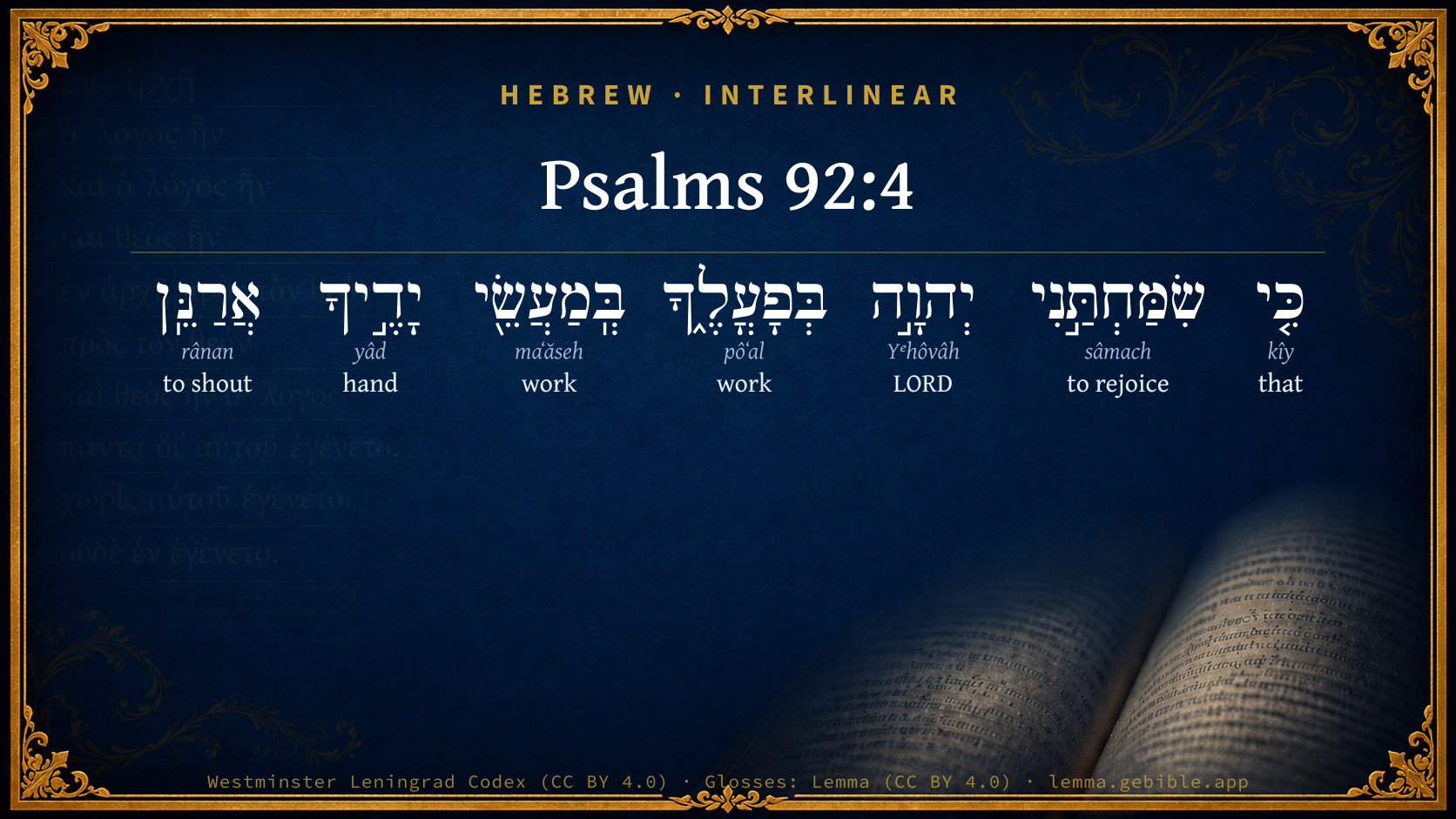
Hebrew (Westminster Leningrad Codex) Psalms 92:4 appears in the Hebrew Old Testament. The text above is from the Westminster Leningrad Codex. Each word links to its Strong’s number, a concise gloss, and parsing drawn from the Open Scriptures Hebrew Bible morphology. Click any word for its full Brown-Driver-Briggs (BDB) entry.
Download image
Cite this verse

Psalms 92:4 (World English Bible). Public Domain. Lemma interlinear Bible study tool, https://lemma.gebible.app/v/psalms/92/4.

Show BibTeX & RIS
BibTeX
RIS
English Translation
For you, Yahweh, have made me glad through your work. I will triumph in the works of your hands.
World English Bible · Public Domain
Download a study sheet

One document with this verse’s original text, its word-by-word gloss line, the meaning frame, cross-references with their text, attributed commentary, and full source and license credits — printable, and it pastes into notes with its structure intact.

This verse Autodidact and up

Study sheet (.html) Plain text (.txt)

A passage Seminary Student

Up to 50 verses in one chapter. A passage sheet keeps up to 6 commentary sources and 12 cross-references per verse, in the order this page ranks them, and says so on the sheet whenever that leaves anything out. Ask for a single verse and you get the Autodidact verse sheet above.

Everything on this page stays free to read, with no account — the sheet is a download of what is already on screen, not access to it.

Want to remove ads? Support Godless Engineer
Compare translations 3

The same verse in 3 English versions, stacked beneath the original-language interlinear above. Click any original word for its lexicon entry.

Each is an independent rendering of the whole verse — the interlinear is not word-aligned to these translations.

Highlighted words mark where these versions differ — a whole-verse word diff, not a word-by-word alignment.

  • World English Bible Public Domain
    For you, Yahweh, have made me glad through your work. I will triumph in the works of your hands.
  • King James Version Public Domain
    For thou, LORD, hast made me glad through thy work: I will triumph in the works of thy hands.
  • unfoldingWord Literal Text CC BY-SA 4.0
    For you, Yahweh, have made me glad through your deeds. I will sing for joy because of the deeds of your hands.

unfoldingWord Literal Text — © unfoldingWord, licensed CC BY-SA 4.0. Word-aligned USFM3 via Door43 (git.door43.org/unfoldingWord/en_ult).

Versions to compare (up to 4)

3 of 4 selected

Show all 18 translations

Every available English version of this verse, each an independent rendering of the whole verse.

  • World English Bible Public Domain
    For you, Yahweh, have made me glad through your work. I will triumph in the works of your hands.
  • Berean Standard Bible Public Domain
    For You, O LORD, have made me glad by Your deeds; I sing for joy at the works of Your hands.
  • Majority Standard Bible Public Domain
    For You, O LORD, have made me glad by Your deeds; I sing for joy at the works of Your hands.
  • King James Version Public Domain
    For thou, LORD, hast made me glad through thy work: I will triumph in the works of thy hands.
  • American Standard Version (1901) Public Domain
    For thou, Jehovah, hast made me glad through thy work: I will triumph in the works of thy hands.
  • Revised Version (1885) Public Domain
    For thou, LORD, hast made me glad through thy work: I will triumph in the works of thy hands.
  • Geneva Bible (1599) Public Domain
    For thou, Lord, hast made mee glad by thy workes, and I wil reioyce in the workes of thine handes.
  • Douay-Rheims (1899) Public Domain
    Upon an instrument of ten strings, upon the psaltery: with a canticle upon the harp.
  • Young's Literal Translation Public Domain
    For Thou hast caused me to rejoice, O Jehovah, in Thy work, Concerning the works of Thy hands I sing.
  • Literal Standard Version CC BY-SA 4.0
    For You have caused me to rejoice, O YHWH, in Your work, || I sing concerning the works of Your hands.
  • Unlocked Literal Bible CC BY-SA 4.0
    For you, Yahweh, have made me glad through your deeds. I will sing for joy because of the deeds of your hands.
  • unfoldingWord Literal Text CC BY-SA 4.0
    For you, Yahweh, have made me glad through your deeds. I will sing for joy because of the deeds of your hands.
  • Darby Bible Public Domain
    For thou, Jehovah, hast made me glad through thy work; I will triumph in the works of thy hands.
  • World Messianic Bible Public Domain
    For you, LORD, have made me glad through your work. I will triumph in the works of your hands.
  • Webster's Bible Public Domain
    \\92:3\\Upon an instrument of ten strings, and upon the psaltery; upon the harp with a solemn sound.
  • Free Bible Version CC BY-SA 4.0
    You've made me so happy, Lord, because of all you've done for me! I sing for joy at what you've done!
  • Bible in Basic English Public Domain
    For you, O Lord, have made me glad through your work; I will have joy in the works of your hands.
  • JPS Tanakh (1917) Public Domain
    (92-5) For Thou, LORD, hast made me glad through Thy work; I will exult in the works of Thy hands.

Literal Standard Version (2020), Covenant Press — licensed CC BY-SA 4.0. Text via the HelloAO Bible API (eBible.org). Unlocked Literal Bible (unfoldingWord) — licensed CC BY-SA 4.0. Text via the HelloAO Bible API (eBible.org). unfoldingWord Literal Text — © unfoldingWord, licensed CC BY-SA 4.0. Word-aligned USFM3 via Door43 (git.door43.org/unfoldingWord/en_ult). Free Bible Version, Dr. Jonathan Gallagher — licensed CC BY-SA 4.0. Text via the HelloAO Bible API (eBible.org).

Word by word

More ways to search: Search by grammar → Find every occurrence → Compare this word →

Practice this passage: Drill this verse → Learn its vocabulary →

בְּפָעֳלֶ֑ךָ
pôʻal
H6467
“in/at · work · your”
Preposition + Noun, Common, Masculine, Singular, Construct + Suffix, Personal, 2nd Person, Masculine, Singular
Part of Speech
Preposition + Noun
Type
Common
Gender
Masculine
Number
Singular
State
Construct
Full BDB Definition

Origin: from H6466

TWOT: 1792a

work, deed, doing - deed, thing done - work, thing made - wages of work - acquisition (of treasure)
  1. כִּ֤י kîy H3588 “that” Conjunction
  2. שִׂמַּחְתַּ֣נִי sâmach H8055 “to rejoice · me” Verb, Piel, Perfect, 2nd Person, Masculine, Singular + Suffix, Personal, 1st Person, Common, Singular
  3. יְהוָ֣ה Yᵉhôvâh H3068 “LORD” Noun, Proper
  4. בְּֽמַעֲשֵׂ֖י maʻăseh H4639 “in/at · works of” Preposition + Noun, Common, Masculine, Plural, Construct
  5. יָדֶ֣יךָ yâd H3027 “hands · your” Noun, Common, Both, Dual, Construct + Suffix, Personal, 2nd Person, Masculine, Singular
  6. אֲרַנֵּֽן rânan H7442 “to shout” Verb, Piel, Imperfect, 1st Person, Common, Singular

About this verse

These counts appear in no published source. They are computed here, from the morphology-tagged text and Lemma’s own curated glosses. What Lemma adds →

7
words
7
distinct lemmas
Wisdom
section

Shared distinctive vocabulary

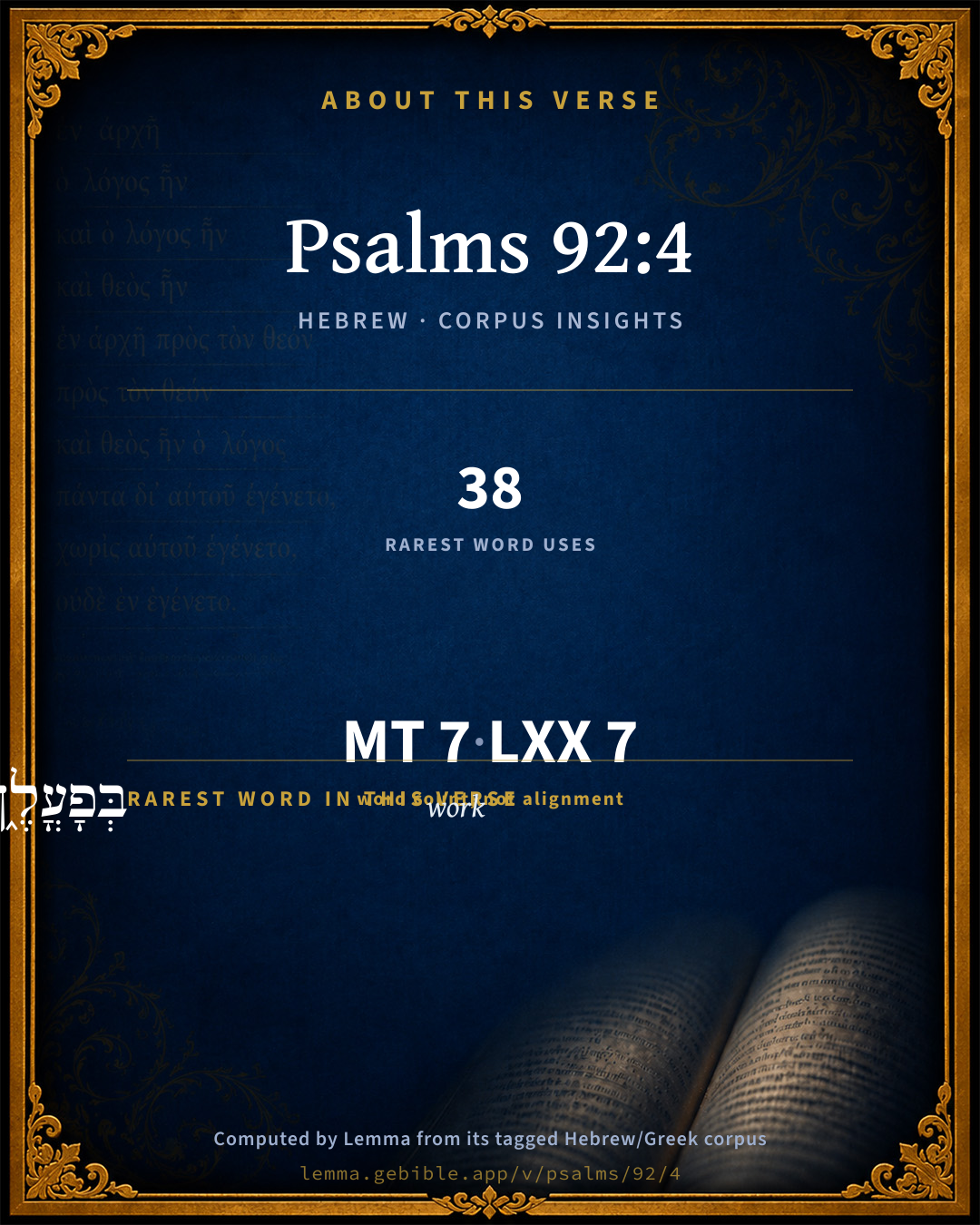
בְּפָעֳלֶ֑ךָ work H6467 occurs in 38 verses of the Hebrew Bible. Also found in:

Grammatical profile

  • 2 verbs
  • 4 nouns
  • 1 conjunction

Verb forms

  • שִׂמַּחְתַּ֣נִי Piel · Perfect
  • אֲרַנֵּֽן Piel · Imperfect

Hebrew & Septuagint length

In English translation the verse runs 19 words from the Hebrew and 21 from the Septuagint (LXX English) — closely comparable.

A rough comparison of the two English renderings, which tokenize alike — not a word-level alignment.

Word counts can differ between the Hebrew and the Greek without any difference in meaning — e.g. the Hebrew direct-object marker אֵת has no separate Greek word, and Greek often adds the article ὁ.

In the original languages it is 7 Hebrew tokens and 7 Greek tokens — but the two are counted differently (Hebrew bundles its prefixes and suffixes into one token; the Greek is in lemma form), so that isn’t a like-for-like length.

Cross-references

19

Topical passages linked to Psalms 92:4 in the Treasury of Scripture Knowledge — connected by theme and wording, ordered by reader-vote popularity; previews shown in the World English Bible.

  • 2 Corinthians 2:14 Now thanks be to God, who always leads us in triumph in Christ, and reveals through us the sweet aroma of his knowledge in every place.
  • Psalms 8:6 You make him ruler over the works of your hands. You have put all things under his feet:
  • Psalms 126:3 Yahweh has done great things for us, And we are glad.
  • Isaiah 65:13–14 Therefore thus says the Lord Yahweh, Behold, my servants shall eat, but you shall be hungry; behold, my servants shall drink, but you shall be thirsty; behold, my servants shall rejoice, but you shall be disappointed;
  • Luke 1:47 My spirit has rejoiced in God my Savior,
  • John 16:22 Therefore you now have sorrow, but I will see you again, and your heart will rejoice, and no one will take your joy away from you.
  • Zephaniah 3:14–16 Sing, daughter of Zion! Shout, Israel! Be glad and rejoice with all your heart, daughter of Jerusalem.
  • Revelation 18:20 Rejoice over her, O heaven, you saints, apostles, and prophets; for God has judged your judgment on her."
  • Psalms 143:5 I remember the days of old. I meditate on all your doings. I contemplate the work of your hands.
  • Psalms 90:16 Let your work appear to your servants; Your glory to their children.
  • Psalms 104:31 Let the glory of Yahweh endure forever. Let Yahweh rejoice in his works.
  • Isaiah 61:2–11 to proclaim the year of Yahweh's favor, and the day of vengeance of our God; to comfort all who mourn;
  • Isaiah 66:10–11 Rejoice you with Jerusalem, and be glad for her, all you who love her: rejoice for joy with her, all you who mourn over her;
  • Jeremiah 31:7 For thus says Yahweh, Sing with gladness for Jacob, and shout for the chief of the nations: publish you, praise you, and say, Yahweh, save your people, the remnant of Israel.
  • Jeremiah 31:11–13 For Yahweh has ransomed Jacob, and redeemed him from the hand of him who was stronger than he.
  • Psalms 64:10 The righteous shall be glad in Yahweh, And shall take refuge in him. All the upright in heart shall praise him!
  • Psalms 106:47–48 Save us, Yahweh, our God, Gather us from among the nations, To give thanks to your holy name, To triumph in your praise!
  • Psalms 145:6–7 Men will speak of the might of your awesome acts. I will declare your greatness.
  • Psalms 104:34 Let your meditation be sweet to him. I will rejoice in Yahweh.

Cross-references courtesy of OpenBible.info (CC BY 4.0).

Hebrew and Greek witnesses Masoretic Hebrew ↔ Greek Septuagint

The same verse in the two great witnesses to the Old Testament, shown verse-for-verse.

You’re reading Greek Psalm 91 (Hebrew Psalm 92). The Septuagint counts the superscription, so verse numbers can differ from the Hebrew — chapter-level alignment, not verse-by-verse. Numbering follows Rahlfs.

These are two independent witnesses, not word-aligned to each other, and the Septuagint is shown in lemma (dictionary) form.

Hebrew Psalms 92:4 Masoretic · Westminster Leningrad Codex

כִּ֤י שִׂמַּחְתַּ֣נִי יְהוָ֣ה בְּפָעֳלֶ֑ךָ בְּֽמַעֲשֵׂ֖י יָדֶ֣יךָ אֲרַנֵּֽן

For you, Yahweh, have made me glad through your work. I will triumph in the works of your hands.

World English Bible · Public Domain

Greek LXX Greek Psalm 91:4 Septuagint · lemma form

ἐν δεκάχορδος ψαλτήριον μετά ᾠδή ἐν κιθάρα

For you, O Lord, have made me glad with your work: and in the operations of your hands will I exult.

LXX2012 (modern English Septuagint) · Public Domain

Hebrew: Westminster Leningrad Codex (CC BY 4.0). Greek: Septuagint (public domain); English from LXX2012 (modern English Septuagint) (Public Domain). How the Septuagint differs from the Hebrew →

Commentary

Notes on Psalms 92:4 from classic Christian and Jewish commentators (each source and its license shown beneath its notes). The classic Christian expositions comment on the surrounding passage and are grouped to its opening verse, so a note may address several verses; the Jewish commentaries on the Tanakh (Rashi and others) are per-verse, so they appear only where the commentator wrote on this verse.

Lemma curates 59 commentaries, every one of them public domain or Creative Commons licensed, each selected and text-cleaned for this edition rather than reprinted as found. About our sources →

Trapp's Complete Commentary

John Trapp

Psa 92:4 For thou, LORD, hast made me glad through thy work: I will triumph in the works of thy hands.

Ver. 4. For thou, Lord, hast made me glad, &c.] And I will improve this cheerfulness to thankfulness, Jas 5:13. On the sabbath we ought solummodo spiritualibus gaudiis repleri, to be filled with spiritual joys only, saith the Council of Paris, held A.D. 820.

I will triumph in the works of thy hands] sc. The works of creation, administration, but especially of redemption.

John Trapp, A Commentary or Exposition upon All the Books of the Old and New Testament (1647–1656) — public domain. Text from a community e-Sword module.

The Biblical Illustrator

Joseph S. Exell

Psa_92:4-6

For Thou, Lord, hast made me glad through Thy work: I will triumph in the works of Thy hands.

Delight in Gods works

The Hebrew prophets and psalmists, when their minds were in the most exalted and inspired state, saw God in everything; in the mightiest and in the meanest movements of the universe, in all the events of history and in all the incidents of the individual experience. They were all and everywhere the works of God. To them the universe was no self-propelling machine, but a living organism of which God was the ever present soul.

1. Religious people are often afraid of science, and denounce it as an enemy to faith and piety. But what is science, and what is its aim? Its aim is to know and understand Gods work in nature. Why should such an aim be construed as antagonistic to religion or detrimental to piety? God has not sent us into the world blindfolded to the wonder and glory of His works, as if He did not mean us to unriddle the secrets of His workmanship.

2. Then there are rich poetic reasons for a closer communion with the Divine works of nature. God has endowed the meanest nature among us with the susceptibility of being pleased and delighted with the scenes of beauty and grandeur with which the world is filled. We were made for very sweet and pure enjoyments, and not only to grind in the mill of our daily work. This must have been partly what the psalmist meant (Psa_92:4).

3. Then there is the religious motive to a more intimate acquaintance with the works of God. How great are Thy works, and Thy thoughts are very deep! The Divine thoughts are embodied and expressed in the Divine works. And if we wish to know God more perfectly, what ideas the Divine Being has been expressing in His creative acts--ideas of beauty, goodness, and power; to know something of the range of the infinite wisdom, and something of the sweep and compass of Almighty power, we must give ourselves with greater energy to the contemplation and study of His works. (C. Short, M.A.)

Divine workmanship

I. The work of the Lord.

1. Creation.

2. Providence.

3. Grace. The renovation of the heart of man, the removal of idolatry, the creation of the beauties of holiness, that is the work of God. And it is His chief work, His sublimest achievement.

II. Some reasons or grounds on which a contemplation of this work of grace is so eminently fitted to inspire the breasts of good men with sentiments of peculiar gladness.

1. Because it is a work of such beneficial character and tendency. Wherever you see a sinner converted from the error of his ways, you see the firstfruits of a most glorious state, the scene of a mighty harvest.

2. Because it contains the richest impress of the hand of its Author.

3. Because it is a work so surprising and unexpected. Eye hath not seen, etc.

4. On account of its permanency. This work shall advance and triumph, till there shall be unbelief nowhere, faith everywhere; hatred nowhere, love everywhere; confusion nowhere, order everywhere; darkness nowhere, light everywhere; Satan nowhere on earth, Christ everywhere.

5. Because of its necessary connection with still higher operations. The work is too much for one world to hold. When it has filled one world it will rush over into another, and fill the recesses of eternity when earth is a cinder and time a story. (W. Beaumont, D.D.)

The Christian made glad

I. An interesting subject. It is the work of God--

1. To redeem the soul (Joh_3:16; Psa_89:19; Rom_8:3; Rom_5:6-8).

2. To regenerate the soul (Eph_2:1; 2Co_5:17; Joh_1:13; 1Pe_1:23).

3. To receive the soul to favours and privileges lost by sin (Eph_2:11-13).

4. To comfort the soul (Isa_40:1-2; 2Co_1:3-4; Psa_119:50; Rom_15:4; Act_9:31).

5. To protect and save His people to the end (Rom_8:31).

6. To glorify the soul (Joh_14:2-3; Joh_17:24).

II. An interesting statement: Thou hast made me glad through Thy works. This gladness is--

1. Divine (Psa_40:1-3).

2. The gladness of experience (Psa_4:7).

3. Social joy (Mal_3:16).

4. The gladness of faith and hope (Rom_15:4; Heb_6:16-19; Tit_1:2; Tit_2:13).

III. A judicious resolution: I will triumph in the work of Thy hands. This implies--

1. Grateful acknowledgment of Divine obligation (1Pe_1:3).

2. Intimate acquaintance and rapturous satisfaction with the works of Gods hands (1Co_2:2; Gal_6:14).

3. Expectation of an ultimate and complete triumph.

4. A determination to proclaim the works of Gods hands to others. (Helps for the Pulpit.)

The Biblical Illustrator, edited by Joseph S. Exell (c. 1880s–1900s) — public domain. Text from a community e-Sword module.

Joseph Benson's Commentary

Psa 92:4-5. For thou hast made me glad through thy work, &c. — Which thou didst create by thine almighty power, and dost still govern with infinite wisdom. “A prospect of creation, in the vernal season,” says Dr. Horne, “fallen as it is, inspires the mind with joy, which no words can express. But how doth the regenerate soul exult and triumph at beholding that work of God’s hands whereby he creates all things anew in Christ Jesus! If we can be pleased with such a world as this, where sin and death have fixed their habitation; shall we not much rather admire those other heavens and that other earth wherein dwell righteousness and life? What are we to think of the palace, since even the prison is not without its charms!” O Lord, how great are thy works! — Great beyond expression, beyond conception! The products of boundless power and unsearchable wisdom; men’s works are nothing to them. We cannot comprehend the greatness of God’s works, and therefore must reverently and awfully wonder, and even stand amazed at the magnificence of them. Thy thoughts are very deep — Here he assigns the reason of the inconceivable greatness and grandeur of God’s works. Mens’ works are little and trifling, for their thoughts are shallow: but God’s works are very great, and such as cannot be measured, because his thoughts are very deep, and such as cannot be fathomed. Or, he speaks of God’s counsels and methods in the government of the world and of his church. All his counsels, whether in creation or providence, as much exceed the contrivances of human wisdom as his works do the efforts of human power!

Joseph Benson's Commentary on the Old and New Testaments (1811–1818) — public domain. Text from a community e-Sword module.

J. A. Alexander on Psalms

Joseph Addison Alexander

5. (Psa 92:4) For thou hast gladdened me, Jehovah, with thy work; in the doings of thy hands I will rejoice. This verse introduces the theme or subject of the praise proposed, to wit, the work and doings of the Lord, i.e. his pro vidential dealings. See above, on Psa 90:16-17. The last verb denotes properly the vocal expression of an inward joy.

Joseph Addison Alexander, The Psalms Translated and Explained (1850) — public domain. Text from a community e-Sword module.

Tyndale Open Study Notes

Tyndale Open Resources

92:4-7 Fools perish because they do not understand the Lord’s marvelous works and eternal plans.

92:4-5 The Lord acts and the psalmist responds in praise (92:4). God’s actions spring from his thoughts (92:5).

Tyndale Open Study Notes — © Tyndale Open Resources, licensed CC BY-SA 4.0. Text via the HelloAO Bible API.

Geneva Bible (1599)

Geneva Bible translators

He showeth what is the use of the Sabbath day: to wit, to meditate God’s works.

Geneva Bible (1599) marginal notes — public domain. Text via Bolls.life.

Adam Clarke's Commentary

Verse 4. For thou, Lord, hast made me glad through thy work] I am delighted with thy conduct towards me; with the work of thy providence, the works of thy grace, and thy works of creation.

Adam Clarke's Commentary on the Bible (1810–1826) — public domain. Text from a community e-Sword/MySword module.

John Calvin's Commentaries

4 Because thou, Jehovah, hast made me glad. The Psalmist repeats the truth that the Sabbath was not prescribed as a day of idleness, but a season when we should collect our whole energies for meditation upon the works of God. He intimates, at the same time, that those are best qualified for celebrating the praises of God who recognize and feel his fatherly goodness, and can undertake this service with willing and joyful minds. His language implies that the goodness and faithfulness of God, which he had already mentioned, are apparent in his works upon a due examination of them. What produces joy in our hearts is the exhibition which God gives of himself as a Father, and of his deep and watchful anxiety for our welfare; as, on the other hand, the cause of our brutish indifference is our inability to savor or relish the end designed in the works of God. As the universe proclaims throughout that God is faithful and good, it becomes us to be diligently observant of these tokens, and to be excited by a holy joy to the celebration of his praise.

John Calvin's Commentaries (1540-1563) — public domain. Text from the Calvin Translation Society English edition (1840s-50s) via the Christian Classics Ethereal Library (ccel.org). Calvin's coverage is partial (roughly two-thirds of the Bible); uncommented books and verses are honest gaps, never fabricated. The 19th-century editor's footnotes and remarks are omitted so the notes are faithfully Calvin's own voice.

Ellicott's Commentary for English Readers

(4) The Vulgate rendering of this verse is quoted by Dante in a beautiful passage descriptive of the happiness which flows from delight in the beauty of the works of God in nature. But the reference is to the works in history, not in nature. The psalmist is really expressing his gladness at God’s wonders wrought for Israel. (Comp. Psa_90:15-16,” Make us glad . . . let thy work appear unto thy servants.)

A Bible Commentary for English Readers, edited by Charles John Ellicott (1878–1897) — public domain. Text from a community e-Sword module.

The Cambridge Bible for Schools and Colleges

gen. ed. J. J. S. Perowne

4. hast made me glad through thy work] The prayer of Psa_90:15-16 has been answered. God has wrought for Israel.

I will triumph] Or, as in Psa_90:14, I will shout for joy. Not only joy but the expression of it is meant.

the works of thy hands] Or, the doings of thy hands, a different word from that in the preceding line. The context makes it clear that God’s work and doings do not here mean the works of creation (Psa_8:3; Psa_8:6), but the dealings of His Providence (Psa_28:5; Psa_143:5; Isa_5:12). It is the victory of righteousness which has gladdened the Psalmist’s heart.

4–8. The special ground for praise in the manifestation of Jehovah’s sovereignty.

The Cambridge Bible for Schools and Colleges (gen. ed. J. J. S. Perowne; Cambridge University Press, 1878–1918) — public domain. Text from a community e-Sword module.

John Gill's Exposition

For thou, Lord, hast made me glad through thy work,.... Either of creation, which work is mentioned in the precept of the sabbath, as an argument for it; and therefore a very proper work to be remembered and observed on that day; or of providence, which in general extends to all men, but especially to them that believe; or of the work of redemption wrought out by Christ, which is cause of great joy and gladness; or of the work of grace upon the soul, which when a man is satisfied of, gives him infinite pleasure, as knowing it will be performed until the day of Christ; and when a man is in such a joyful frame of spirit, he is in a very suitable one to sing the praises of God, Jam 5:13,

I will triumph in the works of thine hands; those before mentioned; or shout aloud for joy, on account of them; and also triumph over all enemies, as being out of the reach of them, so as to be hurt and ruined by them.

John Gill's Exposition of the Whole Bible (1746–1763) — public domain (CC PDM 1.0). Text via the HelloAO Bible API.

Albert Barnes' Notes on the Bible

For thou, Lord, hast made me glad - Thou hast made me happy; thou hast given me such a state of feeling as finds an appropriate expression in “praise.”

Through thy work - Either the work of creation, the finishing of which the Sabbath was designed particularly to commemorate; or the works of God in general - the universe; or the general dealings of his providence; or some particular interpositions of Providence in his behalf that called for special praise. All these are appropriately combined in the celebrations - the praises - of the Sabbath; to these should be added, as among the most marvelous of his works, and that which furnishes special occasion for praise on the Christian Sabbath, the wonderful work of redemption - that which of all the “works” of God makes a heart rightly affected most “glad.”

I will triumph - I will exult or rejoice.

In the works of thy hands - In all thy works; in all that thou hast done.

Albert Barnes' Notes on the Bible (1834–1885) — public domain. Text from a community e-Sword/MySword module.

Matthew Poole's English Annotations

Which thou didst create by thine almighty power, and dost still govern with infinite wisdom; one instance whereof we have in the following verses.

Matthew Poole's English Annotations on the Holy Bible (1683–1685) — public domain. Text from a community e-Sword/MySword module.

The Treasury of David

Charles H. Spurgeon

Ver. 4. For thou, Lord, hast made me glad through thy work. It was natural for the psalmist to sing, because he was glad, and to sing unto the Lord, because his gladness was caused by a contemplation of the divine work. If we consider either creation or providence, we shall find overflowing reasons for joy; but when we come to review the work of redemption, gladness knows no bounds, but feels that she must praise the Lord with all her might. There are times when in the contemplation of redeeming love we feel that if we did not sing we must die; silence would be as horrible to us as if we were gagged by inquisitors, or stifled by murderers.

I will triumph in the works of thy hands. I cannot help it, I must and I will rejoice in the Lord, even as one who has won the victory and has divided great spoil. In the first sentence of this verse he expresses the unity of God's work, and in the second the variety of his works; in both there is reason for gladness and triumph. When God reveals his work to a man, and performs a work in his soul, he makes his heart glad most effectually, and then the natural consequence is continual praise.

Ver. 4. Thou LORD hast made me glad through thy work. One of the parts of the well spending of the Sabbath, is the looking upon, and consideration of the works of creation. The consideration of the Lord's works will afford us much sweet refreshment and joy when God blesses the meditation; and when it is so we ought to acknowledge our gladness most thankfully and lift up our heart in his ways. David Dickson.

Ver. 4. Thy work. The "work of God" here is one no less marvellous than that of creation, which was the original ground of hallowing the Sabbath (see title of this Psalm) namely, the final redemption of his people. A.R. Fausset.

Ver. 4. Made me glad through thy work, etc. Surely there is nothing in the world, short of the most undivided reciprocal attachment, that has such power over the workings of the human heart as the mild sweetness of Nature. The most ruffled temper, when emerging from the town, will subside into a calm at the sight of an extended landscape reposing in the twilight of a fine evening. It is then that the spirit of peace settles upon the heart, unfetters the thoughts, and elevates the soul to the Creator. It is then that we behold the Parent of the universe in his works; we see his grandeur in earth, sea, sky; we feel his affection in the emotions which they raise, and half mortal, half etherealized, forgot where we are in the anticipation of what that world must be, of which this lovely earth is merely the shadow. Miss Porter.

Ver. 4. I will triumph in the works of thy hands. Here it will be most fitting to remind the reader of those three great bursts of adoring song, which in different centuries have gushed forth from souls enraptured with the sight of nature. They are each of them clear instances of triumphing in the works of God's hands. How majestically Milton sang when he said of our unfallen parents,

"Nor holy rapture wanted they to praise

Their Maker, in fit strains pronounced or sung

Unmeditated; such prompt eloquence

Flowed from their lips in prose or numerous verse,

More tunable than needed lute or harp

To add more sweetness."

Then he gives us that noble hymn, too well known for us to quote, the reader will find it in the fifth book of the Paradise Lost, commencing

"These are thy glorious works, Parent of good, Almighty!"

Thomson also, in his Seasons, rises to a wonderful height, as he closes his poem with a hymn

"These as they change, Almighty Father, these

Are but the varied God."

Coleridge in his "Hymn before Sunrise, in the Vale of Chamouni", equally well treads the high places of triumphant devotion, as he cries

"Awake my soul! not only passive praise

Thou owest! not alone these swelling tears,

Mute thanks and secret ecstasy! Awake,

Voice of sweet song! Awake, my heart, awake!

Green vales and icy cliffs, all join my hymn."

Ver. 4. (first sentence).

1. My state"glad."

2. How I arrived at it"thou hast made me glad."

3. What is the ground of it? "through thy work."

4. What, then, shall I do? ascribe it all to God, and bless him for it.

Ver. 4.

1. The most divine gladnessof God's creation, having God's work for its argument.

2. The most divine triumphcaused by the varied works of God in creation, providence, redemption, & c. The first is for our own hearts, the second is for the convincing of those around us.

Psalms 92:5*

Charles H. Spurgeon's The Treasury of David (1869–1885) — public domain. Psalms only. Text from a community e-Sword/MySword module.

Whedon's Commentary on the Bible

Daniel D. Whedon

4. Glad through thy work— “Work,” here, is used collectively for a series of providential acts. The pious heart is gladdened when faith sees the purposes of God unfolding.

Triumph in the works of thy hands—In this second hemistich a different word for “work” is used; one of more comprehensive import, and expressive of acts of creation as well as providence.

Daniel D. Whedon (gen. ed.), Commentary on the Old and New Testaments (1874–1909) — public domain. Text from a community e-Sword module.

The Pulpit Commentary

For thou, Lord, hast made me glad through thy work. It is difficult to say what "work" is intended. Some have supposed "the work of creation," as the psalm is one "for the sabbath" (see title); but perhaps the general "working" of God"s providence in the world is more probable. (So Hengstenberg, Kay, and Cheyne.) I will triumph in the works of thy hands. A repetition for the sake of emphasis.

The Pulpit Commentary (1880–1919), ed. H.D.M. Spence-Jones & Joseph S. Exell — public domain. Text from a community e-Sword module.

Keil & Delitzsch

C. F. Keil & F. Delitzsch

Statement of the ground of this commendation of the praise of God. Whilst פּעל is the usual word for God's historical rule (Psa 44:2; Psa 64:10; Psa 90:16, etc.), מעשׂי ידיך denotes the works of the Creator of the world, although not to the exclusion of those of the Ruler of the world (Psa 143:5). To be able to rejoice over the revelation of God in creation and the revelation of God in general is a gift from above, which the poet thankfully confesses that he has received. The Vulgate begins Psa 92:5 Quia delectasti me, and Dante in his Purgatorio, xxviii. 80, accordingly calls the Psalm il Salmo Delectasti; a smiling female form, which represents the life of Paradise, says, as she gathers flowers, she is so happy because, with the Psalm Delectasti, she takes a delight in the glory of God's works. The works of God are transcendently great; very deep are His thoughts, which mould human history and themselves gain from in it (cf. Psa 40:6; Psa 139:17., where infinite fulness is ascribed to them, and Isa 55:8, where infinite height is ascribed to them). Man can neither measure the greatness of the divine works nor fathom the depth of the divine thoughts; he who is enlightened, however, perceives the immeasurableness of the one and the unfathomableness of the other, whilst a אישׁ־בּער, a man of animal nature, homo brutus (vid., Psa 73:22), does not come to the knowledge (לא ידע, used absolutely as in Psa 14:4), and כּסיל, a blockhead, or one dull in mind, whose carnal nature outweighs his intellectual and spiritual nature, does not discern את־זאת (cf. Sa2 13:17), id ipsum, viz., how unsearchable are God's judgments and untrackable His ways (Rom 11:33).

Keil & Delitzsch — Biblical Commentary on the Old Testament (1861–1891) — public domain (CC PDM 1.0). Text via the HelloAO Bible API. (Old Testament only.)

unfoldingWord translationNotes

Door43 World Missions Community

glad

happy

through your deeds

The abstract noun phrase "your deeds" can be translated with the relative clause "what you have done." AT: "by what you have done" (See: Abstract Nouns)

the deeds of your hands

The abstract noun phrase "the deeds of your hands" can be translated with the relative clause "what your hands have done." The word "hands" is a synecdoche for the whole person. AT: "What you have done" (See: Abstract Nouns and Synecdoche)

your deeds

The abstract noun phrase "your deeds" can be translated with a relative clause. AT: "what you have done" (See: Abstract Nouns)

Your thoughts are very deep

"We cannot understand what you plan to do until you do it"

Your thoughts

The abstract noun phrase "your thoughts" can be translated with a relative clause. AT: "What you think" or "What you plan" (See: Abstract Nouns)

translationWords

works

joy

hand

unfoldingWord translationNotes — © Distant Shores Media and the Door43 World Missions Community, licensed CC BY-SA 4.0. Source: git.door43.org/Door43/en_tn.

Rashi

Rabbi Shlomo Yitzchaki (Rashi)

Upon a ten-stringed harp and upon a psaltery Heb. עשור, a harp of ten strings.

Rashi on the Tanakh — English translations: “The Judaica Press complete Tanach with Rashi, translated by A. J. Rosenberg” (CC BY 4.0); “Pentateuch with Rashi's commentary by M. Rosenbaum and A.M. Silbermann, 1929-1934” (public domain); “The Metsudah Tanach series, Lakewood, N.J” (CC BY 4.0); and “The Book of Joshua, Metsudah Publications, 1997” (CC BY 4.0). Text via Sefaria.

Lesson kit

Teaching starters — assembled from the data on this page, not authored interpretation. Every prompt links to the verse data it draws on. Edit before teaching.

Psalms, in the Wisdom, opens this verse with 7 words (7 distinct Hebrew lemmas). Its most distinctive word is pôʻal (“work”). A historical commentator’s framing appears above. Read the whole chapter for the surrounding context.

Discussion questions

  1. The word pôʻal carries the sense “work.” How does it shape the verse?
  2. How does Deuteronomy 32:4, which shares the word «work», read alongside this verse?
  3. These translations render this verse differently; the difference is in the English rendering, not the original. What questions does that raise?
  4. «שִׂמַּחְתַּ֣נִי» is a Piel Perfect verb. How does that grammatical form shape the action described?
  5. Compare how Trapp's Complete Commentary and The Biblical Illustrator read this verse. Where do they agree or differ?

Things to notice

Reading settings

Reading text

Shown beneath each verse's original-language words.

Old Testament
Old Testament edition

Read the OT as the Masoretic Hebrew (MT) or the Greek Septuagint (LXX).

English shown for the Greek Septuagint (in the Hebrew ↔ Greek comparison).

Comparing translations? Open the Compare panel on any verse page to stack up to four side by side.