
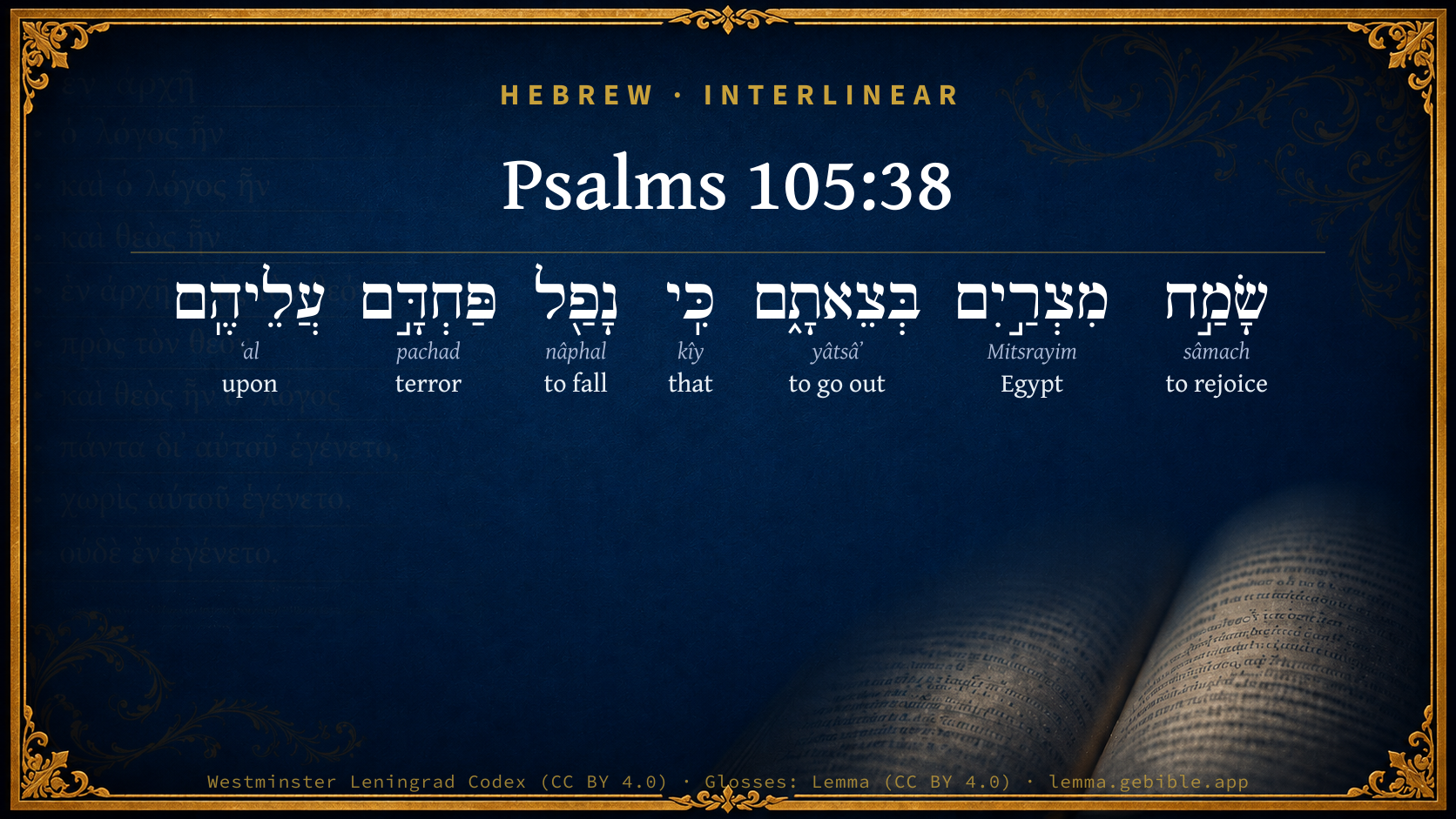
Psalms 105:38

Hebrew (Westminster Leningrad Codex) Psalms 105:38 appears in the Hebrew Old Testament. The text above is from the Westminster Leningrad Codex. Each word links to its Strong’s number, a concise gloss, and parsing drawn from the Open Scriptures Hebrew Bible morphology. Click any word for its full Brown-Driver-Briggs (BDB) entry.
Download image
Cite this verse

Psalms 105:38 (World English Bible). Public Domain. Lemma interlinear Bible study tool, https://lemma.gebible.app/v/psalms/105/38.

Show BibTeX & RIS
BibTeX
RIS
English Translation
Egypt was glad when they departed, For the fear of them had fallen on them.
World English Bible · Public Domain
Download a study sheet

One document with this verse’s original text, its word-by-word gloss line, the meaning frame, cross-references with their text, attributed commentary, and full source and license credits — printable, and it pastes into notes with its structure intact.

This verse Autodidact and up

Study sheet (.html) Plain text (.txt)

A passage Seminary Student

Up to 50 verses in one chapter. A passage sheet keeps up to 6 commentary sources and 12 cross-references per verse, in the order this page ranks them, and says so on the sheet whenever that leaves anything out. Ask for a single verse and you get the Autodidact verse sheet above.

Everything on this page stays free to read, with no account — the sheet is a download of what is already on screen, not access to it.

Want to remove ads? Support Godless Engineer
Compare translations 3

The same verse in 3 English versions, stacked beneath the original-language interlinear above. Click any original word for its lexicon entry.

Each is an independent rendering of the whole verse — the interlinear is not word-aligned to these translations.

Highlighted words mark where these versions differ — a whole-verse word diff, not a word-by-word alignment.

  • World English Bible Public Domain
    Egypt was glad when they departed, For the fear of them had fallen on them.
  • King James Version Public Domain
    Egypt was glad when they departed: for the fear of them fell upon them.
  • unfoldingWord Literal Text CC BY-SA 4.0
    Egypt was glad when they departed, for the dread of them had fallen upon them.

unfoldingWord Literal Text — © unfoldingWord, licensed CC BY-SA 4.0. Word-aligned USFM3 via Door43 (git.door43.org/unfoldingWord/en_ult).

Versions to compare (up to 4)

3 of 4 selected

Show all 18 translations

Every available English version of this verse, each an independent rendering of the whole verse.

  • World English Bible Public Domain
    Egypt was glad when they departed, For the fear of them had fallen on them.
  • Berean Standard Bible Public Domain
    Egypt was glad when they departed, for the dread of Israel had fallen on them.
  • Majority Standard Bible Public Domain
    Egypt was glad when they departed, for the dread of Israel had fallen on them.
  • King James Version Public Domain
    Egypt was glad when they departed: for the fear of them fell upon them.
  • American Standard Version (1901) Public Domain
    Egypt was glad when they departed; For the fear of them had fallen upon them.
  • Revised Version (1885) Public Domain
    Egypt was glad when they departed; for the fear of them had fallen upon them.
  • Geneva Bible (1599) Public Domain
    Egypt was glad at their departing: for the feare of them had fallen vpon them.
  • Douay-Rheims (1899) Public Domain
    Egypt was glad when they departed: for the fear of them lay upon them.
  • Young's Literal Translation Public Domain
    Rejoiced hath Egypt in their going forth, For their fear had fallen upon them.
  • Literal Standard Version CC BY-SA 4.0
    Egypt has rejoiced in their going forth, || For their fear had fallen on them.
  • Unlocked Literal Bible CC BY-SA 4.0
    Egypt was glad when they went away, for the Egyptians were afraid of them.
  • unfoldingWord Literal Text CC BY-SA 4.0
    Egypt was glad when they departed, for the dread of them had fallen upon them.
  • Darby Bible Public Domain
    Egypt rejoiced at their departure; for the fear of them had fallen upon them.
  • World Messianic Bible Public Domain
    Egypt was glad when they departed, for the fear of them had fallen on them.
  • Webster's Bible Public Domain
    Egypt was glad when they departed: for the fear of them fell upon them.
  • Free Bible Version CC BY-SA 4.0
    The Egyptians were delighted to see them go, for they were frightened of the Israelites.
  • Bible in Basic English Public Domain
    Egypt was glad when they went; for the fear of them had come down on them.
  • JPS Tanakh (1917) Public Domain
    Egypt was glad when they departed; for the fear of them had fallen upon them.

Literal Standard Version (2020), Covenant Press — licensed CC BY-SA 4.0. Text via the HelloAO Bible API (eBible.org). Unlocked Literal Bible (unfoldingWord) — licensed CC BY-SA 4.0. Text via the HelloAO Bible API (eBible.org). unfoldingWord Literal Text — © unfoldingWord, licensed CC BY-SA 4.0. Word-aligned USFM3 via Door43 (git.door43.org/unfoldingWord/en_ult). Free Bible Version, Dr. Jonathan Gallagher — licensed CC BY-SA 4.0. Text via the HelloAO Bible API (eBible.org).

Word by word

More ways to search: Search by grammar → Find every occurrence → Compare this word →

Practice this passage: Drill this verse → Learn its vocabulary →

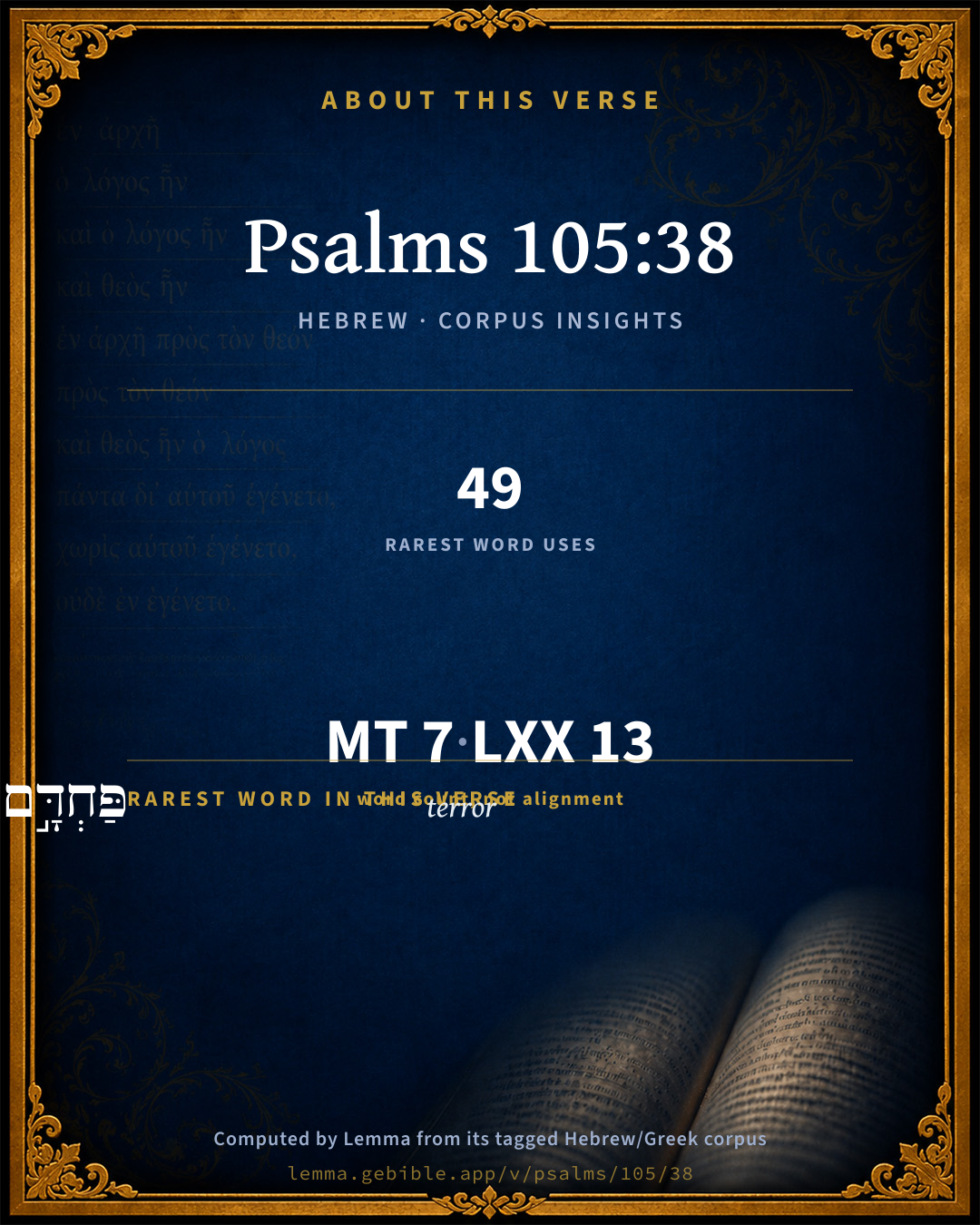
About this verse

These counts appear in no published source. They are computed here, from the morphology-tagged text and Lemma’s own curated glosses. What Lemma adds →

7
words
7
distinct lemmas
Wisdom
section

Shared distinctive vocabulary

פַּחְדָּ֣ם terror H6343 occurs in 48 verses of the Hebrew Bible. Also found in:

Grammatical profile

  • 3 verbs
  • 2 nouns
  • 1 preposition
  • 1 conjunction

Verb forms

  • שָׂמַ֣ח Qal · Perfect
  • בְּצֵאתָ֑ם Qal · Infinitive Construct
  • נָפַ֖ל Qal · Perfect

Hebrew & Septuagint length

In English translation the verse runs 15 words from the Hebrew and 13 from the Septuagint (LXX English) — closely comparable.

A rough comparison of the two English renderings, which tokenize alike — not a word-level alignment.

Word counts can differ between the Hebrew and the Greek without any difference in meaning — e.g. the Hebrew direct-object marker אֵת has no separate Greek word, and Greek often adds the article ὁ.

In the original languages it is 7 Hebrew tokens and 13 Greek tokens — but the two are counted differently (Hebrew bundles its prefixes and suffixes into one token; the Greek is in lemma form), so that isn’t a like-for-like length.

Cross-references

5

Topical passages linked to Psalms 105:38 in the Treasury of Scripture Knowledge — connected by theme and wording, ordered by reader-vote popularity; previews shown in the World English Bible.

  • Exodus 12:33 The Egyptians were urgent with the people, to send them out of the land in haste, for they said, "We are all dead men."
  • Exodus 15:16 Terror and dread falls on them. By the greatness of your arm they are as still as a stone; Until your people pass over, Yahweh, Until the people pass over who you have purchased.
  • Joshua 2:9 and she said to the men, I know that Yahweh has given you the land, and that the fear of you is fallen on us, and that all the inhabitants of the land melt away before you.
  • Genesis 35:5 They traveled: and a terror of God was on the cities that were round about them, and they didn't pursue the sons of Jacob.
  • Exodus 10:7 Pharaoh's servants said to him, "How long will this man be a snare to us? Let the men go, that they may serve Yahweh, their God. Don't you yet know that Egypt is destroyed?"

Cross-references courtesy of OpenBible.info (CC BY 4.0).

Hebrew and Greek witnesses Masoretic Hebrew ↔ Greek Septuagint

The same verse in the two great witnesses to the Old Testament, shown verse-for-verse.

You’re reading Greek Psalm 104 (Hebrew Psalm 105). The Septuagint counts the superscription, so verse numbers can differ from the Hebrew — chapter-level alignment, not verse-by-verse. Numbering follows Rahlfs.

These are two independent witnesses, not word-aligned to each other, and the Septuagint is shown in lemma (dictionary) form.

Hebrew Psalms 105:38 Masoretic · Westminster Leningrad Codex

שָׂמַ֣ח מִצְרַ֣יִם בְּצֵאתָ֑ם כִּֽי נָפַ֖ל פַּחְדָּ֣ם עֲלֵיהֶֽם

Egypt was glad when they departed, For the fear of them had fallen on them.

World English Bible · Public Domain

Greek LXX Greek Psalm 104:38 Septuagint · lemma form

εὐφραίνω αἴγυπτος ἐν ὁ ἔξοδος αὐτός ὅτι ἐπιπίπτω ὁ φόβος αὐτός ἐπί αὐτός

Egypt rejoiced at their departing; for the fear of them fell upon them.

LXX2012 (modern English Septuagint) · Public Domain

Hebrew: Westminster Leningrad Codex (CC BY 4.0). Greek: Septuagint (public domain); English from LXX2012 (modern English Septuagint) (Public Domain). How the Septuagint differs from the Hebrew →

Commentary

Notes on Psalms 105:38 from classic Christian and Jewish commentators (each source and its license shown beneath its notes). The classic Christian expositions comment on the surrounding passage and are grouped to its opening verse, so a note may address several verses; the Jewish commentaries on the Tanakh (Rashi and others) are per-verse, so they appear only where the commentator wrote on this verse.

Lemma curates 59 commentaries, every one of them public domain or Creative Commons licensed, each selected and text-cleaned for this edition rather than reprinted as found. About our sources →

Trapp's Complete Commentary

John Trapp

Psa 105:38 Egypt was glad when they departed: for the fear of them fell upon them.

Ver. 38. Egypt was glad when they departed] For they said, We are all dead men, Exo 12:33. The devil for like cause spake Christ fair to be rid of him, Mar 1:24.

For the fear of them fell upon them] God can make the very name and countenance of his servants fearful to their oppressors.

John Trapp, A Commentary or Exposition upon All the Books of the Old and New Testament (1647–1656) — public domain. Text from a community e-Sword module.

J. A. Alexander on Psalms

Joseph Addison Alexander

38. (Psa 105:38) Glad was Egypt at their going forth, for their fear had fallen upon them. This panic terror, which followed the last plague and facilitated the escape of Israel (Exo 11:1; Exo 12:31-33), accounts for the readiness with which the Egyptians gave whatever was demanded, and completely vindicates the children of Israel from the charge of borrowing what they never meant to pay. The terms used in the history denote the acts, of asking and giving, not those of borrowing and lending. The terms of the last clause are derived from Exo 15:16, Deu 11:25.

Joseph Addison Alexander, The Psalms Translated and Explained (1850) — public domain. Text from a community e-Sword module.

Geneva Bible (1599)

Geneva Bible translators

For God’s plagues caused them rather to depart with the Israelites, than with their lives.

Geneva Bible (1599) marginal notes — public domain. Text via Bolls.life.

John Calvin's Commentaries

38. Egypt rejoiced at their departure The Psalmist sets forth the power of God from the additional circumstance, that the Egyptians willingly allowed the chosen people to depart, when yet nothing was farther from their intention. Although they wished them destroyed a hundred times, yet they thought that they had the wolf by the ears, as we say; and thus the fear of revenge made them more determined to blot out the memory of that people. Whence it follows, that when they all at once laid aside their former purpose, it was a secret work of divine providence. To the same effect is the statement in the preceding verse, that they were brought forth with gold and silver The Egyptians could never have had the heart voluntarily to strip themselves, to enrich those whom they would have willingly deprived of life. This was then the bounty of God, in whose hand, and at whose disposal, are all the riches of the world. He might have taken by force from the Egyptians what he had given them; but he bowed their hearts, so that of their own accord they denuded themselves. The expression, for their terror had fallen upon them, is to be understood passively; for the Israelites were not afraid of the Egyptians, but, on the contrary, were terrible to them. Nor does the prophet speak of an ordinary fear. A little before fear had stirred them up to cruelty and tyranny; but as even to that day, they had endeavored, with indomitable audacity, to shake off all fear, God suddenly laid them prostrate by the extraordinary terror which fell upon them. It is, therefore, here justly reckoned among the displays of the wonderful power of God, that he subdued the impetuous fury with which the Egyptians boiled before, that they might allow those to depart free, whom they had determined to handle rudely, and to waste in servile employments; which was like rendering sheep terrible to wolves.

John Calvin's Commentaries (1540-1563) — public domain. Text from the Calvin Translation Society English edition (1840s-50s) via the Christian Classics Ethereal Library (ccel.org). Calvin's coverage is partial (roughly two-thirds of the Bible); uncommented books and verses are honest gaps, never fabricated. The 19th-century editor's footnotes and remarks are omitted so the notes are faithfully Calvin's own voice.

The Cambridge Bible for Schools and Colleges

gen. ed. J. J. S. Perowne

38. Cp. Exo_12:33.

for the fear &c.] For dread of them had fallen upon them. Cp. Exo_15:16.

The Cambridge Bible for Schools and Colleges (gen. ed. J. J. S. Perowne; Cambridge University Press, 1878–1918) — public domain. Text from a community e-Sword module.

John Gill's Exposition

He spread a cloud for a covering,.... That is, the Lord spread one over their heads as an "umbrella", to protect them from the heat of the sun; this refers to the pillar of cloud, Exo 13:20, though that seems to have been in an erect posture, and to go before the children of Israel to direct them in their journey, and not a covering to them. Kimchi says it was a covering to them when they rested, but not when they journeyed: but when they rested it only covered the tabernacle, not the people, for anything we read of it, Num 9:21, it looks as if there were more clouds than one, and indeed the Jews speak of many, and particularly make mention (e) of one that was over the heads of the Israelites, that the heat of the sun, and the hail and rain, might not have power over them; and of such use this cloud was, at least at certain times, if not always; a type of Christ, who is the covering and shelter of his people from the heat of the fiery law, of the flaming sword of justice, of the wrath of God, of the fiery darts of Satan, and of the fury of wicked men.

And fire, to give light in the night: this respects the pillar of fire which gave them light by night; an emblem of Christ, who is the light of his people, when it is a night season with them, as it sometimes is; a night of affliction and distress, of darkness and desertion, of temptation, of carnal security and sleepiness; when Christ arises as a light in darkness, and enlightens by his presence, by his Spirit, and by his word; as well as is as fire to warm, refresh, quicken, and comfort them when chill and cold, in such seasons.

(e) Vid. Targum in Cant. ii. 6.

John Gill's Exposition of the Whole Bible (1746–1763) — public domain (CC PDM 1.0). Text via the HelloAO Bible API.

Albert Barnes' Notes on the Bible

Egypt was glad when they departed - They had suffered so many plagues; the land was so utterly desolate, there was so much sorrow in their dwellings, from the calamities which had come upon them for refusing to let the Israelites go, that at last they were glad to have them depart, and they were willing to aid them that they might get rid of them. This will, in part, account for the fact that they were willing to give them what they asked - even silver and gold - if they might thus facilitate their departure.

For the fear of them fell upon them - The fear of them, as being under the protection of God; and the fear of the judgments, which must follow if they continued to oppress them.

Albert Barnes' Notes on the Bible (1834–1885) — public domain. Text from a community e-Sword/MySword module.

Matthew Poole's English Annotations

Of them, i.e. of the Israelites, lest God for their sakes should destroy them.

Matthew Poole's English Annotations on the Holy Bible (1683–1685) — public domain. Text from a community e-Sword/MySword module.

The Treasury of David

Charles H. Spurgeon

Ver. 38. Egypt was glad when they departed, which would not have been the case had the gold and silver been borrowed by the Israelites, for men do not carry their goods into a far country. The awe of God like to see borrowers lad to nay them to be was on Egypt, and they feared his people and were glad to pay them to be gone. What a change from the time when the sons of Jacob were the drudges of the land, the offscouring of all things, the brick makers whose toil was only requited by the lash or the stick. Now they were reverenced as prophets and priests;

for the fear of them fell upon them, the people proceeded even to a superstitious terror them. Thus with cheers and good wishes their former taskmasters sent them on their way: Pharaoh was foiled and the chosen people were once more on the move, journeying to the place which the Lord had given to them by a covenant of salt. "O give thanks unto Jehovah; call upon his name, make known his deeds among the people."

Psalms 105:39*

Charles H. Spurgeon's The Treasury of David (1869–1885) — public domain. Psalms only. Text from a community e-Sword/MySword module.

Whedon's Commentary on the Bible

Daniel D. Whedon

38. Egypt was glad—God had prepared Israel, by their bitter bondage, to leave Egypt without regret; and by his judgments on Egypt had made the Egyptians willing, even glad, that they should depart. Exo_12:31-33. The Egyptian account of the affair was, according to Josephus, (Con. App. 1:26, 32,) that the Egyptians expelled them by force of arms on account of their leprosy, their hatred of the Egyptian gods, and their military invasion of the kingdom, and pursued them into Syria. Compare with this, for absurdity, the Pharisees’ story of the resurrection of Jesus, Mat_28:11-15. But, contrariwise, the masses of the people took sympathy with the Israelites. Exo_11:2-3; Exo_12:36. See note on Psa_105:37

Daniel D. Whedon (gen. ed.), Commentary on the Old and New Testaments (1874–1909) — public domain. Text from a community e-Sword module.

The Pulpit Commentary

Egypt was glad when they departed. (see Exo_11:1, 8 12:31, 33) For the fear of them fell upon them. The Egyptians "were urgent upon the people, that they might send them out of the land in haste; for they said, We be all dead men". (Exo_12:33)

The Pulpit Commentary (1880–1919), ed. H.D.M. Spence-Jones & Joseph S. Exell — public domain. Text from a community e-Sword module.

Lesson kit

Teaching starters — assembled from the data on this page, not authored interpretation. Every prompt links to the verse data it draws on. Edit before teaching.

Psalms, in the Wisdom, opens this verse with 7 words (7 distinct Hebrew lemmas). Its most distinctive word is pachad (“terror”). A historical commentator’s framing appears above. Read the whole chapter for the surrounding context.

Discussion questions

  1. What does “terror” (pachad) contribute to the verse as a whole?
  2. How does Genesis 31:42, which shares the word «terror», read alongside this verse?
  3. These translations render this verse differently; the difference is in the English rendering, not the original. What questions does that raise?
  4. «שָׂמַ֣ח» is a Qal Perfect verb. How does that grammatical form shape the action described?
  5. Compare how Trapp's Complete Commentary and J. A. Alexander on Psalms read this verse. Where do they agree or differ?

Things to notice

Reading settings

Reading text

Shown beneath each verse's original-language words.

Old Testament
Old Testament edition

Read the OT as the Masoretic Hebrew (MT) or the Greek Septuagint (LXX).

English shown for the Greek Septuagint (in the Hebrew ↔ Greek comparison).

Comparing translations? Open the Compare panel on any verse page to stack up to four side by side.