
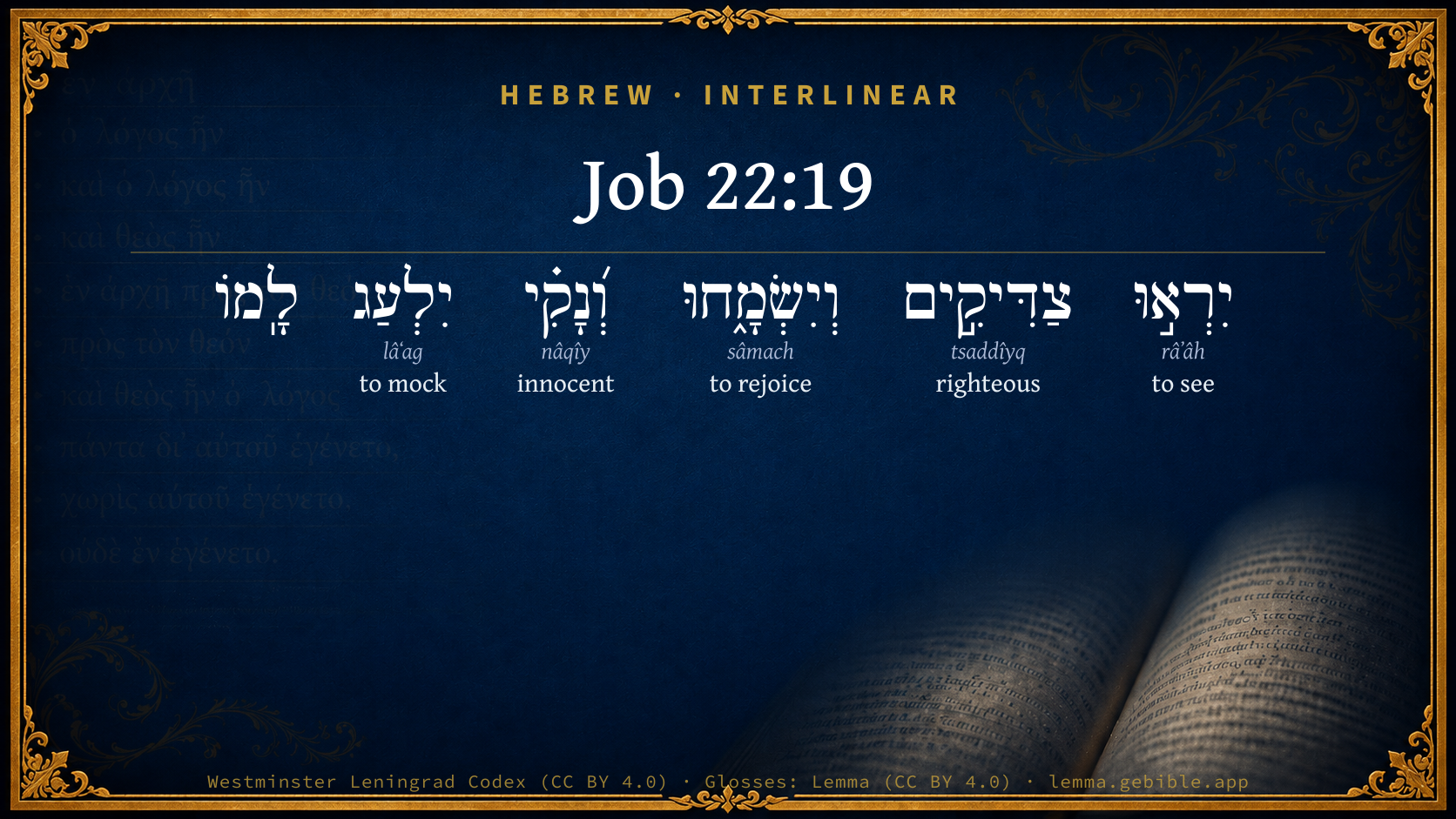
Job 22:19

Hebrew (Westminster Leningrad Codex) Job 22:19 appears in the Hebrew Old Testament. The text above is from the Westminster Leningrad Codex. Each word links to its Strong’s number, a concise gloss, and parsing drawn from the Open Scriptures Hebrew Bible morphology. Click any word for its full Brown-Driver-Briggs (BDB) entry.
Download image
Cite this verse

Job 22:19 (World English Bible). Public Domain. Lemma interlinear Bible study tool, https://lemma.gebible.app/v/job/22/19.

Show BibTeX & RIS
BibTeX
RIS
English Translation
The righteous see it, and are glad; The innocent ridicule them,
World English Bible · Public Domain
Download a study sheet

One document with this verse’s original text, its word-by-word gloss line, the meaning frame, cross-references with their text, attributed commentary, and full source and license credits — printable, and it pastes into notes with its structure intact.

This verse Autodidact and up

Study sheet (.html) Plain text (.txt)

A passage Seminary Student

Up to 50 verses in one chapter. A passage sheet keeps up to 6 commentary sources and 12 cross-references per verse, in the order this page ranks them, and says so on the sheet whenever that leaves anything out. Ask for a single verse and you get the Autodidact verse sheet above.

Everything on this page stays free to read, with no account — the sheet is a download of what is already on screen, not access to it.

Want to remove ads? Support Godless Engineer
Compare translations 3

The same verse in 3 English versions, stacked beneath the original-language interlinear above. Click any original word for its lexicon entry.

Each is an independent rendering of the whole verse — the interlinear is not word-aligned to these translations.

Highlighted words mark where these versions differ — a whole-verse word diff, not a word-by-word alignment.

  • World English Bible Public Domain
    The righteous see it, and are glad; The innocent ridicule them,
  • King James Version Public Domain
    The righteous see it, and are glad: and the innocent laugh them to scorn.
  • unfoldingWord Literal Text CC BY-SA 4.0
    The righteous see and rejoice, and the innocent scorn them.

unfoldingWord Literal Text — © unfoldingWord, licensed CC BY-SA 4.0. Word-aligned USFM3 via Door43 (git.door43.org/unfoldingWord/en_ult).

Versions to compare (up to 4)

3 of 4 selected

Show all 18 translations

Every available English version of this verse, each an independent rendering of the whole verse.

  • World English Bible Public Domain
    The righteous see it, and are glad; The innocent ridicule them,
  • Berean Standard Bible Public Domain
    The righteous see it and are glad; the innocent mock them:
  • Majority Standard Bible Public Domain
    The righteous see it and are glad; the innocent mock them:
  • King James Version Public Domain
    The righteous see it, and are glad: and the innocent laugh them to scorn.
  • American Standard Version (1901) Public Domain
    The righteous see it, and are glad; And the innocent laugh them to scorn,
  • Revised Version (1885) Public Domain
    The righteous see it, and are glad; and the innocent laugh them to scorn:
  • Geneva Bible (1599) Public Domain
    The righteous shall see them, and shall reioyce, and the innocent shall laugh them to scorne.
  • Douay-Rheims (1899) Public Domain
    The just shall see, and shall rejoice, and the innocent shall laugh them to scorn.
  • Young's Literal Translation Public Domain
    See do the righteous and they rejoice, And the innocent mocketh at them,
  • Literal Standard Version CC BY-SA 4.0
    The righteous see and they rejoice, || And the innocent mocks at them:
  • Unlocked Literal Bible CC BY-SA 4.0
    Righteous people see their fate and are glad; innocent people laugh them to scorn.
  • unfoldingWord Literal Text CC BY-SA 4.0
    The righteous see and rejoice, and the innocent scorn them.
  • Darby Bible Public Domain
    The righteous see it, and are glad; and the innocent laugh them to scorn:
  • World Messianic Bible Public Domain
    The righteous see it, and are glad. The innocent ridicule them,
  • Webster's Bible Public Domain
    The righteous see it, and are glad: and the innocent deride them.
  • Free Bible Version CC BY-SA 4.0
    Those who do right rejoice when they see the destruction of the wicked, and the innocent mock them,
  • Bible in Basic English Public Domain
    The upright saw it and were glad: and those who had done no wrong made sport of them,
  • JPS Tanakh (1917) Public Domain
    The righteous saw it, and were glad, and the innocent laugh them to scorn:

Literal Standard Version (2020), Covenant Press — licensed CC BY-SA 4.0. Text via the HelloAO Bible API (eBible.org). Unlocked Literal Bible (unfoldingWord) — licensed CC BY-SA 4.0. Text via the HelloAO Bible API (eBible.org). unfoldingWord Literal Text — © unfoldingWord, licensed CC BY-SA 4.0. Word-aligned USFM3 via Door43 (git.door43.org/unfoldingWord/en_ult). Free Bible Version, Dr. Jonathan Gallagher — licensed CC BY-SA 4.0. Text via the HelloAO Bible API (eBible.org).

Word by word

More ways to search: Search by grammar → Find every occurrence → Compare this word →

Practice this passage: Drill this verse → Learn its vocabulary →

About this verse

These counts appear in no published source. They are computed here, from the morphology-tagged text and Lemma’s own curated glosses. What Lemma adds →

6
words
5
distinct lemmas
Wisdom
section

Notable vocabulary

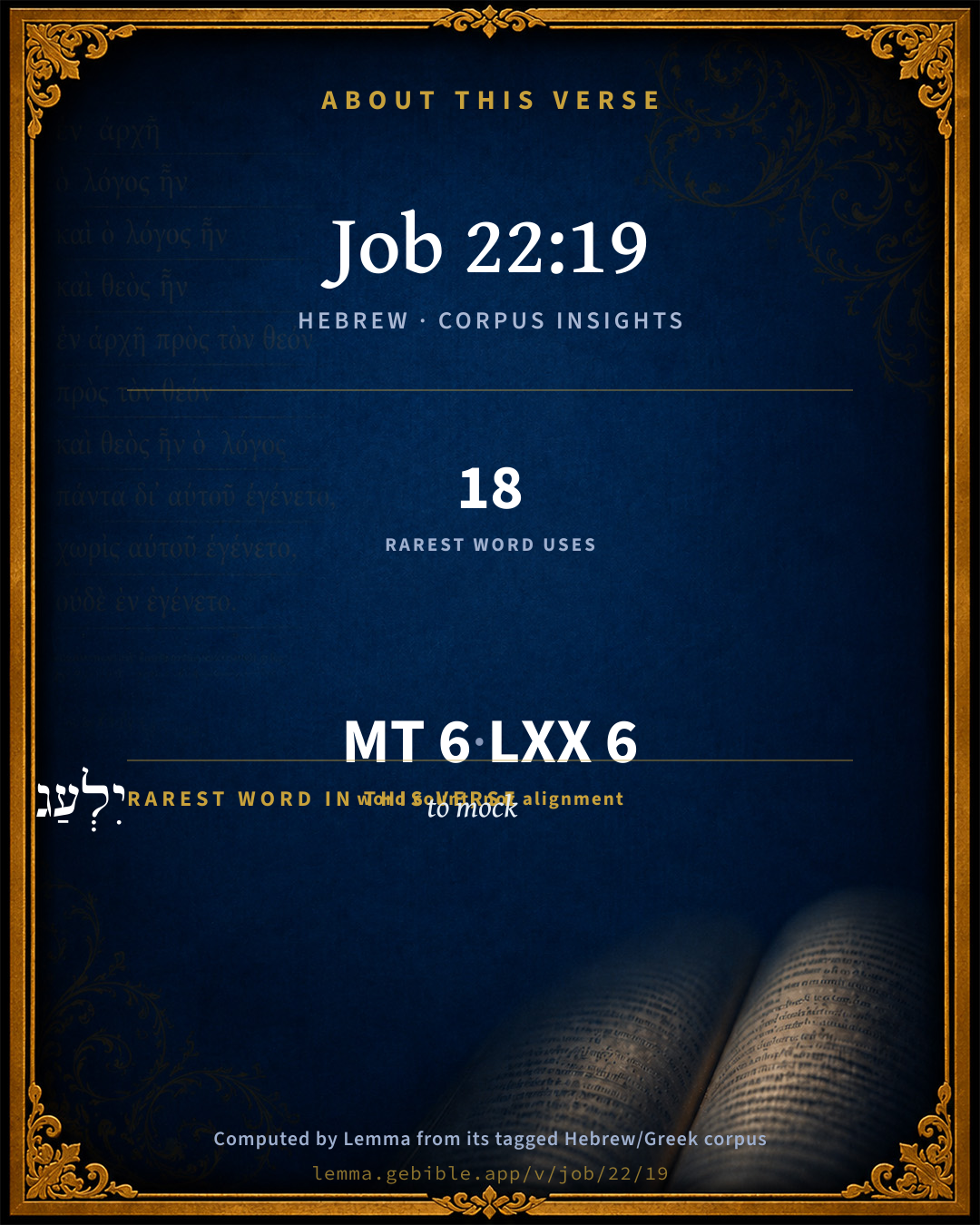
The rarest word here is יִלְעַג to mock H3932 — appearing just 18 times in the whole Hebrew Bible.

Shared distinctive vocabulary

יִלְעַג to mock H3932 occurs in 18 verses of the Hebrew Bible. Also found in:

Grammatical profile

  • 3 verbs
  • 2 adjectives
  • 1 preposition

Verb forms

  • יִרְא֣וּ Qal · Imperfect
  • וְיִשְׂמָ֑חוּ Qal · Imperfect
  • יִלְעַג Qal · Imperfect

Hebrew & Septuagint length

In English translation the verse runs 11 words from the Hebrew and 14 from the Septuagint (LXX English) — closely comparable.

A rough comparison of the two English renderings, which tokenize alike — not a word-level alignment.

Word counts can differ between the Hebrew and the Greek without any difference in meaning — e.g. the Hebrew direct-object marker אֵת has no separate Greek word, and Greek often adds the article ὁ.

In the original languages it is 6 Hebrew tokens and 6 Greek tokens — but the two are counted differently (Hebrew bundles its prefixes and suffixes into one token; the Greek is in lemma form), so that isn’t a like-for-like length.

Cross-references

9

Topical passages linked to Job 22:19 in the Treasury of Scripture Knowledge — connected by theme and wording, ordered by reader-vote popularity; previews shown in the World English Bible.

  • Psalms 58:10 The righteous shall rejoice when he sees the vengeance. He shall wash his feet in the blood of the wicked;
  • Psalms 52:6 The righteous also will see it, and fear, And laugh at him, saying,
  • Psalms 107:42 The upright will see it, and be glad. All the wicked will shut their mouths.
  • Job 9:23 If the scourge kills suddenly, He will mock at the trial of the innocent.
  • Psalms 48:11 Let Mount Zion be glad! Let the daughters of Judah rejoice, Because of your judgments.
  • Psalms 97:8 Zion heard and was glad. The daughters of Judah rejoiced, Because of your judgments, Yahweh.
  • Proverbs 11:10 When it goes well with the righteous, the city rejoices. When the wicked perish, there is shouting.
  • Revelation 18:20 Rejoice over her, O heaven, you saints, apostles, and prophets; for God has judged your judgment on her."
  • Revelation 19:1–3 After these things I heard something like a loud voice of a great multitude in heaven, saying, "Hallelujah! Salvation, power, and glory belong to our God:

Cross-references courtesy of OpenBible.info (CC BY 4.0).

Hebrew and Greek witnesses Masoretic Hebrew ↔ Greek Septuagint

The same verse in the two great witnesses to the Old Testament, shown verse-for-verse.

These are two independent witnesses, not word-aligned to each other, and the Septuagint is shown in lemma (dictionary) form.

Hebrew Job 22:19 Masoretic · Westminster Leningrad Codex

יִרְא֣וּ צַדִּיקִ֣ים וְיִשְׂמָ֑חוּ וְ֝נָקִ֗י יִלְעַג לָֽמוֹ

The righteous see it, and are glad; The innocent ridicule them,

World English Bible · Public Domain

Greek LXX Job 22:19 Septuagint · lemma form

ὁράω δίκαιος γελάω ἄμεμπτος δέ μυκτηρίζω

The righteous have seen it, and laughed, and the blameless one has derided them.

LXX2012 (modern English Septuagint) · Public Domain

On this verse, Haydock's Catholic Bible Commentary discusses the Septuagint’s reading. Read the note in Commentary ↓

Hebrew: Westminster Leningrad Codex (CC BY 4.0). Greek: Septuagint (public domain); English from LXX2012 (modern English Septuagint) (Public Domain). How the Septuagint differs from the Hebrew →

Commentary

Notes on Job 22:19 from classic Christian and Jewish commentators (each source and its license shown beneath its notes). The classic Christian expositions comment on the surrounding passage and are grouped to its opening verse, so a note may address several verses; the Jewish commentaries on the Tanakh (Rashi and others) are per-verse, so they appear only where the commentator wrote on this verse.

Lemma curates 59 commentaries, every one of them public domain or Creative Commons licensed, each selected and text-cleaned for this edition rather than reprinted as found. About our sources →

Trapp's Complete Commentary

John Trapp

Job 22:19 The righteous see [it], and are glad: and the innocent laugh them to scorn.

Ver. 19. The righteous see it, and are glad] And as or myself, the counsel of the wicked is far from me: I do therefore abominate their present prosperity, because they shall shortly be for a laughing stock to all good men; the upright shall see it and be glad, and all iniquity shall stop her mouth, as self condemned, and therefore by the saints (swallowed up with a zeal of God’s glory) rightly derided, Psa 52:9; Psa 58:11.

And the innocent laugh them to scorn] Not out of ill will, or envy, or other corrupt affection; but, 1. For the glory of God, whose power, justice, and goodness is hereby evinced and evidenced. 2. For the good of others, who stumble at the prosperity of the ungodly, or else are eased of their cruelty. 3. Add hereunto, that it is never the worse for the wicked themselves that God taketh them off. For if they be elect, they repent ere they die; as if reprobates, they are kept hereby from adding to their sin and so to their torments, which shall be proportioned thereunto. Those who understand this verse of Noah and his sons, rejoicing when they saw the rest drowned and themselves preserved, render the words thus, The righteous saw it and were glad, and the innocent laughed them to scorn. A late reverend man of God among us, in a discourse of his about the benefit of a good conscience in times of common calamity, brings in Noah and those with him in the ark, insulting over the perishing old world thus (Mr Jeremy Dyke, p. 1 83):

“Now, Jubal, let us hear one of your merry songs; pipe now, and make yourself merry, as you were wont in jibing at Noah’s folly in making a ship to sail on dry land. What ailest thou, Jubal, to howl and wring thine hands thus? Where is thy harp and organs now? Now the flood is come, now Noah is in his cabin, and the water begins to be chin deep, tell me, O Jubal, whether building of tents or building of an ark be the wiser work? Would you not give all the shoes in your shop, all the tools in your tents, all the cattle in your flocks, to be but where Noah’s dog lies? And now, sirs, you that were such men of renown, Gen 6:4, you that were the brave gallants of the earth, now tell me who is the fool and who is the wise man now.”

Piscator takes the next verse, "Whereas" (or, though) "our substance is not cut down, but" (or yet) "the remnant of them the fire consumeth," to be spoken in the person of Noah, whom he makes the innocent man here mentioned; and adds, saying in the beginning of the next verse: as if Noah coining out of the ark should wash his feet in the blood of those wicked; and say, God hath preserved me and mine (our sincerity hath prevailed for our safety), and in his wrath destroyed the ungodly. But I rather concur with Tremellius, and Merlin, and others, who make this verse coherent with, and preparatory to, the following famous exhortation to repentance, Job 22:21-23, &c. Acquaint thyself now with him, and be at peace, &c. But be sure thou do it now, that is, speedily and timously.

John Trapp, A Commentary or Exposition upon All the Books of the Old and New Testament (1647–1656) — public domain. Text from a community e-Sword module.

Joseph Benson's Commentary

Job 22:19. The righteous see it — Whom God often spares in common calamities, and gives them to see the destruction of the wicked; as Noah, Lot, &c. And are glad — Not that they insult over, or rejoice in, the ruin of any men, but because they delight in the vindication of God’s honour, and justice, and holiness, which is connected with the destruction of his enemies, and which is, and ought to be, dearer to them than all the interests of men. And the innocent laugh them to scorn — Justly deride them, for their vain and strong confidences, which are now destroyed; for their profane contempt of God’s wrath and judgments, which they now feel; and for their deep and crafty counsels, which are now frustrated and turned against themselves.

Joseph Benson's Commentary on the Old and New Testaments (1811–1818) — public domain. Text from a community e-Sword module.

Tyndale Open Study Notes

Tyndale Open Resources

22:19-20 The righteous will be happy to see the wicked destroyed: They will be glad to see justice done and injustices avenged (see also Ps 58:10-11; Rev 19:1-4). Eliphaz’s sentiment neglected God’s desire that sinful people repent (see Ezek 33:11).

Tyndale Open Study Notes — © Tyndale Open Resources, licensed CC BY-SA 4.0. Text via the HelloAO Bible API.

Geneva Bible (1599)

Geneva Bible translators

The just rejoice at the destruction of the wicked for two causes: first, because God showeth himself judge of the world and by this means continueth his honor and glory: secondly, because God showeth that he hath care over his in that he punished their enemies.

Geneva Bible (1599) marginal notes — public domain. Text via Bolls.life.

Jamieson, Fausset & Brown

Robert Jamieson, A. R. Fausset & David Brown

Triumph of the pious at the fall of the recent followers of the antediluvian sinners. While in the act of denying that God can do them any good or harm, they are cut off by Him. Eliphaz hereby justifies himself and the friends for their conduct to Job: not derision of the wretched, but joy at the vindication of God's ways (Psa 107:42; Rev 15:3; Rev 16:7; Rev 19:1-2).

Jamieson, Fausset & Brown — Commentary Critical and Explanatory on the Whole Bible (1871) — public domain (CC PDM 1.0). Text via the HelloAO Bible API.

Adam Clarke's Commentary

Verse 19. The righteous see it, and are glad] They see God's judgments on the incorrigibly wicked, and know that the Judge of all the earth does right; hence they rejoice in all the dispensations of his providence.

Adam Clarke's Commentary on the Bible (1810–1826) — public domain. Text from a community e-Sword/MySword module.

Ellicott's Commentary for English Readers

(19) The righteous see it.—That is, the destruction of the wicked, as in the days of Noah.

A Bible Commentary for English Readers, edited by Charles John Ellicott (1878–1897) — public domain. Text from a community e-Sword module.

The Cambridge Bible for Schools and Colleges

gen. ed. J. J. S. Perowne

19. The righteous see it and are glad,

And the innocent laugh them to scorn,

20. Saying, Surely our adversaries are cut off,

And that which they have left the fire hath consumed.

The “remnant” of the wicked, or “that which they leave,” is their substance and possessions.

19, 20. These two verses are connected together,

The Cambridge Bible for Schools and Colleges (gen. ed. J. J. S. Perowne; Cambridge University Press, 1878–1918) — public domain. Text from a community e-Sword module.

John Gill's Exposition

Whereas our substance is not cut down,.... As yours is; Noah and his family were preserved in the ark, and the creatures with him, and sufficient sustenance was laid up for them all, when everything relating to the wicked was destroyed: but this may be thought too restrictive, as well as what follows too subtle, that this should respect the human species not being cut down and utterly destroyed in the flood, but preserved in and restored by Noah and his family; it may perhaps be thought better to interpret these words as the words of Eliphaz and his friends, joining with the righteous and the innocent, putting themselves in their number, and rejoicing with them at the destruction of the wicked, and as having a particular regard to Job's case, and the difference between him and them; his substance being cut down, and he stripped of all; whereas they were not deprived of theirs, but it continued with them, and they in the full possession of it; the reason of which difference was, he was a wicked man, and they righteous and innocent; but by others, who also take them to be the words of the righteous triumphing over the wicked, they are rendered thus; "is not he cut off that rose up against us?" (g) Our enemy and adversary, he is no more, he can do us no more hurt, and we are delivered out of his hand:

but the remnant of them the fire consumes; which Aben Ezra, Ben Gersom, and others, interpret of the destruction of Sodom and Gomorrah, and the other cities, by fire; which would have had some appearance of truth, if the destruction had been of the whole world, and as general as the flood was, or more so, and had cleared the world of the remnant of the ungodly, whereas it was only of a few cities: rather it may be Eliphaz glances at the case of Job, as different from him and his friends, that when their substance was untouched, the remnant of Job's was consumed by fire; what were left by the Chaldeans and Sabeans were destroyed by fire from heaven; though if it could be thought that Eliphaz had knowledge of the general conflagration at the last day, and had that in view, it would afford a better sense; but it may be he does not mean material, but metaphorical fire, the fire of divine wrath, which will consume the wicked, root and branch, and leave them nothing.

(g) "annon exscinditur qui insurgit contra nos", Schmidt, Michaelis.

John Gill's Exposition of the Whole Bible (1746–1763) — public domain (CC PDM 1.0). Text via the HelloAO Bible API.

Albert Barnes' Notes on the Bible

The righteous see it, and are glad - see the destruction of the wicked; compare Rev 15:3; Rev 16:7; Rev 19:1-2. This is designed by Eliphaz, probably, not only to state a fact about the righteous of other times who saw the wicked punished, but, also, to vindicate his own conduct and that of his two friends in regard to Job. If the righteous of other times had rejoiced when the wicked were punished, they inferred that it was not improper for them to manifest similar rejoicings when God had overtaken one who was so signally depraved as they supposed Job to be. Their lack of sympathy for him, therefore, they would defend by a reference to the conduct of the people of other times. There is a sense in which good people rejoice when the wicked are detected and punished. It is not:

(1) that they rejoice that the sin was committed; nor

(2) that they rejoice in misery; nor

(3) that they would not rejoice more if the wicked had been righteous, and had escaped suffering altogether.

But it is the kind of joy which we have when a murderer, a robber, or a pirate is seized - when a counterfeiter is detected - when a man who prowls around the dwelling at night to murder its inmates is brought to punishment. It is joy, not that the sin was committed, but that the laws are executed; and who should not rejoice in that? We have joy in the character of an upright judge when he impartially and faithfully administers the laws; and why should we not rejoice in God when he does the same? We rejoice in the manifestation of truth and justice among people - why should we not in the exhibition of the same things in God? We rejoice in a police that can ferret out every form of iniquity, and bring offenders to justice; and why should we not rejoice in that government which is infinitely more perfect than any police ever was among people?

And the innocent laugh them to scorn - This is another way of saying that they exult or rejoice; compare Pro 1:26-27. No consideration can justify people in deriding and mocking those who are subjected to punishment; and it is by no means certain that the speaker meant to refer to such derision.

Albert Barnes' Notes on the Bible (1834–1885) — public domain. Text from a community e-Sword/MySword module.

Haydock's Catholic Bible Commentary

Shall. Septuagint, "saw." The Jews explain this of Noe, who saw the ruin of the giants with pity, mixed with joy, as he approved of the divine judgments. (Vatable, &c.) --- The just can thus rejoice, only on this account; as they would not be just if they were devoid of charity. (St. Gregory) (Psalm lvii. 11., and cvi. 42.) (Calmet)

George Leo Haydock (1774–1849), Haydock's Catholic Family Bible and Commentary, 1859 edition — public domain. Excludes Psalms (Douay-Rheims chapter numbering differs from Protestant) and Deuterocanonical books (Catholic canon only).

Matthew Poole's English Annotations

The righteous see it; whom God oft spares in common calamities, and makes them to survive and see the destruction of the wicked; as Noah, Lot, &c.

Are glad; not that they insult over or rejoice in the ruin of any men, but because they delight in the vindication of God’s honour, and justice, and holiness, which is conjoined with the destruction of his enemies, and which is and ought to be dearer to them than all the interests of men.

The innocent laugh them to scorn; they justly deride them, for their vain and yet strong confidences, which are now destroyed; and for their profane contempt of God and of his judgments, which now they feel; and for their deep and crafty counsels, which are now frustrated and turned against themselves.

Matthew Poole's English Annotations on the Holy Bible (1683–1685) — public domain. Text from a community e-Sword/MySword module.

Whedon's Commentary on the Bible

Daniel D. Whedon

19. Are glad — They rejoice, not in the sufferings of the wicked, but in the triumph of justice. Aristotle observes that “no good man is troubled when parricides, for instance, meet with their deserved punishment; for it is our duty to rejoice on such occasions.”

Daniel D. Whedon (gen. ed.), Commentary on the Old and New Testaments (1874–1909) — public domain. Text from a community e-Sword module.

The Pulpit Commentary

The righteous see it, and are glad; i.e. "the righteous see both the short-lived prosperity (ver. 18) and the ultimate destruction (ver. 16) of the wicked, and rejoice over them. especially over the latter". (comp. Psa_58:10 Psa_107:40-42 Pro_11:10) And the innocent laugh them to scorn. (comp. Psa_2:6) Scorn and derision are the just portion of the wicked, and in Old Testament times even saints did not scruple to pour them out on those who deserved them. But the gospel spirit is different.

The Pulpit Commentary (1880–1919), ed. H.D.M. Spence-Jones & Joseph S. Exell — public domain. Text from a community e-Sword module.

Keil & Delitzsch

C. F. Keil & F. Delitzsch

19 The righteous see it and rejoice,

And the innocent mock at them:

20 "Verily our opponent is destroyed,

And the fire hath devoured their abundance."

This thought corresponds to that expressed as a wish, hope, or anticipation at the close of many of the Psalms, that the retributive justice of God, though we may have to wait a long time for it, becomes at length the more gloriously manifest to the joy of those hitherto innocently persecuted, Psa 58:11. The obj. of יראוּ, as in Psa 107:42, is this its manifestation. למו is not an ethical dative, as in Psa 80:7, but as in Psa 2:4 refers to the ungodly whose mocking pride comes to such an ignominious end. What follow in Job 22:20 are the words of the godly; the introductory לאמר is wanting, as e.g., Psa 2:3. אם־לא can signify neither si non, as Job 9:24; Job 24:25; Job 31:31, nor annon, as in a disjunctive question, Job 17:2; Job 30:25; it is affirmative, as Job 1:11; Job 2:5; Job 31:36 - an Amen to God's peremptory judgment. On נכחד (he is drawn away, put aside, become annulled), vid., supra, p. 398. קימנוּ (for which Aben-Ezra is also acquainted with the reading קימנוּ with קמץ קטן, i.e., צירי) has a pausal springing from , as Job 20:27, מתקוממה for מתקוממה; Rut 3:2, לרמותנו; Isa 47:10, ראני (together with the reading ראני, comp. Ch1 12:17, לרמותני). The form קים is remarkable; it may be more readily taken as part. pass. (like שׂים, positus) than as nom. infin. (the act of raising for those who raise themselves); perhaps the original text had קמינו (קמינוּ). יתרם is no more to be translated their remnant (Hirz.) here than in Psa 17:14, at least not in the sense of Exo 23:11; that which exceeds the necessity is intended, their surplus, their riches. It is said of Job in b. Megilla, 28a: איוב ותרן בממוניה הוה, he was extravagant (prodigus) with his property. The fire devouring the wealth of the godless is an allusion to the misfortune which has befallen him.

After this terrible picture, Eliphaz turns to the exhortation of him who may be now perhaps become ripe for repentance.

Keil & Delitzsch — Biblical Commentary on the Old Testament (1861–1891) — public domain (CC PDM 1.0). Text via the HelloAO Bible API. (Old Testament only.)

Lesson kit

Teaching starters — assembled from the data on this page, not authored interpretation. Every prompt links to the verse data it draws on. Edit before teaching.

Job, in the Wisdom, opens this verse with 6 words (5 distinct Hebrew lemmas). Its most distinctive word is lâʻag (“to mock”). A historical commentator’s framing appears above. Read the whole chapter for the surrounding context.

Discussion questions

  1. The word lâʻag carries the sense “to mock.” How does it shape the verse?
  2. How does 2 Kings 19:21, which shares the word «to mock», read alongside this verse?
  3. These translations render this verse differently; the difference is in the English rendering, not the original. What questions does that raise?
  4. «יִרְא֣וּ» is a Qal Imperfect verb. How does that grammatical form shape the action described?
  5. Compare how Trapp's Complete Commentary and Joseph Benson's Commentary read this verse. Where do they agree or differ?

Things to notice

Reading settings

Reading text

Shown beneath each verse's original-language words.

Old Testament
Old Testament edition

Read the OT as the Masoretic Hebrew (MT) or the Greek Septuagint (LXX).

English shown for the Greek Septuagint (in the Hebrew ↔ Greek comparison).

Comparing translations? Open the Compare panel on any verse page to stack up to four side by side.