
1 Samuel 11:15

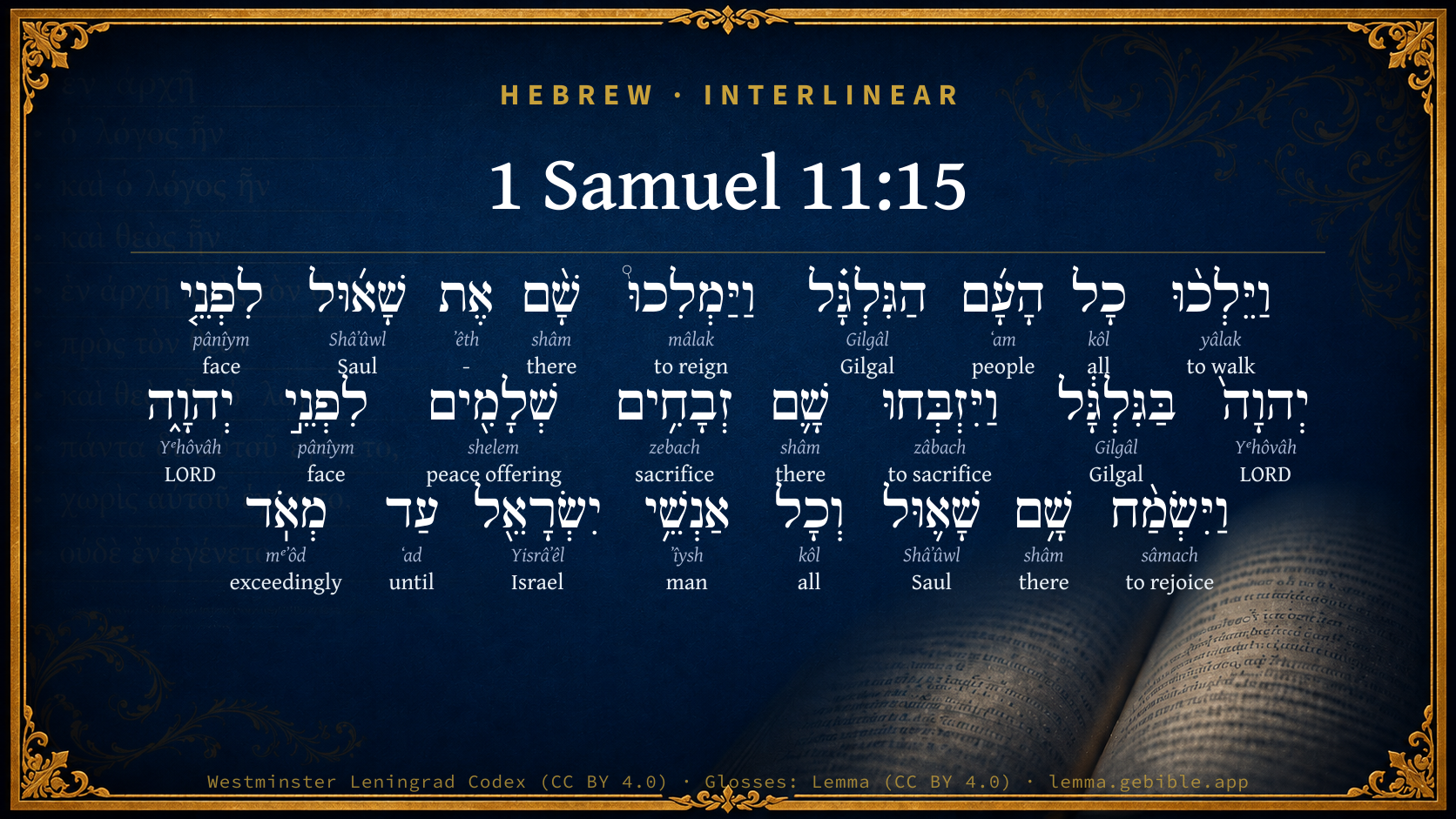
Hebrew (Westminster Leningrad Codex) 1 Samuel 11:15 appears in the Hebrew Old Testament. The text above is from the Westminster Leningrad Codex. Each word links to its Strong’s number, a concise gloss, and parsing drawn from the Open Scriptures Hebrew Bible morphology. Click any word for its full Brown-Driver-Briggs (BDB) entry.
Download image
Cite this verse

1 Samuel 11:15 (World English Bible). Public Domain. Lemma interlinear Bible study tool, https://lemma.gebible.app/v/1-samuel/11/15.

Show BibTeX & RIS
BibTeX
RIS
English Translation
All the people went to Gilgal; and there they made Saul king before Yahweh in Gilgal; and there they offered sacrifices of peace-offerings before Yahweh; and there Saul and all the men of Israel rejoiced greatly.
World English Bible · Public Domain
Download a study sheet

One document with this verse’s original text, its word-by-word gloss line, the meaning frame, cross-references with their text, attributed commentary, and full source and license credits — printable, and it pastes into notes with its structure intact.

This verse Autodidact and up

Study sheet (.html) Plain text (.txt)

A passage Seminary Student

Up to 50 verses in one chapter. A passage sheet keeps up to 6 commentary sources and 12 cross-references per verse, in the order this page ranks them, and says so on the sheet whenever that leaves anything out. Ask for a single verse and you get the Autodidact verse sheet above.

Everything on this page stays free to read, with no account — the sheet is a download of what is already on screen, not access to it.

Want to remove ads? Support Godless Engineer
Compare translations 3

The same verse in 3 English versions, stacked beneath the original-language interlinear above. Click any original word for its lexicon entry.

Each is an independent rendering of the whole verse — the interlinear is not word-aligned to these translations.

Highlighted words mark where these versions differ — a whole-verse word diff, not a word-by-word alignment.

  • World English Bible Public Domain
    All the people went to Gilgal; and there they made Saul king before Yahweh in Gilgal; and there they offered sacrifices of peace-offerings before Yahweh; and there Saul and all the men of Israel rejoiced greatly.
  • King James Version Public Domain
    And all the people went to Gilgal; and there they made Saul king before the LORD in Gilgal; and there they sacrificed sacrifices of peace offerings before the LORD; and there Saul and all the men of Israel rejoiced greatly.
  • unfoldingWord Literal Text CC BY-SA 4.0
    And all of the people went Gilgal, and there they caused Saul to reign to the face of Yahweh at Gilgal. And there they sacrificed sacrifices, peace offerings, to the face of Yahweh. And Saul and all of the men of Israel rejoiced there unto abundance.

unfoldingWord Literal Text — © unfoldingWord, licensed CC BY-SA 4.0. Word-aligned USFM3 via Door43 (git.door43.org/unfoldingWord/en_ult).

Versions to compare (up to 4)

3 of 4 selected

Show all 18 translations

Every available English version of this verse, each an independent rendering of the whole verse.

  • World English Bible Public Domain
    All the people went to Gilgal; and there they made Saul king before Yahweh in Gilgal; and there they offered sacrifices of peace-offerings before Yahweh; and there Saul and all the men of Israel rejoiced greatly.
  • Berean Standard Bible Public Domain
    So all the people went to Gilgal and confirmed Saul as king in the presence of the LORD. There they sacrificed peace offerings before the LORD, and Saul and all the Israelites rejoiced greatly.
  • Majority Standard Bible Public Domain
    So all the people went to Gilgal and confirmed Saul as king in the presence of the LORD. There they sacrificed peace offerings before the LORD, and Saul and all the Israelites rejoiced greatly.
  • King James Version Public Domain
    And all the people went to Gilgal; and there they made Saul king before the LORD in Gilgal; and there they sacrificed sacrifices of peace offerings before the LORD; and there Saul and all the men of Israel rejoiced greatly.
  • American Standard Version (1901) Public Domain
    And all the people went to Gilgal; and there they made Saul king before Jehovah in Gilgal; and there they offered sacrifices of peace-offerings before Jehovah; and there Saul and all the men of Israel rejoiced greatly.
  • Revised Version (1885) Public Domain
    And all the people went to Gilgal; and there they made Saul king before the LORD in Gilgal; and there they sacrificed sacrifices of peace offerings before the LORD; and there Saul and all the men of Israel rejoiced greatly.
  • Geneva Bible (1599) Public Domain
    So all the people went to Gilgal, and made Saul King there before the Lord in Gilgal: and there they offered peace offerings before the Lord: and there Saul and all the men of Israel reioyced exceedingly.
  • Douay-Rheims (1899) Public Domain
    And all the people went to Galgal, and there they made Saul king before the Lord in Galgal, and they sacrificed there victims of peace before the Lord. And there Saul and all the men of Israel rejoiced exceedingly
  • Young's Literal Translation Public Domain
    and all the people go to Gilgal, and cause Saul to reign there before Jehovah in Gilgal, and sacrifice there sacrifices of peace-offerings before Jehovah, and there Saul rejoiceth -- and all the men of Israel -- very greatly.
  • Literal Standard Version CC BY-SA 4.0
    and all the people go to Gilgal, and cause Saul to reign there before YHWH in Gilgal, and sacrifice sacrifices of peace-offerings there before YHWH, and Saul rejoices there—and all the men of Israel—very greatly.
  • Unlocked Literal Bible CC BY-SA 4.0
    So all the people went to Gilgal and made Saul king before Yahweh in Gilgal. There they sacrificed peace offerings before Yahweh, and Saul and all the men of Israel rejoiced greatly.
  • unfoldingWord Literal Text CC BY-SA 4.0
    And all of the people went Gilgal, and there they caused Saul to reign to the face of Yahweh at Gilgal. And there they sacrificed sacrifices, peace offerings, to the face of Yahweh. And Saul and all of the men of Israel rejoiced there unto abundance.
  • Darby Bible Public Domain
    And all the people went to Gilgal; and there they made Saul king before Jehovah in Gilgal; and there they sacrificed peace-offerings before Jehovah. And there Saul and all the men of Israel rejoiced exceedingly.
  • World Messianic Bible Public Domain
    All the people went to Gilgal; and there they made Saul king before the LORD in Gilgal. There they offered sacrifices of peace offerings before the LORD; and there Saul and all the men of Israel rejoiced greatly.
  • Webster's Bible Public Domain
    And all the people went to Gilgal; and there they made Saul king before the LORD in Gilgal: and there they sacrificed sacrifices of peace-offerings before the LORD; and there Saul and all the men of Israel rejoiced greatly.
  • Free Bible Version CC BY-SA 4.0
    Everyone went to Gilgal and confirmed Saul as king before the Lord. They sacrificed friendship offerings to the Lord, and Saul together with all the Israelites had a great celebration.
  • Bible in Basic English Public Domain
    So all the people went to Gilgal; and there in Gilgal they made Saul king before the Lord; and peace-offerings were offered before the Lord; and there Saul and all the men of Israel were glad with great joy.
  • JPS Tanakh (1917) Public Domain
    And all the people went to Gilgal; and there they made Saul king before the LORD in Gilgal; and there they sacrificed sacrifices of peace-offerings before the LORD; and there Saul and all the men of Israel rejoiced greatly.

Literal Standard Version (2020), Covenant Press — licensed CC BY-SA 4.0. Text via the HelloAO Bible API (eBible.org). Unlocked Literal Bible (unfoldingWord) — licensed CC BY-SA 4.0. Text via the HelloAO Bible API (eBible.org). unfoldingWord Literal Text — © unfoldingWord, licensed CC BY-SA 4.0. Word-aligned USFM3 via Door43 (git.door43.org/unfoldingWord/en_ult). Free Bible Version, Dr. Jonathan Gallagher — licensed CC BY-SA 4.0. Text via the HelloAO Bible API (eBible.org).

Word by word

More ways to search: Search by grammar → Find every occurrence → Compare this word →

Practice this passage: Drill this verse → Learn its vocabulary →

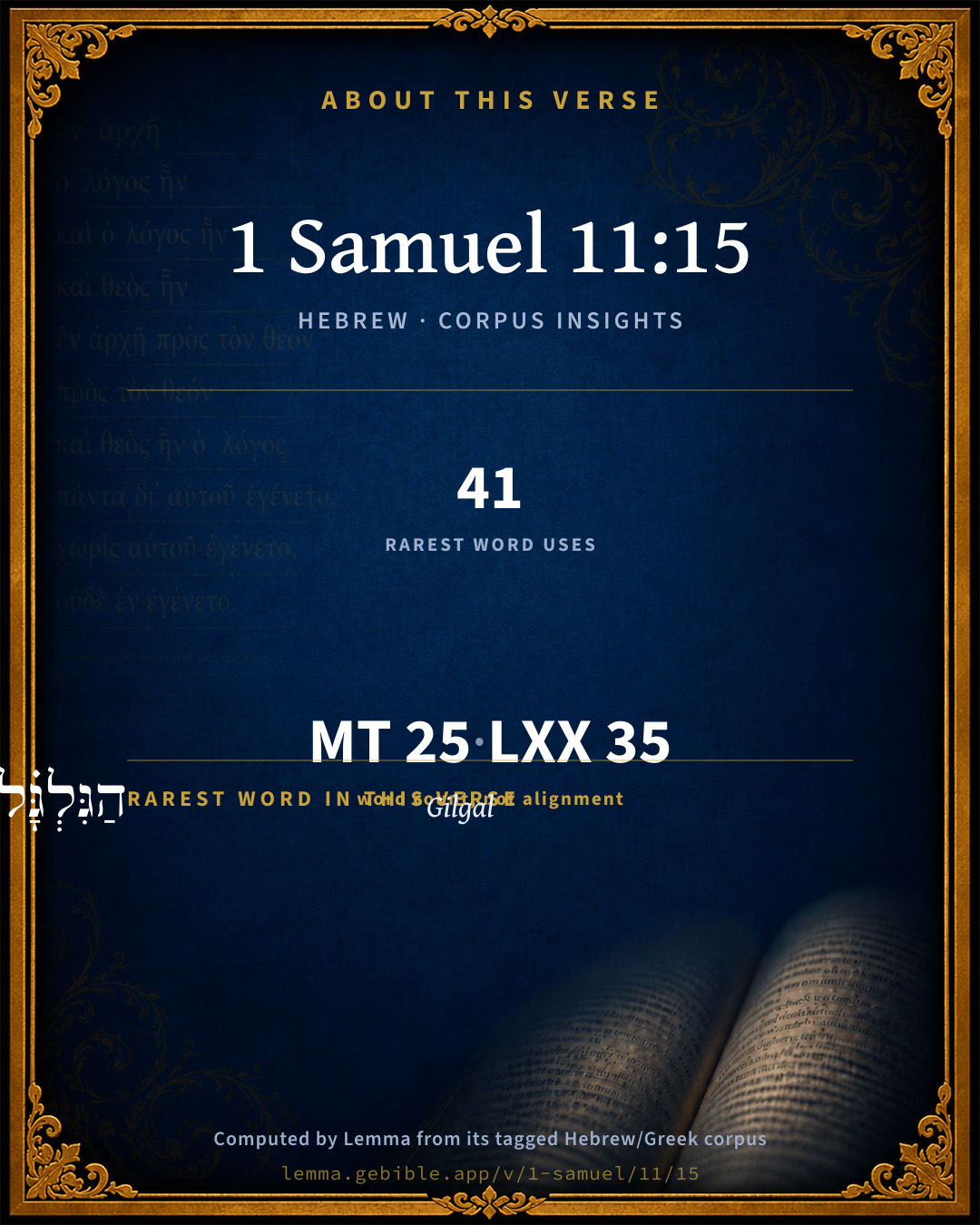
הַגִּלְגָּ֗ל
Gilgâl
H1537
“the · Gilgal”
Particle, Definite Article + Noun, Proper
Part of Speech
Particle + Noun
Type
Proper
Full BDB Definition

Origin: the same as H1536

TWOT: None

Gilgal = "a wheel, rolling" - the first site of an Israelite camp west of the Jordan, east of Jericho, here Samuel was judge, and Saul was made king; later used for illicit worship - dwelling place of prophets in northern Israel about four miles - a region conquered by Joshua, site unsure
  1. וַיֵּלְכ֨וּ yâlak H3212 “and · to walk” Conjunction + Verb, Qal, Sequential Imperfect, 3rd Person, Masculine, Plural
  2. כָל kôl H3605 “all of” Noun, Common, Masculine, Singular, Construct
  3. הָעָ֜ם ʻam H5971 “the · people” Particle, Definite Article + Noun, Common, Masculine, Singular, Absolute
  4. וַיַּמְלִכוּ֩ mâlak H4427 “and · to reign” Conjunction + Verb, Hiphil, Sequential Imperfect, 3rd Person, Masculine, Plural
  5. שָׁ֨ם shâm H8033 “there” Adverb
  6. אֶת ʼêth H853 “-” Particle, Direct Object
  7. שָׁא֜וּל Shâʼûwl H7586 “Saul” Noun, Proper
  8. לִפְנֵ֤י pânîym H6440 “to/for · face(s) of” Preposition + Noun, Common, Both, Plural, Construct
  9. יְהוָה֙ Yᵉhôvâh H3068 “LORD” Noun, Proper
  10. בַּגִּלְגָּ֔ל Gilgâl H1537 “in/at the · Gilgal” Preposition, Determined + Noun, Proper
  11. וַיִּזְבְּחוּ zâbach H2076 “and · to sacrifice” Conjunction + Verb, Qal, Sequential Imperfect, 3rd Person, Masculine, Plural
  12. שָׁ֛ם shâm H8033 “there” Adverb
  13. זְבָחִ֥ים zebach H2077 “sacrifices” Noun, Common, Masculine, Plural, Absolute
  14. שְׁלָמִ֖ים shelem H8002 “peace offerings” Noun, Common, Masculine, Plural, Absolute
  15. לִפְנֵ֣י pânîym H6440 “to/for · face(s) of” Preposition + Noun, Common, Both, Plural, Construct
  16. יְהוָ֑ה Yᵉhôvâh H3068 “LORD” Noun, Proper
  17. וַיִּשְׂמַ֨ח sâmach H8055 “and · to rejoice” Conjunction + Verb, Qal, Sequential Imperfect, 3rd Person, Masculine, Singular
  18. שָׁ֥ם shâm H8033 “there” Adverb
  19. שָׁא֛וּל Shâʼûwl H7586 “Saul” Noun, Proper
  20. וְכָל kôl H3605 “and · all of” Conjunction + Noun, Common, Masculine, Singular, Construct
  21. אַנְשֵׁ֥י ʼîysh H376 “men of” Noun, Common, Masculine, Plural, Construct
  22. יִשְׂרָאֵ֖ל Yisrâʼêl H3478 “Israel” Noun, Proper
  23. עַד ʻad H5704 “until” Preposition
  24. מְאֹֽד mᵉʼôd H3966 “exceedingly” Adverb

About this verse

These counts appear in no published source. They are computed here, from the morphology-tagged text and Lemma’s own curated glosses. What Lemma adds →

25
words
18
distinct lemmas
Historical
section

Shared distinctive vocabulary

הַגִּלְגָּ֗ל Gilgal H1537 occurs in 39 verses of the Hebrew Bible. Also found in:

Grammatical profile

  • 4 verbs
  • 15 nouns
  • 1 preposition
  • 4 adverbs
  • 1 particle

Verb forms

  • וַיֵּלְכ֨וּ Qal · Sequential Imperfect
  • וַיַּמְלִכוּ֩ Hiphil · Sequential Imperfect
  • וַיִּזְבְּחוּ Qal · Sequential Imperfect
  • וַיִּשְׂמַ֨ח Qal · Sequential Imperfect

Repetition

Words recur within this verse — often emphatic in Hebrew:

  • שָׁ֨ם there H8033 ×3
  • כָל all H3605 ×2
  • הַגִּלְגָּ֗ל Gilgal H1537 ×2
  • שָׁא֜וּל Saul H7586 ×2
  • לִפְנֵ֤י face H6440 ×2
  • יְהוָה֙ LORD H3068 ×2

Hebrew & Septuagint length

In English translation the verse runs 36 words from the Hebrew and 37 from the Septuagint (LXX English) — closely comparable.

A rough comparison of the two English renderings, which tokenize alike — not a word-level alignment.

Word counts can differ between the Hebrew and the Greek without any difference in meaning — e.g. the Hebrew direct-object marker אֵת has no separate Greek word, and Greek often adds the article ὁ.

In the original languages it is 25 Hebrew tokens and 35 Greek tokens — but the two are counted differently (Hebrew bundles its prefixes and suffixes into one token; the Greek is in lemma form), so that isn’t a like-for-like length.

Cross-references

9

Topical passages linked to 1 Samuel 11:15 in the Treasury of Scripture Knowledge — connected by theme and wording, ordered by reader-vote popularity; previews shown in the World English Bible.

  • 1 Samuel 10:8 You shall go down before me to Gilgal; and, behold, I will come down to you, to offer burnt offerings, and to sacrifice sacrifices of peace-offerings: seven days shall you wait, until I come to you, and show you what you shall do.
  • 1 Samuel 10:17 Samuel called the people together to Yahweh to Mizpah;
  • 1 Chronicles 29:21–24 They sacrificed sacrifices to Yahweh, and offered burnt offerings to Yahweh, on the next day after that day, even one thousand bulls, one thousand rams, and one thousand lambs, with their drink-offerings, and sacrifices in abundance for all Israel,
  • Exodus 24:5 He sent young men of the children of Israel, who offered burnt offerings and sacrificed peace-offerings of oxen to Yahweh.
  • 1 Samuel 8:19 But the people refused to listen to the voice of Samuel; and they said, No: but we will have a king over us,
  • 1 Samuel 12:13–15 Now therefore see the king whom you have chosen, and whom you have asked for: and, behold, Yahweh has set a king over you.
  • 1 Samuel 12:17 Isn't it wheat harvest today? I will call to Yahweh, that he may send thunder and rain; and you shall know and see that your wickedness is great, which you have done in the sight of Yahweh, in asking you a king.
  • Hosea 13:10–11 Where is your king now, that he may save you in all your cities? And your judges, of whom you said, 'Give me a king and princes?'
  • James 4:16 But now you glory in your boasting. All such boasting is evil.

Cross-references courtesy of OpenBible.info (CC BY 4.0).

Hebrew and Greek witnesses Masoretic Hebrew ↔ Greek Septuagint

The same verse in the two great witnesses to the Old Testament, shown verse-for-verse.

These are two independent witnesses, not word-aligned to each other, and the Septuagint is shown in lemma (dictionary) form.

Hebrew 1 Samuel 11:15 Masoretic · Westminster Leningrad Codex

וַיֵּלְכ֨וּ כָל הָעָ֜ם הַגִּלְגָּ֗ל וַיַּמְלִכוּ֩ שָׁ֨ם אֶת שָׁא֜וּל לִפְנֵ֤י יְהוָה֙ בַּגִּלְגָּ֔ל וַיִּזְבְּחוּ שָׁ֛ם זְבָחִ֥ים שְׁלָמִ֖ים לִפְנֵ֣י יְהוָ֑ה וַיִּשְׂמַ֨ח שָׁ֥ם שָׁא֛וּל וְכָל אַנְשֵׁ֥י יִשְׂרָאֵ֖ל עַד מְאֹֽד

All the people went to Gilgal; and there they made Saul king before Yahweh in Gilgal; and there they offered sacrifices of peace-offerings before Yahweh; and there Saul and all the men of Israel rejoiced greatly.

World English Bible · Public Domain

Greek LXX 1 Samuel 11:15 Septuagint · lemma form

καί πορεύομαι πᾶς ὁ λαός εἰς γάλγαλα καί χρίω σαμουηλ ἐκεῖ ὁ σαούλ εἰς βασιλεύς ἐνώπιον κύριος ἐν γάλγαλα καί θύω ἐκεῖ θυσία καί εἰρηνικός ἐνώπιον κύριος καί εὐφραίνω σαμουηλ καί πᾶς ἰσραήλ ὥστε λίαν

And all the people went to Galgala, and Samuel anointed Saul there to be king before the Lord in Galgala, and there he offered meat-offerings and peace-offerings before the Lord: and Samuel and all Israel rejoiced exceedingly.

LXX2012 (modern English Septuagint) · Public Domain

On this verse, Ellicott's Commentary for English Readers discusses the Septuagint’s reading. Read the note in Commentary ↓

Hebrew: Westminster Leningrad Codex (CC BY 4.0). Greek: Septuagint (public domain); English from LXX2012 (modern English Septuagint) (Public Domain). How the Septuagint differs from the Hebrew →

Targum (Aramaic paraphrase)

1

The Targum is the ancient Jewish Aramaic paraphrase of the Hebrew Scriptures — an interpretive translation, not the Hebrew text itself. Onkelos (literal) and Pseudo-Jonathan (expansive) render the Torah, and Jonathan the Prophets. Coverage is partial: where no permissively-licensed English translation exists for a verse, only the Aramaic is shown. This is verse-level text, not a word-by-word alignment to the Hebrew.

  1. Targum Jonathan Prophets (Joshua–Malachi)
    וַאֲזַלוּ כָּל עַמָא לְגִלְגָלָא וְאַמְלִיכוּ תַמָן יַת שָׁאוּל קֳדָם יְיָ בְּגִלְגָלָא וּנְכִיסוּ תַמָן נִכְסַת קוּדְשִׁין קֳדָם יְיָ וַחֲדֵי תַמָן שָׁאוּל וְכָל אֱנָשֵׁי יִשְׂרָאֵל עַד לַחֲדָא:

    (no public-domain English translation for this verse)

    Targum Jonathan — Aramaic: “Mikraot Gedolot” (public domain). English: “Sefaria Community Translation” (CC0 1.0 (public-domain dedication)); “London "Chaldee Paraphrase," 1871” (public domain). Text via Sefaria.

Commentary

Notes on 1 Samuel 11:15 from classic Christian and Jewish commentators (each source and its license shown beneath its notes). The classic Christian expositions comment on the surrounding passage and are grouped to its opening verse, so a note may address several verses; the Jewish commentaries on the Tanakh (Rashi and others) are per-verse, so they appear only where the commentator wrote on this verse.

Lemma curates 59 commentaries, every one of them public domain or Creative Commons licensed, each selected and text-cleaned for this edition rather than reprinted as found. About our sources →

Trapp's Complete Commentary

John Trapp

1Sa 11:15 And all the people went to Gilgal; and there they made Saul king before the LORD in Gilgal; and there they sacrificed sacrifices of peace offerings before the LORD; and there Saul and all the men of Israel rejoiced greatly.

Ver. 15. And there they made Saul king.] Serrarius saith these were the ceremonies used at such a time: (1.) They set the king in his throne; (2.) They crowned him; (3.) They anoined him; (4.) They put the book of the law into his hand: They took an oath of him to observe it; (6.) They offered sacrifices of all sorts; (7.) They showed various signs and testimonies of public joy.

John Trapp, A Commentary or Exposition upon All the Books of the Old and New Testament (1647–1656) — public domain. Text from a community e-Sword module.

Joseph Benson's Commentary

1Sa 11:15. There they made Saul king — Owned and accepted him for their king. Saul had been anointed in Ramah, and chosen by lot in Mizpeh; but still some disdained to acknowledge him for their king, which made him content himself for a time with a private life. But now, after this signal token of God’s presence with him, in the late victory, he was, by common consent, received by all the people for their king. Before the Lord — Not before the ark, the symbol of God’s presence, as the expression sometimes means; for the ark was now at Kirjath-jearim, and not at Gilgal; but in a solemn manner, as in God’s presence, appealing to him as a witness of their sincerity in this transaction, and with solemn sacrifices and prayers for his blessing upon it.

Joseph Benson's Commentary on the Old and New Testaments (1811–1818) — public domain. Text from a community e-Sword module.

Tyndale Open Study Notes

Tyndale Open Resources

11:15 The solemn ceremony before the Lord acknowledged Saul’s sovereignty as king while affirming that the Lord was Israel’s true King. • Peace offerings were common on historic occasions that inaugurated important institutions (see Exod 24:5; Lev 9:4, 18, 22; 1 Kgs 8:63-64).

Tyndale Open Study Notes — © Tyndale Open Resources, licensed CC BY-SA 4.0. Text via the HelloAO Bible API.

Geneva Bible (1599)

Geneva Bible translators

In sign of thanksgiving for the victory.

Geneva Bible (1599) marginal notes — public domain. Text via Bolls.life.

Adam Clarke's Commentary

Verse 15. There they made Saul king] It is likely, from these words, that Saul was anointed a second time; he was now publicly acknowledged, and there was no gainsayer. Thus far Saul acted well, and the kingdom seemed to be confirmed in his hand; but soon through imprudence he lost it.

ON the custom referred to in 1Sa 11:7 I am favoured with the following observations by a learned correspondent: -

"It is considered that the authenticity of records respecting a peculiar people cannot be better illustrated, or the fidelity of the historian more clearly ascertained, than by proving that the manners and customs recorded are in unison with, or bear a resemblance to, the manners and customs of other nations of the same antiquity; or, what may be more correct, in a similar state of improvement; and the records of such rites and customs may possibly acquire an additional mark of authenticity, when the similarity is not so exact as to admit a presumption that the customs of one nation were merely copied from the other.

"Sir Walter Scott, in the third canto of the Lady of the Lake, describes the rites, incantations, and imprecations, used prior to the fiery cross being circulated, to summon the rough warriors of ancient times to the service of their chief; and in the first note of this canto he alludes to this ancient custom which, in comparatively modern times, has been used in Scotland, and proves that a similar punishment of death or destruction of the houses for disobeying the summons was inflicted by the ancient Scandinavians, as recorded by Olaus Magnus, in his history of the Goths. A custom still more in point than the one cited may be found to have existed in a more ancient nation, whose history is supposed the most, if not the only authentic narrative of deeds of ancient times, and which also records the sanguinary manners of uncultivated nations; see the preceding chapter, first eight verses. 1Sa 10:1-8 The similarity of the custom is to be found in the seventh verse; with the Highlanders a goat was slain; with the Israelites, an ox. The exhibition of a cross stained with the blood of the sacrificed animal was the summons of the former, while part of the animal was the mandate of the latter. Disobedience in the one nation was punished with the death of the parties, and burning of their dwellings; in the other, the punishment was more simple, and more allusive to the sacrificed emblem, the forfeiture or destruction of their oxen. It is not difficult to judge whether the comparison be correct.

"The first verses record the sanguinary practices of ancient times, which to many appear merely as the gratification of revenge, or as proofs of victory; yet when it is considered that the right eye must chiefly aid the warrior in aiming at his adversary, whether the weapon be of ancient or modern warfare, here arises a military reason, corroborative of the truth of history, for the deprivation, and in some degree lessening the cruelty of the mutilation, which would be increased if it were caused by revenge or wantonness; though Nahash declares it to be a reproach upon all Israel."

Adam Clarke's Commentary on the Bible (1810–1826) — public domain. Text from a community e-Sword/MySword module.

Ellicott's Commentary for English Readers

(15) And there they made Saul king before the Lord in Gilgal.—We must not understand with the LXX. Version that Saul was anointed afresh at Gilgal. The Greek Version reads, “and Samuel anointed Saul king there.” The Gilgal convention was nothing more than a solemn national confirmation of the popular election at Mizpeh. The words “before the Lord,” imply the presence of the Ark, or of the high priest with the mystic Urim and Thummim. Bishop Wordsworth understands the words “they made Saul king” to signify that after this “the people would not allow him any longer to lead a private life, but they made him to assume the royal state and authority to which he had been appointed by God.”

A Bible Commentary for English Readers, edited by Charles John Ellicott (1878–1897) — public domain. Text from a community e-Sword module.

The Cambridge Bible for Schools and Colleges

gen. ed. J. J. S. Perowne

15. there they made Saul king] The choice of Saul as king, privately made by God through Samuel, and publicly confirmed by the election at Mizpah, had received an unmistakable ratification in his victory over Nahash. His detractors were silenced, and the unanimous consent of the people accepted him. The assembly now held after the general levy for the war was probably larger and more representative of the whole nation than the previous one at Mizpah.

The Sept. has, “and Samuel anointed Saul there to be king,” which may possibly be the original reading. A public anointing would be natural, for that recorded in ch. 1Sa_10:1 was strictly private, and the use of the title “the Lord’s anointed” in ch. 1Sa_12:3 gains point if the ceremony had just been performed. That it might be repeated we know from the case of David, who was thrice anointed.

sacrifices of peace-offerings] Thank-offerings to Jehovah for the deliverance he had wrought, and for the establishment of the kingdom.

The Cambridge Bible for Schools and Colleges (gen. ed. J. J. S. Perowne; Cambridge University Press, 1878–1918) — public domain. Text from a community e-Sword module.

Albert Barnes' Notes on the Bible

Made Saul king - The Septuagint has another reading, “and Samuel anointed Saul king there.” The example of David, who, besides his original anointing by Samuel 1Sa 16:12-13, was twice anointed, first as king of Judah 2Sa 2:4, and again as king over all Israel 2Sa 5:3, makes it probable that Saul was anointed a second time; but this may be included in the word “made king” (see 1Sa 12:3, 1Sa 12:5).

Albert Barnes' Notes on the Bible (1834–1885) — public domain. Text from a community e-Sword/MySword module.

Haydock's Catholic Bible Commentary

They made. Septuagint, "and there (again the prophet; Josephus) Samuel anointed Saul king." The same ceremonies as had been used before, except the casting of lots, were here repeated, particularly the solemn anointing, (Salien) whence, in the following chapter, (ver. 3) Saul is styled the anointed. (Menochius) --- The Lord. His ark was probably present, and the priests to offer victims. (Salien, the year of the world 2963)

George Leo Haydock (1774–1849), Haydock's Catholic Family Bible and Commentary, 1859 edition — public domain. Excludes Psalms (Douay-Rheims chapter numbering differs from Protestant) and Deuterocanonical books (Catholic canon only).

Matthew Poole's English Annotations

They made Saul king, i.e. they recognized him, or owned and accepted him for their king by consent; for, to speak properly, Saul was not made or constituted king by the people, but by the Lord’s immediate act: see 1Sa 8:9; 10:1.

Before the Lord; who was there present in a special manner; both because the people of the Lord were there assembled, and because there was an altar, as the following sacrifices show. The same phrase is used 1Sa 10:17; 14:18.

They sacrificed sacrifices of peace-offerings; partly to praise God for so glorious a victory, and for the firm settlement of the distracted kingdom; and partly to implore the presence and assistance of God to the king and kingdom, in all their affairs and exigencies.

Matthew Poole's English Annotations on the Holy Bible (1683–1685) — public domain. Text from a community e-Sword/MySword module.

Whedon's Commentary on the Bible

Daniel D. Whedon

15. There they made Saul king before the Lord — Whether Samuel anointed him again on this occasion we are not told, but it is certain that by some formal ceremony he was set apart and recognised as king. Samuel’s speaking of him as Jehovah’s anointed (1Sa_12:3) makes it probable that the public anointing was done at this time. One prominent ceremony of the occasion was the sacrifices of peace offerings. In these the worshipper himself received the greater part of the animal slain, and with it held a feast of thanksgiving; an appropriate service for that proud occasion, when all the men of Israel rejoiced greatly.

Daniel D. Whedon (gen. ed.), Commentary on the Old and New Testaments (1874–1909) — public domain. Text from a community e-Sword module.

The Pulpit Commentary

They made Saul king. This is not to be interpreted, with the Septuagint, of a second anointing of Saul, but of his confirmation in the kingdom by the unanimous voice of the nation, whereas the first election of him at Mizpah had met with opposition. Before Jehovah. Ie. with religious ceremonies conducted by Samuel and the high priest. The difference between Saul"s election at Mizpah and the confirmation of it at Gilgal is much the same as between the first proclamation or" a king and his coronation. The latter is the nation"s acknowledgment of his sovereignty, and the solemn consecration of him to his high office. Peace offerings were tokens of joy and gratitude, and were followed by a feast. At this there was great rejoicing, because the king whom they had desired had so quickly proved himself worthy to be their head.

The Pulpit Commentary (1880–1919), ed. H.D.M. Spence-Jones & Joseph S. Exell — public domain. Text from a community e-Sword module.

John Wesley's Explanatory Notes

Made - They owned and accepted him for their king.

John Wesley, Explanatory Notes Upon the Whole Bible (1754–1765) — public domain. Text via the GEBible commentary corpus.

Lesson kit

Teaching starters — assembled from the data on this page, not authored interpretation. Every prompt links to the verse data it draws on. Edit before teaching.

1 Samuel, in the Historical, opens this verse with 25 words (18 distinct Hebrew lemmas). Its most distinctive word is Gilgâl (“Gilgal”). A historical commentator’s framing appears above. Read the whole chapter for the surrounding context.

Discussion questions

  1. How does “Gilgal” (Gilgâl) shape what this verse is saying?
  2. Deuteronomy 11:30 shares the word «Gilgal» with this verse. How do the two illuminate each other?
  3. “there” occurs 3× in this one verse. What is the effect of the repetition?
  4. The translations on this page render this verse differently — a whole-verse word diff, not a word-by-word alignment. What might account for the different wordings?
  5. The verb «וַיֵּלְכ֨וּ» is Qal Sequential Imperfect. How does its form color the action?
  6. Reading how Trapp's Complete Commentary and Joseph Benson's Commentary read this verse, where do the two commentators agree and where do they part?

Things to notice

Reading settings

Reading text

Shown beneath each verse's original-language words.

Old Testament
Old Testament edition

Read the OT as the Masoretic Hebrew (MT) or the Greek Septuagint (LXX).

English shown for the Greek Septuagint (in the Hebrew ↔ Greek comparison).

Comparing translations? Open the Compare panel on any verse page to stack up to four side by side.